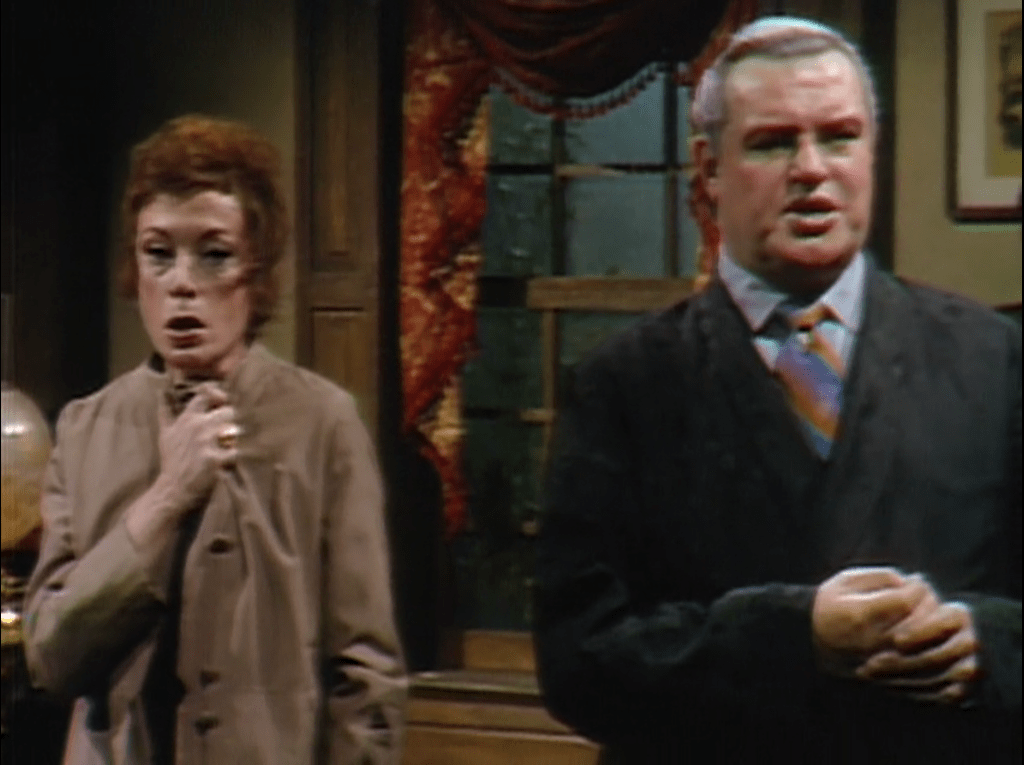
Episode 738: The rest of the truth

This episode ends with one of the most thrilling moments in all of Dark Shadows.

The show’s first supernatural menace was undead blonde fire witch Laura Murdoch Collins, who was on it from December 1966 to March 1967. Its second was vampire Barnabas Collins, who first appeared in April 1967. Laura herself was presented with many tropes that conventionally mark vampires; for example, they laid great emphasis on the fact that Laura was never seen eating or drinking. And Laura’s story was structured very much like Bram Stoker’s Dracula, with well-meaning governess Vicki taking Mina’s role as the driving force behind the opposition to her. Presumably, if Barnabas had been staked and destroyed as the original plan envisioned, Vicki would have led the fight against him as well, and in #275 driven the stake into his heart. But Barnabas brought the show a new audience, and so Vicki was never called on to go to battle with him. Her character withered and was written out, and he replaced her as its chief protagonist.

In early 1967, Vicki learned that Laura had appeared at least twice before, and had died in strikingly similar ways each time. In 1767, Laura Murdoch Stockbridge was burned to death with her young son David; in 1867, Laura Murdoch Radcliffe was burned to death with her young son David; and in 1967, Vicki found Laura Murdoch Collins beckoning her young son David to join her in the flames consuming a wooden building. At the last second, Vicki broke through David’s trance and he ran to her, escaping the flames.

In November 1967, the show established that Barnabas lived on the great estate of Collinwood as a human in 1795, and that he became a vampire as a result of the tragic events of that year. If Barnabas were the same age in 1795 that Jonathan Frid was in 1967, he would have been born late in 1752, meaning that he would have been a teenager when Laura Murdoch Stockbridge and little David Stockbridge went up in smoke. The Stockbridges were a very wealthy family, so they would likely have been on familiar terms with Barnabas and the other rich Collinses of Collinsport, and the deaths of Laura and David would have been one of the major events in the area in those days. So longtime viewers have been wondering ever since whether Barnabas knew Laura, and if so what he knew about her.

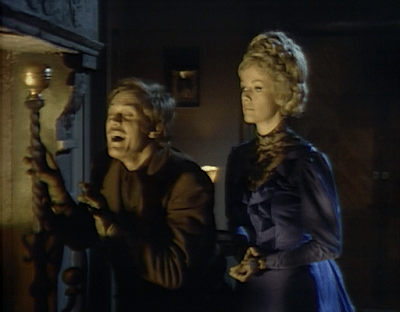
Now Barnabas has traveled back in time to the year 1897, and there he meets another incarnation of Laura. He is thunderstruck at the sight of her. In her bland, enigmatic way, she expresses curiosity about his reaction, and he collects himself sufficiently to make some flattering remarks about her beauty. As soon as he is alone with his blood thrall, Miss Charity Trask, he declares that Laura has been dead for over a hundred years. So has he, but apparently when a woman rises from the dead to prey on the living that’s different, somehow. We saw this same old double standard a couple of weeks ago, when libertine Quentin Collins expressed shock at Laura’s return from the dead, when he himself had died and been a zombie just the week before.

If Laura did know Barnabas when she was as she is now and he was an adolescent, it is no wonder she does not seem to recognize him. She knows that there is a Barnabas Collins on the estate, and has heard that he is a descendant of the eighteenth century bearer of the same name. She would expect him to resemble the boy she knew, but would not necessarily know what that boy looked like when he was in his forties.

This is the first time we’ve seen Charity since Barnabas bit her in #727. She lives in the town of Rockport, which in the 1960s was far enough away from Collinwood that in #521 it was worthy of note that you could dial telephone numbers there directly. In 1897, when automobiles were rare and roads weren’t made for the few that did exist, a long-distance relationship between vampire and blood thrall would seem quite impractical. Still, in #732 we saw a character make two round trips between Rockport and Collinwood in a single evening, so I suppose it could be managed.

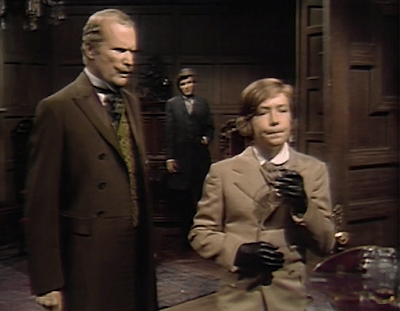
Barnabas’ recognition of Laura is a fitting conclusion to a fine episode. Much of it is devoted to a three-cornered confrontation between Laura, her twelve year old son Jamison Collins, and her brother-in-law/ ex-lover/ mortal enemy, Quentin. Danny Horn analyzes this in his post about the episode at Dark Shadows Every Day. I recommend that post highly. All I would add is that as it plays out today, the confrontation makes me suspect that the writers of the show may have done more planning than Danny usually credits them with. Jamison is the only person Quentin loves, and so far we have seen that Jamison loves Quentin back. When he learns that Quentin is his mother’s foe, Jamison turns against Quentin. Barnabas traveled back in time after Quentin’s ghost had made life impossible for everyone in 1969. The evil of Quentin’s spirit fell heaviest on David Collins, whom Quentin had possessed, turned into another version of Jamison, and was in the process of killing. Nothing yet has explained why Quentin’s ghost would focus its malignity on the image of Jamison. Actress Diana Millay used to claim that Laura was added to the 1897 segment at the last minute because she told Dan Curtis she wanted to work, but Millay famously enjoyed testing the credulity of Dark Shadows fans with outlandish remarks. I wonder if a falling-out between Quentin and Jamison over Laura was in the flimsies all along.

Charity makes her first entrance in the great house of Collinwood. Quentin is apologizing to her for some boorish behavior when he realizes she hasn’t been listening to him at all. She is completely absorbed in the eighteenth century portrait of Barnabas that hangs in the foyer. She excuses herself and wafts out the front door.

In Barnabas’ house, Charity says that he makes her feel beautiful, and that she wants to see herself in a mirror. Barnabas is a bit sheepish about the particulars of vampirism, and so he changes the subject. We cut from this exchange to Laura’s room in the great house, where she is with a servant named Dirk whom she has enthralled to serve as a source of body heat. That scene opens with a shot in a mirror, making the point that Laura’s relationship with Dirk is a reflection of Barnabas’ relationship with Charity. Earlier, there had been a clumsy attempt at an artsy shot of Laura reflected in Quentin’s sherry glass. That does show us that Laura casts a reflection and that her relationship with Quentin has been affected by his drinking, but it calls too much attention to itself to do much more than that.

The portrait in the foyer is hugely important to Barnabas. It made its debut on the show in #204, the day before his name was first mentioned and more than a week before he himself premiered. His thralls stare at it and receive his commands through it. He himself uses it as a passport, appealing to his resemblance to it as proof that he is a descendant of its subject and therefore a member of the Collins family. Today, Barnabas is surprised when Charity comes to his house; he wasn’t transmitting a message through the portrait summoning her. Instead, it was functioning as another mirror, in which Charity, who has become a part of Barnabas, could see the motivating force within her own personality.

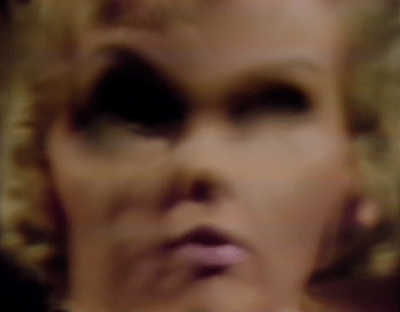
Dirk is played by Roger Davis, a most unappealing actor. At one point he makes this face while Dirk is involved in some kind of mumbo-jumbo:

Screenshot by Dark Shadows Before I Die.

At one point today, Quentin tells Jamison that he shouldn’t be afraid of telling the servants what to do, since after all he will someday be the master of Collinwood. Jamison takes this altogether too much to heart, and spends the rest of the episode ordering everyone around. David Henesy is a good enough actor to extract the comic value from this. For example, when he turns to Quentin, says “I’ll talk to you later!,” and keeps walking, we laughed out loud.

Episode 722: Too good-looking to die from old age

Another drab-looking outing from director Henry Kaplan, enlivened with some witty writing by Violet Welles and sprightly acting by John Karlen and David Henesy.

Daft prankster Carl Collins (Karlen) goes to the suite in the west wing of the great house of Collinwood recently occupied by his brother, the late Quentin Collins. Carl finds his nephew, twelve year-old Jamison Collins (Henesy) sitting by Quentin’s gramophone, listening to a sickly sweet waltz of which Quentin was fond. Carl mutters and rambles, claiming at one moment that Quentin is not really dead and at the next that he has a theory about who really killed him. Jamison just stares in response. Carl, agitated, demands that Jamison turn off the gramophone. When he does not answer, Carl declares that he is Jamison’s uncle. Jamison calmly replies that Carl is not his uncle, but his brother.

Carl comes back with his sister Judith. They question Jamison, who seems to know things only Quentin would know. Judith declares that “The child is possessed!” and flounces out of the room.

Jamison’s governess, Rachel Drummond, has a dream in which Jamison and Judith make her uncomfortable. She tries to go to the drawing room, only to find Carl blocking her way. He is wearing a railroad conductor’s hat and holding Jamison’s toy locomotive. He tells her it is too late to pass this point, and shows her a gigantic pocket watch to prove the point. She wakes up to find Quentin’s body sitting in a rocking chair next to her bed.

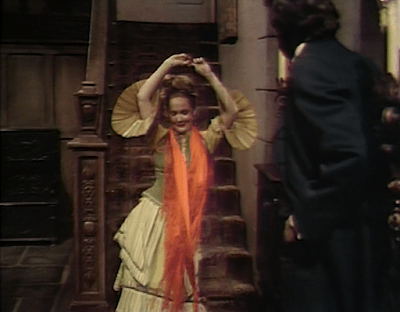
April first, a very important date! Screenshot by Dark Shadows Before I Die.

Episode 711: Our beautiful black-hearted child of the angels

In the groundskeeper’s cottage on the estate of Collinwood, Satanists Evan Hanley and Quentin Collins call on the powers of Hell to send a demon to help them fight Quentin’s recently arrived and deeply mysterious distant cousin Barnabas. The call is answered by none other than our old friend Angelique the wicked witch.

Quentin and Evan have no idea who Angelique is, and she does not know them either. Evan introduces himself to her as a lawyer; he seems genuinely surprised that this does not impress her. Evan tells Angelique that he and Quentin summoned her from Hell and can send her back; she agrees that they summoned her, but is not so sure they can send her back. Quentin tells her that the year is 1897, that she is on an estate known as Collinwood, and that he and Evan have an enemy called Barnabas Collins. Angelique is intrigued by the year, familiar with the estate, and thrilled to hear about Barnabas. Evan starts making demands; Angelique causes him to choke and gasp. She is quite friendly to Quentin, and when Quentin suggests she let Evan breathe and speak again, she indulges him.

Angelique puts Evan in his place.

Evan is played by Humbert Allen Astredo, who in 1968 played suave warlock Nicholas Blair. He plays Evan with exactly the same bearing, tone of voice, and range of facial expressions he had brought to the role of Nicholas. Viewers who remember Nicholas have been bewildered by this. Barnabas knew Nicholas and fought him; when he met Evan the other day, his reaction left open the possibility that he recognized him as the same person. But Evan’s dabbling in the occult, as we saw it yesterday, shows only an infinitesimal fraction of Nicholas’ vast abilities in that field, and his buffoonish response when Angelique appears shows that he is no relation.

It is when Angelique strikes Evan dumb that we learn why Astredo played him in the same way he played Nicholas. Nicholas was introduced as Angelique’s boss, the master of magical powers much greater than hers. Since the main difficulty with fitting Angelique into a story was that she could easily accomplish any goal if she just kept her focus, adding a character who is even more powerful took the show to an absolute dead end. They had to box Nicholas up inside a lot of pointless business, and he quickly became a source of frustration to the audience. Seeing Astredo as another Nicholas reminds us of that frustration, and when Angelique brushes him aside with a flick of her finger our unease evaporates. We are assured that the plot will keep moving this time, and that Astredo will be free to show us what he can do as an actor.

At the end of Friday’s episode, it was Quentin who tried to stop the ceremony when Angelique’s visage began to take shape in the fire, fearing they had gone too far. Today Quentin realizes there is no turning back, but Evan keeps saying he wants to return Angelique whence she came. It’s hard to see what he expected- he was calling on the Devil to send a demon. I suppose he really is disappointed that Angelique is not excited to find herself in the company of a member of the bar.

Quentin goes home to the great house on the estate. He sneaks up behind governess Rachel Drummond while she is dozing on the sofa in the drawing room and puts his hand on her face. That wakes her. When she protests, he asks if he did it unpleasantly. She answers, “No… I mean, yes!… I don’t know.” That summarizes precisely the natural reaction to Quentin. His behavior is abominable in the extreme, but David Selby’s charisma and easy charm come through even in the character’s darkest moments, and the audience can no more want him to stay off-screen than the female characters can want him to leave them alone.

Quentin and Rachel sit together; his hands are on her face again when Barnabas shows up. Quentin gets up and twits Barnabas with his obvious closeness to Rachel, then excuses himself to go to bed.

Barnabas gives Rachel a music box that once belonged to the gracious Josette. This will induce further flashbacks in longtime viewers. Barnabas is a vampire, and as a living man in the 1790s he was in love with Josette. In May and June of 1967, Barnabas lived in contemporary times. He abducted Maggie Evans, who like Rachel in the portion of the show and like Josette in the portion set in the 1790s, is played by Kathryn Leigh Scott. He tried to erase Maggie’s personality, overwrite it with a copy of Josette’s, and to turn her into his vampire bride. The music box played a crucial part in this remake of the 1932 film The Mummy.

When Barnabas urges Rachel to listen to the music box, we pan to the window and see Angelique peeking in. As Angelique’s great power is the main difficulty with fitting her into a plot, so her single-mindedness is the main difficulty with making an audience enjoy watching her. This shot of her does as much to enlist the sympathies of longtime viewers as does the moment when she shuts Evan up. The whole time Barnabas and Rachel are involved with the music box, we are groaning. It was during the imprisonment of Maggie that Dark Shadows first became a hit, and it is a story that the show has been strongly identified with ever since. But we do not need to see it again. Angelique once married Barnabas and is maniacally possessive of him, and she does not want to see it either.

Angelique is as dismayed as we are, though for a different reason.

In the 1790s segment, which ran from November 1967 to March 1968, we saw that Angelique was motivated at least as much by her hatred of Josette as by her desire for Barnabas. After she has seen Barnabas getting up to his old tricks with Josette-lookalike Rachel, Angelique visits the portrait of Josette which hangs above the mantel in the parlor of the Old House on the estate. Longtime viewers know that Josette’s ghost inhabits the portrait. In #70, the portrait glowed, her ghost (also played by Miss Scott) emerged from it, then went outside and danced among the pillars. In #102, strange and troubled boy David Collins stood in front of the portrait and had a lively conversation with it. We could hear only his side, but it was clear the portrait was answering him. Today Angelique stands where David stood then. She scowls at the portrait and declares “I am Angelique, and I hate you!” She then goes back to the cottage where Evan and Quentin conjured her up and chokes a cloth doll, causing Rachel to collapse. She mouths words, and Rachel speaks them. Hearing Rachel talk about Josette’s death, Barnabas cries out in anguish.

This was the first episode credited to writer Violet Welles, who worked as a Broadway publicist before and after working on Dark Shadows. Ms Welles had been an uncredited collaborator with Gordon Russell on a great many of his projects, including several episodes of Dark Shadows prior to this one. She was by far the best writer of dialogue on the show. It is no wonder that the “Memorable Quotes” section of the Dark Shadows wiki entry for this episode includes whole scenes; the lines glitter with wit. Now that she is with Dark Shadows as a senior writer under her own name, the show enters its most successful period, both artistically and commercially.

Episode 660: Suppose I am from another century

A couple of weeks ago well-meaning governess Victoria Winters vanished into a rift in the fabric of space and time, traveling back to the 1790s to be with her husband, a loudmouthed idiot known variously as Peter and Jeff. Now evidence is accumulating that when Vicki and Peter/ Jeff were reunited, they were immediately put to death for their many crimes. Old world gentleman Barnabas Collins is determined to follow Vicki into the past and thwart the course of justice.

Barnabas and his best friend, mad scientist Julia Hoffman, call on occult expert Timothy Eliot Stokes. Barnabas pleads with Stokes to work the same mumbo-jumbo for him that enabled Peter/ Jeff to go back to the 1790s. Stokes says that the procedure would have no effect on Barnabas. He explains that it transported Peter/ Jeff only because Peter/ Jeff properly belonged to that period. It would do nothing to a person who was already living in his own time. Barnabas then asks “Suppose I am from another century?” Stokes replies “Then it’s one of the best-kept secrets in Collinsport, isn’t it?” while Julia coughs and looks panic-stricken.

Julia and Stokes react to Barnabas’ invitation to suppose that he is from another century.

In fact, Barnabas is a native of the eighteenth century. He finds himself in the 1960s because he was, for 172 years, a vampire. This is indeed one of the best-kept secrets in town. If any part of it leaks out he and Julia will be spending the 1970s and 1980s in prison, so it is no wonder she tries to shut him down before he can make any indiscreet revelations to Stokes. But it is an exciting moment for longtime viewers. As it stands, Julia is the only character who knows Barnabas’ secret, and therefore the only one who can speak freely with him or interpret new information in the light of what the audience already knows. Stokes is a highly dynamic character; if he joins the inner circle, there is no telling how fast the action might move or in what direction. It is a bit of a letdown that Barnabas decides not to come out to him.

Stokes makes a little speech that puzzles many viewers. He says that he has reached the conclusion that Peter/ Jeff really was two people. The spirit of an eighteenth century man named Peter Bradford must have come to the year 1968 and taken possession of the body of a living man named Jeff Clark. Now that Peter has returned to the past, Jeff must have regained control of his physical being and is out there in the world someplace. This theory does not fit with anything we have seen over the last several months, and it won’t lead to any further story development.

Peter/ Jeff himself suggested the same idea a few weeks ago, but he had so little information about himself that we could discount it. Stokes, though, is one of the mouthpieces through which the show tells us what we are supposed to believe.

Many science fiction and fantasy fans like to take the world-building elements of their favorite franchises as seriously as they possibly can, and treat every apparent contradiction or dead end as a riddle to be solved. That kind of analysis doesn’t get you very far with Dark Shadows, a narrative universe whose structure star Joan Bennett summarized by saying “We ramble around.” It is tempting to go to the opposite extreme, and to assume that they didn’t do any advance planning at all. But we know from an interview that writer Violet Welles gave to the fanzine The World of Dark Shadows in 1991 that they did the same planning exercises that other daytime soaps did. They would make up six month story forecasts called “flimsies” and fill those out with more detailed plans covering periods of 13 weeks. Welles explains the resulting difficulty:

The difficult ones were — we were in 13-week segments, and there were sometimes characters that didn’t work, and because they didn’t work, they didn’t use them as much, they weren’t part of the plot. So at the end of the 13 weeks, toward the end of the cycle, you’d have characters who were really not a lot of interest who had to play scenes with other characters who really didn’t have a lot of interest, dealing with things that basically didn’t concern them. Those were hard to write. But you never felt particularly overwhelmed.

Violet Welles interviewed by Megan Powell-Nivling, The World of Dark Shadows, issue #59/60, June 1991. Preserved by Danny Horn on Dark Shadows Every Day, 30 August 2015.

In other words, while the writers definitely did long-range planning, those long-range plans come into the audience’s view not a source of secret message to decode, but in the residue left over from stories that didn’t work out. During his months on the show, Peter/ Jeff spent a lot of time getting violently angry when people called him “Peter,” responding in his grating whine “My na-a-ame is JEFF! CLARK!” That disagreeable habit made up about 90 percent of Peter/ Jeff’s personality, and the other 10 percent was no picnic either. Coupled with this Goes Nowhere/ Does Nothing story about Peter appropriating the body of Jeff Clark, I would guess that in some early stage of planning they kicked around the possibility of having two Peter/ Jeffs. But it has long since become clear that one Peter/ Jeff is already one too many. That leaves them to fill out some scenes that would otherwise run short with material that may have seemed like a good idea when they made up the flimsies six months ago, but that is pointless now.

Also in this episode, children Amy Jennings and David Collins visit Eagle Hill cemetery and have questions. Amy suggests they go see the caretaker, a suggestion David derides. He declares that the caretaker is as old as the tombstones, and that he won’t answer any of their questions. Amy insists, and they go looking for him.

The caretaker appeared on the show four times when David’s mother, undead fire witch Laura Murdoch Collins, was the chief supernatural menace. He then made five more appearances early in Barnabas’ time as a vampire. As played by veteran stage actor Daniel F. Keyes, he was a delight, a boundlessly befuddled old chap who seemed to have strayed in from the pages of EC Comics. Sadly, David and Amy don’t find the caretaker today.

Eagle Hill cemetery itself was introduced as one of several burial grounds in the Collinsport area. It is the old graveyard north of town, and Barnabas and his immediate family were the only Collinses buried there. The rest of the Collins ancestors were interred in a private family cemetery, and there was also a public cemetery somewhere in or around the village of Collinsport. They stuck with this geography longer than you might have expected. But today Amy explicitly says that Eagle Hill is on the grounds of the estate of Collinwood, just outside the front door of the main house. This contributes to the effect, growing very noticeable lately, that the imaginary space in which the drama takes place is collapsing in on itself. The occasional excursions the show took to the town of Bangor, Maine in its early days are long gone, and now we barely even see the village of Collinsport. It’s often said that Dark Shadows is Star Trek for agoraphobes; it is starting to feel as if it is retreating into a very small cocoon indeed.

Episode 643: Magda, whoever she is

The whole episode takes place within the great house of Collinwood. We start with conversations between heiress Carolyn Collins Stoddard, mysterious drifter Chris Jennings, and sarcastic dandy Roger Collins. They are trying to determine the significance of the events of a séance that took place yesterday, during which Carolyn was possessed by the spirit of someone named “Magda.” This name is unknown to anyone in the house.

Through Carolyn, Magda uttered a command to “Stop them!” because “My curse!” means that “He must stay where he is!” Returning viewers know that Chris’ little sister Amy and Roger’s young son David are in touch with the ghost of Quentin Collins, a great-uncle of Roger’s who lived in the late nineteenth century and whom the family history falsely records as having gone to France and died there. We can assume that Magda was a contemporary of Quentin’s, that he is the one who must remain where he is, and that she means the children when she says “Stop them!” But none of the adult characters knows what Amy and David are up to, and Magda’s words mystify them.

Roger is alone in the drawing room while Carolyn is showing Chris out of the house. He is about to take care of some work he brought home from the office when a book flies off the piano and lands on the floor. He finds a letter tucked in the book. Carolyn comes back, and he tells her what happened. He says that the letter is addressed to his father, Jamison Collins; this is the first time we have heard Jamison’s name. He says that it is dated 1887, when Jamison would have been a boy. And he tells her that it is signed “Quentin.” With a look of recognition, he says “We have a Quentin Collins as an ancestor. Actually, I didn’t know very much about him. I think he spent most of his time abroad.”

Roger reads the letter to her. The text is: “Dear Jamison, you must return to Collinwood. I need your help. You must intercede with Oscar. Only you can save me.” Considering how the book spontaneously leapt from the piano, Carolyn is sure that Magda’s ghost must have wanted them to read the letter, and that she is trying to warn them that someone in the house is in danger. It calls Quentin to their attention.

Roger goes upstairs to check on David. As it happens, Amy is in David’s room at the time, and they are about to go looking for Quentin’s ghost. They know that the adults will not tolerate this, and so David jumps into bed and Amy hides behind the door. There is some farcical business as Roger starts to go, Amy starts to come out, then he stops and she scurries back to her hiding place. Once his father is gone, David tells Amy that it was very unusual for him to drop in. “He never says good night to me.”

When Roger returns to the drawing room, Carolyn, who a few minutes ago announced that someone in the house- “It could be any one of us!”- was in imminent danger, asked Roger why he was “suddenly so concerned about David.” Even longtime viewers who remember Roger as the phenomenally bad father he was in the first 38 weeks of the show will think that this is overdoing it. After all, Magda’s warning to him and Carolyn came in the form of a letter addressed to a boy, and David is the only boy in the house. It is natural enough that the reference to Jamison would bring David to mind.

Amy had slipped into David’s room while he was sleeping. She woke him to say that Quentin was angry because “Something has happened.” She knows nothing about the séance or the conversations going on downstairs, and so cannot share our conjecture that Magda is an old enemy of Quentin’s and it is her activities that are disturbing him. David is at first reluctant to get up and irritated when Amy wants to contact Quentin. As he grumbles at her, they begin to sound like an old married couple, even though they only met on Monday and are eleven years old.

David grudgingly agrees to pick up the antique telephone through which he has heard Quentin’s breath and Amy has heard him speak. The breath is audible, and when he gives the receiver to Amy she hears Quentin says that “she would try to stop” them. He didn’t specify who “she” was, but Amy has drawn the conclusion that they should go to the room in the long deserted west wing of the house where they originally found the telephone and contacted Quentin. Every time David resists her ideas, Amy strikes exactly the note that will lead him to do what she wants. At one point, Amy tells David “You’re braaver than I am!” to which he bluffly replies “Because you’re a girl!” He then presses forward with the plan she had formulated.

You know how kids are, always on their phones. Screenshot by Dark Shadows Before I Die.

The children find that the door they had previously used to get into the west wing is now locked. David says that there is another way in, but that it is a secret very few people know about. He leads her to the door of the drawing room, only to find that Roger and Carolyn are still in there. They hide. Once the coast is clear, David leads Amy to a secret panel behind a chair next to the fireplace. We have seen this panel before, in #87. On that occasion, Roger had used it to sneak into the west wing unobserved and release well-meaning governess Vicki from the room to which David had confined her, hoping that she would die. It was unclear whether anyone other than Roger knew of its existence. We haven’t seen it since. Dark Shadows‘ ratings were very low in October 1966, and most of the people watching now hadn’t heard of it then. So when David says that very few people know about the secret panel in the drawing room, his words apply to the audience as well as to the characters.

David opens the panel. He and Amy go into the passage. When the panel is closed behind them, we see the chair move itself back into place in front of it, suggesting an occult power is at work.

David and Amy encounter various signs of supernatural opposition as they make their way to the room. At one point Amy sounds genuinely frightened and suggests turning back, but she has done her work too well- David is now determined to prove his courage. Once they are in the room, the door slams shut and they find that they are trapped. Longtime viewers who remember what David did to Vicki way back when will see an irony in his captivity in the west wing.

Skillful as Amy is in her management of David Collins, Denise Nickerson and David Henesy haven’t quite figured out how to work together yet. They had very different styles of acting, his coming from inside out as he uses his lines and stage directions to project the character’s feelings and intentions, hers coming from outside in as she throws herself into whatever the character is doing at the moment and finding her inner life through those. She is on top of her form right from the start, but he keeps getting thrown off, atypically mangling his dialogue several times and putting the emphasis in odd places in the lines he does get right. That won’t last long- soon David and Amy will be a “supercouple,” as fun to watch together as any other pairing on the show. But this episode is a bad day at the office for Mr Henesy.

Danny Horn’s post about this episode on his Dark Shadows Every Day takes the bits and pieces of information that will fit well with continuity months down the line, contrasts them with the bits and pieces that won’t, and focuses on a case that the writers didn’t have any plan in mind when they were writing the show. I think Danny simultaneously goes too far and not far enough with this point.

In a 1991 interview that Danny himself put online, writer Violet Welles confirmed that the writing on Dark Shadows, as on other soaps, began with a six month story projection that the writers would break down into “flimsies,” day by day outlines of how it might all play out. No one was going to force them to stick with those projections, much less with the flimsies, but creating them meant that the writers spent a lot of time kicking ideas around for possible plots and possible characters. They also meant that there were stacks of paper recording those ideas, so if someone suggests in November that Quentin might have been enemies with a witch named Magda, it won’t require a feat of memory to recall that suggestion in January. So it is going too far to dismiss all thought of a connection between what the characters say today and what we will see next year.

But he doesn’t go far enough when he suggests that the pressure the writers were under to crank out five scripts a week would have kept them from planning for events we wouldn’t see for several more months. They were indeed subject to impossible deadlines, and they did indeed have to improvise at the last minute. So much so that they did not know whether any given event would happen next week, next month, six months from now, or not at all. They may well have planned a story out in detail thinking they might need it soon, only to have it sit on the shelf until next summer.

I always try to write these commentaries as if I hadn’t seen any of the subsequent episodes, so when I mention foreshadowing I try not to say whether or how it will pay off. I also try to write from a perspective that would have been more or less possible for someone watching the show when it was originally broadcast, so when foreshadowing does pay off or when in other ways an episode echoes something we had seen earlier I try to note that echo first and to speculate about what it might mean later, confining any references to information that became public afterward to the bottom of the post. So I won’t quote the particulars of Danny’s argument, or of my comment on it. I hesitated to say as much as I have about Magda, but when I tried to make the same point without using names the results looked like algebra (“Let x be a ghost and y be a witch. Suppose that x and y lived in the same period; call this period P.”) Since the episode leans so heavily into the relationship between Magda and Quentin today, I resigned myself to the spoiler.

Episode 575: This rotten collection of death

How Revolting and Disgusting You Really Are

Suave warlock Nicholas Blair has a job for a woman. Talking to his subordinate, vampire Angelique, he says that the job must go to “the most evil woman who ever lived.” At this, Angelique breaks into a smile, then raises her head proudly. Nicholas then says, “Someone like Lucrezia Borgia.” At this, Angelique’s face falls, and she protests that Lucrezia is dead.

Angelique, flattered when she thinks Nicholas is describing her as “The most evil woman who ever lived.”

Nicholas brushes this objection off, saying that “The spirit of evil can be made to live again.” Longtime viewers may have been wondering whether Lucrezia Borgia would make an appearance, since her name has come up more than once. In #152, sarcastic dandy Roger insulted his sister, reclusive matriarch Liz, by comparing her to Lucrezia; in #178, Roger insulted his niece, heiress Carolyn, in the same way; and in #523, Carolyn brought up Lucrezia to insult Angelique, whom she knew when Angelique was calling herself Cassandra and was married to Roger. Perhaps we might have imagined some kind of story where Roger turns out to have some kind of supernatural connection to Lucrezia.

Nicholas continues teasing Angelique, bringing up the Countess Elizabeth Bathory, alleged serial killer and blood drinker of the 16th and 17th centuries. Angelique calls that lady “a vile woman,” in a tone that suggests she knew her personally. From November 1967 through March 1968, Dark Shadows was a costume drama set in the 1790s, and Angelique was its chief villain. She was not a vampire then, but a witch. Her spells were very powerful, but she was quite clumsy in her use of them, suggesting that she was a young woman new to witchcraft. Perhaps this line is meant to open the door to a retcon, one which will make it possible to tell stories about Angelique set in even earlier periods than the 1790s segment.

Nicholas agrees that the countess was “a vile woman,” and repeats that epithet as the first in a list of her qualifications for the job he has in mind- “ambitious, cunning, devious, unprincipled, decadent!” He finally concludes his teasing of Angelique and tells her that he will not hire her for the job. She is disappointed, as one of the benefits of the job is release from vampirism. She leaves the room. In the corridor, she flashes a smile which regular viewers recognize as a sign that she is going to defy Nicholas and try to seize what he would not give her.

The Only Filthy Way It Could Be Done

The job is an unusual one. Nicholas has persuaded Frankenstein’s monster Adam to confront old world gentleman Barnabas Collins and mad scientist Julia Hoffman with a threat. If Julia and Barnabas do not repeat the procedure that created Adam and produce a woman who will be his mate, Adam will kill everyone in and around the great house of Collinwood. Subjected to that extortion, they undertake the project.

The procedure not only involves building a body from parts of corpses and running electrical charges through it, but also requires that the body be somehow connected to a person who will serve as its “life force.” It is energy drained from this person that will animate the body. Barnabas was Adam’s “life force.” Before the procedure, Barnabas was a vampire. Serving as Adam’s “life force” put his vampirism into remission. Nicholas talked about this with Angelique, raising her hopes that he would let her escape from vampirism the same way, only to dash those hopes cruelly.

Julia completed the experiment that brought Adam to life after the death of another mad scientist, Eric Lang. Lang had built the body and the apparatus, and had left detailed notes. Julia had studied those notes for some time before she knew which switches to throw and which dials to turn. Under Adam’s threat, Julia has rebuilt the apparatus in Barnabas’ basement and she has a cadaver there which she is using for parts. Barnabas has ordered his servant Willie to help with the grave robbing. Barnabas has also enlisted the aid of Lang’s former grave robber, an unpleasant man named Peter who prefers to be called Jeff. The equipment needs a lot of tending, and Peter/ Jeff is the lab tech on that detail.

A Nice, New, Clean Slab of Flesh

Peter/ Jeff is by himself in the basement lab when Professor Timothy Eliot Stokes walks in. It’s news to Peter/ Jeff that Stokes is aware of the project, but he tells him that he knows everything about it. Stokes stays so calm as he examines the apparatus and looks at the cadaver that one supposes he must know a great deal.

Stokes asks Peter/ Jeff how the equipment runs when Barnabas’ house has no electricity. Peter/ Jeff says that Julia installed a generator. This must be some unusual kind of generator, since it runs in absolute silence. Later in the episode, Stokes will have a conversation with another character about how Barnabas doesn’t have a telephone.

When Barnabas was a vampire, he didn’t want meter readers or other workers dropping by unannounced and he had no use for modern conveniences. So of course he did not connect his house to the electric grid or to telephone service in those days. As for other utilities, it is a fairly prominent bit of lore that vampires cannot tolerate running water, so of course he wasn’t going to have any plumbing. But he’s been unvamped for almost six months now, so he may as well just update his house. Stokes’ lines today lampshade the problems he creates by refusing to do so.

Another unannounced visitor interrupts Stokes’ conversation with Peter/ Jeff. It is Adam. He is upset to find Stokes in the lab. Stokes once took Adam in and taught him English, and in those days Adam considered Stokes to be his best friend. But Stokes shocked Adam when he broke the news to him that he was an artificially constructed man, and has thoroughly alienated him by trying to talk him out of the violent lifestyle Nicholas has persuaded him to adopt.

Adam goes on a self-pitying rant when Stokes tries to reason with him. Peter/ Jeff interrupts and tells Adam something Stokes left out of his birds and bees talk, that he was built out of parts of dead bodies. Peter/ Jeff taunts Adam about this in a speech that is full of such gems that I suspect it was written, not by the credited author of today’s script, Gordon Russell, but by Russell’s frequent uncredited collaborator Violet Welles. Welles’ name will start to appear in the credits in 711, and fans of the show recognize the sparkle that marks her dialogue.

Peter/ Jeff tries to stab Adam. Adam easily disarms him and holds the knife at his throat. Stokes tells Adam that without Peter/ Jeff the project will be delayed. Adam then flings Peter/ Jeff to the floor. Peter/ Jeff is played by Roger Davis, an actor who had a big television career and was irritating in every part. Mr Davis is so annoying on Dark Shadows that Mrs Acilius and I can’t be the only ones who are disappointed when Adam doesn’t kill his character off the show and who cheer when he throws him to the floor.

Peter/ Jeff gets up and leaves the lab. Adam demands Stokes bring him back to resume working. Knowing how violent Adam is, Stokes follows Peter/ Jeff to the great house of Collinwood. Peter/ Jeff is meeting his fiancée, well-meaning governess Vicki, there, planning to take her out for a date. Stokes tells him that they will be in grave danger from Adam unless he goes back to the lab at once. Peter/ Jeff looks out the window, and sees Adam peering in. Adam actually opens the window and reaches into the drawing room while Vicki and Peter/ Jeff are there; it is hard to understand how Vicki doesn’t notice him. Peter/ Jeff makes an excuse, and goes back to the lab.

We see him back at work. The camera pans up to a mirror. It holds on the mirror for several seconds while we see Angelique’s reflection. Previously, they have stressed that vampires do not cast reflections. There have been several moments when actors have missed their marks or other production faults have occurred that left us seeing a vampire in a mirror, but this is obviously intentional, and it is jarring to regular viewers.

Angelique’s reflection

Angelique and Peter/ Jeff talk for a moment, then she bites him. Evidently she plans to enslave him and use his access to the laboratory to force her way into the role of “life force” for Adam’s mate. So far, almost every victim of a vampire we have seen has been left unable to do the work s/he was doing before being bitten, so regular viewers might suspect that Angelique’s ploy will simply incapacitate Peter/ Jeff from helping with the project. This expectation becomes all the more substantial when we remember the many times Angelique’s schemes have blown up in her face. The less likely it seems to us Angelique will succeed, the less effective this week-ending cliffhanger will be.