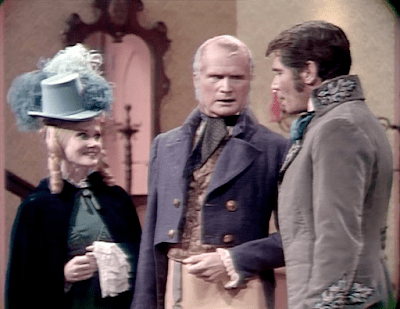
The Countess DuPrés meets her brother, André DuPrés, Josette’s father, in the gazebo on the grounds of the great estate of Collinwood. She starts talking to André about evil powers at work in the house, and he tells her to stop wasting his time with her mumbo-jumbo. She tells him that she is not talking about something she learned by studying her tarot cards. She was hiding in the bushes next to the gazebo the night before, where she saw and heard a tryst between Josette and Jeremiah Collins, uncle of Josette’s fiancé Barnabas.
Since Josette is apparently in love with Barnabas, barely knows Jeremiah, and has always been a good girl, André finds this difficult to believe. The countess assures him it is so, and says that there is no sensible explanation but that Josette and Jeremiah are under a spell. André says that that isn’t a sensible explanation, either.
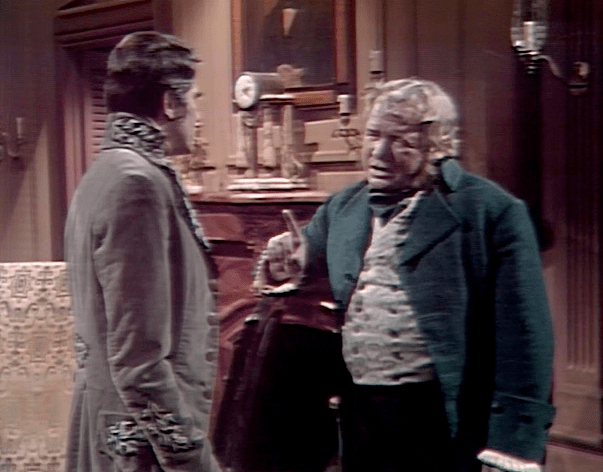
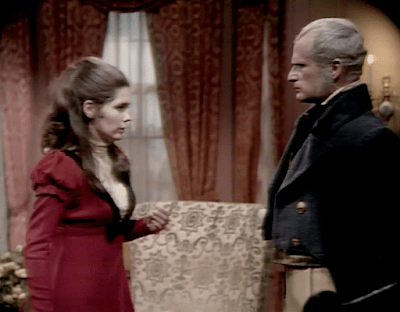
André goes back to the manor house. He confronts Jeremiah. The two of them do something virtually unprecedented on Dark Shadows– they address a problem directly in candid, rational conversation. In this narrative universe, that qualifies as a plan “so crazy that it just might work!” And, apparently, it does- Jeremiah apologizes for his behavior, admits that he himself is unable to explain what came over him, and promises that he and Josette will never again be alone together. That satisfies André.
The first and last intelligent conversation ever to take place on Dark Shadows. Screenshot by Dark Shadows Before I Die.
Later, the countess is in the front parlor with the lady of the house, the alcoholic Naomi Collins. The countess tries to interest Naomi in the tarot. She deals a twelve card layout, and is horrified by what she sees. She tells Naomi that the card signifying the Lovers is inverted, that Death is near them, etc. She talks about a force of evil at work in the house, and asks about well-meaning governess Vicki. We can see why a sensible adult like André was reluctant to listen to his sister in the opening scene, but we also know that Dark Shadows is the sort of show where things like this are reliable guides to upcoming story beats.
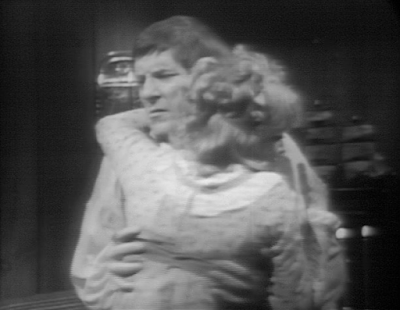
After dealing with the countess, Naomi needs some sleep. She doesn’t get much, though. She dreams of a giant tarot card floating up from the foot of her bed. It is unclear whether she is awake or still dreaming when she rises from bed and follows the card. She sees Jeremiah walking past in the corridor outside her room. She follows him to the front parlor, and sees him locked in an embrace with a woman. She can see the woman’s arms caressing Jeremiah’s back and can hear her voice, but cannot see her face. She sees a simple trident shape on the woman’s hand. Jeremiah orders Naomi out of the room. Rather than comply, she grabs the woman’s arm. It comes off in Naomi’s hand, prompting her to scream.
The arm is so obviously made of plastic that we laughed out loud when it came off. I’m sure it looked less bad on the average TV set in 1967, at least in areas where ABC was on a station that didn’t come in particularly well, which was most of them.
The woman’s voice Naomi hears sounds like that of Kathryn Leigh Scott, who plays Josette; it also sounds like it is playing on a record. The woman Jeremiah is kissing is Dorrie Kavanaugh. Kavanaugh stood in for Miss Scott in #224, #225/226, #238, and #240, and had a speaking part as Phyllis Wick in #365. Sad to say, this is Kavanaugh’s last appearance on Dark Shadows; her brief turn as Phyllis was sensational, I was disappointed not to see her again. Even sadder, she would die of cancer in 1983, at the age of 38.
Last night Josette DuPrés, fiancée of young gentleman Barnabas Collins, slipped into the bedroom of Barnabas’ uncle and best friend Jeremiah and propositioned him. This morning, Jeremiah thinks he must tell Barnabas that his intended is not the virtuous maiden he thought her to be.
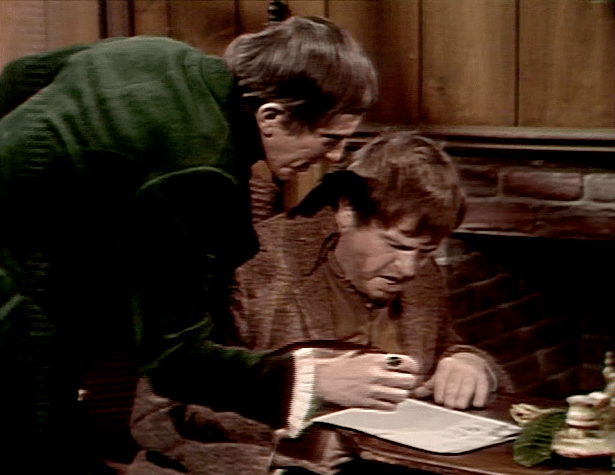
Jeremiah finds Barnabas teaching kindly indentured servant Ben Stokes the alphabet. Ben marvels that children are able to learn something he finds so difficult. After struggling a while with the letter Q, Ben says he thinks it unlikely that he would ever say a word with a Q in it anyway. When Jeremiah says he has something important to discuss with Barnabas, Ben is excused from his lesson.
When Jeremiah sees how devoted Barnabas is to Josette, he can’t bring himself to break the bad news. He simply declares that no one must come between them. and Barnabas happily says that he is sure no one would want to do that.
Jeremiah sees Josette entering the house. She tries to hurry away, ashamed to face him, but he insists they go outside and talk. She swears that she has never before approached a man as she did him, that she is utterly mystified as to what came over her, and that rather than hurt Barnabas she would kill herself.
Josette’s aunt, the Countess Natalie DuPrés, is a house-guest at Collinwood. She meets Josette in the front parlor. She wonders why Josette has been out of the house and alone from dawn until after lunch. Josette will not explain, and when Barnabas enters she runs away and shuts herself in her room. The Countess tells Barnabas that Josette is suffering from the sort of jitters girls often have before they become brides, and insists he take her rather than Josette on a furniture-shopping expedition.
Josette, Barnabas, Jeremiah, and the Countess are all unaware of the true situation. The Countess’ maidservant, Angelique, is a witch who has cast a spell on Josette so that she will conceive a mad passion for Jeremiah. She has cast another spell on Ben to make him her henchman. Angelique’s plan was that after Josette threw herself at Jeremiah, Jeremiah would tell Barnabas of the advance and the wedding would be off. Angelique would then be in a position to renew the affair that she and Barnabas had before he became engaged to Josette, and she would end up as the new Mrs Collins.
When Ben reports to Angelique that Jeremiah could not bring himself to tell Barnabas what Josette had done, she is shocked. She comes up with another plan- she will make Jeremiah reciprocate Josette’s feelings. She orders Ben to pour a love potion into the hot toddy he serves Jeremiah at night.
The other day, Angelique had Ben put a sleeping potion into Jeremiah’s hot toddy while he was in his room getting ready for bed. This time, Jeremiah is in the front parlor with Barnabas and the Countess. That makes for a more complicated scene, as Ben has to slip the potion in when none of the three are looking. Moreover, at one point the Countess asks for a drink other than sherry, and at another she urges Barnabas to have a drink. Since Jeremiah has asked for a smaller drink than usual, it seems possible at both of these moments that he might give the hot toddy away, foiling Angelique’s plan. It is all very well handled, and of course it ends with Jeremiah taking the drink and falling into the trap.
The Countess is still playing cards in the front parlor when everyone else is in bed. She sees Josette coming downstairs. Her niece tells her she can’t sleep and is going for a walk. The Countess offers to go with her, an offer Josette firmly declines.
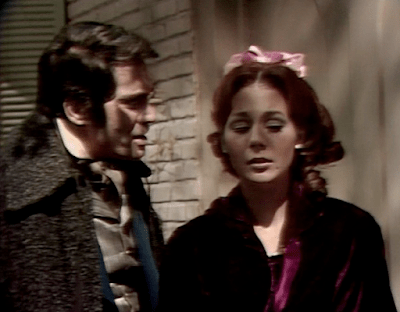
We cut to a new set, a gazebo on the grounds of the estate. Jeremiah is there. He tells Josette that he was compelled to go there, he knew not why, but that some time ago he realized he was waiting for her. Josette says she was compelled to come also. They profess their love for each other and kiss. We turn to the bushes, and see the horrified face of the Countess watching their ominous embrace.
No two performers did more to pioneer what would become the Dark Shadows house style of acting than Thayer David and Lara Parker. When David first appeared as gruff groundskeeper Matthew Morgan in #38, he stood out in a cast of theater actors who tended to play their parts somewhat larger than life by his exceptional intensity. In the 1795 period piece, he brings the same quality to his portrayal of kindly indentured servant Ben Stokes. As wicked witch Angelique, Parker is the first member of the cast to find a kind of ferocity that outdoes even David. Today, the two of them are the main characters in the episode, yet each shows great restraint and understatement. Their performances are admirably precise.
Angelique is maidservant to Countess Natalie DuPrés, a French lady who took her to the island of Martinique when she fled the Revolution. The countess hasn’t been much in evidence, so that Angelique spends most of her time working for her niece Josette, fiancée of young gentleman Barnabas Collins. Before Barnabas and Josette became a couple, he had a brief affair with Angelique, to which Angelique attached great importance. When she finds that Barnabas does not love her and cares only for Josette, she sets about casting spells to ruin their happiness.
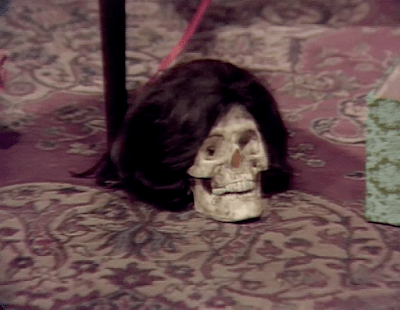
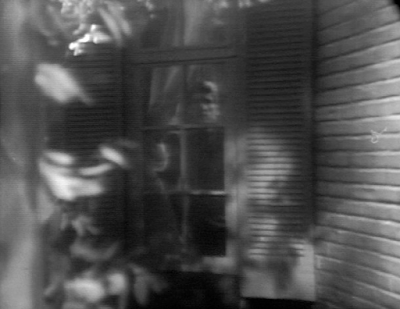
Today, Josette opens a gift box to find a skull wearing a wig. She is altogether undone by this. Barnabas confronts Angelique about it. While he does not seem to have any idea that Angelique is a witch, he is sure she is responsible for the nasty surprise. She denies everything, and he has no evidence against her.
Ben had tried to tell Barnabas and Josette about Angelique, but being under her power, he cannot. But Barnabas could tell Josette the truth about his past with Angelique. Because he does not, she goes on trusting Angelique, giving her full access to her things and to her person, enabling her to cast whatever spell she wishes. Had Barnabas trusted Josette with the truth, they might have been able to fight Angelique. Because he insists on hiding it from her, they are utterly helpless and will lose absolutely everything.
When Dark Shadows started, the 1960s version of the Collins family was isolated from the community, unable to make anything happen, and vulnerable to a wide variety of enemies, all because matriarch Liz and her brother Roger clung desperately to shameful secrets. When those secrets came to light, they lost nothing and found themselves with a new freedom. Now, in 1795, the Collinses are the lords of the town, running a dynamic business, and apparently unassailable in their wealth and prestige. But in Barnabas’ failure to come clean with Josette, we see the beginning of the process that will lead them to the precarious state in which they are trapped in 1966.
Today, Angelique completes a spell that causes Josette to conceive a mad passion for Barnabas’ uncle and best friend Jeremiah. After Josette sneaks into Jeremiah’s room and makes a fool of herself by propositioning him, she runs back to her own room and sobs on the bed. Angelique is there, feigning puzzlement and sympathy, quietly accepting the young mistress’ refusal to tell her what is wrong.
This is the first episode of the 1795 segment not to include time-traveling governess Vicki. While actors Kathryn Leigh Scott, Thayer David, and Anthony George all appeared in the main time frame (debuting in episodes #1, #38, and #262, respectively,) only Jonathan Frid, as Barnabas, is playing a character we had met there. There’s a heavy-handed moment of self-reference today when Josette tells Barnabas that sometimes he is “too modern,” and he thinks about it during a close-up. That close-up goes on so very long that there is no doubt they are giving us reading instructions, telling us that Barnabas, rather than Vicki, is now our point of view character.
Angelique, lady’s maid/ wicked witch, has cast a spell over kindly indentured servant Ben Stokes, making him her slave in an even deeper sense than he was already Joshua Collins’ slave. She gives Ben various tasks in support of her current project, black magic that will make the lovely Josette forget her fiancé Barnabas and conceive a mad passion for Barnabas’ uncle and dear friend Jeremiah. Most notably, she needs an unbroken spider web from an oak tree, and Ben brings her one.
Meanwhile, cousin Millicent Collins has come to the estate of Collinwood. Millicent is giggly, afraid of germs, and very, very rich. Joshua means for his bachelor brother Jeremiah to marry Millicent, a prospect that repels Jeremiah.
Time-traveling governess Vicki enters. When she sees Millicent, Vicki calls her “Carolyn,” because she is played by Nancy Barrett, who plays a character named Carolyn in the parts of Dark Shadows set in the twentieth century. The makers of the show wanted Vicki to keep the audience up to date on the cast members’ resumés, even though it makes all the other characters think she is a lunatic.
Alone with Vicki, Jeremiah confides that he does not want to marry Millicent. Vicki had studied Collins family history when she was living in the 1960s and has an idiotic compulsion to verbalize her every thought, so she declares that Millicent will never marry. Jeremiah remarks that she says the strangest things.
This scene is more tolerable than the others in which Vicki blurts out information she wouldn’t know if she belonged in 1795 because of the casting of Anthony George as Jeremiah. George was a cold actor who kept the audience guessing what was going on inside his characters’ heads. That made him a disaster as the second to play the hot-blooded Burke Devlin, but when we see him as Jeremiah we take his ready acceptance of Vicki’s bizarre behavior as a sign that he has something up his sleeve. If they can stop giving Vicki such tiresome lines, Jeremiah might be a promising love interest for her.
Time-traveling governess Victoria Winters sees a man fueling the fireplace in the front parlor of the manor house on the estate of Collinwood. As she has done several times since arriving in the year 1795, she jumps to the conclusion that he is the character the same actor played in the 1960s. In fairness to Vicki, a couple of the people are the same- young gentleman Barnabas Collins will become a vampire and meet her in her own time, and Barnabas’ ten year old sister Sarah will die soon and her ghost will haunt Collinwood and its environs in 1967. So it’s tricky to handle the repertory theater aspect of the rest of the cast, and, by having Vicki freak out and shout about the main time period every time she meets someone, the show has chosen the most irritating possible way of addressing this problem.
The man Vicki meets today is indentured servant Ben Stokes, and the man she mistakes him for is gruff groundskeeper Matthew Morgan. Since Matthew held her prisoner in this very house and tried to decapitate her here in 1966, her misidentification of Ben leads Vicki to scream and holler and bring the master of the house to ask what is going on. Ben responds that he did nothing at all, Vicki volunteers that it was all her fault and tries to explain.
The master, haughty overlord Joshua Collins, is ever mindful of Ben’s status as a felon entrusted by the state to his custody, and declares that Ben is forbidden to speak to any woman for any reason. Vicki is appalled by this, but as governess she is a servant herself, so Joshua orders her to be silent. Besides, her protestations don’t make any sense to anyone who didn’t see episodes #108-#126 of Dark Shadows. Since it is 1795, Joshua doesn’t have access to the show on streaming or even on cable. He tells Matthew he won’t get the day off he’d asked for tomorrow.
Before Joshua dismisses Vicki to return to her duties, he mentions that his second cousins Millicent and Daniel Collins will be arriving soon and staying for the month leading up to the wedding of Joshua’s son Barnabas to Josette duPrés. Daniel is a child the age of Joshua’s daughter Sarah, and will be joining Sarah as Vicki’s charge during his stay at Collinwood. Joshua mentions that Millicent is a lovely young woman, and that from her early childhood it had been understood that she would marry Joshua’s younger brother Jeremiah. Joshua is quite pleased with this prospect, not least because Millicent has inherited a considerable fortune.
Vicki’s compulsion to keep the audience up to date on the resumés of the actors is mirrored by a compulsion to blurt out information she knows only because she comes from 1967. She had studied the Collins family history, so when Joshua talks of Millicent’s prospective marriage to Jeremiah she shouts “Millicent never married!” Joshua is puzzled by this idiotic remark, but quick to accept Vicki’s explanation that she had read a novel about a spinster named Millicent and couldn’t help but yell about it.
During the first year of Dark Shadows, Vicki was, on balance, one of the smartest characters and was the one who made the most important things happen. So it is distressing to see her verbalizing her every thought, including irrelevancies about the actors’ other roles and information that would tend to expose her secret. If she is going to survive in this past world, she’s going to have to regain enough brain power to keep her mouth shut. Moreover, even when she was at her smartest Vicki was always a conspicuously inept liar. Joshua is fundamentally uninterested in a person of her apparently low social status, and so he accepted the story she made up to cover herself this time. But someone more willing to pay attention to her might very quickly conclude that Vicki is a strange and dangerous person.
Meanwhile, lady’s maid/ wicked witch Angelique is in the woods gathering noxious weeds to use in an evil potion. Ben catches her there, and warns her that the plants she has in her basket are poisonous. She drops them, thanks him, and strikes up a conversation. He tells her Joshua has forbidden him to talk to women. She says this is horribly cruel, and Ben agrees. He goes, and she picks the deadly leaves back up.
In the servants’ quarters, Vicki enters Angelique’s room. She sees some things of Barnabas’ that Angelique had used to cast a spell on him the other day. When Angelique comes in, Vicki tells her that Josette was asking for her. Vicki then asks how Barnabas’ things got to be in Angelique’s room. She says she doesn’t know, then puts the blame on Sarah. Vicki says she will scold Sarah for carrying Barnabas’ things around the house, and Angelique begs her not to. She says she is afraid that if she does, Sarah won’t visit her anymore.
Angelique has no way of knowing it, but this is the perfect lie to tell Vicki. For months before she left 1967, everyone was eager for Sarah’s ghost to come and visit them. Indeed, Vicki was at a séance called to contact Sarah when Sarah took possession of her, said through her that she would tell the “story from the beginning,” and yanked her back to this time. So, when Angelique presents herself as afraid that Sarah will stop visiting her, Vicki cannot refuse her request.
Angelique decides she needs a helper to keep herself from being suspected. We cut between the outdoors, where we see Ben chopping wood, and the servant’s quarters, where Angelique is mixing up a potion. Vicki comes to Ben, and we wonder which of them will be Angelique’s target.
Vicki apologizes to Ben. He just wants her to go away- he’s got into enough trouble for talking to her once, the last thing he wants is to be caught repeating the offense. She says that she knows that Joshua “can seem stern,” to which Ben reacts with disbelief. He says that Joshua is far worse than stern.
Again, this is Vicki failing to distinguish characters from the actors who play them. Louis Edmonds plays Joshua in 1795, and high-born ne’er-do-well Roger Collins in the parts of Dark Shadows set in the twentieth century. For the first 25 weeks of the show, Roger was the villain, and he tried to kill Vicki once or twice. By the time his ex-wife Laura went up in smoke in #191, Roger was no threat to anyone. When Sarah brought Vicki back here, Roger had long since been reduced to occasional comic relief.
Joshua is as selfish and cold as Roger at his worst, but where Roger is cowardly, weak, and shameless, Joshua is bold, imperious, and utterly convinced that he is right. Roger is what Joshua might become after a long period of continual degeneration and degradation, a grotesque parody of his ancestor. He has Joshua’s style, but none of his strength. He is reminiscent of the “Last Men” in Nietzsche’s Also Sprach Zarathustra, who were strangers to every consideration but their own immediate comfort. Even so, enough of Louis Edmonds’ wit and personality come through that we always enjoy seeing Roger, and we can understand why Vicki likes him. Edmonds is so good that we are sure we will enjoy watching Joshua as well, but he is clearly never going to become a lovable squish.
Ben is trying to orient Vicki to the current phase of the show when we cut to Angelique in her room. She calls Ben’s name. Suddenly Ben seems to have taken ill. He finally persuades Vicki to leave him alone before he gets caught talking to her again. Once Vicki is gone, he sees a vision of Angelique calling to him and sets off.
When Ben gets to Angelique’s room, he tells her he has no idea what he is doing there. She tells him he is there because she wanted him. This means only one thing to him, so he lifts his arms and steps forward, obviously intending to brighten the day with some rapid love-making. She pulls back and tells him to take a drink first. The beverage she offers him is readily identifiable to a modern audience as Coca-Cola.
In the 1960s, Coca-Cola may have been the pause that refreshes, but in 1795 it had more drastic effects. After Ben drinks it, he staggers back and Angelique tells him that he no longer has a will of his own and will be her slave forevermore. He doesn’t make love to her, either, so no matter how tasty the Coke was the visit would have to be reckoned a loss from Ben’s point of view.
Rich young gentleman Barnabas Collins is having trouble breathing, and the doctor thinks he may die at any moment. The source of Barnabas’ ailment is a spell cast on him by wicked witch Angelique. Angelique panics when she hears that Barnabas may die, and spends almost the whole episode figuring out how to undo the spell.
Angelique scrambles desperately to correct her error before it is too late. Screenshot by Dark Shadows Before I Die.
We only learned on Friday that Angelique was a witch. Her trouble today makes us wonder how long she’s been at it. For all we know this might be the first spell she has ever cast, and that’s why she bungled it so badly. That in turn leads us to wonder how big a part of her character witchcraft will turn out to be. If she hasn’t been involved with it for very long, maybe she’ll swear off black magic soon and become a different sort of person. We do expect that she will have something to do with whatever it is that is about to turn Barnabas into a vampire, but maybe that will be an accident of some kind, or maybe she will be on the side of good, trying to stop it, by the time that ultimate disaster happens.
On Wednesday, we met a new arrival from Paris by way of the island of Martinique. She is Angelique, maidservant to the Countess DuPrés and onetime bedfellow of rich young gentleman Barnabas Collins. Barnabas is engaged to marry the countess’ niece Josette, and is anxious to keep Angelique in the background. Angelique does not share either of Barnabas’ goals.
At rise, Angelique meets Barnabas’ uncle Jeremiah in the front parlor of the manor house of Collinwood. She has found a toy soldier and asks Jeremiah about it. When he identifies it as one of the toys Barnabas was most fond of in his boyhood, he volunteers to take it to the playroom himself. She asks to keep it for a while, so that she can study its workmanship. He doesn’t object, and exits. Once she is alone in the parlor, Angelique starts talking to herself. She says that she will use it to cause Barnabas unimaginable pain. This is the first direct suggestion we have seen that Angelique is involved in witchcraft.
Time-traveling governess Vicki enters. She tells Angelique that they should be friends, because they are both servants in the house, and it is a foreign setting to both of them. Angelique asks what Vicki means by describing herself as foreign, since she is an American. Vicki realizes that she can’t tell someone she has just met that she is a time traveler thrust here from 1967 by the ghost of the little girl she is supposed to be educating, and so she mutters something about how Angelique wouldn’t understand. After they part, we hear Angelique musing that Vicki has no idea what she understands. At no point does Angelique show any interest whatever in becoming friends with Vicki.
Later, we see Angelique alone in her room with the toy soldier and Barnabas’ handkerchief. She is talking to herself about her evil plans again when she is interrupted by a knock at the door. She hides the things and answers it. Barnabas enters.
Barnabas renews the effort he made at the end of Wednesday’s episode to friendzone Angelique. Again, she isn’t having it. After he leaves, she takes the soldier and the handkerchief back out and tells them that she has decided to wait for Josette’s arrival to enact her revenge on Barnabas.
She won’t have to wait long. Josette’s father, André, is entering the parlor, grumbling about the lack of servants at Collinwood. He beckons his daughter, and she follows him into the house. She is played by Kathryn Leigh Scott.
A major cast member of the parts of Dark Shadows set in the 1960s as Maggie Evans, The Nicest Girl in Town, Miss Scott has played Josette’s ghost more than once. She created the part in #70, when she was the shimmery figure who emerged from Josette’s portrait in the very house we are in today and danced among its pillars. She reprised the part in #126, again in this house, when Josette led the other ghosts in rescuing Vicki from crazed handyman Matthew Morgan. For some months Barnabas, who is in 1967 a vampire, held Maggie prisoner here and tried to replace her personality with that of Josette. Barnabas often seemed convinced that Maggie really was Josette, and when strange and troubled boy David saw Maggie wearing Josette’s dress in #240 he said that her face was “exactly the same” as it was on the many occasions when he had seen Josette’s ghost.
Barnabas’ plan to Josettify Maggie is drawn from the 1932 film The Mummy, in which the undead Imhotep (Boris Karloff) is released from his tomb, holds Helen Grosvenor (Zita Johanns) prisoner, and tries to replace Helen’s personality with that of his lost love Princess Ankh-Esen-Amun. In that movie, there is a flashback to ancient Egypt, where we see that Zita Johanns also plays Ankh-Esen-Amun and we realize that Imhotep’s crazy plan was rooted in some supernatural connection between the two women. The connection between Josette and Maggie has been equivocal until now- Miss Scott was always veiled when she played Josette’s ghost, and stand-in Dorrie Kavanuagh was the one wearing the dress in #240. Moreover, after Maggie got away in #260, Barnabas soon turned his attentions to Vicki, and decided he would try the same gimmick with her. But now we see that Barnabas really was onto something with regard to Maggie, and we wonder where it will lead. I remember the first time we watched the show, my wife, Mrs Acilius, reacted with great excitement to Josette’s entrance in this episode and exclaimed “Of course! Maggie is Josette!”
Vicki spent the first three days of this week telling the actors what parts they played in the first 73 weeks of Dark Shadows, an annoying habit. But there is a reason for it. She knew Barnabas and Sarah as supernatural beings in 1967, so she will recognize them as the same people here. And Josette’s looks reveal her connection to Vicki’s friend Maggie, so she will recognize that. Since only Angelique, of the characters we have met so far in 1795, is played by someone who did not appear previously, the writers are in a difficult position with regard to all of the other members of the company.
I wish they had solved that problem by having Vicki show up in 1795 unable to speak. The suggestion I made in my post about #366 is that she could have materialized in the midst of the accident that upset the carriage bringing the original governess, Phyllis Wick.* Vicki could have sustained a slight injury that left her mute for a week or so, could have had voiceover monologues registering her recognitions of Barnabas, Sarah, and Josette/ Maggie, and would not have had audible monologues when she saw the others. By the time she could talk again, Vicki would know that she was supposed to pretend to be Phyllis Wick.
Clearly Vicki is supposed to get into some kind of trouble in 1795; she is still the heroine, and the first rule of all soap operas is that the heroine must always be in danger. But she is supposed to be seeing the events that started the phase of the Collins family curse that involves Barnabas’ vampirism, and those events did not involve a governess who went around calling people by the wrong names and blurting out information she learned from reading the Collins family history. The logic of the plot requires that whatever trouble Vicki gets into is more or less the same trouble Phyllis Wick would have got into, and the appeal of the character requires that the audience watch to see what kind of con artist Vicki might turn out to be. Both of those imperatives demand that she try to masquerade as Phyllis.
Vicki does manage to keep herself from telling André and Josette that they are being played by the actors who took the parts of Sam and Maggie Evans in other parts of Dark Shadows. She can’t help staring at Josette, however. Josette is quite cheerful when she asks Vicki why she is staring; André, a more conventional aristocrat than his relaxed daughter, is visibly annoyed with Vicki’s impertinence.
There was an opportunity here for Vicki to show some quick thinking. She could have told Josette that Barnabas has gone on at length about her appearance, and that she is amazed at the accuracy of his descriptions. That would have endeared her to Josette as the bearer of the message that her fiancé is very much in love with her, and would have reassured her that, while Vicki is an attractive young woman who lives under Barnabas’ roof, she is not a rival for his affections. As it is, Vicki just mumbles something about not having known she was staring.
Angelique enters. She and Josette rush into each other’s arms and speak French. Miss Scott tells a funny story about that moment. She and Lara Parker had talked about the script and agreed that two Frenchwomen excited to see each other after a long separation ought to greet each other in French, and they persuaded the producer of their point. Only when they got the revised script with the dialogue in French did it dawn on them that neither of them could speak the language. Fortunately, several other members of the cast were fluent in it, and coached them through.
We can see that Josette really regards Angelique as a friend. Viewers who have been with the show from the beginning will remember Josette’s ghost as a powerful and stalwart force for good, and will also know that Maggie is The Nicest Girl in Town. So whatever grievance Angelique may have against Barnabas, and however unjust may be the social system that has exalted Josette and subordinated Angelique, when we see Angelique faking friendship for Josette while planning to make her watch her lover suffer, we know that she is really evil.
Barnabas enters. Josette tells him that her long, difficult journey was worthwhile now that she is with him. This is a very sharp retcon. In #345, mad scientist Julia Hoffman asked Barnabas if Josette ever came to him of her own free will, and he responded with a silent grimace that left no doubt as to the answer. Now, we see that she has gladly sailed from Martinique to central Maine in late autumn to be with him.
Barnabas and Josette are alone, and he wants to kiss her. She is bashful and says that their parents might be upset if they don’t wait for the wedding. He says they might pretend to be, but that in reality it is expected. That is a sweet little conversation, and it ends in a sweet little kiss.
Angelique is back in her room. She twists Barnabas’ handkerchief around the neck of his toy soldier.
The episode ends with Barnabas on the floor, apparently asphyxiating, while Josette looks on in horror.
Wednesday, Barnabas made it clear that he had his affair with Angelique because he didn’t think Josette could love him. That gives Angelique a perfectly understandable motive for seeking revenge on him. A rich man exploited his position to trifle with her, a servant, giving no thought to her feelings or interests.
The selfishness and entitlement Barnabas exhibited thereby is jarring in the mild-mannered, apparently egalitarian fellow we have seen so far this week, but it fits perfectly with his behavior as a vampire in 1967. Seen from another angle, his behavior is consistent with everything the Collinses have done to get themselves in trouble since we first met them. He was tempted to take advantage of Angelique because he had underestimated his own lovability and despaired of making a real connection with Josette.
Barnabas is still underestimating himself and Josette now. Never once does it occur to him to come clean to her about what he did with Angelique. While Josette would no doubt be saddened to learn that her beloved fiancé had dallied with her pet servant, as a rich French girl from Martinique she has after all lived her whole life among wealthy men surrounded by enslaved women, and so could hardly have been shocked by what Barnabas had done. Surely she would have decided to go ahead with the wedding, and she would have known to be wary of Angelique.
By failing to trust Josette with the truth about his misdeeds, Barnabas puts her and himself at Angelique’s mercy. We think of 1966, when matriarch Elizabeth Collins Stoddard and her brother, high-born ne’er-do-well Roger Collins, were both prisoners of shameful secrets they dared not share even with each other. In 1967, when those secrets were finally laid bare to the whole world, Liz and Roger found they were free to go on about their business as if nothing had happened. In Barnabas’ petrified silence, we see all of the shadows that have kept his relatives in darkness for so long.
*Whom Dorrie Kavanaugh played in her brief appearance at the end of #365.
As I’ve gone along making these notes, I’ve occasionally been moved to tag episodes as “Genuinely Good” or “Stinkers.” Since no episode of Dark Shadows aired 56 years ago today- 23 November 1967 was Thanksgiving Day in the United States, so ABC showed football games instead of its regular programming- I’m taking the opportunity to list the installments to which I gave these labels.
Genuinely Good Episodes
#25. Written by Art Wallace. Vicki finds an incriminating piece of evidence in David’s room.
#32. Written by Art Wallace. Roger and Liz face the fact that it was David who tried to kill Roger.
#50. Written by Art Wallace. Vicki and Carolyn see Bill Malloy’s body below the cliff.
#59. Written by Art Wallace. The sheriff comes to Collinwood and questions Roger.
#68. Written by Francis Swann. Roger encourages David to murder Vicki.
#69. Written by Francis Swann. Mrs Johnson visits Burke in his hotel room.
#87. Written by Francis Swann. Roger finds Vicki in the sealed room and releases her.
#102. Written by Francis Swann. David has a conversation with the portrait of Josette.
#103. Written by Francis Swann. Vicki and Burke investigate Roger.
#112. Written by Ron Sproat. Liz rescues Vicki from Matthew.
#126. Written by Ron Sproat. The ghosts of Josette and the Widows, accompanied by that of Bill Malloy, rescue Vicki from Matthew.
#146. Written by Malcolm Marmorstein. Sam burns his hands.
#182. Written by Ron Sproat. Roger begins to suspect that Laura might really be a supernatural being and a threat to David.
#253. Written by Joe Caldwell. Maggie gives Willie her ring. The first really good episode of Dark Shadows 2.0.
#254. Written by Joe Caldwell. Carolyn and Buzz announce their engagement.
#258. Written by Malcolm Marmorstein. Maggie talks with Sarah.
#260. Written by Ron Sproat. Maggie escapes from Barnabas.
#265. Written by Malcolm Marmorstein. First appearance of Dr Julia Hoffman.
#318. Written by Gordon Russell. Barnabas and Julia hide in the secret room of the mausoleum while Sam and Woodard search the outer part.
#325. Written by Gordon Russell. Sarah comes to David in a dream.
#327. Written by Gordon Russell. David communicates with two aspects of Sarah that don’t communicate with each other.
#333. Written by Ron Sproat. Burke and Woodard search Barnabas’ basement.
#344. Written by Joe Caldwell. David knows what’s going on and has given up hope of changing it.
#345. Written by Gordon Russell. Burke is missing and feared dead.
#348. Written by Joe Caldwell. Julia tries to save the experiment. The first episode of Dark Shadows to fully integrate color into a coherent visual strategy, and probably the best episode of the series up to this point.
#351. Written by Gordon Russell. Barnabas adds Carolyn to his diet.
#363. Written by Gordon Russell. Tony catches Carolyn going through his safe, then Sarah appears to Barnabas.
#364. Written by Gordon Russell. Sarah confronts Barnabas.
#365. Written by Sam Hall. A séance at Collinwood has an unexpected result. This is the final episode of Dark Shadows 2.0.
I credit the writers, because there were only two directors in this period of Dark Shadows, Lela Swift and John Sedwick, and they didn’t differ sharply in approach. The rest of the production staff was the same in every episode, so the writers were the only ones whose names seemed like they might give a clue as to what set the best episodes apart from the worst ones.
I’m very surprised to see Marmorstein’s name in this list three times. Joe Caldwell was making uncredited contributions to the writing from #123 on; #146 is very much in his style, and I suspect he was its true author. But Caldwell was getting on-screen credit by the time of #258 and #265, so I think those must actually have been Marmorstein’s handiwork. Granted, neither of them is all that close to the top of the all-time great list, and the actors and directors do a lot to elevate them. Even so, they do prove that Marmorstein was not the total incompetent he so often seemed to be.
One thing I notice is that many of these episodes feature long-delayed confrontations in which the character learns information they hadn’t expected and can’t use right away. So in #25, David talks with Vicki and for the first time makes an explicit statement about his father’s accident, while Liz talks with Roger and for the first time makes an explicit statement about Vicki’s origins. In each case, the explicit statement is an obvious lie and the person telling it demands that the other go along with it. Hearing the characters talk about issues they’ve been evading for a long time relieves some worn-out suspense, while the actual content of the conversation builds fresh suspense as we wonder what use Vicki and Roger will make of the knowledge that David and Liz are lying. And of course the similarity between David’s behavior and his aunt’s shows that the boy is carrying on a family tradition.
In #32, Roger and Liz finally admit to themselves and each other the fact that David caused the accident. While they set to work covering this up, Roger tells Liz that he isn’t sure David really is his son. Liz refuses to entertain the question, but it sets us up for the storyline centering on David’s mother Laura.
Jumping ahead to #258, the conversation between Maggie and Sarah shows that Sarah is able to interact with the living and suggests that she wishes Maggie well, but is just as inconclusive as were the conversations in #25 and #32. Sarah’s conversation with Barnabas in #364 shows that she is angry with him and trying to rein him in, but also shows that she has little direct influence over him.
Stinkers
#223. Written by Ron Sproat. David runs around and screams.
#249. Written by Ron Sproat. The family looks in the locked room and doesn’t find anything.
#266. Written by Ron Sproat. Liz is depressed.
#268. Written by Ron Sproat. Liz is still depressed.
#272. Written by Joe Caldwell. Liz has revealed her secret, and no one knows what to do about it.
#298. Written by Ron Sproat. It seems as if Maggie is going to remember what Barnabas did to her, but then she doesn’t.
#299. Written by Ron Sproat. It seems as if Barnabas is going to bite Vicki, but then he doesn’t.
#356. Written by Gordon Russell. Julia sticks her notebook in the clock, giving the clock the star turn it has been waiting for.
I suppose the first thing you’ll notice is that I didn’t come up with the “Stinkers” label until after Barnabas joined the show. If I’d thought of it sooner, Malcolm Marmorstein’s name would have graced the list many times. Also, there probably would have been some episodes there that aired on Fridays, as they didn’t really start to make an effort to do anything special at the end of the week until about halfway through Laura’s arc.
But I’m not going to go back and add the label to episodes from the first 42 weeks. I didn’t have any particular thought of making “Best” and “Worst” lists when I put them on; I was just marking some of my posts as raves or pans. So I’d be imposing a false organization on them if I went back through and did that.
In 1966 and 1967, supernatural menaces Laura Murdoch Collins and Barnabas Collins would often be seen staring out the windows of their houses on the great estate of Collinwood, sending psychic energy towards the targets of their sinister plans. In 1795, Barnabas is neither supernatural nor menacing, but we already see him peering out one of those windows. He is not projecting bad vibes into the world, but is worried about his beloved fiancée, Josette DuPrés. She is supposed to arrive soon, in fact was supposed to arrive some time ago. Now there is a storm, and he hopes she is not at sea.
The audience’s main point-of-view character in 1966 and for most of 1967 was well-meaning governess Vicki. Now Vicki has come unstuck in time, and found herself in this extended flashback to the eighteenth century. Since she will know Barnabas and regard him as a close friend in the 1960s, she is at her ease talking to him now. Although she is a member of the staff in his family’s house in a period when it was customary for masters to summon their servants with bells and communicate with them only in direct commands, Barnabas is a remarkably genial and democratic sort who welcomes her casual manner.
Vicki has already annoyed the audience several times by blurting out information that makes it obvious to the other characters that she does not belong in their world. She does that again in this scene. Barnabas is worried something may have happened to Josette, and Vicki tells him that she will arrive safely. He is surprised by the assurance with which she delivers this prediction, and asks if she is clairvoyant. She realizes that she has been indiscreet, and denies that she is. He is unconvinced.
Barnabas’ father, haughty overlord Joshua Collins, enters. He is appalled to find his son socializing with a servant. He dispatches Vicki to the nursery to look after her charge, his young daughter Sarah. He demands to know why Barnabas is not tending to his own duties at the family’s shipyard. They begin to quarrel, when a knock comes at the door.
Barnabas opens the door to find a woman named Angelique, whom he identifies as maid to Josette’s aunt, the Countess DuPrés. Angelique says that the countess was on her way to Collinwood, but that her carriage is stuck in the mud. Joshua orders Barnabas to send a footman to rescue her. Angelique is the first character we have met in 1795 who is not played by a performer we have seen in the first 73 weeks of the show.
Joshua goes to his wife, Naomi. Naomi is an alcoholic, a fact of which we are made aware because almost her every scene begins with a shot of her drinking alone. That’s what she is doing before Joshua finds her. He scolds her for her drinking; she complains that he doesn’t allow her to do anything else. She can’t even pass the time with a book- we saw Monday that Naomi is completely illiterate.
Naomi’s alcoholism is both a nod to the concern of first-wave feminism with the atrophy of the elite housewife, and a suggestive side-light on Barnabas as we knew him in the 1967 segment. Then, Barnabas abducted Maggie Evans, The Nicest Girl in Town, and tried by more or less magical means to replace her personality with that of Josette. For the first 40 weeks of Dark Shadows, Maggie’s father’s alcoholism had been a substantial story element, and she would always retain a number of classic Adult Child of an Alcoholic (ACoA, in the lingo of the recovery movement) characteristics, such as beginning utterances with a little laugh to prove that she is happy. Now that we know that Barnabas is also an ACoA, we can wonder if that shared experience was part of the reason he was drawn to Maggie.
The countess arrives. Since she is played by Grayson Hall, who also plays mad scientist Julia Hoffman in the parts of the show set in the 1960s, Vicki blurts out “Julia!” when she sees her. Hall had also been nominated for an Academy Award for her performance as Judith Fellowes in the 1964 film Night of the Iguana; if Vicki is going to keep the audience up to date on the cast’s resumes, it would have been more interesting if she’d exclaimed “Judith!” Vicki explains that the countess looks like someone she once knew who was named Julia, a remark which irritates the countess, who would like to think her appearance is distinctive. Vicki has certainly not made a favorable impression on this grand lady.
Joshua tells the countess he is surprised that “You still affect a title” when “France has followed our example and become a republic.” His pride in this development, after the Terror and in the bloodiest year of the wars in the Vendée, marks Joshua as a member of the Jeffersonian party in US politics. The Federalists and others had long since turned against the French Revolution by that year.
The countess tells Joshua that it is precisely because France has become a republic that she chooses to live on the island of Martinique. That answers a question that some fans ask about Angelique- why is she white? If the DuPrés family lives on Martinique and are major sugar planters there, they must hold a great many African people in slavery. When we hear that they are bringing a servant with them, we expect that servant to be Black. When we learn that the the countess is an emigré, we realize that she brought Angelique with her from France.
The countess may solve one puzzle for us in her exchange with Joshua, but she presents us with another. Josette’s father André is the countess’ brother, yet he is never referred to as a count. Indeed, when he appears, we will see him answer to “Mr DuPrés.” Perhaps he renounced his title, as many French aristocrats did during the Revolution.
Whatever the explanation, “DuPrés” would seem to represent a missed opportunity. When Josette was first mentioned, in the early months of Dark Shadows, her maiden name was given as “LaFrenière.” It would have been a nice touch to have kept that name for Josette and her father, and to have reserved “DuPrés” as the name of the countess’ late husband.
“LaFrenière” had been a perfect choice because of its class ambiguity for a show about an aristocratic family in the state of Maine- it was originally the family name of the barons of Fresnes, and could therefore be a sign of a senior order of nobility, but is also a very widespread name in Quebec. So “Josette LaFrenière” might either have been a French noblewoman who deigned to marry into the mercantile Collins family at the apex of their prestige, or a working class girl from the north who eloped with the boss’ son.
The choice of Martinique as Josette’s place of origin might add a new twist to this class ambiguity. The Empress Josephine grew up there as a member of the untitled but ancient Tascher family, who, like the fictional DuPrés family, owned an enormous sugar plantation on the island. The Taschers of Martinique went back and forth between Martinique and metropolitan France, and Josephine herself was living there in 1779 when she married her first husband, the Vicomte de Beauharnais. Josephine herself was in prison when the vicomte was guillotined in 1794, one of the last to die in the Reign of Terror, and she was freed just a few days later. The next year, she recovered her husband’s property, and a year after that married the young general Napoleon Bonaparte. It seems likely that the similarity between the names “Josephine” and “Josette” was writer Sam Hall’s inspiration for placing Josette’s origins on Martinique. Association with a figure who was at once a grand lady and an example of very steep upward social mobility could synthesize the two possible Josettes LaFrenière into a single figure.
Had they developed the story of the family’s relationship with the town of Collinsport more richly in Dark Shadows 1.0 and 2.0, they could have used this ambiguity to build up suspense that would be resolved today, in the third episode of Dark Shadows 3.0. Since they did so little with that theme in those days, when the story was moving very slowly and it would have been relatively easy to fit just about anything in, I suppose we shouldn’t be surprised that they drop it so completely at this period of the show, when the story is flowing at a breakneck speed.
The countess’ lofty aristocratic manner stings Joshua. Alone with Naomi, he loudly proclaims his belief that all men are equal. We already know enough about Joshua’s tyranny over his household that this absurd little speech must be an intentional spoof of the rich landowners who supported the Jeffersonian party in the early decades of the Republic. Again, this would be funnier and more poignant if the show had done more with social class in its first 73 weeks.
Barnabas sees the countess dealing out tarot cards. He tells her she is too sophisticated for them, and is reluctant to sit with her while she uses them to read his fortune. The moment she says that the cards suggest a connection between him and the concept of infinity, his skepticism evaporates instantly and he excitedly asks if that means he will live forever. The countess cautions that his jubilation at this idea may be misplaced. She notices the “Wicked Woman” card, and takes a significant look at Vicki. Evidently the audience is not alone in objecting to Vicki’s brainless nattering about what the show used to be like.*
Angelique comes to Barnabas’ room. It turns out the two of them had a brief affair when he was first on Martinique, and she expects to resume it. He is not at all pleased at her attentions.
Not how every man would react to a passionate embrace from Lara Parker… Screenshot by Dark Shadows Before I Die.
Barnabas explains that he was already falling in love with Josette when he and Angelique had their fling, but that he didn’t really know her. He couldn’t believe that she would reciprocate his feelings, and consoled himself by dallying with Angelique. This explanation goes over with her about as well as you’d expect, and she storms out of the room, vowing that she will get her way in the end.
We know that the tarot cards are giving accurate information, because the show leans heavily on the uncanny and they wouldn’t have spent so much time on a gimmick that wasn’t meant to advance the plot. We also know that Vicki is not the Wicked Woman the countess is looking for. That leaves Angelique, and we can assume that her wickedness will express itself in some supernatural action taken to avenge herself on Barnabas. Since we know that Barnabas will become a vampire, we wonder if it is Angelique who makes him one.
Closing Miscellany
I usually refer to surviving cast members with courtesy titles and to deceased ones by surname alone. So Alexandra Moltke Isles is “Mrs Isles,” which has been her professional name for 56 years, David Henesy is “Mr Henesy,” Nancy Barrett is “Miss Barrett,” etc, while Jonathan Frid, Joan Bennett, Louis Edmonds, and Grayson Hall are just “Frid,” “Bennett,” “Edmonds,” and “Hall.” Until last month, I’d been looking forward to saying lots of things about “Miss Parker” and her portrayal of Angelique, but Lara Parker died on 12 October 2023. So she’s just going to be “Parker,” and I’m going to be sad about it.
Artist Teri S. Wood has created a number of short animations about Angelique and Barnabas. This one is based on their two-scene at the end of today’s episode:
Patrick McCray has a post about this episode that mystifies me. He writes that “After seven months of hearing about Angelique, today, she enters. So, no pressure Lara. You only have to live up to a half year of build-up.” Uh, what? There has been absolutely no reference to Angelique on the show before today. I can think of an interpretation of the story that might retroject Angelique into episodes #211-365, and I will talk about it next week. But I don’t think it is an interpretation Patrick would favor.
He also talks about David Ball’s method of reading plays from the ending back to the beginning and then from the beginning forward, so that the ending comes to seem implicit in everything else. He allows that Dark Shadows has more than one ending, but I would say he doesn’t go far enough. I’d say the series has ten endings. The first came in #191, when Laura went up in smoke while her son David found refuge in Vicki’s arms. That ending defined Dark Shadows 1.0 as the story of David’s escape from his evil, undead mother Laura, and his adoption of Vicki as his new, life-affirming mother. The second came in #364, when Barnabas met the ghost of his little sister Sarah, she commanded him to be nice to the living, and he went right on with his murderous plans. That ending defined Dark Shadows 2.0 as the story of Barnabas’ irredeemable evil.
Two of the other endings will feature Angelique dying in Barnabas’ arms, and Patrick suggests that those make the whole show the story of their relationship. I don’t buy it at all. Each of the ten parts is about what it is about, and even those two episodes with Angelique dying derive more dramatic charge from other moments.
*Making connections with the first 73 weeks is my job!
Episode #359 included a recreation of a shot from #69, harking back to a long-forgotten storyline in which housekeeper Mrs Johnson was a secret agent spying on the ancient and esteemed Collins family for their arch-nemesis, Burke Devlin. In #69, Mrs Johnson followed Burke’s orders and eavesdropped on a conversation between him and blonde heiress Carolyn Collins Stoddard. In #359, Carolyn herself is a secret agent, spying on the household for vampire Barnabas Collins. She follows Barnabas’ orders to eavesdrop on a conversation between him and mad scientist Julia Hoffman. The reference showed just how drastically both Carolyn and the show itself had changed from week fourteen to week seventy-two.
The puzzle is why writer Sam Hall watched #69. He wasn’t connected to Dark Shadows in those days, and it would be very far down the list of episodes you would watch in an attempt to get up to speed on what was happening when he came aboard. That puzzle is solved today.
As Mrs Johnson, Clarice Blackburn had a big turn in #69. Angrily denouncing the Collinses, she twisted up her face in a lunatic expression and loudly declared “I believe in signs and omens!” She appeared as the sworn enemy of the people we have been following all along, and as someone who is superstitious even by the standards of the haunted house where most of the action takes place.
Today, we and well-meaning governess Victoria Winters have been transported back in time to 1795. Blackburn reappears in the role she will be playing in the segment of the show set in that year- Abigail Collins, unmarried sister of haughty overlord Joshua. Abigail is a Puritan busybody out of Nathaniel Hawthorne by way of The Crucible. She renews the promise of all the mischief we had hoped Mrs Johnson would make when we first met her, long ago.
Vicki wakes up in the manor house and sees Abigail. She thinks Abigail is Mrs Johnson and is relieved that she has awakened from a nightmare. Abigail quickly makes it clear that the year is still 1795, that she is not “the friendly housekeeper,” and that she finds everything about Vicki to be appalling. She loses no time in declaring that Vicki is possessed by the Devil. Vicki denies this, but does not convince Abigail.
When Abigail leaves Vicki’s room, she locks the door from the outside. The rooms in the servants’ quarters are surprisingly large and well-appointed for the 1790s, but when we see that they can double as jail cells it offsets the apparent luxury. Vicki escapes through the window.
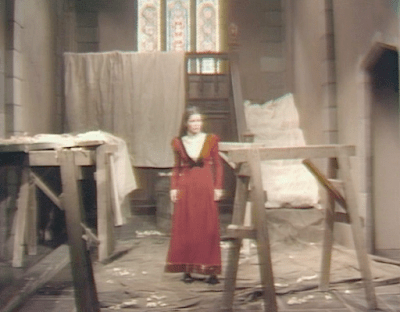
The great house of Collinwood, where Vicki lives in 1967, is under construction, and she goes there. Danny Horn, on his Dark Shadows Every Day, often said that the real subject of the series was the house. This scene corroborates his interpretation. When the ghost of little Sarah Collins said she would tell “the story from the beginning,” she sent Vicki back to the time when the great house was being built.
Vicki finds a man in the foyer played by Anthony George. George had been the second actor to play the part of Burke. You might think her experience with Abigail would break Vicki of her habit of telling her cast-mates what characters they played in the 1960s part of the show, but no such luck. She reacts to George’s new character as if he were Burke. After a moment, she tells him that she can see he isn’t the same man. This is a riddle- if the characters played by the same actor look so much alike that it makes sense for Vicki to keep mistaking them for each other, what does she see in this Anthony George character that sets him apart from the other?
As it happens, George is playing Jeremiah Collins, builder of the great house and brother of Joshua. In #280, Barnabas had given a costume party and George’s Burke had attended it dressed as Jeremiah. Barnabas, a native of the late eighteenth century, had been thunderstruck by the sight of Burke in that costume, unable to do anything but say “Jeremiah!” and glare at him. So there is a strong resemblance, perhaps suggestive of some spiritual linkage between the two men. Vicki’s constant confusion of the actors with their roles indicates that such linkages are to be found throughout the cast. Having her babble about the resemblances out loud so frequently is the most annoying possible way to make this point. If Barnabas had kept mistaking the 1960s characters for their 1790s counterparts, it’s hard to imagine that they would have accepted him and certain that the audience would not have.
Vicki tells Jeremiah that Abigail thinks she is a witch. Jeremiah makes it clear that he finds Abigail’s hostility to be a strong recommendation, and the fact that Sarah is a fan of Vicki’s clinches the deal. He takes her back to the main house.
Once Vicki is back in her room, Jeremiah brings her 1967 clothes. He asks her why she wants them so much, telling her that they will bring nothing but trouble if they are found. She tells him that she will need them when she gets home. Combined with her habit of blurting out remarks that could only strike people in the 1790s as bizarre, Vicki’s attachment to her belongings from her own time suggests that she will very soon find herself in huge trouble. That’s unwelcome- this voyage to the past is shaping up to be interesting, and it would be nice to stay here long enough to get to know all of the characters. If Vicki keeps acting like this, she’ll get herself kicked out of 1795 and drag us back to the 1960s before Dark Shadows has had a chance to show us what they can do with a period piece.
Vicki tells Jeremiah that she has amnesia about her life until her arrival at Collinwood the day before. He tells her that she will have to make up a better story than that. She is shocked that he is telling her to lie, and he says that she will never find a place in the world if she doesn’t.
When Barnabas left 1795 and showed up in 1967, we didn’t see anyone patiently explaining to him that he would have to conceal his true identity and maintain a convincing cover story. He had figured that out by the time we met him. Most of the time he was on screen in those first months, he was trying to play the role of a modern man, a distant cousin from England whom the Collinses had forgotten about. It was fascinating to watch him essay that part. Occasionally he would stumble and blurt out information only someone from an earlier century would know; Vicki caught him doing that more than once, most notably in #233, when it seems for a moment that he might be thinking of killing her to cover his indiscretion. Other times he would face questions he couldn’t answer, and we would wonder what he would set in motion with his attempts to evade them. Quite frequently actor Jonathan Frid would have trouble with Barnabas’ lines, and it would seem that Barnabas, not he, was the one groping for words. When we first realized yesterday that Vicki was taking Barnabas’ journey in reverse, we might have hoped that it would be as interesting to watch her trying to pass as a native of the eighteenth century as it was watching Barnabas trying to pass as a native of the twentieth. That hope took a beating before the day was done, and her conversation with Jeremiah reduces it to a still lower order of probability.
Downstairs, Abigail is telling Joshua and his wife Naomi that they ought to turn Vicki over to “the authorities.” Jeremiah opposes this plan. Naomi makes a great show of screwing up her courage and “for the first time” speaks out against Abigail’s ideas.
This is quite a reversal from what we saw in the part of the show set in the 1960s. Joan Bennett plays Naomi here and matriarch Elizabeth Collins Stoddard there; Louis Edmonds plays Joshua here and Liz’ brother Roger there. But where Joshua is an iron-willed, self-assured tyrant and Naomi his cowed and isolated dependent, Liz is the mistress of Collinwood and Roger a shameless, sybaritic wastrel who lives as a guest in her house and collects a salary from her business. We saw yesterday that Naomi is entirely illiterate; we see today that this inability, though it is an anachronism in a wealthy New England lady of the 1790s, is of a piece with her cramped position in the world. Not only is she supposed to obey her husband; she is supposed to defer to his sister, and is sidelined even in the management of her own household.
The show has been hinting heavily from the first episode that Vicki, played by Joan Bennett lookalike Alexandra Moltke Isles, is Liz’ unacknowledged daughter. It’s certainly no surprise when Liz goes out of her way to stick up for Vicki. Regular viewers, connecting Bennett’s two characters, may not be surprised that Naomi also takes Vicki’s side, but she doesn’t really have much reason within the story to do so. It might have been better if they had given the two of them more time together before this scene, and shown us why Naomi would be especially well-disposed towards Vicki.
Naomi carries her point, and Joshua offers Vicki a position as Sarah’s governess. Vicki is surprised when he asks if she can read; he says that “Many people can’t, these days,” a reference to yesterday’s demonstration of Naomi’s illiteracy. She is startled by his offer of four dollars a week; he angrily asserts he could get someone else for less, and she remembers herself sufficiently to agree that the pay is ample. Joshua is very much the haughty overlord, but he does have some closeups in which we see him looking vulnerable as he tries to figure out who Vicki is and why his wife and brother have taken her side against Abigail. It is a strong scene, and it raises our hopes that Joshua will make exciting things happen.









 Dark Shadows Commentary