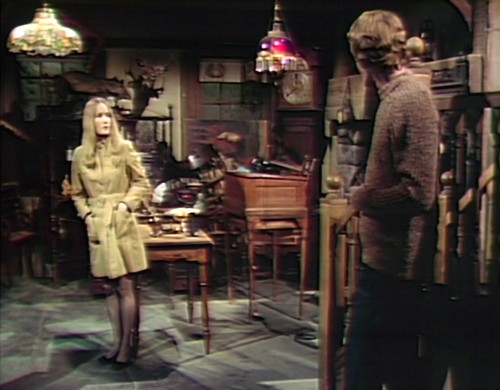
Heiress Carolyn Collins Stoddard has had a dream in which her new husband, whom she knows as Jeb Hawkes but who when we first saw him asked to be called Jabe, was in a fight on top of Widows’ Hill. His opponent, a stooge named Sky Rumson, threw him off the precipice to his death. When she awoke, Carolyn ran to the hill in search of Jabe. Instead, she found Sky. He told her that her dream was not complete, because it did not show her death. He then grabbed her by the throat.
Jabe rushes up and knocks Carolyn out of Sky’s grip. He and Sky fight, and Sky does throw him off the precipice. Carolyn escapes.
Back home at the great house of Collinwood, Carolyn finds her mother, matriarch Elizabeth Collins Stoddard, and permanent houseguest Julia Hoffman, MD. It takes her a while to compose herself sufficiently to tell Liz and Julia what happened. Julia offers Carolyn a sedative, which prompts her to jump up and shout a verbal refusal. By the time Carolyn starts telling the story, her distant cousin, old world gentleman Barnabas Collins, has joined them in the drawing room. She interrupts herself to yell at Barnabas that he always hated Jabe and is probably glad he’s dead. When Carolyn finishes, Barnabas slips out. Liz calls the police, and Julia is surprised neither of them saw Barnabas leave.
For the last nineteen weeks, the show has been trying to make a story out of some themes drawn from the writings of H. P. Lovecraft. That segment is usually called “the Leviathans,” after a race of Elder Gods who are behind the action. Jabe was central to the Leviathan segment. Sky is the only other character remaining from it. Barnabas appears in the house where Sky has been crashing and finds him packing his bag. Sky does not understand how Barnabas got in. Barnabas dismisses his question, merely saying that Sky knows there are things he can do that ordinary people cannot. Sky draws a revolver and fires two rounds at Barnabas point blank, without effect. Sky exclaims “Oh, no!” Barnabas is amused that none of Sky’s late colleagues told him that he is a vampire. He takes Sky’s hand, curls his arm back so that the gun is pointing at his heart, and squeezes Sky’s finger onto the trigger.
Back at the great house, Liz gets a telephone call from the sheriff. The police haven’t found Jabe’s body, and have surmised that it washed out to sea. They have found Sky, and have tentatively ruled his death a suicide. Later, Carolyn has another dream. In this one, Jabe shows up and confirms his death. That marks the end of the Leviathan segment. Carolyn will go on using the name “Mrs Hawkes” and saying she misses Jabe, but otherwise the last nineteen weeks will be forgotten.
Before killing Sky, Barnabas had mentioned that he almost regrets not leaving him to the other person who is on her way to do him in. That is Sky’s estranged wife, wicked witch Angelique. Had the Leviathan segment been more successful, or had Geoffrey Scott been even marginally competent in his performance as Sky, they might have made something of the parallels between Sky and Jabe. They are both very tall men with blonde wives who are dissatisfied with them. Angelique is dissatisfied that Sky is a tool of the Leviathans and that he tried to set fire to her on the orders of their representative, and Carolyn is dissatisfied with Jabe because he keeps running away from dangers he has brought on himself by his rebellion against the Leviathans and he won’t tell her anything about himself. Sky is a mortal man, while Angelique may once have been human but has long since become a creature of the supernatural. Carolyn is a mortal woman, while Jabe is now human but was originally a shape-shifting monster from beyond space and time.
But the ratings have been sinking throughout the Leviathan period, and the whole narrative structure of the arc keeps collapsing around them every time they try to do anything with it. So they are in too much of a hurry to move on to the next thing to do any exploring of the characters. Also, Scott is hopeless. As my wife, Mrs Acilius, put it, it isn’t that he is an actor with just one strategy. He keeps trying different things, and none of them comes close to working. We won’t see him again.
The new story has to do with an alternate universe that is occasionally visible in a room in the long disused east wing of Collinwood. Barnabas, Julia, and others have been spying on its inhabitants, and Barnabas is fixated on the idea that if he can cross over into it his vampirism will disappear. Since his bloodlust is overwhelming him, he is desperate to pursue this forlorn hope. He goes to the room when the alternate universe cannot be seen there, and a moment later finds that it has changed with him in it. Julia is in the hallway, looking in. At first she and Barnabas can see each other, and she can hear him, though he cannot hear her. After a moment, Carolyn’s alternate universe counterpart enters and demands to know who Barnabas is and what he is doing in the house.
Barnabas took Carolyn as his blood-thrall in October 1967. The show went back in time to 1795 the following month. In the 1790s segment, Nancy Barrett played fluttery heiress Millicent Collins. We saw that Barnabas first became a vampire in 1796; not long after, he took Millicent as his blood thrall. Shortly after the show returned to contemporary dress in March 1968, one of Julia’s colleagues in the mad science profession applied a treatment that put Barnabas’ vampirism into remission. That freed Carolyn of her connection to him, and at some point she forgot it ever happened.
For most of 1969, Dark Shadows was set in 1897. In that segment, Miss Barrett played repressed schoolmarm Charity Trask. Barnabas bit her, too. Carolyn’s counterpart in “Parallel Time,” known by her married name Carolyn Loomis, is the fourth character* Miss Barrett played on Dark Shadows; considering that Barnabas is so frantically hungry, it looks like she will follow in the footsteps of her predecessors and serve as his breakfast.
*Or fifth- in #819, sorcerer Count Petofi found Charity’s personality to be an irritant, so he erased it and replaced it with that of the late Pansy Faye, a Cockney showgirl/ mentalist. From that time on, Miss Barrett played Pansy, not Charity.
Wicked witch Angelique made her first appearance in #368/369, set in the year 1795. We first saw Angelique when she entered the doors of the Old House on the estate of Collinwood, working as a lady’s maid and hiding her powers.
Today, it is 1970 and Angelique is back in the Old House. Her ex-husband, vampire Barnabas Collins, has summoned her and asked her to lift a curse she placed on Jabe, the husband of his distant cousin Carolyn. Barnabas tells Angelique that her quarrel was never with Jabe, but with suave warlock Nicholas Blair. Earlier in the episode we had seen Angelique and Nicholas having a discussion about how much they hate each other. He taunted her by claiming she has not changed in the last 200 years. When Barnabas invites Angelique to redirect her wrath towards Nicholas, she perks up. She orders Barnabas to fetch Carolyn’s husband and leave him alone in the Old House with her.
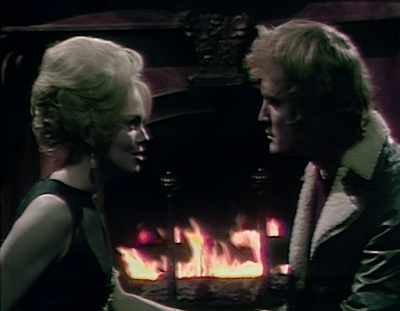
Angelique sits by the fire with Jabe and explains that she cannot simply liquidate the curse. It must end with someone’s death. But the good news is that it does not have to be his death. He can transfer it to someone else. He says he doesn’t want to kill anyone. She tells him that the person she has in mind is Nicholas. Suddenly he’s all ears as she explains the process for handing the curse over.
Angelique finds the limit of Jabe’s newfound reverence for life. Screenshot by Dark Shadows Before I Die.
Longtime viewers know that Nicholas was quite wrong to say Angelique has never changed. She was monomaniacal and utterly narcissistic in 1795. She wasn’t so very different when we next saw her in 1968, though the show’s pace was a bit slower at that point and so Lara Parker was free to play her with more nuance. That made a difference that the show underlined early in 1969, when Barnabas took a brief trip back in time to the 1790s and ran into Angelique as she was when first we knew her. Even though they were still enemies in 1968, they occasionally had to tell each other the truth, and occasionally had to leave each other alone to fight other adversaries. The unbending hostility the eighteenth century version of Angelique showed Barnabas startled him and us after we had seen the relatively circumspect approach she took to conducting a cold war against him.
Throughout most of 1969, Dark Shadows was set in 1897. Angelique showed up then, and she remembered the events of 1968. Barnabas and his friend, mad scientist Julia Hoffman, were there as time travelers. Julia actually befriended Angelique, and Angelique became Barnabas’ ally in the battles he attempted to wage in that period. Angelique even let go of her erotic obsession with Barnabas, transferring her affections to his distant cousin Quentin Collins.
After the show came back to contemporary dress, Julia stumbled upon Angelique. She found that Angelique had sworn not to use her powers, had married a man who made her happy, and had lost all interest in Barnabas or anyone else at Collinwood. She was as relaxed and attentive to others as in 1795 she had been frantic and self-absorbed. Only after it turned out the same supernatural enemies Barnabas and Julia were fighting had corrupted her husband did Angelique start casting spells again, and then in pursuit of more rational, identifiable goals than she had ever sought in the eighteenth century.
That arc of character development ends with this episode. We will see Lara Parker as several more characters up to and beyond the end of the series, some of them named Angelique, but none of whom went through the transformations we have seen.
Today also marks the final appearances of werewolf Chris Jennings and his girlfriend Sabrina Stuart. Evidently the makers of the show planned to bring them back in a few months, after an upcoming story plays out, but by that time actor Don Briscoe was unable to work. He had bipolar personality disorder and tried to self-medicate with street drugs.
Quentin was such a big hit in 1897 that they had a magic spell put on him that immunized him against aging and brought him intact to the contemporary setting. Today, Barnabas takes Quentin to a room in the long disused east wing of Collinwood where you can occasionally catch glimpses of an alternate universe. The effect manifests while they are looking in, then winks out, leaving the dark, bare room that is in that space in their universe. Once that happens, Barnabas announces “You have just seen Parallel Time.” Those of us who have been watching from the beginning know that he got the line wrong. You’re supposed to say “Parallel Time is a Dan Curtis Production.”
An information management day. Old world gentleman Barnabas Collins has told his distant cousin, Roger Collins, about a parallel universe that is occasionally visible in a room in the long disused east wing of the great house of Collinwood. Today, Roger tells his sister Elizabeth about the room. Liz owns the house. We might wonder if she will have questions about what effect the presence of a spare universe on the premises will have on her property taxes.
Roger talks about the phenomenon while standing in the room with permanent houseguest Julia Hoffman, MD. He is incredulous when he notices that Julia is not listening to him. She cannot tell him what has distracted her. Unknown to Roger and Liz, Barnabas is a vampire. Julia has devised a treatment that is supposed to put this curse in remission, but it is not working at all. She has given him the last of the injections, and the only difference in Barnabas is that he is getting sick and feeling an unusually intense bloodlust.
Caretaker Chris Jennings, another distant cousin, comes stumbling home to his cottage on the grounds of the estate. He finds his girlfriend and ex-fiancée Sabrina Stuart waiting for him. Chris is another patient Julia has been unable to help. He is a werewolf. There was a full moon last night. Sabrina tells Chris he killed a man named Bruno. Chris is distressed that he killed anyone, but Sabrina points out that Bruno knew of his secret and was trying to use him to kill others. He was holding her and a man named Rumson prisoner, and when the police searched Bruno’s premises after his death they found Sabrina and Rumson imprisoned there. Sabrina keeps telling Chris she wants to marry him. Most of the time they will live ordinary lives, but one night out of 28 she will just have to lock him up in a special cell. Chris won’t hear of this.
My wife, Mrs Acilius, is a great one for love stories and an admirer of actress Lisa Blake Richards. Chris and Sabrina have run out of road on Dark Shadows, and are obviously going to be written out soon. Mrs Acilius wishes they could ride off into the sunset accompanied by the sound of wedding bells. So when Chris refused to marry Sabrina, she exclaimed “Stupid man!” I pointed out something Chris knows but does not mention to Sabrina, that his curse is hereditary. Any male descendants he has will also be werewolves. Mrs A conceded that this does complicate matters.
Roger saw Chris at Bruno’s place when he rescued him and Carolyn shortly before moonrise last night. Chris was at that time in the throes that precede his transformation. Chris ran off before Roger or Carolyn could see what became of him. Roger comes to the cottage to check on him.
Chris is in the back changing out of his bloody clothes, so Sabrina answers the door. She tells Roger that Chris is there and that she was with him all night, watching over him because he was ill. After what he saw of Chris at Bruno’s, Roger has no doubt that Chris needed a nurse, and he tells Sabrina that he is glad he had such a charming one. The audience can understand that Sabrina wants to conceal Chris’ lycanthropy from Roger, but surely it cannot be wise for her to claim that she was in the cottage overnight. Not only are her true whereabouts known to everyone who was in or around the police station the night before, but since Roger was the one who found Bruno’s body and he found it on the grounds of Collinwood, even police as inept as the ones in Collinsport are likely to follow up with him. Besides, her imprisonment with Rumson is a sensational story, of interest to the press. Maybe we will move on to the next phase of the show before the facts come to light, but Sabrina can’t know that.
Sabrina is determined to persuade Chris to resume their engagement. She goes to the one person whose opinion Chris seems to respect, Barnabas. When she knocks on his door, Barnabas hides behind a partition. When Sabrina first arrived, she had seen Barnabas through the window of his front parlor, so she lets herself in. He finally gives up on hiding and pleads with her to leave. She ignores what he is saying and keeps talking. She plows ahead with her idea about how Barnabas can help her and Chris become a happy married couple. Barnabas struggles to resist his urge for blood, but cannot. He bites Sabrina, much to her surprise. Miss Richards’ understated exclamation of “Barnabas!” when he shows his fangs and goes for her neck is very nicely done, it really sounds like a woman puzzled that a trusted friend is violating her personal space.
Sabrina staggers back to Chris’ cottage. She collapses in his chair, and he sees the puncture wounds on her neck. They are much bigger than the marks we’ve seen on Barnabas’ previous victims. I suppose he really was a lot hungrier than usual. Chris doesn’t know that Barnabas is a vampire, and the cliffhanger leaves us wondering whether he can avoid finding out.
Probably the most memorable shot in the episode is a very impressive bit of videotape editing. Roger and Barnabas are standing at the door to the Parallel Time room, watching Roger’s counterpart interact with Liz’ and Chris’. Parallel Roger walks toward the door. He exits the room, not into the space Roger and Barnabas occupy, but into the hallway as it exists in Parallel Time. He vanishes from their view, and the effect also winks out in the room, leaving Roger and Barnabas looking into the bare, dark chamber it is in the house they know.
The Leviathan People, a race of Elder Gods, plan to retake the Earth and destroy humankind, and their harbinger is a shape-shifting monster who has taken the form of a tall young man and asked people to call him Jabe. Their plan requires that Jabe join himself to heiress Carolyn Collins Stoddard in an unholy ceremony that will transform Carolyn into the same kind of squamous, rugose, and paleogean creature Jabe defaults to being. Jabe has fallen in love with Carolyn, but so far from redoubling his determination to fulfill the plan his feelings have turned him against it. He wants to renounce his powers, become truly human, and make a life with Carolyn as she is. Though Jabe’s personality has been so obnoxious that even people brainwashed into supporting the Leviathans’ whole program have gotten fed up with him and become his enemies, he has somehow won Carolyn’s heart. She doesn’t know that he is a monster from beyond space and time, still less that he murdered her father and several other people. She is in love with the man he appears to be, and he wants to become that man in fact.
I first shared my thoughts about Dark Shadows online in the comments section of Danny Horn’s great blog Dark Shadows Every Day. In his post about #962, Danny identifies a major problem with the relationship between Carolyn and Jabe:
But both sides have apparently agreed to shield Carolyn from the big sinister secret, so in practice, she hasn’t had very much to do, except to fall passionately in love with Jeb, because of reasons.
As I’ve said before, I don’t know why Carolyn likes Jeb, and I’ve been scratching at that itch for a while. But today, I think I figured out the real problem with her character arc, and it’s all about the let’s-break-antiques scene.
This was Carolyn and Jeb’s first date, back in episode 940. I didn’t write about it at the time, because I had other things to say, and I didn’t realize how important it was until now.
The scene takes place in the antique shop, and it starts with Jeb gazing at her, and sighing, “I’m going to be very happy with you.”
She’s puzzled. “What made you say that?”
“Because I felt it,” he shrugs. “Haven’t you ever said or done what you felt?”
“Sometimes I do.”
“I do it all the time,” Jeb smirks, and swaggers across the room. “Everybody should. I always do what I feel. Right now, I feel like doing this.”
And then he picks up a porcelain figurine from a nearby display, and smashes it on the floor.
Carolyn is horrified, obviously. “Jeb, you shouldn’t have done that!”
He smiles. “Why not?”
“That was an antique, and it didn’t even belong to you!”
“Haven’t you ever felt like breaking something?”
She stops short. “Yes,” she says, “but…”
“Well, then, let’s see you break this.”
Then he picks up another figurine.
“Go on,” he says, offering it to her. “Break it.”
She looks into his eyes, and says, “I wish I could begin to understand you.”
“Maybe you can,” he says, “if you just free yourself. Go on. Just let it drop from your hand.”
[Smash]
He smiles, and opens a bottle of wine. She asks what he’s doing, and he says, “We’re going to celebrate.”
“Celebrate what?”
“Your liberation.”
“I don’t understand.”
He hands her the drink. “Oh, you will… soon.”
It’s a weird scene, and it should have been followed immediately by a dozen more weird scenes along the same lines. This should have been the storyline.
After all, the whole point of the Leviathan threat is that they’re going to take Carolyn, a character that we love and root for, and turn her into a hideous gargantuan, rutting with her blasphemous mate and raising a brood of ambidextrous deathstalkers.
And in the let’s-break-antiques scene, they set up the idea that Jeb is going to change Carolyn’s personality, leading her step by step into his dark world, in the service of her “liberation” from boring traditional values, like respect for other people’s ugly decor. We should have seen her going down that path, becoming more and more estranged from the family and friends who aren’t part of this nightmare death cult.
Except they didn’t. The champagne was drugged, and she blacked out, and since then, they haven’t even touched on the idea that Jeb might be leaving a stain on Carolyn’s soul.
Now, this is a show that’s explored a dozen varieties of hypnosis and possession in minute detail, so it’s not like they don’t know how to write a story like that. They just didn’t. To the extent that we believe that Carolyn loves Jeb, it’s an entirely innocent, human infatuation with a handsome stranger, who she’s unfortunately not really allowed to know very much about.
Because they can’t change Carolyn.
This is an enormous problem for the show, and it’ll be one of the key pieces to the puzzle of Who Killed Dark Shadows. There are four core family members, and they are untouchable. They don’t experience any lasting change, starting around early 1968 and continuing until the end of the show. Sure, they have moments of temporary hypnosis and possession, everybody does, but they don’t actually change.
And if Carolyn can’t change, even a little, then that means there’s no future, just a status quo that leads inexorably towards entropy, and the heat death of this fictional universe.
My main role in Danny’s comments was to draw connections between the episodes he discussed and the episodes from the first 42 weeks of the show, which he made a point of not discussing. In response to the above, I wrote:
It is too bad that the show got to the point where the only stories that counted were the supernatural ones. Not that those shouldn’t always have been the A stories, but there should have been room for B stories where we explore the characters’ personalities and see how humans might react if they were to find themselves living in a world like that of DARK SHADOWS.
As it turned out, it was difficult to do much with human characters even within the supernatural stories. Danny’s hypothetical series of scenes between Carolyn and Jabe where we see Carolyn being seduced to the dark side could have been very powerful if we’d been tracing Carolyn’s evolution from tempestuous, self-centered, spoiled rich girl of 1966 and 1967 to the relatively calm, responsible young woman we saw in 1968 and 1969. They could then keep us in continual suspense- would Carolyn continue to grow into a powerful matriarch, or would the shock of one otherworldly horror after another shatter all her progress and send her reeling back to her most unsympathetic moments? Since we haven’t had scenes focusing on Carolyn’s personality and relationships since Jason McGuire was on the show, and we aren’t expecting any to come ever again, hav[ing] a thread like that on the show at this point would seem as out of place as does a week spent documenting in exhaustive detail the evolution of Bruno’s attitude towards Jeb.
Nancy Barrett is a superb actor, and while she is on camera we believe that Carolyn loves Jabe. But she has to create this impression from the ground up every time she appears. Nothing that is happening reinforces it. Not only does her love for Jabe pop into being out of nowhere, but because she is not involved with anything he is doing it cannot motivate her to take any significant actions. Today Jabe and Carolyn stand before an altar while a high priest of the cult devoted to the Leviathans is performing the ceremony meant to unite them in horrid monstrosity. But Carolyn is there, not because of any decisions she has made or feelings she has, but because she has been hypnotized by the high priest.
I am reminded of the 2006 film Idiocracy. An average man from the early twenty first century suddenly finds himself in a future where everyone has a very low mentality. He goes to the movies and discovers that the most popular film of the era is called Ass. It is a 90 minute closeup of a pair of flatulent buttocks. When he becomes head of state, the protagonist explains that in his day there was something called a “story.” He describes a story as “a way of making you care whose ass it is and why it is farting.” That’s what the Leviathans segment lacks. The execution is good enough to make us believe that particular things are happening, but there is nothing to make us care who is making them happen or why they want them to happen.
One of the few forms of narrative that is still cultivated in the world of Idiocracy is professional wrestling, a dramatic genre in which villainous characters often have changes of heart and become heroic. This is known as the “heel-face turn” (as opposed to the “face-heel turn,” which is the opposite character development.) They have been working on Jabe’s heel-face turn for a few days. Yesterday he asked mad scientist Julia Hoffman to cure him of whatever it is that makes him revert to his monstrous form. Christopher Pennock and Grayson Hall played that scene so well that we wished we could ignore everything else in the episode and believe in it. Jabe started the episode by ordering four zombies whom he had raised from the dead to murder five people: Julia; her friend, vampire Barnabas Collins; two distant cousins of Barnabas’, Quentin Collins and Roger Collins; and Barnabas’ servant Willie Loomis. Jabe told Julia he would not kill her or Barnabas if she complied with his request, but at the end of the episode he had the zombies stuff Quentin in a coffin and bury him alive. After that, we could hardly believe that Jabe had changed at all.
Today, Barnabas is at home when Maggie Evans, The Nicest Girl in Town, bursts into his front parlor. She tells him she is sure Quentin is trapped somewhere and has no more than an hour to live. Barnabas has no idea how Maggie can know this, and she can’t explain it herself. The camera zooms in on a trident drawn on her hand, and regular viewers know what is going on. A while ago, Barnabas’ ex-wife, wicked witch Angelique, cast a spell on Maggie and Quentin causing them to feel an overwhelming love for each other at irregular intervals. Angelique thought this would make Barnabas unhappy, but he hasn’t noticed it, and he has so much else going on right now it seems unlikely he’d care much one way or the other if he did. The spell enables Maggie to lead Barnabas to the grave where Quentin is trapped and to tell Barnabas to dig it up. Quentin is fine when they exhume him, so if anything Barnabas should be glad of Angelique’s spell.
When Quentin comes out of the coffin, he says his only problem is that his legs hurt. Since he is 6’4″ tall and the coffin is at most 5′ long, that’s understandable. He says that Jabe told him he had something out of the ordinary in store for him. Now he knows that whatever else Jabe may be, “he’s a man of his word!” Usually David Selby’s accent raises a bit of a puzzle- why is the rakish scion of an aristocratic old New England family also an amiable West Virginian? But Mr Selby’s delivery of this line, with its note of appreciation for Jabe’s forthrightness, is so perfect that you could never wish him different in any way.
The high priest of the Leviathan cult whom we will see presiding at Jabe and Carolyn’s joining ceremony is none other than suave warlock Nicholas Blair, who was well known around the great estate of Collinwood in 1968. Nicholas finds Julia working on a chemistry experiment preparatory to her project of humanizing Jabe; he smashes her equipment and says he will let her live if she goes away and does not interfere with the Leviathans’ project.
When Nicholas calls on Carolyn to hypnotize her, she recognizes him and expresses mild surprise that he is back. When she insists on addressing him as “Mr Blair,” he tells her that her mother called him by his first name. She replies, “Well, that’s my mother’s business,” and asks him again why he is there.
Jabe visits Julia at Barnabas’ house and pleads with her to do something for him tonight. She says that even if that were possible, she would refuse to do it, since she knows that he buried Quentin alive a few hours ago. He says that she must believe that he is “a changed man” who is willing to “live and let live,” though he is not free to explain what has brought this change on. Barnabas comes downstairs and gives Jabe a dirty look.
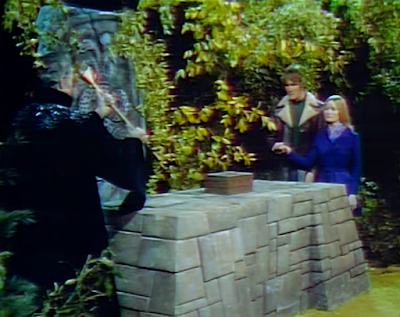
The joining is underway at a cairn in the woods. Only people associated with the Leviathans can see the cairn. A small wooden box sits on the cairn; Jabe originally emerged from that box, four months ago, back when he was nothing more than a whistling sound. Nicholas stands to one side, obscured by branches, reciting a lot of mumbo-jumbo and waving a long rod. Jabe and Carolyn stand together on the other side. Nicholas orders Jabe to take the rod. He does. He stands behind the raised part of the cairn that serves as an altar and faces the box.
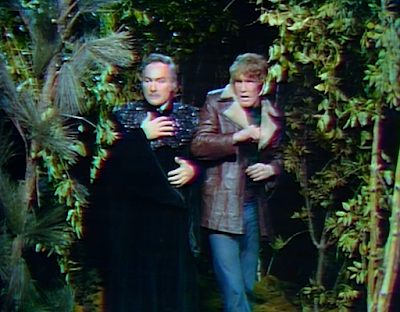
At that moment, Jabe shouts “Now, Barnabas! Get her now, Barnabas!” Barnabas leaps from behind the foliage, grabs Carolyn by the arm, and runs off with her; Jabe brings the rod down on the box, smashing it. Nicholas exclaims “You fool, do you know what you’ve done!? Better leave now or we’ll both go up in it!” The cairn glows and collapses; Nicholas and Jabe stand together off to the side, watching. Jabe clutches himself by the middle, groans, and passes out.
Watching it this time, I was not only surprised by Jabe’s “Now, Barnabas! Get her now, Barnabas!”; I remembered being surprised by it last time we watched the show through. It really is a thrilling moment, one of many in the Leviathans segment. But since it exhausts all of the elements in that segment from which a story could have been built, and since there is absolutely no other storyline going just now, I’m afraid the comparison to Idiocracy’s movie-in-a-movie Ass has to stand.
We are approaching the end of the sixteenth week of a segment made up of material drawn from the tales of H. P. Lovecraft. Central to this is the idea of the Leviathan People, a race of Elder Gods who want to retake the Earth and eliminate humankind. There has been a lot of good stuff in these episodes, but it hasn’t come together as a unit. At this point, the narrative seems to be falling apart completely.
The harbinger of the Leviathans, who appears to be a tall man in his mid twenties named Jeb but is in fact a four-month old shape-shifting monster who would rather be called Jabe, has lost interest in the plan and wishes he could be a real boy. Jabe has alienated virtually everyone with whom he has come into contact, including people who were under heavy mind-control meant to turn them into his slaves, and has been reduced to raising four recently deceased men to serve him as zombies.
Yesterday, he ordered the zombies to kill five of his enemies. The targets he listed were mad scientist Julia Hoffman, vampire Barnabas Collins, Barnabas’ servant Willie Loomis, and Barnabas’ distant cousins Roger Collins and Quentin Collins. The zombies have abducted Julia and brought her to Jabe’s house. She is welcomed there by a man named Sky Rumson. Sky is not a zombie, but may as well be for all the skill Geoffrey Scott brings to the role. When Scott recites his dialogue, you get the impression that he is telling you what an actor would say had they cast one in the part. Grayson Hall could fill any stage without support, making Julia’s scene with Sky relatively painless, but if it was meant to have any significance the audience will never know what that was.
Sky and a zombie force Julia into the back room of the house, where Jabe is in the squamous, rugose, and paleogean form of the true Leviathan. She is terrified by the sight. Jabe resumes his human shape. He and Julia go back to the living room, where he confides in her that he doesn’t want to take his Leviathan form ever again. He wants to renounce his powers and become human. He knows that Julia is giving Barnabas treatments to put his vampirism into remission, and that she succeeded with such treatments when Barnabas was under a different vampire curse in 1968. He asks her to help him rid himself of his Leviathan side. She is unsure she will be able to do so, but can’t resist the challenge. By the end of the scene, she is figuring out what tests she will have to run to diagnose the biochemical basis of Jabe’s condition.
Christopher Pennock really was a fine actor, and he is outstanding in this scene. He sounds like a deeply lonely, helplessly confused young boy who can’t figure out how to overcome the consequences of his own abuse of the people around him. Jabe’s request for Julia’s help and his agreement to lay off Barnabas as the price for it doesn’t fit with the orders he gave the zombies yesterday, the actions he takes later today, or anything else in the Leviathan story, and is a sign that the plot is falling apart faster than the writers can patch it up. But he and Hall are so splendid in showing Jabe’s neediness and Julia’s response to it that it doesn’t matter.
Meanwhile, Sky is at the great house of Collinwood, looking for Jabe’s foster mother-turned-makeout partner Megan Todd (it was 1970, everyone took Freud very seriously.) He meets Roger and Quentin there. They hold him at sword point until he tells them where Julia is and how to get past the zombies. To the extent that there is a reason for Sky to be on the show, it is to illustrate how total the control is the Leviathans have over the minds of the people they have co-opted, so when he gives in so quickly to Quentin’s threat to give him a scar (not even to kill him, just to compromise his potential as a model for deodorant ads) he dissolves the last prospect that the Leviathans themselves will be a danger we can care about.
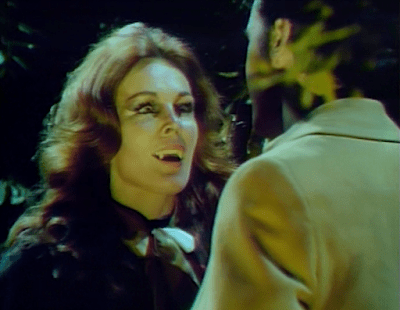
Quentin goes off to rescue Julia, and Roger assumes responsibility for holding the sword. He is momentarily distracted when he sees Megan in the window, and Sky takes advantage, disarming Roger and running out of the house. Outside, he meets Megan and tells her that Jabe is upset with her for some reason. She asks if he is afraid of her. He is puzzled by the question, and tells her she is very beautiful. She invites him to look at her. As he does, she opens her mouth, revealing vampire’s fangs. She bites him.
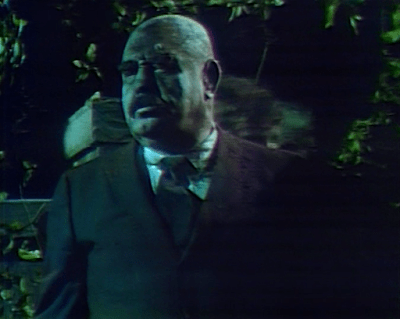
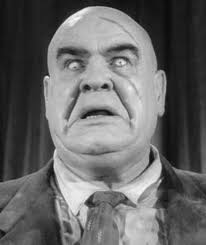
Quentin arrives at Jabe’s house. Jabe is surprised to see him, but not surprised Sky was too chicken to keep any of his secrets. He orders the zombies to seize Quentin. The tall, portly, shaven headed zombie, who wears a mustache that keeps him from being mistaken for Tor Johnson in Plan 9 from Outer Space, slaps Quentin in the face a single time. With this, Quentin instantly loses consciousness. Yesterday, other zombies slapped Julia and Roger in the face, each a single time, and each of them instantly lost consciousness as well. Great ones with slaps, the zombies.
Jabe instructs the zombies to stuff Quentin into a coffin that is about three feet too short for him, and then has them carry it all the way to the cemetery. He has them bury Quentin in a grave that one of them had recently vacated. I suppose real-estate flipping has been interesting to TV viewers for longer than I had thought.
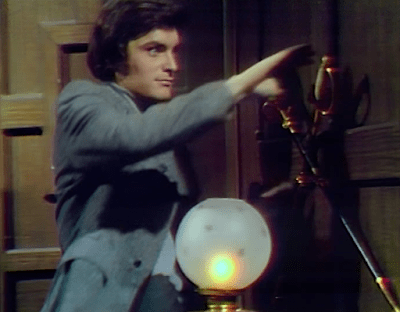
There is a famous goof in today’s episode. When Quentin grabs the sword out of its display on the wall of the Collinwood drawing room*, the lamp underneath it falls off the table and smashes on the floor. You know this wasn’t supposed to happen because it takes place out of frame and you can hear the stagehands sweeping the floor while Sky is pinned to the wall. Also, Dan Curtis was way too tight with a buck to break a lamp for the sake of a scene that’s mainly about a character as minor as Sky Rumson. It’s a shame they couldn’t have pulled the camera back and shown the lamp shattering, it would have been perfectly suited to the moment. And if they had to sweep up the wreckage right then, well, it would have been hilarious if housekeeper Mrs Johnson had come in with her broom and dustpan, taken care of the mess, and left without a word about what Quentin and Roger were doing to Sky.
The reigning chief villain on Dark Shadows is a shape-shifting monster from beyond space and time. He refuses to shift his shape, since he likes being a tall young man. He isn’t interested in any part of space or time not connected with heiress Carolyn Collins Stoddard, with whom he has fallen in love. He can’t persuade anyone to call him by his preferred name, “Jabe,” so has resigned himself to going by “Jeb.”
As we open, Jabe is raising four men from the dead. That he can do such a thing might suggest that he is a formidable menace, but the introductory voiceover explains that he has no choice about it, since he is “unable to trust one living human being.” Whatever powers he may have, Jabe is surrounded by enemies whom he can battle only by resorting to the most desperate means. We are left wondering how much longer the show can keep the storyline going if it depends on such a feeble menace.
Jabe and one of the zombies are peeking through the window of the Old House on the estate of Collinwood, home to vampire Barnabas Collins, a distant cousin of Carolyn’s. Jabe sees Barnabas’ best friend, mad scientist Julia Hoffman, giving him an injection. He realizes that Julia is trying to treat Barnabas’ vampirism.
Jabe goes to the great house on the estate and orders Carolyn’s mother, matriarch Elizabeth Collins Stoddard, to keep watch over Barnabas’ blood thrall Megan Todd. Liz is one of Jabe’s few remaining followers. He is crude and abusive towards her; she protests that they are in her house, and when he responds to this with a sneer she gives him a look of disbelief. First-time viewers can understand how Jabe came to be so isolated.
When Barnabas was first on the show, from April 1967 to March 1968, Liz never figured out that he was a vampire. The show depended on keeping Liz in the dark about Barnabas’ curse, because she was too civic-minded to let him stay in a house on her estate if she had known that he was an abomination risen from the depths of Hell to prey upon the living, even if he was her cousin. In those days, the show seemed determined to keep Liz on the shelf lest she be stained by contact with the main story, and so they took care to give Barnabas’ adversaries reasons to keep from telling Liz about him.
Now, Liz is under the control of the forces Jabe represents. She is already hostile to Barnabas, and has told Jabe she would try to evict him from Collinwood if that is what he wants her to do. Jabe does not have any reason to withhold from her the fact that his enemy is a vampire.
Moreover, Liz is no longer the symbol of lawful goodness she was two years ago. In #956, she told eleven year old Amy Jennings that she hoped Jabe wouldn’t murder Maggie Evans, The Nicest Girl in Town. Her first reason for not wanting this to happen was that it would remind people of the other murders Jabe has committed. The second, and more important, was that it would tend to exonerate the person they have framed to keep the heat off Jabe. It seems likely that Jabe will soon defeated and Liz will be released from the spell under which she has been laboring, but if she comes out of that remembering what Barnabas is she will also remember that she herself is complicit in some pretty serious felonies, all of them well-known to Barnabas. Since Liz knows that Barnabas is invested in her position in the community and puts a high priority on protecting it, the show wouldn’t have a hard time explaining why she keeps him around, and she would be available to take part in whatever stories they might have going.
Liz is sitting with Megan. She can see that Megan is ill and goes to fetch her a glass of water. When she returns, Megan has gone. We see Megan at Barnabas’ house. Barnabas is intensely hungry. But he does not want to bite her. He knows that if he does so, she will die. She insists, and he gives in.
Julia enters and pronounces Megan dead. Barnabas is in a panic; he had earlier lied when Julia asked him if he had bitten anyone, and he flies directly into hysteria, accusing Julia of implying that he acted deliberately. She keeps her cool and assures him she does not see it that way. Usually Julia’s quickness to make excuses for Barnabas’ murders is an opportunity for Grayson Hall to amaze us with the spectacle of a brilliant woman rationalizing the behavior of a hopelessly evil man, but this scene is a showcase for Jonathan Frid. So they have taken care to establish that Barnabas was overpowered by the need for blood and have shown him taking steps to avoid biting Megan, allowing us to take Julia’s behavior more seriously and focus on Barnabas’ panic.
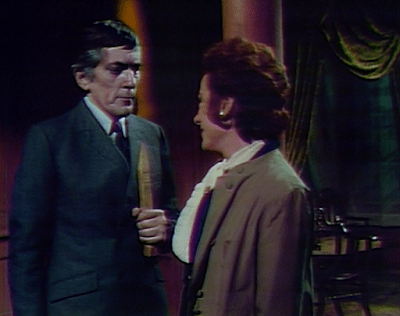
Barnabas tells Julia that to prevent Megan rising as a vampire they will have to drive a wooden stake through her heart. Previously Barnabas has simply strangled his victims or broken their necks after they died, and that has kept them from coming back. He did this as recently as #951, when he fed on Jabe’s would-be devotee Nelle Gunston. Regular viewers will know that the trip he and Julia make to the basement to fetch a stake is just a setup for them to return and find Megan already gone. Before that happens, there is a strange moment when Barnabas and Julia have the stake and are talking about driving it through Megan’s heart. Barnabas wants to spare Julia that horror, but she smiles warmly as if assuring him that it is her pleasure to join in the act.
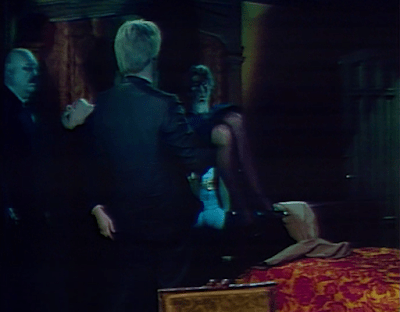
Jabe dispatches his four zombie henchmen into the great house, saying that he has given them their orders and now it is time to “Carry them out!” Julia lives in the great house, and is working with some test tubes in her bedroom. It’s the first time we’ve seen Julia’s room in years, and the first time we have seen scientific apparatus of any kind there. One of the zombies knocks on her door, another emerges from behind the curtains, and a third comes up and slaps her in the face. Perhaps remembering Jabe’s words as he sent them into the house, they carry her out.
One of the zombies is named Thomas Findley. Longtime viewers will remember Madame Janet Findley, a psychic who made a big impression in three episodes in December 1968, and Margaret Findley, who was one of the ghostly Widows who were prominent in the show’s supernatural back-world in its first 26 weeks. Another zombie is a large bald man who will remind many viewers of Tor Johnson in Plan 9 from Outer Space.
Danny Horn’s post about this one at his great Dark Shadows Every Day is a fascinating comparison of the episode with four issues of Gold Key’s Dark Shadows comic book. Other commentators have mentioned that the graveyard scenes often evoke the sensibility of EC Comics, particularly in the character of The Caretaker, but Danny’s in-depth discussion of what this episode has in common with those four issues is far and away the most substantive analysis I have seen of the overlap between the visual grammar of Dark Shadows and that of comic books.
The Leviathan People, a race of Elder Gods, are planning to retake the Earth from humanity. Like all stories of Elder Gods, this one raises the question of why they lost the Earth in the first place. The answer seems to be clear. The first Leviathan to manifest himself is a shape-shifting monster who spends most of his time in the form of a tall young man who, when we were introduced to him, asked to be called “Jabe.” No one would call him that, so he settled for “Jeb.” The Leviathans have assembled a cult of people to serve them; Jabe’s personality has alienated many of them already, and seems likely to alienate more.
Among the ex-followers who were glad to join a plot to exterminate homo sapiens but who found Jabe too obnoxious to stomach are vampire Barnabas Collins and a crazed sadist known only as Bruno. Jabe’s onetime foster mother, Megan Todd, lost her allegiance to the Leviathans after Barnabas bit and enslaved her. Since Barnabas’ current bout of vampirism is the result of a curse Jabe placed on him during a tantrum, the cult’s loss of Megan is another strike against Jabe.
The Leviathans have two principal vulnerabilities. They can be destroyed by ghosts or by werewolves. Since they have chosen to start their campaign on the great estate of Collinwood, which is the world capital of both ghosts and werewolves, this would suggest that they are as bad at strategic planning as Jabe is at team-building.
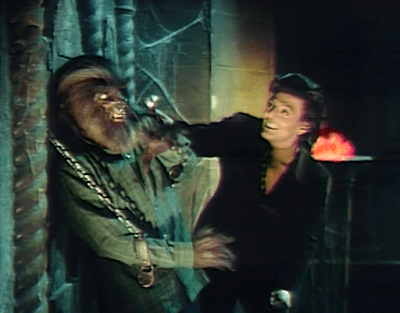
Bruno has captured the current werewolf and lures Jabe to him. He also discovers that Megan is Barnabas’ blood thrall. Everything else today is filler, but it does give the actors a chance to show off. Bruno beats the werewolf with a whip to ensure that he will be angry enough “to rip a man to shreds!” He’s a werewolf, the whole idea is that he’s already disposed to rip anyone he meets to shreds, but as Bruno Michael Stroka puts so much zest into the whipping scene that we forget how ridiculous the furry rig Alex Stevens is wearing looks and feels sorry for the poor widdle doggie.
Barnabas summons Megan to his house and gives her some instructions that don’t make sense and that she won’t have the chance to follow. While she is there, she says she just wants him to suck her blood. He does. Marie Wallace plays Megan in this scene as if she is having a sexy dream.
Bruno left the late Sheriff Davenport, whom Jabe killed and then brought back as a zombie slave, to guard the werewolf. To keep the zombie from getting in the way of his plan to use the werewolf against Jabe, he tricks him into letting the werewolf destroy him. Davenport is the most garrulous zombie of all time; in his first postmortem appearance, when Jabe set him to hold prisoner Maggie Evans, The Nicest Girl in Town, Davenport rambled on and on about everything he saw and heard, at one point launching into an explanation of some things his wife used to do that annoyed him. Today he has to argue with Bruno, demanding to know whether he has authorization from Jabe to leave the werewolf alive and giving his opinion that it isn’t a good idea to take too much initiative. Ed Riley does as much as anyone could to overcome the ludicrous overwriting of his part. No one could make a chatterbox like Zombie Davenport seem like a partially reanimated corpse, but when he isn’t saddled with excessive dialogue Riley manages to create the impression that he is at least somewhat weird. It’s too bad he won’t be back.
For most of 1968, Dark Shadows was a shapeless mess. The makers of the show had caught on that the audience liked monsters, so they kept tossing one monster after another into the mix, hoping to repeat the popular success they had had with vampire Barnabas Collins the year before. One of the storylines that ended up disappointing this hope most completely was that centering on 6’4″ Frankenstein’s monster Adam; another was the “Dream Curse” that was supposed to revive Barnabas’ vampirism after it had been put into remission by the mad scientists who created Adam.
Suave warlock Nicholas Blair was on the show in those days. Nicholas appeared to be a regional manager for Satan’s operations in upper New England. He found out about Adam and came up with the idea of using him as the progenitor of a new species that would displace humankind and win the Earth for his master. Adam met heiress Carolyn Collins Stoddard and fell hard for her. He also developed an interest in the writings of Sigmund Freud. But he never clicked with the audience, and Nicholas’ plan didn’t make any sense in the context of the show. So the plan flopped and Nicholas was called to the main office. He’s back today.
The A story for the last fourteen weeks has been the effort of the Leviathan People, a race of Elder Gods, to use a 6’4″ shape-shifting monster as the progenitor of a new species that will displace humankind and win the Earth for them. The monster, who once invited people to call him Jabe, met Carolyn and fell hard for her. The Leviathans want Jabe to take Carolyn as his bride and turn her into a creature like himself, but he would rather be human and take Carolyn out on dates. Jabe isn’t the reader Adam was. Adam might be interested in Jabe’s current projects, though. When he was growing into his adult form, Jabe’s foster parents were antique dealers Philip and Megan Todd. He has now arranged to kill Philip, and as we open today he is passionately kissing Megan.
The door opens, and Nicholas enters. He tells Jabe that he is his boss, and that the Leviathan takeover of the Earth was his idea. It is the same idea that didn’t work last time he was on the show, and when he tells Jabe that he failed that time he adds that he does not intend to be punished for failing again.
Nicholas bullies Jabe into going to his room and turning into the inhuman monster he really is. Henchman Bruno shows up to consult with Nicholas while Jabe is in the room. Nicholas tells Bruno it is his responsibility to see to it that Jabe doesn’t kill anyone else. Nicholas leaves, and Bruno goes into Jabe’s room. Less than a minute after Nicholas told him to keep Jabe from further killing, Bruno is standing before the monster, apparently about to be killed.
Bruno manages to get out of the room alive. Jabe returns to human form and follows him. Bruno gasps that Jabe was going to kill him. Jabe replies that he wasn’t, “it was.” Adam might have found significance in this remark. One of Freud’s central concepts was a division between the ego (from the Latin pronoun equivalent to the English “I”) and the id (from the Latin for “it.”) People repress their unacceptable urges and attribute them to something separate from themselves. So, I don’t want to kill my father and marry my mother, it does. Bruno tells Jabe that in the room, he is “it,” and moreover that he himself, as a devotee of the Leviathans, wants to become something like “it.” Evidently the Leviathans’ promise to their followers is that they will replace their ambiguous and divided personalities with pure unreasoning id.
Jabe tells Bruno that he wants to be human. Bruno is horrified by this, commanding “Don’t even say that!” Indeed, Nicholas had said that for the Leviathan People, wanting to be human is the ultimate sin. That suggests a backstory which, if developed, might make the Leviathans scarier than they are. All tales of Elder Gods who want to take the Earth back raise the question of how they lost it in the first place. If our remote ancestors figured out a way to take it from them, surely we, who can learn everything they knew and add to it knowledge they lacked, will be able to prevail against them at least as easily.
But if it was envy of early humans that wrecked the Leviathan world order, a couple of possibilities open up. It could be that some of them defected to join us, so that their final defeat was mostly a struggle between Leviathans with our forebears as helpless on-lookers. In that case, it would remain to be seen whether humans could beat Leviathans. It could also be that the Leviathans who joined the human side have descendants among humans today, and that some of those descendants are vulnerable to co-optation by the Leviathans who are trying to reclaim their former position. There is a hint today that this might turn out to be the case- Bruno asks Nicholas why the estate of Collinwood is so important, and Nicholas, looking uncomfortable, tells him that there is a reason, but that he cannot explain it. Perhaps the members of the Collins family have some Leviathan blood that makes them at once receptive to the appeals of their estranged kinfolk and peculiarly dangerous to them if they are antagonized.
Nicholas is a logical choice to represent the idea that the greatest weakness of the Leviathan People is the temptation to become human. At the zenith of his power in 1968, he would reprove his subordinate Angelique for her romantic feelings for Barnabas, sneering that they made her “so human.” His downfall began when he fell in love with Maggie Evans, The Nicest Girl in Town, and found himself being humanized. So if Jabe is going to meet his doom because his desire for Carolyn makes him renounce his Leviathan form, he is going to remind longtime viewers of Nicholas, and we may as well have Nicholas on the show.
They may have had another reason to want Humbert Allen Astredo back in the cast. Lara Parker used to say that none of her acting lessons really took, and that it was only when Astredo would explain various techniques to her between rehearsals of their scenes as Nicholas and Angelique in 1968 that it all finally clicked for her. I’m sure Parker was exaggerating to make a self-deprecating joke, but it is undeniably true that her performances improved greatly after she had been working with Astredo for a while. So maybe the producers were hoping that some of the less experienced actors in the cast would benefit from time with this outstanding teacher.
The Dream Curse involved more than a dozen repetitions of a sequence over a period of months while one character after another had the same basic nightmare. The sequence involved opening a bunch of doors and seeing enigmatic images. Each time another character had the dream a little bit was added. At the end, it turned out that the curse was not able to renew Barnabas’ vampirism, so there was no point to any of it. For some reason, this did not go over very well with the fans.
Lately, Carolyn has been having a recurring nightmare. We see it for the third time today. The first time she had it, Jabe told her all about himself, and she saw that he had killed someone. Not too long after she woke up, her distant cousin Quentin came by and told her that Jabe had murdered her father Paul. The next time she went to sleep, she had the dream again, and it was clearer that Paul was one of the people Jabe had murdered. This time she even opens Paul’s coffin. She can’t figure out what the dream means. Too bad Adam isn’t around, by now he must have read Freud’s Interpretation of Dreams and enough of the case studies to apply his technique. If she told him the dream, he would be able to explain to her that the dream means that she is an hysterical female who needs to keep coming to him at least twice a week.
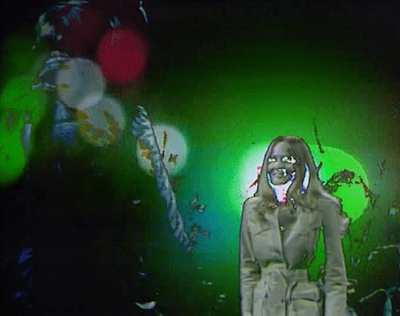
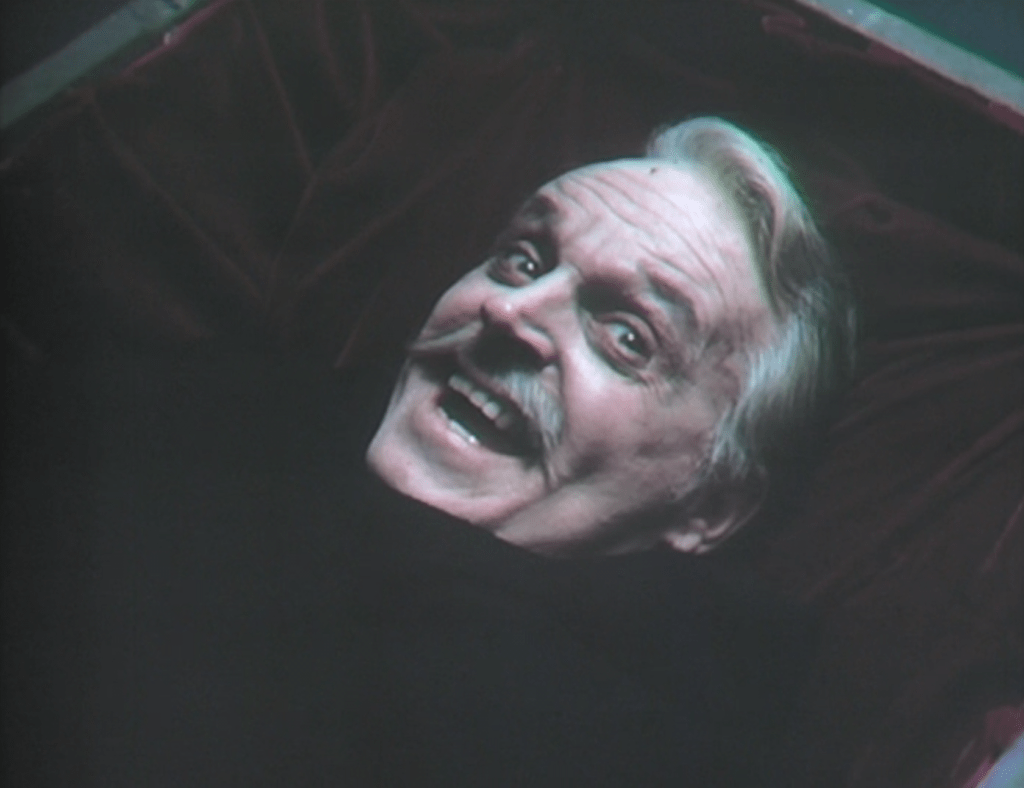
Jabe visits Carolyn, who tells him all about the dream. Not being trained in psychoanalysis, Jabe doesn’t tell her about her unresolved Electra complex or even send her a bill. He just rushes out to exhume Paul’s coffin. This leads to one of the most extraordinary images in Dark Shadows. They wanted to show that Paul’s body was there, but actor Dennis Patrick was by this time in California, producing and taking a role in the movie Joe. So they superimpose a photo of Patrick’s face on a still of a plush-lined box. The resulting image defies all description:
I’d remembered this as an image they flashed on the screen for a moment, but no, they hold it for quite a while. And then they go in for a closeup! Which is the last thing we see before the credits roll!
An old friend of mine has a brother who was hung up on Dark Shadows for a while, he apparently got the DVDs and watched them obsessively for months. When I told him that I was writing this blog, he claimed that this picture of Paul was the only thing he remembered about the show. I can believe it, really. I often try to figure out what they were thinking when they put the episodes together; as you can see with my speculation above about how the Leviathans lost the power they used to have over the Earth, sometimes I resort to some fairly elaborate fanfic to try to puzzle it out. But why they believed it was appropriate to put this image on national television, let alone to linger over it, cut back to it in closeup, and leave it as the climactic episode-ender, that stumps me completely.
Old world gentleman Barnabas Collins has fallen afoul of a shape-shifting monster from beyond time and space who once hoped people would call him “Jabe.” The monster, who has settled for the name “Jeb,” turns Barnabas back into what he was from the 1790s until 1968, a vampire.
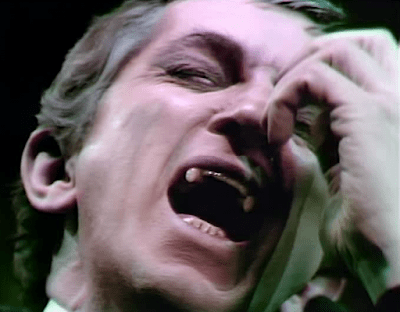
Re-vamped, Barnabas suddenly gets a lot of gray in his hair and a much darker complexion. Makeup artist Vince Loscalzo deserves a lot of credit for these bits of color, they are placed perfectly to emphasize the look of anguish as Barnabas realizes what has happened to him and struggles to resist his urges. The actors’ faces were the medium of Loscalzo’s art, and he outdid himself with these complements to Jonathan Frid’s face.
People talk endlessly about the heroic makeup work Dick Smith did with Jonathan Frid one week in October 1967 and again on a feature film, but Vince Loscalzo did great stuff like this day in and day out for years. Screenshot by Dark Shadows Before I Die.
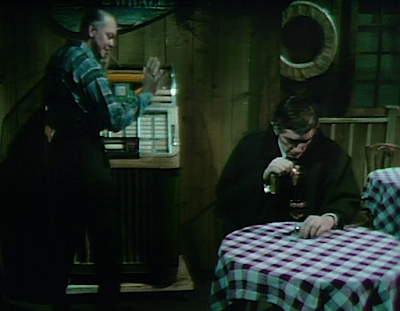
We see Barnabas sitting at a table in The Blue Whale, the tavern in the village of Collinsport. He is the only patron in the room. He has a glass of reddish liquid in front of him, and the bartender is moving around the room. The bartender looks at Barnabas, as if to ask, “How do you like your glass of AB negative, Mr Collins?” But he turns away and moves on.
A young woman enters. Barnabas invites her to join him at his table. He sees that she is wearing a pendant that identifies her as a member of the secret cult that serves Jabe and other creatures who intend to seize control of the Earth, supplanting humankind. Barnabas introduces himself, and says that he was the one who made it possible for Jabe to come to life. This is true, but it is also true that he has become disaffected from the cult. Even after Jabe turned him back into a vampire, Barnabas is still determined to thwart it.
The young woman introduces herself as Nelle Gunston, who was recruited into the cult while living a dreary life with her parents in Virginia. Nelle tells Barnabas that everything has changed for her since she joined the cult. She says that she will gladly do anything she can to advance its objectives, including murder. They have this conversation in nice loud voices while the bartender is nearby.
Barnabas’ friends, mad scientist Julia Hoffman and recovering werewolf Quentin Collins, enter. He introduces them to Nelle, then explains to them that he and Nelle have a private matter to discuss. Quentin and Julia go to the bar, where Quentin orders brandies. They talk about Nelle’s pendant and their fear that Barnabas is falling back under the power of the cult while the bartender is in their space serving them drinks. Evidently they’ve learned to rely on his discretion. They are still deep in conversation when Barnabas leaves with Nelle.
Barnabas takes Nelle back to his place on the pretext that Jabe will meet them there. She asks him why it is so dark in there; he asks her how she got into the cult. She catches on that Jabe is not coming and that Barnabas is not loyal to him. She draws a knife and is about to stab Barnabas when he bares his fangs to her.
Quentin and Julia let themselves into Barnabas’ house. They find Nelle dead on the floor and Barnabas wallowing in self-pity next to her. Julia takes a second look at Nelle and sees the puncture wounds on her neck. She tells Barnabas she will renew the treatments that first put his vampirism into remission two years before; he says there is something else he has to do first. After he rushes out, Quentin and Julia talk about how they will hide Nelle’s body.
Nelle was the perfect victim for Barnabas- no one in town knew her, no one expected her to come, no one will notice she is missing. And he is determined to weaken the cult, so reducing its numbers by one fits his goals.
Barnabas goes to the antique shop in the village. Jabe is in an upstairs room; Barnabas is convinced that Jabe can assume his true form and lay it down only in that room. We saw him do that in a house on an island many miles away in #946, and he told Barnabas that he had done so in #947, but apparently that doesn’t count, somehow. Jabe is far more powerful in his true form than he is when he is man-shaped, but he cannot mingle with humans in that form. So Barnabas believes that he will limit Jabe’s options if he destroys the room. He pours gasoline all around the first floor of the shop and sets a match to it.
Nelle is played by Elizabeth Eis, in her first appearance on Dark Shadows. They say that the first thing actors have to do to work effectively is to pay attention to each other. Eis shows how far this can take you. She listens ravenously to everything Frid says and never takes her eyes off him. The script doesn’t give her a huge amount to work with, but simply by giving her scene partner her total attention she creates a sensational performance. The producers noticed; she will be back later this year in two quite different roles.
This episode is the last time we see either the Blue Whale or Bob O’Connell as the Bartender. The Blue Whale was an important part of the show from its debut in June 1966 until the first costume drama insert began in November 1967. O’Connell appeared as the Bartender in 60 episodes (three of them as other bartenders in other periods of history) and had speaking parts in 6. It’s too bad he doesn’t get to say anything today, but at least he is in the closing credits.
Hail and farewell to Bob the Bartender, the jukebox, and the tavern. Screenshot by Dark Shadows Before I Die.
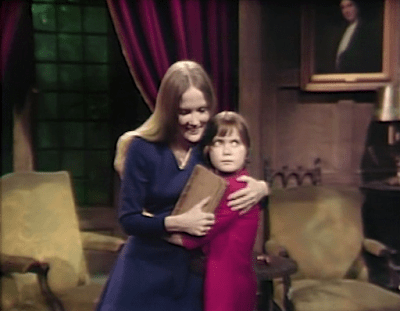
Ten year old Amy Jennings is at home in the great house on the estate of Collinwood. Evidently she’s in a literal mood- she’s in the drawing room, so she’s drawing. Heiress Carolyn Collins Stoddard sees Amy’s work and asks why she is doing it. Amy says she thinks the design is “pretty”; Carolyn replies that “pretty” is the last thing she would call it. That may seem rather rude, but as Amy hasn’t been seen since #912 I suppose she’ll take what she can get.
The design is one which on Dark Shadows is called simply a Naga. It is the secret emblem of a secret cult serving the Leviathan People, a race of Elder Gods. Secret cultist Megan Todd wears the Naga on a large pendant around her neck; Megan’s husband, secret cultist Philip, wears it on a shining ring; Carolyn’s mother, secret cultist Elizabeth Collins Stoddard, wears it as an oversized broach. Amy herself is a secret member of the secret cult, but she hasn’t yet acquired any conspicuous jewelry emblazoned with the secret symbol, leaving her to do her own artwork. Carolyn wonders aloud why so many people are so preoccupied with the design.
Quentin Collins enters. Amy is terrified. Starting in December 1968, Quentin’s ghost haunted Collinwood. By March, the house was uninhabitable and strange and troubled boy David Collins was near death. Old world gentleman Barnabas Collins tried some mumbo-jumbo in hopes of communicating with Quentin; he came unstuck in time and found himself in the year 1897, where he remained for eight months. While Barnabas was flailing about in the late Victorian era, time continued to pass in 1969, and Quentin’s obsession of David finally killed him in September. But a sequence of events with which Barnabas had a tenuous connection changed the circumstances on the night in September 1897 when Quentin originally died, causing him to survive. That night, as it happened, was exactly 72 years before David’s death. On Dark Shadows, anniversaries have the power that laws of nature have in our world, so that caused the haunting to break and David to come back to life. Due to a series of spells cast on him during Barnabas’ sojourn in the past, Quentin is still alive and still apparently in his late twenties in 1970. But the haunting still happened between December 1968 and September 1969, and everyone who lived through it still remembers it.
Quentin has introduced himself to Carolyn as his own great-grandson. Since Carolyn never actually saw his ghost, she is willing to accept this. But Amy had more dealings with the ghost than anyone but David, and it is obvious to her that they are one and the same. She clings to Carolyn.
Carolyn laughs at Amy’s fear and tells her that this Quentin is not the ghost, but is “a cousin of ours.” This is intriguing to regular viewers. It was during the 1897 segment that the audience learned that Quentin was the great-grandfather of Amy and her brother Chris, and just a few weeks ago that Chris learned about that relationship. It is through their descent from Quentin that Amy and Chris are cousins to Carolyn. So if Amy knows she is a Collins, she must have been told that the ghost that tormented her and David was that of her great-grandfather. A scene in which someone gave her that information might have been a good use of Denise Nickerson’s considerable acting talent, but they didn’t bother to produce one.
Quentin tells Carolyn to leave him alone with Amy. Still chuckling, she complies. Once they are alone in the drawing room, Quentin kneels and touches Amy’s face, assuring her that he is “not that Quentin Collins.” David Selby brought immense charm to the role of Quentin, so this scene isn’t as revolting as it might have been, but it is still pretty bad, and we can’t be surprised that Amy is not satisfied.
Amy goes to the village of Collinsport to seek guidance from her spiritual advisor. He is a shape-shifting monster from beyond space and time who usually takes the form of a very tall young man. When he first assumed that form, he invited people to “Call me Jabe,” but no one did. They call him “Jeb” instead, and he answers to it.
Jabe lives in a room above Megan and Philip’s antique shop, and when Amy enters the shop she finds him looking after the place. Apparently shape-shifting monsters from beyond space and time aren’t above doing a little work in retail now and then. She tells Jabe about her encounter with Quentin, and then tells him about a dream she had. In the dream, she went into the long-disused room where she and David first met Quentin. Quentin’s theme song, a sickly little waltz, was playing; she exclaims “It was terrible!” Longtime viewers know the feeling. The tune played incessantly during the “Haunting of Collinwood” period, and when they went back to 1897 characters kept complaining to the living Quentin that he was making them miserable by playing it on his phonograph all the time.
In the dream, Quentin appeared to Amy wearing the nineteenth century clothing and the angry scowl that he wore when he was a ghost. But when he was a ghost, he never spoke words the audience could hear. The only exception was a dream sequence in #767, when Quentin’s ghost spoke to David. That was also the only other dream sequence to be presented as this one is, in flashback as the dreamer is recounting it after the fact. That sequence marked a watershed, the first attempt to explain how Quentin the cranky ghost emerged from Quentin the charming scoundrel we had got to know in the 1897 segment.
This episode, also, has to do with the relationship between these two iterations of Quentin. Amy tells Jabe that Quentin’s ghost in the dream warned her against him by name, and says that she is therefore convinced that the living man she met in the drawing room today is in some way identical to the ghost who haunted the house for those ten months. Amy’s dream marks the final appearance of Quentin’s ghost, but we can see the ghost will not be forgotten.
A state police investigator named Lawrence Guthrie is in town looking into two murders Jabe has committed, those of Carolyn’s father Paul and of a law enforcement officer whose gravestone revealed that his given name was “Sheriff Davenport” (we never learn what Mr Davenport’s title was.) Jabe orders Philip to kill Guthrie. Philip calls Guthrie and asks him to come to the antique shop when Jabe will be out. Once Guthrie is there, Philip tells him that the upstairs room where Jabe stays is an important part of the story of the murders. He shows Guthrie into the room. He stays outside, and locks Guthrie in. Guthrie encounters Jabe there in his true form; Jabe kills him. This is quite effectively handled. My wife, Mrs Acilius, was completely caught off guard by the killing. She believed Philip really was trying to break free of the Leviathan cult, and wondered what Guthrie was supposed to find in the room.
Neither Jabe nor Philip is an especially well-developed character, but Christopher Bernau and Christopher Pennock were both fine actors, and they play off each other very well today. It is a tribute to their performances that Guthrie’s death scene comes as a surprise.
At the end, Quentin is at Collinwood trying to tell Carolyn that it was Jabe who killed her father and Mr S. Davenport. Inexplicably, Carolyn is interested in dating Jabe, and is unwilling to listen to this. Jabe bursts in and announces that there has been another murder, that the murderer is in custody, and that he has confessed to it and to the killings of Paul and Sheriff. That murderer, Jabe says, is Philip. That’s another surprise- after the murder of Guthrie, Jabe did tell Philip that he had another task to perform, and once we hear that he has confessed to the killings it makes perfect sense that that would have been what Jabe meant. But I don’t think anyone could have predicted it. It makes for a strong ending.
Danny Horn’s post about this episode on his great blog Dark Shadows Every Day is a lovely little bit of fanfic proceeding from the assumption that Lawrence Guthrie is the brother of Dr Peter Guthrie, the parapsychologist whom undead blonde fire witch Laura Murdoch Collins killed in March 1967.
The closing credits again misspell writer Violet Welles’ name as “Wells.” They started doing that last week, around the same time the misspelling of wardrobe house Ohrbach’s as “Orhbach’s,” a frequent goof in the show’s first year, reappeared after a long absence.


 Dark Shadows Commentary