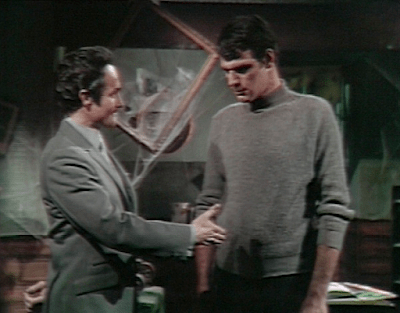
Suave warlock Nicholas Blair proposes to Maggie Evans, The Nicest Girl in Town. Maggie declines, citing her concern for her troubled ex-fiancé Joe Haskell. Nicholas has a man named Harry Johnson under his power, and a vial of poison he wants to give to Joe. After his disappointing date with Maggie, Nicholas goes home and takes a firm grip on his Harry Johnson. He orders Harry to slip the poison to Joe.
That was all I had to say about the episode, but my wife, Mrs Acilius, had a great deal more. She saw it as an essay about free will.
In the opening scenes, Nicholas talks with Frankenstein’s monsters named Adam and Eve. Adam was created in May, in a procedure that used parts salvaged from corpses and a “life force” extracted from recovering vampire Barnabas Collins. When Nicholas found out about Adam, he came up with the idea of a humanoid species bred from patchwork people and loyal to his master Satan. He schemed to have Eve created as Adam’s mate. Nicholas decided that the donor of Eve’s “life force” should be “the most evil woman who ever lived”; he therefore conjured up Danielle Roget, an eighteenth century homicidal maniac based on Madame DuFarge from A Tale of Two Cities, and assigned her the task. Now he finds that Eve has Danielle’s memories and personality, and that she hates Adam. She has found a man she recognized as the reincarnation of someone she was involved with when she was Danielle, and has made up her mind that they will love each other.
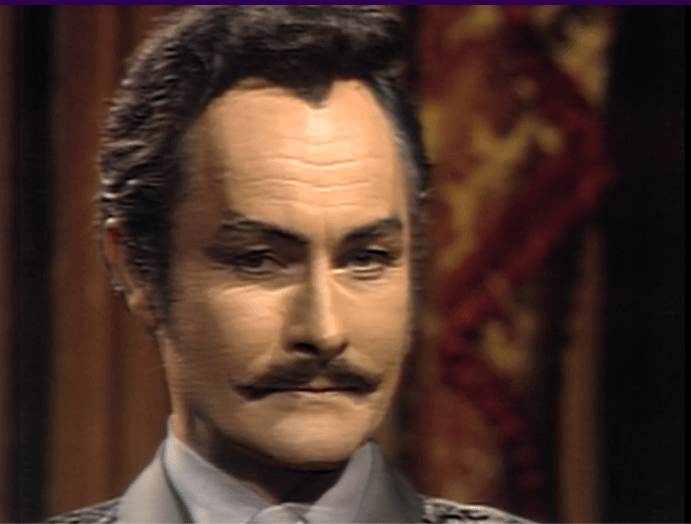
Nicholas is frustrated he cannot control Eve. He turns from her and looks into the camera, as if appealing to the audience for sympathy. Nicholas does not seem to understand what went wrong. He had the basic ingredients for his new species- a male and a female. He had not reckoned on one of them disregarding his plan and choosing a direction of her own.
Nicholas turns to us.
Adam sees Eve storm out of the house as he is going to see Nicholas. He asks Nicholas where she is going, and is astonished when Nicholas tells him he doesn’t know. Adam is unhappy that Eve does not want him, and thinks that a change of scene would help. Still upset about his conversation with Eve, Nicholas is slow to focus his attention on Adam. When Adam complains Nicholas thinks that he and Eve belong to him, Nicholas turns to him and starts telling him what he wants to hear. Evidently it is dawning on Nicholas that Adam, too, might start to make his own decisions.
The man Eve has chosen is named Peter, but he prefers to be called Jeff. Eve shows up at his apartment, refuses to leave, and tells him that they are going to be together from now on. Roger Davis’ inadequacies as an actor leave this scene flat. Eve keeps talking about signs of doubts and irresolution she sees in Peter/ Jeff’s face, none of which Mr Davis is able to manifest. All he does is yell and pout. But as Eve, Marie Wallace manages to make the point that Eve is no more interested in anyone else’s free will than is Nicholas. She wants Peter/ Jeff to love her, and that is all there is to it so far as she is concerned.
For his part, Nicholas has learned nothing from the failure of his attempt to match Adam and Eve. He thinks all he has to do is get Joe out of the way and Maggie will come to him “willingly.” He even seems to underestimate Harry. He doesn’t bother lying to Harry about what he wants him to do to Joe, and Harry is horrified at the idea of complicity in murder. Harry is a career criminal, and several times we have seen him try to get money out of people by blackmail, extortion, or spying. Nicholas could easily have told him he is about to commit a crime he is used to committing and avoid all resistance. For example, he might have said that the potion was a truth serum and once Joe took it he would have to tell him some secret they could use against him. But it simply doesn’t occur to him to take Harry’s sensibilities into account, and he winds up having to threaten him to gain his compliance. A villain who is supposed to have subtle but irresistible powers loses a piece of his menace every time he resorts to an “or else!,” so this is a significant setback for the character of Nicholas.
Well-meaning governess Vicki is engaged to marry an unpleasant man named Peter who prefers to be called Jeff. Vicki knows that Peter/ Jeff has some kind of job that keeps him busy during the day. She does not know that he has been spending all night working at a second job. He is helping to build a Frankenstein’s monster. This second job is unpaid; his incentive is that if the monster is not built, an already existing Frankenstein’s monster named Adam has said that he will kill Vicki and everyone else in the great house of Collinwood.
As we open today, Peter/ Jeff is bitten by vampire Angelique. After Peter/ Jeff regains consciousness, Angelique starts giving him orders. He ignores them, and she bites him again. After that, he seems dazed and agrees to do whatever she commands. She wants him to hook her up to the body under construction and to use her “life force” to animate it. He tells her that he doesn’t know how to do that, and that the body isn’t ready to come to life in any case. Turns out she needn’t have bothered.
Meanwhile, Vicki gets some news. Roger, brother of matriarch Liz, tells her that he wants to send Peter/ Jeff on a six-week training program along with two junior executives from the Collins family business, and that if he works out there will be a job for him at the end of it. Vicki is dazzled by the offer.
Peter/ Jeff comes by. Roger meets him alone in the drawing room to make the offer. Peter/ Jeff can neither leave the Frankenstein project nor tell Roger about it. He has to turn the offer down without explanation, leaving Roger offended. Vicki then asks Peter/ Jeff what he was thinking, and he can’t explain the situation to her, either. She is frustrated that she tells him everything about herself, but she can’t get any information from him. She says that the offer must have represented a “family decision” on the part of the Collinses, implying that Peter/ Jeff’s refusal will reflect badly on both of them in their eyes.
When Dark Shadows started in June 1966, Vicki was its chief protagonist, Roger its most menacing villain, and the Collinses’ business interests a major part of the story. Vicki receded to the margins after her most interesting storyline, her difficult relationship with her charge David, was resolved in March 1967, and by that time Roger had become harmless and the business had long since ceased to be a source of interest. When we hear Roger talking about a job for Peter/ Jeff, for a moment it seems that he and the business might once again be important, and that Vicki might again have something to do with the plot. Vicki’s disappointment in her beau reminds us that the character doesn’t really have a place on the show any more.
Upstairs, Liz is taking clothes out of her closet and talking about them with her daughter Carolyn. They jar longtime viewers when they look at a particular dress and reminisce that they bought it on a trip to Boston. For the first 55 weeks of the show, Liz was a recluse who hadn’t left home since Carolyn was an infant. I suspect Liz had worn that dress during that period, and wish I’d looked for it when we were on those episodes during this watch-through. There certainly hasn’t been enough time since then for the trip to Boston to evoke the nostalgic tone in which they describe it, or for the dress to have fallen so far out of fashion that the ladies agree it is time to throw it away.
The Liz-is-a-recluse story was never exciting, and once they ditched it the show was quick to give us scenes of Liz happily going out. It is sometimes said that Dark Shadows is what Star Trek would have been if they had replaced space travel with agoraphobia, and Liz’ seclusion was the first exploration of this topic. Following the deep cut into the early days of the show in Roger’s offer to Peter/ Jeff with a moment when such a prominent part of its first year is simply forgotten is so typical of this period’s episodes that I wonder if some of the dialogue was written by uncredited contributors who weren’t up to date on bygone story points.
Carolyn is glad that Liz, who just recently escaped from a mental hospital, is taking an interest in her wardrobe. Liz lets her down hard when she says that she wants to get rid of as many belongings as possible in the short time before her death. Carolyn tries to tell her that she isn’t dying, but Liz refuses to listen. She demands that Carolyn promise to have an open casket at her funeral.
Liz was in the mental hospital because of a psychological disturbance with which Angelique afflicted her some months ago. When she did that, Angelique was a witch. Since then, Angelique has been stripped of her witchly powers, killed, and brought back to the world as a vampire. You might think Angelique’s spells would all have been broken when she was de-witched; that has been the pattern on Dark Shadows previously. For example, when blonde fire witch Laura vanished in #191, the spell she had cast that caused Liz to mope around and be obsessed with death until she was sent off to a hospital was broken. Longtime viewers wonder if Liz’ continuing obsession with death and her paranoid fear of being buried alive are natural symptoms of the trauma Angelique put her through, and if she just needs better therapy than she was getting in the hospital.
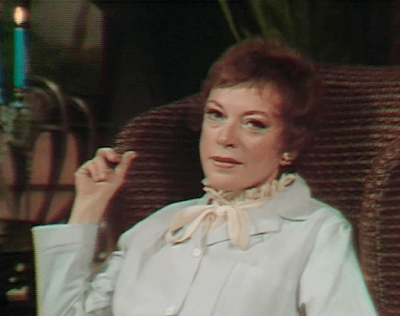
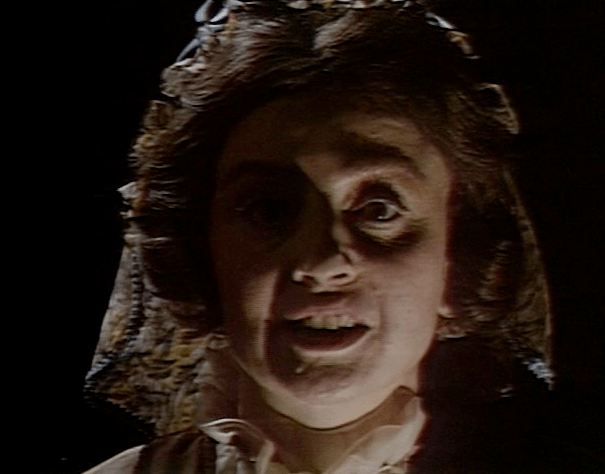
Liz has a dream. It opens with Angelique looking directly into the camera. Angelique is wearing the same costume she wore in the scene with Peter/ Jeff and laughing. When Liz knew Angelique, she never dressed that way, she wore a black wig, and so far as the audience knows she never let Liz hear her signature evil laugh. So it seems that Liz’ current troubles are indeed a part of Angelique’s ongoing spell.
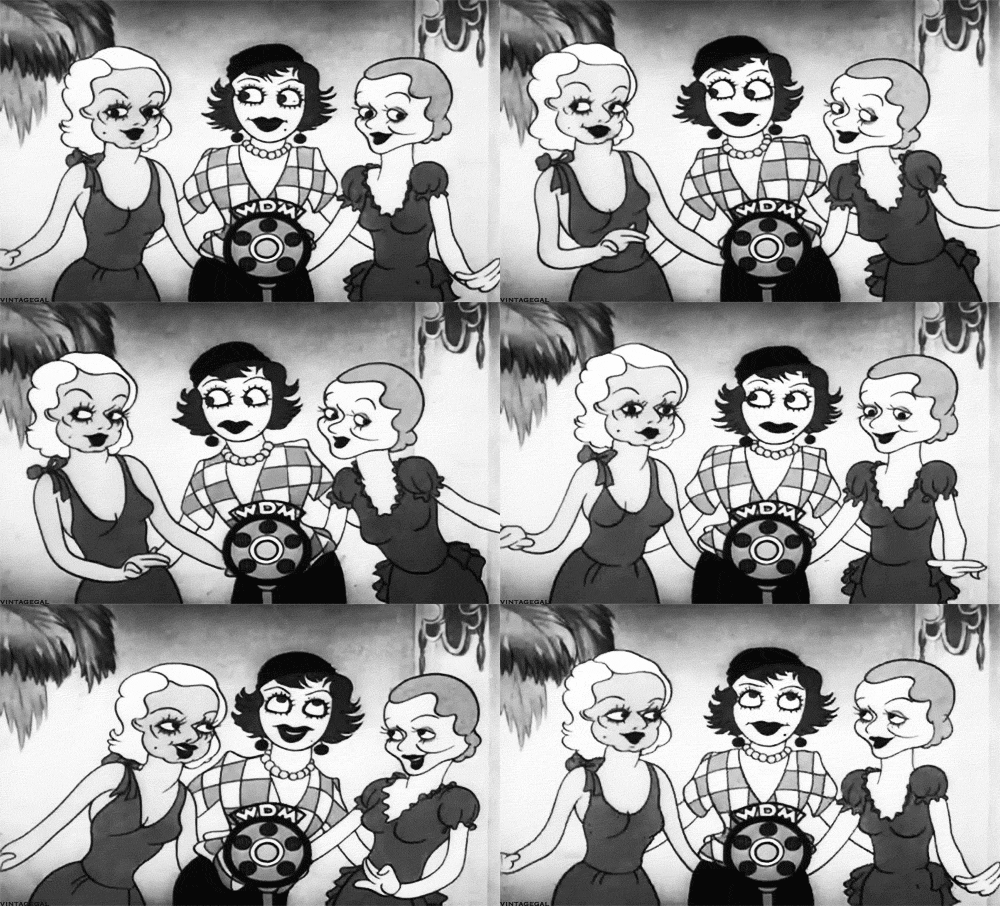
Facing us, Angelique tells Liz that she will be plagued by her obsessions until she dies. This is enough to trigger PTSD flashbacks in regular viewers. Twenty weeks ago, in #477, Angelique was looking at us when she described “The Dream Curse,” an abysmally repetitious, ultimately pointless storyline that dragged on for months. Joan Bennett was a fine actress and a great star, but there was only so much even she could do with a character who just mopes around and talks about death, and Dark Shadows has already made her do it more than once. In a comment on Danny Horn’s post about this episode, I wondered if Angelique couldn’t have cast a spell on Liz that isn’t just a retread of one we’ve seen before, and suggested one that would give her “a compulsion to put on a top hat and tails and sing and dance.” Here’s an animated gif of a cartoon showing Joan Bennett’s sister Constance dancing with Jean Harlow and Joan Crawford; it has more entertainment value than did the entire Dream Curse, and might serve as a consolation to those of us left shaking by Angelique’s threat to clog up the story again:
One mad scientist built a Frankenstein’s monster, and another brought it to life. The builder, Eric Lang, had forced a man to dig up freshly buried corpses he used as materials. That man, an unpleasant fellow named Peter who prefers to be called Jeff, left Lang’s employ after he awoke on a surgical table and found Lang trying to cut his head off. Shortly after that, Lang died, and his colleague Julia Hoffman completed the experiment.
Lang and Julia’s creation is known as Adam. Adam is under the mistaken impression that Julia’s friend, recovering vampire Barnabas Collins, was his maker. He is now threatening to kill all the Collinses unless Barnabas and Julia provide him with a mate. They are complying. They have collected Lang’s journals, and are keeping a cadaver and some equipment in Barnabas’ basement.
Well-meaning governess Vicki is engaged to marry Peter/ Jeff. Barnabas is fond of Vicki, and Adam’s original threat was to kill her. He kidnapped her and held her prisoner for a couple of days; it was when he released her that he extended his threat to the whole family. When he was holding her, Adam gave Vicki’s engagement ring to Barnabas as proof of his seriousness. Now Barnabas has told Vicki that her ring turned up outside his house, and she drops by to pick it up.
Barnabas is alarmed that Vicki came to the house after dark. He knows not only that Adam is still at large, but also that a vampire named Tom Jennings is on the prowl. Vicki doesn’t remember her time as Adam’s prisoner and knows nothing about Tom, but she has heard enough about strange goings-on that she appreciates Barnabas’ concern. She assures Barnabas that she didn’t walk through the woods, and she isn’t alone. Peter/ Jeff is just outside, waiting in her car. Barnabas tells her he’s sorry Peter/ Jeff didn’t come in with her. As he says this, he looks at the door, giving the impression that he is sincere. Earlier, Peter/ Jeff had told Vicki that he was jealous of Barnabas; this scene makes it clear that he has nothing to worry about on that score. Regular viewers know that Julia has a crush on Barnabas; his behavior towards Vicki, whom he sometimes claims to love and want to marry, leaves her looking blissful.
Vicki notices that Julia is carrying one of Lang’s journals; Barnabas tells her that he and Julia are thinking of writing a book about Lang. Vicki knows only that Lang was a doctor who was a friend of theirs, so she accepts this explanation easily. When she goes, Barnabas insists on accompanying her to the car.
Barnabas returns, and tells Julia that he and his servant Willie Loomis will go out and try to find Tom before he bites someone. He speaks tenderly to her; she smiles.
Julia, content with the state of her relationship with Barnabas. Screenshot by Dark Shadows Before I Die.
Julia goes to the basement to close down the experiment for the night. She is still in a blissful mood as she listens to the radio playing the Jackie Gleason Orchestra’s truly appalling version of George Gershwin’s “Love is Here to Stay.” Since they have a stolen corpse in the basement and incriminating documents scattered throughout the house, the front door is of course unlocked. Peter/ Jeff lets himself in and is shocked to find Lang’s journal on the desk in the front parlor.
Julia comes upstairs and finds Peter/ Jeff. He explains that he wanted to see Barnabas and asks why they have Lang’s journal. Julia repeats the story Barnabas told Vicki. Peter/ Jeff laughs at the idea that Barnabas and Julia would write a book about Lang’s attempt to build a man from stolen body parts; Julia says it won’t be about that part of his life. Peter/ Jeff is still laughing when he leaves the house.
It’s odd Julia sticks with Barnabas’ story. A few days ago, Peter/ Jeff confronted Barnabas and Julia with his suspicion that Adam is Lang’s creation. Had she said they were disturbed by his suggestion and were checking Lang’s records to make sure there was no way he could be right, he wouldn’t be in a position to contradict her. He certainly wouldn’t be bothered that they lied to Vicki to cover up what they know about Lang’s experiment, since he is at one with them in his desperation to keep her from ever finding out what he did. Later, we see her writing a note to Barnabas explaining that Peter/ Jeff had not believed “my- really, your- story.” Perhaps she is embarrassed that she did not live up to her usual standards as Dark Shadows’ most fluent and most plausible liar.
Julia heads back to the basement, and we see a figure peering in the window. It is Tom. Coming on the heels of her failure to deceive Peter/ Jeff, this leaves us with no doubt that Julia’s happy night will soon give way to misery.
While Julia is writing her note for Barnabas, Tom appears in the basement. Julia sees him, realizes who he is, and screams as he bares his fangs and approaches the camera.
This ending comes as an anticlimax. The sight of Tom at the window was enough to let us know what Julia was in for; there was no real need to continue the episode beyond it. Moreover, the scene is poorly executed. When Tom walks toward the camera, he twice stops himself awkwardly because he’s running out of set. He also stops in the middle of opening his mouth, apparently realizing he has started that move too soon. Julia’s scream doesn’t help, either. Grayson Hall was a brilliant actress, the heart of the show, but she was terrible at screaming. This is actually one of her better attempts, but coupled with Don Briscoe’s stumbling it still brings a bad laugh.
Suave warlock Nicholas Blair has learned that Frankenstein’s monster Adam is hiding in a room in the long-deserted west wing of the great house of Collinwood. He materializes there and talks as if he’s trying to recruit Adam into a self-esteem cult. He says “You mustn’t worry about what other people think, Adam. And you needn’t always do what other people want you to do. You must learn to be a strong-willed individual.” In response, Adam carefully articulates the new vocabulary item: “In-di-vi-du-al.” It sounds like the big guy will be signing up for courses at the Nathaniel Branden Institute in no time.
Later, we see Adam in the main part of the house. He has let himself into the bedroom where his patroness Carolyn Collins Stoddard, the acting mistress of Collinwood, is sleeping. He wakes her and tells her of Nicholas’ visit. Carolyn tells him to wait there while she goes to the drawing room and scolds Nicholas for wandering into parts of the house he had no permission to explore. Nicholas apologizes, and tells Carolyn her secret is safe with him.
In the final part of the episode, the wicked witch known variously as Angelique and Cassandra makes her way to Adam’s room in the west wing. She finds his door locked, and makes a graceful little hand gesture to magically open it. Standing over Adam while he sleeps, she decides that she cannot use magic to kill him, since Nicholas wants Adam to live and she would like him to believe that a human committed the murder. Therefore, she lifts an ax and is ready to chop into him when the episode ends. The ax wasn’t there earlier and she didn’t conjure it up; presumably she found it in “hammerspace,” the dimension where fans of animated cartoon say characters find whatever tools they need to do whatever the script calls for them to do at any given moment.
Adam’s residence in the west wing is a drab storyline, but longtime viewers will notice that it marks a change in the geography of Collinwood. The west wing was introduced as an area separated from the rest of the house, not only by a locked door, but some kind of metaphysical rift. In #14, well-meaning governess Vicki Winters saw the locked door inexplicably open and close itself; that was the clearest indication up to that point that in Collinwood, the word “ghost” referred to something more than unresolved conflicts among people. A reminiscence of that moment in #27 reinforced the suggestion that there was something supernatural about breaching the barrier between that wing and the main part of the house.
From #84 to #87, Vicki’s charge, strange and troubled boy David Collins, locked her up in a room in the wing; that was such an isolated place that it seemed Vicki might die before the family found her. Again, the distance was not only physical- while in captivity there she saw a full fledged ghost, a glowing figure dripping seaweed and singing to her. When sarcastic dandy Roger went to look for Vicki in #87, we saw him open the first of Dark Shadows‘ secret panels, a bit of the wall in the drawing room that opens to a long, dusty passage leading to the west wing. That was startling to see then, and we haven’t had a look at it since. Viewers who remember it have been looking at that spot on the wall ever since, wondering what worlds lie behind it.
Adam’s presence in the west wing fits in with its unearthly character, as do Nicholas and Angelique/ Cassandra’s activities there. But since those two witches live at Collinwood, the rest of the house has taken on that character as well. The separation of the west wing from the main part thus comes to lose its significance. Why shouldn’t Adam be able to visit the rest of the house, and why shouldn’t he know his way around well enough that he goes directly to Carolyn’s bedroom? Why shouldn’t unlovely ex-convict Harry Johnson, the most mundane character on the show now, have adventures in the west wing?
Angelique, the camera in front of her, the secret panel to the west wing behind her. Screenshot by Dark Shadows Before I Die.
Roger Collins is on the telephone in the foyer of the great house of Collinwood. He is assuring the caller that it will be fine if Maggie, whom returning viewers know to be The Nicest Girl in Town, comes to stay. He says that he and Cassandra will be glad to have her for as long as she wants to be with them, and that he is sure Liz will approve. First time viewers thus learn that Roger has a wife named Cassandra, and that they live as guests in a house belonging to someone called Liz. A moment later, Liz enters, and is too distracted to hear anything Roger says to her.
Roger ends the phone call, and follows Liz into the drawing room. She stares out the window and makes a gloomy remark about death. He says he understands she must be very upset about Sam Evans. Returning viewers know that Sam was Maggie’s father, and that he died in yesterday’s episode. Roger goes on about how it is natural to be grieved at the loss of a friend like Sam, but soon learns that Liz’ mood has nothing to do with Sam’s demise- it’s news to her that he is dead.
Roger’s lines will startle longtime viewers. For the first 40 weeks of the show, Roger and Sam were united by a deep and abiding mutual hatred, and since then they have had no contact at all. Roger’s words about Sam as a family friend are so far from what we have previously seen that they should be considered a retcon.
Liz and Roger spend several minutes in the drawing room. She keeps going on about the all-pervasive reality of death, and he keeps urging her to see a doctor. There isn’t much to their lines, but Joan Bennett and Louis Edmonds were such extraordinary screen performers that it’s always fun to watch them together. This scene might be a particular pleasure to longtime viewers, who have rarely seen Roger as the responsible adult in any encounter.
We dissolve to a bedroom where a young woman in a black wig is sifting through some powders, looking directly into the camera, and telling Liz that her obsession with death will become even worse than it already is and will have dire consequences. Liz will believe that she is someone else, a woman who lived and died in another century, and may die by the same poison that killed that person.
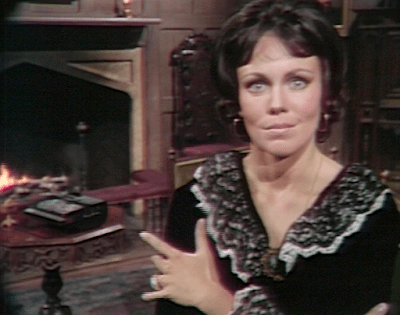
There is a knock at the door. It is Roger. The woman hides her powders and lets him in. He addresses her as Cassandra and asks why the door was locked. Thus first-time viewers learn that she is his wife, that this is their room, that she is a witch, and that Liz’ problem is the result of a spell she has cast.
Cassandra tells Roger that she locked the door because David kept pestering her about Sam’s death and she wanted a moment to herself. With that, first-time viewers find out that David is Roger’s son, that Cassandra is his stepmother, and that she expects Roger to consider locking him out of the room an appropriate response to his grief about Sam.
Roger does not so consider it, and is bewildered by what Cassandra tells him. He tells Cassandra that Liz is in a bad way, and he is worried about her. Cassandra says she did not know that Roger was so concerned about his family. Baffled by this, Roger says that of course he is concerned, Liz is his sister. This tells first time viewers both what Roger’s relationship to Liz is, and that Cassandra has so little sense of family that she cannot imagine how other people feel.
Regular viewers will learn more. In the first year of the show, Roger’s keynote was his lack of loyalty to the family. That has now been set aside once and for all, and his normal attachment to his son and his sister provide a contrast with Cassandra’s apparently sociopathic coldness. Further, we saw a great deal of Cassandra from November 1967 through March 1968, when the show was a costume drama set in the 1790s and she was called Angelique. We saw then that Angelique had no conception of family or friendship, and that her idea of love begins and ends with her control over a person.
Cassandra promises to join Roger downstairs for a game of bridge in half an hour. He leaves, and she gets back to work spellcasting. As she does so, a figure in a black cassock materializes behind her. She turns, and the figure vanishes. In a quizzical tone, she says Roger’s name, revealing that she did not see the figure or realize that it is a supernatural presence. Together with her locking the door, scrambling to hide her magical paraphernalia when Roger knocked, lying to cover what she was doing, and failing to understand what a person with a reasonable amount of human empathy would consider acceptable behavior, her puzzlement shows that whatever her powers may be, they have definite limits.
Back in the foyer, another young woman with black hair lets a man into the house. She calls him Joe, and he calls her Vicki. Joe and Vicki talk about Sam’s death and about Maggie. Joe says that he wants to marry Maggie as soon as possible and to move away. Vicki is all for their marriage, but does not want them to go. Joe talks about how close he and Sam were. Longtime viewers will remember that when Sam and Roger were enemies, Sam was the town drunk. Even then, Joe was always happy to help him in whatever way he could, and did not see his condition as any obstacle to marrying Maggie.
Liz enters and angrily addresses Joe as “Lieutenant Forbes.” Joe has never heard of Lieutenant Forbes, and cannot understand why Liz, who knows him well, would not recognize him. Vicki clearly does know who Liz is talking about, and manages to calm her down. After Liz apologizes and hastens away, Vicki answers Joe’s questions only by saying that Forbes is someone from “the past.” Since we heard Cassandra talk about Liz taking on the personality of someone who lived in “another century,” this suggests that Vicki, too, has an unnatural familiarity with that same century.
Joe wants to go upstairs to the room where Maggie is sleeping so that he will be the first person she sees when she wakes up. Vicki is about to lead him to Maggie when Cassandra insists she join her in the drawing room to talk about David. Vicki tells Joe which door to open, and complies with Cassandra’s directions. This shows that Vicki is a member of the household staff whose responsibilities have to do with David. Regular viewers know that she is his governess, and that they are very close.
Cassandra tells Vicki that David has been asking about Sam’s last words. Vicki says that he addressed them to Maggie, not to her, and implies that she did not hear them. When Cassandra continues probing, Vicki protests. She asks if Cassandra can’t see that she is upset. Considering how clueless Cassandra was about human feelings in her conversation with Roger, it is entirely possible that she cannot. Vicki tells her that Liz is deeply depressed; Cassandra feigns ignorance. Vicki says in a cold voice, “You wouldn’t know anything about that,” then leaves.
Longtime viewers know that it was Vicki who came unstuck in time in #365 and took us with her to the 1790s. During her nineteen weeks in the past, Vicki came to know not only Forbes, but Angelique. She knows perfectly well that Angelique and Cassandra are the same person, that she is a witch, and that she is a deadly menace to everyone. She likely suspects that Liz’ depression is the consequence of one of Cassandra’s spells, and the tone of her parting remark would suggest that she does. Further, those who saw the show yesterday know that Vicki is lying about Sam’s last words. They were addressed to her, and she heard them clearly. She is choosing not to repeat them to Cassandra lest Cassandra use them for her nefarious purposes.
Cassandra is alone in the drawing room for only a few seconds. She is joined there by the same figure who had appeared in her room. This time she sees him. He confronts her.
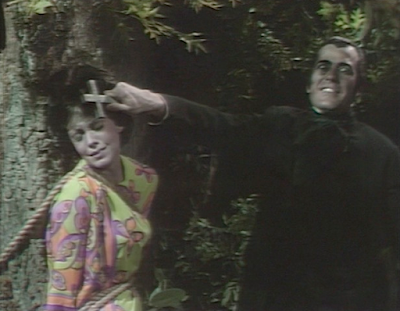
Regular viewers know that the figure is the Rev’d Mr Trask, a fanatical witchfinder who mistook Vicki for the witch in the 1790s and sent her to the gallows. He tells Cassandra that he now has the opportunity to correct that error. He shows her a cross, from which she recoils. We cut to a scene in the woods. Trask has tied Cassandra to a tree and performs an exorcism on her. This is Trask’s go-to technique; he tied Vicki to a tree in #385 and performed an exorcism on her in #386. Since Cassandra actually is in league with the devil (or as Trask would say, THE DE-VILLL!!!,) he has more success this time. Cassandra vanishes and leaves the ropes hanging on the tree.
A first-time viewer might take this climax as an indication that Dark Shadows is a Christian show and Trask is its hero. Not only is Trask going after the right target, he is clearly making some headway. He says all the right things about casting the evil out of Cassandra and saving whatever good is left in her. His delivery of his lines is so fervent that Mrs Acilius, a vigorous Christian, cheered him on. In fact, Trask’s wild incompetence throughout the 1790s segment led to one disaster after another, and was of a piece with the show’s light regard for religion. Not until #450 did a cross provoke a reaction from a monster; that was the first suggestion the show gave that there might be anything to Christianity, and the scenes between Cassandra and Trask today are the second.
Dark Shadows borrows story points freely from all sorts of books, plays, movies, and folklore. So far, it has steered clear of Christianity as a source. For obvious reasons- most of the audience is at least nominally Christian, and Christianity is, in one way or another, a live option for the rest. So it’s a topic that can take over very quickly once it is introduced. I suppose a specifically Christian version of Dark Shadows could have worked, but I can’t imagine that the staff they had would have been particularly interested in making a show like that. So when it looks like they are going to let Trask have even a temporary win, we see the show running one of its boldest risks yet.
Yesterday, wiggéd witch Angelique/ Cassandra sent her cat’s paw Tony to kill sage Timothy Eliot Stokes. Stokes pulled “the old switcheroo” on him, and Tony drank from the glass into which he had put Angelique/ Cassandra’s poison. Today, we learn that Stokes gave Tony an emetic to save his life. Stokes calls mad scientist Julia Hoffman, MD to examine Tony and assist with the next stage of the battle against Angelique/ Cassandra.
Recovered, Tony has no idea why he obeyed Angelique/ Cassandra’s command to kill Stokes, and is ready to surrender to the police. Stokes tells him he is under the power of a witch, and enlists him in the battle against her.
Stokes takes out the memoirs of his ancestor Ben, who was Angelique’s cat’s paw in the eighteenth century. He does some automatic writing in Ben’s hand and finds that they must contact the spirit of the Rev’d Mr Trask, a witchfinder who inadvertently helped Angelique in those days. Fortunately, Trask, like Tony, was played by Jerry Lacy, so it shouldn’t be too hard to get hold of him. Stokes also finds that Trask was walled up in “the coffin room,” which Julia tells him is for some mysterious reason a nickname given to the space at the foot of the stairs in the basement of the Old House on the estate of Collinwood. Stokes decrees that he, Julia, and Tony must go to this room and hold a séance there.
On his way to the Old House, Tony follows Stokes’ instructions and stops at the main house on the estate and tells Angelique/ Cassandra that Stokes is dead. This follows a scene between Angelique/ Cassandra and her husband, sarcastic dandy Roger, in which Roger complains about her lack of interest in him. Her mind isn’t on the game of chess they are playing, she hasn’t been attentive to him for several nights, and she refuses to go on a honeymoon. Angelique/ Cassandra ensorcelled Roger into marrying her so that she could have a perch at Collinwood, and he seems to be slipping out of the spell’s power.
Stokes, Julia, and Tony gather in the coffin room. They begin the séance. This is the fifth séance we have seen on Dark Shadows, but the first that does not include well-meaning governess Vicki. In four of the previous five, it had been Vicki who went into the trance. On the other occasion, it was strange and troubled boy David who became the vessel through which the dead spoke to the living. The first three times Vicki served as the medium, she channeled the gracious Josette Collins, and when David filled that role he gave voice to David Radcliffe. In those days, Vicki was closely connected to Josette, perhaps a reincarnation of her, as David was another version of the cursed boy David Radcliffe. The final time Vicki spoke for the dead, she spoke for nine year old Sarah Collins, with whom she was no more closely connected than were any of a number of other characters. Sarah has no present-day counterpart, so her appearance at a séance suggested that Dark Shadows was moving away from its use of necromancy as a way of connecting characters from different time periods.
This time, Tony goes into the trance. In #481, Angelique/ Cassandra told Tony that she chose him as her cat’s paw because he resembled Trask, so when he is the medium through whom Trask speaks we are returning to Dark Shadows‘ original conception of how séances work. Trask mistakes Stokes for Ben, as Angelique did in a dream visitation last week. The brick wall behind which Trask’s remains are hidden bulges and is about to crumble when we fade to the credits.
True fans of Dark Shadows know that the episode’s real climax comes during those credits. Thayer David strolls onto the set under Louis Edmonds’ credit for Roger. He even looks into the camera when he realizes what he has done.
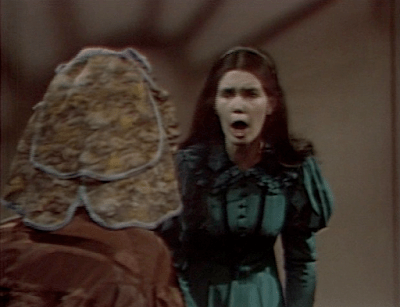
The opening voiceover melds into a sequence in which we cut back and forth between repressed spinster Abigail Collins and the fanatical Rev’d Mr Trask standing in front of black backgrounds, looking directly into the camera, and declaring that the trial of bewildered time-traveler Vicki for witchcraft must begin at once.
Soap Opera Land famously does not observe the legal codes that prevail elsewhere. If that is going to bother you, you probably aren’t in the right frame of mind to enjoy the show at all. But there is an art to depicting a fictional trial. You can deviate as much as you like from the rules that prevail in the real world, but there have to be some kind of rules the audience can understand. We can either see those rules applied with the result that a disorderly world is reduced to order, or see them flouted so that our heroes’ hopes of justice are cruelly dashed. If we aren’t aware of any rules, there is no point in setting the play in a courtroom.
That’s the first problem with Vicki’s trial. Now and then her lawyer/ gaoler/ boyfriend/ etc Peter will object to some question or move that a statement be stricken, and once or twice the judges will agree with him. But they are just as likely to respond to identical protests by ordering him to stop interrupting. The witnesses respond to questions with extended free association sessions. Vicki herself interrupts testimony repeatedly, usually to make self-incriminating remarks, and no one tries to stop her. Trask is for some reason simultaneously the prosecutor and one of the witnesses. Opposing counsel periodically engage in shouting matches with each other while the judges watch. The whole thing is so chaotic that it may as well be taking place in a bar-room or at the county fair or on the waterfront after dark.
The second problem with the trial is that it requires Peter to raise his voice repeatedly. Actor Roger Davis can deliver dialogue more or less competently when he is speaking in a normal conversational tone, but his loud voice always tends toward an ugly snarl. This is a major limitation for any performer on a show as shouty as Dark Shadows, but the opposition of Peter to Trask puts Davis head to head with Jerry Lacy, who is a virtuoso of shouting. Next to Lacy’s, Davis’ shouting is not recognizable as a performance.
When I’m watching a scene on Dark Shadows that suffers because of an actor’s shortcomings, I sometimes try to make it bearable by imagining what it would have been like had someone else who may have been available for the part been cast instead. Harvey Keitel was an extra on the show in #33; no doubt he would have accepted a speaking part if offered. Roger Davis plays Peter as a deeply angry man, and Mr Keitel is one of the very best at making audiences empathize with such characters. So it’s interesting to try to picture him as Peter.
On the other hand, there’s nothing in the scripts that requires Peter to constantly seethe with barely contained rage. That was Mr Davis’ contribution. Had the show gone with a more amiable Peter, they might have been able to cast Frederic Forrest in the part. In #137, Forrest was a background player. While Forrest played his share of angry men over the years, he also excelled as goofily cheerful characters, most famously as Chef in Apocalypse Now. I would have liked to see Peter played that way. I think he would have had some real chemistry with Alexandra Moltke Isles’ Vicki, and that we would have had protective feelings for him as he went up against the formidable Trask.
There is a third problem with the trial that neither Harvey Keitel nor the late Frederic Forrest could have done any more with than could Mrs Isles. That is that Vicki and Peter are written as phenomenally stupid. Vicki hasn’t done a single intelligent thing since arriving in the late eighteenth century in November,* but she has become, if anything, even dumber since 1795 gave way to 1796. Peter’s behavior has also been deeply foolish, and today he hits rock bottom when he blurts out to the court that he abused his position as gaoler to help Vicki sneak out, to commit a burglary at the great house of Collinwood, and to steal evidence against her so that it could not be presented to the court. Even under Soap Opera Law, that’s three felonies.
Some claim that the phrase “Dumb Vicki” is ableist. I disagree. “Dumb” really does not mean “mute” anymore, so that using it isn’t ableist against people who do not have the power of speech. And the intelligence characters like Peter and this version of Vicki lack is not the intelligence that IQ tests are supposed to measure. One of the most interesting characters in the part of Dark Shadows set in the eighteenth century is fluttery heiress Millicent Collins, who would probably fall far short of a triple digit score on a Stanford-Binet scale, but whose behavior makes sense to us because we tell what she wants out of life and how she thinks her actions will help her get it. That’s really all we mean when we talk about a “smart character.” A well-crafted story about someone with profound developmental disabilities can depict that person as a smart character, in that sense, as easily as can one about a great sage or a brilliant scientist. Vicki and Peter are not smart characters, no matter how what kind of school we might suppose would best suit them as students, because there is nothing for us to learn by observing their behavior and no suspense as to what their several actions will add up to. They just do one damn thing after another.
Clarice Blackburn and Jerry Lacy do some fine acting today, as does Grayson Hall in a brief turn as the Countess DuPrés. The pre-title bit with Blackburn and Lacy in front of the black backgrounds is so specific to theater in the 1960s that I can’t help but smile at it, but I’m glad it’s there. It isn’t as though you could ever really forget that the show is 56 years old, and I like to see that they preserved something that would have been so typical of the off-Broadway productions that would have been such a big part of the working lives of the cast and other creatives in those days.
*In her testimony today, Abigail gives the dramatic date of Vicki’s arrival in the past as 12 October 1795. The episodes in which the events she describes happened were broadcast on 17 November and 20 November 1967. In the last few weeks, the show has explicitly told us that the day and month of the dramatic setting in 1796 is the same as the broadcast date in 1968, so it’s confusing.
In the great house of Collinwood, well-meaning governess Vicki is worried about her depressing fiancé Burke, who is missing and feared dead after a plane crash in Brazil. Permanent houseguest Julia Hoffman enters and shows her a piece of crystal. Julia says that she thinks the crystal might have been part of a chandelier that hung in the foyer of the long-abandoned west wing of the house. Vicki plans to restore the west wing and hopes to live there with Burke, so this is of interest to her.
Julia tells Vicki to peer into the center of the crystal. As she complies, Julia stares directly into the camera and continues to give instructions. The Federal Communications Commission was very nervous about hypnosis in the 1960s, so much so that even indirect references to the process would draw memos from the television networks’ Standards and Practices offices warning producers that they must not put anything on the air that could hypnotize the audience. Apparently ABC’s Standards and Practices office wasn’t vigilant enough about the daytime dramas, because after a while we hear the tinkling sound Julia tells us we will hear and instead of the picture we see a kaleidoscope effect. By the time we come out of the trance, Julia and Vicki are in the basement of the Old House on the estate.
The Old House is home to Old World gentleman Barnabas Collins. Vicki sees a coffin in the basement, and Julia orders her to open it. After a long display of reluctance, she does. She finds Barnabas inside, apparently dead. Julia shows her the crystal again. Once more the screen shows the kaleidoscope pattern, and next thing we know Julia and Vicki are returning to the drawing room of the great house.
There, Vicki is about to say that she wants to show the crystal to her dear friend Barnabas, only to find that she has an unaccountable difficulty bringing herself to say Barnabas’ name. Later, Barnabas comes to the house and asks Vicki to watch the sunrise with him. He is diffident about the invitation, and she is uncomfortable with him. Actor Jonathan Frid may have had some difficulty with Barnabas’ lines at this point, but if so, his stumbles dovetail so well with Barnabas’ own display of shyness that they don’t hurt the scene.
Vicki overcomes her discomfort and agrees to meet Barnabas at dawn. He is about to shake her hand when she notices that there is something wrong with his hand. He looks at it and is shocked. He says something about having injured it this morning. She pleads with him to stay and let her put something on his hand, but he rushes out.
Unknown to Vicki, Barnabas is a vampire and Julia is a mad scientist trying to turn him back into a human. The night before, Julia had given him an accelerated treatment that initially caused numbness in his hand, but that later gave him such a sense of well-being that he thought he would be free of his curse by the time the sun came up. After leaving Vicki, he returns to Julia’s laboratory in the basement of his house and shows her his hand, which has aged enormously.
Also unknown to Vicki, Barnabas has designs on her and sees Burke’s absence as a sign that he should move quickly to win her affections. That’s why he ignored Julia’s objections and insisted on the accelerated treatment. In the last few episodes, the show has put heavy emphasis on Julia’s wish to start a romance of her own with Barnabas and his scornful response to this wish; perhaps she took Vicki to Barnabas’ coffin to keep her from becoming a rival for his affections. Or perhaps her motives were altruistic- even if Barnabas weren’t a vampire, there would still be plenty of reasons why a woman would be well-advised to steer clear of him.
The opening voiceover tells us that “Evil reaches deeply into man’s soul, turning his heart to stone, transforming him into a vile monstrosity, and it is horrible to observe this process in an innocent and not be able to recognize it or prevent it.” Without that introduction, first-time viewers would have no reason to assume that Maggie Evans, The Nicest Girl in Town, is going through anything other than an ordinary sickness that has her looking bad and snapping at people.
Kathryn Leigh Scott does play Maggie’s moodiness very well. She does an especially admirable job in the scene where she yells at her boyfriend, hardworking young fisherman Joe, and orders him out of the house. After Joe goes, Maggie looks directly into the camera, and returning viewers will recognize that she is well on her her way to becoming the undead.
Bloofer lady
Meanwhile, well-meaning governess Vicki and dashing action hero Burke are dressed up and having dinner in Collinsport’s only night spot, The Blue Whale. Most of the time, The Blue Whale is a waterfront dive with frequent bar fights. But when Burke and Vicki dine there in their good clothes, the place transforms into a respectable restaurant, as it did in #189.
Burke and Vicki recap some plot points surrounding the great estate of Collinwood. Later, Maggie’s father Sam comes in and tells them of her condition. Vicki replies to Sam’s description with “Now let me see if I understand this. You said that yesterday she was sick and she collapsed, and last night she was up and around, and this morning she was sick again?”
In his post about this episode on his great blog Dark Shadows Every Day, Danny Horn’s response to this line is “IT IS NOT OKAY TO SUMMARIZE A RECAP THAT HE JUST SAID ONE SENTENCE AGO.” It’s true that the episode is heavy on recapping. A defter writer than Malcolm Marmorstein probably would have started the scene with Vicki putting this question to Sam, leaving out the recap that it re-recaps. But Vicki’s question itself is a good moment. As she delivers it, Alexandra Moltke Isles uses her face to show Vicki coming to a realization that has so far eluded everyone else.
The moment of recognition
Vicki recognizes that Maggie’s symptoms are identical to those which sorely bedraggled blood-thrall Willie Loomis displayed a couple of weeks ago. As she explains this, we see Burke gradually catch on and Sam absorb the information. Up to this point, everyone has been remarkably obtuse in failing to make this connection- the same doctor who examined Willie examined Maggie today, and doesn’t give any sign of recognizing it, or for that matter of understanding anything else relating to medicine.
As Vicki was the only character yesterday who escaped the long-running Idiot Plot that goes on because everyone fails to notice the abundant evidence that reclusive matriarch Liz killed her husband and buried him in the basement, so she is the only character today who spots the obvious similarity between the cases of the two victims of the vampire. The show is still sputtering along, but in a Smart Vicki turn like this we can find a glimmer of hope that it will start moving soon.
John Lasell is a tremendous actor, and was electrifying when he first appeared on Dark Shadows as parapsychologist Peter Guthrie in episode 160. But four weeks of endless recapping has taken its toll on him. In today’s pre-credits sequence, recreating yesterday’s final scene, we see what it looks like when John Lasell is bored.
Dr Guthrie and hardworking young fisherman Joe have arrived at the door to a mausoleum which houses a grave they plan to break into. Finding that he cannot turn the knob to the building’s front door, Guthrie says “It’s locked.” More precisely, he whines “It’s laaaakt.” The character has several sides, but this is the first time we’ve seen him as a cranky five-year old. As the two of them fumble about, Guthrie at one point lifts Joe’s tool box, gestures towards the inside of it, and says “Try this.” Try what, all of his tools simultaneously? When the door mysteriously opens, Guthrie takes a beat before he turns to look at it, and he never does get around to looking surprised.
They enter the crypt. Guthrie shines a flashlight directly into the camera. Characters on Dark Shadows do this so often that it must be intentional, at least to the extent that the directors resigned themselves to letting actors get away with it, but it always looks like a mistake. It’s especially jarring here, when John Lasell is himself looking into the camera when he shines the light in our eyes.
Hey Guthrie, are you a doctor of optometry?
Once Guthrie and Joe have found the vault housing the coffin of Laura Murdoch Stockbridge, they quarrel about whether to go through with their plan. They go through the same arguments they used in their scene in the drawing room of the great house of Collinwood yesterday. As yesterday, Joel Crothers manages to put enough verve into Joe’s mixed emotions that he is interesting to watch, but Lasell simply cannot bring himself to commit to another tired rehash. The only thought his performance in this scene brings to mind is puzzlement as to what happened to Guthrie’s glasses.
Back at Collinwood, instantly forgettable young lawyer Frank charges into the drawing room and demands that flighty heiress Carolyn tell him where Guthrie is. She replies that Guthrie swore her to secrecy. Frank says that Guthrie had called him shortly before to ask about a plan that might get him sent to jail. Frank asks Carolyn if Guthrie has gone to the crypt at the old cemetery. Faced with the prospect that Guthrie and Joe might land in jail, Carolyn admits that they are both there.
Guthrie and Joe try to pry Laura Murdoch Stockbridge’s nameplate off the wall of the crypt. They keep talking about how the whole thing might as well be a single block of stone. The actual wall keeps springing back in a way that only cheap grades of plywood do, undercutting this dialogue and requiring the actors to put more and more effort into keeping it from falling down. By the end of the sequence, both of Joel Crothers’ arms and one of John Lasell’s are holding the wall up, so that Dr Guthrie has to remove the supposedly massive nameplate with one hand. Even the blocking isn’t up to director Lela Swift’s usual standards- most of what we see in this sequence is the back of John Lasell’s coat. Considering what’s going on with the set, that may not be such a bad thing.
After Joe and Guthrie get the nameplate off the wall, Crothers flashes a look at Lasell that shows he is struggling to keep a straight face. Lasell’s boredom saves the take- if he had been intellectually available enough to notice Crothers’ twitching lips, he would have burst out laughing:
Straight face
The coffin is quite large and apparently very heavy. Guthrie and Joe put all their strength into carrying it a few feet. They then place it on a miniature tea stand.
Sure, that’ll hold, why not.
Guthrie fits a wedge under the lid and holds it while Joe swings a hammer. The elderly Caretaker enters and orders them to stop. If only for the sake of the tea stand, this command comes as a great relief.
The Caretaker tells Guthrie and Joe that they won’t open the coffin unless they kill him first. That doesn’t stop Guthrie’s efforts to win him over, but it is enough for Joe. Frank shows up. He apologizes to the Caretaker and yells at Guthrie.
Guthrie tries to explain himself to Frank. When Frank tells him that a court would likely respond to his hypotheses by committing him to a psych ward, Guthrie responds “Well, doesn’t that prove my point halfway?” When Frank asks how, Guthrie says “Wouldn’t a court… um… would a court be more sympathetic… uh… before the point? My reasons? Than after?” I’m sure that was not how it was phrased in the script, but I can’t imagine that whatever was written there made any more sense. Guthrie’s behavior is so preposterous today that it is understandable John Lasell didn’t bother to put in much of a performance. Still terribly disappointing, and quite unusual to see him as the weakest member of the cast. The rest of them all do very well in this well-paced, if not particularly well-mounted, episode.
The three men are about to leave the crypt when Joe says he detects a flowery scent. Guthrie asks if it is the scent of jasmine- the sign that the ghost of Josette Collins is near. Joe doesn’t know what jasmine smells like. The Caretaker can just about make out the scent of jasmine, far away, as if it were wafting in from the sea. In a reprise of a moment from #154, when the Caretaker told Vicki the same thing, Joe protests that the scent is not far away at all. It is flooding the room, is overpowering, is coming from behind an obstacle in the crypt.
The coffin opens itself, evidently the result of Josette’s action. The men gather round and look inside. It is empty- no bones, no dust, no sign that there ever was a body inside. Guthrie’s hypothesis, that the body of Laura Murdoch Stockbridge vanished after burial, is confirmed.