The Leviathan People, a race of Elder Gods, are planning to retake the Earth from humankind. Step one in their plan was to bring old world gentleman Barnabas Collins under their sway and make him the leader of a secret cult headquartered in the village of Collinsport, Maine. Step two was to bring a shape-shifting monster from beyond time and space to life and put him up in a room above an antique shop in the village. Step three is to get heiress Carolyn Collins Stoddard, Barnabas’ distant cousin, to pair up with the monster and turn into a creature like him.
The monster usually takes the form of a young man. When he first appeared in this guise, he said he wanted to be called “Jabe” For all his powers and his willingness to kill, he can’t persuade anyone to use that name, so he answers to “Jeb.” Jabe has somehow succeeded in charming Carolyn, but his personality drove Barnabas away from the cult. Determined to prevent Jabe from having his way with Carolyn, Barnabas has enlisted another distant cousin, Quentin Collins, among his allies in this battle.
For the last few days, Barnabas has been telling Quentin and his other comrades that their only resource against the Leviathans is that Jabe and his loyalists still trust him. Today Jabe comes to the great house of Collinwood and has an argument with Barnabas and Quentin. Jabe accuses Barnabas of disloyalty, and Barnabas immediately declares that he never believed in the Leviathan cause and will do everything in his power to defeat it.
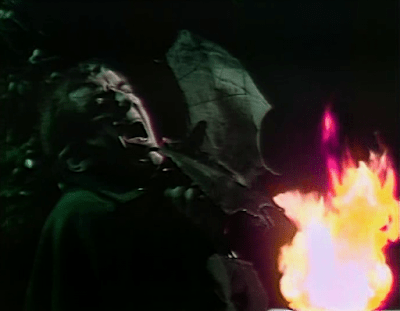
Barnabas intends to launch his attack by using two objects with great cultic significance to the Leviathans. One is a small wooden box that is kept in Jabe’s room. The other is a large stone altar in the woods on the grounds of Collinwood that only people associated with the Leviathan cult can see. With Quentin’s help, he steals the box. He forbids Quentin to accompany him to the altar. He sets the box on the altar and raises his cane to smash it. Suddenly the box opens, and he freezes. A bat comes flying out.
In the 1790s, Barnabas was cursed to become a vampire. He remained in that horrid condition until two mad scientists worked together to free him of the effects of the curse in 1968. Jabe has decided to make him a vampire again. He put the bat in the box, and it bites Barnabas, renewing the curse.
The bat was about the size of a real bat when Jabe put it in the box. Even at that, it must have been a pretty tight fit for the little fellow. But when it bites Barnabas, it is as big as a California condor.
Jabe calls Carolyn “honey” in their scene together. We’ve heard many endearments, most often “dear” and “darling,” but never before “honey,” not so far as I can recall. It makes Jabe seem a bit more up to date than the other characters.
Julia Hoffman, MD, has followed her friend, vampire Barnabas Collins, on an uncertain and frightening journey into the past. They are now in the year 1897, where Barnabas hopes to prevent disasters that would befall the Collins family in 1969. Today, Julia is in their hiding place, the old rectory on Pine Road, trying to replicate the experimental treatment that put Barnabas’ vampirism into remission for a while early in 1968. A knock comes at the door.
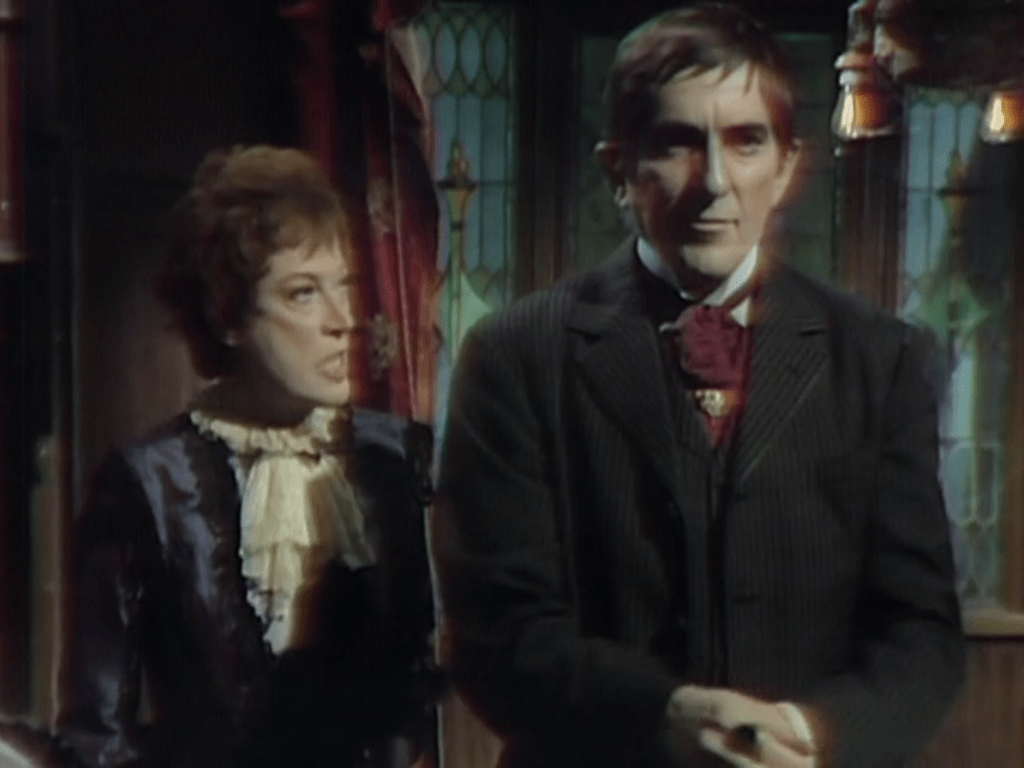
It is Julia and Barnabas’ current arch-nemesis, sorcerer Count Petofi. Julia reacts to the sight of him with fear. Petofi assures Julia that he does not now have any intention of making another attempt on her life. He tells her that she is alive thanks to the incompetence of his henchman Aristide and to Barnabas’ bravery, but that if she finds herself in danger again she must not count on Barnabas to save her. When he tells her that this is because a woman drove a stake through Barnabas’ heart, Julia reacts with shock. She asks if Petofi plans to hand her back over to Aristide for another try; he says that his plan is rather to keep her under constant surveillance so that when she returns to 1969, he will go along with her.
Julia learns that Barnabas is dead, and not just because it is daytime. Screenshot by Dark Shadows Before I Die.
Julia’s displays of fear and bravery are a bit of an attention-getter for returning viewers. Last week she learned that it is only her “astral body” that is in 1897, while her physical body is in 1969. She is therefore immune to any physical harm. It is tactically sound to keep this information from Petofi, of course, but characters on Dark Shadows do not always have sufficient discretion to observe this basic rule of gamesmanship. Barnabas particularly is in the habit of showing all his cards to his enemies while hiding everything from those who would like to help him, and even Julia, who is the smartest character on the show, has done the same thing from time to time. The most celebrated example is probably #619, when she marched into a hostile warlock’s living room, told him everything he wanted to know, and somehow walked away the winner. But today not only does she keep shtum during the scene, the show doesn’t even let the audience in on what she’s doing. First time viewers are as much in the dark as Petofi is.
Later, Julia goes to the great house of Collinwood to tell rakish libertine Quentin Collins that Barnabas had asked her to take a message to him in the event that he died. Quentin is in terrible danger from Petofi, and must flee at once. Quentin says that he has already come to that conclusion, and urges her to do the same. Julia tells him that she cannot. Barnabas left several tasks uncompleted that must be attended to for the future of the Collins family to take its necessary shape. She assures Quentin that she is not in as much danger as he is. She says that Petofi thinks she is his ticket to 1969, and that he will not kill her. Again, she does not even hint at her immunity to physical harm.
Earlier in the episode, Petofi had ordered Quentin to keep watch on Julia. When he resisted, Petofi reminded him that if it were not for his intervention, Quentin would be a werewolf and the lovely Amanda Harris, whom Quentin has asked to run off with him, would be lethally mauled the next time she is in his vicinity during a full Moon. Quentin has betrayed Barnabas and Julia on Petofi’s orders before, and we have little doubt that he will do so again.
Barnabas knew that Quentin was under Petofi’s control, and he shared his information with Julia. The other day he told Quentin where his coffin was kept during the day, leading directly to his staking. Longtime viewers may have taken this as another example of Barnabas showing his cards to his enemies. Those watching closely will have noticed an enigmatic look Barnabas gave Quentin as he was leaving the room at the end of that conversation, and will have asked if he was up to something. That Julia holds back the fact that she cannot be killed in 1897 suggests that she knows that whatever she tells Quentin will get back to Petofi. This will prompt us to ask the same question.
Last week, Julia made an agreement with wicked witch Angelique to fight Petofi together. Angelique would not tell her what her plan of action was, but when Julia looked in the mirror and saw, not her own reflection, but Angelique’s, she said that she understood what the plan was and knew that it would work. So if we have been watching regularly, we are likely confident that Julia, Angelique, and Barnabas have a surprise in store for Petofi.
One of Petofi’s vulnerabilities is prominently featured today. As a supervillain, he is committed to the idea of exercising as much control as possible over the world. With that commitment comes a blind spot. He is slow to understand events that take place outside anyone’s control. When he learned that Barnabas and Julia had traveled through time while meditating on I Ching wands, he himself cast such wands, meditated on them, and had a terrifying experience. He was convinced Julia had directed that experience, and it was when she could not tell him how she had done so or how to subject the consequences of meditation to his will that he ordered Aristide to kill her.
Petofi has now learned that Julia was telling the truth when she said that the effects of the meditative state were not within her power. But he is still experimenting with the wands, trying to develop a technique to subdue the power that meditation on them unlocks. He uses a man named Tim Shaw as the subject of his experiment today; Tim has a vision in which a masked man, who turns out to be Quentin, kills Amanda.
Tim had come to Petofi with the news of Barnabas’ death, hoping to collect some kind of reward from him. Petofi was quite cheerful at the news, but uninterested in the details until Tim told him that the killer was a woman he knows by the name Charity Trask. That threw Petofi for a loop, and he went to Quentin.
Petofi had ordered Quentin to stake Barnabas. He congratulated him on manipulating Charity into doing it for him, and was visibly disconcerted when Quentin said it was an accident Charity followed him- he hadn’t even known she was there. Again, Petofi’s overestimation of the efficacy of plans reveals a soft spot. If Angelique, Julia, and Barnabas can strike him there, they have an excellent chance of bringing him down.
Julia Hoffman is miserable. She has followed her friend, vampire Barnabas Collins, and traveled back in time to the year 1897 on a mission to prevent terrible things that were happening in 1969. She has managed to come up with a treatment that is similar to one that briefly cured Barnabas of vampirism in March and April 1968, and is giving him regular injections in the course of that treatment. She is in hiding with him in an abandoned building, and has survived kidnapping and attempted murder. And what is her reward for all that? He is back on the same bullshit he was involved in when she first learned of his existence in 1967. He has met a girl and made up his mind to throw away all of their plans in an effort to convince her that she is the reincarnation of his lost love Josette. It’s no wonder Julia is so furious with him that she looks like she is the one with fangs.
Barnabas in danger.
Making matters worse, this time it seems Barnabas might be on to something. He pays a visit to his distant cousin, Quentin Collins, and asks who the girl is. Quentin says that she is Kitty Soames, widow of the late Earl of Hampshire, returned to her native USA after her husband’s death. When Barnabas starts in with his lunacy about Josette, Quentin becomes excited. He tells him that Kitty looked at the spot where his portrait hung until he was exposed as a vampire and asked what had become of it. When Quentin asked how she knew about that, since she had never been to the house before, she laughed and said that of course she knew the portrait, of course she was familiar with Barnabas. After a few seconds, she said she knew nothing of any portrait or of anyone named Barnabas.
Barnabas takes this as proof positive that Kitty is Josette returned to life, and that her memories of the 1790s are coming back to her. He asks Quentin to meet him at his hiding place so that they can arrange for him to meet her. He tells him where the hiding place is. Quentin agrees. Barnabas gives Quentin an enigmatic look before he exits.
Quentin is miserable. He is under the power of sorcerer Count Petofi, who has ordered him to kill Barnabas. Now that he knows where Barnabas keeps his coffin, there is nothing to stop him obeying. He will have to go there at dawn and stake his friend.
Barnabas has confronted Quentin about his subjection to Petofi, whom he knows to be his deadly foe. He has several times shown his distrust of Quentin. So people who started watching the show in the last year or so will be puzzled when he tells Quentin where to find him when he is helpless. Those who have been in the audience longer know that Barnabas not only has a habit of telling his enemies exactly what they need to know, but that he also loses all semblance of rationality where Josette is concerned. It is all too believable that he may have done this. Still, there is that look back at Quentin, suggesting that Barnabas knows that he is giving information to his enemies.
Quentin is in the drawing room of the great house, waiting for the dawn to bring with it his obligation to kill his friend. A woman who used to be Miss Charity Trask enters. Petofi erased Charity’s personality some time ago. Her body is now home to Pansy Faye, Cockney showgirl, mentalist, and onetime fiancée of Quentin’s late brother, inveterate prankster Carl Collins.
Pansy is miserable. Pansy is cross that Quentin did not go to see her perform at the Blue Whale, a local tavern where she is doing her old act. But what really has her down is that it is exactly three months since Barnabas murdered Carl, and she is the only one who seems to remember him. When Kitty and Quentin spoke of Carl yesterday, they were the first characters other than Pansy to mention his name since the immediate aftermath of his death. She is irritated with Quentin for getting drunk, angry that Barnabas is still at large, and sorrowful that while the dawn means a new day for most, for people like her and Quentin it just means reliving the same day time and again. Quentin perks up when Pansy lists the many good reasons why someone ought to kill Barnabas, and for a moment it seems like he is going to tell her where he is and invite her to do it. She recognizes this, and keeps asking questions after he stops himself. The whole scene is beautiful from beginning to end, one of the highlights of the series. If they had had Daytime Emmys in 1969, it is the tape they should have sent to the voters to get the acting awards for Nancy Barrett and David Selby.
Dawn comes, and Quentin does go to the cave where Barnabas’ coffin is. He has a stake and mallet with him. He opens the coffin, sees Barnabas, places the stake over his heart, and raises the mallet. That’s as far as he can go. He throws the weapons aside and leaves the cave, vowing that if Barnabas can face whatever he has faced, he too can face his own destiny.
Shortly after, we hear footsteps. Pansy enters. She sees the coffin and opens it. She finds the mallet and stake. She drives the stake into Barnabas’ chest. Blood spurts out around the wound and out of his mouth. It would seem that Barnabas Collins is no more.
Quentin is a villain, but he is charming, and at this point David Selby is a breakout star to rival Jonathan Frid as Barnabas. Earlier, it had seemed Pansy might kill Quentin, and many fans hated her for that. No one seriously expected her to kill Barnabas, since he was a pop culture phenomenon familiar even to people who never saw the show. To this day, Dark Shadows is known (to those who know it at all) as “the vampire soap opera from the 1960s.” So having her kill Barnabas is certainly a twist worthy of ending a week.
Laura Murdoch Collins, estranged wife of the stuffy Edward, is settling into the cottage on the estate of Collinwood. Broad ethnic stereotype Magda Rákóczi is acting as her servant. Laura talks quite openly with Magda about Edward’s rakish brother Quentin. When Quentin was banished from Collinwood the year before, that is to say in 1896, Laura followed him to Alexandria, Egypt. That occasioned her estrangement from Edward.
Laura knows that Quentin uses the cottage for rendezvous with the various women in his life, and has Magda go through the place looking for things of his to box up and send to him. They find a doll and a deck of tarot cards; Laura tells Magda that no one knows how thoroughly Quentin is obsessed with the occult. Magda is an expert tarot reader, and Laura asks her to read the cards for her.
Magda lays out the cards, and they keep indicating death. Laura is initially distressed by this, but brightens at the thought that they might mean that Quentin will soon die. When Magda says that the death to which the cards pertain is one that has already taken place, Laura loses all patience and dashes the cards from the table. We know that Laura is an undead fire witch who periodically incinerates herself and reemerges as a humanoid Phoenix, and so it would seem that she is upset that the cards are confirming Quentin’s story that he saw her burn to death the previous year in Alexandria.
A recently arrived, quite distant cousin of Edward’s, the mysterious Barnabas Collins, comes calling on Laura. Barnabas has come with a present. Laura at first believes that this means that her evening has taken a turn for the better, and tells Barnabas that she is glad to think they might become friends. When she unwraps the present and finds an eighteenth century oil painting that appears to be a portrait of her, she is caught off guard. She at first acknowledges the resemblance, saying that she might have sat for it herself; Barnabas agrees that she might have. When she tries to backtrack and asks Magda if her chin looks like the one in the portrait, Magda replies “They look the same to me.” After Barnabas leaves, Laura orders Magda to put the portrait in a closet.
We know that Barnabas is a vampire, who has traveled back in time to 1897 to prevent Quentin from dying and becoming a ghost who will ruin things for everyone at Collinwood in 1969. We also know that he was acquainted with Laura in the eighteenth century, when he was alive. In the early part of the episode, Magda reproached Barnabas with his carelessness, telling him he must want people to know about him. Showing Laura the portrait would seem to prove that Magda was right. It serves no purpose but to arouse her suspicions. All the more so since Barnabas’ own eighteenth century portrait hangs in the foyer of the great house at Collinwood. He has used it as evidence that he is a descendant of an ancient member of the family, and Laura has apparently accepted it as such. But now that he has confronted her with her own portrait from the same epoch, she has every reason to search for another explanation.
Laura was Dark Shadows‘ first supernatural menace, from December 1966 to March 1967. In those days a lot of details were established about her previous incarnations, many of which they have been retconning away with some violence over the last few episodes. We learned then that in each of her appearances, Laura’s maiden name was Murdoch. It is confirmed today that when Edward met her she was Laura Murdoch. We also learned then that in the eighteenth century Laura Murdoch married into the Stockbridge family, one of the most prominent in the area, and that she and her young son David Stockbridge died (by fire!) in 1767. We saw her tomb in a crypt belonging to the Stockbridges and still maintained, two centuries later, by an old caretaker.
Today, Barnabas and his blood thrall, Magda’s husband Sandor, go to the same set. But it does not represent a freestanding building, nor does it have a staff. It is in the basement of “the old meeting house.” And the stone panel sealing Laura’s tomb is quite different. The one we saw in #154 and #157 read “Here Lyes Buried The Body Of L. Murdoch Stockbridge, Born 1735, Died 1767.” Just the initial L because, as the Caretaker explained repeatedly, “The Stockbridges cared nothing for first names!” But this panel is inscribed “In Memory of Laura Stockbridge Collins, Who died in 1785.” The name “Collins” is because the show has neglected to develop any other elites in the Collinsport area, so if Laura is going to keep coming back and marrying into a leading family, she’s going to have to pick a Collins every time.
The date 1785 is just mystifying. Barnabas said yesterday that he was ten when Laura came along. In November 1968 we flashed back to the year 1795, when he was still human. Actor Jonathan Frid was just about to celebrate his 43rd birthday at that time; if Barnabas is the same age as his player, he would therefore have been born in 1752. That would make him 15 in 1767. That would give him five years to have known Laura before she took her son with her into the flames. It would also be plausible that she would not have been startled when she met Barnabas Wednesday, seeing only the resemblance to the person whom he claims was his ancestor. But if he were born in 1752 and she lived until 1785, she would certainly have realized she was looking at the same person.
It seems that the show really wants us to think that Barnabas was in his twenties in 1795. Of course life was hard back then, but the 43 year old Jonathan Frid was not going to pass for any age much less than his own.
Barnabas orders Sandor to open the wall. In the cottage, Laura can hear the chisel tapping at the stone. Magda can hear nothing. Barnabas orders Sandor to open the coffin; Laura rushes out of the cottage, leaving a bewildered Magda behind. Laura reacted when they messed with her tomb in 1967 as well, so they’ve preserved that much of the continuity, at least.
When Dark Shadows began in June 1966, strange and troubled boy David Collins (David Henesy) was frantically afraid that he would be sent away from the great house of Collinwood. In #10, David overheard his father Roger (Louis Edmonds) telling his aunt Elizabeth Collins Stoddard (Joan Bennett) that they ought to do just that. As the owner of the house and holder of all the family’s wealth, it is up to Liz to make the decision. Hearing his father press to send him away, David responded by sabotaging the brakes on Roger’s car, nearly killing him.
Roger told Liz that David belonged in an “institution,” but David was just as terrified when it was suggested that he might go to an ordinary school. It was not entirely clear why he had this attitude. David and Roger had only lived in the vast gloomy house for a few weeks when the show started. Roger openly hated David, as did Liz’ daughter Carolyn. Liz loved him, but as a recluse and an aging grande dame had little in common with a young boy. Moreover, David hated his governess, the well-meaning Vicki, as much as he could hate any school. His mother, who did not live in the house and whose name was in those days was never to be mentioned there, was the only person for whom David expressed fondness; when in #15 David watched Roger drive off in the car whose brakes he had sabotaged, we saw him standing by himself, saying “He’s going to die, mother. He’s going to die!” So it is difficult to see why David was so intensely committed to staying at Collinwood.
Today, we see a suggestion that David may have been influenced by an ancestral memory of bad times at a boarding school. It is 1897, and David’s grandfather Jamison Collins (David Henesy) is twelve. Jamison’s father Edward (Louis Edmonds) has asked the Rev’d Mr Gregory Trask to come to Collinwood to urge his sister, Judith Collins (Joan Bennett,) to send Jamison and his nine-year old sister Nora to be students at Worthington Hall, a boarding school Trask runs. As the house’s owner and holder of all the family’s wealth, it is up to Judith to make the decision.
Trask wins Judith’s confidence by performing a ceremony after which Jamison and her brother, Jamison’s uncle Quentin, are restored to themselves after a spell that had made Quentin a zombie and put his spirit in possession of Jamison. Recently arrived, thoroughly mysterious distant cousin Barnabas Collins sputters with rage at the very sight of Trask, and exasperates Judith with his insistence that Trask is evil. Judith does not trust Barnabas, and Barnabas’ inability to either explain or contain his hostility only confirms her favorable judgment of Trask.
Once Quentin and Jamison are themselves again, Trask sends Barnabas and Quentin out of the drawing room. Quentin raises his eyebrows in response to Trask’s order and asks his sister “Are you sure you’re still in charge of this house, Judith?” She does not respond.
Judith makes a remark about Quentin’s influence on Jamison, saying that “He’s been like this ever since [Quentin] came home.” Since Jamison was just freed from possession a few minutes before, it is unclear what she could mean, and Jamison objects “That’s not true!” Trask unctuously replies “Now, your aunt does not tell lies, Jamison.” Returning viewers know that Judith lies constantly. Nor is Trask unaware that Judith is less than perfectly truthful. When he first arrived in Friday’s episode, Judith and Barnabas tried to conceal the situation with Quentin and Jamison from him, and she told a series of lies in pursuit of that objective.
When Jamison continues his attempts to tell the truth, Trask silences him with “Now, there is only one who is constantly right, Jamison, and He is not on this earth, but above. Now, I want you to go out into the hall and consider all the wonderful things your aunt has done for you recently. I am sure you will have much to think about.” Jerry Lacy brings such an inflexible authority to Trask’s personality that we cannot imagine a rebuttal to this sanctimonious little speech. We share Jamison’s helplessness and frustration.
Alone with Trask, Judith agrees to let him take Jamison and Nora to Worthington Hall. Jamison barges back in and declares that he will not go. Trask assures him that he will not take him unless he is willing to go. He then obtains Judith’s permission to talk with Jamison alone in his room.
While Jamison is taking Trask upstairs, we cut to the study. Quentin and Barnabas are alone there. Quentin asks Barnabas if Trask really was his “savior.” Barnabas replies “Apparently.” Quentin asks Barnabas what he thinks really happened; he sidesteps the question. Quentin keeps probing for Barnabas’ interpretation of his recent experience; Barnabas alludes to Quentin’s adventures in Satanism, saying “You dabble in odd things, perhaps one of your interests resulted in this.” Quentin observes that this is “Delicately put,” and goes on to remark on “what an interesting life” he has had.
Barnabas then takes his turn as the questioner. He asks Quentin about his wife, a tall, beautiful, homicidally crazed woman named Jenny who is being held prisoner somewhere in the house. Quentin grows tense, and does not give direct answers. He explodes at Barnabas, saying that he has no interest in making a friend of him. Barnabas observes that he has in fact made an effort to turn him into an enemy; Quentin interjects “Your fault!” Barnabas says they could be useful to each other; Quentin exclaims “Wrong!” When he thinks of Barnabas, Quentin says, only one question comes to mind- “What does he want from me?”
Jonathan Frid said that his favorite scene in Dark Shadows was one he had with Anthony George in #301. Barnabas tells local man Burke Devlin that their relationship to each other is like that of “two superb swordsmen with highly sharpened blades. You thrust, and I parry. I thrust, you parry.” That scene has never impressed me. The Barnabas/ Burke conflict did not have enough grounding in the story to come to life, and having the characters tell the audience that they were like “superb swordsmen” does not make it so. But this showdown really does pay off. Barnabas and Quentin are the show’s two great breakout stars, and we are in the middle of a long run of episodes where everything works. This scene brings out all the values they might have hoped that Burke and Barnabas’ confrontation would put on screen when they planned it.
We return to Jamison’s room, the same bedroom David Collins occupied in the 1960s. Trask is still being friendly. When Jamison says that he would miss his pony if he had to go away to Worthington Hall, Trask says “You must bring him with you!” When Jamison refuses to tell Trask his pony’s name, the friendliness vanishes. Trask darkens, tells him “You’re going to have to learn to answer questions, boy,” and insists they pray together. When Jamison resists, Trask tells him that he must change his ways lest he go on being a disappointment to his father. Jamison protests that his father loves him, and Trask asks incredulously “Does he?” He asks Jamison if he wants his soul to be saved. Jamison can’t very well say anything but yes to that, and so Trask says “Then I think I can help you.” Jamison is trapped.
After a scene in the drawing room where Quentin demands Judith tell him where Jenny is locked up, we return to Jamison’s room. The scene begins with a closeup of the rope belt of Jamison’s robe. Jamison is retying it. He keeps fiddling with it, perhaps a nervous habit, but it is the first thing we see and they hold the shot for a long time. We cannot but wonder whether the belt was untied at some point while Jamison and Trask were alone off camera.
Jamison fiddles with his belt.
Trask orders Jamison to tell Judith that he wants to go to Worthington Hall; Jamison says he will not. The dialogue does not explain how Jamison’s robe came undone, and neither he nor Trask seems concerned with the matter. Their blasé attitude turns an uncomfortable image into a lingering mystery.
In the drawing room, Trask announces to Judith that Jamison has something to say. Jamison says that Trask threatened him and tried to make him lie. Trask says that Judith will have to find another school for him, and she declares that she will not. Jamison will go to Worthington Hall.
Trask exits. Jamison finds Quentin and asks him to help him escape the grim fate in store for him. Quentin promises to do so, and by the end of the episode Jamison will be safely hidden somewhere in the house. Meanwhile, Barnabas throws a fit before Judith, saying that he cannot understand why “You would believe that maniac before you believe Jamison.” Judith scolds him and tells him to treat Trask with respect.
Trask returns. Barnabas asks him if his family is from Salem, Massachusetts. Trask affirms that it is so. Barnabas claims to have seen ink drawings of a Rev’d Trask who was at Collinwood in the 1790s; Trask says that he was his ancestor. He says that the earlier Rev’d Trask disappeared shortly after leaving Collinwood, and that his disappearance was never explained.
Longtime viewers know that Barnabas is a vampire who lived in the 1790s, and that the original Trask is one of those he blames for the many misfortunes that befell the family in those days, including his own transformation into a bloodsucking abomination. We remember the first Trask as a case study of a type much on people’s minds in the 1960s, Eric Hoffer’s “True Believer.” That Trask was so deeply and unshakably convinced of his own understanding of the situation around him that when he set out on a witch hunt, the real witch was easily able to manipulate him into doing her work for her. Barnabas murdered the original Trask in #442 by bricking him up in an alcove, one of the most famous moments in all of Dark Shadows. He seems pleased to hear that people are still wondering what became of the late witchfinder.
Gregory Trask seems to be a different sort. He can change his tune in a way that his forebear never could, putting on a friendly mask when it serves his interests to do so. While the original Trask was single-mindedly trying to live up to his own twisted idea of virtue, the second sometimes responds to bad news with a delighted grin, suggesting that he sees an opportunity to profit from it. The first Trask’s fanaticism sometimes led him to hypocrisy, when he thought that his ends were so good that they justified dishonest means, but this Trask seems to be a hypocrite who has kidded himself into acting like a fanatic. Mr Lacy’s performance makes him a formidable presence; the writers have made him a powerful adversary.
In April 1967, Barnabas Collins showed up at the great house of Collinwood, home of Elizabeth Collins Stoddard and her family. Liz (Joan Bennett) was isolated, embattled, and under the control of a blackmailer. When a courtly gentleman claiming to be a distant cousin from England showed up, apparently wanting nothing from her but her friendship, she quickly accepted him, even giving him the Old House on the estate to live in. As Barnabas’ eccentricities became ever more difficult to ignore and bizarre and terrible events piled up around him, Liz steadfastly refused to entertain the idea that Barnabas might be anything less than perfectly trustworthy. Since Barnabas was in fact a vampire escaped from his grave to prey upon the living, this refusal tended to push Liz further and further to the fringes of the story.
Now Barnabas has traveled back in time to the year 1897. Joan Bennett again plays the mistress of Collinwood. Like Liz, spinster Judith Collins has agreed to let Barnabas stay in the Old House and do some work on it, presumably at his own expense. Unlike her, Judith is not desperate for friendship, and she is not at all sure Barnabas is someone she should trust.
Today, Joan Bennett is in closeup while a recorded monologue in her voice tells us what Judith thinks of Barnabas:
What is happening to all of us? Until Barnabas arrived, everything seemed the same. But what has Barnabas to do with it? Something, something, I’m sure. He knows too much, he’s involved himself so quickly, as if he were the center of it.
Had Liz ever thought in those terms for one second, Barnabas would have been exposed and destroyed and Dark Shadows would have gone back to telling stories about the Collins family cannery. But 1897 is a more dynamic setting, in which no one has much time to wonder where Barnabas goes during the daylight hours or why he keeps his cellar door locked.
Today’s great crisis concerns Judith’s brother Quentin and her twelve year old nephew Jamison. Quentin died the other day, which you might expect to mark an ending of sorts. But as it happens, his body is roaming about as a zombie and his spirit has taken possession of Jamison. Yesterday Judith permitted Barnabas to do some mumbo-jumbo that lured Quentin back to his coffin, and, with the help of Judith’s surviving brother Carl, Barnabas buried Quentin and filled the grave with cement. But before the episode was over, Quentin had made his way out of the ground and abducted governess Rachel Drummond. For his part, Jamison is still possessed.
Today, Barnabas announces to Judith that she must let him take Jamison to Quentin’s grave, where he will perform another ceremony. Judith is appalled, as one might expect her to be, but yields to him. By the time Barnabas and Jamison come back to the great house, Judith is entertaining a visitor. He is the Rev’d Mr Gregory Trask.
When longtime viewers see Jerry Lacy wearing a cassock, they will expect to hear Trask’s name and title. Mr Lacy played another Rev’d Trask from December 1967 to March 1968, when Dark Shadows was set in the 1790s, the period when Barnabas first became a vampire. That Trask was a fanatical witchfinder whose zeal was matched only by his ineptitude. Wicked witch Angelique was able to manipulate Trask for her own purposes, and he earned Barnabas’ most cordial hatred.
When Barnabas sees Gregory Trask, he blurts out his surname. Puzzled, Trask asks if they have met. Barnabas does not answer, but immediately begins to display his hostility towards the newcomer. Barnabas is a poor tactician who has a habit of volunteering to his enemies exactly what he thinks of them. His interactions with the first Trask were a case in point, and we see him falling into the same pattern with this second.
Trask has come to Collinwood at the invitation of Judith’s brother Edward, father of Jamison and of nine year old Nora. Just four weeks ago Edward brought Rachel to the great house to be Nora and Jamison’s governess; last we saw, in #715, Edward was optimistic Rachel would work out well in her position. But now he has called Trask to come and take the children away to a school he operates, eliminating the need for a governess.
With Quentin lumbering around the house and Jamison spouting off about his possession, Judith and Barnabas cannot keep Trask from figuring out what is going on. He sits Quentin in a chair, intimidates Jamison into kneeling, sends Barnabas and Judith out of the drawing room, and starts praying for help. When Barnabas tries to enter, Trask tells him he can do nothing but help the devil, and slams the doors in his face. Judith and Barnabas are left standing in the foyer, wondering what will happen.
Vampire Barnabas Collins has traveled back in time to the year 1897 where he hopes to prevent his distant cousin, libertine Quentin, from becoming a ghost who will ruin things for everyone in 1969. Barnabas knows that if events play out as they did originally, Quentin will die soon. He tells him today that it is his understanding that people become ghosts when they leave unfinished business behind them. He does not know what business Quentin originally left unfinished, or how he can keep him from dying without finishing it on this iteration of the timeline. So you might think that his first priority would be to get as close as possible to Quentin and learn as much as he can about what he wants.
Instead of doing this, Barnabas has gone out of his way to antagonize Quentin by accusing him of stealing his grandmother Edith’s will. Quentin and his siblings are all frenziedly searching for the will, but it is of no concern to Barnabas. Edith cannot possibly have left him any money, and he knows that the original timeline worked out so that the Collins family assets wound up in the hands of people who were oblivious to his sinister nature and happy to let him make his home on their estate. Showing interest in the will can do nothing but raise suspicions as to who this stranger really is and why he showed up when he did.
Quentin did in fact steal the will. Edith’s ghost may be at work in the house- her glove mysteriously shows up in the corridor near Quentin’s room, the furniture in the room is turned upside down, and before the end of the episode Quentin alone can hear the pounding of an enormously amplified heartbeat emanating from the walls of his room. But Quentin accuses Barnabas of planting the glove and disordering his room, and in #538 we saw that Barnabas is capable of making people with guilty consciences have hallucinations of just this kind. Barnabas is also frequently seen reading, and it is certainly possible he might have read Edgar Allan Poe’s “Tell-Tale Heart” and decided to make it come to life. He may not even have needed to read the story- we saw in #442 that in 1796, early in his career as a vampire, he bricked up an enemy of his in the style Poe would describe in his 1846 story “The Cask of Amontillado.” Evidently his imagination and Poe’s ran along similar lines.
Barnabas meets governess Rachel Drummond. He is immediately attracted to Rachel, unsurprising since she is played by the lovely Kathryn Leigh Scott. He tells Rachel that she strongly resembles the portrait of Josette Collins, and he relates some facts about Josette’s life and death that did not make it into the family history. Indeed, Miss Scott played Josette in the part of Dark Shadows set in the 1790s.
Yesterday, Barnabas met unethical lawyer Evan Hanley, played by Humbert Allen Astredo. His reaction to Evan was not inappropriate, but the same reaction would also have been fitting had Barnabas thought Evan was Astredo’s previous character, warlock Nicholas Blair. This may have reminded longtime viewers of the 1790s segment, when time-traveling governess Vicki alienated the audience by time and again telling the characters that they were being played by actors who had other parts in the first 73 weeks of the show. Do the characters not look alike to Barnabas, or does he simply have the presence of mind not to waste everyone’s time with tedious drivel about who used to be who? We now know that in Rachel’s case, at least, it is the latter.
Quentin has a scene with his sister Judith in which he tells her that he did not like to play with her when they were children, because she was a “scaredy-cat.” Joan Bennett was 31 years old when David Selby was born, a fact of which the original audience would have been well aware since she was already a major star of motion pictures at the time. Indeed, her father Richard Bennett had been so big on Broadway that her birth was announced on the front pages of the New York papers, so that she never bothered to be coy about her age. But she and Mr Selby are such strong actors that it doesn’t raise an eyebrow when we hear that Judith and Quentin were children together.
Not everyone we see today merits such high praise, alas. Executive producer Dan Curtis was friendly with a man called Roger Davis, and he often let Mr Davis come on the set of Dark Shadows and assault the actors while they were trying to work. Unfortunately this happens today. Mr Davis is usually presented as if he were himself an actor playing a part. His idea of acting is simple enough. For example, he was once supposed to play a character named Jeff Clark, and his approach involved shouting “My name is Jeff Clark!” every episode or two. More recently, he was credited with a role called Ned Stuart, and he went around saying “My name is Ned Stuart!” That’s one way of attempting characterization, I suppose.
Today he is supposed to be someone named Dirk Wilkins. Regular viewers keep waiting for him to yell “My name is Dirk Wilkins!,” but he neglects to do so. He has a mustache, perhaps he thought that was sufficient. He finds Terry Crawford playing maidservant Beth Chavez, grabs her and yells in her face. Mr Selby interrupts this encounter. In character as Quentin, he makes some flip remarks and walks away, and Mr Davis resumes abusing Ms Crawford. Later he finds Ms Crawford on another set and grabs her again. Finally he walks into the set representing Quentin’s room while David Selby is trying to show us Quentin’s panicked response to the sound of the heartbeat. Mr Davis makes some nasty remarks, and when Mr Selby tries to involve him in the scene by tussling with him as Quentin might under those circumstances, it looks like Mr Davis gives him a real punch in the midsection. Mr Selby goes on acting, but the assault takes the audience out of the story. The ABC network really should have posted security guards outside the studio to keep this sort of thing from happening.
Matriarch Edith Collins has died. Her grandson Edward stands with recently arrived distant cousin Barnabas in the study of the great house of Collinwood, viewing Edith’s body. Edward asks Barnabas if Edith told him the family’s celebrated secret. Barnabas assures him she did not. Edward claims that the oldest son of the family has known the secret in every generation for a century. This does not appear to be true- Edward is the oldest son in his generation, and he has never known it. We have learned that the family has many false ideas about the secret. That it has been passed from father to son may well be one of these.
We cut to the foyer. Edward’s brother, libertine Quentin, enters with a character we have not seen before. He is lawyer Evan Hanley. Evan and Quentin conspire to replace Edith’s will with a forgery that will leave her money to Quentin. Quentin inveigles Evan into this plot by talking about their “meetings” and intimating that they may become known if he doesn’t get his way. Since Evan is played by Humbert Allen Astredo, whom longtime viewers know as warlock Nicholas Blair, and since Quentin was first introduced as the malevolent ghost of a man who may have been involved with black magic, we might assume that these “meetings” have something to do with the occult.
Quentin exits, and Barnabas and Edward enter. Edward introduces Barnabas to Evan, then he and Evan leave to attend to business. Barnabas gives them a hard look as they go. Barnabas’ conversation with Edward about the secret had grown quite heated, and returning viewers know that he has reason to be uncomfortable about the topic. He knows that the secret in fact concerns him, and that if the family learns it he will be in big trouble. So his expression may be entirely due to the apprehension he still feels as the result of that discussion. On the other hand, Barnabas did know Nicholas and do battle with him, and it is possible that he recognizes a trace of Nicholas in Evan. Astredo plays Evan as a subdued version of Nicholas, with no noticeable difference of posture or manner or cadence. Even if Barnabas can’t see that the two are played by the same actor, he may well have observed the similarity.
Barnabas hears laughter from the walkway at the top of the foyer stairs. He looks up to see twelve year old Jamison. Jamison says that Evan is lying when he says that he had a deep regard for Edith- they hated each other, since Evan knew that Edith believed he was a “shyster.” I’m sure it was possible in central Maine in 1897 for a rich Protestant kid with red hair and an Irish name to drop a shmekndik of Yiddish here and there, but it does get your attention.
Jamison tells Barnabas he is reluctant to view Edith’s body, as he has never seen a dead person. That’s what he thinks- Barnabas is a vampire, so he’s talking with a dead person right now. Barnabas asks Jamison if he likes Quentin. Something about his tone reveals to Jamison that Barnabas is hostile to Quentin, and so Jamison yells at him that he is “just like the others” who disapprove of his favorite uncle. He storms out.
Edith’s grandchildren are scrambling to find her will. Quentin suggests they make a game of the search; stuffy Edward objects that they most certainly will not make a game of it. Of course they will, since the search for a secret will is obviously a comedy plot.
Blackmailing Evan into joining his plot to forge a will in Edith’s name is not Quentin’s only crime today. He also assaults Edith’s friend Magda Rákóczi. Magda and her husband Sandor have been living in the Old House on the estate as Edith’s guests; now Barnabas is staying there. He has bitten Sandor and made him his slave, and bribed Magda into going along with his plans. Quentin calls at the Old House, where he chokes Magda and threatens her with a knife until she tells him where the will is. He then goes back to the great house and exploits Jamison’s trust to manipulate him into stealing the will and giving it to him. Quentin is such a horrible stinker that if he were played by any actor less charming than David Selby he would be intolerable to watch. As it is, we just keep wishing that Quentin would straighten up and fly right.
At the end of the episode, Barnabas accuses Quentin of having the will and threatens to do something “drastic” if he does not give it up. As a matter of fact, Jamison has not yet handed the will over to Quentin at this point, so what Barnabas says is not true. Worse, there is no tactical advantage for Barnabas in openly declaring himself to Quentin as an enemy at this point. Quite the contrary; he has traveled back in time to 1897 to prevent Quentin’s ghost haunting the great house in 1969 and making it uninhabitable, and has no idea what will be involved in doing that. He needs to be on friendly terms with as many people as possible to get the information he needs, and he particularly needs to get as close to Quentin as he can if he is to have any hope of thwarting whatever disaster is in store for him.
This isn’t the first time Barnabas has rashly shown his enemies what he thinks of them. When wicked witch Angelique returned to torment him in the spring of 1968, Barnabas repeatedly confronted her about her evil schemes, keeping her up to date on exactly what he did and did not know, while concealing everything from the people who wanted to help him fight her. Longtime viewers can see that there is no danger that Barnabas will learn anything from his experiences.
Well-meaning governess Vicki has found a grievously injured Barnabas Collins in the woods. Barnabas insists Vicki not take him to a doctor or anyone else, but hide him somewhere no one will find him. She thinks of a secret door to the long-abandoned west wing of the great house of Collinwood, and uses that to take him to a hiding place there.
For the first year of Dark Shadows, the west wing was strongly associated with Vicki. In #14, she alone saw the locked door separating the bedrooms from the west wing open and close, apparently by itself. That was the first unequivocal evidence of supernatural activity on the show. In #84, Vicki’s charge, strange and troubled boy David, led her into the west wing, the first time we had seen its interior. He then trapped her in a room there, hoping she would die. She would languish in that room until David’s father, high-born ne’er-do-well Roger Collins, rescued her in #87. When Vicki was engaged to Roger’s nemesis Burke Devlin in #338, matriarch Liz offered to restore the west wing and let Vicki and Burke live there. After Burke died in a plane crash in #345, Vicki vowed to go on with the project of restoring the west wing. In #347, permanent houseguest Julia Hoffman, MD, exploited Vicki’s interest in the west wing to get her to stare into a crystal supposedly taken from a chandelier there until she is in a state of deep hypnosis.
More recently, Frankenstein’s monster Adam stayed in the west wing for many weeks as the guest of heiress Carolyn. Vicki’s connection with the wing was renewed when Adam abducted her and hid her there for a few days starting in #553. Today, Vicki hides Barnabas in Adam’s old room, re-establishing the west wing as her space. Thus we loop back to a theme that goes back to the third week of the show.
Later in the episode, Barnabas wakes up and is distressed to find that it is almost sunset. He pleads with Vicki to bring him a cross as quickly as possible. The audience knows, but Vicki does not, that Barnabas is the victim of vampire Angelique. Vicki’s ignorance of this point reminds us that she has been excluded from the show’s A-plots ever since #211, when Barnabas was introduced, himself in those days a vampire. Her calm departure to go fetch a cross reminds us that she knows this part of the house well. Every room in it is stuffed with bric-a-brac, undoubtedly she will have seen something nearby that is in the shape of a cross.
Meanwhile, Julia is in a hospital room, visiting local man Joe Haskell. Julia has become Barnabas’ inseparable friend, and Joe is Angelique’s other victim. She does not know that Angelique is the vampire, though she had surmised as much in #608. She questions Joe. At first he denies everything, but after she discloses that she was for a time the victim of yet another vampire he tells her that she must know why he can’t tell her who has been sucking his blood. She asks if the suave Nicholas Blair is hiding the vampire. Joe closes his eyes and scoffs at the idea. This reaction does nothing to curtail Julia’s suspicions of Nicholas.
Julia goes to Nicholas’ house. He genially escorts her into his living room. There, he takes a seat while she stalks about the room and tells him what she knows about him. Barnabas has a self-defeating habit of showing his cards to his adversaries, and longtime viewers may at first be afraid Julia has picked it up from him. Since Nicholas is a warlock who not only controls Angelique but has a wide range of magical powers that he uses to promote Satan’s interests on Earth, he is not an opponent with whom one can afford to make mistakes. Angelique herself was once a witch who, in #378, was able to turn a man into a cat at a moment’s notice. Nicholas’ command of the black arts goes far beyond Angelique’s. He was able to strip Angelique of her powers, raise her from the dead at least twice, and turn her into a vampire. Julia is simply a mad scientist, and she does not have any equipment with her. There’s no telling what Nicholas might do to Julia if their interview displeases him.
On his great blog Dark Shadows Every Day,Danny Horn lists three reasons why we know Julia will survive this confrontation without being turned into a toadstool:
Really, the thing that everybody wants to know is: why can’t the Stormtroopers shoot straight in Star Wars? It turns out there are three simple answers. #1. Stormtroopers shooting laser bolts are more interesting to look at than Stormtroopers who stand around complaining. #2. Shooting Luke Skywalker in the head halfway through the first movie is going to leave a rather obvious gap in the trilogy. #3. ‘Strong Guy Kills Weak Guy’ is not headline news.
Danny Horn, Dark Shadows Every Day, “Episode 619: The Gunslinger,” posted 4 April 2015
This is all very true- of course Nicholas and Julia will not leave each other alone indefinitely, of course the show cannot spare her, of course she will overcome her disadvantages and come away from their showdown with the upper hand. But it misses the point. Suspense comes when we know what must happen, but cannot see any way it might happen. What makes the scene work is the moment when Julia tells Nicholas that Barnabas is missing. That is news to him, and as Danny says elsewhere in his post, it is “the first sign of a crack that’s going to bring his entire operation crashing down,” as his shocked reaction suggests it might be.
The scene is one of the best in the series, though it is marred by a miscalculated ending. In the early part, we see Julia making an effort to keep her cool while Nicholas sits watching her smugly. She succeeds in keeping her brave face on until she senses that she has Nicholas off guard, at which point she moves in for the kill and tells him about Barnabas. She is then firmly in command. He composes himself and dismisses her.
That’s when it goes wrong. When Julia is heading out the door, Nicholas recovers his smugness and tells her that he must admit that he admires her for coming to see him. She looks alarmed and asks why. He replies, in a half-whisper, “You know.” She hastens out. I can see that this ending may have seemed like a good idea. We clearly saw in the beginning how hard it was for Julia to keep her fear in check and how easy it was for Nicholas to bask in the superiority his powers give him over a mere mortal. Though Julia has emerged as the winner in this engagement, she still has grounds for immense fear, and he for boundless self-confidence. But it is so broadly drawn as to be confusing. Has Nicholas already found a way to turn Julia’s success against her? Has she realized too late that she has made a mistake we aren’t aware of?
We learn shortly after that neither of these things has happened. Angelique comes upstairs. She sees Nicholas being very still. She makes several attempts to engage him in conversation. He finally approaches her and strikes her across the face. He then orders her to undo what she has done to Barnabas before it ruins his plans.
This is the second time Nicholas has slapped a woman in the face. The first time was in #610, when he struck Frankenstein’s monster Eve. Humbert Allen Astredo and Marie Wallace executed that business well, as he and Lara Parker execute it well today. For that matter, Grayson Hall and Lara Parker had done a good job when Julia slapped Angelique in the face in #535. Watching them, you can admire trained professionals practicing a specialized aspect of their craft. But since Nicholas has such vast powers, he is persuasive as a villain only when we are left guessing about just what he is up to. When we see him is reduced to hitting a woman, he shrinks from avatar of Satan to cheap pimp.
After Julia leaves Nicholas’ house, she lingers in the woods outside, watching his front door. She sees Nicholas leave the house, then sees Angelique and realizes that she is the vampire.
Julia is the most intelligent character on the show, and while we watch her in the woods her face suggests that she is thinking clever thoughts. Unfortunately, we hear her interior monologue in a recorded voiceover, and her lines are remarkably obtuse. On the heels of her overdone fear on the way out of Nicholas’ house, it does as much to undercut Julia’s image as a smart person who can win a duel with the Devil as Nicholas’ physical abuse of Angelique undercuts his image as a demonic sorcerer.
In #134, strange and troubled boy David saw his mother Laura Murdoch Collins for the first time in years. To everyone’s surprise, not least his own, David reacted to Laura with terror. It turned out that he had good reason for this reaction, as Laura was actually an undead blonde fire witch come to lure him to his own death.
In #489, David learned that his father Roger had remarried. Like everyone else in the great house of Collinwood, David was stunned to learn that Roger had known his new wife for less than a day before he married her. Unlike the others, his speechless reaction prompted Roger to jump to the conclusion that he disliked his new stepmother. Roger scolded David and sent him to play outside until he could come back and be charming.
While outside, David had stumbled upon the new Mrs Collins kissing a man other than her husband. Later, he found her alone in the drawing room, told her what he had seen, and informed her that he would tell his father about it.
Roger’s new wife wears a black wig and calls herself Cassandra. What the audience knows, but neither Roger nor David do, is that she is actually an undead blonde witch. Roger does have a type.
The new Mrs Collins’ real name is Angelique. She has come to 1968 from the late eighteenth century to resume her punishment of Barnabas Collins, whom she turned into a vampire in their time, but who has now been freed from the symptoms of the curse. When David told Angelique/ Cassandra that he would report her misconduct to Roger, she used her magic powers to strike him dumb. When his muteness became inconvenient for her in #492, she cast another spell to erase his memory and restore his speech. To execute this spell, she took fire from the hearth and spoke words to David that caused him to drift into a trance. We remember #140, when Laura urged David to stare into the flames of this same hearth while she told the story of the Phoenix, causing him to drift into a trance. From that point on, he liked his mother very much.
Today, David meets Roger in the foyer of Collinwood. He tells his father that Angelique/ Cassandra took him into town, where she bought him a Swiss army knife. He says she would have bought him anything he wanted. Thus we learn that, though she is a wicked witch (as well as a wigged one,) Angelique/ Cassandra is in some ways a typical step-parent. When Roger says he is glad to see that David now likes Angelique/ Cassandra, David is mystified. As far as he can recall, he always liked her.
Roger sends David to answer a knock at the door. It is their distant cousin Barnabas. This is the first time we have seen David and Barnabas together since #333, when David barely escaped with his life after Barnabas caught him looking at his coffin. David now greets him quite calmly.
David leaves. In the foyer, Roger scolds Barnabas for his rudeness to Angelique/ Cassandra. Barnabas could hardly be expected to fail to recognize his old nemesis, but he has indeed shown an extreme lack of prudence in his uninhibited talks with her. Not only has he created unpleasant scenes to which Roger is bound to object, but he has also let Angelique/ Cassandra know exactly what he does and does not know about her.
Roger says that if Barnabas cannot be friendly to Angelique/ Cassandra, he shouldn’t come to the great house anymore. Barnabas asks if Roger shouldn’t ask his sister Liz, who after all owns the house, what she thinks. Roger says that will be unnecessary, since Liz has even less tolerance for rude behavior than he does. Barnabas is promising to do better when Liz runs in, frightened by a tall man she met on the grounds. Liz told the man he was on private property and directed him to leave. The man said nothing at all in response to this challenge or to her subsequent questions. He stood still and appeared to be mute until he spoke Barnabas’ name. Liz ran from him when she saw that he had a shackle attached to his leg. Roger flies into a panic, assuming that a shackled man must be dangerous and remembering that David is alone in the woods. He gets his gun, and rushes out. Barnabas accompanies him.
In the woods, David is playing Mumblety-Peg with his new knife. The tall man shows up; when David finds that the man cannot talk, he says that he is glad. He says that he often wishes no one could talk. He goes on at considerable length about the disadvantages that come with the ability to speak. He then explains to the man that you play Mumblety-Peg by dropping the knife into the ground so that it sticks there. The man becomes excited and grabs the knife. David objects and demands he return it. They struggle; David falls and hurts his ankle. David grumbles that all the man had to do was give him his knife back. The man looks alarmed and picks David up. David doesn’t like that one bit, and insists he be put down.
Roger points the gun at Adam and David.
David’s shouting brings Roger and Barnabas. Roger points his gun at the man and orders him to put David down. When the man does not move, Barnabas tells Roger not to shoot. David, in the line of fire, seconds this recommendation. Barnabas talks to the man in a soothing voice, gesturing towards the ground, and the man does set David down. David runs to Barnabas and gives him a hug.
This is the second time David has run into Barnabas’ arms. The first was in #315. David had been trapped in the hidden chamber in the old Collins family mausoleum, where Barnabas was confined in his coffin from the 1790s until 1967. Barnabas learned that David was there, suspected he might have deduced his secret, and decided to kill him. David got out of the chamber just as Barnabas was approaching it, and ran from it directly to him. He had not in fact figured out Barnabas’ secret while in the hidden chamber, but Barnabas’ behavior in the minute before someone else came along was menacing enough that David caught on that he had sinister plans for him. For the next ten weeks, his fear of Barnabas would deepen, leading him to discover the whole horrible truth about his distant relative. All that is forgotten now, evidently.
Roger jumps to the conclusion that the tall man had “tried to kill David!” He shoots him in the shoulder and runs after him with his gun, over Barnabas’ objections. Roger had been quite unconcerned with David’s well-being throughout the first year of the show. In the first months, he openly hated the boy and continually tried to persuade Liz to send him off to an institution; in #83, he coldly manipulated David into attempting to murder someone who posed a problem for him; even after other characters had begun to realize that Laura was a deadly threat to David, Roger continued to press eagerly for her to get full custody of him and take him away; and in #313, when David was trapped in the mausoleum, Roger could barely be bothered to take part in the search. Roger’s behavior will therefore be less likely to suggest to regular viewers that he is overcome with paternal feeling than that he is a panicky fool who is much too excited about an opportunity to shoot someone.
The tall man is Adam, a Frankenstein’s monster created in the procedure that caused Barnabas’ vampirism to go into remission. Though he is 6’6″, Adam is only a couple of weeks old, effectively a baby. Barnabas has been keeping him in his basement, chained to the wall in the prison cell he maintains for those times when he has abducted a pretty girl and has to keep her from running away. The opening voiceover tells us that “no man has suffered more” than Barnabas, just as we cut to Adam, despondent in his shackles. Barnabas comes in to give Adam a cup of broth and a couple of minutes of rigidly formal social interaction, then leaves him alone again. Somehow this sequence makes it difficult to sympathize as deeply with Barnabas as the narration would have us do.





 Dark Shadows Commentary