Mad scientist Julia Hoffman and bedraggled servant Willie Loomis have been in the woods, looking for old world gentleman Barnabas Collins. Barnabas has become the victim of vampire Angelique, and loss of blood has brought him very low. Julia and Willie fear that if they do not find Barnabas before nightfall, he will die. Barnabas was a vampire himself until March; they fear he will revert to that condition if they cannot save his life.
Despairing of the search, they return to Barnabas’ house. Julia remarks that “I actually found myself feeling that we’d come home and find him here.” Willie lives there, Julia doesn’t, but as Barnabas’ inseparable friend and partner in all his adventures she may as well. Julia and Willie decide that the only way to save Barnabas is to drive a stake through Angelique’s heart. She tells Willie that she believes the suave Nicholas Blair to be keeping Angelique’s coffin in his house. She sends Willie to fetch a stake and mallet, and she ventures forth to visit Nicholas.
Julia and Nicholas had a very dramatic confrontation in his living room in #619. Today, she tells him she has come to provide medical attention to Frankenstein’s monster Adam. Adam and Barnabas have a Corsican brothers connection, so Julia knows that Barnabas’ injuries will have reduced Adam to a dire state. Nicholas is keeping Adam at his house because he has plans for him, and if those plans fail it “will bring down the Master’s wrath.” Facing that prospect, Nicholas has little choice but to allow Julia to attend to Adam. She gives him some shots, which do provide him with considerable relief. But she says this is only temporary. She proclaims that “the only known cure” for Adam and Barnabas’ joint condition is Angelique’s destruction.
Early in the scene, Julia says that she and Nicholas must work together to help Adam and Barnabas. Nicholas tells her that he has no healing powers. At that, we may think he is about to talk forthrightly about himself as a warlock. But when she asks where Angelique’s coffin is, Niccholas starts playing dumb again. This frustrates Julia, as it might frustrate the audience. Danny Horn’s whole post about the episode on Dark Shadows Every Day is about how much it frustrates him. Julia leaves the stake behind when she goes, and Nicholas takes it downstairs to Angelique’s coffin with the intention of destroying her.
Meanwhile, Julia’s ministrations have done enough to revive Adam and Barnabas that the latter is able to cry out in the woods. Willie finds him and takes him home. Julia comes back, sees them, and sends Willie to call for an ambulance to take Barnabas to Windcliff, a sanitarium of which she is the nominal head and which is located about a hundred miles away. Barnabas objects to that, but Julia insists.
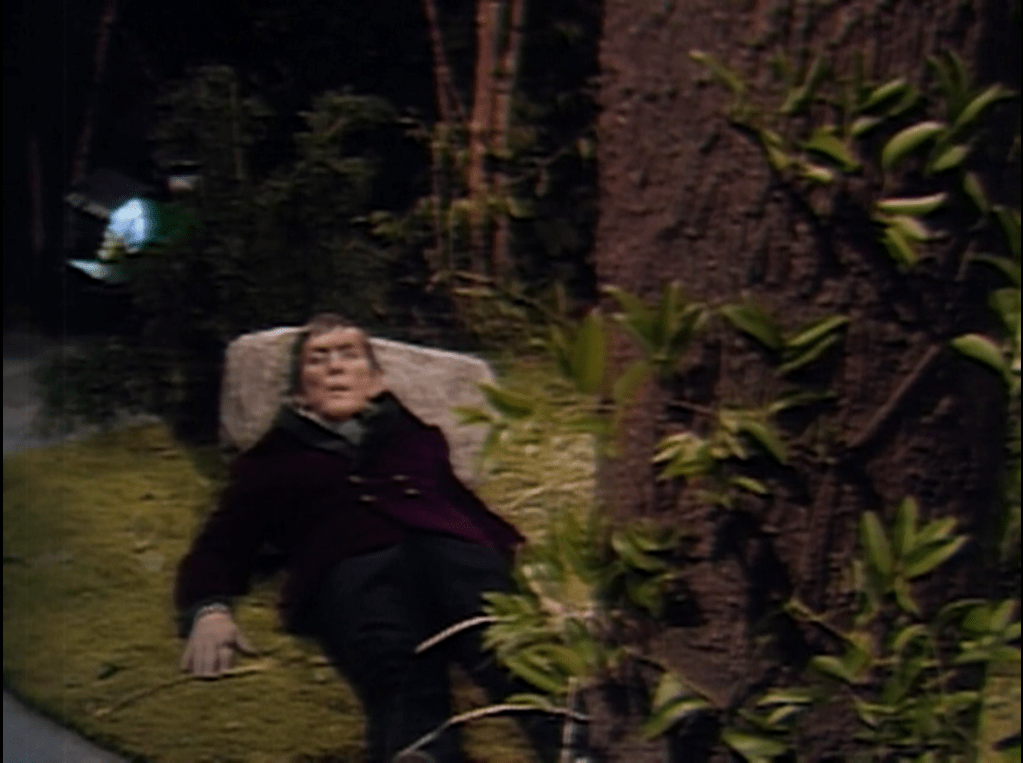
There is a spectacular goof in this one. We see Barnabas lying on the “grass” in the “woods.” For several seconds we can see the edges of the little green rug Jonathan Frid is on, and a studio light on the floor next to it.
A woman named Eve sees a man standing on the terrace of the great house of Collinwood. She addresses the man as “Peter Bradford.” Regular viewers know that this is indeed his name, but we also know that he prefers to be called “Jeff Clark.” Peter/ Jeff has died and came back to life since he was first known as “Peter Bradford,” so I suppose you could say that’s a case of deadnaming. But while most transfolk tend to be patient when people inadvertently deadname them, Peter/ Jeff is a huge jerk about correcting people who use his former name. Yesterday twelve year old David Collins called him “Peter Bradford,” and he grabbed the boy and shook him until it looked like he had given him a concussion.
Eve is also a returnee from the world of the dead. Doubly so; her body is a Frankenstein creation made of parts salvaged from corpses, while her memories and personality are those of eighteenth century homicidal maniac Danielle Roget. Peter lived in that same era, and when Eve/ Danielle recognizes him we learn that they knew each other then. Peter/ Jeff doesn’t assault her as he did David; she’s his own size. He doesn’t recognize her, which she attributes to the fact that she looks different than she did when they knew each other. He keeps whining that his name is “Jeff Clark,” but she isn’t having it.
Meanwhile, Peter/ Jeff’s fiancée, well-meaning governess Vicki, is in the drawing room, having a conversation with matriarch Liz. There is a blooper in the middle of this conversation. Liz is supposed to say something like “Then you’ve resolved all your difficulties,” but Joan Bennett stumbles over the words. Alexandra Moltke Isles improvises a response that makes sense of it. That response is smooth enough, but she delivers the rest of her lines very quickly and with unusually little eye contact with her scene partner. Perhaps that is because she was afraid the improvised line was going to put the scene over time, or maybe she realized she had called attention to Bennett’s flub and was nervous because she had embarrassed a big star.
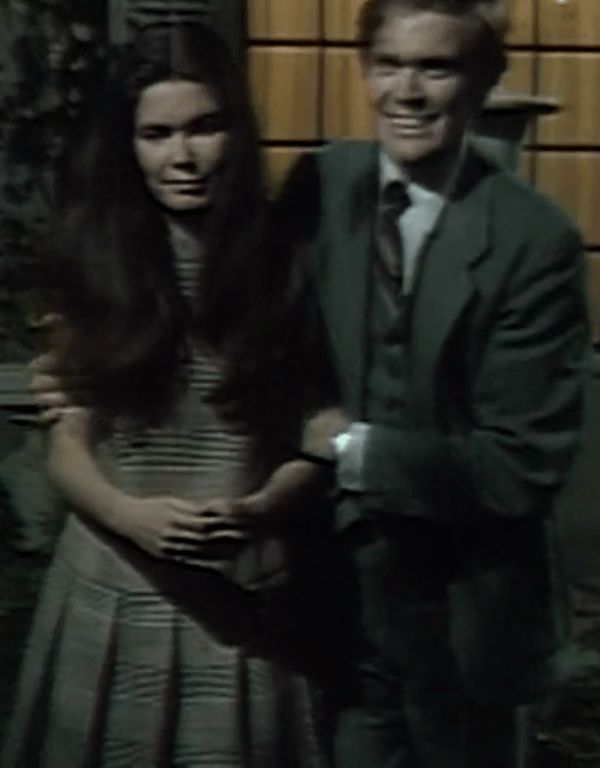
Or maybe Mrs Isles was nervous because her next scene was going to be with Peter/ Jeff, and she knew it would involve Roger Davis putting his hands on her. As they exit, Peter/ Jeff clutches Vicki by wrapping his arms around her in a remarkably awkward fashion, and she visibly squirms. This is most likely Mrs Isles’ discomfort arising from Mr Davis’ habit of physically assaulting his scene partners. A charitable viewer just might be able to believe that it is Vicki’s discomfort because Peter/ Jeff just spent the whole scene telling her transparent lies. He doesn’t want to tell her about his encounter with Eve/ Danielle, and makes up totally unconvincing excuses for his distracted state. Perhaps Mrs Isles channeled her unhappiness at being yoked with Mr Davis into her expression of Vicki’s dissatisfaction with the loathsome little man she is engaged to marry.
Peter/ Jeff steers Vicki offscreen.
Once Vicki and Peter/ Jeff are gone, Eve/ Danielle emerges from the bushes whence she had been spying on them. Liz comes out to the terrace and sees Eve/ Danielle. She asks who she is. When she does not answer, Liz tells her that she knows- she is the angel of death. Eve/ Danielle is startled by this, and hurries away.
The next scene takes place in the house of suave warlock Nicholas Blair. Nicholas has been keeping Eve/ Danielle there since she came to life. She has returned from Collinwood. Nicholas is upset with her for going out without his permission. She taunts him, and he slaps her. He threatens to kill her, and she says that while she does not know what his plans are, it is clear to her that she figures too prominently in them for him to do that.
Coming so shortly after we saw an actress give strong signs of unease at contact with Roger Davis, Nicholas’ slap to Eve/ Danielle’s face is a lesson in how professional actors handle scenes involving physical violence. Eve/ Danielle is relaxed before the slap and in shock after it. Her reaction gives the scene its energy. If Marie Wallace had reason to believe Humbert Allen Astredo would actually hit her, she may well have been as tense before the slap as Mrs Isles was before Roger Davis slithered his arms around her, and the scene would have dribbled out as lifelessly as does Peter/ Jeff’s scene with Vicki.
Once Nicholas concedes that Eve/ Danielle is important to his plans, she relaxes again and decides she may as well tell him about her encounter with Peter/ Jeff. Nicholas is intrigued, and disturbed. He tells Eve/ Danielle that “If it is true that they are one and the same, then there are forces at work here that I don’t know about.” Eve/ Danielle’s memory of her previous existence is very incomplete, and she wants Nicholas to help her to learn more about herself. Once he has heard about Peter/ Jeff, he is eager to oblige. He hypnotizes her.
At this point, my wife, Mrs Acilius, expressed frustration. “He’s going to hypnotize her and afterward she won’t remember anything! It’s only interesting if she remembers.” Eve/ Danielle does have a flashback to 1795, but at the end she seems to come out of the trance on her own. She turns to Nicholas, calls him by name, and says that she remembers Peter Bradford and she loves him. Since Nicholas doesn’t give her a post-hypnotic suggestion and snap his fingers, it seems likely she will remember her past with Peter.
When Danielle was introduced, I assumed that the name “Roget” was a case of deadline-induced selection. She is based on Madame DuFarge from A Tale of Two Cities, so she had to be French. But the writer didn’t have a list of French surnames at his fingertips, so he looked at his desk, saw a copy of Roget’s Thesaurus, and went with that. Perhaps that was what happened, but today Eve/ Danielle lives up to her namesake and goes into the synonym business. She calls Peter/ Jeff by his original name. She is on the receiving end of synonymy from Liz, since “the angel of death” is as good a name for her as any. And one of the memory gaps Eve/ Danielle wants Nicholas to help her fill is her previous name.
Marie Wallace plays Danielle in the flashback, even though she had mentioned in the first act that she looked different in those days. This occasions much discussion on the fansites. Here is the debate on the Dark Shadows Wiki:
During the fiashback scene, Danielle Roget should have been played by Erica Fitz instead of Marie Wallace. Fitz had previously portrayed Danielle Roget in episode 594, so it would have made sense and for character continuity to continue using the same actress. [Addendum: There are strong reasons to argue otherwise as well. One could argue that this is a memory that Nicholas is conjuring in Eve, so it’s from Eve’s perspective, and she would naturally see herself in her current guise, not even knowing what Danielle Roget looked like. This is also a reasonable place for dramatic license to prevail. The scene is very short, and it wouldn’t have been especially practical to have an additional actress. It’s also possible that viewers may have been confused if another actress was in the scene–Erica Fitz was on the show for only two episodes, so viewers at the time might not even have seen or not fully remembered what she looked like. Aside from that, it’s also possible Erica Fitz was not available.]
Discussion under “Bloopers and Continuity Errors” in “610” on The Dark Shadows Wiki.
In a comment on his own post about the episode on Dark Shadows Every Day, Danny Horn puts it more succinctly:
Yeah, I think the in-universe explanation is that the flashback pictured at the top of this post is Eve’s hypnosis-assisted memory of the event, so she’s picturing herself as she is now.
The real-world explanation is that Marie Wallace is playing Eve/Danielle now, and exactly nobody wants Erica Fitz to come back and appear in the flashback.
Comment left 23 March 2015 by Danny Horn on “Episode 610: Inexplicable You,” Dark Shadows Before I Die, 21 March 2015.
For my part, I’m sure Erica Fitz Mears is a very nice lady, and we should all give her money to help with her health problems. But no, she was not a good actress and I do not regret that she did not get more work on screen. Since Mrs Mears was only in two episodes, today’s flashback might have been an opportunity to give some other actress a chance to show what she could do as Danielle. But Miss Wallace does a very good job, and rounding the episode with two confrontations between the same pair of performers does a great deal to strengthen its structure. It would probably have been a mistake to cast anyone else in the flashback.
The flashback scene does come as bad news to longtime viewers, for reasons that have nothing to do with the casting of Danielle. When in November 1967 the show needed to develop a backstory for vampire Barnabas Collins, it took us back to 1795 and introduced Angelique, a maniacal ex-girlfriend who was determined to disrupt Barnabas’ new romance. That was a triumph that turned Barnabas from a stunt that boosted their ratings sufficiently to ward off cancellation into one of the major pop-culture phenomena of the 1960s, and Angelique herself became one of the show’s most important characters. That they are trying the same tactic with Peter/ Jeff, right down to a dramatic date of 1795, leads us to fear that they see him as a permanent part of the cast, and that they want to tie Eve/ Danielle as closely to him as Angelique is tied to Barnabas.
One mad scientist built a Frankenstein’s monster, and another brought it to life. The builder, Eric Lang, had forced a man to dig up freshly buried corpses he used as materials. That man, an unpleasant fellow named Peter who prefers to be called Jeff, left Lang’s employ after he awoke on a surgical table and found Lang trying to cut his head off. Shortly after that, Lang died, and his colleague Julia Hoffman completed the experiment.
Lang and Julia’s creation is known as Adam. Adam is under the mistaken impression that Julia’s friend, recovering vampire Barnabas Collins, was his maker. He is now threatening to kill all the Collinses unless Barnabas and Julia provide him with a mate. They are complying. They have collected Lang’s journals, and are keeping a cadaver and some equipment in Barnabas’ basement.
Well-meaning governess Vicki is engaged to marry Peter/ Jeff. Barnabas is fond of Vicki, and Adam’s original threat was to kill her. He kidnapped her and held her prisoner for a couple of days; it was when he released her that he extended his threat to the whole family. When he was holding her, Adam gave Vicki’s engagement ring to Barnabas as proof of his seriousness. Now Barnabas has told Vicki that her ring turned up outside his house, and she drops by to pick it up.
Barnabas is alarmed that Vicki came to the house after dark. He knows not only that Adam is still at large, but also that a vampire named Tom Jennings is on the prowl. Vicki doesn’t remember her time as Adam’s prisoner and knows nothing about Tom, but she has heard enough about strange goings-on that she appreciates Barnabas’ concern. She assures Barnabas that she didn’t walk through the woods, and she isn’t alone. Peter/ Jeff is just outside, waiting in her car. Barnabas tells her he’s sorry Peter/ Jeff didn’t come in with her. As he says this, he looks at the door, giving the impression that he is sincere. Earlier, Peter/ Jeff had told Vicki that he was jealous of Barnabas; this scene makes it clear that he has nothing to worry about on that score. Regular viewers know that Julia has a crush on Barnabas; his behavior towards Vicki, whom he sometimes claims to love and want to marry, leaves her looking blissful.
Vicki notices that Julia is carrying one of Lang’s journals; Barnabas tells her that he and Julia are thinking of writing a book about Lang. Vicki knows only that Lang was a doctor who was a friend of theirs, so she accepts this explanation easily. When she goes, Barnabas insists on accompanying her to the car.
Barnabas returns, and tells Julia that he and his servant Willie Loomis will go out and try to find Tom before he bites someone. He speaks tenderly to her; she smiles.
Julia, content with the state of her relationship with Barnabas. Screenshot by Dark Shadows Before I Die.
Julia goes to the basement to close down the experiment for the night. She is still in a blissful mood as she listens to the radio playing the Jackie Gleason Orchestra’s truly appalling version of George Gershwin’s “Love is Here to Stay.” Since they have a stolen corpse in the basement and incriminating documents scattered throughout the house, the front door is of course unlocked. Peter/ Jeff lets himself in and is shocked to find Lang’s journal on the desk in the front parlor.
Julia comes upstairs and finds Peter/ Jeff. He explains that he wanted to see Barnabas and asks why they have Lang’s journal. Julia repeats the story Barnabas told Vicki. Peter/ Jeff laughs at the idea that Barnabas and Julia would write a book about Lang’s attempt to build a man from stolen body parts; Julia says it won’t be about that part of his life. Peter/ Jeff is still laughing when he leaves the house.
It’s odd Julia sticks with Barnabas’ story. A few days ago, Peter/ Jeff confronted Barnabas and Julia with his suspicion that Adam is Lang’s creation. Had she said they were disturbed by his suggestion and were checking Lang’s records to make sure there was no way he could be right, he wouldn’t be in a position to contradict her. He certainly wouldn’t be bothered that they lied to Vicki to cover up what they know about Lang’s experiment, since he is at one with them in his desperation to keep her from ever finding out what he did. Later, we see her writing a note to Barnabas explaining that Peter/ Jeff had not believed “my- really, your- story.” Perhaps she is embarrassed that she did not live up to her usual standards as Dark Shadows’ most fluent and most plausible liar.
Julia heads back to the basement, and we see a figure peering in the window. It is Tom. Coming on the heels of her failure to deceive Peter/ Jeff, this leaves us with no doubt that Julia’s happy night will soon give way to misery.
While Julia is writing her note for Barnabas, Tom appears in the basement. Julia sees him, realizes who he is, and screams as he bares his fangs and approaches the camera.
This ending comes as an anticlimax. The sight of Tom at the window was enough to let us know what Julia was in for; there was no real need to continue the episode beyond it. Moreover, the scene is poorly executed. When Tom walks toward the camera, he twice stops himself awkwardly because he’s running out of set. He also stops in the middle of opening his mouth, apparently realizing he has started that move too soon. Julia’s scream doesn’t help, either. Grayson Hall was a brilliant actress, the heart of the show, but she was terrible at screaming. This is actually one of her better attempts, but coupled with Don Briscoe’s stumbling it still brings a bad laugh.
Suave warlock Nicholas is studying a mirror in his parlor. His subordinate, vampire Angelique, enters and comments on his vanity. He invites her to look at the mirror and tell him what she sees. “Only your reflection,” she replies. But the audience also sees the reflection of her hair and forehead. Her line, coupled with the fact that we do not see her whole face, suggests that her reflection was not supposed to be visible. In #288 the idea that vampires do not cast reflections was a crucial plot point. When old world gentleman Barnabas was a vampire, he several times cast the sorts of reflection Angelique casts today, usually as the result of Jonathan Frid missing his mark. Perhaps Lara Parker simply took half a step too many in this scene.
Nicholas’ mirror is no simple reflector. It functions as a closed circuit TV. He uses it to show Angelique the room in the attic where well-meaning governess Vicki is being held prisoner. He lets Vicki go, casts a spell to cause her to forget her captivity, and then tells Angelique that he will be going out.
Angelique asks what she is supposed to do while he is gone- sit in her chair and get bored? He says he couldn’t have put it better himself. When he returns, she is in fact in the chair, sitting still. It’s hilarious that she doesn’t pace, or get a book, or try to see if the mirror gets any other channels.
Nicholas was away visiting Maggie, The Nicest Girl in Town, on whom he has a crush. Maggie’s fiancé Joe dropped in while he was at her house. He tells Angelique that Joe is to be the next victim of her vampire’s bite.
Suave warlock Nicholas has expressly forbidden his subordinate, the wicked witch known variously as Angelique and Cassandra, from killing Frankenstein’s monster Adam. But now he has twice caught her trying to do just that. He punishes her by stripping her of her powers. He tells her that she is now a human being, and that she will die soon.
Nicholas de-witches Angelique/ Cassandra, while also trying to hold her wig in place. Screenshot by Dark Shadows Before I Die.
Angelique/ Cassandra’s husband, sarcastic dandy Roger, comes downstairs and confronts her about her indifference to him. She responds that there never was anything between them and never will be, and rushes out of the house. My wife, Mrs Acilius, is a soap opera fan from way back, and she says that as far as she is concerned this archetypal soap moment makes for a “Genuinely Good Episode.”
Angelique/ Cassandra goes to see recovering vampire Barnabas. He opens the door and asks what she wants. She says that she was once the mistress of the house and that as such she has a right to enter.
Ever since she showed up in the year 1968, Angelique/ Cassandra has been trying Barnabas’ patience and the audience’s by pretending that she was not the witch he married in the 1790s. He asks her why she has dropped that pretense now, and she says that she, like he, has become human. She also says that she will die at dawn. It is unclear why she thinks this- all Nicholas told her was that her life expectancy was to be measured in “minutes.” She declares her intention to kill Barnabas, and is pointing a gun at him when the episode ends.
If it does not lead to her immediate demise, depriving Angelique/ Cassandra of her powers would be an intriguing way of making her a more flexible character. In the costume drama segment set in the late eighteenth century, she was so powerful that she painted herself into a corner, facing no real opposition. The only suspense she could generate came when she was indecisive or distracted and got in her own way. In 1968, her subordination to Nicholas has pushed her to the opposite extreme. She has been very busy, but hasn’t done much. If she survives without her powers, it might be interesting to see her learn how to live as a human after all this time.
Angelique/ Cassandra’s appearance reflects the end of her dual identity perhaps more clearly than was intended. When she answered to the name Angelique in the 1790s, she had blonde hair; when she turned up in 1968 calling herself Cassandra, she wore a black wig. Throughout this episode, the wig keeps sliding around on her head.
This episode includes another of the innumerable replays of an audiotape message about Barnabas and Adam. The other day, it seemed that Nicholas and Cassandra had taped over the message, as undead fire witch Laura Murdoch Collins taped over a recording she didn’t want parapsychologist Peter Guthrie to hear in #172. But Friday they played it for us yet again. When Nicholas threatens Angelique/ Cassandra with death if she keeps disobeying him, Mrs Acilius said to the screen “I’ll kill you myself if you play that tape again!” I am glad to report that this is the last time we will hear the thing.
Danny Horn’s Dark Shadows Every Day post about this episode juxtaposes screenshots and dialogue from the scene in which Nicholas strips Angelique/ Cassandra of her powers with screenshots and dialogue from a contemporary episode of General Hospital. The contrast is hilarious. It also shows why even the conventionally soapy scenes with Roger and Barnabas stand out from the other daytime dramas of the period. Director Lela Swift’s use of the camera was incomparably more dynamic and ambitious than anything General Hospital was doing, Robert Cobert’s original orchestral score is comprehensible to a modern audience in a way that an organ playing in the background would never be, and the action is paced so that it takes less time for Angelique/ Cassandra to lose her supernatural powers, end her marriage to Roger, and pull a gun on Barnabas than it took Lucille to explain to Audrey that she had an idea about how she could learn to play bridge.
A stranger comes to the great house on the estate of Collinwood and introduces himself as Nicholas Blair, brother of Cassandra Blair Collins. Cassandra’s husband Roger Collins is shocked; Cassandra had never mentioned that she had a brother. Moreover, she has been missing for the last 24 hours, and Roger is convinced something terrible has happened to her. Roger’s distant cousin Barnabas Collins and Dr Julia Hoffman are also shocked, but for a different reason. They know that Cassandra is actually Angelique, a wicked witch who, in the 1790s, turned Barnabas into a vampire. She recently returned to the world of the living when Barnabas’ vampirism went into remission, and she tried to implement a plan to bring it back in full force. When Angelique/ Cassandra went missing, they hoped it meant that she had been defeated. Nicholas’ arrival replaces their hopes with the fear of new battles.
Nicholas at first assumed that Barnabas was Angelique/ Cassandra’s husband, and told him “I should have recognized you anywhere!” This is a sure sign of trouble- Barnabas, who was in fact briefly married to Angelique in 1796, has not been out of the state of Maine since 1795, and has never been photographed. Nicholas says that he has recently been on Martinique, where Barnabas first met Angelique in the eighteenth century, and that he is a “citizen of the world” with no fixed address. He assures Roger that it is Cassandra’s way to disappear abruptly, and that she is sure to return.
Roger, Julia, Barnabas, and Nicholas in the drawing room.
Roger takes Nicholas to the bedroom he and Angelique/ Cassandra share. He shows Nicholas a portrait of Angelique which returning viewers know to have a mysterious connection with Angelique/ Cassandra’s physical being. Roger leaves the room, and Nicholas talks to the portrait. He asks Angelique if she can hear him, and a musical cue associated with her plays on the soundtrack. The cue cuts out, and Nicholas follows up with another question. Dark Shadows stood out from the daytime soaps of the period in having an orchestral score instead of an organ accompanying the action. The meta-theatrical touch of a character who can hear that score is a major departure. It is something people at the time would have seen in animated shorts from Warner Brothers, but likely not anywhere else. Since the biggest and fastest-growing share of Dark Shadows’ audience at this point was children under the age of 13, there was a risk that adult viewers might take that association with cartoons as a sign that it was time for them to find something else to do with their mid-afternoons.
Back in his own house on the same estate, Barnabas finds his servant Willie Loomis holding a rifle. Willie says that he is afraid that man named Adam will come to the house. Barnabas dismisses that fear and orders Willie to put the rifle away. Willie objects. Barnabas repeats the command and leaves. Willie grumbles, but does as he was told. We see a face peering in at the window.
The face belongs to hardworking young fisherman Joe Haskell. Returning viewers know that Barnabas held Joe’s fiancée Maggie prisoner from May to June of 1967 and was extremely cruel to her. When the case was being investigated, Barnabas framed Willie for those crimes. Willie was sent to a mental hospital, and Barnabas had Willie released and brought him back to work for him some weeks ago. Joe thinks that Willie is the perpetrator, and has no patience with him. He knocks on the door and demands Willie let him in.
Joe insists that Willie tell him what he knows about Adam. Willie tries to evade his questions. When Willie says that Adam dislikes him, Joe responds”that means he knows you.” Joe twists Willie’s arm while repeating his questions. Once Joe releases him, Willie runs off and comes back with the rifle. He points it at Joe and orders him out of the house. Joe complies, but says that he will be back, and that he will be having words with Barnabas.
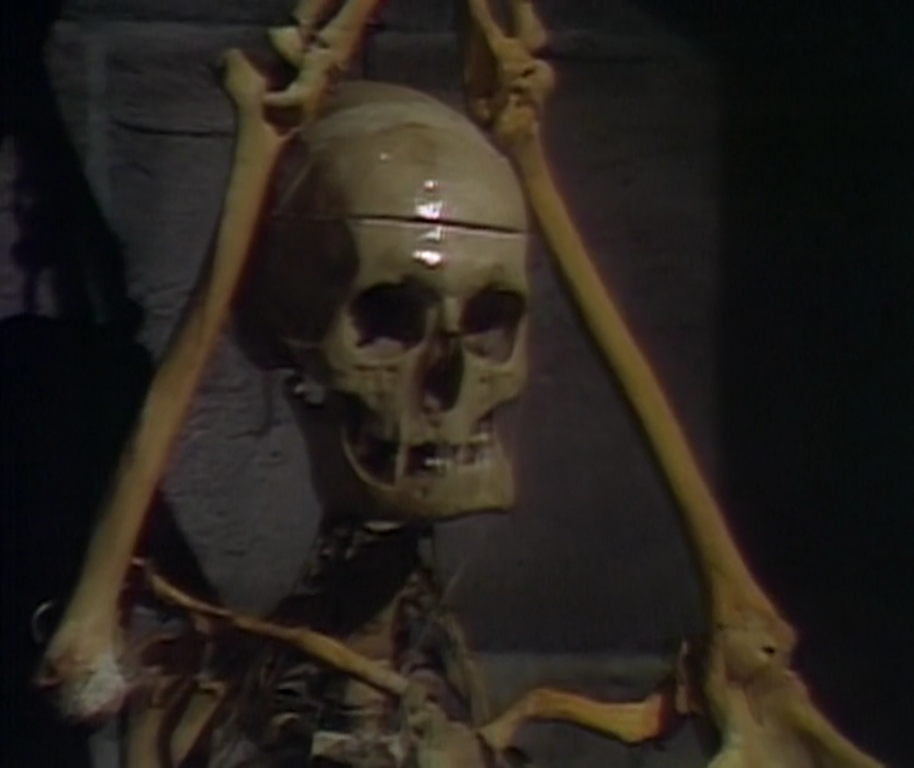
Later, Willie is in the basement. Some bricks are missing from a wall, exposing a skeleton hanging from the ceiling. Viewers who have been with Dark Shadows all along will recognize the basement of Barnabas’ house as a redress of the set that represented the basement of the main house in the first year of the show. The spot with the missing bricks was where a door stood that was always locked in those days. For the first 54 weeks of Dark Shadows, matriarch Liz thought that her husband’s corpse was buried behind that door. That belief turned out to be mistaken, but now we see that there are indeed human remains in the most similar possible spot. We might wonder what else Liz might have been less wrong about than at first sight appeared.
We watch Willie preparing to fill in the missing bricks, leaving the skeleton in place. After all, judging by Liz’ old way of thinking, that’s what ought to be in a space like that. We hear Willie’s interior monologue. He is making himself laugh with a pun on his own name when a stagehand wanders into the shot.
Uh, hello?
That moment of unintentional humor gives way to a scene rich in intentional comedy. Willie goes upstairs and finds that Nicholas has let himself into the house. Nicholas entrances him and extracts information from him. Willie tells him about a meeting with a ghost- “the one downstairs,” he specifies. Nicholas directs Willie to sit down, to remain in a blissed-out state until he leaves, and then to forget all about their encounter.
Nicholas goes to the basement, looks at the skeleton, and calls it “Reverend Trask!” Willie hadn’t given him this name; evidently he recognizes Trask the same way he recognized Barnabas.
We open with a reprise of yesterday’s close, with mad scientist Julia Hoffman and servant Willie Loomis in the basement of the Old House on the estate of Collinwood. They hear a sobbing in the air; Julia knows it is the sound of the ghost of gracious lady Josette. Yesterday, the sobbing sounded like Kathryn Leigh Scott, who played Josette in the part of Dark Shadows set in the 1790s; today, it is a recording used in the early months of the series when a mysterious sobbing was heard coming from the basement of the great house on the estate. That sobbing was implied at that time to be Josette also, but in #272 it turned out to be matriarch Elizabeth Collins Stoddard. Using the same recording for Josette, and playing it on a redress of the set used for the basement at the great house, would seem to be a way of admitting to longtime viewers that it was a mistake to resolve the Mystery of the Sobbing Woman that way.
The performer on the old recording is Florence Stanley. Stanley would become nationally famous in the 1970s as Bernice, wife of Sergeant Fish on Barney Miller and later on a spinoff series titled Fish. Fish was played by Abe Vigoda, who will later appear in a couple of episodes of Dark Shadows. I doubt very much Stanley and Vigoda ever talked with each other about their experiences on the show, but it makes me happy that they were both alums.
Abe Vigoda and Florence Stanley as Phil and Bernice Fish.
Julia figures out that recovering vampire Barnabas Collins has been bricked up behind a wall in the basement by the vengeful spirit of eighteenth century witchfinder the Rev’d Mr Trask. She orders Willie to chisel away the bricks and rescue Barnabas. Willie is confused and frightened by what Julia has told him, and resists her command. As he chips away, he is interrupted first by a strange, sudden chill and then by the feeling of a hand on his shoulder. Julia conjured Trask up at a séance held on this spot a few days ago. But she at first refuses to acknowledge that he can be a real obstacle to Willie’s compliance with her commands, so she tells Willie to “shut up!” and get back to work. When Trask becomes visible to them both, Julia has no choice but to address herself to him.
Julia tells Trask that, as a man of God, he must know that murder is wrong. This changes nothing; evidently Trask’s moral theology has evolved considerably since his physical death. Then she tells him that if he wants to correct a terrible mistake he made in life, he should forget about Barnabas and turn to the witch he hunted then, who now calls herself Cassandra Collins and lives at the great house on the estate. Again, no change. When Julia says that Cassandra is the one who ultimately caused Trask’s own misfortunes and that if he is going to take revenge on someone, it should be her, he disappears and the cold, clammy feeling of a ghostly presence goes with him. Willie gets back to work, and they get Barnabas out of his predicament in the nick of time.
In the great house, Cassandra plays a scene with Elizabeth. Cassandra has caused Elizabeth to be obsessed with death, and now causes her to believe she is one of her own collateral ancestors, Naomi Collins, who died in 1796. Cassandra leads Elizabeth to Naomi’s tomb and shows her the stone wall plates inscribed with the dates of the people buried there.
Cassandra does some more spellcasting to deepen Elizabeth’s misery and confusion. Elizabeth resists and runs out; Cassandra laughs gleefully. Her laughter stops when Trask appears to her, a torch glowing in his hand. He tells her that she is the witch, and that he has come to burn her. He commands “Burn, witch, burn!” and she bursts into flames.
The scene in the basement is great fun, as is Cassandra’s confrontation with Trask. But the parts with Cassandra and Elizabeth drag. This is the second time Elizabeth has moped around hopelessly and thought of nothing but death; the first time was a year ago, in late June and early July 1967. It was deadly dull then, and is no better now. The show simply does not know what to do with Elizabeth, and usually wastes the great talents of Joan Bennett.
There are a couple of famous production faults at the tomb. When they get there, the plate over Naomi’s casket still reads “born, 1761; died, 1821,” as it did before the show settled on the 1790s as the decisive period. When Cassandra causes Elizabeth to see the tomb as incomplete and still awaiting Naomi’s interment, the inscription is covered by a piece of cardboard painted to match the stone and clumsily pasted on it.
In the first months of Dark Shadows, the audience’s point of view was represented by well-meaning governess Vicki, who needed to have explained to her everything we might want to know and who reacted to all the strange goings-on with the mixture of disquiet and curiosity that the makers of the show hope we will feel.
Vicki has long since been replaced as our representative by mad scientist Julia. We no longer want characters to tell us what has been going on, nor are we making up our minds about our moral evaluation of the events in the stories. We find ourselves in the middle of a whole clutch of fast-moving plots, trying to keep up with them all and hoping that nothing will stop the thrills. Julia’s loyalty to her best friend, sometime vampire Barnabas, and her supremely well-developed capacity for lying put her in the same position, and her vestigial conscience is no obstacle to any juicy storyline.
When Vicki was our on-screen counterpart, her charge, strange and troubled boy David, was the show’s most powerful chaos agent. David precipitated a series of crises that seemed likely to expose the secrets of the ancient and esteemed Collins family, to kill one or more of the major characters, or both. In #70, David led Vicki to his favorite playground, the long-vacant Old House on the estate of Collinwood. David would keep sneaking into the Old House even after Barnabas took up residence there in #218.
Today, David again lets himself into the Old House. He is caught there by Julia and a man he has not seen before. Julia is stern with him for entering the house without Barnabas’ permission; he defends his presence there, reminding Julia that she promised him he could play with the tape recorder on Barnabas’ desk. He asks who the man is.
The man introduces himself to David as “Timothy Eliot Stokes.” This is the first time time we have heard his middle name. Soon, the show will phase “Timothy” out, and his friends will address Stokes as “Eliot.” I suppose that’s because he’s a professor, and “Eliot” suggests Harvard.
Stokes introduces himself to David.
In 1966, Thayer David played crazed groundskeeper Matthew. Suspected of murder, Matthew hid out in the Old House and kept Vicki prisoner there until some ghosts scared him to death in #126. David didn’t believe Matthew was a killer and didn’t know he was holding Vicki, so when he stumbled upon him in the Old House he brought him food and cigarettes. Even after he found Vicki bound and gagged behind a hidden panel, he kept Matthew’s secret. When David meets another character played by the same actor on the same set, longtime viewers can see that Stokes is as genteel and urbane as Matthew was rough-hewn and paranoid. For her part, Julia recalls Vicki when she scolds David for sneaking into the Old House, but where Vicki was doing her job as David’s governess and trying to enforce the rules of the household as a governess might, Julia is scrambling to keep David from finding out about her own secret activities.
Julia tells David to take the tape recorder and go home to the great house on the estate. As he makes his way to the front door, Stokes takes Julia aside and tells her that it will not be well if it is known in the great house that David has seen him. Julia hurries to David and tells him to keep quiet about the fact that he has seen Stokes. She says that she hates to ask him to lie; at this, I mimicked Julia and said “I know you share my devotion to the truth,” prompting Mrs Acilius to laugh out loud. Later, Julia will go to the great house, where she lives as a permanent guest, and David will cheerfully assure her that he kept her secret. The two of them seem quite relaxed together, leading us to believe that he will continue to do so.
There is a bit of irony in Julia’s harshness with David for entering Barnabas’ house without his permission. She and Stokes didn’t have Barnabas’ permission to be there, either. Indeed, if he had known what they were up to he would likely have objected most strenuously. Along with a man named Tony, they held a séance in the part of the basement where Barnabas kept his coffin when he was under the full effect of the vampire curse. They were trying to contact the Rev’d Mr Trask, a Puritan divine whom Barnabas bricked up to die in the eighteenth century. The séance was so successful that the bricks crumbled, exposing Trask’s bones, still held together somehow in the shape of a skeleton hanging from the ceiling. At the end of the episode, Trask has resumed his corporeal form and set about taking revenge on Barnabas by walling him up in the same spot.
Odd that Trask’s skeleton holds together after all the ligaments and tendons have rotted away, odder that there is a straight cleavage separating the top of the skull from the rest, oddest of all that the section is attached to the rest of the skull by a piece of Scotch tape.
Yesterday, wiggéd witch Angelique/ Cassandra sent her cat’s paw Tony to kill sage Timothy Eliot Stokes. Stokes pulled “the old switcheroo” on him, and Tony drank from the glass into which he had put Angelique/ Cassandra’s poison. Today, we learn that Stokes gave Tony an emetic to save his life. Stokes calls mad scientist Julia Hoffman, MD to examine Tony and assist with the next stage of the battle against Angelique/ Cassandra.
Recovered, Tony has no idea why he obeyed Angelique/ Cassandra’s command to kill Stokes, and is ready to surrender to the police. Stokes tells him he is under the power of a witch, and enlists him in the battle against her.
Stokes takes out the memoirs of his ancestor Ben, who was Angelique’s cat’s paw in the eighteenth century. He does some automatic writing in Ben’s hand and finds that they must contact the spirit of the Rev’d Mr Trask, a witchfinder who inadvertently helped Angelique in those days. Fortunately, Trask, like Tony, was played by Jerry Lacy, so it shouldn’t be too hard to get hold of him. Stokes also finds that Trask was walled up in “the coffin room,” which Julia tells him is for some mysterious reason a nickname given to the space at the foot of the stairs in the basement of the Old House on the estate of Collinwood. Stokes decrees that he, Julia, and Tony must go to this room and hold a séance there.
On his way to the Old House, Tony follows Stokes’ instructions and stops at the main house on the estate and tells Angelique/ Cassandra that Stokes is dead. This follows a scene between Angelique/ Cassandra and her husband, sarcastic dandy Roger, in which Roger complains about her lack of interest in him. Her mind isn’t on the game of chess they are playing, she hasn’t been attentive to him for several nights, and she refuses to go on a honeymoon. Angelique/ Cassandra ensorcelled Roger into marrying her so that she could have a perch at Collinwood, and he seems to be slipping out of the spell’s power.
Stokes, Julia, and Tony gather in the coffin room. They begin the séance. This is the fifth séance we have seen on Dark Shadows, but the first that does not include well-meaning governess Vicki. In four of the previous five, it had been Vicki who went into the trance. On the other occasion, it was strange and troubled boy David who became the vessel through which the dead spoke to the living. The first three times Vicki served as the medium, she channeled the gracious Josette Collins, and when David filled that role he gave voice to David Radcliffe. In those days, Vicki was closely connected to Josette, perhaps a reincarnation of her, as David was another version of the cursed boy David Radcliffe. The final time Vicki spoke for the dead, she spoke for nine year old Sarah Collins, with whom she was no more closely connected than were any of a number of other characters. Sarah has no present-day counterpart, so her appearance at a séance suggested that Dark Shadows was moving away from its use of necromancy as a way of connecting characters from different time periods.
This time, Tony goes into the trance. In #481, Angelique/ Cassandra told Tony that she chose him as her cat’s paw because he resembled Trask, so when he is the medium through whom Trask speaks we are returning to Dark Shadows‘ original conception of how séances work. Trask mistakes Stokes for Ben, as Angelique did in a dream visitation last week. The brick wall behind which Trask’s remains are hidden bulges and is about to crumble when we fade to the credits.
True fans of Dark Shadows know that the episode’s real climax comes during those credits. Thayer David strolls onto the set under Louis Edmonds’ credit for Roger. He even looks into the camera when he realizes what he has done.
From #133, artist Sam Evans was compelled to paint a series of pictures that explained the evil intentions of undead blonde witch Laura Murdoch Collins, estranged wife of sarcastic dandy Roger Collins. In #146, Laura put a stop to Sam’s work by starting a fire that burned his hands so badly it seemed for a time he might never be able to paint again.
Sam shares his home, the “Evans cottage,” with his daughter Maggie, who is The Nicest Girl in Town and a waitress at the diner in the Collinsport Inn. Between her earnings there and the paintings Sam sells, the Evanses make a living, but it isn’t such a grand living that he can turn down any commissions, even very eccentric ones. Moreover, his work space entirely dominates the interior of the cottage. In the early days of the show, Sam’s old friend Burke Devlin often stopped by, and the conversation always turned to reminiscences of Burke’s youthful days of honest poverty. Nowadays the most frequent visitor is Maggie’s fiancé, hardworking fisherman Joe Haskell. Sam is delighted with the prospect of this upwardly mobile laborer as a son-in-law. When a representative of the moneyed world visits Sam or Maggie at home, as New York art dealer Portia Fitzsimmons did in #193 and old world gentleman Barnabas Collins did in #222, the contrast between their manner and the humble surroundings is meant to jolt us. The Evans cottage is therefore our window on the working class of Collinsport. When the troubles of the ancient and esteemed Collins family have an effect there, Dark Shadows is telling us that the whole town is dependent on the businesses they own and suffers as a result of their problems.
Yesterday, Barnabas came back to the cottage and brought Sam a very odd commission indeed. He presented a painting of a lovely young woman in eighteenth century garb and offered Sam $500* to paint over the image so that before morning the woman would look to be “about 200 years old.” Sam wasn’t in a position to refuse that much money, even though Barnabas wouldn’t explain why he wanted him to do such a thing.
If Sam knew what the audience knows, he would likely have turned the job down even if Barnabas had offered $500,000,000. The woman in the portrait is Angelique, and like Laura she is an undead blonde witch. In the 1790s, Angelique cursed Barnabas and made him a vampire. In #466, Barnabas’ vampirism went into remission. Shortly thereafter, the portrait made its way to the great house of Collinwood, where Roger became obsessed with it. In #473, Roger returned from an unexplained absence with a new wife. She is Angelique, wearing a black wig and calling herself Cassandra. From #366-#461, Dark Shadows had been a costume drama set in the 1790s; during this segment, we saw that Angelique was a far more dynamic and brutal menace than Laura ever was. Sam would hardly want to involve himself in a battle with this wiggéd witch.
For his part, Barnabas first appeared on camera in #210 and #211. But his portrait was first seen hanging in the foyer at Collinwood in #205, having been prefigured in #195. Dangerously unstable ruffian Willie Loomis became obsessed with the portrait of Barnabas. Willie could hear a heartbeat pounding from the portrait in #208 and #209, and followed its sound to the crypt where Barnabas was trapped in his coffin. As Roger’s obsession with Angelique’s portrait would bring her back to the world of the living, so Willie’s obsession with Barnabas’ portrait led to his return.
In the opening teaser, we see Sam working on the painting. He tells it that he can’t understand why Barnabas would want to disfigure such a pretty face, then resumes his task. The camera zooms in on the painting, as it had zoomed in on Barnabas’ portrait in #208 and #209, and the soundtrack plays the same heartbeat. Sam doesn’t react- he can’t hear it. It is addressed to the audience, especially to those members of the audience who remember the show as it was 13 months ago.
Angelique/ Cassandra is in the gazebo on the grounds of Collinwood. She is wearing a hooded cloak to conceal the aging she has already experienced as a result of Sam’s work. Her cat’s paw Tony Peterson, a local attorney, shows up, responding to her psychic summons. She entrances him with a flame and he tells her that the artist who has been in touch with the Collinses most frequently of late is Sam Evans. From this she concludes that Sam is aging her portrait at Barnabas’ bidding. Before Angelique/ Cassandra and Tony can go their separate ways, heiress Carolyn Collins Stoddard comes upon them.
Tony and Carolyn met in #357. In that episode, he was an instance of Jerry Lacy’s Humphrey Bogart imitation. A hard-boiled materialist, Tony had grown up in Collinsport as a working-class boy. He resented the Collinses and attributed all of their unusual characteristics to their wealth and social prominence. At that time, Barnabas was still a vampire and Carolyn was under his power. As a blood thrall, she knew that there was more to life than could be explained by Tony’s reductive logic, but she wasn’t free to offer any explanations. When Tony saw Barnabas biting Carolyn in #463, he interpreted their embrace as a sign of a sexual relationship.
Now their roles are reversed. It is unclear what Carolyn remembers from her time under Barnabas’ control; Nancy Barrett often plays the character as if she remembers everything, but the dialogue doesn’t give her much support for that, and in this scene she is as this-worldly as Tony was in the Autumn of 1967. She interprets Tony and Angelique/ Cassandra’s meeting at the gazebo as proof positive of an adulterous liaison, and declares she will report it to Roger. When Tony tells her that Angelique/ Cassandra has some mysterious power, Carolyn is dismissive, declaring that the Collinses are the ones who have all the power in this town. Tony tries to explain that the power Angelique/ Cassandra has is of an entirely different order from the power their ownership of capital gives the Collinses, and Carolyn responds with unconcealed contempt.
Angelique/ Cassandra knocks on the door of the Evans cottage. Sam opens the door. She ignores his objections and enters. While he keeps ordering her to get out of his house, she stands next to the portrait as he has aged it and points out her resemblance to it. He is astounded, but keeps telling her to leave. She says that she has no grievance against him and that no harm will come to him if he hands the painting over to her. He refuses. She heads out.
Angelique/ Cassandra has barely closed the door behind her when Sam has trouble seeing. After a moment, he realizes he has been struck blind. She comes back in, takes the painting, tells him she warned him, and leaves.
Over the years, several members of the cast said on the record that Sam’s blindness was actor David Ford’s idea. He thought that if he could wear dark glasses it wouldn’t bother the audience that he read all his lines off the teleprompter.
In 2022, a commenter on Danny Horn’s post about this episode on his blog Dark Shadows Every Day identified the portraits of Angelique as the work of ABC Art Department specialist Joseph Guilfoyle:
You asked if anyone knew who painted these portraits. I can verify that the portraits of Angelique were painted by Joseph Guilfoyle. He was an artist in the Art Department at ABC. He was my Godfather and his daughter remembers this very well as it made her a bit of a celebrity at the time. Portraits were not commissioned out but instead were created in the Art Department as it was filled with many talented artists.
Also worthy of note are the two facial makeups representing Angelique’s aging. It’s no wonder they didn’t have the personnel to make David Ford’s fake mustache look convincing when they were lavishing all the work on turning Lara Parker into two quite distinct old crones.
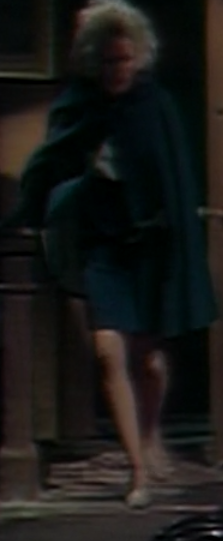
The costumers were involved in a famous production error in the final scene. Angelique/ Cassandra’s hooded cloak cuts off above her knees. There is no old age makeup on her legs, which are featured from every angle, making a ludicrous contrast with her face and wig.







 Dark Shadows Commentary