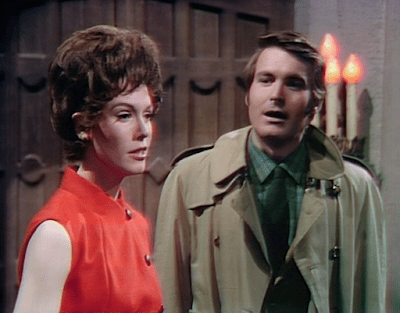
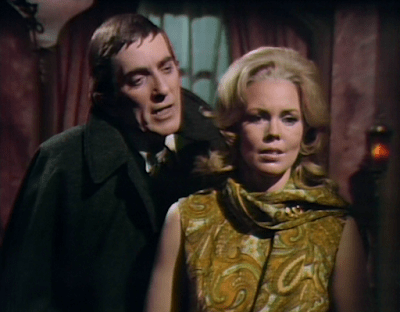
Heiress Carolyn Collins Stoddard talks her friend Sabrina Stuart into wearing a wig over her prematurely gray hair. Sabrina’s ex-fiancé Chris Jennings sees Sabrina with the wig and is suddenly attracted to her again. Sabrina knows that Chris is a werewolf. She disregards both Chris’ lycanthropy and the fact that he is more interested in her wig than in her and starts talking to him about renewing their engagement.
A villain named Bruno has evil plans for the werewolf. He knows that the werewolf is a man who is close to Sabrina, and when he sees her with Chris he realizes it is him. At the end of the episode, he abducts Chris at gunpoint.
For most of 1968, Dark Shadows was a shapeless mess. The makers of the show had caught on that the audience liked monsters, so they kept tossing one monster after another into the mix, hoping to repeat the popular success they had had with vampire Barnabas Collins the year before. One of the storylines that ended up disappointing this hope most completely was that centering on 6’4″ Frankenstein’s monster Adam; another was the “Dream Curse” that was supposed to revive Barnabas’ vampirism after it had been put into remission by the mad scientists who created Adam.
Suave warlock Nicholas Blair was on the show in those days. Nicholas appeared to be a regional manager for Satan’s operations in upper New England. He found out about Adam and came up with the idea of using him as the progenitor of a new species that would displace humankind and win the Earth for his master. Adam met heiress Carolyn Collins Stoddard and fell hard for her. He also developed an interest in the writings of Sigmund Freud. But he never clicked with the audience, and Nicholas’ plan didn’t make any sense in the context of the show. So the plan flopped and Nicholas was called to the main office. He’s back today.
The A story for the last fourteen weeks has been the effort of the Leviathan People, a race of Elder Gods, to use a 6’4″ shape-shifting monster as the progenitor of a new species that will displace humankind and win the Earth for them. The monster, who once invited people to call him Jabe, met Carolyn and fell hard for her. The Leviathans want Jabe to take Carolyn as his bride and turn her into a creature like himself, but he would rather be human and take Carolyn out on dates. Jabe isn’t the reader Adam was. Adam might be interested in Jabe’s current projects, though. When he was growing into his adult form, Jabe’s foster parents were antique dealers Philip and Megan Todd. He has now arranged to kill Philip, and as we open today he is passionately kissing Megan.
The door opens, and Nicholas enters. He tells Jabe that he is his boss, and that the Leviathan takeover of the Earth was his idea. It is the same idea that didn’t work last time he was on the show, and when he tells Jabe that he failed that time he adds that he does not intend to be punished for failing again.
Nicholas bullies Jabe into going to his room and turning into the inhuman monster he really is. Henchman Bruno shows up to consult with Nicholas while Jabe is in the room. Nicholas tells Bruno it is his responsibility to see to it that Jabe doesn’t kill anyone else. Nicholas leaves, and Bruno goes into Jabe’s room. Less than a minute after Nicholas told him to keep Jabe from further killing, Bruno is standing before the monster, apparently about to be killed.
Bruno manages to get out of the room alive. Jabe returns to human form and follows him. Bruno gasps that Jabe was going to kill him. Jabe replies that he wasn’t, “it was.” Adam might have found significance in this remark. One of Freud’s central concepts was a division between the ego (from the Latin pronoun equivalent to the English “I”) and the id (from the Latin for “it.”) People repress their unacceptable urges and attribute them to something separate from themselves. So, I don’t want to kill my father and marry my mother, it does. Bruno tells Jabe that in the room, he is “it,” and moreover that he himself, as a devotee of the Leviathans, wants to become something like “it.” Evidently the Leviathans’ promise to their followers is that they will replace their ambiguous and divided personalities with pure unreasoning id.
Jabe tells Bruno that he wants to be human. Bruno is horrified by this, commanding “Don’t even say that!” Indeed, Nicholas had said that for the Leviathan People, wanting to be human is the ultimate sin. That suggests a backstory which, if developed, might make the Leviathans scarier than they are. All tales of Elder Gods who want to take the Earth back raise the question of how they lost it in the first place. If our remote ancestors figured out a way to take it from them, surely we, who can learn everything they knew and add to it knowledge they lacked, will be able to prevail against them at least as easily.
But if it was envy of early humans that wrecked the Leviathan world order, a couple of possibilities open up. It could be that some of them defected to join us, so that their final defeat was mostly a struggle between Leviathans with our forebears as helpless on-lookers. In that case, it would remain to be seen whether humans could beat Leviathans. It could also be that the Leviathans who joined the human side have descendants among humans today, and that some of those descendants are vulnerable to co-optation by the Leviathans who are trying to reclaim their former position. There is a hint today that this might turn out to be the case- Bruno asks Nicholas why the estate of Collinwood is so important, and Nicholas, looking uncomfortable, tells him that there is a reason, but that he cannot explain it. Perhaps the members of the Collins family have some Leviathan blood that makes them at once receptive to the appeals of their estranged kinfolk and peculiarly dangerous to them if they are antagonized.
Nicholas is a logical choice to represent the idea that the greatest weakness of the Leviathan People is the temptation to become human. At the zenith of his power in 1968, he would reprove his subordinate Angelique for her romantic feelings for Barnabas, sneering that they made her “so human.” His downfall began when he fell in love with Maggie Evans, The Nicest Girl in Town, and found himself being humanized. So if Jabe is going to meet his doom because his desire for Carolyn makes him renounce his Leviathan form, he is going to remind longtime viewers of Nicholas, and we may as well have Nicholas on the show.
They may have had another reason to want Humbert Allen Astredo back in the cast. Lara Parker used to say that none of her acting lessons really took, and that it was only when Astredo would explain various techniques to her between rehearsals of their scenes as Nicholas and Angelique in 1968 that it all finally clicked for her. I’m sure Parker was exaggerating to make a self-deprecating joke, but it is undeniably true that her performances improved greatly after she had been working with Astredo for a while. So maybe the producers were hoping that some of the less experienced actors in the cast would benefit from time with this outstanding teacher.
The Dream Curse involved more than a dozen repetitions of a sequence over a period of months while one character after another had the same basic nightmare. The sequence involved opening a bunch of doors and seeing enigmatic images. Each time another character had the dream a little bit was added. At the end, it turned out that the curse was not able to renew Barnabas’ vampirism, so there was no point to any of it. For some reason, this did not go over very well with the fans.
Lately, Carolyn has been having a recurring nightmare. We see it for the third time today. The first time she had it, Jabe told her all about himself, and she saw that he had killed someone. Not too long after she woke up, her distant cousin Quentin came by and told her that Jabe had murdered her father Paul. The next time she went to sleep, she had the dream again, and it was clearer that Paul was one of the people Jabe had murdered. This time she even opens Paul’s coffin. She can’t figure out what the dream means. Too bad Adam isn’t around, by now he must have read Freud’s Interpretation of Dreams and enough of the case studies to apply his technique. If she told him the dream, he would be able to explain to her that the dream means that she is an hysterical female who needs to keep coming to him at least twice a week.
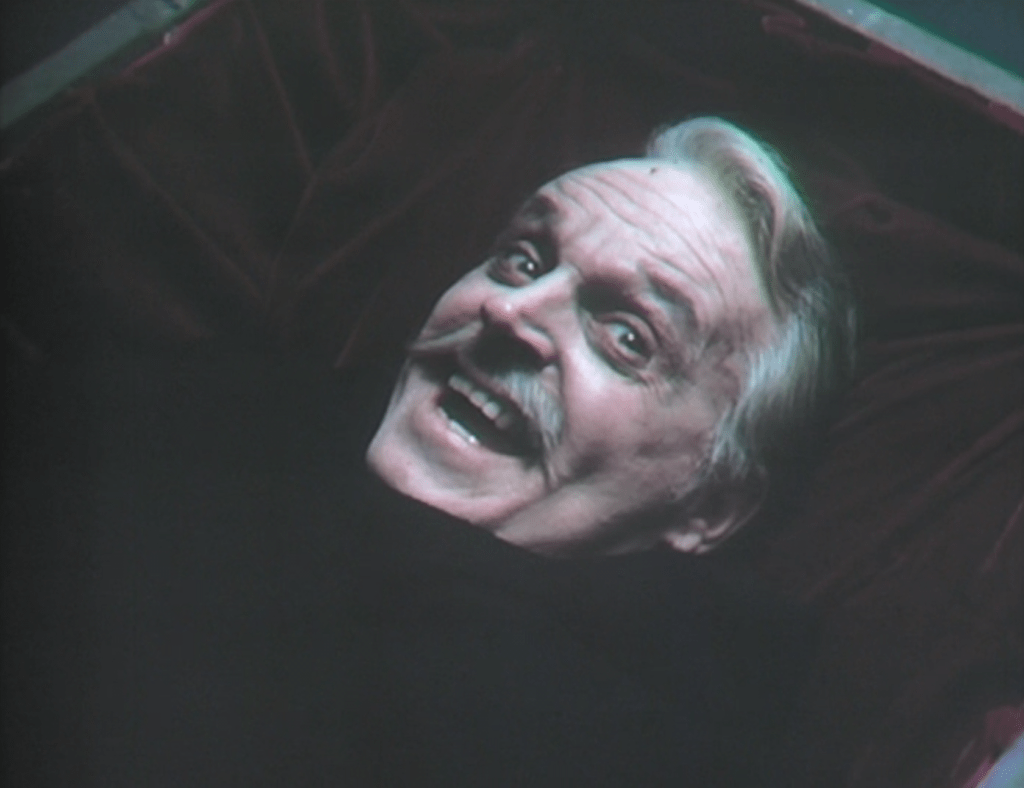
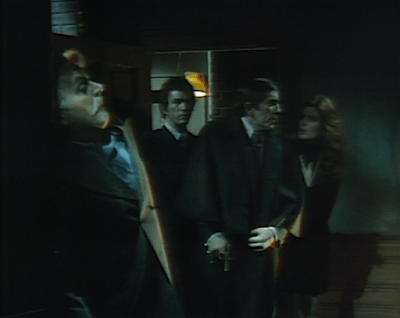
Jabe visits Carolyn, who tells him all about the dream. Not being trained in psychoanalysis, Jabe doesn’t tell her about her unresolved Electra complex or even send her a bill. He just rushes out to exhume Paul’s coffin. This leads to one of the most extraordinary images in Dark Shadows. They wanted to show that Paul’s body was there, but actor Dennis Patrick was by this time in California, producing and taking a role in the movie Joe. So they superimpose a photo of Patrick’s face on a still of a plush-lined box. The resulting image defies all description:
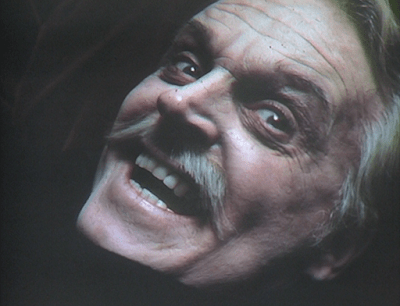
I’d remembered this as an image they flashed on the screen for a moment, but no, they hold it for quite a while. And then they go in for a closeup! Which is the last thing we see before the credits roll!
An old friend of mine has a brother who was hung up on Dark Shadows for a while, he apparently got the DVDs and watched them obsessively for months. When I told him that I was writing this blog, he claimed that this picture of Paul was the only thing he remembered about the show. I can believe it, really. I often try to figure out what they were thinking when they put the episodes together; as you can see with my speculation above about how the Leviathans lost the power they used to have over the Earth, sometimes I resort to some fairly elaborate fanfic to try to puzzle it out. But why they believed it was appropriate to put this image on national television, let alone to linger over it, cut back to it in closeup, and leave it as the climactic episode-ender, that stumps me completely.
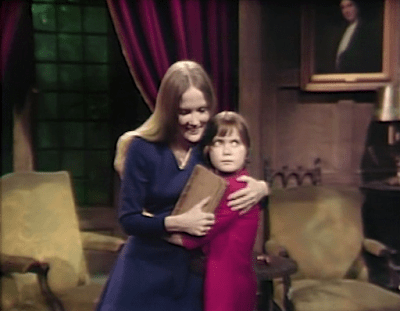
Ten year old Amy Jennings is at home in the great house on the estate of Collinwood. Evidently she’s in a literal mood- she’s in the drawing room, so she’s drawing. Heiress Carolyn Collins Stoddard sees Amy’s work and asks why she is doing it. Amy says she thinks the design is “pretty”; Carolyn replies that “pretty” is the last thing she would call it. That may seem rather rude, but as Amy hasn’t been seen since #912 I suppose she’ll take what she can get.
The design is one which on Dark Shadows is called simply a Naga. It is the secret emblem of a secret cult serving the Leviathan People, a race of Elder Gods. Secret cultist Megan Todd wears the Naga on a large pendant around her neck; Megan’s husband, secret cultist Philip, wears it on a shining ring; Carolyn’s mother, secret cultist Elizabeth Collins Stoddard, wears it as an oversized broach. Amy herself is a secret member of the secret cult, but she hasn’t yet acquired any conspicuous jewelry emblazoned with the secret symbol, leaving her to do her own artwork. Carolyn wonders aloud why so many people are so preoccupied with the design.
Quentin Collins enters. Amy is terrified. Starting in December 1968, Quentin’s ghost haunted Collinwood. By March, the house was uninhabitable and strange and troubled boy David Collins was near death. Old world gentleman Barnabas Collins tried some mumbo-jumbo in hopes of communicating with Quentin; he came unstuck in time and found himself in the year 1897, where he remained for eight months. While Barnabas was flailing about in the late Victorian era, time continued to pass in 1969, and Quentin’s obsession of David finally killed him in September. But a sequence of events with which Barnabas had a tenuous connection changed the circumstances on the night in September 1897 when Quentin originally died, causing him to survive. That night, as it happened, was exactly 72 years before David’s death. On Dark Shadows, anniversaries have the power that laws of nature have in our world, so that caused the haunting to break and David to come back to life. Due to a series of spells cast on him during Barnabas’ sojourn in the past, Quentin is still alive and still apparently in his late twenties in 1970. But the haunting still happened between December 1968 and September 1969, and everyone who lived through it still remembers it.
Quentin has introduced himself to Carolyn as his own great-grandson. Since Carolyn never actually saw his ghost, she is willing to accept this. But Amy had more dealings with the ghost than anyone but David, and it is obvious to her that they are one and the same. She clings to Carolyn.
Carolyn laughs at Amy’s fear and tells her that this Quentin is not the ghost, but is “a cousin of ours.” This is intriguing to regular viewers. It was during the 1897 segment that the audience learned that Quentin was the great-grandfather of Amy and her brother Chris, and just a few weeks ago that Chris learned about that relationship. It is through their descent from Quentin that Amy and Chris are cousins to Carolyn. So if Amy knows she is a Collins, she must have been told that the ghost that tormented her and David was that of her great-grandfather. A scene in which someone gave her that information might have been a good use of Denise Nickerson’s considerable acting talent, but they didn’t bother to produce one.
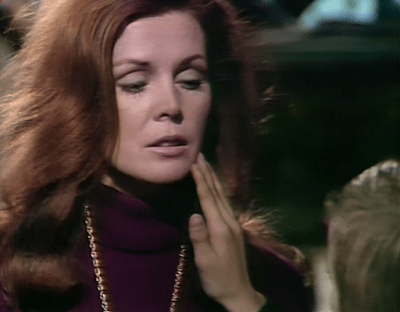
Quentin tells Carolyn to leave him alone with Amy. Still chuckling, she complies. Once they are alone in the drawing room, Quentin kneels and touches Amy’s face, assuring her that he is “not that Quentin Collins.” David Selby brought immense charm to the role of Quentin, so this scene isn’t as revolting as it might have been, but it is still pretty bad, and we can’t be surprised that Amy is not satisfied.
Amy goes to the village of Collinsport to seek guidance from her spiritual advisor. He is a shape-shifting monster from beyond space and time who usually takes the form of a very tall young man. When he first assumed that form, he invited people to “Call me Jabe,” but no one did. They call him “Jeb” instead, and he answers to it.
Jabe lives in a room above Megan and Philip’s antique shop, and when Amy enters the shop she finds him looking after the place. Apparently shape-shifting monsters from beyond space and time aren’t above doing a little work in retail now and then. She tells Jabe about her encounter with Quentin, and then tells him about a dream she had. In the dream, she went into the long-disused room where she and David first met Quentin. Quentin’s theme song, a sickly little waltz, was playing; she exclaims “It was terrible!” Longtime viewers know the feeling. The tune played incessantly during the “Haunting of Collinwood” period, and when they went back to 1897 characters kept complaining to the living Quentin that he was making them miserable by playing it on his phonograph all the time.
In the dream, Quentin appeared to Amy wearing the nineteenth century clothing and the angry scowl that he wore when he was a ghost. But when he was a ghost, he never spoke words the audience could hear. The only exception was a dream sequence in #767, when Quentin’s ghost spoke to David. That was also the only other dream sequence to be presented as this one is, in flashback as the dreamer is recounting it after the fact. That sequence marked a watershed, the first attempt to explain how Quentin the cranky ghost emerged from Quentin the charming scoundrel we had got to know in the 1897 segment.
This episode, also, has to do with the relationship between these two iterations of Quentin. Amy tells Jabe that Quentin’s ghost in the dream warned her against him by name, and says that she is therefore convinced that the living man she met in the drawing room today is in some way identical to the ghost who haunted the house for those ten months. Amy’s dream marks the final appearance of Quentin’s ghost, but we can see the ghost will not be forgotten.
A state police investigator named Lawrence Guthrie is in town looking into two murders Jabe has committed, those of Carolyn’s father Paul and of a law enforcement officer whose gravestone revealed that his given name was “Sheriff Davenport” (we never learn what Mr Davenport’s title was.) Jabe orders Philip to kill Guthrie. Philip calls Guthrie and asks him to come to the antique shop when Jabe will be out. Once Guthrie is there, Philip tells him that the upstairs room where Jabe stays is an important part of the story of the murders. He shows Guthrie into the room. He stays outside, and locks Guthrie in. Guthrie encounters Jabe there in his true form; Jabe kills him. This is quite effectively handled. My wife, Mrs Acilius, was completely caught off guard by the killing. She believed Philip really was trying to break free of the Leviathan cult, and wondered what Guthrie was supposed to find in the room.
Neither Jabe nor Philip is an especially well-developed character, but Christopher Bernau and Christopher Pennock were both fine actors, and they play off each other very well today. It is a tribute to their performances that Guthrie’s death scene comes as a surprise.
At the end, Quentin is at Collinwood trying to tell Carolyn that it was Jabe who killed her father and Mr S. Davenport. Inexplicably, Carolyn is interested in dating Jabe, and is unwilling to listen to this. Jabe bursts in and announces that there has been another murder, that the murderer is in custody, and that he has confessed to it and to the killings of Paul and Sheriff. That murderer, Jabe says, is Philip. That’s another surprise- after the murder of Guthrie, Jabe did tell Philip that he had another task to perform, and once we hear that he has confessed to the killings it makes perfect sense that that would have been what Jabe meant. But I don’t think anyone could have predicted it. It makes for a strong ending.
Danny Horn’s post about this episode on his great blog Dark Shadows Every Day is a lovely little bit of fanfic proceeding from the assumption that Lawrence Guthrie is the brother of Dr Peter Guthrie, the parapsychologist whom undead blonde fire witch Laura Murdoch Collins killed in March 1967.
The closing credits again misspell writer Violet Welles’ name as “Wells.” They started doing that last week, around the same time the misspelling of wardrobe house Ohrbach’s as “Orhbach’s,” a frequent goof in the show’s first year, reappeared after a long absence.
In May and June of 1967, vampire Barnabas Collins held Maggie Evans, The Nicest Girl in Town, prisoner. He drank her blood, tortured her, and drove her insane. When Maggie escaped, he turned his attentions to well-meaning governess Vicki Winters. Maggie’s imprisonment was the storyline that first made Dark Shadows a hit, but it was bleak and often difficult to watch, and if its horrors had shortly after been reenacted with Vicki as the victim many viewers would likely have given up on the show. So Barnabas decided that he wanted Vicki to come to him of her own will. That avoided the problem, but left the show stuck in a rut. For the next several months, Barnabas did not have a coherent goal. Since he was the main figure in the A story, that left Dark Shadows spinning in circles.
They escaped from that rut in November 1967, when Vicki went back in time to the 1790s. The audience followed her there, and we found out how Barnabas first became a vampire. He had fallen afoul of wicked witch Angelique. Angelique wanted Barnabas to love her. Since her enormous powers were explicitly shown to include the ability to make people fall in love with each other, we wondered why she didn’t simply use that ability on Barnabas. They answered that question by having Angelique declare that she wanted him to come to her of his own will. She tried to attract his love by casting a series of spells on everyone around him, spells that resulted in death and ruin for the people he most cared about. When Barnabas found out what was going on and tried to kill Angelique, she turned him into a vampire.
Now it is January 1970, and Barnabas’ vampire curse is in abeyance. A race of Elder Gods called the Leviathan People are trying to retake the Earth from humankind, and have threatened to reactivate the curse if he does not help them. The Leviathans control a group of people whom they have formed into a cult devoted to their service. The Leviathans have brought a shape-shifting monster to life, and it is written that the monster will marry Barnabas’ distant cousin Carolyn Collins Stoddard and turn her into a creature like himself.
Angelique has renounced her powers and is trying to live as a mortal woman. The other day, Barnabas asked her to help him protect Carolyn from the Leviathans. Angelique no longer wants anything to do with Barnabas or anyone else from the estate of Collinwood, but she understands the threat the Leviathans pose and is willing to help Barnabas against them, provided she can do so without losing what she has in her current life. Barnabas arranged for Carolyn and her mother, matriarch Elizabeth Collins Stoddard, to hide out at Angelique’s house while he tried to figure out a way of fighting the monster. Liz is a dedicated member of the cult, and believes Barnabas to be its faithful leader, so when Barnabas told her to take Carolyn to Angelique’s she complied at once.
Unknown to Angelique, her husband, hard-charging businessman Sky Rumson, is himself a member of the Leviathan cult. Thursday, he telephoned the monster and told him Carolyn was at the house; Friday he opened the door to the monster, and the monster went to Carolyn. Today, the monster decides that he will not impose the transformation on Carolyn after all. Instead, he will wait for her to come to him of her own will. This keeps the story from ending here, but it makes it unclear where it can go.
The monster’s decision poses a deeper problem for him as a presence on the show than the similar decisions did for Barnabas and Angelique. They pursued identifiable goals, and were influenced by thoughts and feelings they had while they interacted with others. The only goal the monster has is to take possession of Carolyn, and now it is unclear what that means. Nor is anything at stake for him in any encounter with another person. He keeps saying that he doesn’t need anyone, and that seems to be true- there is no reason to pay attention to him in any scene. He has, in short, been established not as a character at all, but simply as a function. All he has ever been is Threat. Now that he has decided to be nice to Carolyn, he will no longer even fulfill that function. His future would appear to be quite limited.
Sky also appears to be a short-timer. When Dark Shadows started, one of its most dynamic characters was hard-charging businessman Burke Devlin, played ably by the charismatic Mitchell Ryan. Despite all of Ryan’s magnetism, they could never come up with anything very interesting for Burke to do. Hard-charging businessman just isn’t a type they have much use for. They signal that Sky won’t be around long by casting Geoffrey Scott in the role. Scott was very handsome and would go on to a long career on screen, but in early 1970 he did not appear to have any skills of any kind as an actor. Not only does he deliver his dialogue as if he were reading a series of nonsense syllables aloud, but he is noticeably bad at hitting his mark. For example, on Friday Sky at one point backed away from Carolyn during a conversation. He took a step too far, with the result that his rear end was a few inches from a hearth with a vigorously burning fire. It was hard not to watch the seat of his pants and wait for it to ignite. There were times when they cast actors who still needed a lot of training and kept them around for quite a while, but Scott was at this point in his career so amazingly inept that it is hard to imagine they meant to use him for anything more than the decorative value his good looks offered.
Liz is at home in the great house of Collinwood when a man she has not seen before appears on the walkway above the foyer and starts giving her orders. He comes down and introduces himself to her by the name Bruno. He shows her that he is wearing a ring that identifies him as a member of the Leviathan cult. Liz says that he must have come to give her instructions. He confirms that this is so.
A howling resounds outside, and Bruno asks Liz about it. She tells him that she long ago met a wolf-like creature in the woods, and she suspects the howling comes from that creature. Returning viewers know that the Leviathans are vulnerable to werewolves and that the monster is terrified of them. Bruno knows this too, so he goes out to hunt for it.
The monster, in the form of a tall young man, comes to the great house to introduce himself to Liz. She is concerned when he tells her to stop taking orders from Barnabas, but delighted when he says that Carolyn has a future with “us.” Carolyn telephones from Angelique’s house, and Liz puts the monster on the phone.
Carolyn is all smiles when she is talking to the monster. They’ve met a few times, and he has been nothing but a jerk to her. She had objected to his behavior, and his responses had ranged from frightening to slimy. That she is all of a sudden attracted to him undercuts her character almost as badly as nerfing his threat to her undercuts his position on the show.
After the phone call, Bruno returns. He tells the monster he couldn’t find the werewolf. The monster declares that he will go to the Old House on the estate to confront Barnabas, whom he labels a traitor. Bruno points out that it is almost daybreak, and if he waits just a little while he will not be in danger from the werewolf. The monster says that it is too important to wait.
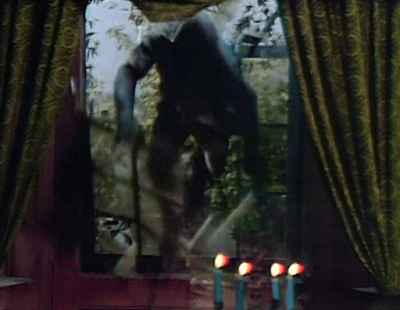
The werewolf chases the monster through the woods. By the time the monster gets to the Old House, he is shouting for Barnabas, the “traitor” he was planning to deal with, to come and help him. Barnabas is nowhere to be seen, and we end with the werewolf bursting through the window. The werewolf got a few closeups earlier in the episode, when he was nosing around in the woods. These always make him look like a cute widdle doggie. If they hadn’t given us those ridiculous images, his entrance through the window might have been a genuinely scary moment.
Carolyn’s scene at the beginning involves a couple of notable wardrobe-related points. She went to bed Friday fully dressed, even wearing shoes, and is still that way when she is back in bed today. Several times we have seen men go to bed shoes and all, but usually the women wear nighties. I think this is the first time we have seen a shod woman asleep in bed.
Carolyn falls on her back in the opening reprise. She is wearing a very short skirt, and this fall exposes her underwear. She is lying on the bed in several subsequent shots, and it must have taken some doing to keep the undies from making another unscheduled guest appearance.
Episode 361 was virtually a one-woman show, featuring Grayson Hall as Julia Hoffman, MD. Julia was being tormented by haunted house-style effects resulting from her involvement with a supernatural entity. The script, by Ron Sproat, was largely a recycling of an episode Sproat had written for Never Too Young, the soap opera that ran on ABC at 4 PM before Dark Shadows premiered.
Episode 658 consisted largely of a one-man show, featuring Joel Crothers as fisherman Joe Haskell. Joe was being tormented by haunted house-style effects resulting from his involvement with a supernatural entity. The script, by Gordon Russell, owed a good deal to Sproat’s work on #361.
Episode 897 ended with a long scene that amounted to a one-woman show, featuring Marie Wallace as antique shop owner Megan Todd. Megan was being tormented by haunted house-style effects resulting from her involvement with a supernatural entity. The script, by Violet Welles, drew from both #361 and #658.
Many fans consider #361 to be The Worst Episode of Dark Shadows, and many consider Megan’s turn at the end of #897 to be The Worst Scene on Dark Shadows. To the extent that #658 is remembered at all, it is because it is one of Crothers’ last appearances on the show. The memory of this fine and well-loved actor makes the fans so weepy that no one can be very harsh about his final star turn.
Today, the second half of the episode is virtually a one-woman show featuring Nancy Barrett as heiress Carolyn Collins Stoddard. Carolyn is being tormented by haunted house-style effects resulting from her involvement with a supernatural entity. The script, by Gordon Russell, recycles elements of #361, #658, and #897.
Russell was usually one of the most careful writers on Dark Shadows, but this one is remarkably shoddy. Carolyn and her mother, matriarch Liz, are staying at the home of a woman named Angelique. Angelique tells them that she has to drive to the airport to pick up her husband, and that she will be away for “several hours.” A couple of minutes later, Liz is also called away, and she tells Carolyn that she is sure “Angelique will only be gone an hour or so.”
Worse, all the action of the episode is completely, flagrantly unnecessary. The calls that leave Carolyn alone in the house are part of a monster’s scheme to get at Carolyn. But Liz is the monster’s loyal servant- if he had told her to bring Carolyn to him, she would gladly have done so.
Carolyn’s torments aren’t quite a monodrama, since they are interrupted by a couple of brief scenes with other actors. But one of those is a dream sequence in which she talks to the monster while we see him silhouetted in darkness. The interaction between them is so limited he may as well be a recorded voice. She also has a few interactions with Angelique’s husband. Since he is played by Geoffrey Scott, he may as well be a cardboard standee.
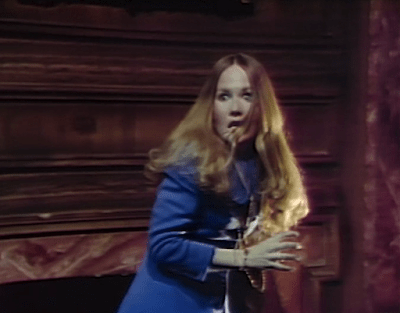
One advantage this episode has over #361 is that Nancy Barrett was excellent at screaming, second only to Clarice Blackburn in her ability to produce a true blood-curdler. Grayson Hall, accomplished as she was, had asthma and was physically incapable of controlling the timbre of her voice when she raised its volume above a certain level. Sproat’s script for #361 required Julia to scream several times, and every time she tried it Hall emitted a croaking sound that raised a bad laugh. Miss Barrett’s closing scream today, by contrast, really puts the “opera” in “soap opera,” it sounds great.
This is one of the few episodes with no scenes on the estate of Collinwood, and one of very few to take place primarily in a location many miles from the village of Collinsport.
There’s also an interesting moment when Angelique claims to have met Liz and Carolyn’s distant cousin Barnabas while they were both living in England. Barnabas never lived in England, that’s a lie he has been telling his relatives to conceal the fact that he is a recovering vampire who hasn’t left Maine since George Washington was president. Liz is part of the current supernatural storyline and Carolyn has at various times known all about Barnabas, so we don’t expect to be reminded that he’s still peddling the “cousin from England” bit.
Yesterday and today, a clock stopped at 8:00 featured prominently in shots when it was pivotal to the story that it was not 8:00. The clock is part of the merchandise in an antique shop, so it is understandable it does not run, but it is rather odd to see someone telling people that he didn’t wait for 8:00 when a clock face displaying that time looms over his shoulder. Today, it is important that a scene in the shop is taking place after 10:00. We open that scene with a view of a different clock, one that reads 10:20, but before long the stopped clock is back in full view.
At the great house of Collinwood, old world gentleman Barnabas Collins is rushing to the front door. Governess Maggie Evans asks him where he is going. He says that he is going to the village of Collinsport. She says she is going there as well and that she will ride in with him. He says that he can’t take her. He refuses to explain why. The other day, Maggie and Barnabas held hands and leaned in close to each other, talking softly about how important their friendship was. This sudden refusal to communicate pulls Maggie up short. She demands to know whether Barnabas trusts her. He says he does. She marches up to him and orders him to “Prove it!” The tight aspect ratio of old time TV combines with director Henry Kaplan’s habit of putting the actors as close to the camera as he can get them to make it seem, in the moment, that the feelings Maggie expects Barnabas to prove are of an erotic nature.
Maggie has been the governess at Collinwood for over a year now. Her predecessor, the well-meaning Vicki Winters, was written out of the show for a number of reasons, not least their inability to figure out an intelligible relationship between her and Barnabas. There was a long period when Vicki the character seemed to know that she was on a show starring Barnabas and she kept trying to involve herself in his storyline, even inviting herself to spend the night at his house. In theory, Barnabas was in love with Vicki and yearned for her, but no matter how flagrantly she threw herself at him he never did anything about it. Eventually they paired her off with an intolerable jerk, and the two of them disappeared into a rift in the space-time continuum.
Vicki never did take quite as direct an approach with Barnabas as Maggie does today. No matter how deeply Vicki drove the ball into his court, she always counted on him to show at least a little initiative. Maggie knows better than to rely on Barnabas, and she corners him into agreeing to see her and give some kind of explanation when he is done with the mission he is concealing from her, at 10:00 sharp.
Fans often fret about the “Vickification” Maggie undergoes while she is serving as governess. When it became clear that Vicki wasn’t going to matter to Barnabas, she couldn’t be allowed to affect the A story in any way. To keep her on the sidelines, she was written as an ever greater ninny.
Maggie is pretty bad at her job- she’s a squish when the children don’t want to do their lessons, which is every time we’ve seen her with them. But she’s still good with grownups, she’s smart, and she’s emphatically sexy. So she isn’t going to go down into irrelevance without a fight.
Maggie isn’t the only character insisting on her place in the story. A few weeks ago, it seemed that matriarch Elizabeth Collins Stoddard would be a part of the main plot for the first time in ages when she was inducted into a secret cult serving a mysterious race of Elder Gods who are trying to regain control of the Earth. But she has drifted back to the sidelines, and has yet to meet the cult’s leader in his current form.
Barnabas was Liz’ preceptor in the cult, and she is indignant with him for the decline in her part:
Liz: Barnabas, I must speak to you.
Barnabas: Not now, Elizabeth.
Liz: Have I done something wrong? Just tell me that.
Barnabas: No, nothing at all.
Liz: I’ve tried to follow the rules, as many as I know. You yourself can testify to my faithfulness. But David sees our leader, you’ve seen him.
Barnabas: Jabez?
Liz: Is that what he calls himself now? Well, no matter what name, he’s the same boy who used to play here. Surely he must remember me with some affection.
Barnabas: He is only recently matured enough to appear to us.
Liz: Why have I been ignored? Barnabas? You haven’t answered my question.
Barnabas: You’ll meet him soon enough but now is not the time.
Liz: Does the book specify when I am to meet him? Is that why you’re against it now?
During the show’s costume drama segments, Joan Bennett got to play dynamic roles, but she has been excluded from the action in the contemporary parts for so long that she has a tremendous amount of passion to bring to this scene. It is great to see her cut loose for once.
A shape-shifting monster from beyond time and space has assumed the form of a young man and decided to marry heiress Carolyn Collins Stoddard. Carolyn’s distant cousin, old world gentleman Barnabas Collins, knows all about the monster and wants to prevent the wedding.
The other day, the monster mentioned to Barnabas that when he is not in human form, nothing can kill him. That would seem to imply that when he is in human form, at least some of the things that kill humans can kill him. So Barnabas slips some poison in a drink and gives it to the monster. The plan is logical enough, but like all of Barnabas’ plans it fails. Whatever the monster’s vulnerabilities are, that particular poison is not one of them. It does not harm him at all, though it does affect the drink’s flavor sufficiently to damage the monster’s confidence in Barnabas’ bar-tending abilities.
Barnabas’ next plan is less sensible. His ex-wife, wicked witch Angelique, is living nearby with her new husband. He goes to Angelique and asks her to take Carolyn in for a while. Angelique reminds Barnabas that Carolyn knows her and dislikes her. She was married to Carolyn’s uncle Roger for a while in 1968, when she was using the alias Cassandra. By the end of that period, she had alienated Carolyn and everyone else at the great house of Collinwood. Barnabas exclaims “But she won’t recognize her; you had dark hair!” Presumably the scripted line was “But she won’t recognize you; you had dark hair!”
Which doesn’t really make all that much more sense- the black wig Angelique wore when she was calling herself Cassandra was the entirety of her disguise. She didn’t need to conceal her identity any more thoroughly than that, since the only people who could recognize her were Barnabas and time-traveling governess Vicki. Barnabas couldn’t afford to admit that he had lived in the 1790s and married a witch, and Vicki was at that point not allowed to do anything that would affect the course of the A story, so the wig was plenty. To say now that the difference in hair color will keep Carolyn from recognizing Angelique as Cassandra is to lampshade the absurdity of Barnabas’ idea.
Barnabas tells Angelique that the monster is affiliated with mysterious supernatural beings known as the Leviathan People. This alarms Angelique sufficiently that she agrees to hide Carolyn.
This is also the episode in which rakish libertine Quentin Collins reintroduces himself to the family at Collinwood. They had known him as the ghost who drove them from their home in November 1968, and Carolyn met the living Quentin in late 1969, when he went by the name Grant Douglas.
Quentin is at loose ends, so he agrees when Barnabas and mad scientist Julia Hoffman ask him to help them in their battle against the Leviathans. The plan is for him to use the power of his handsomeness and charm to distract Carolyn from the monster. This would seem to be quite a sensible idea, since he has been the big attraction of the fan magazines since he joined the show.
We cut to the great house of Collinwood, where the piano is being played very well. We see that Carolyn is the pianist. This is puzzling to longtime viewers. The piano has been a prominent part of the drawing room set from the beginning of the show, an echo of the deep prehistory of Dark Shadows, which was originally based in part on old teleplays Art Wallace wrote about a lady who gave piano lessons. We have seen Carolyn poke at the keyboard a couple of times, in a manner that made it clear she could not play at all.
Quentin knocks at the front door and Carolyn lets him in. He gives his right name, and claims to be his own great-grandson. When Carolyn asks why he said his name was Grant Douglas, he claims to be a writer who used that among other pseudonyms. That doesn’t explain anything, but Carolyn settles for it, for some reason. He tells her that, since they are only third cousins, their family relationship is no bar to them spending a great deal of time together. She says she is busy tonight, but eagerly volunteers that she is free tomorrow.
The monster enters. He meets Quentin, and they take an instant dislike to each other. That doesn’t mean much, since the monster is extremely obnoxious and everyone not under the power of the Leviathans dislikes him. For that matter, some who are under their power can’t stand him, either. For example, Barnabas was a devotee of theirs until he had to deal with the monster, and his personality broke the spell. So it remains to be seen what contribution, if any, Quentin will make to this story.
Quentin doesn’t try to persuade Carolyn to break her date with the monster. He, Julia, and Barnabas are at Collinwood when the monster calls. He tells her Carolyn is on her way, two hours earlier than originally planned. The monster and Carolyn share a drink; he slips her a mickey. Once she is passed out, he carries her up to the room in which he assumes his true form, declaring that her new life is about to begin.
Up to this point, drugging drinks has chiefly been a source of comedy on Dark Shadows. Barnabas tried to poison Angelique in #402, when they were married; that led to a farce scene when his mother showed up, Angelique passed the poisoned drink to her, and he had to scramble. For a while in 1968, a warlock calling himself Nicholas Blair hung around and functioned as Angelique’s boss; in #528, she asked him to slip some poison to Vicki, prompting him to complain that “I am much too talented to spend my time drugging drinks.” By the time he was done, he had not only complied with Angelique’s request, but drugged a couple of other people’s drinks on his own initiative. He may as well have kept his pride, since none of those poisonings got him what he wanted. So the monster’s use of that tactic might lead us to suspect that Carolyn’s odds are better than they appear.
Heiress Carolyn Collins Stoddard is mourning her father, who was recently murdered. She tells Maggie Evans, governess to the children in the great house of Collinwood, that she will not rest until she finds the killer. Maggie urges her to leave that up to the Maine State Police. Returning viewers know that the culprit is a monster from beyond space and time. We also know that the monster takes the form of a very tall young man who, when he first materialized, asked people to “Call me Jabe.” They called him “Jeb” instead.
Jabe has no impulse control, no awareness of other people’s feelings, and no long-range plans. He wants to marry Carolyn tomorrow, which, considering that a disagreeable encounter yesterday was the first time he met her while in his current form, she would be unlikely to agree to do even if her father had not just been killed.
Carolyn is taking the night air on Collinwood’s terrace when she hears some strange noises. Most of them are being produced by the late Sheriff Davenport, whom Jabe recently murdered then raised from the dead to serve him as a zombie. He’s hanging around in the bushes, idly watching.
Jabe shows up and says he’s sorry if he startled Carolyn. He tells her that they will be married tomorrow, exasperating her beyond endurance. She gives him a piece of her mind. She uses the word “crazy” to describe his behavior, prompting him to get very stiff and snarl “Don’t ever call me that!” She turns to go, and he grabs her arm. She tells him to let go. He refuses, and she threatens to scream. He still does not let go, but she breaks away and goes back inside.
Maggie sees a flustered Carolyn come rushing into the house. She asks her what’s wrong. Carolyn won’t answer. She hurries upstairs to her bedroom.
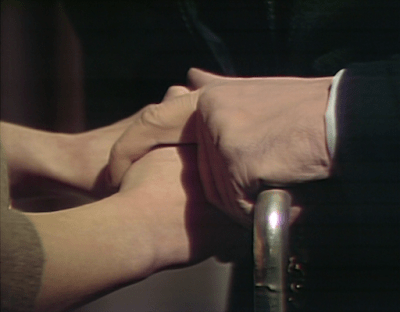
Carolyn’s distant cousin, old world gentleman Barnabas Collins, comes in. He and Maggie talk about Carolyn. Maggie says that she is deeply impressed by Barnabas’ concern for Carolyn. She takes his hand. They put their heads together and talk quietly about how important their friendship is to each of them while the camera zooms in on their hands. Barnabas used to be a vampire, and spent the spring and summer of 1967 torturing Maggie so viciously she suffered a complete mental collapse. Her psychiatrist, Julia Hoffman, saw in Barnabas her chance to pursue her dream career as a mad scientist, and so she sold Maggie out. She used her magical powers of hypnosis to rewrite Maggie’s memories so that she forgot all about what Barnabas had done to her. Her feelings of terror were replaced by warm friendliness towards him. Still, longtime viewers will find it a bit jolting to linger over this handclasp, with its suggestion that romance may be about to bloom between Maggie and Barnabas.
The next day, Carolyn finds a note of apology and some red roses in the drawing room. They are from Jabe. She is putting them in a vase when Barnabas turns up. He is concerned when she tells him the flowers are from Jabe. She says she is not sure what to make of Jabe.
We hear Barnabas thinking that if Carolyn starts seeing Jabe, there will be no hope for her. He’s thinking of Jabe’s monstrous nature and his association with the Elder Gods who are on their way to destroy the human race, but even first-time viewers who know nothing of those things have seen enough of Jabe to agree with him. Regular viewers know that, while there is, in an ontological sense, more to Jabe than Carolyn has seen, she has already taken the complete measure of his personality and temperament. If she winds up deciding he is an acceptable partner, it can only be because the writing staff has decided to sacrifice her character once and for all to the business of moving the plot forward.
Longtime viewers will find this prospect especially disturbing. The terrace was the scene of many grisly encounters between Maggie’s predecessor, well-meaning governess Vicki Winters, and Vicki’s boyfriend, a repellent little man named Peter who preferred to be called Jeff. Peter/ Jeff was not a monster from beyond space and time, he was something much worse- a character played by Roger Davis. At least when Jabe grabs Carolyn’s arm, it is only the characters who are in an abusive situation. When Peter/ Jeff clutched at Vicki, Mr Davis squeezed Alexandra Moltke Isles out of shape and blocked the camera’s view of her. Vicki, Dark Shadows‘ original protagonist, had been pushed to the margins of the story for a number of reasons, but it was her inexplicable insistence on sticking with the loathsome Peter/ Jeff that finally made it impossible for her to continue on the show.
For some unaccountable reason, the producers and directors seem to have liked Mr Davis. They kept him on the show for a couple of years, in a variety of roles, and allowed him to assault his scene partners with abandon. The writers seem to have caught on that he was not so good; his most recent character, Harrison Monroe, was a robot who just kept yelling at everyone until his head fell off. But the directors were still fans; when Christopher Pennock joined the cast as Jabe last week, they told him to imitate Roger Davis. To his credit, he instead conducted himself in a professional manner. However much of a dead-end Jabe is, you will never see Pennock hurting another member of the cast or obstructing her performance.
The current A-story is about a group of people under the control of the Leviathans, unseen supernatural beings. The Leviathans’ plan involves a mysterious force that has incarnated itself in a series of children, most recently an apparently thirteen year old boy named Michael, and will culminate in the obliteration of the human race. Since all of the actors who are under contract to appear on Dark Shadows are human beings, the success of this plot would leave Dan Curtis on the hook for a lot of buyouts, so we can be fairly sure the Leviathans will eventually fail. Besides, the non-human day players, such as the parakeet we saw in Wednesday’s episode, just haven’t caught on with the public.
Recovering vampire Barnabas Collins was originally the leader of the cultists who serve the Leviathans. Since his introduction in April 1967, Barnabas has been far and away the show’s biggest draw, so it is unlikely he will go down with the ship whenever the Leviathan story ends. Making him the chief villain means that we once more get to see him as he was when he was first on the show, an ice-cold, merciless villain, and also that we are in suspense the whole time as to how and when he will return to the side, not of good exactly, but of sustainable narrative development.
Three weeks ago, they decided to throw all of that away. Episode #915, aired on Monday 29 December 1969, was an homage to Charles Dickens’ A Christmas Carol. As A Christmas Carol begins with Scrooge in his place of business denying a request from his subordinate Bob Cratchit, so #915 began with Barnabas in an antique shop in the village of Collinsport refusing to comply with a demand from Michael, who is currently under his charge. As Marley’s ghost appeared to Scrooge and warned him that he would come to a bad end if he did not become more obliging to Bob Cratchit, so an embodied Leviathan appeared to Barnabas and warned him that he would have to be more deferential to Michael. As Scrooge was visited by spirits representing his past, present, and possible future, so Barnabas is visited by a bat representing his former existence as a vampire, antique shop owner and fanatical Leviathan cultist Megan Todd representing his present, and a woman played by future four-time Academy Award nominee Marsha Mason representing the grim future that awaits him if he does not obey. As Scrooge ends by knuckling under to Marley’s insistence that he become joyous and loving, so Barnabas gives in to the Leviathan’s command that he go on acting on behalf of the plan.
Barnabas’ main activity yesterday was helping Paul Stoddard, who has been trying to warn people about the Leviathan cult, to escape from captivity in the great house of Collinwood, and his main activity today is trying to help Paul after he has sneaked into to the antique shop and come face to face with the mysterious force in its true form. Since his efforts are so completely counterproductive, they might have led viewers who missed #915 to wonder if Barnabas, still loyal to the Leviathans, has deliberately led Paul into a trap, or if he is sincere when he says he wants to help him and is just bungling as he usually does.
They might have, that is, had the show not gone out of its way to ensure it would not create any such suspense. Yesterday’s opening voiceover told us in so many words that the Leviathans were extorting Barnabas’ participation in their plot and that he was “desperate to find a way of stopping the menace.” Today, it tells us that Barnabas “has been forced to do things against his own will” but is trying “to secretly fight back.” As if that weren’t enough, today’s episode also interrupts a conversation between Barnabas and his sometime best friend, mad scientist Julia Hoffman, to give us an interior monologue in which Barnabas tells us exactly what’s on his mind.
Not only do they tell us too much today, they show us too much. Yesterday ended with Paul going into the room where the mysterious force is kept; we closed with a shot zooming in on the terrified expression on his face as he saw this force. We open with a reprise of that scene, which is harmless enough. But after the opening title, we return to the room and see Paul still standing around, still looking terrified. Eventually, Megan, her husband Philip, and Barnabas all come into the room as well and try to figure out how to get Paul out. The four-scene drags on and on, turning a quick moment of horror into a protracted scene of low comedy.
We also see too much of the antique shop itself. Yesterday Philip mentioned to Megan that he was going to add “a bolt” to the door of the room to keep the mysterious force from escaping. That left us free to picture a metal insert as massive as we please. But today we get a clear look at Philip’s handiwork, and it’s one of those little things that you accidentally tear out of the wall if you open the door when you forget it is latched. The mysterious force can’t be all that much of a threat if that bolt is enough to keep it in.
When Barnabas and the Todds finally extract Paul from the room, they take him to the prison cell in the basement of the antique shop. It has been well established by now that all houses in and around the village of Collinsport have prison cells in their basements, and since the Todds live above the shop they wouldn’t be up to code if they didn’t have one. The basement prison cells we’ve seen previously have been sparsely decorated, but this one features a stuffed deer’s head, a kerosene lamp, and several other objects. In that way it fits with the rule for disused spaces on Dark Shadows, which is to cram them with peculiar-looking junk. But since the only way into the cell is through a solid metal door, it would be easy for a prisoner to find a blunt instrument to bean any jailer who might come calling.
Again, this is a matter of showing too much. A person in a cell is already an intriguing visual- we are inclined to examine every detail of their expression, appearance, and attire to see how they got there, how they feel about it, what might happen to them while they are confined, and whether they might get out any time soon. You can add to that interest by juxtaposing them with other people or showing them looking at objects they can’t reach, but heaping up miscellaneous props is at best a distraction.
In #891, old world gentleman Barnabas Collins gave a present to antique shop owners Megan and Philip Todd. It was a wooden box. When the Todds opened the box, it made a whistling sound. By #893, the whistling sound had taken the form of a newborn baby whom Megan introduced to heiress Carolyn Collins Stoddard under the name “Joseph.” In #905, Joseph had taken the shape of an eight year old boy, and was going by “Alexander.” In #909, Alexander briefly shape-shifted. He kept his apparent age and mass, but his body became that of a girl. In particular, s/he was for an hour or two a perfect double of Carolyn as she was at eight. In that shape, s/he tormented Carolyn’s father Paul, who had been absent throughout Carolyn’s childhood. In #913/914, Alexander gave way to a thirteen year old who insisted on being called “Michael.”
Clearly, none of these children is really human. They are manifestations of a supernatural force known as “the Leviathans.” The Leviathans operate through a secret cult that is gradually taking over people in and around the estate of Collinwood and the nearby village of Collinsport. Barnabas, the Todds, Carolyn’s mother Liz, and her cousin, strange and troubled boy David Collins, are among the members of the cult. Paul is one of its enemies, and others are coming into their sights.
As he was when he was Alexander, Michael is a bully, monotonous in his hostility and demands for obedience. Philip has had about enough of this. He spanks Michael today, and tells Megan that it is time they think about quitting the Leviathan cult. Megan is appalled by Philip’s apostasy. She and Michael talk alone. He caresses her face, exciting a physical response from her. She then agrees that Philip should be got rid of, and picks up a gun.
We have seen Barnabas caress the faces of people whom he wanted to bring under the control of the Leviathans, so the makers of the show could tell the ABC network’s Standards and Practices Office that Michael was doing a magic trick when he did that to Megan. But in a period when Sigmund Freud was the among most cited nonfiction authors in the English-speaking world, few adults in the audience could have failed to notice the erotic charge in the contact between Michael and his (foster) mother as they plot the murder of his (foster) father.
Freud has turned up on the show before. In September 1968, Carolyn hid Frankenstein’s monster Adam in a room in the dusty and long-disused west wing of the great house of Collinwood. Adam spent most of his time alone, with little to do but read. When Carolyn brought him a meal there in #577, Adam was disappointed she was not prepared to discuss Freud’s works with him. She mentioned that she was dealing with some family troubles, at which Adam invited her to sit down and to “Tell me about your mother.”
Adam is long gone, but we see today that the west wing is still dusty. Maggie, David’s governess, fell afoul of Michael yesterday and is wandering around there, hopelessly lost. For some time, Adam held Maggie’s predecessor Vicki prisoner in his room; evidently writers Sam Hall and Gordon Russell see some kind of connection between Freudian psychoanalysis and governesses stuck in the west wing.
Like Adam, Michael came into being otherwise than by sexual reproduction, and the arrangement of his anatomy is the result of a series of conscious acts of will. Also like Adam, he has an intense crush on Carolyn, one which does not exclude violence. In #549, Adam attempted to rape Carolyn. In #919/920/921, Michael introduced himself to Carolyn by creeping up behind her and putting his hands over her eyes; moments later, he was yelling at her and demanding “How dare you” when she would not go along with an idea of his. Since Carolyn is virtually the same height as Michael, his disregard of her personal space and his unrestrained bullying come off not only as bratty, but as rape-adjacent.
Furthermore, Marie Wallace, who plays Megan, first joined the show as patchwork woman Eve, Adam’s intended spouse. Megan’s desperate indulgence towards Michael puts her at the opposite extreme from Eve’s total rejection of Adam, but it is equally inflexible, and when she takes up her gun today it seems likely to lead to an equally disastrous ending. Whatever point Hall and Russell were making by associating Adam with Freud is apparently in their minds again when Michael and Megan play out their little Oedipal dance.
Closing Miscellany
When Maggie is first trapped in the west wing, she reaches up to bang on the closed panel. When her shoulders rise, the high hem of the outfit Junior Sophisticates provided Kathryn Leigh Scott exposes parts of her that performers on daytime television in the USA in 1970 did not customarily display.
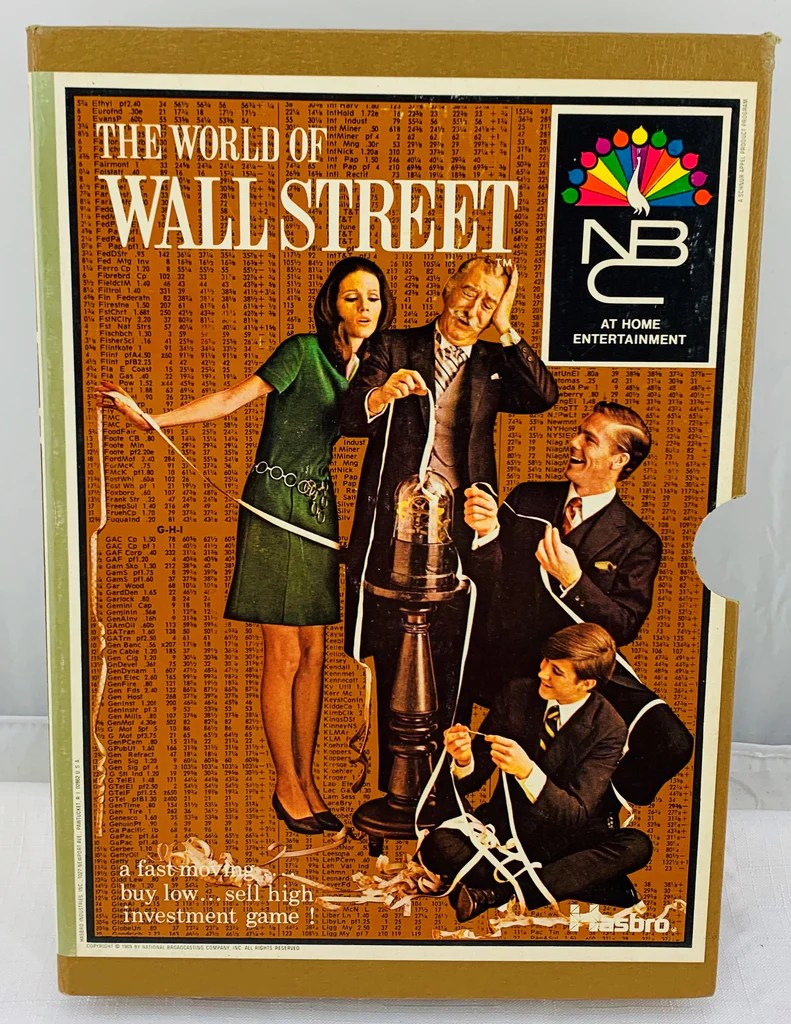
Yesterday and today, David and Michael play a game they call “Wall Street.” They use Monopoly money and a playing surface which, when Michael overturns it today, proves to be a checkerboard with a backgammon board on the reverse. A board game called The World of Wall Street really was around in those days; it was produced in 1969 by Hasbro and NBC. The dialogue David and Michael exchange during the game sounds like things you might say while playing it. Perhaps the script called for the boys to play that game, but ABC vetoed it since the rival NBC network’s logo appeared prominently on the box.


 Dark Shadows Commentary