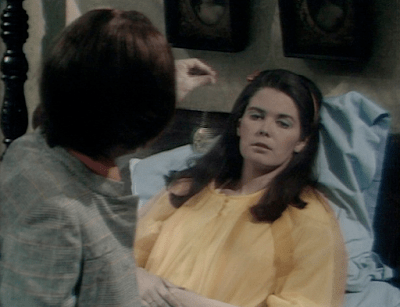
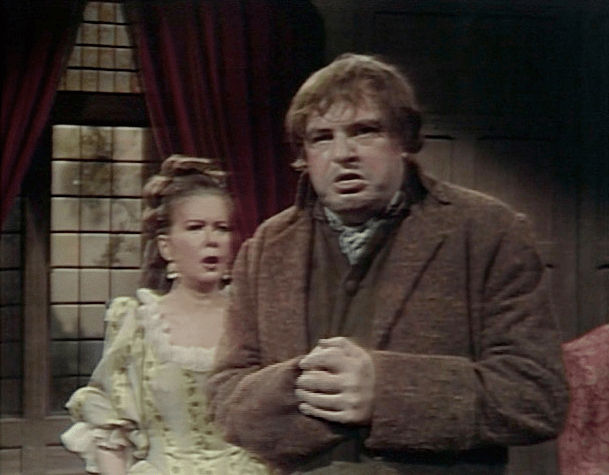
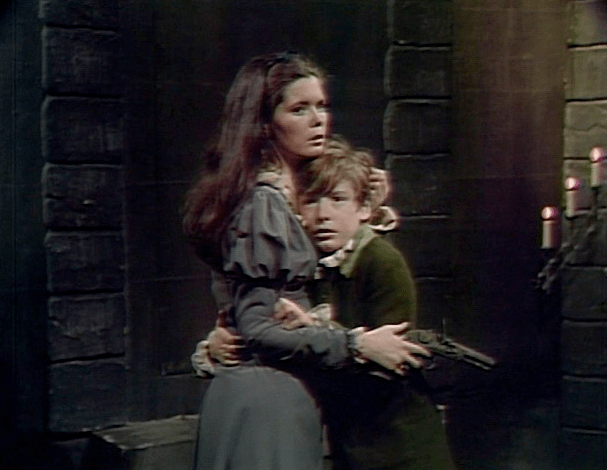
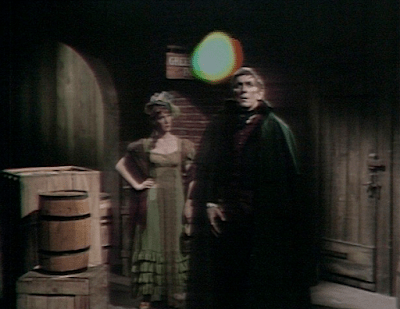
Episode 465: Too cool for ghoul

The other day, vampire Barnabas Collins added well-meaning governess Vicki to his diet. Barnabas has bitten several people in the year he has been on Dark Shadows, and his victims have reacted to the experience in a wide variety of ways. Vicki’s post-bite syndrome is unique on the show, and as far as I know unique in vampire stories. Her reaction could most succinctly be summarized as “not feelin’ it.”

Barnabas had hoped to enslave Vicki with his bite, as he had enslaved others, and attributes her blasé response to the unseen presence of wicked witch Angelique. But it may be that Barnabas has himself to blame. Several times in 1967, Vicki went out of her way to make herself available to Barnabas for biting. She invited herself to his house for a sleepover in #285, pressed her neck towards his teeth while embracing him in #311, and has rarely missed a chance to be alone with him. There is a hilarious meta-fictional element to this theme, as Vicki tries to secure a place for herself in the main storyline by becoming the vampire’s thrall.

For his part, Barnabas has time and again looked at Vicki’s neck, shown his fangs to the camera, and then backed off. Even when he finally did bite Vicki in #462, he spent so much time and energy displaying his internal struggle that my wife, Mrs Acilius, commented “Barnabas is about to make himself sick.” Indeed, he took so long making that display that the episode ended before he sank his teeth into Vicki, and we had to wait until the next day to be sure he’d actually gone through with it. You hardly expect Vicki to be excited that such a reluctant suitor has at long last deigned to attach himself to her.

Vicki has recently returned from a long visit to the year 1795,* when the human Barnabas died and the vampire began his career. Barnabas fears she may have discovered his secret while in that period, a fear that deepens as her scattered memories return.

In fact, Vicki never discovered that Barnabas was a vampire. She does have some information that, coupled with what she and others have already found out, could lead to his exposure, but she isn’t thinking about that at all. Instead, her main focus is on an unpleasant man named Peter, whom she met and with whom she fell in love in the 1790s. On Wednesday, she learned that shortly after she left the eighteenth century Peter had been hanged for a killing she committed,** and she is frantic with guilt about it.

At the top of today’s episode, Barnabas sends Vicki a telepathic message that they will be eloping tonight. She accepts this without any visible emotion. Then her friend, hardworking young fisherman Joe (Joel Crothers,) comes to the door. In the 1790s segment, Crothers played naval officer/ sleazy operator Nathan Forbes, a villain who was responsible for many terrible crimes against Vicki and people she cared about. This is the first time we’ve seen Joe since the show returned to contemporary dress, and Vicki takes a while to adjust to the fact that it is her trusty old pal before her, not the detestable schemer who did so much to blight her time in the eighteenth century.

Joe has come to bring Vicki a charm bracelet that his girlfriend Maggie had given her. The charm bracelet turned up in the old courthouse in the village of Collinsport. The courthouse has been disused for years and is about to be torn down. Joe wonders when Vicki was there; she makes many cryptic remarks in reply, but can’t bring herself to tell such a sensible fellow that she was tried there for witchcraft and sentenced to death 172 years before, much less that his counterpart gave the testimony that condemned her to the gallows.

After Joe has gone, Vicki still isn’t motivated to do anything to prepare for her departure with Barnabas. Instead, she takes a nap in the drawing room. She has a dream in which she sees Peter in his gaol cell. She promises him that she will prove his innocence, and marches off. She finds Nathan dozing at a desk. She tells Nathan that he could prevent Peter’s execution if he were to tell the judges that he lied when he told them he saw Peter kill the man whom Vicki actually killed. Nathan cheerfully explains that he cannot tell the judges anything, since he is dead. He tells Vicki that she is dead, too- he was strangled, she was hanged.

Nathan, having a wonderful time in the afterlife, proposes a toast “to Death- the best of all possible worlds!” Screenshot by Dark Shadows Before I Die.

Nathan’s statement is proof that the dream is not simply a product of Vicki’s psychology, but a communication with Nathan’s spirit. Barnabas strangled Nathan, but his father Joshua Collins hid that fact from the world, and neither Vicki nor anyone else alive in 1968 has any way of knowing about it. Vicki wasn’t hanged, but she was about to be when she was whisked back to her own time, and Nathan would have no way of knowing she survived.

Vicki goes back to Peter’s cell and finds it empty. She turns and sees the gallows, on which Peter is hanged before her eyes. She wakes up calling out Peter’s name.

Vicki opens her eyes to see Barnabas standing in front of her. He asks her who Peter was; she says he was someone she knew long ago, and that it will be hard for her to forget him. He asks if she knew he was coming; she affirms that she did. If he knew about the contents of the very elaborate dream she just had, he would have all the more reason to ask such a question. The only action of Barnabas’ mentioned in it was Nathan’s murder, and Nathan doesn’t bother to tell Vicki by whom he was strangled. There are four speaking roles and a background player in the dream, and not only is Barnabas not one of them, no one mentions in it his name, sees his image, or comes into contact with any of his belongings. Barnabas has been dominating the show since he was first named in #205, and Vicki, whom he was under the impression he had enthralled, has lost all interest in him.

Barnabas tells Vicki it’s time to go. She says she has to do something else first. She wants to go to the old Collins mausoleum and see if there is a secret room hidden there. If there is, she will know she really did travel back in time.

Barnabas was trapped in his coffin in that secret room from the 1790s until 1967, and is anxious that no one should discover its existence. He is also eager to get going with whatever plan he has made for Vicki. But he finds himself powerless to oppose her. Not only is he not her dark and irresistible master, as he had been of his other blood thralls, he isn’t getting nearly as much deference from her as she had always shown him before he bit her.

We cut to a car, in which Vicki is driving Barnabas to the cemetery. Apparently it is Vicki’s car. This is the first time we have seen Vicki driving, and it brings up a bit of a riddle for viewers who have been paying close attention to Dark Shadows from the beginning. In the first 46 weeks of Dark Shadows, Vicki was continually asking to borrow heiress Carolyn’s car, getting rides from people, walking longer distances than others thought reasonable, trying to catch the bus, and wishing she had a bicycle. In #232, #233, and #259, it was implied that Vicki had a car of her own. They never explained how or when she came into possession of such a thing, but they stopped all the business of her trying to find a way to get around. As we watch Barnabas squirming in the passenger seat, we can believe he would rather be standing with her at a bus stop.

Barnabas keeps telling Vicki that he doesn’t think they ought to go to the mausoleum. She snaps at him that he was originally enthusiastic about going. The statement is entirely false, and the line is entirely convincing. We saw that Barnabas was appalled at Vicki’s interest in the mausoleum, and we saw that she was too absorbed in her own thoughts to notice his feelings. The two of them bicker about the need to get settled before sunrise, and they sound for all the world like an old married couple. Barnabas exercises exactly zero control over Vicki, and the result is hilarious.

The bickering couple. Screenshot by Dark Shadows Before I Die.

The show so often puts Vicki in the role of Designated Dum-Dum, requiring her to facilitate the mechanics of the plot by doing things she would have no reason to do, that the show’s original protagonist is eventually swallowed up by Dumb Vicki. It’s always refreshing to see Smart Vicki put in an appearance. I don’t know if the woman we see today is a perfect example of Smart Vicki, but she certainly is Smart Alexandra Moltke Isles. Mrs Isles’ performance is so good that even a hater like Danny Horn had to admit in his post about the episode on Dark Shadows Every Day that she is fun to watch. And the character is Strong Vicki, taking action in pursuit of her own objectives, making use of the information available to her, and bending Barnabas to her will.

The scene in the car will have an amusing echo for longtime viewers. From November 1966 to March 1967, instantly forgettable young lawyer Frank Garner kept telling Vicki how interested he was in her. Vicki went on some dates with him and accepted him as her sidekick in her struggle against undead fire witch Laura Murdoch Collins, but all in all was almost as cool towards him as she has been to Barnabas post-bite. In #153, Vicki was Frank’s passenger in his car. He thought they were going out for a glamorous evening, but she abruptly insisted that they go to the old cemetery north of town and visit an old crypt. Frank was about as pleased then as Barnabas is now. I suppose a fellow ought to know what he’s getting into when he and Vicki get into a car together.

Barnabas sees a figure ahead and asks Vicki what it is. She looks and slows down. A man in contemporary dress who looks like Peter lopes into the road, smiles a big goofy grin, and waves. Even though Vicki’s movements and the sound effects told us she took her foot off the accelerator as soon as Barnabas said he saw something, the man is so close to the car that she slams on the brakes, the tires squeal, and she loses control of the vehicle. He must have wandered right in front of the car. That confirms for returning viewers that the man must be Peter. He always did the least intelligent and most dangerous thing, usually while grabbing at people and shouting in a petulant voice. Poor Vicki. Barnabas is a vampire and a cold fish, but she’s managed to get herself stuck with a guy who makes those shortcomings look minor by comparison.
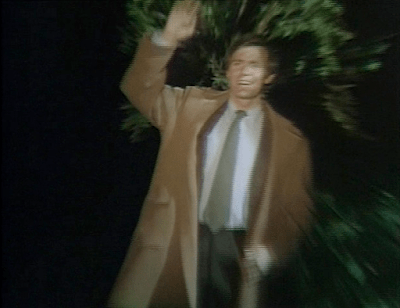
Ugh, this guy. Screenshot by Dark Shadows Before I Die.

*It was 1795 in #365, and in #413 they explicitly told us the new year 1796 had come. But after Vicki returns to the 1960s in #461, the only year they talk about is 1795.

**With justification- she shot a man who was trying to strangle a young boy.
Episode 464: Justice to history

High-born ne’er-do-well Roger Collins was Dark Shadows‘ first villain. Through the first 40 weeks of the show, dashing action hero Burke Devlin was determined to prove that Roger, not he, had been driving when his car hit and killed a pedestrian ten years before, and Roger would stop at nothing to keep Burke from succeeding. The Revenge of Burke Devlin storyline was never particularly exciting. By the time Burke formally gave up on his quest for vindication in #201, it had been running on fumes for some time. Roger hasn’t been central to a plot since then. The show has capitalized on actor Louis Edmonds’ unrivaled gift for sarcasm by having him deliver the occasional zinger, and otherwise has used him as a symbol of the inability of the Collins family to use its wealth and connections to solve any of its problems.

For nineteen weeks ending this past Monday, Dark Shadows was a costume drama set in the late eighteenth century and Edmonds played haughty overlord Joshua Collins. That performance was a triumph, and the entire segment turned out to be The Tragedy of Joshua Collins. So returning viewers will have an appetite to see more of what Edmonds can do, and will be excited when we come back from the opening title sequence to a scene focusing on Roger.

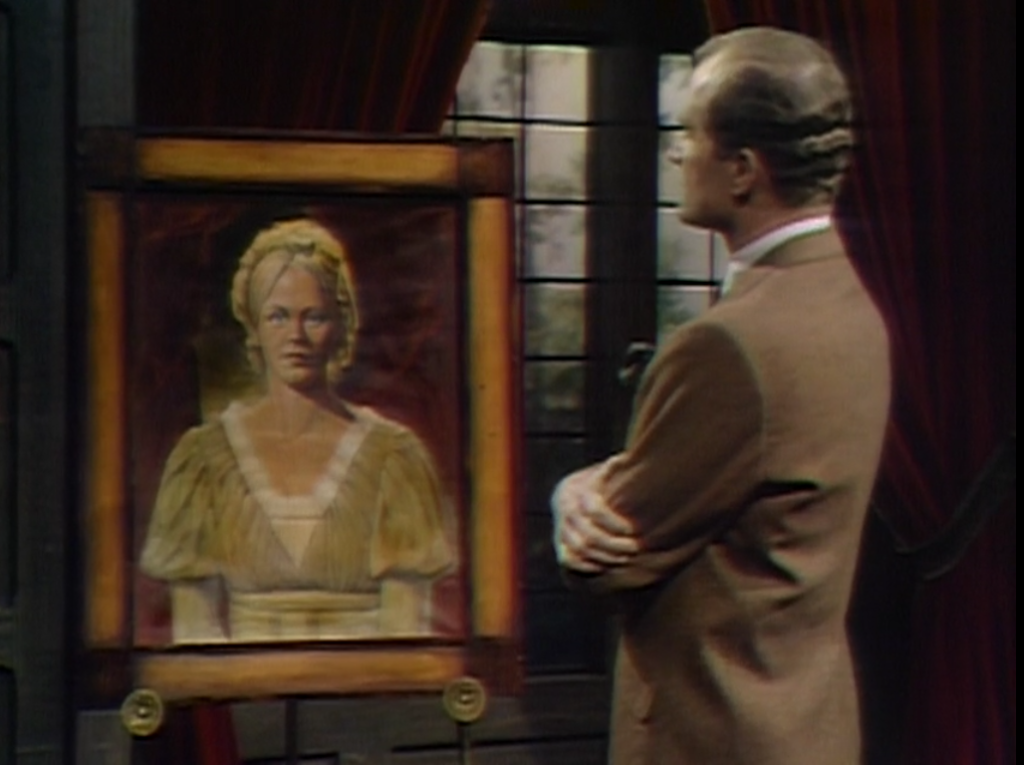
Roger spends this scene staring at a portrait and reciting poetry to it while various people enter the room and try to get his attention. That may not sound like a promise of thrills, but it is on this show. For example, Roger’s son, strange and troubled boy David, had a lively if somewhat one-sided conversation with the portrait of Josette Collins that hangs in the Old House on the estate in #102, and that conversation presaged danger for David and an important role for Josette’s ghost. The show’s first supernatural menace was Roger’s estranged wife, undead fire witch Laura Murdoch Collins, and several characters had important relationships with portraits of Laura during the four months she was in the cast. And dangerously unstable ruffian Willie Loomis once spent a week staring at the portrait of the late Barnabas Collins that hangs in the foyer of Collinwood. As a result, Willie wound up opening Barnabas’ coffin, finding that he was a vampire, and turning Dark Shadows into an entirely different kind of show.

Roger talks to the portrait of Angelique.

The portrait that has captured Roger’s attention is of Angelique, the wicked witch who turned Barnabas into a vampire in the first place. Well-meaning governess Vicki found this portrait in an antique store and brought it home yesterday. It was Vicki who took us to the 1790s when she became unstuck in time. While there, she met Angelique and the living Barnabas. Shortly after her return to the 1960s, Vicki found that her memory of her time in the past had become spotty. She can’t explain why she wanted the painting, but it does make sense to her that Barnabas reacts to it with violent dislike.

We first saw the portrait in #449, when it was clear that Vicki would be returning to the 1960s soon but unclear whether Angelique would follow her. Showing us that they had commissioned a portrait of Lara Parker was their way of telling us she would be back. Having Roger become obsessed with the portrait is their way of telling us that he will be the instrument of her arrival, as Willie was the instrument of Barnabas’.

We learn that Roger’s obsession will blur the distinction between him and Joshua when long-term houseguest Julia Hoffman approaches him and he speaks to her in Joshua’s voice, addressing her as the Countess DuPrés, who was a houseguest at Collinwood in Joshua’s time. Julia and the countess are both played by Grayson Hall. Vicki mistook the countess for Julia when she first met her in 1795, and since her return to 1968 has kept mistaking Julia for the countess. Now that Roger has made the same mistake, Julia must be trying to figure out what’s going on.

A man comes to the front door. Vicki answers it and sees a familiar face. It belongs to Professor Timothy Eliot Stokes. She hasn’t met him before, but she met his ancestor, much put-upon servant Ben Stokes, in the 1790s.

Like Ben and crazed handyman Matthew Morgan from 1966, Professor Stokes is played by Thayer David. Matthew and Ben were both major characters, so we can assume that Stokes will be as well. Matthew was a bad guy, Ben a good guy. When Ben was on the show, the contrast between him and Matthew was drawn very heavily to make the point that Matthew’s crimes are what Ben’s virtues would have led him to do had his personality been warped by the environment in which Matthew grew up. That environment was the consequence of the curse that Angelique placed on the Collinses in the 1790s. Burke expressed this idea in #64 when he said of Matthew that “Collinwood breeds murderers,” but he was understating the effect. Matthew grew up, not on the estate, but in the nearby village of Collinsport, and the curse leaves its mark on everyone who comes from there. Since Stokes is an out-of-towner, he is likely to be unaffected by the consequences of the curse, and so we do not know what we will find under his worldly and self-possessed exterior.

Stokes is researching his ancestor Ben, and wanted to buy the portrait because he thought it might depict a woman Ben knew. Stokes says that Ben wrote a memoir. Barnabas is in the room; in the 1790s, Ben was his closest friend, and knew all about his vampirism. So he is alarmed by the idea of a volume of memoirs by Ben. He can take some comfort when Stokes tells him that most of the manuscript was lost in a fire a few years ago.

The idea of a servant writing memoirs that might expose Barnabas’ secret first came up in #326. At that point, Willie was out of his control, and Barnabas told Julia, who is a mad scientist and his confederate, that he was afraid Willie might start “writing his memoirs!” That phrasing was meant to raise a laugh, since Willie is conspicuously not burdened with literary ambitions. But it planted a seed that flowers for the first time here, and that will flower again later.

Stokes offers Vicki $200 for the painting. Barnabas is eager to get the thing out of the house and urges her to take Stokes’ money, but before she can Roger bids $500. Stokes can’t afford that, and so it stays at Collinwood.

Stokes’ interest in family history establishes a contrast between him and Roger. Stokes, like Roger, appears to be a confirmed bachelor. But while Roger’s lack of interest in the responsibilities of marriage is of a piece with his indifference to all family ties, so that he was eager to divorce Laura and palm David off on her even after it had become clear to other characters that she was a danger to the boy, Stokes is an avid genealogist. He has renounced the prospect of marriage because he has other ways to be of service, not simply because he wants to wallow in his own crapulence as Roger does.

Suddenly Vicki remembers that the woman in the portrait is named Angelique, that Angelique was a witch, and that her spells caused all the misfortune that began at Collinwood in 1795. We hear all of this while Barnabas is in closeup, squirming gloriously. Stokes leaves with Barnabas and tells him he knew that the woman’s name was Angelique, but that it’s news to him that she was a witch. He is impressed by Vicki’s knowledge, and says that he can sense that she is attuned to paranormal phenomena. He wants to get to know her better.

Vicki suddenly remembers who Angelique was. Screenshot by Dark Shadows Before I Die.

Most characters we have met spend a long time slowing the story down by scoffing at the idea of the supernatural. That Stokes is a self-identified student of the occult and immediately receptive to Vicki’s identification of Angelique as a wicked witch tells us that he will serve to speed up the pace of events.

This again makes a stark contrast with Roger. When Vicki managed to get Roger away from the painting for a moment in Act One, he told her that he refused to believe that she traveled to the past and returned to the present. When she lists some of the abundant evidence he and everyone else saw that can be explained no other way, he says he attributes all of that to mass hallucination.

In his Dark Shadows Every Day post about this episode, Danny Horn at one point refers to Stokes as a character whose function is “to backfill Dr. Woodard’s spot in the cast,” referring to a stolid medico whom Barnabas and Julia murdered several months back. But in this contrast, we see that the character whose place Stokes is actually taking is Roger. When the show started, the Collinses of Collinwood were the central frame of reference for the action. But Roger and his sister, matriarch Liz, are for various reasons locked out of the supernatural storylines. Since those are the only storylines they have, the show needs to build another family to anchor the action, and that family is going to be defined, not by marriage and genealogy, but by a shared commitment to getting as deep as possible into the weirdest shit going.

Stokes tells Barnabas that there was a series of unsolved murders in Collinsport in the 1790s, and wonders if it might be possible to prove that Angelique was responsible for them. Barnabas suggests that it is too late to do justice in such an old case, to which Stokes replies that it is never too late to do justice to history. Not only does this reply deepen the contrast between Stokes and the amoral Roger, it has, by happenstance, a deep resonance for many who might see the episode today. It originally aired on 4 April 1968, just a few hours before the Rev’d Dr Martin Luther King, Jr, was assassinated. Millions are still unsatisfied with the official answers about who killed Dr King and why; they might cheer the idea that there is a species of justice that is still possible even after 56 years or more have gone by.

Barnabas bit Vicki the other day in an attempt to control her and keep her from revealing any information about him she may have acquired during her sojourn in the past. Disquieted by his conversation with Stokes, Barnabas stares out his window and summons Vicki to his house. In her bedroom, an enchanted music box Barnabas gave her as part of an earlier brainwashing attempt opens itself and begins to play. She rises from bed and goes to him listening to the music box all the way.

At Barnabas’ house, Vicki gives him the music box. He tells her that the next time he calls her, they will go away together forever. He bites her neck.

Barnabas has Vicki over for a bite. Screenshot by Dark Shadows Before I Die.

We cut to Vicki’s bedroom. The music box is back in its place and she is back in bed, asleep. Julia comes in to check on her. Vicki says she’d had a bad dream, and Julia finds the bite marks on her neck.

In the weeks leading up to Vicki’s visit to the past, Julia had alienated Barnabas by opposing his efforts to seduce Vicki. Now she marches over to Barnabas’ house and renews her opposition. She accuses him of having been in Vicki’s bedroom. He answers that he brought her to his house. This might seem to be a trivial distinction, but perhaps not to viewers who have been with the show from the beginning. Today’s focus on Roger might remind us of #4, when Roger tried to let himself into Vicki’s room while she was sleeping, obviously in search of some kind of sexual thrill that would not be preceded by her consent. Barnabas can’t deny that he is the moral equivalent of a rapist, but he isn’t going to miss an opportunity to differentiate himself from Roger.

Barnabas doesn’t seem very interested in anything Julia is saying. Even when she gives him an ultimatum, threatening to expose him if he doesn’t back off by tomorrow night, he reacts with a mild irritation. Regular viewers, remembering the displays of jeering contempt and seething rage which are typically the options from which Barnabas chooses his response to this sort of thing, will be startled by his relative blandness. Julia should be unnerved by it.

Episode 462: Whole image

In November 1967, Dark Shadows was very rapidly running out of stories to tell. Rather than introduce new characters and new complications to solve this problem, they kept killing off existing characters and foreclosing possible developments, making it impossible not to notice that they were speeding directly towards a blank wall. In #365, they did something no one could have seen coming. Rather than crashing into the wall, they passed right through it and relaunched the show as a costume drama set in the 1790s. The result was a triumph, nineteen weeks of high drama, low farce, lurid horror, pointed satire, and authentic tragedy. Now they are back in contemporary dress, and we are waiting to see what comes next.

Before the costume drama insert, mad scientist Julia was trying to keep well-meaning governess Vicki from falling into the clutches of vampire Barnabas. Julia’s efforts pitted her against many opponents. Vicki regarded Barnabas as a friend, actress Alexandra Moltke Isles was eager to get into the main storyline, the fans wanted to connect the show’s original point of view character with its breakout star, and the writers needed a fresh story to tell. But by repeatedly hypnotizing Vicki and making her subconsciously aware of Barnabas’ horrible secret, Julia was able to hold the line until Vicki disappeared into the 1790s and took the audience, the writers, and Mrs Isles with her.

At the top of today’s episode, Julia is hypnotizing Vicki again. Vicki is in bed, and Julia is extracting memories of her visit to the late eighteenth century, using a post-hypnotic suggestion to sequester those memories from her conscious mind.

Julia hypnotizes Vicki. Screenshot by Dark Shadows Before I Die.

Vicki has a dream in which the ghost of Jeremiah Collins, who befriended her in 1795, warns her about Barnabas. The ghost’s voice is provided by Addison Powell, whom Danny Horn named on his great blog Dark Shadows Every Day as “THE WORST ACTOR EVER TO APPEAR ON DARK SHADOWS.” I can think of two or three who might finish ahead of Powell in the contest for this title, but his voice performance today is indeed amazingly bad. He delivers his lines on a single shrill note throughout, and has a lot of trouble managing his breath. I suppose his attempts to get through long speeches without inhaling make sense for someone who just emerged from his grave, but the consequent lack of emphasis on any particular words or phrases and the intermittent gasps each time he runs out of oxygen do keep him from establishing the sense of mystery and terror that the scene calls for.

We then cut to the terrace outside the house, where we see Barnabas approaching the door. Julia meets him, with a new haircut.

Julia’s hair. Screenshot by Dark Shadows Before I Die.

This is Grayson Hall’s actual hair; the wig she was wearing in the first scenes had been part of Julia’s costume from her first appearance, in #265. The last time an actress was freed from a wig to perform under her own hair was when Maggie Evans’ tight little blonde hairpiece gave way to Kathryn Leigh Scott’s reddish brown tresses in #20. With that, the wised-up waitress who was everybody’s pal and nobody’s friend became The Nicest Girl in Town. Longtime viewers who remember Maggie’s transformation will recognize what is happening today, when the same device marks a reset of a character. Julia, who yesterday was precisely as hostile to Barnabas and as helpless before him as she was when we left off in November, is today both willing to cooperate with him and very much in control of the situation. He even goes down on one knee to beg her to help him find out what Vicki learned during her sojourn in the eighteenth century. She promises nothing.

Kneeling Barnabas. Screenshot by Dark Shadows Before I Die.

After another visit to Vicki in her room, Julia assures Barnabas that she can use her mastery of hypnosis to cordon off any memories Vicki may have that might pose a threat to him. Unconvinced, Barnabas decides to take matters into his own hands.

Julia tells Barnabas she can control Vicki. Screenshot by Dark Shadows Before I Die.

Barnabas appears in Vicki’s room. She awakens and is surprised to find him at her bedside. She recoils from him as she had been doing in November, when Julia had made her unconsciously aware of his true nature, but, again as she had done in those days, she overcomes her aversion and turns to him. He tells her to come to him. She hesitates, but does. He tells her he can give her peace and make it seem that everything that is distressing her is far away. She embraces him and asks him to do so. It looks very much like a seduction. Considering that Vicki kept embracing Barnabas and pushing her neck towards his teeth before Julia started hypnotizing her, it is an overdue one. Barnabas opens his mouth. He displays the same inner struggle he has shown on previous occasions when he had the chance to bite Vicki, but is still bending his head towards her neck when we fade out for the closing credits.

Barnabas about to bite Vicki. Screenshot by Dark Shadows Before I Die.

Episode 460: Lies beyond the grave

In #365, well-meaning governess Vicki came unstuck in time and found herself in the year 1795. Now, Vicki is about to be hanged for witchcraft, and the last of the story threads that have been playing out around her are about to be tied up.

Yesterday’s episode ended in the study at the great house of Collinwood, where naval officer/ sleazy operator Nathan Forbes shot a wooden bolt from a crossbow into the chest of vampire Barnabas Collins. At the top of today’s episode, Barnabas pulls the bolt out, telling Nathan that the bolt didn’t hit him. Barnabas’ voice is dubbed in over this, clarifying that Nathan missed his heart. We then switch to Nathan’s point of view and see Barnabas approaching for the kill.

After the opening title, we see that Barnabas is still in the study. Time has apparently passed. Barnabas’ father Joshua enters. Barnabas asks him if Nathan has been buried. Joshua says that he has, and lists the stories that he will tell to cover up all the deaths that Barnabas has been involved with over the last few months. Barnabas wants Joshua to shoot him through the heart with a silver bullet right now and destroy him forever. Joshua cannot do that, but he promises that he will put Barnabas out of his misery come daylight, when he is in his coffin. Barnabas asks two more favors of his father, that he free much put-upon servant Ben and that he prevent the execution of the wrongly convicted Vicki. Joshua promises to do these things as well.

Joshua and Barnabas. Screenshot by Dark Shadows Before I Die.

Throughout this scene, actors Louis Edmonds and Jonathan Frid hold back tears. Patrick McCray remarks: “Crying is not the most powerful thing an actor can do on stage. Rather, it is the attempt not to cry that seizes audiences. In these moments, Frid and Edmonds seize. In a medium of love scenes, there is none more poignant.”

The performers have a powerful theme to work with, one that Danny Horn explicates when he considers the question of why Joshua is still alive at the end of this storyline. When she made Barnabas a vampire, wicked witch Angelique decreed that everyone who loved him would die. Yesterday, Joshua confessed that he feared he was incapable of love, and Barnabas told him that such a disability might save his life. But when we see Edmonds and Frid struggling against the urge to weep, we know that Joshua loves Barnabas very deeply indeed, as we have in recent weeks seen that he loved others he has lost. Danny explains:

The reason why Joshua is spared from the curse is that the love he feels for Barnabas isn’t the kind of love that Angelique recognizes, and so he slips under her radar.

Angelique’s love is selfish, and spiteful. She uses it as a convenient excuse for running over anyone who gets in her way. She doesn’t understand love that arises from respect, and strength of character. And she will never feel the kind of deep, honest love that Joshua now realizes for the first time that he is in fact capable of.

Danny Horn, from “Eats, Shoots, and Leaves,” posted on Dark Shadows Every Day 16 August 2014

Danny goes on to explain that, while others had love for Barnabas that included a selfless element, there was also something in their feelings that Angelique could recognize, while Joshua’s love for him comes entirely from this higher plane. The portion of Dark Shadows set in the years 1795-1796 turns out to be The Tragedy of Joshua Collins, not only because Joshua has the highest social status among the characters, makes the most important decisions, and is played by one of the best actors, but because he grows into the sort of person who is governed by this kind of love. When the world around him is being ground down into dishonesty and cheapness, largely due to the consequences of his own misguided actions, Joshua discovers a new kind of strength within himself. Even amid the ruins of a world he himself did as much as anyone to wreck, Joshua represents the hope that something better might yet come into being.

After daybreak, Joshua stands beside Barnabas’ coffin in the secret chamber hidden inside the Collins family mausoleum, the pistol in his hand. Joshua cannot bring himself to fire the silver bullets into his son’s heart. Ben enters. Joshua orders him to affix a silver crucifix to the inside of the coffin to immobilize Barnabas there, and then to chain the coffin shut. Joshua and Ben assure each other that Barnabas will never be released. Later, we see Ben in the chamber, alone with the chained coffin. He looks at it and says “Goodbye, Mr Barnabas, goodbye.” Thayer David delivers that line with an unforgettable simplicity.

Returning viewers know that Joshua’s plan to keep Barnabas confined will work only until April of 1967, when Barnabas will be freed to prey upon the living once more. That July, in #276, Barnabas will stand in the hidden chamber and say that, while in chaining the coffin rather than destroying him his father “thought he was being merciful, what he did was no act of mercy.” This remark, combined with a story he told Vicki in #214 about his conflict with Joshua, just may have been the germ from which the whole story of Joshua grew. At any rate, the promise ABC-TV made to its viewers when it aired this promotional spot in November 1967 has been fulfilled:

Back in the study, Joshua frees Ben and gives him a severance packet of $100, worth about $2500 in 2024 dollars. When Ben thanks him for his generosity, Joshua denies that he is being generous. I have to agree with Joshua there- that amount might get a fellow out of town, but he’d have to find a new job pretty fast if he wanted to stay in the habit of sleeping indoors.

Another servant brings a note while Joshua and Ben are in the study. The governor has refused Joshua’s plea that Vicki’s execution be stayed. She will be hanged tonight.

At the gaol, Vicki’s boyfriend, an unpleasant man named Peter, is brought to her cell. The gaoler tells them they have five minutes before Vicki will be taken to her death. It is little wonder Vicki’s last request was to have time with Peter. Spending five minutes with him is like living to a ripe old age. Peter vows to overcome death and reunite with her. The last time we heard that was when Barnabas died the first time. In #409, he used his dying breaths to ask gracious lady Josette to wait for him to return to her. Fool that she was, Josette did, leading to disaster for her. Returning viewers may well wince, not only at the ominous parallel with Josette’s grim fate, but also at the memory of the many tedious scenes in which Josette at first insisted that Barnabas was coming back and was then at a loss when asked to explain herself. Besides, we don’t want to see any more of Peter.

The scene of Vicki’s hanging is quite elaborate by Dark Shadows standards. They’ve built a fairly realistic gibbet, hired several extras, put hats on them, and given them burning torches to hold. They test the equipment with a heavy sack, slowly lead Vicki to the place of honor, ask her if she wants a mask, and command the Lord to have mercy on her unrepentant soul. The camera drifts up to the top of the rigging, leaving Vicki out of the shot. When the time comes, we hear the drop and see the rope tighten.

Swing time for Vicki. Screenshot by Dark Shadows Before I Die.

This marks the end of the 1795 flashback, but not necessarily of Dark Shadows 3.0. In #437, Vicki told Peter that she often had nightmares in her childhood, so often that she became a connoisseur of nightmares. She would stay asleep throughout the whole process, waking up only at the very moment she was about to be killed. That was a rather heavy-handed way of telling the audience that Vicki would ascend the gallows, put her head in the noose, and find herself back in the 1960s. Once she is back in her own time, what she has learned in the 1790s will have consequences for what she does next. So we can expect an epilogue of some kind before Dark Shadows 4.0 begins.

Episode 457: I will meet you

This is the first episode of Dark Shadows credited to a director other than Lela Swift or John Sedwick. It is also the first production of any kind directed by Dan Curtis, the series’ creator and executive producer. Curtis’ inexperience shows at several moments when the camera is in an awkward spot or the actors are unsure what to do, and in his post about the episode on Dark Shadows Every Day Danny Horn documents several of the more egregious examples with screenshots and detailed analysis. The impossible deadlines and tiny budget on which Dark Shadows was produced meant that even Swift and Sedwick, who were seasoned professionals and ambitious visual artists, sometimes had to turn in work that wasn’t much better than what first-timer Curtis manages today, and longtime viewers of the show will take even his worst stumbles in stride.

At the top of the episode, it is daytime, and much put-upon servant Ben Stokes (Thayer David) finds the lady of the house, Naomi Collins (Joan Bennett,) standing at an open coffin that holds the corpse of her son, Barnabas. Ben knows that Barnabas is a vampire who will rise at night to prey upon the living. Naomi has never heard of vampires. All she knows is that Barnabas is dead, and that his coffin has been moved from the family mausoleum to a room atop a tower in the mansion. Ben pleads with her to leave the room and to go with him back to the main part of the house.

Naomi questions Ben. Ben tells her that Barnabas has a “sleeping sickness,” and has been in a coma ever since the night he apparently died. Ben does not like to lie to Naomi, but her husband, haughty overlord Joshua, has judged that the truth would kill her, and Ben is governed by that assessment. He does tell her that the “sleeping sickness” is a symptom of a curse, that the wicked witch who placed the curse was Barnabas’ sometime wife Angelique, and that Joshua is in Boston trying to find someone who knows how to lift it.

Ben asks Naomi how she came to be in the tower room. She tells him that naval officer/ sleazy operator Nathan Forbes told her that Barnabas was being kept there, and also that Barnabas was responsible for the series of murders that had recently taken place in the town of Collinsport. At that, Ben vows to kill Nathan. To his chagrin, Naomi forbids him to do this.

Naomi forbids Ben to kill Nathan. Screenshot by Dark Shadows Before I Die.

In the part of Dark Shadows set between August and December of 1966, Bennett played reclusive matriarch Elizabeth Collins Stoddard and David played her fanatically devoted handyman Matthew Morgan. When well-meaning governess Vicki came unstuck in time and arrived in the late 1790s, she at first mistook Naomi for Liz and Ben for Matthew. This scene takes longtime viewers back to the days when Matthew was always on the lookout for someone who represented a threat to Liz’ interests and she was always sternly prohibiting him from murdering anyone for her sake.

Ben is a far saner man than Matthew ever was; the contrast between them shows the effect that growing up in Collinsport, a town suffering from the consequences of a curse that has been working its way for many generations, has had on Matthew’s personality. While Ben is a brave, kind-hearted fellow whose fierce loyalties sometimes overpower his good sense, Matthew is a paranoid ogre who kills Liz’ friend Bill Malloy and tries to kill Vicki. It isn’t just one family that will be warped by Angelique’s curse. It will breed monsters everywhere the Collinses’ influence prevails.

Naomi then turns her attention to the B-plot. Nathan has married fluttery heiress Millicent Collins, only to find that Millicent has signed her share of the Collins fortune over to her little brother Daniel. Nathan responded to that news by crafting a plot to murder Daniel. His first attempt failed when Noah Gifford, the henchman he hired to abduct Daniel and drown him, fell afoul of Vicki. Vicki found Noah strangling Daniel near the place where she was hiding, having escaped from gaol, and shot him to death. After that, Daniel and Vicki went back to the mansion and told Naomi what they knew. Naomi recognized Daniel’s description of his attacker as a man she had seen with Nathan earlier, and realizes that Nathan is trying to murder the boy. So she orders Ben to take Daniel into town to stay with the Rev’d Mr Bland, a clergyman who looks like a duck.

Naomi confronts Nathan, who keeps telling her that whatever Barnabas might look like during the day, he gets up at night and goes out to murder people. She tries to shut him up, but later she is still wondering whether she should go back to the tower room after dark to check his story out.

She sees Millicent standing in the foyer, staring at the portrait of Barnabas that hangs there. The portrait of Barnabas first appeared under the closing credits in #204, and from #205 on it figured as a means through which Barnabas could communicate with the living. Barnabas bit Millicent the other day, and she hears him summoning her.

Among the 1960s characters who receive their commands from the vampire while staring at the portrait is Liz’ daughter Carolyn, who like Millicent is played by Nancy Barrett. Millicent at times evoked an early version of Carolyn. Until the spring of 1967, Carolyn was tempestuous and irresponsible, sometimes friendly to point-of-view character Vicki, sometimes hostile to her. Millicent is as timid and overly dependent as that version of Carolyn was headstrong and self-centered. One way or another, each is a Spoiled Heiress, and evidently that’s a favorite meal of Barnabas’.

Naomi follows Millicent to the gazebo on the grounds of the estate. There, she sees Barnabas. She is stunned that the son whose corpse she was looking at just a few hours before is up and moving. He bites Millicent, and Naomi lets out a scream. Barnabas looks up, and realizes that his mother has caught him in the act.

The vampire’s bite affects each victim differently. The first victim we saw was Willie Loomis, whom Barnabas’ bite transformed from a dangerously unstable ruffian to a sorely bedraggled blood thrall. Willie was at first gravely ill, then ran to Barnabas like an addict desperate for a fix, and eventually settled into life as a sorrowful servant who could not run away from Barnabas but could resist him to the point where Barnabas occasionally found it necessary to keep him in line with beatings.

The second victim we saw was Maggie Evans, The Nicest Girl in Town. She reacted very much like the first victim in the 1790s segment, gracious lady Josette, who, like Maggie, was played by Kathryn Leigh Scott. At first, those two were alternately blissful and snappish, happy to be under Barnabas’ power and defensive with anyone who might interfere with it. But each recoiled from him by the time it became clear he planned to kill her and make her into a vampire herself. Each escaped from him to the shore below Widow’s Hill- Maggie by running through an underground tunnel that rose to the shoreline, Josette by flinging herself to her death from the top of the cliff.

Later, Barnabas bit Carolyn. She initially contemplated his most gruesome crimes with pure glee and showed great energy as his protector and enforcer. Soon her conscience reappeared, but she was still doing his dirty work faithfully when Vicki disappeared into the past.

Millicent differs from all those others in that she simply continues to go about her business in between Barnabas’ meal-times. Granted, she was already deeply disturbed by that point, so that her business was conducted mostly in show-stopping mad scenes. But it’s still odd that she can talk to Nathan as if their marriage were the main thing in her life.

When we finished watching this one, my wife, Mrs Acilius, wondered if these differences were simply the result of the victims’ personalities coming through or if the vampire can pick and choose how to apply the pressure. He wanted Willie as a slave, and the reaction he produced gave him that. He wanted to turn Maggie into a reincarnation of Josette, and wound up getting the same reaction from Maggie that he had got from Josette. He bit Carolyn in a moment of desperation, with no plan in mind, and her reaction is complicated and volatile. He bit Millicent to keep her quiet, and her reaction is remarkably inconspicuous. Maybe we’re just supposed to think that Barnabas is fabulously lucky, but there is an opening there to tell a story about how him deciding what he wants to do to a person when he sucks their blood.

Episode 455: Old enough now

In Dark Shadows #316, broadcast and set in September 1967, strange and troubled boy David Collins (David Henesy) escaped from the hidden chamber in the Collins family mausoleum, only to find himself in the clutches of his distant cousin, Barnabas the vampire. He was spared from Barnabas’ murderous intentions when local man Burke Devlin happened by.

Today’s episode was broadcast in March 1968 and set in the 1790s. Young Daniel Collins (David Henesy) leaves the hidden chamber in the Collins family mausoleum, only to find himself in the clutches of a criminal named Noah Gifford. Daniel is spared from Noah’s murderous intentions when bewildered time-traveler Vicki, who was once Daniel’s governess, emerges from the hidden chamber and shoots Noah dead.

Vicki and David inside the hidden chamber. Screenshot by Dark Shadows Before I Die.

The contrast between the two scenes shows how much thicker the narrative texture of the show is in the 1790s flashback than it was before. In #316, David had accidentally got himself trapped in the hidden chamber. That led to a whole week of episodes where he was helpless and people looked for him, Barnabas with the intention of killing him because he overestimated how much David knew about him. Burke just chanced to be there at the right moment to rescue David. That was all there was to it, really, and once it was over it didn’t change the story very much.

But Daniel deliberately went to the hidden chamber because he was fleeing from Noah, who was working as an agent of naval officer/ sleazy operator Nathan Forbes. Nathan is married to Daniel’s sister, fluttery heiress Millicent Collins, and is scheming to get control of her money. Murdering Daniel is one part of that plan. Vicki is in hiding because she has been convicted of witchcraft, sentenced to die, and has escaped from gaol. She chooses to rescue Daniel at the risk of her own life because she loves him, and also because he will grow up to be the ancestor of the Collinses whom she knew in the 1960s. All of the characters involved in Daniel’s encounter with Noah know what they are doing, have chosen to pursue important goals, are brought together by the convergence of ongoing plot-lines, and take actions that propel the flashback segment towards its conclusion.

One of the themes Danny Horn developed on his great blog Dark Shadows Every Day was that the actors didn’t know how to handle firearms. Alexandra Moltke Isles provides several spectacular examples in today’s episode. Danny’s post about it includes several screenshots of Vicki pointing her loaded gun at Daniel, including one of her aiming it directly at his crotch. Since one of Vicki’s chief goals is safeguarding Daniel’s ability to someday produce offspring, this would seem to be a particularly maladroit gesture.

Episode 450: That man who says he is Barnabas

Haughty overlord Joshua Collins and his long-term house-guest the Countess DuPrés have summoned good witch Bathia Mapes to lift the curse that has made Joshua’s son Barnabas a vampire. Meanwhile, Barnabas has bitten his second cousin Millicent and gone to the waterfront to find another victim. Bloggers Danny Horn, Patrick McCray, and John and Christine Scoleri have said so much so well about this episode that I have only a few points to add.

Millicent tells Joshua that it is wrong of him to have “that man who says he is Barnabas” in the house when he does such frightful things. Nancy Barrett’s performance as a woman made insane by her encounter with the undead is achingly beautiful. And her idea that Barnabas is an impostor is an intriguing one. Should Bathia succeed, Barnabas will need a story to account for the several sightings people made of him when he was cursed. That success seems unlikely- if Barnabas is freed from the curse now, what will we find when Dark Shadows stops being a costume drama set in the 1790s and returns to a contemporary setting? But it is something to file away for future use…

Bathia summons Barnabas away from the docks, where he is about to kill a prostitute, by sending the flame from a candle to him. The movement of the flame is an interesting effect, but what most held my attention was the scene between Barnabas and the woman he almost victimizes. Jonathan Frid and day player Rebecca Shaw play this scene in silence, with exaggerated movements, against a heavy musical score. The resulting balletic interlude is a striking departure from Dark Shadows’ previous form.

Barnabas disappoints his partner at the end of the ballet sequence. Screenshot by Dark Shadows Before I Die.

Bathia keeps Barnabas in place by showing him a cross from which he recoils. This is the first time we have seen this reaction. Barnabas routinely comes and goes through a cemetery where many of the grave markers are in the shape of the cross, and they don’t bother him a bit.

Not only is it the first time this particular symbol has been a problem for Barnabas, it is the first time Dark Shadows has suggested there might be something to Christianity. The representatives of the faith we have seen so far in the 1790s have been Barnabas’ Aunt Abigail, a disastrously repressed spinster; the Rev’d Mr Bland, of whom the best that could be said was said by the doomed Ruby Tate when she described him to Barnabas as the preacher who looked like a duck; and the Rev’d Mr Trask, a fanatical witchfinder who inadvertently became the handiest tool wicked witch Angelique had at her disposal. The 1960s characters, aside from one fleeting mention of the word “Christmas” in 1966, have not betrayed any awareness that there is such a thing as Christianity.

Bathia commands the spirit of Angelique to speak to them through Barnabas. When Angelique was first on the show, she very conspicuously kept doing many of the weirdest things Barnabas was in the habit of doing in 1967. So Barnabas exasperated his henchmen by fixating on well-meaning governess Vicki but refusing to bite her, insisting that Vicki would eventually come to him “of her own will.” Angelique exasperates her thrall, much put-upon servant Ben, by casting spells on everyone but Barnabas when her goal is to win Barnabas’ love, insisting that Barnabas would eventually come to her “of his own will.” When in 1967 Barnabas sends his thrall Carolyn to steal an incriminating document and she asks what will happen if she is caught, he replies “See that you don’t get caught.” When Angelique sends Ben to steal a hair ribbon from Abigail and he speaks of what will happen if he is caught, she replies “See that you don’t get caught.” Moments like these suggest that the vampire Barnabas is not simply cursed by Angelique, but possessed by her. Perhaps it was Angelique, wearing Barnabas’ body as a suit, that we saw in 1967, not the son of Joshua and Naomi at all.

Jonathan Frid as Angelique . Screenshot by Dark Shadows Before I Die.

This fits with the general idea of the supernatural developed in the first 73 weeks of Dark Shadows. The first supernatural menace on the show was undead fire witch Laura Murdoch Collins, who was on from December 1966 to March 1967. Laura was a complex of beings, made up of at least two material bodies and an indeterminate number of spirits, some of which seemed to be unaware of the other parts of the system and pursuing goals incompatible with theirs. From June to November of 1967, the ghost of Barnabas’ little sister Sarah kept trying to contain the damage her big brother was doing to the living characters. Sarah too turned out to be a complicated sort of phenomenon, and the form in which she visited people when they were awake was unaware of and at odds with the form in which she visited them in their dreams. If we go by Laura and Sarah, we would have to assume that supernatural beings are multifarious and fissiparous. So perhaps each time Angelique casts a spell, she splits a bit off of herself and the fragment springs up as another version of her, functioning independently of the rest. In that case, the vampire Barnabas is an avatar of Angelique. When Bathia compels Angelique to speak, she is compelling one of the Angeliques to drop a mask.

The given name “Bathia” is rare; the only person with it who ranks higher in Google search than Bathia Mapes is a musicologist named Bathia Churgin. Professor Churgin was born in New York in 1928, went to Harvard, and taught in the USA until she moved to Israel in 1970. So it is possible that someone connected with Dark Shadows may have heard of Professor Churgin and named Bathia Mapes after her, either as a tribute or just because the name stuck in their mind.

The surname “Mapes” is somewhat less rare; apparently “it is borne by around one in 903,601 people.” In 1963 and 1965, Frank Herbert published two novels that were later issued together under the title Dune; there is an elderly woman with a mystical bent named The Shadout Mapes in those. I’ve never taken much interest in Dune, and owe my awareness of this to comments on Danny Horn’s blog (from Park Cooper here and from “Straker” here.) There doesn’t seem to be much doubt that Bathia’s family name is a nod to The Shadout Mapes; whether it was Sam Hall or another of the writers or someone else who worked on Dark Shadows or one of their kids who had read Dune, I cannot say.

Episode 449: To provide a witch

In the parts of Dark Shadows set in the 1960s, Grayson Hall plays mad scientist Julia Hoffman, sometime confidant of ancient vampire Barnabas Collins. Now it is 1796, Barnabas has only recently become a vampire, and Hall is the Countess DuPrés. Like Julia, the countess is deeply versed in the supernatural, and like her she is a long-term guest at the great house on the estate of Collinwood.

Barnabas’ father Joshua has learned of his son’s curse, and is desperate to find a way to free him of it. Today, we open in the Old House on the estate. Joshua has summoned the countess to meet him there. Joshua brings the countess up to date about Barnabas’ condition. He also informs her that the one who played the curse was not the luckless Victoria Winters, who is currently in gaol awaiting execution on charges of witchcraft, but was in fact the countess’ one-time maid Angelique. At this, the portrait above the mantel vanishes and is replaced with one of Angelique.

Portrait of the wicked witch. Screenshot by Dark Shadows Before I Die.

This is the first we have seen the portrait of Angelique. As Danny Horn points out in his post about this episode on Dark Shadows Every Day, it is a message to the audience. Barnabas killed Angelique weeks ago, and her ghost, which was pretty busy on the show for a little while after that, has not been prominent lately. They are running out of unresolved storylines, and will be returning to the 1960s soon. When they show us that they have commissioned and paid for a portrait of Angelique, the makers of Dark Shadows are telling us that she will be back when they return to a contemporary setting.

Joshua asks the countess if she can help lift the curse. At first the countess shows incredulity that Joshua thinks she can “provide a witch” who will counteract Angelique’s spell, but she immediately follows this display by announcing exactly how they will go about summoning such a person.

Back in the great house, naval officer/ sleazy operator Nathan Forbes is continuing with his efforts to drive his new wife Millicent insane so that he can get his hands on her share of the Collins family fortune. Millicent has seen a light in the room on top of the mansion’s tower. Nathan denies having seen the light, and Millicent takes his denial, not as a sign that his vision is failing, but as a reason to fear that she is hallucinating. Nathan insists that she go to the tower room and prove to herself that no one is there.

Returning viewers will be startled by this insistence of Nathan’s. Nathan has deduced that Barnabas is in the tower room. He does not know that Barnabas is a vampire, but does know that he is responsible for the many killings that have taken place in the area recently. When he presses Millicent to go to the room, he is not only trying to unhinge her mind, but is sending her to surprise a crazed murderer in his lair.

Perhaps Nathan hopes only that Millicent will be shocked to see her cousin. But he has been using his knowledge of Barnabas’ presence on the estate to blackmail Joshua. Millicent is a compulsive talker. If she learns that Barnabas is at home, it will only be a matter of time before she tells everyone about it, making Nathan’s information worthless as leverage over Joshua. Unless Nathan does in fact calculate that Barnabas will kill Millicent, it is hard to see what he thinks will happen when Millicent goes to the room.

Joshua and the countess return to the great house. Joshua hustles everyone out, commanding them to go into town to attend a speech by the governor of Massachusetts.* Nathan resists; alone with Joshua, he asks if Barnabas will still be in the tower when everyone gets back. Joshua refuses to discuss the matter.

Joshua and the countess begin their summoning ceremony in the drawing room. Nathan eavesdrops at the door. Joshua finds him there and drives him from the house; the ceremony begins again.

Millicent goes to the tower room. She lets herself in. Barnabas confronts her. He tells her that he will let her go if she will promise never to tell anyone she saw him there; she cannot do that. Patrick McCray puts it well in his post on The Dark Shadows Daybook: “Millicent’s tragedy is that her nature compels her to tell the truth. She knows it will kill her and she knows that she is consigned to it. She is addicted to chatter and chatter will kill her. When she screams at Barnabas’ attack, I think she’s not so much screaming at the terror of the vampire as she is screaming at herself.”

In the drawing room, the countess and Joshua continue the ceremony. We hear the wind. One draft blows out the candle; another blows open the door. An old woman appears in the doorway. She enters the foyer, and says that it is too late- the man they have summoned her to help has already gone.

Enter the good witch. Screenshot by Dark Shadows Before I Die.

*In our time-band, Samuel Adams held that office in 1796. We might imagine that Adams had a counterpart in the universe of Dark Shadows. If so, it would have struck people odd that Joshua was not already committed to attending the speech, and indeed that he had not invited Governor Adams to spend the night at Collinwood. When Joshua first met the countess, he proudly claimed that the French Revolution was an imitation of the USA’s War of Independence; by that point in history, such a claim marked its maker as a supporter of the faction in American politics that the governor represented, the more militant wing of Thomas Jefferson’s party. In fact, much later in the series we will see a portrait of Jefferson prominently displayed at Collinwood. Joshua must surely have been the richest and most eminent Jeffersonian in the region, so much so that even though his family was in mourning they would still have been expected to host the governor in their mansion.

Episode 446: You have given me nothing I can understand

Haughty tyrant Joshua Collins goes to the basement of the Old House on his estate and finds his son Barnabas rising from a coffin. Barnabas explains to his father that he has become a vampire.

Joshua and Barnabas in the coffin room. Screenshot by Dark Shadows Before I Die.

This scene prompts considerable discussion in fandom about gay subtext. In his post about the episode on Dark Shadows Every Day, Danny Horn points out that actors Jonathan Frid and Louis Edmonds were both gay, and speculates that this fact might have had some influence on the way they play Barnabas’ coming out to his father. “I’m not suggesting that this situation is intended to be a metaphor for a gay child talking to his father about his terrible, shameful secret life… But the ‘keep the secret, don’t tell my mother’ part — there’s some resonance, isn’t there? At least, it’s a hook into the story that helps us to get closer, and really feel some of the horror of this moment. A father hands a gun to his son, and says, Kill yourself, so that your mother never finds out.”

Even this tentative raising of the question, with its “I’m not suggesting” and “some resonance” and “at least,” is too much for Patrick McCray. In his Dark Shadows Daybook post about #446, he concedes that “homosexuality is the obvious choice” for an interpretive lens through which to read the scene, but goes on to flatly assert that “this isn’t a veiled metaphor for something like homosexuality.” For him, as for Danny, Barnabas figures in the scene as a murderer first and last, and Joshua as a man finding himself irrevocably severed from the world of rationally explainable phenomena.

For my part, I think that we have to remember that intentionality is always a more complicated thing in a work of art than it is when lawyers are interpreting a contract or cryptographers are cracking a cipher. Certainly the scene is not simply a coming-out scene played in code. Barnabas’ murders do not map onto any metaphor for sexual encounters. While the vampire’s bite is often a metaphor for the sexual act, Barnabas presents his acknowledgement in this scene that he has murdered three women in terms of the secrets he calculated he could keep by killing them and maintains a cold, matter-of-fact tone while doing so. When in the course of the scene Barnabas exasperates Joshua by attempting to murder him, there is nothing erotic between the men. No doubt the scene is at one level meant to be what Danny Horn and Patrick McCray say it is, the point when Joshua realizes he is part of a supernatural horror story and the audience realizes that Barnabas is a cold-blooded killer. As such, it is one of the key moments that defines the 1795 flashback as The Tragedy of Joshua Collins.

But there are other levels of intentionality here as well. One has to do with the word “vampire.” When Barnabas is trying to tell his story to Joshua, his first approach is to give him the facts and leave it to him to apply the correct label. But the facts are so alien to Joshua that they only deepen his confusion. Seeing his father’s bewildered reaction, Barnabas’ frustration mounts until he finally shouts “I am a vampire!”

We have heard this word only once before on Dark Shadows, when wicked witch Angelique mentioned it in #410, but it figured in the show as a metaphor for outness long before it was spoken. In #315, Barnabas’ associate, mad scientist Julia Hoffman, urges him not to murder strange and troubled boy David Collins. She catches herself, breaking off after saying that David deserves better than “to die at the hands of a-” Barnabas grins and teases her, asking “At the hands of a what, doctor?” He dares her to say the word and taunts her for her faux pas in coming so close to using it. Julia and Barnabas have a tacit understanding that they will discuss his vampirism only in euphemisms and circumlocutions. To say the word would be to push beyond the limits of Barnabas’ outness to Julia.

When he tries to avoid calling himself a vampire, Barnabas is trying to establish a relationship in which his father will know enough that he is no longer inclined to ask questions, but not enough to achieve any real understanding of his feelings. When he realizes that he cannot keep from using the embarrassing, ridiculous, utterly necessary word, Barnabas is forced to come out to Joshua in a way he had desperately wanted to avoid.

Moreover, Jonathan Frid’s performance as Barnabas departs starkly from anything else he does on Dark Shadows. After he calls himself a vampire, Frid’s whole body relaxes. His neck, shoulders, and hips are looser than we have ever seen them; even his knees bend a little. His voice shifts a bit away from the old-fashioned mid-Atlantic accent he typically uses as Barnabas, a bit toward twentieth century Hamilton, Ontario. At that point, he is not playing a murderer or a creature from the supernatural or an eighteenth century aristocrat- he is playing himself, enacting a scene from his own life.

Barnabas’ coming out to his father is not today’s only story about information management. Joshua rules his corner of the world by parceling out just that information he thinks people ought to have. We have seen this habit lead to disaster after disaster. In his scene with Barnabas, we see another such instance. Joshua has come to the basement because naval officer/ sleazy operator Nathan Forbes told him that he had seen Barnabas at the Old House, and that Barnabas had attacked Joshua’s second cousin Millicent. After Barnabas admits to his various murders, Joshua brings up the attack on Millicent. Barnabas denies that he had any involvement in that attack, sparking an angry response from Joshua. When Barnabas later asks Joshua why he came to the basement, he swears that Barnabas will never know why.

Had Joshua told Barnabas that Nathan sent him to the basement, the two of them might have figured out that Nathan faked the attack on Millicent as part of his scheme to trick her into agreeing to marry him and to blackmail Joshua into consenting to the marriage. That in turn might have helped Joshua find a way to prevent Nathan from carrying out his evil schemes. But his parsimony with information leaves Joshua believing Nathan’s story about the attack, and therefore puts him and the rest of the Collinses entirely at Nathan’s mercy. When we see the effect that the radical honesty of coming out as a vampire had on Barnabas, we can’t help but wonder how many misfortunes the Collinses might have avoided if they had not lived according to Joshua’s code of truthlessness.

A voice comes from the upstairs. Naomi Collins, wife to Joshua and mother to Barnabas, has entered the house. Joshua leaves his gun with Barnabas and tells him to do the honorable thing, then hastens up to meet her.

Naomi tells Joshua that she he came to the Old House because Nathan told her he had gone there. She insists that Joshua explain what is going on; he pleads with her not to ask. She tells him to think of her; a quiver in his voice, he says “I am thinking of you now.” Naomi is as mystified and as frustrated by Joshua’s refusal to explain himself as Joshua had been with Barnabas’ story, but even as she plays these reactions Joan Bennett also shows us Naomi softening towards her husband. She catches a glimpse of the lover hidden beneath the lord of the manor, peeking out from below the massive superstructure of his pride.

Back in the great house, Nathan is sprawled on the sofa, his boots resting on a polished table, guzzling the Collinses’ fine liqueurs. When Joshua and Naomi return, Nathan offers Joshua a snifter of brandy and invites him to drink it with him in the drawing room. Joshua reacts indignantly, protesting that he is not accustomed to a guest offering him the hospitality of his own house.

This exchange is familiar to longtime viewers. From March to June of 1967, when Dark Shadows was set in contemporary times, the great house was dominated by seagoing con man Jason McGuire, who was blackmailing reclusive matriarch Liz. Several times, most notably in #200 and #264, Jason poured himself a drink and invited Liz’ brother, high-born ne’er-do-well Roger Collins, to join him. Roger would protest that he was not accustomed to being offered a drink of his own brandy in his own house, often drawing the rejoinder that it was Liz’ brandy and Liz’ house, and that he was as much her guest as Jason was.

Roger and Joshua are both played by Louis Edmonds. Roger represents the final stage of decay from the height Joshua represents. He has squandered his entire inheritance, committed acts of cowardice that cost the lives of two men, and let a more or less innocent man go to prison in his place. In #4 he tried to sneak into well-meaning governess Vicki’s room while she slept, and when Liz caught him he told her he didn’t want to be lectured on his “morals,” leaving no doubt that he was looking for some kind of cheap sexual thrill at Vicki’s expense. He openly scorns his responsibilities as a father, cares nothing for the family’s traditions, and the one time we see him working in his office at the headquarters of the family’s business all he does is answer the telephone and tell the caller to contact someone else instead. He drinks constantly, is always the first to give up on a difficult task, makes sarcastic remarks to everyone, and backs down whenever he faces the prospect of a fair fight. In #273, he even admitted to Liz that, had he known what Jason knew about her, he probably would have blackmailed her too.

Joshua’s relentlessly dishonest approach to life may be rooted in fear, and it is never difficult to see that its end result would be to produce a man as craven as Roger. But Joshua himself is as strong as Roger is weak. It is impossible to imagine Roger shaking off an attempt on his life as Joshua shakes off Barnabas’ attempt to strangle him today. While Roger is prepared to sacrifice any member of his family for his own convenience, Joshua will go to any lengths to protect Naomi from the truth of Barnabas’ horrible secret. Nor does Joshua take the easy way out even when he is knuckling under to Nathan. In their scene today, Nathan makes it clear that he is willing to accompany Joshua back to the Old House. Had Roger known what Joshua knows about that basement, he would never have missed an opportunity to send Jason there and let Barnabas do his dirty work for him. But Joshua cuts Nathan off the moment he raises the subject.

Joshua does go back to the coffin room, and he finds Barnabas standing around. He is disappointed that his son has not killed himself. Barnabas tries to explain that he cannot die by a gunshot, but Joshua dismisses his words. He takes the gun himself and, with a display of anguish, shoots Barnabas in the heart. Only thus, he believes, can he keep the unbearable truth from coming to light.

Episode 442: For the love of God, Montresor!

When vampire Barnabas Collins rose from his grave to prey upon the living in April 1967, he was a bleak, frightening presence. As the show went on, we saw him spend a great deal of time ruminating on murders he might like to commit, but he had few opportunities to act on those thoughts. By November, when well-meaning governess Vicki came unstuck in time and wound up in the year 1795, Barnabas had killed only two people, only one of them with premeditation. Both of those victims, seagoing con man Jason McGuire and addled quack Dave Woodard, had long since lost their relevance to the plot, and neither has been mentioned more than a few times since his death. As a result, Barnabas’ talk of killing comes to seem like nothing more than a series of hostile fantasies.

Soon, Dark Shadows will have to return to a contemporary setting. It was the frightening impression Barnabas created in his first weeks that made Dark Shadows a hit, and to keep it going the show will have to make him seem dangerous again. In the fifteen and a half weeks they have been in the 1790s, he has killed at least six people, including his uncle, his aunt, his wife, two streetwalkers, and a woman named Suki. That’s an adequate rate of murders to reestablish Barnabas as a fiend, but volume will only get you so far. They need to give us some shocking images of cruelty, preferably as the result of crimes committed with slender motives, to get him back in place as a truly scary creature.

Today, the show addresses both that need and the need to give a fitting sendoff to a character who has been one of the standouts of the eighteenth century flashback. The Rev’d Mr Trask, visiting witchfinder, was, along with repressed spinster Abigail, one of the two bright lights of the show’s otherwise dreary reworking of Arthur Miller’s The Crucible. Now the witch trial is over, Vicki has been convicted, and she is waiting to be hanged. In #437, Vicki gave a speech which left little doubt that at the moment appointed for her execution she would return to the 1960s and the costume drama period would end. Therefore, Trask can hardly reopen the case without confusing the whole plot. As a personality totally warped by fanaticism, he can’t very well branch out into other kinds of stories without a long buildup, much longer than they are likely to stay in the 1790s. Yet Trask has been so much fun that the audience would feel cheated if he simply went back where he came from.

So Barnabas lures Trask to his basement, ties him to the ceiling, and seals him up behind a brick wall. Unfortunately, this homage to Edgar Allan Poe’s “Cask of Amontillado” does not adapt the most celebrated line of that story and have Trask cry out “For the love of God, Mr Collins!”

Barney’s bricklaying project. Screenshot by Dark Shadows Before I Die.

Closing Miscellany

In a moment of black humor, the closing credits run over an image of the completed brick wall. We might imagine Jerry Lacy still dangling from the ceiling behind the wall. Mr Lacy was often a model of an actor’s devotion to his craft, but I very much doubt that even he took matters that far.

Hey Jerry, you OK in there until tomorrow? Screenshot by Dark Shadows Before I Die.

A recording of Jonathan Frid reading “The Cask of Amontillado” made in the spring of 1992 can be found on YouTube, posted by Frid’s longtime business partner Mary O’Leary.

In #264, high-born ne’er-do-well Roger Collins visited Barnabas at home. When it was time for a drink, Barnabas offered him a glass of amontillado. Poe’s story is so famous and amontillado is such an unusual variety of sherry that it must have been a deliberate reference. Perhaps the idea of Barnabas sealing someone up behind bricks was floating around among the writing staff for months and months.

Several fansites label it a continuity error that Trask reacts to the sight of Barnabas by exclaiming that he is dead. The family has been covering up Barnabas’ death, putting word about that he went to England. Many think Trask should not be among those privy to the Collinses’ secret. But as Danielle Gelehrter points out in a comment on Danny Horn’s Dark Shadows Before I Die, Trask and the gracious Josette discussed Barnabas’ death in #412.

I am writing this post on 19 February 2024. In a bit of synchronicity, yesterday, I saw this post on the site that all normal people still call Twitter: