Vampire Dirk Wilkins has bitten neurotic intellectual Rachel Drummond, fugitive schoolteacher Tim Shaw, and wealthy spinster Judith Collins. As we open, it is early morning and all three of them are gathered in Dirk’s hiding place. At Dirk’s command, Judith shoots Rachel. Tim does not know of Dirk’s wishes for Rachel, whom he loves. He is shocked by Judith’s deed, and takes Rachel to the Old House on Judith’s estate, Collinwood. The Old House is currently home to Judith’s distant cousin, Barnabas Collins. Tim knows that Barnabas is fond of Rachel, and hopes he will help them. But Barnabas is not available, and Rachel dies in Tim’s arms.
In the great house on the estate, Judith’s brother Edward and overwhelmingly evil charlatan Gregory Trask are fretting about the situation. Edward says that Barnabas believes that the vampire is Dirk; Trask replies “Then I would tend to believe it is not.” In #774, Trask found that Judith was bleeding from wounds on her neck and was in a robot-like daze; he had heard her calling Dirk’s name, and drew the conclusion that Dirk was the vampire. But his prejudice against Barnabas is so strong that he forgets about that.
Judith comes back, holding her revolver. Edward takes the gun and finds that it has recently been fired, and three chambers are missing their bullets. Edward leads Judith to her bedroom, and Trask goes into the drawing room, where by himself and in evident sincerity he calls on God to help him smite the forces of evil.
Returning viewers might be amazed at Trask’s attitude. He just completed a deal with a Satanist to use black magic to murder his wife; how can he believe himself to be God’s chosen instrument for this sort of work? But we have already seen that Trask’s hypocrisy is so extreme that it has given rise to its opposite. He has fooled himself, and is capable of the most earnest faith. In this he is the mirror image of his ancestor, whom we came to know between November 1967 and March 1968, when the show was set in the 1790s. That Rev’d Trask was such a true-believing fanatic that he became a hypocrite, so convinced of the rightness of his ends that he could not see how rotten the means were by which he was pursuing them.
Later, Dirk summons Judith. Edward follows her to Dirk’s hiding place, where he manages to stake the vampire, destroying him. He strikes quite a few inches below the heart, pretty well in the mid-gut region, but that apparently suffices.
This is perhaps the bloodiest episode of Dark Shadows so far. Rachel’s blouse is covered with blood, and blood spurts out of Dirk’s mouth while Edward is driving the stake into his belly. There is a good deal of discussion of this in the comments section of Danny Horn’s post about the episode on Dark Shadows Every Day. Many who were too young to remember the original broadcast wondered if there was public pushback against the graphic violence. The original fans among the commenters responded that no, to the extent that people were worried about the content of daytime TV at the time their concerns were focused on sex, not violence. One of the most memorable responses came from Friend of the Blog Percy’s Owner:
Not really. My dad remarried a woman with very conservative ideas about what I should watch and read. She had to prescreen everything. She worked and got home after DS, so she couldn’t have stopped me from watching it, but once I assured her that no one was having sex, she was FINE with it. She actually asked me if this was the soap with the woman who didn’t know who the father of her baby was. When I was able to say with absolute truth that there were no babies at all on DS she didn’t care.
Comment left by “Percy’s Owner,” 24 November 2015, on Danny Horn, “Episode 776: Blood Sports,” Dark Shadows Every Day, 23 November 2015.
I didn’t participate in that part of the discussion, but I did join in on another topic. Some commenters expressed the opinion that the portion of Dark Shadows set in the year 1897 went on too long, and that too many actors played multiple roles in it. I said that I was of the opposite view:
Oh, I disagree- I wish 1897 had gone on longer and had included a lot more doubling. For example, I’d have liked to see John Karlen come back as a suave, smooth-talking fellow. And Don Briscoe as a straight-up imitation of W. C. Fields, in the same way that Tony Peterson gave Jerry Lacy a chance to do a straight-up imitation of Humphrey Bogart. And Clarice Blackburn as the diametric opposite of Abigail/ Minerva- she could have been Magda’s black sheep cousin, the shameless woman.
Comment left by “Acilius” 9 November 2020 on Danny Horn, “Episode 776: Blood Sports,” Dark Shadows Every Day, 23 November 2015.
Neurotic intellectual Rachel Drummond is the third character Kathryn Leigh Scott has played on Dark Shadows, and today she joins the other two in becoming the victim of a vampire. In the parts of Dark Shadows set in the 1960s, Miss Scott plays Maggie Evans, The Nicest Girl in Town. Vampire Barnabas Collins took Maggie as his victim in May and June of 1967, and tried to brainwash her into believing she was his lost love Josette. At first Maggie responded to the vampire’s bite with the same addictive behavior it prompted in others, but eventually she shook loose of Barnabas’ power and rebelled against him. She tried to stake Barnabas, and when that failed she escaped from him. It was only because her psychiatrist betrayed her to become Barnabas’ co-conspirator and to hypnotize Maggie into forgetting her experience that she did not expose Barnabas.
When Dark Shadows flashed back to the 1790s to show how Barnabas became a vampire and to suggest that he might still be interesting if he weren’t one, Miss Scott played Josette. After he had brought the vampire curse on himself, Barnabas bit Josette, who like Maggie at first responded blissfully. When Josette realized Barnabas wanted to make her into a vampire as well, she, like Maggie, resolved to escape. Maggie’s escape took her from the prison cell in Barnabas’ basement through a tunnel to the beach below the cliff of Widow’s Hill; Josette’s escape led to very nearly the same spot, but it began, not in the cell, but at the top of the cliff, and it involved her flinging herself to her death on the rocks below.
Early in 1968, Barnabas was freed of the effects of his vampirism, and he set about battling other supernatural menaces. In the course of one such battle, he has come unstuck in time, and taken us with him to the year 1897. In that year, he is once again a vampire. One of his victims was dim-witted servant Dirk Wilkins. Since Barnabas was beginning to attract suspicion, he allowed Dirk to die and rise as a vampire, planning to tip people off to Dirk’s hiding place so that he would be found and destroyed and everyone would attribute all the vampire attacks of the previous few months to him. This plan fell apart immediately, when Barnabas lost track of Dirk as soon as he first rose.
Rachel has stumbled into Dirk’s hiding place. She asks him if he knows what happened to her friend Tim, and he bites her. She shows some signs of a blissful initial reaction to the bite, but still has some questions about Tim. Dirk tells her to forget about Tim and to stay where she is. He returns before dawn to find her waiting. She brings Tim up again, and he ignores her. She helps him close the lid of his coffin, caressing it. Though Rachel is obedient, this does not mean that she is any more under Dirk’s power than Maggie was under Barnabas’ power when she rebelled against him or Josette was when she jumped off Widow’s Hill. Rachel’s personality is something that takes place deep inside her head and prevents her from asserting herself against other people. Even if Dirk were not a vampire, she would probably have been just as compliant.
While Rachel is sitting dutifully in his hiding place, Dirk calls upon Barnabas. He tells Barnabas that he will kill Rachel unless he brings blonde fire witch Laura Murdoch Collins back to life before dawn. Returning viewers know that Barnabas has no idea how to revive Laura. We also know that no one else is going to bring Laura back, because she was running out of story when she vanished in #760 and they already have more characters than they can fully use. Even a fan favorite like Miss Scott is absent from the show for dozens of episodes at a time. So it seems that Rachel is doomed.
Meanwhile, Barnabas has another problem to deal with. His distant cousin, stuffy Edward Collins, has summoned him to the great house of Collinwood. Edward suspects Barnabas of vampirism, and has told him so. Edward’s sister, spinster Judith, has turned up with bite marks on her neck and an oddly subdued affect. Edward brings Barnabas face to face with Judith. When she does not react to him as Edward expects a victim to react to the vampire who bit her, Edward is embarrassed and stumbles through a series of half-expressed apologies. Barnabas declares that he will resume the search for Dirk, and instructs Edward to stay with Judith at all times. He hopes that Judith will lead Edward to Dirk’s lair.
Edward does sit with Judith for a time, but when he hears some noises in the foyer he leaves the room to investigate. He wanders all through the house for a number of minutes, long enough that the recorded background music plays beyond the cues we are used to hearing and gets to some tunes we haven’t heard in months.
While Edward is conducting this journey, Dirk sneaks up behind him on the walkway at the top of the foyer stairs and grabs him by the neck, knocking him out. Dirk then appears in Judith’s room, gives her a gun, and tells her he will have a job for her to do soon. He dematerializes before Edward comes back and finds Judith still in bed.
Later, Edward leaves again to make tea, and when he brings the tray back Judith is gone. In its first months, one of the themes of Dark Shadows was that the Collinses of 1966 were running out of money, so it made sense that they were chronically short of servants. In this period, however, the Collinses are supposed to be at the zenith of their wealth and power. It is simply a flaw in the story that Edward himself has to leave Judith to find out what the noises were in the foyer or to fetch her tea.
The task Dirk set for Judith was to murder Rachel. After dawn, she goes to the hiding place, pulls the gun, and tells Rachel she is sorry for what she must do. In the parts of Dark Shadows set in the 1960s, Joan Bennett plays matriarch Elizabeth Collins Stoddard. In #569 and #570, it looked like Liz might be bitten by vampire Tom Jennings. But the show is firmly committed to a prohibition against involving Liz directly in the plot, so that came to nothing. When Judith presents herself as Rachel’s designated assassin, longtime viewers will be glad to see that Judith is not subject to the same restrictions.
Vampire Barnabas Collins first appeared on Dark Shadows in #210 and quickly became the show’s main character and star attraction, but the word “vampire” was not uttered on-screen until #410, and thereafter was used quite sparingly for a long while. Those days are definitely behind us now; the characters say “vampire” eight times in this one.
Barnabas has traveled back in time to the year 1897, and is embroiled in a great many storylines, none of which he fully understands or has any idea of changing for the better. Yesterday, crazed groundskeeper Dirk Wilkins told twelve year old Jamison Collins (David Henesy) that Barnabas was a vampire, and Jamison, checking on his story, found an empty coffin in Barnabas’ basement. Today, Jamison tells his father, the stuffy Edward (Louis Edmonds,) what Dirk said and what he saw.
Edward comes to Barnabas’ house, repeats Jamison’s story, and asks to see the basement. Barnabas has hidden the coffin, but Edward tells him that he cannot dismiss the story so easily. A few weeks before, Edward discovered that Jamison’s mother Laura was an undead blonde fire witch bent on incinerating her children to renew her own existence; since that experience, he can no longer disregard claims about the supernatural. There have been a number of attacks on the estate of Collinwood and in the village of Collinsport which have left victims drained of blood and showing bite marks on their necks; he must take Jamison’s claims seriously. He is alone with Barnabas in his basement while explaining this to him, rather a foolhardy position in which to lay out to a man one’s grounds for suspecting that he is a vampire.
Edward leaves. Barnabas is in a bind. Jamison’s children will be the adults at Collinwood in the 1960s, and they are the ones who accept Barnabas’ story that he is their distant cousin from England and give him the Old House on the estate to live in. If Jamison knows about him, it will hardly be likely that his children will be so welcoming. Even if he can reverse his journey through time, there will be no future for him to go back to. So he tells his blood thrall, maidservant Beth, that they must provide a vampire to take the blame for his earlier deeds and allay Jamison and Edward’s suspicions.
Barnabas thinks that he has already arranged a solution to this problem. He bit Dirk in order to shut him up and bring him under control, but apparently he over-ate. Dirk is not going to live through the night. When he dies, he will rise as a vampire. Barnabas and Beth will see to it that Dirk is caught and that he takes the fall for Barnabas’ crimes.
Barnabas has stashed Dirk in a secret room off the parlor of the Old House, a space behind the bookcase in the front parlor. Barnabas opens this space, intending to sit by Beth until they see Dirk die, only to find that it is too late- Dirk has wandered off.
Longtime viewers will find satisfactions in the reflections of earlier characters that run throughout this episode. The secret chamber in which Barnabas tried to keep Dirk is not a place which he has used before, but it first appeared on the show long before he did. In #115, another crazed servant, handyman Matthew Morgan, locked well-meaning governess Vicki up in the chamber, eventually attempting to kill her there. When Barnabas suddenly thinks of that chamber, he is emphasizing the echo of Matthew in Dirk’s rampage.
Edward’s fearlessness in standing alone before Barnabas in his basement and telling him that he suspects he may be a vampire is also something we have seen before. From November 1967 to March 1968, when Dark Shadows was set in the 1790s, Louis Edmonds played haughty overlord Joshua Collins. In #446, Joshua found his son Barnabas rising from his coffin in this same basement and confronted him about his bad behavior. When Barnabas moved to kill him, Joshua glared at him and Barnabas slunk away in shame. Edward is quite different from Joshua; on the one hand he lacks the earlier man’s sense of enterprise and drive for power, while on the other he is far more loving towards his children and quicker to set aside his individual pride for the sake of family unity. But we can see that he does share his kinsman’s ability to fend off vampire attacks by insisting on good manners.
The most fully developed echo is of #333. In that episode, set in contemporary times, strange and troubled boy David Collins (David Henesy,) had seen a coffin in Barnabas’ basement. Connecting that with an abundance of other readily available evidence, David concluded that Barnabas was a vampire. David’s father, high-born ne’er-do-well Roger Collins (Louis Edmonds,) refused to consider such a notion. When local men Burke and Dave went to Barnabas’ house and demanded to search the basement, he initially resisted. At length he led them downstairs. The coffin was not there. Burke and Dave went back to the great house of Collinwood, and Roger crowed with triumph that they had been so silly as to take David’s story seriously. Embarrassed, Burke and Dave asked David if he might have made the whole thing up.
Barnabas may have had this incident in mind, and with it a hope that by showing Edward the empty basement he would embarrass him as he had embarrassed Burke and Dave, perhaps turning him into the same kind of ally that Roger was in 1967. But Edward is made of sterner stuff, and he sheds light on what was in the minds of the makers of the show.
Laura was another iteration of the show’s first supernatural menace. From December 1966 to March 1967, we learned that David’s mother, Laura Murdoch Collins, was a humanoid Phoenix who had returned from the dead to incinerate him along with herself and thereby renew her existence. Roger eventually came face to face with that fact and made himself marginally useful in the effort to stop her. Afterward, he was shocked out of his habit of openly expressing hatred for David, and eventually even showed a modicum of affection and concern for the boy. But he quickly snapped back into the Collins family’s traditional attitude of denial that the supernatural could have any role in human events, and he would not be budged from this denial.
The Laura we saw in 1897 was a violent retcon of many of the most important features of the story we saw in 1966 to 1967, and as Jamison’s mother she implies that Roger married his own grandmother. So it seemed inexplicable that the makers of the show would choose to introduce her. It is when Edward explains that his experience with Laura has opened his mind to the possibility of dangers intruding from the world of the supernatural, that we understand why they did it. They are showing us that Edward is on a continuum about halfway between Joshua and Roger.
Joshua was in a way too strong for his world to support, so that he defeated his own aims and produced tragedies for all those he meant to elevate. By contrast, Roger is like one of Nietzsche’s “Last Men,” what nowadays some call “cage-stage,” a person who is so degenerated he cannot exist on his own or create anything lasting but can be happy in captivity. Edward does not have Joshua’s anomalous strength; like Roger, he lives in his sister’s house as her guest and works for her business as an employee. But neither does he have Roger’s cowardly inability to face facts or his vicious glee in the humiliation of others. He is brave enough and strong enough and fair-minded enough to represent a grave threat to Barnabas.
Twelve year old Jamison Collins has run away from the unspeakably horrible boarding school where he has been imprisoned, and erstwhile lady’s maid Beth Chavez thinks he might be in the woods on the grounds of the great estate of Collinwood. Beth knows that her boyfriend, Jamison’s uncle Quentin, is in those woods. She also knows that Quentin is a werewolf, so she has gone out with a gun to protect Jamison from him. She does not know that the gun will stop a werewolf only if it fires silver bullets, so she is in trouble when she comes face to face with Quentin in his lupine form.
Luckily for Beth, Jamison’s father, the stuffy Edward, and his distant cousin, the mysterious and recently arrived Barnabas, happen by. They distract the werewolf, and Barnabas beats him with the silver head of his cane. The werewolf runs off, and Barnabas gives chase. Edward calls him back. Edward tells Barnabas he will need a gun to fight the werewolf, and Barnabas replies that the head of the cane will be enough. Edward demurs, saying that will work only once. Barnabas can’t very well tell the quotidian Edward that silver is the only weapon that is effective against werewolves, still less that he learned this while fighting a werewolf in the year 1969 and that he has traveled back in time to 1897 to stop the werewolf curse at its origin. Even if he somehow convinced Edward of this lunatic story, he would only increase the likelihood that a further uncanny truth would be revealed, namely that he himself is a vampire. So Barnabas helps Edward carry Beth back to the great house on the estate.
There, Barnabas decides that Jamison has probably gone to visit his mother Laura, who is staying in the groundskeeper’s cottage due to her estrangement from Edward. Indeed, we have seen Jamison there, talking with Laura about going away from Collinwood with her. Barnabas suspects what the audience is in a position to know, that Laura is an undead blonde fire witch who periodically incinerates herself and her children so that she, but not they, may rise and live again as a humanoid Phoenix. Another iteration of Laura was on Dark Shadows from December 1966 to March 1967, when the show took place in a contemporary setting. When Laura tells Jamison about the place to which she will take him, longtime viewers will hear echoes of what that other Laura told her son David in #140 about a land that “some call Paradise.”
A bat squeaks outside the window of the cottage, and Barnabas materializes inside. They haven’t tried this effect in quite a while. When they did it in #341, they superimposed the image of Barnabas in the wrong place on the screen, so that he looked like he was about four feet tall. That Mini-Bar was not very intimidating. But they get it right this time, and it makes for an effective moment.
Laura emerges from the bedroom, and is indignant to see Barnabas. He bluntly tells her that he knows she is a mortal threat to her children, Jamison and his sister Nora. He tells her he will take them from her. She says she is sure that he is capable of “tricks,” but says that she has some of her own. She causes him to suffer intense heat. He recovers, and a groggy Jamison comes staggering out of the bedroom. Barnabas grabs Jamison and sets out for the great house. When Laura again mentions her “tricks,” he replies menacingly that “You have not known mine!” Laura vows to have her revenge.
The original 1966-1967 Laura story was the first plot on Dark Shadows to be driven by a supernatural character from beginning to end, and it did involve some confrontations between Laura and the ghost of the gracious Josette. But it was nearly as slow-paced, understated, and heavily atmospheric as were the relatively naturalistic stories that preceded it. That other Laura was the right menace for a show like that. She did not come with the established imagery of familiar movie monsters like vampires and werewolves, nor was there any reason to expect her to generate a lot of violent confrontations or special effects. Despite her association with fire, Laura was a cool presence on screen. She fit with a sedate tone and appealed to an adult audience interested in the long arcs of character development. When the 1897 Laura zaps a vampire who himself just fought a werewolf, there is no coolness anywhere. The show is meant primarily for children now, and they want the heat action and imagery generate when they are packed tight into each minute. Diana Millay is certainly up to the job, though it is a shame she doesn’t have the same opportunities she had in early 1967 to display her gifts for dry comedy and subtle psychological drama.
In the parts of Dark Shadows set in the 1960s, Louis Edmonds plays Roger Collins, younger brother of matriarch Elizabeth Collins Stoddard. In 1966 and 1967, we saw that Roger had squandered his entire inheritance. He was reduced to living as a guest in Liz’ house and working as an employee for her business. Roger was the show’s first villain. His villainy was confined to a storyline known as “The Revenge of Burke Devlin.” That story never really caught on, and by #201 even Burke Devlin had lost interest in it. Roger receded to the margins, and for the rest of the series Edmonds’ gift for sarcastic dialogue kept the character alive as occasional comic relief.
From November 1967 to March 1968, Dark Shadows was a costume drama set in the 1790s. Edmonds, a costume drama specialist in his years on Broadway, came into his own as haughty overlord Joshua Collins. Joshua’s focus on moneymaking and his determination to preserve the glamour of the Collins family name at all costs placed him at the opposite pole from Roger, a blithe spendthrift pathologically lacking in family feeling. Joshua used his power to cover up all of the tragic and horrible events we saw in the 1790s segment, and imposed a false history in its place.
Now, the show is set in 1897. Edmonds plays Edward, the stuffy eldest brother of the adult members of the Collinses of Collinsport. Edward has Joshua’s imperious demeanor and his determination to conceal the family’s disgraces, but like Roger he finds himself penniless, dependent on his sister’s largess. Yesterday he learned that his youngest brother, libertine Quentin, had killed his estranged wife Jenny. So far, Quentin has been a breezily amoral wastrel, easily recognizable to longtime viewers as a kindred spirit of his great-nephew Roger. But Quentin shocked himself when he murdered Jenny, and he had a terrified look on his face as he tried to sneak out of the house afterward.
Edward intercepted him then and forbade him to go. Edward had learned from Quentin’s girlfriend, Jenny’s former maid Beth, what happened. Edward was in a high dudgeon about the mess Quentin had made, but did not seem particularly surprised or at all grieved. He was quite confident he would be able to hush the whole thing up, and fabricated a story about Jenny falling down the stairs and dying shortly after from a head injury.
What did shock Edward was Quentin’s revelation that Jenny was the sister of one of the neighbors, Magda Rákóczi. Magda is a member of the Romani people, an ethnicity against whom Edward and the rest of the Collinses are violently prejudiced. “You married a Gypsy!” he exclaims in utter disgust. He remained convinced that he could keep the whole thing quiet, and drilled Beth and Quentin in the lies they were to tell Magda and her husband Sandor.
Magda did not give Edward a chance to direct the little play he had written. She found physical evidence indicating Quentin had murdered Jenny, and accused him. When she threatened to go to the police, Edward asked her what she imagined the authorities would do when asked to choose between the word of a Collins and the word of a “Gypsy.” At that, Magda dropped her plan to go to the police and vowed to place a curse on Quentin. Edward dismissed that as “words,” but Quentin is deeply involved in the occult. He is helpless with fear.
Today, Edward calls on Quentin in his room. He finds that Quentin has not slept all night. He continues to regard Quentin’s fear of Magda’s curse with total contempt, but perks up when Quentin says that he has thought of a way to escape it. Returning viewers already know that there is one way wide open to Quentin to escape the curse. He can go to the police and confess that he murdered Jenny.
This, of course, is not Quentin’s idea. He wants to offer Magda $10,000. Neither he nor Edward has that kind of money, but their sister Judith, whom their grandmother chose as her sole heiress, does. Edward says that he might be able to persuade Judith to give him that sum on one condition. Their grandmother’s will left Quentin no property or income, but it did guarantee him the right to live in the great house of Collinwood as long as he might wish. If he will sign documents renouncing that right, Judith might give him the money.
Quentin drifts off to sleep. He has a nightmare. Sandor and Magda show him Jenny’s body and tell him he can escape punishment if he blesses it. He does so, and Jenny comes back to life. She asks for a kiss. Quentin gives it, and Magda and Sandor laugh. They say that the kiss has sealed his fate- it is “the kiss of death!”
Edward returns with word that Judith will give him his $10,000, but that she has added a condition. Not only Quentin, but Sandor and Magda too, will have to leave the area forever. Quentin promises to make that happen, and signs the papers.
Meanwhile, Magda and Sandor are at home in the Old House on the grounds of the estate. Magda has mixed a potion and told Sandor that “a very old Gypsy woman” once used it to place a terrible curse on someone called “Count Petofi.” All they have to do is trick Quentin into drinking the potion, and the same curse will befall him. Sandor disdainfully replies that he had thought Magda might have come up with a plan that had a chance of working. He can’t imagine Quentin drinking anything they might give him.
They look out the window, and see Quentin coming to the house. They are pleasantly surprised that he is delivering himself. He knocks. They open the door, and he bursts in. Magda makes a great show of telling him he is not welcome and demanding he leave. He tells them about the nightmare, and says he knows that it is part of the curse. He offers them money to lift it. Magda is at first openly offended, while Sandor behaves as if he is tempted. Quentin shows them the money, and Magda plays the part of a woman succumbing to greed. She asks Jenny’s spirit to forgive her, and takes the envelope. She makes a gesture that Quentin takes to be an act of spellcasting. While she counts the money, Sandor says they will have to share a drink to complete the deal. Quentin happily agrees.
Once Quentin has taken the drink, Magda tells him that he has been fooled. The nightmare was not part of any curse, but was simply the voice of his own conscience. She tells him that the drink brought the curse on him, and that he will begin to suffer its effects tonight. She throws the money at him and tells him to take it. He reels away, dazzled by the horror of it all.
Magda’s curse shows the limits of the Collinses’ power. Their prestige and connections enable them to intimidate the authorities so that they need not worry about an insistent police investigation. But their freedom from that concern has allowed Quentin to travel so far into depravity that he has committed murder and brought a curse upon himself. When they encounter someone who will not be intimidated, their only recourse is to money. Magda’s unwillingness to sell her sister’s vengeance for any number of dollars means that the rich Judith would be as powerless against her as are the impecunious Edward and Quentin.
Not only has the Collinses’ station led Quentin to indulge himself in one vice after another until he is so far gone he cannot imagine good behavior, it has led him to assume that everyone assigned to a humbler place in the world can be bought. Sandor and Magda are quite good actors, almost as good as Thayer David and Grayson Hall, and they look very much like people who are tempted to take the bribe Quentin is offering. But even to make the offer shows a complete lack of perspicacity. Jenny has not been dead for twenty four hours, and he somehow supposes her sister is ready to bargain away her memory.
Quentin cannot say he wasn’t warned. His dream told him that Magda and Sandor would trick him into bringing the curse on himself by leading him to believe they were giving him a way to escape the curse. He is so far gone in the symptoms of his over-privileged background that he cannot even interpret this message. Thus we see that the real curse of the Collinses, the obstacle that blocks the sunlight and casts all the dark shadows that shroud them, is their wealth and power. The first ten months of the show made some feints towards developing a social drama about the relations between the Collinses in their house on the hill and the working people in the village below. The village is mentioned nowadays only as a source for victims of the various monsters bred at Collinwood, but the price everyone pays for the Collinses’ exalted position is always front and center.
Madwoman Jenny Collins is hiding in the quarters of her formerly devoted servant, Beth. Beth enters with Jenny’s estranged husband, libertine Quentin. Jenny eavesdrops as Beth tearfully tells Quentin that she was once very close to Jenny, but that now she wishes her ill, because she is in love with him. Quentin and Beth embrace, and Jenny lunges at them with a kitchen knife.
Quentin disarms Jenny and strangles her. We were introduced to Quentin as a murderous ghost haunting the great house of Collinwood in 1969, and when we first came to the year 1897 to meet him as a living being it was a matter of minutes before he was squeezing his grandmother’s throat and threatening to kill her. Quentin has been going around the house announcing for days and days that he plans to kill Jenny, so it comes as no surprise to the audience that he puts his hands around her neck even though she has already been disarmed, fights off Beth’s attempts to stop him, and keeps choking Jenny until some time after she has stopped moving. We have been well-prepared for this unambiguous image of intentional homicide.
Once Quentin has finished his work, he runs out of the room. Beth goes to the foyer and, between sobs, tells Quentin’s stuffy brother Edward that Jenny is in her room, dead.
In Beth’s room, Edward feels Jenny’s wrist and says that she is indeed dead. Once Beth has given him a few of the salient details of the murder, he declares that he has heard enough. He orders Beth to take the knife back to the kitchen and put it where it belongs. They talk briefly about Jenny and Quentin’s children, whose existence has previously only been hinted to the audience and has been denied to other characters as recently as yesterday.
We cut to the foyer. Quentin comes creeping down the stairs, holding a bag and looking from side to side. When Quentin reaches the foot of the stairs, Edward seizes the bag and orders him to stay in the house. In the drawing room, Edward tells Quentin and Beth what story they will put about to cover up the murder and save the family name. Beth is to say that she found Jenny lying at the foot of the stairs, stunned. She helped Jenny to her room, then left her there for a moment while she went to look for help. Finding no one, she came back and saw Jenny lying on the bed. When she could not wake her, she realized she had died of the injuries she sustained in her fall.
Quentin says that the story will not work. He tells Edward that earlier in the evening, Jenny’s presence at Collinwood was revealed to three more people, distant cousin Barnabas Collins and ethnic stereotypes Magda and Sandor Rákóczi. Edward says that as a member of the family, Barnabas will not question the story, and that as “Gypsies,” Sandor and Magda will do anything in return for money. Quentin says that Magda and Sandor will not be so easy to deal with. When they learned that Jenny was in the house, Magda told Quentin something which he tells Edward and Beth “None of us ever knew,” that Jenny was her sister.
Edward is thunderstruck, and exclaims “You married a Gypsy!” Yesterday it seemed that Edward and Quentin’s sister Judith, the owner of the house, had known Jenny’s origin for some time, and that it was why she locked Jenny up in the house when she went insane rather than sending her to a mental institution where Sandor and Magda might be among her visitors. And as far back as #701, it seemed likely that Beth knew secrets relating to Jenny, to Magda, and to Romani heritage. In that episode, Quentin marveled that Beth was still around Collinwood when Jenny, who had brought her to the house as her servant, had left, and Magda taunted Beth by bringing up a bit of Romani folklore and laughing “But you wouldn’t know anything about that, would you?” So while Jenny’s background is news to Quentin and Edward, it may not be true that “None of us” knew.
Magda and Sandor come to the house. On their previous visits to the great house, they have acted like servants or like stage Gypsies come to tell fortunes and sing songs. But now that the word is out about Jenny’s true identity, they come in with their heads up and look Edward in the eye. They say that they have come to see Jenny. Edward turns away from them, and says that there has been an accident. Jenny is dead. Horrified, Magda asks where she is. Edward says that she is in Beth’s room, and offers to have Beth show them the way. Magda says that she knows where it is, and that she and Sandor want to go by themselves. Edward says “Of course,” very much in the tone a gentleman uses with his equals.
In the room, Magda notices that Jenny is holding a button in her hand. She concludes that she pulled it off the coat of a man with whom she was fighting for her life. Sandor notices heavy bruising around her neck.
Meanwhile, Edward is drilling Beth and Quentin in the stories they are to tell. Beth recites the whole thing, and he tells her to remember every word. Quentin is less cooperative, but still seems to have learned his part. He tells them not to speak until they are spoken to.
Sandor and Magda enter. She asks some questions; Edward answers, and shows offense when she tries to direct them to Beth. Before he can proceed to the next act of the little drama he has prepared, letting first Beth and then Quentin corroborate his account with the stories he has given them, Magda looks at Quentin’s coat. She can see that a button is missing and that the ones that remain match the one she found in Jenny’s hand. She calls him a murderer, and says that the police will hear of it.
Edward says that Quentin might have lost the button anywhere at any time. He asks her what the authorities in the village of Collinsport would do if asked to choose between a Romani person’s word and that of a Collins. Magda drops the idea of going to the police, and tells Quentin that she will place a curse on him that will make him suffer as Jenny suffered, but that his suffering will not be subject to the release that death has brought Jenny. Quentin is terrified, Edward dismissive.
From the very beginning, one of the main themes of Dark Shadows has been denial, the psychological defense mechanism. In this one, we see that denial is, among other things, the wish that time would stop moving forward. Quentin says that he is not going to go to jail for something he did not mean to do. He obviously did mean to kill Jenny, but he does not want to accept any of the consequences that follow from that act. He wants to be frozen in his comfortable, carefree life, without punishment from the law or vengeance from Magda. Edward wants the family name to be frozen in the lofty regard in which it was held before Quentin murdered Jenny.
For her part, when Magda tells Quentin it will not be possible for him to die, she is promising to give him and Edward what they want, but not in the way they want it. A curse is a way of freezing time. The suffering it brings persists, unchanged, from year to year. It cannot be explained, it cannot be escaped, it falls on one person after another whatever their deserts. Its only logic is to renew itself endlessly.
One of the first “Big Bads” on Dark Shadows was crazed handyman Matthew Morgan, played by Thayer David. Matthew was the most devoted employee of reclusive matriarch Elizabeth Collins Stoddard (Joan Bennett.) Matthew took his devotion to Liz to such an extreme that he was a menace to everyone else. In November and December of 1966, we learned that Matthew had decided that Liz’ second most dedicated employee, plant manager Bill Malloy, was a threat to her. Matthew had tried to put a stop to Bill’s doings. Not knowing his own strength, Matthew accidentally killed Bill. When well-meaning governess Victoria Winters discovered what had happened, Matthew abducted Victoria, held her prisoner in the long-deserted Old House on the grounds of the estate of Collinwood, and was about to murder her when a bunch of ghosts emanated from the show’s supernatural back-world and scared him to death.
In those days, Dark Shadows was a slow-paced “Gothic” drama set in contemporary times. From November 1967 to March 1968, it was a costume drama set in the 1790s, and its plot often moved at a breakneck speed. Among the characters then was much-put-upon indentured servant Ben Stokes, who like Matthew was played by Thayer David. At first Ben made a stark contrast with Matthew. He was as relaxed, friendly, and reasonable as Matthew was tense, forbidding, and paranoid. But when his one ally among the Collins family, scion Barnabas, was cursed to become a vampire, Ben’s devotion made him resemble Matthew ever more closely. In his development, we saw a retrospective reimagining of Matthew. The curses that were placed on Barnabas and the rest of the Collinses from the 1790s on had burdened the village of Collinsport, and people who grew up there labored under the consequences of those curses and of the Collinses’ attempts to conceal them. Ben was what Matthew might have been had he not been warped by the evil that began when black magic was first practiced in the area so many generations before.
In January 1969, the show briefly returned to 1796, to a time coinciding with the last days of the earlier flashback. We saw that by that point, the curses had already transformed life on and around the great estate. In that period, Ben’s efforts to protect Barnabas led him inadvertently to kill a man, not knowing his own strength, and then to cover that crime up by killing a woman, not at all inadvertently. He had become Matthew. The curse placed on Barnabas had become the curse of all those who work for the Collinses and all of those who live in the shadow of their wealth and power.
Before Matthew, Dark Shadows‘ chief villain was high-born ne’er-do-well Roger Collins (Louis Edmonds); after, it was Roger’s estranged wife, undead blonde fire witch Laura Murdoch Collins (Diana Millay.) In this episode, the makers of the show take a page from its 1790s flashbacks. They have Edmonds and Millay reconceive the Roger and Laura of that atmospheric, sometimes almost action-free soap as characters appropriate to the fast-paced supernatural thriller it now is.
Since #701, Dark Shadows has been set in the year 1897. Louis Edmonds plays Roger’s grandfather Edward; Diana Millay plays Edward’s estranged wife, undead blonde fire witch Laura Murdoch Collins. In his days as a villain, Roger’s defining characteristic was his unnatural lack of family feeling. He had squandered his entire inheritance, a fact which did not bother him in the least. When his sister Liz confronted him in #41 about the difficulties he had created by putting his half of the family business up for sale, he airily replied that he had enjoyed his inheritance. When in #273 Liz and Roger discussed a blackmail plot of which she had been the victim, Roger admitted that had he known her terrible secret, he probably would have used it to force her to give him her half of the estate so that he could squander that, as well.
It wasn’t only the family’s material possessions and Liz’ right to them to which Roger was indifferent. He openly hated his son, strange and troubled boy David Collins (David Henesy.) He continually insulted David, badgered Liz to send David away, and in #83 coldly manipulated David’s fears to lead him to try to murder Victoria.
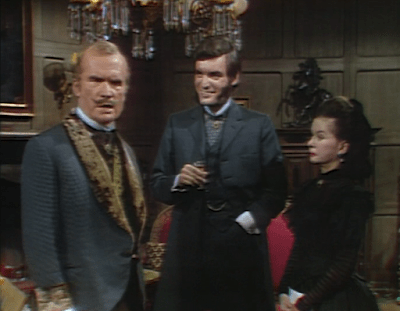
In the 1897 segment, Edward is as stuffily serious about the family business as Roger was in 1966 nihilistically apathetic about it. Edward loves his children, twelve year old Jamison (David Henesy) and nine year old Nora, but his rage at Laura has come between himself and them. Laura left Edward the year before to run after Edward’s brother, breezy libertine Quentin (David Selby.) Edward tried to conceal the fact that his brother cuckolded him. He has repeatedly declared that Laura “No longer exists!” and has forbidden her name to be mentioned in the house.
Edward trapped between the enigmatic Laura and the exuberant Quentin. Screenshot by Dark Shadows Before I Die.
For his part, Quentin bears a striking similarity to the early, wicked Roger. He wants money only to spend it, a fact which he cheerfully admits. He tried to forge a will in his grandmother Edith’s name to cheat his sister Judith (Joan Bennett) out of her inheritance, having previously threatened to kill Edith. He does have great affection for Jamison, but since he often uses the boy as a pawn in Satanic ceremonies, his fondness for his nephew is not much of an improvement over Roger’s hatred for his son. Indeed, Quentin’s resemblance to Roger connects the 1897 segment not only to the early months of the show, but also to the weeks immediately preceding it. Early in 1969, Quentin’s ghost had taken possession of David Collins and was causing him to die. When we see that Quentin is now what Roger was originally, David’s ordeal takes on a new dimension. He is dying for the sins of his father.
In this episode, Laura has returned. Edward has offered her a great deal of money to go away and never come back; she refuses. She threatens to tell the world about her relationship with Quentin if Edward does not let her stay at Collinwood. Edward buckles to this blackmail. Laura tells him that “Family pride is your greatest weakness,” making him Roger’s exact opposite.
When Laura was at Collinwood from December 1966 to March 1967, her old boyfriend Burke Devlin kept pestering her with his suspicion that he, not Roger, was David Collins’ father. Burke was not the first character to bring this idea up. Roger had mentioned it to Liz in #32, when they were talking about an attempt David had made to kill Roger. At that time, Liz was horrified that Roger seemed to want to believe that David was Burke’s natural son.
It seems unlikely that Quentin is Jamison’s father. They have been firm about 1870 as Quentin’s date of birth, and in 1897 Jamison is quite plainly twelve. Laura may have gone on to marry her own grandson, but it would be a bit of a stretch for her to have started sleeping with her brother-in-law when he was fifteen, even if he did look like David Selby.
But Roger’s anger and jealousy about Burke and Laura do mirror Edward’s about Quentin and Laura. It was abundantly clear that Roger and Burke’s deepest pain regarding Laura was that their intense attachment to each other was disrupted when she left Burke for Roger; Diana Millay used her gift for dry comedy to make this explicit in a scene the three of them played in the groundskeeper’s cottage in #139. Likewise, Edward’s frustration with and disappointment in his brother is at least as deep a source of anguish to him as is his loss of Laura’s love.
Laura, too, is quite different this time around. The first Laura story took shape gradually over a period of weeks, as Laura herself emerged from the mist. Now Laura is a forceful presence from her first appearance. Originally we heard that Laura had married into several of the leading families of the Collinsport region; now they have given up on the idea of developing other leading families, and Laura just keeps coming back to the Collinses. In the first story, they laid great emphasis on the interval of precisely one hundred years between her appearances; now, the number of years doesn’t seem to have any particular significance. As we go, we will see an even more important difference. When we first met Laura, she was utterly determined to make her way into a pyre so that she could rise as a humanoid Phoenix; now she is unhappy about the whole thing, and angry with people who have helped her on her fiery way.
Edward lets Laura live in the cottage where Roger and Liz would put her in 1966. In the final scene, she goes there and finds Quentin, drunk and trying to conjure up an evil spirit. Quentin keeps telling Laura that she is dead. Frustrated with her persistent refusal to concur with this statement, Quentin puts his hands around her neck and announces that whether or not she is dead now, she will be by the time he gets through with her.
Roger was uncharacteristically sober at the beginning of his three-scene in the cottage with Burke and Laura in #139, but he did enter brandishing a fire-arm. So Quentin’s homicidal intentions on this set further cement his affiliation with his great-nephew in the eyes of longtime viewers.
Millay and Edmonds are not the only actors whose screen iconography the show turns to advantage today. We first saw Kathryn Leigh Scott and Don Briscoe together in #638, when she was playing ex-waitress Maggie Evans and he was playing mysterious drifter Chris Jennings. They met in the foyer at Collinwood. Maggie was angry with Chris, and Chris was guilt-ridden. Today, Miss Scott plays governess Rachel Drummond and Briscoe plays teacher Tim Shaw. They meet in the foyer at Collinwood. Rachel is angry with Tim, and Tim is guilt-ridden.
Though the same actors are playing the same basic emotions on the same set, the situations are different, and the characters are very different. Maggie is Dark Shadows‘ principal representative of the working class of the village of Collinsport. She speaks directly and bluntly, using the plainest language she can to dare Chris to try to excuse his inexcusable behavior. Chris occupies a lowly and unsettled place in the world, and he dodges her gaze and evades her questions, saying as little as he can, almost mumbling.
But Rachel is a neurotic intellectual, and she expresses her anger in complex sentences featuring vocabulary that only a very well-read person would have used in 1897 (for example, the word “sadist.”) Tim retreats from her anger into a defense of his job that quickly devolves into the tiredest platitudes imaginable. At one point he actually intones “It is better to light one candle than to curse the darkness.” Miss Scott makes Rachel’s highly literate onslaught on Tim as forceful as was Maggie’s unvarnished challenge to Chris, and Briscoe makes Tim’s pompous posturing as pitiable as was Chris’ broken burbling. Writer Gordon Russell must have been delighted that the actors did such good work with his ambitious pages.
When Laura Murdoch Collins first appeared on Dark Shadows in December 1966, it was far from clear what sort of being she was. From the beginning, there were definite hints that she had emerged from the supernatural back-world of ghosts and presences lurking behind the action, but as those ghosts and presences were undefined and vague, so Laura herself was undefined and vague when we met her. We couldn’t even tell how many of her there were- there was a charred corpse in Phoenix, Arizona, a phantom flickering on the front lawn of the great estate of Collinwood, two graves of Laura Murdochs from previous centuries, a woman who turns up in various places that serve food but never eats or drinks, and a series of dream visitations and inexplicable compulsions. Some of those were Laura, maybe all of them were, but how they were connected to each other, if they were connected at all, was anyone’s guess. Diana Millay’s performance reflected that uncertainty. Her Laura was initially blank and distant.
As her storyline went on, Laura came into ever sharper focus. By the time we realized that she was a humanoid Phoenix, an undead fire witch who had returned to Collinwood to take her son, strange and troubled boy David Collins, into the flames with her so that she could renew her life, she had become a dynamic character. As Laura gained force, Millay had the chance to reveal a talent for sarcastic dialogue rivaling that of Louis Edmonds, who played Laura’s estranged husband Roger Collins. Before Laura went up in flames in March 1967, we wished we could have seen a whole series featuring Millay and Edmonds as an unhappily married couple sniping at each other.
In those days, Dark Shadows was set in contemporary times. Now, its dramatic date is 1897, and Edmonds plays Roger’s grandfather, the stuffy Edward Collins. As in the first 24 weeks of Dark Shadows we saw that the name of Roger’s estranged wife was taboo in the great house of Collinwood, so in the first six weeks of the 1897 segment Edward has been furiously insistent that his estranged wife should never be mentioned. When Laura turns up, bearing the same name and played by the same actress as Edward’s granddaughter-in-law, we know what we are in for.
The show moves a lot more quickly now than it did when it debuted. David had shown signs of a psychic connection with Laura from #15 in July 1966, over 21 weeks before she arrived. Edward and Laura’s nine year old daughter Nora had dreams, visions, and an episode of automatic writing directed by Laura yesterday and the day before, and Laura herself shows up today. At first she meets Nora on the peak of Widow’s Hill, as a dream had told her she would. Laura comes to the house and sees Edward the following afternoon. Edward is horrified to see her; she is understated and cool at the beginning of their scene, but by the end of it she is in tears, pleading with Edward to be allowed to see their children, Nora and twelve year old Jamison. She thus recapitulates within minutes a progression that in 1966 and 1967 took months.
When Laura saw Nora on Widow’s Hill, she swore her to secrecy, forbidding her to tell anyone but Jamison that she is back. Nora did try to tell Jamison, only to find that he wouldn’t believe her. She showed him a broach Laura gave her which bears an Egyptian symbol that popped into her head yesterday; Jamison is entirely unimpressed.
We learned the other day that when Edward’s brother Quentin was banished from Collinwood a year before, Laura followed him. The two wound up in Alexandria, Egypt, together. Jamison and Nora come to Quentin’s room today; Quentin sees the broach and flies into a panic. He searches through a book, then demands to know where Nora got the broach. She says only that she found it in the woods, and he keeps asking if someone gave it to her. She keeps denying that anyone did, and he rushes downstairs, looking for Edward.
In the drawing room, Quentin sees Laura. He is utterly shocked. “You’re dead!” he exclaims. “I saw you die!” Last week, Quentin himself died and came back to life. When he told Edward about his death and resurrection, he laughed delightedly. When Edward asked for an explanation, Quentin dismissed the whole subject, having exhausted his interest in it with his laughter. Yet now he is stunned out of his wits to see that Laura too has returned from the dead. Seems to be quite a double standard at work.
Every character we see in this episode bears the surname “Collins.” I believe this is the first episode we have seen with an all-Collins cast.
Libertine Quentin Collins has learned that his estranged wife, madwoman Jenny, is being kept locked up somewhere in the great house of Collinwood. He learned this when Jenny escaped and stabbed him. He also learned that his brother, stuffy Edward, and maidservant Beth Chavez are involved in the plot to keep Jenny in confinement. He spends time today trying to find out where Jenny is, openly telling both Beth and Edward that when he finds her, he will kill her.
Edward is estranged from his own wife, and just yesterday we learned that her name is Laura. Evidently she is the same sort of creature as we came to know from December 1966 to March 1967. In those days Dark Shadows was set in contemporary times, and Edward’s grandson Roger Collins was dismayed at the return of his estranged wife, who was also named Laura. That Laura was an undead blonde fire witch, a humanoid Phoenix who sought to be incinerated with her son, strange and troubled boy David Collins, so that her own life could be renewed.
Today, the year is 1897 and Edward and Laura’s nine year old daughter Nora is convinced that her mother will return after a year when she has been away and it has been forbidden to mention her name. Nora has a vision of Laura’s face in the fireplace, a vision of flames in the corridor, and a dream in which she meets Laura in the woods outside the house. At the end of the episode she wakes up, sneaks out to the woods, and finds the cloak Laura was wearing in her dream lying on the ground.
All of this is recapped from previous episodes, but actors David Selby, Louis Edmonds, and Denise Nickerson make it worth watching. As Beth, Terrayne Crawford is stiff and literal, and her awkward performance does detract from her scenes. But everyone else is so good that you don’t notice her weaknesses too much.
This episode marks the second time we hear the name “Mrs Fillmore.” In #707, we learned that Beth took substantial sums of money into the village of Collinsport to a lady of that name as part of the plot to cover up Jenny’s presence in the house. Today Beth has to remind Edward of that fact, and Quentin looks through the envelope with hundreds of dollars in banknotes meant for Mrs Fillmore.
When Nora screams that there is a fire in the upstairs hallway, Edward and Beth run towards it. Quentin just sulks in the drawing room; evidently the idea that the house is on fire bores him. By the time Beth and Edward get upstairs, the flames Nora saw have vanished, and nothing is burned. She swears that there was a fire, they cannot believe her. This echoes #400, when wicked witch Angelique cast a spell that caused time-traveling governess Vicki to see flames in her room in the Old House on the estate, and subsequently Vicki’s friends were puzzled that there was no indication there of anything burned. That confusion led to trouble for Vicki, and longtime viewers can imagine it is a sign of trouble for Nora as well.
Yesterday, Nora drew a series of Egyptian hieroglyphics saying that her mother was coming home. At the beginning of her dream, a maniacal Edward holds an oversized copy of that drawing and rips it up, declaring Laura will never be back. The oversized drawing harks back all the way to episode #722, when Nora’s governess, neurotic intellectual Rachel Drummond, had a dream in which the daffy Carl Collins held a gigantic pocket watch. That was a striking enough image that not even the Vaseline almost entirely covering the lens could ruin it. But today even less of the picture is legible, and the gambit isn’t fresh anymore. Louis Edmonds does do a fine job of laughing maniacally, though, I will grant that.
The picture really does look like that, and it is supposed to look like that. Director Henry Kaplan was not much of a visual artist. Screenshot by Dark Shadows Before I Die.
One day in the year 1897, Edward, Carl, and Quentin Collins hear their sister Judith read their grandmother’s will. Stuffy Edward and childlike Carl are shocked to find that Judith is the sole heir of their family’s vast holdings. Quentin stole the will and tried to forge a new one, so he is not shocked, but he is weirdly gleeful about the paragraph relating to him. He will receive no property and no income, but will be guaranteed a place to live in the great house of Collinwood forever. This enshrines his relationship with Judith as one of the clearest examples of Dark Shadows’ signature dynamic of Bossy Big Sister and Bratty Little Brother. No matter how atrociously Quentin may behave, no matter how loudly Judith may disapprove of him, she has no authority to punish him and her concern for the family’s good name will compel her to cover up his misdeeds and shelter him from their natural consequences.
Meanwhile, governess Rachel Drummond and ladies’ maid Beth Chavez are busy with a mystery concerning the room on top of the tower that stands in the middle of the great house. Rachel has seen lights in the room and suspects someone is being held prisoner there; contrary to the direct orders of Judith and Edward, and against Beth’s very strongly worded advice, Rachel is investigating this matter aggressively. She sneaks up the stairs to the top of the tower, listens at the door to the room, and sees Beth coming out of it with a tray.* She then goes to Beth’s room, where she interrupts Quentin sexually harassing Beth. When she tells Beth what she saw in the tower and asks about it, Beth is shocked that Rachel went into the tower. She denies everything.
Later, Rachel goes back to the top of the tower and again listens at the door. She hears a cradle rocking. We saw that cradle in #645, when Dark Shadows was set in contemporary times and Quentin and Beth were ghosts haunting children David Collins and Amy Jennings. They sent Amy and David to fetch the cradle from the attic of the Old House on the estate and to bring it to Quentin’s old room in the west wing of the great house. This is one of the first times in the 1897 segment when we explicitly close a loop opened during the “Haunting of Collinwood” story.
*At the beginning of the episode, we saw Beth approach the room with the tray and a baby doll. During that scene, we hear what I believe is new music. It has been quite some time since we have heard any new cues, so this stands out.






 Dark Shadows Commentary