Madwoman Jenny, estranged wife of libertine Quentin Collins, is on the loose again, and she is the object of a madcap search by Quentin’s sister, spinster Judith, his girlfriend, maidservant Beth, and his distant cousin, secret vampire Barnabas. Quentin makes two contributions to the process. The less important is to serve as the bait in a cockamamie trap Barnabas and Judith lay for Jenny. The more important is to keep up a running commentary mocking the other characters for the silliness of their activities.
The trap itself involves a moment of intentional humor. Barnabas has returned to the year 1897 to prevent Quentin becoming a ghost who will ruin things for everyone on the great estate of Collinwood in 1969. One of the things Quentin did in that year that terrified the characters and tried the patience of the audience was to cause the strains of a sickly little waltz continually to resound from the walls of the great house. When the show became a costume drama and we got to know the living Quentin, we found that he too played a gramophone record of that same tune incessantly, annoying all and sundry. The trap requires Quentin to play the recording over and again until Jenny hears it and comes. After it has been going for half an hour, Barnabas tells Quentin that the plan didn’t work and they should stop playing the waltz. Quentin asks “Are you tired of hearing this music?” Barnabas speaks for all of us when he replies “Frankly, yes.”
Not only is this a successful comedy, it also gives the cast an opportunity for some of their best dramatic acting. As Judith, Joan Bennett at one point stops, looks at Barnabas, and asks “Can we trust you? Really trust you?” She apologizes for the bluntness of that question, then admits that she has long been busy putting a prettier face on the Collins family than the dark secrets Barnabas has discovered make plausible. “I’m not really very trusting. I try to pretend we’re nicer than we really are.” In the parts of Dark Shadows set in the 1960s, Bennett plays matriarch Liz, whose whole personality is about denial and the pretense that the Collinses are nicer than they really are. Liz latched onto Barnabas as soon as she saw him, and refuses to see any evidence that he is not quite normal. Nor does she ever really face her own habits of concealment and their implications. In this little exchange, we see Bennett playing a character whose superficial similarities to Liz point up her profound differences from her.
“Can we trust you? Really trust you?”
Joan Bennett had one of the most distinguished careers of any American actress of the twentieth century. Terrayne Crawford stands at something of the opposite pole, and her performance as Beth leads most fans to declare that she is the weakest of all the members of the cast of the portion of Dark Shadows set in the year 1897. I don’t really disagree with that, but she is fine today. Miss Crawford’s great limitation was that she could play only one emotion at a time, and she was on the show in a period when the scripts gave every character complex motivations in almost every scene. But today, all Beth has to play is Anguish, and Miss Crawford does a fine job.
Beth took care of Jenny during the year Quentin was away from Collinwood, and became very close to her. In the nine and a half weeks since Quentin’s return, she has fallen in love with him. In a scene at the close of today’s episode, Beth tearfully admits to Quentin that she wishes something would happen to Jenny so that he would no longer have a wife. Beth collapses into Quentin’s arms. Jenny has been hiding in a corner, eavesdropping; she comes out, holding a knife. There have been occasions when we might have rooted for Jenny to succeed in killing Beth, just to spare us the embarrassment of Miss Crawford’s flat, tedious performances. But this time, we want to see more of her, and the prospect that Beth might die makes for an effective cliffhanger.
For months, the evil ghost of Quentin Collins has been gaining strength, secretly manipulating children Amy Jennings and David Collins as he prepares to drive everyone from the great house of Collinwood so that he can have the place to himself. Now he has cast aside all secrecy and he openly menaces the adult residents of the house. Today, they give up and leave. Once they are all gone, Quentin stands on the walkway at the top of the staircase in the foyer and laughs heartily.
Collinwood belongs to matriarch Elizabeth Collins Stoddard. Liz’ brother Roger, David’s father, lives there as her guest. Up to this point, Liz and Roger have served primarily as blocking figures. Each is devoted to denial as a way of life. Occasionally a fact bursts upon them that is so enormous that one or the other of them has no choice but to face it for a little while. Usually they snap back into their characteristic mode of willful ignorance the moment the crisis is past, and even while it is going on the other responds by digging even deeper into the insistence that nothing is happening. When I first watched Dark Shadows, I could imagine the characters fleeing Collinwood one by one, then venturing back to get Liz and Roger, only to find them sitting serenely in the drawing room, assuring their would-be rescuers that everything was all right while leather-winged demons fluttered about their heads.
On Monday, Liz saw enough of Quentin’s power that she gave up her attitude of denial, apparently forever. Today, Roger does what we have been led to expect, and loudly declares that the whole issue is imaginary and that the other adults should be ashamed of themselves for encouraging the children to be afraid of ghosts. When the whole house starts to resound with the crepuscular tones of an old-timey waltz Quentin plays when he is exercising power, Roger declares that it is a trick the children are playing on them. The others go to pack their things while Roger stays in the drawing room.
Alone there, Roger sees Quentin materialize before him. On their way out, Liz and occult expert Timothy Eliot Stokes check the drawing room one last time, and find Roger sitting motionless in a chair. For a moment we wonder if he will fall over dead. He starts speaking, though, and admits that he was wrong. As they leave, Roger looks back into the house and shouts a defiant pledge to return. Apparently the makers of Dark Shadows have decided they no longer need two major characters whose primary function is to put the brakes on the action.
After everyone has gone, the camera pans across sets representing several rooms in the great house. This must have taken some doing. The foyer and drawing room were the only standing sets; the others were built as needed. The show was done live to tape, so these sets must all have been standing simultaneously. The studio was not very big at all. I wonder if they crammed some of these into space that was not generally used for action.
The walkway at the top of the foyer stairs is a commanding position, and the show has been sparing in its use of it. Quentin’s triumphant laugh is the first time we see a villain stand there and exult in his new position as Master of Collinwood. In the early days of the show, the dashing and enigmatic Burke Devlin threatened to take control of the house. He never came very close to doing that, but it could have been interesting to see him stand on the walkway, survey the foyer, and think about the day when the house would be his. For a long period in 1967, seagoing con man Jason McGuire was bossing Liz around; there were several days when he might have stood on the walkway, looked around with smug satisfaction, and chuckled.
Yesterday’s episode ended with the drapes in a bedroom in flames. That was a real fire, not a special effect, and you could see it spreading rapidly and putting out a lot of smoke. Having failed in that attempt to murder everyone in the building, the technical staff in today’s reprise of the sequence settles for lighting some gas burners behind a window dressing.
There are two ongoing narrative threads in this part of Dark Shadows. One is the story of mysterious drifter Chris Jennings. Mad scientist Julia Hoffman knows Chris to be a werewolf and she is trying to help him. The other is the story of Quentin Collins, a ghost who is gradually gaining power and planning to drive everyone away from the great estate of Collinwood so that he can have the place to himself. Chris’ story had been the fast-paced A plot that kept expanding to involve more and more characters, while Quentin’s was the slow-paced B plot that consistently involved only Chris’ nine year old sister Amy, strange and troubled boy David Collins, and their governess Maggie Evans, with intermittent small parts for other established characters and the occasional chance for a day player to act a death scene. That changed yesterday, when Quentin decided that he had grown so strong he no longer needed to conceal himself from matriarch Elizabeth Collins Stoddard or the other adults in the great house. Quentin’s story is now the main topic, and Chris is the secondary feature.
We open today with Liz telling Julia what happened the night before. Julia tells Liz that she and old world gentleman Barnabas Collins had suspected that an evil ghost was at work in the house, and that they have seen another spirit that seems to be opposed to it. Liz says she has called occult expert Timothy Eliot Stokes. Stokes arrives and questions everyone.
Liz is alone at the desk in the drawing room when a secret panel leading to a passage to the long-deserted west wing opens. A cutout meant to suggest a disembodied hand appears on the screen. It picks up a letter opener from the desk and is about to stab her when Stokes enters.
Stokes shouts. The hand drops the letter opener and vanishes. He tells Liz what he saw. He notices the panel is open, and asks Liz about it. She says that it leads to the west wing, but that, as far as she knows, no one has used it in years. That answers a question that has been on the audience’s minds since October 1966. In that month, we saw Liz’ brother, high-born ne’er-do-well Roger, use the panel to play a dirty trick on well-meaning governess Victoria Winters. The panel was not seen or mentioned again until David and Amy started using it to do Quentin’s bidding several weeks ago. This line is our first confirmation that Liz knows that the panel and the passage behind it exist. Stokes asks Liz’ permission to perform an exorcism.
Meanwhile, Julia gets a telephone call from Chris. Liz’ daughter, heiress Carolyn Collins Stoddard, has taken a fancy to Chris and installed him in a cottage on the estate. Chris tells her that he is facing an emergency. Someone has come to the village of Collinsport who might know his secret.
In the cottage, Chris tells Julia that an unpleasant man named Ned Stuart has brought his sister Sabrina to the village and that he is demanding Chris meet with Sabrina. Chris had assumed Sabrina was dead, because she was in the room with him one night two years before when he underwent the transformation into his lupine form. Ned had told Julia and Barnabas that he was looking for Chris because he wanted to know what happened to his sister; he had always referred to Sabrina in the past tense, leading them to assume she was dead. Now Chris is in a panic, convinced that Sabrina will tell the police about him and that he will be punished for the many, many homicides he has committed as the werewolf.
Julia points out that if Sabrina were going to do that, she could have done so at any time. He would already have been arrested. Sabrina must not have told Ned or anyone else what she saw, and Ned must be telling the truth when he says he does not know what happened the last time Chris and Sabrina were together. She persuades Chris to go to visit the Stuarts in their suite at the Collinsport Inn.
Julia accompanies Chris on the visit. Ned is irritated that Chris did not come alone. His remarks are uncomfortable to hear, chiefly because of actor Roger Davis’ habit of clenching his anal sphincters when he raises his voice, making him sound like he is suffering from agonizing constipation.
After Ned makes this fingernails-on-a-blackboard noise for a couple of minutes, he lets Chris and Julia into Sabrina’s room. She is in a catatonic state. Her hair is white, and her face is tinged with light blue makeup. The makeup makes her look haggard in color, but most TV sets in the USA in the 1960s received only in black and white. In black and white, the makeup is not very effective.
Ned says that Sabrina was like that when he found her, the morning after she paid her last visit to Chris’ apartment. Several takes of a framed copy of actress Lisa Blake Richards’ professional headshot invite us to imagine the before-and-after. Ned calls Sabrina’s attention to Chris; she rises from her chair, starts towards him, and collapses.
Throughout its first 73 weeks, Dark Shadows was usually very slow-paced, even by the standards of a 1960s daytime soap. Major characters like matriarch Liz and her brother, high-born ne’er-do-well Roger, often seemed to exist solely for the purpose of refusing to accept the facts in front of their faces and thereby slowing down the progression of the plot. Even characters who did face facts would often as not have the memory of goldfish, so that weeks of character development would evaporate with a sudden display of inexplicable ignorance.
That changed when well-meaning governess Vicki came unstuck in time in #365. For the next few months, Dark Shadows was a costume drama set in the 1790s, and events came thick and fast. When Vicki returned to the present and Dark Shadows returned to contemporary dress in March 1968, the show was a genuine hit. They tried to sustain the breakneck pace of the 1790s segment throughout 1968, with mixed success. That period was a Monster Mash, featuring multiple witches, vampires, mad scientists, Frankensteins, ghosts, and the Devil himself, or perhaps one of his middle managers. That attracted a new audience of preteen viewers, but all too often left the characters spinning their wheels as they tried to make room for each other within one small fishing village near Bangor, Maine.
A few months ago, they dumped all of those larger than life but ultimately unproductive figures and started concentrating on two storylines. The A story so far has been that of werewolf Chris and the efforts old world gentleman Barnabas and mad scientist Julia have made to keep him from killing quite so many people. That one has been moving along at a steady clip.
The B story has not progressed nearly as fast. At times, it has matched the leisurely pace of the show’s early days. Today is dedicated to that story, and in today’s pre-title teaser it appears that it has brought narrative progression to a total halt.
Maggie is the new governess in the great house of Collinwood, charged with the education of Chris’ nine year old sister Amy and of strange and troubled boy David. As usual, we open with a reprise of the previous episode. This time, the reprise is 5 minutes and 45 seconds of Maggie wandering around the house looking for the children and hearing voices, while doors open themselves. That was OK at the end of Friday’s installment, but on its own it is stupefying.
The story is that the evil spirit of the late Quentin is taking possession of David and Amy in order to destroy the Collins family and have the house to itself. It made sense that that story would start slow. Quentin was at first very weak. He existed only in a sealed chamber the children stumbled upon while exploring the long deserted west wing, and could influence events outside that chamber only by persuading them to do his bidding. He gradually gained the power to control one child at a time, and to manifest himself outside his little room. A while ago he was able to put strychnine into Chris’ drink; by the end of Friday’s episode he had Amy and David under his power simultaneously.
Once the action finally gets underway in today’s episode, Quentin is about to strangle Maggie and the children are screaming at him to stop. Housekeeper Mrs Johnson and Liz enter the room. Mrs Johnson sees Quentin, Liz does not. Maggie is unconscious and the children are in a state. By the end of the episode, Liz, Maggie, and Mrs Johnson know Quentin’s name, his plan, and his power. He has managed to create some kind of bubble around the house so that the people inside it cannot hear the rain. The children pass out. David comes to, and announces that it is too late to be afraid. He laughs maniacally, and in the background we also hear Quentin’s laughter.
With this slam-bang ending, the Haunting of Collinwood takes over as the A story and Liz forever sheds her role as a blocking figure. This phase of the show is approaching its climax, and there is a chance that what comes next will be exciting.
The evil spirit of the late Quentin Collins has been taking control of strange and troubled boy David Collins. David tricks his governess, Maggie Evans, into going into a room in the long-deserted west wing of the great house of Collinwood. Quentin appears to Maggie there, frightening her.
Maggie goes to matriarch Elizabeth Collins Stoddard and tells her she saw an unfamiliar man lurking in the west wing. When she says that she suspects David is in cahoots with the man, Liz becomes deeply skeptical. Her disbelief reminds longtime viewers of #27, when Maggie’s predecessor, the well-meaning Vicki Winters, discovered evidence indicating that David was behind an attempt to murder his father, Liz’ brother Roger. Desperate to escape the implication, Liz briefly went so far as to suggest that Vicki herself might be the culprit. That idea was absurd on its face, and Liz treated Vicki as a member of the family, so she dropped it almost as soon as she had put it into words. But Maggie doesn’t have anything definite to back up her suspicions of David, and Liz is no more attached to her than she might be to any other member of the household staff. She remains leery of Maggie throughout the episode.
Quentin appears to David in his room. David talks to Quentin; he praises him for a fine plan, and Quentin smiles and nods in reply. He asks him how he came up with the name “Mr Juggins” and Quentin does not react. When Liz’ daughter Carolyn and local man Chris Jennings enter, Quentin vanishes.
After Carolyn and Chris exit, David sings a song about “Mr Juggins.” Quentin reappears, quite happy. I don’t blame Quentin, the song makes me happy too. It’s sung to the tune of “Yankee Doodle”:
Mr Juggins met Miss Evans on a darkened ni-i-ight,
The poor girl fainted dead away, he gave her such a fri-i-ight.
Mr Juggins keep it up,
Mr Juggins keep it up,
Mr Juggins keep it up,
Until Aunt Liz beleeeeves me!
This is the first time we’ve heard David sing, and it is delightful. David Henesy was in the national touring company of Oliver! in 1964 and 1965, and he does a first-class job with this little ditty. The song also marks the first time David utters the name “Liz”- he has always called her “Aunt Elizabeth.”
Furthermore, the Dark Shadows Almanac, as cited on the Dark Shadows Wiki, reports that the technician responsible for holding up the boom microphones was named Max Jughans. Considering that the shadows of the boom mics appeared on screen in most episodes, the mics themselves in many, and the entire boom mic assembly on occasion, the director’s voice must have come from the control room during many a dress rehearsal calling “Mr Jughans, keep it up!” Certainly David Henesy comes very close to laughing when he first gets to the line “Mr Juggins, keep it up!”
Maggie and Liz talk to David in his room. David offers to take them to the room where Maggie saw Quentin so that he can prove a story he has been telling; Liz replies “You don’t need to prove anything.” This line shows how completely she has disregarded what Maggie has told her. David insists, and they go.
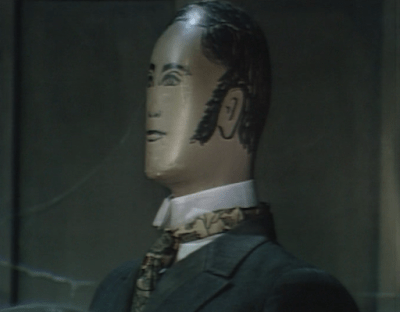
In the room, Maggie gasps. She thinks she is seeing Quentin again. In fact, it is a dummy wearing a coat like his and with a face painted to look more or less like his. David says that he calls the dummy “Mr Juggins.” Liz turns to Maggie and triumphantly asks “Could this be the man you saw?” It’s lucky for Maggie she didn’t get the job when Vicki did, or she would still be in jail for the attempt on Roger’s life.
I’m not saying Mr Juggins is the best guest star Dark Shadows ever had, only that he was one of the best. Screenshot by Dark Shadows Before I Die.
Today, everyone has the memory of a goldfish. Heiress Carolyn receives a telepathic message from her mother, the apparently-dead Liz, urging her to go home to the great house of Collinwood and stay inside in order to escape a terrible danger. A few minutes later, she has apparently forgotten the content of this message, as she goes back outside to check on Liz in her coffin.
During her brief stay in Collinwood, Carolyn talked with permanent houseguest Julia. Julia keeps telling her that Liz is dead and that the dead cannot communicate with the living, suggesting that she too has become a goldfish. Julia is a doctor, and Liz is entombed because she mistakenly declared her dead. She had made the same mistake about her several weeks before, and learned nothing from that experience. But she has also attended several séances, built two Frankenstein’s monsters, seen a number of ghosts, and spent a year and a half carrying on a one-sided romance with recovering vampire Barnabas. She also knows that in #592 and #593, Carolyn herself died and came back to life. So it is bizarre that she goes on about the finality of death and the impossibility of communication between the living and the dead.
Carolyn goes back to her mother’s crypt and is attacked by a werewolf. Liz knew she would be buried alive, and so insisted her coffin be equipped with a button that would ring bells everyone at Collinwood could hear. While Carolyn is confronting the werewolf, Liz overcomes her paralysis sufficiently to push this button. That brings Barnabas and Julia.
The werewolf paused in his attack on Carolyn when he saw her silver bracelet; that gave Julia and Barnabas time to arrive while Carolyn was still alive. Barnabas strikes him with the silver head of his cane, causing him to run off. When Carolyn tells of the werewolf’s fascination with the bracelet, Barnabas mentions that the head of the cane is also silver; he grows very thoughtful, apparently realizing that silver has a power over the werewolf. Yet later, when he goes to hunt for the werewolf, he takes a gun but nearly leaves the cane behind. He finally takes it, but his long hesitation shows that he, too, is suffering from goldfishism.
While still in the crypt, Julia had looked at Liz’ body and insisted she was dead. She wrote off the ringing of the bells as a coincidence, perhaps caused by some jostling during Carolyn’s encounter with the werewolf. Later, Liz gets out of the coffin and goes home to Collinwood. There, Julia, Barnabas, and Carolyn are astonished to see her. Julia examines her. After she finds that Liz has what is in Collinsport English called a “pulsebeat,” she seems willing to concede that she might be alive. She then starts giving orders which everyone willingly follows, because she is such a good doctor.
Liz is the one character whose brain seems to be in working order today. She can remember that her trouble started when her brother Roger’s wife Cassandra cast a spell on her. Barnabas and Julia know that Cassandra was in fact a wicked witch named Angelique, and that Barnabas has just returned from a trip back in time during which he destroyed Angelique. They assure her that Cassandra will never return. They can’t tell her why they are sure of this, because they, like the producers of Dark Shadows, have decided that Liz must never know what is really happening around her, lest she become an active participant in the plot. So all they can say is that they just know, and she is of course unconvinced.
It is a relief to wrap up the “Liz will be buried alive” storyline; that was dull from the beginning, and just got duller as it went. It didn’t help that we have seen Liz immobilized by depression twice before. This isn’t even the first time she has been rendered catatonic as the result of a curse placed by an undead blonde fire witch.
It’s also encouraging that Julia and Barnabas have met the werewolf and are engaged with him. They are the show’s chief protagonists, and nothing can really move without their involvement. Now that they are involved with the werewolf, we can stop spinning our wheels.
An extraordinarily uneventful outing. In yesterday’s episode it looked like heiress Carolyn would go to visit Chris the werewolf as he is in the middle of a transformation and would be attacked. But she didn’t go. Governess Maggie did go to Chris’ cottage, and at the end of the episode it looked like she might be attacked. As we open today, she is there and he is about to change, but she leaves and gets home safely while he is still in human form.
It again looks like Carolyn might be attacked when she walks through the woods to visit the mausoleum where her mother, matriarch Liz, is entombed. Liz was alive when she was mistakenly buried and is still alive now. Liz is unable to move or speak, but she somehow shares the audience’s thought that Carolyn might possibly be attacked. We see her in her coffin and hear her interior monologue as she thinks about the “terrible danger” her daughter is in.
As it happens, Carolyn makes it home fine. Later she goes out again; we see the werewolf prowling nearby, again raising the theoretical possibility that she will be attacked. But Carolyn hears Liz’ voice in her head, a telepathic warning that she should hasten off. The werewolf also reacts as if he can hear Liz’ voice, and he goes off in another direction. The screen goes dark and the credits start rolling. The werewolf hasn’t attacked anyone and no one has learned anything about him.
It appears that the werewolf is trying to figure out where Liz’ voice is coming from.
It’s kind of interesting that Liz can transmit telepathic messages now. She could use a supernatural power or two if she’s going to get into the swing of things on the show. It’s also interesting that the werewolf seems to be able to overhear the messages Liz sends to Carolyn. Chris’ little sister Amy lives in the great house of Collinwood now, and along with strange and troubled boy David she is falling under the power of the evil ghost of Quentin Collins. Quentin communicated with Amy before he could get through to David. David was miffed by this, since “Quentin is my ancestor.” That suggested that Quentin will turn out to be Amy’s ancestor as well, making her and Chris members of the Collins family. If so, that might explain why Chris, even in his lupine form, was able to pick up a telepathic transmission Liz directed to her blood relatives.
There is a wardrobe malfunction in this one of a type that showed up several times in the first year of the show. When Carolyn makes her first entrance, she walks down the stairs in the foyer. At each step, Nancy Barrett’s chest thrusts into her sweater with results that would probably not have made it on the air had anyone from the ABC network’s office of Standards and Practices been watching the show. In the early days, they put the actresses into very form-fitting tops often enough that I thought they were challenging the audience to take an adult attitude towards female anatomy, and so I did my best to rise to that challenge by leaving it unremarked when we could see the exact shape of their breasts. But it’s a rare occurrence now, so I think we have to list it among production faults.
Hardworking young fisherman Joe Haskell has been through a lot lately, and it is taking its toll. He was bitten and enslaved by a female vampire, with the result that he lost his job and his fiancée. He was still under her power when he realized that his cousin and close friend, Tom Jennings, was also a vampire. Now he has been attacked by a werewolf and has discovered that that werewolf is, on the few nights of the month when the moon is not full, Tom’s brother Chris. Last night he saw Chris transform in his lupine shape. He took Chris’ revolver and emptied it into the werewolf’s furry chest, but that only slowed him down. Joe escaped from the werewolf’s wrath, but we see today that he is never going to be right again.
Chris’ nine year old sister Amy is staying at the great house of Collinwood as the guest of matriarch Elizabeth Collins Stoddard. As we open, Liz’ daughter Carolyn is in the drawing room, recently returned from a trip. She is terribly distraught to hear a recap of the last couple of weeks from permanent houseguest Julia Hoffman, MD. While they talk, Joe slips into the house, crazy-eyed and bent-backed.
Joe makes his way up to the bedroom where Amy is asleep. He dwells on what her brothers became, then approaches her bed with his hands in strangling position. After a commercial break, he says “Save her!,” then agrees with himself that he ought to save Amy.
Joe wakes Amy, urges her to be silent, and starts packing her clothes. She asks if they are going to join Chris, and Joe becomes violently agitated. Amy grows frightened. Joe grabs her, puts his hand over her mouth, and carries her out of the house, leaving her half-packed bag behind.
In the woods, Joe hears sounds which he believes to be the werewolf. He starts shouting that he won’t let it have Amy. He is so absorbed in this that Amy gets loose and runs from him.
Joe’s derangement is entirely explainable as a natural response to the horrible and incomprehensible traumas he has undergone. The same could be said of the other mentally ill character in today’s episode, Liz, and in Monday’s episode Julia very nearly said it. Today, however, the show raises the possibility that Liz’ trouble might be the result of ongoing persecution by the spiritual forces of darkness.
Months ago, Liz fell afoul of her brother Roger’s wife. She called herself Cassandra, but was really an evil sorceress named Angelique wearing a black wig. This wiggéd witch cast a spell that caused Liz to sink into a deep depression, obsessed with the idea she would be buried alive. Twice before, Liz has sunk into similar depressions. The first was the result of a spell cast by Roger’s previous wife, Laura Murdoch Collins, who like Angelique/ Cassandra was an undead blonde fire witch. (Roger has a type.) The second was a response to a long blackmail to which a seagoing con man named Jason McGuire subjected her. For the last several weeks it has seemed that this third bout might be lifting, but it came back with a vengeance last week when well-meaning governess Victoria Winters dematerialized before Liz’ eyes.Vicki’s departure was as much a shock to Liz, in its own way, as Chris’ transformation was to Joe. Even before any spells were cast on her, Liz had shut herself up in the house and refused to leave for eighteen years. So we know that Liz is given to depression.
Today Liz has a nightmare. The dream sequence begins with a melody that for all the world sounds like “Rock-a-bye Baby” played on a kazoo, but which turns out to be a distorted recording of Amy singing that lullaby. Liz sees Amy atop the cliff on Widows Hill, a place associated with death and peril. In the past, several women have fallen to their deaths from Widows’ Hill; we have seen Liz and Vicki attempt suicide there. Amy’s image is as distorted as is the sound of her voice. She is swaying from side to side, perhaps dancing the hula; the visual effects exaggerate this sway.
Liz is trying to get Amy away from the cliff when she sees Angelique/ Cassandra. The witch tells her that she will fulfill her curse and see that Liz is buried alive. Liz finds that she can no longer communicate with Amy, for which Angelique/ Cassandra taunts her.
Shortly after Liz wakes up from her dream, Carolyn and Julia come to her room. They hear her crying out that “she” is a danger to her, but a moment later Liz cannot remember who that was. Julia mentions to Carolyn today that multiple psychiatrists have reported that Liz cannot remember how her depression started; that she sees Angelique/ Cassandra in the nightmare but cannot remember who she was so shortly after suggests that the nightmare is part of the depression. If Angelique/ Cassandra’s continued activity is causing the one, it must therefore be causing the other.
Liz says that she is afraid for Amy and asks Carolyn to check on her. When she finds Amy missing, she asks Julia what to tell her mother. Without missing a beat, Julia says “Lie to her!” This is perfectly fitting- Julia is the show’s most fluent and most accomplished liar. Julia and Carolyn begin a search. Julia is on the phone asking for the sheriff when Amy comes in the front door, followed by Joe.
Julia is at first relieved to see Amy with good ol’ Joe. But Amy is terrified of Joe, and when she runs upstairs Julia blocks the staircase to keep him from following. Joe says that he must take Amy far away from Collinsport at once. Julia says that if he can explain why, she will let him. Nothing he can put into words makes much sense to her, and he is so obviously unhinged that there is no way anyone would think he was the right person to assume responsibility for a child. Julia tells Joe that whatever he may have encountered in the village poses no threat to Amy in the mansion. He laughs, shakes his head, and mutters “You don’t know… you don’t know…”
Julia’s attempt to reassure Joe is interrupted by a blood-curdling scream from upstairs. She hurries up to see what is happening. Joe goes on laughing and muttering, wandering out of the house. That the scream coming from upstairs, where Amy is, does not catch his attention when he is so determined to protect Amy from imminent danger shows that he is truly lost, never to recover.
Julia finds a distraught Carolyn standing over an immobile Liz. She gives Liz a quick look, and tells Carolyn that she is dead. You might think Julia would be more careful about this. She has several times made erroneous death pronouncements, most recently when she pronounced Liz herself dead in #604. That incident led Julia to conclude that Liz had an unusual disorder that could cause her to appear to be dead. Especially since Julia knows about Liz’ overwhelming fear that she will be mistakenly thought dead and be buried alive, this hasty diagnosis is bizarre. Of course we end with a shot of Liz on the floor and hear her voice on the soundtrack saying “I’m not dead! I’m not dead!”
Liz had collapsed after she had a vision of Angelique/ Cassandra appearing in her room and touching her. This would seem to be a strong suggestion that the show wants us to think that Liz is still actively hag-ridden, and that her depression is therefore among Dark Shadows‘ supernatural storylines. On the other hand, the vision might have been an hallucination on Liz’ part, and her apparent death might be the result of a psychological syndrome. There may not be any mental process in our world that can induce a seizure so complete that it would fool doctors into thinking that a patient was dead, but in the world of Dark Shadows Julia, whose abilities are all supposed to be strictly the result of her scientific training, can use hypnosis to erase and rewrite people’s memories at will. If the power of suggestion is that great in this fictional universe, it is easy to suppose that self-hypnosis could conceal anyone’s vital signs from the most sophisticated examination.
This was the first episode directed by Henry Kaplan. Lela Swift directed the first twenty episodes of the show, and half of the rest. From #21, she shared directing duties with John Sedwick, usually trading off from one week to the next. Sedwick left the show in June, and several other men have taken turns as Swift’s relief. Kaplan will occupy that spot until the end of the series.
Swift and Sedwick were both ambitious and accomplished visual artists, and the others have more or less lived up to the standard they set. Today’s episode doesn’t look particularly bad, but a great many of the hundreds of segments Kaplan would go on to direct would be made up of one closeup after another, most of them badly out of focus. Swift will continue to work at her usual high level, but the sludge Kaplan dumps on our screens day after day will go a long way towards breaking people of the habit of watching Dark Shadows and discrediting it in the eyes of critics and television professionals.
Moreover, Kaplan did not work well with actors. Many of the cast hated Kaplan for his habit of using a stick, not only to point to their marks, but often to prod them physically. Others hated him for the verbal abuse he casually heaped on them. In a recent panel discussion, Marie Wallace and Donna Wandrey share stories about the difficulties of working with this disagreeable hack. The performances in this one do not show Kaplan’s malign influence. Joel Crothers does a marvelous job as Joe. While the actresses step on each others’ lines so often that it is clear they are nervous, that is not so very unusual.
Well-meaning governess Victoria Winters has vanished into the past, sarcastic dandy Roger Collins is on a long business trip overseas, and matriarch Elizabeth Collins Stoddard is in the grips of a paralyzing depression. That leaves a shortage of adults in the great house of Collinwood, and old world gentleman Barnabas Collins has left his own house on the estate to be of assistance. He is fussing over Liz and insisting that she take the sedatives permanent houseguest Julia Hoffman, MD, prescribed for her. Liz says that all she cares about is that someone take Vicki’s place in the lives of the children in the house, Roger’s son David Collins and houseguest Amy Jennings. To address that concern she orders Barnabas to telephone Maggie Evans, The Nicest Girl in Town, and ask her to replace Vicki starting tonight.
Maggie is in her house talking with her ex-boyfriend Joe Haskell about his plan to move out of town soon when the telephone rings. Soon the two of them are in the drawing room at the great house, where Barnabas fills them in about recent developments.
Joe is Amy’s cousin. He has been doing what he can to fill the void left in her life by the deaths of her parents and her brother Tom, and more particularly by the puzzling refusal of her brother Chris to settle down and live with her. Amy comes downstairs and sees Joe; she is delighted to spend time with him while Maggie is upstairs with Liz, accepting the offer.
Amy’s delight gives way to alarm when she sees a pentagram superimposed on Joe’s face. She does not know what the returning viewers do, that Chris is a werewolf and the pentagram is the mark of his next victim, but she does know that it is a sign that Joe is in great danger. She pleads with him not to go to Maggie’s house and collect her things; she tells him that if he stays at Collinwood tonight, he will be safe. Joe dismisses her concerns as the result of staying up past her bedtime.
Joe enters the Evans cottage. While he is looking over the list Maggie gave him, he hears growling noises outside the window. He turns to look, and sees the window shatter and the werewolf jump through the glass.
The episode has a definite high point and an equally definite low point. The high point comes when Amy is staring at the full moon, which she senses is associated with something very bad. She cries as she does so. That is a powerful enough image that the following scene, when Barnabas sees her tears, asks her what is wrong, and she hugs him, is quite effective.
The low point comes when we see the werewolf sleeping on his bed. A werewolf can be terrifying if you catch only brief glimpses of him, and then only when he is in the middle of attacking someone. But this furry little fella isn’t scary at all. You keep expecting him to start flopping his legs because he’s dreaming about chasing a bunny. It generates a bad laugh that undercuts the final scene of the attack on Joe.
Whooooo‘s the goodest boy? Are you the goodest boy? I bet you are! Screenshot by Dark Shadows Every Day.
Amy has a couple of great one-word lines, too. Barnabas asks, “Amy, what are you doing with the door open?” To which she replies, “Nothing.” Later, Joe asks “Well what was all that you two were talking about?” To which she replies, “Nothing.” She really is a kid!
Mysterious drifter Chris Jennings telephones the great house of Collinwood. Old world gentleman Barnabas Collins answers. Chris asks to speak to permanent houseguest Julia Hoffman, MD. Barnabas tells him Julia is busy with a patient, and Chris says that it is extremely urgent Julia call him back the moment she is free.
Julia comes downstairs. She had been tending to matriarch Elizabeth Collins Stoddard. Liz is mentally ill. She is deeply depressed and fixated on the idea that she will soon be buried alive. Barnabas starts talking about the witch whose spell started Liz’ illness; Julia points out that the origin doesn’t really matter. Indeed it does not. Liz’ condition is quite logical when we realize that she has been exposed to a long series of traumatic events of supernatural character. Of course she feels helpless- her world really does not make rational sense, and there really are forces beyond her control that are determined to bring misery to her and those she loves. And of course she is preoccupied with death- she is surrounded, not only by people in mortal jeopardy, but also by figures who are at once dead and alive. Unknown to her, Barnabas is one of these- he died in the 1790s, became a vampire, and was restored to humanity less than a year ago. The story of Liz’ depression is not really a tale of the supernatural, but of a person responding to her environment in a perfectly natural way.
Liz’ depression is not exactly a fun story, and the show hadn’t done anything with it for months. We might have hoped it was all over. What has brought it back is the disappearance of well-meaning governess Victoria Winters. The other day, Vicki embraced her husband, an unpleasant man known variously as Peter and Jeff, and vanished into thin air as Barnabas and Liz watched. She and Peter/ Jeff were traveling back in time to the 1790s, never to return. Liz was very close to Vicki; the show spent its first year hinting heavily that she was Vicki’s biological mother, though they never got round to saying so explicitly or telling us anything about Vicki’s father. Now that Vicki is gone, Liz is inconsolable.
That is the in-universe explanation for Liz’ trouble. There are two real-world reasons. First, Joan Bennett was going away for a few weeks to do a play in Chicago, and the show needed to explain why Liz wasn’t going to be around when so much of the action was taking place in her house. Second, the key figure in both of the ongoing storylines is Chris’ eleven year old sister Amy, who is staying at Collinwood. Barnabas is the show’s chief protagonist, and so far he does not have any particular connection to either of those stories. Plunging Liz into a paralyzing depression completes the task they started by sending her brother Roger on a business trip overseas. It means that Barnabas has a reason to camp out in the main house and act as a father figure to Amy.
Barnabas had a vague notion about a romance with Vicki, though he did almost nothing to develop such a relationship. His basic feeling towards her seems to have been that he might want her someday, and so he reacted with petulant anger to any person or event that made her unavailable to him. Thinking about Vicki’s departure with Peter/ Jeff, he spends several minutes pouting while Julia tries gently to reason with him.
Barnabas is very upset that Vicki was so inconsiderate as to move on with her life when he might someday have wanted her. Screenshot by Dark Shadows Before I Die.
At the end of his tantrum, Barnabas declares that he and Julia should go back upstairs and talk with Liz. As they are going, he sees the telephone and says “Oh. By the way, Chris Jennings called. He said it was urgent.” It’s even funnier that Barnabas remembers this call so late in the scene than it would be if he had forgotten it altogether. Chris may use words like “emergency” and “extremely urgent,” but in Barnabas’ world there is only one truly urgent matter, and that is whatever his feelings are at the moment.
Vampires are metaphors for extreme selfishness. Barnabas may not be a vampire anymore, but he is still very selfish. But perhaps is attitude towards Vicki is not so unsympathetic as I have made it out to be. When he was still under his curse, he thought he might be able to remake Vicki as an eighteenth century woman, then turn her into a vampire and take her as his bride. Vicki did indeed have an attachment to that era, so much so that she traveled back in time to the 1790s. And when he became human again, Barnabas was immediately embroiled with a succession of witches and monsters, to none of whom did he want to expose Vicki. He wanted to clear them out of the way so his life could start, and once it did he would be free to approach her. But her life was already underway, and of course his was too. The nemeses Barnabas and Julia fought together throughout 1968 are gone now, but so is Vicki, and it is the two of them who are alone together.
The other day, Chris dropped by to ask Julia for sedatives. She was unimpressed with his drug-seeking behavior, and so when Barnabas tells her about Chris’ call she says that he can wait. What she does not know is that Chris is a werewolf, and he was hoping that strong enough pills could knock him out throughout the night of the full moon.
Chris and Amy’s cousin Joe Haskell has been trying to fill in for Chris in the big brother role. He and Amy have gone to the movies, and we see them on their way back to the great house, looking at the moon. Amy tells Joe that she is terribly afraid of the moon, for reasons she can’t explain. Joe asks if she really saw a pentagram on his face in #648; she confirms that she did. Joe knows that someone else saw it too, visiting medium Janet Findley. He also knows that when he told Chris about it he was terribly upset. Neither Joe nor Amy knows what Chris and Madame Findley knew, that it is the sign that he will be the werewolf’s next victim.
Amy is alone in the foyer of the great house when Liz comes down the stairs, apparently in a trance. She does not respond when Amy calls out to her, but walks out into the night. Amy is standing in the open doorway, watching her, when Barnabas comes and asks what she is doing. She tells Barnabas what happened. He tells her to go to bed; she refuses. He then decides it will be good enough if she waits in the drawing room until he brings Liz back. She goes to the drawing room, but when he goes off to tell Julia what has happened she slips out to look for Liz. Barnabas learns that she has left when Julia, whom he has sent to sit with her, reports that she is not in the drawing room.
Barnabas is out looking for Liz and Amy when Chris comes to Collinwood. He is upset that Julia did not call him back; she is skeptical of him. He tries to give a reasonable-sounding explanation; if only he knew of her background treating vampires and Frankensteins, he would realize that he has everything to gain by telling her the truth. She finally gives him a bottle of sleeping pills, along with a wary look and an injunction to use the pills only as directed.
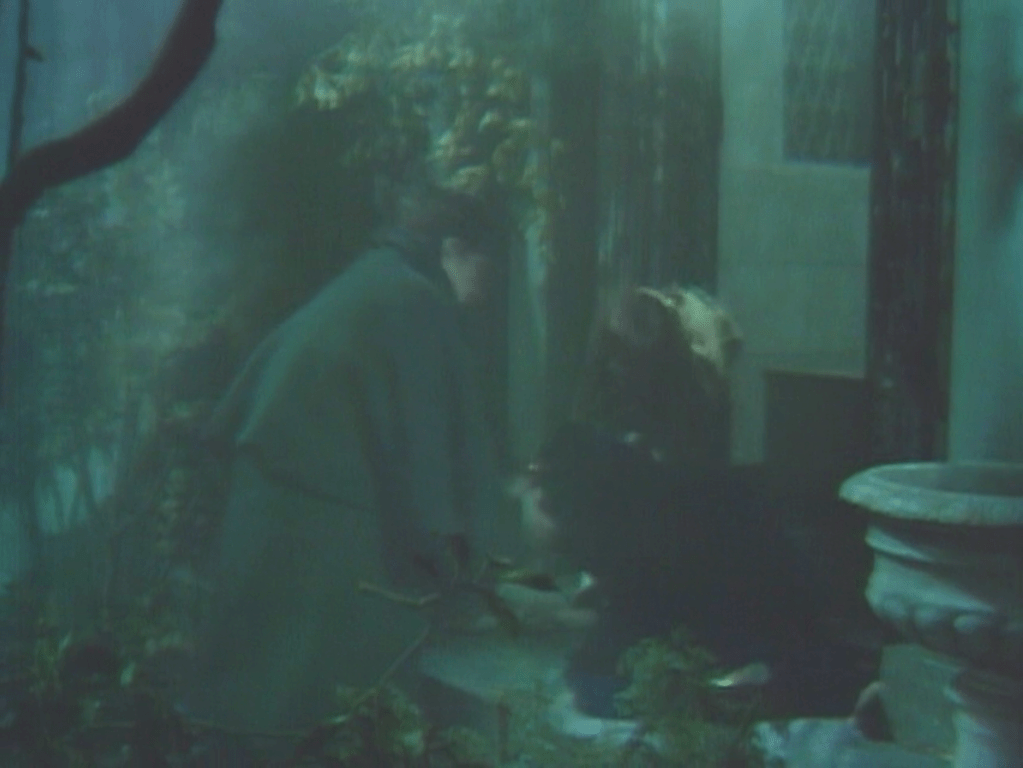
Liz goes to the old Collins family mausoleum. Barnabas’ parents and sister are buried there, and he was himself trapped there for 172 years when he was a vampire. She thinks of it now as her tomb, and tells herself that she is ready to be buried there now. She collapses. Amy finds her, fears that she is dead, and cries out. Her voice brings Barnabas, who tells Amy that Liz is alive. He also says that they must get her back to the house at once. Barnabas puts his arms under Liz’ left side, Amy puts hers under her right, and they lift her. This brief glimpse of the two of them working together goes a long way towards establishing Barnabas’ closeness to Amy.
I’ve altered the saturation and exposure a bit in this still. Though the original is darker and the fog machine was working overtime, in the moving image you can see what Amy is doing clearly enough.
Joe pays another visit to Chris’ room. Chris has taken a bunch of sleeping pills from the bottle Julia gave him. Joe scolds Chris for his failure to visit Amy. Chris knows that he could transform at any time, and is desperate to get Joe to leave. Joe does leave. Chris goes to bed. He falls asleep. The camera pans to his hand, which has already become a werewolf’s paw.







 Dark Shadows Commentary