Episode 830: Up in the tower room, all bloody

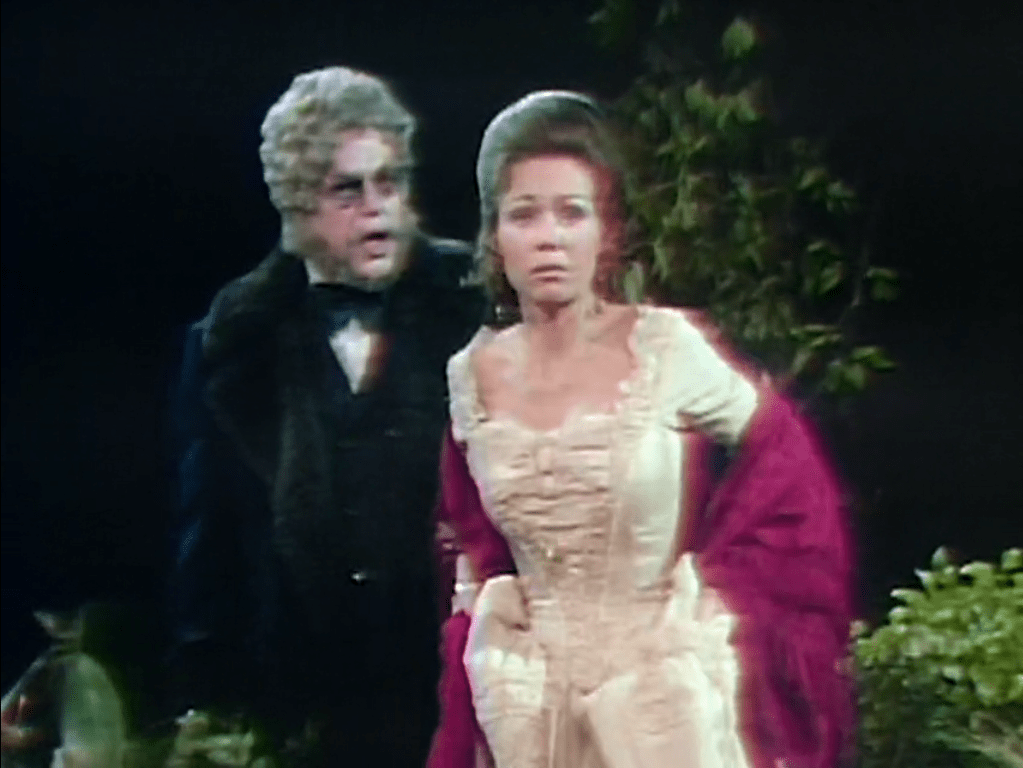
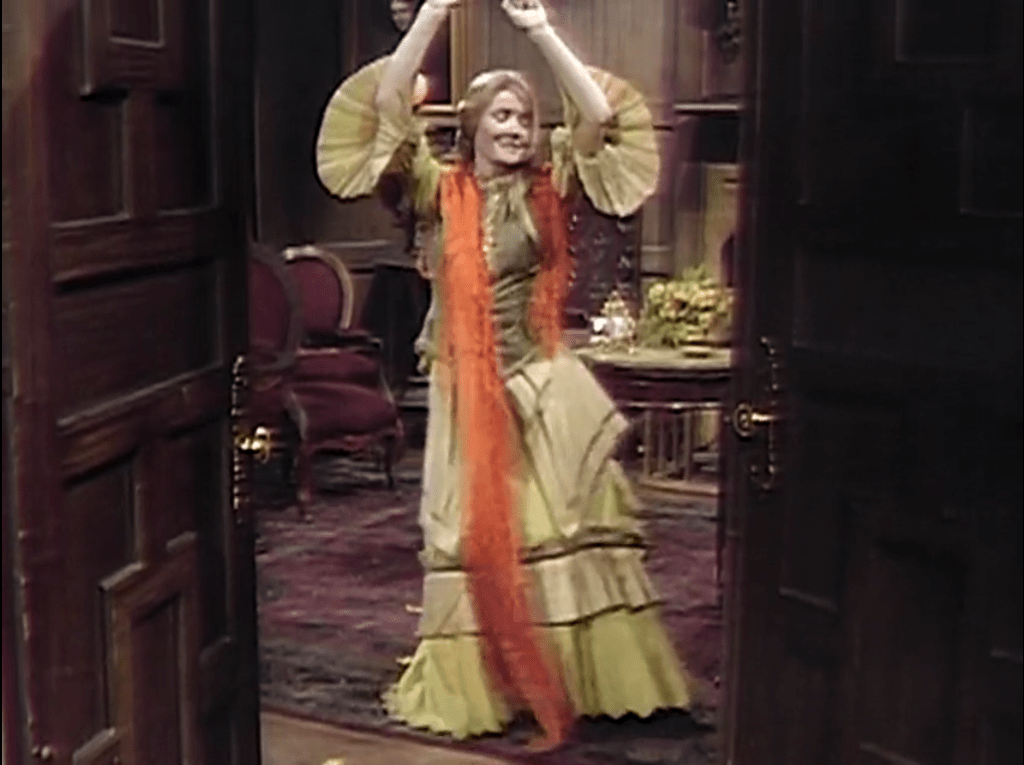
We open in the woods on the estate of Collinwood, where a young woman in heavy makeup and bright clothing is crying. Another woman in even heavier makeup and even brighter clothing approaches and asks her what is wrong. The first woman says that she had a vision which told her that the rakish Quentin Collins will die of stab wounds twelve days from now, on 10 September 1897.

The first woman used to be Charity Trask, the miserably repressed daughter of the evil Gregory Trask. She is now possessed by the spirit of Cockney showgirl Pansy Faye. Charity knew that Quentin was a werewolf, and wanted nothing to do with him. Evidently Pansy did not acquire that knowledge when she took up residence in Charity’s body, and has decided that she will marry Quentin. Quentin has no interest in either Charity or Pansy, and already has two other fiancées, one of whom he loves, at least after his fashion, and the other of whom is sealed to him by a pact with the Devil. Yesterday Charity/ Pansy learned of the second engagement, and tried to kill Quentin to prevent it coming about; week before last, she tried to end the first engagement by killing the fiancée. Pansy had her faults, but she wasn’t inclined to physical violence. That part seems to be Charity’s contribution to the symbiont.

The other woman is broad ethnic stereotype Magda Rákóczi. Magda was the one who made Quentin a werewolf in the first place. She cursed him for murdering his wife Jenny, who was her sister. It was only after she had placed the curse that Magda learned that Jenny had given birth to Quentin’s twin children, a boy and a girl. Since the curse is hereditary, Magda is now desperate to lift it, and she and Quentin have become allies.

Some time ago, we learned that if Quentin dies, there will be no hope of lifting the curse. So Magda is terrified when Charity/ Pansy tells her of her vision of Quentin’s death.  She takes her back home to the great house on the estate, where her father and Quentin are bickering while they recap yesterday’s story. Trask tries to deny that Charity/ Pansy is insane or that she is capable of killing, but when she enters and announces that she will murder the first person who comes between her and Quentin he has to admit that it might be time to find a place for her in residential care.

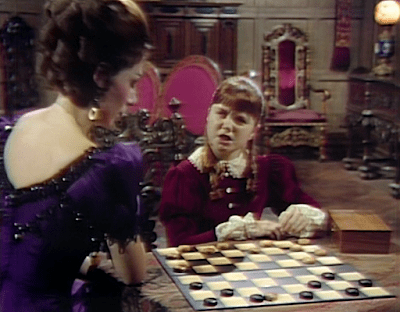
We turn our attention to the upstairs of the great house. We see Charity/ Pansy in bed, with Magda sitting in a chair beside. The gramophone is playing a record of Pansy Faye’s theme song. Regular viewers will wonder where Charity/ Pansy could possibly have found such a thing. Charity never met the living Pansy, who was killed the very evening she arrived at Collinwood. Perhaps Pansy’s fiancé, the childlike Carl Collins, bought the record when he met Pansy in Atlantic City and brought it back with him. Carl himself was killed well before the possession began, but perhaps Charity or Charity/ Pansy found it among Carl’s effects.

Charity asks Magda if she likes the tune. “I only like Gypsy music,” she replies. Charity/ Pansy and Quentin both reiterate their theme songs endlessly, but few other characters in the 1897 segment have so much as a dedicated entrance cue. This line of Magda’s makes us wonder what the show might have been like if they had given every major character a theme song.

Trask has a crisis in the drawing room. He hears a ghostly voice warning him that there will be another killing soon. He starts shouting the name “Minerva!” and pleading for mercy. First time viewers might not know what to make of this. Those who have been with the show for a while know that Minerva was Trask’s wife and Charity’s mother, and that he instigated a plot to murder her so that he could marry wealthy spinster Judith Collins and become master of Collinwood. When the voice starts to talk about “the beast that walks like a man,” Trask says “You’re… not Minerva?” Jerry Lacy is an expert comic actor, and his delivery of that line is laugh-out-loud funny.

The same ghost appears visibly to Quentin in his room. He recognizes it as that of Tessie Kincaid, a woman he killed in a recent fit of lycanthropy. He knows that she is appearing to him because tonight there will be a full Moon.

Tessie appears to Quentin. Screenshot by Dark Shadows Before I Die.

Magda enters and finds Quentin writing a suicide note. She tells him he must not kill himself. She chains him to a post in his room and stands by with a pistol. Trask enters and finds them in this compromising position. Mrs Acilius and I laughed as we imagined how Magda and Quentin might have claimed they were planning to spend the evening.

But there is no point in lying to Trask. Between what Tessie’s ghost told him and what he overheard while eavesdropping on a conversation Quentin and Magda had earlier in the drawing room, he has figured out Quentin’s problem. He takes the gun from Magda and recognizes the bullets with which it is loaded as silver. He announces that he will wait until the Moon rises and see what happens.

Tessie’s turn today marks Deborah Loomis’ third and final appearance on Dark Shadows. Miss Loomis didn’t get to do very much, but she made the most of all of it, and I wish we had seen more of her.

Episode 828: Sovereign of the worms

In 1897, King Johnny Romana is the hereditary chieftain of a Rroma tribe that has long been at war with ancient sorcerer Count Petofi. King Johnny is at the supreme moment of his destiny, standing over Petofi with his scimitar raised, ready to deal the ultimate blow, when a creepy little guy ruins it all for him. Petofi’s henchman Aristide throws a knife and catches King Johnny in the back. Aristide has a dagger with a curved blade that he sometimes calls “The Dancing Girl,” other times “The Dancing Lady”; he makes a big deal of it, the thing fascinates him. But when he kills King Johnny, Aristide doesn’t even use his special knife. It’s a brutal anticlimax for King Johnny.

King Johnny does live long enough to tell Petofi that he isn’t safe yet. After nine days pass, he will appear to another Rroma, somewhere in the world, and will pass on to that person his immunity to Petofi’s magical powers and his mission to kill him. After Aristide buries King Johnny, he finds that the scimitar has vanished. Evidently it will go to the new avenger.

Meanwhile, at the great house of Collinwood, twelve-year old Jamison Collins is dying. Petofi cast a spell causing Jamison to be possessed by the spirit of his grandson David Collins, who will live in 1969. But David won’t live at all unless the spell is broken, because it is killing Jamison. Jamison’s devoted uncle, rakish libertine Quentin Collins, makes a deal with wicked witch Angelique. He will marry her if she manages to break Petofi’s spell and save Jamison. They made a similar bargain previously, but that time her magic failed.

Petofi senses that his spells are being challenged. He marches to Collinwood and orders Quentin to make Angelique stop what she is doing. Angelique herself enters; she and Petofi confront each other, then she goes back to the study to resume her attempts to free Jamison. We end with Petofi preparing to cast a spell against her.

Petofi confronts Angelique in the drawing room at Collinwood while Quentin looks on. Screenshot by Dark Shadows Before I Die.

This is an entertaining, fast-paced episode. It’s too bad it is the final appearance of actor Paul Michael in the series. He played the most unpromising part of King Johnny so skillfully that we barely noticed he was little more than a menacing pose, an evil laugh, and an ethnic stereotype. He does return with a small part in the feature film House of Dark Shadows, but it would have been fun to see what he could do with a really meaty role.

Episode 819: You’re a bit of all right, you are!

Evil sorcerer Count Petofi tells the disastrously repressed Charity Trask that he will show her a vision of her own death. He’s tried that twice before on other characters, with mixed success, and it doesn’t work at all with Charity. He can’t see the visions he causes her to have; when she describes them to him, he is afraid that she has seen, not her own impending demise, but his. He casts a spell on her and rushes out.

Petofi meets his boyfriend Aristide and takes him on a shopping trip through the cemetery. What he wants with the body he orders Aristide to exhume is not made clear.

The importance of the episode is in the spell Petofi casts on Charity. He effectively murders her. For the rest of the segment of Dark Shadows set in the year 1897, Nancy Barrett will play, not Charity, but Pansy Faye, Cockney showgirl who came to the great estate of Collinwood as the fiancée of the daffy Carl Collins. The show often tends towards the somber, so it is a joyous thing to see Charity/ Pansy enthusiastically shake her moneymaker.

It is sometimes said that Petofi makes Charity believe that she is Pansy, but this is not correct. Charity never met Pansy, and barely knew the late Carl. She certainly never saw Pansy perform on stage. Yet she sings Pansy’s theme song word for word and note for note as she did, and does the dance that went with it just as Pansy did it. She has Pansy’s garish sense of style, her not-very-convincing East London accent, and her memories of Carl. Petofi has caused Pansy to take possession of Charity and to live again through her body, as he has caused David Collins, strange and troubled boy indigenous to the mid-twentieth century, to take possession of his grandfather Jamison Collins. While David’s spirit is killing Jamison’s body, Pansy seems to be having a wonderful time in Charity’s person, certainly far more than Charity ever had herself. As for Charity’s mind, that seems no longer to exist.

Episode 797: I do not like death at all

Vampire Barnabas Collins, werewolf Quentin Collins, and broad ethnic stereotype Magda Rákóczi hold a séance to contact the spirit of Rroma maiden Julianka. This is the thirteenth séance we have seen on Dark Shadows. It deviates from the previous ones in three important ways. First, no one objects in the middle of it and has to be sternly hushed by the séance-leader. Second, it doesn’t matter that the physical contact among the participants is broken- previously it had been a fatal error if anyone stopped touching the fingers of the people on either side of them, but this time Quentin jumps up and runs out and it’s no problem. Third, Julianka does not choose one of the participants as a medium and speak through them, but manifests as a ghost.

Julianka appears. Screenshot by Dark Shadows Before I Die.

Perhaps because they are rewriting the rules of the Dark Shadows séance, they make a reference to an earlier milestone in the show’s development. The séance is held in the parlor of the Old House on the estate of Collinwood. That isn’t unusual; séances have been held there on three previous occasions, including the second and in some ways most dramatic one, held in #186. What makes the location noteworthy is Julianka’s movement when she first appears. She comes in as a green screen effect hovering somewhat above floor level, then takes several steps down an unseen staircase.

We have seen that same movement on this same set. It was in #70, when the ghost of the gracious Josette was the first supernatural being to become visible to viewers of Dark Shadows. Aside from the reuse of that footage, we have not seen a ghost move that way since. Compared with the changes that began when Josette walked down from her portrait in #70 and brought the supernatural back-world that had been implicit in the show from its first week into the foreground, these changes to the rules for séances are small potatoes.

Barnabas and Magda hoped to persuade Julianka to give them some information they needed to lift the curse from Quentin and cure his lycanthropy, but she isn’t interested. She blames them for her death, and will not even let them ask questions, let alone answer them. They try to protest that they weren’t the ones who killed her, but she ignores them. So far from helping them end Quentin’s curse, she places a new curse, this one on Magda. She decrees that everyone who loves Magda will die. That was the same curse wicked witch Angelique pronounced on Barnabas in #405 when she made him a vampire. Longtime viewers will be unsure how Julianka’s curse will operate- Magda doesn’t seem likely to become a vampire, but perhaps they are suggesting she will turn into a monster of some other kind.

Unfortunately, Julianka’s appearance today is the last time we will see Diana Davila. In her approach to the role, Miss Davila concentrated very much on her eyes. She kept them open wider than I would have imagined a person could open her eyes, did not blink, and when she looked from side to side she did not turn her eyes in their sockets, but instead turned her head. This dictated a rigidity of movement for the rest of her body and a narrow range of inflection for her voice. Taken as a unit, these mannerisms made for a perfectly logical way of expressing Julianka as a strange, unreachable person, an emissary not only of the tribe of King Johnny Romana, but of another world altogether. In practice, this style had a drawback given the conditions under which actors had to work on Dark Shadows. In the three episodes where Julianka was a living being, Miss Davila did not have quite enough time to learn her lines. She did better than did most cast members, but the particular illusion she was trying to create could be shattered by the slightest bobble. This time, though, she is letter-perfect, and as a result the scene with Julianka’s ghost is one of the most effective in the series.

Episode 791: Roomful of spirits

The evil Gregory Trask coerced lawyer/ Satanist Evan Hanley into helping him murder his wife, Minerva, so that he could marry wealthy spinster Judith Collins. Now Trask and Evan have conjured up a magical simulacrum of Minerva and caused it to hang around Judith. They claim they can’t see it, which, coupled with some other troubles Judith has had, leads her to believe that she has lost her mind. Trask and Evan strong-arm Judith into signing a paper, Trask locks her up in the tower room, and Evan makes the simulacrum disappear.

In case you can’t tell, these guys are villains. Screenshot by Dark Shadows Before I Die.

Meanwhile, Judith’s brother Quentin is at large. Quentin is a werewolf, and when he returned to human form this morning his face was disfigured. This worked to his advantage. He was in jail at the time, and he was being watched. The sheriff’s deputy had not recognized Quentin’s brother Edward when he came to jail that night, so it isn’t so surprising he doesn’t recognize Quentin, even though he is six foot four, has a distinctive hairdo and prominent mutton chop sideburns, and is wearing the same blue suit with a frock coat that he always wears. It is surprising that Edward doesn’t recognize him either, but this may be the result of a congenital problem the Collinses have. Not only was Quentin himself stumped when the equally identifiable Evan had a similar glob of makeup on his face recently, but Judith fails to recognize Quentin today when he comes to the drawing room. When Judith found him, Quentin was listening to his favorite record and reciting its lyrics in his unaltered voice, and he identified himself to her by name. Still, she couldn’t see it.

Quentin bursts into Evan’s room shortly after he finishes dissolving the simulacrum of Minerva. He sees that Evan’s face is no longer disfigured, and assumes that he used the magical Hand of Count Petofi to restore his appearance. Evan tells him he did not- he can’t explain why his face reverted, it just did so on its own. This does not satisfy Quentin, and it will not satisfy returning viewers. We saw Evan struggle to fix his problem for some time, and when he found himself in a crisis situation he suddenly turned up looking like his old self. So we’ve been in suspense for several days wondering what the explanation would be for his cure, and we are no more inclined to settle for a non-explanation than is Quentin.

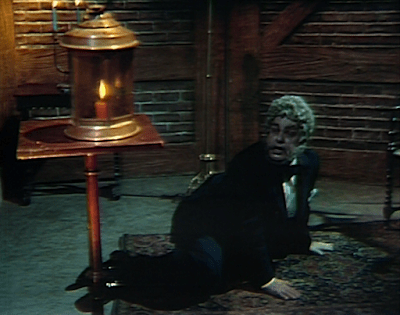
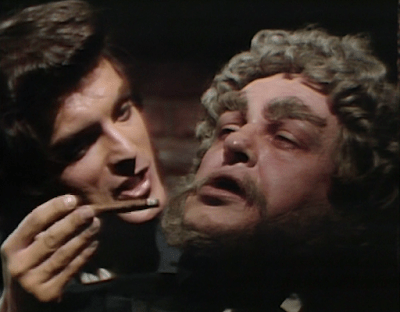
Quentin knocks Evan out with a candlestick; the background music is a cue we have previously heard during on-camera murders, leading us to wonder if Evan will survive the blow. Quentin rummages around for a moment and finds the hand. He is looking at it, wondering how to use it to restore his appearance, when a man in a wool cap enters and orders him to surrender the hand at once.

This episode features one of Dark Shadows‘ all-time great goofs. When Evan is casting the spell to dissolve the simulacrum, a black-clad figure dashes past in front of him. A voice can be clearly heard exclaiming “Jesus, Lacy!” Evidently actor Jerry Lacy was in such a hurry to get from one set to another that he didn’t realize he was crossing a live camera.

Episode 780: Carl was not mad

In yesterday’s episode, inveterate prankster Carl Collins told his brother, the rakishly handsome Quentin, that their distant cousin Barnabas was a vampire. Quentin has problems of his own, and he is counting on Barnabas to help him. So he locked Carl up in Barnabas’ hiding place, expecting that when night came Barnabas would prune one more branch off the Collins family tree.

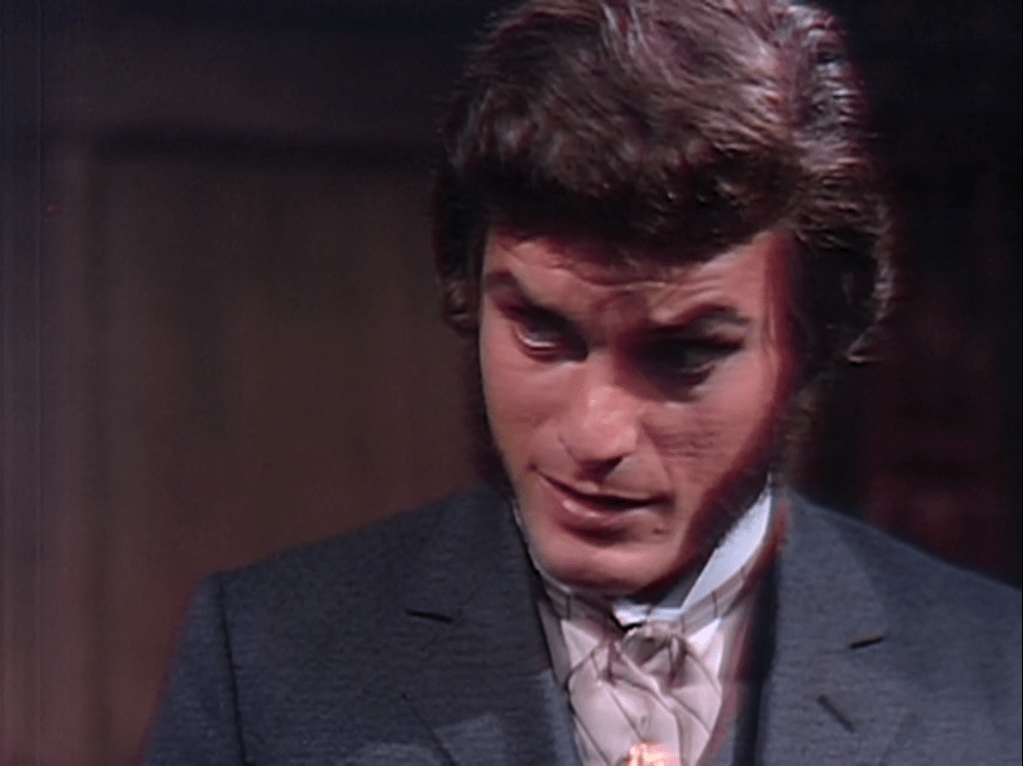
Today, Quentin finds that Carl has escaped. He goes to Barnabas and tells him what has happened. Carl’s practical jokes annoy Barnabas intensely, and Barnabas has never bothered to conceal his disdain for him. He reacts to Quentin’s news with fury and a lot of orders. When Quentin later finds Barnabas standing by Carl’s corpse in the drawing room of the great house of Collinwood, he is really torn up about his brother’s death for almost a whole minute.

Quentin mourns for Carl- blink and you’ll miss it. Screenshot by Dark Shadows Before I Die.

A knock comes at the door; it is the oppressively evil Rev’d Gregory Trask. Quentin keeps Trask in the foyer for a bit while Barnabas hides Carl’s body. When Trask forces his way into the drawing room, Barnabas is gone. Carl’s body is cunningly hidden… behind the curtains, propped upright. Of course it falls out almost immediately. Earlier in the episode, Carl took Trask to Barnabas’ hiding place, and we saw that Barnabas had single-handedly lugged his coffin and the structure on which it rests some distance away. If he is strong enough to do that, surely he could have tossed Carl’s body out the window. And regular viewers know that there is a secret panel in this room, of which Barnabas has repeatedly shown that he is well aware. They would probably have expected him to hide the body there. That he just stashes it behind the curtains where it is certain to come into Trask’s view suggests that he isn’t even trying to get away with this particular murder.

Closing Miscellany

John Karlen is breathing pretty deeply during Carl’s big closeup as a corpse. It’s really confusing, I thought they were telling us he wasn’t dead yet.

I don’t know what the writers planned for Carl in the flimsies they sketched out six months before this episode was made, though there is so little room for him in subsequent plot-lines that I suspect he was supposed to die at about this point in the story. Still, his death was accelerated because Karlen had other things to do. He won’t be back on the show until #956, in February of next year.

The creaky little waltz that Quentin listens to obsessively was released as a single in June of 1969 and would hit #13 on the Billboard Hot 100 in August. Regular viewers may be sick of it already, and the characters certainly wish Quentin would get another record. It’s Trask’s turn to complain about it today, giving him something in common with Barnabas.

Trask wears a cross which he uses as a weapon against Barnabas. The show is oddly inconsistent about the effect of the cross on vampires. We’ve seen other characters use crosses against them, and at one point it was said that a cross inside the lid of Barnabas’ coffin immobilized him. But his hiding place is in the middle of a cemetery full of grave markers in the shape of huge crosses, and we see several of them today. Barnabas just walks right past those with no problem. You might think that since the show was made in the USA, where sincerity is so highly regarded, that the cross might be effective against him only if it is wielded by the pure of heart. But Trask is every bit as evil as are Barnabas and Quentin, and it works for him. It’s a puzzlement.

In a long comment on Danny Horn’s post about this episode at Dark Shadows Every Day, I responded to a discussion about whether there is a point in thinking of Barnabas as someone possessed by demons:

I think of the climax of the Iliad. As Achilles moves in to kill Hector, Athena takes hold of his spear and drives it in, delivering the fatal wound herself.

For modern readers, this may ruin the story. The whole poem has been leading up to this moment; we’ve spent a lot of time with Achilles, listening to him try to figure out what it would mean for him to kill Hector. So why have the goddess take over at the last minute? Isn’t it an evasion of Achilles’ responsibility for his actions, and a cheat for us as we’ve been observing his psychological development?

For the original audience, it was not. They actually believed in their gods. Athena really existed, as far as they were concerned. When an event was important enough, they took a interest. If it was really huge, they would get involved. Moreover, the gods worked closely with each other. So much so that you didn’t pray to one at a time, but always to groups of them. When Athena joins Achilles in his fight, it isn’t her pushing him aside- it’s him doing something so important it blurs the boundary between human and divine.

Something like that is at work in the traditional, pre-modern, conception of demonic possession. To say that a person is possessed is a way of looking at behavior that is reducible neither to moralistic judgment nor to psychological analysis. It isn’t individualistic in the way that those modes of discourse are. Rather, it suggests that the boundaries between the person and the spiritual forces of darkness have broken down. Perhaps the person is partly to blame for that breakdown, but the whole point is that s/he is no longer a distinct being, but is merging into those supernatural forces.

So, imagine a version of Dark Shadows where Elizabeth Collins Stoddard really was the main character. Her whole approach to life is denial. So, you could have had a story with a beginning, middle, and end. In the beginning, we see the lengths she has gone to in her quest to keep from ever having to have an embarrassing conversation. In the middle, we see various horrors take place around her, each worse than the one before, each more obvious than the one before, and each time she finds a way to convince herself it doesn’t exist. At the end, a couple of innocent characters go to her in the drawing room of Collinwood to rescue her from the monsters who are running rampant there. She looks at them placidly and tells them she sees nothing wrong. Why ever do they think she would want to leave her home? All the while leathery-winged demons are fluttering about her head. She doesn’t see them, and they have no choice but to flee.

Comment left 10 November 2020 by “Acilius” on “Episode 780: The Establishment Vampire,” posted 2 December 2015 by Danny Horn at Dark Shadows Every Day

Episode 778: The strongest magic is always the simplest

A lot happens in this one. Inveterate prankster Carl Collins realizes that his fiancée, Cockney showgirl Pansy Faye, is dead. He has a dream in which he meets Pansy backstage as she is preparing for her final performance, then sees her standing on stage before him, his sister Judith, and their distant cousin Barnabas; when he awakes from the dream, Carl is sure he has figured out what happened to Pansy, and he sets out for the very place where Barnabas is planning to rest during the day. This seems to imply that Carl will discover that Barnabas is a vampire.

The dream sequence is like nothing we’ve seen before on Dark Shadows, though it is strongly reminiscent of the kind of thing you would have seen on near-contemporary shows like ABC’s prime-time horror anthology Night Gallery hosted by Rod Serling and the Paulist Fathers’ syndicated morality plays Insight hosted by the Rev’d Fr Ellwood Kieser. It starts with a closeup of a sign on which Pansy’s name is emblazoned in glittery letters, and plays over a soundtrack of an audience applauding thunderously. Pansy calls Judith, Barnabas, and Carl to join her on stage, each in their turn; their behavior in this drama-within-a-drama mirrors their behavior in the framing narrative.

Pansy’s sign. Screenshot by Dark Shadows Before I Die.

Meanwhile, Barnabas’ unwilling sidekick, broad ethnic stereotype Magda Rákóczi, has returned from Boston. There, she met with a leading member of the Romani people, whose name she alternately pronounces as “King Johnny Romana” and “King Johnny Romano.” She shows Barnabas a box she took from King Johnny. It contains a severed hand wearing a ring, which Magda declares will solve their troubles. Magda has placed a curse on Judith and Carl’s brother Quentin, turning Quentin into a werewolf. After placing that curse, Magda learned that her sister Jenny had borne two children to Quentin, and since the curse is hereditary she is desperate to find a way to lift it. Barnabas traveled back in time to 1897 in the course of his own attempt to resist the effects Magda’s curse will have in 1969, so they are allied in this effort.

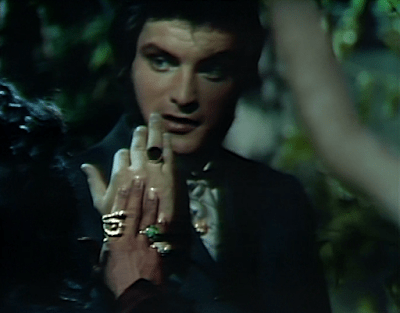
Barnabas is utterly unimpressed with the hand and with Magda’s plan to place it on Quentin as he is about to transform. He seems convinced that Magda is just trying to conceal the fact that she failed to find anyone in King Johnny’s camp who could actually help them. He doesn’t care about the original owner of the hand, a legendary nobleman named Count Petofi who was himself cured of lycanthropy, or about an incantation Magda says over the hand that is supposed to prepare it to draw the curse from Quentin. He isn’t even interested when she admits that she stole the hand from King Johnny and that if they don’t get it back to him before he realizes it is missing he will send someone to kill her. He reacts as if the whole thing is a show she is putting on to build up her cover story.

In a metafictional set of way, Barnabas is onto something. The original storylines the writers had prepared for the 1897 segment are coming to a head. Several of its major characters have already died, and others, such as Carl, would not be very attractive customers for a life insurance salesman. Apparently the original flimsies, written six months ago, gave only a few more weeks until Barnabas was to return to 1969 and take the show back to contemporary dress. But 1897 is a hit. The ratings are soaring, and there are some dynamics among the characters that they want to explore in a lot more depth. So they want to stay, but to keep the momentum going they need more story and a number of new characters, including a major villain whom Barnabas and Quentin can team up to fight together. So the writers find themselves in the same position with regard to us that Magda is in with regard to Barnabas, trying to sell us on their latest preposterous brainstorm.

Pansy’s farewell performance in Carl’s dream is, alas, Kay Frye’s final appearance on Dark Shadows. Some fans seem unable to look past Pansy’s own hilariously inept performance when we first see her doing her act, and to see that Miss Frye herself does a terrific job playing a cold, cynical working girl. She is good today, when Pansy is on stage and in her character as the “world-famous mentalist and singer,” but is also trying to tell Carl the truth about Barnabas. I only wish they could have brought Miss Frye back as someone else, either in the extended 1897 segment or in another time period.

Episode 776: We used to sing sea shanties

Vampire Dirk Wilkins has bitten neurotic intellectual Rachel Drummond, fugitive schoolteacher Tim Shaw, and wealthy spinster Judith Collins. As we open, it is early morning and all three of them are gathered in Dirk’s hiding place. At Dirk’s command, Judith shoots Rachel. Tim does not know of Dirk’s wishes for Rachel, whom he loves. He is shocked by Judith’s deed, and takes Rachel to the Old House on Judith’s estate, Collinwood. The Old House is currently home to Judith’s distant cousin, Barnabas Collins. Tim knows that Barnabas is fond of Rachel, and hopes he will help them. But Barnabas is not available, and Rachel dies in Tim’s arms.

In the great house on the estate, Judith’s brother Edward and overwhelmingly evil charlatan Gregory Trask are fretting about the situation. Edward says that Barnabas believes that the vampire is Dirk; Trask replies “Then I would tend to believe it is not.” In #774, Trask found that Judith was bleeding from wounds on her neck and was in a robot-like daze; he had heard her calling Dirk’s name, and drew the conclusion that Dirk was the vampire. But his prejudice against Barnabas is so strong that he forgets about that.

Judith comes back, holding her revolver. Edward takes the gun and finds that it has recently been fired, and three chambers are missing their bullets. Edward leads Judith to her bedroom, and Trask goes into the drawing room, where by himself and in evident sincerity he calls on God to help him smite the forces of evil.

Returning viewers might be amazed at Trask’s attitude. He just completed a deal with a Satanist to use black magic to murder his wife; how can he believe himself to be God’s chosen instrument for this sort of work? But we have already seen that Trask’s hypocrisy is so extreme that it has given rise to its opposite. He has fooled himself, and is capable of the most earnest faith. In this he is the mirror image of his ancestor, whom we came to know between November 1967 and March 1968, when the show was set in the 1790s. That Rev’d Trask was such a true-believing fanatic that he became a hypocrite, so convinced of the rightness of his ends that he could not see how rotten the means were by which he was pursuing them.

Trask prays for God’s help against evil. Screenshot by Dark Shadows Before I Die.

Later, Dirk summons Judith. Edward follows her to Dirk’s hiding place, where he manages to stake the vampire, destroying him. He strikes quite a few inches below the heart, pretty well in the mid-gut region, but that apparently suffices.

This is perhaps the bloodiest episode of Dark Shadows so far. Rachel’s blouse is covered with blood, and blood spurts out of Dirk’s mouth while Edward is driving the stake into his belly. There is a good deal of discussion of this in the comments section of Danny Horn’s post about the episode on Dark Shadows Every Day. Many who were too young to remember the original broadcast wondered if there was public pushback against the graphic violence. The original fans among the commenters responded that no, to the extent that people were worried about the content of daytime TV at the time their concerns were focused on sex, not violence. One of the most memorable responses came from Friend of the Blog Percy’s Owner:

Not really. My dad remarried a woman with very conservative ideas about what I should watch and read. She had to prescreen everything. She worked and got home after DS, so she couldn’t have stopped me from watching it, but once I assured her that no one was having sex, she was FINE with it. She actually asked me if this was the soap with the woman who didn’t know who the father of her baby was. When I was able to say with absolute truth that there were no babies at all on DS she didn’t care.

Comment left by “Percy’s Owner,” 24 November 2015, on Danny Horn, “Episode 776: Blood Sports,” Dark Shadows Every Day, 23 November 2015.

I didn’t participate in that part of the discussion, but I did join in on another topic. Some commenters expressed the opinion that the portion of Dark Shadows set in the year 1897 went on too long, and that too many actors played multiple roles in it. I said that I was of the opposite view:

Oh, I disagree- I wish 1897 had gone on longer and had included a lot more doubling. For example, I’d have liked to see John Karlen come back as a suave, smooth-talking fellow. And Don Briscoe as a straight-up imitation of W. C. Fields, in the same way that Tony Peterson gave Jerry Lacy a chance to do a straight-up imitation of Humphrey Bogart. And Clarice Blackburn as the diametric opposite of Abigail/ Minerva- she could have been Magda’s black sheep cousin, the shameless woman.

Comment left by “Acilius” 9 November 2020 on Danny Horn, “Episode 776: Blood Sports,” Dark Shadows Every Day, 23 November 2015.

Episode 766: The weeping Dorcas

Vampire Barnabas Collins happens upon his unwilling sidekick, ethnic stereotype Magda Rákóczi, after she has fired a silver bullet at his distant cousin, werewolf Quentin Collins. He sternly forbids her to finish Quentin off, and for some reason she decides he is right.

Back in human form, Quentin is haunted by the ghost of Dorcas Trilling, a woman he killed in his first night as a werewolf. He has been telling himself that the evil deeds of the werewolf are not his own responsibilities, but that “he” is the culprit. That comforts him, but Dorcas isn’t having it. So he instantly collapses into, “All right, I did, but I couldn’t help it!” That doesn’t go over any better.

Unfortunately, this is Gail Strickland’s final appearance on Dark Shadows. Screenshot by Dark Shadows Before I Die.

Barnabas and Quentin have a confrontation. Barnabas tells Quentin that he knows his secret and says that he wants only to help him; Quentin angrily responds that he cannot trust Barnabas, who refuses to tell him anything about himself. He does ask Barnabas to kill him if it is the only way to keep him from turning into the werewolf again, so I suppose that is a step towards friendship.

Episode 764: A primitive tribe

Odds and ends today:

The Kindest, Warmest, Bravest, Most Wonderful Human Being I’ve Ever Known in My Life

The show is doing an homage to The Manchurian Candidate this week, with schoolteacher Tim Shaw brainwashed into becoming an assassin when he sees the Queen of Spades. We open with the plan going awry. Lawyer/ warlock Evan Hanley did the brainwashing with the intention that Tim would kill someone else, but when he shows Tim the card, Tim tries to kill him. As Evan, Humbert Allen Astredo shows us a man suddenly becoming frightened and just as suddenly making up his mind to be brave. In other episodes, Astredo has already shown us Evan responding to fear in other ways. He really was a remarkably good actor, and it is a pleasure to see how much variety he can find in his parts.

Later, we see Judith Collins, the mistress of Collinwood, playing solitaire. Tim comes to the house. We know that each episode ends with a cliffhanger, and so this leads us to expect that we will end today with Tim’s hands around Judith’s throat. But that is a misdirection. In fact, Judith turns the Queen of Spades away from Tim at the last second, and he leaves the room without attacking her.

Slight Enough to Vanish, But Too Dense to Live

Tim’s brainwashing is a B-story on the show right now, and it would throw off the rhythm of the week to end two consecutive episodes with cliffhangers from it. The A-story is about the rakish Quentin Collins, who has been cursed to become a werewolf. There is a full moon tonight, and the sheriff’s department is roaming the grounds of the great estate of Collinwood with guns looking for the wolf who walks like a man. Joining in the search is Quentin’s distant cousin, Barnabas Collins, who is, unknown to all but a very few people, a vampire. Barnabas has traveled back in time to the year 1897, and among the things he is hoping to do is to learn how the werewolf curse that has afflicted his friend Chris Jennings in the 1960s first began.

Barnabas learned in 1969 that in 1897 Quentin and a woman named Beth Chavez paid a man named Ezra Braithwaite to make a silver pendant in the form of a pentagram and that a baby boy was buried in that year wearing that pendant. Tonight, Ezra telephones Barnabas at the great house of Collinwood and tells him that Beth just came in, ordered such a pendant, and told him to send the bill to Quentin.

Barnabas knows that the pentagram was an amulet meant to ward off werewolves. Beth is Quentin’s girlfriend, a fact that is no secret to anyone, not even Barnabas. So you might assume Barnabas would have figured out that Quentin is the werewolf. But apparently he has not. He materializes inside Beth’s room and demands she tells him who the werewolf is. When she refuses, he bites her. That bite is the cliffhanger.

Dear cousin Barnabas. Screenshot by Dark Shadows Before I Die.

Barnabas occasionally makes remarks about how he wants to keep the original timeline intact so that the people he knew in the 1960s will still be there when he gets back. But he’s been feasting on the people he meets in 1897 with abandon. Beth is the fourth resident of Collinwood he has bitten, and he has killed at least two young women in the village. Moreover, his approach to every problem he encounters or imagines is to confront the most powerful person associated with it and antagonize them immediately. It’s hard to see how he expects anything to remain unchanged after he inserts this rampage into the history of the late Victorian age.

But You Wouldn’t Know Anything About That

Judith tells Barnabas today that Beth came to Collinwood as a lady’s maid two years ago. Beth claims to have a cousin in town to Judith today while lying to cover up her trip to Braithwaite’s, and when Barnabas asks Judith if Beth is from Collinsport she mentions this cousin as her reason for believing that she is. Judith clearly knows very little about Beth, and cares less.

The lady who brought Beth as her maid was Quentin’s then-wife, Jenny, who was secretly a member of the Romani people. In #701 it was hinted that Beth was concealing a Romani origin of her own. Casting the tall, blonde, blue-eyed, pale Terrayne Crawford as Beth would seem to indicate that they were not committed to following up this hint, but in today’s scenes with Judith they do go out of their way to emphasize that Beth’s background is a mystery.

The Woman Who Never Left

Beth has been helping the family hide the fact that Jenny went mad and bore twins after Quentin left her. Quentin murdered Jenny in #748, eliminating the need for a servant to cover up her existence, and the twins, about whom Quentin does not know, are firmly ensconced in the care of a woman in the village named Mrs Fillmore. In #750, Judith fired Beth, but it didn’t take. Beth never left the house, and after a while the family started giving her orders again. Today Beth tells Judith that Mrs Fillmore reports that the boy twin is feverish, and asks to be kept on staff until he gets well. Judith agrees.

Judith tells Beth that she has decided to tell Quentin about the twins. She hopes that is what will prompt her brother to cast aside his selfish ways and become a mature adult. Beth is horrified and begs her not to do so. Judith, puzzled, says that Beth has always urged her to tell Quentin. She asks why she has changed her mind, and she makes up something obviously false about Quentin being unable to cope with the news that his son has a fever.

Yesterday, Beth learned that Quentin’s curse is hereditary. Returning viewers might wonder if she is afraid that Quentin will also learn that, and that if he does he might kill his children to prevent them passing it on. He does keep saying that he would rather be dead than have the curse, so he might talk himself into regarding such a murder as an act of mercy.

Featuring Edward Marshall as Ezra Braithwaite

Edward Marshall plays Ezra, a part played in #684 and #685 as an 87 year old man living in the year 1969 by Abe Vigoda (who was 48 at the time, but he and the makeup department both knew their business well enough that he was entirely convincing.) Mr Marshall appeared in #669 as unsightly ex-convict Harry Johnson, a part originally created by the not-always-stellar Craig Slocum. Mr Marshall gave Harry the same attitude and many of the same mannerisms Slocum had given him, but was so much more fun to watch that I wanted to see a lot more of him.

Parts of Harry’s costume and most of his surly demeanor are recycled in the 1897 segment in the character of dimwitted groundskeeper Dirk Wilkins, played by the repulsive Roger Davis. Whenever Dirk is on screen, I imagine Mr Marshall in Mr Davis’ place. I recommend that bit of mental recasting, it goes a long way towards making Dirk bearable. Unfortunately this is Mr Marshall’s final appearance on Dark Shadows.