Episode 857: Champagne for Wanda

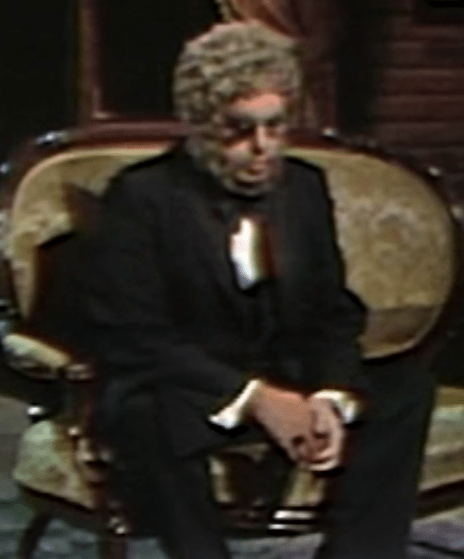
Sorcerer Count Petofi is wearing the body of rakish libertine Quentin Collins as a disguise, while Quentin is trapped in Petofi’s own aging and pudgy form. I will call the villainous Petofi played by David Selby Q-Petofi, and the forlorn Quentin as played by Thayer David P-Quentin.

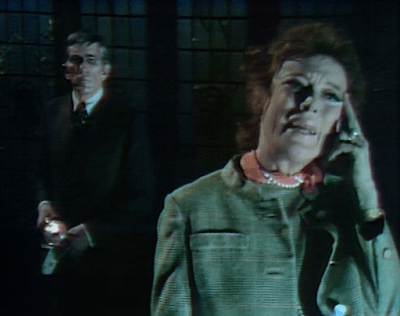
We open with Q-Petofi at the front door of the great house of Collinwood. Yesterday we saw P-Quentin on the same spot, and heard David Selby’s voice articulating the miserable thoughts that showed on Thayer David’s face. Today the roles are reversed, and we see Mr Selby looking exultant while the voice of Thayer David talks about the glories of his situation.

We see that Q-Petofi is accompanied by his henchman, Aristide. He dismisses Aristide’s fear that he will somehow reveal his true identity to the occupants of the great house. He twits Aristide for a little while, pretending that he will use him as a guinea pig in a dangerous experiment he has planned for later in the evening, then sends him off to find someone else to serve that purpose.

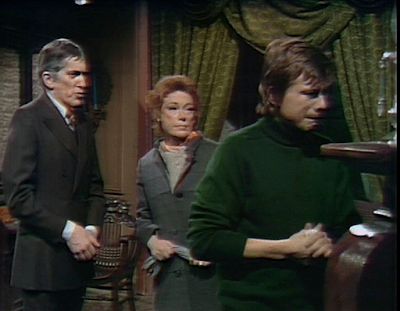
Q-Petofi walks in on an argument in the drawing room between stuffy Edward Collins and the overbearing Gregory Trask. Trask is in charge of the house while his wife, Edward’s sister Judith, is in a mental hospital. Trask is going over the household accounts and complaining that Edward is spending too much on his houseguest, Kitty Soames, the dowager countess of Hampshire. Edward asks Q-Petofi to explain Collinwood’s tradition of hospitality to Trask, setting Trask off with a rant about Quentin’s relationship with Trask’s own former houseguest, the lovely and mysterious Amanda Harris. Q-Petofi’s indifference to the whole discussion strikes both Trask and Edward as odd, but it really is quite typical of the old Quentin.

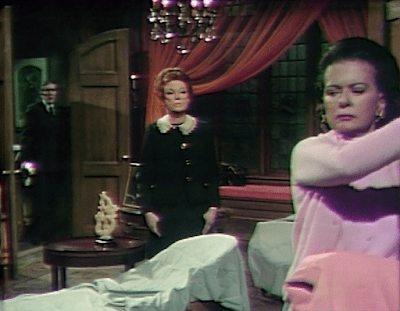
After Trask exits, Edward tells Q-Petofi that he thinks he can subdue Trask by marrying Kitty. He says that it takes money to run Collinwood, and the late Earl’s estate gives Kitty ownership of half the county of Hampshire. Returning viewers know that the Earl died bankrupt, and so far from owning great swathes of southern England Kitty doesn’t even have train fare to get from Collinwood in central Maine to her mother’s house in Pennsylvania. So we have confirmation that Kitty has been less than fully honest with Edward. On the other hand, Kitty is under the impression that Edward is rich, while in fact their grandmother left every penny to Judith. So neither is leveling with the other about their financial status. Q-Petofi knows all of this, but it has nothing to do with his plans, and so he struggles to feign interest.

For his part, P-Quentin is sitting in the caretaker’s cottage on the estate. It seems right to longtime viewers that a character played by Thayer David should seek refuge here. When we first saw the cottage, it belonged to handyman Matthew Morgan, who was at that time played by George Mitchell. In #38, Mitchell was replaced in the part of Matthew by Thayer David, in the first of the many roles he would play on Dark Shadows. When Matthew had to leave the cottage for the last time in #112, his whole world fell apart. So when Aristide comes in and brutally evicts him, we can feel the full weight of the disaster that has befallen P-Quentin.

With nowhere else to go, P-Quentin returns to the great house. Once again it is Thayer David’s turn to look soulfully at the camera while David Selby’s voice speaks desperate words in voiceover. He tells himself that his brother Edward will have to believe him when he tells him the truth.

As it happens, Edward likes Petofi and is glad when he believes he is receiving a visit from him. Based on Edward’s earlier remarks about Collinwood’s tradition of hospitality, we could be quite sure that if P-Quentin presented himself as Petofi, Edward would be glad to offer him a place to stay. But P-Quentin plunges right in and tries to tell Edward the whole story. Of course Edward is not convinced. He treats it as a joke in questionable taste, and offers P-Quentin a brandy. When P-Quentin tells him to forget the brandy, he says that if he really were Quentin, he would never forget the brandy.

P-Quentin insists on going ahead with the lunatic tale, and keeps clutching at Edward’s arm. Edward finds the whole experience revolting, and firmly escorts him to the door. If it has occurred to P-Quentin to tell Edward any of the little stories of childhood that only he and Edward would know, it is too late now to do so. Edward orders P-Quentin to stop talking and go home. Little does he know that P-Quentin has no home to go to.

At the waterfront, the fog machine is working overtime, and so is one of the locals. In a comment on Danny Horn’s post about the episode at his great Dark Shadows Every Day, user “Goddess of Transitory” remarks:

I was remarking to my husband about the really remarkable size and relative wealth of the hooker population of Collinsport. They may hang at the docks (makes sense in a port town–you troll for lonely sailors) but they all have really nice clothes and jewelry and no matter how many of them Barnabas et al. tear through, there’s always more.

Makes you wonder what modern day Collinsport’s main economic generator really is…

Comment by “Goddess of Transitory,” left 7 April 2021 on Danny Horn, “Episode 857: All of Him,” 5 May 2016, Dark Shadows Every Day.

We find today’s well-bathed, well-coiffed, well-made-up young woman of professionally agreeable disposition drinking from a flask. Aristide emerges from the fog and takes the flask from her. When she protests, he says that if she follows him, she will be drinking champagne, and her protests subside. Her name is Wanda Paisley.

Aristide takes Wanda to the cottage, where Q-Petofi is waiting. Wanda is quite pleased at the prospect of sharing her favors with two handsome young men at once, but less pleased when Q-Petofi says that before the festivities get underway she will have to throw some I Ching wands and meditate on them. He assures her that she will be well paid for whatever services she may render, and asks her to agree that this is what really matters. Wanda’s agreement is not forthcoming. When Q-Petofi keeps yammering on about the wands and the hexagrams and the trance and the doors, it dawns on Wanda that this evening is not going to be what she signed up for, and she gets up to leave. Aristide grabs her, and Q-Petofi uses his magical powers to coerce her into cooperating.

Wanda casts the wands and meditates on them. She has a vision of a skeleton with big plastic eyeballs reaching its arm bones out to her. She screams. Where she had been sitting is another skeleton with big plastic eyeballs, this one also wearing a dress and a wig. Q-Petofi tells Aristide that “beyond the door anything is possible.”

Her turn as Wanda today marks Karen Lynn’s only appearance on Dark Shadows. She’s very good, it’s a shame they couldn’t find more for her. Her only other screen credit is a 1963 feature called The Orgy at Lil’s, which an IMDb reviewer says made history as “the first roughie.” I don’t know what a “roughie” is, and based on the description of The Orgy at Lil’s I rather doubt that my education in cinematic history would be significantly deepened by finding out. At any rate, it sounds like Miss Lynn was well-prepared to portray Wanda’s enthusiastic response when Q-Petofi first joined her and Aristide.

I made a contribution of my own to the comment thread on Danny’s post:

This has to be the archetypal Dark Shadows episode. It has Jerry Lacy modeling the style of acting he and Lara Parker invented for the show, Louis Edmonds being sarcastic, a squabble about control of Collinwood, people drinking brandy, a prostitute picked up on the docks while the [fog] machine runs, several kinds of supernatural mumbo-jumbo presented as if we will of course understand them, a dream sequence, and a skeleton in a wig. The next episode opens with a grave-digging scene, which is pretty nearly the only thing missing from this one.

Comment left by “Acilius,” 3 December 2020, on Danny Horn, “Episode 857: All of Him,” 5 May 2016, Dark Shadows Every Day.

It’s true no actors blow their lines, none of the boom mic shadows obstruct our view of anything crucial, and there is only one audible cough from a crew member, so it is an unusual episode in some ways. But I could have mentioned another very typical thing- a practical effect they try for the first time. I believe the split screen shot of Q-Petofi in the drawing room and P-Quentin at the cottage is the first time the show has used this device. It doesn’t work very well, but they were always pushing to do something new:

P-Quentin (Thayer David) and Q-Petofi (David Selby.) Screenshot by Dark Shadows Before I Die.

Episode 812: The back road to salvation

Denise Nickerson joined the cast of Dark Shadows in #632 as nine year old Amy Jennings, sister of the doomed Chris (Don Briscoe.) As Amy, Nickerson was central to the show for the next fourteen weeks. In #701 we traveled back in time and Dark Shadows became a costume drama set in 1897. In that year, Nickerson is Nora Collins. Nora was in 10 episodes in the first twelve weeks of 1897, and apart from a two episode stint in #782 and #783 has been unseen and very nearly unmentioned in the ten weeks since. The 1897 segment is packed with so many lively characters that even the best of them disappear for long periods, but the extended neglect of Nora is particularly disappointing. Nickerson was an outstanding young actress, brought out interesting qualities in her scene-mates, and had drawn a significant fan base among the show’s preteen viewers.

Nickerson is back today. In Act One, she walks in on her father Edward trying to strangle her Uncle Quentin. Nora’s scream distracts Edward and saves Quentin. When Nora asks Quentin what got into her father, he tells her that it’s something like a magic spell and will end soon. He refuses to explain further. It is unclear why Nora accepts this refusal. For our part, the audience accepts it because Edward’s attack on Quentin has nothing to do with today’s episode. It’s just left over from yesterday’s cliffhanger.

Don Briscoe is also back, after an absence of twelve episodes. In 1897, he plays Tim Shaw, persecuted schoolteacher turned adventurer. As Chris, Briscoe would do a little W. C. Fields imitation from time to time, occasionally ending a sentence with Fields’ signature inflections. This would raise a smile from other characters in 1969, when such a habit was relatively fashionable. Considering that Fields’ persona was that of a man who belonged in the Gay Nineties, we should have suspected when we first saw the date 1897 that Briscoe would have an opportunity to develop his Fields imitation in greater depth. Indeed, we see him today wearing a hat and coat that might have come from Fields’ closet, accompanied by exactly the sort of woman whom Fields’ characters reliably failed to impress.

I regret to inform you that Tim does not, at any point, address Amanda as “My little chickadee.”

Tim has been in New York, where he made a great deal of money in a very short time by means of something which he keeps in a small box. Returning viewers know that this thing is The Hand of Count Petofi, and that it is the object of a desperate search by many dangerous people, including Quentin. We also know that the Hand is not subject to anyone’s control. If it has made Tim rich, that is because it wanted to do so for purposes of its own, not because Tim had any skill in manipulating it. Tim has used his riches to purchase the companionship of Amanda Harris, a cynical young woman who is impatient with him and appalled at the smallness of the village of Collinsport.

Tim and Amanda are staying at the Collinsport Inn. The Inn was a very important part of the show for its first 40 weeks, when one of the principal storylines was The Revenge of Burke Devlin. Like Tim, Burke was a working class boy from Collinsport who was framed for a homicide of which he was only technically guilty, and who then went to New York City, made a huge amount of money in a very short time, and came back to his home town to even the score with those who set him up to take the blame for a crime for which they were even more responsible than he was. Burke lived at the Inn, and it represented his territory, in opposition to the great house of Collinwood where his adversaries lived. The Revenge of Burke Devlin storyline never really took off, and by #201 Burke himself lost interest in it. Since then, we have gone months at a time without seeing the Inn. We saw a guest room there in #698, but I can’t remember the last time we saw the lobby before today.

Tim orders Amanda to hide the box in her room, then sends her off to Collinwood to make a connection with the cruel and lecherous Rev’d Gregory Trask. Amanda tells Trask that she has been under the power of an evil man and that she wants to change her ways. Trask tells her that he will give her spiritual guidance. He has his back to her when he says that his plan requires that he provide her with “private instruction”; he isn’t looking at her when she rolls her eyes at this. Back in the Inn, Amanda tells Tim that he was right, Trask is despicable.

While Amanda and Tim are taking a stroll by the waterfront, Quentin ransacks Tim’s room looking for the Hand. Quentin hears them on their way back, and leaps out Tim’s window. They’ve gone out of their way to make it clear that Tim’s room is upstairs- we heard Tim on his telephone telling the front desk to send Amanda “up” to him, and we saw him and Amanda getting on the staircase to go to the room. So they are inviting us to wonder how Quentin climbs down the side of the building.

When Tim sees the shambles in his room, he sends Amanda to her room to make sure the box is still there. It is, but he decides that the Inn is not a safe enough place for the Hand. He takes the box to Nora in her bedroom at Collinwood. Regular viewers know that Tim was Nora’s teacher, and Nora considers him her friend. It may seem odd that the person Tim turns to when he needs help with such a sensitive matter is nine years old, but longtime viewers will again remember Burke. He had a way with children; he immediately won the devotion of strange and troubled boy David Collins, and Maggie Evans, The Nicest Girl in Town, remembered him very fondly from her own childhood. Burke and David trusted each other in delicate situations more than once, and we can see the same thing happening between Tim and Nora.

Nora promises to hide the box somewhere in the house and not to tell anyone about it. Tim leaves, and Nora puts the box in her armoire. Nora is a fairly responsible person, but she is nine, and the box is wrapped like a present. As we fade to the credits, she is opening the box.

This leaves us wondering not only how Nora will react to the sight of the Hand, which is a gruesome thing, but also what effect it will have on Nora’s own appearance. In #784, lawyer/ Satanist Evan Hanley looked at the Hand, and it responded to his gaze by disfiguring his face. A few days later, it disfigured Quentin as well. Evan and Quentin have both regained their good looks, frustratingly without explanation. But it would be intensely unpleasant to see little Nora’s face mangled, even temporarily, so this is quite an effective cliffhanger for viewers who have been watching for several weeks.

This episode not only features the welcome returns of Nickerson, Briscoe, and the Inn’s lobby after their absences; it brings an equally welcome newcomer. Amanda Harris is played by Donna McKechnie, six years before she originated the role of Cassie in A Chorus Line and thereby became a permanent star of Broadway. Reviewing TV episodes on the 56th anniversaries of their original airing, recent news about the cast is often sad. For example, Lara Parker died very shortly before the 56th anniversary of the first broadcast of an episode in which she appeared as wicked witch Angelique. I call the cast members by their surnames, and put courtesy titles in front of the surnames of living people. I could have cried when I had to call her simply “Parker.” But Miss McKechnie is alive and well. Just yesterday, I saw a YouTube video (one of two posted on 23 July) of a panel featuring Miss McKechnie at a Dark Shadows convention on 19 July with Kathryn Leigh Scott, Marie Wallace, Sharon Smyth Lentz, and Matt Hall.

Episode 810: Not with pity

Charity Trask is in the drawing room of the great house on the estate of Collinwood trying to call the police when her abusive step-uncle, Quentin Collins, comes out of a secret panel and takes the telephone from her. He tells her that there is no longer any point in telling the police about Tessie, the injured woman upstairs. Tessie won’t be telling them anything. She has died. Apparently the sheriff of Collinsport is the same in 1897 as are his counterparts in other periods when Dark Shadows has been set- if you’re already dead, it’s too late for them to take an interest in you.

Charity says that Quentin killed Tessie. Charity knows that Quentin is a werewolf. He locks the door to the room and asks “Are you afraid to be locked in alone with a beast, a murderer, a creature of the supernatural?” This would seem to be rather an odd question, especially since he spent yesterday’s whole episode threatening to kill her.

Charity says that her father, Gregory Trask, will see to it that Quentin is brought to justice. Quentin takes a paper from his pocket and shows it to Charity. It is a confession to the murder of Charity’s mother, signed by her father. Charity claims that it was fabricated by Satan, which is what her father told her when she first saw it, and that Trask repeatedly tried to destroy it. This only convinces Quentin that the confession is true. He says that if either Charity or her father tells the police about him, he will hand over the paper. He adds “Now, Charity, I may hang for murder, but your father will be dancing at the end of a rope, too.”

Dark Shadows is set in the state of Maine, which in our universe abolished capital punishment in 1887. That used to be true in the show’s universe, as well. In #101, broadcast and set in November 1966, high-born ne’er-do-well Roger Collins told his son, strange and troubled boy David, that “They don’t hang people anymore. Not in this state, anyway.” But by the time the show left the 1960s for its first costume drama segment a year later, characters were already afraid of being sentenced to death. The morbid fascination of the gallows is so much of a piece with the show’s exaggerated melodrama that there must be a death penalty, no matter when or where the action is supposed to be taking place.

Quentin tells Charity that there is a chance- a small chance, he concedes- that he will be cured of lycanthropy before the next full Moon, so that she need not feel that she is an accessory to murder if she doesn’t turn him in right away. Miserable, frightened, and confused, she takes this seriously enough that she remains quiet at least through this episode.

We cut to a hiding place where a man known as Aristide is looking at himself in a mirror and primping his hair, moving his fingers through it with an exaggerated daintiness. We pan to broad ethnic stereotype Magda Rákóczi , who impatiently asks “Did you send for me so there would be two of us to admire you?” Aristide has some business to discuss relating to plot points not directly involved in this episode, and he and Magda trade menacing insinuations about the danger each faces from the various supernatural forces at work in the area. Magda says that what the ziganophobic Aristide calls her “Gypsy cunning” will protect her, and Aristide says that an amulet he wears around his neck will protect him.

Magda replies “All right, we’ve both got something to protect us. I go now,” and starts to leave. Aristide stops her, and says that she must recover the severed hand of Count Petofi. She says that a man named Tim Shaw stole the hand and ran off with it, and she has no way of knowing where Tim is. Aristide says she must find out and bring it soon, “before time runs out.” She asks “Before time runs out for who? You mean when Petofi comes back!” In fact, Aristide means more than that- his master, 150 year old sorcerer Count Petofi, will die in a matter of days unless he is reunited with the hand that was cut from his right arm a century before, in 1797. If he does recover the hand in time, he will become immortal. Magda fears Petofi and hates him, and would doubtless make any sacrifice to keep the hand away from him if she knew these were the stakes. So Aristide is mortified that he let slip the phrase “before time runs out,” and is anxious to avoid saying anything else.

Back at Collinwood, Quentin confers with a Mrs Fillmore. Mrs Fillmore has been looking after the twin children Quentin’s wife Jenny bore him after he left her and before he murdered her. This is the first time we have seen Mrs Fillmore. It is also the first confirmation we have had that Quentin has seen Mrs Fillmore. He didn’t know about the twins until #798, when the boy twin was already dead as the result of a curse that a woman named Julianka placed on Magda, who is Jenny’s sister. Now Mrs Fillmore tells Quentin that the girl is suffering the same symptoms the boy showed before he died, and that the doctor is at a loss what to do for her. Quentin says he will look for someone who might be able to help, and they both exit.

Charity is alone in the drawing room, making an earnest effort to get drunk. Magda enters and expresses surprise that the unbendingly prudish Charity has been drinking. Charity replies that she merely ate some chocolates that were filled with brandy. At the sight of an empty snifter, she says that after eating the chocolates she poured herself a small brandy. She then picks up and drinks another, regular-sized brandy. Charity starts talking about how terrible life at Collinwood is. Magda mentions Tim Shaw, who was once Charity’s fiancé and who was framed for her mother’s murder. Charity wonders if Magda can use the Tarot cards to find Tim and bring him back. She asks if Tim will have to tell the truth if he comes back, and Magda assures her that he will. Magda may assume that the truth Charity wants is about the end of her relationship with Tim; she does not know that Charity is desperate to revert to believing that Tim, not her father, murdered her mother.

Magda asks Charity to tell her as much as she can about Tim. Charity says that when Tim was a boy, his closest friend was named Stephen Simmons, and that “He and Stephen Simmons used to always say they would go to San Francisco when they grew up.” Magda asks where Stephen Simmons is now, and Charity says she thinks he lives in Worcester, Massachusetts. She goes to her bedroom to look for a Christmas card Stephen sent her last year, hoping it may have his current address.

Quentin returns and finds Magda. He asks Magda how she knew about his daughter. She asks what he means. When Quentin tells her that the girl is suffering the same symptoms that her brother showed immediately before his death, they rack their brains to come up with a potential defense against Julianka’s curse. Magda remembers Aristide’s amulet. It is capable of warding off vampires and witches- perhaps it will defend against Julianka as well. Magda tells Quentin where Aristide is hiding, and he decides to go to Aristide and rob him of the amulet.

Aristide is asleep when Quentin arrives. He awakens before Quentin can take the amulet, and declares “This pendant protects me from witches, warlocks, and unnatural spirits.” Quentin asks “How does it do against flesh and blood, Aristide?” Aristide draws a curvy piece of wood with no sharp edges and replies “For flesh and blood, I have The Dancing Lady.” The piece of wood is supposed to be a knife. When Aristide first displayed it in #792, he called it “The Dancing Girl.” Perhaps this is a case of Soap Opera Rapid Aging Syndrome, and in a couple of weeks it will be The Dancing Dowager, then The Dancing Crone. At any rate, Quentin replies “Then let her dance, Aristide, let her dance.” Quentin wins the subsequent fistfight. He knocks Aristide senseless, then takes the amulet from him.

Quentin and Magda go to Mrs Fillmore’s house, the first time we have seen this set. Appropriately for a member of the Collins family, the baby sleeps in a cradle shaped like a coffin.

Collins coffin cradle. Screenshot by Dark Shadows Before I Die.

Quentin talks with Mrs Fillmore about little “Lenore,” a name we have not heard before today. The only other girl of Lenore’s generation in the Collins family is the daughter of Quentin’s brother Edward, and she is named Nora. Since the name “Lenore” became popular outside Greece because speakers of English and French thought it was an alternative form of “Nora,” that would suggest rather a limited imagination regarding girl’s names on the part of whoever chose them.

But it is appropriate that Quentin and Edward have children with similar names. They are two variations on Dark Shadows’ first archvillain, Roger, whose evil largely expressed itself in his amazingly bad parenting of David. Edward’s attentive and caring interactions with Nora and her brother Jamison show that he is a less villainous Roger, while Quentin’s frequent assaults on his adult family members are among the evidence that he is an even worse version of the same character. Jamison is the only child we have seen Quentin interact with, and he is fond of him. But while we were still in the 1960s, Quentin’s ghost was possessing and killing the children at Collinwood, and in #710, only two weeks into the 1897 flashback, he and his fellow Satanist Evan Hanley used Jamison as a “sacrificial lamb” in a ritual meant to exploit his innocence for their own sinister purposes. Clearly, Quentin is no more to be trusted with the care of a child than was the early Roger.

Quentin asks Mrs Fillmore to leave him and Magda alone with Lenore. They apply the amulet, and it does not seem to work. Magda tries to raise the spirit of Julianka. After some pleadings and whatnot, there is thunder, wind, and other signs of ghostly presence. Magda cries out in hope that Julianka has come with pity. A figure materializes and says “Not with pity, Magda.” But the figure is not Julianka. It is Jenny.

In #804, we saw a photograph of Jenny in Quentin’s room. It was a full length picture in a period-appropriate costume, not just Marie Wallace’s professional headshot, raising a hope that we would see Miss Wallace again before too long. But after a week and a half, those hopes had begun to fade. Perhaps they took the picture months ago and never got around to using it when Jenny was on the show. If they had done that, they wouldn’t be above sticking in a scene of Quentin looking at the picture and discussing it with his distant cousin Barnabas the vampire so that they could get their money’s worth out of it. When Miss Wallace does in fact return, the show sends us out on a high note.

Episode 808: The mysterious shadow he can cast

Sorceror Count Petofi has taken possession of twelve year old Jamison Collins. He has also cast a spell on broad ethnic stereotype Magda Rákóczi, compelling her to lead him and his henchman Aristide to the hiding place of vampire Barnabas Collins.

Magda, Jamison/ Petofi, and Aristide. Screenshot by Dark Shadows Before I Die.

Jamison/ Petofi and Aristide are ready to drive a stake through Barnabas’ heart. They open his coffin and find that he is away from home today. Magda does not know where his other hiding place is. Jamison/ Petofi becomes intrigued with Barnabas and decides to search through Magda’s home, the Old House on the estate of Collinwood, for papers that might give him information about Barnabas.

He and Aristide find a book published in 1965. Since the dramatic date is currently 1897, this seems to be a matter of some interest. Jamison/ Petofi calls for Magda, who tells him that Barnabas told her that the book had been brought back in time from the 1960s by “a girl named Vicki.” Barnabas’ utterance of the name “Vicki” in #797 was the first reference to well-meaning governess Victoria Winters in the 1897 segment, and this is the second. Vicki was the main character of the show for its first year, and remained in the cast for over a year after that. That the name “Vicki” would be heard only in rare and trivial echoes is not something longtime viewers would likely have predicted before she was written out of the show last year.

Magda goes on to explain that Barnabas himself traveled back in time from 1969. She has a vague idea that he was trying to save a dying child, and hasn’t the faintest clue how he made this remarkable journey. Jamison/ Petofi says that they will get the rest of the story from Barnabas himself. He also says that if he can travel in time, he will be able to live forever, a proposition which would seem to require further explanation.

Jamison/ Petofi is satisfied Magda is telling them everything she knows, but Aristide keeps making threats. The most intriguing refers to something Petofi might do to her: “You’ve heard of his powers. Hasn’t anyone in your tribe ever told you about the mysterious shadow he can cast? The shadow that isn’t your own that follows you?” Writer Sam Hall was probably familiar with a novel called Phantastes by George MacDonald, a bestseller of the nineteenth century that was influential among English fantasy writers of the first half of the twentieth century. It tells of a character named Anodos, who is tormented by a malicious shadow that moves by itself and won’t leave him alone. So perhaps Hall is planning to mine MacDonald’s works for an upcoming story.

Meanwhile, in the great house on the estate, Charity Trask has a dream. She sees Jamison/ Petofi with a portrait of rakish libertine Quentin Collins. The portrait is identical to the one she saw turn into a picture of a werewolf the night before, and she asks Jamison/ Petofi if he saw the same thing. He laughs, then tells her Quentin is a lost soul.

Quentin shows up. Charity’s father, the evil Gregory Trask, has directed her to marry Quentin, and she has set out to comply with this command. Quentin has never shown the slightest interest in her in their time awake together, and he isn’t much friendlier in this dream. He asks her to do something to lighten his mood. “Can’t you be happy? Can’t you be gay?  Don’t you want to make me happy?” We’ve never seen her happy; as Gregory’s daughter, it’s hard to see how she could be. She has probably never tried to be gay, either, but it would have to be better than marrying Quentin. She does try to make him happy by imitating Cockney showgirl Pansy Faye, whom she never met or saw or heard, but whose spirit has been possessing her off and on for several days now. She sings Pansy’s theme song and does the highly suggestive dance that goes with it, only to find that Quentin has vanished.

Charity turns and finds Quentin embracing and kissing another girl. They are laughing. Quentin tells Charity that, as she can see, she has succeeded in cheering him up, and therefore she should run along. He and the girl then disappear and Magda enters. Magda tells Charity that she should forget Quentin, because he has a terrible secret. She leaves, and Quentin and the other woman reappear, still laughing at Charity.

Charity decides to ask Magda to explain the dream. Before she reaches the Old House, she finds Quentin and the girl from the dream lying on the ground in the woods. Quentin’s clothing is torn and he is unconscious, but he does not appear to be injured. The girl’s face is covered with what in black and white look like slash marks, but in color are obviously purple makeup. She opens her eyes and gasps Quentin’s name. Whether she was calling for Quentin because he was with her when they were attacked or crying out because he is the one who attacked her would not be clear to first time viewers, though returning viewers know that Quentin is a werewolf and will assume he was the attacker.

Episode 807: An award-winning performance, wouldn’t you say?

From #1 to #274, each episode of Dark Shadows began with a voiceover narration by Alexandra Moltke Isles, usually in character as well-meaning governess Vicki. This identified Vicki with our point of view and suggested that she would sooner or later learn everything we knew.

Jonathan Frid joined the cast as vampire Barnabas Collins in #211, and quickly became the show’s great breakout star. If the upright Vicki found out what we knew about Barnabas, one of them would have to be destroyed. Vicki was the favorite of longtime viewers and Barnabas was attracting new ones, so that was out of the question. Therefore, other members of the cast started taking turns reading the voiceovers, and doing so not as their characters, but in the role of External Narrator.

Today marks the first time Frid himself reads the narration. His training first in Canada, then at Britain’s Royal Academy of Dramatic Arts, and later at Yale School of Drama prepared Frid well in the art of dramatic reading, and in later years he would concentrate on that aspect of his craft. Several of his colleagues are his equals in these voiceovers- I would particularly mention Kathryn Leigh Scott, whose conception of The Narrator is always arresting, and Thayer David, who could consistently achieve the most difficult of all effects in voice acting, a perfectly simple reading. So I can’t say I wish Frid had done all of them, but he is always good, and today’s performance is among his most gorgeous.

The action opens on a set known to longtime viewers as the Evans cottage, where from 1966 to 1968 artist Sam Evans and his daughter Maggie served as Dark Shadows‘ principal representatives of the working class of the village of Collinsport. In those days, it was on this set that we saw how the misdeeds of the ancient and esteemed Collins family had consequences that spilled out of the estate of Collinwood and warped the lives of people trying to make a more or less honest living nearby.

Now the dramatic date is 1897, and Sam hasn’t been born yet. But the cottage is already an artist’s studio. It is temporarily occupied by the nationally famous Charles Delaware Tate, who is painting a portrait of rakish libertine Quentin Collins at the behest of evil sorcerer Count Petofi. Charity Trask, a resident of the great house of Collinwood, is visiting Tate in the cottage when she sees the face in the portrait change from that of Quentin. It takes on a great deal of fur and long fangs, and reminds Charity of a wolf.

By the time Tate looks at the painting again, it has resumed its normal appearance. He tells Charity that the transformation must have been in her imagination. She is willing to consider the possibility, but we know better. Quentin is a werewolf, a condition Petofi knows how to cure. Portraits on Dark Shadows have had supernatural qualities at least since #70, including portraits we saw Sam execute on this set in 1966, 1967, and 1968, and the show has borrowed from The Picture of Dorian Gray before. Moreover, Tate’s reaction to Charity is one of barely controlled panic. Nancy Barrett has to ramp up Charity’s own emotional distress to the limit to make it plausible she would not notice Tate’s extreme agitation. Perhaps if Tate were played by a better actor than the ever-disappointing Roger Davis, his response might have been ambiguous enough that Miss Barrett could keep the tone a bit lower, but his unequivocal display of alarm leaves her nowhere to go but over the top.

Mr Davis was under no obligation to play the scene transparently, since Tate later goes to Petofi’s henchman Aristide and lays out in so many words his precise relationship to Petofi’s operations and his knowledge of them. Tate’s career is his reward for selling his soul to Petofi, and he has already experienced great sorrow as a result of that bargain. Tate knows that the portrait changed to reflect the full Moon’s influence on Quentin and that Petofi is currently in possession of twelve year old Jamison Collins. Aristide tells us that Petofi’s own body is in suspended animation while he acts through Jamison. He also says that it was in 1797 that Petofi’s right hand was cut off, and that if he does not reclaim the hand in a few weeks, by the date of the one hundredth anniversary of the amputation, he will die and so will Tate.

Jamison/ Petofi is in the prison cell in the basement of the Old House on the estate of Collinwood. Barnabas has traveled back in time from the 1960s with some vaguely good intentions and is hanging around 1897 causing one disaster after another. Now, he is doing battle with Petofi and has locked him, in the form of Jamison, in the cell. Barnabas’ reluctant sidekick, broad ethnic stereotype Magda Rákóczi, guards Jamison/ Petofi during the day. Early in the episode, Jamison/ Petofi calls Magda and pleads with her to release him. He tells her that he is “just a little boy” and that she is a “rather heartless creature.” She says she wishes he were a little boy again, but that she isn’t stupid and he won’t fool her. Indeed, the phrase “rather heartless creature” and Jamison/ Petofi’s manner in delivering it sound so much like Thayer David as Petofi that they hardly count as an attempt to deceive Magda.

Later, Jamison/ Petofi casts a spell to summon Aristide, then calls to Magda again. When Magda arrives, Jamison/ Petofi gives himself a better script than the one from which he had acted in his previous scene with her. He pretends not to remember how he got into the cell and to be shocked that Magda knows he is there. Perhaps the utter transparency of his earlier pleadings was an attempt to get Magda to underestimate his abilities as a trickster.

In #803, we saw that when Petofi took possession of him Jamison’s right hand disappeared from his wrist, matching Petofi’s own mutilated condition. When Jamison/ Petofi feigns the amnesia that might come upon recovery from possession, we might therefore expect Magda to demand that he remove his gloves to prove that he is himself again. But he plays the part of Jamison so convincingly that we are not really surprised he does fool Magda. She goes into the cell, embraces Jamison/ Petofi, and he kisses her on the cheek. It is this kiss that spreads his magical power, and she realizes too late that she has been had.

Aristide arrives a moment later, and Jamison/ Petofi calls his portrayal of an innocent boy “an award-winning performance.” Indeed, if there had been daytime Emmys in 1969, David Henesy might have won one for his portrayal of Thayer David playing Petofi playing Jamison.

Aristide wants to kill Magda; Jamison/ Petofi forbids this. Under his power, she announces that she is responsible for all the evil that has happened in 1897. She was responsible for releasing Barnabas and therefore for all the murders and other harm he has done; she made Quentin a werewolf, and is to blame for his killings in his lupine form and for the curse his descendants will inherit; she stole Petofi’s severed hand and is at fault for the deaths of Rroma maiden Julianka and of her own husband Sandor that resulted from the hand’s presence. She even takes the blame for Quentin’s murder of her sister Jenny, the act for which the werewolf curse was meant as vengeance. Magda says she must be punished. Jamison/ Petofi tells her that he is not interested in punishing her. He has another use in mind for Magda She will lead him and Aristide to Barnabas’ coffin today, and they will destroy him.

Longtime viewers will perk up twice when Aristide says that Petofi lost his hand in 1797 and that he has exactly one hundred years to recover it. From December 1966 to March 1967, Dark Shadows’ first supernatural menace was undead blonde fire witch Laura Murdoch Collins, who at intervals of exactly one hundred years incinerated herself and a young son of hers, who was always named David, in an unholy ceremony that renewed her existence, but not that of the Davids. Since the usual laws of nature don’t apply, the show needs some other causal mechanism to create suspense, and anniversaries will do as well as anything else. Another iteration of Laura was on earlier in the 1897 segment. It was fun to see her again, but they could shoehorn her into that year only by retconning away the one hundred year pattern in her immolations. It’s reassuring in a way to see that Petofi is bringing centenaries back.

The date 1797 is also significant. It was in 1796 that Barnabas died and became a vampire. We flashed back to that period for the show’s first costume drama segment in November 1967 to March 1968, and Barnabas went back to 1796 for a week in January 1969. So we may go back again some day, and if Petofi was alive and in his prime in 1797, we might run into him there.

Barnabas and Petofi are not the only characters from the 1790s who might be on the minds of attentive longtime viewers. Barnabas’ little sister Sarah died in 1796, and as a ghost was an extremely important part of the show from June to November 1967. We’ve been getting reminders of Sarah for the last several days. In #792 wicked witch Angelique produced a toy soldier of Barnabas’ that Sarah gave to strange and troubled boy David in #331. In #805, Charity found Sarah’s recorder, a prop that often served as Sarah’s calling card in 1967, and talked about learning to play it. And today, we see a portrait standing on the floor of the Evans cottage, a set which Sarah visited in #260, depicting a girl wearing a bonnet very much like the one Sarah wore as a ghost in 1967 and a pink dress just like the one she wore when we saw her as a living being in the flashback to the 1790s.

Portrait at the cottage.

I wonder if, when they were making up the flimsies for this part of the show, they had thought of reintroducing Sarah. That would have required a recasting of the part- Sharon Smyth was noticeably older when we saw Sarah die in January 1968 than she was when Sarah was a ghost in June 1967, and by now we would wonder what she has been eating in the afterlife that has made her get so much taller. Besides, Miss Smyth* had stopped acting by this point.

The process of planning the stories was in two stages, a rough sketching of themes six months in advance, and a capsule of each episode written thirteen weeks ahead of time. There was a lot of flexibility when it came to putting those plans into effect. Some stories that were supposed to end within thirteen weeks were extended over years, while others that were expected to be a big deal petered out before they got going. In an interview preserved by Danny Horn at his great blog Dark Shadows Every Day, writer Violet Welles said that many of the moments on the show that made the least sense were those written when the plans hadn’t worked out: “toward the end of the cycle, you’d have characters who were really not a lot of interest who had to play scenes with other characters who really didn’t have a lot of interest, dealing with things that basically didn’t concern them. Those were hard to write.”  

This episode was taped on 25 July 1969; thirteen weeks before that was 21 May. Six months before was 25 January. By 25 January, Denise Nickerson had been on the show for two months as Amy Jennings. Nickerson was actually born on 1 April 1957, but they several times say that Amy is nine years old. When the show goes to 1897, Nickerson plays Nora Collins, who is also nine. On 19 May, Nickerson taped #761, the last episode she would appear in until #782. She is currently in the middle of a second long absence from 1897, unseen between #783 and #812. Her characters were so important in the months leading up to the 1897 segment and she played them so well that we wonder what they were thinking leaving her in the background so long.

Maybe they were thinking of bringing her back as Sarah. Nickerson didn’t look all that much like Sharon Smyth, and was a far more accomplished young actress than was Miss Smyth, but she did have brown hair, and the show prioritized hair color above all else in recasting parts. For example, two actresses followed Mrs Isles in the role of Vicki, neither of whom had much in common with her either in acting style or in looks, but who both had black hair. So perhaps there was a time when they intended to travel between 1897 and the 1790s and to meet Sarah, played by Denise Nickerson. If Nickerson were still alive, perhaps someone would ask her if she posed for the portrait that is standing on the floor of the Evans cottage today.

*She’s been using her married name for decades now, but when talking about her as a child it’s pretty weird to refer to her as “Mrs Lentz.” Since I use surnames for people associated with the making of the show and attach courtesy titles to surnames of living people, I have to call her “Miss Smyth.”

Episode 805: The shocking condition of your face

The 150 year old evil sorcerer Count Petofi has taken possession of twelve year old Jamison Collins. Jamison/ Petofi has been casting spells to make the various residents of the estate of Collinwood reveal their true selves. Jamison’s distant cousin, Barnabas the vampire, has locked Jamison/ Petofi in the prison cell in the basement of the Old House on the estate. When Barnabas says that he will let Jamison out once Petofi has vacated his body, Jamison/ Petofi replies “If that is what you intend to do, Mr Collins, I’m afraid that you are stupid and incompetent.” There is no need to cast a spell on Barnabas- Maker of Stupid and Incompetent Plans is his true self, and we love him for it.

The great house on the estate is currently under the legal authority of the evil Rev’d Gregory Trask, husband of Judith Collins, who is a patient in a mental hospital. Jamison/ Petofi’s spell has caused Trask’s daughter Charity to be intermittently possessed by the spirit of Cockney showgirl Pansy Faye. Trask is horror-stricken by the makeup, clothes, and hairstyle Charity wears when Pansy is in charge of her, and her East London accent, insouciant attitude towards him, and tendency to sing and dance escalate this horror further. Nancy Barrett and Jerry Lacy are both talented comic actors, and their scenes as Charity/ Pansy and Trask are hilarious.

Trask is appalled to see Charity/ Pansy. Screenshot by Dark Shadows Before I Die.

Collins family lawyer Evan Hanley is at home. Barnabas appears in Evan’s drawing room and asks for some information which Evan denies having. Evan tells Barnabas he has renounced his former interest in black magic and Satanism. Barnabas is skeptical, and Evan replies that his latest forays resulted in a gruesome disfigurement of his face. This disfigurement was later relieved, how we (frustratingly) do not know. But he wants nothing more to do with the occult, since he values the ability to look at himself in the mirror. Barnabas reminds Evan that he cannot see himself in a mirror, implying that he will use his vampire powers against him if he does not cooperate.

Trask comes to Evan’s house. He asks him to draw up papers that will complete his plan to seize control of all the Collins family’s assets. He mentions in passing that Jamison thinks he is Petofi. Evan knows enough about Petofi to be terrified. He tells Trask that neither of them has a chance in a battle with Petofi, and refuses to draw up the papers. Trask responds contemptuously.

Alone in the cell, Jamison/ Petofi decides to have some fun with Evan. We see Evan dozing in his armchair. He has a dream in which Jamison appears. Jamison kisses him; it is by his kisses that Petofi spreads the “true self” spell. Later, Evan goes to the great house at Collinwood and presents Trask with a paper to sign. Trask signs it eagerly, assuming it is the document he asked Evan to bring him. Instead, Evan has prepared a full confession to the murder of Trask’s first wife Minerva. The two of them plotted this murder together, and Trask is horrified when he sees his signature on it. He throws the paper in the fire; after he leaves the room, it rematerializes on the desk, complete with signatures.

During Trask’s confrontation with Charity/ Pansy Faye, the picture suddenly changes from color to sepia tone. After about a half a minute, it changes back. Evidently there was a fault in the videotape master at this point, and an excerpt from the kinescope was used to patch it. The color comes back right after Trask slaps Charity/ Pansy, causing Pansy to release Charity for a bit. It creates the eerie feeling that Trask somehow fixed our TV set by slapping her.

Dark Shadows continually comments on itself as it goes along. In the early days, all the episodes were scripted by Art Wallace. Wallace’s favorite method of composition was a sort of diptych, in which two sets of characters faced similar situations and responded to them differently, highlighting the contrast between their personalities. Petofi’s “true self” spell is of course another way of creating similar contrasts between characters played by the same actor.

As the show came to focus on time travel stories, they could cast actors as characters who represent alternative versions of parts they played in other periods, again putting characters played by the same actors in contrast with one another. And as Wallace would juxtapose similar situations within a single episode, the multiple times periods allowed them to take themes that had been developed in one way in a story set in one year and develop them differently in a story set in another. So Jamison/ Petofi’s contagious curse is a reworking of the “Dream Curse,” which dragged on from April to July 1968. The Dream Curse involved a lot of repetition and very little variety of tone. Jamison/ Petofi’s spells all get right to the point, and are sometimes scary, sometimes bizarre, and often quite funny. So the second time is definitely the charm here.

At one point Charity holds a recorder and tells her father she wants to learn how to play it. The first time we saw this prop was in #260. That episode was set in 1967, and Barnabas was holding Maggie Evans, The Nicest Girl in Town, prisoner in the cell where Jamison/ Petofi is today. The ghost of Barnabas’ little sister Sarah befriended Maggie, and materialized in the cell playing “London Bridge” on that recorder. Over the next several months, the recorder came to be a symbol of Sarah, one that she occasionally left behind as a sign that she had been in a place. Longtime fans will likely remember that, and see it as an indication that what is happening to Charity is going to have permanent consequences, as Sarah’s haunting had permanent consequences.

Episode 793: All the revolted spirits

When wicked witch Angelique first turned Barnabas Collins into a vampire in the 1790s, he went to the waterfront and preyed on the women he found spending their nights there. When Barnabas traveled in time from the 1960s to the year 1897, he again made his way to the waterfront. Whether he bit the women or not, he choked them to death, earning the sobriquet “The Collinsport Strangler.”

Once he had become a vampire, Barnabas displayed so many traits he had come to have in common with Angelique that we suspect he is not only cursed by her, but possessed by her. More precisely, it often seems that when Angelique made Barnabas a vampire she created a copy of her own personality and put it in his mind, where it took control of him. We have further support for that interpretation in today’s opening reprise. We see Angelique on the same set where Barnabas has several times been the last person a young woman would encounter. This time, she encounters a young man. He flirts with her, as the women flirted with Barnabas. Before long, he is choking and within seconds of death because of her action. In this case, she has taken his handkerchief and is tightening it around the neck of a toy soldier that once belonged to Barnabas. She is threatening to kill him unless he tells her where he has hidden the legendary “Hand of Count Petofi.”

The man’s name is Aristide. He capitulates, telling her he buried the hand at the old cemetery, in a grave marked with a stone bearing the name of Townsend. She gives the handkerchief another tug, and he falls down, unconscious.

Later, we are in the great house on the estate of Collinwood. Angelique comes down the stairs, carrying the box in which the hand is kept. Stuffy Edward Collins sees her. Regular viewers have seen the box on a table in the upstairs hallway many times, from the first week of the show onward. It is rather odd that Edward doesn’t ask her why she is carrying it around. Even if we decide to forget that the prop is familiar and decide to treat it as representing something Edward hasn’t seen before, people don’t usually walk around carrying wooden boxes in front of themselves.

Still, Edward does have other matters on his mind. Angelique had been introduced to the family as Barnabas’ fiancée, at a time when all the Collinses knew about Barnabas was that he was their distant cousin. She disappeared when he was exposed as a vampire. Edward tells her that the family’s lawyer, Evan Hanley, told him that he knew her before she met Barnabas, and that he believes that her association with him was innocent. Edward also says that he cannot believe that this is true. Angelique tells Edward a story about Barnabas biting her and making him her slave; Edward is convinced instantly, and declines her offer to leave at once. He urges her to stay at Collinwood until she can make new plans.

Meanwhile, we have learned that Aristide is alive and not seriously injured. A man in a set of whiskers that represent the aesthetic sensibilities of the late Victorian era developed to their uttermost extremity finds Aristide crumpled on the ground, rouses him from unconsciousness, and responds to his story about Angelique almost killing him with dismay that she stopped short. He tells Aristide not to do anything more. His own credentials are in order, and he will present them at Collinwood as he sets about his second attempt to get the hand.

The man does go to Collinwood. He gives Edward a letter from their “mutual friend,” the Earl of Hampshire. It attests to the good character of its bearer, Victor Fenn Gibbon. Edward insists that Fenn Gibbon stay in the house, and he accepts.

Angelique emerges from the drawing room, still carrying the box. Edward continues to ignore it; Fenn Gibbon can’t take his eyes off it. Edward introduces her as Angelique Duvall. This is the first time we have heard the name “Duvall” in connection with her; when we met her in the part of the show set in the 1790s, her name was Angelique Bouchard, and when she turned up in 1968 she called herself Cassandra Blair. Fenn Gibbon asks if she is French. She says that she was born in the USA, but that her forebears were French people who lived on Martinique. Indeed, when she was known as Angelique Bouchard she lived on that island, and it was there she met Barnabas. Fenn Gibbon tells her that lovely as France’s colonial possessions may be, none is as “exquisite” as she. She is charmed, and excuses herself. She leaves the house, taking the box with her.

While Fenn Gibbon regales Edward with tales of derring-do from the battle of Khartoum, Angelique takes the box to the Old House. There, she meets the rakish Quentin Collins, whose desperately handsome face has been severely disfigured by a previous encounter with the hand. Angelique dismisses Quentin’s girlfriend, maidservant Beth, telling her that she cannot be present during what she must now do for Quentin. Beth leaves, Angelique shows Quentin the hand, and Quentin demands that Angelique set to work curing him. She says there will be a price for her services. If she cures him, he will have to marry her. He has nothing to lose, and she looks exactly like Lara Parker, so of course he agrees.

Angelique picks up the hand and gets to work casting a spell, but the hand quickly escapes her control. She turns to find that it is on Quentin and he is in agony. He pleads with her to help, she cries out that she can do nothing, and we see Fenn Gibbon peering in through the window.

Fenn Gibbon looks on. Screenshot by Dark Shadows Before I Die.

Fenn Gibbon* is the fifth role Thayer David played on Dark Shadows. The first, second, and fourth were all closely associated with the Old House. They were crazed handyman Matthew Morgan, who holed up there after he killed local man Bill Malloy; much-put-upon indentured servant Ben Stokes, who lived and worked there; and broad ethnic stereotype Sandor Rákóczi, who with his even more offensively conceived wife Magda lives at the Old House in 1897. With this iconography behind David, regular viewers will know that when they see Fenn Gibbon in the window of the Old House, they are seeing a man who knows his way around the place.

David’s third role sheds even more light on Fenn Gibbon. In the parts of the show set in 1968 and subsequent years, he plays Professor Timothy Eliot Stokes, expert on the occult and descendant of Ben. Unlike most of the characters who made a splash on the show, Stokes has a functioning conscience. He does not always live within the law, but he always strives to do what is right. When we see that Fenn Gibbon knows about the hand and has orchestrated a criminal conspiracy to obtain it, we see that he is an evil version of Stokes. At once this makes him fascinating to regular viewers. Stokes himself is a reimagining of the show’s first academic specialist in the paranormal, Dr Peter Guthrie, who was killed by a witch in #186. He is a jovial and talkative eccentric, where Guthrie was a tight-lipped and understated Yankee. Fenn Gibbon seems to have inherited Stokes’ whimsical bent and exaggerated manner; we now have to wonder what Stokes would be like as a villain.

Even those who joined the show after it went to 1897 and who therefore do not know about Stokes will be intrigued when they see David as Fenn Gibbon. Sandor hasn’t appeared since #750, but he is still alive. This marks the first time Dark Shadows has cast the same actor as two living characters in the same time frame.** Sometimes an actor has doubled as a living character and as a ghost, or has appeared in two roles in parts of an episode set in different periods of history. But this is a new frontier for doubling on the show. Sandor is always a lot of fun, so we might hope that he will be back and that he and Fenn Gibbon just won’t have scenes together. But coming on the heels of his long absence, it does have an ominous ring.

In #758, Quentin backed Angelique against a wall and asked her why she preferred Barnabas to him. That was a very good question. The two of them are obviously attracted to each other, and have a lot of fun every time they are alone together. By contrast, the only emotions Barnabas has ever shown in response to Angelique are glumness and rage. Her maniacal insistence that Barnabas should love her drove Angelique to wreak immense havoc in the 1790s, and also motivated some story in 1968. But there is nothing to it beyond his misery and her self-absorption. When we see her turn her attentions to Quentin, longtime viewers will cheer at the hope that we are about to be freed from that dead end once and for all.

*He introduces himself today as “Fenn Gibbons,” which is how he is almost always addressed. But the closing credits leave the S off his name. The closing credits have been unreliable lately, identifying Edward as his grandson Roger and misspelling Aristide’s name. Still, “Fenn Gibbon” sounds better to me; “Fenn Gibbons” suggests a group of small apes found in a peat bog.

**Don Briscoe briefly played both werewolf Chris Jennings and Chris’ brother Tom, but that is only a partial exception- Tom was a vampire at that time.

Episode 791: Roomful of spirits

The evil Gregory Trask coerced lawyer/ Satanist Evan Hanley into helping him murder his wife, Minerva, so that he could marry wealthy spinster Judith Collins. Now Trask and Evan have conjured up a magical simulacrum of Minerva and caused it to hang around Judith. They claim they can’t see it, which, coupled with some other troubles Judith has had, leads her to believe that she has lost her mind. Trask and Evan strong-arm Judith into signing a paper, Trask locks her up in the tower room, and Evan makes the simulacrum disappear.

In case you can’t tell, these guys are villains. Screenshot by Dark Shadows Before I Die.

Meanwhile, Judith’s brother Quentin is at large. Quentin is a werewolf, and when he returned to human form this morning his face was disfigured. This worked to his advantage. He was in jail at the time, and he was being watched. The sheriff’s deputy had not recognized Quentin’s brother Edward when he came to jail that night, so it isn’t so surprising he doesn’t recognize Quentin, even though he is six foot four, has a distinctive hairdo and prominent mutton chop sideburns, and is wearing the same blue suit with a frock coat that he always wears. It is surprising that Edward doesn’t recognize him either, but this may be the result of a congenital problem the Collinses have. Not only was Quentin himself stumped when the equally identifiable Evan had a similar glob of makeup on his face recently, but Judith fails to recognize Quentin today when he comes to the drawing room. When Judith found him, Quentin was listening to his favorite record and reciting its lyrics in his unaltered voice, and he identified himself to her by name. Still, she couldn’t see it.

Quentin bursts into Evan’s room shortly after he finishes dissolving the simulacrum of Minerva. He sees that Evan’s face is no longer disfigured, and assumes that he used the magical Hand of Count Petofi to restore his appearance. Evan tells him he did not- he can’t explain why his face reverted, it just did so on its own. This does not satisfy Quentin, and it will not satisfy returning viewers. We saw Evan struggle to fix his problem for some time, and when he found himself in a crisis situation he suddenly turned up looking like his old self. So we’ve been in suspense for several days wondering what the explanation would be for his cure, and we are no more inclined to settle for a non-explanation than is Quentin.

Quentin knocks Evan out with a candlestick; the background music is a cue we have previously heard during on-camera murders, leading us to wonder if Evan will survive the blow. Quentin rummages around for a moment and finds the hand. He is looking at it, wondering how to use it to restore his appearance, when a man in a wool cap enters and orders him to surrender the hand at once.

This episode features one of Dark Shadows‘ all-time great goofs. When Evan is casting the spell to dissolve the simulacrum, a black-clad figure dashes past in front of him. A voice can be clearly heard exclaiming “Jesus, Lacy!” Evidently actor Jerry Lacy was in such a hurry to get from one set to another that he didn’t realize he was crossing a live camera.

Episode 772: Apologies are the Devil’s invention

The opening voiceover plays over this image, a type of visual effect we have not seen before at the beginning of an episode:

A transparent sticker of Barnabas superimposed on the exterior of the Old House. Screenshot by Dark Shadows Before I Die.

Barnabas Collins has bitten dimwitted servant Dirk Wilkins, turning Dirk into a vampire like himself. Barnabas has been out all night, searching for Dirk’s hiding place. He hopes to expose Dirk and frame him for his own crimes.

Barnabas comes home to the Old House on the estate of Collinwood to find that Dirk seems to be trying to do the same thing to him. There is a blood-drained corpse in an armchair in his front parlor. It is that of Miss Pansy Faye, Cockney showgirl and Dirk’s first victim.

Barnabas’ distant cousins live in the great house on the estate. One of them, prankster Carl Collins, brought Pansy home with the intention of making her his bride. No sooner does Barnabas discover Pansy’s remains than Carl starts banging on the front door, shouting that he wants to speak with her.

Barnabas hides what’s left of Pansy in a secret chamber behind a bookcase, then lets Carl in. Grisly as the circumstances are, one person lying to another about the presence of a third nearby is a stock situation from farce, and John Karlen and Jonathan Frid play the scene with the particular brand of desperate seriousness that only works in farce. Barnabas persuades Carl to go away and search the grounds of the estate.

That takes a few minutes, starting from what the opening voiceover told us in so many words was “an hour before dawn.” In what remains of that hour, Barnabas takes Pansy’s body to a cemetery and buries her in a shallow grave between tombstones, telling her to “rest in peace.”

Barnabas buries Pansy. Screenshot by Dark Shadows Before I Die.

Barnabas comes home, and finds Carl, who has in the interval not only gone to the great house, the groundskeeper’s cottage, and a house on the estate which is currently occupied by a school, but has also gone into the village of Collinsport and made inquiries about Pansy. A speedy bunch, the Collinses.

Before Barnabas returned to the house, Carl had heard Pansy’s disembodied voice singing the song she had so memorably performed for Barnabas in yesterday’s episode. He had spoken to Pansy’s voice telling her that his grandmother’s will gave him a house to live in and that she could live there with him. This is puzzling for returning viewers. In #714, it was made perfectly clear that the will did not mention Carl at all. Edith Collins left her entire estate to Carl’s sister Judith, and the only one of the brothers who was mentioned was Quentin, who received no money or negotiable assets of any kind but who was guaranteed the right to stay at Collinwood as long as he pleased. Perhaps they are retconning that away, perhaps Carl is lying to Pansy, or perhaps Carl is losing his grip on reality.

Whether or not we are supposed to doubt Carl’s sanity, Barnabas talks Carl into suspecting that he might have hallucinated Pansy’s voice. Carl leaves, and Barnabas has time to return to his coffin before dawn.

The rest of the episode is taken up with doings at the school Carl had visited. We saw Carl questioning Charity Trask, daughter of the school’s master, the overwhelmingly evil Gregory Trask. The prim Charity was exasperated that Carl kept asking about Pansy after she had already denied having seen her. The scene is an interesting one- Charity and Pansy are such total opposites that it is a shame they never met. It would be amusing to see them juxtaposed.

Charity is engaged to marry Tim Shaw, a teacher at the school. Neither of them is happy about this situation. Tim was in love with Rachel Drummond, another of the teachers, and Charity is Barnabas’ blood thrall. But Gregory blackmailed Tim and bullied Charity into accepting the arrangement.

Charity’s mother, prudish Minerva Trask, does not like Tim or want him as a son-in-law. She urges Charity to set her sights on Carl. Charity says that she would rather marry Barnabas; Minerva says that her instincts are sound, but that she ought not to settle for a cousin of the rich Collinses when one of the brothers is available. Even if they have retconned Carl into owning a house, he is clearly not a rich man, so this reveals that Minerva knows as little about his financial position as she does about the curse under which Barnabas labors.

Charity tries to engage Tim in conversation, and is baffled that he is not willing to talk to her. Indeed, he does not seem like himself at all. Not only is he dismissive with Charity, but when Minerva confronts him he is bold and insolent, a far cry from the broken man we have seen interacting with the Trasks previously. When Charity tells him their engagement is off, he does not express the relief that she and we expect, but puts on a stagey voice we have not heard him use before and marches off to apologize to her mother.

There is a reason for Tim’s behavior. Gregory enlisted warlock Evan Hanley to brainwash Tim so that he would kill Minerva. There is some business with the Queen of Spades, first when Tim mutters the phrase “Queen of Spades,” then when Evan sends him a note on which is scrawled “Queen of Spades,” and lastly when he walks in on Minerva playing solitaire and sees her turn up the Queen of Spades. Many viewers in 1969 would have remembered Richard Condon’s 1959 novel The Manchurian Candidate and its 1962 film version. In Condon’s novel, Raymond Shaw became a robot capable of murder when he saw the Queen of Hearts; in the film, the card was the Queen of Diamonds. Many first time viewers, seeing Tim Shaw’s reaction to the Queen of Spades, would have made the connection and understood why he ends the episode by poisoning Minerva’s tea.

Is this your card? Screenshot by Dark Shadows Before I Die.

Tim Shaw differs from Raymond Shaw in that he is under a spell for a long while, including the whole time we see him today, and he can talk and act independently while it operates on him. Raymond simply became catatonic when he saw the card and remained that way until he heard a command. He then executed the command and came back to himself once he was finished. Tim’s behavior may suggest a nod to another literary work, Pushkin’s story “The Queen of Spades.” That tale, which Tchaikovsky turned into an opera and which in 1949 was made into a feature film, is about a timid man who inadvertently kills a powerful woman and loses control of himself as a consequence. Like Tim, Captain Herman is coerced into marrying a woman he does not love. Presented with an opportunity to get out of the marriage, he finds himself making extraordinary efforts to go through with it, efforts which bring about his ultimate downfall.

Episode 767: Birthdays are for people who get older

For the first several months of Dark Shadows, heiress Carolyn Collins Stoddard made no attempt to conceal her loathing of her young cousin, strange and troubled boy David Collins (David Henesy.) That changed at the beginning of 1967, during the storyline centered on David’s mother, undead blonde fire witch Laura Murdoch Collins. Laura cast a spell that caused Carolyn’s mother, reclusive matriarch Liz (Joan Bennett,) to enter a catatonic state. When that happened, Carolyn assumed responsibility for the family’s properties and enterprises. In that position, Carolyn took on a new maturity, and the capricious and often thoughtlessly cruel character we knew in the early days was gone forever.

Laura went up in smoke in March 1967, and the next month vampire Barnabas Collins succeeded her as the show’s supernatural menace. The adults in the great house of Collinwood- Liz, Carolyn, David’s father Roger, and well-meaning governess Vicki- were all taken with Barnabas. Liz gave him the Old House on the estate to live in, and none of them could see the abundant evidence that their distant cousin was a bloodsucking ghoul from beyond the grave. But the ghost of Barnabas’ nine year old sister Sarah appeared to David and led him to suspect that something was off about the new arrival. By late September, David had all but solved the puzzle, and was trying to get the grownups to see the obvious.

In #335, broadcast in October 1967, a psychiatrist named Dr Fisher came from Boston to examine David. Dr Fisher explained Sarah as an imaginary friend David had created in his attempt to control the fear of death he had developed after seeing his mother burn up, and his claim that Barnabas was an undead monster as that fear reasserting itself. We know that this is entirely wrong as far as David goes, but it does go a long way towards explaining the appeal Dark Shadows has for its audience.

In November 1967, Vicki came unstuck in time and Dark Shadows turned into a costume drama set in the late eighteenth century. When she came home and the show returned to contemporary dress in March 1968, David’s understanding of Barnabas and the resulting danger Barnabas would kill David, which had been the chief driving force of the action when she left, had been forgotten. Later that month Barnabas was freed from the effects of the vampire curse, and he set about fighting other uncanny monsters.

Now we are in the fourteenth week of the show’s second major costume drama segment. In late 1968 and early 1969, the malign ghost of Quentin Collins ruined things for everyone. David was under his possession and on the point of death when Barnabas decided the time had come to sit in his basement, throw some I Ching wands, and meditate on them. As a result, he found himself in the year 1897, when Quentin was a living being.

Barnabas has again managed to install himself as master of the Old House, though the Collinses of 1897 are a much less trusting lot than are their descendants in the 1960s. Barnabas and Quentin are becoming friends, but Quentin is increasingly irritated with Barnabas’ refusal to tell him anything about himself beyond the cover story that he concocted when he arrived. The owner of the house, spinster Judith Collins (Joan Bennett,) is more or less satisfied with that story, but her nephew and presumptive heir, twelve year old Jamison Collins (David Henesy,) has come to share Quentin’s belief that there is far more to Barnabas than meets the eye.

Today, Judith approaches Barnabas with a question. She says that Jamison has awoken from a terrible nightmare, and that while he was thrashing about in bed he called out “David Collins is dead!” This comes as a shock to Barnabas, suggesting a message from the future that he has already failed in his weird mission.

Judith has never heard of anyone named “David Collins” and can find no record of such a person, and asks Barnabas if he, who seems to know so much about the family history, has ever heard of an ancestor with that name. This will be of interest to longtime viewers. In #153, it was established that David was the first of his name in the Collins family, and that his mother, undead blonde fire witch Laura, had insisted on calling him that. This would eventually become evidence that Laura’s evil plans for David were in place long before he was born. But in #288, David would see a portrait of a long-forgotten ancestor named “David Collins” in an old volume, and would wonder if he was named for him. The name “David” had such a profound significance in the Laura story that it seemed like a major retcon when David delivered the line, but nothing came of it. Another iteration of Laura was on the show recently, and it seems we are back to the original understanding of how David got his name.

Shaken, Barnabas says that “David Collins is no one who exists!” Judith reacts to his obvious shock and his odd phraseology with the suspicion you would expect it to elicit, but still urges Barnabas to talk with Jamison. By the time she gets the boy to the drawing room, Quentin has joined Barnabas there and is sniping at him about his interest in the family. When Barnabas asks Judith and Quentin to leave him alone with Jamison, Quentin resists, demanding to know why they can’t stay. Barnabas doesn’t give much of an explanation, and it seems to be only Judith’s unwillingness to let Quentin win any argument that leads her to insist that Barnabas get his way.

As it turns out, the reason Judith and Quentin had to leave is that the dream will be played for us as a flashback, and Joan Bennett and David Selby feature in it. We have seen a great many dream sequences on Dark Shadows, but this is the first time one has been presented in retrospect while the dreamer is telling us about it. All previous dream sequences have begun with a character in bed and have shared that character’s experience with us. Several times, including the countless sequences during the “Dream Curse” storyline of April to July 1968, there was a vague possibility that the person would either die during the dream or wake from it irreversibly changed. So even longtime viewers might be surprised when Jamison sits down with Barnabas, starts talking, and we find ourselves in his dream.

Jamison doesn’t know it, but his dream is set in 1969. After Quentin’s ghost made the great house uninhabitable, the family took refuge in the Old House. Jamison goes to its basement, where he sees Barnabas immobilized before the I Ching wands. Unable to get his attention, he goes upstairs to the front parlor, where Carolyn, Liz, and Roger are preparing a birthday party for David. Carolyn is opposed to the exercise. She manipulates a hand puppet while making unpleasant remarks in a high-pitched voice, and says that “Birthdays are for people who get older!” Evidently time is passing in 1969 while Barnabas is struggling with his mission in 1897.

When Vicki was in the 1790s from November 1967 to March 1968, we did not catch any glimpses of the period she had left. Only for a few minutes immediately after she vanished and a few more immediately before she reappeared did we see the drawing room at the great house, and those minutes represented the whole passage of time the contemporary characters experienced during the four months of Vicki’s absence. We’ve already been in 1897 longer than we were in 1795-1796 then, and Jamison’s dream suggests that contemporary time is passing more rapidly now. Since David was within hours of death when Barnabas departed so many weeks ago, his prognosis would seem grim.

The dream is one longtime viewers can imagine David having. Carolyn has been friendly to her little cousin since early 1967, but she was so nasty to him in 1966 that he might well imagine her being impatient with his failure to finish dying sooner. Roger was even more openly hostile to David in those days, and only began to show normal fatherly feeling for him after he realized that he had narrowly escaped death at Laura’s hands. But even though David returned Roger’s open hatred and tried to kill him, he did after all retain a wish for a healthier relationship with him, and so it is not surprising that Roger would appear in a dream of his as someone wishing him well.

David wonders where Barnabas and Quentin are. The adults say that Barnabas is away, but do not recognize Quentin’s name. Roger looks Quentin up in a volume of family history, and finds that there is no entry for him. He declares that this means that there can never have been any such person. Again, if we think of this as a dream of David’s that has intruded itself onto Jamison’s consciousness, it makes sense that Roger, and for that matter Liz and Carolyn, are clueless about what is really going on around them.

Roger can find no reference to Quentin in the family history. Screenshot by Dark Shadows Before I Die.

Quentin appears, at first as the unspeaking ghost he was in when we first saw him from December 1968 to March 1969. Roger, Liz, and Carolyn vanish, and David talks with Quentin. Quentin says that the Roger, Liz, and Carolyn could not see him because he is dead, and that David can see him because he will soon be dead.

Quentin tells David that his own death was preceded by three events, and that if he had understood the significance of any of those events at the time he might have survived. The first event was the discovery of a silver bullet at Collinwood. The second was the murder of someone who might have been able to help him. The third was the turning of the one person he truly loved against Quentin; when that happened “there was almost no time left for Quentin Collins.”

Jamison asks Barnabas what the dream means. Barnabas claims not to know. Jamison replies that he thinks Barnabas knows exactly what it means, and is very upset with him for refusing to share his knowledge. In #660, David had said that “Barnabas knows lots of things he doesn’t tell anyone”; Jamison has already caught on to this same fact.

One of the people with whom Barnabas will not share his knowledge is Quentin. Even though Quentin’s ghost explicitly said in Jamison’s dream that his own demise could have been prevented, and Barnabas’ mission therefore completed, had he known about the three upcoming events, Barnabas flatly refuses to tell Quentin about them. Even when the silver bullet is discovered at Collinwood at the end of the episode, Barnabas still will not pass the dream’s warning on to Quentin.

Instead, Barnabas reenacts Dr Fisher’s part from #335. He seizes in Jamison’s description of the 1960s wardrobe he saw David, Roger, Liz, and Carolyn wearing, and says that it is the key- it shows that the whole scene is a masquerade. As Dr Fisher had said that Sarah Collins was an imaginary figure David had fabricated to contain the fear of death that had afflicted him since he saw his mother Laura die, so Barnabas claims that David Collins is a figure Jamison has fabricated to contain the fear of death that had afflicted him since he saw his mother Laura die. As Dr Fisher’s interpretation was all wrong in-universe but was quite plausible as an explanation of the audience’s responses to the show, so Barnabas’ interpretation is a grotesque lie in-universe but is quite plausible as writer Violet Welles’ description of the creative process that led to the decision to reuse Laura in the 1897 segment of the show. It allows them to pair David with Jamison and Roger with Edward, comparing and contrasting their personalities.