Sarcastic dandy Roger, possessed by the spirit of wicked witch Angelique, visits mad scientist Dr Lang. The village of Collinsport was once a whaling center, and Lang is mindful enough of that long-ago history that he collects harpoons. Roger appears to be fascinated by Lang’s collection. He holds one of the finer pieces, admires it, fondles it, and tries to kill Lang with it. At the last moment, the murder is prevented by recovering vampire Barnabas and Julia, who is a scientist as mad as Lang but infinitely more interesting. As is typical of supernatural beings on Dark Shadows, Angelique projects her power through a portrait of herself; the portrait also has some adventures today.
There is a lot of great stuff in this one, as other bloggers have well explained. The 1960s were the heyday of Freudianism in the USA, and in the first year of the show the influence of that school of thought could often be traced in the scripts of Art Wallace and Francis Swann. Patrick McCray documents in his post on The Dark Shadows Daybook that this was an episode where writer Gordon Russell allowed himself to cut loose and have fun with the sillier side of the Freudian approach.
On his Dark Shadows Every Day, Danny Horn focuses on the scene where Barnabas and Julia decide to go and stop Roger. He points out that it is the first conversation they have had about something other than themselves, the first time Barnabas shares with Julia the secret of how he became a vampire, the first time they take heroic action, and the first time they are recognizably friends. It is that friendship that will drive the action of the show from now on.
In their meticulously detailed summary of the action of the episode on their Dark Shadows Before I Die, John and Christine Scoleri capture the effect on the audience of the steady accumulation of one absurdity upon another as the episode goes on. Reading their unfailingly matter-of-fact description of the ever-mounting lunacies we witness in this half-hour is almost as exhilarating as it was watching them in the first place.
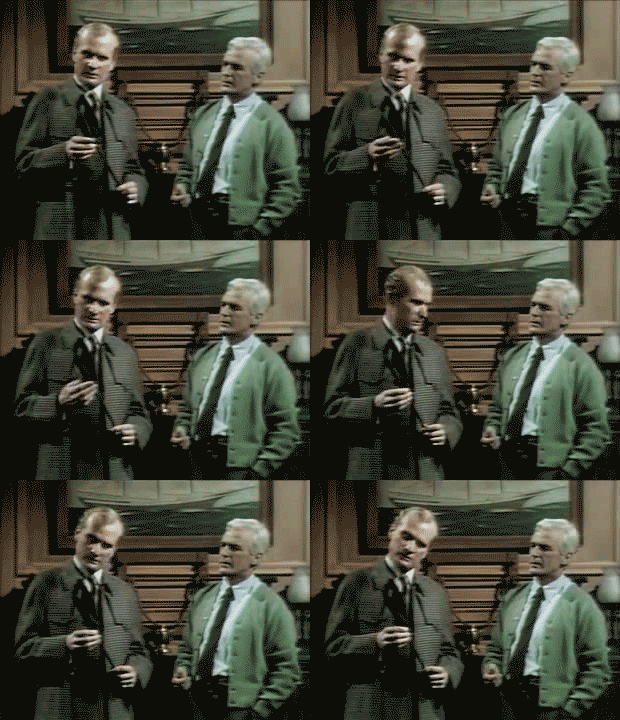
Barnabas calls Julia’s attention to the closing cliffhanger. Screenshot by Dark Shadows Before I Die.
The opening teaser is a reprise of the last scene of Friday’s episode. Dr Eric Lang is trying to convince his patient, recovering vampire Barnabas Collins, to participate in an experiment he wants to start. He addresses him as “Barnabas Barnabas.”
It had been a quirk of Barnabas’ previous physician, Julia Hoffman, to repeat Barnabas’ first name, and as Julia, Grayson Hall manages to put a fresh inflection on “Barnabas, Barnabas” every time she says it. But as Lang, Addison Powell simply says “Barnabas Barnabas” without a pause, as if he were saying a compound name like “Jean-Claude” or “Jim Bob.” He even calls him “Mr Barnabas” at his exit, as if he thinks his full name was “Barnabas Collins Barnabas.” This is by no means the worst thing about Powell’s performance, but it is such an obvious contrast with Hall that it is as if the makers of Dark Shadows are sticking a thumb in our eye and taunting us with his inferiority to her.
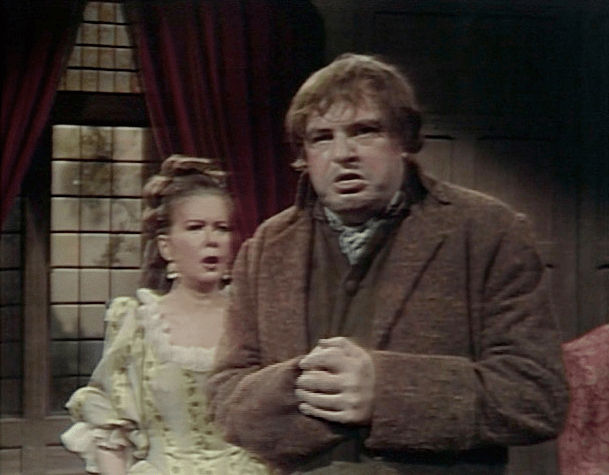
As if that weren’t bad enough, Powell has competition for the title of worst actor in this episode. Craig Slocum washes up in the role of ex-con Harry Johnson. Well-meaning governess Vicki is the first to see Harry; she immediately screams in horror and starts to sob, the correct reaction to the sight of Slocum in any role.
At least there is a silver lining to Harry. He is the son of housekeeper Mrs Johnson, played by the estimable Clarice Blackburn. From November 1967 to March 1968, Dark Shadows was a costume drama set in the late eighteenth century, and Blackburn played repressed spinster Abigail Collins. Abigail was a triumph, an irresistible comic villain who was the highlight of every episode she was in. Mrs Johnson’s scenes today are the first we’ve seen of Blackburn since the show returned to contemporary dress, and she is razor-sharp. She is intriguingly sheepish when she asks matriarch Liz if her son Harry can stay with her for a little while, and alarmingly quick to assure Liz that Harry won’t make trouble. When she hears Vicki scream, Mrs Johnson comes hurrying in, is unsurprised to see that Harry is the source of Vicki’s panic, and cuts Harry off before he can offer a defense. She takes Harry into the drawing room while Liz calms Vicki upstairs, and tells him that he is one false move away from going back to prison forever.
Blackburn is so much fun as the unillusioned mother that it is a terrible shame Slocum never manages to read a line or move a muscle in a way that a living person might in the given situation. She gets laughs in spite of him, but with a competent actor in his part the scene where Harry faces his mother would be some of the best intentional comedy in the whole series.
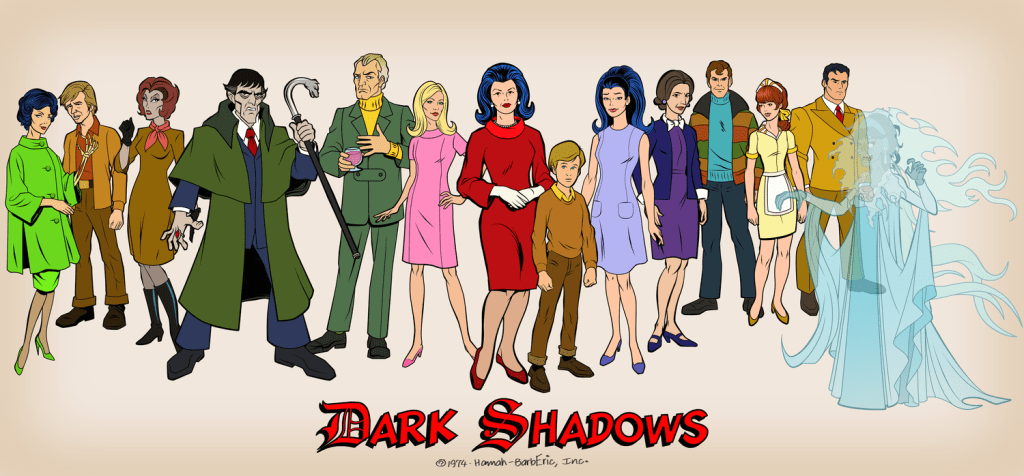
There is one other thing about Harry that makes me smile. On the blog of the Terror at Collinwood podcast, Danielle Gelehrter posted an article some time ago about some concept artwork Eric Marshall did for a hypothetical Dark Shadows animated show in the style of early 1970s TV cartoons such as Scooby Doo or Filmation’s adaptations of Star Trek or My Favorite Martian or Gilligan’s Island. The show Marshall imagines features Harry. Personally, I would have chosen motorcycle enthusiast Buzz, who dated heiress Carolyn for a couple of hilarious weeks in 1967, since his outlandish appearance makes him so much more obvious a choice for animation, but at least Harry’s presence suggests that had such a show been made Clarice Blackburn might have been in the cast and had the chance to do some comedic voice acting.
Eric Marshall’s proposed cast for an animated Dark Shadows that might have been made in the 1970- everyone but Harry. Posted at Terror at Collinwood. Eric Marshall reminds us that Mrs Johnson’s first name is supposed to be “Sarah.” Posted at Terror at Collinwood.
There is some nice stuff in the drawing room between Barnabas and his sometime victim/ fiancée Vicki. Vicki has figured out that the spirit of wicked witch Angelique is once more at work in the great house of Collinwood and that it will take a great effort to stop Angelique from finishing the destruction of the Collins family that she began in the 1790s. If Vicki ever knew that Barnabas was a vampire, she has forgotten it, and Barnabas cannot confess it to her now. He certainly cannot tell Vicki that it was Angelique who made him one. So he listens to her report, but cannot accept her help in the battle against Angelique.
Quite the contrary. Barnabas looks at the spot on Vicki’s neck where he used to take his meals and feels the old hunger coming on. He says he must go to see Lang. Vicki protests that he should stay and let her tend him while they wait for Lang to come to them, but Barnabas insists.
Barnabas goes to Lang’s house. Lang tells Barnabas that if he participates in his experiment, he will not only be entirely free of the vampire curse, but that he might also have the physical appearance of Peter Bradford, alias Jeff Clark, an unpleasant young man who is more or less Vicki’s new boyfriend. This intrigues Barnabas, but Lang will not explain what he means. Since we know that Lang is a mad scientist who is forcing Peter/ Jeff to steal parts from newly interred bodies, we can assume that he will eventually be constructing a Frankenstein’s monster. Presumably he means that the finished product will look like Peter/ Jeff, and Barnabas will somehow live inside it. Since the creature is being built from parts, to look like Peter/Jeff it would have to be finished with salvage from Peter/ Jeff’s corpse. How Peter/ Jeff will be converted from his present state of living and obnoxious to dead and recyclable is what awaits explanation.
Vampire Barnabas Collins, desperate to save his own life after he aged extremely rapidly as the result of an attempt mad scientist Julia Hoffman had made to turn him into a real boy, bit his distant cousin Carolyn Collins Stoddard and enslaved her in #351. In #462, Barnabas was afraid that well-meaning governess Vicki Winters had learned his secret, so he bit her as well. As it happens, Vicki had not figured out that Barnabas was a vampire, so the bite was unnecessary. That was lucky for Barnabas. After he bit her, Vicki was noticeably less interested in Barnabas and less deferential to him than she had been at any point in the year or so she had known him.
Now, Barnabas has happened upon another mad scientist, Eric Lang. Lang has apparently succeeded where Julia had failed. Barnabas can go around in the daytime and do other things humans do. What’s more, Lang takes a look at Vicki’s neck and sees that the marks of Barnabas’ bite have vanished. Vicki remembers having the bites. Even after Lang has told her that they vanished because the reason for them no longer exists, she has an enigmatic look on her face when she stares into the mirror and studies the spot where they used to be. It was never clear what she made of Barnabas’ biting her and sucking her blood- maybe she just thought he favored an aggressive make out technique. She looks deeply puzzled now, but what exactly she is trying to understand is a mystery. She looks away from the mirror, then looks down, defeated in her attempt to find sense in her memories. Finally, she turns her back on the mirror and goes resolutely about her business.
For her part, Julia is in the great house of Collinwood with Carolyn. Julia is surprised that Carolyn is talking to her in a friendly manner, as she did before she and Barnabas “became so close.” Carolyn removes her scarf, glances in the mirror, and is delighted to see that the marks on her neck are gone. Carolyn asks what that means. Julia says that it means that she is free, as free as Barnabas, and that it must continue to be so.
Unlike Vicki, Carolyn had a full briefing from Barnabas about his condition and its requirements, and she was deeply involved in his criminal enterprises for some weeks. Her joyous reaction to the disappearance of the marks leaves no doubt that she remembers something about this experience. There is nothing in any script after this to tell us what, but we will often notice actress Nancy Barrett giving a line reading or showing an unquiet reaction that suggests she remembers everything. I suppose you could say she was padding her part with these little signs, but the directors obviously didn’t object and it will be quite a while before the writers give her dialogue which forces her to stop doing it.
There’s also a lot of business in this episode with Vicki and an unpleasant man named Peter. Lately, Peter has been pretending to be someone else, even though the audience and Vicki know perfectly well who he is. Today the show suggests that this irritating little storyline is the consequence of Peter having amnesia. The episode ends with him, Vicki, and Julia opening the secret panel that reveals the hidden chamber in the Collins family mausoleum where Barnabas was trapped from the 1790s until 1967. That proves that Vicki traveled back in time to the 1790s and that Peter knew her in that era. Since the audience already knows both of those facts and none of the characters directly involved in the action has any reason to doubt either of them, it’s an anticlimactic conclusion.
When Vicki and Julia are entering the mausoleum, Vicki shines a flashlight directly into the camera. In at least eleven of the episodes made when the show was in black and white, characters entering darkened spaces did this with flashlights, often creating elaborate halo effects. Sometimes this appeared to be a blooper, several times it was obviously intentional. We’ve only seen it once or twice, briefly, since the show went to color in the summer of 1967. It’s nice to see it again.
In a room at the Collinsport Hospital, very loud physician Eric Lang (Addison Powell) opens the curtains to show his patient, old world gentleman Barnabas Collins, that it is a sunny afternoon. It takes Barnabas a moment to realize that this is Lang’s way of showing him that he has cured him of his longstanding affliction, vampirism. Once he figures it out, Barnabas is very happy to be human again.
Barnabas talks with Lang about the origins of his vampirism. At one point Lang says “Ah, so a curse was responsible.” You know how doctors are, always coming out with the same cliches. Lang does say something novel when he remarks on Barnabas’ “pulsebeat.” That specimen of Collinsport English will be back.
In the great house of Collinwood, Barnabas’ distant cousins Roger and Liz are at odds. Roger keeps having conversations with a portrait, in the course of which he loses track of the time. The correct time is 1968, and he keeps thinking it is 1795. When he does that, he mistakes himself for his collateral ancestor Joshua Collins and his sister Liz for Joshua’s wife Naomi. Today, Liz has to slap Roger to get him back to himself. Louis Edmonds’ alternation between Joshua and Roger is masterful, one of the outstanding moments of acting in the whole series.
The portrait is of Angelique, the wicked witch who made Barnabas into a vampire in the first place. At the hospital, it becomes clear that Angelique’s spirit is controlling Roger through it. He is cold and distant, staring out the window when Barnabas tells Liz he wants to take up gardening, refusing to say a word when Lang enters the room. When he takes his leave, Roger looks at Barnabas and declares “It’s not this easy.” We realize that he is a puppet for Angelique. Roger steals Lang’s cartoonish mirror-bearing headpiece.
We cut back and forth between Barnabas’ hospital room and the drawing room at Collinwood. At Collinwood, Roger shows the headpiece to the portrait and explains that it was Lang’s. He starts to twist it. In the hospital, Lang suddenly leaps up with a splitting headache. Roger stops twisting, and Lang says he’s better. He resumes twisting, and Lang resumes suffering. Roger tells the portrait he cannot obey its command to put the headpiece in the fire, and throws it across the room. In the hospital, Lang suddenly recovers from his headache. Barnabas tells him it was Angelique’s doing, and says that he will have to become a vampire again to spare Lang her attentions.
On his blog Dark Shadows Every Day, Danny Horn identified Addison Powell as “THE WORST ACTOR EVER TO APPEAR ON DARK SHADOWS.” I don’t agree with that. In yesterday’s episode, for example, Powell attained a level that could fairly be described as “competent,” a label that forever eluded figures like Mark Allen (Sam Evans #1,) Michael Currie (Constable/ Sheriff Carter,) and Craig Slocum (Noah Gifford and, later, Harry Johnson.) And there will be times when his ludicrous overacting lends just the note of camp that turns a scene from a tedious misfire to an occasion for chuckling. But he is pretty bad today. When an actor gets to be depressing to watch, I sometimes make his scenes bearable by trying to imagine what it might have been like if, instead of casting him, they had chosen someone else who might have been available.
So many members of the original Broadway cast of the musical 1776 appeared on Dark Shadows at one time or another that I tend to assume that any of them would have accepted any part on the show. Howard da Silva played Benjamin Franklin in 1776, and he is my imaginary Dr Lang.
You can see da Silva’s Franklin in the 1972 movie version of 1776, where he plays the Sage of Philadelphia with frequent chortles that suggest a mad scientist gleefully working to release a murderous nightmare on the world, which is more or less the show’s vision of the founding of the USA. That isn’t Franklin’s only note- he has occasion to speak earnestly about the British Empire’s mismanagement of its North American possessions, and sorrowfully about the need to leave slavery alone while concentrating on the fight for independence. Those who have seen da Silva play subtle and powerfully compassionate men in his other work, for example as the psychiatrist in the 1962 film David and Lisa and as the defense attorney in the 1964 Outer Limits episode adapting Isaac Asimov’s story “I, Robot,” will hardly be surprised that he could be effective in those moments.
So when Powell overdoes the shouting, I imagine da Silva in his place, going through his bag of tricks to show us a man who might be taking a maniacal satisfaction in his blasphemous labors, who might be profoundly devoted to the relief of suffering, and who might be both at once. Sometimes I get a pretty clear image of what that would have been like, and when that happens the show in my head is hard to beat.
High-born ne’er-do-well Roger Collins was Dark Shadows‘ first villain. Through the first 40 weeks of the show, dashing action hero Burke Devlin was determined to prove that Roger, not he, had been driving when his car hit and killed a pedestrian ten years before, and Roger would stop at nothing to keep Burke from succeeding. The Revenge of Burke Devlin storyline was never particularly exciting. By the time Burke formally gave up on his quest for vindication in #201, it had been running on fumes for some time. Roger hasn’t been central to a plot since then. The show has capitalized on actor Louis Edmonds’ unrivaled gift for sarcasm by having him deliver the occasional zinger, and otherwise has used him as a symbol of the inability of the Collins family to use its wealth and connections to solve any of its problems.
For nineteen weeks ending this past Monday, Dark Shadows was a costume drama set in the late eighteenth century and Edmonds played haughty overlord Joshua Collins. That performance was a triumph, and the entire segment turned out to be The Tragedy of Joshua Collins. So returning viewers will have an appetite to see more of what Edmonds can do, and will be excited when we come back from the opening title sequence to a scene focusing on Roger.
Roger spends this scene staring at a portrait and reciting poetry to it while various people enter the room and try to get his attention. That may not sound like a promise of thrills, but it is on this show. For example, Roger’s son, strange and troubled boy David, had a lively if somewhat one-sided conversation with the portrait of Josette Collins that hangs in the Old House on the estate in #102, and that conversation presaged danger for David and an important role for Josette’s ghost. The show’s first supernatural menace was Roger’s estranged wife, undead fire witch Laura Murdoch Collins, and several characters had important relationships with portraits of Laura during the four months she was in the cast. And dangerously unstable ruffian Willie Loomis once spent a week staring at the portrait of the late Barnabas Collins that hangs in the foyer of Collinwood. As a result, Willie wound up opening Barnabas’ coffin, finding that he was a vampire, and turning Dark Shadows into an entirely different kind of show.
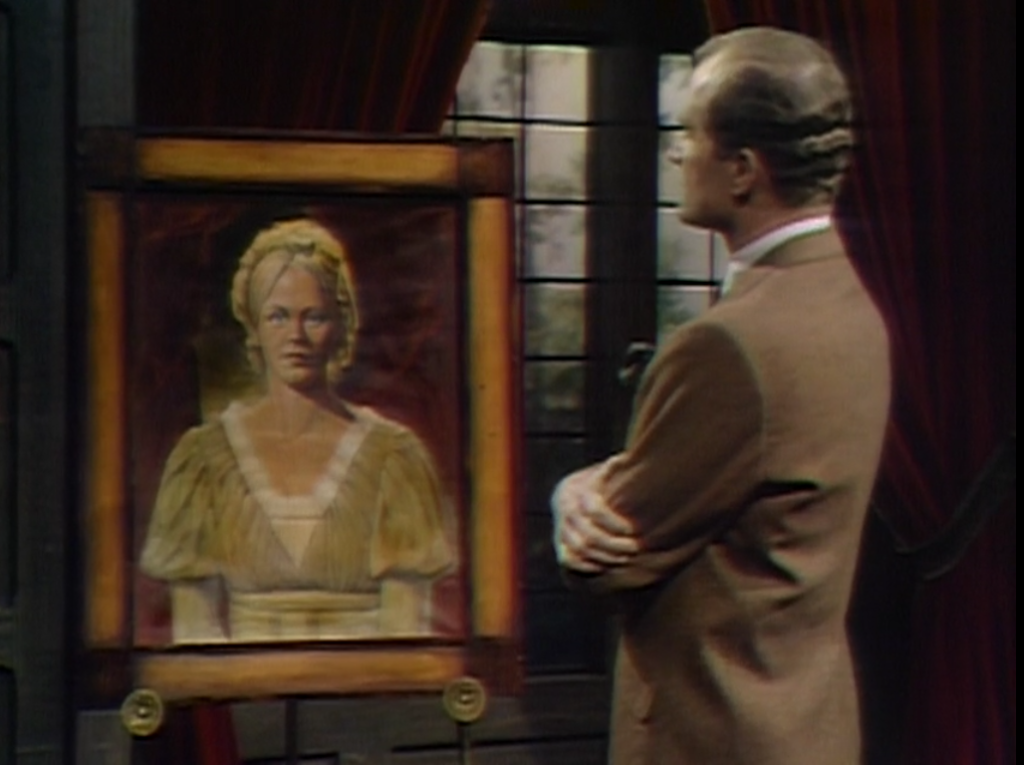
Roger talks to the portrait of Angelique.
The portrait that has captured Roger’s attention is of Angelique, the wicked witch who turned Barnabas into a vampire in the first place. Well-meaning governess Vicki found this portrait in an antique store and brought it home yesterday. It was Vicki who took us to the 1790s when she became unstuck in time. While there, she met Angelique and the living Barnabas. Shortly after her return to the 1960s, Vicki found that her memory of her time in the past had become spotty. She can’t explain why she wanted the painting, but it does make sense to her that Barnabas reacts to it with violent dislike.
We first saw the portrait in #449, when it was clear that Vicki would be returning to the 1960s soon but unclear whether Angelique would follow her. Showing us that they had commissioned a portrait of Lara Parker was their way of telling us she would be back. Having Roger become obsessed with the portrait is their way of telling us that he will be the instrument of her arrival, as Willie was the instrument of Barnabas’.
We learn that Roger’s obsession will blur the distinction between him and Joshua when long-term houseguest Julia Hoffman approaches him and he speaks to her in Joshua’s voice, addressing her as the Countess DuPrés, who was a houseguest at Collinwood in Joshua’s time. Julia and the countess are both played by Grayson Hall. Vicki mistook the countess for Julia when she first met her in 1795, and since her return to 1968 has kept mistaking Julia for the countess. Now that Roger has made the same mistake, Julia must be trying to figure out what’s going on.
A man comes to the front door. Vicki answers it and sees a familiar face. It belongs to Professor Timothy Eliot Stokes. She hasn’t met him before, but she met his ancestor, much put-upon servant Ben Stokes, in the 1790s.
Like Ben and crazed handyman Matthew Morgan from 1966, Professor Stokes is played by Thayer David. Matthew and Ben were both major characters, so we can assume that Stokes will be as well. Matthew was a bad guy, Ben a good guy. When Ben was on the show, the contrast between him and Matthew was drawn very heavily to make the point that Matthew’s crimes are what Ben’s virtues would have led him to do had his personality been warped by the environment in which Matthew grew up. That environment was the consequence of the curse that Angelique placed on the Collinses in the 1790s. Burke expressed this idea in #64 when he said of Matthew that “Collinwood breeds murderers,” but he was understating the effect. Matthew grew up, not on the estate, but in the nearby village of Collinsport, and the curse leaves its mark on everyone who comes from there. Since Stokes is an out-of-towner, he is likely to be unaffected by the consequences of the curse, and so we do not know what we will find under his worldly and self-possessed exterior.
Stokes is researching his ancestor Ben, and wanted to buy the portrait because he thought it might depict a woman Ben knew. Stokes says that Ben wrote a memoir. Barnabas is in the room; in the 1790s, Ben was his closest friend, and knew all about his vampirism. So he is alarmed by the idea of a volume of memoirs by Ben. He can take some comfort when Stokes tells him that most of the manuscript was lost in a fire a few years ago.
The idea of a servant writing memoirs that might expose Barnabas’ secret first came up in #326. At that point, Willie was out of his control, and Barnabas told Julia, who is a mad scientist and his confederate, that he was afraid Willie might start “writing his memoirs!” That phrasing was meant to raise a laugh, since Willie is conspicuously not burdened with literary ambitions. But it planted a seed that flowers for the first time here, and that will flower again later.
Stokes offers Vicki $200 for the painting. Barnabas is eager to get the thing out of the house and urges her to take Stokes’ money, but before she can Roger bids $500. Stokes can’t afford that, and so it stays at Collinwood.
Stokes’ interest in family history establishes a contrast between him and Roger. Stokes, like Roger, appears to be a confirmed bachelor. But while Roger’s lack of interest in the responsibilities of marriage is of a piece with his indifference to all family ties, so that he was eager to divorce Laura and palm David off on her even after it had become clear to other characters that she was a danger to the boy, Stokes is an avid genealogist. He has renounced the prospect of marriage because he has other ways to be of service, not simply because he wants to wallow in his own crapulence as Roger does.
Suddenly Vicki remembers that the woman in the portrait is named Angelique, that Angelique was a witch, and that her spells caused all the misfortune that began at Collinwood in 1795. We hear all of this while Barnabas is in closeup, squirming gloriously. Stokes leaves with Barnabas and tells him he knew that the woman’s name was Angelique, but that it’s news to him that she was a witch. He is impressed by Vicki’s knowledge, and says that he can sense that she is attuned to paranormal phenomena. He wants to get to know her better.
Most characters we have met spend a long time slowing the story down by scoffing at the idea of the supernatural. That Stokes is a self-identified student of the occult and immediately receptive to Vicki’s identification of Angelique as a wicked witch tells us that he will serve to speed up the pace of events.
This again makes a stark contrast with Roger. When Vicki managed to get Roger away from the painting for a moment in Act One, he told her that he refused to believe that she traveled to the past and returned to the present. When she lists some of the abundant evidence he and everyone else saw that can be explained no other way, he says he attributes all of that to mass hallucination.
In his Dark Shadows Every Day post about this episode, Danny Horn at one point refers to Stokes as a character whose function is “to backfill Dr. Woodard’s spot in the cast,” referring to a stolid medico whom Barnabas and Julia murdered several months back. But in this contrast, we see that the character whose place Stokes is actually taking is Roger. When the show started, the Collinses of Collinwood were the central frame of reference for the action. But Roger and his sister, matriarch Liz, are for various reasons locked out of the supernatural storylines. Since those are the only storylines they have, the show needs to build another family to anchor the action, and that family is going to be defined, not by marriage and genealogy, but by a shared commitment to getting as deep as possible into the weirdest shit going.
Stokes tells Barnabas that there was a series of unsolved murders in Collinsport in the 1790s, and wonders if it might be possible to prove that Angelique was responsible for them. Barnabas suggests that it is too late to do justice in such an old case, to which Stokes replies that it is never too late to do justice to history. Not only does this reply deepen the contrast between Stokes and the amoral Roger, it has, by happenstance, a deep resonance for many who might see the episode today. It originally aired on 4 April 1968, just a few hours before the Rev’d Dr Martin Luther King, Jr, was assassinated. Millions are still unsatisfied with the official answers about who killed Dr King and why; they might cheer the idea that there is a species of justice that is still possible even after 56 years or more have gone by.
Barnabas bit Vicki the other day in an attempt to control her and keep her from revealing any information about him she may have acquired during her sojourn in the past. Disquieted by his conversation with Stokes, Barnabas stares out his window and summons Vicki to his house. In her bedroom, an enchanted music box Barnabas gave her as part of an earlier brainwashing attempt opens itself and begins to play. She rises from bed and goes to him listening to the music box all the way.
At Barnabas’ house, Vicki gives him the music box. He tells her that the next time he calls her, they will go away together forever. He bites her neck.
We cut to Vicki’s bedroom. The music box is back in its place and she is back in bed, asleep. Julia comes in to check on her. Vicki says she’d had a bad dream, and Julia finds the bite marks on her neck.
In the weeks leading up to Vicki’s visit to the past, Julia had alienated Barnabas by opposing his efforts to seduce Vicki. Now she marches over to Barnabas’ house and renews her opposition. She accuses him of having been in Vicki’s bedroom. He answers that he brought her to his house. This might seem to be a trivial distinction, but perhaps not to viewers who have been with the show from the beginning. Today’s focus on Roger might remind us of #4, when Roger tried to let himself into Vicki’s room while she was sleeping, obviously in search of some kind of sexual thrill that would not be preceded by her consent. Barnabas can’t deny that he is the moral equivalent of a rapist, but he isn’t going to miss an opportunity to differentiate himself from Roger.
Barnabas doesn’t seem very interested in anything Julia is saying. Even when she gives him an ultimatum, threatening to expose him if he doesn’t back off by tomorrow night, he reacts with a mild irritation. Regular viewers, remembering the displays of jeering contempt and seething rage which are typically the options from which Barnabas chooses his response to this sort of thing, will be startled by his relative blandness. Julia should be unnerved by it.
In November 1967, Dark Shadows was very rapidly running out of stories to tell. Rather than introduce new characters and new complications to solve this problem, they kept killing off existing characters and foreclosing possible developments, making it impossible not to notice that they were speeding directly towards a blank wall. In #365, they did something no one could have seen coming. Rather than crashing into the wall, they passed right through it and relaunched the show as a costume drama set in the 1790s. The result was a triumph, nineteen weeks of high drama, low farce, lurid horror, pointed satire, and authentic tragedy. Now they are back in contemporary dress, and we are waiting to see what comes next.
Before the costume drama insert, mad scientist Julia was trying to keep well-meaning governess Vicki from falling into the clutches of vampire Barnabas. Julia’s efforts pitted her against many opponents. Vicki regarded Barnabas as a friend, actress Alexandra Moltke Isles was eager to get into the main storyline, the fans wanted to connect the show’s original point of view character with its breakout star, and the writers needed a fresh story to tell. But by repeatedly hypnotizing Vicki and making her subconsciously aware of Barnabas’ horrible secret, Julia was able to hold the line until Vicki disappeared into the 1790s and took the audience, the writers, and Mrs Isles with her.
At the top of today’s episode, Julia is hypnotizing Vicki again. Vicki is in bed, and Julia is extracting memories of her visit to the late eighteenth century, using a post-hypnotic suggestion to sequester those memories from her conscious mind.
Vicki has a dream in which the ghost of Jeremiah Collins, who befriended her in 1795, warns her about Barnabas. The ghost’s voice is provided by Addison Powell, whom Danny Horn named on his great blog Dark Shadows Every Day as “THE WORST ACTOR EVER TO APPEAR ON DARK SHADOWS.” I can think of two or three who might finish ahead of Powell in the contest for this title, but his voice performance today is indeed amazingly bad. He delivers his lines on a single shrill note throughout, and has a lot of trouble managing his breath. I suppose his attempts to get through long speeches without inhaling make sense for someone who just emerged from his grave, but the consequent lack of emphasis on any particular words or phrases and the intermittent gasps each time he runs out of oxygen do keep him from establishing the sense of mystery and terror that the scene calls for.
We then cut to the terrace outside the house, where we see Barnabas approaching the door. Julia meets him, with a new haircut.
This is Grayson Hall’s actual hair; the wig she was wearing in the first scenes had been part of Julia’s costume from her first appearance, in #265. The last time an actress was freed from a wig to perform under her own hair was when Maggie Evans’ tight little blonde hairpiece gave way to Kathryn Leigh Scott’s reddish brown tresses in #20. With that, the wised-up waitress who was everybody’s pal and nobody’s friend became The Nicest Girl in Town. Longtime viewers who remember Maggie’s transformation will recognize what is happening today, when the same device marks a reset of a character. Julia, who yesterday was precisely as hostile to Barnabas and as helpless before him as she was when we left off in November, is today both willing to cooperate with him and very much in control of the situation. He even goes down on one knee to beg her to help him find out what Vicki learned during her sojourn in the eighteenth century. She promises nothing.
After another visit to Vicki in her room, Julia assures Barnabas that she can use her mastery of hypnosis to cordon off any memories Vicki may have that might pose a threat to him. Unconvinced, Barnabas decides to take matters into his own hands.
Barnabas appears in Vicki’s room. She awakens and is surprised to find him at her bedside. She recoils from him as she had been doing in November, when Julia had made her unconsciously aware of his true nature, but, again as she had done in those days, she overcomes her aversion and turns to him. He tells her to come to him. She hesitates, but does. He tells her he can give her peace and make it seem that everything that is distressing her is far away. She embraces him and asks him to do so. It looks very much like a seduction. Considering that Vicki kept embracing Barnabas and pushing her neck towards his teeth before Julia started hypnotizing her, it is an overdue one. Barnabas opens his mouth. He displays the same inner struggle he has shown on previous occasions when he had the chance to bite Vicki, but is still bending his head towards her neck when we fade out for the closing credits.
Like every episode of Dark Shadows, this one begins with a voiceover by a member of the cast. Unlike all the preceding voiceovers, this one is delivered by a man. Thayer David does the honors.
We open in the drawing room of the great house of Collinwood. For the first time in months, Barnabas Collins is there. Barnabas died and rose as a vampire in January, and has been concealing his existence since. But now his secret is known to several people in the house. One of those, his mother Naomi, reacted to the knowledge by taking poison. In his agony, Barnabas is pacing the floor, complaining to his friend, much put-upon servant Ben, that the doctor hasn’t come. Barnabas’ father Joshua comes downstairs and announces that there is no longer any need for a doctor- Naomi has died.
Joshua dismisses Ben and talks with Barnabas. He confesses his doubts that he is able to love anyone. Barnabas tells him that such a disability might save his life- the curse wicked witch Angelique placed on him means that everyone who loves him will die. Joshua says that he must end the curse, and will do so by destroying Barnabas. Barnabas asks if he will drive a stake through his heart. Joshua replies that he found a book in Boston that tells of another way. Come morning, he will fire a silver bullet through Barnabas’ heart.
This is the first we have heard that silver bullets will kill vampires. There is some lore that suggests vampires avoid silver, but we know that doesn’t apply to Barnabas- one of his chief trademarks is a cane with a mostly silver handle. The 1941 film The Wolf Man established silver bullets as a means of killing werewolves, and the Lone Ranger fires silver bullets to knock the guns out of the bad guys’ hands, so I guess they might have come to mind in the 1960s if you were thinking of exotic weaponry.
Barnabas has plans for his final night. It was naval officer/ sleazy operator Nathan Forbes who led Naomi to discover Barnabas’ secret, and who is to that extent responsible for her death. Ben enters to inform Joshua and Barnabas of another item to add to the list of Nathan’s misdeeds. Nathan has evidently apprehended bewildered time traveler Victoria Winters and taken her into town, where she faces death on the gallows after being unjustly convicted of witchcraft. The Collinses knew Vicki to be innocent and had been harboring her since shortly after she escaped from gaol. Joshua and Barnabas are certain that Nathan turned her in solely to collect the reward that has been posted for her capture. Barnabas vows to kill Nathan, and Joshua can’t talk him out of it.
We cut to Nathan in the Eagle tavern, where he is spending the money he sold Victoria for. The Eagle has changed pretty dramatically in the last several weeks. In #419, bartender Mr Mooney greeted a female patron with the announcement that the Eagle did not admit unaccompanied women. Since the Eagle is a public house on the waterfront, the management evidently thought this policy was necessary to keep the place from becoming a headquarters for the sex workers of Collinsport.
Now Mr Mooney is nowhere to be seen, and the only person in the barroom with Nathan is identified in the closing credits as “Barmaid.” She is played by Rebecca Shaw, whom we saw the other day as a streetwalker whom Barnabas was about to bite when good witch Bathia Mapes summoned him away with a magical incantation. She is sitting with Nathan, drinking with him, and flirting with him pretty heavily. A bat squeaking at the window frightens her, and when she catches her breath she announces that she will be leaving him alone in the bar for a bit while she lies down. Nathan replies to that by saying he will see her soon, and she turns to take a look at him, apparently expecting him to follow her to bed. It seems possible she is the same character who was working the docks, now employed in a similar capacity in the Eagle. If this is the person who has taken over from Mr Mooney, the management must have given up the hopes it formerly had for its reputation.
Once the woman leaves Nathan alone, Barnabas appears. He confronts Nathan about his many crimes. Nathan pulls a gun and tells Barnabas he will take him to the constable and turn him in as the Collinsport Strangler. Barnabas jeers. Nathan shoots, and Barnabas keeps standing there. He declares that Nathan cannot kill him, because he is already dead. He then informs Nathan that he will wait until 9 pm to kill him. Since it is now 8:30, this does not give Nathan a great deal of time.
At 8:45, Nathan appears at Collinwood. He finds Joshua and Ben in the drawing room, and tells them what has happened. They are neither surprised nor sympathetic. Joshua leaves the room, explaining that he would prefer not to see a gruesome murder. Ben is willing to stay for a while. When Nathan asks how Barnabas can be destroyed, Ben decides to have a little fun. He tells him that if he finds Barnabas resting in his coffin after sunrise and drives a wooden stake through his heart, that will take care of it. Ben is quite jolly when he points out that Nathan will be dead long before sunrise, so that this information would seem to be of little practical use to him. Ben then decides that he doesn’t want to watch the murder either, so he also takes his leave of Nathan.
With five minutes to go, Nathan tells himself that Barnabas will not kill him if Joshua is in the room. He finds Joshua in the study. He begs Joshua to stay. As Joshua is refusing, Nathan looks at the wall and sees a crossbow mounted there, with three wooden bolts next to it. Suddenly his cowardice gives way to wild hope. He tells Joshua he will wait in the study for Barnabas. Joshua goes.
Nathan takes a practice shot at the door, then stands waiting. Barnabas does open the door, Nathan does release another bolt, and does strike him in the chest, a bit to the left of the sternum. Barnabas cries out in pain, and as the episode ends it looks very much as if Nathan may have managed to stake him.
Barnabas is the reason the show is a hit, so we can be quite sure he won’t actually die. Still, the episode is good enough that it feels for a moment that he might. The contrast between the prospect of Joshua killing Barnabas in the stately manner he described earlier in the episode and the idea of Nathan killing him is instructive. Had Joshua carried out his plan or even attempted it, the result would have been what Aristotle was talking about in his Poetics when he described the majestic terror of tragedy. It would have been at once horrifying and awe-inspiring to see a father duty-bound to kill his son. But Nathan is a cheap bum, trying only to save himself so that he can live to abuse and exploit more people. When we root against Nathan destroying Barnabas, we do not want only to continue the pleasure of watching the show. We are rejecting a resolution that would be unworthy of what we have seen so far.
Nathan, indeed, is unworthiness incarnate. When he was first on the show, Nathan was a likable rogue, but in recent weeks he has become both cruel and dreary. So cruel that he has tried to arrange the murder of an eleven year old; so dreary that he works through a conspicuously dim-witted, relentlessly unappealing henchman. Many fans complain about Nathan’s turn, and some speculate that the show just ran out of villains sinister enough to be worthy of Barnabas’ vengeance. On that theory, Nathan’s grave crimes are a last-minute, slapdash invention.
I don’t agree. We met Nathan before Angelique came to Collinwood. In those days, there was room for light comedy, for grand gestures, for dashing heroism, for fairy tale whimsy, and for tender romance. But as her curses have done their work, everyone and everything has been ground down. The ceiling has been lowered, and there is no longer space for the bouncy good cheer of the Old Nathan, much less for the Satanic majesty of villains like Angelique or that Rev’d Mr Trask. The whole world is pervaded by cheapness and sordidness now, and growing more so by the minute.
The only grandeur left is in The Tragedy of Joshua Collins. Were Nathan to destroy Barnabas, that grandeur would vanish, not in sublime pity, but with a taunt. That would be a harsh ending indeed.
This is the first episode of Dark Shadows credited to a director other than Lela Swift or John Sedwick. It is also the first production of any kind directed by Dan Curtis, the series’ creator and executive producer. Curtis’ inexperience shows at several moments when the camera is in an awkward spot or the actors are unsure what to do, and in his post about the episode on Dark Shadows Every Day Danny Horn documents several of the more egregious examples with screenshots and detailed analysis. The impossible deadlines and tiny budget on which Dark Shadows was produced meant that even Swift and Sedwick, who were seasoned professionals and ambitious visual artists, sometimes had to turn in work that wasn’t much better than what first-timer Curtis manages today, and longtime viewers of the show will take even his worst stumbles in stride.
At the top of the episode, it is daytime, and much put-upon servant Ben Stokes (Thayer David) finds the lady of the house, Naomi Collins (Joan Bennett,) standing at an open coffin that holds the corpse of her son, Barnabas. Ben knows that Barnabas is a vampire who will rise at night to prey upon the living. Naomi has never heard of vampires. All she knows is that Barnabas is dead, and that his coffin has been moved from the family mausoleum to a room atop a tower in the mansion. Ben pleads with her to leave the room and to go with him back to the main part of the house.
Naomi questions Ben. Ben tells her that Barnabas has a “sleeping sickness,” and has been in a coma ever since the night he apparently died. Ben does not like to lie to Naomi, but her husband, haughty overlord Joshua, has judged that the truth would kill her, and Ben is governed by that assessment. He does tell her that the “sleeping sickness” is a symptom of a curse, that the wicked witch who placed the curse was Barnabas’ sometime wife Angelique, and that Joshua is in Boston trying to find someone who knows how to lift it.
Ben asks Naomi how she came to be in the tower room. She tells him that naval officer/ sleazy operator Nathan Forbes told her that Barnabas was being kept there, and also that Barnabas was responsible for the series of murders that had recently taken place in the town of Collinsport. At that, Ben vows to kill Nathan. To his chagrin, Naomi forbids him to do this.
In the part of Dark Shadows set between August and December of 1966, Bennett played reclusive matriarch Elizabeth Collins Stoddard and David played her fanatically devoted handyman Matthew Morgan. When well-meaning governess Vicki came unstuck in time and arrived in the late 1790s, she at first mistook Naomi for Liz and Ben for Matthew. This scene takes longtime viewers back to the days when Matthew was always on the lookout for someone who represented a threat to Liz’ interests and she was always sternly prohibiting him from murdering anyone for her sake.
Ben is a far saner man than Matthew ever was; the contrast between them shows the effect that growing up in Collinsport, a town suffering from the consequences of a curse that has been working its way for many generations, has had on Matthew’s personality. While Ben is a brave, kind-hearted fellow whose fierce loyalties sometimes overpower his good sense, Matthew is a paranoid ogre who kills Liz’ friend Bill Malloy and tries to kill Vicki. It isn’t just one family that will be warped by Angelique’s curse. It will breed monsters everywhere the Collinses’ influence prevails.
Naomi then turns her attention to the B-plot. Nathan has married fluttery heiress Millicent Collins, only to find that Millicent has signed her share of the Collins fortune over to her little brother Daniel. Nathan responded to that news by crafting a plot to murder Daniel. His first attempt failed when Noah Gifford, the henchman he hired to abduct Daniel and drown him, fell afoul of Vicki. Vicki found Noah strangling Daniel near the place where she was hiding, having escaped from gaol, and shot him to death. After that, Daniel and Vicki went back to the mansion and told Naomi what they knew. Naomi recognized Daniel’s description of his attacker as a man she had seen with Nathan earlier, and realizes that Nathan is trying to murder the boy. So she orders Ben to take Daniel into town to stay with the Rev’d Mr Bland, a clergyman who looks like a duck.
Naomi confronts Nathan, who keeps telling her that whatever Barnabas might look like during the day, he gets up at night and goes out to murder people. She tries to shut him up, but later she is still wondering whether she should go back to the tower room after dark to check his story out.
She sees Millicent standing in the foyer, staring at the portrait of Barnabas that hangs there. The portrait of Barnabas first appeared under the closing credits in #204, and from #205 on it figured as a means through which Barnabas could communicate with the living. Barnabas bit Millicent the other day, and she hears him summoning her.
Among the 1960s characters who receive their commands from the vampire while staring at the portrait is Liz’ daughter Carolyn, who like Millicent is played by Nancy Barrett. Millicent at times evoked an early version of Carolyn. Until the spring of 1967, Carolyn was tempestuous and irresponsible, sometimes friendly to point-of-view character Vicki, sometimes hostile to her. Millicent is as timid and overly dependent as that version of Carolyn was headstrong and self-centered. One way or another, each is a Spoiled Heiress, and evidently that’s a favorite meal of Barnabas’.
Naomi follows Millicent to the gazebo on the grounds of the estate. There, she sees Barnabas. She is stunned that the son whose corpse she was looking at just a few hours before is up and moving. He bites Millicent, and Naomi lets out a scream. Barnabas looks up, and realizes that his mother has caught him in the act.
The vampire’s bite affects each victim differently. The first victim we saw was Willie Loomis, whom Barnabas’ bite transformed from a dangerously unstable ruffian to a sorely bedraggled blood thrall. Willie was at first gravely ill, then ran to Barnabas like an addict desperate for a fix, and eventually settled into life as a sorrowful servant who could not run away from Barnabas but could resist him to the point where Barnabas occasionally found it necessary to keep him in line with beatings.
The second victim we saw was Maggie Evans, The Nicest Girl in Town. She reacted very much like the first victim in the 1790s segment, gracious lady Josette, who, like Maggie, was played by Kathryn Leigh Scott. At first, those two were alternately blissful and snappish, happy to be under Barnabas’ power and defensive with anyone who might interfere with it. But each recoiled from him by the time it became clear he planned to kill her and make her into a vampire herself. Each escaped from him to the shore below Widow’s Hill- Maggie by running through an underground tunnel that rose to the shoreline, Josette by flinging herself to her death from the top of the cliff.
Later, Barnabas bit Carolyn. She initially contemplated his most gruesome crimes with pure glee and showed great energy as his protector and enforcer. Soon her conscience reappeared, but she was still doing his dirty work faithfully when Vicki disappeared into the past.
Millicent differs from all those others in that she simply continues to go about her business in between Barnabas’ meal-times. Granted, she was already deeply disturbed by that point, so that her business was conducted mostly in show-stopping mad scenes. But it’s still odd that she can talk to Nathan as if their marriage were the main thing in her life.
When we finished watching this one, my wife, Mrs Acilius, wondered if these differences were simply the result of the victims’ personalities coming through or if the vampire can pick and choose how to apply the pressure. He wanted Willie as a slave, and the reaction he produced gave him that. He wanted to turn Maggie into a reincarnation of Josette, and wound up getting the same reaction from Maggie that he had got from Josette. He bit Carolyn in a moment of desperation, with no plan in mind, and her reaction is complicated and volatile. He bit Millicent to keep her quiet, and her reaction is remarkably inconspicuous. Maybe we’re just supposed to think that Barnabas is fabulously lucky, but there is an opening there to tell a story about how him deciding what he wants to do to a person when he sucks their blood.
Haughty overlord Joshua Collins and his long-term house-guest the Countess DuPrés have summoned good witch Bathia Mapes to lift the curse that has made Joshua’s son Barnabas a vampire. Meanwhile, Barnabas has bitten his second cousin Millicent and gone to the waterfront to find another victim. Bloggers Danny Horn, Patrick McCray, and John and Christine Scoleri have said so much so well about this episode that I have only a few points to add.
Millicent tells Joshua that it is wrong of him to have “that man who says he is Barnabas” in the house when he does such frightful things. Nancy Barrett’s performance as a woman made insane by her encounter with the undead is achingly beautiful. And her idea that Barnabas is an impostor is an intriguing one. Should Bathia succeed, Barnabas will need a story to account for the several sightings people made of him when he was cursed. That success seems unlikely- if Barnabas is freed from the curse now, what will we find when Dark Shadows stops being a costume drama set in the 1790s and returns to a contemporary setting? But it is something to file away for future use…
Bathia summons Barnabas away from the docks, where he is about to kill a prostitute, by sending the flame from a candle to him. The movement of the flame is an interesting effect, but what most held my attention was the scene between Barnabas and the woman he almost victimizes. Jonathan Frid and day player Rebecca Shaw play this scene in silence, with exaggerated movements, against a heavy musical score. The resulting balletic interlude is a striking departure from Dark Shadows’ previous form.
Barnabas disappoints his partner at the end of the ballet sequence. Screenshot by Dark Shadows Before I Die.
Bathia keeps Barnabas in place by showing him a cross from which he recoils. This is the first time we have seen this reaction. Barnabas routinely comes and goes through a cemetery where many of the grave markers are in the shape of the cross, and they don’t bother him a bit.
Not only is it the first time this particular symbol has been a problem for Barnabas, it is the first time Dark Shadows has suggested there might be something to Christianity. The representatives of the faith we have seen so far in the 1790s have been Barnabas’ Aunt Abigail, a disastrously repressed spinster; the Rev’d Mr Bland, of whom the best that could be said was said by the doomed Ruby Tate when she described him to Barnabas as the preacher who looked like a duck; and the Rev’d Mr Trask, a fanatical witchfinder who inadvertently became the handiest tool wicked witch Angelique had at her disposal. The 1960s characters, aside from one fleeting mention of the word “Christmas” in 1966, have not betrayed any awareness that there is such a thing as Christianity.
Bathia commands the spirit of Angelique to speak to them through Barnabas. When Angelique was first on the show, she very conspicuously kept doing many of the weirdest things Barnabas was in the habit of doing in 1967. So Barnabas exasperated his henchmen by fixating on well-meaning governess Vicki but refusing to bite her, insisting that Vicki would eventually come to him “of her own will.” Angelique exasperates her thrall, much put-upon servant Ben, by casting spells on everyone but Barnabas when her goal is to win Barnabas’ love, insisting that Barnabas would eventually come to her “of his own will.” When in 1967 Barnabas sends his thrall Carolyn to steal an incriminating document and she asks what will happen if she is caught, he replies “See that you don’t get caught.” When Angelique sends Ben to steal a hair ribbon from Abigail and he speaks of what will happen if he is caught, she replies “See that you don’t get caught.” Moments like these suggest that the vampire Barnabas is not simply cursed by Angelique, but possessed by her. Perhaps it was Angelique, wearing Barnabas’ body as a suit, that we saw in 1967, not the son of Joshua and Naomi at all.
This fits with the general idea of the supernatural developed in the first 73 weeks of Dark Shadows. The first supernatural menace on the show was undead fire witch Laura Murdoch Collins, who was on from December 1966 to March 1967. Laura was a complex of beings, made up of at least two material bodies and an indeterminate number of spirits, some of which seemed to be unaware of the other parts of the system and pursuing goals incompatible with theirs. From June to November of 1967, the ghost of Barnabas’ little sister Sarah kept trying to contain the damage her big brother was doing to the living characters. Sarah too turned out to be a complicated sort of phenomenon, and the form in which she visited people when they were awake was unaware of and at odds with the form in which she visited them in their dreams. If we go by Laura and Sarah, we would have to assume that supernatural beings are multifarious and fissiparous. So perhaps each time Angelique casts a spell, she splits a bit off of herself and the fragment springs up as another version of her, functioning independently of the rest. In that case, the vampire Barnabas is an avatar of Angelique. When Bathia compels Angelique to speak, she is compelling one of the Angeliques to drop a mask.
The given name “Bathia” is rare; the only person with it who ranks higher in Google search than Bathia Mapes is a musicologist named Bathia Churgin. Professor Churgin was born in New York in 1928, went to Harvard, and taught in the USA until she moved to Israel in 1970. So it is possible that someone connected with Dark Shadows may have heard of Professor Churgin and named Bathia Mapes after her, either as a tribute or just because the name stuck in their mind.
The surname “Mapes” is somewhat less rare; apparently “it is borne by around one in 903,601 people.” In 1963 and 1965, Frank Herbert published two novels that were later issued together under the title Dune; there is an elderly woman with a mystical bent named The Shadout Mapes in those. I’ve never taken much interest in Dune, and owe my awareness of this to comments on Danny Horn’s blog (from Park Cooper here and from “Straker” here.) There doesn’t seem to be much doubt that Bathia’s family name is a nod to The Shadout Mapes; whether it was Sam Hall or another of the writers or someone else who worked on Dark Shadows or one of their kids who had read Dune, I cannot say.
The opening voiceover is delivered by Vala Clifton, who makes her debut today as Maude Browning, a young lady whose profession it is to make herself agreeable to the gentlemen she meets. This marks the first time since episode #1 that the first voice we have heard was that of someone we had not seen previously. The rule lately has been that the introduction is always delivered by a woman who appears in the episode. Today, that leaves Ms Clifton as the only candidate.
At the top of the episode, vampire Barnabas Collins tells his friend, much put-upon servant Ben Stokes, of his plans for revenge on the Rev’d Mr Trask, a visiting witchfinder responsible for much misery and injustice. When he makes it clear that he plans to murder Trask and to do it in an especially atrocious manner, Ben puts his foot down and says that he will no longer help Barnabas in any way. Barnabas threatens to kill Ben if he doesn’t come back with the implements he has ordered. Ben says that he may as well kill him right away. He stands still and squeezes his eyes shut, evidently expecting Barnabas to accept the invitation. Barnabas does put on his strangling face and move towards Ben, but at the last second he relents.
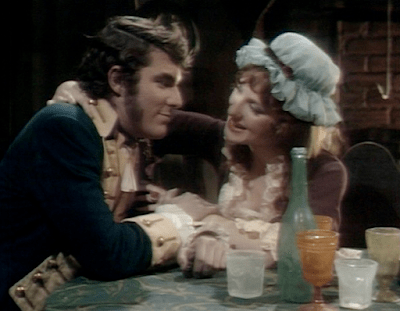
We then see Ben at The Eagle tavern, demanding “More rum!” Maude is at his table, trying to engage him in conversation. He warns her against going out at night, bringing up Ruby Tate, a woman who died on the docks some nights before. Maude has already said that she arrived in town the day of Ruby’s death, but when she is explaining why she isn’t afraid to go out alone at night she suddenly becomes the expert on Ruby’s ways. “She talked to anyone. I don’t.” This is a delicious little moment, reminding us of all the people we’ve known who make up little stories to persuade themselves that they are immune from the misfortunes that have befallen others.
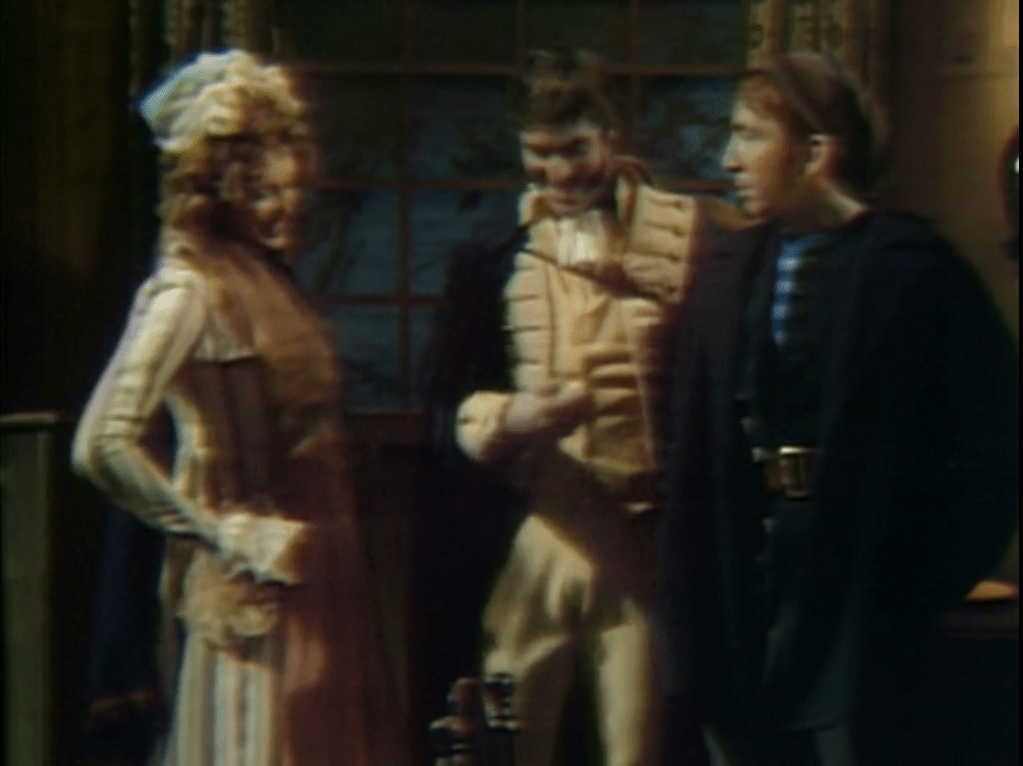
Untrustworthy naval officer Nathan Forbes enters the tavern accompanied by a man in sailor’s togs. Maude gives up on Ben and leaves his table; she chats with Nathan for a moment, her eyes on the bulge in his pants most of the time. That’s understandable, it’s rather a conspicuous bulge.
Maude leaves the tavern, and Nathan directs his companion to sit with Ben and to get information from him about Barnabas Collins. The man introduces himself to Ben, giving his name as Noah Gifford. Noah claims to be looking for work on the great estate of Collinwood. Ben tells Noah to stay away from there and to go back to the sea. He is drunk enough to mention Barnabas’ name, but doesn’t say much about him. He says that he wishes he could go to sea himself. He says that he likes tea, and wants to go to China to get a nice strong cup of it.
In #363, the ghost of Barnabas’ little sister Sarah mentioned that her father and his friends were always going to China on their ships. When Ben brings up China, regular viewers might remember that, and take it as confirmation that the Collinses were involved in trade with China in the 1790s.
Right before we watched this episode, I was reading an article by Amitav Ghosh in the 23 January 2024 issue of The Nationmagazine about trade between the USA and China. Mr Ghosh says that between 1784 and 1804, the USA shipped a wide variety of products to China, but that from 1805 on Americans sold nothing to China but opium. He likens the label “China trade” for that commerce to calling Pablo Escobar’s business “the Andean trade.” Right up to the beginning of the flashback in #365 the show was equivocating on whether Barnabas, Sarah, and the rest of them lived in the eighteenth century or in the 1830s. Choosing 1795-1796 as the setting for this segment turns out to be a way of lightening one of the darker shadows the history we know from our time-band might otherwise have cast over the world of the show.
Nathan’s connection with Noah will sound another echo in the minds of longtime viewers. The first unsavory mariner on the show was seagoing con man Jason McGuire, who spent several months in 1967 blackmailing reclusive matriarch Liz. Jason was accompanied by a henchman, dangerously unstable ruffian Willie Loomis. Nathan at first seemed to be a good-natured and likable fellow, if a bit free with the servant girls and regrettably mercenary in his engagement to marry heiress Millicent Collins. But ever since it turned out that he already had a wife and that she was blackmailing him into splitting Millicent’s inheritance with her, Nathan has been reminding us more and more of the sinister Jason. When he turns up with Noah in tow, the resemblance is complete. We can only wonder if Noah will follow Willie’s lead and get into some kind of terrible trouble at the Collins family mausoleum in the cemetery north of town.
On the docks, Barnabas meets Maude. He goes through the same struggle to keep himself from biting her that he had gone through with Ruby in #414. He is so slow to move in for the kill that she has time to scream and attract Nathan’s attention. Barnabas hears someone running towards them, drops his cane, and runs off.
Nathan sends Maude back to the tavern. He finds the cane and recognizes his old friend Barnabas’ signature wolf’s head handle. In the tavern, he asks Maude to describe her assailant. She mentions that the man wore a gold ring with a large black stone. Knowing that Barnabas always wore such a ring, Nathan is convinced that he did not go to England as his family has been telling everyone, but that he is in Collinsport and is the strangler who has been terrorizing the community.
Nathan seemed most virtuous when Barnabas was alive and he was his more or less loyal friend. So it is a jolt that his reaction to the idea that Barnabas might be a serial killer is to tell Ruby that, lucky as she was to escape the Collinsport Strangler, she “may not be the only lucky one tonight.” Since he has not made any move to contact the authorities, there can be little doubt that his luck is not an opportunity to stop the killings, but the discovery of information he can use to blackmail the Collins family out of every penny they have. He has completed his transformation from a good guy with a rakish side into a deep-dyed villain.
Closing Miscellany
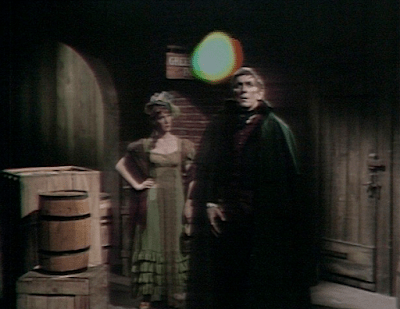
As Nathan enters the waterfront scene, we see a sign behind him labeled “Greenfield Inn.” We saw weeks ago that the Collinsport Inn, familiar from the first year of the show, already exists in the 1790s, so evidently this is a different hostelry. In #214, when Barnabas had returned to Collinsport in 1967, high-born ne’er-do-well Roger Collins did mention that any place in town other than the Collinsport Inn where there were rooms for rent would hardly “qualify as a flophouse”; perhaps the Greenfield Inn is the ancestor of one of these frightful places.
Greenfield Inn. Presumably not the front entrance.
Originally broadcast on 29 February 1968, this was the only episode of Dark Shadows to air on a Leap Day. One of the reasons I started the episode summaries this blog when I did is that the calendars for the years 2022-2027 match those for 1966-1971, so that I can post on the 56th anniversary of each original broadcast, matching not only the date but also the day of the week.













 Dark Shadows Commentary