One day in the year 1897, Edward, Carl, and Quentin Collins hear their sister Judith read their grandmother’s will. Stuffy Edward and childlike Carl are shocked to find that Judith is the sole heir of their family’s vast holdings. Quentin stole the will and tried to forge a new one, so he is not shocked, but he is weirdly gleeful about the paragraph relating to him. He will receive no property and no income, but will be guaranteed a place to live in the great house of Collinwood forever. This enshrines his relationship with Judith as one of the clearest examples of Dark Shadows’ signature dynamic of Bossy Big Sister and Bratty Little Brother. No matter how atrociously Quentin may behave, no matter how loudly Judith may disapprove of him, she has no authority to punish him and her concern for the family’s good name will compel her to cover up his misdeeds and shelter him from their natural consequences.
Meanwhile, governess Rachel Drummond and ladies’ maid Beth Chavez are busy with a mystery concerning the room on top of the tower that stands in the middle of the great house. Rachel has seen lights in the room and suspects someone is being held prisoner there; contrary to the direct orders of Judith and Edward, and against Beth’s very strongly worded advice, Rachel is investigating this matter aggressively. She sneaks up the stairs to the top of the tower, listens at the door to the room, and sees Beth coming out of it with a tray.* She then goes to Beth’s room, where she interrupts Quentin sexually harassing Beth. When she tells Beth what she saw in the tower and asks about it, Beth is shocked that Rachel went into the tower. She denies everything.
Later, Rachel goes back to the top of the tower and again listens at the door. She hears a cradle rocking. We saw that cradle in #645, when Dark Shadows was set in contemporary times and Quentin and Beth were ghosts haunting children David Collins and Amy Jennings. They sent Amy and David to fetch the cradle from the attic of the Old House on the estate and to bring it to Quentin’s old room in the west wing of the great house. This is one of the first times in the 1897 segment when we explicitly close a loop opened during the “Haunting of Collinwood” story.
*At the beginning of the episode, we saw Beth approach the room with the tray and a baby doll. During that scene, we hear what I believe is new music. It has been quite some time since we have heard any new cues, so this stands out.
Vampire Barnabas Collins returns to his coffin at dawn to find it already occupied. Governess Rachel Drummond is resting there, and is under the impression that she is Barnabas’ lost love Josette. He exclaims that only his old enemy, wicked witch Angelique, could be “monstrous enough” to put Rachel in this position.
Longtime viewers remember that in #248 Barnabas forced Maggie Evans, who like Rachel is played by Kathryn Leigh Scott, into this coffin because she refused to submit to his attempt to brainwash her into thinking she was Josette. So we know that Angelique is not all alone in the ranks of the sufficiently monstrous. On the other hand, we also know that it was Angelique who made Barnabas a vampire in the first place, and that like others who labor under Angelique’s curses he is in many ways a reflection of her. So perhaps his remark is not so preposterous an example of lack of self-awareness as it initially seems.
Shortly after, Rachel comes to in the front parlor of Barnabas’ home, the Old House on the estate of Collinwood, and is puzzled to find herself there with him. She has no idea how she got to the Old House, and certainly has no memory of the coffin in its basement. Barnabas tells Rachel he found her wandering in the woods. She goes to pieces, overwhelmed that she is not in control of her actions. He talks soothingly to her. Rachel collects herself, but is still struggling not to let Barnabas see her cry. He offers to walk her home to the great house on the estate. This offer is sheer bravado on his part- the sun has been up for some time, and he cannot possibly expect to survive outdoors all the way to the great house. Luckily for Barnabas, Rachel declines his offer. Unable to keep her emotions in check any longer, she hurries out the front door, walking herself home.
At the great house, Rachel sees maidservant Beth enter the foyer carrying a baby doll. Rachel says that her charge Nora will like the doll very much. Beth sputters at this remark, and spinster Judith Collins summons Beth to the drawing room. Rachel eavesdrops while Judith scolds Beth for her carelessness. Returning viewers know that Beth is helping Judith and Judith’s brother Edward keep someone prisoner in the room atop the tower of the great house, and that it is hugely important to Judith and Edward that no one knows about this. Beth’s sputtering response to Rachel told us also that the doll is not for Nora, but for this mysterious prisoner. Rachel does not have all the information about the matter that we do, but she has enough to suspect something very much like the truth, so we wonder what she gets out of the conversation she overhears.
Later, Rachel meets Beth in the foyer and urgently pleads with her for information about Edward’s wife, the mother of Nora and of her other charge, Jamison. Beth tells her what Edward has already made abundantly clear, that the topic is utterly forbidden. Rachel sidles up to Beth, bends her head at an angle, and speaks in an urgent whisper, something we have not seen from either Maggie or Miss Scott’s other role, Josette. Indeed, Rachel is quite a fresh character, impressively so from an actress whom longtime viewers already seen for so many hours.
Rachel pleads with Beth for more information.
Judith overhears Rachel’s questioning of Beth and Beth’s response that Rachel should leave the matter alone. Judith dismisses Beth and talks to Rachel, telling her that Beth has given her very good advice. Judith has figured so far as a stern and menacing figure; it is something of a surprise that she does not fire Rachel on the spot, and even more of a surprise that she indicates she will not report the conversation to Edward.
The opening voiceover will tell us in a couple of days that Rachel’s reckless curiosity is “spurred on by her own fears.” Miss Scott has been playing this motivation all along. When we first saw Rachel, she and Edward were in a train station. He was being courteous to her, but she was stiff and awkward, clearly very much afraid of something. She is often seen reading, and her dialogue is both filled with signs of intellectual ambition and delivered with a frantic edge, suggesting that her studiousness has its roots in her attempt to defend herself against some danger. We have no idea as yet what that danger was or how it formed Rachel before we met her, but we know that her reaction to the evidence that she has found that someone is being held prisoner in the tower room at Collinwood is a deepening of her long-established fears, not the sudden appearance of new fear.
For her part, Judith’s main concern is finding her late grandmother’s missing will. The late Mrs Collins kept the provisions of her will secret, and it was stolen shortly after her death by some people who wanted to forge a new will and get the estate for themselves.
A woman named Magda Rákóczi shows up at the house, claiming to be able to help Judith find the will. Judith is violently prejudiced against Magda for her Romani ethnicity, and dismisses her offer of help out of hand. But Magda persists. Knowing that her grandmother had a fondness for Magda, Judith lets her into the drawing room and sits behind her while she reads the tarot. Judith keeps protesting that the previous cases Magda cites as evidence that the tarot can tell the future prove nothing, and that in her interpretations of them she is “making no sense whatsoever.”
Magda then says that the arrangement of the cards means that the will is hidden in the room where Judith’s grandmother died, in “the heart of the room.” In an entirely different voice than she has been using so far, Judith asks “What is meant by the heart of the room?” With that, Magda knows that she has Judith in the palm of her hand, and she starts to ham it up. “The hearrrt of the roooom… is a booook! A book that was very important to your grandmother! A very, very oooolld booook!” Judith decides this must be the family history, and she tells Magda that she will look through it at once.
In fact, Barnabas found the will and hid it in the family history. He has sent Magda to tell Judith where to find it. It comes as no surprise to us when Judith comes downstairs with the will and is jubilant to find that she is the sole heir of her grandmother’s vast holdings. After all, Barnabas wants the original provisions of the will to be enacted, and the only way to ensure that result is to see that it comes to the hand of the person who is its chief beneficiary.
We end with Beth standing at the door to the tower room, holding the doll and addressing the person inside as “Jenny.” We learned in #701 that Beth was originally maid to a lady named Jenny, that everyone thinks Jenny has gone away, and that it is surprising Beth has stayed on at the house in Jenny’s absence. Now it is confirmed that Jenny is the prisoner in the tower room. The obvious inference is that Jenny is Edward’s estranged wife, and that she has become the sort of crazy lady who appreciates baby dolls.
Dark Shadows first developed its conception of the supernatural in depth when undead blonde fire witch Laura Murdoch Collins was on the show from December 1966 to March 1967. Laura was not so much one person as she was a complex of at least three distinct beings. There was a charred corpse in the morgue in Maricopa County, Arizona; a phantom that Laura’s son, strange and troubled boy David Collins, can sometimes see through his window as she flickers above the lawns of the estate of Collinwood; and a living woman who carries on conversations with people but is never seen eating or drinking. People who encounter Laura also experience dream visitations that resemble her and unaccountable compulsions to do things relating to her, but it is never clear which of those psychic phenomena come from Laura and which from her arch-nemesis, the ghost of the gracious Josette. It is clear that the various parts that make up Laura are not always aware of each other, and sometimes work at cross-purposes with each other.
Laura’s successor as Dark Shadows‘ chief supernatural menace was vampire Barnabas Collins, who joined the show in April 1967. Like Laura, Barnabas comes in several parts, not all of them working together harmoniously. For example, sometimes doors slam shut when he is in a house, and only he can open them. This is never shown as something he deliberately makes happen, and it does not always serve any intelligible purpose of his. Also, when he is active dogs start howling. Sometimes that immobilizes his targets with fear and confusion, but just as often it costs him the element of surprise and foils his plans. So whatever uncanny forces cause these things to happen are clearly not subject to Barnabas’ will. They accompanied him out of the darkness.
Shortly after Barnabas’ arrival, the show retconned Josette as his lost love and cast her as Princess Ankh-Esen-Amun to his Imhotep in a remake of the 1932 film The Mummy. In that film, the undead man tried to remake contemporary woman Helen Grosvenor in the image of the ancient Ankh-Esen-Amun. Taking that role in Barnabas’ attempt to recreate Josette was Maggie Evans, The Nicest Girl in Town. As in the 1932 film Zita Johanns played Helen in the contemporary scenes and Ankh-Esen-Amun in a flashback to ancient Egypt, so in #70 and #126 had Miss Scott already played the ghost of Josette.
While Barnabas pursued his crazed and evil plan to Josettify Maggie, the ghost of his little sister Sarah showed up. Sarah befriended Maggie and helped her escape from her “big brother.” Sarah did more and more, ultimately sending well-meaning governess Vicki back in time so that from November 1967 to March 1968, Dark Shadows was a costume drama set in the 1790s, when Barnabas and Sarah were alive.
Like Laura and Barnabas, Sarah may have looked like single person, but was in fact a complex of independent beings. In #325, she visits David in a dream and gives him information only she would have. In #327, David sees Sarah during waking hours and tells her about the dream, and it all comes as news to her. This daylight Sarah makes it clear to David that she does not want him to have the information the dream version of her gave him so shortly before.
Moreover, child actress Sharon Smyth was instructed to play Sarah as Barnabas’ conscience. When Barnabas is freed to prey upon the living, he unknowingly pulls Sarah out of the supernatural back-world behind the action of the show, the unseen realm where Josette’s ghost, the “Widows,” the ghost of Bill Malloy, and the rest of them lurk, and brings her with him into 1967. Sarah, however many of her there are, is part of the same complex that includes Barnabas and the forces that surround him.
In the 1790s portion, we met wicked witch Angelique and saw her place the curse that turned Barnabas into a vampire. Like the other supernatural forces, Angelique was a complex of multiple beings, some of which were opposed to each other. In her case, spellcasting was a matter of breaking off little bits of herself that took on lives of their own. Angelique was obsessed with the idea that Barnabas would fall in love with her. She could easily cast a spell to make him do that, but insisted to her helper that Barnabas must come to her “of his own will.” Those were the exact words Barnabas used when talking to his own thrall about Vicki, who succeeded Maggie as the object of his gruesome fantasies. When we heard Angelique take the same line, it dawned on us that the Barnabas we saw from April to November 1967 was not merely cursed by Angelique, he was possessed by her. His thoughts were her thoughts, his plans were her plans. When Barnabas fights Angelique, it is one of her replicas of herself coming back to oppose her, as the zombie version she created of Barnabas’ uncle Jeremiah came back to bury her alive in #396.
Now, Barnabas has traveled back in time to 1897. He has met governess Rachel Drummond, who is played by Kathryn Leigh Scott and whom he recognizes as a double of Josette. Angelique has also come to 1897, conjured up by some Satanists whom Barnabas has antagonized for no apparent reason. Angelique peered through the windows of the great house of Collinwood just in time to see Barnabas giving Rachel Josette’s music box. Dismayed, she went to the Old House on the estate, looked at Josette’s portrait, and declared “I am Angelique, and I hate you!” She, like Barnabas, looks at Rachel and sees another Josette.
Angelique’s motivation in the 1790s segment was ostensibly about her desire for Barnabas, but it was her hatred for Josette that drove her at every turn. Now we see that Barnabas is compelled to create another Josette whom he can love; Angelique is just as powerfully compelled to create another Josette to hate. Since Barnabas’ “love” involves killing its object and raising her as a vampire, it would seem to be as hateful as is Angelique’s overt hostility.
After Angelique proclaimed her hatred to the portrait, she took a cloth doll representing Rachel and strangled it. Rachel herself collapsed, unable to breathe. Angelique mouthed words; Rachel spoke them, leading Barnabas to believe that they were a message from Josette.
Today, Rachel is in the drawing room at the great house, recovering from her choking episode. Barnabas is holding her and looking longingly at her neck when stuffy Edward Collins enters. Edward demands to know what is going on, and Barnabas explains that Rachel had trouble breathing and fainted. Edward becomes concerned and wants to call a doctor; he becomes suspicious when Rachel, who he just met a few days ago, does not want to see a doctor. Barnabas manages to distract Edward from his suspicions with some chatter about the circumstances under which Rachel fainted.
In the groundskeeper’s cottage on the estate, Angelique casts a spell to summon Rachel. Back in the great house, Rachel suddenly looks up, her eyes wide open and focused at a point in the middle distance. She stands up and walks with her neck very still, moving like a wind-up doll. She announces to Edward and Barnabas that she will be going outside for a breath of fresh air. She refuses Barnabas’ offer to accompany her. Edward and Barnabas watch her wonderingly as she marches out with her robotic gait.
Barnabas and Edward wonder what has got into Rachel all of a sudden
Rachel arrives at the cottage and finds Angelique. Angelique calls Rachel “Josette.” When she protests that her name is Rachel, Angelique echoes the Barnabas we first knew and tells her that, when she wills it, her name will be Josette. She tells Rachel that she will not understand what is happening to her, but that Barnabas will soon understand very well.
Back in the great house, a servant tells Edward that he found a woman in the cottage. Barnabas is there, and he reacts to the description with alarm. He goes to the cottage, clearly afraid that he will find Angelique there. Before he can complete a search, a rooster crows and Barnabas hastens back to his coffin in the basement of the Old House on the estate.
Barnabas opens the coffin, and finds Rachel lying in it, unconscious. This sets up a comedy of manners. He hardly knows her well enough to lie down with her, and he can’t very well wake her and ask her to make way for him. We end with him facing this problem in etiquette.
We may also remember #248, when Barnabas expressed his frustration with Maggie’s refusal to turn into Josette by forcing her into his coffin. Perhaps Angelique knows that he did that, and is taunting him with a memory of which he has since shown an ability to be ashamed. If so, the point of the taunt is that he is not different from her. Angelique called Rachel a “pawn” in the “cruel game” she is playing with Barnabas. Angelique, who when we first saw her in the 1790s segment was so monomaniacally devoted to her goals that she could not see events from any perspective other than her own, can now understand that what she is doing to Rachel is horrible. That’s why she is doing it, to show Barnabas that he is part of the same horror as herself and that he can never transcend it.
In the groundskeeper’s cottage on the estate of Collinwood, Satanists Evan Hanley and Quentin Collins call on the powers of Hell to send a demon to help them fight Quentin’s recently arrived and deeply mysterious distant cousin Barnabas. The call is answered by none other than our old friend Angelique the wicked witch.
Quentin and Evan have no idea who Angelique is, and she does not know them either. Evan introduces himself to her as a lawyer; he seems genuinely surprised that this does not impress her. Evan tells Angelique that he and Quentin summoned her from Hell and can send her back; she agrees that they summoned her, but is not so sure they can send her back. Quentin tells her that the year is 1897, that she is on an estate known as Collinwood, and that he and Evan have an enemy called Barnabas Collins. Angelique is intrigued by the year, familiar with the estate, and thrilled to hear about Barnabas. Evan starts making demands; Angelique causes him to choke and gasp. She is quite friendly to Quentin, and when Quentin suggests she let Evan breathe and speak again, she indulges him.
Angelique puts Evan in his place.
Evan is played by Humbert Allen Astredo, who in 1968 played suave warlock Nicholas Blair. He plays Evan with exactly the same bearing, tone of voice, and range of facial expressions he had brought to the role of Nicholas. Viewers who remember Nicholas have been bewildered by this. Barnabas knew Nicholas and fought him; when he met Evan the other day, his reaction left open the possibility that he recognized him as the same person. But Evan’s dabbling in the occult, as we saw it yesterday, shows only an infinitesimal fraction of Nicholas’ vast abilities in that field, and his buffoonish response when Angelique appears shows that he is no relation.
It is when Angelique strikes Evan dumb that we learn why Astredo played him in the same way he played Nicholas. Nicholas was introduced as Angelique’s boss, the master of magical powers much greater than hers. Since the main difficulty with fitting Angelique into a story was that she could easily accomplish any goal if she just kept her focus, adding a character who is even more powerful took the show to an absolute dead end. They had to box Nicholas up inside a lot of pointless business, and he quickly became a source of frustration to the audience. Seeing Astredo as another Nicholas reminds us of that frustration, and when Angelique brushes him aside with a flick of her finger our unease evaporates. We are assured that the plot will keep moving this time, and that Astredo will be free to show us what he can do as an actor.
At the end of Friday’s episode, it was Quentin who tried to stop the ceremony when Angelique’s visage began to take shape in the fire, fearing they had gone too far. Today Quentin realizes there is no turning back, but Evan keeps saying he wants to return Angelique whence she came. It’s hard to see what he expected- he was calling on the Devil to send a demon. I suppose he really is disappointed that Angelique is not excited to find herself in the company of a member of the bar.
Quentin goes home to the great house on the estate. He sneaks up behind governess Rachel Drummond while she is dozing on the sofa in the drawing room and puts his hand on her face. That wakes her. When she protests, he asks if he did it unpleasantly. She answers, “No… I mean, yes!… I don’t know.” That summarizes precisely the natural reaction to Quentin. His behavior is abominable in the extreme, but David Selby’s charisma and easy charm come through even in the character’s darkest moments, and the audience can no more want him to stay off-screen than the female characters can want him to leave them alone.
Quentin and Rachel sit together; his hands are on her face again when Barnabas shows up. Quentin gets up and twits Barnabas with his obvious closeness to Rachel, then excuses himself to go to bed.
Barnabas gives Rachel a music box that once belonged to the gracious Josette. This will induce further flashbacks in longtime viewers. Barnabas is a vampire, and as a living man in the 1790s he was in love with Josette. In May and June of 1967, Barnabas lived in contemporary times. He abducted Maggie Evans, who like Rachel in the portion of the show and like Josette in the portion set in the 1790s, is played by Kathryn Leigh Scott. He tried to erase Maggie’s personality, overwrite it with a copy of Josette’s, and to turn her into his vampire bride. The music box played a crucial part in this remake of the 1932 film The Mummy.
When Barnabas urges Rachel to listen to the music box, we pan to the window and see Angelique peeking in. As Angelique’s great power is the main difficulty with fitting her into a plot, so her single-mindedness is the main difficulty with making an audience enjoy watching her. This shot of her does as much to enlist the sympathies of longtime viewers as does the moment when she shuts Evan up. The whole time Barnabas and Rachel are involved with the music box, we are groaning. It was during the imprisonment of Maggie that Dark Shadows first became a hit, and it is a story that the show has been strongly identified with ever since. But we do not need to see it again. Angelique once married Barnabas and is maniacally possessive of him, and she does not want to see it either.
Angelique is as dismayed as we are, though for a different reason.
In the 1790s segment, which ran from November 1967 to March 1968, we saw that Angelique was motivated at least as much by her hatred of Josette as by her desire for Barnabas. After she has seen Barnabas getting up to his old tricks with Josette-lookalike Rachel, Angelique visits the portrait of Josette which hangs above the mantel in the parlor of the Old House on the estate. Longtime viewers know that Josette’s ghost inhabits the portrait. In #70, the portrait glowed, her ghost (also played by Miss Scott) emerged from it, then went outside and danced among the pillars. In #102, strange and troubled boy David Collins stood in front of the portrait and had a lively conversation with it. We could hear only his side, but it was clear the portrait was answering him. Today Angelique stands where David stood then. She scowls at the portrait and declares “I am Angelique, and I hate you!” She then goes back to the cottage where Evan and Quentin conjured her up and chokes a cloth doll, causing Rachel to collapse. She mouths words, and Rachel speaks them. Hearing Rachel talk about Josette’s death, Barnabas cries out in anguish.
This was the first episode credited to writer Violet Welles, who worked as a Broadway publicist before and after working on Dark Shadows. Ms Welles had been an uncredited collaborator with Gordon Russell on a great many of his projects, including several episodes of Dark Shadows prior to this one. She was by far the best writer of dialogue on the show. It is no wonder that the “Memorable Quotes” section of the Dark Shadows wiki entry for this episode includes whole scenes; the lines glitter with wit. Now that she is with Dark Shadows as a senior writer under her own name, the show enters its most successful period, both artistically and commercially.
Libertine Quentin Collins has stolen his late grandmother Edith’s will, intending to forge a substitute that will give him control of her vast estate. His distant cousin, the recently arrived and thoroughly mysterious Barnabas, has warned Quentin that Edith’s ghost will haunt him if he persists in this plan. Quentin hears a loud pounding emanating from the walls of the great house of Collinwood. He goes to the study, where Edith lies in her coffin. He sees her there, grinning at him. Quentin returns to his room; the still-grinning Edith sashays in and taunts him. He tells her she is dead; this does not seem to bother her. She just keeps on grinning.
Edith may be dead, but she is clearly having a blast. Screenshot by Dark Shadows Every Day.
Quentin strangles Edith. She falls into an armchair in his room, unmoving but still grinning. He buries her somewhere on the grounds of the estate; her hand sticks up from the earth. He wakes up.
Quentin’s friend, unethical lawyer Evan Hanley, comes calling. Evan asks Quentin to give him the will so he can take it to a forger of his acquaintance. Quentin tells Evan about the dream, and how shaken he is. He also tells him about Barnabas, and his concern that Barnabas is a formidable enemy who may have uncanny powers. When Evan tries to dismiss Quentin’s worries, Quentin responds that he is the last person who should make light of the supernatural. When Quentin speaks of Evan’s “devil-callings,” we learn that the clandestine “meetings” they spoke of the other day are Satanist ceremonies. Evan agrees to meet Quentin at 8:00 that night in the groundskeeper’s cottage on the estate to summon one of the spiritual forces of darkness to fight Barnabas.
Returning viewers know that Quentin is right to fear Barnabas’ connections to the supernatural. Barnabas is a vampire, and his powers include the ability to send hallucinations to torment people with guilty consciences. He is also a time-traveler, who has come to 1897 from 1969 on a mission to prevent Quentin from becoming a ghost who will drive the Collins family of that year out of the great house and plague strange and troubled boy David Collins to the point of death.
First time viewers will not learn that today; aside from the opening voiceover, this episode tells us nothing about Barnabas. It does tell us something about Quentin and Evan. They are super-racist against Romani and Sinti people.
Evan has decided to hire Sandor Rákóczi to forge the will. Sandor and his wife Magda have been staying at the Old House on the estate for some time as Edith’s guests. Quentin’s brother Edward and sister Judith are offended by the presence of these “gypsies” in their midst. Unknown to Evan and Quentin, and unmentioned in today’s episode, Barnabas has bitten Sandor, enslaving him. Presumably Sandor has no secrets from Barnabas, making him a bad choice to be Quentin and Evan’s henchman.
Three times today, Evan addresses Sandor as “Gypsy.” When he is putting it to him that he wants him to forge the will, he barks at him with “Now, one moment, Gypsy.” He insists Sandor fix his price in advance. When Sandor tells Evan he is sad that he does not trust him, he replies “Well, then, be sad, Gypsy, but give me your price, now!” Later, Sandor will express curiosity about Quentin and Evan’s plans, to which Evan will reply “Well, don’t be curious, Gypsy, just do as you’re told.”
Evan told Quentin that the “devil-calling” at the cottage should involve twelve year old Jamison Collins as a “sacrificial lamb.” Quentin sincerely cares about his nephew Jamison, and he protests that he won’t do anything to hurt him. Evan assures him that Jamison will simply be a symbol of the innocence that their dark lord exists to despoil and that the boy himself will not be harmed. When Quentin is talking Jamison into joining him and Evan for a secret meeting that night, he tells him they will look into the future. Jamison asks”How, with a crystal ball?” Quentin replies “No, of course not. That kind of thing is for gypsies. It’s not for men, like you and me.” Scripted television in the US in the 1960s rarely gave such flagrantly racist remarks to recurring characters, not only because the audience included members of minority groups, but also because they are so unattractive that they limit the utility of the characters who make them. In this case, Quentin and Evan are already in league with the Devil, and Quentin is on track to die soon and become a ghost. So we know that they are due for a comeuppance. Moreover, their prejudices may lead them to underestimate Sandor, both on his own account and as a tool of Barnabas, so it is useful to the plot that they are in the grip of such ugly attitudes.
Sandor is in the cottage, preparing to forge a new will for Edith, when Jamison drops in. Jamison does not see what he is doing. He and Sandor spend a couple of minutes sparring verbally. Sandor ends the match when he points out to Jamison that it is getting dark. The boy looks alarmed and runs home while Sandor laughs.
In #701, Sandor and Magda mentioned that the Collinses were afraid of the night. Shortly after, they found out about Barnabas, and learned that they had good reason to be. But Sandor can still laugh when he sees that a boy as old as Jamison runs away at the news that the sun is setting.
Sandor is still in the cottage when Quentin brings Jamison by. Evidently Evan plans to let Sandor participate in the ceremony. Regular viewers will remember that in 1969 the first place Quentin manifested himself outside the little room in the great house where David and his friend Amy discovered him was in the cottage, and that he showed considerable power there. That he and Evan have their Satanic “meetings” in the cottage suggests that the evil he did in 1969 has its roots in what he did during them.
Evan directs Jamison to stare into the fire burning in the hearth. This will ring another bell for longtime viewers. Jamison is played by David Henesy, as is David Collins. From December 1966 through March 1967, David Collins’ mother Laura Murdoch Collins lived in the cottage. She was an undead blonde fire witch, and her plan was to lure David to join her in a fiery death. She would rise from the dead as a humanoid Phoenix, as she had done at least twice before. On each of those previous occasions, she went into the flames with a son named David; the Davids did not rise again, as becomes clear when one of them is available to speak in a séance in #186. Laura often urged David to join her in her favorite pastime, staring into fire. So when Evan urges Jamison to do the same, we wonder if Jamison, too, is in danger of being consumed by its fascination.
As the ceremony goes on, Jamison becomes alarmed. He runs out, and Evan orders Sandor to follow him. Quentin, too, runs to the door and protests that they have gone too far. He points to the flames, in which the likeness of a skull wearing a wig takes shape. We may wonder if more will be added to the skull, perhaps so much as to make up a whole woman, and if this woman will be someone we have met before.
Edith’s role in Quentin’s dream unfortunately marks Isabella Hoopes’ final appearance on Dark Shadows. She was just terrific. I wish they had done a parallel time story set around the period of the Civil War in which Hoopes played an aged Sarah Collins. Her nose, chin, and cheekbones resembled those of Sharon Smyth sufficiently that you can imagine an elderly Sarah looking like her, and she had a playfulness that would make longtime viewers remember the nine year old ghost we met in June 1967.
One day in 1897, Edward Collins convenes his siblings Judith, Carl, and Quentin for a family meeting in the drawing room of the great house of Collinwood. Their grandmother Edith died the night before. She was supposed to tell Edward a celebrated family secret, but did not do so. Edward is convinced she must have told one of the others, and declares that no one will leave the room until he finds out which.
Returning viewers know that Edith did not tell any of them, and we can imagine a half hour of nothing but the four Collinses of Collinwood sitting around staring at each other. Fortunately, Quentin points out that Edith was briefly alone with their recently arrived and thoroughly mysterious cousin, Barnabas Collins, and she might possibly have told him. Edward orders Carl to go to the Old House on the estate, where Barnabas is staying. Carl asks why it’s always him who has to do these things, and Edward angrily shoos him away. Louis Edmonds and John Karlen were both talented comic actors, and this little exchange is very funny.
In the Old House, Carl finds Sandor Rákóczi coming up from the cellar. He asks Sandor what he is doing there. Sandor says he lives there. Carl says that he’d heard Barnabas was living in the house now. Sandor says that Barnabas hired him and his wife Magda as servants. Carl laughs at that and says of Barnabas “He is an odd one, isn’t he?” Sandor gives him a fierce look, offended. Carl apologizes.
Carl explains that he has come to fetch Barnabas. Sandor says Barnabas won’t be back until after dark. Carl explains why they need him at the great house, and Sandor laughs. “You must have Gypsy blood! Nobody in the family trusts nobody else!” Carl laughs, too.
This scene may remind longtime viewers of the first time we saw Thayer David on this set, when he was playing crazed handyman Matthew Morgan. The dramatic date and the date of production were both 1966 then. Strange and troubled boy David Collins found Matthew hiding in the Old House, and agreed to help him avoid the police. Carl is a grown man, but he is as eager to please and uninterested in asserting dominance for any length of time as was the nine year old David. Further, he is so naive that he reacts with bewilderment to the idea that lust for money might be a motive for murder. Carl may not be less prejudiced against Romani people than are the rest of the Collinses, but his childlike qualities allow him to laugh at a joke that would have drawn a violent response from any of his siblings.
Carl insists that Sandor go home with him and tell Edward that Barnabas is away. Again, this shows Carl’s childishness. He wants to prove to Edward that he did as he was told and went to the Old House. In fact, Edward is appalled to see Sandor in the great house, and can barely stand listening to him.
While Sandor is leaving, Judith stops him. Sandor is astounded that she is speaking to him at all. She tells him that her grandmother may have tolerated his presence in the Old House, but that she and her brothers will not. Sandor and his wife Magda are to leave the property within twenty four hours. Judith does not give Sandor a chance to tell her that Barnabas has hired them as servants.
On the terrace, Quentin finds Rachel Drummond, the new governess. The two of them look very good together. In fact, Quentin’s seductive manner and Rachel’s response to it make them the most attractive couple we have seen on the show, by a long way.
They talk about the house. Quentin mentions that no one has been in the room on top of the tower since 1796, 101 years ago. Later that night, Rachel will see a light burning in the room, and she will rush into the drawing room to tell Edward about it.
She comes in after a meeting between Edward and Judith. Judith came to tell her brother about something entirely new to the audience. She says that the matter relating to the tower room is going well. Maidservant Beth goes to the room three times a day, and Beth also goes into town regularly to take money to a Mrs Fillmore.
This will interest returning viewers. The other day, Quentin found Beth going into town with a parcel and an envelope containing $300 in cash. Beth said Judith gave her permission to go to town to conduct personal errands, and claimed, absurdly, that she had saved the money from her salary. We now know that she was taking the money to this Mrs Fillmore for some purpose of Edward and Judith’s. Later, Quentin found Beth taking a tray of food upstairs. He asked who was supposed to eat it; she said it was for Edith. When he pointed out that it was more than Edith could eat, she said Judith would be eating with her. In Edith’s room, Beth told Judith about this. She said they would have to be more careful now that Quentin was back home, and dismissed her to take the rest of the food “upstairs.” We now know that this “upstairs” is the tower room, and that Beth is helping Judith and Edward to hide someone there of whose presence in the house Quentin is unaware.
However much this may interest us, it does not interest Edward at all. He is outraged that Judith so much as mentioned the matter to him, saying that he wants her to handle it without notifying him in any way. She objects that they will have to talk about it sometimes; he does not agree.
When Rachel enters and tells them about the light, Edward detains her with a disquisition about the impossibility of the tower room being lighted while Judith scurries off and goes upstairs. After a while, Edward takes Rachel back to the terrace and shows her that the room is dark. He asserts that it was also dark when she looked at it earlier, and it has been dark for over a hundred years.
Longtime viewers will recognize this scene. In March 1968, Dark Shadows was set in 1796, and Barnabas had just become what he is again now, a vampire. Barnabas’ father, haughty overlord Joshua, confined him to the tower room while he tried to find a way to free his son of his curse. Barnabas’ mother Naomi saw lights in the tower room, as did his second cousin Millicent. When Naomi told Joshua about the lights, he pretended not to see them, and when Millicent told her husband Nathan she had seen the lights, he, for his own reasons, also pretended not to see them. Those pretenses led each woman to go to the room, resulting in madness for Millicent and suicide for Naomi. Quentin tells Rachel that the tower room has been closed since 1796 because “a woman killed herself” there; that is an explicit reference to Naomi.
Like Edward and Judith, Joshua and Naomi were played by Louis Edmonds and Joan Bennett. It is a sign of how much more dynamic the 1897 section is than the 1790s section that Judith is an active participant in whatever scheme is going on, not simply a helpless person who stumbles upon a terrible secret and promptly kills herself.
Yesterday, we were in the great house on the estate of Collinwood when dying nonagenarian Edith Collins met mysterious newcomer Barnabas Collins. She told Barnabas that she recognized him. Edith had been entrusted with the Collins family’s darkest secret, which was about Barnabas. He is a vampire, entombed in the 1790s to be kept forever away from the living. Now it is 1897, and Edith sees that the family has failed. She must tell the secret to her eldest grandchild, Edward Collins. Edward comes into the room and Edith tries to tell him what has happened. She has difficulty speaking. Edward asks Barnabas to excuse them. He replies “Of course,” and leaves the room. He does stand at the door and listen to their conversation, apparently waiting to see if Edward will come out with a crucifix and a sharpened stake.
Today, we find that Edith was so shocked by the sight of Barnabas that she has lost her sense of her surroundings. Barnabas was kept in a chained coffin in an old family mausoleum, and Edith does manage to say the word “mausoleum” to Edward, but that’s as far as she gets with the secret. Thereafter, she weaves in and out of the moment, reliving several periods of her life, some as far back as the time of her wedding to Edward’s grandfather.
At the word “mausoleum,” Barnabas rushes back to the Old House on the estate, where he has been staying. He tells his unwilling servant, a woman named Magda Rákóczi, that she must fetch her husband Sandor and that she and Sandor must go to the mausoleum at once, take the coffin out of the secret chamber where it is hidden, leave no trace of any kind in the chamber, and carry the coffin to the house. Magda points out one of several facts that make it impossible to comply with these orders, which is that Sandor is in town where Barnabas sent him. Barnabas refuses to acknowledge this or any other insuperable difficulties, and goes back to the great house.
While Barnabas is sitting in the drawing room clenching his fists on the armchair where he is waiting to see what Edward will do when he learns that he is a vampire, a hidden panel opens and a man carries a pistol into the room. The man holds the pistol at Barnabas’ head and demands he tells him who he really is. The man identifies himself as Carl Collins, one of Edward’s brothers. Barnabas yields nothing. The man discharges the pistol, from which emerges a flag labeled “Fib.” He laughs. Barnabas is not amused. The audience may not share Carl’s sense of humor either, but the subsequent scene in which Carl claims to see that Barnabas has a kind face, predicts that the two of them will become close friends, and offers to let him borrow the pistol and play jokes with it himself, is hilarious. Jonathan Frid plays Barnabas’ icy reaction to Carl perfectly, and as Carl John Karlen does not betray the least glimmer of awareness of Barnabas’ affect.
Carl goes to the Old House to call on Magda. The scene there begins with Magda showing her palm to Carl. He wants her to read the Tarot cards; she says the cards will not speak unless she has money in her hand. Like his siblings, Carl is convinced that the secret which Edith keeps and which she has vowed to disclose only to Edward is the key to control of the family fortune. Magda knows better, but she goes through the cards anyway. They tell her that the family’s fortune is even larger than anyone knows, that when Edith’s will is found it will come as a surprise to everyone, that the surprise will lead to murder, and that the person who inherits the money will not keep it. The Queen of Cups turns up in a position that indicates Edith is still in control, but the last card Magda draws leads her to gasp and stand. She reels about the room, and declares that Edith is dead. “The cards are silent.”
Back in the house, Edward lets Barnabas into Edith’s room. He closes his grandmother’s eyes, and tells Barnabas that she did not tell him the secret. He vows to learn the secret even “if it’s the last thing I do!” We cut to Barnabas, looking uncomfortable. No doubt he is thinking of how inconvenient it would be if Edward were to find out the secret and he had to see to it that it was indeed the last thing he ever did.
This is the sixth consecutive installment to which I have given the “Genuinely Good Episode” tag, a record so far. Like the preceding five, it is stuffed with wonderful things. The acting is all very very good. Isabella Hoopes does a marvelous job as the delirious Edith, as Edward Louis Edmonds gives a master class in how to play a stuffy man, and the pairings of Grayson Hall, John Karlen, and Jonathan Frid with each other all unfold brilliantly, full of laughs but never losing their dramatic tension. So many of the episodes fans most enjoy would be drab for people coming to the show for the first time that it is always a memorable occasion when we see one like this, that anyone should be able to recognize as an outstanding half hour of television. It’s true the visual side lets us down a little; even by the standards of 1960s daytime television, the color is murky and there are too many closeups. But Sam Hall’s script and the performances are so good that no fair-minded person will complain very much about those problems.
Fans will take a special interest in Edith’s ramblings. When it first aired, viewers had no way of knowing how much of what she says about the family’s history will be reflected in upcoming episodes. The writers themselves probably didn’t have a much clearer idea about that than we do. But watching the series through for the first time, our default assumption about each of her lines is that it will have some significance as we go, so if we are committed to watching the show we listen closely.
We’ve already learned that Edith is over 90, so the very latest she could have been born is 1807. More likely she was born a bit before that, sometime between 1801 and 1806. She says today that her father-in-law was Daniel Collins. From November 1967 to March 1968, Dark Shadows was set in the late 1790s, and we saw Daniel. He was about 11 in 1795, so he would have been born in 1784 or thereabouts. So he could have been no more than 23 years old when Edith was born. Presumably his son Gabriel was the same age as his bride, though he might have been significantly younger. Edith does say that she always hated Daniel; perhaps she was a good deal older than Gabriel, and Daniel disapproved of her initially for that reason.
Edith tells us that Gabriel has been dead for 34 years, placing his death date in late 1862 or early 1863. She does not mention his cause of death or say anything about their son who was the father of Edward, Carl, and the others. It is firmly fixed that Edward and Carl’s brother Quentin was born in 1870, so Gabriel’s son must have survived him by several years.*
Edith says several times that the secret has been passed down from generation to generation and that she must tell it to Edward because he is the oldest. That seems to imply that Daniel told his oldest child, whom we presume to have been Gabriel, and that Gabriel told his oldest child, whom we presume to have been the unnamed father of Edith’s four grandchildren. He would then have told Edith before he died, either because Edward was not yet old enough to hear it, or because he was not available at the time.
But that implication is not at all secure. Edith says that Edward must be the keeper of the secret because he is the oldest- she doesn’t say what the connection is between being the oldest and keeping the secret. For all we know, she could have decided on her own to invent that tradition, starting with Edward and continuing with Edward’s oldest child. And when she says that it was passed down from generation to generation, she does not specify how many generations have been involved or which member of each generation did the passing. All we know is that someone of one generation learned it from someone else of a different generation, and that Edith believes it is the family’s responsibility to keep Barnabas from preying upon the living.
I think it’s reasonable to assume that sometime between 1897 and 1967 the secret was lost and not continually passed down. Perhaps in the original timeline Quentin was successful in killing Edith before Edward arrived, or maybe Edward died later in life before he was able to pass it on.
As far as Joshua passing the secret on, maybe he did, or maybe it was the elderly Ben Stokes who started the tradition?
Joshua was Barnabas’ father, and Ben Stokes was a much-put-upon indentured servant who was Barnabas’ devoted friend. They were the two people who knew that Barnabas was a vampire and that he was entombed in the secret chamber of the mausoleum. I replied to “Mike”:
I love that idea. Edith’s desire to tell the oldest son may lead us to assume that it has been handed down to the oldest son generation after generation, and it does lead the “Fab Four”** to assume that it brings with it some kind of power and access to riches. But their assumption is wrong, and ours may also be. Perhaps Joshua never told anyone. Perhaps the first person to tell the secret was Ben Stokes, and the person he told was Edith.
The scene between Barnabas and Magda brought another question to my mind. In #334, Barnabas was able to lock the panel in the mausoleum that leads to the secret room. Why doesn’t he just do that? It has also been made clear that as a vampire he is far stronger than are humans- if he wants to move the coffin from the mausoleum to the Old House, surely he could pick it up himself and do it more quickly and with less risk of detection than could Magda and Sandor. My wife, Mrs Acilius, agrees that we don’t know why Barnabas doesn’t lock the panel, but she says that it is perfectly clear why he can’t move the coffin- that is manual labor, and he is an aristocrat. His servants must do that.
*In a later episode, Quentin will mention that he knew Gabriel, throwing the 1862/3 date into question. But they never get around to any stories that depend on anything that happened in Gabriel’s later years. By the time we get to that one, only obsessive fans will remember his name. Eventually we meet two characters named Gabriel Collins, one in episodes that will air in 1970 and the other in the 1971 film Night of Dark Shadows, but a death date in the 1860s is not relevant to anything we learn about either of them.
**The “Fab Four” are Edith’s grandchildren, Edward, Carl, Quentin, and their sister Judith.
Three of the residents of the great house of Collinwood in the year 1897 are spinster Judith Collins, her brother, libertine Quentin Collins, and their grandmother, nonagenarian Edith Collins. At the opening of today’s episode, Judith walks in on Quentin strangling Edith in her bed. She tells him to stop it and leave the room. He complies, with a sulk. Edith shakes off her annoyance with Quentin, and she and Judith have a conversation about various matters.
One of Dark Shadows’ signature relationships is that between Bossy Big Sister and Bratty Little Brother. However serious the misconduct Bratty Little Brother commits in his disobedience to Bossy Big Sister, in the end she will cover it up and protect him from its consequences. Nothing at all will happen to Quentin as a result of his attempt on his grandmother’s life; Judith will just continue disapproving of him, as she has always done. Later in the episode, Quentin will remark to his recently arrived and quite mysterious distant cousin Barnabas Collins that Judith “gets carried away by delusions of authority. The fact is, she has no authority whatsoever.” Judith overhears this and objects to it, but Quentin’s presence in the house suffices to prove that her manner is not an expression of authority, but simply childlike role-playing.
Quentin’s motive for his attack on dear old grand-mama was his demand that she tell him the family’s “secret.” Edith has declared that she will pass this secret on only to Edward, who is Judith and Quentin’s eldest sibling. Edward is away, and Edith is terribly afraid she will die before he returns. After Judith shoos Quentin out of Edith’s room, she herself tries to wheedle Edith into telling her the secret. Edith tells Judith she is better off not knowing, but Judith does not seem to be convinced. Quentin has said in so many words that his only desire is to take control of the family’s wealth, and Judith is focused on preventing him from doing that. So we can assume that their frantic eagerness to learn the secret is rooted in the belief that the person who knows it will inherit the estate from Edith.
We see Edward. He is not at Collinwood, or even in the village of Collinsport. If I recall correctly, this is the first time the show has taken us anyplace out of town other than the mental hospital since we visited Phoenix, Arizona in #174, more than two years ago.
Edward is in a train station, impatient and irritable, talking with a young woman whose rigid posture and blank facial expression show that she is exceedingly uncomfortable. Her name is Rachel Drummond, and she is to be the new governess for Edward’s son and daughter. He says that he means for her to use her own judgment in making up their curriculum. Rachel says she will have a clearer idea of what her approach will be once she has met the children and Edward’s wife. Edward freezes, and says that he has no wife. Rachel apologizes for her assumption; he says that she has no need to do that, as he had given her no way of knowing about the situation. In a soft voice, Rachel asks about Mrs Collins’ death; Edward replies that “Mrs Collins no longer exists” and that is all he will be saying about the topic. Rachel asks how she should respond if the children ask about their mother; Edward tells her to say that she is away, nothing more.
Back at Collinwood, a recently arrived visitor named Barnabas Collins comes calling with a gift for Edith. It is a piece of jewelry that he inherited from Naomi Collins, whom he identifies as his great-great-great-grandmother. Judith accompanies him to Edith’s bedroom.
Meanwhile, Edward lets himself and Rachel in the front door. He is carrying their bags and grumbling about the lack of servants. Quentin enters. Edward is shocked that his ne’er-do-well brother has returned to the house from which he was banished a year ago, he hoped forever. He has little to say as Quentin teases him and Rachel, saying that she is too pretty to be either the new governess or Edward’s new wife. He asks if she is Edward’s mistress, angering him and making the already unhappy Rachel quite miserable. She says she is the new governess. Quentin asks if she is married. Edward erupts with “Would it make any difference to you if she were?” In the wake of the painful exchange about Edward’s wife no longer existing, this carries a suggestion that makes Rachel’s position even more difficult. Edward realizes what he has said and falls into a horrified silence.
Edward asks Rachel to excuse him and Quentin while they have a private talk. She has nowhere to go; she has not been shown around the house or told which areas she is free to enter, so all she can do is sit quietly in the foyer. Still, that would appear to be an improvement over the endless cascade of awkward exchanges she has had so far, and so she agrees without protest.
While Edward reads Quentin the Riot Act in the drawing room, Judith shows Barnabas into Edith’s room. The room is darkened so that only the outlines of their figures are visible. Judith opens the curtains to let the moonlight in, and sees Edward’s carriage outside. She hurries down to fetch Edward, leaving Barnabas alone with Edith.
Edith asks his name. When he says that he is called Barnabas Collins, she is startled. She sits up and uneasily asks him to step into the light so she can see his face. She reacts with horror. “You! You are the secret!” she exclaims. “Passed down from one generation to the other! You were never to be let out! We have failed! We have failed!” He approaches her. “Don’t come near me! I know what you are!”
When Dark Shadows premiered, the Collinses of 1966 had three big secrets. Matriarch Elizabeth Collins Stoddard had summoned a young woman who had never heard of her or of Collinwood, Victoria Winters, to be governess to her nephew David. Vicki was trying to find out who her biological parents were and why she was left at a foundling home as an infant; the show hinted heavily that Liz was her mother, but dropped that without any resolution. Also, Liz hadn’t left the house for 18 years. That turned out to be because she thought she killed her husband and that his body was buried in the basement. After 55 weeks of that story, it turned out she hadn’t killed him at all, and within days they forgot about the whole thing forever. The third secret was about Liz’ brother Roger. A man named Burke Devlin thought Roger had framed him on the manslaughter charge that cost him five years in prison, and vowed to destroy the Collinses in revenge. After 40 weeks, Burke forced Roger to confess that his suspicions were correct, but by that time Burke had decided to let bygones be bygones and that story also vanished with barely a trace.
With that record, all the talk about “the secret” that we hear when we first arrive in 1897 might make longtime viewers apprehensive that there will be another interminable guessing game that peters out with little or no resolution. But the show has changed. This secret is not only revealed to us within a week, it is a forceful and elegant solution to a major problem.
Barnabas is a time traveler from the 1960s. He has come back by means of some mumbo-jumbo to prevent Quentin’s ghost from haunting Collinwood and making life impossible for the Collins family in the year 1969. He is also a vampire. He originally lived in the 1790s, and Naomi was his mother, not his great-great-great-grandmother. A would-be thief accidentally freed him to prey on the living in April 1967; he managed to conceal his true nature from his living relatives, and in March 1968 he was freed from the effects of the vampire curse. When he came to this period, he found himself once more an undead abomination.
Barnabas has no idea why Quentin’s ghost has become such a problem in 1969, no idea how to investigate the question, and no idea what, if anything, he will be able to do to correct matters if he somehow does manage to find the answer. Since events are moving very fast in 1897, everyone there is deeply and intricately involved with everyone else, and Barnabas is a stranger, there is a distinct possibility that he will be sidelined. That happened to Vicki when she left November 1967 and found herself in the year 1795; by the time the show returned to contemporary dress four months later, she had been an ineffectual ninny for so long that she had lost the loyalty of the audience, never to regain it. As a vampire, Barnabas could make his way to the center of the story by killing everyone, but that would tend to create a narrative cul-de-sac. So Dark Shadows is taking an enormous risk with its star by putting him in this situation.
When Edith tells Barnabas that he is the secret, at one stroke she puts him at the center of the story, connects the part of the show set in 1897 with that set in 1795, and raises a whole set of questions about how the events of those two periods led to what we have seen in the parts set in the 1960s. She electrifies the audience with the promise of an entirely new kind of show.
She also answers a minor, but potentially nagging question. From #204 on, we saw that Barnabas’ portrait hangs beside the entrance to the great house, and we are repeatedly told that it has been there as long as anyone can remember. The Collinses know that the man who sat for it was a cousin of their direct ancestor, and believe that he left for England in the 1790s, never to return. Why display the portrait of so distant a relative in so prominent a place for so long?
Edith’s recognition of Barnabas tells us why. She has studied the portrait for as long as she has known the secret, and when he comes into the light she can see at once that he is its subject. The portrait was therefore meant to help the keeper of the secret defend the family against Barnabas. It actually had the opposite effect. In 1967 and again on his arrival at the great house this week, Barnabas appealed to his resemblance to the portrait as evidence that he was a descendant of “the original Barnabas Collins,” and so persuaded the living members of the family to let him make his home in the Old House on the estate.
The opening voiceover today is the same we heard yesterday and the day before. I do not believe they had ever replayed an opening voiceover even once prior to this; I’m sure they had never done so twice. This one just tells you that Barnabas has traveled back in time, and it is now 1897. Repeating it doesn’t hurt anything, but I do wonder what they were thinking. Were they considering changing the nature of the voiceover, making them so simple that they could be reused routinely? Or was there some kind of problem, say a technical difficulty with the equipment or an issue with the actors’ contracts, which kept them from recording fresh ones?
When vampire Barnabas Collins first came to the great house of Collinwood in April 1967, the living members of the Collins family were embattled, isolated, and desperate for friendship. In 1966, one of the major themes of Dark Shadows had been that the Collinses were running out of money and their nemesis, dashing action hero Burke Devlin, was using his own fortune to buy up their outstanding debts and alienate the people of the village of Collinsport from the Collinses. Everywhere they turned, they met hostility in one form or another. Their two most devoted employees had been plant manager Bill Malloy and handyman Matthew Morgan; in a fit of rage, Matthew killed Bill, and went on to abduct and try to kill well-meaning governess Victoria Winters. Roger Collins’ estranged wife, Laura Murdoch Collins, showed up; she turned out to be an undead blonde fire witch out to kill their son, strange and troubled boy David. No sooner had Victoria rescued David from Laura than seagoing con man Jason McGuire presented himself and set about blackmailing matriarch Elizabeth Collins Stoddard. Jason even forced Liz to give the bedroom next to her daughter Carolyn to his rapey sidekick, dangerously unstable ruffian Willie Loomis.
So when a man knocked on the door who looked exactly like the portrait of an ancestor who lived in a previous century and introduced himself as a distant cousin from England, a wealthy eccentric with courtly manners who wanted only to spend time on the estate where his forebears lived long ago, Liz and Roger were delighted to host him. Barnabas spent most of 1967 as a comic villain scrambling to maintain the pretense that he was native to the twentieth century, but as far as the adult residents of the great house were concerned his authenticity was established beyond doubt the first moment they saw him.
Now Barnabas has traveled back in time to the year 1897. In this period the Collinses of Collinwood are rich, powerful, and paranoid. Unknown to Barnabas, a woman named Magda Rákóczi, whom he had given a ruby ring as a bribe to secure her help after she learned that he was a vampire and that her husband Sandor was his blood thrall, had preceded him to the great house. Magda did not know why Barnabas had come to Collinwood, but she knew that he had some objective and that he would likely leave as soon as he had accomplished it. When Barnabas told Magda that he would keep giving her jewels as long as she helped him, he therefore gave her an incentive to slow him down as much as possible. She therefore told repressed spinster Judith Collins and Judith’s brother, libertine Quentin Collins, that they should beware of a “creature of darkness” who would be calling on them after sundown and who would claim to be “a friend, or perhaps a relative.”
Neither Judith nor Quentin has any respect for Magda, as much because of her Romani ethnicity as because of her mercenary ways. But when Barnabas introduces himself, Judith is deeply shaken. Quentin mocks her, suggesting that the resemblance between Magda’s prediction and Barnabas’ identification is as likely to be a coincidence as anything else, but as soon as he is alone with Barnabas Quentin pulls a sword, holds it at Barnabas’ throat, tells him he knows he is an impostor, and demands the truth within “five minutes” or he will run him through.
With this act, Quentin shows as little strategic nous as Barnabas had shown when he led Magda to believe that it was in her interest to make sure he stayed around for a while. Quentin does not know that Barnabas is a vampire, so that running him through with a sword would do nothing but give whoever saw it a story that he could not tell without branding himself a lunatic. But he does know that he is the black sheep of the family, and that his brothers and sister are eager to get him out of the way before their grandmother dies and her will goes into probate. If he kills a man in cold blood, they would have an excellent reason to have him committed to an asylum and whatever legacy he receives placed in a conservatorship they would control.
So Quentin’s threat is an empty one. Had Barnabas caved in and made a confession that he was a fraud, only Judith would have known of Quentin’s triumph, and she has made it clear that she is not about to yield a penny of her inheritance to him no matter what he does. At most, Quentin would have given Judith a new esteem for Magda, who herself has no use at all for him. And when Barnabas holds his ground, all Quentin can do is back down, losing face and making himself permanently ridiculous in his eyes.
The particulars of the scene are interesting, as well. Quentin tells Barnabas that he has “five minutes” to explain himself. When we heard that, my wife and I laughed out loud. Are we about to be treated to five minutes of silence while they hold their poses? Surely, we thought, it was a blooper- the scripted line must have been “five seconds.” But no! A moment later, Quentin says that “five minutes can go by rather quickly, when a man is about to die.” Had Barnabas been struck with terror at the sight of the weapon so close to him, he might have started confessing as soon as he saw it, but by the time Quentin doubles down on this “five minutes” it is obvious he has already lost the game.
Quentin tells Barnabas that he has just returned from a visit of about six months in England, during which time he discovered that he had no relatives there named Collins. This gives Barnabas an opportunity to insult Quentin, saying that his reputation may have preceded him and driven his relatives to make sure he did not find out about them. This stuns Quentin satisfactorily, but is not strictly necessary. There had been a great deal of migration from Ireland to England by the 1890s, more than enough that an Irish name as widespread as Collins would have been very familiar there. It is hardly likely that even if he had spent six months doing nothing but tracking down every Collins family in the country Quentin would have been able to have confidence that he had not overlooked some descendant of a Collins who had left Collinsport generations before. After all, they didn’t have ancestry dot com back then! It is clear that he must be lying.
Worst of all from Quentin’s perspective, he is still holding the sword at Barnabas’ throat when Judith comes in. At that sight, she has no choice but to set aside her own doubts about Barnabas. She demands Quentin apologize to Barnabas. Barnabas tells them that he can assure Quentin that he does not want any of the family’s money; in fact, he says, the English Collinses are quite comfortable financially and he plans to make some investments in local businesses while he is in Collinsport. Quentin perks up at this, no doubt seeing Barnabas as a possible mark for his next con game. Longtime viewers will remember that when Barnabas introduced himself to the 1960s iteration of the family, Roger was extremely interested in his apparent wealth and had several ideas about how he might help himself to a share of it.
Judith offers Barnabas a room at the great house. He says he would rather stay at the Old House on the estate. Judith breaks it to him that the current head of the family, dying nonagenarian Edith Collins, has let “Gypsies” live there. She makes it sound like a whole Romani clan has settled in, but in fact it is just Magda and Sandor. Barnabas feigns surprise, but still asks permission to inspect the house. Judith consents, and he sets out, alone
Danny Horn’s post about the episode on his Dark Shadows Every Dayfocuses on the ways it makes Quentin look like a child. I’d say it makes Judith look equally childish, even though she is clearly senior to Quentin. The two of them model one of Dark Shadows‘ signature pairings, that of Bossy Big Sister and Bratty Little Brother. Even when the big sister is in a position to exercise authority, as in the 1960s Liz was in a position to exercise authority over Roger, she winds up being merely bossy because however flagrantly he disobeys her, in the end she covers up his misdeeds and protects him from the punishment they merit. Longtime viewers suspect Judith will find herself doing the same.
In yesterday’s episode, Quentin entered maidservant Beth’s room and found her getting ready to go out. He asked if it was her day off; she said Judith gave her permission to run personal errands in town. He grabbed at her things and found an envelope with $300 cash. She claimed she saved this out of her salary, an obvious lie. He made leering insinuations about her relationship with his oldest brother Edward; she slapped his face.
Now, Beth is on her way back to Collinwood from her mysterious errand. Barnabas sees her in the woods and addresses her by name. She asks who he is and how he knows her. He introduces himself, and explains that he saw her photograph in an album at Collinwood. In fact, his friend Julia Hoffman saw such a photograph in 1969 and described it to him; Barnabas himself never saw it, but he did see Beth’s ghost. Evidently the photo had already been taken and put into the album, because Beth smiles when Barnabas talks about it. He asks Beth about the children at Collinwood. She mentions two; he asks about a third, and she says there is no third. He asks why he thought there was, and she seems uncomfortable. After she leaves, we hear his thoughts in a voiceover monologue. In 1969, Beth’s ghost led Barnabas’ friend Chris Jennings to an infant’s coffin; he wonders if that child has already died, and looks around, as if he might be standing on its grave.
Barnabas’ next stop is at the waterfront. When he was first a vampire in the late eighteenth century, Barnabas once found himself on the docks by chance and was overcome with thirst for the blood of the streetwalkers who worked there. This time he must have made a conscious decision to find a sex worker to drain of blood. Some wonder why he does not feed on Sandor and Magda, but longtime viewers know the answer to that one. When Barnabas was first on the show, Willie was his blood thrall, and each bite left Willie critically ill throughout the daylight hours. Barnabas needs Sandor and Magda to guard him during the day, so others will have to suffer to provide him with blood.
Barnabas picks up a small object from the pavement. He hears a soprano voice nearby, calling for an unseen “Charlie!” to help her find her lost makeup compact. The owner of the voice comes into view and introduces herself to Barnabas as Sophie Baker.* Barnabas gives her the compact. She thanks him and says it was a gift from a dear man, a Captain Strathmore. She asks Barnabas his name. He says he thinks it is best if he doesn’t give his name. “What an odd thing to say,” she responds. If she made her living the way Barnabas hoped the woman he found would make hers, it wouldn’t be odd at all; Sophie’s reaction is that of someone who has no idea that she is in a place where that trade is practiced. Evidently Sophie comes from a sufficiently comfortable background that prostitution does not impinge on her thoughts even as something other women do.
Barnabas tries to get away, and Sophie asks “Well, what’s the matter with me?” Charlie is hopelessly drunk, leaving Sophie without an escort. Barnabas is plainly alone, and the night is young. The pub is nearby- why don’t they stop in for a drink. Barnabas shows great reluctance, but finally agrees to walk Sophie to the door. She takes out her compact to freshen her face, looks in its mirror, and notices that Barnabas does not cast a reflection. She is stunned by this. Barnabas bares his fangs, and sates his bloodlust.
The compact with a mirror was apparently a new invention when one was advertised in the Sears & Roebuck catalogue in 1908, so it is an anachronism in 1897. But it is a perfect touch. Sophie’s discovery that Barnabas does not cast a reflection turns the scene from a little bit of farce into a tale of horror in a fraction of a second. That the compact allows such an efficient use of time makes it no wonder that they used the same prop in 1967, when Julia glanced in her compact to confirm her hypothesis about Barnabas’ nature in #288.
This time, the compact also goes a long way towards explaining Barnabas’ attitude towards Sophie. It shows that she can afford to buy the latest and most sophisticated trinkets, and that she expects to be seen using them. Barnabas picks the compact up and returns it to Sophie as a gentleman might a lady’s handkerchief. Sophie’s personality may have led her to match the outgoing and uninhibited manner that is a professional requirement for sex workers and that made them easy targets for Barnabas, but when he sees that she is not of their class he becomes reluctant to attack her. Thus we learn that snobbery Barnabas has shown in some of his darker moments is not just an occasional failing, but that his whole career as a vampire is primarily a war on poor people.
Back at Collinwood, Quentin spots Beth taking a tray of food upstairs. He waylays her, uncovers the tray, and demands to know who it is for. She says it is for Edith, and he declares that his grandmother is far too ill to eat so much. When he finally lets her go, Beth goes to Edith’s room and tells Judith about Quentin’s interrogation. They confer about the matter in urgent whispers. Judith tells Beth they will have to be far more discreet now that Quentin is back. She urges her to take care Quentin does not see her when she takes the rest of the food “upstairs.” Evidently there is someone in the house Quentin does not know about, and Judith and Beth are conspiring to keep it that way.
Judith leaves the room, and Quentin slips in. He pretends to be Edward. Edith is not fooled, and expresses her annoyance with him. She says she is not as far gone as he thinks she is, and he assures her that she is. She will die tonight, and will tell him the family secret before she does. He seems to be threatening to kill her himself by the time the episode ends.
Every episode of Dark Shadows begins with a voiceover delivered by a member of the cast. This one reuses yesterday’s opening voiceover. I believe this is the first time they have done this.
*The closing credits give her name as “Sophie Barnes,” but she very clearly says “Baker.”
We open in the secret chamber in the old Collins family mausoleum, where the woe-begotten Sandor Rákóczi has inadvertently freed vampire Barnabas Collins from his coffin. When dangerously unstable ruffian Willie Loomis freed Barnabas from the same coffin in 1967, Barnabas bit him on the wrist, because ABC-TV’s office of Standards and Practices wouldn’t allow one man to bite another on the neck. But now the ratings are high enough that the network will let Dark Shadows get away with a whole lot more than they would when the show was losing its time slot. So Sandor winds up with two big gashes near his right carotid artery.
Barnabas asks Sandor what year it is. He is shocked to find that it is 1897. The last Barnabas remembered, it was 1969 and he was going into a trance mediated by the casting of I Ching wands. Evidently he had hoped that he would encounter the ghost of Quentin Collins on an astral plane outside time and space and do battle with him for the souls of various characters who live at the great house of Collinwood in the 1960s. But instead he has been transported back to the period when Quentin was alive. In fact, Sandor tells him that this very night Quentin returned to Collinwood after a year away.
A few days before he left on this uncertain and frightening journey into the past, Barnabas reflected that when Quentin was alive, he lay in his coffin. They knew nothing of each other. By that time, Barnabas had been free of the effects of the vampire curse for almost a year. He did travel back in time once before, when he spent episodes #661-665 in the 1790s, and the curse reasserted itself then. So regular viewers should have taken that reflection as a hint that Barnabas might return to Quentin’s time and once more be the vampire he was in his first months on the show.
Barnabas is shocked to find that Sandor and his wife Magda live in the Old House at Collinwood. That was Barnabas’ home when he was alive in the eighteenth century, and he became its master again when he returned in the 1960s. He orders Sandor to get him some clothes; Sandor replies “I won’t get you nothing.” Barnabas tells him that he will do whatever he says. In a very hard voice, he says “You are a Gypsy.” As Sandor, Thayer David indeed wears a stereotypical Romani costume, complete with earrings, a flowing wig, and brownface makeup. It sometimes strikes me as odd that Barnabas’ first meal in 1897 was blackened whitefish. Barnabas follows this ethnic identification with “You know what will happen to you if you do not.” Bram Stoker’s Dracula, published in 1897, made it clear that Sinti and Romani people are experts on vampirism, so I guess Barnabas had some grounds for that statement. At any rate, Sandor does comply.
Magda is on her way to the great house. The mistress of the estate, Sandor and Magda’s patroness Edith Collins, has summoned Magda to visit her as she lies on her deathbed. She wants Magda to read the cards and tell her that her grandson Edward will come home before she dies. As she enters the house, Magda is waylaid by Quentin.
Quentin grabs Magda by the neck. When she protests, he threatens to do it harder. He tells her that when Edith dies, she and Sandor will be thrown off the estate. Magda says she expects that, but Quentin says it needs not be so. If she can persuade Edith to leave all her money to him, he will cut her and Sandor in for 10%. Magda does not agree. Quentin says that he is their only hope, because “I have no prejudices against your kind.” If this is how people with no prejudices against them treat Romani, you can just imagine how the bigots behave.
In fact, you don’t have to imagine for long. After an interlude with Barnabas looking over the interior of the Old House and showing dismay at its poor condition, we return to the great house. Quentin’s older sister Judith comes downstairs and sees Magda. She reacts with unconcealed disgust. Magda excuses herself, and Judith takes Quentin into the drawing room.
Judith closes the drawing room doors, complaining that the servants keep listening in. That is one of many indications that there are no background characters in 1897- everyone is playing an angle. Judith offers Quentin $1500 to go away. Quentin says that he is surprised how highly she thinks of him. He could easily spend that much before dawn, even in the village of Collinsport, and come back the next day claiming to know nothing about it. She mentions something about his word of honor, but neither of them can take that seriously enough to merit a complete sentence.
Quentin insists on seeing their nephew, 12 year old Jamison Collins. Judith complains that it is late and Jamison is asleep, but Quentin says he promised to wake Jamison as soon as he arrived, regardless of the time, and “I keep my promises to Jamison.” When Jamison does come in, Quentin is hiding. Jamison protests that he is too old for such games. Quentin jumps out and startles Jamison. Quentin takes this reaction as proof that Jamison isn’t too old at all, and the two of them share a happy laugh. Quentin gives Jamison a model ship with a plate reading “The Jamison Collins.” Jamison is delighted with this truly thoughtful gift. Judith appears, and Jamison clutches Quentin, shouting “I won’t say it! I don’t want Quentin to leave!”
In 1969, Quentin’s ghost has taken possession of strange and troubled boy David Collins, who like Jamison is played by David Henesy. He wants David to turn into Jamison, in which process he will die. It was to save David’s life that Barnabas meditated upon the I Ching and entered the trance. In this scene we learn that Quentin’s deadly attachment to the image of Jamison had its origin in a healthy love for the living Jamison.
This may suggest a parallel to regular viewers. In his first months on the show, Barnabas was hung up on his lost love, the gracious Josette, and embarked on monstrously evil schemes to turn various living women into vampiric replicas of her. We then had a long flashback to the late eighteenth century, in which we saw that Barnabas and Josette once loved each other and were happy, until a cruel fate ruined everything for them. With Quentin and Jamison, we see that it is not only sexual love, but also the filial love of uncle and nephew that can be twisted into something dark and murderous.
It is not just the audience- Barnabas, too, is thinking of Josette. In the Old House, he meets Magda and demands to know where the portrait of Josette that once hung over the fireplace has gone. “Did you pawn it?” he demands, in a contemptuous tone that admits of no response. He asks who sleeps in Josette’s old bedroom upstairs. When Magda says she does, he declares that he “will not have it!” Magda asks who he is to be so imperious about what he will “have,” and Sandor begs her to be respectful towards him. In view of Quentin’s casual violence towards Magda, Judith’s flagrant loathing of her, and Edith’s hobby of keeping her and Sandor around to amuse her by performing the broadest possible stereotypes of the Sinti and Romani, there can be little doubt that Barnabas’ rage is not just at the idea of a stranger occupying the holy place of his idealized beloved, but at the sight of a member of an ethnic group he has been raised to consider inferior occupying it.
Quentin comes calling. Barnabas hides behind the barred window of the cellar door. Quentin badgers Magda for information about her meeting with Edith, and Sandor says that she is ill and will talk to him tomorrow. Quentin can tell something very strange is going on, but ultimately has to leave without further information.
Once Quentin is gone, it is Magda’s turn to press Sandor for answers. She tells Sandor that Barnabas has “the mark of death” on him, and demands to know who he is. She grabs the hand with which Sandor has been holding a kerchief at his neck and sees the bite marks. She gasps, turns to the cellar door, and exclaims “Vampire!”
Barnabas’ portrait was first seen in #204, he was first named in #205, he first appeared in #210, and he first spoke in #211. But it was not until #410 that anyone spoke the word “vampire” on screen. Up to that point, they had used a number of circumlocutions and ambiguous terms, such as “the undead.” For a while, it looked like Barnabas might not turn out to be a vampire exactly, but some other kind of monster who only occasionally sucks blood, as a treat. It’s a relief that people were more direct in 1897.

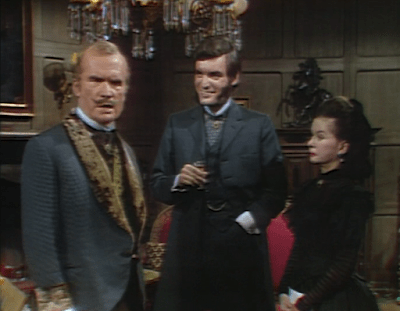
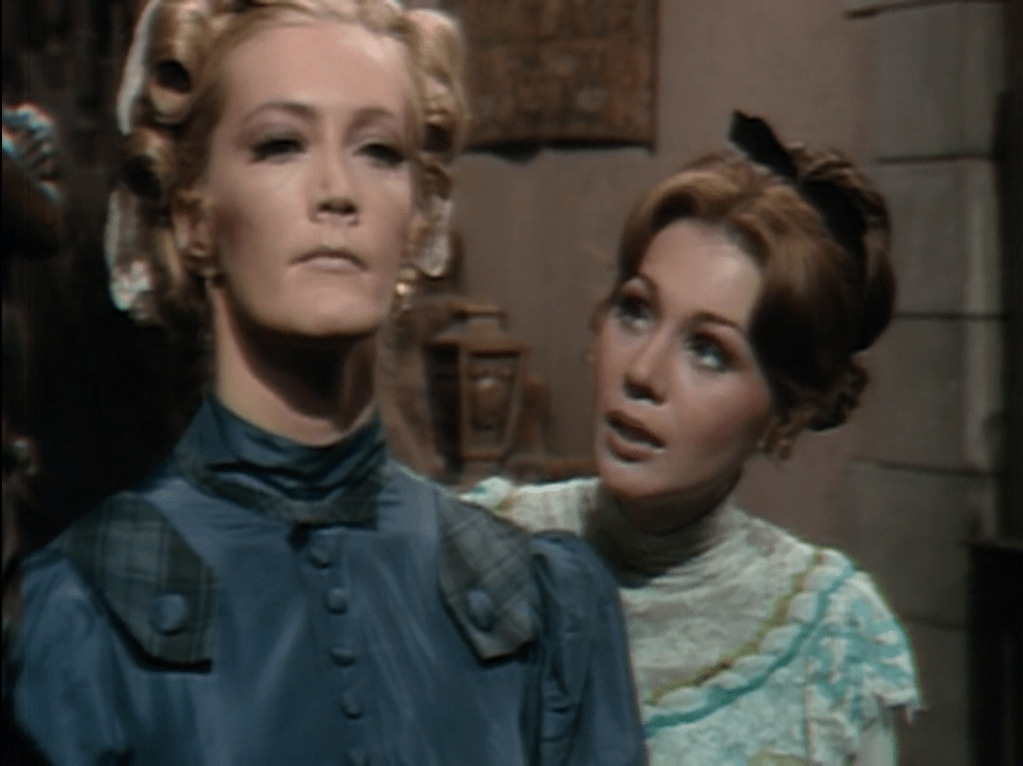



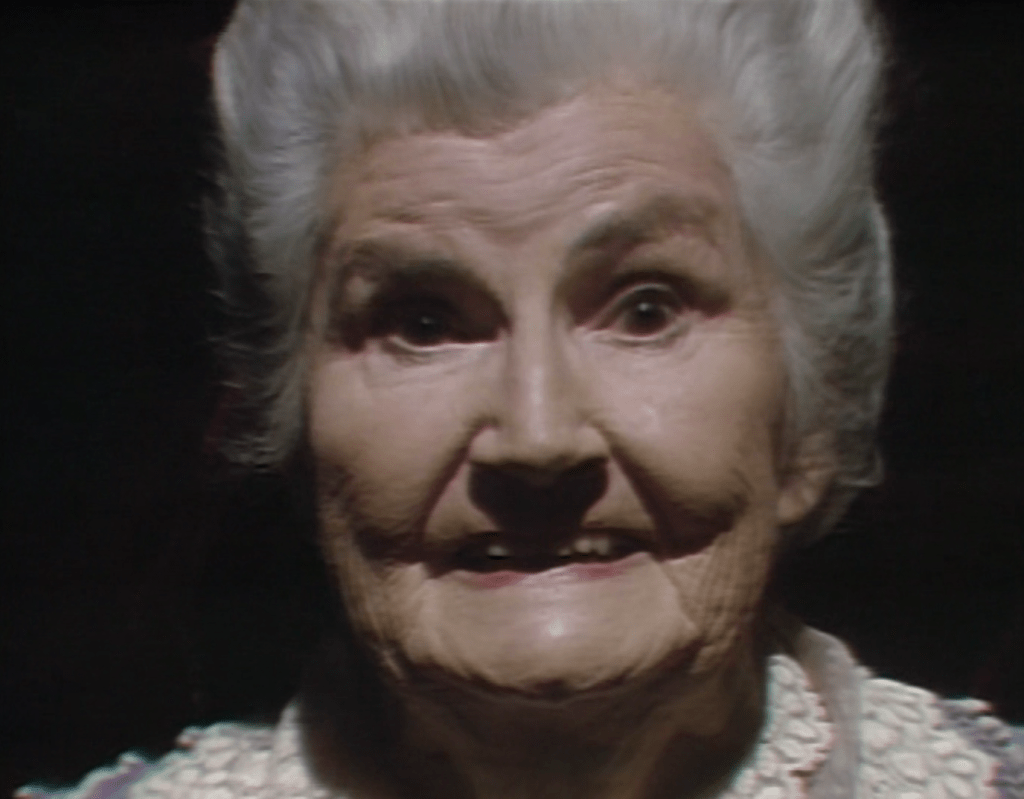
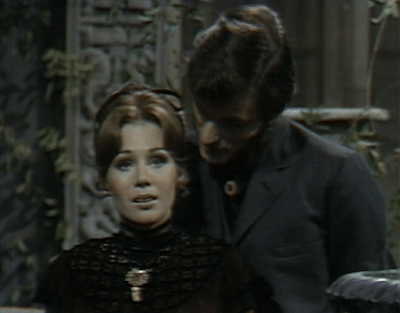

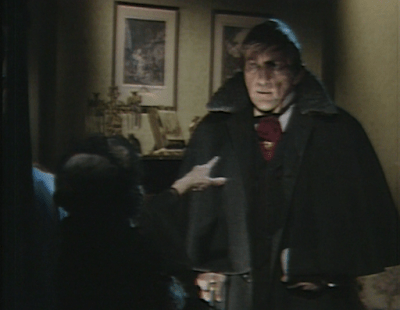


 Dark Shadows Commentary