Episode 890: They will be strangers, but you will know them

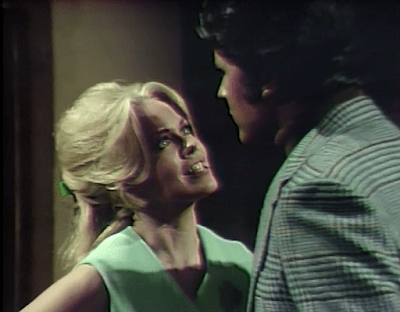
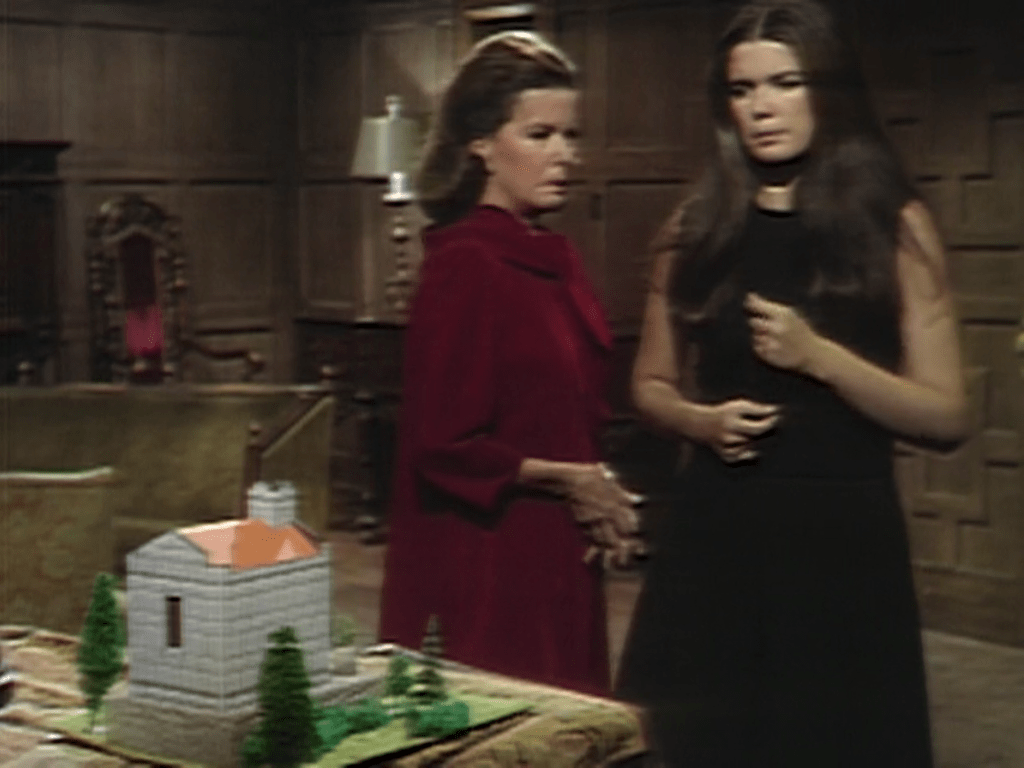
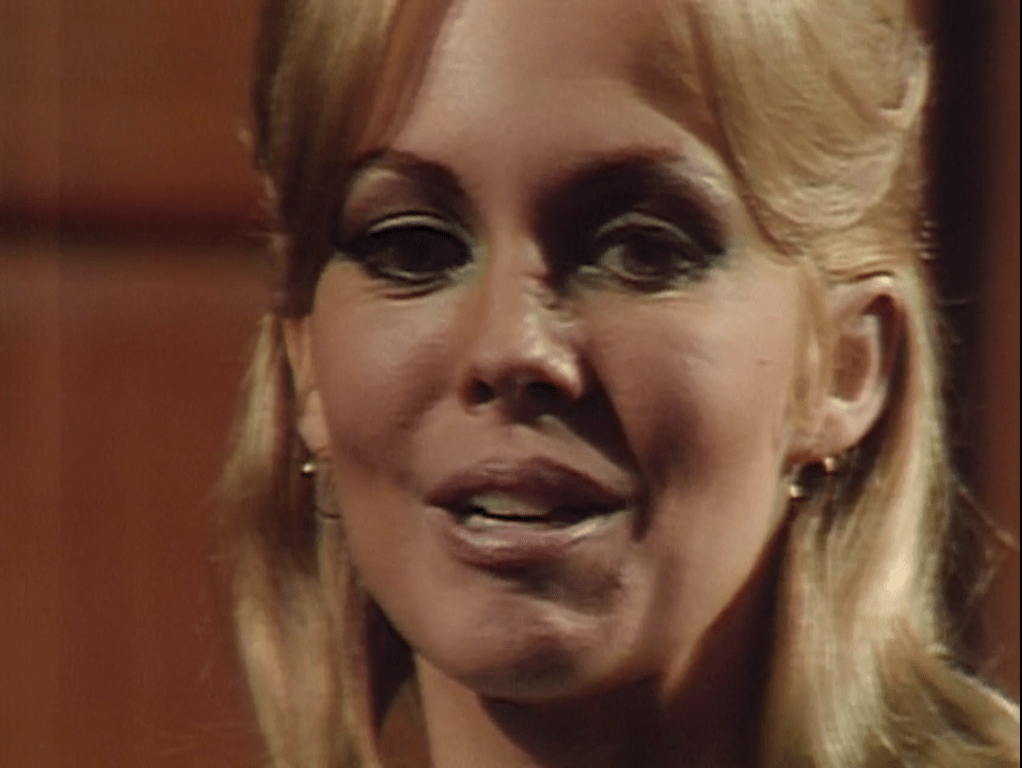
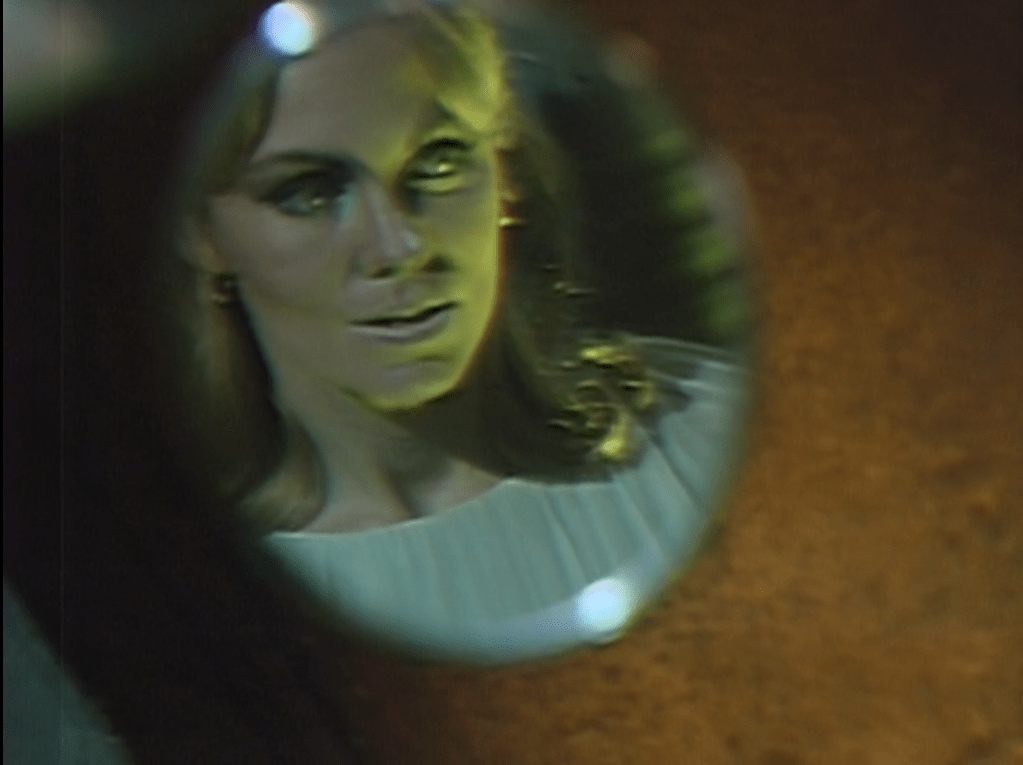
Like many episodes of Dark Shadows, this one ran long and ended with credits only for the cast and for Dan Curtis Productions. The entry on the Dark Shadows wiki says that the director was Lela Swift. I am sure that it was in fact directed by Henry Kaplan. This shot of Nancy Barrett as heiress Carolyn Collins Stoddard is proof positive:

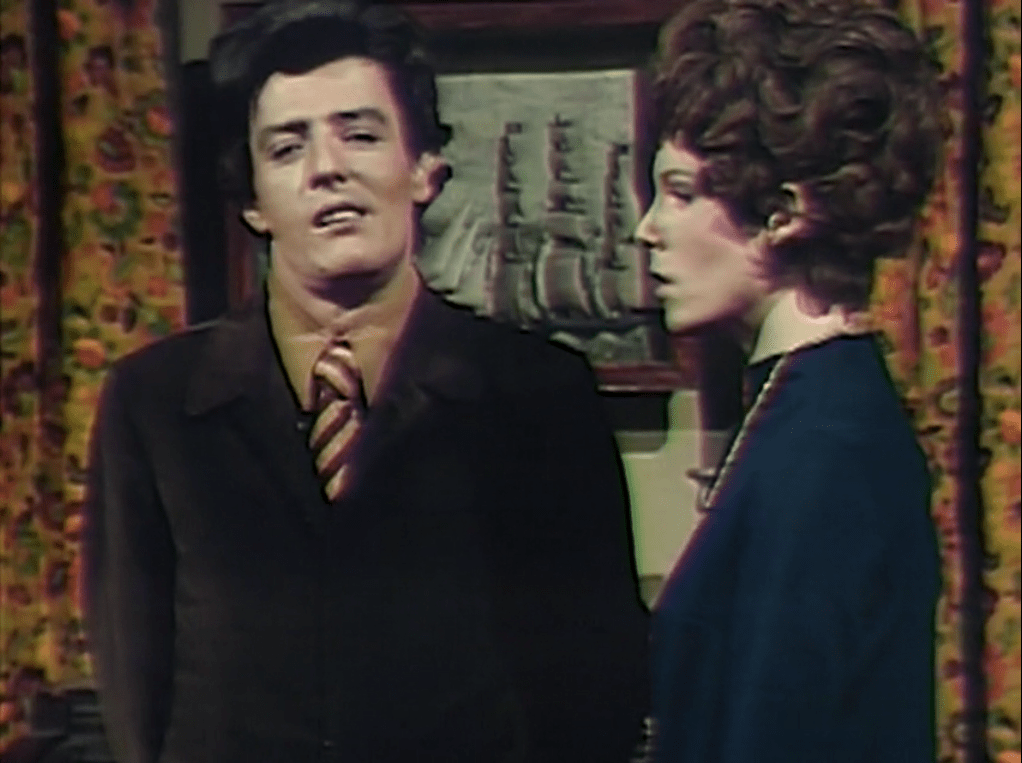
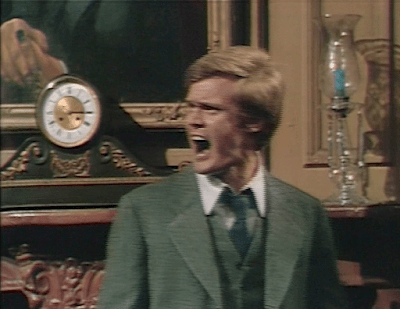
There is another flagrant Kaplanism in today’s first scene between antique shop owners Philip and Megan Todd (Christopher Bernau and Marie Wallace.) Philip enters from upstairs. He stops with his waist at the top of the frame. That’s where he stays for the first part of the scene, ending with Megan raising a paper that covers part of her face. Evidently what’s happening between the characters is none of the audience’s business.

Swift was a talented and ambitious visual artist, Kaplan a sloppy and unimaginative one. He relied heavily on closeups. When it dawned on him that it was dull to hold the frame just beyond the edges of an actor’s face, his response was to zoom in and give us an extreme closeup of some part of the actor’s face. It’s above average for him that the first shot above includes Miss Barrett’s eyes- he specialized in shots displaying the face from the nostrils down, and often held them even after the actors had to move, leaving us with the sight of an ear drifting out of our view.

Even when Kaplan’s tight little frames do not keep us from figuring out what is happening in a scene, they deprive us of the energy that comes from seeing the players interact with each other. We don’t get statements and reactions simultaneously, and we don’t see the actors using the space between them to tell us how the characters feel about each other. Kaplan was also a pretty bad director of actors, regularly poking them with a stick as his way of telling them he wanted them to play a scene differently and on one occasion fastening a handle to a child actor so that he could physically place him on his mark during rehearsal. So perhaps his mania for closeups reflected a lack of awareness of what actors do and how the choices they make contribute to the audience’s experience. As a result of his insensitivity to these and other visual aspects of the medium, Kaplan’s episodes would often be better suited to radio than to television.

Fortunately, the dialogue today is peppered with snappy lines. So Danny Horn devotes his post about the episode on his great Dark Shadows Every Day to a selection of memorable pieces of dialogue. That also makes me suspect the wiki is not entirely correct. It attributes the script to Gordon Russell, an able writer overall but one who is not at all given to bons mots. I use bits of dialogue whenever possible as the titles of these posts, and I often have to search very hard through Russell’s to find suitable ones. It was Violet Welles who excelled at producing those. Russell and Welles often collaborated, so it could be that he wrote a draft to which she added the quotable quotes.

The current story centers on a mysterious cult that has sent time traveler Barnabas Collins back to 1969 from a long sojourn in 1897, by way of a couple of days in 1796. Under the influence of the cult, Barnabas is being a real jerk to his friend, mad scientist Julia Hoffman. Barnabas was a vampire for a long time, and even when he is free of the effects of that curse he habitually resorts to murder to solve his problems. But the victims of those murders are imaginary, played by actors who will go on to find other work, so we don’t usually stay mad at him for any length of time when he commits them. His friendship with Julia, on the other hand, is the emotional core of the show. Barnabas’ coldness to her in yesterday’s episode and today’s leads us to see what the cult is doing to him as the greatest crime anyone has ever committed on Dark Shadows.

Barnabas was a pop culture phenomenon familiar to many millions of people who never saw a single minute of Dark Shadows. The show’s fanbase largely consisted of his devoted followers. So a story about a cult which co-opts him as its leader and changes his personality so that he is impossible to get along with directly addresses a fear that must have blacked out the mind of Dan Curtis every time the postal service truck loaded with Jonathan Frid’s fan mail backed up at ABC Studio 16.

Barnabas brought a box with him from his visit to the eighteenth century, and it is of the utmost importance to the vast eternal plan the cult is working on that the box not be opened until the right time. So Barnabas put it on the mantel in his living room, and when Julia was standing a few inches from him he lifted it from the mantel and placed it on a table in the middle of the room. When she asked what it was, he became flustered and refused to answer any questions about it.

When Julia left the house, Barnabas left the room, with the front door unlocked and the box still on the table. Today, we open with Julia coming back in, hearing the sound of breathing coming from the box, finding its key on the table next to it, and placing the key in its lock. Barnabas comes in just in time to stop her opening it, but we can see that the cult probably could have chosen an agent with a better sense of operational security. Barnabas’ function in the story is to make messes that other people will have to clean up, so as soon as we heard that the box must not under any circumstances be opened we expected him to leave it where it would inevitably fall into the hands of someone bent on opening it, though it is a bit disappointing he has done so this quickly.

After he has taken the box from her, Barnabas berates Julia, orders her from his house, and tells her he owes her nothing. He abruptly sweetens up and tells her that he is only carrying on that way because of some kind of temporal jet lag. He reminds her that when she traveled back in time in September, she was very ill for a while; he suggests that his surly mood might be the result of the same shock that caused that reaction. About a minute after he starts on this new tack, just as Julia has started smiling again, a knock comes at the door. It is Carolyn.

We don’t know what effect the cult’s co-optation of him has had on Barnabas, but regular viewers know that characters on Dark Shadows are always acquiring one magical power and losing another. For the last few months of the 1897 segment, the show’s main villain was sorcerer Count Petofi. One of Petofi’s signature moves was to become aware of visitors shortly before they arrived. It could be that the writers have decided to give the cultified Barnabas that power, and that it was because Carolyn was on her way that he wanted to put Julia in a good mood.

That interpretation is supported by what follows. Carolyn is delighted to see Barnabas; she hadn’t known he was back from his trip to 1897. She hugs him and he smiles, a stark contrast to his icy reaction when Julia hugged him yesterday. She wants to talk about Chris Jennings, a young man she dated a few times and whom she has been told is dangerous. Julia and Barnabas have befriended Chris and know that he is a werewolf. Julia thinks she can somehow control Chris’ transformations, and she urges Carolyn to think well of him. Barnabas tells her to trust her instincts and to avoid Chris. He keeps telling her that she is too important to be allowed to come to harm. Later, he visits Carolyn in her home, the great house on the estate of Collinwood, and he keeps going on and on about how important she is and how confident he is about her future. He also gives her a silver pentagram, an amulet to ward off werewolves, and urges her to wear it at all times. He subsequently has another scene with Julia in his own house, and he is just as cold and dismissive as he was in the first scene, exploding at her for being “irrational.” Evidently the cult has plans for Carolyn, but not for Julia.

Julia bought a painting from the Todds the other day, and now they have received a telegram offering to buy it regardless of price. Julia goes to their shop and discusses the telegram with them. She believes that the telegram, which is signed “Corey,” may actually be from Quentin Collins, a distant cousin of Barnabas’ whom he befriended during his time in 1897 and who may have been immortalized by a magical portrait painted by the same artist responsible for the picture Julia bought. She tells the Todds that she is not certain she wants to part with the painting, but that she would very much like to meet “Mr Corey,” and that she believes others in town would also like to do so. She urges them to reply to the telegram with an invitation.

Barnabas stands over the box. We hear his thoughts as he mulls over his questions about it. He suddenly declares “It is time!” Then he goes to his chair and sits down. Evidently, it is time to take a load off.

Barnabas has a vision of one of the hooded figures who inducted him into the cult. The figure, a man named Oberon, addresses him as “Master” and tells him that he is to give the box to people who wake him by knocking at his door. There is a knocking, he does awaken, and he goes to the door.

Episode 889: Remember the night

The Departures

At the end of 1968 and beginning of 1969, two supernatural menaces were growing in tandem. The malign ghost of Quentin Collins was becoming steadily more powerful until it made the estate of Collinwood uninhabitable. As Quentin’s power grew, the curse that made Chris Jennings a werewolf also gained force, so that Chris could no longer be sure of keeping his human form even on nights without a full Moon. By the end of February, the Collins family had evacuated the great house on the estate, and Chris was in his lupine form permanently.

Trying to contact Quentin’s ghost, recovering vampire Barnabas Collins meditated on a set of I Ching wands. To his surprise, Barnabas found himself relocated in time to the year 1897, when he was a vampire and Quentin was a living being. Over the next eight months, Dark Shadows was a costume drama set in that year. Barnabas learned that Quentin had been a werewolf, and that he was Chris’ great-grandfather. He also learned that a magical portrait painted by an artist named Charles Delaware Tate had freed Quentin of the effects of the werewolf curse. In #839, we saw that the characters in the 1960s are aware of time passing in Barnabas’ absence; we also saw the haunting of Collinwood break in that episode. The characters remember what happened in the previous episodes, and are relieved that Quentin has found peace and they can now move back into the great house. We did not hear anything about Chris at that time. Last we saw him he was locked up in the hidden chamber inside the old Collins mausoleum in the cemetery north of town. For all we know, he’s still there.

When Barnabas went to the past, his entranced body remained in place sitting before the I Ching wands in the basement of his home, the Old House on the grounds of Collinwood. In September, mad scientist Julia Hoffman and Professor Timothy Eliot Stokes were visiting the basement and saw Barnabas’ body vanish before their eyes. Julia then sat down to meditate on the wands, and found herself transported back to 1897. She was there for a couple of weeks, during which time she initiated a treatment for Barnabas like the one that had freed him of the effects of the vampire curse for a while early in 1968. She snapped back to 1969 before the treatment was completed, but other friends of his were able to pick up where Julia left off and finish it successfully.

The portrait of Quentin would appear to have been destroyed in a fire in #883. Some unspecified supernatural agency whisked Barnabas out of the year 1897 at the end of #884, but it did not send him to 1969. Instead, he found himself in 1796, the year he first became a vampire. Amid some sinister doings, Barnabas found himself in a mysterious clearing in the woods where he saw a massive stone structure. Two hooded figures stood by this cairn. He was unable to resist or escape them. He lost consciousness, and they laid him on the cairn. They used it as an altar, covering him with foliage and consecrating him to whatever unknown beings they served. When he awoke, he knew all about the hooded figures and the cult they represented. They greeted him as their master. He spoke a ritual formula, gave some orders, and prepared to leave the eighteenth century.

The Returns

On Tuesday, we saw that Julia has been hanging around the Old House for the five weeks since she returned to 1969. She explained to heiress Carolyn Collins Stoddard that Barnabas would have to reappear in the place from which he disappeared. So she locked the basement from the outside, evidently expecting to hear Barnabas calling to be let out. There is another way out of the basement, a tunnel from the prison cell there to the beach outside, but Julia must have forgotten about that.

At the opening of today’s episode, we learn that Julia was right about Barnabas reappearing in the place from which he disappeared. But she does not know that the last place the audience saw him was at the cairn. The cairn opens, and Barnabas materializes in front of it. He delivers an incantation, and goes on his way.

We cut to the great house at Collinwood, where Julia is showing Stokes a painting she bought yesterday. It is one of Tate’s works, a landscape painted sometime around 1949. Seeing that Tate was still doing work as good as any he ever did only twenty years ago, Julia wonders if he might still be alive in 1969. Stokes scoffs at this possibility, since Tate would be a hundred years old or more, but Julia is determined to search for him. When Stokes asks why she is so interested, she says that she cannot tell him, because it is a confidential favor she is doing for a friend.

While Stokes knows about the haunting of Collinwood and about Barnabas’ trip back in time, he does not know that Chris is the werewolf. If he did, he would probably turn him in to the police. So Julia can’t very well tell him that she is hoping Tate will be able to paint a portrait that will do for him what Quentin’s portrait did 72 years earlier. Fortunately for her, Stokes readily accepts her refusal to explain herself.

Stokes tells Julia about a project of his own. He says that local physician Dr Reeves has enlisted him to help with a patient. Stokes is a scholar of occult lore, not a clinician or therapist of any kind. Reeves’ decision to enlist Stokes’ aid would admit of either of two possible explanations. It could be something that often happens on soap operas, a genre in which all forms of authority tend to become interchangeable with each other, so that scholars can function as doctors, doctors can function as lawyers, and anyone who dresses up for work can function as a cop. The other possibility is that Reeves has caught on that the village of Collinsport is rife with supernatural phenomena and has decided that Stokes’ expertise might enable him to diagnose his patient. Julia’s amused disbelief when Stokes announces that he is going to see “a patient” counts against the first possibility. She is closer than any other character in the parts of Dark Shadows to a representative of the audience’s point of view, so if she is still aware of Stokes as someone whose competence is limited to a specific field we are as well. So we can assume that Dr Reeves has concluded that there is something uncanny about what ails his patient.

Stokes identifies the patient to Julia as Sabrina Stuart, a young woman who, a few years previously, was discovered with a head of white hair and without the ability to speak. He says that he and Reeves have managed to get her to start saying words but that she cannot describe the origin of her trauma. Julia knows that Sabrina’s trouble began when she saw Chris transform into the wolf, and so she is alarmed at the prospect that she will begin talking. She tries to persuade Stokes to give up, but he is nothing daunted.

Stokes exits, and Chris enters. Julia scolds him for having checked himself out of Windcliff, the mental hospital she controls. This is the first we learn that he left the hidden chamber in the mausoleum; it is also the first we learn that he has reverted to human form. He acknowledged that he can change back to the wolf at any time, and that something has to be done, but he can’t take solitary confinement any longer. Longtime viewers, remembering that every time he changes he kills people, will find this to be a stupefyingly selfish decision. It alienates whatever sympathy we may have for Chris.

Chris tells Julia that even if he is cured, he will not be truly free so long as Sabrina is around. He does not say what he plans to do about Sabrina, but if he is willing to commit all the murders that will surely follow from his decision to leave the hospital we can’t help but suspect it won’t be good for her.

We cut to Sabrina’s room in the facility where she is staying. Stokes is providing her with a sort of therapy. The audience will be surprised to see Sabrina again. Sabrina, played by Lisa Blake Richards, appeared in episodes #692, #697, and #698. The show went to 1897 in #701; Miss Richards could easily have been cast in a part in the costume drama segment, but was not. Surely no one could have expected that she would be waiting for us when we returned to contemporary dress, but here she is.

Miss Richards is pleasant enough, but she bears an ill omen. Julia and Stokes talk about Sabrina’s brother Ned, to whom Stokes refers as “a rather surly fellow.” That’s putting it mildly. Not only does he shout at his scene partners and violate their physical space, traits common to all characters played by Roger Davis, but he had a habit of groping his sister’s breasts and rubbing his cheeks on her face. These habits led us to wonder how much of Sabrina’s catatonia was a symptom of the shock of seeing Chris’ transformation and how much was the result of her brother’s constant abuse. Julia is already threatening to bring back Tate, another of Mr Davis’ characters. If Roger Davis winds up playing two parts concurrently, the show might become entirely unwatchable.

Dr Reeves is another character we haven’t seen for a long time. Fred Stewart appeared as Dr Reeves in #17, where he treats Roger Collins after an auto wreck, and in #158, where he examines Elizabeth Collins Stoddard after she has fallen down the stairs. Actors have been returning from long absences lately; Miss Richards’ surprising reappearance today reminds us of all-time champ Alfred Hinckley, unseen since his turn as a train conductor in episode #1, who came back as a doctor in #868, and of John Harkins, who played a policeman in a scene set in Phoenix, Arizona in #174 and returned as a very different law enforcement officer from another faraway place in #878. Perhaps the reference to Dr Reeves means that Stewart will rejoin the cast. Stewart didn’t have much to offer, but I’ll take a thousand of him over one Roger Davis any day.

Be that as it may, what I really wonder about is where writer Gordon Russell found Dr Reeves’ name. Neither he nor any other member of the writing staff was connected with the show when Dr Reeves appeared, and line producer Peter Miner just started three weeks ago. Executive producer Dan Curtis and director Lela Swift were with the show from the beginning, but Curtis was busy getting ready to make the feature film that became House of Dark Shadows at this time, and Swift doesn’t seem to have interacted much with the writers. Even Harriet Rohr, Costello’s assistant who often attended table reads and seems to have helped with continuity, wasn’t around much at this period. So there must have been pieces of paper floating around listing seldom-seen characters and other points of trivia for the writers’ reference. I’m sure fandom would go nuts if those papers ever turned up!

During their therapy session, Sabrina suddenly looks at Stokes and asks him who Carolyn Stoddard is. She then declares that Carolyn is in danger, and demands to meet with her at once.

As it happens, Carolyn dated Chris for a while around New Year’s 1969. Stokes knows Carolyn well enough that he must have been at least dimly aware of this. Ned is obsessed with his hostility to Chris and is rarely far from Sabrina, so Stokes must have heard about Chris and Sabrina’s relationship. But Stokes does not make the connection. He can’t imagine why Sabrina is suddenly talking about Carolyn.

Back at the great house, Chris and Carolyn have a conversation. She is irked that he went away for so long without a word to her. It’s understandable he does not want her to know that he is the werewolf, but why can’t he tell her he was confined to a mental institution? It isn’t as if he is worried about making a good impression on her. On the contrary, everything he says to her is part of his effort to convince her he does not want to renew their relationship.

That terrible beating

By this time, Julia has moved on to her chief concern. She has heard a heartbeat pounding from the portrait of Barnabas that hangs in the foyer of the great house, a sign that he is near. Julia goes to the Old House and finds Barnabas coming down the stairs. She is delighted to see him, but puzzled he is not locked in the basement. He tells her he returned by means of the I Ching. She is sure this cannot be true.

Julia had already returned to 1969 when sorcerer Count Petofi used the I Ching to project himself into that year for a few minutes in #872 and #873 in a way altogether unlike the one Barnabas had used. No one in 1969 saw Petofi while he was then, nor did Barnabas or any of his allies know about the trip. But Julia herself went back to 1897 by yet another radically different I Ching-mediated path, and both of them really ought to be aware that they are dealing with forces that work unpredictably. So it does not make much sense that Julia is so certain whatever it is that is released when one contemplates the I Ching could send Barnabas only to the basement.

Barnabas does not return any of Julia’s warm emotional displays. When she bursts into a smile and hugs him, he stands still and stares icily ahead. This is quite startling to regular viewers, who have seen the two of them grow quite cozy over the last year and a half.

Julia welcomes Barnabas back to the 1960s. Screenshot by Dark Shadows Before I Die.

Barnabas also refuses to answer any of Julia’s questions about what happened in the last weeks of the 1897 story. This will be even more startling. Barnabas and Julia gave each other huge amounts of information even when they first met and he saw her as an enemy. Since they became fast friends in the summer of 1968, their conversations have been the heart of the show. The show burned through so much story in the final weeks of the 1897 segment that it brings us up very short when Barnabas declares that he is too tired to talk about any of it. He won’t even say that everything was settled- his only explanation of anything is that he returned because he wanted to. For all he tells Julia today, their enemies might have triumphed completely in 1897.

While Julia is looking at him, Barnabas picks up a box that he has placed on the mantel. This seems to be a way of calling her attention to it, so she politely asks what it is. He becomes flustered and demands she disregard it. Returning viewers know that it is the one thing he brought with him from his encounter with the hooded figures in 1796. In his conversation with them, he said that it must not be opened until the proper time, lest their whole vast eternal plan come to ruin. Barnabas’ function in the story is to make a mess of everything, so of course he leaves the box out in the open and waves it in front of the face of the world’s most inquisitive person.

Meanwhile, Carolyn visits Sabrina. Sabrina insists Stokes leave them alone; when he does, she insists Carolyn not repeat their conversation to Stokes. She tells Carolyn that Chris, even though he is good, will kill her if they stay together.

We would be hard put to defend the idea that Chris is good, or to regret it if Stokes or any other law-abiding person were in a position to end his reign of terror. It is also surprising that Sabrina, who can barely say her own name when Stokes is working with her, talks quite fluently once he is out of the room. Maybe Dr Reeves was not so wise to choose him as Sabrina’s therapist.

Back in the Old House, Julia tells Barnabas that “Today, I was given reason to believe that Charles Delaware Tate may still be alive.” Barnabas replies “There’s no reason to believe that’s true.” That flat contradiction, with the jarring repetition of the word “reason,” shows that Barnabas is not only evading Julia’s questions, he is rejecting her personally in a way that he did not do even before they became friends, when he kept plotting to kill her. At least in those days he always listened closely to what she said, knowing that her great intelligence made her a danger to him. In this exchange he is treating her as if her words were beneath notice.

Julia sticks with the topic, and Barnabas says that even if Tate were still alive he would be “a hundred and totally useless!” That’s pretty rich coming from Barnabas, who himself is at least twice that age and would be in an awkward spot if he had to explain what use he is to anyone. But Julia only says that they must look into the matter.

A careless lie

Chris enters. He is delighted to see Barnabas, on whom he has pinned all his hopes. Barnabas tells him that “In all the time I was in the past, I found no solution for you. I am afraid there’s nothing that I can possibly do.” He follows that with “I must ask you to excuse me, I’m very tired,” and toddles off to bed.

Julia and Chris leave the house together. She tells him why she thinks Barnabas was lying. Chris goes home, and Julia goes back into the house, through the unlocked front door. She picks up the box, which is still on the table in the middle of the living room. As she heard Barnabas’ heartbeat coming from his portrait in the great house, so she hears breathing coming from inside the box. One wonders what other bodily functions will audibly manifest in objets d’art around Collinwood.

Episode 836: The grownup world

It is 8 September 1969, and the ghost of Quentin Collins has rendered the great house of Collinwood uninhabitable. The family, including permanent house guest Julia Hoffman, have been staying at the Old House on the estate while recovering vampire Barnabas Collins is on a trip back in time to 1897, when Quentin was killed and the trouble started. But Julia has received a letter Barnabas wrote to her in September 1897 indicating that, as of that date, his mission was about to end in total failure, and so she decides to take matters into her own hands. First, she must learn exactly how and when Quentin died.

Julia goes to the great house and follows the sound of Quentin’s theme song to the tower room. There, she finds the ghost of maidservant Beth, who was one of Quentin’s many lovers. When Beth is in a shadowy corner, she puts on a ghostly voice and tells Julia that her name would mean nothing to her. As soon as she comes into the light, Julia says that they’ve met several times, and soon she is calling her by name. Along with the fact that, as Beth, Terrayne Crawford is just standing there in the same light as Grayson Hall, with no practical effect whatsoever to suggest ghostliness, this deflates whatever feeling we are supposed to have that we are witnessing an encounter with the supernatural.

Julia insists Beth tell her how Quentin died. When the ghost of Barnabas’ nine year old sister Sarah Collins was on the show from June to November 1967, she would often insist on the Ghost Rules and vanish if people put direct questions to her. But Beth just wanders around a little, moans to Quentin that she has no choice but to tell Julia what she wants to know, and starts dishing. Again, they aren’t making ghosts like they used to.

Beth tells Julia that on 10 September 1897, she found out Quentin was going to marry a woman named Angelique. Quentin did not tell her this news himself; he left it to Angelique to do so, making the blow fall all the more heavily. This will remind longtime viewers of #392, when Barnabas could not bring himself to tell his ex-fiancée Josette that he was engaged to Angelique, leaving Angelique to tell Josette herself in #393. Josette waited until #425 to leap to her death from the cliff at Widows’ Hill, but things move faster now. Beth went straight from her conversation with Angelique to her room, where she had a bottle labeled “Poison.”

Sensible shopper that she is, Beth buys her poison in the Generic section of the murder weapon store. Screenshot by Dark Shadows Before I Die.

Before she could do away with herself, Beth was interrupted by a knock on the door from twelve year old Jamison Collins. Jamison came in to show her a puzzle he had solved, then saw the bottle. He demanded to know what was going on, and she admitted that she was planning to kill herself because Quentin was going to marry Angelique. He stopped her doing that, but after he left to confront Quentin she took a loaded revolver out of her dresser.

Jamison found Quentin in the drawing room, in Angelique’s arms. Angelique at first dismissed Jamison, saying that his uncle was too busy to speak with him, but Jamison held his ground and insisted on seeing Quentin alone. Quentin obliged, but would answer Jamison’s questions only with airy assertions that he is too young to understand the situation. Jamison is so composed and forceful, and Quentin’s behavior is so flagrantly irresponsible, that we might expect Jamison to ask to be spared lectures on maturity from a man so much more childish than he. Instead, Jamison simply becomes angry and tells Quentin that after what he has done to Beth, he wants nothing more to do with him.

In #767, Jamison had a dream in which Quentin’s ghost said that his death was preceded by three events. The first two events happened shortly after. The third event was that Jamison rejected him. This has now happened, and in the dream Quentin said that once that took place “There was almost no time left for Quentin Collins.” Indeed, shortly after Jamison stalks off Beth shows up with her revolver and shoots Quentin. He staggers from the drawing room and goes upstairs. Since the staircase is made of eleven steps and is eight feet tall, that’s some pretty fancy staggering for a man who has just taken a round to the midsection. Quentin keeps staggering all the way to the tower room, where Beth shoots him a few more times.

We cut back to 1969, where Beth tells Julia she killed herself the day after she killed Quentin. She doesn’t seem to be done talking when Julia excuses herself. Say what you will about Sarah, she always left them wanting more.

Julia finds twelve year old David Collins, Jamison’s grandson, in the drawing room with Quentin’s ghost. Since Barnabas took us back in time with him in #701, we’ve got to know the living Quentin quite well, and he is a charming rascal who has very little in common with the silent, family-annihilating ghost we saw late in 1968. Beth’s story does very little to explain how the one turned into the other. The ghost has been draining the life from David; Julia orders David to come away from him, and he does. David lies down on the couch, and Julia examines him. She finds that he is weak, but resting comfortably.

Occult expert Timothy Eliot Stokes enters. Quentin’s ghost has vanished. Stokes calls Julia by her first name, something he had not done prior to this episode, and asks after David. She at first says he will be all right, then checks on him again. She cannot find a pulse, and declares him dead. Julia has performed wonders in her work as a medical doctor, but her death pronouncements are so often wrong that this does not give much grounds for alarm. However, we then hear Quentin’s voice laughing maniacally, darkening David’s prospects.

Terrayne Crawford seems to be such a nice person that it distresses me to point out that she was not a very good actress. But in this one, Beth’s lack of supernatural quality and Julia’s bland reaction to her make it seem like writer Gordon Russell and director Lela Swift were conspiring to vent their exasperation with Miss Crawford’s limits. She can play one emotion at a time, so that when Beth is shocked to learn that Quentin is going to marry someone else she is only and entirely Shocked. When Beth is suicidal, she is only and entirely Sad; when she decides to take Quentin’s life instead of her own, she is only and entirely Gleeful; when she tells Julia that her vengeance did not relieve her sorrow over Quentin, we can see that’s true, because she is only and entirely Sorrowful. The result is like looking at a series of wood block cuts illustrating various emotions. It’s all very clear and quite vivid, but there’s no sense of development from one scene to the next. Had Miss Crawford been able to lay one emotion over another and play two or more of them at a time, the grin on Beth’s face when she kills Quentin would have shown us that all the layers of complexity of feeling had finally been stripped away and only hatred was left. That would have been a tremendous climax for the character. But since there was never any such complexity to start with, it’s just another block cut.

Often when I see disappointing performances on Dark Shadows, I think of other actors in the cast and try to imagine what they would have done with the part. Gail Strickland, like Miss Crawford, is a tall, thin woman whose chin juts out on a horizontal line, and she was on the show as doomed schoolteacher Dorcas Trilling for a couple of episodes in May. Dorcas’ role would have been well within Miss Crawford’s competence, and in her long and distinguished career Miss Strickland proved she could do just about anything. So on a day like this, I envision a different, much more nuanced Beth. The episode in my imagination is really stellar, I wish you could see it.

Today, David Henesy plays both his 1897 character Jamison Collins and his 1960s character David Collins. He is not credited for either of those roles, but for Daniel Collins, whom he played when the show was set in the 1790s back in late 1967 and early 1968.

Episode 813: All things, good or evil, come to the same end

This is the first episode to feature a scene in the restaurant at the Collinsport Inn since #227 in May 1967. The show was in black and white then; apparently the restaurant set cannot be seen in color, since this one, set in the year 1897, survives only in kinescope.

Aristide, Tim, and Jamison/ Petofi in the restaurant at the Collinsport Inn. Screenshot by Dark Shadows Before I Die.

Schoolteacher turned adventurer Tim Shaw is at a table in the restaurant when he is joined by twelve year old Jamison Collins, a former student of his. Unknown to Tim, Jamison’s body is currently a vessel for the spirit of 150 year old sorcerer Count Petofi. Tim is startled to see Jamison, and tells him he had heard he was ill. Jamison asks where he heard this. Tim pauses, then claims that he telephoned Jamison’s home, the great house of Collinwood. He says that Jamison’s nine year old sister Nora answered the phone and told him of his illness. Tim tells Jamison that he is waiting for a young lady, and that after she arrives he would like to be alone with her.

A man enters and talks with Tim. After he goes, Jamison asks who he is. Tim says he has only met him once, and that he knows almost nothing about him beyond the fact that his name is Aristide. We have seen Aristide in the woods with Jamison/ Petofi, and know that he is Petofi’s servant. Jamison/ Petofi told him in that scene that he felt weak and had only a few hours left if he did not recover “The Hand.”

We also saw Aristide in Tim’s room with Amanda, the young lady Tim is waiting to meet. He confronted Amanda, roughed her up, and threatened her with a prop representing a dagger with a curved blade. He wanted Amanda to tell him where “The Hand of Count Petofi” is. Amanda asked if “The Hand of Count Petofi” was a piece of jewelry or something. She had no idea it is literally a severed hand, cut from the wrist of Count Petofi 100 years ago. Aristide questioned her and learned that Tim took a box from the Inn earlier that night and returned without it.

Tim excuses himself, saying that he will go to the front desk to ask if Amanda left a message there explaining why she is so late. Jamison/ Petofi meets Aristide back in the woods. When Aristide tells him that Tim took a box from the Inn and returned without it, he remembers that Tim said he had talked on the telephone with Nora. He deduces that Tim actually talked to Nora in person when he took the box to Collinwood and enlisted Nora’s help hiding it there.

Jamison/ Petofi goes to Nora’s room and wakes her. He tricks her into telling him that Tim was there, but she refuses to tell him where the box is. He twists her arm until she does so. In the parts of Dark Shadows set in the 1960s, David Henesy played strange and troubled boy David Collins, and Denise Nickerson played nine year old Amy Jennings. David and Amy were intermittently possessed by Jamison and Nora in late 1968 and early 1969, and when Amy/ Nora resisted David/ Jamison in #667 and #679, he twisted her arm. When we see the same violent act here, we see a dramatization of a cycle of abuse. We may also wonder if they are going to retcon that “Haunting of Collinwood” segment to include Petofi as a driving force.

Jamison/ Petofi takes the box from Nora’s armoire, opens it, and holds up the Hand. Regular viewers can expect Petofi to return to his own physical form, reattach the Hand to his wrist, and increase his magical powers greatly.

All of the male cast members have trouble with their dialogue today, even the usually line-perfect David Henesy. I wonder if writer Gordon Russell was late finishing the script. Mr Henesy and Michael Stroka manage to give good enough performances that their bobbles don’t really matter, but Don Briscoe is just bad today. When Tim is talking with Nora in the teaser, his intonations are bizarre, and in his later scenes he is flat and lifeless, including a long stretch when he is openly reading off the teleprompter. Perhaps that’s because of his acting style- he worked from the inside out, finding his character’s motivations and developing those first, adding the dialogue last. Give an actor like that less time than he needs, and he might not have anything at all to offer.

One unfair criticism that Briscoe gets from many of the fans who post comments online is that Tim does not have romantic chemistry with any of the women he is paired with. He isn’t supposed to have romantic chemistry with them! At first we see him linked with neurotic intellectual Rachel Drummond. Tim and Rachel were students together at the boarding school run by the sadistic Gregory Trask. When Jamison and Nora are sent to the same school, Tim and Rachel illustrate the horror that lies in store for them. If Tim and Rachel were a hot and exciting couple, they would send the message that kids subjected to Trask’s abuse can grow up to be happy adults, muffing the whole point of the story.

The second woman attached to Tim was Trask’s daughter Charity. Nora points out to Jamison today that Tim and Charity never got along with each other, and regular viewers remember that this is true. Trask forced them to get engaged, a situation that made them both miserable, and then led them both to believe that Tim had murdered Charity’s mother. Again, the whole point of the relationship is to demonstrate how cruel Trask is.

Now Tim is traveling with Amanda. We met Amanda yesterday, and saw that she is impatient with Tim and tolerates him only because he has a lot of money and keeps spending it on her. As possessor of the Hand of Count Petofi, Tim has managed to get rich quick and turn into a tragic version of the character W. C. Fields played in vaudeville routines and stage plays and films set in the Gay Nineties. Amanda is the sort of woman Fields’ characters invariably failed to impress. Again, the last thing you would want would be for Amanda to seem actually to be attracted to Tim.

Though Michael Stroka, in spite of his line bobbles, does a good job as Aristide, there is one moment today when he does make a bad mistake. Aristide makes a big deal out of his dagger, which he initially called “The Dancing Girl.” The prop is obviously just a flat piece of wood, which we might be able to accept if we don’t have to look at it for an extended period. But when he is threatening Amanda today, he holds “The Dancing Girl’s” blade in the palm of his hand, squeezes it, rolls it around, and caresses it. If there were a sharp edge anywhere on it, his hand would be bleeding profusely. They really are not making it easy for us to believe Aristide is going to cut anyone.

Episode 731: Your greatest weakness

One of the first “Big Bads” on Dark Shadows was crazed handyman Matthew Morgan, played by Thayer David. Matthew was the most devoted employee of reclusive matriarch Elizabeth Collins Stoddard (Joan Bennett.) Matthew took his devotion to Liz to such an extreme that he was a menace to everyone else. In November and December of 1966, we learned that Matthew had decided that Liz’ second most dedicated employee, plant manager Bill Malloy, was a threat to her. Matthew had tried to put a stop to Bill’s doings. Not knowing his own strength, Matthew accidentally killed Bill. When well-meaning governess Victoria Winters discovered what had happened, Matthew abducted Victoria, held her prisoner in the long-deserted Old House on the grounds of the estate of Collinwood, and was about to murder her when a bunch of ghosts emanated from the show’s supernatural back-world and scared him to death.

In those days, Dark Shadows was a slow-paced “Gothic” drama set in contemporary times. From November 1967 to March 1968, it was a costume drama set in the 1790s, and its plot often moved at a breakneck speed. Among the characters then was much-put-upon indentured servant Ben Stokes, who like Matthew was played by Thayer David. At first Ben made a stark contrast with Matthew. He was as relaxed, friendly, and reasonable as Matthew was tense, forbidding, and paranoid. But when his one ally among the Collins family, scion Barnabas, was cursed to become a vampire, Ben’s devotion made him resemble Matthew ever more closely. In his development, we saw a retrospective reimagining of Matthew. The curses that were placed on Barnabas and the rest of the Collinses from the 1790s on had burdened the village of Collinsport, and people who grew up there labored under the consequences of those curses and of the Collinses’ attempts to conceal them. Ben was what Matthew might have been had he not been warped by the evil that began when black magic was first practiced in the area so many generations before.

In January 1969, the show briefly returned to 1796, to a time coinciding with the last days of the earlier flashback. We saw that by that point, the curses had already transformed life on and around the great estate. In that period, Ben’s efforts to protect Barnabas led him inadvertently to kill a man, not knowing his own strength, and then to cover that crime up by killing a woman, not at all inadvertently. He had become Matthew. The curse placed on Barnabas had become the curse of all those who work for the Collinses and all of those who live in the shadow of their wealth and power.

Before Matthew, Dark Shadows‘ chief villain was high-born ne’er-do-well Roger Collins (Louis Edmonds); after, it was Roger’s estranged wife, undead blonde fire witch Laura Murdoch Collins (Diana Millay.) In this episode, the makers of the show take a page from its 1790s flashbacks. They have Edmonds and Millay reconceive the Roger and Laura of that atmospheric, sometimes almost action-free soap as characters appropriate to the fast-paced supernatural thriller it now is.

Since #701, Dark Shadows has been set in the year 1897. Louis Edmonds plays Roger’s grandfather Edward; Diana Millay plays Edward’s estranged wife, undead blonde fire witch Laura Murdoch Collins. In his days as a villain, Roger’s defining characteristic was his unnatural lack of family feeling. He had squandered his entire inheritance, a fact which did not bother him in the least. When his sister Liz confronted him in #41 about the difficulties he had created by putting his half of the family business up for sale, he airily replied that he had enjoyed his inheritance. When in #273 Liz and Roger discussed a blackmail plot of which she had been the victim, Roger admitted that had he known her terrible secret, he probably would have used it to force her to give him her half of the estate so that he could squander that, as well.

It wasn’t only the family’s material possessions and Liz’ right to them to which Roger was indifferent. He openly hated his son, strange and troubled boy David Collins (David Henesy.) He continually insulted David, badgered Liz to send David away, and in #83 coldly manipulated David’s fears to lead him to try to murder Victoria.

In the 1897 segment, Edward is as stuffily serious about the family business as Roger was in 1966 nihilistically apathetic about it. Edward loves his children, twelve year old Jamison (David Henesy) and nine year old Nora, but his rage at Laura has come between himself and them. Laura left Edward the year before to run after Edward’s brother, breezy libertine Quentin (David Selby.) Edward tried to conceal the fact that his brother cuckolded him. He has repeatedly declared that Laura “No longer exists!” and has forbidden her name to be mentioned in the house.

Edward trapped between the enigmatic Laura and the exuberant Quentin. Screenshot by Dark Shadows Before I Die.

For his part, Quentin bears a striking similarity to the early, wicked Roger. He wants money only to spend it, a fact which he cheerfully admits. He tried to forge a will in his grandmother Edith’s name to cheat his sister Judith (Joan Bennett) out of her inheritance, having previously threatened to kill Edith. He does have great affection for Jamison, but since he often uses the boy as a pawn in Satanic ceremonies, his fondness for his nephew is not much of an improvement over Roger’s hatred for his son. Indeed, Quentin’s resemblance to Roger connects the 1897 segment not only to the early months of the show, but also to the weeks immediately preceding it. Early in 1969, Quentin’s ghost had taken possession of David Collins and was causing him to die. When we see that Quentin is now what Roger was originally, David’s ordeal takes on a new dimension. He is dying for the sins of his father.

In this episode, Laura has returned. Edward has offered her a great deal of money to go away and never come back; she refuses. She threatens to tell the world about her relationship with Quentin if Edward does not let her stay at Collinwood. Edward buckles to this blackmail. Laura tells him that “Family pride is your greatest weakness,” making him Roger’s exact opposite.

When Laura was at Collinwood from December 1966 to March 1967, her old boyfriend Burke Devlin kept pestering her with his suspicion that he, not Roger, was David Collins’ father. Burke was not the first character to bring this idea up. Roger had mentioned it to Liz in #32, when they were talking about an attempt David had made to kill Roger. At that time, Liz was horrified that Roger seemed to want to believe that David was Burke’s natural son.

It seems unlikely that Quentin is Jamison’s father. They have been firm about 1870 as Quentin’s date of birth, and in 1897 Jamison is quite plainly twelve. Laura may have gone on to marry her own grandson, but it would be a bit of a stretch for her to have started sleeping with her brother-in-law when he was fifteen, even if he did look like David Selby.

But Roger’s anger and jealousy about Burke and Laura do mirror Edward’s about Quentin and Laura. It was abundantly clear that Roger and Burke’s deepest pain regarding Laura was that their intense attachment to each other was disrupted when she left Burke for Roger; Diana Millay used her gift for dry comedy to make this explicit in a scene the three of them played in the groundskeeper’s cottage in #139. Likewise, Edward’s frustration with and disappointment in his brother is at least as deep a source of anguish to him as is his loss of Laura’s love.

Laura, too, is quite different this time around. The first Laura story took shape gradually over a period of weeks, as Laura herself emerged from the mist. Now Laura is a forceful presence from her first appearance. Originally we heard that Laura had married into several of the leading families of the Collinsport region; now they have given up on the idea of developing other leading families, and Laura just keeps coming back to the Collinses. In the first story, they laid great emphasis on the interval of precisely one hundred years between her appearances; now, the number of years doesn’t seem to have any particular significance. As we go, we will see an even more important difference. When we first met Laura, she was utterly determined to make her way into a pyre so that she could rise as a humanoid Phoenix; now she is unhappy about the whole thing, and angry with people who have helped her on her fiery way.

Edward lets Laura live in the cottage where Roger and Liz would put her in 1966. In the final scene, she goes there and finds Quentin, drunk and trying to conjure up an evil spirit. Quentin keeps telling Laura that she is dead. Frustrated with her persistent refusal to concur with this statement, Quentin puts his hands around her neck and announces that whether or not she is dead now, she will be by the time he gets through with her.

Roger was uncharacteristically sober at the beginning of his three-scene in the cottage with Burke and Laura in #139, but he did enter brandishing a fire-arm. So Quentin’s homicidal intentions on this set further cement his affiliation with his great-nephew in the eyes of longtime viewers.

Millay and Edmonds are not the only actors whose screen iconography the show turns to advantage today. We first saw Kathryn Leigh Scott and Don Briscoe together in #638, when she was playing ex-waitress Maggie Evans and he was playing mysterious drifter Chris Jennings. They met in the foyer at Collinwood. Maggie was angry with Chris, and Chris was guilt-ridden. Today, Miss Scott plays governess Rachel Drummond and Briscoe plays teacher Tim Shaw. They meet in the foyer at Collinwood. Rachel is angry with Tim, and Tim is guilt-ridden.

Though the same actors are playing the same basic emotions on the same set, the situations are different, and the characters are very different. Maggie is Dark Shadows‘ principal representative of the working class of the village of Collinsport. She speaks directly and bluntly, using the plainest language she can to dare Chris to try to excuse his inexcusable behavior. Chris occupies a lowly and unsettled place in the world, and he dodges her gaze and evades her questions, saying as little as he can, almost mumbling.

But Rachel is a neurotic intellectual, and she expresses her anger in complex sentences featuring vocabulary that only a very well-read person would have used in 1897 (for example, the word “sadist.”) Tim retreats from her anger into a defense of his job that quickly devolves into the tiredest platitudes imaginable. At one point he actually intones “It is better to light one candle than to curse the darkness.” Miss Scott makes Rachel’s highly literate onslaught on Tim as forceful as was Maggie’s unvarnished challenge to Chris, and Briscoe makes Tim’s pompous posturing as pitiable as was Chris’ broken burbling. Writer Gordon Russell must have been delighted that the actors did such good work with his ambitious pages.

Episode 605: Ordinary people like us

Recovering vampire Barnabas Collins has determined to let himself into a house occupied by suave warlock Nicholas Blair. He knows that Nicholas is harboring Frankenstein’s monsters named Adam and Eve, that Eve is the reincarnation of a homicidal maniac, and that Nicholas has sinister plans for the pair. Once in the house, he intends to kill Eve.

Most of the episode is taken up with Barnabas’ preparation for this mission. He works with his friends, mad scientist Julia Hoffman and occult expert Timothy Eliot Stokes, to ensure that Nicholas will be out of the house when Barnabas gets there. When he goes into the room where he expects to find Eve, Barnabas discovers that she is not there. Instead, he is greeted by his erstwhile wife, Angelique. Angelique is now a vampire. We end with her baring her fangs at him.

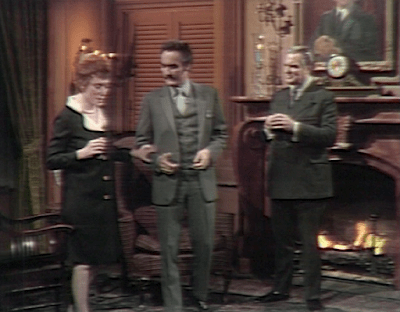
Beneath all the homicidal and fantastic elements is a classic situation of farce. A man sneaks into a house hoping to meet a young woman, only to come face to face with his ex-wife. There are several notes of intentional comedy. Keeping Nicholas distracted, Stokes gives him a long lecture about the history of the Collins family. When he starts in on the details of their shipping interests, Nicholas squirms, jumps up, and thinks of someplace else he ought to be. Stokes and Julia destroy that excuse, and Nicholas sinks sadly back into his chair, bracing himself to hear more.

It dawns on Nicholas he will have to listen to the rest of Stokes’ disquisition. Screenshot by Dark Shadows Before I Die.

When Barnabas first enters Eve’s room, he thinks he sees a figure in her bed, only to find that there are pillows piled up under the covers. Angelique pulled that on him in #403, and Julia did the same thing in #291. Longtime viewers are left wondering when he will fall for the same trick a fourth time.

I do wish writer Gordon Russell had called on his frequent collaborator Violet Welles for help with this one. There are four or five nice laughs, but the tone immediately subsides back to seriousness between them. Welles had a gift for glittering dialogue that could have kept us chuckling throughout.

Episode 603: Almost on the point of believing it

Today is devoted to non-supernatural stories. More precisely, we should call them post-supernatural, because they show people dealing with the aftermath of spells and curses.

The episode consists largely of solo performances. As troubled matriarch Liz, Joan Bennett has two scenes in which she is alone with her own voice in a recorded monologue. Dark Shadows has long used these monologues when characters were alone on screen and their faces would silently show how they felt about the thoughts their voices expressed on the soundtrack, but recently it has been experimenting with new ways of deploying them. For example, #581 marked the first time this device was used to share the thoughts a character was having in the middle of a conversation. Today Liz has a remarkably intense debate with her own recorded voice, first in her bedroom, later in an old graveyard.

Some time ago, wicked witch Angelique cast a spell causing Liz to be obsessed with death. Since then, Angelique lost her power and died. But Liz had been the victim of similar spells before, and is prone to depression in any case, as witness the fact that she once holed up in her house for eighteen years. So even if the spell broke when Angelique was de-witched, it makes sense Liz would continue to suffer the psychological damage it inflicted on her.

Between Liz’ two solo scenes, her brother Roger knocks on her bedroom door, This scene lasts less than a minute, but Louis Edmonds shows us a variety of emotions as he talks to Liz through the door, then opens it and finds she is not there. His discovery that he was giving a soliloquy when he thought he was having a conversation makes for a different kind of solo scene.

The other post-supernatural story concerns well-meaning governess Vicki and her ex-fiancé, an unpleasant man named Peter who insists on being called Jeff. Angelique became a vampire after her most recent death, and for a time she took Peter/ Jeff as her victim. The effects of the vampire’s bite made it impossible for Peter/ Jeff to sustain his relationship with Vicki. Peter/ Jeff has been freed from Angelique’s influence, and even his memory of the experience has been erased. Today he comes to ask Vicki to take him back. But he can explain nothing to her about what happened to him. Vicki is frustrated with Peter/ Jeff. Feeling that he does not trust her enough to tell her what happened, Vicki rejects Peter/ Jeff’s attempt at reconciliation. Alexandra Moltke Isles plays Vicki’s frustration with great force. Considering that her scene partner is the lamentable Roger Davis, this, too, qualifies as a solo performance.

Dark Shadows never had more than three credited writers producing scripts at a time. Often it had only two, and there were stretches when a single writer would have to crank out a script every day for weeks. Since they worked under those conditions, the writers’ methods would often be made obvious. So, Art Wallace, who was credited as the writer of the first 40 episodes, started by crafting the structure of an episode, and fitted incidents and information into that structure as time permitted. Ron Sproat, another very prolific contributor, also put structure first, sometimes resulting in a slow-paced script. Today’s author, Gordon Russell, seems to have taken the opposite approach, cramming each script with action and letting the material shake itself out as best it could. So there is some interesting stuff in this one that doesn’t really connect to anything.

For example, we open today with Liz contemplating an architects’ model of a mausoleum. It really is a lovely little thing.

We have a scene where Vicki is horrified by the idea of the mausoleum. Liz insists Vicki be her voice after her death and stand up to her family for her, seeing to it that she is buried in the mausoleum as she wishes. The show hinted very heavily for a long time that Vicki is Liz’ unacknowledged daughter, but they dropped that a long time ago. As it stands, Vicki is a member of the household staff. As such, she would put herself in an awkward position were she to oppose the family’s wishes after Liz’ death.

Roger enters, demands that Liz forget about everything related to death, and smashes the model. That’s all very dramatic, but it doesn’t make any sense. Though he might well be distressed at Liz’ fixation on the idea that she will soon be buried alive, everyone dies eventually, and rich people often build elaborate mausoleums. Roger’s assertion that the architects must think they are humoring an insane woman and the villagers are all laughing at her is just as nonsensical as his domineering attitude is unconnected to his character as it has been developed up to this point. All of it is entirely irrelevant to the progress of the story.

After that, Liz leaves the room, and Roger talks to Vicki for a bit. He says that Liz’ trouble seemed to start when he married a woman named Cassandra. Unknown to him, Cassandra was actually Angelique in a wig. He tells Vicki “We’ve never been very lucky in love, you and I, have we?,” and edges closer to her. This may come as a bit of a jolt to longtime viewers. In the early days of Dark Shadows, there were a few hints that Vicki and Roger, who are after all modeled on Jane Eyre and Mr Rochester, might strike up a romance. Since they are both single, all of a sudden it seems possible they might get together after all.

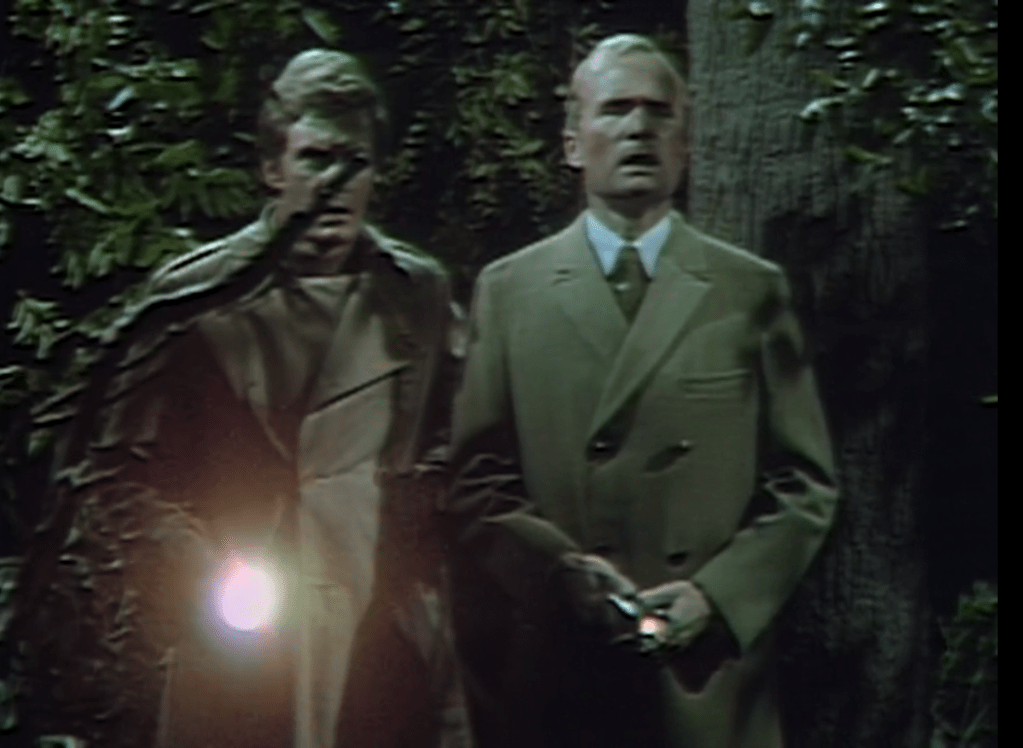
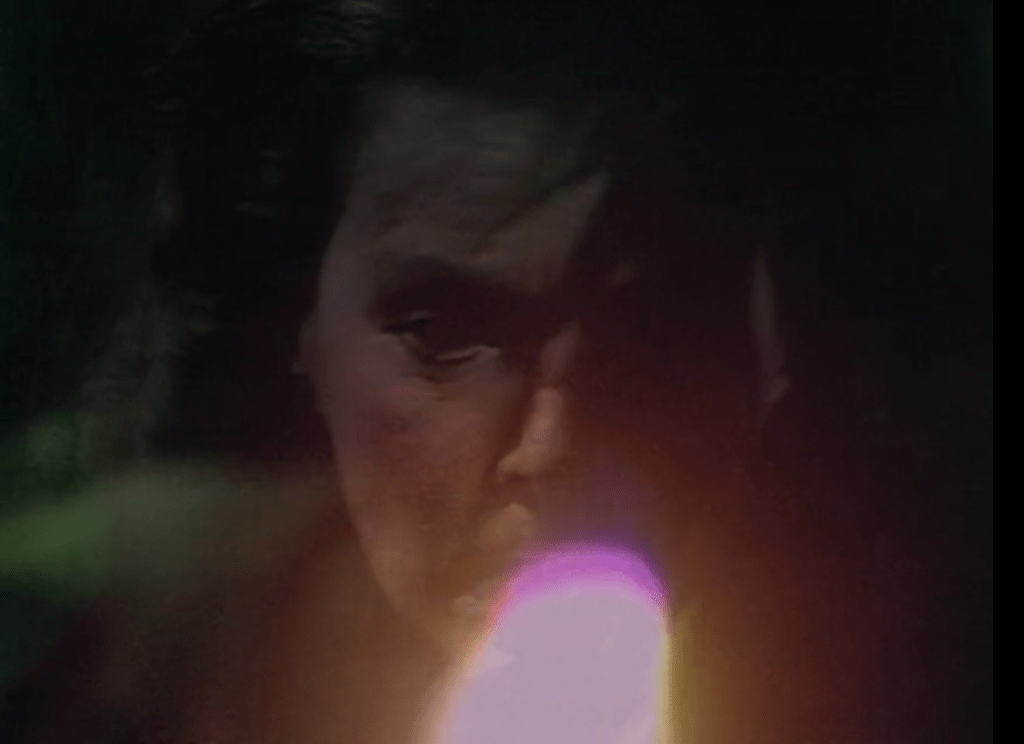
Later, Roger and Peter/ Jeff are outdoors looking for Liz. Each of them shines his flashlight directly into the camera. This is a Dark Shadows trademark. Sometimes it is clearly accidental; Peter/ Jeff does it once, briefly, and that may be an accident. But Roger does it twice, and each time the camera lingers on it. The first time comes as we cut from Liz in the graveyard to Roger and Peter/ Jeff, the second time as we dissolve from them back to Liz.

Cut to a closeup on Roger’s flashlight
Peter/ Jeff accidentally shines his flashlight directly into the camera
Dissolve to Liz from a second closeup on Roger’s flashlight

Liz is at the grave of Peter Bradford, which is to say Peter/ Jeff. He died in the 1790s and returned from the dead in March, a fact which is obvious to the audience and to Vicki but which he persistently denies. These denials are pointless and dull, but are the closest thing Peter/ Jeff has to a personality, so we can’t very well blame him for sticking to them. Peter/ Jeff finds Liz at his grave; she recognizes him as the dead man and faints. He carries her home. If there is any significance to any of this, it is apparently none of the audience’s business. The script certainly isn’t going to show us what it is.

Episode 575: This rotten collection of death

How Revolting and Disgusting You Really Are

Suave warlock Nicholas Blair has a job for a woman. Talking to his subordinate, vampire Angelique, he says that the job must go to “the most evil woman who ever lived.” At this, Angelique breaks into a smile, then raises her head proudly. Nicholas then says, “Someone like Lucrezia Borgia.” At this, Angelique’s face falls, and she protests that Lucrezia is dead.

Angelique, flattered when she thinks Nicholas is describing her as “The most evil woman who ever lived.”

Nicholas brushes this objection off, saying that “The spirit of evil can be made to live again.” Longtime viewers may have been wondering whether Lucrezia Borgia would make an appearance, since her name has come up more than once. In #152, sarcastic dandy Roger insulted his sister, reclusive matriarch Liz, by comparing her to Lucrezia; in #178, Roger insulted his niece, heiress Carolyn, in the same way; and in #523, Carolyn brought up Lucrezia to insult Angelique, whom she knew when Angelique was calling herself Cassandra and was married to Roger. Perhaps we might have imagined some kind of story where Roger turns out to have some kind of supernatural connection to Lucrezia.

Nicholas continues teasing Angelique, bringing up the Countess Elizabeth Bathory, alleged serial killer and blood drinker of the 16th and 17th centuries. Angelique calls that lady “a vile woman,” in a tone that suggests she knew her personally. From November 1967 through March 1968, Dark Shadows was a costume drama set in the 1790s, and Angelique was its chief villain. She was not a vampire then, but a witch. Her spells were very powerful, but she was quite clumsy in her use of them, suggesting that she was a young woman new to witchcraft. Perhaps this line is meant to open the door to a retcon, one which will make it possible to tell stories about Angelique set in even earlier periods than the 1790s segment.

Nicholas agrees that the countess was “a vile woman,” and repeats that epithet as the first in a list of her qualifications for the job he has in mind- “ambitious, cunning, devious, unprincipled, decadent!” He finally concludes his teasing of Angelique and tells her that he will not hire her for the job. She is disappointed, as one of the benefits of the job is release from vampirism. She leaves the room. In the corridor, she flashes a smile which regular viewers recognize as a sign that she is going to defy Nicholas and try to seize what he would not give her.

The Only Filthy Way It Could Be Done

The job is an unusual one. Nicholas has persuaded Frankenstein’s monster Adam to confront old world gentleman Barnabas Collins and mad scientist Julia Hoffman with a threat. If Julia and Barnabas do not repeat the procedure that created Adam and produce a woman who will be his mate, Adam will kill everyone in and around the great house of Collinwood. Subjected to that extortion, they undertake the project.

The procedure not only involves building a body from parts of corpses and running electrical charges through it, but also requires that the body be somehow connected to a person who will serve as its “life force.” It is energy drained from this person that will animate the body. Barnabas was Adam’s “life force.” Before the procedure, Barnabas was a vampire. Serving as Adam’s “life force” put his vampirism into remission. Nicholas talked about this with Angelique, raising her hopes that he would let her escape from vampirism the same way, only to dash those hopes cruelly.

Julia completed the experiment that brought Adam to life after the death of another mad scientist, Eric Lang. Lang had built the body and the apparatus, and had left detailed notes. Julia had studied those notes for some time before she knew which switches to throw and which dials to turn. Under Adam’s threat, Julia has rebuilt the apparatus in Barnabas’ basement and she has a cadaver there which she is using for parts. Barnabas has ordered his servant Willie to help with the grave robbing. Barnabas has also enlisted the aid of Lang’s former grave robber, an unpleasant man named Peter who prefers to be called Jeff. The equipment needs a lot of tending, and Peter/ Jeff is the lab tech on that detail.

A Nice, New, Clean Slab of Flesh

Peter/ Jeff is by himself in the basement lab when Professor Timothy Eliot Stokes walks in. It’s news to Peter/ Jeff that Stokes is aware of the project, but he tells him that he knows everything about it. Stokes stays so calm as he examines the apparatus and looks at the cadaver that one supposes he must know a great deal.

Stokes asks Peter/ Jeff how the equipment runs when Barnabas’ house has no electricity. Peter/ Jeff says that Julia installed a generator. This must be some unusual kind of generator, since it runs in absolute silence. Later in the episode, Stokes will have a conversation with another character about how Barnabas doesn’t have a telephone.

When Barnabas was a vampire, he didn’t want meter readers or other workers dropping by unannounced and he had no use for modern conveniences. So of course he did not connect his house to the electric grid or to telephone service in those days. As for other utilities, it is a fairly prominent bit of lore that vampires cannot tolerate running water, so of course he wasn’t going to have any plumbing. But he’s been unvamped for almost six months now, so he may as well just update his house. Stokes’ lines today lampshade the problems he creates by refusing to do so.

Another unannounced visitor interrupts Stokes’ conversation with Peter/ Jeff. It is Adam. He is upset to find Stokes in the lab. Stokes once took Adam in and taught him English, and in those days Adam considered Stokes to be his best friend. But Stokes shocked Adam when he broke the news to him that he was an artificially constructed man, and has thoroughly alienated him by trying to talk him out of the violent lifestyle Nicholas has persuaded him to adopt.

Adam goes on a self-pitying rant when Stokes tries to reason with him. Peter/ Jeff interrupts and tells Adam something Stokes left out of his birds and bees talk, that he was built out of parts of dead bodies. Peter/ Jeff taunts Adam about this in a speech that is full of such gems that I suspect it was written, not by the credited author of today’s script, Gordon Russell, but by Russell’s frequent uncredited collaborator Violet Welles. Welles’ name will start to appear in the credits in 711, and fans of the show recognize the sparkle that marks her dialogue.

Peter/ Jeff tries to stab Adam. Adam easily disarms him and holds the knife at his throat. Stokes tells Adam that without Peter/ Jeff the project will be delayed. Adam then flings Peter/ Jeff to the floor. Peter/ Jeff is played by Roger Davis, an actor who had a big television career and was irritating in every part. Mr Davis is so annoying on Dark Shadows that Mrs Acilius and I can’t be the only ones who are disappointed when Adam doesn’t kill his character off the show and who cheer when he throws him to the floor.

Peter/ Jeff gets up and leaves the lab. Adam demands Stokes bring him back to resume working. Knowing how violent Adam is, Stokes follows Peter/ Jeff to the great house of Collinwood. Peter/ Jeff is meeting his fiancée, well-meaning governess Vicki, there, planning to take her out for a date. Stokes tells him that they will be in grave danger from Adam unless he goes back to the lab at once. Peter/ Jeff looks out the window, and sees Adam peering in. Adam actually opens the window and reaches into the drawing room while Vicki and Peter/ Jeff are there; it is hard to understand how Vicki doesn’t notice him. Peter/ Jeff makes an excuse, and goes back to the lab.

We see him back at work. The camera pans up to a mirror. It holds on the mirror for several seconds while we see Angelique’s reflection. Previously, they have stressed that vampires do not cast reflections. There have been several moments when actors have missed their marks or other production faults have occurred that left us seeing a vampire in a mirror, but this is obviously intentional, and it is jarring to regular viewers.

Angelique’s reflection

Angelique and Peter/ Jeff talk for a moment, then she bites him. Evidently she plans to enslave him and use his access to the laboratory to force her way into the role of “life force” for Adam’s mate. So far, almost every victim of a vampire we have seen has been left unable to do the work s/he was doing before being bitten, so regular viewers might suspect that Angelique’s ploy will simply incapacitate Peter/ Jeff from helping with the project. This expectation becomes all the more substantial when we remember the many times Angelique’s schemes have blown up in her face. The less likely it seems to us Angelique will succeed, the less effective this week-ending cliffhanger will be.

Episode 557: Unannounced visitors

Act One consists of recovering vampire Barnabas and mad scientist Julia standing around Barnabas’ front parlor recapping various ongoing storylines.

Danny Horn devotes his post about this episode to a detailed analysis of this scene. He shows that Jonathan Frid’s performance and Grayson Hall’s are open to many objections. They fall short in such technical categories as “knowing their lines” and “standing on their marks” and “having the slightest idea what is going on.” But they are fascinating to watch nonetheless. Danny declares that “[t]he point of these scenes is to see how long two adults can stand around in a room saying preposterous things to each other.” Frid and Hall operate at such a high level of tension that the prospect of either of them breaking character generates enough suspense to keep us on the edge of our seats.

Patrick McCray wrote two separate posts about this episode. In the one that went live 13 September 2017, he too focuses on the performances in Act One. He writes:

Poor Jonathan Frid. He must have had a rough night. I am usually oblivious to his infamous (and completely understandable) line trouble, but in this one, it is so palpable that I totally understand why he retired from TV after DARK SHADOWS left the air. In his early dialogue with Grayson Hall, you can see sheer terror in the eyes of both performers as Barnabas haltingly recalls a trip to the hospital. This is followed by the “Frid Surge,” where Barnabas becomes far more committed and energetic when he turns to face the teleprompter. Of course, this gives him that great sense of vulnerability that was the secret to Barnabas’ success. 

Patrick McCray, “The Dark Shadows Daybook: August 13,” posted on the Collinsport Historical Society, 13 September 2017.

This is the only post on the Collinsport Historical Society tagged “Frid Surge”; that’s too bad, I’d like to see that phenomenon tracked throughout the series. I should also mention that Patrick goes on in this post to express his “confidence that Frid could have acted the doors off the collected ensemble had the poor guy just been given another frickin day to study his sides.”

Barnabas and Julia’s recap scene ends when an unexpected visitor barges in. He is an unpleasant man named Peter, who prefers to be called Jeff. Peter/ Jeff is fiancé to well-meaning governess Vicki, whom Barnabas and Julia know to have been abducted by Frankenstein’s monster Adam. Adam came to Barnabas’ house yesterday and threatened to kill Vicki unless Barnabas and Julia created a mate for him.

Peter/ Jeff was assistant to Eric Lang, the mad scientist who created Adam, and he knows that Barnabas and Julia were connected to the experiment. He does not know for sure that Adam is Lang’s creation, that Barnabas and Julia brought Adam to life after Lang’s death, or that Adam has abducted Vicki. He does, however, have grounds to suspect that each of these things might be true. In this scene, he announces his suspicions to Barnabas and Julia. They huddle in one corner of the room while he shouts his lines in his singularly irritating voice. They deny all three of his points. One of the commenters on Danny’s post, “Straker,” summed up their reaction admirably:

Frid and Hall were too professional to show it but I sensed they were both annoyed when Roger Davis marched in and started yelling. It’s kind of like how you feel when you’re at a party and the host’s five year old son throws a tantrum. Sort of an embarrassed tolerance.

Comment left by “Straker” at 6:21 am Pacific time 31 July 2020 on “Episode 557: A Race of Monsters,” by Danny Horn, Dark Shadows Every Day, 1 January 2015
Roger Davis as Peter/ Jeff, in one of the most subtle moments of his performance. Screenshot by Dark Shadows Before I Die.

After Peter/ Jeff’s scene, it is Barnabas’ turn to be an unwelcome guest. He calls on occult expert Timothy Eliot Stokes. Barnabas and Julia suspect that Stokes may be the evil mastermind who has turned the previously gentle Adam toward evil plans. When Stokes hears Barnabas knocking on his door, he looks up and rasps to himself “Go away… No one is home…” This is one of my favorite lines in the whole series. Stokes was quite cheerful when he first involved himself in the strange goings-on, but as he has found himself drawn deeper and deeper into the unholy world of Collinsport he has come to regret his decisions.

Stokes is quite impatient with Barnabas’ demands that he tell him what he knows and his refusal to reciprocate with information about himself. It is only because Vicki is in danger that Stokes tells Barnabas anything at all.

Stokes already knows how Adam came into being, and Barnabas tells him about Adam’s conversation with him. This brings up a question about the scene with Peter/ Jeff. Why couldn’t Barnabas and Julia have trusted Peter/ Jeff with as much information as Barnabas here gives Stokes? Peter/ Jeff can no more go to the police than Stokes can, he will not tell Vicki anything about Lang’s experiment, and Barnabas and Julia have no reason to suspect him of being behind Adam’s turn to evil. These questions don’t come to mind during the scene with Peter/ Jeff, partly because he is so disagreeable a presence that we want him off screen as soon as possible, and partly because it has long been Barnabas’ habit to tell his enemies everything he knows while he zealously guards his secrets from potential helpers.

Patrick McCray’s second post about this episode, published 30 July 2018, includes an analysis of Thayer David’s portrayal of Stokes:

Professor Eliot Stokes gains fascinating dimension in 557. Normally, jovial and helpful, we see his protectiveness of Adam reveal an irascible and sternly just man within. Anton LaVey extolled “responsibility to the responsible,” and there are few other places where Barnabas gets both barrels of that. Stokes is perhaps the most inherently good man in Collinsport since his fellow freemason, Bill Malloy, took his last diving lesson. (Ironically, at the hands of Thayer David’s first character.) Stokes’ prime reason for siding with Adam and not Barnabas? The former vampire and Julia have withheld vital information for months. Yes, they have necessary trust issues, but this is Stokes we’re talking about. Adam may be a wildly unpredictable man-beast, capable of leveling Collinsport to sand before breakfast, but he’s also (until later in the episode) a prime graduate of Rousseau’s Finishing School for Noble Savages. He’s nursed greedily on the milk of morality that spurts abundantly from the ripe and straining teat of of Eliot Stokes’ moral tutelage. It takes a Nicholas Blair — so often Stokes’ foil — to teach him the less savory lessons in humanity. Stokes knows that there’s only so much danger in which Adam can find himself… Victoria Winters is another matter.

Patrick McCray, “The Dark Shadows Daybook: Episode 557,” published on The Collinsport Historical Society, 30 July 2018

Barnabas passes the baton to Stokes, who becomes the third character in the episode to pay an unwelcome visit. He goes to Adam. He asks the big guy who has taught him to be cruel and amoral, and gets nothing but lies in return. He tries to persuade him that he must not hurt an innocent person, and Adam angrily declares that it is “fair” for him to make Barnabas watch him kill Vicki if Barnabas will not make a mate for him.

In Patrick McCray’s 2017 post, he praises Robert Rodan’s performance as Adam:

Robert Rodan issues a highly cerebral, emotionally packed performance. Rodan never receives the credit he deserves. Much of Adam’s stint on the show finds him equipped with an eloquent, even sesquipedalian command of the language. His inner conflict is as existential as it gets… Where do you turn? Rodan balances this absurd chimera of conflicts with effortless aplomb that makes Cirque du Soleil look as clumsy as a Matt Helm fight scene.

Patrick McCray, “The Dark Shadows Daybook: August 13,” posted on the Collinsport Historical Society, 13 September 2017.

Patrick amplifies that praise in his 2018 post:

Robert Rodan is an unsung hero of an actor, delivering his existential angst with passion and truth. It’s a shame that his identification with an eventually unpopular character was probably a factor in Rodan not being recycled by Dan Curtis, despite being the dark-haired, blue-eyed “type” that typified the ruggedly handsome, DS norm (such as Selby, Lacy, Crothers, George, Ryan, Prentice, Storm, Bain, etc.)

Patrick McCray, “The Dark Shadows Daybook: Episode 557,” published on The Collinsport Historical Society, 30 July 2018

While I always found the sight of Conrad Bain a guarantee of a fine performance, I can’t say it ever occurred to me to class him as “ruggedly handsome” in the way that one might class the other men Patrick lists. There’s no accounting for taste, I suppose.

Episode 472: Witches, curses, spirits!

Sarcastic dandy Roger, possessed by the spirit of wicked witch Angelique, visits mad scientist Dr Lang. The village of Collinsport was once a whaling center, and Lang is mindful enough of that long-ago history that he collects harpoons. Roger appears to be fascinated by Lang’s collection. He holds one of the finer pieces, admires it, fondles it, and tries to kill Lang with it. At the last moment, the murder is prevented by recovering vampire Barnabas and Julia, who is a scientist as mad as Lang but infinitely more interesting. As is typical of supernatural beings on Dark Shadows, Angelique projects her power through a portrait of herself; the portrait also has some adventures today.

There is a lot of great stuff in this one, as other bloggers have well explained. The 1960s were the heyday of Freudianism in the USA, and in the first year of the show the influence of that school of thought could often be traced in the scripts of Art Wallace and Francis Swann. Patrick McCray documents in his post on The Dark Shadows Daybook that this was an episode where writer Gordon Russell allowed himself to cut loose and have fun with the sillier side of the Freudian approach.

Roger caresses Lang’s harpoon. Screen capture by Dark Shadows Daybook.

On his Dark Shadows Every Day, Danny Horn focuses on the scene where Barnabas and Julia decide to go and stop Roger. He points out that it is the first conversation they have had about something other than themselves, the first time Barnabas shares with Julia the secret of how he became a vampire, the first time they take heroic action, and the first time they are recognizably friends. It is that friendship that will drive the action of the show from now on.

Barnabas takes his friend Julia by the arm. Screenshot by Dark Shadows Every Day.

In their meticulously detailed summary of the action of the episode on their Dark Shadows Before I Die, John and Christine Scoleri capture the effect on the audience of the steady accumulation of one absurdity upon another as the episode goes on. Reading their unfailingly matter-of-fact description of the ever-mounting lunacies we witness in this half-hour is almost as exhilarating as it was watching them in the first place.

Barnabas calls Julia’s attention to the closing cliffhanger. Screenshot by Dark Shadows Before I Die.