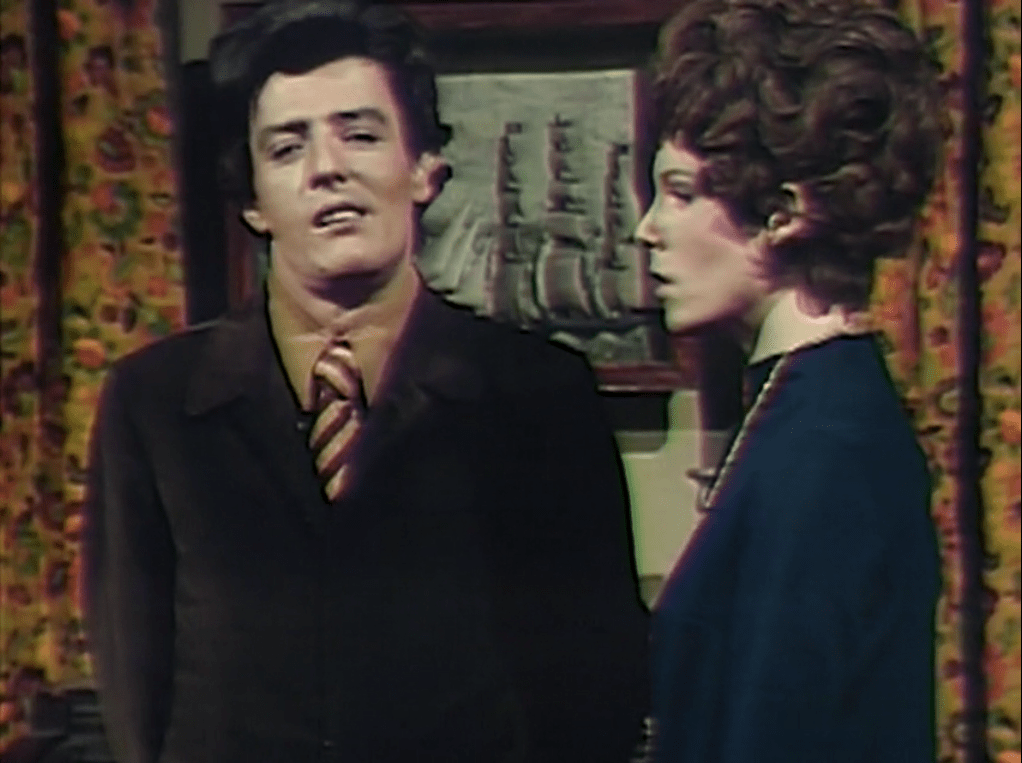
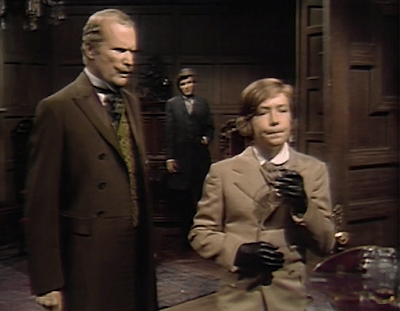
Episode 890: They will be strangers, but you will know them

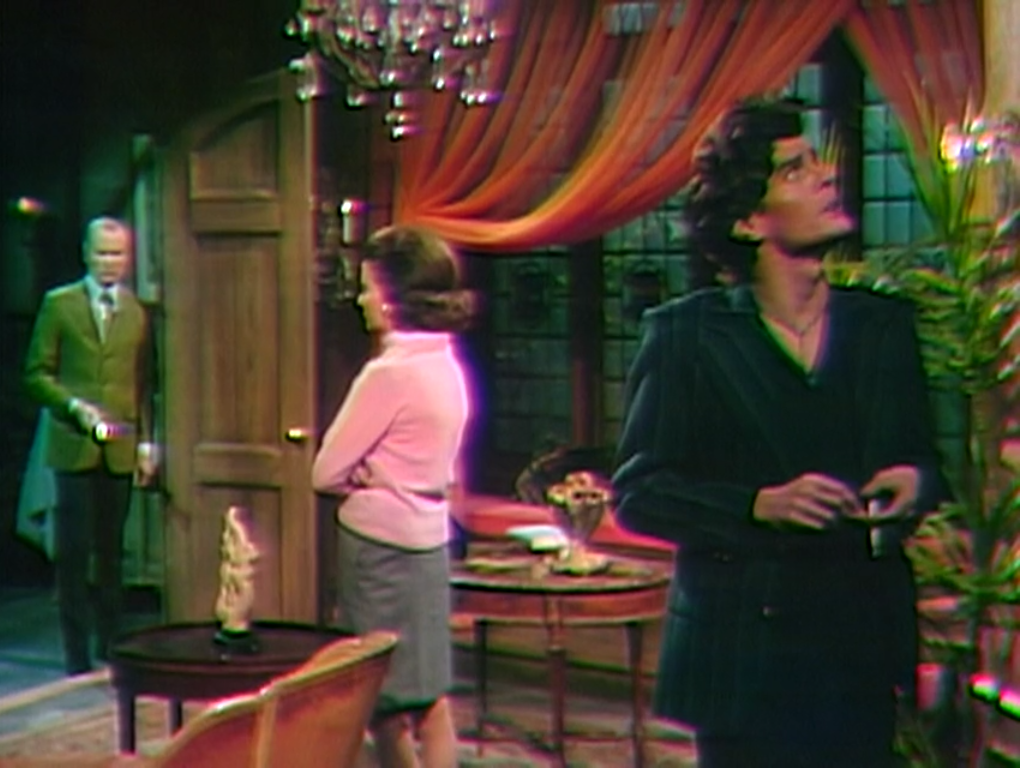
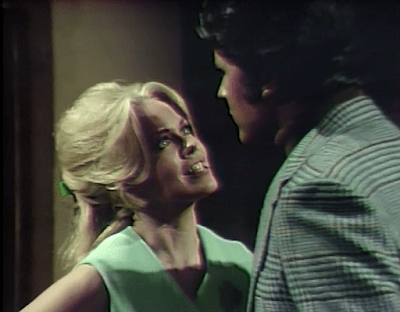
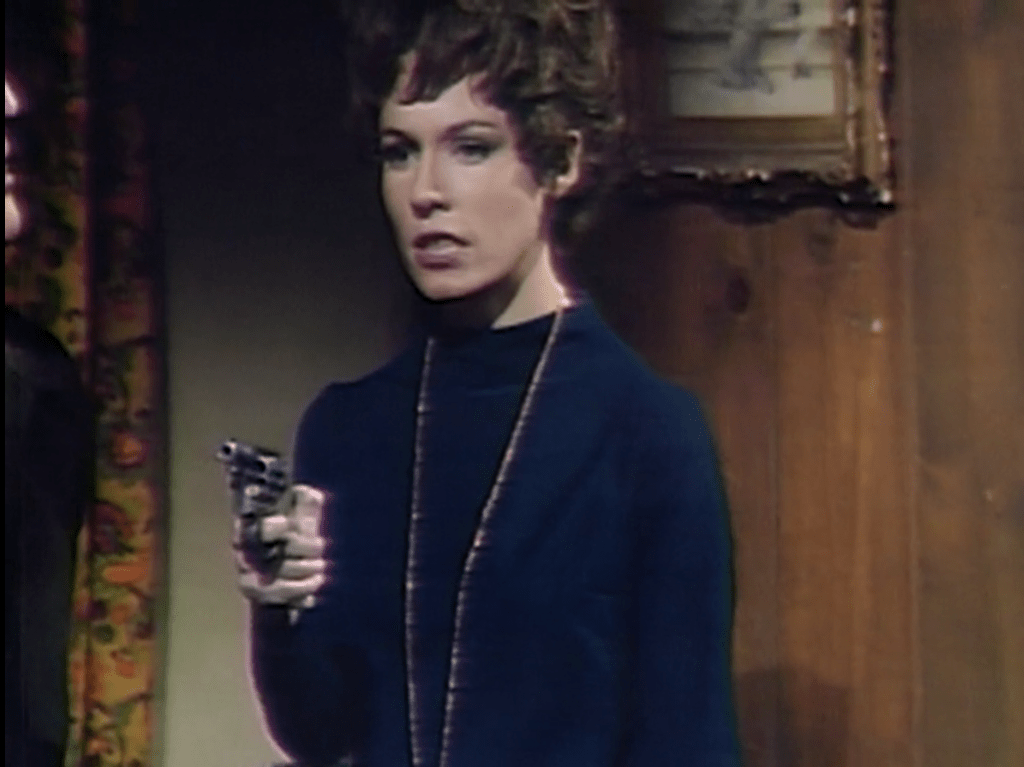
Like many episodes of Dark Shadows, this one ran long and ended with credits only for the cast and for Dan Curtis Productions. The entry on the Dark Shadows wiki says that the director was Lela Swift. I am sure that it was in fact directed by Henry Kaplan. This shot of Nancy Barrett as heiress Carolyn Collins Stoddard is proof positive:

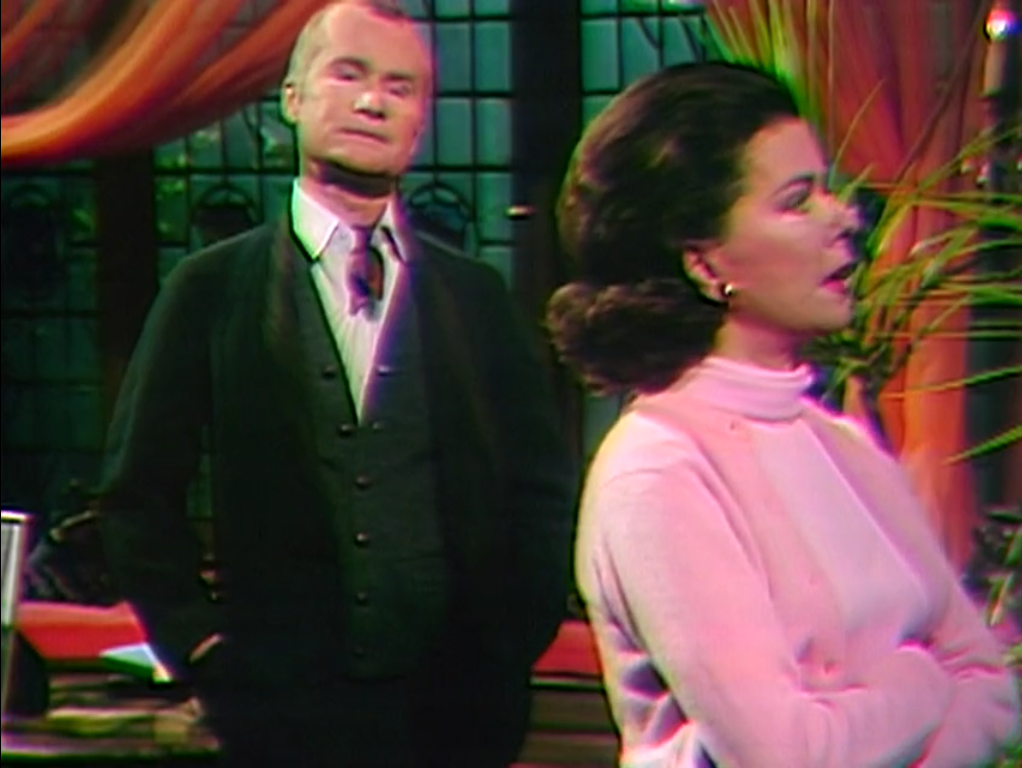
There is another flagrant Kaplanism in today’s first scene between antique shop owners Philip and Megan Todd (Christopher Bernau and Marie Wallace.) Philip enters from upstairs. He stops with his waist at the top of the frame. That’s where he stays for the first part of the scene, ending with Megan raising a paper that covers part of her face. Evidently what’s happening between the characters is none of the audience’s business.

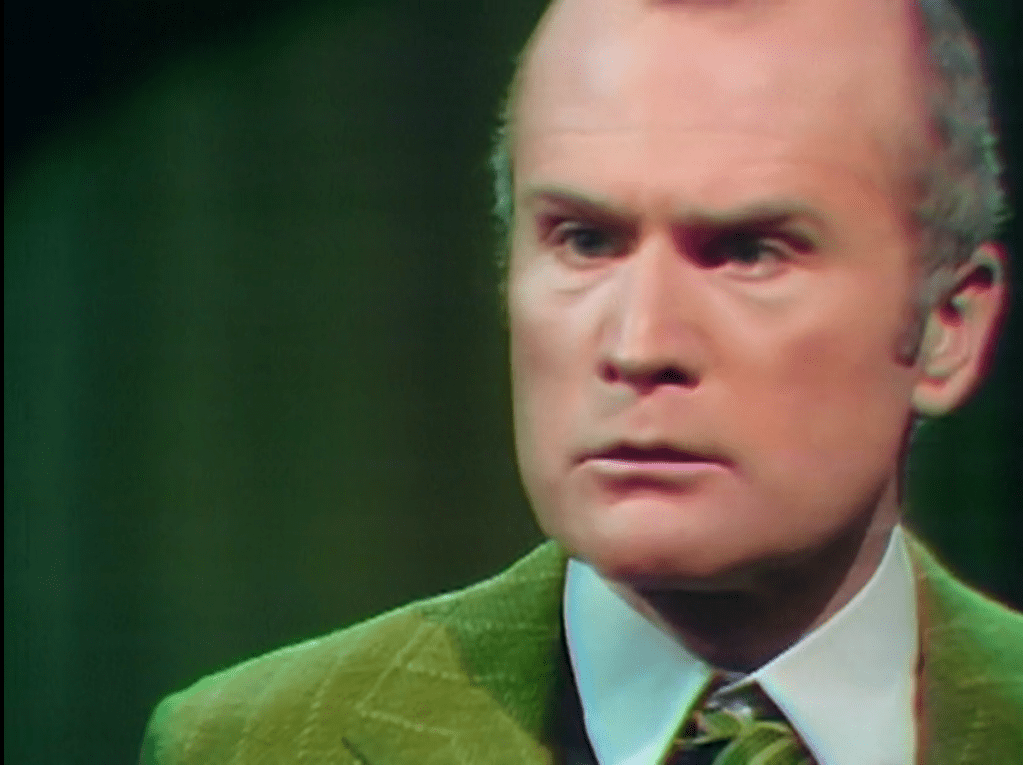
Swift was a talented and ambitious visual artist, Kaplan a sloppy and unimaginative one. He relied heavily on closeups. When it dawned on him that it was dull to hold the frame just beyond the edges of an actor’s face, his response was to zoom in and give us an extreme closeup of some part of the actor’s face. It’s above average for him that the first shot above includes Miss Barrett’s eyes- he specialized in shots displaying the face from the nostrils down, and often held them even after the actors had to move, leaving us with the sight of an ear drifting out of our view.

Even when Kaplan’s tight little frames do not keep us from figuring out what is happening in a scene, they deprive us of the energy that comes from seeing the players interact with each other. We don’t get statements and reactions simultaneously, and we don’t see the actors using the space between them to tell us how the characters feel about each other. Kaplan was also a pretty bad director of actors, regularly poking them with a stick as his way of telling them he wanted them to play a scene differently and on one occasion fastening a handle to a child actor so that he could physically place him on his mark during rehearsal. So perhaps his mania for closeups reflected a lack of awareness of what actors do and how the choices they make contribute to the audience’s experience. As a result of his insensitivity to these and other visual aspects of the medium, Kaplan’s episodes would often be better suited to radio than to television.

Fortunately, the dialogue today is peppered with snappy lines. So Danny Horn devotes his post about the episode on his great Dark Shadows Every Day to a selection of memorable pieces of dialogue. That also makes me suspect the wiki is not entirely correct. It attributes the script to Gordon Russell, an able writer overall but one who is not at all given to bons mots. I use bits of dialogue whenever possible as the titles of these posts, and I often have to search very hard through Russell’s to find suitable ones. It was Violet Welles who excelled at producing those. Russell and Welles often collaborated, so it could be that he wrote a draft to which she added the quotable quotes.

The current story centers on a mysterious cult that has sent time traveler Barnabas Collins back to 1969 from a long sojourn in 1897, by way of a couple of days in 1796. Under the influence of the cult, Barnabas is being a real jerk to his friend, mad scientist Julia Hoffman. Barnabas was a vampire for a long time, and even when he is free of the effects of that curse he habitually resorts to murder to solve his problems. But the victims of those murders are imaginary, played by actors who will go on to find other work, so we don’t usually stay mad at him for any length of time when he commits them. His friendship with Julia, on the other hand, is the emotional core of the show. Barnabas’ coldness to her in yesterday’s episode and today’s leads us to see what the cult is doing to him as the greatest crime anyone has ever committed on Dark Shadows.

Barnabas was a pop culture phenomenon familiar to many millions of people who never saw a single minute of Dark Shadows. The show’s fanbase largely consisted of his devoted followers. So a story about a cult which co-opts him as its leader and changes his personality so that he is impossible to get along with directly addresses a fear that must have blacked out the mind of Dan Curtis every time the postal service truck loaded with Jonathan Frid’s fan mail backed up at ABC Studio 16.

Barnabas brought a box with him from his visit to the eighteenth century, and it is of the utmost importance to the vast eternal plan the cult is working on that the box not be opened until the right time. So Barnabas put it on the mantel in his living room, and when Julia was standing a few inches from him he lifted it from the mantel and placed it on a table in the middle of the room. When she asked what it was, he became flustered and refused to answer any questions about it.

When Julia left the house, Barnabas left the room, with the front door unlocked and the box still on the table. Today, we open with Julia coming back in, hearing the sound of breathing coming from the box, finding its key on the table next to it, and placing the key in its lock. Barnabas comes in just in time to stop her opening it, but we can see that the cult probably could have chosen an agent with a better sense of operational security. Barnabas’ function in the story is to make messes that other people will have to clean up, so as soon as we heard that the box must not under any circumstances be opened we expected him to leave it where it would inevitably fall into the hands of someone bent on opening it, though it is a bit disappointing he has done so this quickly.

After he has taken the box from her, Barnabas berates Julia, orders her from his house, and tells her he owes her nothing. He abruptly sweetens up and tells her that he is only carrying on that way because of some kind of temporal jet lag. He reminds her that when she traveled back in time in September, she was very ill for a while; he suggests that his surly mood might be the result of the same shock that caused that reaction. About a minute after he starts on this new tack, just as Julia has started smiling again, a knock comes at the door. It is Carolyn.

We don’t know what effect the cult’s co-optation of him has had on Barnabas, but regular viewers know that characters on Dark Shadows are always acquiring one magical power and losing another. For the last few months of the 1897 segment, the show’s main villain was sorcerer Count Petofi. One of Petofi’s signature moves was to become aware of visitors shortly before they arrived. It could be that the writers have decided to give the cultified Barnabas that power, and that it was because Carolyn was on her way that he wanted to put Julia in a good mood.

That interpretation is supported by what follows. Carolyn is delighted to see Barnabas; she hadn’t known he was back from his trip to 1897. She hugs him and he smiles, a stark contrast to his icy reaction when Julia hugged him yesterday. She wants to talk about Chris Jennings, a young man she dated a few times and whom she has been told is dangerous. Julia and Barnabas have befriended Chris and know that he is a werewolf. Julia thinks she can somehow control Chris’ transformations, and she urges Carolyn to think well of him. Barnabas tells her to trust her instincts and to avoid Chris. He keeps telling her that she is too important to be allowed to come to harm. Later, he visits Carolyn in her home, the great house on the estate of Collinwood, and he keeps going on and on about how important she is and how confident he is about her future. He also gives her a silver pentagram, an amulet to ward off werewolves, and urges her to wear it at all times. He subsequently has another scene with Julia in his own house, and he is just as cold and dismissive as he was in the first scene, exploding at her for being “irrational.” Evidently the cult has plans for Carolyn, but not for Julia.

Julia bought a painting from the Todds the other day, and now they have received a telegram offering to buy it regardless of price. Julia goes to their shop and discusses the telegram with them. She believes that the telegram, which is signed “Corey,” may actually be from Quentin Collins, a distant cousin of Barnabas’ whom he befriended during his time in 1897 and who may have been immortalized by a magical portrait painted by the same artist responsible for the picture Julia bought. She tells the Todds that she is not certain she wants to part with the painting, but that she would very much like to meet “Mr Corey,” and that she believes others in town would also like to do so. She urges them to reply to the telegram with an invitation.

Barnabas stands over the box. We hear his thoughts as he mulls over his questions about it. He suddenly declares “It is time!” Then he goes to his chair and sits down. Evidently, it is time to take a load off.

Barnabas has a vision of one of the hooded figures who inducted him into the cult. The figure, a man named Oberon, addresses him as “Master” and tells him that he is to give the box to people who wake him by knocking at his door. There is a knocking, he does awaken, and he goes to the door.

Episode 864: Shipwreck Point

Sorcerer Count Petofi is currently occupying the body of rakish Quentin Collins. When he is in this form, I refer to him as Q-Petofi.

Q-Petofi. Screenshot by Dark Shadows Before I Die.

Lawyer/ Satanist Evan Hanley has displeased Q-Petofi. Q-Petofi has put the zap on Evan and made him dig his own grave. Evan begs for his life, but does so in a stilted, robotic voice that suggests he is struggling against Q-Petofi’s power. It is a neat job of acting by Humbert Allen Astredo.

Evan points out that it would raise suspicions if Q-Petofi were seen with his servant Aristide, especially inside the great house of Collinwood. Evan himself, however, is the Collins family’s attorney, trusted by everyone in the house. If anyone there has suspicions about Q-Petofi, they will confide in him. Q-Petofi decides that he may as well let Evan live, and orders him to keep tabs on wicked witch Angelique.

We cut to the foyer of Collinwood, where Angelique is staying. She is on the telephone trying to reach the local pharmacy, and is annoyed that the meds she wants are not yet available. Another houseguest, Cockney showgirl/ mentalist Pansy Faye, enters. Angelique hurriedly ends the call. Pansy taunts Angelique for the end of her engagement to Quentin. After Pansy exits, Angelique gets back on the phone and resumes talking to the pharmacist. Q-Petofi enters, and Angelique pretends she is talking to someone else, then hangs up.

Returning viewers know that Angelique is carrying on a medical intervention designed by time-traveling mad scientist Julia Hoffman, MD. Julia’s friend, vampire Barnabas Collins, made his way from 1969 to 1897, and she followed him. Julia had recreated an experimental treatment that put Barnabas’ vampirism into abeyance for a little while early in 1968 when she snapped back to her own time, vanishing from 1897. Shortly before Julia disappeared, Angelique agreed to complete the procedure and turn Barnabas into a real boy.

Angelique seems less powerful than usual today. Her dealings with the pharmacy are a logical consequence of her agreement to take over Julia’s plan, but she doesn’t usually have to get exasperated with people over the telephone, and not since her early days as a witch in the 1790s has she been so vulnerable to discovery by random passersby. Later, she goes to Barnabas’ hiding place, and Evan follows her. There have been times when Angelique could materialize and dematerialize at will, and it was impossible for any mere mortal to keep track of her whereabouts, but evidently she doesn’t feel up to that today. She does tell Q-Petofi she has a headache, maybe that’s true.

Pansy has a scene in the studio of artist Charles Delaware Tate. She tells Tate she wants to buy one of his paintings; he tells her that everything is for sale, but that his prices are high. She picks out a portrait of the lovely and mysterious Amanda Harris; he throws a tantrum and doesn’t want to sell it to her. When she reminds him that he said all the paintings are for sale, he names the ridiculously high price of $5000. That would be well over $150,000 in 2025. Without missing a beat, Pansy pulls out a few large-denomination bills and fans them under Tate’s nose.

Pansy’s only source of income was a cabaret act she recently did at the Blue Whale, a tavern in the village of Collinsport. We saw her there the other day shortly before nine PM, when she was the only person in the barroom. So it doesn’t seem likely she could have earned that quantity of cash there. Nor is there any apparent reason why Pansy would want a portrait of Amanda, whom she saw as a rival for Quentin’s affections. It seems likely that someone else put her up to buying it.

The obvious candidate would be Judith Collins Trask, owner of Collinwood and all the Collins family businesses. Judith is married to the odious Gregory Trask, whose late daughter Charity provided the host body through which Pansy, who died in #771, has been interacting with the world of the living since Petofi erased Charity’s personality in #819. Judith has persuaded Pansy to move back into Collinwood. Judith has herself recently returned to the great house after Trask had her confined to a mental hospital for a period of more than thirteen weeks. Her stuffy but lovable brother Edward told Judith that Trask spent much of that time trying to seduce Amanda, and Judith wants to get the facts about what went on in her absence.

Closing Miscellany

Director Henry Kaplan was not in good form in this one. In the opening, studio lights are clearly visible right in the middle of the screen, between Evan and Q-Petofi. The same thing happened in yesterday’s episode. The other directors might have made a mistake like that once, but I don’t think any of them would have done it two days in a row.

The camera is also frequently out of focus, as is typical of Kaplan’s shows, and it moves unsteadily. He must have been trying to get the camera operators to do something he hadn’t prepared them for, it looks really bad.

There are a couple of notable bloopers that aren’t particularly Kaplan’s fault. When Angelique makes a remark about Q-Petofi’s attitude towards brandy, David Selby says “Don’t you think it’s possible for one’s…change…or one’s taste to change in brandy?” That is followed by a silent beat, as both he and Lara Parker are stunned by the nonsense that just came out of his mouth.

When Tate lets Pansy into his studio, the shade falls out of the window. He looks at it for a second, then the scene goes on. It is one of the all-time great goofs.

Episode 859: Not this grownup

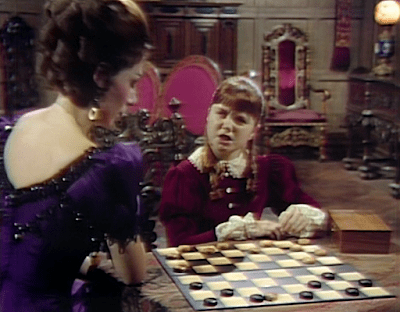
Nine year old Nora Collins enters the drawing room of the great house of Collinwood. She walks in on her father, the stuffy but lovable Edward, embracing Kitty Soames, the dowager countess of Hampshire. She gives them a dirty look and says she supposes Edward is too busy to join her in a game of checkers. He says he does have to run an errand, but suggests that Nora play with Kitty.

Kitty is eager to ingratiate herself with Nora, who clearly wants nothing to do with her. Nora asks, in an icy voice, if the reason Kitty wants to be her friend is that she is planning to marry her father. Returning viewers suspect she is right. Kitty and Edward have more in common than they know. Both are penniless, each is sure the other is very rich, and each imagines marriage to the other will solve all their problems. Kitty can’t very well level with Nora about this, so she claims that the women in the Collins family, being outnumbered by the men, have to stick together. Nora does not hide her distaste at Kitty’s inclusion of herself among the women of the family. Kitty asks Nora if she wants her father to be happy. Nora drills her eyes into Kitty’s face and says in a firm, flat voice “I want that.”

Nora asks Kitty if she is just letting her win at checkers. While she is asking this, Nora moves twice in one turn and takes three of Kitty’s pieces. Kitty watches this without protest and denies that she is letting her win. She then says she wants to concede the game and listen to whatever information Nora is willing to share about the family.

Nora is not impressed with Her Ladyship. Screenshot by Dark Shadows Before I Die.

Edward comes back from his errand to find Nora packing up the checkers and the board. He asks if she enjoyed her game with Kitty. Not looking up, Nora says they never finished it. Kitty hastens back in and asks if she wants to finish it now. Edward points out that it is getting close to Nora’s bedtime. He kisses her, and bids her say goodnight to Lady Hampshire. Kitty asks Nora to call her by her first name. Nora pointedly says “Good night, Lady Hampshire.”

It doesn’t show in her scenes with Nora, but Kitty seems to be suffering from a severe mental health crisis. Returning viewers know that the ghost of Josette Collins is taking possession of her, and suspect that she will turn out to be a reincarnation of Josette. Edward knows enough about the supernatural doings on the estate of Collinwood that he might give Kitty the benefit of the doubt when, for example, she comes running in today and is shrieking about a haunted house, a vanishing woman, and a curse that follows her everywhere. But she is so often so highly distraught that Nora must have noticed that she is not right in the head, and she can hardly look forward to having such a person as a stepmother.

Shortly before Nora enters, Edward calls Kitty “Katie.” This is a small enough slip of the tongue, but Kathryn Leigh Scott’s friends call her Katie, so it is a case of an actor’s name in place of the character’s. I think I can see Louis Edmonds blush a little when he realizes what he has done.

This episode marks the final appearance of Nora, and very nearly the last time we will hear Nora’s name. I think she was badly underused, disappointingly so after the outstanding work Denise Nickerson did as Amy Jennings in the months leading up to the segment set in 1897. She will be back later, in other parts.

Director Henry Kaplan was not much of a visual artist, and his deficiencies are particularly glaring today. Especially during Kitty and Nora’s first scene, the camera keeps drifting up to the actors until we see a randomly selected two-thirds of their faces in extreme closeup. Once the shot excludes the eyes or the mouth, it abruptly pulls back. Even the successfully framed closeups are rarely in focus, and you can forget about finding coherent visual storytelling in any kind of shot other than a closeup. The actors themselves do a good job, in spite of Kaplan’s notoriously unpleasant behavior towards them, but aside from a few evocative facial expressions, most of them by Nickerson, it may as well have been a radio play.

Episode 803: As soon as you’re finished with the mumbo-jumbo

The spirit of evil sorcerer Count Petofi has taken possession of twelve year old Jamison Collins, much to everyone’s consternation. David Henesy spends most of the episode mimicking Thayer David’s Petofi, with hilarious results.

Jamison/ Petofi sipping a glass of “mineral water… for the digestion.” Screenshot by Dark Shadows Before I Die.

We see Jamison’s favorite uncle, Quentin the Satanist, trying to cast a spell to break Petofi’s possession of Jamison. As he always does when he is calling on the dark powers of the unseen realms, Quentin gets very fervent. We pan to Jamison/ Petofi, standing next to Quentin in a state of utter boredom, asking if Quentin will bring him a glass of mineral water once he’s “finished with all the mumbo-jumbo.”

Twice, Jamison/ Petofi pretends he is not possessed, but is his usual preteen self. He does this in order to trick people into letting him kiss them, which is how Petofi’s power spreads to them. This gives Mr Henesy the challenge of showing how Thayer David would play Petofi playing Jamison. That’s the sort of thing an actor needs a director’s help to pull off. Unfortunately, the woeful Henry Kaplan was at the helm today, so we discover that Petofi’s imitation of Jamison sounds exactly like the original, who is in turn uncannily like Jamison’s grandson David Collins and his great-great-grandfather Daniel Collins, who are also played by Mr Henesy.

Those whom Jamison/ Petofi kisses reveal their “true selves.” So maidservant Beth reveals that she was under the power of Jamison’s distant cousin, vampire Barnabas Collins. When Jamison’s father Edward passes this word along to Quentin, Quentin tells him is going to confront Barnabas. Edward has been hunting Barnabas, and by saying this Quentin implies that he knows where Barnabas is and that he has been helping to hide him. For some reason, Edward only smiles in response to this revelation.

Petofi wears a prosthesis in place of his right hand; Edward finds that Jamison’s right hand has also been replaced with a prosthesis. After this horrifying discovery, Jamison/ Petofi kisses Edward. Quentin returns shortly after, and finds that Edward does not recognize him or know the name of the house. Edward identifies himself as a newcomer to the area, and says that he would be glad of any work the family might hire him to do. Evidently his “true self” is a guy who needs a job. Since he has not inherited any assets or accumulated enough to live on, I don’t suppose we can disagree with whatever force it was that declared this to be Edward’s reality.

Episode 729: A tired family

Libertine Quentin Collins has learned that his estranged wife, madwoman Jenny, is being kept locked up somewhere in the great house of Collinwood. He learned this when Jenny escaped and stabbed him. He also learned that his brother, stuffy Edward, and maidservant Beth Chavez are involved in the plot to keep Jenny in confinement. He spends time today trying to find out where Jenny is, openly telling both Beth and Edward that when he finds her, he will kill her.

Edward is estranged from his own wife, and just yesterday we learned that her name is Laura. Evidently she is the same sort of creature as we came to know from December 1966 to March 1967. In those days Dark Shadows was set in contemporary times, and Edward’s grandson Roger Collins was dismayed at the return of his estranged wife, who was also named Laura. That Laura was an undead blonde fire witch, a humanoid Phoenix who sought to be incinerated with her son, strange and troubled boy David Collins, so that her own life could be renewed.

Today, the year is 1897 and Edward and Laura’s nine year old daughter Nora is convinced that her mother will return after a year when she has been away and it has been forbidden to mention her name. Nora has a vision of Laura’s face in the fireplace, a vision of flames in the corridor, and a dream in which she meets Laura in the woods outside the house. At the end of the episode she wakes up, sneaks out to the woods, and finds the cloak Laura was wearing in her dream lying on the ground.

All of this is recapped from previous episodes, but actors David Selby, Louis Edmonds, and Denise Nickerson make it worth watching. As Beth, Terrayne Crawford is stiff and literal, and her awkward performance does detract from her scenes. But everyone else is so good that you don’t notice her weaknesses too much.

This episode marks the second time we hear the name “Mrs Fillmore.” In #707, we learned that Beth took substantial sums of money into the village of Collinsport to a lady of that name as part of the plot to cover up Jenny’s presence in the house. Today Beth has to remind Edward of that fact, and Quentin looks through the envelope with hundreds of dollars in banknotes meant for Mrs Fillmore.

When Nora screams that there is a fire in the upstairs hallway, Edward and Beth run towards it. Quentin just sulks in the drawing room; evidently the idea that the house is on fire bores him. By the time Beth and Edward get upstairs, the flames Nora saw have vanished, and nothing is burned. She swears that there was a fire, they cannot believe her. This echoes #400, when wicked witch Angelique cast a spell that caused time-traveling governess Vicki to see flames in her room in the Old House on the estate, and subsequently Vicki’s friends were puzzled that there was no indication there of anything burned. That confusion led to trouble for Vicki, and longtime viewers can imagine it is a sign of trouble for Nora as well.

Yesterday, Nora drew a series of Egyptian hieroglyphics saying that her mother was coming home. At the beginning of her dream, a maniacal Edward holds an oversized copy of that drawing and rips it up, declaring Laura will never be back. The oversized drawing harks back all the way to episode #722, when Nora’s governess, neurotic intellectual Rachel Drummond, had a dream in which the daffy Carl Collins held a gigantic pocket watch. That was a striking enough image that not even the Vaseline almost entirely covering the lens could ruin it. But today even less of the picture is legible, and the gambit isn’t fresh anymore. Louis Edmonds does do a fine job of laughing maniacally, though, I will grant that.

The picture really does look like that, and it is supposed to look like that. Director Henry Kaplan was not much of a visual artist. Screenshot by Dark Shadows Before I Die.

Episode 722: Too good-looking to die from old age

Another drab-looking outing from director Henry Kaplan, enlivened with some witty writing by Violet Welles and sprightly acting by John Karlen and David Henesy.

Daft prankster Carl Collins (Karlen) goes to the suite in the west wing of the great house of Collinwood recently occupied by his brother, the late Quentin Collins. Carl finds his nephew, twelve year-old Jamison Collins (Henesy) sitting by Quentin’s gramophone, listening to a sickly sweet waltz of which Quentin was fond. Carl mutters and rambles, claiming at one moment that Quentin is not really dead and at the next that he has a theory about who really killed him. Jamison just stares in response. Carl, agitated, demands that Jamison turn off the gramophone. When he does not answer, Carl declares that he is Jamison’s uncle. Jamison calmly replies that Carl is not his uncle, but his brother.

Carl comes back with his sister Judith. They question Jamison, who seems to know things only Quentin would know. Judith declares that “The child is possessed!” and flounces out of the room.

Jamison’s governess, Rachel Drummond, has a dream in which Jamison and Judith make her uncomfortable. She tries to go to the drawing room, only to find Carl blocking her way. He is wearing a railroad conductor’s hat and holding Jamison’s toy locomotive. He tells her it is too late to pass this point, and shows her a gigantic pocket watch to prove the point. She wakes up to find Quentin’s body sitting in a rocking chair next to her bed.

April first, a very important date! Screenshot by Dark Shadows Before I Die.

Episode 701: Welcome home the prodigal

We begin the part of Dark Shadows set in the year 1897 with an episode featuring a glittering script, a strong cast, and a hopeless director. Henry Kaplan’s visual style consisted of little more than one closeup after another. The first real scene in the episode introduces us to Sandor and Magda Rákóczi, a Romani couple who live in the Old House on the estate of Collinwood. They bicker while Sandor throws knives at the wall. Thayer David really is throwing knives, but since we cut between closeups of the targets and of the actors we cannot see anything dynamic in that action. He may as well be whittling.

Magda ridicules Sandor’s pretensions as a knife-thrower and as a patent medicine salesman, and busies herself with a crystal ball. She tells him that when “the old lady” dies, they will have to leave Collinwood. He says he knows all about that. She wants him to steal the Collins family jewels so that they can leave with great riches. He eventually caves in and sets out for the great house on the estate, more to escape her nagging than out of greed.

Regular viewers will remember that we heard Magda’s name in December 1968. The show had introduced two storylines, one about the malevolent ghost of Quentin Collins and the other about werewolf Chris Jennings, and the characters were starting to notice the strange goings-on that Quentin and Chris generated. The adults in the great house had no idea that Quentin was haunting them or that Chris was a werewolf, so they held a séance in #642. Speaking through heiress Carolyn Collins Stoddard, Magda mentioned “My curse!” and said that “He must not come back!” It was clear in the context of the episode that the “He” who “must not come back” was Quentin. Chris was a participant in the séance, and he broke the circle before Magda could explain what she meant by her “curse.” Séances held in #170 and #281 were cut short by the person whose secret the medium was about to expose; that it is Chris who interrupts this one would suggest to longtime viewers that Magda not only knew Quentin, but that the curse she is about to explain was the one that made Chris a werewolf. Carolyn and her uncle Roger Collins talked a little about Magda in #643, and psychic investigator Janet Findley sensed the ghostly presence of a woman whose name started with an “M” in #648. We haven’t heard about Magda since.

As the living Magda, Grayson Hall manages rather a more natural accent than Nancy Barrett had when channeling her concerns about “my currrrrssssse.” The exaggerated costumes Hall and Thayer David wear make sense when we hear them reminiscing about the old days, when they made their livings as stage Gypsies with a knife-throwing act, Tarot card readings, and a magic elixir. Even the fact that Magda is peering into a crystal ball during this scene is understandable when they make it clear that they are staying in the Old House as guests of the mistress of the great house, an old, dying lady who enjoys their broadly stereotypical antics. But there is no way to reconcile twenty-first century sensibilities to Hall and David’s brownface makeup. Some time later, Hall would claim that one of her grandmothers was Romani. If that was a lie, it is telling that only someone as phenomenally sophisticated as Hall could in the 1970s see that she would need to invent a story to excuse playing such a character.

Objectionable as Sandor and Magda are, their dialogue is so well-written and so well delivered that we want to like them. Moreover, the year 1897 points to another reason fans of Dark Shadows might be happy enough to see Romani or Sinti characters that they will overlook the racist aspects of their portrayal. It was in 1897 that Bram Stoker’s Dracula was published, and it depicted the evil Count as surrounded by “Gypsy” thralls. The character who has brought us on this journey into the past is Barnabas Collins, and upon his arrival he found that he was once more a vampire.

In addition to the strengths of the dialogue, the acting, and the intertext, there is also a weakness in this episode that softens the blow of the brownface. Today the picture is so muddy that it is possible to overlook the makeup. That’s Kaplan’s fault. It would often be the case that one or the other of the cameras wasn’t up to standard, but when the director was a visual artist as capable as Lela Swift or John Sedwick, there would always be at least some shots in a scene using the good camera, and others where the lighting would alleviate some of the consequences of the technical difficulties. But Kaplan doesn’t seem to have cared at all. He had made up his mind to use a particular camera to shoot the Old House parlor with a subdued lighting scheme, and if that camera was not picking up the full range of color, too bad. He’d photograph a lot of sludge and call it a day.

Meanwhile, a man knocks on the door of the great house. He is Quentin, and the person who opens the door is Beth Chavez. We first saw these two as ghosts in #646. Beth spoke some lines during the “Haunting of Collinwood” story, but Quentin’s voice was heard only in his menacing laugh.

We already know Quentin as the evil spirit who drove everyone from the house and is killing strange and troubled boy David Collins in February of 1969. His behavior in this scene is no less abominable than we might there by have come to expect. He pushes past Beth to force his way into the foyer, does not bother to deny that he has come back to persuade his dying grandmother to leave him her money, pretends to have forgotten someone named “Jenny,” makes Beth feel uncomfortable by saying that her association with Jenny makes her position in the house precarious, orders Beth to carry his bags, twists her arm, and leeringly tells her that she would be much happier if she would just submit to his charms. David Selby sells the scene, and we believe that Quentin is a villain who must be stopped. But Mr Selby himself is so charming, and the dialogue in which he makes his unforgivable declarations is so witty, that we don’t want him to go away. He establishes himself at once as The Man You Love to Hate.

In an upstairs bedroom, the aged Edith Collins is looking at Tarot cards. Quentin makes his way to her; she expresses her vigorous disapproval of him. She says that “When Jamison brought me the letter, I said to myself ‘He is the same. Quentin is using the child to get back.'” Quentin replies “But you let me come back.” She says that she did, and admits that he makes her feel young. With that, Edith identifies herself with the audience’s point of view.

The reference to Jamison and a letter reminds regular viewers of #643, when Magda’s ghost caused a letter from Quentin to fall into Roger’s hands. It was addressed to Roger’s father, Jamison, and was written in 1887. It read “Dear Jamison, You must return to Collinwood. I need your help. You must intercede with Oscar. Only you can save me.” They’ve revised the flimsies quite a bit since then; now it is 1897, Jamison is 12, and we don’t hear about anyone named Oscar.

Not about any character named Oscar, anyway. Edith tells Quentin that “Men who live as you do will not age well.” Quentin tells Edith that she ought not to believe in the Tarot, because “This card always has the same picture and people change, even I.” On Dark Shadows, which from its beginning has taken place on sets dominated by portraits, these two lines might make us wonder what it would be like if it were portraits that changed while their subjects remained the same. Oscar Wilde’s Picture of Dorian Gray was published in serial form in 1890 and as a novel in 1891, and it was a sensation on both sides of the Atlantic. The dialogue is so witty that the characters must be well-read, making it quite plausible that Quentin’s remark was meant to remind Edith of the book. Especially so, since Wilde was released from prison in 1897, bringing him back to public notice in that year.

Edith tells Quentin that old and sick as she may be, she can still out-think him. She declares that all of her grandchildren will get what they deserve. All, that is, except Edward. Roger mentioned Edward in #697, naming him as his grandfather and Jamison’s father. Edith says that Edward is the eldest, and therefore she must tell him “the secret.” There is a note of horror in her voice as she says this; Quentin misses that note, and reflexively urges her to tell him the secret. She only shakes her head- the secret isn’t a prize to contend for, it is a burden to lament.

Isabella Hoopes plays this scene lying on her side in bed, a challenging position for any performer. Her delivery is a bit stilted at the beginning, but after she makes eye contact with David Selby she warms up and becomes very natural. I wonder if the initial awkwardness had to do with Kaplan. He held a conductor’s baton while directing, and he used to poke actresses with it. I can’t imagine a person in bed wearing a nightgown would have an easy time relaxing if her attention was focused on him. Once she can connect with Mr Selby, though, you can see what an outstanding professional she was.

Quentin goes to the drawing room, and finds Sandor behind the curtains. He threatens to call the police, and Sandor slinks back to the Old House. Magda berates him for his failure to steal the jewels, and he insists there are no jewels in the great house.

Meanwhile, Barnabas is in his coffin, trying to will someone to come and release him. In #210, dangerously unstable ruffian Willie Loomis had become obsessed with Barnabas’ portrait in the foyer of the great house, so much so that he could hear Barnabas’ heart beating through it. Barnabas called Willie to come to the secret chamber in the old Collins family mausoleum where his coffin was hidden. In his conscious mind, Willie thought he was going to steal a fortune in jewels. His face distorted with the gleeful expectation of that bonanza, he broke the chains that bound the coffin shut, and Barnabas’ hand darted out, choking him and pulling him down.

In the Old House, an image suddenly appears in the crystal ball. We can see it, the first time they have actually projected an image in such a ball since the first one made its debut in #48.

Picture in picture. Screenshot by Dark Shadows Before I Die.

Magda notices the image, and tells Sandor to look. He recognizes the old mausoleum. She says that the jewels must be in “the room,” implying that they already know about the hidden panel and the secret chamber behind it. Sandor says it is absurd to imagine Edith going to and from the mausoleum to retrieve pieces of her jewelry collection. Magda ignores this, and urges him to go there. He reluctantly agrees to go with her.

The two of them are heading for the door when they hear a knock. It is Beth, come to say that Edith wants to see Magda. Edith wants what she always wants- to be told that Edward will return before she dies. Sandor says Magda can’t go, but Beth says she will regret it for the rest of her life if she does not. Magda tells Sandor to go on his way without her, and says that she will bring Edith some ancient Gypsy cards, cards older than the Tarot. When she talks about Romani lore, Magda taunts Beth- “but you wouldn’t know anything about that, would you?” Her sarcastic tone implies that Beth has tried to conceal her own Romani heritage.

Sandor opens the secret panel and looks at the chained coffin. He tells himself the jewels can’t be hidden there, then decides he may as well open it anyway- if he doesn’t, Magda will just send him back. Longtime viewers remembering the frenzy in which Willie opened the coffin in #210 will be struck by the utterly lackadaisical attitude with which Sandor performs the same task. Men’s lust for riches may release the vampire, but so too may their annoyance with the wife when she won’t stop carping on the same old thing.

When Willie opened the coffin, it lay across the frame lengthwise and he was behind it. When he raised the lid it blocked our view of his middle. We could see only his face when he realized what he had done, and could see nothing of Barnabas but his hand. The result was an iconic image.

Farewell, dangerously unstable ruffian- hello, sorely bedraggled blood thrall. Screenshot by Dark Shadows Before I Die.

When Sandor opens the coffin, its end is toward us. We see Barnabas at the same time he does. Barnabas’ hand darts up, and also for some reason his foot. The camera zooms in as Barnabas clutches Sandor’s throat. Unfortunately, the shot is so dimly lit that not all viewers will see this. My wife, Mrs Acilius, has eyesight that is in some ways a bit below average, and she missed it completely, even on a modern big-screen television. It’s anyone’s guess how many viewers would have known what was going on when they were watching it on the little TV sets of March 1969, on an ABC affiliate which was more likely than not the station that came in with the poorest picture quality in the area. As a result, the image that marks the relaunch of Barnabas’ career as a vampire is nothing at all. There is so much good stuff in the episode that it easily earns the “Genuinely Good” tag, but Kaplan’s bungling of this final shot is a severe failure.

Grab and kick, and one and two! Screenshot by Dark Shadows Before I Die.

Episode 698: The kind of scene you should be avoiding

Barnabas Collins, old world gentleman extraordinaire, and Julia Hoffman, MD, are helping mysterious drifter Chris Jennings cover up the fact that he is a werewolf, responsible for a great many violent deaths. Lately Chris has started transforming into his lupine shape even on nights when the moon is not full, and this morning they find that he has not changed back even after dawn.

As if that did not present enough difficulty to Julia and Barnabas, one of Chris’ surviving victims is in town. She is his onetime fiancée, Sabrina Stuart. Two years ago, Sabrina saw Chris as the werewolf. She hasn’t told anyone about him, because she hasn’t been able to speak since. Her hair turned white, her skin turned pale, and she has been nearly catatonic.

Others have encountered the werewolf, and none has had this reaction. It’s true that Chris’ cousin Joe had to be taken to a mental hospital after he saw the transformation, but Joe had just been through a very long train of supernaturally induced traumas that had shattered his sensibilities and taken away everything he cared about. Seeing Chris change was just the last step in that process. Sabrina, as we see in a flashback segment today, was fine until she encountered Chris as the werewolf, and she didn’t even see the transformation itself. Yet here she is two years later, unspeaking, immobilized, and wearing the same makeup that Eli Wallach wore as Mr Freeze in the 1960s Batman TV show.

In a comment on Danny Horn’s post about this episode at Dark Shadows Every Day, “Cole” speculates that the show might have meant to tell us that the real reason Sabrina’s condition is less to do with what happened that on night in Chris’ apartment than with her brother and sole caretaker, Ned, played by Roger Davis:

I am once more getting through the Ned/Sabrina scenes thanks to this blog and the comments here; and although I still have to frequently avert my eyes from the screen to hold back the nausea, I keep concentrating on the dialogue while speculating further on JRM’s theory.

It does seem that we– and Julia– might be meant to feel especially concerned by Ned’s refusal to even consider allowing Sabrina to stay at Windcliff. He even says (or, rather, since it is Roger Davis, he SCREAMS), ​”I won’t be separated from her!”

I don’t think his character is meant to be overly suspicious of Julia and Barnabas so the vehemence behind his already rather alarming declaration becomes more baffling unless the viewer concludes he has … extremely unnatural feelings of possessiveness towards sad, PTSD-afflicted Sabrina.

It is almost half as frustrating as it is disturbing because, with any other actors, we would surely know for certain how to interpret these scenes.

We would perhaps recognize that when Sabrina stares pleadingly at Julia once Ned leaves the room, that her muteness is caused as much by her horror at being an ongoing victim of her brother’s unspeakable abuse as by having once witnessed Chris’s transformation into a werewolf. We wouldn’t wonder, instead if the actress, Lisa Richards, is actually pleading with Hall to help her endure Davis’s deliberate act of molesting and assaulting her through out these scenes.

If it wasn’t Roger Davis in this role, we would know who Ned is really meant to be since there is no way any of the other regular male cast members would willingly subject their costars to type of abuse Davis is inflicting on Richards.

If it were … say, Jerry Lacy who was currently playing “Ned Stuart” in a manner even remotely similar to Roger Davis’s ‘interpretation’ of the role, we would recognize at once that the character of Ned is obviously scripted to be an incestuous rapist (and I am sure Lacy would still keep his hands professionally and respectfully away from Lisa Richards’s/”Sabrina’s” breasts, instead using actual acting techniques to portray his character’s warped nature). But with Davis ..

It really could be, as Mary commented below, that he is trying to get the poor actress to break character. And how could we expect other than that he would use his usual disgusting and violent Drumph-like/”‘you can grab them by the pussy” sense of Curtis-granted entitlement to assault her as “Ned,” regardless of the intent of the writer and director.

Either way, what a horrifically mistaken choice in casting.

Lisa Richards: fifty years later, I am thinking of you and hoping you weren’t forced to endure PTSD after filming these scenes with Davis.

Comment left 29 August 2021 by “Cole” on “Episode 698: Sister Act,” Dark Shadows Every Day, Danny Horn, 8 August 2015

When I mentally recast the many parts Roger Davis played on Dark Shadows, I divide them between two men who were background players in the show’s first months. I imagine Fredric Forrest playing the two characters with aliases, Peter Bradford (a.k.a. Jeff Clark) and Charles Delaware Tate (a.k.a. Harrison Monroe.) Forrest excelled both as a quietly intense man under pressure and as a sweet, goofy, overgrown kid. In the hands of an actor who, unlike Mr Davis, could project those qualities, those two unloved characters might both have become fan favorites. His other two parts, Ned Stuart and Dirk Wilkins, would have been perfect for Harvey Keitel, who is unsurpassed as a man who is agitated by a deep anger that he himself barely understands and that he certainly cannot explain to anyone else. Not that it’s any secret why Ned is angry at Chris, but when he takes a break from pawing at Sabrina’s face and breasts he handles her so roughly that he is obviously angry with her, and that is something he isn’t going to be giving any thought.

Mr Davis’ behavior wasn’t much better in episodes directed by Lela Swift and others, but it is little surprise director Henry Kaplan didn’t rein him in. Kaplan directed with a conductor’s baton, and actresses complain that he would jab them with it. When the person in charge has that light a regard for women’s personal space, it’s no wonder a creep like Mr Davis felt free to rub himself all over Ms Richards.

Episode 657: We will never leave this house

Old world gentleman Barnabas Collins, temporarily in charge of the great estate of Collinwood, has decided to place children David Collins and Amy Jennings in boarding school in Boston. Under the influence of the evil ghost of Quentin Collins, Amy and David want to remain in the house. While they pretend to be enthusiastic about Barnabas’ plan, they try to thwart it by talking about when exactly certain clothes had been in or out of certain closets. As it plays out on screen, this plan is somehow even more tedious than you might expect. Eventually Barnabas sets aside the idea of Boston, not because of anything the children have done or know about, but because the ghost of their former governess, the well-meaning Victoria Winters, made its presence known. Barnabas is attached to Vicki and he doesn’t want to miss a visit from her.

David and Amy’s new governess is Maggie Evans, The Nicest Girl in Town. For the first year of the show, Maggie was a waitress, her father Sam was a drunken artist, and their house was a counterpoint to Collinwood. As a working-class residence in the village of Collinsport, it represented all the homes affected by the crises the Collinses put themselves through, and scenes there suggested that there is a whole community of people whose futures hinge on what happens on top of the hill. In 1966, there were even stories about the Collins family business and its employees, and events at the Evans cottage were key to those.

When Barnabas joined the cast in April 1967, he was a vampire, and he soon took Maggie as his victim. In time, she escaped, her memory was erased, and he was cured of vampirism. Sam died in #518 and left the show in #530. Maggie’s engagement to hardworking young fisherman Joe Haskell ended a while ago; there isn’t much left to happen in the Evans cottage. When Maggie was hired to replace Vicki in #652/653, she moved into the mansion. The show formally bade farewell to the Evans cottage as a place in its own right at the end of that episode and beginning of the next, when Joe went there to get Maggie’s things and was attacked by a werewolf. From now on our excursions out of Collinwood will be brief; we don’t have any place left to stay.

Maggie looks like she’s rethinking her decision to move into the mansion. Screenshot by Dark Shadows Before I Die.

For some time one of the cameras has been on its last legs. In this one, it is almost completely unusable. It is something of a peculiar effect to cut back and forth between two cameras, one of them up to the broadcast standards of the period, the other of which produces only ghostly green images. The episode was directed by Henry Kaplan, who was a poor visual artist under any circumstances. The only remotely ambitious composition he tries today is a shot from a point of view inside a fireplace. They did this several times between December 1966 and March 1967, when David’s mother, undead blonde fire witch Laura Murdoch Collins, was on the show, often to good effect. But this time it is done with the defective camera, and it is simply difficult to see what is going on.

Episode 655: The doctor’s office

Hardworking young fisherman Joe Haskell has been through a lot lately, and it is taking its toll. He was bitten and enslaved by a female vampire, with the result that he lost his job and his fiancée. He was still under her power when he realized that his cousin and close friend, Tom Jennings, was also a vampire. Now he has been attacked by a werewolf and has discovered that that werewolf is, on the few nights of the month when the moon is not full, Tom’s brother Chris. Last night he saw Chris transform in his lupine shape. He took Chris’ revolver and emptied it into the werewolf’s furry chest, but that only slowed him down. Joe escaped from the werewolf’s wrath, but we see today that he is never going to be right again.

Chris’ nine year old sister Amy is staying at the great house of Collinwood as the guest of matriarch Elizabeth Collins Stoddard. As we open, Liz’ daughter Carolyn is in the drawing room, recently returned from a trip. She is terribly distraught to hear a recap of the last couple of weeks from permanent houseguest Julia Hoffman, MD. While they talk, Joe slips into the house, crazy-eyed and bent-backed.

Joe makes his way up to the bedroom where Amy is asleep. He dwells on what her brothers became, then approaches her bed with his hands in strangling position. After a commercial break, he says “Save her!,” then agrees with himself that he ought to save Amy.

Joe calls on Amy. Screenshot by Dark Shadows Before I Die.

Joe wakes Amy, urges her to be silent, and starts packing her clothes. She asks if they are going to join Chris, and Joe becomes violently agitated. Amy grows frightened. Joe grabs her, puts his hand over her mouth, and carries her out of the house, leaving her half-packed bag behind.

In the woods, Joe hears sounds which he believes to be the werewolf. He starts shouting that he won’t let it have Amy. He is so absorbed in this that Amy gets loose and runs from him.

Joe’s derangement is entirely explainable as a natural response to the horrible and incomprehensible traumas he has undergone. The same could be said of the other mentally ill character in today’s episode, Liz, and in Monday’s episode Julia very nearly said it. Today, however, the show raises the possibility that Liz’ trouble might be the result of ongoing persecution by the spiritual forces of darkness.

Months ago, Liz fell afoul of her brother Roger’s wife. She called herself Cassandra, but was really an evil sorceress named Angelique wearing a black wig. This wiggéd witch cast a spell that caused Liz to sink into a deep depression, obsessed with the idea she would be buried alive. Twice before, Liz has sunk into similar depressions. The first was the result of a spell cast by Roger’s previous wife, Laura Murdoch Collins, who like Angelique/ Cassandra was an undead blonde fire witch. (Roger has a type.) The second was a response to a long blackmail to which a seagoing con man named Jason McGuire subjected her. For the last several weeks it has seemed that this third bout might be lifting, but it came back with a vengeance last week when well-meaning governess Victoria Winters dematerialized before Liz’ eyes.Vicki’s departure was as much a shock to Liz, in its own way, as Chris’ transformation was to Joe. Even before any spells were cast on her, Liz had shut herself up in the house and refused to leave for eighteen years. So we know that Liz is given to depression.

Today Liz has a nightmare. The dream sequence begins with a melody that for all the world sounds like “Rock-a-bye Baby” played on a kazoo, but which turns out to be a distorted recording of Amy singing that lullaby. Liz sees Amy atop the cliff on Widows Hill, a place associated with death and peril. In the past, several women have fallen to their deaths from Widows’ Hill; we have seen Liz and Vicki attempt suicide there. Amy’s image is as distorted as is the sound of her voice. She is swaying from side to side, perhaps dancing the hula; the visual effects exaggerate this sway.

Liz is trying to get Amy away from the cliff when she sees Angelique/ Cassandra. The witch tells her that she will fulfill her curse and see that Liz is buried alive. Liz finds that she can no longer communicate with Amy, for which Angelique/ Cassandra taunts her.

Shortly after Liz wakes up from her dream, Carolyn and Julia come to her room. They hear her crying out that “she” is a danger to her, but a moment later Liz cannot remember who that was. Julia mentions to Carolyn today that multiple psychiatrists have reported that Liz cannot remember how her depression started; that she sees Angelique/ Cassandra in the nightmare but cannot remember who she was so shortly after suggests that the nightmare is part of the depression. If Angelique/ Cassandra’s continued activity is causing the one, it must therefore be causing the other.

Liz says that she is afraid for Amy and asks Carolyn to check on her. When she finds Amy missing, she asks Julia what to tell her mother. Without missing a beat, Julia says “Lie to her!” This is perfectly fitting- Julia is the show’s most fluent and most accomplished liar. Julia and Carolyn begin a search. Julia is on the phone asking for the sheriff when Amy comes in the front door, followed by Joe.

Julia is at first relieved to see Amy with good ol’ Joe. But Amy is terrified of Joe, and when she runs upstairs Julia blocks the staircase to keep him from following. Joe says that he must take Amy far away from Collinsport at once. Julia says that if he can explain why, she will let him. Nothing he can put into words makes much sense to her, and he is so obviously unhinged that there is no way anyone would think he was the right person to assume responsibility for a child. Julia tells Joe that whatever he may have encountered in the village poses no threat to Amy in the mansion. He laughs, shakes his head, and mutters “You don’t know… you don’t know…”

Julia’s attempt to reassure Joe is interrupted by a blood-curdling scream from upstairs. She hurries up to see what is happening. Joe goes on laughing and muttering, wandering out of the house. That the scream coming from upstairs, where Amy is, does not catch his attention when he is so determined to protect Amy from imminent danger shows that he is truly lost, never to recover.

Julia finds a distraught Carolyn standing over an immobile Liz. She gives Liz a quick look, and tells Carolyn that she is dead. You might think Julia would be more careful about this. She has several times made erroneous death pronouncements, most recently when she pronounced Liz herself dead in #604. That incident led Julia to conclude that Liz had an unusual disorder that could cause her to appear to be dead. Especially since Julia knows about Liz’ overwhelming fear that she will be mistakenly thought dead and be buried alive, this hasty diagnosis is bizarre. Of course we end with a shot of Liz on the floor and hear her voice on the soundtrack saying “I’m not dead! I’m not dead!”

Liz had collapsed after she had a vision of Angelique/ Cassandra appearing in her room and touching her. This would seem to be a strong suggestion that the show wants us to think that Liz is still actively hag-ridden, and that her depression is therefore among Dark Shadows‘ supernatural storylines. On the other hand, the vision might have been an hallucination on Liz’ part, and her apparent death might be the result of a psychological syndrome. There may not be any mental process in our world that can induce a seizure so complete that it would fool doctors into thinking that a patient was dead, but in the world of Dark Shadows Julia, whose abilities are all supposed to be strictly the result of her scientific training, can use hypnosis to erase and rewrite people’s memories at will. If the power of suggestion is that great in this fictional universe, it is easy to suppose that self-hypnosis could conceal anyone’s vital signs from the most sophisticated examination.

This was the first episode directed by Henry Kaplan. Lela Swift directed the first twenty episodes of the show, and half of the rest. From #21, she shared directing duties with John Sedwick, usually trading off from one week to the next. Sedwick left the show in June, and several other men have taken turns as Swift’s relief. Kaplan will occupy that spot until the end of the series.

Swift and Sedwick were both ambitious and accomplished visual artists, and the others have more or less lived up to the standard they set. Today’s episode doesn’t look particularly bad, but a great many of the hundreds of segments Kaplan would go on to direct would be made up of one closeup after another, most of them badly out of focus. Swift will continue to work at her usual high level, but the sludge Kaplan dumps on our screens day after day will go a long way towards breaking people of the habit of watching Dark Shadows and discrediting it in the eyes of critics and television professionals.

Moreover, Kaplan did not work well with actors. Many of the cast hated Kaplan for his habit of using a stick, not only to point to their marks, but often to prod them physically. Others hated him for the verbal abuse he casually heaped on them. In a recent panel discussion, Marie Wallace and Donna Wandrey share stories about the difficulties of working with this disagreeable hack. The performances in this one do not show Kaplan’s malign influence. Joel Crothers does a marvelous job as Joe. While the actresses step on each others’ lines so often that it is clear they are nervous, that is not so very unusual.