Episode 648: Her name is Madame

This is the second of three episodes featuring Cavada Humphrey as Madame Janet Findley, a medium called in to investigate the strange goings-on at the great house of Collinwood. Humphrey’s performance so utterly dominates the segment, and I have so little to add to what I said about her style in yesterday’s post, that all I can do is make a series of more or less miscellaneous observations about its other aspects.

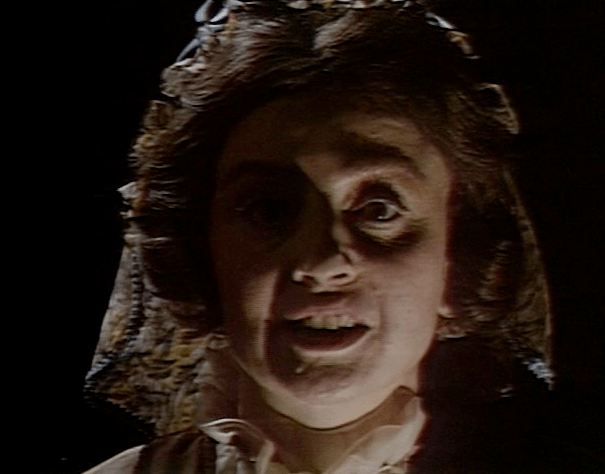
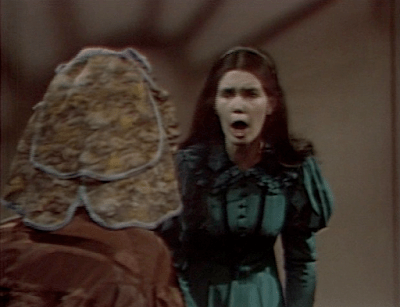
Today Madame Findley meets children David Collins and Amy Jennings. Amy and David are coming under the influence of evil spirit Quentin Collins. She questions them in the drawing room, and finds a hidden panel that leads to the long-abandoned west wing of the house. Over the children’s objections, she enters the secret passage. As soon as she is in, they hurriedly close the panel, locking her in. Evidently their objections were part of a ruse designed to lead her to Quentin’s stronghold. All too often on Dark Shadows, the audience knows too much about what characters are trying to do. This scene stands out, because they really do keep us guessing whether the children want Madame Findley to go into the secret passage. We don’t really know what their goals are until we see them shut her in.

Madame Findley goes into the darkness. Screenshot by Dark Shadows Before I Die.

Earlier in the episode, Amy’s brother Chris dropped in. He was very eager to see permanent houseguest Julia Hoffman, MD. Amy mentioned to Chris that there was another visitor in the house. When Chris asked who it was, Amy replied, “Her name is Madame- Madame something- at least that’s what they call her.”

I heard these lines in the voice of T. S. Eliot. The rhythm is reminiscent of a section of his poem The Waste Land, which in 1968 was an extremely familiar text to people with literary ambitions:

Madame Sosostris, famous clairvoyante,

Had a bad cold, nevertheless

Is known to be the wisest woman in Europe,

With a wicked pack of cards. Here, said she,

Is your card, the drowned Phoenician Sailor,

(Those are pearls that were his eyes. Look!)

Here is Belladonna, the Lady of the Rocks,

The lady of situations.

Here is the man with three staves, and here the Wheel,

And here is the one-eyed merchant, and this card,

Which is blank, is something he carries on his back,

Which I am forbidden to see. I do not find

The Hanged Man. Fear death by water.

I see crowds of people, walking round in a ring.

Thank you. If you see dear Mrs. Equitone,

Tell her I bring the horoscope myself:

One must be so careful these days.

It was indeed a mysterious Tarot card that prompted matriarch Elizabeth Collins Stoddard to call for help, and that call brought Madame Findley to the house. The card she interprets is the Tower of Destruction, which unlike the cards Eliot’s Madame Sostris describes actually appears in existing Tarot decks. She doesn’t have a cold, and she isn’t in the business of selling horoscopes door to door. On the contrary, as Humphrey plays her she is a dazzling presence.

Liz did not call Madame Findley directly. She telephoned occult expert Timothy Eliot Stokes, who introduced her to La Findley. At first sight, Stokes appears to be a stuffy academic with an impossible Anglophile manner, but as we get to know him he turns out to be very much at home in the bizarre netherworld in which the show takes place, so much so that his supernatural adversaries fear that he may have powers surpassing theirs. T(homas) St(earn)s Eliot was so much like T(imothy) Eliot St(oke)s in the first impression he made, so highly regarded by the sort of people who wrote Dark Shadows, and so generally famous in the 1960s that it is very likely that Stokes’ name was at least partly inspired by him.

It’s true that Madame Findley’s name lacks the exotic glamour Eliot gave his character. I suppose if you have all of Europe to choose from, you can take your stray Tarot cards to someone named “Madame Sosostris,” but if you are limited to central Maine, you have to settle for “Janet Findley.”

I made a remark about Madame Findley’s name in the comments on Danny Horn’s post about episode #647 on his great Dark Shadows Every Day:

It’s just delightful that they introduce an otherworldly, mystical character, played with an actress who brings a genuinely eerie note to her performance, and her name is… “Janet Findley.” It’s like Monty Python and the Holy Grail, when they meet the wizard who is known as “Tim.”

I wonder if there’s any connection between the name “Janet Findley” and the name “Janet Fisher,” whom Carolyn mentioned as a friend once of twice in the first season. Seems like a lot of Janet Fs. For that matter, I wonder if there’s a connection between Tim the Wizard from Monty Python and Tim(othy Eliot) Stokes, who a couple of episodes back had to tell Vicki that he isn’t a wizard.

Comment left by Acilius, 8 October 2020, on Danny Horn, “Episode 647: The Wire,” Dark Shadows Every Day, 12 May 2015

That remark drew a response from a commenter who posts as “Mary”:

Findley is a popular name on Dark Shadows. In addition to Janet, Margaret Findley is one of the ghostly widows, Thomas Findley is one of Jeb’s zombies in the Leviathan storyline and Findley’s cove is the location of Carolyn’s cottage in 1995.

Comment left by “Mary,” 18 February 2021, on Danny Horn, “Episode 647: The Wire,” Dark Shadows Every Day, 12 May 2015

When Madame Findley asks about the closed-off parts of the house, Liz tells her about both the west wing and an east wing. The phrase “east wing” had come up a couple of times in the first year of the show, but it always seemed to be either a case of the writers not having made up their minds which side of the house the deserted wing was on or a slip of the tongue by the actors. This is the first time the show makes it clear that the house really does have two deserted wings.

Humphrey was too perfect for Dark Shadows to play only one role. In a comment on Danny’s post about this episode, I indulged in a little fanfic about another part that would have been right for her:

Cavada Humphrey looks quite a bit like Jonathan Frid. I wonder what 1795 would have been like if Barnabas had had an older sister who bossed him around, stood around during his ridiculously childish fits of petulance, occasionally acted as his conscience, and time and again serve as his enabler and protector. It would have been funny to see Grayson Hall’s Countess express disapproval of such a relationship.

Heck, that older sister could have been Sarah. Just because she’s a child in her ghost form doesn’t mean she has to have died at that age. Maybe she comes back in the form in which her relationship to her brother took its permanent shape, when she was about nine and he was about seven. Of course, that possibility is foreclosed at Sarah’s first appearance, when she tells Maggie not to let her “big brother” know she saw her, but I suppose they could have retconned that away with a phony flashback where she says “little brother.”

Comment left by Acilius, 8 October 2020, on Danny Horn, “Episode 648: Astral Disturbances,” Dark Shadows Every Day, 14 May 2015.

I’m very fond of Sharon Smyth, and Sarah’s last appearance in the 1795 segment was so poignant it would have been a substantial loss for her not to have been in it. On the other hand, she had so much less to do when she was playing a living being than she did in the preceding months when Sarah was a ghost, and so much of what she did get to do was outside her rather sharply limited range, that it is not difficult to imagine a different kind of Sarah making the eighteenth century insert a more compelling drama.

Episode 642: Stop thinking of Jeff

Heiress Carolyn comes back to the great house of Collinwood with her date for the evening, a mysterious drifter named Chris. He keeps trying to excuse himself, but she insists he stay. Carolyn is frightened because the barmaid who served them when they were at the Blue Whale tavern the night before was killed in an ultraviolent incident a few hours after they left, and the police are, as usual, stumped. Chris is uncomfortable because he is the killer. He is a werewolf, a fact which he has so far managed to conceal from all the characters he hasn’t already killed.

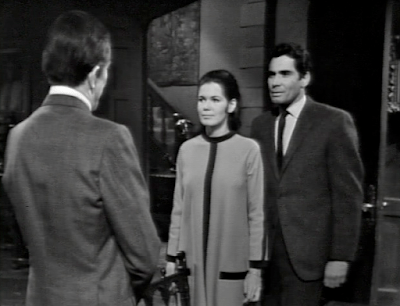
Carolyn’s mother, matriarch Liz, enters. She is followed by occult expert Professor Stokes and governess Vicki. Vicki is wearing a bright green overcoat that matches Carolyn’s dress. It seems likely that the two items are part of the same outfit, and that one of the women borrowed what she is wearing from the other. Carolyn is significantly shorter than Vicki, so it is unlikely Vicki’s dress would fit her as snugly as does this one. We can assume, therefore, that Vicki is wearing Carolyn’s coat.

Carolyn in the green dress, Vicki in the matching coat. Screenshot by Dark Shadows Before I Die.

Vicki is sobbing because Liz and Stokes prevented her from flinging herself to her death from the cliff near the house. What Vicki’s plan would have meant for Carolyn’s coat we need hardly describe. If I were Carolyn, I would keep Vicki away from my closet from now on.

Vicki is suicidal because her husband, an unpleasant man known variously as Peter and Jeff, vanished into thin air the other day, going back in time to the 1790s. Stokes and Liz are with Vicki in her bedroom when a white dot surrounded by a blue halo appears on screen, representing Peter/ Jeff’s ghost. Had Peter/ Jeff been played by a white dot all along, he might have been considerably more tolerable than he was as portrayed by Roger Davis, but that’s just another of the what-ifs we have to think about when we reflect on the show.

“Today, the part of Jeff Clark will be played by a white dot.” Screenshot by Dark Shadows Before I Die.

Stokes decides to hold a séance to contact Peter/ Jeff. Chris and Liz are both reluctant to join, but Stokes insists. Carolyn goes into the trance and channels, not Peter/ Jeff, but someone named “Magda.” Magda doesn’t seem to recognize Peter/ Jeff’s name. She talks about “my curse”; Peter/ Jeff was not represented as being under a curse. She says “You must stop them!” and “He must not come back!”; returning viewers know that Chris’ little sister Amy and Liz’ young nephew David have contacted a ghost named Quentin and are bringing him back into the affairs of the house. So we can conclude that Magda’s message has nothing to do with Peter/ Jeff.

As Carolyn channels Magda, she gets more and more agitated. Chris grabs her and breaks the trance. Vicki appears to be disappointed that they didn’t reach Peter/ Jeff. She resumes sobbing and runs off, and Liz follows her. Chris clutches the dazed Carolyn to him, while Stokes angrily tells him he wishes he knew why he cut the trance short.

Angry Stokes. Screenshot by Dark Shadows Before I Die.

The first séance on Dark Shadows took place in #170 and #171. In that one, Vicki was medium for the gracious Josette. We had been hearing about Josette since #5, had seen her ghost in #70, had met her when she led the other ghosts out of the supernatural back-world to rescue Victoria from crazed handyman Matthew in #126, and were aware of her as she played a central role in opposing the machinations of the show’s chief menace for the months that followed, undead fire witch Laura. It was exciting to think of Josette entering into conversation with multiple characters at once. Many of the subsequent séances (today’s is the ninth by the count of the Dark Shadows Wiki‘s “Séance” page) had brought up voices we were just as eager to introduce to society.

But no one wants to hear more from Peter/ Jeff. He was a drag from his first appearance, and only got harder to take the more we saw of him. Vicki’s inexplicable attachment to him dealt her character the last of the many blows that alienated her from the audience. When Liz, Stokes, and others order Vicki to stop bringing this dreary personage up they speak for all of us who would very much like to forget he ever existed. The result of today’s séance gives us hope that the makers of the show have caught on to our distaste for Peter/ Jeff, and that they will be keeping future references to him to a minimum.

Episode 615: Protecting the vampire

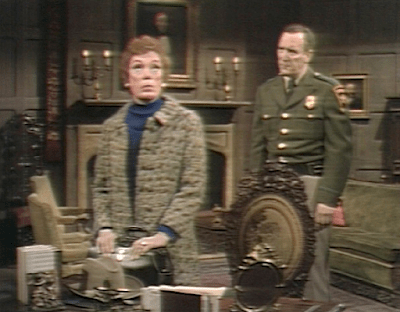
Sheriff Patterson is at the estate of Collinwood. In yesterday’s episode, local man Joe Haskell tried to strangle old world gentleman Barnabas Collins in his house on the estate. Joe is in custody now, and the sheriff opens the episode with questions for some people in the great house.

Sheriff Patterson is played today by one-time substitute Alfred Sandor. I don’t know how much notice Sandor had that he would be playing the part, but it wasn’t enough for him to memorize his sides. He takes at least as many glances at the teleprompter as he has lines. He has a fine sonorous voice, an easy physicality, and when he can break free from the teleprompter he creates the impression that the sheriff is listening and thinking. I wish that he, rather than Vince O’Brien, had become the default Sheriff Patterson after Dana Elcar left Dark Shadows. The sheriff never gets to catch any of the bad guys, but it would be nice if he at least seemed like he had some brains.

The sheriff tells Barnabas’ inseparable friend, Julia Hoffman, MD, that Joe had claimed Barnabas was trying to kill him. Julia dismisses this as absurd. Joe says he was in Barnabas’ house recuperating from an injury, and awoke to find Barnabas offering him medicine that was poisoned. Only Julia’s intervention kept Joe from taking the medicine. Julia concedes that this is true.

Julia wondering what to say. Screenshot by Dark Shadows Before I Die.

New viewers might conclude from this that Julia is a compulsive truth-teller; after all, she is the only one who really knows that the medicine was poisoned, and she found that out by conducting tests which would probably consume all of it. But not only does she share her findings with the sheriff, she went out of her way to leave a sample of the poisoned medicine for the police to do follow-up testing on.

In fact, Julia is Dark Shadows‘ most fluent and most persuasive liar. It is unaccountable, not only that she confirms that the medicine was poisoned, but that the only suspects she lists when the sheriff asks who could have added the poison to the medicine are herself, Barnabas, Barnabas’ servant Willie, and Maggie Evans, The Nicest Girl in Town. While she and Barnabas have already proven their willingness to pin their crimes on Willie, he is too closely associated with them to be a desirable choice for the role of patsy, and no one will believe Maggie is guilty of anything- “The Nicest Girl in Town” might as well be her legal name.

Barnabas has been under the power of vampire Angelique for a couple of weeks. Julia is an expert on vampirism; she joined the cast in the summer of 1967 when she was treating Maggie for the aftermath of abuse she suffered from Barnabas when he was a vampire. She then won her way into Barnabas’ confidence and used him as the subject for an experimental treatment she had devised to cure vampirism. After that treatment failed, another mad scientist devised a different procedure for freeing Barnabas of the effects of his curse, and it was Julia who completed that procedure successfully. She then herself spent time as the victim of another vampire, giving her another perspective on the topic and making her uniquely knowledgeable on it. She has seen abundant evidence of Barnabas’ condition in the many days since Angelique first bit him, but it is only at the end of today’s episode, when she pulls back his cravat and sees the bite marks, that she finally puts two and two together. Combined with her sudden fit of honesty when the sheriff is questioning her, her slowness in figuring out what’s going on with Barnabas makes us wonder what is wrong with her. It’s true she hasn’t been getting much sleep lately, maybe that’s the problem.

There is a little support for this idea in a scene when the sheriff meets Julia in the woods. He is coming from Barnabas’ house, she is going there. He says that he’s surprised to find her in the woods at night, and she says “The woods are- are scary.” It isn’t like her to stumble and repeat a word, nor is “scary” a word she would typically use. Educated adults on Dark Shadows favor a more formal lexical register, saying “frightening” or something like that, leaving such words as “scary” to mark a grossly uneducated character like Willie or a child like young David Collins. Perhaps this line indicates that Julia just needs a good rest.

Many commenters remark on some irregularities in Angelique’s costume, speculating that one of them might be Lara Parker’s left nipple. I don’t think so; it just looks like fabric pilling, as witness the fact that there are multiple prominences in different spots. In the first year of Dark Shadows, Joan Bennett and Alexandra Moltke Isles sometimes did wear tight-fitting tops that revealed the shape of the flesh underneath more precisely than you might expect; that happened often enough that I took it to be a conscious decision to challenge the audience to take a matter-of-fact attitude toward female anatomy, and thought the grownup thing to do was not to mention it. But the show long ago forgot about grownup attitudes, so it is only to be expected that people are still giggling about what they think they can see in this shot.

There is a small prominence in the right spot, but the more conspicuous one is some inches above and to the left. So I suggest you all calm down. Screenshot by Dark Shadows Before I Die.

Episode 544: An incomplete man

Mad scientist Julia Hoffman and suave warlock Nicholas Blair each want to find Frankenstein’s monster Adam before the other does. Julia is sure that occult expert Timothy Eliot Stokes knows where Adam is; while he sits at a chessboard and plays both sides of a game, she asks Stokes to tell her. He says he wants answers to some questions of his own, but the audience knows that the information he wants is just what Julia will never tell him.

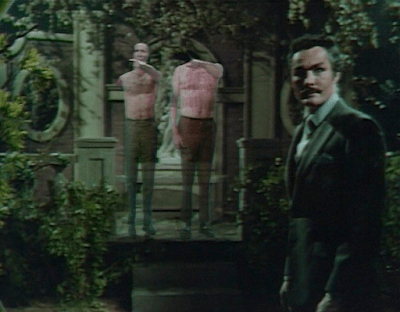
Nicholas takes a less conventional approach. He raises the ghosts of a couple of the dead men whose corpses supplied the raw materials from which Adam’s body was constructed. One lacks a right arm, the other a head. He asks them where Adam is, and they turn in unison to point with their left arms at the great house of Collinwood. It’s such a smoothly coordinated move that it looks like they must be spending their time in the afterlife starting a boy band.

The Boneyard Boys showing off their signature move, the Postmortem Point. Screenshot by Dark Shadows Before I Die.

The arm donor is played by David Groh, who less than a decade later would become a star as Joe on the sitcom Rhoda. Groh was such a charismatic performer that it’s hard not to think of speaking parts on Dark Shadows that other actors played badly and wonder what would have happened had he played them instead. I went on about that in a comment I left on Danny Horn’s Dark Shadows Every Day in 2020; here, I will just mention that if Groh, instead of the lamentably unaccomplished Craig Slocum, had played ex-convict Harry Johnson, we would probably have seen a red-hot love triangle in which Harry vied with Adam for the affections of heiress Carolyn Collins Stoddard.

Earlier in the episode, Adam had asked Stokes why it was not allowed for him to kiss Carolyn. Thayer David makes the most of this scene. Stokes freezes and looks up when Adam starts posing his questions, then seems genuinely shaken when he says that he is inadequate to the task of answering them, since he himself has never raised children. We can see that, in that moment, Stokes feels as incomplete as Adam. It’s touching to see Stokes’ usually supreme self-assurance give way to shamefaced uncertainty. When Stokes tells Adam to put away his budding sexual desires and to concentrate on his books, we catch a glimpse of the tragic side of Stokes’ own celibate, scholarly life.

Stokes feels inadequate. Screenshot by Dark Shadows Before I Die.

But not even a father of twenty would be prepared for this situation. In the ten weeks he has been alive, Adam has become fluent in English and able to read with facility; he has the body of a grown man and moves with agility and force. Yet he knows absolutely nothing of human relationships beyond a basic understanding of the words “Friend” and “Kill!” It is hard to imagine that anyone has ever lived who needed the instruction Adam needs now.

Episode 482: Someone you hate

Recovering vampire Barnabas Collins hopes that mad scientist Eric Lang will be able to free him of his curse once and for all. Since wicked witch Angelique, who put the curse on Barnabas in the first place, has come back to the great estate of Collinwood, Barnabas found a twelfth century Sicilian talisman with the power to protect against witches and gave it to Lang with instructions that he was to keep it on his person at all times. Several days ago, Angelique drove Lang to the point of death, and he survived only because he managed to touch the talisman at the last moment. Even so, Lang refuses to wear the talisman or even to keep track of it. Now Barnabas is with Lang in his study, whence they discover that the talisman has been stolen. Lang asks Barnabas if he can get another one for him. Barnabas looks at Lang as if he were the world’s stupidest man, and tells him that such objects are extremely rare.

The whole business with Lang and the talisman is a prime example of what Roger Ebert called Idiot Plot, in which the story would end immediately if the characters showed as much intelligence as the average member of the audience has. If Lang were played by a good actor, he might be able to hold our interest through a few of these inexplicable actions. Both Alexandra Moltke Isles, as well-meaning governess Vicki, and Dana Elcar, as Sheriff George Patterson, were cast as the Designated Dum-Dum in a number of episodes, and each managed to survive longer than one might have expected. Mrs Isles kept the audience on board for Vicki by making us wonder how anyone could absorb the torrent of bizarre information drowning her. Elcar made the sheriff watchable by making speculate he might only be pretending to be clueless. But as Lang, Addison Powell is just dismally bad. Not only does he not invent a way to make Lang seem like he might be secretly smarter than the script makes him out to be, he does not show any sign of ever having acquired even the most basic acting skills. When Lang seems to think Barnabas can take him to Talismans-Я-Us to replace the priceless object he has lost, the audience loses whatever patience it may have had with him.

Lang’s assistant, a former mental patient named Peter who insists on being called “Jeff,” is quitting after months of helping Lang steal body parts from fresh graves. Peter/ Jeff tells Barnabas that he will be staying in town. That’s bad news for Barnabas, but much worse news for the audience. Peter/ Jeff is played by Roger Davis, who is a far more skilled actor than Addison Powell but, if anything, even less pleasant to watch. His characters are either full of rage or insufferably smug, he often manhandles his scene partners, and when he raises his voice he projects, not from the muscles of his pelvic floor, but from his anal sphincters, causing him to sound like he is suffering from severe constipation.

Lang tells Barnabas he needs a new assistant as soon as possible. Barnabas says he knows just the man. He is Willie Loomis. As Peter/ Jeff was a patient in an institution for the criminally insane when Lang found him, Willie is a patient in such an institution now. Willie was Barnabas’ servant for the first months he was in the 1960s, when Barnabas was a vampire rampaging through the village of Collinsport. Barnabas eventually took the heat off himself by pinning some of his crimes on Willie, packing him off to the mental hospital.

Willie was a fan favorite. Largely this was because actor John Karlen was as capable as Addison Powell was inept and as likable as Roger Davis is repellent. But the writers, too, always found fresh ways to make Barnabas’ conversations with Willie interesting, and when mad scientist Julia Hoffman teamed up with Barnabas she and Willie were great fun to watch together. The idea of Willie replacing Peter/ Jeff, in whatever capacity, is something to cheer for.

We cut to the cottage where Maggie Evans, The Nicest Girl in Town, lives with her father Sam. Maggie is wearing a pair of trousers which may well be the weirdest things ever shown on Dark Shadows. According to a blog called 1630 Revello Drive,* they are based on an article of women’s clothing traditional in India called a gharara. Surely no one in India ever made such things out of this brightly colored floral quilt. If this garment can exist, we would be foolhardy to rule out the possibility of ghosts or vampires or time travel or witches or anything else.

Maggie in her quilted pseudo-gharara. Screenshot by Dark Shadows Before I Die.

Maggie answers a knock on the door and finds Peter/ Jeff. Vicki had arranged for him to rent a room at the Evans cottage. Shortly after he arrives, Vicki comes. Peter/ Jeff tells her she doesn’t know much about him, and asks what she will do if it turns out he is someone she hates.

The next thing we see after that question is Peter/ Jeff with his shoe, a shoe he wears while robbing graves, on Maggie and Sam’s coffee table. Anyone who saw that might well conclude that Peter/ Jeff is such a clod that any civilized person would be tempted to hate him.

That isn’t an ottoman, buddy.

Again, there are actors who specialize in playing men who are compelling to watch when they do unpleasant things. Dark Shadows hit the jackpot in this regard when it cast Jonathan Frid as the vampire Barnabas. It narrowly missed doing so on other occasions. In the first year of the show, future movie stars Harvey Keitel (in #33) and Frederic Forrest (in #137) showed up as background players. Surely they would have taken speaking parts on the show at this point in their careers, and either of them could have made Peter/ Jeff almost as much of an asset as John Karlen made Willie, even if he did wantonly ruin people’s furniture.

*As cited by Christine Scoleri on Dark Shadows Before I Die.

Episode 469: Temporarily arrested

Well-meaning governess Vicki and mad scientist Julia have gone to the Collins family mausoleum in the old cemetery north of town. Vicki wants to see whether her memory is correct and there is a chamber hidden behind a secret panel in the mausoleum, and Julia is trying to limit what Vicki can find. As they enter the mausoleum, Vicki shines a flashlight directly into the camera, then sees a man lurking in a dark corner of the mausoleum.

Vicki assures us that, no matter how much the show might have changed since last summer, it’s still Dark Shadows.

The man is Peter, an unpleasant fellow with whom Vicki unaccountably fell in love when she met him on an unscheduled journey through time to the 1790s. For no reason that will ever be of interest to the audience, Peter keeps insisting that his name is Jeff and that he is not a time traveler. Yet he is the one who finds the mechanism to open the secret panel and expose the hidden chamber where Vicki and Peter once found refuge. Even after that he keeps wasting our time with his pointless denials of the obvious facts.

While they inspect the chamber, Vicki realizes that Julia knew it was there. She confronts her about it, and Julia feigns ignorance. Vicki points out that Julia tried everything she could to keep her from going to the mausoleum and that when those efforts failed she insisted on accompanying her there. Vicki is taking a breath, apparently about to list further evidence supporting the same conclusion, when she glances at Peter and changes the subject.

Vicki remarks that the only way the room has changed since she was there in the late eighteenth century is that there is now a coffin in the middle of it. Julia knows that it is the coffin in which vampire Barnabas Collins was confined from the 1790s until 1967. Barnabas bit Vicki several days ago, but it didn’t really take, and he has since been cured of vampirism. So Vicki probably doesn’t know that Barnabas ever was a vampire, and certainly doesn’t know that it is his coffin. Peter opens the coffin. The empty interior of the coffin dissolves to Barnabas in his hospital bed.

Mid-dissolve.

Barnabas sits up by bending from the waist, showing that old habits die hard. He cries out for the doctor who rehumanized him, Eric Lang. A look of panic spreads across his face.

Terrified Barnabas

He is alarmed to hear hounds baying outside his window. He goes out on the terrace of his hospital room and touches its stone balustrade.

What, your hospital room doesn’t have a terrace with a stone balustrade?

Barnabas goes back inside and continues crying for Lang. When Lang shows up, he explains that the cure isn’t quite complete. There will be occasional relapses of varying intensity, and further treatments are necessary. Barnabas throws a tantrum in response to this news, pouting that if he has to keep taking medicine he may as well go back to being an undead abomination who preys upon the living. Lang talks him down, telling him that he is confident he will be able to effect permanent remission.

We see Julia standing in the rain beside a sign for the Collinsport Hospital, looking up at Barnabas’ silhouette in the window behind his balustrade. She walks away. We then see Lang at a desk in a large wood-paneled room. There is a knock. Lang gives a self-satisfied smirk as he looks at his watch, then opens the door to let Julia in. We see that the wood paneling continues in the corridor behind her. In later episodes we will learn this is in Lang’s house. In that case, the paneling in the corridor behind Julia makes it clear someone has already let her in. At this point, a viewer would naturally assume that it is Lang’s office in the hospital. Wood paneling may not be standard for doctors’ offices in hospitals, but neither are terraces with stone balustrades standard for patient rooms.

Julia looking innocent.

Julia had been treating Barnabas’ vampirism in 1967, and wants to reclaim the case. She and Lang sit across from each other and engage in a verbal fencing match. Lang uses many of the ploys we have seen Julia use to keep control of the situation. On his great blog Dark Shadows Every Day, Danny Horn speculates that the audience’s revulsion at the prospect of Lang replacing Julia was the intended reaction. It cements our sympathy for Julia as a trickster figure and as the de facto protagonist of the chief storylines.

I agree with Danny’s assessment of the scene’s effect, but I doubt it was fully intentional. When I imagine the scene played with Howard da Silva instead of Addison Powell as Lang, I see the audience conflicted and in suspense. We are invested in Julia and her relationship with Barnabas, and so we don’t want Lang to push her aside. But an actor like da Silva would be so intriguing that we couldn’t help but be curious how it would play out if he did. It is only the severity of Powell’s professional deficiencies that causes us to see Lang as nothing but a threat. Compared with the more complex reaction a da Silva could have generated, this scene falls flat.

As Julia is leaving Lang’s office, Peter barges in. Julia’s eyes widen when she sees that the two are connected. Lang realizes that she is likely to make good use of this information, and is furious with Peter for exposing it to her.

It becomes clear that Peter has been implicated in a homicide, that he is suffering from amnesia, and that Lang is blackmailing him into stealing body parts from a nearby cemetery. When Peter says he will no longer help Lang, Lang threatens to send him back to the institution for the criminally insane where he found him. He also forbids Peter to see Vicki again, telling him that Barnabas Collins wants to marry Vicki and that Barnabas’ happiness is important to his plans.

In yesterday’s episode, Peter talked to Lang about his hope that he might be able to learn something about himself from Vicki. This reminds longtime viewers of the first year of Dark Shadows, when Vicki’s motivation for staying in the great house of Collinwood was her hope that she would learn who her biological parents were and why she was left as a newborn at the Hammond Foundling Home. Peter even uses the same phrases Vicki had used in expressing the desire to learn more about himself. Moreover, Vicki, like Peter, has an important gap in her memory, having forgotten key details of her time in the eighteenth century.

That Lang has plans for Vicki was strongly suggested last time, when he told her that he expected her to have an extremely significant future. When we see what future he has decreed for a character who is in a position so similar to Vicki’s, and that the future he has in mind for her includes marriage to Barnabas, we can have little doubt that his plans for her are most evil.

The scene between Lang and Peter is a very efficient piece of exposition, but it is poorly executed as drama. Addison Powell keeps pulling funny faces for no apparent reason, does not appear to have any control over the volume of his voice, and alternately drifts off his mark and stands unnaturally still. Roger Davis is a highly trained professional actor, but he must have skipped the day when his acting teachers covered means of shouting without sounding constipated. The two of them together are not very easy to watch. I get through their scenes with a further bit of imaginary recasting, picturing a onetime Dark Shadows extra like Harvey Keitel as Peter opposite da Silva’s Lang.

Episode 467: Pulsebeat

In a room at the Collinsport Hospital, very loud physician Eric Lang (Addison Powell) opens the curtains to show his patient, old world gentleman Barnabas Collins, that it is a sunny afternoon. It takes Barnabas a moment to realize that this is Lang’s way of showing him that he has cured him of his longstanding affliction, vampirism. Once he figures it out, Barnabas is very happy to be human again.

Barnabas talks with Lang about the origins of his vampirism. At one point Lang says “Ah, so a curse was responsible.” You know how doctors are, always coming out with the same cliches. Lang does say something novel when he remarks on Barnabas’ “pulsebeat.” That specimen of Collinsport English will be back.

In the great house of Collinwood, Barnabas’ distant cousins Roger and Liz are at odds. Roger keeps having conversations with a portrait, in the course of which he loses track of the time. The correct time is 1968, and he keeps thinking it is 1795. When he does that, he mistakes himself for his collateral ancestor Joshua Collins and his sister Liz for Joshua’s wife Naomi. Today, Liz has to slap Roger to get him back to himself. Louis Edmonds’ alternation between Joshua and Roger is masterful, one of the outstanding moments of acting in the whole series.

The portrait is of Angelique, the wicked witch who made Barnabas into a vampire in the first place. At the hospital, it becomes clear that Angelique’s spirit is controlling Roger through it. He is cold and distant, staring out the window when Barnabas tells Liz he wants to take up gardening, refusing to say a word when Lang enters the room. When he takes his leave, Roger looks at Barnabas and declares “It’s not this easy.” We realize that he is a puppet for Angelique. Roger steals Lang’s cartoonish mirror-bearing headpiece.

Lang meets Roger. Screenshot by Dark Shadows Before I Die.

We cut back and forth between Barnabas’ hospital room and the drawing room at Collinwood. At Collinwood, Roger shows the headpiece to the portrait and explains that it was Lang’s. He starts to twist it. In the hospital, Lang suddenly leaps up with a splitting headache. Roger stops twisting, and Lang says he’s better. He resumes twisting, and Lang resumes suffering. Roger tells the portrait he cannot obey its command to put the headpiece in the fire, and throws it across the room. In the hospital, Lang suddenly recovers from his headache. Barnabas tells him it was Angelique’s doing, and says that he will have to become a vampire again to spare Lang her attentions.

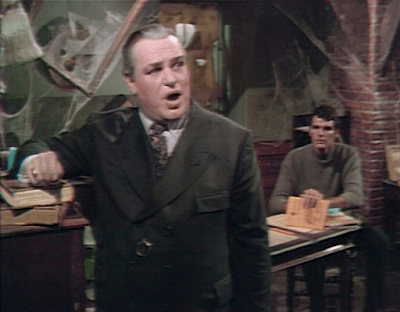
On his blog Dark Shadows Every Day, Danny Horn identified Addison Powell as “THE WORST ACTOR EVER TO APPEAR ON DARK SHADOWS.” I don’t agree with that. In yesterday’s episode, for example, Powell attained a level that could fairly be described as “competent,” a label that forever eluded figures like Mark Allen (Sam Evans #1,) Michael Currie (Constable/ Sheriff Carter,) and Craig Slocum (Noah Gifford and, later, Harry Johnson.) And there will be times when his ludicrous overacting lends just the note of camp that turns a scene from a tedious misfire to an occasion for chuckling. But he is pretty bad today. When an actor gets to be depressing to watch, I sometimes make his scenes bearable by trying to imagine what it might have been like if, instead of casting him, they had chosen someone else who might have been available.

So many members of the original Broadway cast of the musical 1776 appeared on Dark Shadows at one time or another that I tend to assume that any of them would have accepted any part on the show. Howard da Silva played Benjamin Franklin in 1776, and he is my imaginary Dr Lang.

You can see da Silva’s Franklin in the 1972 movie version of 1776, where he plays the Sage of Philadelphia with frequent chortles that suggest a mad scientist gleefully working to release a murderous nightmare on the world, which is more or less the show’s vision of the founding of the USA. That isn’t Franklin’s only note- he has occasion to speak earnestly about the British Empire’s mismanagement of its North American possessions, and sorrowfully about the need to leave slavery alone while concentrating on the fight for independence. Those who have seen da Silva play subtle and powerfully compassionate men in his other work, for example as the psychiatrist in the 1962 film David and Lisa and as the defense attorney in the 1964 Outer Limits episode adapting Isaac Asimov’s story “I, Robot,” will hardly be surprised that he could be effective in those moments.

So when Powell overdoes the shouting, I imagine da Silva in his place, going through his bag of tricks to show us a man who might be taking a maniacal satisfaction in his blasphemous labors, who might be profoundly devoted to the relief of suffering, and who might be both at once. Sometimes I get a pretty clear image of what that would have been like, and when that happens the show in my head is hard to beat.

Episode 427: I object

The opening voiceover melds into a sequence in which we cut back and forth between repressed spinster Abigail Collins and the fanatical Rev’d Mr Trask standing in front of black backgrounds, looking directly into the camera, and declaring that the trial of bewildered time-traveler Vicki for witchcraft must begin at once.

Soap Opera Land famously does not observe the legal codes that prevail elsewhere. If that is going to bother you, you probably aren’t in the right frame of mind to enjoy the show at all. But there is an art to depicting a fictional trial. You can deviate as much as you like from the rules that prevail in the real world, but there have to be some kind of rules the audience can understand. We can either see those rules applied with the result that a disorderly world is reduced to order, or see them flouted so that our heroes’ hopes of justice are cruelly dashed. If we aren’t aware of any rules, there is no point in setting the play in a courtroom.

That’s the first problem with Vicki’s trial. Now and then her lawyer/ gaoler/ boyfriend/ etc Peter will object to some question or move that a statement be stricken, and once or twice the judges will agree with him. But they are just as likely to respond to identical protests by ordering him to stop interrupting. The witnesses respond to questions with extended free association sessions. Vicki herself interrupts testimony repeatedly, usually to make self-incriminating remarks, and no one tries to stop her. Trask is for some reason simultaneously the prosecutor and one of the witnesses. Opposing counsel periodically engage in shouting matches with each other while the judges watch. The whole thing is so chaotic that it may as well be taking place in a bar-room or at the county fair or on the waterfront after dark.

The second problem with the trial is that it requires Peter to raise his voice repeatedly. Actor Roger Davis can deliver dialogue more or less competently when he is speaking in a normal conversational tone, but his loud voice always tends toward an ugly snarl. This is a major limitation for any performer on a show as shouty as Dark Shadows, but the opposition of Peter to Trask puts Davis head to head with Jerry Lacy, who is a virtuoso of shouting. Next to Lacy’s, Davis’ shouting is not recognizable as a performance.

When I’m watching a scene on Dark Shadows that suffers because of an actor’s shortcomings, I sometimes try to make it bearable by imagining what it would have been like had someone else who may have been available for the part been cast instead. Harvey Keitel was an extra on the show in #33; no doubt he would have accepted a speaking part if offered. Roger Davis plays Peter as a deeply angry man, and Mr Keitel is one of the very best at making audiences empathize with such characters. So it’s interesting to try to picture him as Peter.

On the other hand, there’s nothing in the scripts that requires Peter to constantly seethe with barely contained rage. That was Mr Davis’ contribution. Had the show gone with a more amiable Peter, they might have been able to cast Frederic Forrest in the part. In #137, Forrest was a background player. While Forrest played his share of angry men over the years, he also excelled as goofily cheerful characters, most famously as Chef in Apocalypse Now. I would have liked to see Peter played that way. I think he would have had some real chemistry with Alexandra Moltke Isles’ Vicki, and that we would have had protective feelings for him as he went up against the formidable Trask.

There is a third problem with the trial that neither Harvey Keitel nor the late Frederic Forrest could have done any more with than could Mrs Isles. That is that Vicki and Peter are written as phenomenally stupid. Vicki hasn’t done a single intelligent thing since arriving in the late eighteenth century in November,* but she has become, if anything, even dumber since 1795 gave way to 1796. Peter’s behavior has also been deeply foolish, and today he hits rock bottom when he blurts out to the court that he abused his position as gaoler to help Vicki sneak out, to commit a burglary at the great house of Collinwood, and to steal evidence against her so that it could not be presented to the court. Even under Soap Opera Law, that’s three felonies.

Some claim that the phrase “Dumb Vicki” is ableist. I disagree. “Dumb” really does not mean “mute” anymore, so that using it isn’t ableist against people who do not have the power of speech. And the intelligence characters like Peter and this version of Vicki lack is not the intelligence that IQ tests are supposed to measure. One of the most interesting characters in the part of Dark Shadows set in the eighteenth century is fluttery heiress Millicent Collins, who would probably fall far short of a triple digit score on a Stanford-Binet scale, but whose behavior makes sense to us because we tell what she wants out of life and how she thinks her actions will help her get it. That’s really all we mean when we talk about a “smart character.” A well-crafted story about someone with profound developmental disabilities can depict that person as a smart character, in that sense, as easily as can one about a great sage or a brilliant scientist. Vicki and Peter are not smart characters, no matter how what kind of school we might suppose would best suit them as students, because there is nothing for us to learn by observing their behavior and no suspense as to what their several actions will add up to. They just do one damn thing after another.

Clarice Blackburn and Jerry Lacy do some fine acting today, as does Grayson Hall in a brief turn as the Countess DuPrés. The pre-title bit with Blackburn and Lacy in front of the black backgrounds is so specific to theater in the 1960s that I can’t help but smile at it, but I’m glad it’s there. It isn’t as though you could ever really forget that the show is 56 years old, and I like to see that they preserved something that would have been so typical of the off-Broadway productions that would have been such a big part of the working lives of the cast and other creatives in those days.

*In her testimony today, Abigail gives the dramatic date of Vicki’s arrival in the past as 12 October 1795. The episodes in which the events she describes happened were broadcast on 17 November and 20 November 1967. In the last few weeks, the show has explicitly told us that the day and month of the dramatic setting in 1796 is the same as the broadcast date in 1968, so it’s confusing.

Episode 404: I forgot you were here

When I was a kid in the 80s, a friend of mine liked watching syndicated reruns of the tongue-in-cheek Western series Alias Smith and Jones on Saturday afternoons. I didn’t much care for it, but sat through a few of them with him. Eventually they got to some episodes in which the actor who played the character with the alias “Smith” was replaced by a man who was always smiling as if he had just said something terribly clever, even if he hadn’t said anything at all. After a few minutes of that bozo’s inane mugging, my friend couldn’t stand it either, and we could go back outside and play. So that worked out to my benefit.  

In those same years, I was a great fan of The Twilight Zone. The man whose pointless self-satisfied smile ruined Alias Smith and Jones for its fans showed up in one of those episodes, but he was used intelligently there. The episode was called “Spur of the Moment.” In it, a young woman has to choose between two lovers, one of them a prosperous fellow whom her father likes, the other a penniless dreamer whom the whole family hates. Any audience will have seen that story countless times and will assume that we are supposed to root for the penniless dreamer. But The Twilight Zone mixed that up for us by casting the likable Robert E. Hogan as daddy’s choice and the man with what we nowadays call an “instantly punchable face” as the poor boy. When the twist ending shows us that the woman was horribly wrong to marry the poor boy, it’s our dislike of the actor playing him that makes it a satisfying resolution.

So, when I first saw this episode of Dark Shadows some years ago, it was with some apprehension that I met the sight of that same repellent man on screen. His name is Roger Davis. In later years, Joan Bennett would look back at her time on Dark Shadows and would refer to Mr Davis as “Hollywood’s answer to the question, ‘What would Henry Fonda have been like if he had had no talent?'” Mr Davis’ head is shaped like Fonda’s, and his character turns out to be a defense attorney, a common occupation among the roles Fonda played.

The first line addressed to Mr Davis is “I forgot you were here,” spoken by bewildered time-traveler Vicki. When his character Peter, a jailer who is reading for the bar, tells her that he can hear her in her cell at night, she tells him she didn’t know he was there. Vicki’s repeated failure to notice Peter’s existence may not sound like an auspicious start to what is supposed to be a big romance, but it isn’t as bad as what happens when he is escorting her back to her cell. He puts his hand on her elbow, and she reflexively recoils.

Mr Davis is just awful in his scene today. He spits each of out his lines as if they were so many watermelon seeds, stops between them to strike poses almost in the manner of a bodybuilder, and looks at the teleprompter. The last was a near-universal practice on Dark Shadows, but I mention it for two reasons. First, because this is his debut on the show- even Jonathan Frid, whose relationship with the teleprompter is the true love story of Dark Shadows, didn’t start reading from it until he’d been on the show for a week or two. Second, in his attempts to defend what he did on Dark Shadows, Mr Davis has many times claimed that he “always” knew his lines, that he “never” used the teleprompter.

Mr Davis is going to be a heavy presence on the show for what will seem like a very, very long time to come. He, more than anyone else, prompted me to make a habit of what I call “imaginary recasting.” When Joan Bennett was stuck playing a scene with him, she evidently made the experience endurable by thinking back to the days when she was a movie star playing opposite the original, talented Henry Fonda. When I am watching him butcher a scene, I think of other actors who actually appeared on Dark Shadows or who would likely have accepted a part on it if offered, and try to visualize what they would have done in his stead.

Harvey Keitel was a background player in #33, and surely he would have accepted a speaking role on the show at this point in his career. Mr Davis’ invariably, pointlessly belligerent tone of voice makes Peter seem like a guy with a lot of anger. Mr Keitel is of course a master of playing men who have issues with anger but are still deeply sympathetic. When it’s time to sit through one of Mr Davis’ scenes as Peter, I have enough fun imagining what Mr Keitel could have done with the part that I am not too sorely tempted to give up.

Closing Miscellany

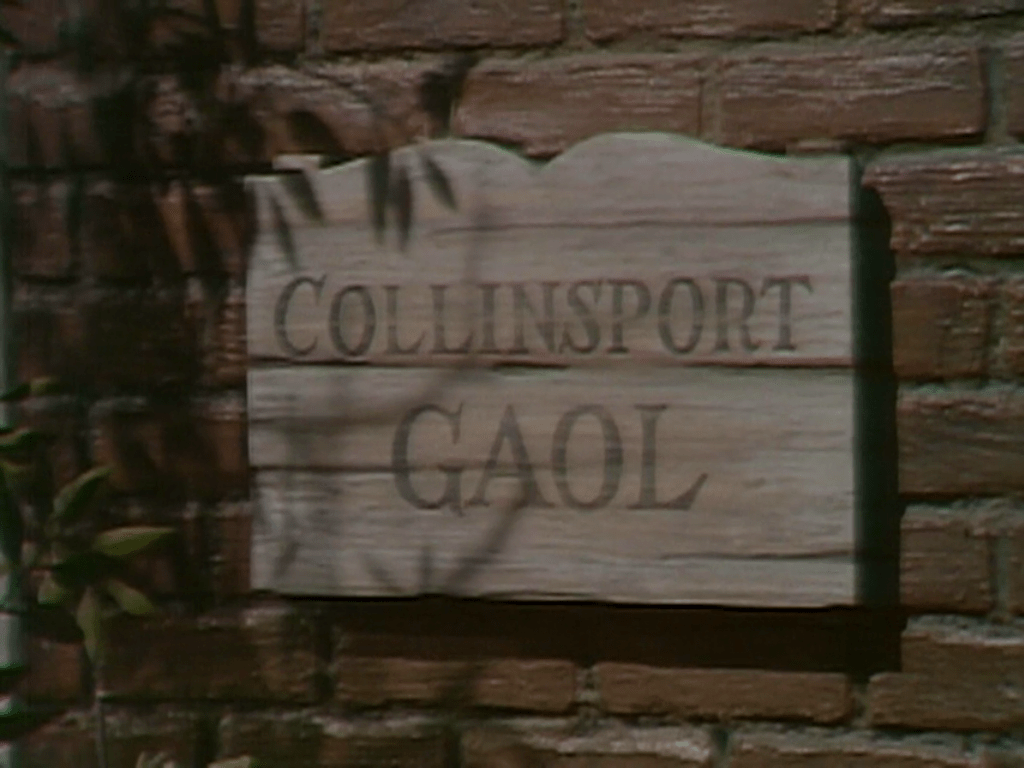
This is the first episode to show that the sign outside the town lockup is labeled, in a period-appropriate spelling, “Collinsport Gaol.”

Ballad of Collinsport Gaol.

The Bil Baird bat puppet appears in this episode, but is so close to the camera it looks like a felt cutout. Bit of a disappointment.

In his post about this episode on Dark Shadows Every Day, Danny Horn discusses the performance Addison Powell gives as a lawyer who meets with Vicki and decides he can’t take her case. He claims that Powell was THE WORST ACTOR EVER TO APPEAR ON DARK SHADOWS. Powell isn’t one of my favorites, but I don’t think he deserves that title. Of those we’ve seen so far, I’d say Mark Allen, who played drunken artist Sam Evans in the first weeks of the series, was the most consistently worthless performer, while Michael Hadge, who was motorcycle enthusiast Buzz for a while in 1967, was the most endearingly inept. Powell is awkward in his scene today, but Roger Davis is even more so, and he, unlike Powell, is so naturally unpleasant that he has to be flawless to earn the audience’s toleration.

Episode 293: A better story next time

Well-meaning governess Vicki was the main character of Dark Shadows in its first 39 weeks, and themost interesting storyline was her relationship to her charge, strange and troubled boy David Collins. That story came to its climax when David chose life with Vicki over death with his mother, blonde fire witch Laura Murdoch Collins, in #191, and Vicki hasn’t had much to do since.

Yesterday, Vicki told her depressing boyfriend, fake Shemp Burke Devlin, about an old vacant house that excites her. Since Vicki’s work with David is compensated mainly with room and board, the only way her interest in an empty house could lead to anything happening on the show would be if she quit her job, married Burke, and moved there with him. Since Burke has even less connection to the ongoing narrative arc than Vicki does, and has been spending his time lately demanding that she stop trying to attach herself to the story and settle in with him in his dead end far away from the plot, that is a dismal prospect.

All the action on the show is centered on vampire Barnabas Collins. In the opening scene, Barnabas talked with his sorely bedraggled blood thrall Willie Loomis about two women. One was Vicki. Willie was agitated that Barnabas is planning to bite Vicki. This is an odd thing to worry about- Vicki has gone out of her way to make herself available to Barnabas for biting, even contriving to spend the night in his house. But she still has all her blood, and no foothold in the vampire story. When Barnabas tells Willie that he does not intend to harm Vicki in any way, those of us who hope she will stay relevant to Dark Shadows have a sinking feeling that he might be telling the truth.

The other woman Barnabas and Willie discuss is mad scientist Julia Hoffman. In contrast to his assurances that he means no harm to Vicki, Barnabas muses openly that he might have to kill Julia at any moment. Observing Willie’s reactions, Barnabas comments that it is interesting that Willie is so concerned about Vicki, but utterly indifferent to Julia. If we remember Willie as he was before Barnabas enslaved him, this may not be so odd.

Before he became sorely bedraggled blood thrall Willie Loomis, he was dangerously unstable ruffian Willie Loomis, menace to womankind. Willie tried to rape Vicki, among others, and his guilt over the use he made of his freedom when he had it is reflected in his solicitousness towards those whom he once used so ill. By the time he met Julia, he had been under Barnabas’ power for months, so he has made no choices concerning her that he can regret.

Barnabas shows up as Vicki and Burke are getting ready to visit “the house by the sea.” Barnabas slips a couple of times as he talks with them about it, revealing to the audience that he is familiar with the house. This raises our hopes- perhaps Vicki’s fascination with the house will lead her to Barnabas and relevance, not to Burke and oblivion. Vicki invites Barnabas to come along with her and Burke as they tour the house, and he agrees.

While Vicki is upstairs changing her clothes, Barnabas and Burke talk in the drawing room. Barnabas points out that little is known of how Burke became so rich so quickly in the years before he came back to Collinsport. Burke responds that far less is known of Barnabas than of him, that his entire life before this year is perfectly obscure to everyone. As Barnabas, Jonathan Frid plays this scene with more variety and subtlety of expression than any previous one, and as Burke, Anthony George gives a tight, forceful performance. It is the first time Dark Shadows viewers have glimpsed the reason George had such a long and busy career as an actor.

George was a cold actor who excelled at characters whose intelligence and determination were obvious, but whose feelings and intentions the audience could only guess at. That would have made him a fine choice for the part of Burke in the early months of the show, but these days he spends most of his time giving big reactions to bewildering news and the rest in passionate love scenes with Vicki. George was just awful at both of those. But in today’s duel with Barnabas, Burke is choosing his every word and gesture with care, putting him right in the center of George’s wheelhouse. Opposite the much warmer Jonathan Frid, the effect is electric.

It leaves me wondering what might have been. Mitch Ryan was compelling as Burke #1, but his hot style of acting pushed Burke’s emotions to the surface and took away some of the mystery that would have been needed to make the “Revenge of Burke Devlin” storyline a success. With George in the part, that story would probably still have fizzled, but it might have taken a bit longer to do so. And of course the part George has been struggling with, until this scene in vain, was written for Ryan. If the two had just traded places and the scripts had stayed the same, Burke #1 and Burke #2 might both have been strong characters.

Of course, they wouldn’t have stayed entirely the same. The writers watch the show and are influenced by what they see the actors doing. But they may not have changed as much as you might expect. Neither Ron Sproat nor Malcolm Marmorstein seemed to have much sense of what actors could do. It’s no wonder that George’s first good scene comes in the second episode credited to Gordon Russell. Perhaps if Russell had been with the show earlier, Burke #2 might have been more of a success.

The scene also brings up one of my favorite fanfic ideas. People are going to wonder about Barnabas’ background, and Burke needs to be written off the show. Why not solve both of those problems by having Barnabas enslave Burke, make Burke set up businesses in Barnabas’ name and use his shadier contacts to get Barnabas false identification papers, then kill Burke off once he has exhausted his resources? You could do that in such a way that the other characters would think Barnabas was a nice guy who was using his wealth to prop Burke up, consolidating his position in their eyes. You could also use it to connect Barnabas to the wider world beyond the estate, suggesting that he poses a menace not only to one family but to a whole community.

At length, Vicki comes back downstairs. Burke greets her first, but she barely acknowledges him. She has eyes only for Barnabas. Barnabas may not be in any hurry to bite Vicki, but she is bursting with readiness to get into the vampire story and back into the main action of the show.

Eyes on the prize. Screenshot by Dark Shadows Before I Die.