Episode 861: Complete control of my faculties

Judith Collins Trask, owner of the estate of Collinwood and all the Collins family businesses, has returned home after more than thirteen weeks confined to a sanitarium. Her return is supposed to be a big shock, but they spoil it by having Joan Bennett do the opening voiceover. They really should have paid more attention to that sort of thing.

Judith’s husband, the odious Gregory Trask, gaslighted her into the sanitarium, and has been exercising control over the Collins family’s wealth ever since. Today, Judith tells her stuffy but lovable brother Edward that Trask never visited her during her time as a mental patient. Edward is surprised, telling her that Trask left the house for an overnight stay every week during that period, and presented these absences as visits to her. In fact, he is on such a trip now. She does not want to hear any more, and says she will give Gregory a chance to explain himself when he comes back to Collinwood.

Judith claims to be entirely herself. That puts her in the minority today. When she left Collinwood in July, Judith had a stepdaughter named Charity Trask. When she enters today, she sees someone who is to all appearances Charity leading Edward and a lady named Kitty Soames in a séance. The body is indeed Charity’s, but sorcerer Count Petofi erased Charity’s personality in #819 and replaced it with that of the late Pansy Faye, a Cockney showgirl and “mentalist” whom Judith met in #771, when Judith’s late brother Carl brought her to Collinwood as his fiancée. Pansy noticed Judith’s disapproval of her when she was alive, and is quite indignant about it now. That Judith keeps live-naming her, calling her “Charity,” doesn’t help.

Judith does manage to do something Edward failed to do a while ago, and talks Pansy into moving back into the great house of Collinwood. She agrees to give up the apartment she rented in the village of Collinsport after she took a job doing her old act at the local tavern, the Blue Whale. We saw her at the Blue Whale in Friday’s episode; it was shortly before nine PM, and she was the only person in the place. So perhaps her income as a cabaret performer is not particularly lavish, and the mansion is a more appealing place to live than the apartment that job would pay for.

For her part, Kitty is still, most of the time, the dowager countess of Hampshire. But the ghost of Josette Collins has been possessing her off and on ever since she arrived at Collinwood in #844, and the trend is definitely towards “on.” In Friday’s scene at the Blue Whale, Kathryn Leigh Scott played Kitty quietly and let Nancy Barrett’s Pansy provide the scene with all its Crazy Lady Energy; today, it is Miss Barrett’s turn to stand back and let Miss Scott show that Kitty is Pansy’s match in that department.
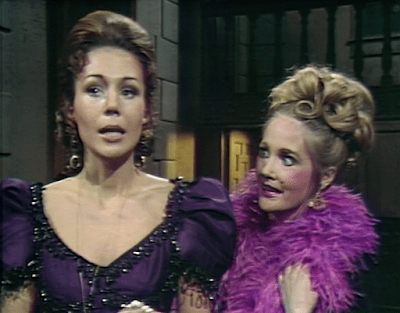
Crazy Lady Energy, also known as “CLE,” the main driving force of Soap Opera Land. Screenshot by Dark Shadows Before I Die.

Judith and Edward’s brother Quentin is in an even stranger predicament than are Pansy and what’s left of Kitty. Between #854 and #856, Petofi forced Quentin to swap bodies with him, so that David Selby now plays Petofi and Thayer David plays Quentin. I call Mr Selby’s portrayal of Petofi “Q-Petofi,” and Thayer David’s portrayal of Quentin “P-Quentin.”
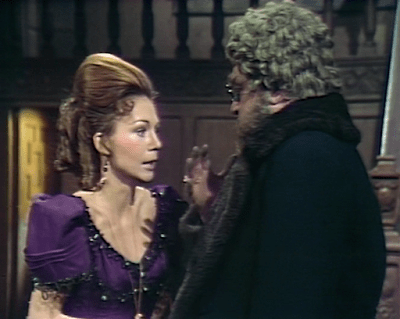
Kitty with P-Quentin. Screenshot by Dark Shadows Before I Die.

The initial shock of finding himself estranged from his own body and trapped in Petofi’s left P-Quentin bewildered. All he could do was go to one person after another and tell the true story of what had happened, which produced only a widespread belief that Count Petofi had gone mad. Now he is starting to figure out how to use his resources.

P-Quentin’s first attempt to take advantage of the fact that everyone thinks he is Petofi was not successful. In #859, he exploited Kitty’s fear of Petofi and threatened to make her vanish if she did not bring him a portrait of Quentin later that night. Kitty tried to comply, but failed, and now it is long past the deadline. Soon she will realize that his threat was an empty one, and so far from being useful to him as a cat’s paw, she will be in a position to expose him as powerless.

Today, P-Quentin runs a smarter game. He introduces himself to Judith as Petofi, and claims to have psychic abilities. He pretends to read her palm, and tells her a story from their childhood that very few people could know. She is delighted, and decides that Count Petofi is someone she wants to see more of.

P-Quentin and Judith. Screenshot by Dark Shadows Before I Die.

In her bedroom upstairs at Collinwood, Kitty has another fit of Josettification. She opens the trunk at the foot of her bed and finds Josette’s wedding dress. She puts it on and wraps a red cloak around it. She goes to the top of Widow’s Hill, the cliff from which Josette jumped to her death in the 1790s. The ghost of Josette’s husband Jeremiah appears to her.

The show is set in 1897 now. It was set in the 1790s from November 1967 to March 1968. Miss Scott played Josette then, and for most of the segment Anthony George played Jeremiah. After Jeremiah’s death, Timothy Gordon played his ghost in a memorable part of the 1790s story. Gordon made two appearances as the ghost after the show returned to contemporary dress, playing him in #462 and #512. This is Jeremiah’s first appearance in 1897, and the second time, after #462, that Gordon’s name appeared in an on-screen credit on Dark Shadows.
Episode 739: No one’s daughter

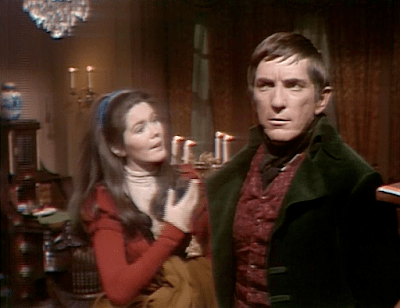
Well-meaning time traveler/ bloodsucking ghoul Barnabas Collins has met Laura Murdoch Collins in 1897, and has recognized her as the Laura Murdoch Stockbridge he knew when he was a ten year old boy in 1767. The audience knows that she is also the Laura Murdoch Radcliffe of 1867, and the Laura Murdoch Collins who was on Dark Shadows as its first supernatural menace from December 1966 to March 1967. We learned in that period that Laura is an undead blonde fire witch who incinerates herself and a young son of hers named David at intervals of exactly one hundred years so that she- but not the Davids- will rise from the ashes as a humanoid Phoenix.

We have already seen two major retcons of Laura’s story as it was told in 1966-1967. The precise regularity of her one hundred year cycle was stressed heavily in those days; it was not only the central piece of evidence that led the other characters to figure out what was going on and rise up against her, but was also the first instance of Dark Shadows using anniversaries as a way of creating suspense when the supernatural elements of the story meant that the usual patterns of cause and effect did not apply. Laura’s presence in 1897, thirty years off her established cycle, tosses all of that into a cocked hat.

Moreover, her identity as the wife of stuffy Edward Collins and mother of twelve year old Jamison and nine year old Nora Collins is also incompatible with the previous story. The Stockbridges were supposed to have been, in their day, among the most prominent families in the part of Maine where the great estate of Collinwood sits. But the fire in which Laura and David Stockbridge went up in smoke occurred two hundred years before. In the USA, that is a long enough interval for anything to be forgotten. Laura and David Radcliffe met their demise only half as long before, but the Radcliffes do not seem to have been quite as well-known or as close geographically to Collinwood as were the Stockbridges. So we could believe that when the twentieth century Laura Murdoch showed up in Collinsport in the 1940s or early 1950s, no one there would have remembered her namesakes. But we saw in #684 and #685 that there were still elderly people around Collinsport in the late 1960s who remembered 1897 quite well. And Jamison was himself the father of Elizabeth Collins Stoddard and Roger Collins, the adults at Collinwood in the 1960s. It is not plausible that no one would have said anything when in 1956 Roger, the only son of the family that owns the town, married a woman named Laura Murdoch who was the exact double of his grandmother who was also named Laura Murdoch.

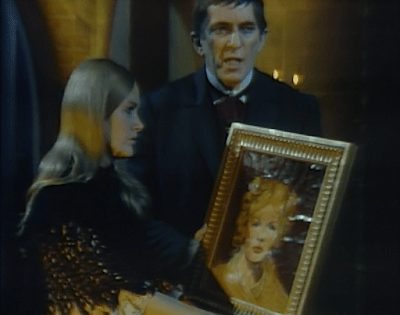
The show doubles down on that implausibility today, when Barnabas summons his blood thrall Charity Trask to look at a portrait he has found in the Old House at Collinwood. It shows Laura Stockbridge, and is a perfect match for the Laura they have met. Barnabas says that Laura was the first wife of his uncle Jeremiah, and that he himself was ten years old when she came to Collinwood.

Barnabas shows Charity the portrait of Laura Stockbridge. Screenshot by Dark Shadows Before I Die.

This gives us a Laura who does not marry into various leading families of the region, but into the Collinses over and again. That makes a kind of sense- the show has not developed any other leading families, not even as characters who are only mentioned but never appear. The Collinses now make up the entire local upper class. In #474, permanent houseguest Julia Hoffman called the Collinses “a very inbred family”; I don’t think she meant that in quite the sense which this new version of Laura is giving it, but as they move towards a dramatis personae that is all-Collins all the time there’s no escaping it.

It also represents a reverse retcon. When Barnabas talked about Jeremiah in his first months on the show, he said that when he was a young man Jeremiah was an old one, and that Jeremiah’s beautiful young wife fell in love with him. But when from November 1967 to March 1968 Dark Shadows became a costume drama set in the 1790s, we saw that Barnabas and Jeremiah, though nephew and uncle, were virtually the same age. With Jeremiah marrying Laura when Barnabas was ten, we return to the previous conception of their ages.

Barnabas’ first conversation about Laura today with Charity is interrupted when another undead blonde fire witch turns up. She is Angelique, who in the 1790s turned Barnabas into a vampire in the first place. She introduces herself to Charity as Barnabas’ fianceé, which prompts Charity to run away and go to bed. Angelique then tells Barnabas that he ought to leave Charity alone, because her father, the Rev’d Mr Gregory Trask, can make trouble that will defeat his mission. Barnabas starts to explain how bad Trask is, to which Angelique responds that he has one job and he’d better stick to it if he is to have any hope of success. She tells him that he will have to settle for blood slaves he selects from among the girls at the docks, girls who have nothing going for them “and above all no fathers.”

Charity, asleep in an upstairs bedroom in the great house of Collinwood, has a dream in which she is getting married. She is in fact engaged to marry a man named Tim, but in the dream Angelique tells her that she is not marrying Tim. She is, instead, to be the bride of Death. This is a very old image indeed; one of the main motifs that runs throughout Sophocles’ Antigone is that the heroine, engaged to marry Haemon, her first cousin (both simple and once removed- Antigone is the daughter of Oedipus and Jocasta, so she knows from inbred families) will instead be married to Death itself. At the climax of the dream, Barnabas bares his fangs at Charity.

Charity’s father comes to the great house. He meets Angelique, who identifies herself as Barnabas’ fiancée and charms him. She urges him to see to it that Charity marries Tim as soon as possible, and warns darkly that there are many kinds of flames burning around them.

The mistress of the house, spinster Judith Collins, then enters and explains to Trask that Charity is still in bed. Trask is shocked by this “sloth” (which he pronounces “slowth,”) but Judith explains that Charity is ill. Judith is sure Charity will be fine after a day of rest. Judith tells Trask that she is deeply saddened that his boarding school has burned down. She offers Trask a great deal of money to rebuild it, and the use of a house on the estate as temporary quarters for the school in the meantime. Trask is delighted. When Judith mentions that his wife Minerva had said that his health was poor, Trask says that it is in fact Minerva whose health is poor, and getting worse. The audience knows that Trask is evil, and many will interpret this remark as a sign that he plans to hasten the deterioration of Minerva’s physical condition.

Judith takes Trask to Charity’s bedroom. They are shocked to find her gone. Judith is sure that she wandered off in delirium, but the filthy-minded Trask raves that she must have set out on some errand of grievous sin. He’s right about the sinfulness, though wrong to focus the blame on Charity- she has answered Barnabas’ summons and is with him in the Old House.

Charity comes back to the great house. Her father is ranting at her when she collapses. He looks at her neck, and finds the bite marks. Perhaps Angelique’s warning to Barnabas came too late.

Episode 396: The doll and the pins

Well-meaning governess Vicki is wrongly suspected of witchcraft and needs a place to hide. Young gentleman Barnabas takes her into his house. In her gratitude, Vicki tells Barnabas the truth about herself. She is a time-traveler, yanked back to this year 1795 from her native 1967 by forces she does not understand. Indentured servant Ben enters the room and Vicki leaves. Mystified by her story, Barnabas asks Ben if he thinks Vicki might be a witch after all.

It is exciting when Vicki starts confiding in Barnabas. She has utterly failed to adapt to her new environment, and has none of the abilities she would need to scam her way into a secure place there. She has ended up as an obstacle to story development and an irritating screen presence. If Vicki isn’t going to lie competently, she may as well tell the truth. But that turns out to be a dead end as well- there is no use for Barnabas to make of the information she has given him.

Barnabas doesn’t repeat Vicki’s story to Ben- he just reports that she said something utterly bizarre. What Barnabas does not know, but Ben does, is that there really is a witch in the house- it is Barnabas’ bride-to-be Angelique. Angelique has enslaved Ben, so if he found out Vicki’s secret she would as well, and would be able to use it against her as she frames Vicki for all of her own crimes. Ben proclaims to Barnabas his absolute certainty that Vicki is not a witch, but since he can’t tell anyone about Angelique, this only puzzles Barnabas. Barnabas is further baffled when Ben says he hopes that Barnabas’ marriage to Angelique brings an end to his troubles.

The other day, Angelique tried to solve a problem of her own by raising a corpse from its grave. This was the late Jeremiah Collins, uncle of Barnabas and his best friend until, under the influence of Angelique’s spell, he and Barnabas’ fiancée Josette eloped together. Barnabas responded to that by challenging Jeremiah to a duel. Conscience-stricken, Jeremiah decided to let Barnabas kill him and told Josette that she would be free to marry Barnabas once he was dead.

Angelique had ordered Jeremiah to plague Josette and Barnabas with angry demands that they stay apart. We could interpret that simply as puppetry on Angelique’s part. But today, Jeremiah is harassing Angelique and refusing her repeated commands to go back to his grave. He says he was at peace in the earth until Angelique disturbed him. He was content with his decision to forfeit his life, but now he has become something he didn’t bargain for. Maybe it’s the indignity of that change that accounts for his change of personality, or maybe he’s just cranky because he can’t get back to sleep.

Regular viewers will think of a third possibility. In the segments of Dark Shadows set in 1966 and 1967, we saw other supernatural beings, such as undead fire witch Laura Murdoch Collins and the ghosts of Josette and of Barnabas’ little sister Sarah. These beings looked at first glance like humans, but the more we learned about them the clearer it became that each was in fact a complex of multiple entities, some of which operated independently of and occasionally at cross-purposes with others. As a witch, Angelique might also be a composite being. Perhaps each time she casts a spell, she breaks off a little piece of herself and deposits it within the person she is trying to control. If so, the creature she is trying to send away is not simply Jeremiah, but the body of Jeremiah animated by a chunk of the spirit of Angelique. That would explain why the actions of the risen Jeremiah are characterized by three traits that were alien to the living man, but that Angelique has in abundance- single-mindedness, vengefulness, and ineffectiveness.

Barnabas, Ben, and a clergyman are in the front parlor, ready for the wedding. Angelique takes a long time to come downstairs. Barnabas goes up to her room to see what is keeping her. He finds her terribly upset, insisting that they have the ceremony somewhere else. Barnabas looks in her suitcase, which had a moment before held the clothes she removed to put on her bridal gown. Those clothes have vanished, and in their place Barnabas finds a doll belonging to his little sister Sarah and some pins. Had Barnabas ever seen a horror movie, he would know to interpret this as a clue from Jeremiah that Angelique had caused a recent illness of Sarah’s by sticking pins in her doll, but people didn’t get to the cinema in 1795, so it’s another dead end.

Angelique composes herself and says she will be right down for the wedding. Barnabas leaves the room. The door closes itself, and Angelique cannot open it. Jeremiah enters and tells Angelique she must be punished for disturbing the dead. He takes her to his grave, which is open. Angelique raised Jeremiah some days ago- if the grave has been open this whole time, you’d think someone would have noticed and people would be talking about it. Anyway, he puts her in the grave, and from her point of view we see him throwing dirt into it.

Jeremiah dropping dirt onto Angelique, from her point of view. Screenshot by

This is the first live burial we’ve seen on Dark Shadows. It’s true that the POV shot from inside the grave echoes a moment in #248 when Barnabas, who is in 1967 a vampire, shuts his prisoner Maggie Evans in a coffin and we see him through her eyes, but that coffin wasn’t in the ground.

Barnabas shuts Maggie in a coffin in #248. Screenshot by Dark Shadows Before I Die.

Harking back as it does to that shocking moment from Barnabas’ early days on the show, the image of the reanimated Jeremiah dropping dirt in the grave invites us to make a comparison between Jeremiah and Barnabas. In life Jeremiah was a mild-mannered, good-hearted fellow, as is the living Barnabas. The destructive behavior he has exhibited since Angelique raised him from the dead is not only typical of her, but also of what we saw from the vampire Barnabas in 1967. Again, we wonder if the fate that awaits Barnabas is not only something Angelique will do to him, but if everything we saw of him in the months between April and November was what Angelique was doing disguised as him.

Closing Miscellany

Angelique’s repeated commands to Jeremiah today to “Go back to your grave!” find an echo in one of the great moments in the history of Dark Shadows conventions, when Lara Parker used that line to explain the Dark Shadows house style of acting:

“Go back to your grave!!!!!”

When Vicki tells Barnabas the truth about herself, the camerawork makes Alexandra Moltke Isles’ strabismus impossible to miss. Previously they had taken great care to photograph her from angles that would obscure this condition, but we’re going to get another clear look at it on Thursday. Combined with the lousy lines the scripts have given Vicki since the beginning of the 1795 segment, it is hard not to suspect that there was some kind of deliberate effort behind the scenes to push Mrs Isles aside.

Vicki and Barnabas. Screenshot by Dark Shadows Before I Die.

This was the first episode of Dark Shadows broadcast in 1968. The copyright date printed on the screen at the end still says 1967. They were several months late before they stopped putting “1966” there, so I guess we shouldn’t be surprised they didn’t update it for an episode shown on New Year’s Day.

Episode 384: What is the truth, Barnabas?

It is 1795, and we are on the great estate of Collinwood. Under the influence of wicked witch Angelique, the kindly Jeremiah and the gracious Josette have eloped, breaking the heart of Josette’s fiancé, Jeremiah’s nephew and best friend Barnabas Collins. Barnabas, up to that point an idealistic man of the Enlightenment, responded by going against his beliefs and challenging Jeremiah to a duel.

Angelique is a lady’s maid. She was introduced as maid to Josette’s aunt, the Countess DuPrés, but today it seems she is Josette’s maid. She comes to Barnabas’ room. He demands to know why her mistress has sent her, meaning Josette, to which she replies she has come on her own account.

Angelique asks Barnabas why he has challenged Jeremiah to a duel, since he has never fought a duel or even seen one before. He explains that he could not stand being an object of pity- “I couldn’t be poor Barnabas.” In 1967, Barnabas will be a vampire. We saw him in that year, in #345, telling his sometime associate mad scientist Julia Hoffman the story of his relationship with Josette. The story he told was different from other versions he had told previously, for example in #233 and #236, and radically different from what we have seen play out in this extended flashback. In the story he told Julia, as in all other versions we had heard before coming to 1795, Josette was originally Jeremiah’s fiancée. One theme developed that resonates here was that all he could be to Josette was a faithful friend, and that he found that role humiliating. He was “poor Barnabas” in that version of the story, and he implies that it was to escape from that identity that he did whatever it was that made him the undead monster he became.

Angelique cast her spell on Josette and Jeremiah because she wanted Barnabas for herself. Now that she sees that he is likely to get himself killed before she can make her play for him, she asks him to wear a medallion of hers, one which she says will bring good luck. In the 1960s, a portrait of Barnabas hangs in the foyer of the great house of Collinwood. He is wearing a medallion in that portrait. Is Angelique’s medallion the one in the portrait? We can’t be sure.

Josette and Jeremiah have a conversation. They try to figure out what came over them. They don’t love each other, and regret hurting Barnabas. As their conversation goes on, Josette realizes that Jeremiah regrets it so deeply that he is planning to let Barnabas kill him in the upcoming duel. She is horrified by this. She doesn’t want anyone to die, and has accepted the fact that Jeremiah is the only husband she’s got. Nevertheless, she cannot dissuade him.

Josette’s father arranges for Jeremiah to have a final talk with Barnabas. Barnabas accuses Jeremiah of lusting for Josette all along, saying that “you wanted her the moment you saw her.” This is not true of Jeremiah, but in #345 it is exactly what Barnabas tells Julia he himself did. In that version, he conceived a wild passion for Jeremiah’s bride-to-be the moment he first saw her.

Barnabas tells Jeremiah “You must have hated me all your life.” As we have seen over these last few weeks, Jeremiah and Barnabas have been dear friends all their lives. But from his early days on the show in the spring of 1967 until we left for our voyage to the past in #365, Barnabas consistently said that he hated Jeremiah from his earliest days. The overall effect of comparing Barnabas’ various accounts of the past with each other and with what we are seeing in this flashback is something like reading the accounts of the patient’s memories in a case study by Freud. Not only does the order of the events jumble as retcon follows retcon, but guilt floats from one person to another and back again.

When Jeremiah tries to explain how he and Josette found themselves stricken with intermittent attacks of intense desire for each other and how they struggled against those attacks during the intervals between them, Barnabas asks “Why didn’t you come to me then?” That’s a good question, and it suggests another, equally good question. Angelique is casting spells because she and Barnabas had a brief affair before he became engaged to Josette. Why hasn’t he come clean to Josette about his past? If he had, Josette would not have put herself so completely in Angelique’s hands that she could bind her with her spells at leisure.

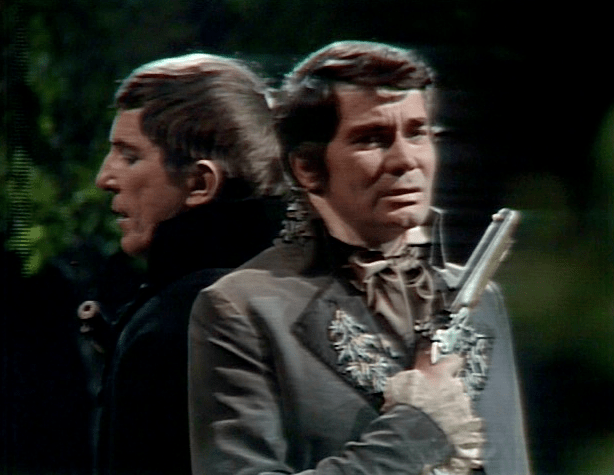
Jeremiah and Barnabas have their duel. We see them back to back, getting ready to pace off the prescribed distance. On Jeremiah’s face, we see his resolution to let Barnabas kill him.

Resigned to his fate. Screenshot by Dark Shadows Before I Die.

The men are in place when Josette comes running up, pleading with them to stop. She arrives just in time to see Barnabas shoot Jeremiah. Some say they hear only one shot, but I hear two. I think Jeremiah deloped.

Josette goes to Jeremiah’s crumpled body and shouts at Barnabas. “You monster! You madman! You killed the only man I ever loved!” She claims that she and Jeremiah were happy together, and that in his pride Barnabas could not let them be happy. She refuses Barnabas’ offer to help move Jeremiah and get a doctor for him.

Angelique had rubbed Josette’s forehead with some of the rose water in which she had put her love potion not long before this, so Josette’s declarations that Jeremiah is “the only man [she] ever loved” and that they were happy together could be a sign of that influence. It could also be rooted in Josette’s realistic assessment of her situation. Earlier, she had told Jeremiah that she would never again allow herself to say that she loved Barnabas, and when Jeremiah said that his own death would make her a free woman she rejected the idea. Whatever the circumstances that led to the marriage, she is Jeremiah’s wife, and if she becomes his widow she will have an obligation to keep up certain appearances.

This was Anthony George’s last episode. George was woefully miscast when he first joined the show in #262 as the second actor to play Burke Devlin. Writers Ron Sproat and Malcolm Marmorstein kept writing Burke as if he were still being played by the explosively exuberant Mitch Ryan. George’s style was the exact opposite of Ryan’s. He was a cold actor whose characters keep us guessing as to their motives and intentions. He was utterly lost as the hot-headed Burke.

When Gordon Russell joined the writing staff in #292, things looked up for George. Russell understood what actors could do, and gave George some scenes he played very well indeed. In Jeremiah Collins, Russell and Sam Hall created a character who was perfect for George. It’s fascinating to watch Josette scrutinize Jeremiah until she gradually realizes that he has decided to throw his life away to do penance for the offense he and she have committed against Barnabas. It is also credible that, while we can see what Jeremiah is doing, Barnabas, who has known him all his life, would not catch on. George was so bad as Burke in the Sproat/ Marmorstein era that it seemed anything that got him off the show would be welcome. But Russell and Hall know so well how to take advantage of his strengths that it is sad to see him go.

All of the actors have trouble with their dialogue today, even the usually reliable Kathryn Leigh Scott and Lara Parker. Jonathan Frid always struggles, but is especially rough this time, and as for David Ford, what can we say. He mangles virtually every line. His character is supposed to be French; he doesn’t sound French, but doesn’t exactly speak English, either. Danny Horn transcribes many of Ford’s flubs in his post about the episode on Dark Shadows Before I Die, but you really have to hear it for yourself to absorb the sheer bizarreness of the speechlike sounds that come out of Ford’s mouth. I always enjoy watching Ford, and I think he made a major contribution to Dark Shadows‘ acting style when he first came on the show, but when he is off he is way, way off.

Episode 383: Between men now

In 1966 and the early weeks of 1967, the Collinsport Inn was an important place on Dark Shadows. The restaurant there, presided over by Maggie Evans (Kathryn Leigh Scott,) The Nicest Girl in Town, was a place where people could meet each other unexpectedly and characters new to town could be introduced. Dashing action hero Burke Devlin (Mitch Ryan) lived in a suite at the inn, and the place often represented his territory, the base from which he conducted his war against the ancient and esteemed Collins family.

The sign. Screenshot by Dark Shadows Before I Die.

We haven’t seen Burke’s room since #206, at which point he had given up his vendetta against the Collinses and proceeded far down the road to irrelevance. We haven’t seen the restaurant since vampire Barnabas Collins (Jonathan Frid) met Maggie there in #221. By the time Anthony George took over the part of Burke in #262, Burke seemed to live in the Blue Whale tavern. He made business calls from the pay phone there, and in one episode apparently stayed behind when the bartender locked the place up for the night.

The inn makes a return appearance at the top of today’s episode. It is 1795, and Jeremiah Collins (Anthony George) is sharing a suite with Josette DuPrés (Kathryn Leigh Scott.) They are on their honeymoon.

Jeremiah and Josette eloped from the estate of Collinwood on the night when Josette was supposed to marry Jeremiah’s nephew, kindly gentleman Barnabas Collins (Jonathan Frid.) Josette truly loved Barnabas and Jeremiah was his dearest friend, but they were under a spell cast by wicked witch Angelique, who wanted Josette out of the way so she could have Barnabas for herself. The power of the spell waxes and wanes. When Josette and Jeremiah are in the grip of it, a trident shaped mark appears on their hands; when they return to their senses, the mark disappears.

Tridents showing. Screenshot by Dark Shadows Before I Die.

When the episode begins, the tridents are showing, and the newlyweds are inflamed with passion. Shortly after, Josette’s mark is gone, Jeremiah’s still showing. She is filled with regret, he is still ardent.

Back in the manor house of Collinwood, Barnabas has a conversation with Josette’s father André and his own father Joshua. He resists André’s suggestion that Josette and Jeremiah must have left together, and resists even more strenuously Joshua’s declaration that they did so because they are the victims of witchcraft. Joshua says that his sister Abigail and André’s sister, the Countess DuPrés, found a blasphemous trinket in the quarters of governess Victoria Winters, and that a witch-hunting divine, the Reverend Trask, is coming to investigate the matter. Barnabas is appalled at the notion of an inquiry into witchcraft, and vows to defend Victoria if Trask comes. Joshua forbids him to do so.

Barnabas’ reaction to the idea of a witchcraft trial, coupled with what we have seen of him so far in the 1795 segment, looks like a retcon. In #358, only a week and a half before we began this uncertain and frightening journey to the past, vampire Barnabas told a story about studying witchcraft under a warlock on Barbados who taught him “the secret magic number of the universe.” Events are moving so fast that it doesn’t look like Barnabas will have time to sail to the Caribbean before he becomes a vampire, and he won’t be crossing any waters after that. But now he is a man of the Enlightenment, who scoffs at the idea of witchcraft today as he scoffed at the tarot when the countess introduced him to it in #368/369.

Jeremiah returns to the house. There is an exquisite little scene with a servant, Riggs, who is uncomfortable at the sight of the disgraced Mr Jeremiah. Riggs stands in for the establishment of Collinwood and the whole working class of the town of Collinsport, and in his reaction we see the disquiet that bad news from the big house on the hill would spread among the people whose livelihoods are at stake when trouble comes to the family there. Riggs makes haste when Jeremiah tells him to go out and fetch Joshua.

When Riggs is gone, Josette enters. The audience sees that the mark is gone from Jeremiah’s hand, and Josette can tell that his passion for her is gone. She tells him that he no more loves her than she loves him. He begins with a protest against this remark, but ends by saying that they must be kind to each other.

Joshua and André enter. André embraces his daughter and tells her everything will be all right; Joshua looks at his brother with distaste and demands an explanation.

Jeremiah says that he and Josette are married. He further says he realizes they are not welcome, and that they will return to the inn. This raises the prospect of a recreation of the early days, with the inn as a territory separate from and opposed to Collinwood. Joshua rejects the idea at once. He will not have the scandal of Jeremiah and his new wife living in town because they have been estranged from the rest of the Collinses. He decrees that they will live at Collinwood and put on a happy face for the townsfolk.

Barnabas enters. Joshua tells him that Jeremiah and Josette are married. He refuses to believe it until Josette confirms it herself. He takes the glove from Jeremiah’s hand and slaps him in the face. He gives him a choice of weapons.

Dueling may have been as alien to the ideals of the Enlightenment as were Barbadian warlocks, but so too is Joshua’s plan of forcing the whole family to commit itself to a massive lie in order to preserve its hereditary privileges. Joshua, the proud apostle of Jeffersonian republicanism, is simply being a hypocrite, but Barnabas is a more complicated figure. Seeing his every hope turned to dust before him, his ideals have become useless. He has only a moment to choose among the evils the Enlightenment had promised to stamp out, and he chooses the most macho one available.

Joshua forbids the duel, but Barnabas disregards his father’s authority and insists on it. In 1795 and for some time after, dueling was widely practiced in much of the United States, and particularly in the South and West a gentleman lost face if he refused a challenge. No such stigma attached in New England, where dueling was condemned by law and religion. Had Joshua or Jeremiah gone to the police, Barnabas would have been arrested. In 1719, Massachusetts, of which Maine was a part until 1821, passed a law making it an offense punishable by a fine of £100 (equivalent to about $7000 today) to challenge someone to a duel. Massachusetts law already considered it murder to kill someone in a duel, and prescribed death by hanging as punishment. Of course, Joshua’s declaration that Jeremiah and Josette will live in the house and the family will present a “united front” to deter scandal makes it clear he will never turn his son over to the police, and the pattern of cover-up with the support of law enforcement we saw among the Collinses in 1966 and 1967 leads us to doubt that anything a member of the family does will ever be a matter for the courts to judge.

There is a missed opportunity in the show’s lack of interest in Massachusetts’ actual laws about dueling. The 1719 law was amended to be even stricter in 1730. Among the provisions added to the law at that time was a requirement that anyone who had either been killed in a duel or been put to death for winning a duel would “be given an unchristian burial at a gallows or crossroads, with a stake driven through their body.” Since the audience knows that Barnabas is fated to become a vampire, there is a chilling irony in seeing him volunteer for a staked burial.

Episode 377: A brand for lovers

In #370, wicked witch Angelique cast a spell on her onetime lover, young gentleman Barnabas Collins. To her surprise, the spell seemed likely to kill him. It took her the bulk of #371 to figure out a way to undo it.

That was the first we learned that Angelique was a witch, and her ill-success left us wondering if it was her first time casting a spell. By now we have seen her cast several more, some quite powerful. It no longer seems likely that she is a novice conjuror.

Early in today’s episode, we learn that Angelique is aware of the limitations of her ability. Thinking about what she has planned for Barnabas, she tells herself that once she has cast her next spell, she won’t be able to stop its consequences even if she wants to. As the idea that she might be new to sorcery led us to wonder if she would at some point turn from her ways and try to make up for her misdeeds, so this line leads us to expect that she will eventually find herself regretting something she has done.

For most of its first 73 weeks, Dark Shadows kept falling into long stretches where only one storyline was going at a time. They are in danger of that now; we are in the middle of the third week of the trip back in time to 1795, and only Angelique has made anything happen. Today, they take a step to correct the situation.

Caddish naval officer Nathan Forbes brings some papers to kindly Jeremiah Collins, and asks if governess Victoria Winters is available for his attentions. Jeremiah says that she isn’t, and asks if he would “accept Millicent Collins as a substitute.” Millicent is Jeremiah’s second cousin, and she is a feather-headed germophobe. Nathan recoils at the suggestion, until Jeremiah mentions that Millicent is very, very rich. He then goes directly to her and starts wooing her with gusto.

Joel Crothers and Nancy Barrett play Nathan and Millicent. In 1966, the same two actors played hardworking young fisherman Joe and flighty heiress Carolyn. In those days, Joe and Carolyn were dating but would rather not be. They were stuck playing one pointless scene after another about how bored they were with each other. When shameless Nathan plies his mercenary charms upon muddled Millicent, we see how much fun Crothers and Miss Barrett could have when the script gave them something to work with. They are a joy to watch.

Nathan and Millicent. Screenshot by Dark Shadows Before I Die.

Meanwhile, Angelique is working to prevent Barnabas from marrying his fiancée Josette. To that end, she has cast a spell causing Josette and Jeremiah to conceive a mad passion for each other. Last night, Barnabas’ mother Naomi had a dream in which Jeremiah was kissing a woman who had a trident marked on her hand. Today, she tells Jeremiah about the dream. He affects unconcern.

Josette, Millicent, and Naomi are about to have a little tea party. Naomi says that her husband disapproves of tea on political grounds. “Joshua remembers the Revolution, and regards tea as a symbol of British authority.” This reminds us of #368/369, when Joshua told Josette’s aunt, the Countess DuPrés, that he was surprised she still chose to “affect a title,” since, as he proudly reminds her, “France has followed our example and become a republic.” After the countess has put him rather firmly in his place, Joshua seethes to Naomi about her snobbery, and loudly declares his belief that all men are equal. These statements mark Joshua as a supporter of Thomas Jefferson, and as an extraordinary hypocrite- we have seen that Joshua is a tyrant in his household and that he regards his servants as a rather noisy form of domesticated animal.

As Josette offers her a cup of tea, Naomi sees the trident mark on her hand. She exclaims “It’s you!” and dashes out.

Trident mark on Josette’s hand. Screenshot by Dark Shadows Before I Die.

Josette had never seen the mark before. She goes to her room and tries to wash it off her hand. Angelique enters; she is the countess’ maid, but she also seems to be the only servant the DuPrés family has brought to Collinwood, and she is the one who has been attending Josette. Josette has no idea she has anything to fear from Angelique; had Barnabas admitted to Josette that he had a brief affair with Angelique before he knew Josette was interested in him and that Angelique is angry he does not want to resume it, Josette might not place herself so completely in her hands. Angelique rubs away the mark, but no doubt also applies some further mumbo-jumbo to her in the process.

Josette is alone in her room when a knock comes at the door. It is Jeremiah. He has been struggling to keep himself from coming to her, but he cannot resist. She is more deeply under the spell than he is, and welcomes him. He tries to shake her out of her amorous state. Some think he overdoes it:

Shake it off! Screenshot by Dark Shadows Before I Die.

He tries to go, then turns and nearly kisses her.* Finally he manages to leave the room. He has resolved to stay away until Josette and Barnabas are safely married.

*There is some kissing earlier in the scene. I discussed Anthony George’s stupefyingly bad kissing in detail when he played Burke Devlin, fiancé of well-meaning governess Vicki. In his post about this episode on Dark Shadows Every Day, Danny Horn goes into depth about how George “sticks his face to” Kathryn Leigh Scott and makes “weird kissing motions” with “his big monkey lips.” He provides five screenshots to accompany his analysis of this “watershed moment in awkward affection.” I don’t see any need to add further comment on this matter.

Episode 376: Occult gibberish

The Countess DuPrés meets her brother, André DuPrés, Josette’s father, in the gazebo on the grounds of the great estate of Collinwood. She starts talking to André about evil powers at work in the house, and he tells her to stop wasting his time with her mumbo-jumbo. She tells him that she is not talking about something she learned by studying her tarot cards. She was hiding in the bushes next to the gazebo the night before, where she saw and heard a tryst between Josette and Jeremiah Collins, uncle of Josette’s fiancé Barnabas.

Since Josette is apparently in love with Barnabas, barely knows Jeremiah, and has always been a good girl, André finds this difficult to believe. The countess assures him it is so, and says that there is no sensible explanation but that Josette and Jeremiah are under a spell. André says that that isn’t a sensible explanation, either.

André goes back to the manor house. He confronts Jeremiah. The two of them do something virtually unprecedented on Dark Shadows– they address a problem directly in candid, rational conversation. In this narrative universe, that qualifies as a plan “so crazy that it just might work!” And, apparently, it does- Jeremiah apologizes for his behavior, admits that he himself is unable to explain what came over him, and promises that he and Josette will never again be alone together. That satisfies André.

The first and last intelligent conversation ever to take place on Dark Shadows. Screenshot by Dark Shadows Before I Die.

Later, the countess is in the front parlor with the lady of the house, the alcoholic Naomi Collins. The countess tries to interest Naomi in the tarot. She deals a twelve card layout, and is horrified by what she sees. She tells Naomi that the card signifying the Lovers is inverted, that Death is near them, etc. She talks about a force of evil at work in the house, and asks about well-meaning governess Vicki. We can see why a sensible adult like André was reluctant to listen to his sister in the opening scene, but we also know that Dark Shadows is the sort of show where things like this are reliable guides to upcoming story beats.

After dealing with the countess, Naomi needs some sleep. She doesn’t get much, though. She dreams of a giant tarot card floating up from the foot of her bed. It is unclear whether she is awake or still dreaming when she rises from bed and follows the card. She sees Jeremiah walking past in the corridor outside her room. She follows him to the front parlor, and sees him locked in an embrace with a woman. She can see the woman’s arms caressing Jeremiah’s back and can hear her voice, but cannot see her face. She sees a simple trident shape on the woman’s hand. Jeremiah orders Naomi out of the room. Rather than comply, she grabs the woman’s arm. It comes off in Naomi’s hand, prompting her to scream.

The arm is so obviously made of plastic that we laughed out loud when it came off. I’m sure it looked less bad on the average TV set in 1967, at least in areas where ABC was on a station that didn’t come in particularly well, which was most of them.

I mean REALLY. Screenshot by Dark Shadows Before I Die.

The woman’s voice Naomi hears sounds like that of Kathryn Leigh Scott, who plays Josette; it also sounds like it is playing on a record. The woman Jeremiah is kissing is Dorrie Kavanaugh. Kavanaugh stood in for Miss Scott in #224, #225/226, #238, and #240, and had a speaking part as Phyllis Wick in #365. Sad to say, this is Kavanaugh’s last appearance on Dark Shadows; her brief turn as Phyllis was sensational, I was disappointed not to see her again. Even sadder, she would die of cancer in 1983, at the age of 38.

Episode 373: Not a lady yet

Angelique, lady’s maid/ wicked witch, has cast a spell over kindly indentured servant Ben Stokes, making him her slave in an even deeper sense than he was already Joshua Collins’ slave. She gives Ben various tasks in support of her current project, black magic that will make the lovely Josette forget her fiancé Barnabas and conceive a mad passion for Barnabas’ uncle and dear friend Jeremiah. Most notably, she needs an unbroken spider web from an oak tree, and Ben brings her one.

Unbroken web. Screenshot by Dark Shadows Before I Die.

Meanwhile, cousin Millicent Collins has come to the estate of Collinwood. Millicent is giggly, afraid of germs, and very, very rich. Joshua means for his bachelor brother Jeremiah to marry Millicent, a prospect that repels Jeremiah.

Joshua suggests Jeremiah show Millicent upstairs. Screenshot by Dark Shadows Before I Die.

Time-traveling governess Vicki enters. When she sees Millicent, Vicki calls her “Carolyn,” because she is played by Nancy Barrett, who plays a character named Carolyn in the parts of Dark Shadows set in the twentieth century. The makers of the show wanted Vicki to keep the audience up to date on the cast members’ resumés, even though it makes all the other characters think she is a lunatic.

Alone with Vicki, Jeremiah confides that he does not want to marry Millicent. Vicki had studied Collins family history when she was living in the 1960s and has an idiotic compulsion to verbalize her every thought, so she declares that Millicent will never marry. Jeremiah remarks that she says the strangest things.

This scene is more tolerable than the others in which Vicki blurts out information she wouldn’t know if she belonged in 1795 because of the casting of Anthony George as Jeremiah. George was a cold actor who kept the audience guessing what was going on inside his characters’ heads. That made him a disaster as the second to play the hot-blooded Burke Devlin, but when we see him as Jeremiah we take his ready acceptance of Vicki’s bizarre behavior as a sign that he has something up his sleeve. If they can stop giving Vicki such tiresome lines, Jeremiah might be a promising love interest for her.

Episode 372: He took a liberty

Time-traveling governess Victoria Winters sees a man fueling the fireplace in the front parlor of the manor house on the estate of Collinwood. As she has done several times since arriving in the year 1795, she jumps to the conclusion that he is the character the same actor played in the 1960s. In fairness to Vicki, a couple of the people are the same- young gentleman Barnabas Collins will become a vampire and meet her in her own time, and Barnabas’ ten year old sister Sarah will die soon and her ghost will haunt Collinwood and its environs in 1967. So it’s tricky to handle the repertory theater aspect of the rest of the cast, and, by having Vicki freak out and shout about the main time period every time she meets someone, the show has chosen the most irritating possible way of addressing this problem.

The man Vicki meets today is indentured servant Ben Stokes, and the man she mistakes him for is gruff groundskeeper Matthew Morgan. Since Matthew held her prisoner in this very house and tried to decapitate her here in 1966, her misidentification of Ben leads Vicki to scream and holler and bring the master of the house to ask what is going on. Ben responds that he did nothing at all, Vicki volunteers that it was all her fault and tries to explain.

The master, haughty overlord Joshua Collins, is ever mindful of Ben’s status as a felon entrusted by the state to his custody, and declares that Ben is forbidden to speak to any woman for any reason. Vicki is appalled by this, but as governess she is a servant herself, so Joshua orders her to be silent. Besides, her protestations don’t make any sense to anyone who didn’t see episodes #108-#126 of Dark Shadows. Since it is 1795, Joshua doesn’t have access to the show on streaming or even on cable. He tells Matthew he won’t get the day off he’d asked for tomorrow.

Before Joshua dismisses Vicki to return to her duties, he mentions that his second cousins Millicent and Daniel Collins will be arriving soon and staying for the month leading up to the wedding of Joshua’s son Barnabas to Josette duPrés. Daniel is a child the age of Joshua’s daughter Sarah, and will be joining Sarah as Vicki’s charge during his stay at Collinwood. Joshua mentions that Millicent is a lovely young woman, and that from her early childhood it had been understood that she would marry Joshua’s younger brother Jeremiah. Joshua is quite pleased with this prospect, not least because Millicent has inherited a considerable fortune.

Vicki’s compulsion to keep the audience up to date on the resumés of the actors is mirrored by a compulsion to blurt out information she knows only because she comes from 1967. She had studied the Collins family history, so when Joshua talks of Millicent’s prospective marriage to Jeremiah she shouts “Millicent never married!” Joshua is puzzled by this idiotic remark, but quick to accept Vicki’s explanation that she had read a novel about a spinster named Millicent and couldn’t help but yell about it.

Joshua irritated by Vicki’s outburst. Screenshot by Dark Shadows Before I Die.

During the first year of Dark Shadows, Vicki was, on balance, one of the smartest characters and was the one who made the most important things happen. So it is distressing to see her verbalizing her every thought, including irrelevancies about the actors’ other roles and information that would tend to expose her secret. If she is going to survive in this past world, she’s going to have to regain enough brain power to keep her mouth shut. Moreover, even when she was at her smartest Vicki was always a conspicuously inept liar. Joshua is fundamentally uninterested in a person of her apparently low social status, and so he accepted the story she made up to cover herself this time. But someone more willing to pay attention to her might very quickly conclude that Vicki is a strange and dangerous person.

Meanwhile, lady’s maid/ wicked witch Angelique is in the woods gathering noxious weeds to use in an evil potion. Ben catches her there, and warns her that the plants she has in her basket are poisonous. She drops them, thanks him, and strikes up a conversation. He tells her Joshua has forbidden him to talk to women. She says this is horribly cruel, and Ben agrees. He goes, and she picks the deadly leaves back up.

In the servants’ quarters, Vicki enters Angelique’s room. She sees some things of Barnabas’ that Angelique had used to cast a spell on him the other day. When Angelique comes in, Vicki tells her that Josette was asking for her. Vicki then asks how Barnabas’ things got to be in Angelique’s room. She says she doesn’t know, then puts the blame on Sarah. Vicki says she will scold Sarah for carrying Barnabas’ things around the house, and Angelique begs her not to. She says she is afraid that if she does, Sarah won’t visit her anymore.

Angelique has no way of knowing it, but this is the perfect lie to tell Vicki. For months before she left 1967, everyone was eager for Sarah’s ghost to come and visit them. Indeed, Vicki was at a séance called to contact Sarah when Sarah took possession of her, said through her that she would tell the “story from the beginning,” and yanked her back to this time. So, when Angelique presents herself as afraid that Sarah will stop visiting her, Vicki cannot refuse her request.

Angelique decides she needs a helper to keep herself from being suspected. We cut between the outdoors, where we see Ben chopping wood, and the servant’s quarters, where Angelique is mixing up a potion. Vicki comes to Ben, and we wonder which of them will be Angelique’s target.

Vicki apologizes to Ben. He just wants her to go away- he’s got into enough trouble for talking to her once, the last thing he wants is to be caught repeating the offense. She says that she knows that Joshua “can seem stern,” to which Ben reacts with disbelief. He says that Joshua is far worse than stern.

Again, this is Vicki failing to distinguish characters from the actors who play them. Louis Edmonds plays Joshua in 1795, and high-born ne’er-do-well Roger Collins in the parts of Dark Shadows set in the twentieth century. For the first 25 weeks of the show, Roger was the villain, and he tried to kill Vicki once or twice. By the time his ex-wife Laura went up in smoke in #191, Roger was no threat to anyone. When Sarah brought Vicki back here, Roger had long since been reduced to occasional comic relief.

Joshua is as selfish and cold as Roger at his worst, but where Roger is cowardly, weak, and shameless, Joshua is bold, imperious, and utterly convinced that he is right. Roger is what Joshua might become after a long period of continual degeneration and degradation, a grotesque parody of his ancestor. He has Joshua’s style, but none of his strength. He is reminiscent of the “Last Men” in Nietzsche’s Also Sprach Zarathustra, who were strangers to every consideration but their own immediate comfort. Even so, enough of Louis Edmonds’ wit and personality come through that we always enjoy seeing Roger, and we can understand why Vicki likes him. Edmonds is so good that we are sure we will enjoy watching Joshua as well, but he is clearly never going to become a lovable squish.

Ben is trying to orient Vicki to the current phase of the show when we cut to Angelique in her room. She calls Ben’s name. Suddenly Ben seems to have taken ill. He finally persuades Vicki to leave him alone before he gets caught talking to her again. Once Vicki is gone, he sees a vision of Angelique calling to him and sets off.

When Ben gets to Angelique’s room, he tells her he has no idea what he is doing there. She tells him he is there because she wanted him. This means only one thing to him, so he lifts his arms and steps forward, obviously intending to brighten the day with some rapid love-making. She pulls back and tells him to take a drink first. The beverage she offers him is readily identifiable to a modern audience as Coca-Cola.

The real thing. Screenshot by Dark Shadows Before I Die.

In the 1960s, Coca-Cola may have been the pause that refreshes, but in 1795 it had more drastic effects. After Ben drinks it, he staggers back and Angelique tells him that he no longer has a will of his own and will be her slave forevermore. He doesn’t make love to her, either, so no matter how tasty the Coke was the visit would have to be reckoned a loss from Ben’s point of view.