Willie Loomis has come back to the Old House on the great estate of Collinwood, where he once lived as the sorely bedraggled blood thrall of vampire Barnabas Collins. Willie intends to stay only for a short time, answering an invitation from Barnabas and mad scientist Julia Hoffman. Willie is engaged to marry a woman named Roxanne, and Roxanne expects to leave with him in the morning. But he finds out that Barnabas and Julia, along with the kindly Maggie Evans and some other people, are locked in battle with a vast and incomprehensible evil. So Willie announces that he cannot leave. He will stay and help Barnabas and Julia fight.
At the beginning and end, a shape-shifting monster sees something that terrifies him. Pondering this, Barnabas remembers that the two things which frighten the monster are ghosts and werewolves. Since Collinwood is the world capital of both ghosts and werewolves, that raises the question of why the monster wants to be there. The disturbance can’t be a werewolf- the first time it occurs, it prevents the monster from attacking Willie and Maggie, and if it were a werewolf it would just have gone on to attack them itself. The second time, Julia comes face to face with it. It casts a glowing light on her, and she asks what it is. One might assume she would recognize a werewolf, who in any case don’t glow. The show does a good job making us wonder just what the phenomenon is and making us hope we will find out tomorrow.
When Barnabas first enslaved Willie in 1967, he was extremely cruel and Willie was miserable beyond imagining. When Willie came back in 1968 after a stay in Windcliff, the mental hospital Julia controls, Barnabas’ vampirism was in remission and Willie took rather an insouciant attitude towards him. In those days, Barnabas put up with Willie’s insubordinate attitude with relatively mild displays of annoyance. Barnabas finally brought Willie to heel in #560, when he convinced Willie that his disobedience was putting Maggie in danger and Willie responded with agony. Torturing Willie in that way made Barnabas smile for the first time in ages. He was glad to return at last to his happy place.
Now, Barnabas is a vampire again, but Willie is full of friendship and goodwill towards him. He talks warmly to Julia about how Barnabas helped him in the past. In turn, Barnabas is genuinely concerned for Willie’s well-being, telling him that the current situation is too dangerous for him and that he should go live his own life. This new coziness leads to some intentionally funny moments. At one point, Willie walks in on Barnabas saying out loud that he doesn’t understand what’s going on. He tells the vampire “You’re talking to yourself, Barnabas. That’s a bad sign!” As if that’s the part he needs to worry about!
Willie has a conversation with Maggie that verges on the poetic. When he tells her “I never knew how awful it was to be alone until I wasn’t,” we find ourselves wanting him to go directly to Roxanne and run as far as he can as fast as he can.
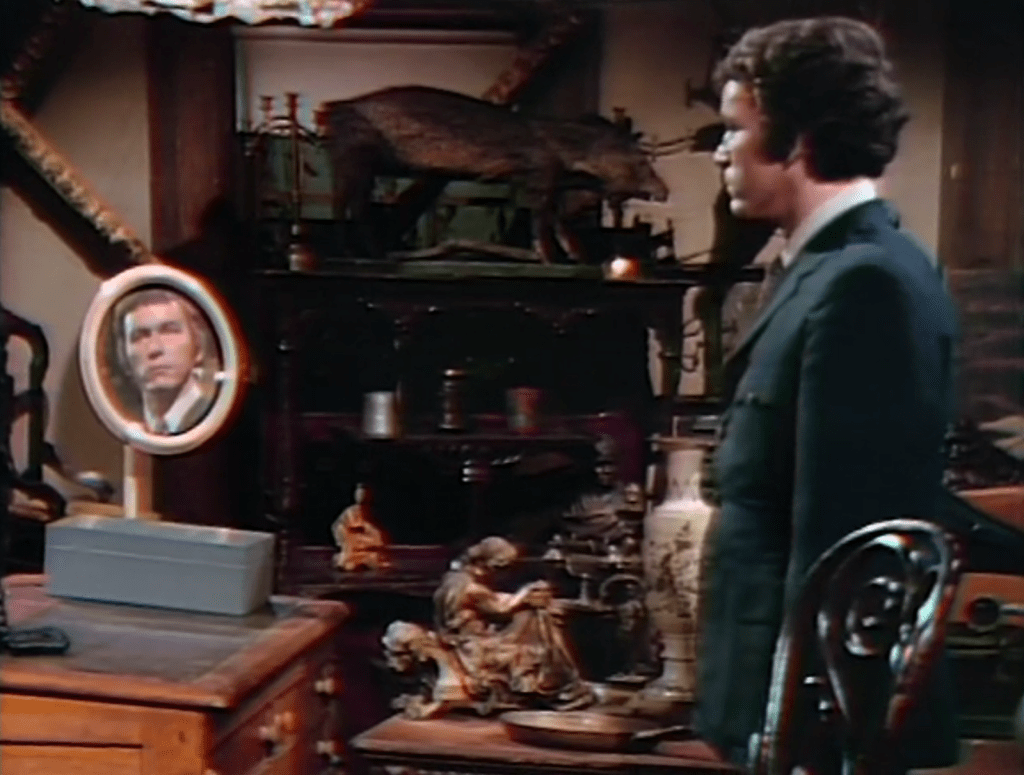
There is a big mirror on the wall at the foot of the stairs in Barnabas’ house. At one point he walks in front of it and casts a reflection. Sometimes they have been very emphatic that vampires don’t cast reflections. Most famously, Julia confirmed that Barnabas was a vampire in #288, when she contrived to open her compact and point the mirror at him. The same prop was used in #704, when it exposed Barnabas’ secret to the luckless Sophie Baker, prompting him to murder her. On the other hand, when wicked witch Angelique became a vampire for a while in 1968, there were some shots that were obviously deliberate in their composition that prominently featured her reflection in mirrors, making the point that she was an exception to this rule. The mirror doesn’t have to be on the wall, but if it is we will inevitably see Jonathan Frid reflected in it, suggesting that they put it there on purpose to show that he is now another exception to the rule.
Barnabas reflects.
Willie was off the show for a year, from #696 (broadcast 24 February 1969) to #956 (broadcast 23 February 1970.) His absence during that period was not explained. Today he mentions to Julia that he has been working at another hospital, as he once worked for her at Windcliff. Indeed, she had offered him a job there in #537. Since Julia did not know about this other hospital job, he must have taken it sometime after leaving his position at Windcliff and without a reference from her. Before Barnabas enslaved him, Willie was a dangerously unstable ruffian, wanted by the police, so they are likely the first employers he has had who would have provided a usable reference. So he probably left Collinwood for the job at Windcliff not much later than March 1969 and held a job in some third place before getting back into hospital work more recently.
In the first year of the show, only David Henesy, as strange and troubled boy David Collins, looked directly into the camera; in the last year, that move has been the signature of Denise Nickerson as David’s young friend Amy Jennings. Today, just about every member of the cast does it. I believe it is the first time Jonathan Frid has done so, though there have been times when his examination of the teleprompter has moved him perilously close to an unintentional soliloquy.
Barnabas tells Julia that their enemies will never find his coffin “where it is now.” The first time we heard that was in 1967, and back then it made us wonder why, if he has an impregnable hiding place for his coffin, he usually just leaves it in the middle of his basement where no one coming downstairs could avoid seeing it. Barnabas spent most of 1969 as a time traveler visiting 1897. His vampirism was exposed in that year, and he was hunted. He assured his allies that no one could find his coffin where it was hidden then; they found it immediately. So longtime viewers aren’t so sure that Barnabas will escape detection during the day.
As Julia, Grayson Hall has a new hairdo today. It is a bit longer than it has been, and is swept up in front.
We are in the fourteenth week of a story about the Leviathan People, a race of Elder Gods who are planning to retake the Earth from humankind. At first, old world gentleman Barnabas Collins was a zealous acolyte of the Leviathans and the faithful leader of a cult devoted to their service. The first chapter of the story came to an end when a shape-shifting monster from beyond space and time, the harbinger of the Leviathans’ return, ordered Barnabas to kill his best friend, mad scientist Julia Hoffman. Barnabas refused that order and became disaffected from the cult, held in line only by the Leviathans’ threats.
The shape-shifting monster has grown, and now spends most of his time as a young man whom everyone calls Jeb, despite his initial request to be called Jabe. Barnabas learned the other day that some of the threats the Leviathans had been making were empty, and so tried to smash a small wooden box that is important to them. Jabe stopped him, and punished the attempt by turning Barnabas back into what he was from the 1790s until 1968, a vampire.
Jabe’s home is a room above an antique shop owned by cultists Megan and Philip Todd. There is a lot of talk about this room as the only place where Jabe can change form. This is confusing to regular viewers. We saw him change from boy to girl while visiting the great house of Collinwood in #909, and in #946 and #947 he changed from his true, non-human, form into Jabe while at a house on an island many miles from the village of Collinsport. Today, Barnabas burns the antique shop down in order to destroy the room; Jabe says that he left the room through the window when the fire started, and changed from his true form into his human shape while outside. I keep trying to give them the benefit of the doubt about this, but at this point the whole theme of the “Chosen Room” falls apart completely.
Nonetheless, the antique shop sets and the troubled relationship between Philip and Megan have been signatures of the Leviathan story so far. Now the shop is gone, and Megan is gleeful that Philip is in jail, having confessed to three murders Jabe committed and unlikely ever to live with her again. So we can say that chapter two of the Leviathan story is over.
Barnabas’ re-vamping marks a transition in more than this storyline. He is the central character of the show and its main attraction; whether or not he is a vampire determines a great deal about what kind of show it is. You could periodize the show into segments depending on whether he is a vampire or not. I’ll risk a spoiler and tell you we have now begun a long segment of Barnabas-as-vampire.
Barnabas goes to the jail and has a conference with Philip. Jabe overtaxed Philip’s allegiance to the Leviathans, as he overtaxed Barnabas’. Philip has confessed to Jabe’s murders only because he loves Megan, believes she still loves him, and fears that if he does not do what Jabe commands he will kill Megan. Barnabas tells him that in fact Megan no longer cares about him at all, but is entirely devoted to Jabe.
In the real world, the state of Maine did away with capital punishment in 1887, a fact which applied to the universe of Dark Shadows in 1966. In #101, high-born ne’er-do-well Roger Collins disappointed his son, strange and troubled boy David, by mentioning it. But the prospect of a gallows is more melodramatic than is that of any prison sentence, however long, and so Philip announces that he is going to be hanged for Jabe’s murders.
Matriarch Elizabeth Collins Stoddard, owner of the great estate of Collinwood and of the businesses that employ most of the people in and around the village of Collinsport, is a devoted member of the Leviathan cult. Liz gives Jabe the carriage house on the estate to live in, telling him its back room will be suited to take the place of the now-destroyed Chosen Room. He tells her that Barnabas has betrayed the cult, but that she need not act against him yet. The carriage house was mentioned a few times in 1969, when Dark Shadows was a costume drama set in 1897 and the Collinses were still traveling by carriage. I believe this is our first confirmation that the carriage house still exists in the twentieth century.
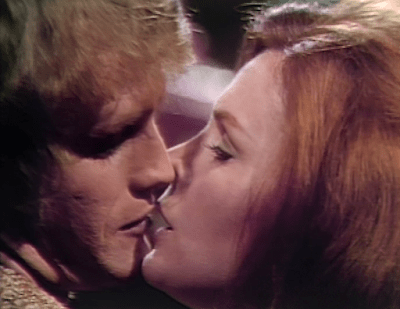
Megan comes to visit Jabe at the carriage house. She is exultant that Philip is in jail. Jabe tells her he has no intention of resuming his true form; she is appalled. The plan has been that he will take Liz’ daughter Carolyn as his bride, and that she will then turn into the same kind of being he is. If he is going to be humanoid all the time, then he will just be taking Carolyn out on dates. Megan says that this was not the point. Jabe dismisses her objections, and tells her that their own relationship is different now than it was when he was first taking shape and she and Philip were his foster parents. He pulls her close to him and gives her a passionate kiss.
Jabe spent several weeks in the form of a succession of children. The children showed violent hostility towards Philip and remarkably little sense of boundaries in their relationship with Megan; the reference to the Freudian Oedipus complex was not subtle then, and the kiss he gives to Megan while he is setting Philip up for a judicial murder makes the connection explicit.
Old world gentleman Barnabas Collins has fallen afoul of a shape-shifting monster from beyond time and space who once hoped people would call him “Jabe.” The monster, who has settled for the name “Jeb,” turns Barnabas back into what he was from the 1790s until 1968, a vampire.
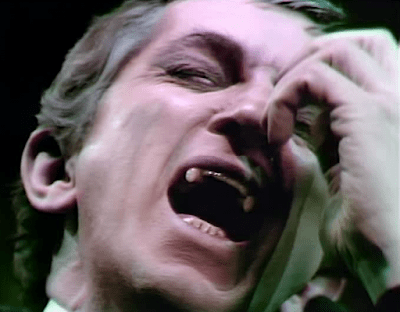
Re-vamped, Barnabas suddenly gets a lot of gray in his hair and a much darker complexion. Makeup artist Vince Loscalzo deserves a lot of credit for these bits of color, they are placed perfectly to emphasize the look of anguish as Barnabas realizes what has happened to him and struggles to resist his urges. The actors’ faces were the medium of Loscalzo’s art, and he outdid himself with these complements to Jonathan Frid’s face.
People talk endlessly about the heroic makeup work Dick Smith did with Jonathan Frid one week in October 1967 and again on a feature film, but Vince Loscalzo did great stuff like this day in and day out for years. Screenshot by Dark Shadows Before I Die.
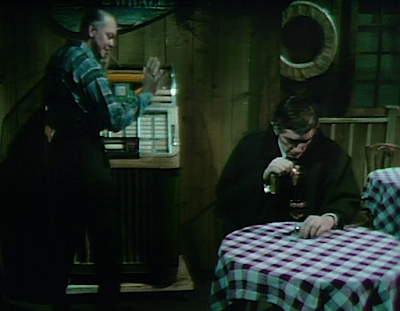
We see Barnabas sitting at a table in The Blue Whale, the tavern in the village of Collinsport. He is the only patron in the room. He has a glass of reddish liquid in front of him, and the bartender is moving around the room. The bartender looks at Barnabas, as if to ask, “How do you like your glass of AB negative, Mr Collins?” But he turns away and moves on.
A young woman enters. Barnabas invites her to join him at his table. He sees that she is wearing a pendant that identifies her as a member of the secret cult that serves Jabe and other creatures who intend to seize control of the Earth, supplanting humankind. Barnabas introduces himself, and says that he was the one who made it possible for Jabe to come to life. This is true, but it is also true that he has become disaffected from the cult. Even after Jabe turned him back into a vampire, Barnabas is still determined to thwart it.
The young woman introduces herself as Nelle Gunston, who was recruited into the cult while living a dreary life with her parents in Virginia. Nelle tells Barnabas that everything has changed for her since she joined the cult. She says that she will gladly do anything she can to advance its objectives, including murder. They have this conversation in nice loud voices while the bartender is nearby.
Barnabas’ friends, mad scientist Julia Hoffman and recovering werewolf Quentin Collins, enter. He introduces them to Nelle, then explains to them that he and Nelle have a private matter to discuss. Quentin and Julia go to the bar, where Quentin orders brandies. They talk about Nelle’s pendant and their fear that Barnabas is falling back under the power of the cult while the bartender is in their space serving them drinks. Evidently they’ve learned to rely on his discretion. They are still deep in conversation when Barnabas leaves with Nelle.
Barnabas takes Nelle back to his place on the pretext that Jabe will meet them there. She asks him why it is so dark in there; he asks her how she got into the cult. She catches on that Jabe is not coming and that Barnabas is not loyal to him. She draws a knife and is about to stab Barnabas when he bares his fangs to her.
Quentin and Julia let themselves into Barnabas’ house. They find Nelle dead on the floor and Barnabas wallowing in self-pity next to her. Julia takes a second look at Nelle and sees the puncture wounds on her neck. She tells Barnabas she will renew the treatments that first put his vampirism into remission two years before; he says there is something else he has to do first. After he rushes out, Quentin and Julia talk about how they will hide Nelle’s body.
Nelle was the perfect victim for Barnabas- no one in town knew her, no one expected her to come, no one will notice she is missing. And he is determined to weaken the cult, so reducing its numbers by one fits his goals.
Barnabas goes to the antique shop in the village. Jabe is in an upstairs room; Barnabas is convinced that Jabe can assume his true form and lay it down only in that room. We saw him do that in a house on an island many miles away in #946, and he told Barnabas that he had done so in #947, but apparently that doesn’t count, somehow. Jabe is far more powerful in his true form than he is when he is man-shaped, but he cannot mingle with humans in that form. So Barnabas believes that he will limit Jabe’s options if he destroys the room. He pours gasoline all around the first floor of the shop and sets a match to it.
Nelle is played by Elizabeth Eis, in her first appearance on Dark Shadows. They say that the first thing actors have to do to work effectively is to pay attention to each other. Eis shows how far this can take you. She listens ravenously to everything Frid says and never takes her eyes off him. The script doesn’t give her a huge amount to work with, but simply by giving her scene partner her total attention she creates a sensational performance. The producers noticed; she will be back later this year in two quite different roles.
This episode is the last time we see either the Blue Whale or Bob O’Connell as the Bartender. The Blue Whale was an important part of the show from its debut in June 1966 until the first costume drama insert began in November 1967. O’Connell appeared as the Bartender in 60 episodes (three of them as other bartenders in other periods of history) and had speaking parts in 6. It’s too bad he doesn’t get to say anything today, but at least he is in the closing credits.
Hail and farewell to Bob the Bartender, the jukebox, and the tavern. Screenshot by Dark Shadows Before I Die.
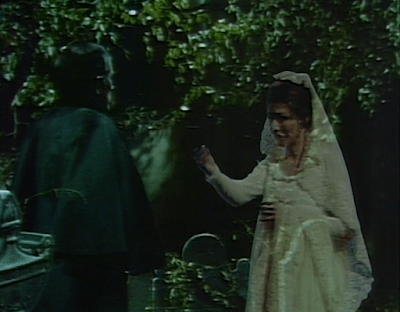
The first ghost we saw on Dark Shadows was that of the gracious Josette Collins, who came down from her portrait and danced around the outside of the Old House on the grounds of the estate of Collinwood in #70. We had first heard of Josette in #5, when drunken sad sack Sam Evans told well-meaning governess Vicki Winters about her, and she had been mentioned many times in the first fourteen weeks. From #70 until #191, Josette’s ghost became a steadily bigger part of the story. She rallied the other ghosts of Collinwood to rescue Vicki from crazed handyman Matthew in #126, and from that point until #191 guided Vicki in her battle with undead blonde fire witch Laura Murdoch Collins. By the end of the Laura story, Josette was firmly established as the chief figure in the show’s supernatural back-world, a world which the action is continually tugging into view.
Vampire Barnabas Collins succeeded Laura as the show’s supernatural Big Bad. Josette was well-suited to do battle with the distant and indefinable Laura, but was too wispy to be very effective against the more dynamic Barnabas. In #212, Barnabas addressed Josette through her portrait in the Old House, which we had seen strange and troubled boy David Collins use to carry on conversations with her in #102 and #162. Barnabas spoke to Josette then as if she were his grandmother, who had sided with his father against him in a fateful conflict, and told her he was kicking her out of the house. Over the next few weeks, there were several episodes when David lamented Josette’s absence from the Old House, suggesting that Barnabas had succeeded in banishing her.
As it became clear Barnabas was a hit and would be kept on the show for a while, they decided to connect him to Josette. So they borrowed the story of the 1932 film The Mummy. As Boris Karloff’s undead Imhotep decided that Helen Grosvenor was the reincarnation of his lost love Princess Ankh-Esen-Amun, so Barnabas decided that Josette, retconned as his lost love, had been reincarnated as Maggie Evans (Kathryn Leigh Scott,) daughter of Sam. As Imhotep abducted Helen and tried to turn her into Ankh-Esen-Amun, so Barnabas abducted Maggie and tortured her in an attempt to erase her personality and upload Josette’s in its place.
In the movie, Helen and Ankh-Esen-Amun were both played by Zita Johann. The original viewers wouldn’t have known it, but Miss Scott, wearing a veil, played the ghost of Josette in #70 and voiced Josette’s lines to Vicki in #126. In the scenes during the Laura story when we caught glimpses of Josette’s face, the ghost was played by frequent stand-in Rosemary McNamara, who looked enough like Miss Scott that viewers may have wondered if she was playing the role. So the idea of a connection between Maggie and Josette had been rattling around the writers’ room for a while. In #240, David saw Maggie wandering around Barnabas’ house. She was wearing Josette’s dress but no veil, in a daze and answering to Josette’s name. Afterward, David said that he had seen Josette and that she looked exactly the same as she did when he had seen her as a ghost. That confirmed that Maggie was at least a Josette lookalike, if not her reincarnation.
Maggie eventually escaped from Barnabas. Her psychiatrist, Julia Hoffman, saw in Barnabas her chance to make a career as a mad scientist, and so she sold Maggie out, using her magical power of hypnosis to delete her memory of what Barnabas did to her and leave her with a feeling of goodwill towards Barnabas. By that time, Barnabas had turned his attentions to Vicki, toying with the idea of Josettifying her. Josette’s ghost made it clear to him that she would try to stop any such effort when she spoke through Vicki at a séance in #280 and 281; after that, Barnabas gave her portrait another talking-to, telling her that she was lost to him forever and must let him live in the present. It sounded like he was going to stop trying to turn girls into Josette, but he kept pushing Josette’s hypnotic music box on Vicki, so if that’s what he meant he didn’t stick with it.
In November 1967, Vicki went back in time to the days when Barnabas and Josette were living human beings. From then until March 1968, Dark Shadows was a costume drama set in the 1790s. Miss Scott was cast as the living Josette, completing the parallel with the flashbacks to ancient Egypt in The Mummy and suggesting that Barnabas, though he was appallingly cruel and thoroughly crazy, was onto something when he told Maggie she was Josette.
The whole idea of supernaturalism is that what appears to be powerless is in fact most powerful and vice versa, so having been powerful as a ghost, Josette has to be at least somewhat understated as a living being. Making matters worse for her, the 1790s segment moved at a breakneck speed, piling one bizarre disaster on top of another, so that there was no time to develop the kind of subtle strength a lady of her sort might be expected to have or to give us much of a look at Josette and Barnabas as a loving couple before everything went horribly wrong for them. She winds up as a pleasant but ineffectual person. The 1790s period was the show’s first great triumph, but it did knock Josette out of the spotlight permanently.
A couple of weeks after Dark Shadows returned to contemporary dress in March 1968, Barnabas’ vampirism went into remission and he tried to function as a good guy. His bumbling attempts at heroism generated as much trouble for everyone as had his villainy. Julia had made herself a permanent houseguest at Collinwood, and she was the one who was busiest with the work of containing his damage. Throughout the part of the show made and set in 1968, Josette was all but forgotten.
Early in 1969, Barnabas came unstuck in time and found himself in 1897, once more subject to the vampire curse. During his eight months in that period, he met two more characters played by Miss Scott. Each of them led him into a fresh bout of Josettery. He gave the music box to neurotic intellectual Rachel Drummond; after her death, he met Kitty Soames, dowager countess of Hampshire, who despite her title was a young woman from Pennsylvania. The music box showed up in Kitty’s room at a time when Barnabas could not possibly have been around, and it became clear that this time, it was Josette herself who was trying to take possession of Kitty.
In #884, airing in November 1969, Kitty was assumed bodily into Josette’s portrait. Barnabas saw this happen. He then returned to the 1790s, to the night when Josette originally flung herself to her death from the cliff at Widows’ Hill rather than let Barnabas turn her into a vampire. Josette had only the vaguest memory of 1897 or of Kitty; as far as she is concerned, she was living through this night for the first time, and was experiencing time in the usual linear fashion.
Barnabas tried to prevent Josette’s suicide, but succeeded only in changing the method she used to do herself in. By the time he returned to the twentieth century, he had fallen under the sway of the Leviathan People, a race of Elder Gods who are trying to retake the Earth from humankind. For a time he led a cult that served them in this goal, but eventually became disaffected. He hesitates to take any very definite action against the Leviathans, because they told him they were “holding Josette prisoner in the past” and that they would inflict on her a more horrible death than either of those she has already died if he defied them in any way.
Vicki was written out of the show in 1968, and Maggie succeeded her as governess to the children at Collinwood. The Leviathans have sent a shape-shifting monster from beyond space and time as the harbinger of their conquest. The monster usually takes the form of a young man who initially asked people to call him “Jabe,” but whom everyone instead calls “Jeb.” Jabe is always obnoxious and often homicidal, and has alienated many people from the Leviathans, including Barnabas. He abducted Maggie and thought he had brainwashed her into joining the cult; once he let her go, she made an alliance with Barnabas and Julia to fight the Leviathans.
Barnabas is convinced Jabe is about to do something especially horrible, and so he wants to open the battle. But his concern for Josette is still holding him back. He and Julia talk about this. It dawns on them that the Leviathans may have been lying, and that they may not have the power to make Josette re-die. The only way they can be sure is to ask Josette, so they decide to hold a séance. They enlist Maggie to be the third member of the circle.
The typical Dark Shadows séance involves three roles- the convener, who gives detailed instructions and barks about the importance of following them, even if everyone in the room has attended multiple séances already; the medium, who goes into the trance and channels the voice from the realm of the dead; and the objector, who tries to interrupt and is sternly hushed by the convener. Recent séances have omitted the objector; today, Julia keeps up a running commentary from the time Barnabas starts the incantations until Maggie goes into the trance, but she doesn’t object and Barnabas doesn’t hush her.
Through Maggie, Josette says she had a hard time getting to the séance, but that it had nothing to do with the Leviathans. She says she doesn’t even know the Leviathans. Barnabas doesn’t believe her, and she says that if he wants proof he should come to her grave.
He does. The tinkling tune of the music box plays on the soundtrack; Barnabas does not mention the original signature of Josette’s presence, the scent of jasmine. Her ghost manifests before him:
THE GHOST OF JOSETTE: It is I. And I will tell you what you must know, now and forever. You asked me if the Leviathans held me prisoner. They do not. But you hold me, just as I hold you with my love. But now the time has come for us both to go free.
BARNABAS: I cannot be free without you.
GHOST: But you must. For I belong to the past. For you there is a future with someone else.
BARNABAS: But I don’t want anyone else.
GHOST: Then you must be lonely, for you cannot have me. But you will find someone else. I know it. And when you do, give her this. The ring that you gave to me, give to her, whoever she may be. This ring is a sign of your freedom and of mine. (Returns her engagement ring to him and vanishes.)
This is Josette’s final appearance on Dark Shadows, not counting a parallel universe version of Josette who will feature in the last weeks of the show, played by another actress. As for the “someone else,” it would be logical for Barnabas to get with Julia, since the two of them are so deeply complicit in each other’s crimes that neither of them will ever be able to make a life with anyone else. But there have been some hints lately that romance might be budding between Barnabas and Maggie, and if that’s going to happen they are going to have to keep us from thinking very clearly about Josette and Barnabas’ attempts to recreate her. We might suppose that her farewell is meant to clear the path for such a development.
There’s also some business about the Leviathan story. In the opening reprise, Jabe catches a bat, which he plans to use to turn Barnabas back into a vampire.
After Barnabas gets the green light from Josette, he meets with Philip Todd, another person whom Jabe has driven out of the Leviathan cult. Philip tells Barnabas how much he hates Jabe and agrees to steal the Leviathan box, an object which does not play music but which is a lot more effective at controlling the minds of people who open it than was that box of Josette’s. At the end of the episode, Jabe catches Philip with the box.
A commenter on Danny Horn’s great Dark Shadows Every Day who identifies herself as “Melissa”* wrote this lyric about Jabe in twocomments about the post covering today’s episode:
Come and listen to my story ’bout s man named Jeb, Poor Leviathan, barely kept his evil web. Then, one day, he and Barney had a spat, And out from the cage came a rubberized bat. (Vampire bat, that is: Nylon string, Terror teeth.)
Next thing you know,ol’ Jeb has got a girl. Cult folk said, “Jeb, come and rule the world!” They said, “In the attic is the place you want to be,” So they threw themselves a seance and they called on J.D.C. (Josette Collins, that is. Swimming fail. Newly scarred.)
Comments left 31 October 2016 by “Melissa” on Danny Horn “Episode 948: War Games,” posted 30 October 2016 at Dark Shadows Every Day.
I’m singing that aloud right now. I realize you might be reading this years after I wrote it, but believe me, I’m singing it right now.
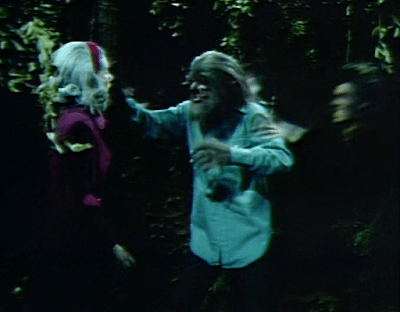
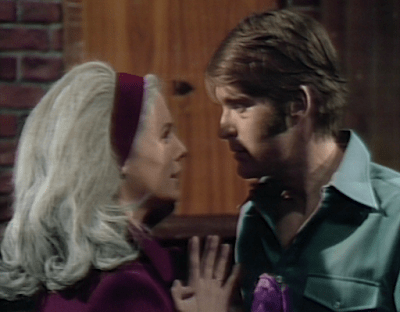
A werewolf is prowling through the woods on the great estate of Collinwood, and Sabrina Stuart, a young woman with white hair, sees him. She knows that when the moon is not full, the werewolf is her ex-fiancé Chris Jennings. She screams at the sight of him. This would be an understandable reaction if the werewolf were scary looking, but since he is a man whose face and hands are covered with hairy makeup appliances while the rest of him is wearing clothes, he is a just cute little doggie who might like a bickie. Television, they say, is a visual medium; that means that the images you put on the screen will stimulate the audience’s imaginations. If you are telling a story about a monster, you must show only enough of him to get them to wonder what terrible things he might do. Once you’ve shown so much that they start to laugh, you’re sunk.
Sabrina composes herself, and tries to reason with the werewolf. He stands there listening to her attentively, being the goodest little boy. This ends when a man emerges from the brush and jumps him. The man shoots the werewolf, who yips and runs away. Sabrina is upset with the man, who is surprised she does not regard him as her rescuer. She identifies herself by name.
The man’s name is Bruno, and he works for another monster, one whom we see only when he is masquerading as a young man. That monster once said he wanted to be called Jabe, but everyone very inconsiderately keeps calling him Jeb instead. Jabe has told Bruno that he is vulnerable to werewolves. Bruno disregarded Jabe’s report that only silver bullets can kill a werewolf, and fired regular ammunition. Jabe is upset about this.
Bruno tells him all is not lost. Since Sabrina was not afraid of the werewolf, his human form must be that of a man to whom she is close. Bruno says Sabrina has a brother, and thinks out loud that he ought to just go ahead and kill him. Regular viewers know that Sabrina’s brother, though he is not a werewolf, is a character played by Roger Davis, so we’re all for Bruno’s idea. But Jabe vetoes it, saying that if a werewolf is killed while in human form he will turn into the wolf and remain in that form forever. That’s new information on Dark Shadows, though there had been so many werewolf movies by 1970 I can’t imagine it was original.
Old world gentleman Barnabas Collins stops by the antique shop where Jabe lives. Barnabas had been the leader of the cult that serves Jabe, but has become disaffected. Jabe knows this. Each wants to kill the other, but neither has been able to make a substantive move. Jabe demands Barnabas do something about the werewolf, in the process exposing his vulnerability. Barnabas is friendly with Chris and knows all about him, so this exposure makes it possible for him and Jabe to join battle.
In the closing credits, writer Violet Welles’ name is misspelled “Wells.” Today’s script is not up to her usual standards; maybe “Violet Wells” was her guild-approved pseudonym.
Maggie Evans, governess in the great house on the estate of Collinwood, is being held prisoner in a big mausoleum somewhere. Her captor appears to be a young man, but is actually a monster from beyond space and time. He is associated with the Leviathan People, a race of Elder Gods who are planning to take the earth away from humankind with the aid of some people whom they control and whom they have formed into a cult. The cultists call the monster Jeb, even though when we first saw him he said he wanted to be called Jabe.
Jabe orders Maggie to open a wooden box and look inside. He makes it clear to her that she is supposed to be under his control after she has done this, so she plays along. He lets her go, with orders that she is to spy on old world gentleman Barnabas Collins, a leader of the cult who has become disaffected from it and is working against Jabe.
Back in the great house, Maggie tells Barnabas what happened. Barnabas’ best friend, mad scientist Julia Hoffman, enters; he tells Julia that Maggie is their new ally in the fight against the Leviathans. When Barnabas was still loyal to the Leviathans, he tried to absorb Julia into the cult. That effort failed, and Barnabas explained that “certain people” were immune from absorption because of their “genetic structure.” Since Julia is the only Jewish character on the show, this sounded jarringly like a claim that the Leviathans were a restricted club. Evidently Maggie is now among those “certain people.” Since Maggie has a Welsh name and is played by a Minnesota-born actress of Scandinavian descent, that retroactively takes some of the anti-Semitic edge off Barnabas’ earlier remark for viewers who remember that episode (unless she converted.)
Maggie had taken an apologetic tone when she told Julia she wanted to be alone with Barnabas; Julia is very circumspect when she comes in at the end of their conversation. For a long time now, the show has been working on the idea that Julia wants a romantic relationship with Barnabas and is sad that he does not share her desire; for the last couple of weeks, they have been hinting that Barnabas and Maggie are getting pretty cozy. Regular viewers will be interested to see Grayson Hall playing Julia being a good sport about losing Barnabas to Maggie, and Kathryn Leigh Scott playing Maggie wishing she didn’t have to hurt her friend’s feelings.
We learned yesterday that Jabe is vulnerable to werewolves. As luck would have it, there is a werewolf at large in the Collinsport area. He is Chris Jennings, and Barnabas and Julia have been trying to cure him of the effects of his curse. He had been spending the nights of the full moon in a cell at Windcliff, a mental hospital Julia is in charge of, but last month came back to the caretaker’s cottage on the grounds of Collinwood. He couldn’t stand being cooped up, and chose to go back to his old practice of killing someone at random every month.
Julia and Barnabas don’t know that Chris is a weapon they can use against Jabe, and they want him to go back to Windcliff. The moon will be full tonight, so they are particularly anxious. But his onetime fiancée, Sabrina Stuart, has a different idea. She has been in contact with an expert on lycanthropy, and he has shipped her the only surviving specimen of the Moon Poppy. She brings the potted plant to Chris and tells him that the flower will open when the moon starts to rise. If he eats it while it is blooming, he will be cured. Otherwise, he will lose his chance- the plant will be dead before morning.
Chris’ transformation begins with moonrise, and once he has become the wolf he has no will of his own. When Barnabas stops by to take him to Windcliff, he points this out to Chris. But Chris is determined to try Sabrina’s cure. He is like every addict who talks himself into believing that this time, it will be different. Of course his determination fails him at the last moment, and by the time he can reach for the opening flower, it is a hairy paw, not a hand, that stretches towards it.
The flower cure and Chris the unlikable protagonist are both borrowings from the 1941 film The Wolf Man. Jabe lives in an antique shop; there’s an antique shop in that movie, too. There were some hints early on that werewolves were a threat to the Leviathans; evidently they had planned to bring these two stories together all along.
Closing Miscellany
Sometimes the closing credits are on cards, one after another; other times, they are on a continuous roll. Through the first year of the show, when they were on a roll costume supplier Ohrbach’s would be misspelled “Orhbach’s.” We haven’t seen that misspelling for a long time, but it’s back today. It will keep cropping up for the rest of the series.
Barnabas and Julia find a fake letter from Maggie saying that she’s been away visiting her Aunt Louise in Quebec. This is the first time we’ve heard of any members of Maggie’s family other than her late parents. Since the letter is a phony meant to cover up her abduction and neither Julia nor Barnabas seems to have heard of Louise before, it is possible there is no such person. Still, Maggie has been a major character since the first episode, so it does get longtime viewers thinking about how little we know about her background.
This is only marginally relevant to the episode, but I can’t resist bringing it up. The other day, a Twitter user named Zach Wilson (whose bio describes him as “watcher of TV, all of it, one episode at a time”) posted an image of pages of TV Guide from 22 April 1966 with the question “What would you watch?” An Educational TV station in whatever market it was running a WGBH-Boston produced telecast of the Boston Theater Company’s production of Gertrude Stein’s “Yes is for a Very Young Man,” starring Lisa Blake Richards. The Harvard Crimson had reviewed the stage production in November 1965; they said that “the play was lousy,” but they praised the cast for making the most of a bad script, singling out Miss Richards for the “outstanding job” she did “with a whining, pathetic character.” Sabrina isn’t exactly Lady MacBeth, either, and Miss Richards had her work cut out for her finding a way to make us want to see more of her.
For the last eleven weeks, the A story on Dark Shadows has been about the Leviathan People, a mysterious race of Elder Gods who are trying to retake the Earth from humanity by enlisting a few people in central Maine into a secret cult and saddling them with responsibility for an ungovernable monster. The cultists have agreed to go along with the monster’s murders and other acts of physical violence, but drew the line when he asked them to call him “Jabe.” He answers to “Jeb” now.
The Leviathans chose old world gentleman Barnabas Collins as the first leader of the cult. This put him at odds with his longtime best friend, mad scientist Julia Hoffman. Now Barnabas has become disaffected from the cult, and he and Julia bring each other up to date on recent developments.
Julia and Barnabas’ conversation frames a series of clips, two of them selected from episode #884 and fulfilling Dan Curtis Productions contractual obligations to feature Roger Davis and Kathryn Leigh Scott in a certain number of episodes. There is also a newly produced clip of Barnabas’ induction into the Leviathan cult, in which a hooded figure named Oberon explains the terms and conditions of membership. When we first saw Oberon, the part of his scalp we could see was completely bald, but he has a tuft of hair growing there now. His part today is so dull that you can’t very well blame actor Peter Lombard for refusing to shave his head for it.
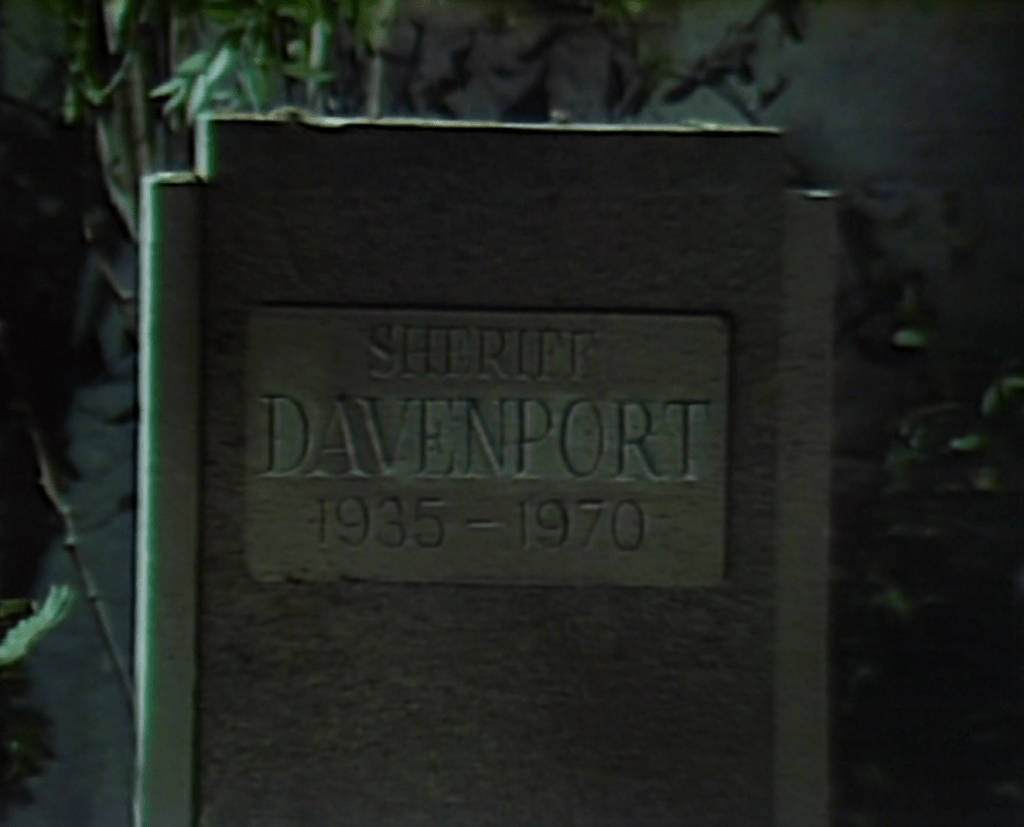
There is also some new information at the end of the episode. Barnabas says that Jabe can raise the corpses of those he has killed and use them as “an Army of the Dead.” We cut to a new grave with a marker reading “Sheriff Davenport.” The other day Jabe killed a law enforcement officer named Davenport; Davenport appeared to be the sheriff of Collinsport, but it turns out “Sheriff” was simply his first name. Sheriff’s hand bursts out of the soil.
I watched the closing credits, wondering if today would be the day they finally acknowledged the videotape editors. It’s due- there have been several obvious cuts over the last few weeks. But they are still toiling in anonymity.
A monster from beyond space and time has taken the form of a vicious man-child and asked people to call it “Jabe.” A cult devoted to the Leviathan People, mysterious Elder Gods who brought the monster to Earth, have decided to put up with its murders and depredations, but even they draw the line at calling the monster “Jabe.” It answers to “Jeb” instead.
Jabe’s latest pointless act of cruelty was to break the leg of one of his faithful servants, thirteen year old David Collins. A couple of times today, Jabe is about to explain why he broke David’s leg, and each time they cut away to some other scene. At one point we cut back to Jabe telling David that “Now you know why I had to do that, don’t you?,” to which David agrees that he does. That just lampshades the fact that the writers couldn’t come up with a reason.
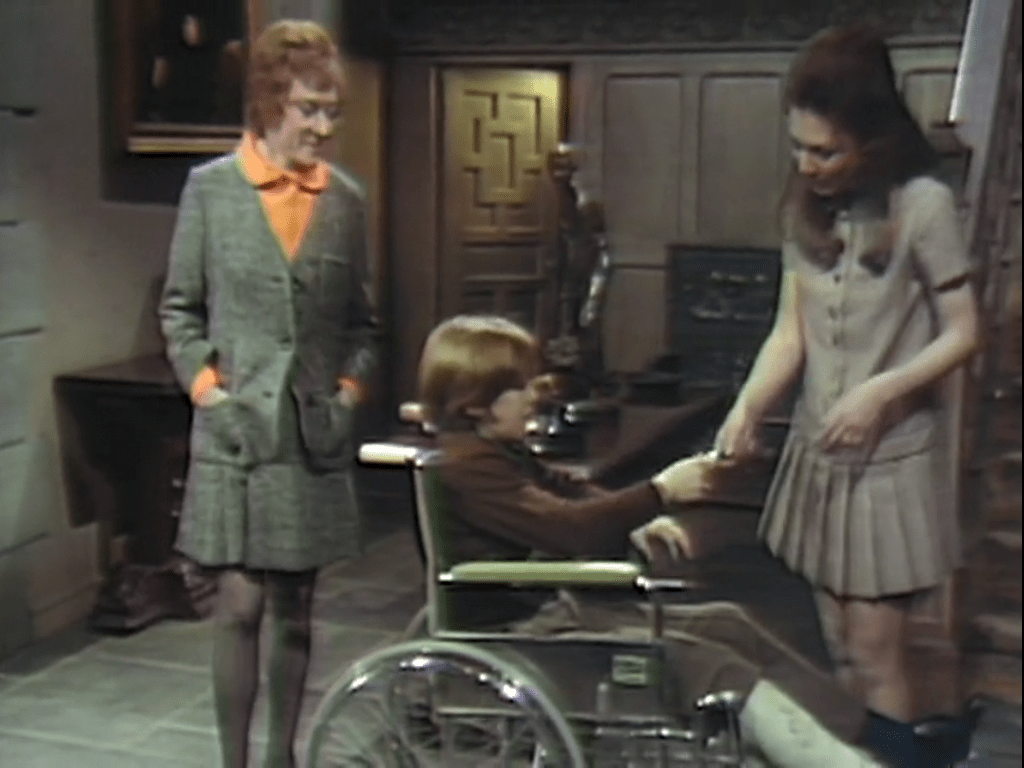
David wants Maggie to be the first to sign his cast.
The actual reason David Collins is wearing a cast and using a wheelchair is that actor David Henesy took a nasty spill on the ice. And since Jabe’s untrammeled violence is the big menace on the show right now, it makes sense that they would have him be at fault. It certainly makes more sense than does the fact that the family insists on David climbing the stairs to his bedroom with crutches, when they have a whole disused wing of servants’ bedrooms on the first floor in any one of which he could stay while he recuperates. On the other hand, that insistence does produce a moment of real hilarity. The instant David begins his ascent, governess Maggie Evans (Kathryn Leigh Scott) and permanent houseguest Julia Hoffman start talking as if he weren’t there. He must be lumbering up the stairs a couple of feet from them the whole time they are carrying on this conversation.
For his part, Jabe doesn’t generate any laughs. Nor is he pursuing any goals that lead us to wonder what he will do next. We just know that if he has a chance to do something nasty, he’ll probably take it.
If they want Jabe to be a character in whom we take an interest, they ought to give him some kind of cockamamie motivation that is intelligible only to him. That’s what they did in 1967, when vampire Barnabas Collins held Maggie prisoner and tortured her. They showed us that Barnabas thought he was going to turn Maggie into his lost love Josette. That idea, borrowed from the 1932 film The Mummy, was so utterly bonkers the show eventually decided to run with it, casting Miss Scott as Josette when they went back in time to explain how Barnabas became a vampire. Meanwhile, the ever-mounting zaniness kept viewers tuning in, wondering if they would ever expose a layer of Barnabas’ psychology that was composed of something other than nonsense.
The opening voiceover today labels Jabe “evil”; that’s no problem, all the most popular characters, including David, started off as appallingly evil, and they have retained their popularity to the extent that they stayed in touch with their roots. But Jabe is not only evil, he is monotonous, and that makes him a deadly threat to the show’s entertainment value.
Barnabas is not currently subject to the effects of the vampire curse, and Julia long ago used her powers as a mad scientist to erase Maggie’s memory of his crimes against her. Barnabas was the original leader of the Leviathan cult, but has become disaffected. Jabe tells Barnabas today that he wants to kill just about everyone at Collinwood, including ten year old Amy Jennings, who is a faithful member of the cult. He also wants to marry heiress Carolyn Collins Stoddard. Barnabas goes to Collinwood and warns Maggie that Carolyn is in danger. He asks her to keep an eye on Carolyn and to urge her to go away. He does not mention Amy. At least Amy’s name comes up in this episode- when she is on camera she is often the best thing in the show, but throughout her long absences she usually goes unmentioned.
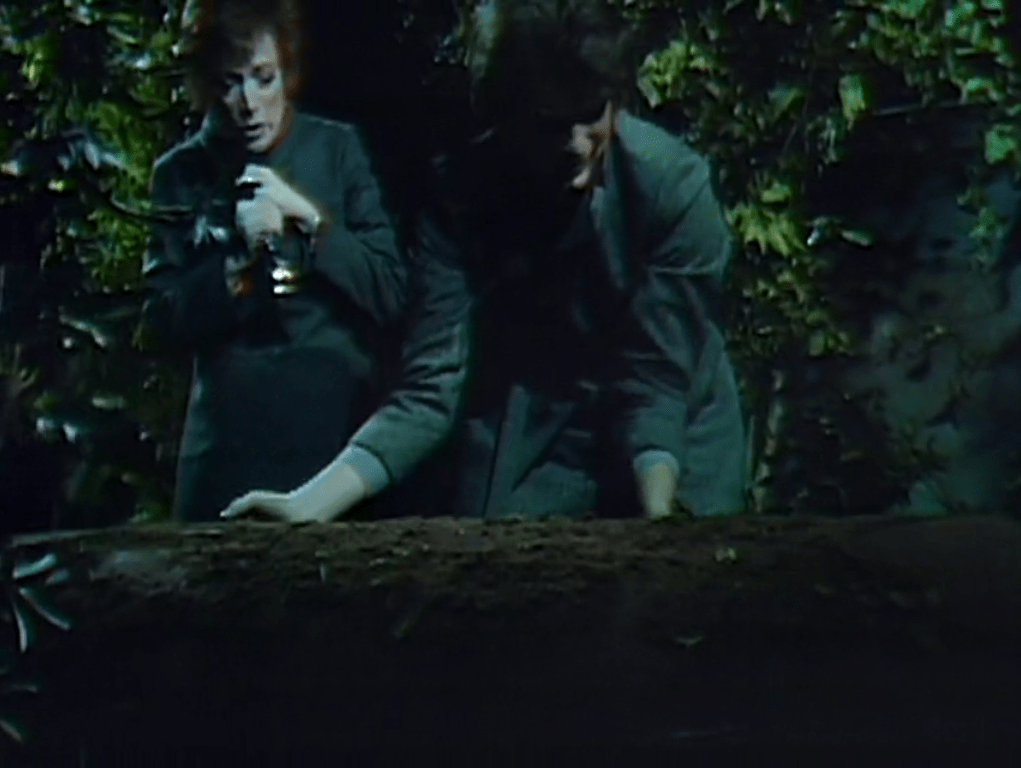
Julia goes to Amy’s great-grandfather, centenarian Quentin Collins, who has recently returned to Collinsport after an absence of many decades and who, because of a series of spells that were cast on him, looks like he is not quite 29 years old. Julia recruits Quentin to dig up the grave of Michael Hackett, Jabe’s previous incarnation. This gives us the first exhumation scene on Dark Shadows since, if I recall correctly, #820. It’s the longest the show has gone without digging up a coffin since the first exhumation scene, in #179. It feels like a homecoming when Quentin sticks his shovel in the plot. Of course they find an empty coffin.
As is usual when digging up a coffin, Quentin wears a three-piece suit with dress shoes, none of which is smudged in the process. Less typically, his coat appears to be somewhat wrinkled.
Afterward, Julia confronts Barnabas. When she tells him how much she already knows, he gives in and says he will tell her everything. With that, we have the promise that Barnabas and Julia will resume the partnership that has been the single most dynamic narrative element on Dark Shadows.
Sheriff Davenport and his new sidekick, mad scientist Julia Hoffman, have come to the top of the stairs above Philip and Megan Todd’s antique shop in the village of Collinsport. The sheriff has a search warrant that specifies the room by the landing as a place of interest in connection with the violent death of one Paul Stoddard. Philip begs the sheriff not to enter the room, saying that a boy who lived there recently died and that any disturbance would “defile” it. He swears the room is entirely empty. The sheriff expresses his sympathy, but opens the door anyway.
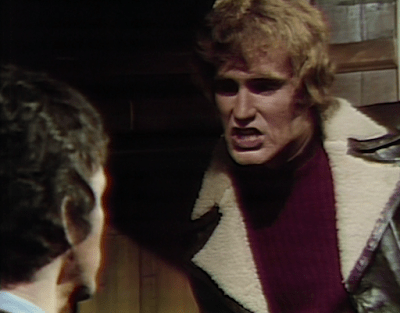
Inside is a young man. Philip seems as surprised at the sight of him as are the sheriff and Julia. He gives his name as “Hawkes, Jeb Hawkes. Short for Jabez… Call me Jabe.” No one calls him Jabe, which seems a bit rude. Jabe claims that he came by earlier when Megan was in and Philip was out, and that she offered to let him live in the room.
The room does not contain any furniture, any luggage, or any other movable property whatsoever. Moreover, while it is possible Megan might have rented the room without mentioning it to Philip, it is difficult to see what Jabe has been doing up there since she left, and since Philip has been moving around the rest of the building it is even more difficult to suppose Jabe could have left his belongings elsewhere without attracting Philip’s notice. Jabe claims to be a photographer, but does not appear to have any camera equipment. Moreover, the sheriff will later tell Julia that he noticed a distinctive odor on Jabe that was prominent on Paul’s corpse, and that he found one of Paul’s cufflinks, damaged as by fire, on the floor of the antique shop. In the finest traditions of Collinsport law enforcement, the sheriff does not take Jabe or Philip into custody, question either of them more than cursorily, or close off the antique shop for a further search. He does come back later to tell Jabe that he should think about finding another apartment.
Jabe is the latest embodiment of a mysterious creature that has previously taken the form of a newborn boy, an eight year old boy, an eight year old girl, and a thirteen year old boy. The boys were vicious little tyrants who did not seem to think at all, only to follow impulses to dominate and humiliate whomever they met. The girl was a Doppelgänger of Paul’s daughter Carolyn as she was when she was eight, and she existed specifically to make Paul feel worthless because he was a deadbeat dad. None of these children engaged with another character in a way that meant there was anything at stake for them in any scene. They as much as tell us that the same will be true of Jabe. When Philip complains today that he has put him and Megan in a difficult position by failing to tell them of his plans, Jabe answers “Maybe I just didn’t want to let you know. Maybe I just wanted to see you sweat it out.”
The only time one of the children did anything surprising in an effort to take on an adversary was when the eight year old boy shape-shifted and became the young Carolyn. Had the sheriff not shown the clownish ineptitude typical of his office, but instead done what a real cop would do and arrested Jabe and Philip, they might have created a situation in which Jabe would have to surprise us again. It might be interesting to see him turn into the grown-up Carolyn, for example. As it is, Jabe just insults Philip, goes to the police station, and murders the sheriff.
This puts a new spin on Roger Ebert’s category of “Idiot Plot.” Ebert said that a movie had an Idiot Plot when its story would end immediately if any of the characters had the brains of an average member of the audience. In this case, the story stays stuck in an angry and utterly predictable rut because of the sheriff’s inexplicable nonfeasance.
The first time Mrs Acilius and I watched Dark Shadows through, we hated Jabe and didn’t want to see Christopher Pennock again. Later, Pennock will return in several quite different roles, each of them more appealing than the one before. By the end of the series he had become one of our favorites, and it occurred to us that even as Jabe he managed to do a lot of things right. But there is only so much an actor can do to work around a script problem, and as written Jabe is barely a character at all. His actions cause problems for several other people, but nothing we see him do or hear him say makes us care about why he takes those actions as opposed to any others. It certainly doesn’t help that half of his episodes, including this one, are directed by Henry Kaplan, whose idea of visual composition was to shove a camera so close to an actor’s face that you can see about one half of one cheekbone.
It didn’t have to be that way. Not only was Pennock a fine actor when he had something to work with, but in this episode we have a scene between Julia and rakish libertine Quentin Collins that shows how a character with a bizarre backstory and a record of evil deeds can become an audience favorite. Quentin is down in the dumps because he just failed to rescue his one true love, Amanda Harris, from the realm of the dead. Julia urges him to reconnect with the Collinses of Collinwood. He asks how he can possibly explain that he is 72 years older than he looks and is now alive, even though his ghost carried out a protracted and deadly haunting of the estate. This dialogue shows that Quentin’s origins require us to believe any number of impossible things, and longtime viewers remember that he is a murderer who killed his wife in cold blood, among other unspeakable acts. But all we see in this scene are his charm and the affection that he and Julia have for each other, and we want to see more of that, as much as they can give us. With similar material, Pennock could have achieved similar results. But it is already clear that he won’t get it as Jabe.
Postscript
In his scene with Julia, Quentin says that no one at the hotel where he and Amanda have been staying remembers her, and that all traces of the alias she had been using seem to have disappeared. Julia speculates that when he lost her in the underworld, the last 72 years of Amanda’s life were negated, that the past was reset so that she did in fact die on a night in the 1890s when she might have died had one of the gods of the dead not intervened.
This raises two questions. First, Amanda has been keeping Quentin. If they are now in a timeline where she never came to town, who’s paying his hotel bill and buying his liquor? It’s a standard feature of soap operas that unless they are telling a story about conflicts over ownership of a business or a house or some other valuable property, everyone just has an inexhaustible supply of money, but they put enough time into Amanda and Julia’s squabble as to which one of them would be Quentin’s sugar mama that you might have expected a line or two about this question.
Second, if everyone else has forgotten Amanda, how does Julia remember her? Quentin journeyed through the infernal regions with her, and so I suppose it makes a kind of sense that from that supernatural location he would have a perspective that would transcend our perception of time and space. But Julia was in and around Collinsport the whole time Quentin and Amanda were harrowing the abode of the permanently unavailable. I suppose the real answer is that she is the audience’s point of view character, and as such knows everything we know. But it does leave us wondering if, in the course of her adventures, some kind of uncanny power may have rubbed off on her.
We open with a reprise of the end of yesterday’s episode. Quentin Collins and Amanda Harris are reenacting the myth of Orpheus and Eurydice. As in the ancient Greek story, they will live together if they can escape all the perils on the road from the realm of the dead to that of the living. Unlike that story, they are allowed to look at each other along the way, but they are not allowed to touch.
The teaser ends where Wednesday’s episode ended, with Amanda falling through a gap in a footbridge and Quentin crying out in anguish. After the opening title, we are surprised to find ourselves at the same scene. Amanda is not yet lost. Quentin pulls her up from the ravine she fell into. But that involves touch, so the ceiling of the cavern collapses and buries her. Suddenly, Quentin finds himself lying on the ground, in the upper world, with no sign of any way back to the place from which he just came.
Amanda’s demise marks Donna McKechnie’s final appearance on Dark Shadows. Miss McKechnie left to be in the original cast of Stephen Sondheim’s Company, paving the way for her enormous success on Broadway in the 1970s. Much later, Miss McKechnie would reprise the role of Amanda in a couple of Big Finish Productions’ Dark Shadows audio dramas, and nowadays she appears at the Dark Shadows conventions.
Any account of Donna McKechnie’s last day at 433 West 53rd Street would be incomplete without this story from Hamrick and Jamison’s book Barnabas and Company:
In rehearsal, we went through the scene with a few Styrofoam boulders and a little peat moss, no big deal. Nobody told me there was going to be ten times as much dropped during the taping. So, when it was time to tape the scene, I was looking up, and I just got buried. I got peat moss in my eyes and in my mouth and ears and nose… and I was covered in rocks. The way things worked at the studio, at the end of that scene, the lights went out, and the camera and crew and actors all moved on to the next scene, in another part of the studio. So there I was, laying under all those Styrofoam rocks and peat moss, and nobody helped me get out. I had to dig myself out, and that was my last experience on Dark Shadows.
Craig Hamrick and R. J. Jamison, BARNABAS AND COMPANY: THE CAST OF THE TV CLASSIC DARK SHADOWS (2nd edition, 2012) page 245.
They’ve been doing a bit of videotape editing recently, as several awkward cuts have made clear. One might think that the whole Underworld sequence, pre- and post-title, was edited in from tape left over from yesterday’s shoot. But Miss McKechnie’s story proves that is not so. The episodes were done in sequence, so if the last bit of tape they shot yesterday had been the crushing of Amanda there wouldn’t have been any next scene to run off to and Miss McKechnie would have had plenty of help digging herself out from under.
Some Sort of Monster was After Him
Meanwhile, the sheriff is at the home of occult expert Timothy Eliot Stokes. Stokes and his friend, mad scientist Julia Hoffman, have called him in because a monster wrecked Stokes’ bedroom, in the process killing a man named Paul Stoddard.
No law enforcement officer on Dark Shadows has yet solved a case, and Sheriff Davenport seems likely to prove the most useless member of the fraternity yet. At no point does he interrogate Stokes and Julia, or even show much interest in what they were doing while Paul was being killed. He refuses to believe Julia when she says that he should be looking for a monster, even though Collinsport has been overrun with monsters for years now and he has acknowledged that the wreckage at Stokes’ is like nothing he has ever seen. Julia tells him that the monster lives in the room at the top of the stairs in the antique shop operated by Megan and Philip Todd. In response, he flatly states that “They wouldn’t have anything to do with his death.” He finally agrees to get a search warrant for the Todds’ place, but when he presents it to Philip he says that he will execute it “unless of course, you don’t want me to?”
The meatiest part of the episode is a long scene between Megan and Philip. She is exultant that the monster has killed Paul and certain that it will go on to do other, even more wonderful things. He’s scared to death of what the monster will do to them if it is not defeated and of the retribution that will come to them if it is. She sneers at him as a coward. He admits that he is a coward, but insists that they run away and count themselves fortunate if they can escape with their lives.
In her first role on Dark Shadows, as Eve, The Fiancée of Frankenstein, Marie Wallace was called upon to show an unbending, unvarying contempt for Adam, the patchwork man she was supposed to marry. Since that was the only feeling Eve had ever shown for Adam, it wasn’t very interesting. But Megan loved Philip when we first met them. The other day, when she told the monster that she had loved Philip for a long time, we could believe her. So her scorn today does carry some force, and no one knows better how to play scorn and play it to the hilt than does Miss Wallace.
The part of Philip has not been a particularly congenial one for Christopher Bernau up to this point, but he too excels in the scene. He has lots of lines you would expect a man to find it hard to say, calling himself a coward and so on, but he speaks them smoothly and fluently. He shows his hesitancy and anguish not in his delivery of the lines, but in his facial expressions and movements while Megan is speaking. You can see him deciding to put aside all male ego and say something that might get through to Megan, no matter how humiliating it is for him to say it. With lines proclaiming his cowardice, Bernau creates the image of a remarkably brave Philip.
That in turn makes it possible for the episode to end on a suspenseful note. The closing cliffhanger has Sheriff Davenport turning the doorknob to the monster’s room, while Philip is frenziedly trying to come up with a way to talk him out of entering it. When we watched that, my wife, Mrs Acilius, said to the screen “If you don’t tell him what’s in there, it’s murder,” in a tone that suggested she thought Philip actually might tell the sheriff the truth. That such an idea could even form is a testament to Bernau’s outstanding performance in this episode.


 Dark Shadows Commentary