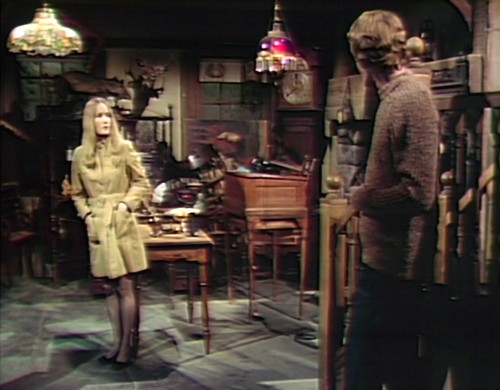
Heiress Carolyn Collins Stoddard and her new husband, who answers to the name of Jeb Hawkes even though when he first appeared he wanted to be called Jabe, have given up on their honeymoon. Jabe is being plagued by a magical shadow that follows him about, as does the shadow that plagues the protagonist of George MacDonald’s 1858 novel Phantastes. Jabe woke up in the bed he and Carolyn were sharing on their wedding night, saw the shadow, and insisted they flee the hotel at once. Since then, they have fled many hotels, and Jabe has kept refusing to explain why. Only after Jabe has ordered Carolyn out of his place in the carriage house on the estate of Collinwood and told her he doesn’t want her anymore does she see the shadow and find out what is going on.
The wedding night scene was the first time we saw two people in bed together on Dark Shadows. Jabe’s shirtlessness, another novelty, emphasized that he and Carolyn had had sex. For its first years, Dark Shadows was as chaste as any daytime soap of the 1960s; there were long stretches when you could not prove that sex even existed in its universe. But it’s the 1970s now, and Carolyn wants more than one experience of connubial intercourse.
Carolyn is determined to help Jabe fight the shadow. He won’t tell her where it came from. She suggests a series of people who might be possible allies in their battle; he responds to each name with a demand that she forget the person. She grows frustrated. She says she will try to enlist the aid of suave warlock Nicholas Blair. Jabe can block this only by going off himself to meet with Nicholas’ henchman Bruno and plead for help against the shadow.
As Jabe is leaving, governess Maggie Evans enters. Maggie brightly asks Carolyn how married life is treating her. When she does not get the usual enthusiastic response, she repeats the question in an uncertain tone. When Carolyn dodges that, Maggie changes the subject. It emerges that Maggie has a dinner date with old world gentleman Barnabas Collins. Carolyn responds, “Oh, maybe someday, you and Barnabas…”
They’ve made something recently of a budding romance between Maggie and Barnabas. As Jabe is keeping terrible secrets from Carolyn, so Barnabas is keeping a terrible secret from Maggie. All of Jabe’s secrets stem from a storyline that never took off, that is now extinct, and that we didn’t particularly want to hear about even when it was going on, so we can sympathize with his reluctance to bring it back up.
But Barnabas’ secret presents immediate practical difficulties. He is a vampire. Where are they going to go for dinner? If they go to a restaurant where the cuisine might appeal to Maggie, there won’t be anything for Barnabas. If they go to the docks and he drinks the blood of a sex worker, there won’t be anything on the menu for her. Also, the most famous storyline on the whole series, the one that first made it a hit, was in May and June of 1967, when Barnabas fed on Maggie, imprisoned her, and tortured her in hopes of erasing her personality and replacing it with that of his lost love Josette. The memory of that has repeatedly been wiped from Maggie’s mind, but even viewers who joined the show long after it ended are aware of it. In fact, right now they are gearing up to take most of the principal cast to Tarrytown, New York to film a feature film adaptation of that story. The sight of Maggie falling in love with Barnabas would therefore be at least a little queasy-making for much of the audience.
Carolyn and Jabe, Barnabas and Maggie, are only two of the troubled couples in this springtime episode. Sabrina Stuart wants to marry werewolf Chris Jennings. She talks with Chris’ great-grandfather, Quentin Collins. There is a strong family resemblance between great-grandfather and great-grandson, in that they are both twenty nine years old. Apparently, at least- Quentin is in fact a centenarian, but the magic spells that put his own lycanthropy in remission also immunized him against aging.
Sabrina says that there is no hope for Chris as long as Bruno is hanging around. Bruno knows that Chris is a werewolf, and has evil plans for him. She tells Quentin that she wants to offer Bruno money to go away and forget about Chris. Quentin doubts this will work, but agrees to go with Sabrina. He promises to come back in an hour. Of course, we know that if he were actually going to go with her he wouldn’t go away in the interim. We probably wouldn’t even have this planning scene, we would find them already on their way to Bruno’s. So the suspense is about what will happen to prevent Quentin meeting Sabrina at the appointed time.
We cut to Bruno’s place. Jabe is there, telling Bruno he needs Nicholas’ help. Bruno ridicules Jabe, saying that Nicholas has no interest in helping him. He also tells him that it wouldn’t matter if someone did help him- he’s going to die soon anyway. When the storyline in which he was introduced ended, he lost the power that enabled him to live. Jabe insists that he can will himself to stay alive. The longer he stays with Bruno, the more opportunities Bruno has to be nasty to him. Bruno says that Carolyn will soon be a young widow, and that she will “need a lot of consoling.” Bruno is in the same amorous mood as everyone else in the episode, and he speculates that he himself might give her some of that consoling. This angers Jabe further.
Quentin makes it all the way to Sabrina’s door when a trident appears on his hand. Returning viewers know that this is the sign of a spell that was cast on him and Maggie, causing them to have an intense passion for one another at irregular intervals. He turns away from Sabrina’s door and goes to call on Maggie. We see the two of them on the terrace at Collinwood. The terrace is often a place for smooching, but it is usually rather stagey, decorous smooching. This is a real make-out session.
Quentin and Maggie getting busy (pronounced “bizz-ay.”)
Sabrina gives up on Quentin an hour after he was supposed to come to her apartment and goes to Bruno’s alone. When Bruno tells her that the money won’t persuade him to forget about Chris, she draws a pistol and announces that she is going to kill him. We cut to the credits.
Again, we know that if Sabrina were really going to shoot Bruno, she wouldn’t have said anything- she would just have taken the gun from her purse and opened fire. My wife, Mrs Acilius, pointed out that the suspense this generates is not whether she will make good her threat, but what will happen to prevent her doing so.
The Leviathan People, a race of Elder Gods, plan to retake the Earth and destroy humankind, and their harbinger is a shape-shifting monster who has taken the form of a tall young man and asked people to call him Jabe. Their plan requires that Jabe join himself to heiress Carolyn Collins Stoddard in an unholy ceremony that will transform Carolyn into the same kind of squamous, rugose, and paleogean creature Jabe defaults to being. Jabe has fallen in love with Carolyn, but so far from redoubling his determination to fulfill the plan his feelings have turned him against it. He wants to renounce his powers, become truly human, and make a life with Carolyn as she is. Though Jabe’s personality has been so obnoxious that even people brainwashed into supporting the Leviathans’ whole program have gotten fed up with him and become his enemies, he has somehow won Carolyn’s heart. She doesn’t know that he is a monster from beyond space and time, still less that he murdered her father and several other people. She is in love with the man he appears to be, and he wants to become that man in fact.
I first shared my thoughts about Dark Shadows online in the comments section of Danny Horn’s great blog Dark Shadows Every Day. In his post about #962, Danny identifies a major problem with the relationship between Carolyn and Jabe:
But both sides have apparently agreed to shield Carolyn from the big sinister secret, so in practice, she hasn’t had very much to do, except to fall passionately in love with Jeb, because of reasons.
As I’ve said before, I don’t know why Carolyn likes Jeb, and I’ve been scratching at that itch for a while. But today, I think I figured out the real problem with her character arc, and it’s all about the let’s-break-antiques scene.
This was Carolyn and Jeb’s first date, back in episode 940. I didn’t write about it at the time, because I had other things to say, and I didn’t realize how important it was until now.
The scene takes place in the antique shop, and it starts with Jeb gazing at her, and sighing, “I’m going to be very happy with you.”
She’s puzzled. “What made you say that?”
“Because I felt it,” he shrugs. “Haven’t you ever said or done what you felt?”
“Sometimes I do.”
“I do it all the time,” Jeb smirks, and swaggers across the room. “Everybody should. I always do what I feel. Right now, I feel like doing this.”
And then he picks up a porcelain figurine from a nearby display, and smashes it on the floor.
Carolyn is horrified, obviously. “Jeb, you shouldn’t have done that!”
He smiles. “Why not?”
“That was an antique, and it didn’t even belong to you!”
“Haven’t you ever felt like breaking something?”
She stops short. “Yes,” she says, “but…”
“Well, then, let’s see you break this.”
Then he picks up another figurine.
“Go on,” he says, offering it to her. “Break it.”
She looks into his eyes, and says, “I wish I could begin to understand you.”
“Maybe you can,” he says, “if you just free yourself. Go on. Just let it drop from your hand.”
[Smash]
He smiles, and opens a bottle of wine. She asks what he’s doing, and he says, “We’re going to celebrate.”
“Celebrate what?”
“Your liberation.”
“I don’t understand.”
He hands her the drink. “Oh, you will… soon.”
It’s a weird scene, and it should have been followed immediately by a dozen more weird scenes along the same lines. This should have been the storyline.
After all, the whole point of the Leviathan threat is that they’re going to take Carolyn, a character that we love and root for, and turn her into a hideous gargantuan, rutting with her blasphemous mate and raising a brood of ambidextrous deathstalkers.
And in the let’s-break-antiques scene, they set up the idea that Jeb is going to change Carolyn’s personality, leading her step by step into his dark world, in the service of her “liberation” from boring traditional values, like respect for other people’s ugly decor. We should have seen her going down that path, becoming more and more estranged from the family and friends who aren’t part of this nightmare death cult.
Except they didn’t. The champagne was drugged, and she blacked out, and since then, they haven’t even touched on the idea that Jeb might be leaving a stain on Carolyn’s soul.
Now, this is a show that’s explored a dozen varieties of hypnosis and possession in minute detail, so it’s not like they don’t know how to write a story like that. They just didn’t. To the extent that we believe that Carolyn loves Jeb, it’s an entirely innocent, human infatuation with a handsome stranger, who she’s unfortunately not really allowed to know very much about.
Because they can’t change Carolyn.
This is an enormous problem for the show, and it’ll be one of the key pieces to the puzzle of Who Killed Dark Shadows. There are four core family members, and they are untouchable. They don’t experience any lasting change, starting around early 1968 and continuing until the end of the show. Sure, they have moments of temporary hypnosis and possession, everybody does, but they don’t actually change.
And if Carolyn can’t change, even a little, then that means there’s no future, just a status quo that leads inexorably towards entropy, and the heat death of this fictional universe.
My main role in Danny’s comments was to draw connections between the episodes he discussed and the episodes from the first 42 weeks of the show, which he made a point of not discussing. In response to the above, I wrote:
It is too bad that the show got to the point where the only stories that counted were the supernatural ones. Not that those shouldn’t always have been the A stories, but there should have been room for B stories where we explore the characters’ personalities and see how humans might react if they were to find themselves living in a world like that of DARK SHADOWS.
As it turned out, it was difficult to do much with human characters even within the supernatural stories. Danny’s hypothetical series of scenes between Carolyn and Jabe where we see Carolyn being seduced to the dark side could have been very powerful if we’d been tracing Carolyn’s evolution from tempestuous, self-centered, spoiled rich girl of 1966 and 1967 to the relatively calm, responsible young woman we saw in 1968 and 1969. They could then keep us in continual suspense- would Carolyn continue to grow into a powerful matriarch, or would the shock of one otherworldly horror after another shatter all her progress and send her reeling back to her most unsympathetic moments? Since we haven’t had scenes focusing on Carolyn’s personality and relationships since Jason McGuire was on the show, and we aren’t expecting any to come ever again, hav[ing] a thread like that on the show at this point would seem as out of place as does a week spent documenting in exhaustive detail the evolution of Bruno’s attitude towards Jeb.
Nancy Barrett is a superb actor, and while she is on camera we believe that Carolyn loves Jabe. But she has to create this impression from the ground up every time she appears. Nothing that is happening reinforces it. Not only does her love for Jabe pop into being out of nowhere, but because she is not involved with anything he is doing it cannot motivate her to take any significant actions. Today Jabe and Carolyn stand before an altar while a high priest of the cult devoted to the Leviathans is performing the ceremony meant to unite them in horrid monstrosity. But Carolyn is there, not because of any decisions she has made or feelings she has, but because she has been hypnotized by the high priest.
I am reminded of the 2006 film Idiocracy. An average man from the early twenty first century suddenly finds himself in a future where everyone has a very low mentality. He goes to the movies and discovers that the most popular film of the era is called Ass. It is a 90 minute closeup of a pair of flatulent buttocks. When he becomes head of state, the protagonist explains that in his day there was something called a “story.” He describes a story as “a way of making you care whose ass it is and why it is farting.” That’s what the Leviathans segment lacks. The execution is good enough to make us believe that particular things are happening, but there is nothing to make us care who is making them happen or why they want them to happen.
One of the few forms of narrative that is still cultivated in the world of Idiocracy is professional wrestling, a dramatic genre in which villainous characters often have changes of heart and become heroic. This is known as the “heel-face turn” (as opposed to the “face-heel turn,” which is the opposite character development.) They have been working on Jabe’s heel-face turn for a few days. Yesterday he asked mad scientist Julia Hoffman to cure him of whatever it is that makes him revert to his monstrous form. Christopher Pennock and Grayson Hall played that scene so well that we wished we could ignore everything else in the episode and believe in it. Jabe started the episode by ordering four zombies whom he had raised from the dead to murder five people: Julia; her friend, vampire Barnabas Collins; two distant cousins of Barnabas’, Quentin Collins and Roger Collins; and Barnabas’ servant Willie Loomis. Jabe told Julia he would not kill her or Barnabas if she complied with his request, but at the end of the episode he had the zombies stuff Quentin in a coffin and bury him alive. After that, we could hardly believe that Jabe had changed at all.
Today, Barnabas is at home when Maggie Evans, The Nicest Girl in Town, bursts into his front parlor. She tells him she is sure Quentin is trapped somewhere and has no more than an hour to live. Barnabas has no idea how Maggie can know this, and she can’t explain it herself. The camera zooms in on a trident drawn on her hand, and regular viewers know what is going on. A while ago, Barnabas’ ex-wife, wicked witch Angelique, cast a spell on Maggie and Quentin causing them to feel an overwhelming love for each other at irregular intervals. Angelique thought this would make Barnabas unhappy, but he hasn’t noticed it, and he has so much else going on right now it seems unlikely he’d care much one way or the other if he did. The spell enables Maggie to lead Barnabas to the grave where Quentin is trapped and to tell Barnabas to dig it up. Quentin is fine when they exhume him, so if anything Barnabas should be glad of Angelique’s spell.
When Quentin comes out of the coffin, he says his only problem is that his legs hurt. Since he is 6’4″ tall and the coffin is at most 5′ long, that’s understandable. He says that Jabe told him he had something out of the ordinary in store for him. Now he knows that whatever else Jabe may be, “he’s a man of his word!” Usually David Selby’s accent raises a bit of a puzzle- why is the rakish scion of an aristocratic old New England family also an amiable West Virginian? But Mr Selby’s delivery of this line, with its note of appreciation for Jabe’s forthrightness, is so perfect that you could never wish him different in any way.
The high priest of the Leviathan cult whom we will see presiding at Jabe and Carolyn’s joining ceremony is none other than suave warlock Nicholas Blair, who was well known around the great estate of Collinwood in 1968. Nicholas finds Julia working on a chemistry experiment preparatory to her project of humanizing Jabe; he smashes her equipment and says he will let her live if she goes away and does not interfere with the Leviathans’ project.
When Nicholas calls on Carolyn to hypnotize her, she recognizes him and expresses mild surprise that he is back. When she insists on addressing him as “Mr Blair,” he tells her that her mother called him by his first name. She replies, “Well, that’s my mother’s business,” and asks him again why he is there.
Jabe visits Julia at Barnabas’ house and pleads with her to do something for him tonight. She says that even if that were possible, she would refuse to do it, since she knows that he buried Quentin alive a few hours ago. He says that she must believe that he is “a changed man” who is willing to “live and let live,” though he is not free to explain what has brought this change on. Barnabas comes downstairs and gives Jabe a dirty look.
The joining is underway at a cairn in the woods. Only people associated with the Leviathans can see the cairn. A small wooden box sits on the cairn; Jabe originally emerged from that box, four months ago, back when he was nothing more than a whistling sound. Nicholas stands to one side, obscured by branches, reciting a lot of mumbo-jumbo and waving a long rod. Jabe and Carolyn stand together on the other side. Nicholas orders Jabe to take the rod. He does. He stands behind the raised part of the cairn that serves as an altar and faces the box.
At that moment, Jabe shouts “Now, Barnabas! Get her now, Barnabas!” Barnabas leaps from behind the foliage, grabs Carolyn by the arm, and runs off with her; Jabe brings the rod down on the box, smashing it. Nicholas exclaims “You fool, do you know what you’ve done!? Better leave now or we’ll both go up in it!” The cairn glows and collapses; Nicholas and Jabe stand together off to the side, watching. Jabe clutches himself by the middle, groans, and passes out.
Watching it this time, I was not only surprised by Jabe’s “Now, Barnabas! Get her now, Barnabas!”; I remembered being surprised by it last time we watched the show through. It really is a thrilling moment, one of many in the Leviathans segment. But since it exhausts all of the elements in that segment from which a story could have been built, and since there is absolutely no other storyline going just now, I’m afraid the comparison to Idiocracy’s movie-in-a-movie Ass has to stand.
Willie Loomis has come back to the Old House on the great estate of Collinwood, where he once lived as the sorely bedraggled blood thrall of vampire Barnabas Collins. Willie intends to stay only for a short time, answering an invitation from Barnabas and mad scientist Julia Hoffman. Willie is engaged to marry a woman named Roxanne, and Roxanne expects to leave with him in the morning. But he finds out that Barnabas and Julia, along with the kindly Maggie Evans and some other people, are locked in battle with a vast and incomprehensible evil. So Willie announces that he cannot leave. He will stay and help Barnabas and Julia fight.
At the beginning and end, a shape-shifting monster sees something that terrifies him. Pondering this, Barnabas remembers that the two things which frighten the monster are ghosts and werewolves. Since Collinwood is the world capital of both ghosts and werewolves, that raises the question of why the monster wants to be there. The disturbance can’t be a werewolf- the first time it occurs, it prevents the monster from attacking Willie and Maggie, and if it were a werewolf it would just have gone on to attack them itself. The second time, Julia comes face to face with it. It casts a glowing light on her, and she asks what it is. One might assume she would recognize a werewolf, who in any case don’t glow. The show does a good job making us wonder just what the phenomenon is and making us hope we will find out tomorrow.
When Barnabas first enslaved Willie in 1967, he was extremely cruel and Willie was miserable beyond imagining. When Willie came back in 1968 after a stay in Windcliff, the mental hospital Julia controls, Barnabas’ vampirism was in remission and Willie took rather an insouciant attitude towards him. In those days, Barnabas put up with Willie’s insubordinate attitude with relatively mild displays of annoyance. Barnabas finally brought Willie to heel in #560, when he convinced Willie that his disobedience was putting Maggie in danger and Willie responded with agony. Torturing Willie in that way made Barnabas smile for the first time in ages. He was glad to return at last to his happy place.
Now, Barnabas is a vampire again, but Willie is full of friendship and goodwill towards him. He talks warmly to Julia about how Barnabas helped him in the past. In turn, Barnabas is genuinely concerned for Willie’s well-being, telling him that the current situation is too dangerous for him and that he should go live his own life. This new coziness leads to some intentionally funny moments. At one point, Willie walks in on Barnabas saying out loud that he doesn’t understand what’s going on. He tells the vampire “You’re talking to yourself, Barnabas. That’s a bad sign!” As if that’s the part he needs to worry about!
Willie has a conversation with Maggie that verges on the poetic. When he tells her “I never knew how awful it was to be alone until I wasn’t,” we find ourselves wanting him to go directly to Roxanne and run as far as he can as fast as he can.
There is a big mirror on the wall at the foot of the stairs in Barnabas’ house. At one point he walks in front of it and casts a reflection. Sometimes they have been very emphatic that vampires don’t cast reflections. Most famously, Julia confirmed that Barnabas was a vampire in #288, when she contrived to open her compact and point the mirror at him. The same prop was used in #704, when it exposed Barnabas’ secret to the luckless Sophie Baker, prompting him to murder her. On the other hand, when wicked witch Angelique became a vampire for a while in 1968, there were some shots that were obviously deliberate in their composition that prominently featured her reflection in mirrors, making the point that she was an exception to this rule. The mirror doesn’t have to be on the wall, but if it is we will inevitably see Jonathan Frid reflected in it, suggesting that they put it there on purpose to show that he is now another exception to the rule.
Barnabas reflects.
Willie was off the show for a year, from #696 (broadcast 24 February 1969) to #956 (broadcast 23 February 1970.) His absence during that period was not explained. Today he mentions to Julia that he has been working at another hospital, as he once worked for her at Windcliff. Indeed, she had offered him a job there in #537. Since Julia did not know about this other hospital job, he must have taken it sometime after leaving his position at Windcliff and without a reference from her. Before Barnabas enslaved him, Willie was a dangerously unstable ruffian, wanted by the police, so they are likely the first employers he has had who would have provided a usable reference. So he probably left Collinwood for the job at Windcliff not much later than March 1969 and held a job in some third place before getting back into hospital work more recently.
In the first year of the show, only David Henesy, as strange and troubled boy David Collins, looked directly into the camera; in the last year, that move has been the signature of Denise Nickerson as David’s young friend Amy Jennings. Today, just about every member of the cast does it. I believe it is the first time Jonathan Frid has done so, though there have been times when his examination of the teleprompter has moved him perilously close to an unintentional soliloquy.
Barnabas tells Julia that their enemies will never find his coffin “where it is now.” The first time we heard that was in 1967, and back then it made us wonder why, if he has an impregnable hiding place for his coffin, he usually just leaves it in the middle of his basement where no one coming downstairs could avoid seeing it. Barnabas spent most of 1969 as a time traveler visiting 1897. His vampirism was exposed in that year, and he was hunted. He assured his allies that no one could find his coffin where it was hidden then; they found it immediately. So longtime viewers aren’t so sure that Barnabas will escape detection during the day.
As Julia, Grayson Hall has a new hairdo today. It is a bit longer than it has been, and is swept up in front.
Today we see Willie Loomis, much-put-upon servant of old world gentleman Barnabas Collins, for the first time since #696. We have heard no explanation of where he has been during the year in between. Long before his absence began, in #537, Barnabas’ friend Julia Hoffman had offered Willie a job at Windcliff, a mental hospital which she controls and where he was once a patient. Maybe he went off to work there.
Willie makes his first entrance today in conversation with Amy Jennings, a child who was herself a patient at Windcliff until she moved to the great house on the estate of Collinwood in #639. Willie knows Amy and expects her to know him, presumably from the time they overlapped on the estate, though perhaps they may have met at the hospital as well. Amy lets Willie in the house, but is in a hurry to go outside. He asks where she is going at such a late hour; she says that she left her bicycle outside and has to put it away before it starts raining.
Next we see Willie, he is on the telephone, making kissing noises. “Oh, oh, well you know, I can’t help it, precious. Oh, I mean your ol’ William, he wants to be with you so bad, but I just gotta wait. Well, sure I’ll hurry, I’ll get back as soon as I can.” Willie has always been much given to referring to himself in the third person, even in his first week on the show, when he was played by James Hall. This is the first time he has called himself “William,” and the first time we have had evidence that there is a woman anywhere in the world who reciprocates his romantic feelings.
Matriarch Elizabeth Collins Stoddard enters. Liz had unpleasant dealings with Willie in his early days, and like most other people in and around Collinsport believes that he abducted Maggie Evans,The Nicest Girl in Town, and held her prisoner in May and June of 1967. She is disgusted to see him in her house. He tells her that Barnabas and Julia asked him to come to Collinwood. He says that he went to the Old House on the estate, where Barnabas lives, and that he is not at home. He asks if Julia still lives in the great house; Liz says that she does, but that she isn’t in at the moment. Maggie is the governess at Collinwood now, and is in the minority of Collinsporters who don’t believe Willie was her kidnapper. She doesn’t know what happened to her in that period, since Julia used her magical power of hypnosis to wipe Maggie’s mind clear of the memories of the period to cover up the fact that Barnabas was the guilty party. Nonetheless, she is sure Willie was not to blame, and she considers him a friend. Willie asks to see Maggie, and Liz says that she, also, is out. He tells Liz he is getting married; she could not be less interested.
Liz and Amy meet in the drawing room and confer about Maggie. They have locked her in the room on top of the great house’s tower, because she is opposed to a conspiracy they are involved in. Amy says that she has told their leader about Maggie, and that he is on his way to take care of Maggie. The leader is a shape-shifting monster. Liz says she hopes he won’t come in the form he assumes when he is in his room, because that would involve killing Maggie. They have managed to frame someone else for the murders the monster has already committed, so if he kills Maggie it will reveal that that man is innocent.
Willie overhears the end of this conversation, and Liz and Amy realize he has overheard them. He sneaks up to the tower room to free Maggie. He gets into the room, but Amy closes and locks it, trapping them inside. Amy makes her signature move, looking directly into the camera and smiling at the audience. We hear the monster approaching, and Willie and Maggie clutch at each other.
Denise Nickerson was good at lots of things, especially playing Creepy Little Kid.
A woman is in a bedroom, packing a bag. A man bursts in with a flaming torch. She exclaims:
Sky, what are you doing?
SKY: I wanted it to work out. I really wanted you to be with me, and I’m sorry you can’t. Goodbye Angelique.
Sky then charges at Angelique with the torch, and we break for the opening title. When we return, Angelique is dodging the flames and they are quarreling. She takes a statuette and tightens a cloth around its neck. Sky begins choking. Angelique orders him to put the torch in the fireplace. He does. She continues tightening the cloth, and he collapses. The actions combine with the eerie music on the soundtrack to tell us that Angelique is casting a spell on Sky. Angelique kneels over Sky and talks about how their marriage was all wrong from the beginning. She takes on a calm tone while allowing that they are equally at fault really; “We both kept from each other our darkest secrets.” She tells Sky she really did love him and wishes it could have worked out between them. All the while she delivers this speech in her mature, thoughtful voice, she is pulling the cloth ever tighter, apparently strangling Sky to death.
We cut to a terrace, where a sinister looking man is silently calling for someone named Maggie to come to him. A young woman comes and tells the sinister looking man she felt she had to come to that spot. She is Maggie, and she calls him Barnabas. She says he doesn’t look like himself, and asks if he has been ill. He is distressed at her questions. She says that sometimes he seems very warm, and other times it seems she doesn’t know him at all. He gives her a ring, and tells her it is very dear to him and a token of their deep friendship. They embrace. He looks at her neck and opens his mouth. His canines are unusually long. A young man calls out a sharp “Excuse me!”
The young man marches up, addresses Maggie as “Miss Evans,” and apologizes for interrupting the moment. He insists on talking with Barnabas alone. When Maggie Evans has left them, the young man sternly observes that “I don’t have to ask what would have happened if I hadn’t arrived when I did.” He tells Barnabas that he must stay away from Maggie, because “In your present state you can only hurt her, you know that.” He says that it is almost sunup. Because someone named “Julia” has been unable to locate someone named “Willie,” he will accompany Barnabas home and will spend the day there.
We cut to the young man dozing in a chair. He is awakened by a knock at the door. He answers it, and finds Angelique. He reacts to the sight of her with shock. She greets him with “Well, don’t just stand there, Quentin. Kiss me.” After a commercial break, she repeats the command. Quentin gives a tiny smooch to a spot of air a few inches in front of Angelique’s lips, prompting her to remark that “You never meant it before, but you used to do a lot better than that.”
Angelique tells Quentin that since they last saw each other, “We’re both a great deal older, and I hope one of us at least is wiser.” Neither of them looks to be much more than 30, so one might assume that by “a great deal older” she means that they are in very different stages of life than they were in the few years of their separation. Quentin tells Angelique that “Barnabas said you hadn’t grown any older, and he was right.” She responds that he also looks exactly the same as when last they met. Since we saw in the first scene that Angelique has the power to cast magic spells, this exchange raises the possibility that they may be much older than they look.
Quentin wonders why Angelique has come back. She says “Oh, Quentin, don’t look so apprehensive. Actually, I came here hoping that I’d be able to see Barnabas, that I’d be in time, but obviously, I’m not.” Quentin guardedly asks “What do you mean obviously?” She says that she knows what has happened. Barnabas went to her house the previous evening and told her that her husband had betrayed him to someone called “Jeb Hawkes.”
Quentin is startled to hear this about Sky. Angelique explains. “Barnabas has told you all about the Leviathans, hasn’t he?… Sky was one of them, before I met him. I left him tonight and I’m never going back to him.” Whatever the Leviathans are, it seems genuinely to sadden Quentin that Angelique found out she had unknowingly married one. He asks if there is anything he can do to help her.
Angelique tells him there is nothing he can do. She goes on to explain: “The truth is my interest in you in the past was never more than a device intended to upset Barnabas. I was very good at devices, always have been. Perhaps, in spite of my feelings for Sky, Barnabas has always been my one true love.” Since Quentin was so unhappy to see Angelique and she told him that his kisses were never sincere, it is not too surprising that this confession does not seem to wound his ego in any way. He tells her that he is sorry it is too late for her to see Barnabas, and he sounds like he means it. He is quick to agree when she says she wants to spend the day in the house, and he suggests she take a nap in an upstairs bedroom.
Angelique says that “It feels good to be back in this house.” She reminisces about a time when she lived there and was happy. She says “I’ll sleep in Ang-… I’ll sleep in Josette’s room.” It sounds like the name she checked herself partway through saying was her own. Since she did live there, it would make sense that there would be a room that others would call “Angelique’s room,” but she does not refer to herself in the third person at any other point in the episode, so we are left wondering if the actress just slipped.
The next scene takes place in the same room. Again Quentin is by himself, this time reading the newspaper. Again he is disturbed by a knock on the front door. He gets up, mutters “All right,” and opens it. To our surprise, he finds Sky. It had looked like Angelique killed Sky in the first act, but here he is, without so much as a frog in his throat to show that he was strangled nearly to death this morning.
Sky tells Quentin that he believes his wife is in the house, and asks if he may come in. Quentin says that he would of course let him in if his wife were there, and before he can deny that she is, Angelique comes downstairs. Quentin asks Angelique if she wants him to stay; she says he can go.
Sky tells Angelique that he has spent the day with someone named “Nicholas Blair.” This Nicholas told him all of Angelique’s secrets. Angelique says Nicholas would have done better to tell Sky about her “before you almost got yourself killed.” Sky ignores this and says that things haven’t really changed between them- he still loves her. She points out that just a few hours ago, she had to choke him out to stop him killing her, not a common event in happy marriages. He says that Nicholas has agreed to let them live together if “you become one of us.” Evidently Nicholas, too, is a “Leviathan,” and is inviting Angelique to become one. She rejects this, saying that she wants nothing to do with Nicholas or the Leviathans and would be interested in Sky only if he broke free of them. They part.
Barnabas enters, a tense expression on his face. He tells Angelique that Quentin told him she was there. Angelique praises Quentin for his kindness and understanding and tells Barnabas that he was right about everything. Calling herself a fool, she says that what has happened to him is her fault. She thought she could trust Sky with Barnabas’ secret, and it was Sky’s betrayal that brought his current misfortune upon Barnabas.
Barnabas relaxes, and tells Angelique that she didn’t hurt him deliberately. She concedes this point, but says that she did do so “the first time.” He says that was long ago and is best forgotten. She embraces him, then says that it is “ironic, how it happened in the same identical way.” The more she talks about whatever it is she is referring to, the more visibly uncomfortable Barnabas grows. Finally she says that maybe this means that “we could become closer friends than we were before… Perhaps it means that we can start again. Start at the beginning as we did the first time.” That’s too much for him, and he turns away from her. She keeps going on about how they are “both outcasts,” and he looks like he wants to run screaming into the night.
She mentions Nicholas, and suddenly Barnabas’ eyes are fixed on her again. She hadn’t known he hadn’t known Nicholas was involved. He declares that he must tell Maggie that Nicholas has returned, because when Nicholas was around before he tried to kill Maggie. Barnabas tells Angelique to wait for him, and rushes out to tell Maggie about the new danger she is in. Angelique gives snippy responses to each mention of Maggie’s name, and looks jealous when Barnabas leaves.
Back on the terrace, Barnabas tells Maggie about Nicholas in a quiet, urgent voice. She assures him she knows how to take care of herself. He tells her that “you mean far too much to me” for him to be happy when she is in the kind of danger Nicholas represents. We see Angelique eavesdropping from the shadows, fuming.
In the next scene, Angelique is still on the terrace, still eavesdropping, but Maggie is inside the house with Quentin. They address each other as “Miss Evans” and “Mr Collins.” Quentin Collins is urging Maggie to stay away from Barnabas “for your own good and for his.” He tells her that “the people he was involved with” are “out to kill him,” and that “if they know you are seeing him, they may do it through you,” by using her as the bait for a trap. Maggie will not agree to stop seeing Barnabas.
At this confirmation that Maggie and Barnabas have been “seeing each other,” Angelique turns to the camera. “You asked if there was any way you could help me, Quentin. Well, there is. Only, you’ll never be aware of it. I am what I was and what I shall always be. I call upon the powers of darkness to help me once again. Make a flame where there was no flame before and let that flame transmit the power of love to those who look into it.” The fireplace in the room where Maggie and Quentin are talking to each other flares up and they look into it. Angelique does some more spellcasting, and all of a sudden Maggie and Quentin are calling each other by their first names, embracing, and talking about their mad love for each other. They look at their hands and notice each of them now sports a trident-shaped symbol that had not been there before.
What a Longtime Viewer Might See
Barnabas’ trouble, unspecified in today’s dialogue, is that the Leviathans have turned him back into what he was from the 1790s until March 1968, a vampire. Barnabas was one of the pop culture crazes of the 1960s, and Dark Shadows was known to millions who never saw a second of the show as the soap opera with a vampire. So even first time viewers were unlikely to need an explanation. But not mentioning it will bring fond memories back for some longtime fans, since Barnabas had been on the show for 40 weeks before the word “vampire” was uttered.
Maggie is the governess to the children at the great house of Collinwood. In 1967, Barnabas abducted her, tortured her, and tried to erase her personality and replace it with that of his lost love Josette. Her memory of that experience has been wiped several times, once by Nicholas, and now she thinks Barnabas is just peachy. They’ve been getting very cozy for the last several weeks. The ring that he gives her today is Josette’s.
Considering their past, it’s pretty weird Barnabas has a shot with Maggie, but it wouldn’t be any less weird if Angelique had a shot with Barnabas. Not only did she kill him and raise him from the dead as a vampire, she was also responsible for the deaths of the people he cared most about, including Josette, his mother, and his little sister. Her approach to him today reminds us that they have so much in common that it often seems as if Barnabas were not only cursed by Angelique, but possessed by her.
Maggie’s predecessor as governess was the well-meaning Victoria Winters. Vicki was Dark Shadows‘ original audience identification character, and drove most of the action in the 42 weeks before Barnabas debuted in April 1967. When Barnabas replaced Vicki as the show’s big attraction, she kept putting herself in situations where it would be difficult for him not to bite her. It was as if Vicki knew that she was a character on a show of which Barnabas was the star, and she was working to establish herself in the A story. The terrace set made its first appearance in one of those situations, in #299. Vicki hugs Barnabas and moves her neck as close as she can get it to his fangs, before a friend shows up and interrupts him, pushing Vicki back out of the plot. Quentin’s interruption brings that scene back to the minds of those who saw that episode.
Angelique and Quentin got to know each other when Barnabas had traveled back in time to 1897 and the show was, for eight months in 1969, a costume drama set in that year. By the end of that period, she was as monomaniacally fixated on Quentin as she had previously been on Barnabas. She didn’t even care that Barnabas was off chasing another woman. So we might wonder if she is putting on a brave face when she tells Quentin that she merely used him as a means of getting Barnabas’ attention.
From November 1967 to March 1968, Dark Shadows was set in the 1790s. That segment introduced Angelique as the witch who first made Barnabas a vampire. The spell she casts on Maggie and Quentin today is identical to one she cast on Josette and Barnabas’ uncle Jeremiah in 1795, right down to the tridents on their hands. Since Maggie and Josette are both played by Kathryn Leigh Scott, the connection will be hard for longtime viewers to miss.
First time viewers might be puzzled by Maggie and Quentin’s protestations that their attraction to one another does not make sense. Even if Maggie has been “seeing” Barnabas, she and Quentin are such a gorgeous pair of young people that it would be weird if they didn’t get together sooner or later. But those who saw #691 will remember that at that point, Quentin was a ghost who tried to strangle Maggie. During the 1897 storyline, history was changed so that Quentin didn’t die, but after the manner of time on Dark Shadows that difference only took effect on the anniversary of the event. The haunting still took place, and Maggie and the others affected by it remember vividly what Quentin’s ghost did.
The first ghost we saw on Dark Shadows was that of the gracious Josette Collins, who came down from her portrait and danced around the outside of the Old House on the grounds of the estate of Collinwood in #70. We had first heard of Josette in #5, when drunken sad sack Sam Evans told well-meaning governess Vicki Winters about her, and she had been mentioned many times in the first fourteen weeks. From #70 until #191, Josette’s ghost became a steadily bigger part of the story. She rallied the other ghosts of Collinwood to rescue Vicki from crazed handyman Matthew in #126, and from that point until #191 guided Vicki in her battle with undead blonde fire witch Laura Murdoch Collins. By the end of the Laura story, Josette was firmly established as the chief figure in the show’s supernatural back-world, a world which the action is continually tugging into view.
Vampire Barnabas Collins succeeded Laura as the show’s supernatural Big Bad. Josette was well-suited to do battle with the distant and indefinable Laura, but was too wispy to be very effective against the more dynamic Barnabas. In #212, Barnabas addressed Josette through her portrait in the Old House, which we had seen strange and troubled boy David Collins use to carry on conversations with her in #102 and #162. Barnabas spoke to Josette then as if she were his grandmother, who had sided with his father against him in a fateful conflict, and told her he was kicking her out of the house. Over the next few weeks, there were several episodes when David lamented Josette’s absence from the Old House, suggesting that Barnabas had succeeded in banishing her.
As it became clear Barnabas was a hit and would be kept on the show for a while, they decided to connect him to Josette. So they borrowed the story of the 1932 film The Mummy. As Boris Karloff’s undead Imhotep decided that Helen Grosvenor was the reincarnation of his lost love Princess Ankh-Esen-Amun, so Barnabas decided that Josette, retconned as his lost love, had been reincarnated as Maggie Evans (Kathryn Leigh Scott,) daughter of Sam. As Imhotep abducted Helen and tried to turn her into Ankh-Esen-Amun, so Barnabas abducted Maggie and tortured her in an attempt to erase her personality and upload Josette’s in its place.
In the movie, Helen and Ankh-Esen-Amun were both played by Zita Johann. The original viewers wouldn’t have known it, but Miss Scott, wearing a veil, played the ghost of Josette in #70 and voiced Josette’s lines to Vicki in #126. In the scenes during the Laura story when we caught glimpses of Josette’s face, the ghost was played by frequent stand-in Rosemary McNamara, who looked enough like Miss Scott that viewers may have wondered if she was playing the role. So the idea of a connection between Maggie and Josette had been rattling around the writers’ room for a while. In #240, David saw Maggie wandering around Barnabas’ house. She was wearing Josette’s dress but no veil, in a daze and answering to Josette’s name. Afterward, David said that he had seen Josette and that she looked exactly the same as she did when he had seen her as a ghost. That confirmed that Maggie was at least a Josette lookalike, if not her reincarnation.
Maggie eventually escaped from Barnabas. Her psychiatrist, Julia Hoffman, saw in Barnabas her chance to make a career as a mad scientist, and so she sold Maggie out, using her magical power of hypnosis to delete her memory of what Barnabas did to her and leave her with a feeling of goodwill towards Barnabas. By that time, Barnabas had turned his attentions to Vicki, toying with the idea of Josettifying her. Josette’s ghost made it clear to him that she would try to stop any such effort when she spoke through Vicki at a séance in #280 and 281; after that, Barnabas gave her portrait another talking-to, telling her that she was lost to him forever and must let him live in the present. It sounded like he was going to stop trying to turn girls into Josette, but he kept pushing Josette’s hypnotic music box on Vicki, so if that’s what he meant he didn’t stick with it.
In November 1967, Vicki went back in time to the days when Barnabas and Josette were living human beings. From then until March 1968, Dark Shadows was a costume drama set in the 1790s. Miss Scott was cast as the living Josette, completing the parallel with the flashbacks to ancient Egypt in The Mummy and suggesting that Barnabas, though he was appallingly cruel and thoroughly crazy, was onto something when he told Maggie she was Josette.
The whole idea of supernaturalism is that what appears to be powerless is in fact most powerful and vice versa, so having been powerful as a ghost, Josette has to be at least somewhat understated as a living being. Making matters worse for her, the 1790s segment moved at a breakneck speed, piling one bizarre disaster on top of another, so that there was no time to develop the kind of subtle strength a lady of her sort might be expected to have or to give us much of a look at Josette and Barnabas as a loving couple before everything went horribly wrong for them. She winds up as a pleasant but ineffectual person. The 1790s period was the show’s first great triumph, but it did knock Josette out of the spotlight permanently.
A couple of weeks after Dark Shadows returned to contemporary dress in March 1968, Barnabas’ vampirism went into remission and he tried to function as a good guy. His bumbling attempts at heroism generated as much trouble for everyone as had his villainy. Julia had made herself a permanent houseguest at Collinwood, and she was the one who was busiest with the work of containing his damage. Throughout the part of the show made and set in 1968, Josette was all but forgotten.
Early in 1969, Barnabas came unstuck in time and found himself in 1897, once more subject to the vampire curse. During his eight months in that period, he met two more characters played by Miss Scott. Each of them led him into a fresh bout of Josettery. He gave the music box to neurotic intellectual Rachel Drummond; after her death, he met Kitty Soames, dowager countess of Hampshire, who despite her title was a young woman from Pennsylvania. The music box showed up in Kitty’s room at a time when Barnabas could not possibly have been around, and it became clear that this time, it was Josette herself who was trying to take possession of Kitty.
In #884, airing in November 1969, Kitty was assumed bodily into Josette’s portrait. Barnabas saw this happen. He then returned to the 1790s, to the night when Josette originally flung herself to her death from the cliff at Widows’ Hill rather than let Barnabas turn her into a vampire. Josette had only the vaguest memory of 1897 or of Kitty; as far as she is concerned, she was living through this night for the first time, and was experiencing time in the usual linear fashion.
Barnabas tried to prevent Josette’s suicide, but succeeded only in changing the method she used to do herself in. By the time he returned to the twentieth century, he had fallen under the sway of the Leviathan People, a race of Elder Gods who are trying to retake the Earth from humankind. For a time he led a cult that served them in this goal, but eventually became disaffected. He hesitates to take any very definite action against the Leviathans, because they told him they were “holding Josette prisoner in the past” and that they would inflict on her a more horrible death than either of those she has already died if he defied them in any way.
Vicki was written out of the show in 1968, and Maggie succeeded her as governess to the children at Collinwood. The Leviathans have sent a shape-shifting monster from beyond space and time as the harbinger of their conquest. The monster usually takes the form of a young man who initially asked people to call him “Jabe,” but whom everyone instead calls “Jeb.” Jabe is always obnoxious and often homicidal, and has alienated many people from the Leviathans, including Barnabas. He abducted Maggie and thought he had brainwashed her into joining the cult; once he let her go, she made an alliance with Barnabas and Julia to fight the Leviathans.
Barnabas is convinced Jabe is about to do something especially horrible, and so he wants to open the battle. But his concern for Josette is still holding him back. He and Julia talk about this. It dawns on them that the Leviathans may have been lying, and that they may not have the power to make Josette re-die. The only way they can be sure is to ask Josette, so they decide to hold a séance. They enlist Maggie to be the third member of the circle.
The typical Dark Shadows séance involves three roles- the convener, who gives detailed instructions and barks about the importance of following them, even if everyone in the room has attended multiple séances already; the medium, who goes into the trance and channels the voice from the realm of the dead; and the objector, who tries to interrupt and is sternly hushed by the convener. Recent séances have omitted the objector; today, Julia keeps up a running commentary from the time Barnabas starts the incantations until Maggie goes into the trance, but she doesn’t object and Barnabas doesn’t hush her.
Through Maggie, Josette says she had a hard time getting to the séance, but that it had nothing to do with the Leviathans. She says she doesn’t even know the Leviathans. Barnabas doesn’t believe her, and she says that if he wants proof he should come to her grave.
He does. The tinkling tune of the music box plays on the soundtrack; Barnabas does not mention the original signature of Josette’s presence, the scent of jasmine. Her ghost manifests before him:
THE GHOST OF JOSETTE: It is I. And I will tell you what you must know, now and forever. You asked me if the Leviathans held me prisoner. They do not. But you hold me, just as I hold you with my love. But now the time has come for us both to go free.
BARNABAS: I cannot be free without you.
GHOST: But you must. For I belong to the past. For you there is a future with someone else.
BARNABAS: But I don’t want anyone else.
GHOST: Then you must be lonely, for you cannot have me. But you will find someone else. I know it. And when you do, give her this. The ring that you gave to me, give to her, whoever she may be. This ring is a sign of your freedom and of mine. (Returns her engagement ring to him and vanishes.)
This is Josette’s final appearance on Dark Shadows, not counting a parallel universe version of Josette who will feature in the last weeks of the show, played by another actress. As for the “someone else,” it would be logical for Barnabas to get with Julia, since the two of them are so deeply complicit in each other’s crimes that neither of them will ever be able to make a life with anyone else. But there have been some hints lately that romance might be budding between Barnabas and Maggie, and if that’s going to happen they are going to have to keep us from thinking very clearly about Josette and Barnabas’ attempts to recreate her. We might suppose that her farewell is meant to clear the path for such a development.
There’s also some business about the Leviathan story. In the opening reprise, Jabe catches a bat, which he plans to use to turn Barnabas back into a vampire.
After Barnabas gets the green light from Josette, he meets with Philip Todd, another person whom Jabe has driven out of the Leviathan cult. Philip tells Barnabas how much he hates Jabe and agrees to steal the Leviathan box, an object which does not play music but which is a lot more effective at controlling the minds of people who open it than was that box of Josette’s. At the end of the episode, Jabe catches Philip with the box.
A commenter on Danny Horn’s great Dark Shadows Every Day who identifies herself as “Melissa”* wrote this lyric about Jabe in twocomments about the post covering today’s episode:
Come and listen to my story ’bout s man named Jeb, Poor Leviathan, barely kept his evil web. Then, one day, he and Barney had a spat, And out from the cage came a rubberized bat. (Vampire bat, that is: Nylon string, Terror teeth.)
Next thing you know,ol’ Jeb has got a girl. Cult folk said, “Jeb, come and rule the world!” They said, “In the attic is the place you want to be,” So they threw themselves a seance and they called on J.D.C. (Josette Collins, that is. Swimming fail. Newly scarred.)
Comments left 31 October 2016 by “Melissa” on Danny Horn “Episode 948: War Games,” posted 30 October 2016 at Dark Shadows Every Day.
I’m singing that aloud right now. I realize you might be reading this years after I wrote it, but believe me, I’m singing it right now.
Maggie Evans, governess in the great house on the estate of Collinwood, is being held prisoner in a big mausoleum somewhere. Her captor appears to be a young man, but is actually a monster from beyond space and time. He is associated with the Leviathan People, a race of Elder Gods who are planning to take the earth away from humankind with the aid of some people whom they control and whom they have formed into a cult. The cultists call the monster Jeb, even though when we first saw him he said he wanted to be called Jabe.
Jabe orders Maggie to open a wooden box and look inside. He makes it clear to her that she is supposed to be under his control after she has done this, so she plays along. He lets her go, with orders that she is to spy on old world gentleman Barnabas Collins, a leader of the cult who has become disaffected from it and is working against Jabe.
Back in the great house, Maggie tells Barnabas what happened. Barnabas’ best friend, mad scientist Julia Hoffman, enters; he tells Julia that Maggie is their new ally in the fight against the Leviathans. When Barnabas was still loyal to the Leviathans, he tried to absorb Julia into the cult. That effort failed, and Barnabas explained that “certain people” were immune from absorption because of their “genetic structure.” Since Julia is the only Jewish character on the show, this sounded jarringly like a claim that the Leviathans were a restricted club. Evidently Maggie is now among those “certain people.” Since Maggie has a Welsh name and is played by a Minnesota-born actress of Scandinavian descent, that retroactively takes some of the anti-Semitic edge off Barnabas’ earlier remark for viewers who remember that episode (unless she converted.)
Maggie had taken an apologetic tone when she told Julia she wanted to be alone with Barnabas; Julia is very circumspect when she comes in at the end of their conversation. For a long time now, the show has been working on the idea that Julia wants a romantic relationship with Barnabas and is sad that he does not share her desire; for the last couple of weeks, they have been hinting that Barnabas and Maggie are getting pretty cozy. Regular viewers will be interested to see Grayson Hall playing Julia being a good sport about losing Barnabas to Maggie, and Kathryn Leigh Scott playing Maggie wishing she didn’t have to hurt her friend’s feelings.
We learned yesterday that Jabe is vulnerable to werewolves. As luck would have it, there is a werewolf at large in the Collinsport area. He is Chris Jennings, and Barnabas and Julia have been trying to cure him of the effects of his curse. He had been spending the nights of the full moon in a cell at Windcliff, a mental hospital Julia is in charge of, but last month came back to the caretaker’s cottage on the grounds of Collinwood. He couldn’t stand being cooped up, and chose to go back to his old practice of killing someone at random every month.
Julia and Barnabas don’t know that Chris is a weapon they can use against Jabe, and they want him to go back to Windcliff. The moon will be full tonight, so they are particularly anxious. But his onetime fiancée, Sabrina Stuart, has a different idea. She has been in contact with an expert on lycanthropy, and he has shipped her the only surviving specimen of the Moon Poppy. She brings the potted plant to Chris and tells him that the flower will open when the moon starts to rise. If he eats it while it is blooming, he will be cured. Otherwise, he will lose his chance- the plant will be dead before morning.
Chris’ transformation begins with moonrise, and once he has become the wolf he has no will of his own. When Barnabas stops by to take him to Windcliff, he points this out to Chris. But Chris is determined to try Sabrina’s cure. He is like every addict who talks himself into believing that this time, it will be different. Of course his determination fails him at the last moment, and by the time he can reach for the opening flower, it is a hairy paw, not a hand, that stretches towards it.
The flower cure and Chris the unlikable protagonist are both borrowings from the 1941 film The Wolf Man. Jabe lives in an antique shop; there’s an antique shop in that movie, too. There were some hints early on that werewolves were a threat to the Leviathans; evidently they had planned to bring these two stories together all along.
Closing Miscellany
Sometimes the closing credits are on cards, one after another; other times, they are on a continuous roll. Through the first year of the show, when they were on a roll costume supplier Ohrbach’s would be misspelled “Orhbach’s.” We haven’t seen that misspelling for a long time, but it’s back today. It will keep cropping up for the rest of the series.
Barnabas and Julia find a fake letter from Maggie saying that she’s been away visiting her Aunt Louise in Quebec. This is the first time we’ve heard of any members of Maggie’s family other than her late parents. Since the letter is a phony meant to cover up her abduction and neither Julia nor Barnabas seems to have heard of Louise before, it is possible there is no such person. Still, Maggie has been a major character since the first episode, so it does get longtime viewers thinking about how little we know about her background.
This is only marginally relevant to the episode, but I can’t resist bringing it up. The other day, a Twitter user named Zach Wilson (whose bio describes him as “watcher of TV, all of it, one episode at a time”) posted an image of pages of TV Guide from 22 April 1966 with the question “What would you watch?” An Educational TV station in whatever market it was running a WGBH-Boston produced telecast of the Boston Theater Company’s production of Gertrude Stein’s “Yes is for a Very Young Man,” starring Lisa Blake Richards. The Harvard Crimson had reviewed the stage production in November 1965; they said that “the play was lousy,” but they praised the cast for making the most of a bad script, singling out Miss Richards for the “outstanding job” she did “with a whining, pathetic character.” Sabrina isn’t exactly Lady MacBeth, either, and Miss Richards had her work cut out for her finding a way to make us want to see more of her.
The current A story revolves around a race of Elder Gods called the Leviathan People. The Leviathans have taken over the minds of several characters and formed them into a cult devoted to advancing their plan to return to Earth and supplant humankind. As part of this plan, a monster has taken up residence in the room above the antique shop in the village of Collinsport. The monster’s true form is bizarre, terrifying, and unseen. It can assume other forms, and as it was growing it went through the shapes of a series of children. Now its human guise is that of a man in his twenties who, when first we saw him, invited people to “Call me Jabe.”
Jabe is a blowhard, impatient, petulant, and unreflective. He is keen to take heiress Carolyn Collins Stoddard as his bride and make her into the same kind of monster he is. Carolyn’s distant cousin, old world gentleman Barnabas Collins, was the Leviathans’ first choice as leader of the cult, and has now become disaffected from it. Working with another distant cousin, the perennially youthful Quentin Collins, Barnabas has for the moment put a stop to Jabe’s plans for Carolyn. Jabe has killed a couple of people, including Carolyn’s father Paul Stoddard and Sheriff Davenport, and plans to kill many more. He is fairly sure that Barnabas is working against him, but is afraid that if he strikes out at Barnabas his own superiors among the Leviathans will punish him. Carolyn’s mother, matriarch Elizabeth Collins Stoddard, and her cousin, strange and troubled boy David Collins, are devoted members of the cult, as is Quentin’s great-granddaughter Amy Jennings, but none of them knows about Jabe’s plans for Carolyn.
When Jabe appeared to be a thirteen year old boy named Michael, he spent a substantial amount of time bullying David. He has continued this in his adult form, breaking David’s leg for no reason to which the audience was made privy. David’s governess, Maggie Evans, saw Michael’s mistreatment of David and tried to stop it, and in response he locked her up and tried to kill her. No one has told Maggie that Michael and Jabe are the same person, but she does know that that Jabe is at fault for David’s injury. She has also, in the last several days, seemed to be getting very cozy with Barnabas. Jabe has abducted Maggie and has her locked up in a big mausoleum someplace.
Meet Bruno
Jabe is in the antique shop when a man wearing a fur coat enters. Regular viewers recognize the actor as Michael Stroka. For most of 1969, Dark Shadows was a costume drama set in the year 1897, and Stroka played the sadistic Aristide, henchman to sorcerer Count Petofi. Petofi was a witty and whimsical villain, and Aristide spent a great deal of time as his straight man. Aristide also gave Stroka opportunities to show off his own formidable gift for deadpan comedy.
The fur coat is so specific to 1970 that the sight of Stroka wearing it means that the show has very literally returned to “contemporary dress.” His character introduces himself to Jabe as Bruno, and says that he will help him in any way. Bruno shows considerable knowledge of the story so far; the other cultists didn’t come with that knowledge, leading us to wonder whether he is one of them or is some kind of supernatural being. As the episode goes on, we see that Bruno shares Aristide’s fascination with knives and his glee in threatening to kill and disfigure pretty girls, and is also about as ineffective when he sets about doing Jeb’s dirty work as Aristide was when he tried to do Petofi’s. So however he came to know what he knows, it seems safe to dismiss the idea that he is anything other than what Aristide was.
David and Barnabas
At the great house of Collinwood, David enters by means of wheelchair. He and Barnabas talk about Maggie’s unexplained absence. They consider the possibility that Jabe might be responsible for it.
Just the other day, adult characters not in on the secret of the Leviathan cult mentioned that David did not seem like “the same little boy” he had been. He isn’t a little boy at all- he’s thirteen. Barnabas talks to him in this scene as one adult to another. After all these years, it’s refreshing to see a sign that David might eventually be allowed to grow up.
Maggie’s First Tormenter
Maggie awakens to find herself in a mausoleum. Before she can make her way to the door, the late Sheriff Davenport enters. Jabe has raised him from the dead and made him his slave. Your typical zombie is an inarticulate sort, who, if moved to speech at all, might emit a faint groan of “Brai-i-i-ins.” Davenport is an exception to this norm. He is positively chatty. He talks about how uncomfortable his grave was, about his sympathy for Maggie, and even starts in with a story about his wife. The guy just won’t shut up.
David and Jabe
David goes to the antique shop. How he got himself from Collinwood to the village in a manual wheelchair designed for use in a hospital is not explained. He tells Jabe about his conversation with Barnabas, including the part where Barnabas told him to study the holy book of the Leviathans and look for information about Jabe’s weaknesses. He says that he found a passage saying that Jabe is vulnerable to werewolves. He didn’t tell Barnabas about this, but came straight to the shop. Jabe is terrified by the mention of werewolves, and relieved David didn’t talk to Barnabas. He tells him not to trust Barnabas.
There is a werewolf on the show, Amy’s brother Chris Jennings, who inherited the curse from their great-grandfather Quentin. Quentin’s own lycanthropy was put into abeyance by the same magic spell that immunized him against aging. We haven’t seen Chris for about a month, when there was a full moon and he killed a character left over from an exhausted storyline. There were some hints early in the current story that Chris represented a threat to the Leviathans, and this is now confirmed.
Maggie’s Second Tormenter
Bruno shows up in the crypt where the late Sheriff Davenport is haranguing Maggie. He sends Davenport to guard the door. Maggie asks Bruno if he is dead, too. He assures her he isn’t, and is very unpleasant to her. Aristide was a lot of fun when he had someone to play off of, but where Petofi was sprightly, Jeb is monotonous. While Aristide would set his sights on victims who gave him more resistance than he bargained for, Maggie’s situation makes her tense and unwilling to volunteer anything. Maggie holds her ground and refuses to answer any of Bruno’s questions, so that he cannot afford to murder her as he had intended to do. That’s logical behavior on her part and a happy ending for the audience, but it does keep Bruno from doing anything to make us want to see him again.
Bruno meets David
Bruno goes to the antique shop. Jeb introduces him to David. He pushes David out of the shop with a brisk movement that is Stroka’s first opportunity to get a laugh as Bruno. He reports his failure to Jabe, who is too afraid of werewolves to rage at him as he has raged at everyone else who has told him things he didn’t want to hear.
Maggie’s Third Tormenter
Jabe goes to the crypt and sends Sheriff Davenport back out. He confronts Maggie, who tells him she recognizes him as “Michael grown up,” using the exact phrase David had used with Barnabas earlier. He tells her she will be all right if she opens a wooden box he has brought with him and looks in it. Returning viewers know that this is “the Leviathan Box,” and that it was by opening it and looking inside that Amy came under the power of the cult.
Yesterday and today, a clock stopped at 8:00 featured prominently in shots when it was pivotal to the story that it was not 8:00. The clock is part of the merchandise in an antique shop, so it is understandable it does not run, but it is rather odd to see someone telling people that he didn’t wait for 8:00 when a clock face displaying that time looms over his shoulder. Today, it is important that a scene in the shop is taking place after 10:00. We open that scene with a view of a different clock, one that reads 10:20, but before long the stopped clock is back in full view.
At the great house of Collinwood, old world gentleman Barnabas Collins is rushing to the front door. Governess Maggie Evans asks him where he is going. He says that he is going to the village of Collinsport. She says she is going there as well and that she will ride in with him. He says that he can’t take her. He refuses to explain why. The other day, Maggie and Barnabas held hands and leaned in close to each other, talking softly about how important their friendship was. This sudden refusal to communicate pulls Maggie up short. She demands to know whether Barnabas trusts her. He says he does. She marches up to him and orders him to “Prove it!” The tight aspect ratio of old time TV combines with director Henry Kaplan’s habit of putting the actors as close to the camera as he can get them to make it seem, in the moment, that the feelings Maggie expects Barnabas to prove are of an erotic nature.
Maggie has been the governess at Collinwood for over a year now. Her predecessor, the well-meaning Vicki Winters, was written out of the show for a number of reasons, not least their inability to figure out an intelligible relationship between her and Barnabas. There was a long period when Vicki the character seemed to know that she was on a show starring Barnabas and she kept trying to involve herself in his storyline, even inviting herself to spend the night at his house. In theory, Barnabas was in love with Vicki and yearned for her, but no matter how flagrantly she threw herself at him he never did anything about it. Eventually they paired her off with an intolerable jerk, and the two of them disappeared into a rift in the space-time continuum.
Vicki never did take quite as direct an approach with Barnabas as Maggie does today. No matter how deeply Vicki drove the ball into his court, she always counted on him to show at least a little initiative. Maggie knows better than to rely on Barnabas, and she corners him into agreeing to see her and give some kind of explanation when he is done with the mission he is concealing from her, at 10:00 sharp.
Fans often fret about the “Vickification” Maggie undergoes while she is serving as governess. When it became clear that Vicki wasn’t going to matter to Barnabas, she couldn’t be allowed to affect the A story in any way. To keep her on the sidelines, she was written as an ever greater ninny.
Maggie is pretty bad at her job- she’s a squish when the children don’t want to do their lessons, which is every time we’ve seen her with them. But she’s still good with grownups, she’s smart, and she’s emphatically sexy. So she isn’t going to go down into irrelevance without a fight.
Maggie isn’t the only character insisting on her place in the story. A few weeks ago, it seemed that matriarch Elizabeth Collins Stoddard would be a part of the main plot for the first time in ages when she was inducted into a secret cult serving a mysterious race of Elder Gods who are trying to regain control of the Earth. But she has drifted back to the sidelines, and has yet to meet the cult’s leader in his current form.
Barnabas was Liz’ preceptor in the cult, and she is indignant with him for the decline in her part:
Liz: Barnabas, I must speak to you.
Barnabas: Not now, Elizabeth.
Liz: Have I done something wrong? Just tell me that.
Barnabas: No, nothing at all.
Liz: I’ve tried to follow the rules, as many as I know. You yourself can testify to my faithfulness. But David sees our leader, you’ve seen him.
Barnabas: Jabez?
Liz: Is that what he calls himself now? Well, no matter what name, he’s the same boy who used to play here. Surely he must remember me with some affection.
Barnabas: He is only recently matured enough to appear to us.
Liz: Why have I been ignored? Barnabas? You haven’t answered my question.
Barnabas: You’ll meet him soon enough but now is not the time.
Liz: Does the book specify when I am to meet him? Is that why you’re against it now?
During the show’s costume drama segments, Joan Bennett got to play dynamic roles, but she has been excluded from the action in the contemporary parts for so long that she has a tremendous amount of passion to bring to this scene. It is great to see her cut loose for once.
Heiress Carolyn Collins Stoddard is mourning her father, who was recently murdered. She tells Maggie Evans, governess to the children in the great house of Collinwood, that she will not rest until she finds the killer. Maggie urges her to leave that up to the Maine State Police. Returning viewers know that the culprit is a monster from beyond space and time. We also know that the monster takes the form of a very tall young man who, when he first materialized, asked people to “Call me Jabe.” They called him “Jeb” instead.
Jabe has no impulse control, no awareness of other people’s feelings, and no long-range plans. He wants to marry Carolyn tomorrow, which, considering that a disagreeable encounter yesterday was the first time he met her while in his current form, she would be unlikely to agree to do even if her father had not just been killed.
Carolyn is taking the night air on Collinwood’s terrace when she hears some strange noises. Most of them are being produced by the late Sheriff Davenport, whom Jabe recently murdered then raised from the dead to serve him as a zombie. He’s hanging around in the bushes, idly watching.
Jabe shows up and says he’s sorry if he startled Carolyn. He tells her that they will be married tomorrow, exasperating her beyond endurance. She gives him a piece of her mind. She uses the word “crazy” to describe his behavior, prompting him to get very stiff and snarl “Don’t ever call me that!” She turns to go, and he grabs her arm. She tells him to let go. He refuses, and she threatens to scream. He still does not let go, but she breaks away and goes back inside.
Maggie sees a flustered Carolyn come rushing into the house. She asks her what’s wrong. Carolyn won’t answer. She hurries upstairs to her bedroom.
Carolyn’s distant cousin, old world gentleman Barnabas Collins, comes in. He and Maggie talk about Carolyn. Maggie says that she is deeply impressed by Barnabas’ concern for Carolyn. She takes his hand. They put their heads together and talk quietly about how important their friendship is to each of them while the camera zooms in on their hands. Barnabas used to be a vampire, and spent the spring and summer of 1967 torturing Maggie so viciously she suffered a complete mental collapse. Her psychiatrist, Julia Hoffman, saw in Barnabas her chance to pursue her dream career as a mad scientist, and so she sold Maggie out. She used her magical powers of hypnosis to rewrite Maggie’s memories so that she forgot all about what Barnabas had done to her. Her feelings of terror were replaced by warm friendliness towards him. Still, longtime viewers will find it a bit jolting to linger over this handclasp, with its suggestion that romance may be about to bloom between Maggie and Barnabas.
The next day, Carolyn finds a note of apology and some red roses in the drawing room. They are from Jabe. She is putting them in a vase when Barnabas turns up. He is concerned when she tells him the flowers are from Jabe. She says she is not sure what to make of Jabe.
We hear Barnabas thinking that if Carolyn starts seeing Jabe, there will be no hope for her. He’s thinking of Jabe’s monstrous nature and his association with the Elder Gods who are on their way to destroy the human race, but even first-time viewers who know nothing of those things have seen enough of Jabe to agree with him. Regular viewers know that, while there is, in an ontological sense, more to Jabe than Carolyn has seen, she has already taken the complete measure of his personality and temperament. If she winds up deciding he is an acceptable partner, it can only be because the writing staff has decided to sacrifice her character once and for all to the business of moving the plot forward.
Longtime viewers will find this prospect especially disturbing. The terrace was the scene of many grisly encounters between Maggie’s predecessor, well-meaning governess Vicki Winters, and Vicki’s boyfriend, a repellent little man named Peter who preferred to be called Jeff. Peter/ Jeff was not a monster from beyond space and time, he was something much worse- a character played by Roger Davis. At least when Jabe grabs Carolyn’s arm, it is only the characters who are in an abusive situation. When Peter/ Jeff clutched at Vicki, Mr Davis squeezed Alexandra Moltke Isles out of shape and blocked the camera’s view of her. Vicki, Dark Shadows‘ original protagonist, had been pushed to the margins of the story for a number of reasons, but it was her inexplicable insistence on sticking with the loathsome Peter/ Jeff that finally made it impossible for her to continue on the show.
For some unaccountable reason, the producers and directors seem to have liked Mr Davis. They kept him on the show for a couple of years, in a variety of roles, and allowed him to assault his scene partners with abandon. The writers seem to have caught on that he was not so good; his most recent character, Harrison Monroe, was a robot who just kept yelling at everyone until his head fell off. But the directors were still fans; when Christopher Pennock joined the cast as Jabe last week, they told him to imitate Roger Davis. To his credit, he instead conducted himself in a professional manner. However much of a dead-end Jabe is, you will never see Pennock hurting another member of the cast or obstructing her performance.

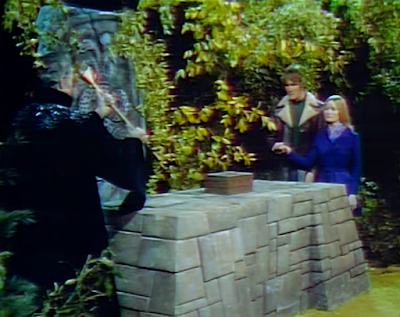

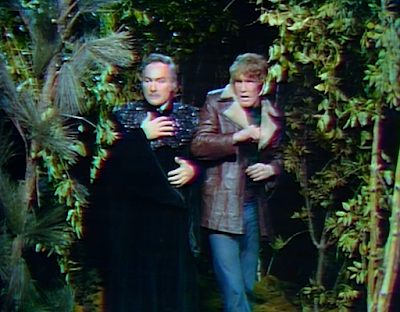
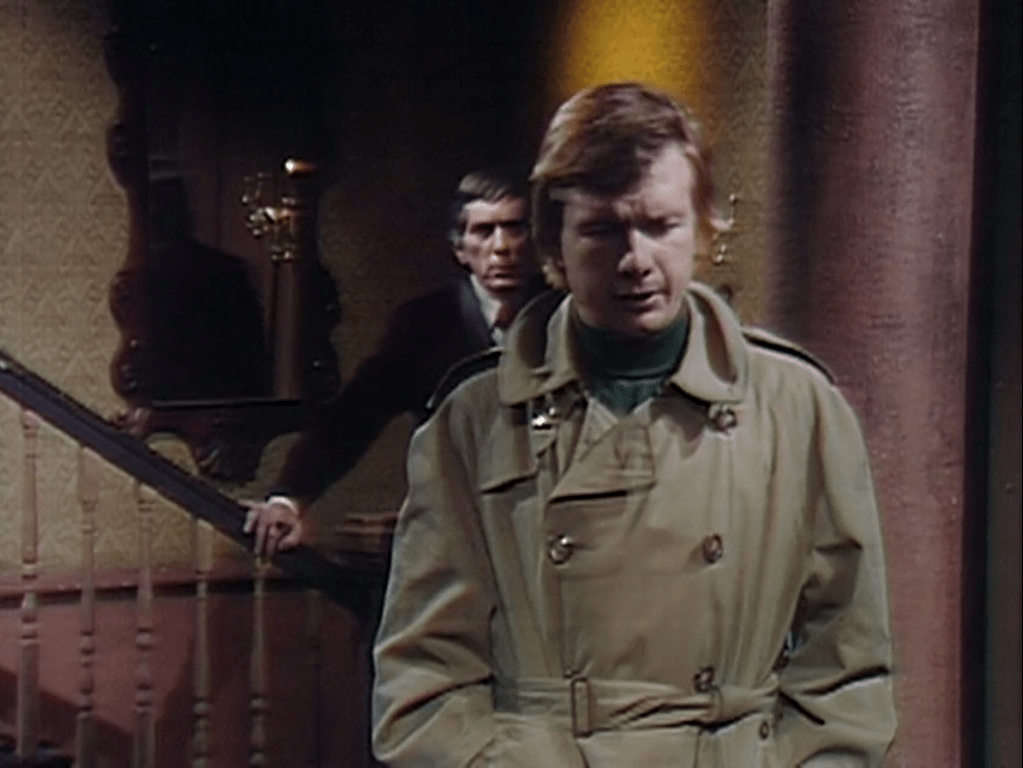
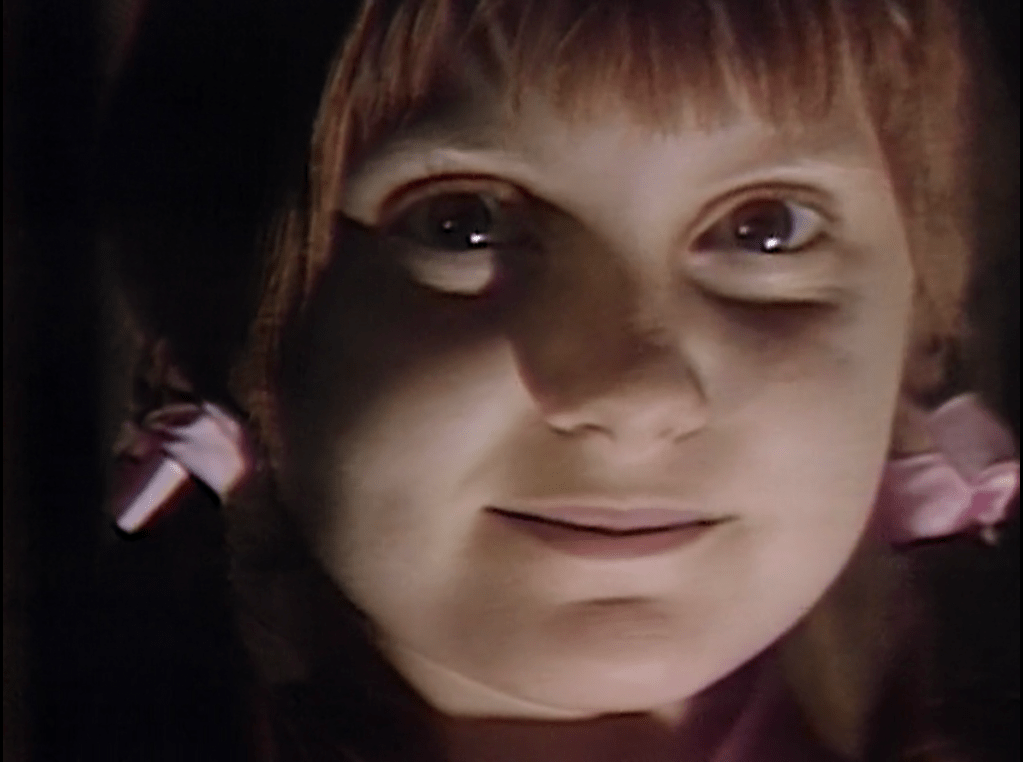
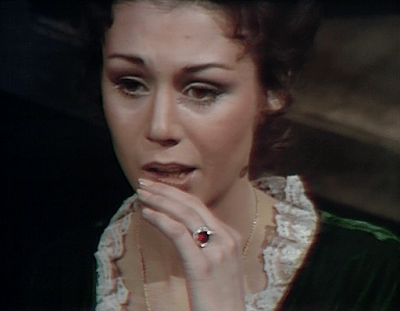
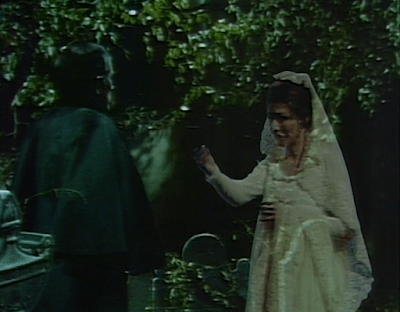
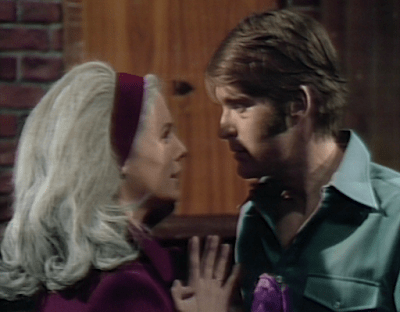


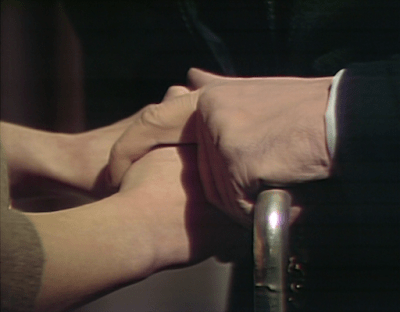
 Dark Shadows Commentary