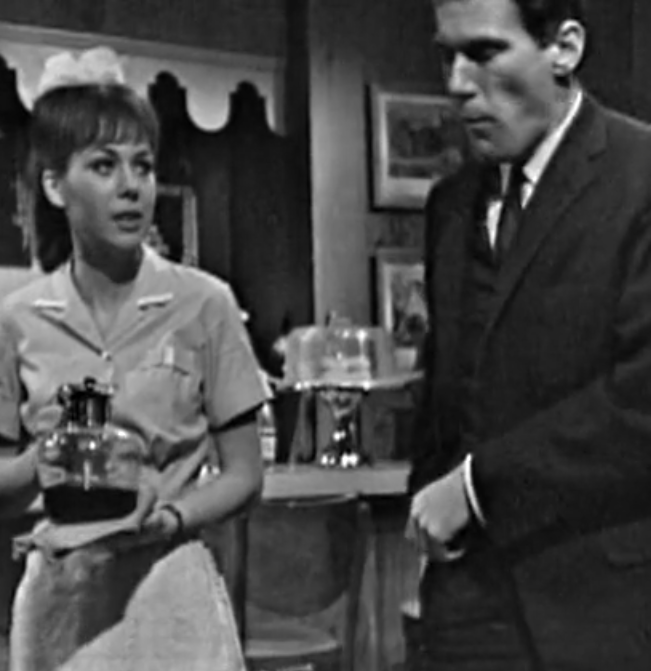
Episode 339: Even greater fool

This episode was taped during a National Association of Broadcast Engineers and Technicians strike. While the camera operators picketed outside, network executives and other amateurs were handling the equipment. It shows. As the episode begins, there is a lot of chatter and miscellaneous noise off camera; none of the shots is properly focused; each zoom shot moves at alarmingly fast pace; and at one point the camera swings wild. Dark Shadows was produced under such poor conditions that any one of those things might have made its way even into an episode made by trained professionals, but today is the single roughest cut yet.

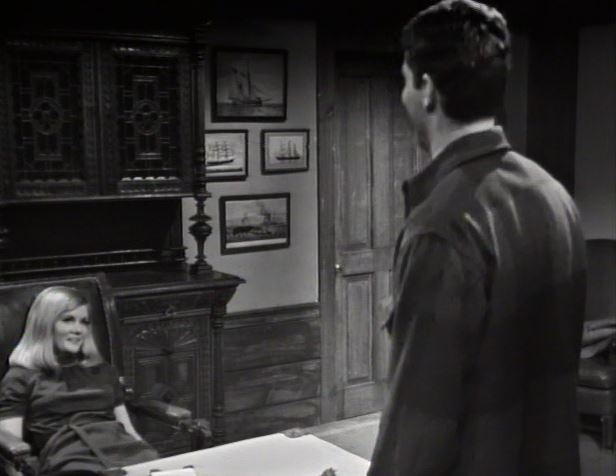
At least the technical incompetence of the suits has some funny results. That can’t be said of the work of the alleged actor scabbing in the role of Dr Dave Woodard. Robert Gerringer, who started playing Woodard in May, honored his union obligations and refused to cross the NABET picket line; the stooge replacing him is so monotonous in his delivery of dialogue and so undistinguished in his bodily movement that he is little more than a blank spot on the screen. Much of this episode is devoted to him rummaging around looking for some papers; it would take considerably more skill than non-Woodard ever displays to make that interesting to watch.

The actor is so dull that he ruins one of the major sources of suspense. We ought to be conflicted about Barnabas’ plan to kill Woodard, because while we want the story to advance and Barnabas to stay on the show, we don’t want the good guys to be killed. Moreover, Woodard is the only one now who fully understands and supports one of our favorite characters, strange and troubled boy David. We certainly shouldn’t want David to lose his only backer. But this guy is such a waste of screen space that it is fatally easy for us to root for the character’s death.

There are a few interesting moments scattered here and there in Ron Sproat’s script. Mad scientist Julia Hoffman tells vampire Barnabas Collins that she tried to quell Woodard’s suspicions by telling him Barnabas had a rare blood disease that she was trying to treat. In fact, Julia does believe that vampirism is a rare blood disease, and she is trying to cure Barnabas of it, so she wasn’t lying when she told him that. It’s always startling to find Julia resorting to the truth.

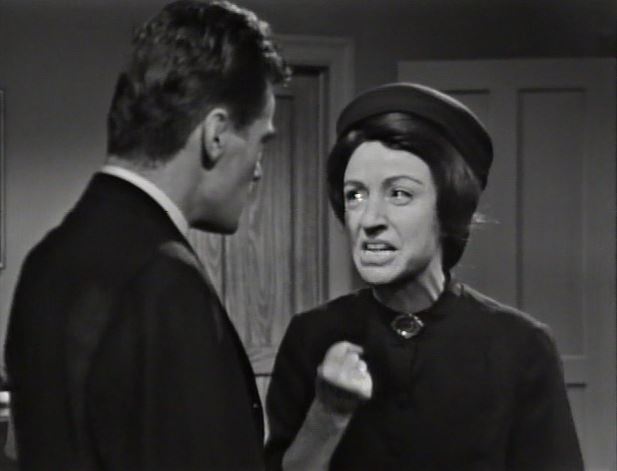
Julia also tells Barnabas that Woodard came up with an idea she has encouraged him to believe, that she is in love with Barnabas. Barnabas laughs at this notion, and Julia objects that it doesn’t seem so preposterous to her. An incredulous look on his face, Barnabas glances at her wig, then at her clothes. He has a point- it really does not look like an ensemble a woman would wear if she was into dudes.

Screenshot by Dark Shadows Before I Die.

Yesterday’s episode gave us several clues that Julia is in fact attracted to Barnabas. Today, she not only seems hurt when Barnabas laughs at the idea she might be falling for him, but she flashes a look of jealousy later when he says something extravagantly complimentary about well-meaning governess Vicki. As my wife, Mrs Acilius, pointed out, this makes it rather unsettling when Julia remarks that she had thought Barnabas was incapable of feeling any emotion, even fear. We know that Julia is a very strange person, but as we find out what she looks for in a partner we start to wonder just how strange she is.

Barnabas is bewildered by everything Julia says and does. When she says she is surprised that he is frightened by Woodard’s investigation into him, he says that of course he is frightened, as it could easily result in his extinction. When she goes on to say that she had thought him a totally unemotional being, he becomes for a moment the audience’s point of view character- he doesn’t say anything, just gives her a look as if she is completely nuts.

At the moment, Barnabas is especially vulnerable because Julia is keeping her notes on the experiment in a little box in her bedroom at the great house of Collinwood. That is an odd place for them. She presumably makes the notes while she is working in her laboratory in the basement of Barnabas’ house, and she consults them while she is there. The laboratory is well-hidden- Woodard and local man Burke Devlin searched the basement in #333, and found no trace of it. So it doesn’t make any sense to create another danger of exposure by keeping them anywhere but there. Of course Woodard sneaks into Julia’s room today and finds the notes.

Housekeeper Mrs Johnson is in this one, after fourteen and a half weeks away. In fact, it’s only her second appearance since #211, the episode in which she was the first character to exchange lines with Barnabas. It’s great to have her back, though of course it saddens me that Clarice Blackburn crossed a picket line.

Episode 266: The sea is my grave. My grave is the sea.

Reclusive matriarch Liz is despondent, and no wonder. For months and months, seagoing con man Jason McGuire has been blackmailing her. She hasn’t been able to resist any of his demands; today she tells him that “There is no point in not being agreeable.” She makes a great show of submissiveness towards him, asking his permission to leave the drawing room. They are scheduled to marry in a few days, much to the dismay of everyone except Jason.

In the pre-credit teaser, we see Liz’ dream that she is standing atop the high cliff on her property, looking at the rocks and the sea far below. The ghosts of the Widows who have jumped to their deaths from the cliff over the years are calling her name. The Widows were a big part of Dark Shadows‘ supernatural back-world in its first months, but this is the first we’ve seen or heard from them since #126. In her dream, they call her name and she tumbles headlong over the cliff.

The Widows appear in Liz’ dream. Screenshot by Dark Shadows Before I Die.

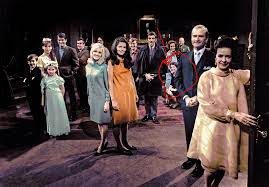
Liz mopes around the house during the day, then goes to the cliff. Housekeeper Mrs Johnson finds her there at nightfall. This is the first time in ten and a half weeks we have seen Mrs Johnson; I don’t usually give spoilers, but we won’t see her again for fourteen and a half more weeks. I suspect she was in this one just to be sure actress Clarice Blackburn would be in the studio when they were taking the cast photo I use as the header on this blog.

Was this photo taken the day this episode was shot?

Mrs Johnson mentions the Widows and tells Liz she doesn’t like hearing the legends about them. So Liz launches a detailed recounting of all of those legends. By the time Mrs Johnson is thoroughly uncomfortable, Liz starts to faint and pitch forward towards the edge of the cliff. Mrs Johnson rescues her, and walks her back to the house.

Liz goes back to bed and has the dream from the opening again. She gets up, opens the window, and tells the Widows she can hear them. As their voices travel in the wind, she repeats a catchphrase from one of the legends- “The sea is my grave. My grave is the sea.”

Episode 189: Doodling around

Yesterday, the group trying to keep blonde fire witch Laura Murdoch Collins from immolating her son, strange and troubled boy David Collins, agreed on a plan. Dashing action hero Burke Devlin would take David away very early in the morning on a trip to a fishing cabin far to the north, near the border between Maine and Canada. David’s father, high-born ne’er-do-well Roger Collins, would evict Laura from the cabin where she has been staying on the great estate of Collinwood. This plan was unsatisfactory to well-meaning governess Vicki, who believed that the time of greatest danger to David was before dawn. So she sat in David’s room overnight and watched him sleep.

Today, David wakes up after dawn and Vicki urges him to go back to sleep. When he stays up, they spend the morning on lessons. When Burke finally shows up around lunchtime, he announces that come evening he will be taking Vicki to dinner at the local tavern, the Blue Whale. Apparently the fishing trip to the cabin far to the north has somehow morphed into a couple of hours in the afternoon on a boat nearby. This is such a jarring break in continuity that Mrs Acilius and I wondered if the writer of today’s episode, Ron Sproat, just hasn’t been watching the show.

Vicki agrees to go out with Burke on condition that the housekeeper, the wildly indiscreet Mrs Johnson, keep David in her sight at all times. When Mrs Johnson was hired, David took it for granted she would be his “jailer.” He used that word with his aunt, reclusive matriarch Liz, in #77, and again with Burke in #79. Today, it turns out he was right. At one point, Mrs Johnson picks up a chair, sets it between David and the door, and plants herself in it to keep him from getting out. Sproat may not know what happened in yesterday’s script, but he does manage to set up an echo with what was going on five months ago.

Jailer

The scenes between David and Mrs Johnson start off with some chuckles. David Henesy and Clarice Blackburn were both talented comic actors, and while they establish themselves as a restless boy and his irritable babysitter they seem like they are about to be funny. But they just don’t have the lines to keep us laughing. By the time Mrs Johnson tells David that she’s tired of watching him “doodling around,” we know the feeling- doodling around is all Sproat has to offer today.

At the Blue Whale, Vicki is too worried about David to keep her mind on Burke. Burke keeps trying to calm her fears. He saw Laura get on a bus out of town in the morning, and according to Vicki’s analysis it was last night that David was in the greatest danger. She still isn’t convinced.

Hardworking young fisherman Joe shows up. He tells them that he had looked at the nineteenth-century newspaper clipping that led Vicki to believe it was last night that Laura would make her move. Laura Murdoch Radcliffe, whom Vicki believes to have been an earlier incarnation of Laura Murdoch Collins, burned herself and her son David to death one hundred years before. Re-reading it, Joe realized that it was ambiguous whether last night was the anniversary of that event or tonight will be. So he went to the hall of records, and found that it was in fact one hundred years ago tonight that the Radcliffes burned.

Vicki wants to rush back to Collinwood at once to check on David. Burke suggests she telephone first and ask Mrs Johnson if he is all right. Vicki agrees.

This is one of the “Dumb Vicki” moments the writers make a disastrous habit of falling back on. When they can’t think of an interesting or even plausible way to get from one story point to the next, they have a character do something inexplicably stupid. Since Vicki is on screen more than anyone else, she is usually the Designated Dum-Dum.

At this point in the series, the only telephones in the great house of Collinwood are downstairs, one in the foyer, the other in the drawing room. Vicki has been living in the house since June, so she ought to know where the telephones are by now. Since David’s room is upstairs, the only way Mrs Johnson can answer a call is by leaving him unattended. Vicki knows that Laura’s power is so strong that she can do all sorts of bizarre things given a few seconds; it makes no sense at all that she accedes to Burke’s suggestion and gives Laura those seconds.

Mrs Johnson is reluctant to leave David alone, but he seems to be getting ready for bed. So she rushes down to get the phone. When Vicki asks her about David, she rushes back upstairs and finds that he has gone missing.

There are a couple of firsts in this episode. Burke has been trying to take Vicki out to dinner since the beginning of the series. They’ve had several near-misses, but this is the first time he buys a meal that she actually eats.

Burke first met Joe in #3, and within minutes he’d alienated him with an offer of a bribe. Joe found further reasons to dislike Burke as time went on. Those reasons have dissipated, and so today is the first time Joe greets cheerfully Burke and calls him by his first name. Joe and Burke were never particularly important to each other and there is no reason to expect they will become so now, but earlier this week we did see Burke and Roger, whose mutual hatred is a major theme in the show, act like friends for a little while. If Burke and Joe can make up, we might wonder if Burke and Roger’s brief détente might also point the way to some kind of reconciliation.

Episode 172: The sound of fire

Friday, Dark Shadows showed us its first séance. Yesterday, the people who attended that séance tried to figure out what it meant. Today, word of the séance starts to get out to people who weren’t there.

These three episodes also involve wrapping up a lot of loose ends that only people who watched the show from the beginning will remember. Friday’s episode harked back to the ghostly image we saw in #30. Yesterday’s episode drew a line under the alarmingly inappropriate crush flighty heiress Carolyn had on her Uncle Roger in the first few weeks of the show. Today, dashing action hero Burke Devlin shows that he is still laboring under a misunderstanding that led him to a dead end in #89 and #99.

In those episodes, Burke was trying to take his revenge on the ancient and esteemed Collins family by hiring the most valued employees away from their cannery. He was confident he would succeed in this plan because he had more money than the Collinses. In #89, he explained that confidence to his lawyer with a bunch of cliches rich guys use when they are villains in old movies: “Money talks. Money buys loyalty. Everyone has their price. Name it and you can buy them. Some just come a little higher than others, that’s all, but everyone is for sale.”

Those men all rebuffed Burke’s offer, as hardworking young fisherman Joe had refused Burke’s attempt to buy his loyalty in #3. Burke believes that the Collinses’ power comes from their money. His failures suggest that it is more nearly the other way around. The Collinses dominate the town of Collinsport because the population is so much in the habit of deferring to them that they can’t really imagine any other way of life. Simply by living in town, they have been indoctrinated into an ideology that puts the Collinses at the center of everything. Though from the perspective of the outside world Burke may have come back to town as a representative of high finance and large-scale capitalism, in the eyes of the locals he might as well be trying to start a communist revolution.

The one Collinsport resident who has agreed to take Burke’s money as payment for working against the Collinses is Mrs Johnson. For many years, Mrs Johnson had been the faithful housekeeper to cannery manager Bill Malloy. In her first appearances, Mrs Johnson talked of her unrequited love for Bill and her conviction that the Collinses were responsible for his death. Wanting revenge on them, she agreed to Burke’s plan to take a job as housekeeper at Collinwood and to give him whatever information she could gather. He has been paying her ever since.

Today, Mrs Johnson comes to Burke’s room and announces she has some information she would give him even if he weren’t paying her. This remark will strike regular viewers as absurd. Those who remember Mrs Johnson’s early appearances know that her motivation for joining with Burke was not his money, but her drive for vengeance. Those who have seen her since, including earlier in this episode, know that she always tells everyone she meets everything she knows. Her usual conversational gambit is to declare “I mind my own business, and expect others to do the same!” and then divulge the entire contents of her awareness, including everything she learned by her incessant eavesdropping on everyone in the house.  

In Mrs Johnson’s case, Burke is overlooking not only the power of ideology, but also the persistence of personal habits. Mrs Johnson not only does not need to be paid to give information; no amount of money could keep her from giving information. She can’t be incentivized out of telling too much, because she doesn’t know that she is doing it. She is perfectly sincere when she says “I mind my business!” or “I’m not a gossip!” or makes any of her other usual protestations.

One thing Burke and Mrs Johnson have in common is a tender regard for well-meaning governess Vicki. The séance was very hard on Vicki, because her body was the scene of a battle between the ghost of Josette Collins and blonde fire witch Laura. Josette had possessed Vicki in order to warn the company about Laura, but Laura used her own powers to drive Josette from Vicki before she could say her name. Now Vicki is spending the day sick in bed. After talking with Burke, Mrs Johnson goes back to Collinwood and takes it upon herself to keep anyone from bothering Vicki.

The first person to try to see Vicki is visiting parapsychologist Dr Guthrie. Mrs Johnson stands on the stairs and forbids him to go up. He tries to persuade her that, as a doctor, he might be able to help. She responds that the only way he will get to Vicki’s room is by knocking her down and walking over her. At that, he gives up and goes to the drawing room.

Keeping Guthrie at bay

Laura then comes to the house and tries to see Vicki. Mrs Johnson takes exactly the same line with her. Laura is more aggressive than Guthrie had been, and tries to walk past Mrs Johnson. Mrs Johnson puts her arm in the way to physically block her. Laura too gives up and goes to the drawing room.

Keeping Laura at bay

There, she finds Dr Guthrie listening to the audiotape he made of the séance and taking notes. We hear Vicki’s voice desperately muttering about “le tombeau vide” before he sees Laura and shuts the player off. He explains that he does not want anyone who was at the séance to hear the recording, as he does not want it to color their recollections.

Laura and Guthrie talk about the tape recorder and about his use of electronic devices in his work as a scientist. Not even actors as capable as Diana Millay and John Lasell can make this dialogue seem to have much point. But a few weeks ago, friend of the blog Courtley Manor called my attention to a 1957 novel for children, David and the Phoenix, by Edward Ormondroyd. I think there is a reference to that book in this scene.

Ormondroyd’s David is a preteen boy who climbs a mountain and finds himself in a magical realm where he comes face to face with the Phoenix. The Phoenix is initially guarded with David, but relaxes when David says that he doesn’t know any scientists. Evidently the Phoenix’ great goal is to be left alone, and scientists were to learn that there really was such a bird as the Phoenix that goal would forever pass out of reach.

Some of the similarities between Dark Shadows’ “Phoenix” storyline and David and the Phoenix may be the result of common source material. In #140, Laura tells David that her real home is a magical world that sounds quite a bit like the place Ormondroyd’s David stumbles upon. But from the 1930s through the 1960s, the legends of the Holy Grail were a staple of university English departments in the USA, and many of those associate the Phoenix with just such places. So it could be that both Edward Ormondroyd and Malcolm Marmorstein had read Wolfram of Eschenbach or someone like him. And “David” was an extremely common name for boys born in the USA in the 1940s and 1950s, so that could be a coincidence.

But when The Scientist appears in Ormondroyd’s book and emerges as the great enemy of the Phoenix, Ormondroyd presents The Scientist in terms of his equipment. He must wait for his equipment to arrive before he can act against the Phoenix, he puts a great deal of effort into transporting his equipment and setting it up, and he suffers his climactic defeat when the Phoenix sabotages his equipment. So readers of Ormondroyd’s book would have to see a nod to it in this conversation between Guthrie the Scientist and Laura the Phoenix.

After Laura has left, Guthrie calls urgently to Mrs Johnson. He asks her if she touched the tape recorder. She tells him she wouldn’t touch the machine with a ten-foot pole. He plays the tape back, and shows that the sounds of the séance have been replaced with the sounds of a crackling fire. Ormondroyd’s readers will remember that The Scientist did not give up after the Phoenix destroyed his equipment, and will expect Guthrie to try to find new ways to fight Laura.

When we heard the crackling on the tape, Mrs Acilius jokingly asked me when the show was made. “This was before Watergate, right?” Yes, indeed; Dark Shadows was not making a reference to the 18 1/2 minute gap in the Nixon tapes. While the consensus among scholars today is that that gap was caused accidentally, it is amusing to imagine that someone in the White House in those days was a Dark Shadows fan and took a page from Laura’s book. I guess the president’s daughter Tricia was into the show for a while, but even if the erasure were deliberate she wouldn’t have been a very likely suspect.

Episode 155: Around her little finger

We open in the hotel suite occupied by dashing action hero Burke Devlin. Burke is getting a briefing from a paid agent of his whom he placed in the home of his enemies, the ancient and esteemed Collins family. This agent is wildly indiscreet housekeeper Mrs Johnson.

Mrs Johnson has come to report on a conversation between high-born ne’er-do-well Roger Collins and Roger’s estranged wife, the mysterious and long-absent Laura. Mrs Johnson overheard Laura telling Roger that she is keeping Burke pacified by pretending that she will testify on his behalf in a retrial of a long-ago criminal case. When Mrs Johnson relays this to Burke, he flies into a rage. He demands to know who is paying her to defame Laura. Mrs Johnson stands up to his abuse, and he apologizes.

Mitch Ryan and Clarice Blackburn were outstanding actors, and it’s always fun to see them play a scene together. But this doesn’t really make much sense. Whatever Laura’s plans, it is hardly likely that she would advance them by telling Roger that she is going to side with Burke. Since this is a conversation Burke is having with a secret agent in his employ, the audience would expect him to understand deception.

Meanwhile, Laura is in the cottage where she is staying on the grounds of the great estate of Collinwood. She has a visitor- her son, strange and troubled boy David. The head of the Collins family, reclusive matriarch Liz, has forbidden Laura to see David and ordered her to leave the estate. Laura repeatedly urges David to keep his visit to her a secret. She gives him a music box, reminding him to hide it from everyone in the great house.

Moments after David gets home, Liz catches him with the music box. She recognizes it as Laura’s and scolds him for visiting her. She tries to explain why he can’t see his mother. David takes this badly, shouting at her that he doesn’t love her. When she objects that this is a terrible thing to say, he tells her he hates her.

Liz sets out for Laura’s cottage. Laura is there, but she is not alone. Burke has come to ask about the conversation Mrs Johnson overheard. Several days ago, Burke had asked her about her relations with Roger, naming well-meaning governess Vicki as his source. Today, Laura asks if Vicki has been talking again. Thoughtlessly, Burke won’t answer, further convincing Laura that Vicki is her enemy.

Laura starts crying. Burke’s anger evaporates. He embraces her and kisses her. At that moment, Liz enters.

Burke, whom we first saw today in his role as spymaster, tells Liz he’s glad that happened because he likes to have everything out in the open. Liz, who has sealed up most of her house and hasn’t left the estate in eighteen years because she is trying to cover up some hideous secret, says that she also likes that. Burke leaves.

Liz demands Laura leave the estate no later than tomorrow morning, and vows that she will never have custody of David. Laura says that no power on earth can keep her from her son, and tells Liz she will learn to her cost what she is capable of.

Back in the house, Laura’s face is superimposed over the screen as Liz grows faint. Liz starts climbing the stairs. She calls for help, naming Roger and well-meaning governess Vicki. We see her start to fall. Then we see her sprawled at the bottom of the stairs.

Liz under Laura’s spell. Screenshot by Dark Shadows Before I Die

The process shot makes it clear that Laura is using witchcraft to control Liz. Burke’s behavior is also uncharacteristic, but it is an open question whether it is the result of Laura casting a magic spell on him, of his own emotions leading him to make a fool of himself, or of sloppy work on the part of the writers.

Episode 135: No one is being kind

Mysterious and long-absent Laura Collins has returned to the great house of Collinwood, seeking custody of her son, strange and troubled boy David, and a divorce from her husband, high-born ne’er-do-well Roger. Roger is enthusiastic about this plan, but David’s attitude has shifted from eagerness to see his mother to the terrified belief that the person who has come to the house is not his mother, and that if he becomes close to her something terrible will happen.

These episodes are loaded with hints that there is something very strange about Laura. When Laura was due to visit the house yesterday, David thought he saw her appear on the lawn and then vanish, an idea Liz dismissed instantly and Roger took as evidence of his great desire to see her. David did indeed want to see Laura at that time; when she came into the house, he was afraid of her. Coupled with other indications that there is something supernatural about Laura and with David’s history of sensitivity to eerie happenings, these disparate reactions might lead us to wonder if there are two of her- a ghost who flickers on the lawn, and a corporeal being who comes inside and carries on conversations.

We have seen Laura at the restaurant in the Collinsport Inn several times; the restaurant’s keeper, Maggie Evans, mentions that Laura never eats or drinks. On Wednesday, Laura’s ex-boyfriend, dashing action hero Burke Devlin, tells her that she seems profoundly different than she had been when they knew each other before. Yesterday, reclusive matriarch Liz told her that her personality had undergone a radical change. She is obsessed with fire* and with the legend of the Phoenix, suggesting that her radical change may have something to do with that myth. Maggie’s father, drunken artist Sam Evans, is possessed by an otherworldly power marked by theremin music on the soundtrack and paints a woman in flames, apparently a consequence of something Laura’s presence has stirred up in town.

Today, we have further suggestions that Laura is not simply a physical entity. She tells flighty heiress Carolyn that although she has been staying at the inn for several days, she has not unpacked her bags. Carolyn looks at Laura’s crisp outfit and flawless makeup and is bewildered by this remark. Laura also explains that a taxi brought her to the house from the Inn and that it is scheduled to return. When she decides not to leave, she tells Carolyn that she will call to cancel the return trip, but when Carolyn leaves her alone Laura turns away from the telephone- evidently there never was a taxi. When well-meaning governess Vicki takes the several mile walk between town and the house, she is wearing the soap opera version of a sensible walking outfit. The style-conscious Carolyn is the perfect person to highlight the improbability that Laura took such a hike looking the way she does.

Laura and Carolyn in the cottage. Screenshot by Dark Shadows Before I Die

Laura will be staying at the cottage at Collinwood. This has been established as an important location, and we’ve been waiting for someone to move into it since its previous occupant, gruff caretaker Matthew, confessed to Vicki that he had killed beloved local man Bill Malloy, had then tried to kill Vicki, and had become a fugitive. Carolyn mentions that Collinwood’s housekeeper, Mrs Johnson, had cleaned the cottage up when Matthew died, but that it needs another cleaning. I found this to be rather a poignant touch. Mrs Johnson had for many years been Bill Malloy’s housekeeper, and was intensely devoted to him. It was quite insensitive to ask her to clean the home of Bill’s killer, and it is quite reasonable that she did not do a particularly thorough job.

*I can’t resist mentioning that Mrs Acilius and I watched this episode while staying in a hotel. I don’t know if this was a consequence of Diana Millay’s performance as Laura, but we had to pause it about halfway in when a fire alarm went off in the building.

Episode 98: My part of the bargain

A woman named Mrs Johnson joins the domestic staff of the great house of Collinwood. After reclusive matriarch Liz has sat with her in the drawing room for a few minutes, Mrs Johnson rises to begin her duties. Liz asks her to wait, and stammeringly warns her that some members of the household may seem unfriendly at first. She isn’t to take notice of that- they simply need time to get used to having a new person around when they have been so isolated for so long. Mrs Johnson takes this warning in stride, and again thinks she has been dismissed. But a second time Liz asks her to wait. She tells Mrs Johnson that she needn’t go into the closed-off portions of the house,* and particularly emphasizes that she wants her to stay out of the basement.

Liz’ nephew, strange and troubled boy David Collins, is not at all happy with Mrs Johnson’s accession to the household establishment. When his aunt begins to introduce them, David cuts her off, saying that he had met Mrs Johnson in the restaurant at the Collinsport Inn. He asks Mrs Johnson why she wants to work in the house. His level tone shocks his aunt. She takes David into the drawing room while Mrs Johnson goes upstairs.

When Liz reproves him for rudeness, David asks if he will have to apologize to Mrs Johnson again. He explains that the Collins family’s arch-nemesis, dashing action hero Burke Devlin, had made him apologize to Mrs Johnson in the restaurant after he yelled at her to “Shut up!” Liz says that for once Burke did the right thing. David then asks if Mrs Johnson is going to be his jailer. Liz asks him where he got such an idea. David starts talking about ghosts, and Liz can’t take it anymore. She tells him to go. He complies, still eerily calm.

In the next scene, we’re back in the drawing room. Gruff caretaker Matthew is working in the fireplace. David sneaks up behind Matthew and startles him. He asks Matthew what he’s scared of- is it ghosts? Matthew says he doesn’t talk about such things. David keeps needling him. Matthew gets more and more agitated, David stays absolutely in control of himself.

Mrs Johnson comes in with a ham sandwich and a glass of milk on a tray. She tells David she’s been looking all over the house for him. He protests that he doesn’t take his meals on a tray, but in the kitchen. When Matthew warns him not to make a mess, he gladly sits down on the couch and takes hold of the sandwich. Matthew sulks away.

Mrs Johnson wheedles David into talking about the closed-off rooms of the house. She asks him what he sees there. He asks if she believes in ghosts. She says she doesn’t. He says, again in the blandest possible voice, “You will.”

Matthew returns in time to hear Mrs Johnson encouraging David to describe the closed-off rooms. He sends David to the kitchen with his tray, and scolds Mrs Johnson for asking questions about matters Liz doesn’t want anyone looking into.

When the clock strikes 3 AM, Mrs Johnson shines a flashlight directly into the camera. She is inspecting the basement. She tries the door to the locked room. She can’t open it, but looks into whatever she can. Suddenly, something grabs her from the darkness. She looks down, and sees David’s complacent grin.

Cheshire cat

Mrs Johnson tells David she came down to investigate a noise. That doesn’t impress David, perhaps because it doesn’t explain why she was opening drawers and cigar boxes. For his part, he tells her that he’s there waiting to see a ghost.

David tells Mrs Johnson that his aunt will be very upset if he finds out she was in the basement. She tries to bluster her way out of trouble, but David tells her not to worry- he won’t tell. She asks why not. Because, he says, she’s a friend of Burke Devlin. She denies being Burke’s friend. He says she must be- otherwise, when she publicly accused Burke of causing the death of beloved local man Bill Malloy, he would have been angry. Burke’s mildness persuaded David that the accusation was a little drama the two of them were acting out. Returning viewers have seen enough of Burke’s temper to know how David came up with his premises, and those who saw episode 79 know that his conclusion is true.

David goes on to say that he thinks Burke must have sent Mrs Johnson to the house to spy on his father, high-born ne’er-do-well Roger Collins. This is also true. Before she can try to deny it, David says that he is all for this mission, because he hates his father and hopes he dies. Mrs Johnson is shocked, both by the words and by the altogether relaxed demeanor with which David speaks them. She must never have met a nine year old sociopath before.

Mrs Johnson resumes her bluster. David assures her that he won’t tell Liz he saw her if she doesn’t tell that she saw him. He goes upstairs, disappointed that he missed seeing the ghost. Mrs Johnson stays downstairs, and after a moment hears a woman sobbing inside the locked room. She tries the door again- it is covered with cobwebs, and obviously hasn’t been opened in a very long time. She knocks, and the sobbing desists.

We’ve heard the sobbing woman before. She drew well-meaning governess Vicki to the basement in the first week of the show, and when Matthew found Vicki down there he rebuked her fiercely and reported to Liz that he caught her “snoopin’ around,” the supreme evil in Matthew’s moral universe. When Liz talked to Vicki about the incident, she amazed Vicki by denying that she had heard any sobbing. Eventually, Vicki forced Roger to admit that he had heard the sobbing many times over the years, and that he had no idea what it was. The reappearance of the sobbing woman promises a resolution to a long-standing mystery.

*Several times in the episode, Mrs Johnson mentions the disused “east wing” of Collinwood. We’ve heard a good deal about a closed-off west wing, and it will be years before the show confirms that there is also an east wing. So “east wing” is probably a blooper today. But it is clear that the house has multiple closed-off sections, and in episode 84 there is a distinct suggestion of a sealed east wing. So if it is a blooper, it is a felicitous one.

Episode 81: I’m not a gossip

We spend today, not so much with the ancient and esteemed Collins family, but with two of the three members of their household staff. Gruff caretaker Matthew Morgan goes into town so that he can scowl at the family’s nemesis, dashing action hero Burke Devlin. Mrs Sarah Johnson goes to the great house of Collinwood to interview for the position of housekeeper.

During the interview, Mrs Johnson tells reclusive matriarch Liz that “I’m not a gossip.” This will become a frequent refrain of hers in the years to come, and will usually serve as a preface to remarks in which she will blab the entire contents of her mind to anyone who will listen. This time, “I’m not a gossip” is followed immediately by her assertion that in all her years as housekeeper to beloved local man Bill Malloy, she never repeated a word she heard spoken in his house to anyone. It seems to be news to Liz that Bill had ever spoken any words he would want to have kept in confidence. It’s certainly news to the audience. All we’ve heard up to this point was that Bill’s whole life was absorbed in his work. Mrs Johnson set me wondering what we might yet learn about Bill.

Matthew drives Mrs Johnson back to town. He sits down with her as she prepares to have lunch at the restaurant in the Collinsport Inn. Matthew tries to persuade her she would be better off moving in with her daughter than taking a job at Collinwood. He tells her that Collinwood is in fact haunted, and that if she isn’t afraid of its ghosts she ought to be. She is unconvinced.

Screenshot by Dark Shadows Before I Die

Matthew gets a great deal of emphasis in this episode. There are two location inserts featuring him- when he walks through downtown Collinsport to the Collinsport Inn, and when the taxi carrying Mrs Johnson pulls up to the outside of the house and we see him trimming bushes. Exterior footage is never commonplace in Dark Shadows, and when we see a character moving around outdoors it’s a sign of something important.

Matthew in town
Matthew sees the taxi

Unknown to Matthew or Liz, Mrs Johnson is in fact convinced that Liz’ brother, high-born ne’er-do-well Roger, is responsible for Bill’s death and that Liz is protecting him. She wants to become housekeeper at Collinwood so she can spy on the Collinses for Burke.

After Matthew leaves the restaurant, Mrs Johnson reports to Burke on her interview with Liz. He is dissatisfied with her work as a secret agent. He berates her, as we had seen him berate his henchmen in earlier episodes. They had submitted to his rantings meekly. Mrs Johnson snaps at him, and gets an apology. Evidently we are supposed to expect that she will be a strong character in her own right, not a mere cat’s paw for Burke.

This is the first of many episodes that survives only on kinescope. This has some happy effects. For example, the footage of Matthew walking in downtown Collinsport is preceded by a shot of him going out the front door of the great house. The kinescope’s poorer resolution makes this set look like very much like an outdoor shot itself.

CORRECTION: It turns out this isn’t a kinescope, just a particularly crummy videotape. There’s a kinescope coming up later this week, though.

Matthew leaves the house

Episode 69: I believe in signs and omens

Mrs Sarah Johnson, longtime housekeeper to the late Bill Malloy, shows up in the hotel room of dashing action hero Burke Devlin. She tells Burke that she believes his enemy, high-born ne’er-do-well Roger Collins, killed Bill. Her principal evidence for this is the fact that Bill’s body washed ashore near Roger’s home on the estate of Collinwood, and “I believe in signs and omens!”

Mrs Johnson believing in signs and omens. Screenshot by Dark Shadows from the Beginning

This line is a bit of an omen itself- Clarice Blackburn will be an important part of the show, not only as Mrs Johnson, but as other characters who believe in signs and omens, and who make things happen in the name of that belief.

Meanwhile, hardworking young fisherman turned hardworking young clerk Joe Haskell is called into Roger’s office at the cannery. There, he finds flighty heiress Carolyn behind her uncle’s desk, looking seductive, or at least highly available.

Carolyn coming on to Joe. Screenshot by Dark Shadows from the Beginning

Nancy Barrett’s way of throwing herself completely into whatever her character is supposed to be doing at any given moment sometimes makes Carolyn seem even more scattered than her persona as Flighty Heiress required, but it does come in handy when the character is supposed to be sexy. That makes her stand out- even by the standards of an American television show of the 1960s, Dark Shadows is remarkably un-sultry. Sometimes it’s a marvel that they can put so many good-looking young people in close proximity to each other and still project an image of total chastity.

Joe and Carolyn kiss, and she asks him to go away with her. He tells her that he can’t just leave work in the middle of the day. She explains that she is troubled by the doings of Joe’s bête noire, Burke. This leads to a lively conversation, which in turn leads Carolyn to resume her attempts to persuade Joe to take the rest of the day off. When Joe’s boss calls for him, she offers to use her clout as the owner’s daughter to persuade him to let Joe go. He won’t let her do this. She leaves, frustrated by his refusal.

Back at the hotel, Burke and Mrs Johnson are devising a plan in which she will get a job at Collinwood and act as a secret agent for him. We get a glimpse of Burke’s persuasive abilities. When Mrs Johnson is showing reluctance to follow his plan, Burke mentions that well-meaning governess Vicki has given Roger an alibi. She immediately declares that Vicki is lying. Burke won’t agree, leading her to demand that he set aside his personal feelings and devote himself wholeheartedly to making the case against Roger. Not only does the audience see Burke showing kindly feelings towards Vicki, keeping the idea alive that they might become a couple, but we also see Mrs Johnson commit herself to going along with Burke’s plan. Whatever Burke’s actual feelings for Vicki, his emotional display at this moment is timed to lock Mrs Johnson into doing what he wants.

There is a knock on the door. It’s Carolyn. Mrs Johnson hides in Burke’s kitchen and listens as he gives Carolyn the idea of hiring her as housekeeper at Collinwood. This isn’t very hard- Burke simply mentions that Mrs Johnson needs a job, and Carolyn at once says that she will tell her mother to hire her as housekeeper at Collinwood. Even so, Burke’s skillful handling of Mrs Johnson is so fresh in our minds that we don’t need to see him actually do anything to enlist Carolyn in his scheme for this scene to reinforce his image as master manipulator.

Mrs Johnson listens in. Screenshot by Dark Shadows from the Beginning

The sight of Mrs Johnson lurking in the shadows, eavesdropping on Burke and Carolyn, further reinforces this image. A guileless woman comes into his room proclaiming her every thought at the top of her lungs, as she had done when she was introduced at the sheriff’s office in episode 67. We can hardly imagine so straightforward a personality becoming an effective undercover operative Yet within minutes of meeting Burke, he has her working as a spy.

Writer Francis Swann is credited with the script for today’s episode. He is particularly good with installments that, like this one, have only four characters. Swann’s ability to slip substantial amounts of plot exposition into natural-sounding dialogue makes a minimalist drama seem busy. In this one, it also helps us to feel that we have seen Burke perform great feats of persuasion. Burke may not have had to work very hard to plant ideas in the minds of Carolyn and Mrs Johnson, but we are aware that the scripted dialogue has planted ideas in our minds, and know that someone on the other side of the screen is good at subtle communication.

Swann and director Lela Swift also make effective use of the sets in today’s episode. This is our first look at the kitchen in Burke’s room. He’s gone in and out of there several times, most notably in episode 29 when he prepared a nonalcoholic mixed drink, the “Burke Devlin Special,” for Roger’s son, problem child David. Regular viewers might have started to wonder what it might look like, and might pay close attention when we get our first look at it. What we do see is a complex pattern of shadows that signals Mrs Johnson’s initiation into the world of film noir.

In today’s scenes with Carolyn and Joe, we spend as much time in Roger’s office as we have in any other episode. It’s the only part of the Collins’ business location we see, standing in for the whole enterprise. Played on that set, Carolyn’s flippant attitude towards Joe’s job and his mixed feelings about the demands she makes lead us to wonder if she’s going to wreck the whole business. Her persistent friendliness towards family nemesis Burke gives substance to that thought. Regular viewers will remember that Roger’s self-indulgent behavior nearly annihilated the business; seeing his favorite niece play-act as him in his office leads us to wonder if she will finish the job.

Episode 67: I was fresh out of arsenic

This one belongs to Maggie Evans, the nicest girl in town. We open with her doing some work in the restaurant she runs. She isn’t feeling so nice today- dashing action hero Burke Devlin has accused her father, drunken artist Sam Evans, of various crimes, including the murder of beloved local man Bill Malloy. When flighty heiress Carolyn comes into the restaurant, Maggie tells her that it might be a good idea to flavor Burke’s coffee with rat poison.

Burke does show up. When he complains about the coffee, Maggie picks up on the idea she had floated to Carolyn and apologizes for not adding arsenic.

Maggie apologizing to Burke for failing to give him arsenic
No arsenic today, sorry

Not that she’s going to let her father off without a piece of her mind. When he comes in and tells her some lies, she discards her usual adult-child-of-an-alcoholic manner of exaggerated patience and calmly asks him if he minds that she doesn’t believe him. He mumbles that there’s no reason why she should.

The sheriff comes into the restaurant to ask Maggie if she can confirm her father’s whereabouts at the time of Bill’s death. She gives him a sarcastic answer. When he asks what she is prepared to swear to on the witness stand, she makes it clear that she will swear to whatever she damn well pleases. Sam then tells the sheriff that Maggie doesn’t actually know where he was that night. At that, she declares that Sam has no idea what she does or doesn’t know. If she wants to perjure herself, it will take more than Sam and the sheriff to stop her.

In the sheriff’s office, we meet Mrs Sarah Johnson, housekeeper to the late Bill Malloy. Mrs Johnson is furious with the Collinses, the family in the big dark house on the hill who own half the town. She more or less blames them for Bill’s death. She very much blames them for his life, which he spent doing nothing but working for their interests. Mrs Johnson is even more indignant than Maggie, but the only person she interacts with is the sheriff. So we have a contrast between a character who gives us several distinct shades of outrage, one for each person she puts in their place, and another who spends her time bringing one specific shade of anger into perfect focus.

In between there’s a scene with Sam and the sheriff, and at the end one between Carolyn and Burke. These offset the studies in indignation from Maggie and Mrs Johnson, both giving the audience a bit of a breather and giving their fiery turns time to sink in.

Miscellaneous:

There’s a moment when the sheriff goes to the water cooler and finds the paper cup dispenser empty. He apologizes that he can’t offer Mrs Johnson a drink. All the websites list this as a production fault, but I’m not sure- it goes on for a while, longer than I imagine it would if he were actually drawing two drinks of water and giving her one, and the timing doesn’t seem off afterward. I don’t know if it was in the script- I suppose they might have noticed they were out of cups and improvised the scene before or during dress rehearsal. At any rate, I don’t think actor Dana Elcar was actually surprised by the absence of cups during the taping.

This episode was recorded on the Sunday before it aired. The Dark Shadows wiki quotes Kathryn Leigh Scott (Maggie) explaining that this was because one of her fellow cast members had shown up drunk on the day they were originally supposed to record it. Mitchell Ryan and David Ford both have important parts in it, and they were both alcoholics. After he stopped drinking, Ryan admitted that he showed up on the set of Dark Shadows drunk on more than one occasion. Ford never stopped drinking, and booze was apparently part of the reason he died in 1983 at the age of 57. Also, while Ryan and Ford are the two actors in this period of the show who usually have the most trouble with their lines, they are both nearly letter-perfect today, as if they had been in trouble and knew they had to be good boys or else. So it could have been either of them.

Clarice Blackburn joins the cast as Mrs Johnson today. As Mrs Johnson, Blackburn will be crucial at certain moments in the years ahead, and she will also be cast as other important characters in the later run of the show. When Mrs Johnson was cast, Blackburn was told to model her on Judith Anderson’s performance as Mrs Danvers, the frightening housekeeper in Hitchcock’s Rebecca. That instruction didn’t last very long, and when four years later they actually got round to including an homage to Rebecca, Blackburn didn’t play the Mrs Danvers part.

On his blog Dark Shadows from the Beginning, Marc Masse develops a theory that set designer Sy Tomashoff was influential in casting Dark Shadows. He focuses on a guest spot Clarice Blackburn had on an earlier series where Tomasheff did the sets, a primetime show called East Side, West Side:

The version of Mrs. Johnson we see today in episode 67 is based on an even earlier role as Gert Keller in the critically acclaimed but greatly overlooked groundbreaking series East Side, West Side, in a 1964 episode called The Givers. Perhaps the biggest surprise to those not familiar with the series would be its leading actor, featuring George C. Scott as a… social worker.

It should be noted that both of these earlier productions had Dark Shadows scenic designer Sy Tomashoff as the “art director”; in the East Side, West Side episode The Givers, the cast list even featured Bert Convy, the original early choice for casting as Barnabas Collins on Dark Shadows. Tomashoff held the same production role in For the People. Both of these series are notable for a good many cast member crossovers with Dark Shadows, often several in a single given episode; and because Sy Tomashoff worked so closely with executive producer Dan Curtis on Dark Shadows, it is likely that he played a significant part in a number of the key casting decisions in the early days of Dark Shadows.

Especially curious as noted in the introduction to today’s post is how Mrs. Johnson comes across as the grieving widow, indicating that she may have been more than just a housekeeper to Bill Malloy even if Malloy himself was never aware of this. If you see her as Gert Keller in the East Side, West Side episode, she seems to be reprising this earlier role…

An even more striking parallel between the portrayals of Gert Keller and Sarah Johnson are the similarities in character dialogue between the speech patterns and emotional tone… [I]n each instance, vocal delivery of dialogue as provided by the actress shows a similar shift between the emotional extremes of tearful despair and bitter resentment at the injustice of each character’s passing, first over Arthur Keller in East Side, West Side with an almost identical pattern and tone evident today on Dark Shadows over Bill Malloy.

In East Side, West Side, Art Keller is a business man struggling with elusive opportunities due to a past bankruptcy situation. Despite the best efforts of Neil Brock [George C. Scott] and his resources and contacts, Keller winds up ending his life soon after Brock drops by with the news that despite the availability of a possible deal for work in connection with a local congressional office, he had to intervene on Keller’s behalf because of the shady nature of the congressman’s methods of operation.

Two years later on Dark Shadows, Gert Keller is transplanted from East Side, West Side to make her debut as Bill Malloy’s bereaved housekeeper, Sarah Johnson.

It’s plausible, but not conclusive- after all, both East Side, West Side and Dark Shadows were cast with New York actors at a time when there was already more national television production, and therefore more proven acting talent, in Los Angeles. Many of the relatively well-established actors who were in New York in the 1960s were there because they were busy with specific projects and weren’t in a position to commit the time for a recurring role on a five-day-a-week TV show. So if you’re casting Dark Shadows and you’re looking for someone you can trust to give you a performance with a particular quality, of course you’re going to look at a lot of people who were on East Side, West Side, whether Sy Tomashoff recommended them or not.