Frankenstein’s monster Adam has threatened to go on a murder spree unless old world gentleman Barnabas and mad scientist Julia build him a mate. He has further demanded that heiress Carolyn donate the “life force” that will animate his bride. We open today with a reprise of yesterday’s ending in which the experiment begins and immediately goes wrong. Julia announces that unless the mate comes to life in the next sixty seconds, Carolyn will die. They show us a clock. Sixty seconds pass, and the mate doesn’t come to life. So I guess Carolyn is dead now.
When we return from the opening titles, Adam insists on taking Carolyn from the laboratory. Julia says that Carolyn is in a bad way. Using a bit of Collinsport English, she says that Carolyn’s “pulsebeat” is decreasing. Alarmed, Barnabas asks if she might die. Julia reluctantly admits that it is possible. Evidently the opening titles wiped their memories clean of her earlier statement about the sixty seconds that would determine Carolyn’s fate.
Adam and Carolyn share a scene in the upstairs bedroom. Robert Rodan and Nancy Barrett do a wonderful job of acting, enough to save the episode from the “Stinkers” label. As Carolyn describes what she saw while she was unconscious during the experiment, images of sculpted pieces depicting body parts are superimposed on the screen over her face. She says she “saw something in the fog… hazy forms, floating in the air. They began to take shape. A collection of dead things, disconnected, coming toward me, wanting something from me-wanting life. My life!” The superimposed images don’t lead to anything, anymore than anything else in the episode does. But they are typical of the bold visual artistry of director Lela Swift, and evocative of the sort of thing you would see in the more ambitious low-budget films of the period.
Carolyn loses consciousness just before Julia comes in with her medical bag. Julia pronounces Carolyn dead. Adam goes to the basement, where he tells Barnabas he is ready to start his murder spree. Barnabas tries to stop him, and Adam easily beats him down. Adam storms out of the house, passing Julia in the foyer on his way to the great house of Collinwood. Barnabas staggers upstairs and tells Julia what happened. She goes upstairs to retrieve her bag so she can treat his wounds, and finds that Carolyn’s body has vanished from the bed.
When suave warlock Nicholas learned that a tall man named Adam was a Frankenstein’s monster, he decided to use him to found a new race of people who would owe their creation to the spiritual forces of darkness. Nicholas wormed his way into Adam’s confidence and persuaded him to demand that a mate be created for him. Adam put this demand to old world gentleman Barnabas. Barnabas donated the “life force” that animated Adam, and mad scientist Julia performed the experiment. When Adam tells Barnabas that he will kill everyone he cares about if he does not provide him with an artificially constructed woman, he and Julia acquiesce.
The Bride of Frankenstein story has been stalled for several days. The body has been built, the equipment is ready, and heiress Carolyn has volunteered to serve as “life force” donor. Today, Barnabas and Julia tell Adam, Carolyn, and each other that they would rather not perform the experiment. Adam talks with Carolyn, whom he loves and who cannot deny that she loves him; he tells her that there is no need for the experiment, that the two of them can simply go away together. Carolyn insists on doing the experiment, for reasons she does not explain. She doesn’t really want it, either- Nicholas has put a spell on her to compel her to volunteer.
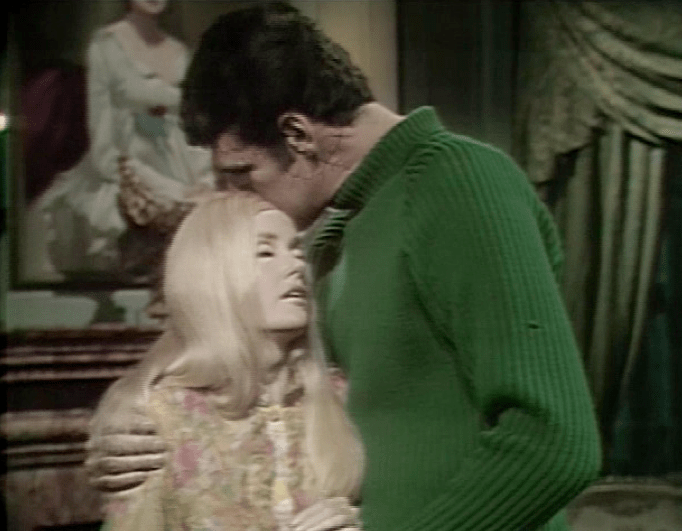
Adam and Carolyn share a tender moment in front of the portrait of Josette. Screenshot by Dark Shadows Before I Die.
Nicholas is the only character who wants the experiment. It makes little sense that he would want it. Assuming that Adam and his mate are both fertile, assuming that they in fact produce children, and assuming that those children are any more subject to sin than are the descendants of the first Adam, it would take years for them to grow up. Even if they all developed severe cases of Soap Opera Rapid Aging Syndrome, it would be many years before they would be ready to supplant H. Sap. The show can’t very well expect us to wait that long for the next story point.
There is one fresh thing in today’s episode, and that is the scene between Adam and Carolyn. Robert Rodan projects an overwhelming warmth and gentleness, and Nancy Barrett shows us every twist of Carolyn’s torment and confusion.
A terrible script, full of repetitious language and recycled story points, but each member of the cast is in top form. They almost make it feel like we haven’t seen all of this before.
In May and June of 1967, vampire Barnabas Collins imprisoned Maggie Evans, The Nicest Girl in Town, and tried to brainwash her into thinking she was his his lost love, the gracious Josette. After Maggie escaped from Barnabas, she was in a state of total mental collapse for several weeks. By the time her memory came back in August, Maggie’s psychiatrist, mad scientist Julia Hoffman, had become Barnabas’ accomplice. Julia has a preternatural power of hypnosis, and she used it to block Maggie’s memories before she could expose Barnabas.
Now, Barnabas and Julia are conducting an experiment to build a female Frankenstein’s monster. Once constructed, the new woman is to be the mate to patchwork man Adam. They need an existing woman to donate her “life force” to animate their creation. They were planning to use Maggie. Barnabas’ servant Willie has a crush on Maggie, so when he learned of their intentions he abducted Maggie before they could get at her.
Willie stashed Maggie in the hidden chamber of the old Collins family mausoleum. As it turns out, Barnabas had taken Maggie there to torture her when she was his prisoner, so when she found herself in that setting her memories came back. Maggie made that clear at the end of yesterday’s episode; she and Willie spend most of today’s talking it over. Kathryn Leigh Scott plays Maggie’s horror and John Karlen plays Willie’s panic with admirable intensity.
Barnabas is visiting the great house of Collinwood when his distant cousin Roger tells him that heiress Carolyn Collins Stoddard has left the house to spend several days in Boston. Adam is threatening to kill various people unless the experiment is completed soon and Carolyn donates the life force, so Barnabas is alarmed by this news.
Barnabas goes home to the Old House on the estate. He finds Carolyn waiting for him there. She tells him she knows all about the experiment and is eager to serve as the donor. Barnabas is bewildered by her enthusiasm. As Carolyn, Nancy Barrett plays this scene with such gusto that she is electrifying to watch. When Barnabas finds her standing in his front parlor looking at him with total self-assurance the show has what is, as far as I am concerned, its sexiest moment so far.
Vampire Angelique wants to take part in an experiment. The experiment is modeled on one in Hammer Studios’ 1967 film Frankenstein Created Woman. A mate will be created for patchwork man Adam by a process that involves draining the “life force” from a person into a female body made up of parts salvaged from several cadavers. Angelique wants to be the “life force” donor.
Angelique knows that when Barnabas Collins donated his “life force” to Adam, he not only survived the process but emerged cured of the vampire curse she had herself placed on him 172 years before, when she was a wicked witch. She is hoping that if she follows his lead, she too will be freed to walk in the daylight.
Angelique has been snacking on an unpleasant man named Peter who prefers to be called Jeff. Peter/ Jeff is working on the experiment as a lab tech. She keeps demanding that he run the experiment with her as the “life force” donor. He keeps explaining that he’s just there to set up the equipment and has no idea how to operate it. The only person qualified to do that is mad scientist Julia Hoffman. Angelique says that no one else must be involved, and gives Peter/ Jeff 24 hours to become an expert on the process.
Meanwhile, Adam visits heiress Carolyn in her bedroom. He describes their relationship in terms that show a far greater maturity than she has seen from him before, and she calls him an “amazing creature.” The word “creature” wounds him. We hear his thoughts in a voiceover monologue, the first time Dark Shadows has used this device in mid-conversation. It is quite unnecessary; Robert Rodan’s face tells us everything we need to know about Adam’s feelings. Carolyn certainly sees that she has hurt Adam, and scrambles to make up for it.
Carolyn gives Adam a bright green sweater, and he bursts into tears. He says that no one has ever given him a gift before. Carolyn does not know about Adam’s origin, and is puzzled by this remark. He tells her no one is as nice as she is, that he wants to be her friend forever and never to hurt her, and rushes out of the room, overwhelmed by his emotions.
The experiment to build a female Frankenstein’s monster began after Adam told Barnabas that if he were not given a mate, he would murder everyone in the great house of Collinwood, including Carolyn. The scene in Carolyn’s room shows that this threat is a hollow one. On Friday, Adam dropped in on suave warlock Nicholas, who put him up to extorting Barnabas and Julia, and told him he loved only Carolyn and was ready to tell Barnabas to forget about the experiment. Nicholas talked him out of that, promising him that he would make it possible for him to have both his mate and Carolyn if only he would do everything he told him to do.
Angelique returns to the lab. Peter/ Jeff isn’t there, but Adam is. She tells Adam that he is breaking his word to Nicholas. Nicholas did not in fact tell Adam to stay away from the lab, but he did give Angelique that command. Adam is skeptical of Angelique, but he has no reason to stay in the lab or to throw her out. So he leaves her there.
Soon Peter/ Jeff is back. He keeps trying to explain to Angelique that he has no idea what he is doing, but she puts herself on the table and insists he start right away. While he throws switches, she moans.
Danny Horn’s post about this episode on Dark Shadows Every Day details the similarities between this scene and the way TV variety shows of the period presented “psychedelic” rock and roll acts such as The Doors. Danny’s commenter “PrisoneroftheNight” (a.k.a. Marc Masse of the intermittently available blog Dark Shadows from the Beginning) points out that The Doors themselves were likely aware of the similarity, as witness a voice that can be heard at the eight second mark of track 11, disc 2, of the CD release of The Doors in Concert calling similar visual effects “Dark Shadows time!”
Danny doesn’t say anything about Lara Parker’s rendering of Angelique’s experience on the table. On Dark Shadows Before I Die, John Scoleri says that Angelique “seemingly enjoys the experiment (because we’ve seen her shriek in pain, and this definitely was not the same),” to which his sister Christine adds that Peter/ Jeff “seemed to be pressing all the right buttons.” When we were watching the episode, Mrs Acilius noticed Peter/ Jeff’s uncomprehending reaction to Angelique’s moans and remarked “Yeah, yeah, we know you’ve never heard a woman make those sounds.”
Two of the four actors in this episode, Nancy Barrett and Roger Davis, are still alive as of this writing. I believe it is the first episode to have a cast that all survived as late as 2021. Robert Rodan died in that year, and Lara Parker in 2023. I don’t know if there are any episodes that still have all-surviving casts. (UPDATED: #751 does!)
Heiress Carolyn came running when her mother, matriarch Liz, woke her with her screams. Liz was having a nightmare about being buried alive. She tries Carolyn’s patience and ours with her obsession that this will in fact happen to her.
Liz tries to call her lawyer, Richard Garner. Whoever answers the phone tells Liz that Garner is not available, hardly surprising since it is the middle of the night. She responds that if he doesn’t call back within the hour, he need never call again. Since we last saw Garner in #246, and his name hasn’t been mentioned since #271, it seems like he may as well get some sleep.
Liz then calls Tony, a young lawyer in town who used to date Carolyn. Tony comes over and Liz hires him to help with some changes to her will. She dictates excerpts from Edgar Allan Poe’s “The Premature Burial” by way of a codicil protecting her from being buried alive, and he tells her he thinks she’s being weird.
The most prominent reference to Poe on Dark Shadows up to this point was in #442, when vampire Barnabas reenacted the plot of “The Cask of Amontillado” by bricking the fanatical Rev’d Mr Trask up in an alcove in his basement. Like Tony, Trask was played by Jerry Lacy, so it is possible that the writers hope the audience will recognize the connection.
Poe wrote punchy little short stories each of which leaves the reader with a single horrifying image. “The Cask of Amontillado” worked well as the basis for an episode, and the bricking up of Trask is one of the most enduring images in all of Dark Shadows. “The Premature Burial” could have made for the same kind of success, had Liz’ obsession begun and ended within one episode. But it has already gone on longer than that, and there is no end in sight. Each time we come back to it, the situation becomes more familiar and less urgent.
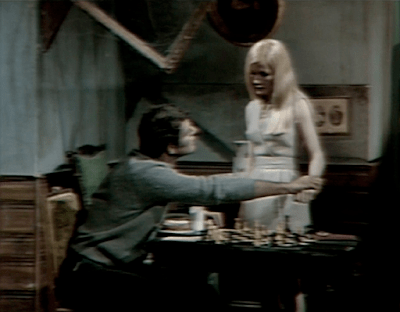
Meanwhile, Carolyn takes a glass of milk and a sandwich to Adam, a Frankenstein’s monster she is hiding in the long-deserted west wing of the house. Adam has little to do but read, and he has become quite intellectual. He is playing both sides of a game of chess when Carolyn arrives, pretending that she is his opponent. When she comes, he attempts a joke, pretending she has left him alone so long he does not remember her name. She is distressed about Liz’ obsessive fear of being buried alive, and so does not recognize that he is joking.
Carolyn looks at the chessboard and asks Adam who he is playing. He says that he is pretending to play her. He is smiling and relaxed when he admits this, and he starts joking again as he tells her about their imaginary games. Adam’s pretending that he did not remember Carolyn’s name was a weak joke, but he is actually pretty funny when he tells her that when he pretends they are playing, she doesn’t do as well as he does. She still does not realize that he is kidding, and reacts with horror. She says she doesn’t play chess; in #357, her uncle Roger mentioned that she does, but that she usually loses to him. Perhaps in the 44 weeks since then, she has given up the game altogether.
Adam shows Carolyn the book he has been reading, a volume of Sigmund Freud’s works, and is disappointed she has not already read it. When she tells him she is worried because of Liz’ condition, he invites her to sit down and says “Tell me about your mother,” suggesting that he is ready to set up shop as a psychoanalyst. Adam is being serious now, but this part of the exchange is hilarious.
Carolyn goes out to the terrace and looks at the night sky, wondering if Freud could help her understand what is happening with her mother. I live in the year 2024, and so I have difficulty imagining how people could ever have taken Freud seriously. But he was very very big in the 1960s, and in its first year Dark Shadows gave us a lot of heavy-handed Freudian symbolism and a number of storylines with obvious psychoanalytic themes. Longtime viewers will find it a reassuring sign of continuity that Freud is still around as the thinker “every twentieth century man should read.”
Tony joins Carolyn on the terrace. He greets her and sees that she has a book about Freud. “I don’t have to ask why you’re reading him,” he remarks. Carolyn asks if he is referring to her mother, and Tony’s response is so indiscreet he may as well spinning his finger around his temple and saying “Cuckoo, cuckoo!” It is clear enough that the concept of “confidential communication” is alien to the lawyers in Soap Opera Land, and now we see that “basic respect” is also very much on the optional list. Carolyn tells Tony to do whatever Liz asks, and starts crying.
I was startled by Carolyn’s crying turn, because it is the first time in the two hundred or so episodes she has appeared in thus far Nancy Barrett has given a subpar performance. The actors all had to work under virtually impossible conditions, so I rarely mention it when one of those who usually does well has a bad day at the office, but the 20 seconds or so she spends very obviously not crying in this scene mark the end of an extraordinary streak.
Tony embraces Carolyn and kisses her. Adam’s room in the west wing overlooks the terrace, and he spies on them while they kiss. After Carolyn excuses herself and goes back into the house, Adam comes up behind Tony, grabs him, forbids him to touch Carolyn, and throws him to the ground.
Heiress Carolyn has been keeping Frankenstein’s monster Adam cooped up all by himself in a dusty room in the long-deserted west wing of the great house of Collinwood, and he is sick of it. Suave warlock Nicholas drops in on Adam and talks to him about the situation. He encourages Adam to rape Carolyn next time she visits, and later he gives it a try.
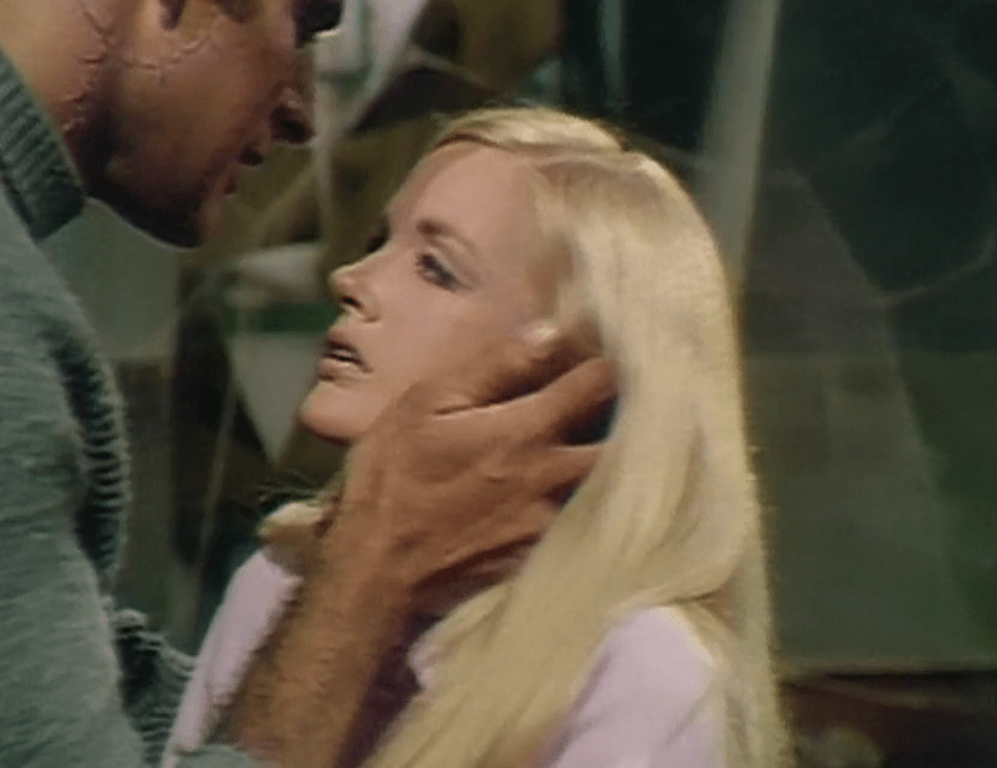
On his Dark Shadows Every Day, Danny Horn praised Nancy Barrett for her approach to the rape scene: “She’s fully committed to the idea that this is not sexy.” In response to this observation, I left a comment in which I said that Robert Rodan’s acting choices were directed towards the same goal:
Robert Rodan does a lot to make the scene unsexy- notice when [Adam] grabs Carolyn’s face, he strokes her cheek with his thumb so as to distort her eyelids. Looks alarming!
Comment by “Acilius,” left 11 September 2020 at 2:32 PM Pacific time, on Danny Horn, Dark Shadows Every Day, “Episode 549: Take What You Want” (19 December 2014)
Here’s the shot. I can’t speak to your tastes, reader, but to me it is a clear example of “not sexy”:
When Dark Shadows began, Carolyn Collins Stoddard was capricious, vain, and perverse. When her mother, reclusive matriarch Liz, was hospitalized in February and March of 1967, Carolyn had to take on responsibility for the family’s businesses and for the great house of Collinwood. With that, she matured dramatically, and she’s never been the flighty heiress since.
Now, Liz is back in the hospital. The show has long since stopped paying attention to the Collinses’ business interests, so we don’t know who’s running those, and the house just sort of takes care of itself while various hell-spawned abominations drop by and take up residence. So Carolyn is keeping herself busy by hiding the latest arrival, Frankenstein’s monster Adam, in the long-deserted west wing.
This is the first we’ve seen the west wing in color. Strange and troubled boy David trapped well-meaning governess Vicki in a room there from #84 to #87, and Adam appears to be staying in the same room.
Adam, who didn’t know a single word of any language when he was brought to life in #490, has in nine and a half weeks acquired the ability to speak fluent, if grammatically unorthodox, English. He is also able to read. When he is alone, he whiles away the hours with the poetry of Elizabeth Barrett Browning. He asks Carolyn for an explication of Barrett Browning’s “Sonnet VI”:
Go from me. Yet I feel that I shall stand Henceforward in thy shadow. Nevermore Alone upon the threshold of my door Of individual life, I shall command The uses of my soul, nor lift my hand Serenely in the sunshine as before, Without the sense of that which I forbore— Thy touch upon the palm. The widest land Doom takes to part us, leaves thy heart in mine With pulses that beat double. What I do And what I dream include thee, as the wine Must taste of its own grapes. And when I sue God for myself, He hears that name of thine, And sees within my eyes the tears of two.
Carolyn does not give the poem anything like the dramatic interpretation we would have expected had Nancy Barrett read it in her own person. Carolyn hastens through it, stumbling a bit over the enjambments, and gives only the most cursory explanations. Since Carolyn has to leave Adam alone so much of the time in order to keep the other residents of the house from suspecting that she is harboring him, it makes sense that she finds a piece about loneliness and separation upsetting. When she mentions that the poem is about a woman’s love for a man, Adam caresses her face, which she finds even more upsetting. He asks if she hates him, she tells him she does not, and she leaves as quickly as she can.
Housekeeper Mrs Johnson notices that someone has been stealing food from the kitchen. She suspects her son, ex-convict Harry. In fact, the culprit is Carolyn, who is gathering provisions for Adam. This harks back to #120, when David stole food from the kitchen to give to the fugitive Matthew Morgan. David was about nine years old, so it made sense that he could not get supplies for his friend any other way. But Carolyn is a grown woman, with money and a car. Even if she would be too conspicuous to go to the grocery store in the village of Collinsport without having to answer questions, she could easily drive to some town where she would not be so well-known and buy food for Adam there. In the last two episodes David seemed far less intelligent and capable than he was when the show began; when we hear that she has been sneaking food from the kitchen, it seems that Carolyn has lost a lot of ground as well.
This is the first we have seen Harry since he was introduced in #471. He stumbles upon Carolyn returning to the main part of the house from the west wing; she reacts by scolding him for being upstairs. When he tells his mother about it, she is frightened. She is still frightened when she talks with Carolyn about the incident. That will remind longtime viewers that in Liz’ absence, Carolyn is in charge of the house. Clarice Blackburn does such a fine job of acting that even first time viewers will understand that Carolyn has the power to fire Mrs Johnson if she wishes.
Craig Slocum is one of the least-loved actors in all of Dark Shadows; in truth, his performances usually are pretty painful to watch. He’s reasonably competent today, but since he shares his scenes with two actresses who would hold an audience’s attention even if they were playing opposite a hat-rack it takes a lot more than reasonable competence make Harry linger in our minds.
Mad scientist Julia Hoffman has summoned sage Timothy Eliot Stokes to the Old House on the great estate of Collinwood, home of her friend, recovering vampire Barnabas Collins. Julia and Stokes talk about the ongoing Dream Curse, a distributed attack on the mental software of a series of people who are more or less connected with Barnabas. The curse takes the form of a nightmare that afflicts one person after another. When Julia declares that Stokes must stop the dreams, he says that she makes it sound like he is responsible for them. She replies that in a way, he is- he was the one who introduced Cassandra Blair to Roger Collins. Roger married Cassandra, giving her a home in the great house on the same estate. Stokes does not dispute the assumption that Cassandra set the curse, but he does deny that he had any influence over Roger’s decision to marry Cassandra.
In #488, Barnabas told Stokes that Cassandra is the witch, and his reaction to Julia’s remark shows both that Julia knows that Stokes is aware of this fact and that he has accepted it. Yet when Julia refers to the witch as “she” later in the episode, Stokes responds as if this were jumping to a conclusion.
Stokes puzzles us again when he says that in the eighteenth century, Josette DuPrés was “a love of Barnabas Collins.” We’ve known that for some time, since Barnabas keeps dwelling on his experiences in the 1790s. But Barnabas doesn’t let on about his past when Stokes is around, nor did his relationship with Josette make it into any written records or any of the legends that circulate in the town of Collinsport. How does Stokes know about it?
The obvious explanation would be that Stokes has been talking with well-meaning governess Vicki. Vicki came unstuck in time in #365 and was marooned in the 1790s until #461. She saw in those days that Barnabas and Josette had been lovers, a fact which Barnabas had inadvertently revealed to her in #233. Neither Vicki nor Stokes has been on the show much lately, leaving them plenty of time for off-camera consultations.
Vicki could also be a source of another piece of information Stokes surprises us with. So far as Stokes knows, the Barnabas of the 1960s is a descendant of another man with the same name. Vicki believes this too, even though she has seen a great deal of evidence that he was a vampire, as for example when he used to bite her on the neck and suck her blood. She did notice that the Barnabas of the 1790s looked, sounded, and moved exactly like his namesake of the 1960s. Today Stokes says that the two Barnabases are “interchangeable” in appearance and behavior, just what Vicki would have told him.
Vicki might possibly have contributed to another bewildering proclamation of Stokes’. He tells Julia that when Barnabas is under great stress, the dream comes to a person who is very close to him, while it settles on people who have no particular connection to him when he is relaxed.
This theory doesn’t work at all. The dreamers whom Stokes classifies as “comparative strangers” to Barnabas are Maggie Evans, The Nicest Girl in Town; Mrs Johnson, housekeeper in the great house; strange and troubled boy David; and an annoying man named Peter who keeps insisting people call him “Jeff.” Of these, only Peter/ Jeff is less than essential to Barnabas. Maggie was the first victim Barnabas sought out. It was his abuse of Maggie that defined Barnabas as a monster the audience should fear, as a lonely guy the audience can feel sorry for, as a bridge between past and present who is pulling the show deeper into the supernatural and towards time travel, and as a figure who will drive stories that bring the residents of Collinwood together with the townsfolk of Collinsport. Mrs Johnson was the first person we saw speak to Barnabas and was the one who invited him into the great house, at a time when the show was putting heavy emphasis on the idea that vampires can enter only where they are invited. David was the first we heard speak Barnabas’ name, and Barnabas was obsessed with killing him for eleven weeks, an obsession that led directly to Vicki’s trip back in time.
Vicki doesn’t know anything about the vital roles these three characters have played in shaping Barnabas’ relationship to the audience and to the structure of the show’s universe, so if Stokes were dependent on her for his information he may have believed they were “comparative strangers” to him. The most puzzling thing is Julia’s reaction. Julia has taken over the function Vicki had at the beginning of the series as the audience’s point of view. She knows what we know and learns what we need to learn. Julia is also supposed to be super-smart, so that when she reacts to Stokes’ theory with excited agreement the show is telling us that he is right.
Barnabas’ servant Willie had the dream the other night, and is supposed to pass it on to heiress Carolyn. He was foiled in his effort to do so yesterday, when Carolyn bit him before he could tell her how it went. Willie got off easy- the last time he was aggressive with Carolyn was in #204, when she pulled a loaded gun on him. He did manage to get enough through to her that she has the first minute of the dream, and she is filled with dread of it from the time she wakes up.
Today, Carolyn is in the Old House with Julia and Stokes. She doesn’t want to have the dream, Stokes believes that if she does he can take control of it and break the curse, and Julia mediates between them. Carolyn goes along with the plan, and it looks like it might succeed. That’s the whole story, which doesn’t add up to much, but Nancy Barrett, Grayson Hall, and Thayer David are all superb actors, and they maintain a fierce intensity that makes it work.
Yesterday, matriarch Elizabeth Collins Stoddard and her daughter Carolyn were in their drawing room quarreling about some family matters when a strange man stumbled into the house. The man was 6’6″ tall, his face was scarred, he trailed a length of chain from a shackle he wore on one ankle, and could speak only a few words. When Carolyn tuned the radio to an Easy Listening station, the man found that the listening was not at all easy for him. Saying “Not music!,” he smashed the radio. This prompted Liz to threaten him with a letter opener. Frightened, the man clutched at Carolyn. The situation escalated when Liz’ distant cousin Barnabas burst in and pointed a rifle at the man. Finally, the man ran out of the house, carrying Carolyn with him.
Today, Liz is moping in the foyer. Local man Tony Peterson, who had gone on a few dates with Carolyn some months ago, comes to the door. He and Liz discuss the situation. Liz laments the harsh tone she took with Carolyn during their argument. She tells Tony that she supposes there is a generational difference between them. He and Carolyn hide their feelings, while Liz expresses hers. This is an exceedingly strange thing for Liz to say- the whole foundation of her character is denial. In the first months of Dark Shadows, Liz was a central character, and the show was largely a study of that psychological defense mechanism and its consequences. She has moved to the margins of the action since then, but hasn’t changed her personality. Indeed, Liz’ conversation with Carolyn took a harsh turn precisely because she refused to face the unpleasant facts Carolyn was reporting to her.
Liz and Tony go to the Old House on the grounds of Liz’ estate, home to Barnabas. They find Barnabas’ servant Willie on the ground by the front door of that house; the door is open, and Willie is nursing a recent head wound. He confirms that the man had been there and that he was carrying Carolyn in his arms. He says that Carolyn appeared to be unconscious. Tony announces that he will go after them, and Willie tells him he will need a gun. “He’s strong, that Adam,” says Willie.
Liz demands to know why Willie called the man “Adam.” Willie denies that he did. That only irritates Liz, who insists that Willie tell her what he knows about the man. Willie repeats his denial, and says that he is worried about a nightmare. He keeps going on about this topic, to which Liz angrily responds “I don’t want to hear any more about your dream!”
Adam has taken Carolyn to an abandoned root cellar somewhere in the woods. This is a new set. Regular viewers, knowing what a rarity new sets are on a show with this one’s budget, will expect something important to happen there. What happens there today is that Adam and Carolyn struggle to communicate with each other. She asks him what he wants; he manages to say “Kill Barnabas!,” a goal which people who have been watching for the last several weeks will agree he has excellent reasons to pursue. He holds a burning pine cone and is surprised to find that it hurts when the fire reaches his hand; she is startled to find that he didn’t know that, and says that he is like a baby. She tries to leave the root cellar, but he won’t let her get to the door.
Liz spoke for the audience when she said she didn’t want to hear any more about Willie’s dream, but it is dramatized for us anyway. It ends with the image that frightens Willie the most, a wolf’s head. Longtime viewers can well understand why this might be a terrifying symbol to Willie. When Willie first worked for Barnabas, Barnabas habitually beat him with his heavy wooden cane topped with a metal handle in the shape of a wolf’s head. In those days, Barnabas was a vampire, and when he felt bloodlust dogs would howl. As Barnabas’ blood thrall, that sound would therefore tell Willie that either he himself would soon be drained of more blood, or that he would be forced to help Barnabas prey on someone else. So it makes sense that for Willie, terror has a canine face.
From #133, artist Sam Evans was compelled to paint a series of pictures that explained the evil intentions of undead blonde witch Laura Murdoch Collins, estranged wife of sarcastic dandy Roger Collins. In #146, Laura put a stop to Sam’s work by starting a fire that burned his hands so badly it seemed for a time he might never be able to paint again.
Sam shares his home, the “Evans cottage,” with his daughter Maggie, who is The Nicest Girl in Town and a waitress at the diner in the Collinsport Inn. Between her earnings there and the paintings Sam sells, the Evanses make a living, but it isn’t such a grand living that he can turn down any commissions, even very eccentric ones. Moreover, his work space entirely dominates the interior of the cottage. In the early days of the show, Sam’s old friend Burke Devlin often stopped by, and the conversation always turned to reminiscences of Burke’s youthful days of honest poverty. Nowadays the most frequent visitor is Maggie’s fiancé, hardworking fisherman Joe Haskell. Sam is delighted with the prospect of this upwardly mobile laborer as a son-in-law. When a representative of the moneyed world visits Sam or Maggie at home, as New York art dealer Portia Fitzsimmons did in #193 and old world gentleman Barnabas Collins did in #222, the contrast between their manner and the humble surroundings is meant to jolt us. The Evans cottage is therefore our window on the working class of Collinsport. When the troubles of the ancient and esteemed Collins family have an effect there, Dark Shadows is telling us that the whole town is dependent on the businesses they own and suffers as a result of their problems.
Yesterday, Barnabas came back to the cottage and brought Sam a very odd commission indeed. He presented a painting of a lovely young woman in eighteenth century garb and offered Sam $500* to paint over the image so that before morning the woman would look to be “about 200 years old.” Sam wasn’t in a position to refuse that much money, even though Barnabas wouldn’t explain why he wanted him to do such a thing.
If Sam knew what the audience knows, he would likely have turned the job down even if Barnabas had offered $500,000,000. The woman in the portrait is Angelique, and like Laura she is an undead blonde witch. In the 1790s, Angelique cursed Barnabas and made him a vampire. In #466, Barnabas’ vampirism went into remission. Shortly thereafter, the portrait made its way to the great house of Collinwood, where Roger became obsessed with it. In #473, Roger returned from an unexplained absence with a new wife. She is Angelique, wearing a black wig and calling herself Cassandra. From #366-#461, Dark Shadows had been a costume drama set in the 1790s; during this segment, we saw that Angelique was a far more dynamic and brutal menace than Laura ever was. Sam would hardly want to involve himself in a battle with this wiggéd witch.
For his part, Barnabas first appeared on camera in #210 and #211. But his portrait was first seen hanging in the foyer at Collinwood in #205, having been prefigured in #195. Dangerously unstable ruffian Willie Loomis became obsessed with the portrait of Barnabas. Willie could hear a heartbeat pounding from the portrait in #208 and #209, and followed its sound to the crypt where Barnabas was trapped in his coffin. As Roger’s obsession with Angelique’s portrait would bring her back to the world of the living, so Willie’s obsession with Barnabas’ portrait led to his return.
In the opening teaser, we see Sam working on the painting. He tells it that he can’t understand why Barnabas would want to disfigure such a pretty face, then resumes his task. The camera zooms in on the painting, as it had zoomed in on Barnabas’ portrait in #208 and #209, and the soundtrack plays the same heartbeat. Sam doesn’t react- he can’t hear it. It is addressed to the audience, especially to those members of the audience who remember the show as it was 13 months ago.
Angelique/ Cassandra is in the gazebo on the grounds of Collinwood. She is wearing a hooded cloak to conceal the aging she has already experienced as a result of Sam’s work. Her cat’s paw Tony Peterson, a local attorney, shows up, responding to her psychic summons. She entrances him with a flame and he tells her that the artist who has been in touch with the Collinses most frequently of late is Sam Evans. From this she concludes that Sam is aging her portrait at Barnabas’ bidding. Before Angelique/ Cassandra and Tony can go their separate ways, heiress Carolyn Collins Stoddard comes upon them.
Tony and Carolyn met in #357. In that episode, he was an instance of Jerry Lacy’s Humphrey Bogart imitation. A hard-boiled materialist, Tony had grown up in Collinsport as a working-class boy. He resented the Collinses and attributed all of their unusual characteristics to their wealth and social prominence. At that time, Barnabas was still a vampire and Carolyn was under his power. As a blood thrall, she knew that there was more to life than could be explained by Tony’s reductive logic, but she wasn’t free to offer any explanations. When Tony saw Barnabas biting Carolyn in #463, he interpreted their embrace as a sign of a sexual relationship.
Now their roles are reversed. It is unclear what Carolyn remembers from her time under Barnabas’ control; Nancy Barrett often plays the character as if she remembers everything, but the dialogue doesn’t give her much support for that, and in this scene she is as this-worldly as Tony was in the Autumn of 1967. She interprets Tony and Angelique/ Cassandra’s meeting at the gazebo as proof positive of an adulterous liaison, and declares she will report it to Roger. When Tony tells her that Angelique/ Cassandra has some mysterious power, Carolyn is dismissive, declaring that the Collinses are the ones who have all the power in this town. Tony tries to explain that the power Angelique/ Cassandra has is of an entirely different order from the power their ownership of capital gives the Collinses, and Carolyn responds with unconcealed contempt.
Angelique/ Cassandra knocks on the door of the Evans cottage. Sam opens the door. She ignores his objections and enters. While he keeps ordering her to get out of his house, she stands next to the portrait as he has aged it and points out her resemblance to it. He is astounded, but keeps telling her to leave. She says that she has no grievance against him and that no harm will come to him if he hands the painting over to her. He refuses. She heads out.
Angelique/ Cassandra has barely closed the door behind her when Sam has trouble seeing. After a moment, he realizes he has been struck blind. She comes back in, takes the painting, tells him she warned him, and leaves.
Over the years, several members of the cast said on the record that Sam’s blindness was actor David Ford’s idea. He thought that if he could wear dark glasses it wouldn’t bother the audience that he read all his lines off the teleprompter.
In 2022, a commenter on Danny Horn’s post about this episode on his blog Dark Shadows Every Day identified the portraits of Angelique as the work of ABC Art Department specialist Joseph Guilfoyle:
You asked if anyone knew who painted these portraits. I can verify that the portraits of Angelique were painted by Joseph Guilfoyle. He was an artist in the Art Department at ABC. He was my Godfather and his daughter remembers this very well as it made her a bit of a celebrity at the time. Portraits were not commissioned out but instead were created in the Art Department as it was filled with many talented artists.
Also worthy of note are the two facial makeups representing Angelique’s aging. It’s no wonder they didn’t have the personnel to make David Ford’s fake mustache look convincing when they were lavishing all the work on turning Lara Parker into two quite distinct old crones.
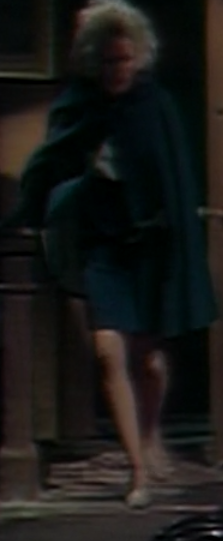
The costumers were involved in a famous production error in the final scene. Angelique/ Cassandra’s hooded cloak cuts off above her knees. There is no old age makeup on her legs, which are featured from every angle, making a ludicrous contrast with her face and wig.









 Dark Shadows Commentary