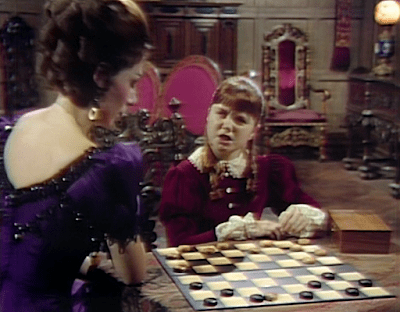
Nine year old Nora Collins enters the drawing room of the great house of Collinwood. She walks in on her father, the stuffy but lovable Edward, embracing Kitty Soames, the dowager countess of Hampshire. She gives them a dirty look and says she supposes Edward is too busy to join her in a game of checkers. He says he does have to run an errand, but suggests that Nora play with Kitty.
Kitty is eager to ingratiate herself with Nora, who clearly wants nothing to do with her. Nora asks, in an icy voice, if the reason Kitty wants to be her friend is that she is planning to marry her father. Returning viewers suspect she is right. Kitty and Edward have more in common than they know. Both are penniless, each is sure the other is very rich, and each imagines marriage to the other will solve all their problems. Kitty can’t very well level with Nora about this, so she claims that the women in the Collins family, being outnumbered by the men, have to stick together. Nora does not hide her distaste at Kitty’s inclusion of herself among the women of the family. Kitty asks Nora if she wants her father to be happy. Nora drills her eyes into Kitty’s face and says in a firm, flat voice “I want that.”
Nora asks Kitty if she is just letting her win at checkers. While she is asking this, Nora moves twice in one turn and takes three of Kitty’s pieces. Kitty watches this without protest and denies that she is letting her win. She then says she wants to concede the game and listen to whatever information Nora is willing to share about the family.
Edward comes back from his errand to find Nora packing up the checkers and the board. He asks if she enjoyed her game with Kitty. Not looking up, Nora says they never finished it. Kitty hastens back in and asks if she wants to finish it now. Edward points out that it is getting close to Nora’s bedtime. He kisses her, and bids her say goodnight to Lady Hampshire. Kitty asks Nora to call her by her first name. Nora pointedly says “Good night, Lady Hampshire.”
It doesn’t show in her scenes with Nora, but Kitty seems to be suffering from a severe mental health crisis. Returning viewers know that the ghost of Josette Collins is taking possession of her, and suspect that she will turn out to be a reincarnation of Josette. Edward knows enough about the supernatural doings on the estate of Collinwood that he might give Kitty the benefit of the doubt when, for example, she comes running in today and is shrieking about a haunted house, a vanishing woman, and a curse that follows her everywhere. But she is so often so highly distraught that Nora must have noticed that she is not right in the head, and she can hardly look forward to having such a person as a stepmother.
Shortly before Nora enters, Edward calls Kitty “Katie.” This is a small enough slip of the tongue, but Kathryn Leigh Scott’s friends call her Katie, so it is a case of an actor’s name in place of the character’s. I think I can see Louis Edmonds blush a little when he realizes what he has done.
This episode marks the final appearance of Nora, and very nearly the last time we will hear Nora’s name. I think she was badly underused, disappointingly so after the outstanding work Denise Nickerson did as Amy Jennings in the months leading up to the segment set in 1897. She will be back later, in other parts.
Director Henry Kaplan was not much of a visual artist, and his deficiencies are particularly glaring today. Especially during Kitty and Nora’s first scene, the camera keeps drifting up to the actors until we see a randomly selected two-thirds of their faces in extreme closeup. Once the shot excludes the eyes or the mouth, it abruptly pulls back. Even the successfully framed closeups are rarely in focus, and you can forget about finding coherent visual storytelling in any kind of shot other than a closeup. The actors themselves do a good job, in spite of Kaplan’s notoriously unpleasant behavior towards them, but aside from a few evocative facial expressions, most of them by Nickerson, it may as well have been a radio play.
In June 1966, Dark Shadows opened with a train carrying well-meaning governess Victoria Winters and dashing action hero Burke Devlin from New York City to Collinsport, Maine. Vicki and Burke first met at the train station in Collinsport. When she found that no one was waiting to take her to the great house of Collinwood, Burke volunteered to drive her there. We haven’t seen the train station since, and all subsequent references to mass transit to and from Collinsport in the 1960s have been about buses. That is to some extent an adjustment to real-world history. In our universe, passenger train service to central Maine had already stopped by 1966.
Now, the show is set in 1897. Devastatingly handsome reprobate Quentin Collins has talked the lovely and mysterious Amanda Harris into joining him on the 6 PM train from Collinsport to NYC. Amanda and Quentin will remind viewers who have been with the show from the beginning of Vicki and Burke. Quentin is no hero, but he serves the plot function Burke did in those early days, antagonizing all the authority figures and fascinating all the women and children. Amanda takes part in some sleazy schemes, while Vicki was eventually forced to be an impossibly stainless model of virtue. But as Vicki was on a quest to learn the truth about her biological parents and felt she could know nothing about herself until she found out who they were, Amanda is tormented that she has no memories and no information about herself dating beyond two years into the past. And as in the first week Vicki was a savvy New York street kid who could keep smiling while she fended off the indecent advances of the lecherous Roger Collins, so Amanda sees right through the equally lecherous but toweringly hypocritical Rev’d Mr Gregory Trask.
Quentin and Amanda agree to meet at the train station. Amanda has to hide from Trask and from a repulsive little man named Charles Delaware Tate, and so she will spend the afternoon in a vacant house on Pine Road where a friend of Quentin’s is squatting. Quentin will settle his affairs at Collinwood. When they made this plan, my wife, Mrs Acilius, said that Dark Shadows has so consistently shown that when its characters leave separately they do not meet each other at their intended destination that it would be a surprise if they get on the train together. Indeed, from the time Amanda leaves Collinwood the suspense is not about whether their reunion will be thwarted, but how.
Tate steals a portrait of Quentin. He knows that the portrait has magical powers and is of the utmost importance to Quentin. Quentin discovers that the portrait is missing. He writes a note saying that he may not be able to get to the train station by 6 PM and asks his nine year old niece, Nora Collins, to take it to Amanda at the house on Pine Road. Nora agrees to do so.
Quentin goes to Tate’s and demands he give the portrait back. They get into a fistfight. Quentin knocks Tate out and searches the house.
Trask catches Nora on her way to the house on Pine Road. He forces her to give him the note. He reads it, and goes to the house himself. He and Amanda have a confrontation. She tells Trask that she first approached him as part of a con game she was ashamed to take part in, but when she saw him leering at her she decided that he deserved to be cheated. He furiously denies being a lecher and she calls him a liar. Trask can intimidate most people into silence, so much so that his scenes are often suffocating to watch, and it is glorious to see Amanda dump the whole truth on him and not back down.
Trask does get in one more lie. He claims that he just saw Quentin getting ready to go out on a date with his other fiancée, Angelique. Amanda doesn’t believe him but she does know about Angelique. She also told Quentin that she wasn’t convinced she was right for him, and that if he didn’t show up she would understand that he had decided they didn’t have a future together after all. So when at the conclusion the conductor sees Amanda standing on the platform by herself and tells her that it’s time to get on the train, we are to assume that she thinks it is over between her and Quentin.
From December 1968 to through February 1969, strange and troubled boy David Collins (David Henesy) and his friend Amy Jennings (Denise Nickerson) were falling under the power of the malign ghost of Quentin Collins. Occasionally the children were possessed by the spirits of David’s grandfather Jamison and great-aunt Nora; at other times they were possessed by Quentin’s own spirit and that of Quentin’s sometime lover, maidservant Beth. In those same days, Amy’s brother Chris (Don Briscoe) was suffering from a curse that made him a werewolf.
As Quentin’s power over David and Amy grew, so did the frequency and duration of Chris’ spells in lupine form. By #700, Quentin so dominated the great house on the estate of Collinwood that its residents fled to the Old House on the estate, home of their distant cousin Barnabas Collins. David, entirely possessed by Jamison, was close to death. For his part, Chris was stuck in wolf form, apparently permanently, and Barnabas had locked him in a secret room in the old Collins family mausoleum.
Desperate to remedy the situation, Barnabas and his associate, occult expert Timothy Eliot Stokes (Thayer David,) searched Quentin’s old room in the long-deserted west wing of the great house. They found some I Ching wands there. Under Stokes’ direction, Barnabas threw the wands, meditated on them, and found himself transported back in time to 1897. In that year, Quentin, Beth, Jamison, and Nora are alive, and Barnabas is a vampire.
Barnabas had no idea what led Quentin to become a malevolent ghost or what first brought the werewolf curse on Chris, but he had reason to believe that 1897 was an important year in the events leading up to both of those unhappy circumstances. So once he arrived in that period, he spent his nights meddling in all the affairs of the Collins family he found there. Vampires are not problem-solvers; their function in a story is to create problems that other characters will have to solve. So all of Barnabas’ well-intentioned interventions backfired badly. Even disregarding the many murders he committed for his own selfish ends, including the murder of Quentin’s brother Carl Collins, his trip would by any standard have to be considered a disaster.
Now, evil sorcerer Count Petofi (Thayer David) has found that Barnabas is a visitor from the future and is determined to go with him when he returns to 1969. When he demanded Barnabas tell him his secret, Barnabas quite truthfully told him he had no idea what was going on when he found himself transported from one period to another. Petofi did not believe him, and is trying to extort the information he wants by summoning the spirit of David to come from 1969 and possess Jamison (David Henesy) in 1897.
Not only is this an intriguing reversal of the 1968-1969 story in which the ghost of Quentin caused Jamison’s spirit to possess David, it also picks up on some recent hints that they might retcon the whole “Haunting of Collinwood” story to put Quentin’s ghost under the control of Petofi. Even if he can’t hitch a ride with Barnabas, perhaps Petofi will find a way to use Quentin to go back to 1969 with us.
Nora (Denise Nickerson) is with her brother Jamison when the possession takes hold. She is puzzled that he insists on calling her “Amy” and himself “David” and that he tells her to call Quentin on the telephone, even though he is in the house. When Quentin shows up, he recognizes the name David Collins from something Barnabas has told him about the future. But Barnabas has not told Quentin that he is fated to become a family-annihilating ghost, and so Quentin cannot understand how David knows who he is.
Meanwhile, a man named Tim Shaw (Don Briscoe) comes to the house and visits Nora in her room. Tim is Amy’s former teacher, and she considers him a friend. She does not know that since she first knew him, he has lost his moral compass, found the severed Hand of Count Petofi, stolen it, and used its magical powers to make a small fortune in New York City. Evidently all working-class Collinsport boys get rich quick when they go to NYC. In 1961, ex-fisherman Burke Devlin got out of prison and went to that city. By the time he returned to Collinsport in 1966, Burke was a big-time corporate raider who had to think for a moment when David Collins asked him if he’d already made his first $100,000,000. He answered “Not yet.” If he’d had the Hand, no doubt he would have passed that milestone long before.
A couple of days ago, Tim asked Nora to hide a box for him. Unknown to her, the box contained the Hand. Tim asks Nora to return the box to him. She tells him Jamison has it, and he flies into a rage. He gets very rough with her. Briscoe and Nickerson were both good actors, and we’ve seen them share tender moments both as Nora and Tim and as Amy and Chris, so the resulting scene is as uncomfortable as it needs to be to show us that Tim is no longer the long-suffering nice guy we once knew. Moreover, longtime viewers who recognize Tim’s echo of Burke and remember that Burke, though sometimes villainous, was always good with David, will be shocked that Tim does not mirror the earlier character’s consistent soft spot for children.
Tim goes downstairs and sees Quentin coming out of the drawing room. He demands to see Jamison. Quentin tells him that Jamison is ill, and it will be impossible for anyone to talk to him. Tim starts to get ugly about it, and Quentin cuts him off, saying that Jamison doesn’t have the Hand. Tim is shocked that Quentin knows about the Hand, but recovers sufficiently to ask who does. Quentin cheerfully tells Tim that if he goes to the abandoned mill at the end of the North Road, he will find his onetime acquaintance Aristide, and that Aristide will direct him to the man who has the Hand.
Tim knows Aristide only slightly, but he has a grudge against him. Aristide attacked Tim’s girlfriend Amanda and demanded she tell him where the Hand was. Even after he realized Amanda did not know what he was talking about, he beat her and threatened to kill her, forcing her to tell him whatever she did know that would help him retrace Tim’s steps. When Tim found Amanda, Aristide had left her unconscious, and Tim feared at first she might be dead.
We cut to the hideout in the mill, where Tim is waiting with a pistol and thinking that he would be justified in killing Aristide for what he did to Amanda. When Aristide comes, Tim holds him at gunpoint and demands the Hand be returned to him. Aristide tells him that is not possible. They quarrel until another man enters. It is Petofi, who shows Tim that the Hand has resumed its place at the end of his right arm.
That suffices to show Tim that the Hand is no longer available to him. Petofi tells him he should consider himself lucky that the Hand, which followed no one’s commands, chose to make him rich and happy. Tim says he is not happy, and will not be until he can take revenge on the hypocritical Rev’d Gregory Trask and lawyer/ Satanist Evan Hanley. This again reminds longtime viewers of Burke, whose original goal in returning to Collinsport was to wreak vengeance on Roger Collins. As Trask and Evan involved Tim in a homicide when he was not in his right mind and tried to make him alone pay the legal penalty for it, so Roger killed someone with Burke’s car while Burke was passed out drunk in the back seat and saw to it that the court concluded that Burke was driving.
Petofi laughs and congratulates Tim on his choice of enemies. Tim brightens and asks if Petofi will join with him in bringing Trask and Evan down. Petofi explains that he does nothing without a price. Tim says he has a lot of money, and Petofi says he doesn’t have any use for money. Petofi brings up Amanda, only to say that he doesn’t have a use for her either, at least not at the moment. He sends Tim along his way.
Aristide is talking when Petofi dismisses him. He tells him that two visitors are coming, and that he wants to be alone when they arrive. He will not explain further, and so Aristide is in rather a huff when he leaves.
The visitors are Quentin and Jamison/ David. Quentin is carrying his nephew/ great-great-nephew. He demands that Petofi cure Jamison of the possession, which seems to be killing him. Petofi refuses. When Jamison/ David calls Quentin by name, Petofi asks him how a boy who lives in 1969 knows who he is. Quentin’s bewildered reaction leaves us wondering how he will respond if Barnabas ever tells him just why he went to the past.
In the opening teaser, Petofi stood over the coffin in which he has trapped Barnabas. He told Aristide that he and Barnabas have been at war for what even he, at his immense age, considers to be a very long time. He says that they are now engaged in the final battle of that war.
Petofi’s remarks make absolutely no sense whatever in the context of what we have seen. It has been clear so far that Petofi’s presence at Collinwood is an accident, that Barnabas never heard of him before, and that Petofi only just learned that Barnabas has traveled through time. Many of the oddest dead ends on the show were left over from advance plans that hadn’t worked out; so when they were drawing up broad outlines six months before taping, or when they were writing episode summaries (called “flimsies”) thirteen weeks before, they would often include ideas that depended on story points that they never got around to making happen or characters who never worked out. Once in a while, the writers tasked with filling in the flimsies wouldn’t be able to make up a complete 22 minute script without incorporating some of this irrelevant material. So perhaps at some point in the planning process they meant to have stories about Barnabas going back to the eighteenth century and fighting Petofi there. They may still have been kicking that idea around when they shot this installment.
If Dark Shadows has offended, Think but this, and all is mended — That you have but slumbered here While these visions did appear. And now, a word from All Temperature Cheer.
Danny Horn, “Episode 816: Midsummer,” posted 1 February 2016 at Dark Shadows Every Day.
Denise Nickerson joined the cast of Dark Shadows in #632 as nine year old Amy Jennings, sister of the doomed Chris (Don Briscoe.) As Amy, Nickerson was central to the show for the next fourteen weeks. In #701 we traveled back in time and Dark Shadows became a costume drama set in 1897. In that year, Nickerson is Nora Collins. Nora was in 10 episodes in the first twelve weeks of 1897, and apart from a two episode stint in #782 and #783 has been unseen and very nearly unmentioned in the ten weeks since. The 1897 segment is packed with so many lively characters that even the best of them disappear for long periods, but the extended neglect of Nora is particularly disappointing. Nickerson was an outstanding young actress, brought out interesting qualities in her scene-mates, and had drawn a significant fan base among the show’s preteen viewers.
Nickerson is back today. In Act One, she walks in on her father Edward trying to strangle her Uncle Quentin. Nora’s scream distracts Edward and saves Quentin. When Nora asks Quentin what got into her father, he tells her that it’s something like a magic spell and will end soon. He refuses to explain further. It is unclear why Nora accepts this refusal. For our part, the audience accepts it because Edward’s attack on Quentin has nothing to do with today’s episode. It’s just left over from yesterday’s cliffhanger.
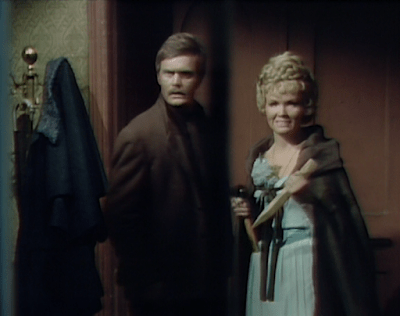
Don Briscoe is also back, after an absence of twelve episodes. In 1897, he plays Tim Shaw, persecuted schoolteacher turned adventurer. As Chris, Briscoe would do a little W. C. Fields imitation from time to time, occasionally ending a sentence with Fields’ signature inflections. This would raise a smile from other characters in 1969, when such a habit was relatively fashionable. Considering that Fields’ persona was that of a man who belonged in the Gay Nineties, we should have suspected when we first saw the date 1897 that Briscoe would have an opportunity to develop his Fields imitation in greater depth. Indeed, we see him today wearing a hat and coat that might have come from Fields’ closet, accompanied by exactly the sort of woman whom Fields’ characters reliably failed to impress.
I regret to inform you that Tim does not, at any point, address Amanda as “My little chickadee.”
Tim has been in New York, where he made a great deal of money in a very short time by means of something which he keeps in a small box. Returning viewers know that this thing is The Hand of Count Petofi, and that it is the object of a desperate search by many dangerous people, including Quentin. We also know that the Hand is not subject to anyone’s control. If it has made Tim rich, that is because it wanted to do so for purposes of its own, not because Tim had any skill in manipulating it. Tim has used his riches to purchase the companionship of Amanda Harris, a cynical young woman who is impatient with him and appalled at the smallness of the village of Collinsport.
Tim and Amanda are staying at the Collinsport Inn. The Inn was a very important part of the show for its first 40 weeks, when one of the principal storylines was The Revenge of Burke Devlin. Like Tim, Burke was a working class boy from Collinsport who was framed for a homicide of which he was only technically guilty, and who then went to New York City, made a huge amount of money in a very short time, and came back to his home town to even the score with those who set him up to take the blame for a crime for which they were even more responsible than he was. Burke lived at the Inn, and it represented his territory, in opposition to the great house of Collinwood where his adversaries lived. The Revenge of Burke Devlin storyline never really took off, and by #201 Burke himself lost interest in it. Since then, we have gone months at a time without seeing the Inn. We saw a guest room there in #698, but I can’t remember the last time we saw the lobby before today.
Tim orders Amanda to hide the box in her room, then sends her off to Collinwood to make a connection with the cruel and lecherous Rev’d Gregory Trask. Amanda tells Trask that she has been under the power of an evil man and that she wants to change her ways. Trask tells her that he will give her spiritual guidance. He has his back to her when he says that his plan requires that he provide her with “private instruction”; he isn’t looking at her when she rolls her eyes at this. Back in the Inn, Amanda tells Tim that he was right, Trask is despicable.
While Amanda and Tim are taking a stroll by the waterfront, Quentin ransacks Tim’s room looking for the Hand. Quentin hears them on their way back, and leaps out Tim’s window. They’ve gone out of their way to make it clear that Tim’s room is upstairs- we heard Tim on his telephone telling the front desk to send Amanda “up” to him, and we saw him and Amanda getting on the staircase to go to the room. So they are inviting us to wonder how Quentin climbs down the side of the building.
When Tim sees the shambles in his room, he sends Amanda to her room to make sure the box is still there. It is, but he decides that the Inn is not a safe enough place for the Hand. He takes the box to Nora in her bedroom at Collinwood. Regular viewers know that Tim was Nora’s teacher, and Nora considers him her friend. It may seem odd that the person Tim turns to when he needs help with such a sensitive matter is nine years old, but longtime viewers will again remember Burke. He had a way with children; he immediately won the devotion of strange and troubled boy David Collins, and Maggie Evans, The Nicest Girl in Town, remembered him very fondly from her own childhood. Burke and David trusted each other in delicate situations more than once, and we can see the same thing happening between Tim and Nora.
Nora promises to hide the box somewhere in the house and not to tell anyone about it. Tim leaves, and Nora puts the box in her armoire. Nora is a fairly responsible person, but she is nine, and the box is wrapped like a present. As we fade to the credits, she is opening the box.
This leaves us wondering not only how Nora will react to the sight of the Hand, which is a gruesome thing, but also what effect it will have on Nora’s own appearance. In #784, lawyer/ Satanist Evan Hanley looked at the Hand, and it responded to his gaze by disfiguring his face. A few days later, it disfigured Quentin as well. Evan and Quentin have both regained their good looks, frustratingly without explanation. But it would be intensely unpleasant to see little Nora’s face mangled, even temporarily, so this is quite an effective cliffhanger for viewers who have been watching for several weeks.
This episode not only features the welcome returns of Nickerson, Briscoe, and the Inn’s lobby after their absences; it brings an equally welcome newcomer. Amanda Harris is played by Donna McKechnie, six years before she originated the role of Cassie in A Chorus Line and thereby became a permanent star of Broadway. Reviewing TV episodes on the 56th anniversaries of their original airing, recent news about the cast is often sad. For example, Lara Parker died very shortly before the 56th anniversary of the first broadcast of an episode in which she appeared as wicked witch Angelique. I call the cast members by their surnames, and put courtesy titles in front of the surnames of living people. I could have cried when I had to call her simply “Parker.” But Miss McKechnie is alive and well. Just yesterday, I saw a YouTube video (one of two posted on 23 July) of a panel featuring Miss McKechnie at a Dark Shadows convention on 19 July with Kathryn Leigh Scott, Marie Wallace, Sharon Smyth Lentz, and Matt Hall.
Nine year old Nora Collins walks in on her teacher, Charity Trask, being bitten by vampire Barnabas Collins. Barnabas tells Nora to “Look into my eyes!” He hypnotizes Nora and mind-wipes away her memory of him. Barnabas has been on Dark Shadows for more than two years now, and this is only the second time he has pulled the “Look into my eyes!” move with someone whose blood he has not been drinking. The previous occasion was also with Nora, in #756. In the parts of Dark Shadows set in the 1960s, Barnabas is usually paired with mad scientist Julia Hoffman, who is the master of a magical form of hypnosis that allows her to rewrite people’s memories at will. So if Barnabas exercised this traditional vampire power in those segments of the show, he’d be stepping on Julia’s territory. But this episode is part of a time-travel story set in 1897, and Julia is not here.
Barnabas has been exposed and is being hunted by a number of people. His current hiding place is inside a cave. He confers there with his reluctant sidekick, broad ethnic stereotype Magda Rákóczi. Today the show is being taped on new cameras, and the image is crisper and more nuanced than we have seen since it went to color in August of 1967. The cave would barely have shown up through yesterday’s cameras, but it looks nifty today.
Magda is Barnabas’ sidekick, she is quick with lies, and she is played by Grayson Hall, but she does not do hypnosis. Screenshot by Dark Shadows Before I Die.
Magda has stolen a severed hand that a crime boss was keeping in a box, and believes that she can use it to undo a curse she placed on the rakish Quentin Collins. Barnabas is worried that they will not use the hand correctly when the time comes to release Quentin. Since there is no way to test the procedure they plan to use on Quentin, he asks if it will be able to help someone else. Magda says that it should. He has the bright idea to summon Charity. He evidently overate, and she is in danger of dying from loss of blood.
Vampires are metaphors for extreme selfishness, and with this suggestion Barnabas is a case in point. If the hand can lift curses from the people it touches, why does Barnabas not have Magda place it on him? If it freed him of vampirism, that would heal Charity and his other victims, and would allow him to stroll up to the vampire hunters on some sunny day and watch their suspicions of him collapse. But that is out of the question, because he does not know how to control the hand. He is simply using Charity as a laboratory animal.
Barnabas telepathically summons Charity. As it happens, lawyer/ Satanist Evan Hanley is at her bedside. Evan is among the vampire hunters, and knows Charity is under Barnabas’ power. He physically restrains her from leaving her room. Barnabas and Magda despair of bringing Charity and the hand together. The hand then disappears from its box. Magda thinks the hand is simply lost and is terrified that she will not be able to return it to its owner, but Barnabas is serenely convinced that it has gone to Charity under its own power.
This turns out to be true. The hand materializes in Charity’s room. Evan sees it, and, expert that he is in occult lore, exclaims “The hand of Ojden!” It settles on Charity’s face, and when it vanishes the bite marks are gone from her neck and she is once again her brisk, authoritative, and intensely priggish self, no longer a thrall of Barnabas. The hand reappears in the cave next to the box, and Barnabas smugly announces to Magda that it completed its mission.
For some reason, Barnabas’ self-satisfied certitude crumbles and he feels compelled to check on Charity to see that she has indeed been healed. He materializes in her room, but she is not there and the cock is already crowing. When he returns to the cave, Evan meets him, holding up a cross and keeping him from getting back into his coffin.
Vampire Barnabas Collins has been exposed and is in hiding. Most of those who would destroy him are as evil as he is, and none is as much fun to watch, so we’re on his side.
Stuffy Edward Collins catches Barnabas’ blood thrall Charity Trask in the basement of the Old House on the estate of Collinwood. Barnabas sent her there to fetch some soil from his original grave which he will use to make a new coffin habitable. Edward asks Charity what she is doing in the basement; she lies and claims that she can’t remember. This is an interesting moment for fans of Dark Shadows. Nancy Barrett’s acting style is uninhibited and often larger-than-life; one suspects that she was often accused of overacting. But Charity really does overact. In the contrast between her one-dimensional, exaggerated manner when she feigns amnesia and Miss Barrett’s own very noisy but highly textured performances, we see the definitive refutation of any such charge.
Charity got into the basement through a tunnel that connects the beach below Widows’ Hill to a prison cell in the basement of the Old House. In #260, set in 1967, we saw that the tunnel was in place when Barnabas and his little sister Sarah were living beings in the eighteenth century, that Sarah was aware of the tunnel, and that their father Joshua forbade her to tell Barnabas about it. Sarah’s ghost told Barnabas’ victim Maggie Evans how to escape through the tunnel. When Barnabas pursued her through it, we could see from his reaction that he was seeing the tunnel for the first time. The other Collinses of the 1960s were unaware of the existence even of the cell, let alone of the tunnel.
Now it is 1897, and when Charity mentions the tunnel to Edward he impatiently responds that he knows all about the tunnel. His tone suggests that he would expect Charity to know that he knows about it; evidently it is no secret among the residents of Collinwood. Since Edward’s twelve year old son Jamison is one of those residents, and Jamison’s daughter Liz and son Roger will be the adults at Collinwood in the 1960s, one wonders how that knowledge was lost in the seventy years separating this time-travel story from the principal time frame.
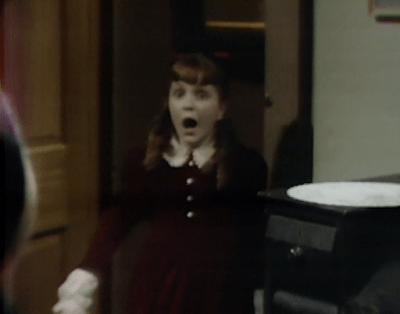
In the last scene, Barnabas is in Charity’s bedroom, about to chow down on her bloodstream. We pan from a two-shot to a closeup of Charity. She gives a thirty five second speech about how it isn’t safe for him to stay long, since her father knows that she is under Barnabas’ power and is lying in wait for him. Thirty five seconds is evidently how long it took for Jonathan Frid to put in Barnabas’ fangs, because when we pan back to him they are showing and he is ready to bite. At that moment, Jamison’s nine year old sister Nora walks in and reacts with horror to the sight of Barnabas with his mouth on Charity’s neck.
Undead blonde fire witch Laura Murdoch Collins realizes that Barnabas Collins is a vampire, and that when he was alive he was the “strange, dreamy boy with sad eyes” she was fond of in the 1760s, when she was married to his uncle. Laura and Barnabas confront each other in a graveyard at the beginning of the episode; she tells him he is not human. He passes up the opportunity to reply “So few people are, these days.” At the end of the episode, Laura and her witless henchman Dirk let themselves into Barnabas’ house after dawn. She has a mallet and stake, he has a pistol to ensure no one interferes.
It means something to longtime viewers that we end today with Laura poised to destroy Barnabas. It was Laura who cleared the way for Barnabas’ first introduction. She was the show’s first supernatural menace when she was on from December 1966 to March 1967, and her story was structured very much like Bram Stoker’s Dracula. That was successful enough that the following month they introduced Barnabas as Dracula Mark II. That Laura knew Barnabas in the 1760s when she was already what she is and he was still a boy also nods to this history.
Laura went up in smoke in March 1967, when the show took place in a contemporary setting, and reappeared in April 1969, when it was a costume drama set in 1897. In the interval, Dark Shadows changed from a slow-paced, moody Gothic drama meant for an audience largely consisting of people who were fans of Joan Bennett’s in the 1930’s to a slam-bang supernatural thriller with a huge following among preteens. In her first tour as Laura, Diana Millay could focus on her strengths in dry comedy and subtle psychological drama. This time around, she recognizes the new demographic and plays Laura like a villain on Batman. At times it seems odd that Dirk isn’t wearing a jumpsuit with his name stenciled on it.
Perhaps when she hits the stake with the mallet, the word “Whack!” will be printed in a bubble on the screen. Screenshot by Dark Shadows Before I Die.
Meanwhile, Barnabas materializes inside a classroom at a school where Laura’s nine-year old daughter Nora is alone. Nora tells Barnabas that she is not happy at the school and that she and her twelve year old brother Jamison want to leave with their mother. Barnabas tells her to “Look into my eyes!” and he puts the zap on her. When he is done, he tells her that their conversation will be their secret. She smiles, looks directly into the camera, and tells the audience “I like secrets!” Denise Nickerson had a talent for delivering lines to the camera, and ever since she joined the show in November 1968 they’ve had her do that quite often. Rather too often, I’m sorry to say- it can chill the audience to see a character who is so disconnected from everyone else that they just start talking to us if the effect is used sparingly, but they have her do it so frequently that it has lost its force by now.
Nora and Jamison’s school is a miserable place, less a center of learning than a dungeon where the sadistic Rev’d Gregory Trask gleefully inflicts unwarranted and cruel punishments on both children and teachers. Trask’s daughter Charity is a member of the faculty, and since #727 she has also been Barnabas’ blood thrall. In #753, we saw Charity acting as her father’s second in command at the school, enforcing a particularly vicious sanction against Jamison. It did not then seem that her subjection to Barnabas had modified her role in her father’s operation at all.
When Charity enters and finds Barnabas with Nora, her two enslavements come into conflict. Barnabas tells her that Laura will be coming to the school to see Nora soon, and orders her to let her in. Charity is very confused and starts talking about her father and his rules. Barnabas bites her, leaving her more tranquil but quite weak.
Laura knocks on the door. Charity finds that Barnabas has vanished, and lets her in. She demands to see Nora, saying that she will take her away. Charity says that no relatives are allowed to visit the children at night, and that she will need permission from others to allow Laura to take Nora. Laura insists, and eventually Charity complies. She sends Nora down, and brings her packed suitcase. But Nora has told her mother that she does not want to go. We saw in 1967 that Laura’s children must go with her willingly if she is to perform her evil mission, and so she has to yield. She looks at the collar Charity has drawn up to cover her neck, and says that she will not tell her father that two of Nora’s relatives have visited her tonight.
Some of the actors have trouble with the names “Laura” and “Nora” today. It really was a mistake to give Nickerson’s character a name that rhymes with “Laura.” In #354, set in 1967, matriarch Elizabeth Collins Stoddard told her daughter Carolyn that “Aunt Catherine” would be overjoyed to host her in her home in Boston, and that this never-before mentioned aunt gives wonderful parties attended by men Carolyn’s own age. Catherine cannot have been Elizabeth’s sister or a member of Carolyn’s father’s family; she must be Elizabeth’s own aunt. Nora is the only one of Elizabeth’s aunts we ever hear about, and she would have been 79 in 1967. As a grande dame of Boston society, she might still have been giving big parties featuring people of all ages, and so naming the character “Catherine” would have closed that loop.
It would also have opened the door for another story to add some action to the rather slow period leading up to the 1897 flashback. Aunt Catherine could have come to Collinwood from Boston in 1969 and met the evil ghost of the roguish Quentin Collins. Recognizing her favorite uncle but knowing that he came to a dark and mysterious end, that would have set up a confrontation that might have led to an enigmatic conclusion. Quentin killed other adults who knew about him, but his relationship with Catherine would have made it maladroit to bring their encounter to so straightforward a climax. Better to have her disappear inexplicably. That disappearance would be followed by signs that the disturbances in the house had suddenly grown far more dangerous. We would wonder if Catherine had joined with Quentin as another evil spirit, or if the two of them were doing battle in some unseen realm and inflicting collateral damage in the world of the living.
I have an idea who they should have cast as Aunt Catherine. Isabella Hoopes played dying matriarch Edith Collins at the beginning of the 1897 segment, and she was great fun. Had we been introduced to Hoopes as the spry and sophisticated Aunt Catherine, her turn as Edith would have been even richer. When Quentin chokes and threatens to kill Edith, we would try to read their interaction as a clue to what happened between him and Catherine before her disappearance. When Edith haunts Quentin after her death, we would look for clues as to what happened to Catherine after her disappearance. And of course Nickerson’s role as Catherine’s younger self would have gained another dimension, not only as we watch her interactions with Quentin, but also as we compare her personality at the age of nine to that of the octogenarian we had met previously.
I even have some dialogue Catherine could have exchanged with the Collinses of 1969:
Catherine: Roger, I hear you have married again. Will you present me to your wife this time? I must admit I took it rather personally that I could never meet Laura.
Roger: I’m sorry, Aunt Catherine. Cassandra and I have already gone our separate ways.
Catherine: Oh, I’m the one who should be sorry- it was tactless of me not to know… We Collinses have never have had much luck in marriage, have we?
Elizabeth: You and Uncle Ambrose were happy.
Catherine: Yes. Happy… But there wasn’t much luck to that. After all, he was my fourth husband and I was his third wife. We simply applied the lessons of experience.
Carolyn: So there is hope. After your disappointments, you found your grand passion.
Catherine (a look of frank disbelief on her face): Not exactly. (Pause.) Carolyn, your mother told me some time ago you were the one involved in a grand passion. His name is- what- Bud?
Carolyn: Buzz?
Catherine: Yes, Buzz. I should have remembered that, I once knew a Navy flyer who went by that name. If your Uncle Roger won’t be introducing me to anyone, will you at least present me to Buzz?
Carolyn: Oh, it ended between me and Buzz some time back. He’s left town.
Catherine: Ah, too bad. I’d have liked to meet another Buzz, the one I knew was so elegant.
Elizabeth: This one was hardly elegant. He rode a motorcycle, and that was his whole life. He always wore leather clothing and dark glasses, with a long beard and a ragged mop of hair. You never saw the like, Aunt Catherine.
Catherine: On the contrary, I have seen the like every often. Just such men make up your cousin William’s preferred milieu.
Carolyn (laughing): I once told mother I was going to marry Buzz, but that was an empty threat. Buzz isn’t the sort of man who really wants a wife.
Catherine: Neither is William.
(Elizabeth, Roger, and Carolyn fall silent. After a moment, they all start talking at once.)
Elizabeth: Have you seen-
Roger: How is old Mr-
Carolyn: Was your trip-
(They fall silent again. Another awkward pause ensues.)
Elizabeth: Do you know that there is another Collins at Collinwood?
Catherine: Oh?
Elizabeth: Yes, a distant cousin of ours, from England. His name is Barnabas Collins.
Catherine (furrows her brow): Barnabas Collins? Named for the man in the foyer?
Elizabeth: Yes, the portrait is of his ancestor.
Catherine: How odd. When I was a girl, I asked the old people around here about all of the portraits. They were happy to go on at length about all the others, but they were always tongue-tied when we got to that one. Left me with the impression there was something exceptionally sinister about it, or about the man. Of course that only piqued my curiosity.
Carolyn (suddenly defensive): There is certainly nothing sinister about our Barnabas!
Catherine: Nothing sinister? Are you sure he is a Collins?
(Roger and Elizabeth chuckle, Carolyn flushes.)
Elizabeth: Oh, he is a Collins, all right. He’s quite an expert on the family’s past. I’m sure the two of you would have a great deal to talk about.
Catherine: I’m sure. But I would rather choose another topic. At my age I can’t forget that I will soon be part of the past. I would like to keep my eyes on the future while I still have one.
This scene would have left longtime viewers with some suspense-generating questions. Why did Roger’s wife Laura go out of her way to avoid Catherine? Who were the “old people” at Collinwood in Catherine’s childhood? What did they know about Barnabas? Further, Laura and Buzz were so emblematic of two of the early phases of Dark Shadows that involving Catherine in a conversation referring to both of them would promise that she will be woven in with the whole narrative structure of the show.
Moreover, seeing a Collins who had spent decades far from Collinwood might give us a fresh perspective on the main characters. We see only those whose minds and hearts have been deformed by the many curses that loom over the estate. Meeting one who has been outside their influence for so long would suggest what it has cost the others to stay on the estate. We might then feel anew the tragedy that we have been taking for granted.
Libertine Quentin Collins has learned that his estranged wife, madwoman Jenny, is being kept locked up somewhere in the great house of Collinwood. He learned this when Jenny escaped and stabbed him. He also learned that his brother, stuffy Edward, and maidservant Beth Chavez are involved in the plot to keep Jenny in confinement. He spends time today trying to find out where Jenny is, openly telling both Beth and Edward that when he finds her, he will kill her.
Edward is estranged from his own wife, and just yesterday we learned that her name is Laura. Evidently she is the same sort of creature as we came to know from December 1966 to March 1967. In those days Dark Shadows was set in contemporary times, and Edward’s grandson Roger Collins was dismayed at the return of his estranged wife, who was also named Laura. That Laura was an undead blonde fire witch, a humanoid Phoenix who sought to be incinerated with her son, strange and troubled boy David Collins, so that her own life could be renewed.
Today, the year is 1897 and Edward and Laura’s nine year old daughter Nora is convinced that her mother will return after a year when she has been away and it has been forbidden to mention her name. Nora has a vision of Laura’s face in the fireplace, a vision of flames in the corridor, and a dream in which she meets Laura in the woods outside the house. At the end of the episode she wakes up, sneaks out to the woods, and finds the cloak Laura was wearing in her dream lying on the ground.
All of this is recapped from previous episodes, but actors David Selby, Louis Edmonds, and Denise Nickerson make it worth watching. As Beth, Terrayne Crawford is stiff and literal, and her awkward performance does detract from her scenes. But everyone else is so good that you don’t notice her weaknesses too much.
This episode marks the second time we hear the name “Mrs Fillmore.” In #707, we learned that Beth took substantial sums of money into the village of Collinsport to a lady of that name as part of the plot to cover up Jenny’s presence in the house. Today Beth has to remind Edward of that fact, and Quentin looks through the envelope with hundreds of dollars in banknotes meant for Mrs Fillmore.
When Nora screams that there is a fire in the upstairs hallway, Edward and Beth run towards it. Quentin just sulks in the drawing room; evidently the idea that the house is on fire bores him. By the time Beth and Edward get upstairs, the flames Nora saw have vanished, and nothing is burned. She swears that there was a fire, they cannot believe her. This echoes #400, when wicked witch Angelique cast a spell that caused time-traveling governess Vicki to see flames in her room in the Old House on the estate, and subsequently Vicki’s friends were puzzled that there was no indication there of anything burned. That confusion led to trouble for Vicki, and longtime viewers can imagine it is a sign of trouble for Nora as well.
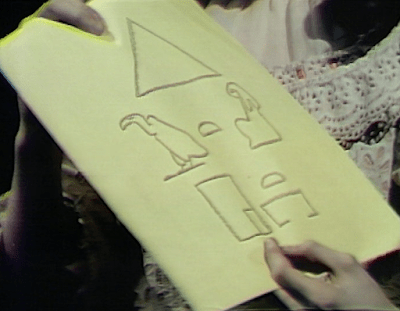
Yesterday, Nora drew a series of Egyptian hieroglyphics saying that her mother was coming home. At the beginning of her dream, a maniacal Edward holds an oversized copy of that drawing and rips it up, declaring Laura will never be back. The oversized drawing harks back all the way to episode #722, when Nora’s governess, neurotic intellectual Rachel Drummond, had a dream in which the daffy Carl Collins held a gigantic pocket watch. That was a striking enough image that not even the Vaseline almost entirely covering the lens could ruin it. But today even less of the picture is legible, and the gambit isn’t fresh anymore. Louis Edmonds does do a fine job of laughing maniacally, though, I will grant that.
The picture really does look like that, and it is supposed to look like that. Director Henry Kaplan was not much of a visual artist. Screenshot by Dark Shadows Before I Die.
Repressed patrician Edward Collins enters his study in the great house on the estate of Collinwood and finds his brother, libertine Quentin, riffling through his desk. Quentin does not feel an obligation to apologize for going through Edward’s things since Edward is among the conspirators holding Quentin’s estranged wife, madwoman Jenny, prisoner somewhere in the house. Quentin learned that Jenny was around only when she escaped from her cell and stabbed him. He is looking for information about where she is now so that she will not get another chance at him. Edward says that Quentin does not need to know where Jenny is, since he is confident she will not escape again.
Quentin is not at all reassured by Edward’s promise. He brings up another topic, Edward’s own estranged wife. For the first several weeks of the portion of Dark Shadows set in the year 1897, the audience was led to believe that Jenny was Edward’s wife, and the mother of his children, twelve year old Jamison and nine year old Nora. When we found out that Jenny was Quentin’s wife, we wondered not only who Edward was married to, but also whether Jenny had borne children by Quentin. After all, she is obsessed with her “babies,” and in #707 we learned that the enterprise of concealing Jenny’s presence in the house involved taking substantial sums of money into the village of Collinsport and giving them to a Mrs Fillmore. Perhaps Mrs Fillmore is taking care of Jenny and Quentin’s children.
Today, Quentin mentions that Edward’s wife, whom Edward said in #705 and says again today “no longer exists” as far as he is concerned, is named Laura. This rings a very loud bell for longtime viewers. The first supernatural menace to dominate the plot of Dark Shadows was Laura Murdoch Collins, estranged wife of high-born ne’er-do-well Roger Collins. That Laura was on the show from December 1966 to March 1967. In the first week of the show, newly hired governess Vicki was surprised to learn that Roger’s wife was still alive, and was told in no uncertain terms that she was not to be discussed. In #705, during the first week of the 1897 portion, newly hired governess Rachel Drummond was surprised to learn that Edward’s wife was still alive, and was told in no uncertain terms that she was not to be discussed. Like Roger, Edward is played by Louis Edmonds. When we learn that Edward’s wife, too, is named Laura, we can only assume that she, too will prove to be an undead fire witch out to incinerate her children for the sake of her own immortality.
Quentin reminds Edward that Laura followed him the year before when he was banished from Collinwood. Indeed, Laura followed Quentin all the way to Alexandria, Egypt. The other day, Quentin admitted to Jamison that he had been a police spy in that city. Edward does not want to hear about any of it.
Nora enters. She asks Edward if she can use his desk to draw with crayons. Edward says that he was just leaving, and she can do what she wants. Quentin stays behind with her for a moment. Nora asks her uncle if he thinks her mother will come back. He looks uncomfortable, says he doesn’t know, and exits.
Barnabas Collins, a distant cousin recently arrived from someplace far away, enters. He looks at what Nora has drawn and recognizes Egyptian hieroglyphics. He asks if she copied them out of a book; she says that they just popped into her head. He says he wonders what they mean; she looks directly into the camera and tells the audience she knows exactly what they mean. They say that her mother is coming home soon. And indeed, they do include actual hieroglyphic symbols for “Mother,” “Come,” and “Home.”
Nora starts talking about her mother. Barnabas encourages her to continue with the topic, and Edward enters. Edward is quite stern with Barnabas; he had made it clear that his wife was not to be discussed with anyone in the house, least of all with his children. Barnabas explains that Nora brought her mother up. He goes on to show Edward the drawing and tell him that he finds it profoundly disturbing. Edward accepts that as a sufficient excuse for going along with Nora while she talks about her mother, but he attributes the drawing to Quentin’s influence.
Whenever we saw Laura alone indoors during the “Phoenix” storyline, she was staring blankly into a fire burning in a hearth. She kept urging her son, strange and troubled boy David, to join her in this pastime, and every time he did we were led to believe that she had taken a sizable step towards her terrible goal. Now we see Nora in the drawing room, staring into the fire that always burns in its hearth.
Nora hears gurgling noises, like indistinct voices rising from below or behind the fire. Frightened, she runs into the foyer, into her father’s arms. She tries to explain to Edward what she heard, and he insists there is nothing to be afraid of. He carries her into the drawing room, where he declares they will look into the fire together and will both realize that nothing out of the ordinary is going on. His plan fails when Nora sees a face wearing a blonde wig starting to take shape in the flames. Nora cries out that it is her mother’s face. We pan to Edward. He is also looking into the fire, and he looks shocked. We wonder whether he is shocked because he can also see the face, or if he is merely alarmed by Nora’s reaction.
Roger and his sister Liz, the adults in the generation of Collinses who live at Collinwood in the 1960s, are Jamison’s children. So Edward and Laura are their grandparents. If this Laura is indeed the same immortal humanoid Phoenix who was David’s mother, Roger therefore married his own grandmother. In #313, Roger had a line about his “ancestors,” which Louis Edmonds bobbled. When he said “incestors,” he giggled, repeated the misspoken word, then corrected himself, calling the maximum possible attention to his error. Many fans bring that rather bizarre blooper up when we come to this story. The writing staff picked up ideas wherever they could, and I suppose the cast’s line difficulties might have been as good a source as any.
Governess Rachel Drummond has figured out that her employers, the Collins family of Collinwood, are keeping someone locked in the room atop the tower in the great house on the estate. Rachel has seemed frightened ever since we first saw her, in #705, and this information has added to her fear considerably. Rachel recently came to the conclusion that some unknown person was trying to harm her. She then let Romani stereotype Magda Rákóczi talk her into believing that the prisoner in the tower room was that person, and that her only hope was to choose the time of their confrontation.
Today, Rachel opens the door to the room and goes in. We know that the enemy Rachel ought to fear is wicked witch Angelique, and we can tell that the person in the room is not her. Instead, she is a madwoman named Jenny, and she is tall with red hair. Jenny attacks Rachel, pushes her back in the room, and flees, locking the door behind her and trapping Rachel.
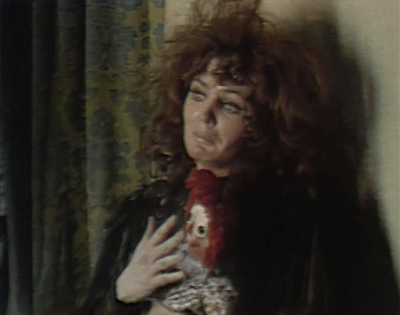
The show has been dropping broad hints that Jenny is the estranged wife of stuffy Edward Collins and the mother of Edward’s children, Rachel’s charges Jamison and Nora. Once she is on the loose, Jenny slips into Nora’s room and looks at a framed picture of Edward there, expressing her hatred for him. Nora has been outside; she had a dream that her missing mother came home, and she went out to look for her. When Nora comes back into the room, Jenny dares not show herself, but stays in the shadows and longingly caresses a doll.
Jenny, in 1897, with a Raggedy Ann doll, first made in 1918. Screenshot by Dark Shadows Before I Die.
A servant named Dirk Wilkins figures in the episode a couple of times. He finds Nora outside, picks her up, and with considerable roughness carries her into the house. Perhaps this roughness is only apparent, but actor Roger Davis was notorious for physically abusing his scene-mates on camera, especially women and children. He may well have been even harder on Denise Nickerson than Dirk is on Nora.
One of my ways of making the show tolerable to watch when Mr Davis is on camera is to imagine someone else playing his part. Dirk is supposed to be unlikable; he sneers at everyone, even his employers. In the part of Dark Shadows set in 1968, a character named Harry Johnson had a similar manner, and even wore a costume like Dirk’s. The first actor to play Harry was Craig Slocum, who was pretty bad, but the second, Edward Marshall, took the same personality and made it quite amusing to watch. Mr Marshall might have made a fine Dirk. Other accomplished performers had small turns as background players on Dark Shadows and surely would have been glad to accept speaking roles. Among these, Harvey Keitel (Dancer at Blue Whale in #33) and David Groh (Ghost of One-Armed Man in #544 and Hangman’s Assistant in #664) went on to do outstanding work playing ill-tempered men, so in either of their hands Dirk might have become a breakout star.




 Dark Shadows Commentary