Madwoman Jenny, estranged wife of libertine Quentin Collins, is on the loose again, and she is the object of a madcap search by Quentin’s sister, spinster Judith, his girlfriend, maidservant Beth, and his distant cousin, secret vampire Barnabas. Quentin makes two contributions to the process. The less important is to serve as the bait in a cockamamie trap Barnabas and Judith lay for Jenny. The more important is to keep up a running commentary mocking the other characters for the silliness of their activities.
The trap itself involves a moment of intentional humor. Barnabas has returned to the year 1897 to prevent Quentin becoming a ghost who will ruin things for everyone on the great estate of Collinwood in 1969. One of the things Quentin did in that year that terrified the characters and tried the patience of the audience was to cause the strains of a sickly little waltz continually to resound from the walls of the great house. When the show became a costume drama and we got to know the living Quentin, we found that he too played a gramophone record of that same tune incessantly, annoying all and sundry. The trap requires Quentin to play the recording over and again until Jenny hears it and comes. After it has been going for half an hour, Barnabas tells Quentin that the plan didn’t work and they should stop playing the waltz. Quentin asks “Are you tired of hearing this music?” Barnabas speaks for all of us when he replies “Frankly, yes.”
Not only is this a successful comedy, it also gives the cast an opportunity for some of their best dramatic acting. As Judith, Joan Bennett at one point stops, looks at Barnabas, and asks “Can we trust you? Really trust you?” She apologizes for the bluntness of that question, then admits that she has long been busy putting a prettier face on the Collins family than the dark secrets Barnabas has discovered make plausible. “I’m not really very trusting. I try to pretend we’re nicer than we really are.” In the parts of Dark Shadows set in the 1960s, Bennett plays matriarch Liz, whose whole personality is about denial and the pretense that the Collinses are nicer than they really are. Liz latched onto Barnabas as soon as she saw him, and refuses to see any evidence that he is not quite normal. Nor does she ever really face her own habits of concealment and their implications. In this little exchange, we see Bennett playing a character whose superficial similarities to Liz point up her profound differences from her.
“Can we trust you? Really trust you?”
Joan Bennett had one of the most distinguished careers of any American actress of the twentieth century. Terrayne Crawford stands at something of the opposite pole, and her performance as Beth leads most fans to declare that she is the weakest of all the members of the cast of the portion of Dark Shadows set in the year 1897. I don’t really disagree with that, but she is fine today. Miss Crawford’s great limitation was that she could play only one emotion at a time, and she was on the show in a period when the scripts gave every character complex motivations in almost every scene. But today, all Beth has to play is Anguish, and Miss Crawford does a fine job.
Beth took care of Jenny during the year Quentin was away from Collinwood, and became very close to her. In the nine and a half weeks since Quentin’s return, she has fallen in love with him. In a scene at the close of today’s episode, Beth tearfully admits to Quentin that she wishes something would happen to Jenny so that he would no longer have a wife. Beth collapses into Quentin’s arms. Jenny has been hiding in a corner, eavesdropping; she comes out, holding a knife. There have been occasions when we might have rooted for Jenny to succeed in killing Beth, just to spare us the embarrassment of Miss Crawford’s flat, tedious performances. But this time, we want to see more of her, and the prospect that Beth might die makes for an effective cliffhanger.
We open in the cottage on the grounds of the estate of Collinwood, where the rakish Quentin Collins has triumphantly confronted his sister-in-law and sometime lover, Laura Murdoch Collins, with a telegram from the authorities in Alexandria, Egypt, declaring that she died in that city the year before. Laura points out that the fact that she is standing in front of him and breathing would tend to limit the credence such a document might be expected to command. Quentin hadn’t thought of that. He looks puzzled for a moment, then says that even if no one else is convinced, he is now sure that she is dead.
Laura, unable to believe that Quentin really is this stupid. Screenshot by Dark Shadows Before I Die.
Viewers who have been with Dark Shadows from the beginning will particularly enjoy this exchange. Another iteration of Laura, also played by Diana Millay, was on the show from December 1966 to March 1967, when the dramatic date was contemporary with the broadcast date. In those days, the authorities in Phoenix, Arizona, kept sending messages to the residents of the great estate of Collinwood concerning their reasons for believing that Laura was dead. Most of those messages were received with a laugh, then with irritation that a bunch of brain-dead bureaucrats wouldn’t stop pestering them with reports that were obviously false. But there were a few times when characters took them with an inexplicable seriousness. It’s a relief to see that this part of the show, set in the year 1897, will not include any of those jarringly foolish reactions.
Quentin and Laura argue about her children. She wants to take them and leave Collinwood; he asks what she will accept instead. Quentin’s pretense that he would have anything to offer her that might be tempting so amuses Laura that she doesn’t bother to be insulted. When he says that he will give her money, she laughs. The penniless Quentin says that he will steal any amount she names. He claims to “have powers.” Before Laura returned to Collinwood in #729, we twice saw Quentin take part in unholy summoning rituals on this set (#711 and #718,) each of which did result in communication with the spiritual forces of darkness. It does seem to be a bit of an exaggeration for him to claim to “have powers,” though. Especially so when he is talking to someone whom he believes to have transcended death.
A male servant comes to the door. Quentin believes this man to be Laura’s lover, and nearly says so today. In fact, Quentin has severely underestimated Laura in every way. She did die in Alexandria. But she has also died in other places, at other times, and will do so again. She is an undead fire witch who periodically incinerates herself and rises from the ashes as a humanoid Phoenix. The man is not her lover in any human sense. Rather, one of the ways she keeps herself more or less alive is by draining heat from his body in a kind of dry vampirism.
Quentin leaves Laura alone with the servant. Opposite David Selby, Diana Millay had shown her gift for dry comedy to great advantage. Once he exits and she is alone with the servant, her manner shifts abruptly. She suddenly starts overacting and sounding false. I think that is down to the actor who plays the servant, Roger Davis. Mr Davis was notoriously abusive of his female scene partners, and she has to play her scene in his arms. It would have been difficult for anyone to relax sufficiently to give a good performance when she was stuck in that unenviable position.
Laura is not the only vampiric presence at Collinwood these days. Time-traveler Barnabas Collins is the old-fashioned blood-sucking kind, and we see him rise from his coffin. He summons his blood thrall Charity Trask to come to him at the Old House on the estate. Charity comes. Several of Barnabas’ female victims have gone through a particular series of stages. First, they are elated at their new connection with Barnabas, and want to devote themselves to him as slavishly as possible. Then, they become reluctant to go on serving as his breakfast, and make anguished protests about wanting to return to their previous lives. Finally, they rebel. Charity has entered the second stage. She says that her father expects her. Barnabas has seen all this before, and has learned to have fun with it. He tells Charity that he needs her more than her father does. He bares his fangs and bites her, after which she is back to elated servility.
Barnabas tells Charity that she will be assisting him in a ceremony. She waits in the Old House while Barnabas goes to the great house on the estate to fetch something he needs for that ceremony.
We cut to Quentin’s room in the great house, where we see a mirror. It shows the reflection of Quentin kissing maidservant Beth. When we first saw them talk to each other in #701, Beth was fighting her attraction to Quentin and trying to resist his attempts to seduce her. That’s what was supposed to be going on, anyway, but we didn’t actually see it. Terrayne Crawford played Beth’s lines according to the literal meaning of the words, with the result that for the first six weeks of the part of Dark Shadows set in 1897 Beth seemed sincerely uninterested in Quentin, and his overtures were just sexual harassment. Now Ms Crawford no longer has to play conflicting emotions. Beth is simply in love with Quentin. She gets that point across adequately.
Beth pulls away from Quentin, explaining that she has to get back to work. He talks about ending his marriage so that they can be together permanently; he says that it may serve their cause to stop being so discreet, since a little scandal may prompt the rest of his family to drop their opposition to any change in the status quo. While they get ready to part, we see the window, outside of which a bat is squeaking incessantly. They exit, and Barnabas appears.
Barnabas rummages through Quentin’s desk and finds a book. Beth reenters and catches him. He tells her he came for the book and was planning to leave a note. A smirk on her face, Beth says that it will not be necessary to do so, as she will tell Quentin all about what she has seen.
Beth goes downstairs and meets Quentin in the foyer. Quentin asks what book it was Barnabas took. She says that all she saw of the title was the word “dead.” Evidently Quentin has quite a few books with the word “dead” in the title, because he has to ask where exactly Barnabas found it. She says it was in the desk, and he rushes off to the Old House.
It was the Egyptian Book of the Dead, and Barnabas used it to perform a rite calling on Amun-Ra to cause the spirit of one of Laura’s previous incarnations to appear before him. At that, we cut to the cottage, where the currently alive-ish Laura grows weak and vanishes. Back in the Old House, we see the ghost take shape. Charity sees it too, and runs screaming out the front door. Quentin enters just in time to see the end of Barnabas’ conversation with the phantasmal Laura. The phantom looks at Quentin, screams, and disappears.
On Friday, Laura said that no one knew just how deeply Quentin was obsessed with the occult. His own absurd claim today to “have powers” so great that he could make it worth Laura’s while to leave without her children confirms that he is very far gone in this obsession. So when he sees that Barnabas is not only doing battle with the same adversary whom he is trying to confront, but is also able to conjure up spirits from the vasty deep, we can be confident that Quentin’s hostility to his recently arrived “cousin from England” will soon be evaporating. As Tony Peterson might say, I think this is the beginning of a beautiful friendship.
Libertine Quentin Collins has learned that his estranged wife, madwoman Jenny, is being kept locked up somewhere in the great house of Collinwood. He learned this when Jenny escaped and stabbed him. He also learned that his brother, stuffy Edward, and maidservant Beth Chavez are involved in the plot to keep Jenny in confinement. He spends time today trying to find out where Jenny is, openly telling both Beth and Edward that when he finds her, he will kill her.
Edward is estranged from his own wife, and just yesterday we learned that her name is Laura. Evidently she is the same sort of creature as we came to know from December 1966 to March 1967. In those days Dark Shadows was set in contemporary times, and Edward’s grandson Roger Collins was dismayed at the return of his estranged wife, who was also named Laura. That Laura was an undead blonde fire witch, a humanoid Phoenix who sought to be incinerated with her son, strange and troubled boy David Collins, so that her own life could be renewed.
Today, the year is 1897 and Edward and Laura’s nine year old daughter Nora is convinced that her mother will return after a year when she has been away and it has been forbidden to mention her name. Nora has a vision of Laura’s face in the fireplace, a vision of flames in the corridor, and a dream in which she meets Laura in the woods outside the house. At the end of the episode she wakes up, sneaks out to the woods, and finds the cloak Laura was wearing in her dream lying on the ground.
All of this is recapped from previous episodes, but actors David Selby, Louis Edmonds, and Denise Nickerson make it worth watching. As Beth, Terrayne Crawford is stiff and literal, and her awkward performance does detract from her scenes. But everyone else is so good that you don’t notice her weaknesses too much.
This episode marks the second time we hear the name “Mrs Fillmore.” In #707, we learned that Beth took substantial sums of money into the village of Collinsport to a lady of that name as part of the plot to cover up Jenny’s presence in the house. Today Beth has to remind Edward of that fact, and Quentin looks through the envelope with hundreds of dollars in banknotes meant for Mrs Fillmore.
When Nora screams that there is a fire in the upstairs hallway, Edward and Beth run towards it. Quentin just sulks in the drawing room; evidently the idea that the house is on fire bores him. By the time Beth and Edward get upstairs, the flames Nora saw have vanished, and nothing is burned. She swears that there was a fire, they cannot believe her. This echoes #400, when wicked witch Angelique cast a spell that caused time-traveling governess Vicki to see flames in her room in the Old House on the estate, and subsequently Vicki’s friends were puzzled that there was no indication there of anything burned. That confusion led to trouble for Vicki, and longtime viewers can imagine it is a sign of trouble for Nora as well.
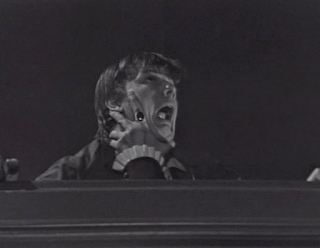
Yesterday, Nora drew a series of Egyptian hieroglyphics saying that her mother was coming home. At the beginning of her dream, a maniacal Edward holds an oversized copy of that drawing and rips it up, declaring Laura will never be back. The oversized drawing harks back all the way to episode #722, when Nora’s governess, neurotic intellectual Rachel Drummond, had a dream in which the daffy Carl Collins held a gigantic pocket watch. That was a striking enough image that not even the Vaseline almost entirely covering the lens could ruin it. But today even less of the picture is legible, and the gambit isn’t fresh anymore. Louis Edmonds does do a fine job of laughing maniacally, though, I will grant that.
The picture really does look like that, and it is supposed to look like that. Director Henry Kaplan was not much of a visual artist. Screenshot by Dark Shadows Before I Die.
A showcase for the actors today. We begin in the room on top of the tower at the great house on the estate of Collinwood. Madwoman Jenny Collins, who has been locked up in that room for some time, is threatening to stab her sister-in-law Judith with a large pair of scissors. Judith and her brother Edward have been hiding Jenny and trying to keep the rest of the family in the dark about her presence in the house. For services to this secret, they have been paying maidservant Beth Chavez and, we heard in #707, someone named Mrs Fillmore. Beth comes in just in time to distract Jenny with talk about her “babies,” and thereby to prevent her from killing Judith. Jenny turns to some baby dolls, and cuddles them happily.
Judith goes downstairs and encounters newly hired governess Rachel Drummond. Rachel has caught on the someone is living in the tower room, and the other day sneaked up there and let Jenny out. Judith reprimands Rachel for seeing and hearing things that don’t exist. Rachel is a neurotic intellectual. Her insecurities compelled her to investigate the question of the tower room, and also make it plausible that she might eventually cave in to Judith’s attempt to gaslight her into believing that she didn’t really see what she saw.
Rachel goes out, and Beth enters. Judith shows how frustrated she is with the whole situation. This scene is a bit of a letdown. As Judith, Joan Bennett was brilliant opposite Marie Wallace’s Jenny, and brilliant again opposite Kathryn Leigh Scott’s Rachel. But she falls to pieces alone with Terrayne Crawford as Beth. So many of the fansites feature so much grousing about Miss Crawford’s literalist style of acting that I hate to pile on, but it is true that she did not give Bennett anything to play off of. When Miss Crawford delivers a line, its meaning is the dictionary meaning of the words that compose it, no more and no less. She never leaves you wondering what else is going on in Beth’s mind. Sharing a scene with her would be like sharing a scene with a sign labeled “No Right on Red.” Later, Miss Wallace will have a two-scene with Miss Crawford, but as a character in a psychotic state she doesn’t need support. Her lines in that scene are flowery gibberish that don’t work at all, but neither actress is to blame for that.
The master class in acting resumes as we cut to the Old House on the estate. The mysterious Barnabas Collins has recently arrived at Collinwood and is staying in the Old House as the guest of his distant cousins in the great house. Rachel and Barnabas are attracted to each other, and she tells him what has happened. He says that he believes her, and goes on to say that no one at Collinwood is what they seem. She pleasantly replies “Except for you!” He hesitates before agreeing.
More than meets the eye.
In fact, Barnabas has more than five hundred episodes of secrets he is keeping from Rachel and everyone else. Jonathan Frid’s work prior to Dark Shadows was almost entirely on stage, but he used his face like a movie actor, keeping every part of it but his eyes virtually immobile. With that, he can isolate emotions, playing just one feeling at a time. All anyone can see by looking at him in his scenes with Rachel today is that he is anguished. Rachel interprets that anguish as a sign that he cares about her, and she is delighted to think that she has such a straightforward and reliable friend.
Returning viewers know that Barnabas is in fact the most dangerous person Rachel has ever met. That knowledge on our part frees Miss Scott to play Rachel’s relief at Barnabas’ friendliness as broadly as she likes. Her unrestrained display of good cheer brightens the episode’s otherwise somber emotional palette, but the irony the audience finds in a woman having this reaction to Barnabas keeps the dramatic tension high.
Barnabas walks Rachel back to the great house. They have made a plan that she will bring him the key to the tower room and he will go up there to investigate. She impulsively kisses him on the cheek. Rachel goes in the house and finds to her surprise that Judith is still awake. Judith detains Rachel in the drawing room with a glass of sherry and a lot of disconnected talk. Judith doesn’t make eye contact with Rachel during this scene; she doesn’t want a conversation. She is simply enjoying her new position as head of the household. Rachel cannot get away until Beth enters and Judith abruptly dismisses her.
Barnabas has been watching the windows of the tower room and has seen lights go on and off. Nervous, he considers letting himself into the room without a key; he has the means to do that, but he would like to keep Rachel from knowing about his abilities, and so he resolves to wait for her.
After Rachel brings Barnabas the key, he goes to the tower room and uses it to let himself in. No one is there. He picks up the damaged, severed head of a doll, one of Jenny’s “babies.” Suddenly, he hears someone enter. He turns, and reacts with shock.
One day in the year 1897, Edward, Carl, and Quentin Collins hear their sister Judith read their grandmother’s will. Stuffy Edward and childlike Carl are shocked to find that Judith is the sole heir of their family’s vast holdings. Quentin stole the will and tried to forge a new one, so he is not shocked, but he is weirdly gleeful about the paragraph relating to him. He will receive no property and no income, but will be guaranteed a place to live in the great house of Collinwood forever. This enshrines his relationship with Judith as one of the clearest examples of Dark Shadows’ signature dynamic of Bossy Big Sister and Bratty Little Brother. No matter how atrociously Quentin may behave, no matter how loudly Judith may disapprove of him, she has no authority to punish him and her concern for the family’s good name will compel her to cover up his misdeeds and shelter him from their natural consequences.
Meanwhile, governess Rachel Drummond and ladies’ maid Beth Chavez are busy with a mystery concerning the room on top of the tower that stands in the middle of the great house. Rachel has seen lights in the room and suspects someone is being held prisoner there; contrary to the direct orders of Judith and Edward, and against Beth’s very strongly worded advice, Rachel is investigating this matter aggressively. She sneaks up the stairs to the top of the tower, listens at the door to the room, and sees Beth coming out of it with a tray.* She then goes to Beth’s room, where she interrupts Quentin sexually harassing Beth. When she tells Beth what she saw in the tower and asks about it, Beth is shocked that Rachel went into the tower. She denies everything.
Later, Rachel goes back to the top of the tower and again listens at the door. She hears a cradle rocking. We saw that cradle in #645, when Dark Shadows was set in contemporary times and Quentin and Beth were ghosts haunting children David Collins and Amy Jennings. They sent Amy and David to fetch the cradle from the attic of the Old House on the estate and to bring it to Quentin’s old room in the west wing of the great house. This is one of the first times in the 1897 segment when we explicitly close a loop opened during the “Haunting of Collinwood” story.
*At the beginning of the episode, we saw Beth approach the room with the tray and a baby doll. During that scene, we hear what I believe is new music. It has been quite some time since we have heard any new cues, so this stands out.
Vampire Barnabas Collins returns to his coffin at dawn to find it already occupied. Governess Rachel Drummond is resting there, and is under the impression that she is Barnabas’ lost love Josette. He exclaims that only his old enemy, wicked witch Angelique, could be “monstrous enough” to put Rachel in this position.
Longtime viewers remember that in #248 Barnabas forced Maggie Evans, who like Rachel is played by Kathryn Leigh Scott, into this coffin because she refused to submit to his attempt to brainwash her into thinking she was Josette. So we know that Angelique is not all alone in the ranks of the sufficiently monstrous. On the other hand, we also know that it was Angelique who made Barnabas a vampire in the first place, and that like others who labor under Angelique’s curses he is in many ways a reflection of her. So perhaps his remark is not so preposterous an example of lack of self-awareness as it initially seems.
Shortly after, Rachel comes to in the front parlor of Barnabas’ home, the Old House on the estate of Collinwood, and is puzzled to find herself there with him. She has no idea how she got to the Old House, and certainly has no memory of the coffin in its basement. Barnabas tells Rachel he found her wandering in the woods. She goes to pieces, overwhelmed that she is not in control of her actions. He talks soothingly to her. Rachel collects herself, but is still struggling not to let Barnabas see her cry. He offers to walk her home to the great house on the estate. This offer is sheer bravado on his part- the sun has been up for some time, and he cannot possibly expect to survive outdoors all the way to the great house. Luckily for Barnabas, Rachel declines his offer. Unable to keep her emotions in check any longer, she hurries out the front door, walking herself home.
At the great house, Rachel sees maidservant Beth enter the foyer carrying a baby doll. Rachel says that her charge Nora will like the doll very much. Beth sputters at this remark, and spinster Judith Collins summons Beth to the drawing room. Rachel eavesdrops while Judith scolds Beth for her carelessness. Returning viewers know that Beth is helping Judith and Judith’s brother Edward keep someone prisoner in the room atop the tower of the great house, and that it is hugely important to Judith and Edward that no one knows about this. Beth’s sputtering response to Rachel told us also that the doll is not for Nora, but for this mysterious prisoner. Rachel does not have all the information about the matter that we do, but she has enough to suspect something very much like the truth, so we wonder what she gets out of the conversation she overhears.
Later, Rachel meets Beth in the foyer and urgently pleads with her for information about Edward’s wife, the mother of Nora and of her other charge, Jamison. Beth tells her what Edward has already made abundantly clear, that the topic is utterly forbidden. Rachel sidles up to Beth, bends her head at an angle, and speaks in an urgent whisper, something we have not seen from either Maggie or Miss Scott’s other role, Josette. Indeed, Rachel is quite a fresh character, impressively so from an actress whom longtime viewers already seen for so many hours.
Rachel pleads with Beth for more information.
Judith overhears Rachel’s questioning of Beth and Beth’s response that Rachel should leave the matter alone. Judith dismisses Beth and talks to Rachel, telling her that Beth has given her very good advice. Judith has figured so far as a stern and menacing figure; it is something of a surprise that she does not fire Rachel on the spot, and even more of a surprise that she indicates she will not report the conversation to Edward.
The opening voiceover will tell us in a couple of days that Rachel’s reckless curiosity is “spurred on by her own fears.” Miss Scott has been playing this motivation all along. When we first saw Rachel, she and Edward were in a train station. He was being courteous to her, but she was stiff and awkward, clearly very much afraid of something. She is often seen reading, and her dialogue is both filled with signs of intellectual ambition and delivered with a frantic edge, suggesting that her studiousness has its roots in her attempt to defend herself against some danger. We have no idea as yet what that danger was or how it formed Rachel before we met her, but we know that her reaction to the evidence that she has found that someone is being held prisoner in the tower room at Collinwood is a deepening of her long-established fears, not the sudden appearance of new fear.
For her part, Judith’s main concern is finding her late grandmother’s missing will. The late Mrs Collins kept the provisions of her will secret, and it was stolen shortly after her death by some people who wanted to forge a new will and get the estate for themselves.
A woman named Magda Rákóczi shows up at the house, claiming to be able to help Judith find the will. Judith is violently prejudiced against Magda for her Romani ethnicity, and dismisses her offer of help out of hand. But Magda persists. Knowing that her grandmother had a fondness for Magda, Judith lets her into the drawing room and sits behind her while she reads the tarot. Judith keeps protesting that the previous cases Magda cites as evidence that the tarot can tell the future prove nothing, and that in her interpretations of them she is “making no sense whatsoever.”
Magda then says that the arrangement of the cards means that the will is hidden in the room where Judith’s grandmother died, in “the heart of the room.” In an entirely different voice than she has been using so far, Judith asks “What is meant by the heart of the room?” With that, Magda knows that she has Judith in the palm of her hand, and she starts to ham it up. “The hearrrt of the roooom… is a booook! A book that was very important to your grandmother! A very, very oooolld booook!” Judith decides this must be the family history, and she tells Magda that she will look through it at once.
In fact, Barnabas found the will and hid it in the family history. He has sent Magda to tell Judith where to find it. It comes as no surprise to us when Judith comes downstairs with the will and is jubilant to find that she is the sole heir of her grandmother’s vast holdings. After all, Barnabas wants the original provisions of the will to be enacted, and the only way to ensure that result is to see that it comes to the hand of the person who is its chief beneficiary.
We end with Beth standing at the door to the tower room, holding the doll and addressing the person inside as “Jenny.” We learned in #701 that Beth was originally maid to a lady named Jenny, that everyone thinks Jenny has gone away, and that it is surprising Beth has stayed on at the house in Jenny’s absence. Now it is confirmed that Jenny is the prisoner in the tower room. The obvious inference is that Jenny is Edward’s estranged wife, and that she has become the sort of crazy lady who appreciates baby dolls.
Vampire Barnabas Collins has traveled back in time to the year 1897 where he hopes to prevent his distant cousin, libertine Quentin, from becoming a ghost who will ruin things for everyone in 1969. Barnabas knows that if events play out as they did originally, Quentin will die soon. He tells him today that it is his understanding that people become ghosts when they leave unfinished business behind them. He does not know what business Quentin originally left unfinished, or how he can keep him from dying without finishing it on this iteration of the timeline. So you might think that his first priority would be to get as close as possible to Quentin and learn as much as he can about what he wants.
Instead of doing this, Barnabas has gone out of his way to antagonize Quentin by accusing him of stealing his grandmother Edith’s will. Quentin and his siblings are all frenziedly searching for the will, but it is of no concern to Barnabas. Edith cannot possibly have left him any money, and he knows that the original timeline worked out so that the Collins family assets wound up in the hands of people who were oblivious to his sinister nature and happy to let him make his home on their estate. Showing interest in the will can do nothing but raise suspicions as to who this stranger really is and why he showed up when he did.
Quentin did in fact steal the will. Edith’s ghost may be at work in the house- her glove mysteriously shows up in the corridor near Quentin’s room, the furniture in the room is turned upside down, and before the end of the episode Quentin alone can hear the pounding of an enormously amplified heartbeat emanating from the walls of his room. But Quentin accuses Barnabas of planting the glove and disordering his room, and in #538 we saw that Barnabas is capable of making people with guilty consciences have hallucinations of just this kind. Barnabas is also frequently seen reading, and it is certainly possible he might have read Edgar Allan Poe’s “Tell-Tale Heart” and decided to make it come to life. He may not even have needed to read the story- we saw in #442 that in 1796, early in his career as a vampire, he bricked up an enemy of his in the style Poe would describe in his 1846 story “The Cask of Amontillado.” Evidently his imagination and Poe’s ran along similar lines.
Barnabas meets governess Rachel Drummond. He is immediately attracted to Rachel, unsurprising since she is played by the lovely Kathryn Leigh Scott. He tells Rachel that she strongly resembles the portrait of Josette Collins, and he relates some facts about Josette’s life and death that did not make it into the family history. Indeed, Miss Scott played Josette in the part of Dark Shadows set in the 1790s.
Yesterday, Barnabas met unethical lawyer Evan Hanley, played by Humbert Allen Astredo. His reaction to Evan was not inappropriate, but the same reaction would also have been fitting had Barnabas thought Evan was Astredo’s previous character, warlock Nicholas Blair. This may have reminded longtime viewers of the 1790s segment, when time-traveling governess Vicki alienated the audience by time and again telling the characters that they were being played by actors who had other parts in the first 73 weeks of the show. Do the characters not look alike to Barnabas, or does he simply have the presence of mind not to waste everyone’s time with tedious drivel about who used to be who? We now know that in Rachel’s case, at least, it is the latter.
Quentin has a scene with his sister Judith in which he tells her that he did not like to play with her when they were children, because she was a “scaredy-cat.” Joan Bennett was 31 years old when David Selby was born, a fact of which the original audience would have been well aware since she was already a major star of motion pictures at the time. Indeed, her father Richard Bennett had been so big on Broadway that her birth was announced on the front pages of the New York papers, so that she never bothered to be coy about her age. But she and Mr Selby are such strong actors that it doesn’t raise an eyebrow when we hear that Judith and Quentin were children together.
Not everyone we see today merits such high praise, alas. Executive producer Dan Curtis was friendly with a man called Roger Davis, and he often let Mr Davis come on the set of Dark Shadows and assault the actors while they were trying to work. Unfortunately this happens today. Mr Davis is usually presented as if he were himself an actor playing a part. His idea of acting is simple enough. For example, he was once supposed to play a character named Jeff Clark, and his approach involved shouting “My name is Jeff Clark!” every episode or two. More recently, he was credited with a role called Ned Stuart, and he went around saying “My name is Ned Stuart!” That’s one way of attempting characterization, I suppose.
Today he is supposed to be someone named Dirk Wilkins. Regular viewers keep waiting for him to yell “My name is Dirk Wilkins!,” but he neglects to do so. He has a mustache, perhaps he thought that was sufficient. He finds Terry Crawford playing maidservant Beth Chavez, grabs her and yells in her face. Mr Selby interrupts this encounter. In character as Quentin, he makes some flip remarks and walks away, and Mr Davis resumes abusing Ms Crawford. Later he finds Ms Crawford on another set and grabs her again. Finally he walks into the set representing Quentin’s room while David Selby is trying to show us Quentin’s panicked response to the sound of the heartbeat. Mr Davis makes some nasty remarks, and when Mr Selby tries to involve him in the scene by tussling with him as Quentin might under those circumstances, it looks like Mr Davis gives him a real punch in the midsection. Mr Selby goes on acting, but the assault takes the audience out of the story. The ABC network really should have posted security guards outside the studio to keep this sort of thing from happening.
Magda Rákóczi, preposterously broad ethnic stereotype, has discovered that the recently arrived Barnabas Collins is a vampire. Barnabas has bitten and enslaved Magda’s husband Sandor, and tells her that she, too will do his bidding. When she asks what has brought him to this conclusion, he tells her that as long as she is in his employ, he will give her jewels. He hands her a ruby ring, and she agrees.
Longtime viewers know well that Barnabas’ plans regularly backfire. Today, we see one of the reasons why. Barnabas does not tell Magda why he has come to the estate of Collinwood in the year 1897, but he does tell her that the following night he will be calling on the Collins family in the great house in order to win their acceptance of him as a distant cousin from England. For all she knows he might be able to complete his task and go back to where he came from shortly after the Collinses welcome him. That would leave her with no further jewelry. So Magda goes to the great house and tells spinster Judith Collins and her brother, libertine Quentin Collins, that a stranger will visit them after sunset. He will present himself as a “friend, perhaps a relative,” but they must not trust him. He is in fact a “creature of darkness” who means them harm.
Judith and Quentin are one of Dark Shadows‘ signature pairings of Bossy Big Sister/ Bratty Little Brother, and they bicker about whether to be disgusted or amused by what they take to be Magda’s transparently fraudulent warning. When Barnabas shows up, Judith is shaken and Quentin laughs at her for taking Magda seriously. In the last scene, Quentin does pull a sword on Barnabas and threaten to kill him on the spot unless he tells a more acceptable story, so apparently he placed a higher value on Magda’s words than he wanted to let Judith know.
Her dialogue is full of lines like “I don’t care” and “It’s none of your business,” and Terry Crawford decides that the best acting choice she could make would be to play it as if Beth sincerely means every word that she says. This is different from what a good actor would do in every respect.
She should be fencing with him, half-flirting and half-angry and half-guilty. Yes, she should be playing three halves right now; that’s the point of the scene. But Terry Crawford gives you what’s on the page, because somebody explained the concept of “subtext” to her once, while she was thinking about something else.
Alas, it is so. Appealing as David Selby’s personality is and lively as his interpretation of Quentin is, Miss Crawford’s literalism means that his efforts are largely wasted, at least in his scenes with her. With Joan Bennett’s Judith or with any of the other members of the cast, we can see that while Quentin’s behavior is inexcusable, his charm is irresistible. But Miss Crawford shows us Beth resisting it with no apparent difficulty, and that leaves him as just another jerk. As I put it in a comment on Danny’s post:
I agree about Terry Crawford. She has to do something very difficult- simultaneously show contempt for Quentin and attraction to him. She manages only the first, meaning that when he keeps at her after she tells him to leave her alone, it isn’t a game, it’s just sexual assault. That makes Quentin a lot harder to like than he needs to be.
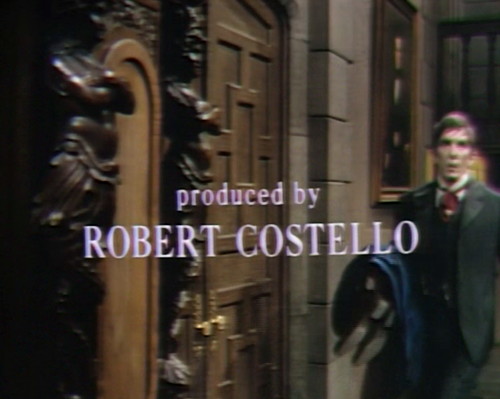
This episode ends with one of the all-time great screw-ups. A few times actors have come partly into view during the closing credits, usually just one arm briefly entering the shot. But this time Jonathan Frid comes walking right into the frame, gives a horrified reaction, and scurries off. It is a thing of beauty, enough to make you wonder how there can be people who are not fans of Dark Shadows.
A great moment in the history of television, or THE GREATEST moment in the history of television? You decide. Screenshot by Dark Shadows Every Day.
We begin the part of Dark Shadows set in the year 1897 with an episode featuring a glittering script, a strong cast, and a hopeless director. Henry Kaplan’s visual style consisted of little more than one closeup after another. The first real scene in the episode introduces us to Sandor and Magda Rákóczi, a Romani couple who live in the Old House on the estate of Collinwood. They bicker while Sandor throws knives at the wall. Thayer David really is throwing knives, but since we cut between closeups of the targets and of the actors we cannot see anything dynamic in that action. He may as well be whittling.
Magda ridicules Sandor’s pretensions as a knife-thrower and as a patent medicine salesman, and busies herself with a crystal ball. She tells him that when “the old lady” dies, they will have to leave Collinwood. He says he knows all about that. She wants him to steal the Collins family jewels so that they can leave with great riches. He eventually caves in and sets out for the great house on the estate, more to escape her nagging than out of greed.
Regular viewers will remember that we heard Magda’s name in December 1968. The show had introduced two storylines, one about the malevolent ghost of Quentin Collins and the other about werewolf Chris Jennings, and the characters were starting to notice the strange goings-on that Quentin and Chris generated. The adults in the great house had no idea that Quentin was haunting them or that Chris was a werewolf, so they held a séance in #642. Speaking through heiress Carolyn Collins Stoddard, Magda mentioned “My curse!” and said that “He must not come back!” It was clear in the context of the episode that the “He” who “must not come back” was Quentin. Chris was a participant in the séance, and he broke the circle before Magda could explain what she meant by her “curse.” Séances held in #170 and #281 were cut short by the person whose secret the medium was about to expose; that it is Chris who interrupts this one would suggest to longtime viewers that Magda not only knew Quentin, but that the curse she is about to explain was the one that made Chris a werewolf. Carolyn and her uncle Roger Collins talked a little about Magda in #643, and psychic investigator Janet Findley sensed the ghostly presence of a woman whose name started with an “M” in #648. We haven’t heard about Magda since.
As the living Magda, Grayson Hall manages rather a more natural accent than Nancy Barrett had when channeling her concerns about “my currrrrssssse.” The exaggerated costumes Hall and Thayer David wear make sense when we hear them reminiscing about the old days, when they made their livings as stage Gypsies with a knife-throwing act, Tarot card readings, and a magic elixir. Even the fact that Magda is peering into a crystal ball during this scene is understandable when they make it clear that they are staying in the Old House as guests of the mistress of the great house, an old, dying lady who enjoys their broadly stereotypical antics. But there is no way to reconcile twenty-first century sensibilities to Hall and David’s brownface makeup. Some time later, Hall would claim that one of her grandmothers was Romani. If that was a lie, it is telling that only someone as phenomenally sophisticated as Hall could in the 1970s see that she would need to invent a story to excuse playing such a character.
Objectionable as Sandor and Magda are, their dialogue is so well-written and so well delivered that we want to like them. Moreover, the year 1897 points to another reason fans of Dark Shadows might be happy enough to see Romani or Sinti characters that they will overlook the racist aspects of their portrayal. It was in 1897 that Bram Stoker’s Dracula was published, and it depicted the evil Count as surrounded by “Gypsy” thralls. The character who has brought us on this journey into the past is Barnabas Collins, and upon his arrival he found that he was once more a vampire.
In addition to the strengths of the dialogue, the acting, and the intertext, there is also a weakness in this episode that softens the blow of the brownface. Today the picture is so muddy that it is possible to overlook the makeup. That’s Kaplan’s fault. It would often be the case that one or the other of the cameras wasn’t up to standard, but when the director was a visual artist as capable as Lela Swift or John Sedwick, there would always be at least some shots in a scene using the good camera, and others where the lighting would alleviate some of the consequences of the technical difficulties. But Kaplan doesn’t seem to have cared at all. He had made up his mind to use a particular camera to shoot the Old House parlor with a subdued lighting scheme, and if that camera was not picking up the full range of color, too bad. He’d photograph a lot of sludge and call it a day.
Meanwhile, a man knocks on the door of the great house. He is Quentin, and the person who opens the door is Beth Chavez. We first saw these two as ghosts in #646. Beth spoke some lines during the “Haunting of Collinwood” story, but Quentin’s voice was heard only in his menacing laugh.
We already know Quentin as the evil spirit who drove everyone from the house and is killing strange and troubled boy David Collins in February of 1969. His behavior in this scene is no less abominable than we might there by have come to expect. He pushes past Beth to force his way into the foyer, does not bother to deny that he has come back to persuade his dying grandmother to leave him her money, pretends to have forgotten someone named “Jenny,” makes Beth feel uncomfortable by saying that her association with Jenny makes her position in the house precarious, orders Beth to carry his bags, twists her arm, and leeringly tells her that she would be much happier if she would just submit to his charms. David Selby sells the scene, and we believe that Quentin is a villain who must be stopped. But Mr Selby himself is so charming, and the dialogue in which he makes his unforgivable declarations is so witty, that we don’t want him to go away. He establishes himself at once as The Man You Love to Hate.
In an upstairs bedroom, the aged Edith Collins is looking at Tarot cards. Quentin makes his way to her; she expresses her vigorous disapproval of him. She says that “When Jamison brought me the letter, I said to myself ‘He is the same. Quentin is using the child to get back.'” Quentin replies “But you let me come back.” She says that she did, and admits that he makes her feel young. With that, Edith identifies herself with the audience’s point of view.
The reference to Jamison and a letter reminds regular viewers of #643, when Magda’s ghost caused a letter from Quentin to fall into Roger’s hands. It was addressed to Roger’s father, Jamison, and was written in 1887. It read “Dear Jamison, You must return to Collinwood. I need your help. You must intercede with Oscar. Only you can save me.” They’ve revised the flimsies quite a bit since then; now it is 1897, Jamison is 12, and we don’t hear about anyone named Oscar.
Not about any character named Oscar, anyway. Edith tells Quentin that “Men who live as you do will not age well.” Quentin tells Edith that she ought not to believe in the Tarot, because “This card always has the same picture and people change, even I.” On Dark Shadows, which from its beginning has taken place on sets dominated by portraits, these two lines might make us wonder what it would be like if it were portraits that changed while their subjects remained the same. Oscar Wilde’s Picture of Dorian Gray was published in serial form in 1890 and as a novel in 1891, and it was a sensation on both sides of the Atlantic. The dialogue is so witty that the characters must be well-read, making it quite plausible that Quentin’s remark was meant to remind Edith of the book. Especially so, since Wilde was released from prison in 1897, bringing him back to public notice in that year.
Edith tells Quentin that old and sick as she may be, she can still out-think him. She declares that all of her grandchildren will get what they deserve. All, that is, except Edward. Roger mentioned Edward in #697, naming him as his grandfather and Jamison’s father. Edith says that Edward is the eldest, and therefore she must tell him “the secret.” There is a note of horror in her voice as she says this; Quentin misses that note, and reflexively urges her to tell him the secret. She only shakes her head- the secret isn’t a prize to contend for, it is a burden to lament.
Isabella Hoopes plays this scene lying on her side in bed, a challenging position for any performer. Her delivery is a bit stilted at the beginning, but after she makes eye contact with David Selby she warms up and becomes very natural. I wonder if the initial awkwardness had to do with Kaplan. He held a conductor’s baton while directing, and he used to poke actresses with it. I can’t imagine a person in bed wearing a nightgown would have an easy time relaxing if her attention was focused on him. Once she can connect with Mr Selby, though, you can see what an outstanding professional she was.
Quentin goes to the drawing room, and finds Sandor behind the curtains. He threatens to call the police, and Sandor slinks back to the Old House. Magda berates him for his failure to steal the jewels, and he insists there are no jewels in the great house.
Meanwhile, Barnabas is in his coffin, trying to will someone to come and release him. In #210, dangerously unstable ruffian Willie Loomis had become obsessed with Barnabas’ portrait in the foyer of the great house, so much so that he could hear Barnabas’ heart beating through it. Barnabas called Willie to come to the secret chamber in the old Collins family mausoleum where his coffin was hidden. In his conscious mind, Willie thought he was going to steal a fortune in jewels. His face distorted with the gleeful expectation of that bonanza, he broke the chains that bound the coffin shut, and Barnabas’ hand darted out, choking him and pulling him down.
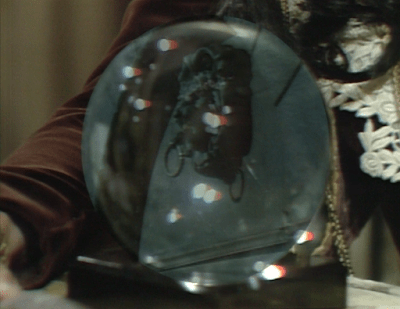
In the Old House, an image suddenly appears in the crystal ball. We can see it, the first time they have actually projected an image in such a ball since the first one made its debut in #48.
Magda notices the image, and tells Sandor to look. He recognizes the old mausoleum. She says that the jewels must be in “the room,” implying that they already know about the hidden panel and the secret chamber behind it. Sandor says it is absurd to imagine Edith going to and from the mausoleum to retrieve pieces of her jewelry collection. Magda ignores this, and urges him to go there. He reluctantly agrees to go with her.
The two of them are heading for the door when they hear a knock. It is Beth, come to say that Edith wants to see Magda. Edith wants what she always wants- to be told that Edward will return before she dies. Sandor says Magda can’t go, but Beth says she will regret it for the rest of her life if she does not. Magda tells Sandor to go on his way without her, and says that she will bring Edith some ancient Gypsy cards, cards older than the Tarot. When she talks about Romani lore, Magda taunts Beth- “but you wouldn’t know anything about that, would you?” Her sarcastic tone implies that Beth has tried to conceal her own Romani heritage.
Sandor opens the secret panel and looks at the chained coffin. He tells himself the jewels can’t be hidden there, then decides he may as well open it anyway- if he doesn’t, Magda will just send him back. Longtime viewers remembering the frenzy in which Willie opened the coffin in #210 will be struck by the utterly lackadaisical attitude with which Sandor performs the same task. Men’s lust for riches may release the vampire, but so too may their annoyance with the wife when she won’t stop carping on the same old thing.
When Willie opened the coffin, it lay across the frame lengthwise and he was behind it. When he raised the lid it blocked our view of his middle. We could see only his face when he realized what he had done, and could see nothing of Barnabas but his hand. The result was an iconic image.
Farewell, dangerously unstable ruffian- hello, sorely bedraggled blood thrall. Screenshot by Dark Shadows Before I Die.
When Sandor opens the coffin, its end is toward us. We see Barnabas at the same time he does. Barnabas’ hand darts up, and also for some reason his foot. The camera zooms in as Barnabas clutches Sandor’s throat. Unfortunately, the shot is so dimly lit that not all viewers will see this. My wife, Mrs Acilius, has eyesight that is in some ways a bit below average, and she missed it completely, even on a modern big-screen television. It’s anyone’s guess how many viewers would have known what was going on when they were watching it on the little TV sets of March 1969, on an ABC affiliate which was more likely than not the station that came in with the poorest picture quality in the area. As a result, the image that marks the relaunch of Barnabas’ career as a vampire is nothing at all. There is so much good stuff in the episode that it easily earns the “Genuinely Good” tag, but Kaplan’s bungling of this final shot is a severe failure.
At the estate of Collinwood, two ghosts are at odds over the fate of a werewolf. Caught in the crossfire are a mad scientist, a recovering vampire, and a couple of kids.
The ghosts are the evil Quentin Collins and a weepy woman so far known only as Beth. The werewolf is Chris Jennings, who is staying in the caretaker’s cottage on the estate. The mad scientist is Julia Hoffman, MD, a permanent guest in the great house. The recovering vampire is Julia’s inseparable friend Barnabas Collins, master of the Old House. The kids are Chris’ nine year old sister Amy and strange and troubled boy David Collins, who live in the great house.
Yesterday, Quentin went to the cottage and put strychnine in Chris’ whiskey. Beth appeared to Julia and led her and Barnabas to the cottage in time to save Chris; today, they figure out that Beth is a ghost.
Quentin has been exercising power over David and Amy, at first with Beth’s cooperation. Beth appears to Amy in a dream visitation. While she guides Amy to images of Chris and David and to the realizations that Quentin means to kill Chris and that David has tried vainly to stop him, we hear Beth speak for the first time. She says everything twice, giving her dialogue a lyrical quality that could be quite lovely. Unfortunately, Terrayne Crawford’s limitations as an actress keep that loveliness from coming through.
Barnabas and Julia know that Chris is a werewolf and have persuaded him to accept their help. They question Chris and are satisfied that he did not poison himself. When he mentions that David visited him the previous morning, Barnabas decides to go interrogate David. Longtime viewers know that David has extensive experience with ghosts, a fact of which Barnabas has at times been most uncomfortably aware. Once Barnabas has learned that Beth is a ghost, it will strike us as reasonable that he will be interested in David’s connection with the matter.
Amy goes to the cottage and sees Julia tending to Chris. They tell her he just had an upset stomach and will be fine. She does not believe them, and says she had a dream that convinced her Chris was in mortal danger. This intrigues Julia, who presses for more details about the dream. Amy clams up, but now Julia and Barnabas, the show’s two chief protagonists, have figured out that David and Amy have something to do with ghosts, and that those ghosts in turn have to do with Chris. The Haunting of Collinwood story hasn’t made any real progress for several weeks, but that can now change.
Back in the great house, Barnabas questions David about his visit to Chris. He doesn’t get any more information out of him than Julia had got out of Amy. There is a bit of intentional humor when Barnabas tells David he thought it would be pleasant to share breakfast with him and Amy. David says it isn’t so pleasant at breakfast- housekeeper Mrs Johnson is in a bad mood in the mornings. Barnabas suggests they ignore her, and David replies that it is not easy to do that. David Henesy delivers this line with perfect comic timing.
Amy shows up and responds favorably to Barnabas’ self-invitation to their breakfast. After Barnabas leaves the room, Amy confronts David about Quentin’s attempt to kill Chris. David has despaired of opposing Quentin, and is terrified when Amy tells him she will go tell matriarch Elizabeth Collins Stoddard everything that has been going on. He is convinced Quentin will kill them if she does this. He is pleading with her to come back when the episode ends.





 Dark Shadows Commentary