One night in 1797, nine Rroma men trapped sorcerer Count Petofi in the forest of Ojden. They amputated his right hand, and with it took most of his magical powers. Some time after, Petofi learned that he had exactly one hundred years to reattach the hand. If he managed it within that time, he would become immortal. Otherwise, he would die on the anniversary of the amputation.
Now that anniversary has come, and Petofi has succeeded in regaining his hand with only minutes to spare. Time-traveling vampire Barnabas Collins and his distant cousin, desperately handsome werewolf Quentin, have decided that because Petofi’s spirit is in possession of Quentin’s twelve year old nephew Jamison and Jamison is as close to death as is Petofi himself, only by surrendering the hand to Petofi can they save the boy. Barnabas did get Petofi’s servant Aristide to promise to free Quentin of lycanthropy once he has the hand back, but he put little faith in that promise.
Now Petofi is jubilant and Jamison is still sick. Barnabas tells Petofi about the deal Aristide made, and also says that he wants Jamison and the rest of the Collinses to be freed from the ill effects Petofi has had on them. Petofi could not be less interested. Instead, he wants Barnabas to tell him how he traveled in time from 1969 and how he will travel back there.
Petofi lets slip that he is anxious to go to another period of history because he is afraid of the Rroma people who are still after him. We know, not only that it was Rroma who cut off his hand, but that when Petofi saw a young Rroma woman in a tavern in #794 he couldn’t get out fast enough. While it may have taken nine Rroma men to take his hand, evidently a single Rroma woman, and a tiny one at that, is capable of doing him considerable harm. Barnabas has a Rroma friend, broad ethnic stereotype Magda Rákóczi, who has considerable magic powers of her own, and he knows of a Romany band currently camped near Boston. So Petofi’s apparently well-founded ziganophobia is a sign that Barnabas may be able to defeat him, even though Petofi’s powers were formidable even before he was reunited with his hand.
Petofi says that he will cure Jamison only if Barnabas explains how he traveled to 1897 from 1969. Barnabas tells Petofi he has no idea how he made that journey. This is so. He meditated on some I Ching wands, a process which he was told might have any of an infinite number of effects, and found himself in 1897. Nor does he have any idea how to get back. He might have enlarged on the theme of his complete lack of useful knowledge in this area. In 1968, Barnabas traveled back to his original era, the 1790s, by going to the grave of a man named Peter Bradford on the anniversary of Bradford’s death. Bradford’s ghost had been haunting him, and Barnabas called for Bradford to take him back to the year 1796. After he did so, Barnabas found that he could return to the 1960s only by having himself sealed in his coffin and waiting inside it for 172 years until friends let him out. He doesn’t tell Petofi about that incident, but it does not seem likely to be of any more help to him than the story about the I Ching would be.
Petofi does not believe that Barnabas is so hapless. First he squeezes Barnabas’ hand, depriving him of the power to dematerialize. Then he opens a cupboard and tells Barnabas to look in it. It takes a while to warm up, but eventually it gets an ABC affiliate showing Dark Shadows. Barnabas sees the parlor of the Old House on the estate of Collinwood in 1969. His best friend, mad scientist Julia Hoffman, MD, is sitting there reading a book. We haven’t seen Julia since #700, but she might be on our minds today. At one point Aristide lights his cigar on a candle burning in a large candelabra. In #296, Julia very memorably did the same thing with her cigarette.
Barnabas sees strange and troubled boy David Collins come staggering downstairs, raving deliriously about Quentin. Julia tells him to reject Quentin, who in 1969 is a ghost haunting Collinwood and draining the life from David. David passes out, and Julia injects him with a powerful sedative, as you do with unconscious children.
The cupboard loses the channel, and Barnabas asks Petofi what else is happening in 1969. Petofi cannot answer any questions; it quickly becomes clear that he couldn’t see or hear the scene. Barnabas is intrigued to learn of another of Petofi’s weaknesses, and walks out.
Aristide then speculates that Barnabas might be telling the truth. Petofi rejects this at once, reveals more of his cupboard’s limitations:
No, he’s not a fool, Aristide. He thinks he can win, accomplish whatever he wants to do here, and disappear without me…
Had Petofi ever seen even one episode of Dark Shadows, it would not occur to him to say that Barnabas is “not a fool.” Nor would he surmise that Barnabas is pursuing a plan that includes a plausible method of escape. If Barnabas had a plan of any kind, Petofi would know all about it, since it would have failed spectacularly the moment he took the first step towards putting it into effect.
Petofi and Aristide then go to the Old House. They find Magda there. At the moment, she is under Petofi’s power. Like Julia, Magda is played by Grayson Hall. We may have thought the glimpse into 1969 was a videotaped insert, but evidently it was done live, because Magda is not wearing her usual heavy brownface makeup. She may have a bit of an artificial tan, but Julia’s blue eyeshadow is clearly visible through it.
Magda, looking more like an actual Rroma woman than she ever has before.
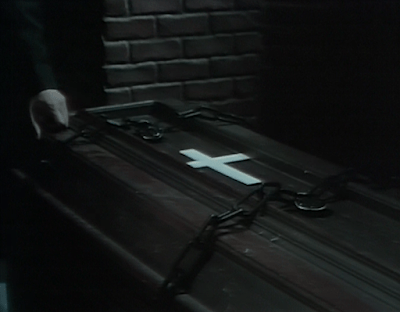
Petofi forces Magda to lead her to Barnabas’ hiding place. He has a cross and Aristide has a chain and a padlock. Petofi puts the cross inside the coffin, and orders Aristide to chain the coffin closed. Petofi declares that Barnabas is in for a long journey.
Sorceror Count Petofi has taken possession of twelve year old Jamison Collins. He has also cast a spell on broad ethnic stereotype Magda Rákóczi, compelling her to lead him and his henchman Aristide to the hiding place of vampire Barnabas Collins.
Jamison/ Petofi and Aristide are ready to drive a stake through Barnabas’ heart. They open his coffin and find that he is away from home today. Magda does not know where his other hiding place is. Jamison/ Petofi becomes intrigued with Barnabas and decides to search through Magda’s home, the Old House on the estate of Collinwood, for papers that might give him information about Barnabas.
He and Aristide find a book published in 1965. Since the dramatic date is currently 1897, this seems to be a matter of some interest. Jamison/ Petofi calls for Magda, who tells him that Barnabas told her that the book had been brought back in time from the 1960s by “a girl named Vicki.” Barnabas’ utterance of the name “Vicki” in #797 was the first reference to well-meaning governess Victoria Winters in the 1897 segment, and this is the second. Vicki was the main character of the show for its first year, and remained in the cast for over a year after that. That the name “Vicki” would be heard only in rare and trivial echoes is not something longtime viewers would likely have predicted before she was written out of the show last year.
Magda goes on to explain that Barnabas himself traveled back in time from 1969. She has a vague idea that he was trying to save a dying child, and hasn’t the faintest clue how he made this remarkable journey. Jamison/ Petofi says that they will get the rest of the story from Barnabas himself. He also says that if he can travel in time, he will be able to live forever, a proposition which would seem to require further explanation.
Jamison/ Petofi is satisfied Magda is telling them everything she knows, but Aristide keeps making threats. The most intriguing refers to something Petofi might do to her: “You’ve heard of his powers. Hasn’t anyone in your tribe ever told you about the mysterious shadow he can cast? The shadow that isn’t your own that follows you?” Writer Sam Hall was probably familiar with a novel called Phantastes by George MacDonald, a bestseller of the nineteenth century that was influential among English fantasy writers of the first half of the twentieth century. It tells of a character named Anodos, who is tormented by a malicious shadow that moves by itself and won’t leave him alone. So perhaps Hall is planning to mine MacDonald’s works for an upcoming story.
Meanwhile, in the great house on the estate, Charity Trask has a dream. She sees Jamison/ Petofi with a portrait of rakish libertine Quentin Collins. The portrait is identical to the one she saw turn into a picture of a werewolf the night before, and she asks Jamison/ Petofi if he saw the same thing. He laughs, then tells her Quentin is a lost soul.
Quentin shows up. Charity’s father, the evil Gregory Trask, has directed her to marry Quentin, and she has set out to comply with this command. Quentin has never shown the slightest interest in her in their time awake together, and he isn’t much friendlier in this dream. He asks her to do something to lighten his mood. “Can’t you be happy? Can’t you be gay? Don’t you want to make me happy?” We’ve never seen her happy; as Gregory’s daughter, it’s hard to see how she could be. She has probably never tried to be gay, either, but it would have to be better than marrying Quentin. She does try to make him happy by imitating Cockney showgirl Pansy Faye, whom she never met or saw or heard, but whose spirit has been possessing her off and on for several days now. She sings Pansy’s theme song and does the highly suggestive dance that goes with it, only to find that Quentin has vanished.
Charity turns and finds Quentin embracing and kissing another girl. They are laughing. Quentin tells Charity that, as she can see, she has succeeded in cheering him up, and therefore she should run along. He and the girl then disappear and Magda enters. Magda tells Charity that she should forget Quentin, because he has a terrible secret. She leaves, and Quentin and the other woman reappear, still laughing at Charity.
Charity decides to ask Magda to explain the dream. Before she reaches the Old House, she finds Quentin and the girl from the dream lying on the ground in the woods. Quentin’s clothing is torn and he is unconscious, but he does not appear to be injured. The girl’s face is covered with what in black and white look like slash marks, but in color are obviously purple makeup. She opens her eyes and gasps Quentin’s name. Whether she was calling for Quentin because he was with her when they were attacked or crying out because he is the one who attacked her would not be clear to first time viewers, though returning viewers know that Quentin is a werewolf and will assume he was the attacker.
Early in 1969, the great estate of Collinwood became uninhabitable. The ghost of Quentin Collins took possession of the place and was about to kill strange and troubled boy David Collins. Quentin and David’s distant cousin Barnabas Collins traveled back in time to the year 1897, when Quentin was a living being, and hoped to somehow prevent Quentin from becoming an evil spirit.
So far, Barnabas has managed to make everything much, much worse. As soon as he arrived in 1897, he found that he had become a vampire. So far, he has been responsible for at least six homicides that did not take place the first time through this period of history. He has also enslaved three people by biting them. He has not prevented a curse that has made Quentin a werewolf, which is evidently the origin of the disaster at Collinwood in 1969.
Moreover, Barnabas’ blunderings have caused Judith Collins, who owns Collinwood and the Collins family businesses, to become close to the hypocritical Rev’d Gregory Trask. Trask has responded to Judith’s interest in him by enlisting lawyer/ Satanist Evan Hanley to carry out a particularly cruel plan to murder Trask’s wife Minerva. Now Trask and Judith are married. Today she tells her brothers, Quentin and the stuffy Edward, that she is changing her will. Edward’s twelve year old son Jamison will still be her heir, but Gregory will administer the estate if Judith dies before Jamison is 21. Regular viewers know, not only that Gregory killed Minerva on the off-chance that he would thereby get a shot at taking Judith’s money, but that he is a sadist who takes special pleasure in making Jamison miserable. So this provision is a death sentence for Jamison. Since the residents of the great house at Collinwood in the 1960s are Jamison’s daughter Liz, son Roger, and grandchildren Carolyn and David, Trask will negate Dark Shadows‘ contemporary timeline if he murders Jamison.
It is not impossible that this might happen. The show is now chiefly about time travel, and the 1960s are not an indispensable destination. Barnabas did leave a few interesting characters behind when he traveled to the nineteenth century- sooner or later he is going to have to be reunited with mad scientist Julia Hoffman, MD, and occult expert Professor Timothy Eliot Stokes also has a lot to offer. But if Barnabas could find a way to come unstuck in time, Julia and Stokes can too. Wicked witch Angelique has already made her way to 1897. And anyone else we might miss can be replaced by the same actor playing a similar part. It does seem unlikely Collinwood will become Traskwood. But in April 1967 it seemed even less likely that the ABC network would devote thirty minutes of airtime five days a week to showing a vampire feeling sorry for himself, yet here we are.
Quentin is amused by Judith’s marriage to Trask, Edward appalled. Edward tells Judith that their grandmother’s will specified that he and Quentin would have the right to stay in the house as long as they wished, a point Judith concedes. This is a retcon. When the will was read in #714, it was made very clear that only Quentin was given a place in the house. Jamison was named as contingent heir. Edward was not mentioned at all. Neither was Carl Collins, another brother of Judith’s, whom Barnabas murdered a couple of days ago and who has already been forgotten.
Judith runs Edward and Quentin out of the drawing room. When she comes back in, she finds that the new will has been torn to shreds, a dagger has been stuck into a Bible under a verse lamenting the sufferings of the righteous, and there is a childish drawing tacked to the wall labeled “Mrs Trask.” Although “Mrs Trask” is now her own name, a fact which she proudly declared to Edward a few minutes before, she immediately assumes the drawing depicts Minerva.
Not the usual sort of portrait one finds on the walls of the great house. Screenshot by Dark Shadows Before I Die.
This resonates with two stories that longtime viewers will remember. From November 1967 to March 1968, Dark Shadows was set in the 1790s. The ancestor of the future Collinses in that period was Daniel Collins, who like Jamison and David is played by David Henesy. Daniel’s big sister Millicent married roguish naval officer Nathan Forbes, who set about trying to murder Daniel in order to get all of Millicent’s wealth for himself.
Yesterday Judith saw Minerva’s ghost in the same part of the drawing room where these odd occurrences have taken place, and the Biblical verse is very much the sort of thing Minerva would have been likely to quote. So we are to assume that she is indulging in a little poltergeist activity. But the “Mrs Trask” drawing is so unlike anything the somber Minerva would have made herself that we can only assume she took it from some other spirit out in the unseen realm. Since “Mrs Trask” is Judith’s name now, the question of who that spirit might be brings up a second old story.
From March to July 1967, Liz was being blackmailed by seagoing con man Jason McGuire. Jason’s ultimate demand was that Liz should marry him, giving him control of the Collins family fortune. Liz’ daughter Carolyn was outraged when it looked like she was going to marry Jason, and in #252 she taunted her mother by shouting the name “Mrs McGuire!” over and again. Perhaps Minerva’s dead spirit has crossed paths with Carolyn’s unborn one, and Carolyn has drawn the picture as a way of rehearsing for that scene. Though Carolyn is an adult, Jamison had a dream in #767 in which he caught a glimpse of the Collinwood of 1969 and saw that Carolyn has a fondness for childish imagery.
There is also some business in this episode about broad ethnic stereotype Magda Rákóczi’s effort to lift the werewolf curse she placed on Quentin. Magda has stolen a severed hand that has magic powers and plans to put it on Quentin’s heart when he begins transforming tonight. Yesterday, Evan forced Magda to let him see the hand; when he looked at it, the hand grabbed him. It left him unconscious and severely disfigured. Now Magda is keeping Evan in her home, the Old House at Collinwood, and treating him with surprising tenderness. Quentin sees Evan there. He does not recognize him, even though he and Evan were close friends, Evan is wearing the same gray suit he always wore, and his very distinctive hair and beard are unchanged. Eventually Evan regains the ability to say his name, and Quentin freaks out. He does not want to go through with Magda’s plan, but when the transformation begins he drops his opposition.
The hand looks very much like a Halloween decoration, so much so that I wonder if Dan Curtis hoped to make some money by getting copies of it into department stores by October 1969. It’s pretty disgusting to look at, but that’s the point.
One of the problems Dark Shadows had throughout its run was that it tended to veer between appealing exclusively to adults and exclusively to children. In the early months, its glacial pace, heavy atmosphere, psychological depth, and reliance on the star power of Joan Bennett drew a rather mature audience. As the supernatural and fantastic themes came to predominate, the average age of the viewers dropped towards the single digits. By the end of the big Monster Mash that ran through 1968, the show’s strongest demographic was probably elementary school pupils. Dividing an episode between the relatively adult melodrama of Edward’s reaction to the Judith/ Trask marriage and the undisguised kids’ stuff of The Hand of Count Petofi would seem to be a way of offering something to both the oldest and youngest viewers.
This episode originally aired on 27 June 1969. That was the third anniversary of the show’s premiere. That first installment, like 332 of those that followed it, revolved around the character of well-meaning governess Victoria Winters, played by Alexandra Moltke Isles. Mrs Isles left the show in November 1968; her son Adam Isles, who would in the 2000s become a top official of the USA’s Department of Homeland Security, was born this day. Mrs Isles has said in interviews that while she was recovering from the birth she tuned in to Dark Shadows, but that the show had changed so much in her time away from it that she couldn’t figure out what was going on.
I imagine Mrs Isles had changed a great deal as well. Like so many members of the cast and production staff, she was a fashionable, sophisticated New York society figure. While she was working on the show, she was immersed in its imaginary world, but after several months away she would have refocused her attention on the sorts of things she was raised to care about when she was growing up as the daughter of Countess Mab Moltke. One doubts that magical severed hands, werewolves, devil worshipers, and actors in brownface makeup would have ranked especially high on that list.
When vampire Barnabas Collins first appeared on Dark Shadows in April 1967, regular viewers may have thought they knew what to expect. They had just spent four months focused on undead blonde fire witch Laura Murdoch Collins, mother of strange and troubled boy David. David’s well-meaning governess Victoria Winters gradually realized that Laura was a deadly threat to him. After some initial confusion, Vicki rallied the other characters in opposition to Laura. Ultimately Laura went up in smoke and David escaped her clutches, choosing Vicki and life over his mother and death.
In many ways, the Laura story was modeled on Bram Stoker’s Dracula. So when Laura’s successor as supernatural menace was an out and out vampire, we may have expected further mining of that source. Barnabas bit and abducted Vicki’s friend Maggie Evans. As the daughter of drunken artist Sam, Maggie had played a key role in the “Revenge of Burke Devlin” storyline. But that storyline fizzled in the show’s early months, and by #201 even Burke Devlin lost interest in it. Maggie was at that point surplus to requirements, and when Barnabas added her to his diet we might have suspected that she would die and rise as a vampire. As Mina and the group she led in Dracula had to destroy her friend Lucy when Lucy rose as “the Bloofer Lady,” so Vicki and her friends would have to destroy Maggie. Vicki herself would then stake Barnabas. The average viewer would have expected this to be the sign to move on to the next menace; those who were aware of TV ratings and programming decisions might think it would be Dark Shadows‘ way of going out with a flourish before its impending cancellation.
Barnabas turned out to be a hit. The idea of a vampire on a daytime soap was such an oddity that a sizable new audience tuned in out of curiosity, and Jonathan Frid’s portrayal of Barnabas’ scramble to impersonate a living man native to the twentieth century resonated with so many of them that he became a breakout star. So they had to figure out a way to make him a permanent part of the cast. That meant Maggie couldn’t die. In the first place, they couldn’t risk making Barnabas responsible for the death of so likable a character. Second, as the survivor of the horrendous abuse Barnabas inflicts on her Maggie would have a new function, as the witness who might emerge to expose him and wreck the show. Third, while Maggie was in Barnabas’ clutches Kathryn Leigh Scott proved herself such a versatile actress that it would obviously damage the show to lose her. So Barnabas not only failed to kill Maggie, he completed only two homicides in the whole of 1967. Each of his two victims was a male character who had run out of story. As a result, the killings and the victims were quickly forgotten.
Barnabas’ nonlethal vampirism made it easier to keep the cast intact, but it also drained him of the lurid novelty that had made him such a draw. To reassure the audience that Barnabas really was a bloodthirsty fiend from the depths of Hell, the show had Vicki come unstuck in time in #365. She found herself in the 1790s, when Barnabas first became a vampire. That gave us a whole cast of characters whom we did not expect to see again once the show returned to contemporary dress. So Barnabas was free to slaughter people to his heart’s content.
The 1790s flashback was a hit in the ratings. When Vicki brought us back to 1968 in #461, the makers of the show had to figure out a way to keep the momentum going. They cured Barnabas of the effects of the vampire curse and surrounded him with a hectic parade of other refugees from 1930s horror movies- mad scientists, Frankensteins, witches, werewolves, and a couple of fresh vampires. After that Monster Mash period exhausted itself, they took us through a long, deliberately paced segment focusing on just two stories, one about a tormented werewolf and the other about a ghost who takes possession first of two young children, then of the whole estate of Collinwood. Barnabas, who has come to see himself as a good guy and the protector of the family, tries to cure the werewolf and reason with the ghost. His efforts instead transport him back in time to 1897.
In that year, Barnabas is a vampire again. He keeps saying that his only goal is to prevent the evils that will befall the family in 1969, but he is as uninhibitedly murderous as he ever was in the periods when he was unambiguously a villain. In Friday’s episode, he murdered one of the principal members of the Collins family, prankster Carl Collins, uncle of the Jamison Collins whose daughter and son are the adults at Collinwood in the 1960s. Barnabas had become so careless after so many killings that he left Carl’s body propped up behind the curtains in the windows of the drawing room, where it fell into plain view moments after Barnabas’ foe the Rev’d Gregory Trask entered. In this episode, Trask enlists Edward Collins, brother of Carl and father of Jamison, to help him hunt Barnabas.
My wife, Mrs Acilius, points out that when we see a character closing the doors to the drawing room, that person is in charge of the house. So in the early months of the show matriarch Liz was the one to close the doors; when Liz was taken to a hospital and her daughter Carolyn was in charge, Carolyn closed the doors. When Vicki was fully in command of the campaign against Laura, she closed the doors to consult privately with her lieutenants. When Trask and Edward go into the drawing room to discuss the situation, it is Trask who closes the doors. Vicki was good, so consistently so that she had to be written out of the show months ago. But Trask is overwhelmingly evil. That he has ascended to the rank of door-closer means that virtue has no stronghold anywhere.
Edward and Trask go to the Old House on the estate, where Barnabas has been staying. They find Barnabas’ reluctant sidekick, broad ethnic stereotype Magda Rákóczi. Magda denies that Barnabas is in the house and pretends not to know what Trask and Edward are talking about when they say that Barnabas is a vampire. Trask slaps Magda in the face; we have seen many face-slaps on Dark Shadows, but so far as I can recall this is the first delivered while the slap-ee has her back to the camera. Since he does not have to swing his hand very close to Grayson Hall’s face, Jerry Lacy can therefore put full force into the gesture, making it look like Trask is delivering a truly brutal blow to Magda. Afterward, Magda rubs her face and vows revenge on Trask. She quotes a rather confusing “old gypsy saying”: “Walk fast and the Devil will overtake you; walk slow and misfortune will catch you. You’d better not walk slow, because I will never be far behind.”
Edward and Trask search the Old House and find nothing. At dusk, Barnabas emerges from the secret room behind the bookcase in the front parlor. Magda hadn’t thought to look there, and Trask and Edward didn’t know the room existed. Barnabas says he will have to find a new hiding place for his coffin. Magda says she will do whatever she can to help him. Barnabas is surprised at her support for him; after all, he has bitten and enslaved her husband Sandor, and his destruction would mean Sandor’s restoration. Magda has an atypical moment of speechlessness, after which she says that Trask is an “animal” and must be punished at all costs.
Trask and Edward went back to the main house early in the morning to look for the plans to the Old House. It apparently took them all day to find them. By the time they have gone through them and identified all of its secret rooms, Barnabas is already up. They come back to the Old House and find the empty coffin in the secret room. Trask says that he will make the coffin “unusable” for Barnabas before daybreak. He leaves Edward, who is carrying a gun loaded with silver bullets, to guard the house.
Barnabas goes to one of his blood-thralls, Trask’s daughter Charity. He tells Charity that he is “in serious trouble” and commands her to go to the basement of the Old House. There, she will find some soil from his original grave, which he needs to prepare his new resting place. He tells her about a tunnel from the beach to the basement which she can use to elude detection by Edward. Since Barnabas has just materialized in Charity’s room and will shortly materialize in the secret room in the Old House while Edward is standing on the other side of the bookcase, we wonder why he can’t use that same power to get into the basement himself.
Barnabas finds that the coffin is topped with a cross. He can’t get close enough to take hold of the coffin and move it, so presumably even after he gets the soil he needs he will have to plunder a mortuary showroom to get a fresh resting place before dawn.
Charity does go to the basement. She puts some soil in her purse, then knocks over a crate, attracting Edward’s attention. She does not run away, but merely hides in an alcove until Edward comes down, sees her in shadow, and orders her to show herself.
We begin the part of Dark Shadows set in the year 1897 with an episode featuring a glittering script, a strong cast, and a hopeless director. Henry Kaplan’s visual style consisted of little more than one closeup after another. The first real scene in the episode introduces us to Sandor and Magda Rákóczi, a Romani couple who live in the Old House on the estate of Collinwood. They bicker while Sandor throws knives at the wall. Thayer David really is throwing knives, but since we cut between closeups of the targets and of the actors we cannot see anything dynamic in that action. He may as well be whittling.
Magda ridicules Sandor’s pretensions as a knife-thrower and as a patent medicine salesman, and busies herself with a crystal ball. She tells him that when “the old lady” dies, they will have to leave Collinwood. He says he knows all about that. She wants him to steal the Collins family jewels so that they can leave with great riches. He eventually caves in and sets out for the great house on the estate, more to escape her nagging than out of greed.
Regular viewers will remember that we heard Magda’s name in December 1968. The show had introduced two storylines, one about the malevolent ghost of Quentin Collins and the other about werewolf Chris Jennings, and the characters were starting to notice the strange goings-on that Quentin and Chris generated. The adults in the great house had no idea that Quentin was haunting them or that Chris was a werewolf, so they held a séance in #642. Speaking through heiress Carolyn Collins Stoddard, Magda mentioned “My curse!” and said that “He must not come back!” It was clear in the context of the episode that the “He” who “must not come back” was Quentin. Chris was a participant in the séance, and he broke the circle before Magda could explain what she meant by her “curse.” Séances held in #170 and #281 were cut short by the person whose secret the medium was about to expose; that it is Chris who interrupts this one would suggest to longtime viewers that Magda not only knew Quentin, but that the curse she is about to explain was the one that made Chris a werewolf. Carolyn and her uncle Roger Collins talked a little about Magda in #643, and psychic investigator Janet Findley sensed the ghostly presence of a woman whose name started with an “M” in #648. We haven’t heard about Magda since.
As the living Magda, Grayson Hall manages rather a more natural accent than Nancy Barrett had when channeling her concerns about “my currrrrssssse.” The exaggerated costumes Hall and Thayer David wear make sense when we hear them reminiscing about the old days, when they made their livings as stage Gypsies with a knife-throwing act, Tarot card readings, and a magic elixir. Even the fact that Magda is peering into a crystal ball during this scene is understandable when they make it clear that they are staying in the Old House as guests of the mistress of the great house, an old, dying lady who enjoys their broadly stereotypical antics. But there is no way to reconcile twenty-first century sensibilities to Hall and David’s brownface makeup. Some time later, Hall would claim that one of her grandmothers was Romani. If that was a lie, it is telling that only someone as phenomenally sophisticated as Hall could in the 1970s see that she would need to invent a story to excuse playing such a character.
Objectionable as Sandor and Magda are, their dialogue is so well-written and so well delivered that we want to like them. Moreover, the year 1897 points to another reason fans of Dark Shadows might be happy enough to see Romani or Sinti characters that they will overlook the racist aspects of their portrayal. It was in 1897 that Bram Stoker’s Dracula was published, and it depicted the evil Count as surrounded by “Gypsy” thralls. The character who has brought us on this journey into the past is Barnabas Collins, and upon his arrival he found that he was once more a vampire.
In addition to the strengths of the dialogue, the acting, and the intertext, there is also a weakness in this episode that softens the blow of the brownface. Today the picture is so muddy that it is possible to overlook the makeup. That’s Kaplan’s fault. It would often be the case that one or the other of the cameras wasn’t up to standard, but when the director was a visual artist as capable as Lela Swift or John Sedwick, there would always be at least some shots in a scene using the good camera, and others where the lighting would alleviate some of the consequences of the technical difficulties. But Kaplan doesn’t seem to have cared at all. He had made up his mind to use a particular camera to shoot the Old House parlor with a subdued lighting scheme, and if that camera was not picking up the full range of color, too bad. He’d photograph a lot of sludge and call it a day.
Meanwhile, a man knocks on the door of the great house. He is Quentin, and the person who opens the door is Beth Chavez. We first saw these two as ghosts in #646. Beth spoke some lines during the “Haunting of Collinwood” story, but Quentin’s voice was heard only in his menacing laugh.
We already know Quentin as the evil spirit who drove everyone from the house and is killing strange and troubled boy David Collins in February of 1969. His behavior in this scene is no less abominable than we might there by have come to expect. He pushes past Beth to force his way into the foyer, does not bother to deny that he has come back to persuade his dying grandmother to leave him her money, pretends to have forgotten someone named “Jenny,” makes Beth feel uncomfortable by saying that her association with Jenny makes her position in the house precarious, orders Beth to carry his bags, twists her arm, and leeringly tells her that she would be much happier if she would just submit to his charms. David Selby sells the scene, and we believe that Quentin is a villain who must be stopped. But Mr Selby himself is so charming, and the dialogue in which he makes his unforgivable declarations is so witty, that we don’t want him to go away. He establishes himself at once as The Man You Love to Hate.
In an upstairs bedroom, the aged Edith Collins is looking at Tarot cards. Quentin makes his way to her; she expresses her vigorous disapproval of him. She says that “When Jamison brought me the letter, I said to myself ‘He is the same. Quentin is using the child to get back.'” Quentin replies “But you let me come back.” She says that she did, and admits that he makes her feel young. With that, Edith identifies herself with the audience’s point of view.
The reference to Jamison and a letter reminds regular viewers of #643, when Magda’s ghost caused a letter from Quentin to fall into Roger’s hands. It was addressed to Roger’s father, Jamison, and was written in 1887. It read “Dear Jamison, You must return to Collinwood. I need your help. You must intercede with Oscar. Only you can save me.” They’ve revised the flimsies quite a bit since then; now it is 1897, Jamison is 12, and we don’t hear about anyone named Oscar.
Not about any character named Oscar, anyway. Edith tells Quentin that “Men who live as you do will not age well.” Quentin tells Edith that she ought not to believe in the Tarot, because “This card always has the same picture and people change, even I.” On Dark Shadows, which from its beginning has taken place on sets dominated by portraits, these two lines might make us wonder what it would be like if it were portraits that changed while their subjects remained the same. Oscar Wilde’s Picture of Dorian Gray was published in serial form in 1890 and as a novel in 1891, and it was a sensation on both sides of the Atlantic. The dialogue is so witty that the characters must be well-read, making it quite plausible that Quentin’s remark was meant to remind Edith of the book. Especially so, since Wilde was released from prison in 1897, bringing him back to public notice in that year.
Edith tells Quentin that old and sick as she may be, she can still out-think him. She declares that all of her grandchildren will get what they deserve. All, that is, except Edward. Roger mentioned Edward in #697, naming him as his grandfather and Jamison’s father. Edith says that Edward is the eldest, and therefore she must tell him “the secret.” There is a note of horror in her voice as she says this; Quentin misses that note, and reflexively urges her to tell him the secret. She only shakes her head- the secret isn’t a prize to contend for, it is a burden to lament.
Isabella Hoopes plays this scene lying on her side in bed, a challenging position for any performer. Her delivery is a bit stilted at the beginning, but after she makes eye contact with David Selby she warms up and becomes very natural. I wonder if the initial awkwardness had to do with Kaplan. He held a conductor’s baton while directing, and he used to poke actresses with it. I can’t imagine a person in bed wearing a nightgown would have an easy time relaxing if her attention was focused on him. Once she can connect with Mr Selby, though, you can see what an outstanding professional she was.
Quentin goes to the drawing room, and finds Sandor behind the curtains. He threatens to call the police, and Sandor slinks back to the Old House. Magda berates him for his failure to steal the jewels, and he insists there are no jewels in the great house.
Meanwhile, Barnabas is in his coffin, trying to will someone to come and release him. In #210, dangerously unstable ruffian Willie Loomis had become obsessed with Barnabas’ portrait in the foyer of the great house, so much so that he could hear Barnabas’ heart beating through it. Barnabas called Willie to come to the secret chamber in the old Collins family mausoleum where his coffin was hidden. In his conscious mind, Willie thought he was going to steal a fortune in jewels. His face distorted with the gleeful expectation of that bonanza, he broke the chains that bound the coffin shut, and Barnabas’ hand darted out, choking him and pulling him down.
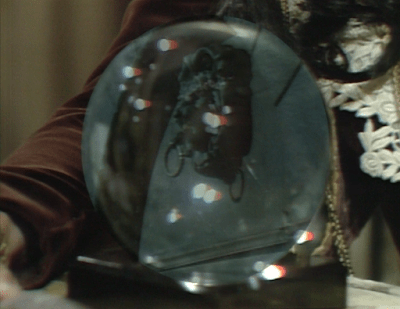
In the Old House, an image suddenly appears in the crystal ball. We can see it, the first time they have actually projected an image in such a ball since the first one made its debut in #48.
Magda notices the image, and tells Sandor to look. He recognizes the old mausoleum. She says that the jewels must be in “the room,” implying that they already know about the hidden panel and the secret chamber behind it. Sandor says it is absurd to imagine Edith going to and from the mausoleum to retrieve pieces of her jewelry collection. Magda ignores this, and urges him to go there. He reluctantly agrees to go with her.
The two of them are heading for the door when they hear a knock. It is Beth, come to say that Edith wants to see Magda. Edith wants what she always wants- to be told that Edward will return before she dies. Sandor says Magda can’t go, but Beth says she will regret it for the rest of her life if she does not. Magda tells Sandor to go on his way without her, and says that she will bring Edith some ancient Gypsy cards, cards older than the Tarot. When she talks about Romani lore, Magda taunts Beth- “but you wouldn’t know anything about that, would you?” Her sarcastic tone implies that Beth has tried to conceal her own Romani heritage.
Sandor opens the secret panel and looks at the chained coffin. He tells himself the jewels can’t be hidden there, then decides he may as well open it anyway- if he doesn’t, Magda will just send him back. Longtime viewers remembering the frenzy in which Willie opened the coffin in #210 will be struck by the utterly lackadaisical attitude with which Sandor performs the same task. Men’s lust for riches may release the vampire, but so too may their annoyance with the wife when she won’t stop carping on the same old thing.
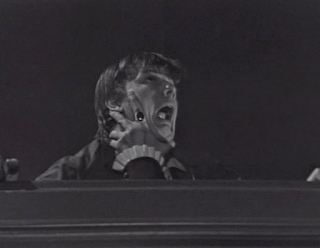
When Willie opened the coffin, it lay across the frame lengthwise and he was behind it. When he raised the lid it blocked our view of his middle. We could see only his face when he realized what he had done, and could see nothing of Barnabas but his hand. The result was an iconic image.
Farewell, dangerously unstable ruffian- hello, sorely bedraggled blood thrall. Screenshot by Dark Shadows Before I Die.
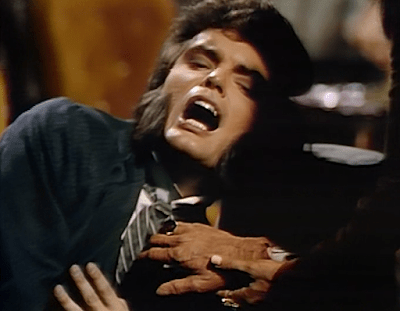
When Sandor opens the coffin, its end is toward us. We see Barnabas at the same time he does. Barnabas’ hand darts up, and also for some reason his foot. The camera zooms in as Barnabas clutches Sandor’s throat. Unfortunately, the shot is so dimly lit that not all viewers will see this. My wife, Mrs Acilius, has eyesight that is in some ways a bit below average, and she missed it completely, even on a modern big-screen television. It’s anyone’s guess how many viewers would have known what was going on when they were watching it on the little TV sets of March 1969, on an ABC affiliate which was more likely than not the station that came in with the poorest picture quality in the area. As a result, the image that marks the relaunch of Barnabas’ career as a vampire is nothing at all. There is so much good stuff in the episode that it easily earns the “Genuinely Good” tag, but Kaplan’s bungling of this final shot is a severe failure.
Old world gentleman Barnabas Collins and governess Maggie Evans make their way into a dusty little room in the long-deserted west wing of the great house of Collinwood. Until last week, the ancient and esteemed Collins family lived in the main part of the great house, but now the evil spirit of the late Quentin Collins has emerged from the west wing and made life unbearable there. They have taken refuge in Barnabas’ home, the Old House on the same estate. Maggie’s charges, twelve year old David Collins and nine year old Amy Jennings, are possessed by Quentin, and David has gone missing.
Last night Maggie had a dream in which she entered this room, found a hole in the wall, and saw a door on the other side. She passed through that door and found a chamber crowded with Victorian bric-a-brac. She met Quentin there, and he gave her a kiss that looked very pleasant indeed. After she awoke, Maggie decided that she would go to the room to see if there was such a chamber behind the wall, convinced she would find David there. Or maybe that she would get another kiss, who can say.
Barnabas and his friend, mad scientist Julia Hoffman, MD, told Maggie it was far too dangerous for anyone to go to the great house alone, and insisted Barnabas accompany her on her expedition. This would seem to reduce the likelihood of another smooch from Quentin, but Maggie acquiesced.
Before we see Maggie and Barnabas, we are treated to a closeup of the tailor’s dummy to whom David referred in #681 as “Mr Juggins.” The camera pulls back, and we see that Mr Juggins is standing in front of a stone bust and next to a globe. The effect is quite stately. Unfortunately, this is Mr Juggins’ final appearance on the show. I think he had a lot of potential.
Barnabas and Maggie finds that there is indeed an opening where she had dreamed one would be and a door behind it. Barnabas pries the rest of the paneling off the false wall, and they enter the chamber beyond. Maggie confirms that it matches her dream perfectly.
They are marveling at this discovery, one made possible only by the intervention of whatever supernatural agency sent Maggie’s dream, when the doorknob starts turning. Occult expert Timothy Eliot Stokes enters.
Maggie and Barnabas look wonderingly at Stokes, and ask how he knew about the chamber. Regular viewers will be at least as surprised to see him as they are. Stokes tells them he was searching a nearby corridor and could hear the noise Barnabas made when he ripped the paneling out. That deflates the moment a little, but does leave us with a sense that there is more to Stokes than we know.
Stokes joins Barnabas and Maggie in searching the chamber, and quickly finds Amy hiding behind a curtain. Amy passes out, and the men urge Maggie to take her to the Old House. Alone with Barnabas, Stokes finds a set of I Ching wands and a couple of books in a desk. He says that it tells him a great deal about Quentin that he had these things. He also says that they will never find David by searching the house- the only way to rescue him is by studying the I Ching.
Maggie has taken Amy back to the Old House. There, Amy suddenly exclaims “Stokes is wrong!” Evidently whatever spirit is possessing Amy is streaming audio from Quentin’s chamber. Maggie asks what she means, and Amy avers that David is in the great house, but that he will soon be entirely subsumed by the spirit of his grandfather Jamison. Maggie rushes out to get him.
We cut back to the great house. Maggie enters the foyer, and David comes to the head of the stairs. She calls to him; he answers and calls her by name, but is struggling. The door at the head of the stairs opens, indicating that Quentin is there. Maggie confronts him and demands David do the same. David struggles further. He is in Maggie’s arms when the door closes, indicating Quentin has left. Maggie exclaims “We won! We won!” But there is no victory. David collapses. Maggie takes him back to the Old House, where Julia examines him and concludes that he will be dead within hours unless the possession is broken.
This situation is familiar to longtime viewers. Dark Shadows version 1.0 ran from June 1966 to March 1967. Its main theme was David’s difficult relationship with Maggie’s predecessor as his governess, Vicki Winters. It reached its end in #191, when David’s mother, undead fire witch Laura Murdoch Collins, tried to kill him. At the last moment, David ran from Laura into Vicki’s arms. With that, he had chosen life over death, and the story of Vicki and David had nowhere to go.
Maggie and Vicki were close friends, and so we can suppose she heard all about how David escaped from Laura. She knows what we know, and so she must feel the same shock we do when the scenario does not reach the same happy ending.
As David’s embrace of Vicki marked the end of Dark Shadows 1.0, his embrace of Maggie today marks the end of Dark Shadows 5.0.* This iteration of the show has focused on two intertwined stories. They concern werewolf Chris Jennings and the ghost of Quentin. Chris’ lycanthropy has been getting steadily more aggressive, and now he cannot revert to his human form at all. Quentin’s power has been growing in tandem with the expansion of Chris’ curse, so that there is nothing left for him to achieve. Both of these stories have, therefore, reached their conclusion. Moreover, the great house has been the constant element at the center of the show. Now that it is closed to the surviving characters, they cannot pick up a new plot and continue the series. It seems that this is to be the final episode of Dark Shadows.
In November 1967, it seemed that Dark Shadows had foreclosed every possible avenue of story development. The characters gathered for a séance, something we had seen them do three times before. Those previous séances had been dramatic high points, but this one had an outcome unlike anything we had seen. Vicki vanished from the circle. A woman unknown to the company took her place and identified herself as Phyllis Wick, governess at Collinwood in the year 1795. She and Vicki had traded places. Vicki took us with her, and for the next four months Dark Shadows was a costume drama set in the late eighteenth century. The result was a triumph that turned the show into a full-fledged hit, one of the major pop culture phenomena of the 1960s.
By now, we’ve seen ten séances, and they’ve gotten sloppy with them. In #600, a séance to contact someone named Philippe Cordier takes less time and trouble than it would have in 1969 to place a station-to-station telephone call. In #682, four characters held a séance in which no one objected when the medium went into the trance, breaking from a ritual form they had observed very strictly up to that point. In #698, we even heard about a séance held off-screen. So it is unlikely they will use a séance to get us from the conclusion of Dark Shadows 5.0 to the beginning of whatever it is that will compose Dark Shadows 6.0.
Barnabas and Stokes take Quentin’s I Ching wands and books to the basement the Old House, where Julia joins them. Stokes explains the I Ching more or less accurately, then Barnabas decides he will use the wands in an attempt to communicate with Quentin. Stokes warns him that the effects of the method are extremely unpredictable, and Julia keeps trying to stop the proceedings. Among them, the three represent the roles of convener, medium, and objector that we have seen in one séance after another.
But Quentin does not speak through any of the participants. Instead, Barnabas’ spirit leaves his body and walks towards a door. He opens it, and finds a coffin on the other side. It seems he is about to become a vampire again, as he was for the 172 years ending in March 1968. He is able to speak while this is going on; Julia knows what he means when he mentions a coffin and a mausoleum. Stokes is not a party to their criminal conspiracies, and so is puzzled. He asks Julia if she knows what Barnabas is talking about, and it is obvious that she is lying when she says she does not. Barnabas heads off towards the chained coffin, and an entirely new show.
*Version 2.0, running from March 1967 to November 1967, introduced Barnabas as a vampire. Barnabas occasionally preyed upon the living, but spent most of his time trying to fit in to the twentieth century. He was so successful in that project that matriarch Elizabeth Collins Stoddard gave him the Old House on the estate of Collinwood to live in, and the viewing public started tuning in in large numbers.
Version 3.0, running from November 1967 to March 1968, was the 1790s segment. It was the inverse of version 2.0. Vicki’s attempt to navigate an alien time failed as spectacularly as Barnabas had succeeded, getting her condemned to death by the other characters and losing the loyalty of the audience.
Version 4.0 was a Monster Mash full of creatures familiar from Universal Pictures horror films of the 1930s; it ran from March to November 1968, and its main theme turned out to be the growing friendship between Barnabas and Julia.
Thayer David joined the cast of Dark Shadows in August 1966, taking over the role of moody handyman Matthew Morgan from George Mitchell starting with #38. In that first episode, Matthew brawled in a barroom and left dashing action hero Burke Devlin gasping. The main storyline of the next few months was the investigation into the death of beloved local man Bill Malloy; it turned out Matthew had unintentionally killed Bill when they got into a fight and Matthew didn’t know his own strength.
Those two events explain the recast. George Mitchell was a slender little man whose white hair and craggy face made him look older than his 61 years. He was a fine actor, but no one would have believed that he could win a fight with Burke or that he was so strong that he would accidentally kill Bill. David was Mitchell’s equal in acting ability, but more importantly was a burly fellow in his late 30s.
Today, we hark back to David’s original function on the show. The setting is the year 1796; vampire Barnabas Collins has traveled back from the 1960s to rescue his fellow time traveler, well-meaning governess Victoria Winters, from death by hanging. David plays another servant. As Matthew was fanatically loyal to matriarch Elizabeth Collins Stoddard, so Ben Stokes is utterly devoted to Barnabas. Ben finds roguish naval officer Nathan Forbes and visiting Countess Natalie DuPrés about to drive a stake through Barnabas’ heart. Ben demands they stop; Nathan aims his pistol in Ben’s direction and squeezes the trigger. The gun misfires. Ben reflexively clutches at his chest, but finding he is not hurt he advances on Nathan. They fight. As Matthew was so strong he could not fight Bill without accidentally killing him, so Ben accidentally kills Nathan. Ben then tells the countess he doesn’t want to hurt her and that she will be all right if she stays put until he can figure out what to do; she is unable to assure him she will do so, and in his attempt to restrain her he inadvertently kills her, too.
Barnabas had originally lived in the eighteenth century. He passed from that time into the 1960s because he was chained in his coffin in 1796 and discovered in 1967 by would-be grave-robber Willie Loomis. Now, he has rescued Victoria, and he is eager to go back to 1969, when he is free of the effects of the vampire curse. He traveled back by standing in an old graveyard and calling to the spirit of Vicki’s boyfriend, an unpleasant man known variously as Peter and Jeff, to pull him into the past. He went to the same graveyard yesterday and tried the same trick in reverse. Peter/ Jeff isn’t in 1969, so he calls instead to his friend, mad scientist Julia Hoffman. That didn’t work, so he decided to have Ben chain him in the coffin and take the long way back.
Barnabas is unhappy to wake up this evening. He leaves his crypt to find Ben using a shovel to pat down some earth nearby. He asks why Ben did not chain the coffin as he was instructed. Ben tells him about Nathan and the countess; evidently he is only now finishing their shallow graves. Ben has never murdered anyone before, so he asks Barnabas’ expert opinion about the next steps. Barnabas tells him to get rid of the countess’ things and to tell whoever asks that she left for Paris.
The reference to Paris is a bit unexpected to longtime viewers. When the countess first appeared in #368/369, she said that she chose to live on the island of Martinique because metropolitan France had become a republic. She and her servant Angelique came to Collinwood along with the countess’ brother André DuPrés and André’s daughter Josette, who was at that time engaged to marry the still-human Barnabas. André is identified as the owner of a sugar plantation on Martinique.
In 1796, France was of course still a republic. But the Terror had ended shortly after the execution of Robespierre in the summer of 1794. Among the beneficiaries were the real-world counterparts of the DuPrés family, the vaguely aristocratic owners of a sugar plantation on Martinique. Their name was Tascher; the daughter of the family was named, not Josette, but Josephine, the widow of the Vicomte de Beauharnais. Josephine was imprisoned in Paris during the Terror, but she was freed, reunited with her son, and restored to her property by June 1795. In May of 1796, Josephine would marry an up-and-coming artillery officer named Napoleon Bonaparte. It would indeed be plausible that the countess would want to go back to Paris and take the opportunity to reestablish a life there.
After the story of Matthew Morgan and the consequences of the death of Bill Malloy ended in December 1966, Dark Shadows was for 13 weeks dominated by the battle between undead fire witch Laura Murdoch Collins and the forces of good, led by Victoria with assistance from the ghost of Josette. Laura was the show’s first supernatural menace.
The ghost of Josette had been introduced in #70 as the tutelary spirit of the long-deserted Old House on the estate of Collinwood. Matthew held Victoria prisoner in the Old House late in 1966, and in #126 he decided to kill her. Josette led the other ghosts out of the supernatural back-world that exists somewhere behind the action to save Victoria by scaring Matthew to death. During the Laura story, Josette’s ghost was deeply involved in the action, literally painting a picture to explain to the characters what was going on.
Prompted by Josette’s ghost, Victoria figured out that Laura was going to burn her son, strange and troubled boy David Collins, to death on the anniversary of similar immolations. This would turn out to be a key turn in Dark Shadows’ world-building. When you are telling stories about supernatural beings, you can’t rely on the laws of nature or logic to shape the audience’s expectations. You need to give them some other mechanism of cause and effect if you are going to create suspense. So from that point on, the show would use anniversaries as causal forces. “It happened exactly one hundred years ago tomorrow night!” means it will happen again then.
That was the basis of Barnabas’ trip to 1796 and of his hope to return by standing on the same spot. Tombstones indicating that Victoria and Peter/ Jeff had been hanged materialized at times related to the anniversaries of those events, and Barnabas must leave 1969 at a certain point to arrive at a certain point in 1796. Eight o’clock on a given night in 1796 corresponds to eight o’clock on a given night in 1969, and those are the times when Barnabas and Julia go to the graveyard from which he vanished and call out to each other.
Even though the conjoined eight o’clocks don’t facilitate Barnabas’ return trip, the structure of today’s episode plays on the same idea of intercutting timelines. We alternate between scenes of Barnabas and Ben in 1796, and of Julia and Willie in 1969. Barnabas bit Willie and enslaved him when he opened his coffin; by the time Barnabas was cured of the effects of the vampire curse, Willie had let go of any hard feelings about that. Barnabas has made the Old House his home, and Willie voluntarily lives there as his servant. Julia has been a permanent guest in the great house on the estate since 1967, but now is apparently staying at Barnabas’.
Julia is determined that Barnabas will return by rematerializing on the spot from which he vanished, and she keeps going back there. Willie doesn’t believe this will happen, but in a long interior monologue comes up with the idea that he might reappear in his old coffin. In her turn, Julia dismisses that idea. They quarrel about these competing absurdities, and Willie decides to put his hypothesis to the test. He goes to the old mausoleum to check on the coffin, and finds it empty. He returns to the house to report this to Julia.
Julia decides it’s time to sleep, so she goes upstairs- apparently to her own bedroom. Seconds later, a ghost appears to Willie. He recognizes it as Josette. She vanishes, and he calls Julia. When Julia comes he tells her that Josette had never appeared to either of them unless Barnabas was in danger. As far as I can recall the audience has never known Josette to appear to Willie or Julia at all, and Barnabas is always in danger, so that remark is a bit of a mystery to longtime viewers.
In the days leading up to Willie’s discovery of Barnabas in April 1967, he, and he alone, heard a heartbeat coming from the eighteenth century portrait of Barnabas that hangs in the foyer of the great house. While he is talking with Julia, Willie turns to the portrait of Barnabas that artist Sam Evans painted in May 1967 and hears the heartbeat again. Julia cannot hear the heartbeat. Willie combines the sound of the heartbeat with the sight of Josette and concludes that Barnabas has returned and the old coffin is no longer empty. We cut to the hidden room in the mausoleum. Chains materialize around the coffin, and we see Barnabas inside it, struggling to escape.
We may wonder if Barnabas has been struggling that way every night since he was chained there in his attempt to return to the 1960s. That would be 173 years, added to the 171 years the first time. It would seem that 344 years confined to a box would make Barnabas even screwier than he is. In a much later episode, we will see Barnabas released after a long entombment and he will be surprised that more than one day has passed. The 2012 film adaptation of Dark Shadows includes a humorous scene based on the idea that time does not pass for Barnabas while he is chained in his coffin. But when he was first released in April 1967, there were indications that he had undergone a nightly torment through the centuries, and the closing image of Barnabas in the box today echoes those indications.
Nathan’s death marks the final appearance of actor Joel Crothers, who has been one of Dark Shadows’ most valuable cast members since his debut in #3, when he played hardworking young fisherman Joe Haskell. We said goodbye to Joe last week; it was nice to have another glimpse of Crothers in his villainous role before he left for the last time.
In January 1969, old world gentleman Barnabas Collins learned that governess Vicki Winters had traveled through time to the year 1796, where she and her boyfriend Peter Bradford were hanged for their many crimes. Barnabas decided to follow Vicki to that year in order to save her and Peter. Barnabas himself lived in the 1790s, and is alive in the 1960s because for 172 of the years between he was a vampire. Once he made his way back to 1796, Barnabas reverted to vampirism.
Yesterday, Barnabas killed a streetwalker named Crystal. After he watched her corpse sink in the bay, he went home to the great house of Collinwood to get to work on his main occupation, feeling sorry for himself. To his shock and bewilderment, he found that Crystal’s body had materialized in an armchair in the study.
Today, Barnabas calls his servant Ben Stokes to help him dispose of Crystal’s body. We have seen that when characters go from the foyer to the study, they walk past the camera, exiting stage right. Once, it seemed the camera might follow a character into the space beyond the foyer. That was in #196, when matriarch Elizabeth Collins Stoddard took several steps towards the camera while telling seagoing con man Jason McGuire that if he wanted to stay at Collinwood he could use a room that direction. Jason called Liz back before she went too far, and insisted on a room upstairs. This time, Barnabas leads Ben all the way off the set. They walk through some darkened space for a couple of minutes before entering the study.
Barnabas and Ben leave the set.
The camera is tight on the two of them throughout this sequence, concealing the fact that there is no set decoration behind them. The episode was directed by executive producer Dan Curtis. Barnabas and Ben’s walk through the void bears Curtis’ directorial signature. Curtis was extremely audacious in everything he did, but had very little experience as a visual artist. He wanted to create the illusion that Collinwood was a big place, but the tight closeup results in a static composition and leaves the audience guessing where Barnabas and Ben are supposed to be. Moreover, making the sequence work at all requires that half the studio be plunged into darkness, creating problems throughout the episode.
In the study, Barnabas and Ben find that Crystal is gone and Barnabas’ ex-wife, wicked witch Angelique, is sitting in the chair. Angelique and Barnabas send Ben away so they can talk privately. Barnabas hasn’t tried to explain to Ben that he is on a return trip to the eighteenth century after 20 months in the 1960s; he hasn’t even told Vicki that he is the man she knew in her own time. But he recognizes that Angelique is not a continuation of her 1795 self, but is a fellow time traveler from 1968. Once Ben is gone, he asks her why she has returned to the era.
Barnabas and Angelique play out their big scene in the lighting dictated by the walk through the nonexistent hallway.
She explains that after she failed to advance the plot in 1968, her demonic masters punished her by sentencing her to remain in “this time forever.” It is not at all clear what that means. Will she relive the year 1796 over and over, like Bill Murray in the 1993 movie Groundhog Day? Or will she just go on living forever and experience time in the usual linear fashion? In the latter case, she would rejoin the 1960s in episodes to be broadcast in the 2130s. Not only would that negate all the timelines we’ve heard about and establish a whole new continuity, it would also mean that Lara Parker had secured the longest-term contract in the history of professional acting.
Angelique tells Barnabas she will help him free Vicki if he will agree to stay and resume their marriage. He is appalled by the notion, but she asks if he can save Vicki without her. He says that he cannot. This is a bit of a puzzle. Barnabas’ vampirism comes with a wide array of powers he could use to break someone out of jail. He could bite the jailers and establish control over them sufficient to force them to let Vicki out. If he isn’t thirsty, he has great physical strength, and is invulnerable to most weapons, so he could just force his way in to the gaol and carry Vicki off. He might not even have to bother with the front door. In #242, Barnabas ripped the iron bars out of the windows of a doctor’s office, and Vicki’s cell at the Collinsport gaol has a window with bars that can’t be much stronger than those were. But I suppose he is worried about distorting the course of subsequent history if he does something spectacular, and he certainly doesn’t want Vicki to find out that he is something other than a human. So he makes a deal with Angelique.
The idea is that Vicki will go to the gallows, appear to drop dead before the hangman does his thing, and that after Barnabas and Peter take Vicki’s body back to Collinwood Angelique will revive her. Both Peter and Ben are horrified at the idea of trusting Angelique, but Barnabas seems to think he has no choice. He insists that Vicki and Peter both wait patiently for Angelique to accomplish her part.
The hanging goes ahead as scheduled. Peter is enraged that Barnabas let Angelique cheat them out of the chance to thrash around and scream during the execution. They take the body to Collinwood and lay it out in the study, a few feet from where Crystal’s body had been at the beginning of the episode. They leave it alone, and Angelique appears. Evidently she does intend to bring Vicki back to life, but she vows that Vicki will be under her power from now on.
Vampire Barnabas Collins has traveled back in time to the year 1796, where he plans to change what happened on one crucial night.
Yesterday’s episode was a clip show excerpted from #456-#460, the last full week of a period when Dark Shadows was a costume drama set in the 1790s. Today’s consists largely of reenactments of those scenes. It all pays off in the last minute, when a confrontation between Barnabas and roguish naval officer Nathan Forbes ends differently than it had the first time round. As before, Nathan loads a crossbow with a wooden bolt and waits for Barnabas to come to him, hoping that he will shoot the bolt through Barnabas’ heart and thereby achieve the same effect as a wooden stake. The first time, Nathan missed Barnabas’ heart and Barnabas killed him. Unlike the first time, Barnabas knows what Nathan is planning. So he opens the door, but does not enter the room. Nathan can hear Barnabas’ voice, but cannot see him. Finally Barnabas jumps Nathan from behind, evidently biting him.
Barnabas originally killed Nathan as revenge for Nathan’s role in his mother’s death. This time he is willing to let Nathan live. He wants to take control of him and force him to tell the authorities that he lied when he testified against governess Victoria Winters and her boyfriend, an unpleasant man named Peter. Victoria is herself a time-traveler, and Barnabas got to be quite fond of her in her original period, the 1960s. She is scheduled to be hanged tonight for her many crimes, and Peter is also condemned to the gallows. Barnabas has come to rescue them.
During the opening title sequence, Thayer David announces that “Today the part of Victoria Winters will be played by Carolyn Groves.” When we first see her, Victoria is asleep in her cell at the Collinsport gaol, and her face looks very much like that of Alexandra Moltke Isles, the original Victoria.
Barnabas wakes Victoria. She is puzzled to see him. He has never told her that he was a vampire; even when he was biting her on the neck and sucking her blood for a week in March 1968, she didn’t seem to catch on. She just seemed to think he had a particularly aggressive make-out technique. She thinks that the Barnabas she knew in the 1960s was a descendant of the one she knew in the 1790s, and that the one from the 1790s is dead. Barnabas would rather not get into the weeds about his personal history, such as the countless murders he has committed, and gives Victoria a truncated account of how he, the man from the 1790s, is laboring under a curse that made it seem that he was dead. He doesn’t explain how he got into her cell, how he knows who Peter is, or how he plans to free the two of them from their death sentences. He asks her to take all of that on faith.
Miss Groves plays Victoria as so happy to see Barnabas she smiles all through her account of her imminent and, she believes, inevitable execution. That’s odd to see, but it fits so perfectly with the delight Victoria always took in Barnabas’ company that it shouldn’t bother longtime viewers.
Mrs Isles was cast as the original Victoria in large part because she looked so much like Joan Bennett that Bennett famously mistook her for her daughter when she first saw her. In the Collinsport Historical Society’s 30 December 2017 post for this episode, Patrick McCray not only tells us that Miss Groves appeared in a play with Joan Bennett in 1960, but provides a still of the cast in which the two women look like they could be mother and daughter:
The show spent much of its first year hinting heavily that Victoria was the unacknowledged daughter of Bennett’s character, matriarch Elizabeth Collins Stoddard. They never collected those hints and built them into a story, and the question of Victoria’s parentage was left as one of Dark Shadows’ most annoying loose ends. Perhaps Miss Groves’ casting is a sign that the failure to resolve that question bothered the makers of the show as much as it did the audience.
An eighteenth century homicidal maniac named Danielle Roget was raised from the dead in 1968 to serve a warlock’s evil scheme. Today, she is taking a break. Another witch has sent her back to her original era for a short visit.
Danielle wants to see a man named Peter Bradford, who has also been raised from the dead and whom she has seen several times in 1968. Peter has a collection of intensely annoying habits which serve as a substitute for a personality. Among these is a tendency to fly into a rage whenever anyone calls him by his right name, and to insist that he be called “Jeff Clark” instead. Danielle has traveled back to the 1790s in search of some evidence that will convince him to desist from this tedious practice.
Today we open at the Collinsport gaol. Peter is in a cell, the gaoler and his assistant are reading Peter’s death warrant, and a gallows is under construction outside. Danielle materializes behind the gaolers, and talks with them for a while. They tell her that a woman named “Gloria Winters” was recently hanged for witchcraft. Danielle realizes that they are actually talking about Victoria Winters, who was the chief protagonist of Dark Shadows for about a year. In November 1967, Victoria came unstuck in time and found herself in the year 1795. She was trapped there until March 1968. Victoria’s utter failure to adapt to her new surroundings led to her condemnation as a witch. At the last second she was whisked from the gallows and returned to her own time. The luckless person whose place she had taken when she arrived from the 1960s appeared at the end of the rope and died in her place.
Danielle asks to see Peter. The gaolers escort her into his cell, lock her in with him, and leave them alone together for several minutes. Peter is unhappy to see Danielle, to whom he was once engaged but whose murderous ways have alienated him. He tells her it saddens him that she is free while he, an innocent person, is about to be executed. Indeed, it was Victoria who killed the man Peter was convicted of murdering, and she did it only to prevent that man killing a child. She tried to tell the court what had happened, but since she was already sentenced to hang and was in love with Peter, her testimony did not persuade the judges.
Danielle offers to break Peter out of gaol. He agrees. She tells him she will go to the great house of Collinwood to enlist much-put-upon indentured servant Ben Stokes in her scheme. Ben, she says, could refuse her nothing.
During the flashback that lasted from November 1967 to March 1968, Ben was ensorcelled by wicked witch Angelique. Now we learn that before Angelique came along, he had been under the influence of Danielle, another beautiful woman with an evil heart and a greatly heightened acting style. Perhaps Ben would do better if he looked for a homely, soft-spoken woman.
We cut to Collinwood, where haughty patriarch Joshua Collins is summoning Ben. They discuss Peter’s upcoming hanging and Victoria’s recent one, and lament the injustice of it all. Joshua calls Ben’s attention to a book Victoria brought with her from the twentieth century. It is a highly inaccurate history of the Collins family up to that time. Joshua says that he believes the book is an evil thing and that getting rid of it is the only hope of ending the cascade of horrors that have befallen the family and everyone they know since Victoria first arrived. Joshua orders Ben to take the book deep into the woods and burn it. He tells him something else- he has read the book thoroughly, and will see to it that posterity accepts all of its false reports as true. Rather than risk the world finding out that his son became a vampire, his wife committed suicide, and his cousin married a bounder, he will see that it is published that the son moved to England, the wife died of natural causes, and the cousin was a spinster all her life. Thus we learn how the events we saw during the 1795 segment were kept out of the historical record.
Ben is barely out the front door when Danielle stops him. He is dismayed to see her. He tells her she wasn’t supposed to come back, and refuses to look at her. She says she has a plan to spare Peter. Ben says that her plans always involve hurting someone, and she says that this time it is different. Ben asks if she intends to poison the gaoler. She tosses her head, laughs at the thought, and assures Ben all she will put in the gaoler’s drink is a “harmless drug.” Ben asks if she is sure the man won’t be hurt, and she assures him she has no grievance against him, only a desire for him to sleep long enough to get Peter to safety. At length, Ben agrees to take two horses to the gaol. There won’t be time for him to burn the book first; Danielle takes it from him for safekeeping.
We cut to the office of the gaol, where Danielle has been reading the book. She tells herself that Victoria must have brought it from the 1960s, and that it might be very valuable to her. The gaoler enters, and Danielle tells him she wants to see him after the hanging. He doesn’t understand why; she clarifies that she is making a pass at him. They are an unlikely couple, and he seems dubious of her interest in him. He tells her Peter is writing a note, probably for her, and sends her back to see him.
The gaoler has the look of a man who believes that if a thing seems too good to be true, it probably is. Screenshot by Dark Shadows Before I Die.
Peter tells Danielle he has decided not to escape. He hands her a note which he predicts she will have trouble understanding. Delivered by another actor, this might have sounded like an apology for an unsuccessful effort to express a complicated idea, but Roger Davis has a way of spitting out his lines that makes it sound very much like he is telling Danielle she is stupid. The gaoler and his assistant come to take Peter off to be hanged, not a moment too soon.
In the office, Danielle reads the note and is pleased with it. She closes it in the book. Apparently she expects to be able to use both of those items to get Peter to stop boring everyone with his nonsense about being named “Jeff Clark.” The gaoler stands behind her and watches as she fades away, taking the book with her.
The gaoler is played by Tom Gorman. Gorman was on Dark Shadows at least 14 times, until now always as an uncredited background player. His first part was in November 1966, when each episode began with the words “My name is Victoria Winters.” So it really is remarkable when he proclaims “Her name was Gloria Winters!” Despite that spectacular blooper, he does a nifty job playing the gaoler’s confusion and skepticism about Danielle, and it is too bad this is his final appearance.





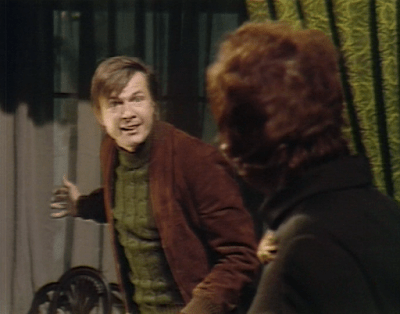


 Dark Shadows Commentary