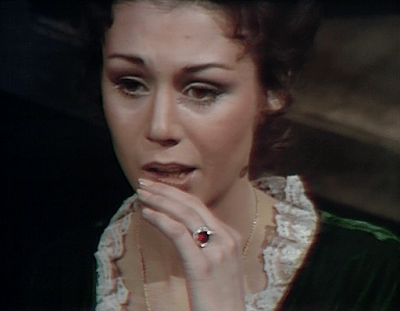
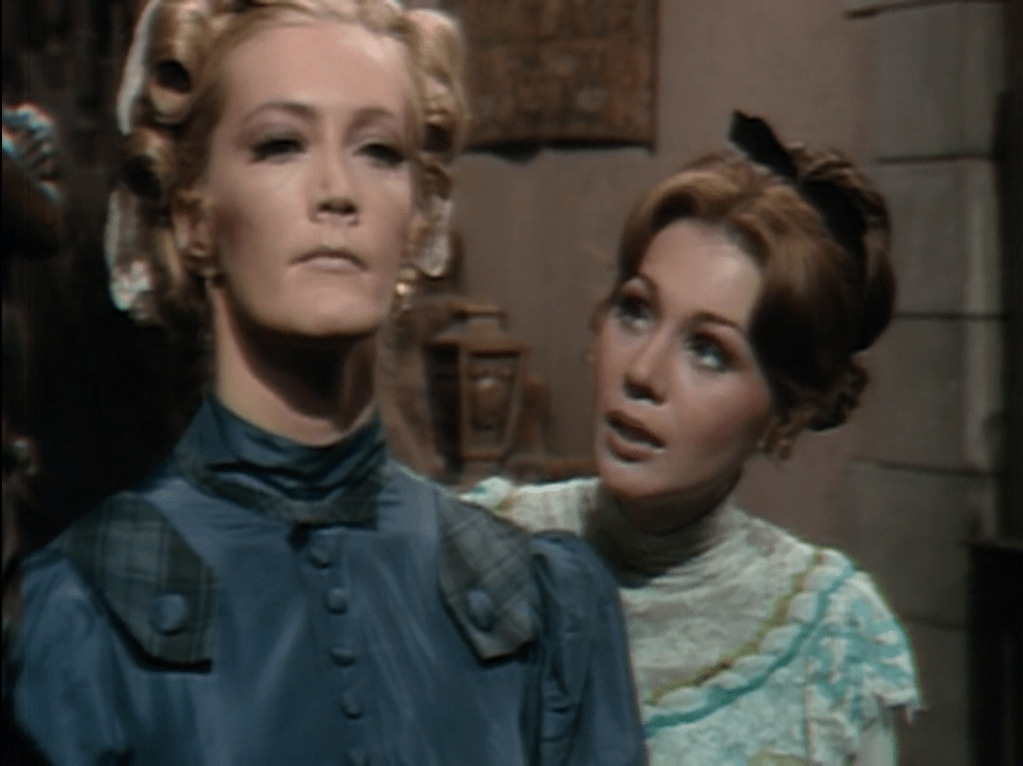
Episode 794: The hand doesn’t always bring out the best in people

Soap operas usually have at least one set representing a public gathering place where characters can meet one another unexpectedly. By this point in the development of Dark Shadows, the population of its universe is so heavy with monsters and witches that unexpected meetings usually take place in graveyards, or basements, or out in the woods someplace. But for the first seventy three weeks of the show, one of the most important meeting places was a tavern called The Blue Whale, and as the bartender Bob O’Connell was a significant, though almost always silent, presence.

The Blue Whale has been mentioned occasionally since those days, most recently in #704, shortly after vampire Barnabas Collins traveled back in time to the year 1897. Today is the first time we visit the Blue Whale in the 1897 segment, and the first time we have seen Bob O’Connell as the man pouring since #439, when Dark Shadows was set in the 1790s. In those days, the tavern was called The Eagle and O’Connell’s character’s name was Mr Mooney.

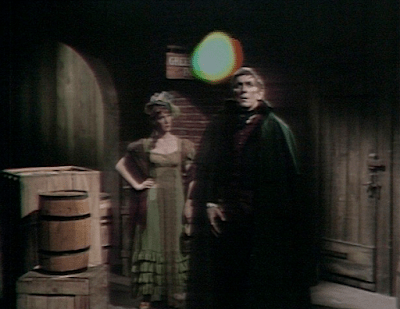
When we arrive at the tavern today, there is only one customer, a young man sitting at a table. When the bartender sets a drink in front of him, he orders a Chartreuse. The bartender moves to take the drink he has just served, apparently thinking the young man changed his mind, but the young man explains that he is waiting for someone else. This man, a heavyset fellow with gray side whiskers, enters a moment before the bartender brings his liqueur.

The bartender wonders if Aristide still wants the drink he originally ordered. Screenshot by Dark Shadows Before I Die.

The younger man is known to returning viewers as a knife-wielding criminal named Aristide, the older as his master, who calls himself Victor Fenn Gibbon. The two urgently discuss a woman named Angelique. Fenn Gibbon tells Aristide that he can almost forgive him for being so distracted by Angelique’s beauty that he allowed her to take “the Hand” from him, and furthermore that she appears to have magical powers. He says that he showed forged papers to one Edward Collins, and that on the basis of those papers Edward concluded that he was “a member of the British aristocracy” and invited him to stay at the great house on the estate of Collinwood. Aristide will have to stay in the village of Collinsport, since Fenn Gibbon does not want their association to become known to the Collinses. Aristide is bitterly disappointed.

This will remind longtime viewers of seagoing con man Jason McGuire and his sidekick, dangerously unstable ruffian Willie Loomis. Jason turned up in March 1967 with a sinister plan and soon took up residence as a guest at Collinwood. Shortly afterward, Willie joined him. At first Jason insisted Willie stay in town. He made that insistence while sitting at virtually the same spot Fenn Gibbon and Aristide occupy today, and Willie reacted with the same disappointment Aristide shows when he was told to stay in a flophouse when his co-conspirator was to be a guest in a mansion.

When Fenn Gibbon tells us that the letters he showed Edward were forgeries, he raises the question of his real name. He seems to have a whimsical sense of humor, and a double barreled name that sounds like a species of small ape found in a peat marsh would appeal to someone trying to test the credulity of an American impressed by the naming conventions of the British upper classes. And indeed, returning viewers know that Edward lacks a sense of humor, is quite a snob, and displays all the tell-tale signs of a hopeless case of Anglophilia.

A small young woman takes her place at the bar. Fenn Gibbon recognizes her as of Romani extraction. He becomes agitated and leaves, but directs Aristide to get to know her. Aristide, whom returning viewers saw meet with misfortune when he tried to pick up Angelique, gladly complies. She responds to his initial approach with a flat declaration that she isn’t interested, but when he mentions the other Romani people in the area, she perks up. She gives her name as Julianka, and asks if he knows a woman named Magda. He says he has met her.

This will intrigue returning viewers. The other day, Aristide robbed Edward’s brother Quentin of the legendary “Hand of Count Petofi,” a severed appendage which broad ethnic stereotype Magda Rákóczi had stolen from Romani chieftain/ organized crime boss King Johnny Romana and which she plans to use to lift a curse she had placed that made Quentin a werewolf. When Quentin told Magda what had happened, he described Aristide only as a “young man.” If Magda really has met Aristide, Quentin’s reticent reply would have cost him an opportunity to help Magda figure out who her enemies really are.

Whether or not Aristide has met Magda, he does know where she lives. He escorts her to the grounds of the Old House at Collinwood. He does not offer to accompany her into the house, but asks her to meet him later at the Blue Whale. As Angelique had responded to Aristide’s overtures by choking him within an inch of his life, Julianka responds to them by drawing a dagger. Aristide just doesn’t have game.

After Aristide parts from Julianka, the werewolf pounces on him. He is about to be devoured when Fenn Gibbon shows up. The sight of pretty little Julianka drove Fenn Gibbon away in a barely concealed panic, but the werewolf doesn’t scare him a bit. He talks calmly to the werewolf, and says that he has orders for him. The werewolf docilely complies. This would be a much bigger surprise if the werewolf were not an adorable little doggie wearing a tidy suit with a watch fob, but it still sends the message that Fenn Gibbon has very extensive powers.

In the Old House, Julianka meets Barnabas. She says that she can use the Hand of Count Petofi to cure Quentin. She also says that Magda’s husband Sandor is in Montreal. This point will be of interest to regular viewers. We haven’t seen Sandor since #750. We may well have been wondering whatever happened to him. We are particularly likely to have been wondering about that this week, since Thayer David, who plays him, is playing Fenn Gibbon. They don’t usually double actors within a time period, and so Fenn Gibbon’s introduction might have suggested they wanted us simply to forget about Sandor. If they are going to take the trouble to tell us he is in Montreal, perhaps we can hope he will return before long, and simply not share scenes with Fenn Gibbon.

Barnabas is in a glum mood. He always is, more or less, but especially so when he has had to deal with Angelique. She told him earlier that she has moved on from her centuries-long fixation on him and now wants to marry Quentin. Barnabas responds with disbelief, declaring that the only reason she would do that is to spite him. Since her obsession led her to turn him into a vampire and kill everyone he ever loved, you can see that Barnabas would have mixed feelings when she tells him that she is looking for a fresh start. On the one hand, it suggest the possibility that he might achieve some kind of freedom. But he’s still a bloodsucking ghoul, his sister and mother and true love and uncle and aunt and countless others are still dead, and the person behind all that doesn’t even care about it anymore.

My wife, Mrs Acilius, points out that it is only appropriate that Angelique made Barnabas a vampire. Angelique too is phenomenally selfish, and whatever she creates becomes a replica of herself. So of course her greatest achievement is to turn a man into a metaphor for extreme selfishness. Barnabas’ selfishness tempers his rage at Angelique’s news; when Julianka comes to him, he is deep in thought, no doubt brooding about what it all means for him.

In his post about this episode at Dark Shadows Every Day, Danny Horn shows that the relationship between Fenn Gibbon and Aristide is modeled on that between Gutman and Wilmer in The Maltese Falcon, and he and his commenters demonstrate that that novel and its 1941 film version included explicit hints that Gutman and Wilmer were occasional sex partners. Aristide has been so eager to connect with the ladies that it’s hard to see much gay subtext between him and Fenn Gibbon so far, but it’s early days for them on the show. Moreover, the echo of Jason and Willie reminds us of the hints the show dropped that those two had shared more than a firm handshake at some point in their seafaring days. The original series bible and the early drafts of the first scripts had referred to The Blue Whale as “The Rainbow Bar”; maybe Aristide and Fenn Gibbon are destined to bring that name back.

Episode 793: All the revolted spirits

When wicked witch Angelique first turned Barnabas Collins into a vampire in the 1790s, he went to the waterfront and preyed on the women he found spending their nights there. When Barnabas traveled in time from the 1960s to the year 1897, he again made his way to the waterfront. Whether he bit the women or not, he choked them to death, earning the sobriquet “The Collinsport Strangler.”

Once he had become a vampire, Barnabas displayed so many traits he had come to have in common with Angelique that we suspect he is not only cursed by her, but possessed by her. More precisely, it often seems that when Angelique made Barnabas a vampire she created a copy of her own personality and put it in his mind, where it took control of him. We have further support for that interpretation in today’s opening reprise. We see Angelique on the same set where Barnabas has several times been the last person a young woman would encounter. This time, she encounters a young man. He flirts with her, as the women flirted with Barnabas. Before long, he is choking and within seconds of death because of her action. In this case, she has taken his handkerchief and is tightening it around the neck of a toy soldier that once belonged to Barnabas. She is threatening to kill him unless he tells her where he has hidden the legendary “Hand of Count Petofi.”

The man’s name is Aristide. He capitulates, telling her he buried the hand at the old cemetery, in a grave marked with a stone bearing the name of Townsend. She gives the handkerchief another tug, and he falls down, unconscious.

Later, we are in the great house on the estate of Collinwood. Angelique comes down the stairs, carrying the box in which the hand is kept. Stuffy Edward Collins sees her. Regular viewers have seen the box on a table in the upstairs hallway many times, from the first week of the show onward. It is rather odd that Edward doesn’t ask her why she is carrying it around. Even if we decide to forget that the prop is familiar and decide to treat it as representing something Edward hasn’t seen before, people don’t usually walk around carrying wooden boxes in front of themselves.

Still, Edward does have other matters on his mind. Angelique had been introduced to the family as Barnabas’ fiancée, at a time when all the Collinses knew about Barnabas was that he was their distant cousin. She disappeared when he was exposed as a vampire. Edward tells her that the family’s lawyer, Evan Hanley, told him that he knew her before she met Barnabas, and that he believes that her association with him was innocent. Edward also says that he cannot believe that this is true. Angelique tells Edward a story about Barnabas biting her and making him her slave; Edward is convinced instantly, and declines her offer to leave at once. He urges her to stay at Collinwood until she can make new plans.

Meanwhile, we have learned that Aristide is alive and not seriously injured. A man in a set of whiskers that represent the aesthetic sensibilities of the late Victorian era developed to their uttermost extremity finds Aristide crumpled on the ground, rouses him from unconsciousness, and responds to his story about Angelique almost killing him with dismay that she stopped short. He tells Aristide not to do anything more. His own credentials are in order, and he will present them at Collinwood as he sets about his second attempt to get the hand.

The man does go to Collinwood. He gives Edward a letter from their “mutual friend,” the Earl of Hampshire. It attests to the good character of its bearer, Victor Fenn Gibbon. Edward insists that Fenn Gibbon stay in the house, and he accepts.

Angelique emerges from the drawing room, still carrying the box. Edward continues to ignore it; Fenn Gibbon can’t take his eyes off it. Edward introduces her as Angelique Duvall. This is the first time we have heard the name “Duvall” in connection with her; when we met her in the part of the show set in the 1790s, her name was Angelique Bouchard, and when she turned up in 1968 she called herself Cassandra Blair. Fenn Gibbon asks if she is French. She says that she was born in the USA, but that her forebears were French people who lived on Martinique. Indeed, when she was known as Angelique Bouchard she lived on that island, and it was there she met Barnabas. Fenn Gibbon tells her that lovely as France’s colonial possessions may be, none is as “exquisite” as she. She is charmed, and excuses herself. She leaves the house, taking the box with her.

While Fenn Gibbon regales Edward with tales of derring-do from the battle of Khartoum, Angelique takes the box to the Old House. There, she meets the rakish Quentin Collins, whose desperately handsome face has been severely disfigured by a previous encounter with the hand. Angelique dismisses Quentin’s girlfriend, maidservant Beth, telling her that she cannot be present during what she must now do for Quentin. Beth leaves, Angelique shows Quentin the hand, and Quentin demands that Angelique set to work curing him. She says there will be a price for her services. If she cures him, he will have to marry her. He has nothing to lose, and she looks exactly like Lara Parker, so of course he agrees.

Angelique picks up the hand and gets to work casting a spell, but the hand quickly escapes her control. She turns to find that it is on Quentin and he is in agony. He pleads with her to help, she cries out that she can do nothing, and we see Fenn Gibbon peering in through the window.

Fenn Gibbon looks on. Screenshot by Dark Shadows Before I Die.

Fenn Gibbon* is the fifth role Thayer David played on Dark Shadows. The first, second, and fourth were all closely associated with the Old House. They were crazed handyman Matthew Morgan, who holed up there after he killed local man Bill Malloy; much-put-upon indentured servant Ben Stokes, who lived and worked there; and broad ethnic stereotype Sandor Rákóczi, who with his even more offensively conceived wife Magda lives at the Old House in 1897. With this iconography behind David, regular viewers will know that when they see Fenn Gibbon in the window of the Old House, they are seeing a man who knows his way around the place.

David’s third role sheds even more light on Fenn Gibbon. In the parts of the show set in 1968 and subsequent years, he plays Professor Timothy Eliot Stokes, expert on the occult and descendant of Ben. Unlike most of the characters who made a splash on the show, Stokes has a functioning conscience. He does not always live within the law, but he always strives to do what is right. When we see that Fenn Gibbon knows about the hand and has orchestrated a criminal conspiracy to obtain it, we see that he is an evil version of Stokes. At once this makes him fascinating to regular viewers. Stokes himself is a reimagining of the show’s first academic specialist in the paranormal, Dr Peter Guthrie, who was killed by a witch in #186. He is a jovial and talkative eccentric, where Guthrie was a tight-lipped and understated Yankee. Fenn Gibbon seems to have inherited Stokes’ whimsical bent and exaggerated manner; we now have to wonder what Stokes would be like as a villain.

Even those who joined the show after it went to 1897 and who therefore do not know about Stokes will be intrigued when they see David as Fenn Gibbon. Sandor hasn’t appeared since #750, but he is still alive. This marks the first time Dark Shadows has cast the same actor as two living characters in the same time frame.** Sometimes an actor has doubled as a living character and as a ghost, or has appeared in two roles in parts of an episode set in different periods of history. But this is a new frontier for doubling on the show. Sandor is always a lot of fun, so we might hope that he will be back and that he and Fenn Gibbon just won’t have scenes together. But coming on the heels of his long absence, it does have an ominous ring.

In #758, Quentin backed Angelique against a wall and asked her why she preferred Barnabas to him. That was a very good question. The two of them are obviously attracted to each other, and have a lot of fun every time they are alone together. By contrast, the only emotions Barnabas has ever shown in response to Angelique are glumness and rage. Her maniacal insistence that Barnabas should love her drove Angelique to wreak immense havoc in the 1790s, and also motivated some story in 1968. But there is nothing to it beyond his misery and her self-absorption. When we see her turn her attentions to Quentin, longtime viewers will cheer at the hope that we are about to be freed from that dead end once and for all.

*He introduces himself today as “Fenn Gibbons,” which is how he is almost always addressed. But the closing credits leave the S off his name. The closing credits have been unreliable lately, identifying Edward as his grandson Roger and misspelling Aristide’s name. Still, “Fenn Gibbon” sounds better to me; “Fenn Gibbons” suggests a group of small apes found in a peat bog.

**Don Briscoe briefly played both werewolf Chris Jennings and Chris’ brother Tom, but that is only a partial exception- Tom was a vampire at that time.

Episode 718: Spy school

The principal writer of the first seventeen weeks of Dark Shadows was Art Wallace, who was interested in characters as one another’s reflections. Many of his episodes were structured as diptychs, in which we would alternate between two small groups dealing with similar situations. In the comparison, we would see that people who were in some ways very different from each other or hostile to each other would make the same decisions when faced with the same circumstances.

Wallace left the show in October 1966, never to return, but his interest in mirroring comes up again and again. The current storyline centers on Barnabas Collins, who has traveled back to the year 1897. In the first months of 1969, the ghost of Quentin Collins was persecuting strange and troubled boy David, and it was to rescue David that Barnabas participated in a summoning ritual which, to his surprise, got him unstuck in time and brought him face to face with the living Quentin. It also turned Barnabas back into what he was for 172 years, a vampire.

This story is the inverted image of Dark Shadows‘ first costume drama insert, which ran from November 1967 to March 1968. In that period, well-meaning governess Vicki participated in a summoning ritual because she knew that some supernatural menace posed a mortal threat to David. She did not know who that menace was or in what way he was supernatural, but the audience knew that it was Barnabas the vampire. During the four months of that uncertain and frightening journey into the past, we learned how Barnabas became a vampire and that he could be interesting even if he were not one. Vicki didn’t learn anything, and would eventually be written out of the show.

Early in today’s episode, Barnabas is in the room on top of the tower in the great house on the estate of Collinwood. This room was introduced in the 1790s story as one of the places where Barnabas was hidden. In this period, a mentally ill woman named Jenny Collins is hidden there. Governess Rachel Drummond sneaked into the room because Barnabas’ unwilling associate, ethnic stereotype Magda Rákóczi, read Rachel’s palm and told her she had a deadly enemy who was hiding there, and that if she let that enemy choose the time of their first meeting she would have no chance of survival. Jenny sprang from the room, locked Rachel in it, went to the main part of the house, and set fire to the sheets of the bed in which the stuffy Edward Collins lay sleeping.

Barnabas heard about this from Rachel, who reminds him of his lost love Josette. He knows that Angelique, the wicked witch who turned him into a vampire in the first place, is operating in this period and that she has already targeted Rachel. He knows nothing about Jenny, and so he assumes that Angelique is lurking in the tower room. When he enters it, he opens an armoire and finds a doll’s head. The rest of the doll is not attached and the back of the head is caved in, but the face is undamaged. This is the first suggestion of a mirror, a device in which a face can be seen intact and functional even though it is separated from the rest of the person.

Barnabas calls for Angelique and she appears. Barnabas denounces Angelique’s crimes; Angelique brings up his. She asks what he sees when he looks in the mirror, then remembers that he casts no reflection. Angelique does not mention what we have seen ever since we first met her during the 1790s segment, that the vampire curse made Barnabas into her reflection. Today, for example, she gleefully taunts him with the murders he has committed, including those her curse compelled him to commit. This reminds longtime viewers of #341, when Barnabas pressured his friend Julia Hoffman into helping him kill a man named Dave Woodard and then gleefully taunted her with her new status as a murderer.

Angelique tells Barnabas that he has only to love her and she will cease to be his enemy. She makes it clear that she knows all about the mission that has led him to travel back in time from 1969, and offers to help him accomplish it. She suggests that it is his hatred for her that has led her to treat him and everyone around him so cruelly for so long. She says that she will return his love as abundantly as she has returned his hate. She claims to be his mirror, as we know he has long been hers, and offers to show him a pleasing reflection if he submits to her desires.

Barnabas angrily refuses, and Angelique conjures up an image of his impending destruction in the window. Barnabas will not look into this magic mirror, and when he seizes Angelique she vanishes from his arms.

Quentin is on his guard against Barnabas. In the course of an adorable scene in which Quentin and his twelve year old nephew Jamison pretend to be spies, he sends Jamison to steal something that belongs to Barnabas.

Spy school.

Jamison is leery of the whole thing; he says that Quentin doesn’t know any more about real spycraft than he does, forcing Quentin to admit that he was in fact a spy for the police in Egypt not so long ago. This too will get the attention of longtime viewers. Jamison is played by David Henesy, who in the parts of Dark Shadows set in the 1960s plays David Collins. Jamison and Quentin are in the groundskeeper’s cottage on the estate, which from December 1966 to March 1967 was home to David’s mother Laura Murdoch Collins. Laura often told the story of the Phoenix, usually setting the scene in an unnamed land which, she said in #140, “Some call… Paradise.” But she leans heavily enough on the existing mythology of the Phoenix that she reminds even readers who have never heard of Herodotus of ancient Greece and Egypt. Laura herself turned out to be a supernatural phenomenon consisting of several distinct beings reflecting themselves back to each other.

Quentin decides that Jamison must sneak into Barnabas’ house and bring his cane back to the cottage. After he does so, Quentin casts a spell that causes Jamison to speak with the voice of Ba’al, a title for various gods whose cults are remembered very unfavorably in Judaism, Christianity, and Islam. Among other grim associations the name of Ba’al brings to the minds of those who adhere to the great monotheistic religions is the practice of child sacrifice among the Phoenicians, a practice that often involved the burning of the body of the sacrificed child. Since “Phoenician” and “Phoenix” sound so much alike,* longtime viewers may well associate Ba’al with Laura.

Quentin has made a voodoo doll of Barnabas. Through Jamison, Ba’al says that only silver will work against Barnabas. Silver is of course used in making mirrors, and the piece of silver Quentin uses to inflict disabling pain on Barnabas is the head of Barnabas’ own cane. So once more Barnabas finds himself oppressed by a reflection, or perhaps by the absence of a reflection.

Barnabas is with Magda when he collapses under the pain Quentin is causing him. They discover that the cane is missing. Magda figures out what is happening, and rushes to the cottage. She confronts Quentin, jeering at his cowardice. Quentin is no man at all. He is using a child as a pawn in a black magic rite, and fighting an enemy using a doll. Magda looks at Quentin’s face and reacts with horror as the image of a skull is superimposed on it. She recognizes this as a sign that he will die soon.

Jamison has scenes with both Quentin and Magda today. David Henesy had such great chemistry with David Selby that it’s no wonder Mr Selby named his son “Jamison,” and Hall’s equally great chemistry with him leads me to suspect that if her son Matthew hadn’t already been born when she joined the show he might have been named for Mr Henesy as well. Hall and Jonathan Frid are always wonderful together, and today’s Barnabas/ Angelique confrontation is the best scene Frid and Lara Parker have shared so far. Angelique’s maniacal intensity has always set an upper bound to how responsive Parker could be to Frid’s performance. She is calm enough today that we see them for the first time really in the same space.

*As well they might- they both come from the ancient Greek Φοίνιξ, an adjective meaning “red.” Herodotus calls the legendary fire creature “red-bird,” and the Greeks named the northern Canaanites after the red dye they bought from them.

Episode 713: The heart of the room

Vampire Barnabas Collins returns to his coffin at dawn to find it already occupied. Governess Rachel Drummond is resting there, and is under the impression that she is Barnabas’ lost love Josette. He exclaims that only his old enemy, wicked witch Angelique, could be “monstrous enough” to put Rachel in this position.

Longtime viewers remember that in #248 Barnabas forced Maggie Evans, who like Rachel is played by Kathryn Leigh Scott, into this coffin because she refused to submit to his attempt to brainwash her into thinking she was Josette. So we know that Angelique is not all alone in the ranks of the sufficiently monstrous. On the other hand, we also know that it was Angelique who made Barnabas a vampire in the first place, and that like others who labor under Angelique’s curses he is in many ways a reflection of her. So perhaps his remark is not so preposterous an example of lack of self-awareness as it initially seems.

Shortly after, Rachel comes to in the front parlor of Barnabas’ home, the Old House on the estate of Collinwood, and is puzzled to find herself there with him. She has no idea how she got to the Old House, and certainly has no memory of the coffin in its basement. Barnabas tells Rachel he found her wandering in the woods. She goes to pieces, overwhelmed that she is not in control of her actions. He talks soothingly to her. Rachel collects herself, but is still struggling not to let Barnabas see her cry. He offers to walk her home to the great house on the estate. This offer is sheer bravado on his part- the sun has been up for some time, and he cannot possibly expect to survive outdoors all the way to the great house. Luckily for Barnabas, Rachel declines his offer. Unable to keep her emotions in check any longer, she hurries out the front door, walking herself home.

At the great house, Rachel sees maidservant Beth enter the foyer carrying a baby doll. Rachel says that her charge Nora will like the doll very much. Beth sputters at this remark, and spinster Judith Collins summons Beth to the drawing room. Rachel eavesdrops while Judith scolds Beth for her carelessness. Returning viewers know that Beth is helping Judith and Judith’s brother Edward keep someone prisoner in the room atop the tower of the great house, and that it is hugely important to Judith and Edward that no one knows about this. Beth’s sputtering response to Rachel told us also that the doll is not for Nora, but for this mysterious prisoner. Rachel does not have all the information about the matter that we do, but she has enough to suspect something very much like the truth, so we wonder what she gets out of the conversation she overhears.

Later, Rachel meets Beth in the foyer and urgently pleads with her for information about Edward’s wife, the mother of Nora and of her other charge, Jamison. Beth tells her what Edward has already made abundantly clear, that the topic is utterly forbidden. Rachel sidles up to Beth, bends her head at an angle, and speaks in an urgent whisper, something we have not seen from either Maggie or Miss Scott’s other role, Josette. Indeed, Rachel is quite a fresh character, impressively so from an actress whom longtime viewers already seen for so many hours.

Rachel pleads with Beth for more information.

Judith overhears Rachel’s questioning of Beth and Beth’s response that Rachel should leave the matter alone. Judith dismisses Beth and talks to Rachel, telling her that Beth has given her very good advice. Judith has figured so far as a stern and menacing figure; it is something of a surprise that she does not fire Rachel on the spot, and even more of a surprise that she indicates she will not report the conversation to Edward.

The opening voiceover will tell us in a couple of days that Rachel’s reckless curiosity is “spurred on by her own fears.” Miss Scott has been playing this motivation all along. When we first saw Rachel, she and Edward were in a train station. He was being courteous to her, but she was stiff and awkward, clearly very much afraid of something. She is often seen reading, and her dialogue is both filled with signs of intellectual ambition and delivered with a frantic edge, suggesting that her studiousness has its roots in her attempt to defend herself against some danger. We have no idea as yet what that danger was or how it formed Rachel before we met her, but we know that her reaction to the evidence that she has found that someone is being held prisoner in the tower room at Collinwood is a deepening of her long-established fears, not the sudden appearance of new fear.

For her part, Judith’s main concern is finding her late grandmother’s missing will. The late Mrs Collins kept the provisions of her will secret, and it was stolen shortly after her death by some people who wanted to forge a new will and get the estate for themselves.

A woman named Magda Rákóczi shows up at the house, claiming to be able to help Judith find the will. Judith is violently prejudiced against Magda for her Romani ethnicity, and dismisses her offer of help out of hand. But Magda persists. Knowing that her grandmother had a fondness for Magda, Judith lets her into the drawing room and sits behind her while she reads the tarot. Judith keeps protesting that the previous cases Magda cites as evidence that the tarot can tell the future prove nothing, and that in her interpretations of them she is “making no sense whatsoever.”

Magda then says that the arrangement of the cards means that the will is hidden in the room where Judith’s grandmother died, in “the heart of the room.” In an entirely different voice than she has been using so far, Judith asks “What is meant by the heart of the room?” With that, Magda knows that she has Judith in the palm of her hand, and she starts to ham it up. “The hearrrt of the roooom… is a booook! A book that was very important to your grandmother! A very, very oooolld booook!” Judith decides this must be the family history, and she tells Magda that she will look through it at once.

Magda goes over the top. Screenshot by Dark Shadows Before I Die.

In fact, Barnabas found the will and hid it in the family history. He has sent Magda to tell Judith where to find it. It comes as no surprise to us when Judith comes downstairs with the will and is jubilant to find that she is the sole heir of her grandmother’s vast holdings. After all, Barnabas wants the original provisions of the will to be enacted, and the only way to ensure that result is to see that it comes to the hand of the person who is its chief beneficiary.

We end with Beth standing at the door to the tower room, holding the doll and addressing the person inside as “Jenny.” We learned in #701 that Beth was originally maid to a lady named Jenny, that everyone thinks Jenny has gone away, and that it is surprising Beth has stayed on at the house in Jenny’s absence. Now it is confirmed that Jenny is the prisoner in the tower room. The obvious inference is that Jenny is Edward’s estranged wife, and that she has become the sort of crazy lady who appreciates baby dolls.

Episode 712: A pawn in this cruel game

Dark Shadows first developed its conception of the supernatural in depth when undead blonde fire witch Laura Murdoch Collins was on the show from December 1966 to March 1967. Laura was not so much one person as she was a complex of at least three distinct beings. There was a charred corpse in the morgue in Maricopa County, Arizona; a phantom that Laura’s son, strange and troubled boy David Collins, can sometimes see through his window as she flickers above the lawns of the estate of Collinwood; and a living woman who carries on conversations with people but is never seen eating or drinking. People who encounter Laura also experience dream visitations that resemble her and unaccountable compulsions to do things relating to her, but it is never clear which of those psychic phenomena come from Laura and which from her arch-nemesis, the ghost of the gracious Josette. It is clear that the various parts that make up Laura are not always aware of each other, and sometimes work at cross-purposes with each other.

Laura’s successor as Dark Shadows‘ chief supernatural menace was vampire Barnabas Collins, who joined the show in April 1967. Like Laura, Barnabas comes in several parts, not all of them working together harmoniously. For example, sometimes doors slam shut when he is in a house, and only he can open them. This is never shown as something he deliberately makes happen, and it does not always serve any intelligible purpose of his. Also, when he is active dogs start howling. Sometimes that immobilizes his targets with fear and confusion, but just as often it costs him the element of surprise and foils his plans. So whatever uncanny forces cause these things to happen are clearly not subject to Barnabas’ will. They accompanied him out of the darkness.

Shortly after Barnabas’ arrival, the show retconned Josette as his lost love and cast her as Princess Ankh-Esen-Amun to his Imhotep in a remake of the 1932 film The Mummy. In that film, the undead man tried to remake contemporary woman Helen Grosvenor in the image of the ancient Ankh-Esen-Amun. Taking that role in Barnabas’ attempt to recreate Josette was Maggie Evans, The Nicest Girl in Town. As in the 1932 film Zita Johanns played Helen in the contemporary scenes and Ankh-Esen-Amun in a flashback to ancient Egypt, so in #70 and #126 had Miss Scott already played the ghost of Josette.

While Barnabas pursued his crazed and evil plan to Josettify Maggie, the ghost of his little sister Sarah showed up. Sarah befriended Maggie and helped her escape from her “big brother.” Sarah did more and more, ultimately sending well-meaning governess Vicki back in time so that from November 1967 to March 1968, Dark Shadows was a costume drama set in the 1790s, when Barnabas and Sarah were alive.

Like Laura and Barnabas, Sarah may have looked like single person, but was in fact a complex of independent beings. In #325, she visits David in a dream and gives him information only she would have. In #327, David sees Sarah during waking hours and tells her about the dream, and it all comes as news to her. This daylight Sarah makes it clear to David that she does not want him to have the information the dream version of her gave him so shortly before.

Moreover, child actress Sharon Smyth was instructed to play Sarah as Barnabas’ conscience. When Barnabas is freed to prey upon the living, he unknowingly pulls Sarah out of the supernatural back-world behind the action of the show, the unseen realm where Josette’s ghost, the “Widows,” the ghost of Bill Malloy, and the rest of them lurk, and brings her with him into 1967. Sarah, however many of her there are, is part of the same complex that includes Barnabas and the forces that surround him.

In the 1790s portion, we met wicked witch Angelique and saw her place the curse that turned Barnabas into a vampire. Like the other supernatural forces, Angelique was a complex of multiple beings, some of which were opposed to each other. In her case, spellcasting was a matter of breaking off little bits of herself that took on lives of their own. Angelique was obsessed with the idea that Barnabas would fall in love with her. She could easily cast a spell to make him do that, but insisted to her helper that Barnabas must come to her “of his own will.” Those were the exact words Barnabas used when talking to his own thrall about Vicki, who succeeded Maggie as the object of his gruesome fantasies. When we heard Angelique take the same line, it dawned on us that the Barnabas we saw from April to November 1967 was not merely cursed by Angelique, he was possessed by her. His thoughts were her thoughts, his plans were her plans. When Barnabas fights Angelique, it is one of her replicas of herself coming back to oppose her, as the zombie version she created of Barnabas’ uncle Jeremiah came back to bury her alive in #396.

Now, Barnabas has traveled back in time to 1897. He has met governess Rachel Drummond, who is played by Kathryn Leigh Scott and whom he recognizes as a double of Josette. Angelique has also come to 1897, conjured up by some Satanists whom Barnabas has antagonized for no apparent reason. Angelique peered through the windows of the great house of Collinwood just in time to see Barnabas giving Rachel Josette’s music box. Dismayed, she went to the Old House on the estate, looked at Josette’s portrait, and declared “I am Angelique, and I hate you!” She, like Barnabas, looks at Rachel and sees another Josette.

Angelique’s motivation in the 1790s segment was ostensibly about her desire for Barnabas, but it was her hatred for Josette that drove her at every turn. Now we see that Barnabas is compelled to create another Josette whom he can love; Angelique is just as powerfully compelled to create another Josette to hate. Since Barnabas’ “love” involves killing its object and raising her as a vampire, it would seem to be as hateful as is Angelique’s overt hostility.

After Angelique proclaimed her hatred to the portrait, she took a cloth doll representing Rachel and strangled it. Rachel herself collapsed, unable to breathe. Angelique mouthed words; Rachel spoke them, leading Barnabas to believe that they were a message from Josette.

Today, Rachel is in the drawing room at the great house, recovering from her choking episode. Barnabas is holding her and looking longingly at her neck when stuffy Edward Collins enters. Edward demands to know what is going on, and Barnabas explains that Rachel had trouble breathing and fainted. Edward becomes concerned and wants to call a doctor; he becomes suspicious when Rachel, who he just met a few days ago, does not want to see a doctor. Barnabas manages to distract Edward from his suspicions with some chatter about the circumstances under which Rachel fainted.

In the groundskeeper’s cottage on the estate, Angelique casts a spell to summon Rachel. Back in the great house, Rachel suddenly looks up, her eyes wide open and focused at a point in the middle distance. She stands up and walks with her neck very still, moving like a wind-up doll. She announces to Edward and Barnabas that she will be going outside for a breath of fresh air. She refuses Barnabas’ offer to accompany her. Edward and Barnabas watch her wonderingly as she marches out with her robotic gait.

Barnabas and Edward wonder what has got into Rachel all of a sudden

Rachel arrives at the cottage and finds Angelique. Angelique calls Rachel “Josette.” When she protests that her name is Rachel, Angelique echoes the Barnabas we first knew and tells her that, when she wills it, her name will be Josette. She tells Rachel that she will not understand what is happening to her, but that Barnabas will soon understand very well.

Back in the great house, a servant tells Edward that he found a woman in the cottage. Barnabas is there, and he reacts to the description with alarm. He goes to the cottage, clearly afraid that he will find Angelique there. Before he can complete a search, a rooster crows and Barnabas hastens back to his coffin in the basement of the Old House on the estate.

Barnabas opens the coffin, and finds Rachel lying in it, unconscious. This sets up a comedy of manners. He hardly knows her well enough to lie down with her, and he can’t very well wake her and ask her to make way for him. We end with him facing this problem in etiquette.

We may also remember #248, when Barnabas expressed his frustration with Maggie’s refusal to turn into Josette by forcing her into his coffin. Perhaps Angelique knows that he did that, and is taunting him with a memory of which he has since shown an ability to be ashamed. If so, the point of the taunt is that he is not different from her. Angelique called Rachel a “pawn” in the “cruel game” she is playing with Barnabas. Angelique, who when we first saw her in the 1790s segment was so monomaniacally devoted to her goals that she could not see events from any perspective other than her own, can now understand that what she is doing to Rachel is horrible. That’s why she is doing it, to show Barnabas that he is part of the same horror as herself and that he can never transcend it.

Episode 548: Too much a part of him

Wicked witch Angelique defied her supervisor, suave warlock Nicholas, one too many times. Yesterday, Nicholas stripped Angelique of her powers, including her immunity to aging. Since she is 194 years old, this leaves her with a sharply limited future.

Today, Nicholas tells Angelique he will think of sparing her from her imminent demise if she can persuade recovering vampire Barnabas to forgive her for her extreme abuse of him and of everyone he has ever cared about. She goes to Barnabas and begs him for forgiveness. Barnabas replies that when he asked her for forgiveness, she responded by turning him into a vampire. He does show signs of concern for her, but cannot pardon everything she has done. He specifically mentions The Dream Curse, a three month storyline that not only brought great suffering to him and a dozen other characters, but which also made the audience miserable. She dies.

Angelique begs Barnabas for forgiveness. Screenshot by Dark Shadows Before I Die.

Nicholas’ only acknowledged motivation to this point has been a selfless devotion to evil for its own sake. That makes it odd that he would place a value on forgiveness. Dark Shadows is pervaded with ghost stories, and ghost stories are, first and foremost, explanations of how unresolved conflicts in the past can poison relationships among people in the present. It is also a soap opera, and the biggest events in soaps are changes in the way particular characters feel about each other. So both genres tend to elevate forgiveness, not only as a virtue, but as the highest form of The Good in human life. We saw this in the first year of the show, when well-meaning governess Vicki kept forgiving strange and troubled boy David for his attempts to kill her, acts of forgiveness which culminated in #191 when David ran from the mother who was trying to lure him to his own death into Vicki’s arms and an acceptance of life. Two weeks later, in #201, dashing action hero Burke closed another narrative thread left over from episode #1 when he forgave sarcastic dandy Roger for an old grievance he had against him. With those events, it was pardoning that cleared the flotsam left over from Dark Shadows 1.0, paving the way for the introduction of Barnabas and the advent of Dark Shadows 2.0.

Perhaps Nicholas was so certain Barnabas would not be able to bring himself to forgive Angelique in the time available before her death that making her beg for forgiveness was his way of perverting the world’s best thing into yet another instrument of cruelty. Certainly he suggests this interpretation when he introduces the idea with a laugh and a comment that he might find it “amusing.”

When Nicholas stands over Angelique’s corpse, he tells her that her own hatred had made it impossible for Barnabas to forgive her because it had “become too much a part of him.” That Angelique’s hatred became a part of Barnabas rings a bell for longtime viewers. The show has always depicted supernatural beings, not as self-contained individuals, but as complexes of phenomena that operate more or less independently, often without each other’s knowledge, sometimes in pursuit of mutually exclusive goals. For example, in 1967 the ghost of Barnabas’ little sister Sarah visited David during the day and tried to prevent him finding out Barnabas was a vampire, but she also appeared to David in a dream and showed him everything the daytime ghost wanted to keep hidden. When David told the Sarah of the waking hours what her dream visitation form had shown him, she was horrified and forbade him from following up on any of that information.

When Angelique places a curse, she sometimes seems to create a little version of herself, give it possession of the person she is targeting, and turn it loose in the world. Sometimes that little Angelique turns against her. For example, she raised the body of Barnabas’ uncle Jeremiah from the dead to use for her own nefarious purposes, only to find that it would not return to its grave when she was finished with it. When Barnabas was a vampire, he had some obsessions that were strikingly similar to obsessions Angelique had shown. So Angelique wanted Barnabas to love her, and had the power to cast a spell that would make him do so, but instead wrought immense havoc on everyone else with one wild scheme after another, because she wanted him to come to her “of his own will.” Likewise the vampire Barnabas wanted to make Vicki his victim, but passed up one opportunity after another to bite her because he wanted her to come to him “of her own will.” That similarity is so close that it makes us wonder if the Barnabas we first met was simply Angelique in disguise. Not only her hatred, but all of her quirks had become part of him.

Angelique came from the 1790s to 1968 by some magical process that involved a portrait of her that is now on a stand in Vicki’s room. Today she uses a secret panel to let herself into the room and look at the portrait. We first saw that panel open when the show was a costume drama set in the 1790s. The room was occupied then by gracious lady Josette, and it was the vampire Barnabas who used the panel to enter. We haven’t seen the panel since, leaving it strongly associated with Barnabas in the minds of regular viewers. Angelique’s use of it today further suggests her identity with him when he is in his vampire state.

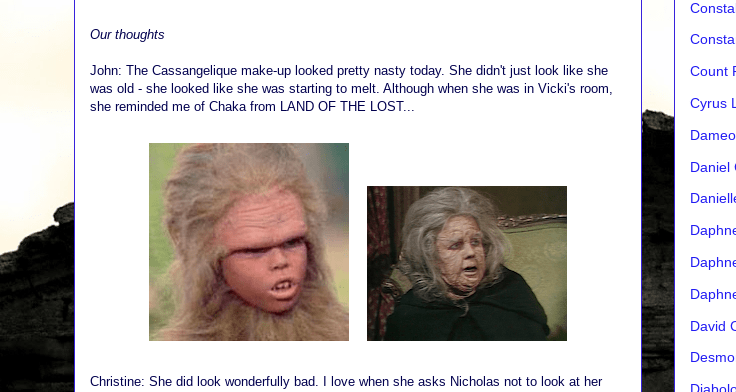
In their post about the episode on Dark Shadows Before I Die, John and Christine Scoleri find a resemblance between Angelique’s old age makeup and another TV character:

Captured from Dark Shadows Before I Die.

But look at Angelique’s creator, writer Sam Hall. She came by her looks honestly:

Episode 451: The pit of my soul

Haughty overlord Joshua Collins and good witch Bathia Mapes decide to take Joshua’s son Barnabas to the deserted Old House on the estate of Collinwood. Bathia has agreed to do battle with the ghost of wicked witch Angelique in hopes of lifting the curse whereby Angelique turned Barnabas into a vampire. Bathia warns Joshua that if she is interrupted, Angelique will defeat her. In that case, Barnabas will remain as he is, and Bathia will die. Joshua assures her that no one will come to the Old House.

Bathia, Joshua, and Barnabas before they go to the Old House. Screenshot by Dark Shadows Before I Die.

In the great house on the estate, Barnabas’ mother Naomi talks with fluttery heiress Millicent Collins and Millicent’s new husband, naval officer/ sleazy operator Nathan Forbes. Millicent’s mental health has always been fragile, and Nathan has been making a concerted effort to shatter it altogether so that he can get his hands on her share of the Collins fortune. Making matters worse, Barnabas bit Milllicent the other day. She has a beautiful mad scene today, one of several that Nancy Barrett knocks out of the park during this storyline. She insists on telling Naomi that she has seen Barnabas. This distresses Naomi, who knows that Barnabas is dead but does not know about the vampire curse.

Millicent gives Naomi enough details to stir her curiosity about what is going on at the Old House. She goes there, interrupting Bathia’s efforts. Joshua manages to hustle Naomi out of the house, but the damage is done. Bathia bursts into flames and dies. In keeping with his habit of covering up compromising information, Joshua has kept everything from Naomi. Once more, we see the cost of this habit. Had he leveled with her about Barnabas’ condition, Barnabas might have been freed.

There is a detailed comparison of the script for this episode with the finished product on a tumblelog called sights9. It is in five parts, the first of them here.

A very famous blooper occurs before Joshua and Bathia take Barnabas from the great house to the Old House. Bathia is supposed to be giving instructions, but falls silent, stares at the teleprompter, and squints helplessly for a long moment. Then we hear the line producer, Bob Costello, prompt her with “Then go to the house” and she picks back up.

Episode 450: That man who says he is Barnabas

Haughty overlord Joshua Collins and his long-term house-guest the Countess DuPrés have summoned good witch Bathia Mapes to lift the curse that has made Joshua’s son Barnabas a vampire. Meanwhile, Barnabas has bitten his second cousin Millicent and gone to the waterfront to find another victim. Bloggers Danny Horn, Patrick McCray, and John and Christine Scoleri have said so much so well about this episode that I have only a few points to add.

Millicent tells Joshua that it is wrong of him to have “that man who says he is Barnabas” in the house when he does such frightful things. Nancy Barrett’s performance as a woman made insane by her encounter with the undead is achingly beautiful. And her idea that Barnabas is an impostor is an intriguing one. Should Bathia succeed, Barnabas will need a story to account for the several sightings people made of him when he was cursed. That success seems unlikely- if Barnabas is freed from the curse now, what will we find when Dark Shadows stops being a costume drama set in the 1790s and returns to a contemporary setting? But it is something to file away for future use…

Bathia summons Barnabas away from the docks, where he is about to kill a prostitute, by sending the flame from a candle to him. The movement of the flame is an interesting effect, but what most held my attention was the scene between Barnabas and the woman he almost victimizes. Jonathan Frid and day player Rebecca Shaw play this scene in silence, with exaggerated movements, against a heavy musical score. The resulting balletic interlude is a striking departure from Dark Shadows’ previous form.

Barnabas disappoints his partner at the end of the ballet sequence. Screenshot by Dark Shadows Before I Die.

Bathia keeps Barnabas in place by showing him a cross from which he recoils. This is the first time we have seen this reaction. Barnabas routinely comes and goes through a cemetery where many of the grave markers are in the shape of the cross, and they don’t bother him a bit.

Not only is it the first time this particular symbol has been a problem for Barnabas, it is the first time Dark Shadows has suggested there might be something to Christianity. The representatives of the faith we have seen so far in the 1790s have been Barnabas’ Aunt Abigail, a disastrously repressed spinster; the Rev’d Mr Bland, of whom the best that could be said was said by the doomed Ruby Tate when she described him to Barnabas as the preacher who looked like a duck; and the Rev’d Mr Trask, a fanatical witchfinder who inadvertently became the handiest tool wicked witch Angelique had at her disposal. The 1960s characters, aside from one fleeting mention of the word “Christmas” in 1966, have not betrayed any awareness that there is such a thing as Christianity.

Bathia commands the spirit of Angelique to speak to them through Barnabas. When Angelique was first on the show, she very conspicuously kept doing many of the weirdest things Barnabas was in the habit of doing in 1967. So Barnabas exasperated his henchmen by fixating on well-meaning governess Vicki but refusing to bite her, insisting that Vicki would eventually come to him “of her own will.” Angelique exasperates her thrall, much put-upon servant Ben, by casting spells on everyone but Barnabas when her goal is to win Barnabas’ love, insisting that Barnabas would eventually come to her “of his own will.” When in 1967 Barnabas sends his thrall Carolyn to steal an incriminating document and she asks what will happen if she is caught, he replies “See that you don’t get caught.” When Angelique sends Ben to steal a hair ribbon from Abigail and he speaks of what will happen if he is caught, she replies “See that you don’t get caught.” Moments like these suggest that the vampire Barnabas is not simply cursed by Angelique, but possessed by her. Perhaps it was Angelique, wearing Barnabas’ body as a suit, that we saw in 1967, not the son of Joshua and Naomi at all.

Jonathan Frid as Angelique . Screenshot by Dark Shadows Before I Die.

This fits with the general idea of the supernatural developed in the first 73 weeks of Dark Shadows. The first supernatural menace on the show was undead fire witch Laura Murdoch Collins, who was on from December 1966 to March 1967. Laura was a complex of beings, made up of at least two material bodies and an indeterminate number of spirits, some of which seemed to be unaware of the other parts of the system and pursuing goals incompatible with theirs. From June to November of 1967, the ghost of Barnabas’ little sister Sarah kept trying to contain the damage her big brother was doing to the living characters. Sarah too turned out to be a complicated sort of phenomenon, and the form in which she visited people when they were awake was unaware of and at odds with the form in which she visited them in their dreams. If we go by Laura and Sarah, we would have to assume that supernatural beings are multifarious and fissiparous. So perhaps each time Angelique casts a spell, she splits a bit off of herself and the fragment springs up as another version of her, functioning independently of the rest. In that case, the vampire Barnabas is an avatar of Angelique. When Bathia compels Angelique to speak, she is compelling one of the Angeliques to drop a mask.

The given name “Bathia” is rare; the only person with it who ranks higher in Google search than Bathia Mapes is a musicologist named Bathia Churgin. Professor Churgin was born in New York in 1928, went to Harvard, and taught in the USA until she moved to Israel in 1970. So it is possible that someone connected with Dark Shadows may have heard of Professor Churgin and named Bathia Mapes after her, either as a tribute or just because the name stuck in their mind.

The surname “Mapes” is somewhat less rare; apparently “it is borne by around one in 903,601 people.” In 1963 and 1965, Frank Herbert published two novels that were later issued together under the title Dune; there is an elderly woman with a mystical bent named The Shadout Mapes in those. I’ve never taken much interest in Dune, and owe my awareness of this to comments on Danny Horn’s blog (from Park Cooper here and from “Straker” here.) There doesn’t seem to be much doubt that Bathia’s family name is a nod to The Shadout Mapes; whether it was Sam Hall or another of the writers or someone else who worked on Dark Shadows or one of their kids who had read Dune, I cannot say.

Episode 405: To love anyone

Gallant gentleman Barnabas Collins discovered that his wife, Angelique, was a wicked witch and a deadly threat to his true love, the gracious Josette. He did not tell anyone what he knew about Angelique, but did persuade Josette to flee. Today, Angelique discovers that Josette is beyond the range of her powers.

In her rage, Angelique takes a doll belonging to Barnabas’ little sister Sarah. She sticks pins in it; Barnabas has learned that this causes Sarah to become ill. Angelique is about to stick a pin into the doll’s heart when Barnabas takes a dueling pistol and shoots Angelique.

Angelique drops the doll; Barnabas takes the pins from it. Angelique presses her hand to her shoulder while delivering a long, bombastic speech. Barnabas has plenty of time to reload the pistol and shoot her again, but chooses just to stand there and listen to her. This turns out to be a bad decision when she ends the speech by placing a curse on him. He will spend all eternity unable to rest, and everyone who loves him will die. Having completed her death scene, she ostentatiously collapses.

We hear a window smashing. A bat appears. It approaches Barnabas. He yells at it, flails his arms, and walks backward. This is an echo of #330, which ended with strange and troubled boy David Collins reacting the same way when the same puppet appeared in his bedroom. David was a neurotic and isolated pre-teen who had been through a lot of trauma, so that was an effective scene. Barnabas is a grown man who has been trying to function as an action hero. Seeing him as the equivalent of a cartoon lady standing on a chair screaming because she saw a mouse rather undercuts this. Anyway, the bat bites Barnabas on the neck, so now he’s going to be a vampire.

The bite. Not Barnabas’ cloak in the background, playing the role of The Grim Reaper. Screenshot by Dark Shadows Before I Die.

In #330, it was Barnabas who sent the bat against David. This is one of many indications that the vampire Barnabas we knew from April to November of 1967 was not only under Angelique’s curse, but that he was in some sense a manifestation of Angelique. Maybe when she casts a spell, she breaks off a chunk of herself and that chunk goes about the world pursuing its own objectives. The image of a supernatural being as a complex of vaguely related but independent phenomena has been standard in Dark Shadows since undead fire witch Laura Murdoch Collins first appeared on the show in December of 1966, so regular viewers are prepared to learn that the vampiric Barnabas is a subcategory of the syndrome known as “Angelique.”

This episode explains how a couple of the more important props got to be in the places we are used to seeing them. Early in the episode, Barnabas gives Josette a music box. This music box figured heavily in the story from May to August 1967 as a symbol of Josette and as a vehicle for some kind of magic spell that was supposed to turn other people into her. A bit later, we see that Barnabas has hung the portrait of Josette over the mantle in the front parlor of the Old House. It was there when we first saw the Old House in #70, and was the focus of all supernatural phenomena on the show from then until Barnabas reclaimed the Old House in #212.

Episode 396: The doll and the pins

Well-meaning governess Vicki is wrongly suspected of witchcraft and needs a place to hide. Young gentleman Barnabas takes her into his house. In her gratitude, Vicki tells Barnabas the truth about herself. She is a time-traveler, yanked back to this year 1795 from her native 1967 by forces she does not understand. Indentured servant Ben enters the room and Vicki leaves. Mystified by her story, Barnabas asks Ben if he thinks Vicki might be a witch after all.

It is exciting when Vicki starts confiding in Barnabas. She has utterly failed to adapt to her new environment, and has none of the abilities she would need to scam her way into a secure place there. She has ended up as an obstacle to story development and an irritating screen presence. If Vicki isn’t going to lie competently, she may as well tell the truth. But that turns out to be a dead end as well- there is no use for Barnabas to make of the information she has given him.

Barnabas doesn’t repeat Vicki’s story to Ben- he just reports that she said something utterly bizarre. What Barnabas does not know, but Ben does, is that there really is a witch in the house- it is Barnabas’ bride-to-be Angelique. Angelique has enslaved Ben, so if he found out Vicki’s secret she would as well, and would be able to use it against her as she frames Vicki for all of her own crimes. Ben proclaims to Barnabas his absolute certainty that Vicki is not a witch, but since he can’t tell anyone about Angelique, this only puzzles Barnabas. Barnabas is further baffled when Ben says he hopes that Barnabas’ marriage to Angelique brings an end to his troubles.

The other day, Angelique tried to solve a problem of her own by raising a corpse from its grave. This was the late Jeremiah Collins, uncle of Barnabas and his best friend until, under the influence of Angelique’s spell, he and Barnabas’ fiancée Josette eloped together. Barnabas responded to that by challenging Jeremiah to a duel. Conscience-stricken, Jeremiah decided to let Barnabas kill him and told Josette that she would be free to marry Barnabas once he was dead.

Angelique had ordered Jeremiah to plague Josette and Barnabas with angry demands that they stay apart. We could interpret that simply as puppetry on Angelique’s part. But today, Jeremiah is harassing Angelique and refusing her repeated commands to go back to his grave. He says he was at peace in the earth until Angelique disturbed him. He was content with his decision to forfeit his life, but now he has become something he didn’t bargain for. Maybe it’s the indignity of that change that accounts for his change of personality, or maybe he’s just cranky because he can’t get back to sleep.

Regular viewers will think of a third possibility. In the segments of Dark Shadows set in 1966 and 1967, we saw other supernatural beings, such as undead fire witch Laura Murdoch Collins and the ghosts of Josette and of Barnabas’ little sister Sarah. These beings looked at first glance like humans, but the more we learned about them the clearer it became that each was in fact a complex of multiple entities, some of which operated independently of and occasionally at cross-purposes with others. As a witch, Angelique might also be a composite being. Perhaps each time she casts a spell, she breaks off a little piece of herself and deposits it within the person she is trying to control. If so, the creature she is trying to send away is not simply Jeremiah, but the body of Jeremiah animated by a chunk of the spirit of Angelique. That would explain why the actions of the risen Jeremiah are characterized by three traits that were alien to the living man, but that Angelique has in abundance- single-mindedness, vengefulness, and ineffectiveness.

Barnabas, Ben, and a clergyman are in the front parlor, ready for the wedding. Angelique takes a long time to come downstairs. Barnabas goes up to her room to see what is keeping her. He finds her terribly upset, insisting that they have the ceremony somewhere else. Barnabas looks in her suitcase, which had a moment before held the clothes she removed to put on her bridal gown. Those clothes have vanished, and in their place Barnabas finds a doll belonging to his little sister Sarah and some pins. Had Barnabas ever seen a horror movie, he would know to interpret this as a clue from Jeremiah that Angelique had caused a recent illness of Sarah’s by sticking pins in her doll, but people didn’t get to the cinema in 1795, so it’s another dead end.

Angelique composes herself and says she will be right down for the wedding. Barnabas leaves the room. The door closes itself, and Angelique cannot open it. Jeremiah enters and tells Angelique she must be punished for disturbing the dead. He takes her to his grave, which is open. Angelique raised Jeremiah some days ago- if the grave has been open this whole time, you’d think someone would have noticed and people would be talking about it. Anyway, he puts her in the grave, and from her point of view we see him throwing dirt into it.

Jeremiah dropping dirt onto Angelique, from her point of view. Screenshot by

This is the first live burial we’ve seen on Dark Shadows. It’s true that the POV shot from inside the grave echoes a moment in #248 when Barnabas, who is in 1967 a vampire, shuts his prisoner Maggie Evans in a coffin and we see him through her eyes, but that coffin wasn’t in the ground.

Barnabas shuts Maggie in a coffin in #248. Screenshot by Dark Shadows Before I Die.

Harking back as it does to that shocking moment from Barnabas’ early days on the show, the image of the reanimated Jeremiah dropping dirt in the grave invites us to make a comparison between Jeremiah and Barnabas. In life Jeremiah was a mild-mannered, good-hearted fellow, as is the living Barnabas. The destructive behavior he has exhibited since Angelique raised him from the dead is not only typical of her, but also of what we saw from the vampire Barnabas in 1967. Again, we wonder if the fate that awaits Barnabas is not only something Angelique will do to him, but if everything we saw of him in the months between April and November was what Angelique was doing disguised as him.

Closing Miscellany

Angelique’s repeated commands to Jeremiah today to “Go back to your grave!” find an echo in one of the great moments in the history of Dark Shadows conventions, when Lara Parker used that line to explain the Dark Shadows house style of acting:

“Go back to your grave!!!!!”

When Vicki tells Barnabas the truth about herself, the camerawork makes Alexandra Moltke Isles’ strabismus impossible to miss. Previously they had taken great care to photograph her from angles that would obscure this condition, but we’re going to get another clear look at it on Thursday. Combined with the lousy lines the scripts have given Vicki since the beginning of the 1795 segment, it is hard not to suspect that there was some kind of deliberate effort behind the scenes to push Mrs Isles aside.

Vicki and Barnabas. Screenshot by Dark Shadows Before I Die.

This was the first episode of Dark Shadows broadcast in 1968. The copyright date printed on the screen at the end still says 1967. They were several months late before they stopped putting “1966” there, so I guess we shouldn’t be surprised they didn’t update it for an episode shown on New Year’s Day.