A lot of wonderful acting in this one. We start off with Willie Loomis (John Karlen,) staggering into the cottage Maggie Evans (Kathryn Leigh Scott) shares with her father Sam (David Ford.) Yesterday, Maggie’s boyfriend Joe beat Willie up. Maggie invites Willie in, comforts him, tries to treat his wounds, and agrees to drive him home. Joe had excellent reasons for insisting Willie stay away from Maggie, and those reasons might lead returning viewers to react to the beginning of the scene with frustration. But Karlen and Miss Scott are so good together that they very smoothly defuse that frustration, and we soon find ourselves as absorbed in the scene as we were in the many scenes the same actors shared in May and June of 1967, when Maggie was the prisoner of Barnabas the vampire* and Willie, as Barnabas’ slave, was trying desperately to reduce her suffering.
A very tall man named Adam (Robert Rodan) comes to the open front door and announces “Willie bad!” Maggie has no idea who Adam is. Adam enters the cottage and clarifies his intention with a declaration of “Kill Willie!” Willie tries to talk Adam out of this plan, and reminds him of the good times they had together. Maggie tells Adam that Willie is hurt, and Adam looks concerned when he responds “Willie hurt?” Rodan gets the same flicker of light into Adam’s eyes that you might see in the eyes of a toddler who is intrigued to hear that someone is having feelings he wouldn’t have expected them to have. Before long, though, Adam is angry again. Maggie takes a hammer and tries to hit Adam, leading Adam to state a new plan- “Kill Maggie!”
Sam comes home. Sam befriended Adam during a trip Maggie recently took out of town. He tells Maggie to stand behind him. She does, and he talks to Adam about their friendship. Adam agrees that Sam is his friend and that he would never hurt him, but he refuses to agree when Sam tells him that Maggie is also his friend. Maggie makes a move that confuses Adam. Trying to get at her, Adam hits Sam very hard. Adam sees that he has knocked Sam down, and he runs away.
We see Adam in the woods, and for the first time hear his voice in a pre-recorded monologue telling us his thoughts. “Afraid! Adam afraid! Adam bad! Adam hurt friend!” Rodan’s acting is more than sufficient to enable us to figure out that this was what Adam was thinking even without the monologue, but he does such a good job of voice acting that I don’t really begrudge it. Crude as the lines are, Rodan simultaneously expresses fine shades of fear and guilt through them.
Willie and Maggie have another scene in the Evans cottage. She is stern with him now, demanding to know what Willie knows about Adam. Willie denies that he knows anything, and she points out that when he was trying to calm Adam he appealed to several facts from their previous acquaintance. Willie tells a story to cover that up, essentially the same story Barnabas made up to tell the sheriff in #505. Maggie is a lot smarter than the sheriff- that isn’t saying much, chewing gum is a lot smarter than the sheriff- and even he didn’t buy this line when Barnabas was pushing it. She tells Willie in a firm tone that she will continue to ask questions until she gets answers she can believe. She explicitly tells him she will ask Barnabas. Maggie’s firmness and Willie’s barely controlled panic make for another gripping encounter.
Willie goes back home to Barnabas’ house. Barnabas’ best friend Julia Hoffman (Grayson Hall) is there. Willie tells Julia they have to find Adam before the police do, since he now knows enough words to get them all in a lot of trouble. Usually when Julia and Willie have their staff conferences, she is firmly in charge and full of ideas. But she is at a complete loss today. She has no idea how to capture Adam, and she doesn’t know where Barnabas is.
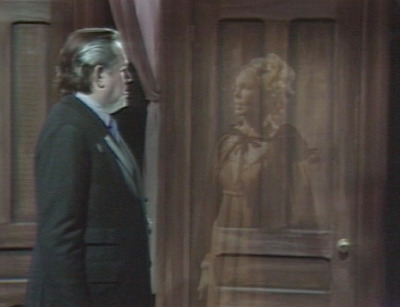
What’s more, Julia has just seen a ghost. She heard sobbing coming from the basement, and when she went down there she saw a woman in white whom she recognized as Josette Collins, deceased. Josette dematerialized in front of her. Now the sobbing starts back up, and Julia accompanies Willie to the basement.
Josette is already gone when they get there. Julia tells Willie what she saw earlier. She figures out that Barnabas is bricked up behind the wall where Josette’s ghost had stood. She explains her reasoning in terms that viewers who have seen the last several episodes will be able to follow, but which don’t make a bit of sense to Willie. His sharp befuddlement and her vague certitude make for a laugh-out-loud funny scene.
In the early months of the show, several characters heard a sobbing woman in the locked room in the basement of the great house of Collinwood. It was strongly implied in a number of those episodes that the woman was the ghost of Josette. In #272, matriarch Liz said that she herself was the one who did the sobbing. That didn’t fit very well with what we had seen, but by that point the show had reconceived Josette as part of Barnabas’ story and stopped involving her ghost in the action. Longtime viewers have a strong reminder of the “Sobbing Woman” story today, since Barnabas’ basement is a redress of the set used for the basement of the great house and the alcove where he is walled up is in the same place as the door to locked room in basement of great house.
*Maggie has amnesia about all that, and thinks Barnabas is her friend. His vampirism is in remission now.
Hardworking young fisherman Joe Haskell is engaged to marry Maggie Evans, The Nicest Girl in Town. Early in their relationship, Maggie warned Joe that they might never be able to get married, because her father Sam was an alcoholic and would always need her to come rescue him. Joe liked Sam, drunk or sober, and was always quick to lend him a hand. He didn’t seem to understand Maggie’s worries.
Now, it’s Joe who is worried, and Maggie who doesn’t understand why. Sam’s drinking doesn’t seem to be as much of a problem as it was then. But he has been struck blind, ending his career as a painter. Joe still wants to marry Maggie, and is still glad to help Sam. But Sam has befriended a very tall, phenomenally strong man named Adam, who is wanted by the police because he abducted heiress Carolyn Collins Stoddard several days ago. Sam doesn’t consider the abduction to be a strike against Adam, whose ignorance of social customs he considers to be a disability equal to his own blindness. Joe is convinced that Adam is a violent felon and is alarmed that Sam insists on inviting him to the Evans cottage. Maggie has been out of town and doesn’t know about Adam.
Today, Joe finds a reason to be as alarmed about Maggie’s judgment of men as he is about Sam’s. Maggie was missing for some weeks in May and June of 1967, and when she was found she was so severely traumatized that she could barely talk. She spent months in a mental hospital called Windcliff after that, during which time she had regressed to childhood and developed a tendency to become wildly agitated. She seems to be her old self now, but she still has amnesia covering the whole period from her disappearance through her time at Windcliff.
Like the rest of the village of Collinsport, Joe believes that Maggie was abducted and brutalized by Willie Loomis, servant to old world gentleman Barnabas Collins, and that Willie was trying to kill Maggie when the police shot him in #322 and #323. When he survived his gunshot wounds, Willie was sent to Windcliff. In #483, Joe was appalled to find that Barnabas had arranged Willie’s release and brought him back to work for him. Joe informed Barnabas that he intended to kill Willie if he ever again saw him near Maggie.
Joe is on his way to the Evans cottage when he sees Willie heading for the front door. He confronts him and reminds him of what he told Barnabas. Willie tells him Maggie is no longer afraid of him, that they are friends now, that she visited him at Barnabas’ house earlier that evening, and that it wasn’t the first time she had gone there. Willie is going on about himself as Joe’s “competition” for Maggie’s attention when Joe hits him a couple of times and knocks him out.
Joe goes into the house and tells Maggie what happened. She admits that she did go to Barnabas’ house earlier, that she talked to Willie, and that it wasn’t the first time. Joe reacts with incredulity and says that Willie tried to kill her. Maggie insists that Willie is innocent. Joe asks why she believes that; she can’t explain. He asks why she went to Barnabas’ house. Again, she can’t explain. She says that she does not know why she went there, but that she is sure it wasn’t to see Willie. Joe is shocked that Maggie can’t explain something she did just an hour or two before. He keeps asking, but she insists that she does not know why she went to the Old House.
Joe becomes more and more alarmed. Maggie turns away from him, and he grabs her arm. All the fansites remark on the roughness of this move; it looks like an act of domestic violence. It certainly is not what we would expect of Nice Guy Joe, who was Carolyn’s doormat in the early months of the show and has been a Perfect Gentleman in his relationship with Maggie since then. The 1960s were a particularly bad time for intimate partner violence on screen, so it speaks relatively well of actors Joel Crothers and Kathryn Leigh Scott, and especially of director John Sedwick, that this moment passes briefly. Joe doesn’t follow it up with any further violence, and Maggie seems to forget about it instantly, as if it were an accident. In those days, it might just easily have been highlighted as a proof of Joe’s manliness.
The arm-grab is not defensible, but Joe’s intense feelings in response to Maggie’s inability to explain her behavior are. Joe and Sam visited Maggie at Windcliff in #265. She didn’t recognize them and started shrieking lyrics to “London Bridge” in what I think is the single most frightening scene in the whole of Dark Shadows. Maggie’s amnesia blotted that out, but Joe can hardly have forgotten it. He also remembers Willie as he was in his first weeks on the show, when he seemed determined to rape all the young women and beat up their boyfriends. The idea of Maggie’s mental health regressing to such a low point that she would wander off with a man like that must terrify Joe.
#1. Sam recently went blind; that’s why Joe has to pick him up at the bar.
#2. “Cassandra” is really Angelique, who’s cast a complicated Dream Curse spell that will eventually lead to Barnabas’ death. The gift that she brought was pipe tobacco, laced with a magic powder that would make Sam have the dream.
#3. Professor Stokes is fighting Cassandra, and trying to stop the Dream Curse. He stole the pipe tobacco, because he doesn’t want Sam to have the dream.
#4. Willie has a crush on Maggie, so he stole a pair of Josette’s earrings from Barnabas, and left them in Maggie’s purse while she wasn’t looking. When she puts the earrings on, she has a flashback to the period when Barnabas held her captive, and tried to convince her that she was Josette — a period that should be blocked from her memory.
#5. Adam, the newborn Frankenstein, has befriended Sam, and is now looking for him…
[#6.] Barnabas… was chained up a couple episodes ago and trapped behind this wall. Now he’s kicking at the wall, desperate for someone to come and rescue him.
[#7. A] man… abducted Carolyn a few weeks ago.
[#8.] Cassandra putting a curse on Liz, and making her think about death all the time.
Danny might have mentioned several other stories that don’t come up today, but of which regular viewers are aware and on which the ones that do come up depend. For example, Barnabas’ vampirism has gone into remission, and as a result his sometime victims were freed of the effects of his bites. It is unclear what this means for them, particularly for Willie, who often seems to have become once more the dangerously unstable ruffian whom Joe and the others knew when he first came to Collinsport. Also, a man named Peter is dating well-meaning governess Vicki, and Vicki has trouble remembering that Peter would prefer to be called Jeff. That may not be too exciting, but it’s no duller than Liz moaning endlessly about death. We could also bring up strange and troubled boy David, who has come into possession of a tape recorder with a message that has been played for the audience approximately umpteen billion gazillion times, but that no character other than Adam has heard, and if anyone else does there will be consequences. And Harry, the ex-convict son of housekeeper Mrs Johnson, is staying at Collinwood, and may someday be mentioned again. If he is, there is a danger that the audience will once more have to watch Craig Slocum try to act, truly a grim prospect.
Danny argues that the dense packing of so many storylines into the show makes watching it a stimulating cognitive exercise that “actually teaches people how to process information more efficiently.” As this blog makes obvious, I enjoy this kind of complexity very much. Not only do I keep talking about how ongoing storylines relate to each other, I reach back and find echoes of plot elements from months or years before and consider the significance of the common themes they develop; I look at the way the show borrows stories from books and plays and movies and folklore and notice how they put those source materials in dialogue with each other; and sometimes, my dissatisfaction with stories that didn’t work leads me to think up other stories that might have turned out better, adding yet another layer of narrative accretion to the already extremely intricate existing dramatic text.
I think Danny goes overboard, though, in his presentation of his case. He suggests that an increase in the number of storylines per minute of airtime is equivalent to an increase in the intellectual power of the show. But analysis and collation of plot elements is only one of many kinds of mental activities audiences engage in, and is far from the most important one. If that was all you wanted, you wouldn’t need actors. When an actor creates a character, s/he transforms the story points into the experiences of a person and the audience into witnesses of those experiences. When the drama is well executed, those experiences, even if they can be assigned to some category that is familiar to us, strike us as fresh and unique. When that happens, you don’t need a large number of interlocking storylines to generate complexity- your responses, emotionally and intellectually, will be as complex as your own background can support.
The audience’s background matters. There’s an old saying that when you engage with a literary work, it isn’t just you who read the book, but the book reads you. I often see how true this is in my job as a faculty member in ancient Greek and Latin at a state university in the interior of the USA. When I teach courses on ancient Mediterranean literature in translation, students aged 18-25 have an entirely different reaction than do the “non-traditional” students, those coming back to school after some years doing something else. Most of the students who are in the traditional college age group make interesting connections with a wide variety of topics, while others in that group get bored and can’t see a point in reading old books. But of the dozens of students I’ve taught when they were over the age of 40, every single one has found the reading to be a deeply rewarding experience. The literature that we have from the ancient world was written for adults, and the average American post-adolescent is only going to get so much out of it.
At this point in 1968, Dark Shadows is very much a show for children. The biggest and fastest-growing share of the audience is under 13 years old. So if it is going to be a smart show, it’s going to be smart in the sense that IQ tests measure, transmitting large amounts of information and giving the audience a short period of time to absorb, analyze, and recombine that information before it is followed by another close-packed message. It’s no wonder that an actor like Joel Crothers would become discontented with the show and go away complaining that the cast was being crowded out. He has ever less basis for the hope that he will be able to present the audience with a recognizable human feeling and leave them with hard thinking to do about what that feeling means.
Wiggéd witch Angelique/ Cassandra and her reluctant cat’s paw Tony are on the terrace at the great house of Collinwood, quarreling about Tony’s failure to complete his latest mission. Angelique/ Cassandra talks about the punishments she is capable of inflicting on Tony, and decides that she will force him to fall hopelessly in love with her. This punishment will begin as soon as she has kissed him.
This is not the first time Angelique/ Cassandra has found a reason to kiss Tony. The last time she did so, in #489, her stepson David caught them, and she had to scramble to come up with a spell to wipe his memory. This time, her sister-in-law Liz catches them, and she curses Liz to become obsessed with death. As she is casting the spell, she tells Liz that the obsession will make her life less empty. It does not promise to make it more interesting for the audience to watch.
For nineteen weeks from November 1967 to March 1968, Dark Shadows was a costume drama set in the late eighteenth century. Among the more interesting characters introduced in that period were fanatical witchfinder the Rev’d Mr Trask; roguish naval officer Nathan Forbes; fast-talking con artist Suki Forbes; and streetwalkers Ruby Tate and Maude Browning. All five of these characters were murdered by vampire Barnabas Collins, and all five of them are among those who return today for an impromptu trial of Barnabas.
Barnabas killed Trask by luring him to his basement and bricking him up in an alcove, as Montresor did to Fortunato in Edgar Allan Poe’s 1846 story “The Cask of Amontillado.” Some other characters invited themselves to the basement yesterday and held a séance there. As a result of the séance, the bricks fell away and Trask came back to life. Now, Trask has confined Barnabas to the same alcove. He declares that he will give him a trial before he bricks him up.
In the eighteenth century, Trask was the prosecutor in the trial of time traveling governess Vicki Winters. Victoria was convicted of witchcraft and sentenced to death. Vicki’s trip from the 1960s to the 1790s inverted Barnabas’ displacement in time; as Vicki’s witchcraft trial was so chaotic it did not seem to follow rules of any kind, neither does the murder trial Trask improvises for Barnabas fit any conceivable model of procedure. Vicki’s trial stretched over two weeks, from #427 to #437; Barnabas’ begins and ends today, during the second half of the episode.
Trask conjures up Nathan, Suki, Ruby, Maude, and Barnabas’ first homicide victim, his uncle Jeremiah, to serve as a jury; he conjures up a man named Ezra Simpson, of whom we have never previously heard, to act as judge. Trask is the prosecutor, and Nathan is his sole witness. This court of “the damned!,” as Trask calls them, recalls the rogues who confront Jabez Stone as jurors and judge in Stephen Vincent Benét’s 1936 story “The Devil and Daniel Webster.” Unlike Jabez Stone, however, Barnabas does not have a right to counsel.
Trask asks Nathan how he died. After Nathan says that Barnabas strangled him, Trask asks him how Suki died. Barnabas objects that Nathan shouldn’t be allowed to speak for others; regular viewers sympathize with this, since Suki, played today as she was originally by Jane Draper, was sensational every second she was on screen, and when we saw Miss Draper again we were happy to think that she would have another chance to show what she could do. Barnabas also shouts at one point that he is innocent; this is less likely to attract the audience’s sympathy. Mrs Acilius and I certainly got a good laugh from it.
Barnabas asks to be allowed to present a defense. Trask invites him to question Nathan. He is about to do so when Nathan smiles at him, turns around, and vanishes. Trask explains that Nathan has already said all that needs to be said. Later, Trask looks at the recompleted wall and laughs with vicious glee, delighted at what is behind it.
Barnabas has neither the powers nor the limitations of a vampire now. The effects of the curse went into remission when mad scientists Eric Lang and Julia Hoffman created a man from parts scavenged from the cemetery and connected Barnabas to him as they electrified him and brought him to life. Barnabas named this man Adam.
Now Adam has escaped from the horribly abusive home Barnabas and Julia provided for him. He has found a friend in Sam Evans, an artist who was blinded when Barnabas enlisted him in one of his hare-brained schemes. Sam is teaching Adam to speak, and is so impressed with his ability to learn that he wonders aloud if he will be able to teach him to paint professionally.
Adam develops a sudden pain in his wrists. He moans “Barnabas! Hurt!” A shot of Barnabas hanging by his wrists in the basement alcove is laid over a closeup of Adam. Evidently the bond between them is such that Adam can sense Barnabas’ pain, even though they are miles apart. Apparently it is mid-1840s day on Dark Shadows; the scene in Barnabas’ house recalls “The Cask of Amontillado,” and the scene at Sam’s house is based on Alexandre Dumas’ 1846 novella The Corsican Brothers. “The Devil and Daniel Webster” was set in that decade or a bit earlier, and while Frankenstein was written in 1818 many adaptations of it, including the one Dark Shadows creator Dan Curtis would make in 1973, are set in the 1840s.
Adam becomes agitated. He cannot explain what is happening to him, no matter how patiently Sam asks. Sam’s son-in-law-to-be Joe Haskell comes in; Adam brushes against Joe as he runs out the door. Though Joe is a tall and sturdy man, Adam is so tremendously strong that this casual contact sends him flying.
It dawns on Joe that Adam is the man who abducted heiress Carolyn Collins Stoddard and then fell from the cliff on Widows’ Hill. Sam calmly replies that he had already figured that out. Joe is shocked that Sam hasn’t called the police; Sam replies that Adam is as disabled as he is, and that he means no one any harm. Joe is not at all convinced of the second of these points, and worries that “Barnabas! Hurt!” might not have reflected a fear that Barnabas is hurt, as Sam thinks it does, but might rather express Adam’s resolution to hurt Barnabas. Joel Crothers and David Ford bring out the full comic value of this scene; Mrs Acilius laughed at the blandness with which Ford’s Sam confirms that he knows who Adam is.
Joe goes to Barnabas’ house to warn him, but finds it locked and apparently empty. Later, Julia goes there too. She has a key, and lets herself in. She doesn’t see any evidence that Barnabas is or has been home; she goes downstairs, and is mystified to see that the alcove wall, which was broken when she was there for the séance, is now bricked up again.
Several times, Dark Shadows has contrasted Barnabas’ home, the Old House on the great estate of Collinwood, with the Evans cottage, a working class residence in the village of Collinsport. Today they draw this contrast in sharp relief. The basement of the Old House is always dark, but even the upstairs is lit by candles today; the scenes in the Evans cottage, taking place at the same time, are sunlit. The basement is the most haunted part of the most haunted house on the haunted estate, and eight characters in costume dress materialize from thin air there; the Evans cottage is a part of the modern world where Sam and Joe can use reason to arrive at agreement about facts, even if they make different judgments about the significance of those facts. When Julia and Joe go to the Old House, each wanders about alone, finding no one to talk to; at the Evans cottage, even Adam is able to have a conversation, and while there he can receive a message from Barnabas by some mysterious means. Trask seizes control of the basement of the Old House to make a parody of the criminal justice system and enact his vengeance on Barnabas; in the Evans cottage, Sam refuses to call the sheriff because he wants to shield Adam from punishment for the crimes he inadvertently committed.
In the first months of Dark Shadows, the audience’s point of view was represented by well-meaning governess Vicki, who needed to have explained to her everything we might want to know and who reacted to all the strange goings-on with the mixture of disquiet and curiosity that the makers of the show hope we will feel.
Vicki has long since been replaced as our representative by mad scientist Julia. We no longer want characters to tell us what has been going on, nor are we making up our minds about our moral evaluation of the events in the stories. We find ourselves in the middle of a whole clutch of fast-moving plots, trying to keep up with them all and hoping that nothing will stop the thrills. Julia’s loyalty to her best friend, sometime vampire Barnabas, and her supremely well-developed capacity for lying put her in the same position, and her vestigial conscience is no obstacle to any juicy storyline.
When Vicki was our on-screen counterpart, her charge, strange and troubled boy David, was the show’s most powerful chaos agent. David precipitated a series of crises that seemed likely to expose the secrets of the ancient and esteemed Collins family, to kill one or more of the major characters, or both. In #70, David led Vicki to his favorite playground, the long-vacant Old House on the estate of Collinwood. David would keep sneaking into the Old House even after Barnabas took up residence there in #218.
Today, David again lets himself into the Old House. He is caught there by Julia and a man he has not seen before. Julia is stern with him for entering the house without Barnabas’ permission; he defends his presence there, reminding Julia that she promised him he could play with the tape recorder on Barnabas’ desk. He asks who the man is.
The man introduces himself to David as “Timothy Eliot Stokes.” This is the first time time we have heard his middle name. Soon, the show will phase “Timothy” out, and his friends will address Stokes as “Eliot.” I suppose that’s because he’s a professor, and “Eliot” suggests Harvard.
Stokes introduces himself to David.
In 1966, Thayer David played crazed groundskeeper Matthew. Suspected of murder, Matthew hid out in the Old House and kept Vicki prisoner there until some ghosts scared him to death in #126. David didn’t believe Matthew was a killer and didn’t know he was holding Vicki, so when he stumbled upon him in the Old House he brought him food and cigarettes. Even after he found Vicki bound and gagged behind a hidden panel, he kept Matthew’s secret. When David meets another character played by the same actor on the same set, longtime viewers can see that Stokes is as genteel and urbane as Matthew was rough-hewn and paranoid. For her part, Julia recalls Vicki when she scolds David for sneaking into the Old House, but where Vicki was doing her job as David’s governess and trying to enforce the rules of the household as a governess might, Julia is scrambling to keep David from finding out about her own secret activities.
Julia tells David to take the tape recorder and go home to the great house on the estate. As he makes his way to the front door, Stokes takes Julia aside and tells her that it will not be well if it is known in the great house that David has seen him. Julia hurries to David and tells him to keep quiet about the fact that he has seen Stokes. She says that she hates to ask him to lie; at this, I mimicked Julia and said “I know you share my devotion to the truth,” prompting Mrs Acilius to laugh out loud. Later, Julia will go to the great house, where she lives as a permanent guest, and David will cheerfully assure her that he kept her secret. The two of them seem quite relaxed together, leading us to believe that he will continue to do so.
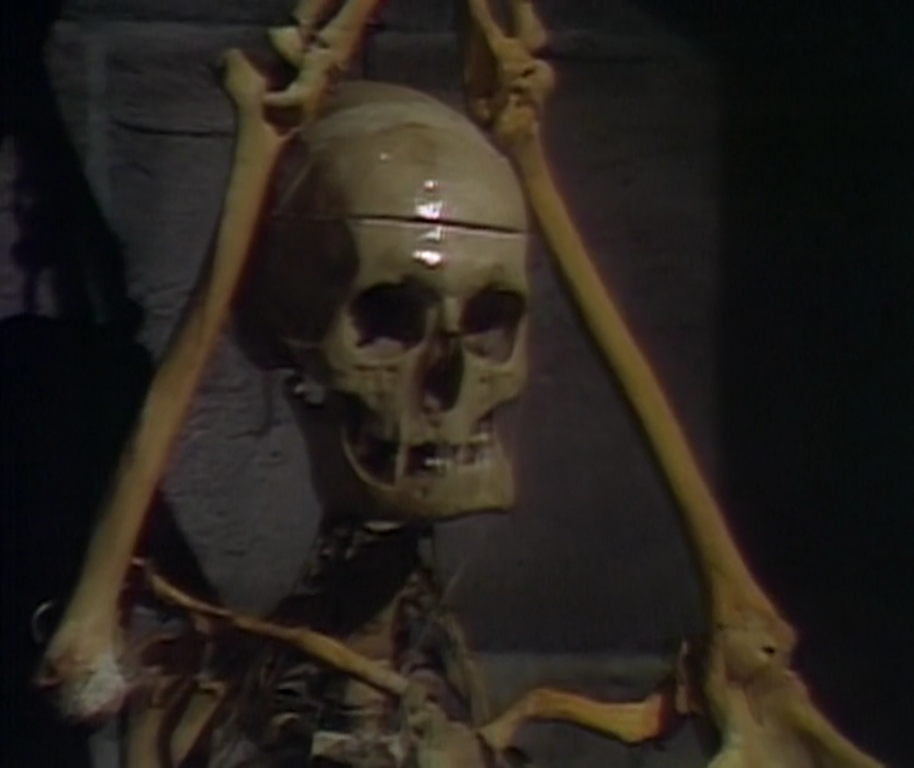
There is a bit of irony in Julia’s harshness with David for entering Barnabas’ house without his permission. She and Stokes didn’t have Barnabas’ permission to be there, either. Indeed, if he had known what they were up to he would likely have objected most strenuously. Along with a man named Tony, they held a séance in the part of the basement where Barnabas kept his coffin when he was under the full effect of the vampire curse. They were trying to contact the Rev’d Mr Trask, a Puritan divine whom Barnabas bricked up to die in the eighteenth century. The séance was so successful that the bricks crumbled, exposing Trask’s bones, still held together somehow in the shape of a skeleton hanging from the ceiling. At the end of the episode, Trask has resumed his corporeal form and set about taking revenge on Barnabas by walling him up in the same spot.
Odd that Trask’s skeleton holds together after all the ligaments and tendons have rotted away, odder that there is a straight cleavage separating the top of the skull from the rest, oddest of all that the section is attached to the rest of the skull by a piece of Scotch tape.
Yesterday, wiggéd witch Angelique/ Cassandra sent her cat’s paw Tony to kill sage Timothy Eliot Stokes. Stokes pulled “the old switcheroo” on him, and Tony drank from the glass into which he had put Angelique/ Cassandra’s poison. Today, we learn that Stokes gave Tony an emetic to save his life. Stokes calls mad scientist Julia Hoffman, MD to examine Tony and assist with the next stage of the battle against Angelique/ Cassandra.
Recovered, Tony has no idea why he obeyed Angelique/ Cassandra’s command to kill Stokes, and is ready to surrender to the police. Stokes tells him he is under the power of a witch, and enlists him in the battle against her.
Stokes takes out the memoirs of his ancestor Ben, who was Angelique’s cat’s paw in the eighteenth century. He does some automatic writing in Ben’s hand and finds that they must contact the spirit of the Rev’d Mr Trask, a witchfinder who inadvertently helped Angelique in those days. Fortunately, Trask, like Tony, was played by Jerry Lacy, so it shouldn’t be too hard to get hold of him. Stokes also finds that Trask was walled up in “the coffin room,” which Julia tells him is for some mysterious reason a nickname given to the space at the foot of the stairs in the basement of the Old House on the estate of Collinwood. Stokes decrees that he, Julia, and Tony must go to this room and hold a séance there.
On his way to the Old House, Tony follows Stokes’ instructions and stops at the main house on the estate and tells Angelique/ Cassandra that Stokes is dead. This follows a scene between Angelique/ Cassandra and her husband, sarcastic dandy Roger, in which Roger complains about her lack of interest in him. Her mind isn’t on the game of chess they are playing, she hasn’t been attentive to him for several nights, and she refuses to go on a honeymoon. Angelique/ Cassandra ensorcelled Roger into marrying her so that she could have a perch at Collinwood, and he seems to be slipping out of the spell’s power.
Stokes, Julia, and Tony gather in the coffin room. They begin the séance. This is the fifth séance we have seen on Dark Shadows, but the first that does not include well-meaning governess Vicki. In four of the previous five, it had been Vicki who went into the trance. On the other occasion, it was strange and troubled boy David who became the vessel through which the dead spoke to the living. The first three times Vicki served as the medium, she channeled the gracious Josette Collins, and when David filled that role he gave voice to David Radcliffe. In those days, Vicki was closely connected to Josette, perhaps a reincarnation of her, as David was another version of the cursed boy David Radcliffe. The final time Vicki spoke for the dead, she spoke for nine year old Sarah Collins, with whom she was no more closely connected than were any of a number of other characters. Sarah has no present-day counterpart, so her appearance at a séance suggested that Dark Shadows was moving away from its use of necromancy as a way of connecting characters from different time periods.
This time, Tony goes into the trance. In #481, Angelique/ Cassandra told Tony that she chose him as her cat’s paw because he resembled Trask, so when he is the medium through whom Trask speaks we are returning to Dark Shadows‘ original conception of how séances work. Trask mistakes Stokes for Ben, as Angelique did in a dream visitation last week. The brick wall behind which Trask’s remains are hidden bulges and is about to crumble when we fade to the credits.
True fans of Dark Shadows know that the episode’s real climax comes during those credits. Thayer David strolls onto the set under Louis Edmonds’ credit for Roger. He even looks into the camera when he realizes what he has done.
Unloved Frankenstein’s monster Adam has survived a plunge from the cliff at Widow’s Hill and made his way into the home of blind ex-artist Sam Evans. Sam realizes that Adam is badly hurt and cannot speak much English; with great kindness, he tries to clean and bandage Adam’s wounds.
Sage Timothy Eliot Stokes comes in. Adam, who in his few weeks of life has had little but hostility from humans, is alarmed by the sight of another one, and flees. Stokes explains to Sam who Adam is, and Sam’s sympathy for the big guy only deepens. This retelling of the creature’s encounter with the blind hermit in The Bride of Frankenstein is affectingly done.
Wicked witch Angelique, calling herself Cassandra, has made her way into the apartment of local man Tony Peterson. Tony is agitated by the presence of Angelique/ Cassandra and keeps telling her he wants her to go home to her husband and leave him alone. She tells Tony he is “Quite a Puritan,” reminding us that when Dark Shadows was a costume drama set in New England in the 1790s, actor Jerry Lacy played the Rev’d Mr Trask, a fanatical but utterly inept witchfinder who inadvertently served Angelique’s darkest purposes. Mr Lacy plays Tony quite differently than he did Trask, but Angelique/ Cassandra told Tony in #481 that she chose him as her cat’s paw because he reminded her of Trask. She gets him to strike his cigarette lighter, sending him back into the trance in which he can deny Angelique/ Cassandra nothing.
Well-meaning governess Vicki has made her way to Stokes’ apartment. It was Vicki who took Dark Shadows back in time to the 1790s, when she came unstuck in time during a séance in #365. It seemed at the beginning of the costume drama segment that Vicki would regain the position she held in the first months of the show as our point of view character, that she would again provide the emotional anchor of the show in her scenes as governess alone with the young children of the house, and that she would drive the action as she had to think on her feet and come up with plausible lies to secure a place in an unfamiliar century. As it happened, she did none of those things. She was shut out of all the main action, was never seen giving a lesson to either of her charges, and when she was on camera spent her time telling everyone she met that they were played by an actor who had another part in the first 73 weeks of the show. Long before Vicki came back to the 1960s in #461, the character had become all but insupportable.
The action now revolves around recovering vampire Barnabas Collins, and Barnabas steadfastly refuses to include Vicki in his life. Faced with that blank wall, Vicki has spent some time hanging around with a man named Peter whose only story point is that he wants to be called Jeff. This does not make for much drama. Vicki learned a great deal in the 1790s, and recognized Angelique/ Cassandra as soon as she showed up in 1968. But she can’t fight her by herself, and so she has responded to Barnabas’ aloofness by trying to forget what she knows.
Stokes has called Vicki to his apartment to enlist her help against Angelique/ Cassandra. Longtime viewers will remember that Vicki led the fight against Dark Shadows’ first supernatural menace, undead blonde witch Laura Murdoch Collins, and that for support in that battle she was the one who recruited the services of the show’s first sage, parapsychologist Peter Guthrie. This much diminished Vicki is now subordinated to the sage. He calls her in, he commands her to tell her story, he tells her that her story is true, and he requires her services. He shows her a silhouette of Trask and insists she overcome her reluctance to look at it. When a knock comes at the door, he even sends her out the back way and tells her that his next visitor must not know of her connection with him, as if he were dismissing a prostitute.
Stokes tells Vicki he can’t afford to be seen with her.
Oddest of all, Stokes already seems to know everything Vicki does before they talk. In #507, he laid out a theory that would be plausible to someone who knew exactly what Vicki knows about the strange goings-on, but not to anyone who knows one thing more or less than she does. Yet today we see that he is talking with Vicki about them for the first time. It is unclear what he could learn from her, or what contribution she could make to his efforts.
The visitor from whom Stokes wants to hide Vicki is Tony, giving his name as “Arthur Hailey,” perhaps in honor of the novelist whose Airport was topping the bestseller lists when the episode was made. Stokes is quite relaxed around Tony, offering him first brandy and then cheese. Tony accepts both. He exclaims “I like cheese!” in an awkward voice that makes it clear we are listening, not to Jerry Lacy’s acting, but to Tony’s. While Stokes is out of the room fetching the cheese, Tony sprinkles a powder Angelique/ Cassandra gave him into Stokes’ glass. Tony looks away from the table before they take their drinks. When they do, it is Tony who chokes and collapses, not Stokes.
This is the second time we’ve seen that staple of farce, “The Old Switcheroo.” In #402, Barnabas tried to poison Angelique, and had to think fast when she passed her glass to his mother. That use of the trope confirmed that, while Barnabas is undeniably a villain, he is a comic villain who endears himself to us as we watch him scramble through one failed scheme after another, while Angelique is a menace to be taken seriously. Now, Angelique has settled in for the long term, and the show will quickly run out of characters if she maintains the kill rate she had in the eighteenth century. They have to dial her threat level down considerably. One way of doing that is to give her a henchman who is, most of the time, unaware of her power over him, and who is consistently luckless when she activates him; another is for her to use comically unreliable means to pursue her evil ends. She does not yet cut the Wile E. Coyote-esque figure that Barnabas does, but neither is she in imminent danger of vaporizing the whole story and leaving ABC with thirty minutes of dead air on weekday afternoons.
This was the first episode directed by John Weaver. Except for one week in March 1968 when executive producer Dan Curtis took the helm, directing duties for the first 497 episodes of Dark Shadows alternated between Lela Swift and John Sedwick. Now Sedwick is about to leave the show. Associate director Jack Sullivan stepped up to direct #504 and will direct dozens more; Weaver, an associate director on some early episode, will only be credited as director four times before leaving in July. Several more directors will have similarly brief stints as fill-ins before Henry Kaplan joins the show as Swift’s alternate in December.
In #473, we saw that wicked witch Angelique had traveled from the eighteenth century to the year 1968 to reimpose the vampire curse she had once placed on old world gentleman Barnabas Collins. In a single day, Angelique met Barnabas’ distant cousin Roger, bewitched him, and married him. This secured her a home in the great house on the estate of Collinwood. Barnabas lives in the Old House on the same estate. Calling herself Cassandra and wearing a black wig, she pretends not to understand why Barnabas doesn’t like her.
In #477, Angelique appeared to Barnabas in a dream and told him and the audience how she would go about turning him back into a vampire. Her approach would essentially be a distributed malware attack on the wetware inside the heads of the people of Collinsport. One person after another would have the same basic nightmare. Each nightmare would begin with a visit from a person who had not yet had it, and after the dreamer awoke they would feel an uncontrollable compulsion to describe the dream to that person. Once they had done so, that person would have the nightmare, and the cycle would repeat. When the dream got back to Barnabas, he would become a vampire again.
Yesterday, heiress Carolyn Collins Stoddard had the dream. Carolyn met with occult expert Timothy Eliot Stokes and mad scientist Julia Hoffman at the Old House. Stokes managed to insert himself into Carolyn’s dream as the person to whom she must tell it. Today, Stokes has the dream. He sets out to function as an antivirus program. He has learned what the dreamer usually does, and consciously makes himself defy all those rules. His hack-back works sufficiently to force Angelique/ Cassandra to appear in the dream herself and get into an argument with him.
Angelique/ Cassandra addresses Stokes by the name of his eighteenth century ancestor Ben, an indentured servant whom she ensorcelled and used for her own nefarious purposes. She refuses to believe that Stokes is not Ben, and does not react strongly when he tells her that he knows her name is Angelique. When he later addresses her as Cassandra Collins, she is horrified and vanishes. It’s a staple of stories about magic that the act of calling adversaries by their true names can defeat them; Mrs Acilius brought up the story of Rumpelstiltskin. That the name “Angelique” has no effect while “Cassandra” drives her away suggests that she was using a pseudonym when we first knew her, and she really is Cassandra.
The power of naming also explains what Barnabas may have been thinking when he kept confronting Angelique/ Cassandra and telling her exactly what he did and did not know about her. Perhaps he hoped that simply by addressing her as “Angelique” he would make her vanish.
When Stokes awakens, he tells Julia he is confident that he has stopped the curse. That confidence is put to the test immediately when a knock comes at the door. Stokes opens it, and sees the man from his dream. He does not know the man, but we do. He is Sam Evans, an artist recently blinded by one of Angelique/ Cassandra’s spells. He is accompanied by Joe Haskell, fiancé to Sam’s daughter Maggie. They mention that Maggie is spending the evening in the nearby city of Bangor, Maine. Sam says that he heard the name “Stokes” in his head earlier in the evening, and that he also felt an urge to come to the Old House. He has a strong feeling that Stokes has something to tell him, and insists that he do so.
Stokes is disquieted to see Sam, but feels no compulsion to tell the dream. Sam is furiously dissatisfied. It is unclear whether his frustration at not hearing the dream will be as intense or as persistent as is the upset previous dreamers felt when they resisted telling it.
Sam and Joe leave. In front of Sam’s house, Joe reaches to open the front door. Sam is irritated with him. He not only insists on opening the door himself, but won’t do so until Joe leaves. Joe explains that Maggie made him promise to keep an eye on him, to which Sam replies with a threat to forbid their marriage unless he backs off. Joe mentions that a strange, very tall man who recently abducted Carolyn might still be at large; Sam replies that the man jumped off Widows’ Hill, which means certain death to “anything human.”
Inside the house, Sam finds that a window Joe had closed before they left is open. He hears someone in Maggie’s room. It turns out to be the strange, very tall man, badly cut from his recent fall and wielding a kitchen knife.
They don’t explain what Maggie is doing in Bangor. From episode #1 until she was attacked by Barnabas in #227, Maggie was the principal waitress at the restaurant in the Collinsport Inn. After some time as Barnabas’ prisoner and a longer period as a patient in Julia’s hospital, she returned to town in #295. For all they’ve told us since then, Maggie may have got her job back or taken another one. But if she had, they would have told us today that she was working the night shift, not that she was on some unexplained trip out of town. So now we know that nobody in the Evans house is gainfully employed.
Mad scientist Julia Hoffman has summoned sage Timothy Eliot Stokes to the Old House on the great estate of Collinwood, home of her friend, recovering vampire Barnabas Collins. Julia and Stokes talk about the ongoing Dream Curse, a distributed attack on the mental software of a series of people who are more or less connected with Barnabas. The curse takes the form of a nightmare that afflicts one person after another. When Julia declares that Stokes must stop the dreams, he says that she makes it sound like he is responsible for them. She replies that in a way, he is- he was the one who introduced Cassandra Blair to Roger Collins. Roger married Cassandra, giving her a home in the great house on the same estate. Stokes does not dispute the assumption that Cassandra set the curse, but he does deny that he had any influence over Roger’s decision to marry Cassandra.
In #488, Barnabas told Stokes that Cassandra is the witch, and his reaction to Julia’s remark shows both that Julia knows that Stokes is aware of this fact and that he has accepted it. Yet when Julia refers to the witch as “she” later in the episode, Stokes responds as if this were jumping to a conclusion.
Stokes puzzles us again when he says that in the eighteenth century, Josette DuPrés was “a love of Barnabas Collins.” We’ve known that for some time, since Barnabas keeps dwelling on his experiences in the 1790s. But Barnabas doesn’t let on about his past when Stokes is around, nor did his relationship with Josette make it into any written records or any of the legends that circulate in the town of Collinsport. How does Stokes know about it?
The obvious explanation would be that Stokes has been talking with well-meaning governess Vicki. Vicki came unstuck in time in #365 and was marooned in the 1790s until #461. She saw in those days that Barnabas and Josette had been lovers, a fact which Barnabas had inadvertently revealed to her in #233. Neither Vicki nor Stokes has been on the show much lately, leaving them plenty of time for off-camera consultations.
Vicki could also be a source of another piece of information Stokes surprises us with. So far as Stokes knows, the Barnabas of the 1960s is a descendant of another man with the same name. Vicki believes this too, even though she has seen a great deal of evidence that he was a vampire, as for example when he used to bite her on the neck and suck her blood. She did notice that the Barnabas of the 1790s looked, sounded, and moved exactly like his namesake of the 1960s. Today Stokes says that the two Barnabases are “interchangeable” in appearance and behavior, just what Vicki would have told him.
Vicki might possibly have contributed to another bewildering proclamation of Stokes’. He tells Julia that when Barnabas is under great stress, the dream comes to a person who is very close to him, while it settles on people who have no particular connection to him when he is relaxed.
This theory doesn’t work at all. The dreamers whom Stokes classifies as “comparative strangers” to Barnabas are Maggie Evans, The Nicest Girl in Town; Mrs Johnson, housekeeper in the great house; strange and troubled boy David; and an annoying man named Peter who keeps insisting people call him “Jeff.” Of these, only Peter/ Jeff is less than essential to Barnabas. Maggie was the first victim Barnabas sought out. It was his abuse of Maggie that defined Barnabas as a monster the audience should fear, as a lonely guy the audience can feel sorry for, as a bridge between past and present who is pulling the show deeper into the supernatural and towards time travel, and as a figure who will drive stories that bring the residents of Collinwood together with the townsfolk of Collinsport. Mrs Johnson was the first person we saw speak to Barnabas and was the one who invited him into the great house, at a time when the show was putting heavy emphasis on the idea that vampires can enter only where they are invited. David was the first we heard speak Barnabas’ name, and Barnabas was obsessed with killing him for eleven weeks, an obsession that led directly to Vicki’s trip back in time.
Vicki doesn’t know anything about the vital roles these three characters have played in shaping Barnabas’ relationship to the audience and to the structure of the show’s universe, so if Stokes were dependent on her for his information he may have believed they were “comparative strangers” to him. The most puzzling thing is Julia’s reaction. Julia has taken over the function Vicki had at the beginning of the series as the audience’s point of view. She knows what we know and learns what we need to learn. Julia is also supposed to be super-smart, so that when she reacts to Stokes’ theory with excited agreement the show is telling us that he is right.
Barnabas’ servant Willie had the dream the other night, and is supposed to pass it on to heiress Carolyn. He was foiled in his effort to do so yesterday, when Carolyn bit him before he could tell her how it went. Willie got off easy- the last time he was aggressive with Carolyn was in #204, when she pulled a loaded gun on him. He did manage to get enough through to her that she has the first minute of the dream, and she is filled with dread of it from the time she wakes up.
Today, Carolyn is in the Old House with Julia and Stokes. She doesn’t want to have the dream, Stokes believes that if she does he can take control of it and break the curse, and Julia mediates between them. Carolyn goes along with the plan, and it looks like it might succeed. That’s the whole story, which doesn’t add up to much, but Nancy Barrett, Grayson Hall, and Thayer David are all superb actors, and they maintain a fierce intensity that makes it work.
All of the storylines in the part of Dark Shadows set in 1968 bear a heavy weight of repetitious elements. The “Dream Curse” consists of countless reenactments of the same dream sequence, almost all of them followed by at least one scene in which the character who had the dream struggles with a compulsion to tell it to someone else, and then by a speech in which we hear the details of the dream yet again. That curse was set by wicked witch Angelique, who for no particular reason keeps insisting that her name is Cassandra. Angelique is a time traveler from the eighteenth century, as is shouting man Peter, who for no particular reason keeps insisting that his name is Jeff.
Mad scientist Eric Lang tried to cure Barnabas Collins of vampirism by an experimental procedure that involved the creation of a Frankenstein’s monster. Angelique killed Lang before he could finish the experiment, but fortunately for Barnabas his best friend Julia is also a mad scientist, and she completed it. Barnabas named the creature Adam. Lang left behind an audiotape explaining that Barnabas will be free of vampirism as long as Adam lives, but that he will revert if Adam dies. Barnabas and Julia have not heard this message, but it has been played for the audience many times. Yesterday’s episode closed with yet another replay of the message, and today’s opens with still another. Since the message is nearly a minute long, it will soon have accumulated a full episode’s worth of airtime.
After the message, we see a new set. It represents the rocky shore below the cliff on Widows’ Hill. Barnabas is there with his servant Willie, looking for Adam. Adam jumped off the cliff yesterday. Since episode #2, that plunge has always been shorthand for certain death, so the opening voiceover introduces a new idea when it tells us that Adam’s leap merely “appeared to be” his self-destruction. Barnabas believes that Adam is still alive, though Willie does not. The two of them stand around and shout Adam’s name over and over; after the fifth or sixth repetition, Mrs Acilius and I cracked up laughing. At least they could have broken it up a little, and alternated “ADAM!!!” with “STELLA!!!”
The rocky shore below Widows’ Hill.
Willie had the dream last night, and now feels compelled to tell it to heiress Carolyn. Adam had abducted Carolyn and held her for a couple of days before he dove from the cliff; she is now at home in the great house of Collinwood. Willie wants to sneak into Collinwood to talk to Carolyn. Barnabas points out that Willie was only recently released from the mental hospital where he was confined after he took the rap for Barnabas’ abduction of another young woman, Maggie. If he sneaks into Carolyn’s bedroom it will go badly for him. Barnabas directs Willie to search for Adam inland, prompting Willie to flash a grin. The very first night Willie was back from the hospital, he disobeyed Barnabas’ orders and ran off to visit Maggie. So his grin tells us to expect that he will disobey Barnabas’ orders again, this time to visit Carolyn.
Willie goes to the great house. We see him standing by the wall, below the second-storey window of Carolyn’s room. In her room, Carolyn talks with her mother, matriarch Liz. She explains to her mother that she is neither frightened of Adam nor angry with him, but that she pities him, because he seemed like an inarticulate and lonely little child. After this conversation, Liz leaves the room. Willie scales the wall, slips in through Carolyn’s window, grabs Carolyn, holds her mouth shut, and forces her to listen while he starts to tell the dream. Carolyn bites Willie, screams, and Liz comes.
Willie flees through the window. Carolyn explains to her mother that she is neither frightened of Willie nor angry with him, but that she pities him, because he seemed to be deeply terrified by his dream. She says that she is afraid that she, too, will have the dream.
Three people who live in the house have already had the dream. One of them is Julia, who is careful about who she talks to. The others are strange and troubled boy David, who regularly confides in both Carolyn and Liz, and housekeeper Mrs Johnson, who tells everyone everything. It is surprising that neither of them has mentioned it to either Carolyn or Liz.






 Dark Shadows Commentary