A lot of action in this one. Rakish Quentin Collins bluffs sorcerer Count Petofi with a threat that his nemesis, Rroma chieftain/ New England crime boss King Johnny Romana, will be coming. At the last moment, Petofi gives in and releases Quentin’s distant cousin, time traveling vampire Barnabas Collins, whom he has been holding prisoner.
Back in the great house of Collinwood, broad ethnic stereotype Magda Rákóczi discovers maidservant Beth Chavez lying unconscious on the floor. Magda takes her pulse. She then picks up the snifter from which Beth had been drinking, holds it to her nose, and gives a look of discovery. All of a sudden, Grayson Hall looks very much like her first character on Dark Shadows, Julia Hoffman, MD.
Somehow Magda gets Beth back to her room and saves her life. Beth tells her that she was poisoned by a woman called Charity. Magda leaves the room to look for Charity. Before she gets more than a few feet into the hall, King Johnny’s henchman Istvan springs out from the Shadows’ and grabs her.
Quentin comes into the foyer of the great house. Beth is there. He sees that she is upset and weak and asks what is wrong, but she will not explain. He asks if Barnabas can sneak to her bedroom without being observed. She leads the way to make sure no one who is involved in the vampire hunt sees him.
After Beth, Barnabas, and Quentin do some recapping, we see Magda in the woods with Istvan. She tries to talk him into running away with her, but he ignores her. He is supposed to bind and gag her. As we have seen many times on Dark Shadows, Magda has to hold the gag in her teeth. At the very end, an unseen figure approaches with a lantern, and Magda reacts with terror.
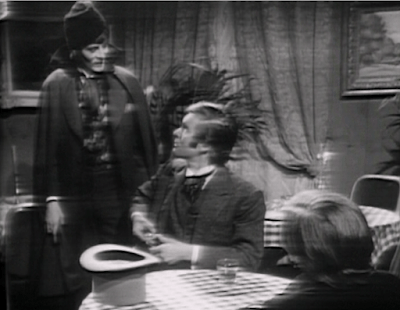
This is the first episode to feature a scene in the restaurant at the Collinsport Inn since #227 in May 1967. The show was in black and white then; apparently the restaurant set cannot be seen in color, since this one, set in the year 1897, survives only in kinescope.
Aristide, Tim, and Jamison/ Petofi in the restaurant at the Collinsport Inn. Screenshot by Dark Shadows Before I Die.
Schoolteacher turned adventurer Tim Shaw is at a table in the restaurant when he is joined by twelve year old Jamison Collins, a former student of his. Unknown to Tim, Jamison’s body is currently a vessel for the spirit of 150 year old sorcerer Count Petofi. Tim is startled to see Jamison, and tells him he had heard he was ill. Jamison asks where he heard this. Tim pauses, then claims that he telephoned Jamison’s home, the great house of Collinwood. He says that Jamison’s nine year old sister Nora answered the phone and told him of his illness. Tim tells Jamison that he is waiting for a young lady, and that after she arrives he would like to be alone with her.
A man enters and talks with Tim. After he goes, Jamison asks who he is. Tim says he has only met him once, and that he knows almost nothing about him beyond the fact that his name is Aristide. We have seen Aristide in the woods with Jamison/ Petofi, and know that he is Petofi’s servant. Jamison/ Petofi told him in that scene that he felt weak and had only a few hours left if he did not recover “The Hand.”
We also saw Aristide in Tim’s room with Amanda, the young lady Tim is waiting to meet. He confronted Amanda, roughed her up, and threatened her with a prop representing a dagger with a curved blade. He wanted Amanda to tell him where “The Hand of Count Petofi” is. Amanda asked if “The Hand of Count Petofi” was a piece of jewelry or something. She had no idea it is literally a severed hand, cut from the wrist of Count Petofi 100 years ago. Aristide questioned her and learned that Tim took a box from the Inn earlier that night and returned without it.
Tim excuses himself, saying that he will go to the front desk to ask if Amanda left a message there explaining why she is so late. Jamison/ Petofi meets Aristide back in the woods. When Aristide tells him that Tim took a box from the Inn and returned without it, he remembers that Tim said he had talked on the telephone with Nora. He deduces that Tim actually talked to Nora in person when he took the box to Collinwood and enlisted Nora’s help hiding it there.
Jamison/ Petofi goes to Nora’s room and wakes her. He tricks her into telling him that Tim was there, but she refuses to tell him where the box is. He twists her arm until she does so. In the parts of Dark Shadows set in the 1960s, David Henesy played strange and troubled boy David Collins, and Denise Nickerson played nine year old Amy Jennings. David and Amy were intermittently possessed by Jamison and Nora in late 1968 and early 1969, and when Amy/ Nora resisted David/ Jamison in #667 and #679, he twisted her arm. When we see the same violent act here, we see a dramatization of a cycle of abuse. We may also wonder if they are going to retcon that “Haunting of Collinwood” segment to include Petofi as a driving force.
Jamison/ Petofi takes the box from Nora’s armoire, opens it, and holds up the Hand. Regular viewers can expect Petofi to return to his own physical form, reattach the Hand to his wrist, and increase his magical powers greatly.
All of the male cast members have trouble with their dialogue today, even the usually line-perfect David Henesy. I wonder if writer Gordon Russell was late finishing the script. Mr Henesy and Michael Stroka manage to give good enough performances that their bobbles don’t really matter, but Don Briscoe is just bad today. When Tim is talking with Nora in the teaser, his intonations are bizarre, and in his later scenes he is flat and lifeless, including a long stretch when he is openly reading off the teleprompter. Perhaps that’s because of his acting style- he worked from the inside out, finding his character’s motivations and developing those first, adding the dialogue last. Give an actor like that less time than he needs, and he might not have anything at all to offer.
One unfair criticism that Briscoe gets from many of the fans who post comments online is that Tim does not have romantic chemistry with any of the women he is paired with. He isn’t supposed to have romantic chemistry with them! At first we see him linked with neurotic intellectual Rachel Drummond. Tim and Rachel were students together at the boarding school run by the sadistic Gregory Trask. When Jamison and Nora are sent to the same school, Tim and Rachel illustrate the horror that lies in store for them. If Tim and Rachel were a hot and exciting couple, they would send the message that kids subjected to Trask’s abuse can grow up to be happy adults, muffing the whole point of the story.
The second woman attached to Tim was Trask’s daughter Charity. Nora points out to Jamison today that Tim and Charity never got along with each other, and regular viewers remember that this is true. Trask forced them to get engaged, a situation that made them both miserable, and then led them both to believe that Tim had murdered Charity’s mother. Again, the whole point of the relationship is to demonstrate how cruel Trask is.
Now Tim is traveling with Amanda. We met Amanda yesterday, and saw that she is impatient with Tim and tolerates him only because he has a lot of money and keeps spending it on her. As possessor of the Hand of Count Petofi, Tim has managed to get rich quick and turn into a tragic version of the character W. C. Fields played in vaudeville routines and stage plays and films set in the Gay Nineties. Amanda is the sort of woman Fields’ characters invariably failed to impress. Again, the last thing you would want would be for Amanda to seem actually to be attracted to Tim.
Though Michael Stroka, in spite of his line bobbles, does a good job as Aristide, there is one moment today when he does make a bad mistake. Aristide makes a big deal out of his dagger, which he initially called “The Dancing Girl.” The prop is obviously just a flat piece of wood, which we might be able to accept if we don’t have to look at it for an extended period. But when he is threatening Amanda today, he holds “The Dancing Girl’s” blade in the palm of his hand, squeezes it, rolls it around, and caresses it. If there were a sharp edge anywhere on it, his hand would be bleeding profusely. They really are not making it easy for us to believe Aristide is going to cut anyone.
Charity Trask finds Quentin Collins unconscious and disheveled in the woods. She kneels beside him in a show of concern, then notices a woman on the ground near him. The woman’s face is covered with what on a black and white television look like slash marks and her clothing is badly torn. She regains consciousness just long enough to say Quentin’s name. Charity notices that Quentin is holding a scrap of cloth that matches the woman’s dress, and realizes that he is the werewolf who has been terrorizing the area.
Quentin comes to, and Charity tells him they must get help for the injured woman. Quentin’s response is to threaten to kill Charity if she says anything to anyone about what she has seen. He says that he will look after the woman, and repeats his death threats to Charity.
Charity goes home to the great house of Collinwood, where her father, the overbearingly evil Gregory Trask, orders her to marry Quentin by the end of the week. She is horrified and tells him she will not. She cannot explain why. Before Gregory can corner Charity and force her to give him information, twelve year old Jamison Collins enters. Jamison reports seeing the injured woman in the woods, and says that Gregory must go to her at once if she is to survive. Gregory dismisses this as a “tall tale” and says he will not be distracted from punishing Jamison for his long unexplained absence from the house. Charity, on the point of sobbing, urges Trask to take Jamison seriously, and he reluctantly goes to see if there really is a woman in the woods.
We know more than do Charity or Trask. We saw Jamison meet Quentin in the woods next to the woman’s body, and talk to him in an amiable and condescending tone about the possibility of turning this unfortunate incident to their mutual advantage. He also makes it clear that, despite his appearance, he is not simply Jamison. He is a sorcerer named Count Petofi, in possession of Jamison and acting through his body. When Charity asks Jamison/ Petofi if the woman was alone when he found her, he replies that of course she was. Smiling, he asks who she thought he might have seen. Terribly agitated, she soon excuses herself and goes into the foyer. Jamison/ Petofi looks directly into the camera and smiles. David Henesy was the first actor on Dark Shadows to use this technique, back in 1966 when he was playing strange and troubled boy David Collins. He’s been doing it a lot lately, and is still very good at using it to unsettle the audience.
He looks young for 150, but he’s grown quite a bit since 1966. Screenshot by Dark Shadows Before I Die.
Quentin comes down the staircase, wearing a tidy new suit. Charity is shocked that he did nothing to help the injured woman; he resumes his menacing tone and demands to know whether she kept her side of the bargain. He eventually deduces that she did not tell what she saw, and allows her to go upstairs to her bedroom. Quentin is usually charming, often funny, and occasionally aligned with good against evil, but even before he became a monster he was established as a homicidal maniac. When we first met Quentin, he was a ghost haunting Collinwood in the late 1960s and he kept killing people there. The first week of our trip back in time to 1897, we saw him trying to strangle his grandmother in her bed. And his sister-in-law turned him into a werewolf as revenge after he murdered his wife Jenny. Since we are focused on the horror of Charity’s situation as her father is pressuring her to marry Quentin, of course his bloodthirstiness is the aspect of his personality we see most clearly today.
Trask returns, carrying the injured woman. Quentin asks if she was conscious. Trask says she is not conscious. Quentin specifies that he wants to know if she has been conscious at any point while with Trask. This arouses Trask’s suspicions; Quentin protests that it is information he will need when he telephones the doctor. Trask says that she was not, and carries her upstairs.
Quentin goes to the drawing room. Jamison/ Petofi is there, and has some business to discuss. Quentin is too unsettled by the fact of the possession to talk candidly. Jamison/ Petofi decides to humor him. “I’ll become that beautiful child you so want to see… Can we play a game, Uncle Quentin?” Quentin is stunned by Jamison/ Petofi’s sudden change of tone and bearing. It is indeed impressive to see David Henesy drop his mimicry of Thayer David as Petofi and resume his usual approach to the role of Jamison. We’d forgotten just how deeply he had come to inhabit that imitation.
Jamison/ Petofi declares that they will have a treasure hunt. He gives Quentin a series of clues in the form of cryptic rhymes. Quentin is completely stumped by all of them. Finally Jamison/ Petofi just points at the desk drawer he wants Quentin to open and tells him there is a document in it that he can use against Trask. Quentin opens the drawer and pulls out heap after heap of paper, then declares “There’s no paper here!”
Quentin is not especially brainy; much of his appeal comes from the joy David Selby, Ph.D., took in playing a character who at no point says or does anything to demonstrate intellectual prowess. But we are not supposed to believe that he is stupid, at least not so stupid that it is plausible that “There’s no paper here!” was the scripted line. Maybe it was a blooper for “There’s no paper like that here!” or “There’s no paper here I haven’t seen before!” or something like that.
A document bearing a wax seal and a couple of signatures materializes on top of the papers Quentin has pulled out of the desk. He reads it, and sees that it is a full confession to the murder of Trask’s first wife, signed by Trask and lawyer Evan Hanley. All Jamison/ Petofi has to say is “It can be very useful, can’t it? Especially since it’s true… Aren’t games fun, Uncle Quentin?” and Quentin catches on that the document gives him power he can use against Trask.
Meanwhile, the injured woman has briefly regained consciousness in the upstairs bedroom where Trask and Charity are attending her. She spoke Quentin’s name, and Trask sent Charity to fetch him. Trask confronts Quentin about this. Quentin says that the woman’s name is Tessie, that he talked to her a couple of times when they ran into each other at the Blue Whale tavern, and that he knows nothing more about her. He admits he didn’t call the police after he called the doctor; he claims he simply forgot, in the confusion of the moment. Trask says that he will go and make the call. In an accusing tone, he asks “Most unfortunate, isn’t it, that you were the one who forgot?” He leaves Quentin alone with Tessie.
Tessie regains consciousness, looks at Quentin, and reacts with dismay. He tells her he didn’t mean to do it. She moans and dies. As she flops over, her right breast comes perilously close to springing out of her décolletage. When he realizes she has died, Quentin says “Tessie!” with a note of exasperation, as if she’s always doing inconvenient things like that. Mrs Acilius and I laughed out loud.
Downstairs, we see that Trask did not call the police after all. Charity is doing it from the telephone in the drawing room. Quentin enters through the secret panel behind her. We first saw him use this panel in #685, when it was 1969 and he was a silent but peculiarly corporeal ghost. He let himself into the drawing room and strangled silversmith Ezra Braithwaite, played by Abe Vigoda. A bit of an eldritch moment that the killer of Tessie is also the killer of a character played by the actor who would go on to play Tessio in the 1972 film The Godfather.
In Vigoda’s last scene in that movie, Tessio and Corleone Family consigliere Tom Hagen are at pains to assure each other that Tessio’s impending murder and the events that led up to it were strictly business, and that Tessio and his murderers still have the warmest regards for each other. Quentin’s attempt to deny his guilt to Tessie is of that same sort- he didn’t have any hostility towards her, his nature as a werewolf simply required that he kill the nearest person.
By contrast, Quentin’s interaction with Charity is intensely personal and intensely unpleasant. He takes the telephone out of her hand, something that men often do to women on Dark Shadows when they are trapping them, and moves deep into her personal space as he demands to know why she would want to call the police. She tells him her father ordered her to make the call; he says that Tessie will tell the police nothing now, because she is dead. Charity shouts that he killed Tessie, and that she will tell everything.
Danny Horn devotes much of his post about the episode at his great blog Dark Shadows Every Day to the absurdity of Quentin making a date with Tessie on a night when the Moon was full. In a comment, I pointed out that we have no reason to think he did make a date with her:
I don’t think it’s so hard to explain why Tessie was in the woods at dawn, though it does require a little fanfic.
Charity was in Quentin’s room in 806, inviting him to go for a walk on the beach when he’s busy getting drunk and listening to the same dreary little waltz over and over. To get Tessie into the woods, all we have to do is assume that shortly after that scene Quentin ran out of booze before he was drunk enough to stop caring about the upcoming full moon. Not wanting to deal with the Trasks, he didn’t go to the mansion’s liquor pantry, but staggered down to the Blue Whale.
There, Quentin met Tessie. She was upset with him for missing several dates in the last few days. He can’t very well explain what he’s been doing lately, and his refusal to answer Tessie’s questions angers her. She’s about to give Quentin a piece of her mind when he realizes that it will be dark soon, and rushes from the bar.
Now Tessie is really furious. She follows Quentin to the estate. Once there, she sees him change into the werewolf, and hides in terror for most of the night. Shortly before dawn, she thinks he is gone and leaves her hiding place. The werewolf appears and slashes away at her for a few minutes before changing back into human form and collapsing beside her.
And that’s when Charity finally takes her walk, and finds out.
Comment left 17 November 2020 by “Acilius” on Danny Horn, “Episode 808: Twice Burned,” Dark Shadows Every Day, 18 January 2016
Tessie is played by Deborah Loomis, and is the earliest screen credit on her IMDb page. Her next role listed there was in Hercules in New York, a 1970 film which also featured fellow Dark Shadows day player Erica Fitz Mears, who appeared in #594 and #595 as Leona Eltridge. Neither Miss Loomis nor Mrs Mears stuck with acting after the middle of the 1970s, but the two top billed members of the cast worked steadily for some years after. The first name in the credits was comedian Arnold Stang, who was best known at the time for a series of TV commercials for window screens ending with the tag “Arnold Stang says don’t get stung!” Second billed was Arnold Strong, a bodybuilder from Austria making his acting debut. Under his birth name of Arnold Schwarzenegger, Arnold Strong would go on to roles in several later films. I know of no evidence he ever auditioned for a part on Dark Shadows.
A MacGuffin day today, as everyone is busy trying to get hold of the magical Hand of Count Petofi. Broad ethnic stereotype Magda Rákóczi stole the Hand, which incidentally is a literal severed hand, from Romani chieftain/ organized crime boss King Johnny Romana. She hoped to use it to cure handsome rake Quentin Collins of the werewolf curse she placed on him, but found that she was unable to master its powers. Several people have stolen it from each other since then; at the beginning of the episode it is in the possession of wicked witch Angelique, who is also unable to figure out how to use it to solve Quentin’s problem.
Today, a man named Aristide is holding Quentin prisoner. He straps Quentin to a table under a descending pendulum with what we are supposed to imagine is a razor sharp blade. He goes to Angelique and tells her that Quentin will die in minutes unless she gives him the hand. Since Angelique can’t see Quentin and Aristide doesn’t even describe the predicament, it isn’t clear why Aristide went to all this trouble, but it does create a memorable image and a nice homage to the works of Edgar Allan Poe. It would also warm the hearts of viewers mourning the end of the Batman TV series.
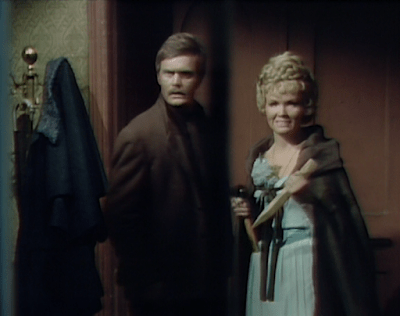
Meanwhile, a small and pretty young woman named Julianka has told Quentin’s distant cousin Barnabas Collins that she can cure Quentin if she has the Hand. He gets it from Angelique and takes it back to his house, where Julianka is waiting. She pulls a knife on him and declares that she is an emissary of King Johnny. She will not cure Quentin, and will stab Barnabas if he does not surrender the Hand. Barnabas calmly offers her money and the Hand if she will cure Quentin before she goes, but she refuses. He gives her the Hand. After she goes, we hear his thoughts as he is feeling sorry for her.
In the woods, Julianka hears a squeaking bat. She reacts with horror as the bat turns into Barnabas in front of her. She asks what he is; he tells her that he believes she knows what he is. He does not bite her, but she does become docile. It seems that Barnabas is using the “Look into my eyes!” vampiric power that he only recently acquired. It also seems that, while Julianka was lying when she originally claimed she had come to Collinwood to cure Quentin, she was telling the truth when she said that she was able to do so.
The Hand recently disfigured Quentin’s face, as it had a few days before disfigured the face of Quentin’s onetime friend Evan Hanley. Evan’s good looks returned after a while, and we have not been told why. Today Quentin’s do as well, and when he asks Aristide for an explanation the best he can do is to suggest it may just be luck. They spent quite a bit of time showing Evan’s efforts to cure himself, and even more time showing Quentin feeling sorry for himself, so this is not at all a satisfactory payoff.
In an original cast panel at a Dark Shadows convention in the 80s or 90s, David Selby reminisced about today’s scene between Quentin and Aristede. He said that when the cameras started rolling, he knew what actions he and Michael Stroka were supposed to perform, that he was supposed to end up tied to the table, and that it was supposed to take a certain number of minutes and seconds. He also knew that there was some dialogue they were to speak in the midst of all that, but he couldn’t remember any of it. The teleprompter was out of view. He looked at Stroka, hoping to see something in his face to jog his memory, and what he actually saw was the same blankness he was himself experiencing. So the two of them improvised their way through it. When they were done, they looked at the clock and saw that they had filled exactly the allotted time. But not a word of what they said was in the script. The resulting scene includes some awkward lines, but it has a great energy to it, just the sort of thing that gets you hooked on live theater.
The evil Gregory Trask coerced lawyer/ Satanist Evan Hanley into helping him murder his wife, Minerva, so that he could marry wealthy spinster Judith Collins. Now Trask and Evan have conjured up a magical simulacrum of Minerva and caused it to hang around Judith. They claim they can’t see it, which, coupled with some other troubles Judith has had, leads her to believe that she has lost her mind. Trask and Evan strong-arm Judith into signing a paper, Trask locks her up in the tower room, and Evan makes the simulacrum disappear.
Meanwhile, Judith’s brother Quentin is at large. Quentin is a werewolf, and when he returned to human form this morning his face was disfigured. This worked to his advantage. He was in jail at the time, and he was being watched. The sheriff’s deputy had not recognized Quentin’s brother Edward when he came to jail that night, so it isn’t so surprising he doesn’t recognize Quentin, even though he is six foot four, has a distinctive hairdo and prominent mutton chop sideburns, and is wearing the same blue suit with a frock coat that he always wears. It is surprising that Edward doesn’t recognize him either, but this may be the result of a congenital problem the Collinses have. Not only was Quentin himself stumped when the equally identifiable Evan had a similar glob of makeup on his face recently, but Judith fails to recognize Quentin today when he comes to the drawing room. When Judith found him, Quentin was listening to his favorite record and reciting its lyrics in his unaltered voice, and he identified himself to her by name. Still, she couldn’t see it.
Quentin bursts into Evan’s room shortly after he finishes dissolving the simulacrum of Minerva. He sees that Evan’s face is no longer disfigured, and assumes that he used the magical Hand of Count Petofi to restore his appearance. Evan tells him he did not- he can’t explain why his face reverted, it just did so on its own. This does not satisfy Quentin, and it will not satisfy returning viewers. We saw Evan struggle to fix his problem for some time, and when he found himself in a crisis situation he suddenly turned up looking like his old self. So we’ve been in suspense for several days wondering what the explanation would be for his cure, and we are no more inclined to settle for a non-explanation than is Quentin.
Quentin knocks Evan out with a candlestick; the background music is a cue we have previously heard during on-camera murders, leading us to wonder if Evan will survive the blow. Quentin rummages around for a moment and finds the hand. He is looking at it, wondering how to use it to restore his appearance, when a man in a wool cap enters and orders him to surrender the hand at once.
This episode features one of Dark Shadows‘ all-time great goofs. When Evan is casting the spell to dissolve the simulacrum, a black-clad figure dashes past in front of him. A voice can be clearly heard exclaiming “Jesus, Lacy!” Evidently actor Jerry Lacy was in such a hurry to get from one set to another that he didn’t realize he was crossing a live camera.
Dark Shadows fans like to make jokes about the inefficiency of law enforcement in the fictional town of Collinsport, but in this episode we see that the sheriff and his men really never had a chance. The ancient and esteemed Collins family controls everything in the area, and they will go to any lengths to keep the police from obtaining the information they need to do their job effectively.
Stuffy Edward Collins invokes the police when he demands that broad ethnic stereotype Magda Rákóczi vacate the Old House on the estate of Collinwood. Magda laughs and says that if the police show up, she will tell them that Edward’s distant cousin Barnabas is a vampire. Horrified at the damage it would do to the Collins family name were word of Barnabas’ condition to get out, Edward backs down. Barnabas is at large and has been responsible for at least six homicides since traveling through time to the year 1897, including the murder of Edward’s brother Carl in the drawing room of their home just the other day. But evidently that is a small matter to Edward compared to the danger that the sheriff might be indiscreet.
Barnabas materializes at the police station, where a werewolf is being held in custody. A deputy is startled to see Barnabas in front of him all of a sudden. For only the third time in the series, Barnabas says “Look into my eyes!” and induces an hypnotic trance in someone not his blood thrall. It is the first time he has exercised this power on someone other than Edward’s nine year old daughter Nora. Barnabas tells the deputy that once he has completed his task, he will remember nothing. So he is following the family policy with regard to keeping the police in total ignorance.
Edward shows up and sees Barnabas. Edward is wearing a cross and holding a revolver loaded with six silver bullets, which on Dark Shadows are as effective against vampires as they are against werewolves. Barnabas hides behind the deputy and tells Edward that he is acting in the interests of the future of the Collins family. Edward says that he belongs to the past, not the future. Barnabas doesn’t explain anything; he vanishes.
Not exactly an heroic look for ol’ Barney. Screenshot by Dark Shadows Before I Die.
Barnabas’ post-hypnotic suggestion has its effect, and the deputy is bewildered to find himself face to face with Edward. Edward tells him that they must watch the werewolf. The deputy starts to say something about the sheriff, and Edward replies “The sheriff doesn’t realize what this animal is!” Of course he doesn’t, no one will tell him anything about it.
Back in the Old House, Barnabas and Magda lament their failures. He could not take the werewolf from the cell in the police station to the cell in the basement of the house; she could not persuade lawyer/ Satanist Evan Hanley to return a severed hand he stole from them. They wanted to do these things because the werewolf is Edward’s brother Quentin, whom Magda is trying to free from his curse by means of the hand’s magical powers. Barnabas knows that if they do not succeed, terrible consequences will ensue in 1969.
Closing Miscellany
It is a serious mistake to show the werewolf when he is not in the act of committing a spectacular homicide. They didn’t have the budget to put him in full-body makeup, so he wears a tidy little suit, complete with a watch fob. He is so well put together that it is difficult to imagine him inspiring any fear other than the fear that one will not meet his apparently rather exacting standards of attire.
There is a noteworthy blooper in this one. Magda confronts Evan, declaring “The book, I know you took it from the Old House!” Usually actors roll with each other’s bobbled lines, but this is far enough out that Humbert Allen Astredo obviously has no idea where Grayson Hall is in the script. All he can do is ask “The book?” “The hand!” she corrects.
They also make a goof in the closing credits. This is one of three consecutive days when Louis Edmonds is billed not as Edward, but as Roger Collins, the role he plays in the parts of Dark Shadows set in the 1960s. He’s been identified correctly throughout the first seventeen weeks of the 1897 segment and everyone else is identified correctly in these episodes, so it is not clear what happened.
Danny Horn’s posts at Dark Shadows Every Day are often laugh-out-loud funny, and the one for this episode is especially so. His description of the scene between Magda and Evan has some big laughs, and when he imagines the sheriff’s deputies trying to catch the werewolf by “putting on their alluring lady-werewolf disguises a la the Warner Brothers cartoons,” well that’s just super how could anyone improve on it.
For most of its run, Dark Shadows was made with severely limited access to videotape editing equipment. If something went wrong, the only way to fix it was to start over. So even spectacular mistakes stayed in, especially if they took place near the end of the episode. Today there is a blooper in the opening voiceover- yesterday’s episode centered on a prophetic dream that twelve year old Jamison Collins had about his future descendant David, but the narrator names the dreamer as “David.”
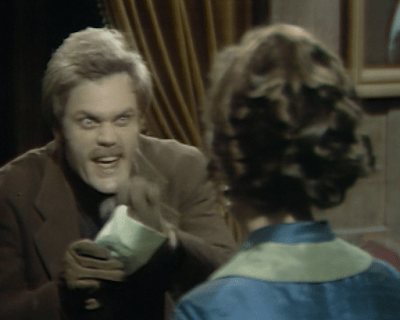
It doesn’t get much better from there. The episode is a showcase for the acting of Roger Davis as crazed groundskeeper Dirk. Unfortunately Mr Davis is the sort of actor who needs close guidance from a director, and the directors on Dark Shadows famously gave their male performers a great deal of latitude. So he hams up his every scene, often interrupting himself with sounds that are variously transcribed as “huh?” or “hyunh!” or “hyuk hyuk!” He ruins every shot he is in.
The only Davis-free scenes are interactions between maidservant Beth and the show’s two breakout stars, her boyfriend Quentin and her vampire master Barnabas. The writing staff has figured out a way to work around Terrayne Crawford’s limitations as an actress; Beth is always very earnest and straightforward. That is a great relief after the first weeks of the part of Dark Shadows set in 1897, when they gave Beth the same rich and complex motivations they lavished on everyone else and she fell disastrously flat every time. Still, Beth’s emotional transparency does not give David Selby or Jonathan Frid much for Quentin or Barnabas to play off of, so that they seem to be explaining the plot to her.
Quentin at one point slaps Beth in the face today. It used to be extremely rare for male character to slap female ones on the show, but these incidents are have started to come thick and fast since writer violet Welles joined the staff. Miss Welles was far and away the best writer of dialogue on Dark Shadows, and I suppose she must have had a reason for showing us all these women getting hit by men, but I for one am eager for it to stop.
Barnabas bit Dirk a while ago, but before he did that Dirk was already enslaved by undead blonde fire witch Laura. So rather than becoming a blood thrall, Dirk reacted to Barnabas’ bite by going nuts. At the end of today’s installment, Dirk is trying to kill Barnabas. Dirk has yet to find a task so simple he can succeed in it, so we leave without much suspense that he will manage to kill off the main protagonist. I suppose it will do for a Wednesday cliffhanger.
Undead blonde fire witch Laura Murdoch Collins realizes that Barnabas Collins is a vampire, and that when he was alive he was the “strange, dreamy boy with sad eyes” she was fond of in the 1760s, when she was married to his uncle. Laura and Barnabas confront each other in a graveyard at the beginning of the episode; she tells him he is not human. He passes up the opportunity to reply “So few people are, these days.” At the end of the episode, Laura and her witless henchman Dirk let themselves into Barnabas’ house after dawn. She has a mallet and stake, he has a pistol to ensure no one interferes.
It means something to longtime viewers that we end today with Laura poised to destroy Barnabas. It was Laura who cleared the way for Barnabas’ first introduction. She was the show’s first supernatural menace when she was on from December 1966 to March 1967, and her story was structured very much like Bram Stoker’s Dracula. That was successful enough that the following month they introduced Barnabas as Dracula Mark II. That Laura knew Barnabas in the 1760s when she was already what she is and he was still a boy also nods to this history.
Laura went up in smoke in March 1967, when the show took place in a contemporary setting, and reappeared in April 1969, when it was a costume drama set in 1897. In the interval, Dark Shadows changed from a slow-paced, moody Gothic drama meant for an audience largely consisting of people who were fans of Joan Bennett’s in the 1930’s to a slam-bang supernatural thriller with a huge following among preteens. In her first tour as Laura, Diana Millay could focus on her strengths in dry comedy and subtle psychological drama. This time around, she recognizes the new demographic and plays Laura like a villain on Batman. At times it seems odd that Dirk isn’t wearing a jumpsuit with his name stenciled on it.
Perhaps when she hits the stake with the mallet, the word “Whack!” will be printed in a bubble on the screen. Screenshot by Dark Shadows Before I Die.
Meanwhile, Barnabas materializes inside a classroom at a school where Laura’s nine-year old daughter Nora is alone. Nora tells Barnabas that she is not happy at the school and that she and her twelve year old brother Jamison want to leave with their mother. Barnabas tells her to “Look into my eyes!” and he puts the zap on her. When he is done, he tells her that their conversation will be their secret. She smiles, looks directly into the camera, and tells the audience “I like secrets!” Denise Nickerson had a talent for delivering lines to the camera, and ever since she joined the show in November 1968 they’ve had her do that quite often. Rather too often, I’m sorry to say- it can chill the audience to see a character who is so disconnected from everyone else that they just start talking to us if the effect is used sparingly, but they have her do it so frequently that it has lost its force by now.
Nora and Jamison’s school is a miserable place, less a center of learning than a dungeon where the sadistic Rev’d Gregory Trask gleefully inflicts unwarranted and cruel punishments on both children and teachers. Trask’s daughter Charity is a member of the faculty, and since #727 she has also been Barnabas’ blood thrall. In #753, we saw Charity acting as her father’s second in command at the school, enforcing a particularly vicious sanction against Jamison. It did not then seem that her subjection to Barnabas had modified her role in her father’s operation at all.
When Charity enters and finds Barnabas with Nora, her two enslavements come into conflict. Barnabas tells her that Laura will be coming to the school to see Nora soon, and orders her to let her in. Charity is very confused and starts talking about her father and his rules. Barnabas bites her, leaving her more tranquil but quite weak.
Laura knocks on the door. Charity finds that Barnabas has vanished, and lets her in. She demands to see Nora, saying that she will take her away. Charity says that no relatives are allowed to visit the children at night, and that she will need permission from others to allow Laura to take Nora. Laura insists, and eventually Charity complies. She sends Nora down, and brings her packed suitcase. But Nora has told her mother that she does not want to go. We saw in 1967 that Laura’s children must go with her willingly if she is to perform her evil mission, and so she has to yield. She looks at the collar Charity has drawn up to cover her neck, and says that she will not tell her father that two of Nora’s relatives have visited her tonight.
Some of the actors have trouble with the names “Laura” and “Nora” today. It really was a mistake to give Nickerson’s character a name that rhymes with “Laura.” In #354, set in 1967, matriarch Elizabeth Collins Stoddard told her daughter Carolyn that “Aunt Catherine” would be overjoyed to host her in her home in Boston, and that this never-before mentioned aunt gives wonderful parties attended by men Carolyn’s own age. Catherine cannot have been Elizabeth’s sister or a member of Carolyn’s father’s family; she must be Elizabeth’s own aunt. Nora is the only one of Elizabeth’s aunts we ever hear about, and she would have been 79 in 1967. As a grande dame of Boston society, she might still have been giving big parties featuring people of all ages, and so naming the character “Catherine” would have closed that loop.
It would also have opened the door for another story to add some action to the rather slow period leading up to the 1897 flashback. Aunt Catherine could have come to Collinwood from Boston in 1969 and met the evil ghost of the roguish Quentin Collins. Recognizing her favorite uncle but knowing that he came to a dark and mysterious end, that would have set up a confrontation that might have led to an enigmatic conclusion. Quentin killed other adults who knew about him, but his relationship with Catherine would have made it maladroit to bring their encounter to so straightforward a climax. Better to have her disappear inexplicably. That disappearance would be followed by signs that the disturbances in the house had suddenly grown far more dangerous. We would wonder if Catherine had joined with Quentin as another evil spirit, or if the two of them were doing battle in some unseen realm and inflicting collateral damage in the world of the living.
I have an idea who they should have cast as Aunt Catherine. Isabella Hoopes played dying matriarch Edith Collins at the beginning of the 1897 segment, and she was great fun. Had we been introduced to Hoopes as the spry and sophisticated Aunt Catherine, her turn as Edith would have been even richer. When Quentin chokes and threatens to kill Edith, we would try to read their interaction as a clue to what happened between him and Catherine before her disappearance. When Edith haunts Quentin after her death, we would look for clues as to what happened to Catherine after her disappearance. And of course Nickerson’s role as Catherine’s younger self would have gained another dimension, not only as we watch her interactions with Quentin, but also as we compare her personality at the age of nine to that of the octogenarian we had met previously.
I even have some dialogue Catherine could have exchanged with the Collinses of 1969:
Catherine: Roger, I hear you have married again. Will you present me to your wife this time? I must admit I took it rather personally that I could never meet Laura.
Roger: I’m sorry, Aunt Catherine. Cassandra and I have already gone our separate ways.
Catherine: Oh, I’m the one who should be sorry- it was tactless of me not to know… We Collinses have never have had much luck in marriage, have we?
Elizabeth: You and Uncle Ambrose were happy.
Catherine: Yes. Happy… But there wasn’t much luck to that. After all, he was my fourth husband and I was his third wife. We simply applied the lessons of experience.
Carolyn: So there is hope. After your disappointments, you found your grand passion.
Catherine (a look of frank disbelief on her face): Not exactly. (Pause.) Carolyn, your mother told me some time ago you were the one involved in a grand passion. His name is- what- Bud?
Carolyn: Buzz?
Catherine: Yes, Buzz. I should have remembered that, I once knew a Navy flyer who went by that name. If your Uncle Roger won’t be introducing me to anyone, will you at least present me to Buzz?
Carolyn: Oh, it ended between me and Buzz some time back. He’s left town.
Catherine: Ah, too bad. I’d have liked to meet another Buzz, the one I knew was so elegant.
Elizabeth: This one was hardly elegant. He rode a motorcycle, and that was his whole life. He always wore leather clothing and dark glasses, with a long beard and a ragged mop of hair. You never saw the like, Aunt Catherine.
Catherine: On the contrary, I have seen the like every often. Just such men make up your cousin William’s preferred milieu.
Carolyn (laughing): I once told mother I was going to marry Buzz, but that was an empty threat. Buzz isn’t the sort of man who really wants a wife.
Catherine: Neither is William.
(Elizabeth, Roger, and Carolyn fall silent. After a moment, they all start talking at once.)
Elizabeth: Have you seen-
Roger: How is old Mr-
Carolyn: Was your trip-
(They fall silent again. Another awkward pause ensues.)
Elizabeth: Do you know that there is another Collins at Collinwood?
Catherine: Oh?
Elizabeth: Yes, a distant cousin of ours, from England. His name is Barnabas Collins.
Catherine (furrows her brow): Barnabas Collins? Named for the man in the foyer?
Elizabeth: Yes, the portrait is of his ancestor.
Catherine: How odd. When I was a girl, I asked the old people around here about all of the portraits. They were happy to go on at length about all the others, but they were always tongue-tied when we got to that one. Left me with the impression there was something exceptionally sinister about it, or about the man. Of course that only piqued my curiosity.
Carolyn (suddenly defensive): There is certainly nothing sinister about our Barnabas!
Catherine: Nothing sinister? Are you sure he is a Collins?
(Roger and Elizabeth chuckle, Carolyn flushes.)
Elizabeth: Oh, he is a Collins, all right. He’s quite an expert on the family’s past. I’m sure the two of you would have a great deal to talk about.
Catherine: I’m sure. But I would rather choose another topic. At my age I can’t forget that I will soon be part of the past. I would like to keep my eyes on the future while I still have one.
This scene would have left longtime viewers with some suspense-generating questions. Why did Roger’s wife Laura go out of her way to avoid Catherine? Who were the “old people” at Collinwood in Catherine’s childhood? What did they know about Barnabas? Further, Laura and Buzz were so emblematic of two of the early phases of Dark Shadows that involving Catherine in a conversation referring to both of them would promise that she will be woven in with the whole narrative structure of the show.
Moreover, seeing a Collins who had spent decades far from Collinwood might give us a fresh perspective on the main characters. We see only those whose minds and hearts have been deformed by the many curses that loom over the estate. Meeting one who has been outside their influence for so long would suggest what it has cost the others to stay on the estate. We might then feel anew the tragedy that we have been taking for granted.
Broad ethnic stereotypes Sandor and Magda Rákóczi are in the parlor of their home, the Old House on the great estate of Collinwood, quarreling about a locket. Shortly before, Magda found maidservant Beth Chavez and libertine Quentin Collins in the parlor, and she noticed Beth snatch a locket from a table and try to hide it. Beth claimed that the locket was hers, but Magda declared that it was not, and that she knew who it really belonged to. Now Beth and Quentin have left, Magda has the locket, and Sandor is pleading with Magda to stop trying to figure out what it means that the locket is in the house. “She is far away!” he protests.
Returning viewers know that the locket belongs to madwoman Jenny, Quentin’s estranged wife. Unlike Magda, we also know that Quentin’s brother and sister, with the assistance of Beth and another servant, have been keeping Jenny prisoner in a series of cells deep in the great house ever since Quentin left her the previous year. Yesterday Jenny had a strong reaction to Magda’s name, in the course of which she started muttering about Sandor as well, hinting that the Rákóczis are of some importance to Jenny.
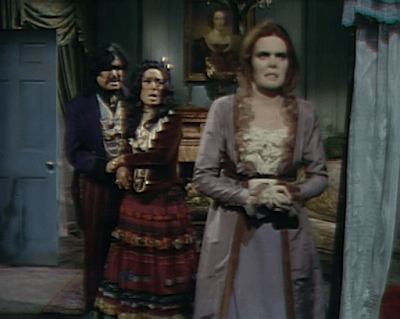
Sandor and Magda hear a voice from an upstairs bedroom. They go there, and are astonished to find Jenny. They ask her where she went when Quentin left her; she denies that Quentin ever did leave her, and talks about being locked up in a room. It dawns on Magda and Sandor that the Collinses locked Jenny up in the house and have been keeping her there. Jenny angrily says that yesterday she was horrified when Sandor and Magda’s caravan pulled up at the home she and her husband share, and that she told them never to speak to her again; they tell her that happened years ago. She is shocked and disbelieving.
Jenny sneeringly calls Magda and Sandor “Gypsies.” Magda replies “You are a Gypsy, too.” Jenny replies that “What I was is not what I am.” After a few more moments, Magda and Jenny embrace and Magda calls her sister.
The revelation that Jenny is Magda’s sister is one of the most effective twists in the whole series. When Mrs Acilius and I first watched the show through, we were thunderstruck by it. The most amazing thing is that it makes so much sense we couldn’t believe we hadn’t figured it out. The Collinses have disdain for Jenny, not only because their black sheep brother brought her into the family, but also because she is of obscure birth. So when she became mentally ill, why didn’t they just ship her off to an institution and have done with it? The answer is racism. They are not simply embarrassed that Quentin chose an unsuitable wife; they are frozen with horror that a Romani person now bears their family name. They cannot take the chance that anyone, even the staff of a discreet, high-end sanitarium, will learn of this shame, and so they hide her away in their own house.
In #701, the first episode of the part of Dark Shadows set in the year 1897, it was established that Beth came to Collinwood as Jenny’s maid and that it is surprising she stayed after Jenny ceased to be a visible member of the family. In the same episode, Magda mentioned some Romani folklore to Beth, said, “But you wouldn’t know anything about that!,” and laughed tauntingly while Beth looked alarmed. The implication that Beth has been trying to conceal her own Romani heritage, combined with her association with Jenny, was something else we were surprised we didn’t pick up on the first time through the show. Perhaps that is because of the visuals. As Sandor and Magda, Thayer David and Grayson Hall wear heavy brownface makeup and dark curly wigs. As Beth, the tall, wasp-waisted Terrayne Crawford has her own light blonde hair, pale skin, and blue eyes. So it was easy to take Magda’s line as a reflection of something that was in the flimsies months before they cast the part of Beth Chavez with an obviously Anglo actress, and to assume that we would never hear of it again.
There are some flaws on screen today. Early on, Quentin walks in front of a green-screen with a picture of the Old House, and it is ludicrously fake even by the standards of special effects on Dark Shadows.
The real house in this photo burned down about this time, perhaps because it couldn’t stand the disgrace of having appeared in this shot. Screenshot by Dark Shadows Before I Die.
Later, there are three goofs in thirty seconds. Sandor leaves Magda alone in the room with Jenny. Jenny is supposed to slam a book down on Magda’s head to stun her, but we can clearly see that the book sweeps through a space several inches to Magda’s left. When Magda falls and Jenny runs out, Sandor isn’t supposed to see Jenny, but the two of them are on screen together and their shoulders actually brush against each other. Once downstairs, Jenny is supposed to try the front door, find it locked, and look for a hiding place. But when she touches the door, it opens, and she has to pull it shut before she can play her scene about being unable to get out.
Well-meaning time-traveler/ bloodsucking fiend Barnabas Collins enters a cottage on the grounds of the estate of Collinwood to find thuggish groundskeeper Dirk Wilkins standing over the freshly stabbed corpse of the rakish Quentin Collins. Since Quentin’s cause of death is a long-bladed thrusting dagger, a weapon also known as a “dirk,” it would seem clear that Wilkins is the culprit. But as it happens, Barnabas saw Wilkins enter the cottage a moment before, so he can be fairly sure he did not kill Quentin.
Nonetheless, Barnabas threatens to go to the police and accuse Wilkins unless he answers “a lot of questions.” Barnabas doesn’t have any witnesses to back up his version of events, and though he claims to be a relative of the ancient and esteemed Collins family he only arrived in town a few weeks before. But Wilkins isn’t hard to intimidate, so he answers some of Barnabas’ questions about madwoman Jenny Collins. Most importantly, he tells Barnabas that Jenny is the estranged wife of Quentin, not of Quentin’s brother Edward as the audience had been led to believe in the four weeks leading up to Friday’s episode.
As Wilkins, actor Roger Davis has been getting very careless with his lines. Jonathan Frid always had a lot of trouble with his own dialogue, but he is clearly sticking with the script in an exchange like this:
Wilkins: Mr. Collins, you gotta understand that she’s crazy in the head! She could hurt herself — or somebody!
Barnabas: Who do you mean by “we”?
This comes to a head with one of Dark Shadows‘ most famous bloopers:
Barnabas: Tell them that you saw no one here. Wilkins: Oh, that’s fine. What am I gonna tell ’em? Barnabas: That you saw no one here!
Jenny is being kept in a cell in the basement of the great house on the estate. Wilkins and maidservant Beth were assigned to watch her. On Friday Jenny bashed Wilkins on the head with her dinner tray, unfortunately not hard enough to kill him and get the odious Mr Davis off the show. She did knock him out, though, and ran off to the cottage to stab Quentin. We cut to the cell, where Jenny is babbling to Beth. It gradually dawns on Beth that Jenny is telling her she stabbed Quentin and killed him. Beth locks Jenny in the cell and rushes off to the cottage.
In the cottage, Barnabas has summoned wicked witch Angelique and asked her to bring Quentin back to life. Angelique points out some of the flaws in Barnabas’ plan, and tells him that even if she does grant his wish the price for her services will be very high. They seem to be approaching a tentative agreement when Beth arrives at the door and Angelique vanishes.
Beth finds Barnabas in the cottage. He tries to keep her out. It has long since been established that, as a vampire, Barnabas is far stronger than any mortal man, yet Beth pushes past him without apparent difficulty. For that matter, we also know that he is as capable as Angelique of vanishing into thin air, yet he hangs around while Beth sees Quentin’s body. Barnabas insists she tell no one what she saw in the cottage, and he is staring at her with the same intensity that has sometimes exerted an hypnotic effect on people. This doesn’t work on Beth. She says that she will tell Judith Collins, the mistress of the estate, that Quentin is dead and that Barnabas was with him. Barnabas just watches Beth go. Evidently he has given up on using his vampiric powers. Terry Crawford’s literal acting style doesn’t win her much enthusiasm from the fans of Dark Shadows, but it does add a touch of humor to a scene like this. Vampire? What’s that? Sounds like bullshit, I’m gonna report this to the boss.
We cut to the drawing room of the great house, where Quentin’s body is laid out in a coffin with candles burning on high stands by its head and foot. Barnabas and Beth are there. Beth tells Barnabas she has not yet spoken to Judith. Apparently she just took Quentin’s body to the great house on her own? And found a coffin? And carried it into the drawing room where she put Quentin in it? And that’s how the family is going to find out Quentin is dead, by seeing him lying in state in the middle of the house?
Barnabas and Beth exit, and Angelique enters. She tells the corpse that she will raise him from the dead, and that once she does Barnabas will really be sorry.






 Dark Shadows Commentary