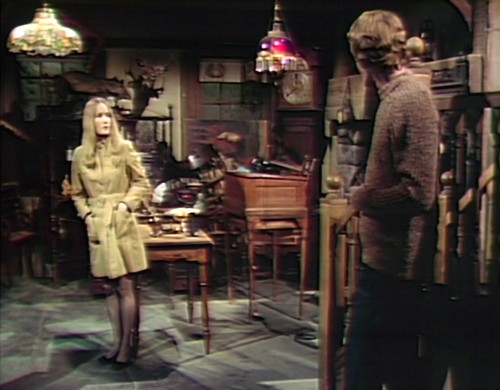
Heiress Carolyn Collins Stoddard has had a dream in which her new husband, whom she knows as Jeb Hawkes but who when we first saw him asked to be called Jabe, was in a fight on top of Widows’ Hill. His opponent, a stooge named Sky Rumson, threw him off the precipice to his death. When she awoke, Carolyn ran to the hill in search of Jabe. Instead, she found Sky. He told her that her dream was not complete, because it did not show her death. He then grabbed her by the throat.
Jabe rushes up and knocks Carolyn out of Sky’s grip. He and Sky fight, and Sky does throw him off the precipice. Carolyn escapes.
Back home at the great house of Collinwood, Carolyn finds her mother, matriarch Elizabeth Collins Stoddard, and permanent houseguest Julia Hoffman, MD. It takes her a while to compose herself sufficiently to tell Liz and Julia what happened. Julia offers Carolyn a sedative, which prompts her to jump up and shout a verbal refusal. By the time Carolyn starts telling the story, her distant cousin, old world gentleman Barnabas Collins, has joined them in the drawing room. She interrupts herself to yell at Barnabas that he always hated Jabe and is probably glad he’s dead. When Carolyn finishes, Barnabas slips out. Liz calls the police, and Julia is surprised neither of them saw Barnabas leave.
For the last nineteen weeks, the show has been trying to make a story out of some themes drawn from the writings of H. P. Lovecraft. That segment is usually called “the Leviathans,” after a race of Elder Gods who are behind the action. Jabe was central to the Leviathan segment. Sky is the only other character remaining from it. Barnabas appears in the house where Sky has been crashing and finds him packing his bag. Sky does not understand how Barnabas got in. Barnabas dismisses his question, merely saying that Sky knows there are things he can do that ordinary people cannot. Sky draws a revolver and fires two rounds at Barnabas point blank, without effect. Sky exclaims “Oh, no!” Barnabas is amused that none of Sky’s late colleagues told him that he is a vampire. He takes Sky’s hand, curls his arm back so that the gun is pointing at his heart, and squeezes Sky’s finger onto the trigger.
Back at the great house, Liz gets a telephone call from the sheriff. The police haven’t found Jabe’s body, and have surmised that it washed out to sea. They have found Sky, and have tentatively ruled his death a suicide. Later, Carolyn has another dream. In this one, Jabe shows up and confirms his death. That marks the end of the Leviathan segment. Carolyn will go on using the name “Mrs Hawkes” and saying she misses Jabe, but otherwise the last nineteen weeks will be forgotten.
Before killing Sky, Barnabas had mentioned that he almost regrets not leaving him to the other person who is on her way to do him in. That is Sky’s estranged wife, wicked witch Angelique. Had the Leviathan segment been more successful, or had Geoffrey Scott been even marginally competent in his performance as Sky, they might have made something of the parallels between Sky and Jabe. They are both very tall men with blonde wives who are dissatisfied with them. Angelique is dissatisfied that Sky is a tool of the Leviathans and that he tried to set fire to her on the orders of their representative, and Carolyn is dissatisfied with Jabe because he keeps running away from dangers he has brought on himself by his rebellion against the Leviathans and he won’t tell her anything about himself. Sky is a mortal man, while Angelique may once have been human but has long since become a creature of the supernatural. Carolyn is a mortal woman, while Jabe is now human but was originally a shape-shifting monster from beyond space and time.
But the ratings have been sinking throughout the Leviathan period, and the whole narrative structure of the arc keeps collapsing around them every time they try to do anything with it. So they are in too much of a hurry to move on to the next thing to do any exploring of the characters. Also, Scott is hopeless. As my wife, Mrs Acilius, put it, it isn’t that he is an actor with just one strategy. He keeps trying different things, and none of them comes close to working. We won’t see him again.
The new story has to do with an alternate universe that is occasionally visible in a room in the long disused east wing of Collinwood. Barnabas, Julia, and others have been spying on its inhabitants, and Barnabas is fixated on the idea that if he can cross over into it his vampirism will disappear. Since his bloodlust is overwhelming him, he is desperate to pursue this forlorn hope. He goes to the room when the alternate universe cannot be seen there, and a moment later finds that it has changed with him in it. Julia is in the hallway, looking in. At first she and Barnabas can see each other, and she can hear him, though he cannot hear her. After a moment, Carolyn’s alternate universe counterpart enters and demands to know who Barnabas is and what he is doing in the house.
Barnabas took Carolyn as his blood-thrall in October 1967. The show went back in time to 1795 the following month. In the 1790s segment, Nancy Barrett played fluttery heiress Millicent Collins. We saw that Barnabas first became a vampire in 1796; not long after, he took Millicent as his blood thrall. Shortly after the show returned to contemporary dress in March 1968, one of Julia’s colleagues in the mad science profession applied a treatment that put Barnabas’ vampirism into remission. That freed Carolyn of her connection to him, and at some point she forgot it ever happened.
For most of 1969, Dark Shadows was set in 1897. In that segment, Miss Barrett played repressed schoolmarm Charity Trask. Barnabas bit her, too. Carolyn’s counterpart in “Parallel Time,” known by her married name Carolyn Loomis, is the fourth character* Miss Barrett played on Dark Shadows; considering that Barnabas is so frantically hungry, it looks like she will follow in the footsteps of her predecessors and serve as his breakfast.
*Or fifth- in #819, sorcerer Count Petofi found Charity’s personality to be an irritant, so he erased it and replaced it with that of the late Pansy Faye, a Cockney showgirl/ mentalist. From that time on, Miss Barrett played Pansy, not Charity.
For sixteen weeks, Dark Shadows kept gearing up to tell us about the Leviathan People, a Lovecraftian race of Elder Gods who had a plan to retake the Earth and destroy humankind. During that time, the show gave us several good scenes, some striking images, a few thrilling moments, and many outstanding performances. But it never came together into anything that could be called a story. Today, they officially run up the white flag.
The harbinger of the Leviathans is a shape shifting monster from beyond space and time. The monster settled into the form of a tall young man, fell in love with heiress Carolyn Collins Stoddard, and decided he just wanted to be human and marry her. Nicholas Blair, high priest of the cult devoted to the service of the Leviathans, wants to join him and Carolyn, not in marriage, but in a ceremony that will turn her into the same kind of squamous, rugose, and paleogean creature the monster is when he is relaxed. The monster disrupts that ceremony, and suddenly the whole Leviathan project crumbles.
Nicholas tells the monster that he will die soon, since he can no longer change out of his humanoid form. The monster doesn’t understand what he means. Nicholas explains that the body through which he once invited people to “Call me Jabe” cannot live on its own. Since he can no longer shift shape, the monster’s future as Jabe is extremely limited.
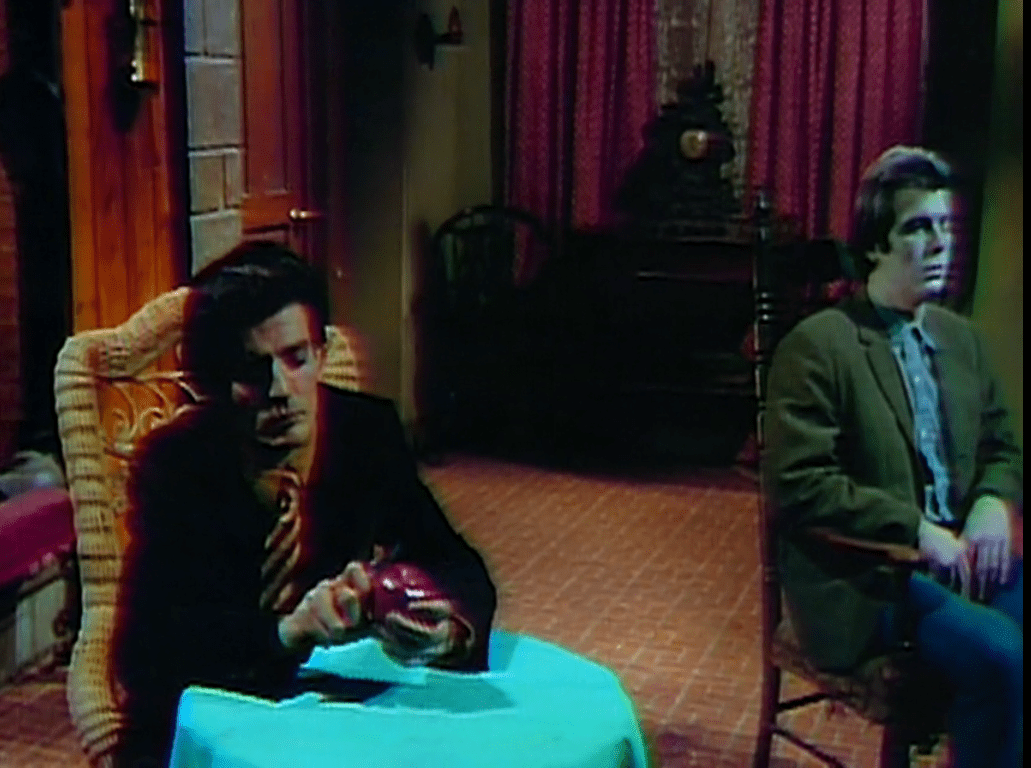
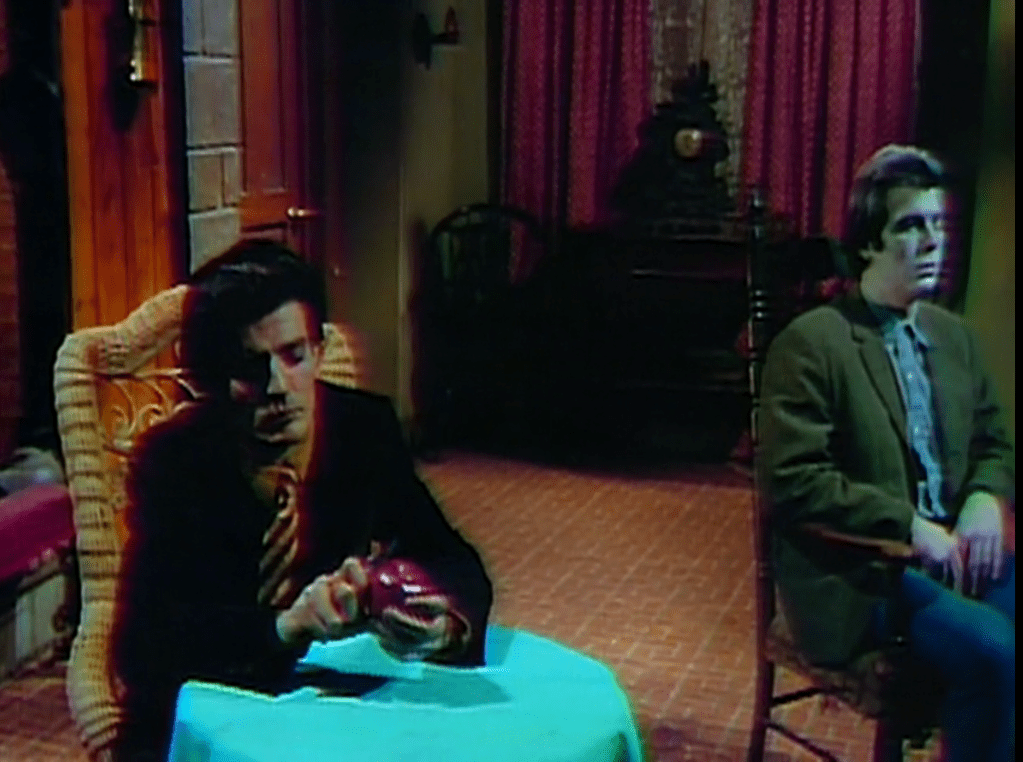
Meanwhile, Nicholas’ henchman Bruno is hanging around the carriage house on the estate of Collinwood, where Jabe has been staying. He peels an apple and sits in a chair next to a zombie. We’ve seen plenty of zombies, but no one on the show has had anything to eat since the diner at the Collinsport Inn was a frequent set in 1966 and early 1967, so the apple is noteworthy.
In a different role, Michael Stroka visited the diner in its one post 1967 appearance, in #813. No one was being served that time, though.
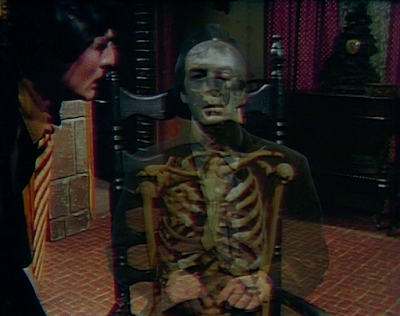
Bruno finds that there is a fire raging in the back room, and orders the zombie to help him put it out. As he gives this order, the zombie’s flesh and clothing disappear. All that is left of him is a skeleton. Bruno goes to the woods and finds another skeleton, this one with eyes in its sockets and clothes around it. He sees Nicholas, and tells him that “All our dead have turned into skeletons!” Nicholas explains that the power of the Leviathans is broken, and their time is up.
Old world gentleman Barnabas Collins takes his distant cousin Carolyn back to her home in the great house of Collinwood. Barnabas tells Carolyn’s mother, matriarch Elizabeth Collins Stoddard, that Carolyn is in a trance. They take Carolyn upstairs and put her in bed.
Liz has been under the control of the Leviathans, a dedicated and ruthless member of their cult. She asks Barnabas what is going on, and he launches into a denunciation of the Leviathans. She responds with complete bewilderment. Barnabas realizes that Liz is not only free of the Leviathans, but that she does not remember them or anything she did for their sake.
This may disappoint longtime viewers. Throughout 1967 and 1968, the show kept Liz firmly shielded from any knowledge of the supernatural stories, let alone active involvement in them. For most of 1969, Dark Shadows was a costume drama set in 1897, and Joan Bennett played Judith Collins. Unlike Liz, Judith was allowed to know what was going on and to take part in the action. She was under mind-control when she shot governess Rachel Drummond to death, but when she was released from that control she remembered what she had done and was desperate to cover it up. In that desperation, she became a player in several plot-lines and we saw what Bennett could do when she had something to work with.
Liz hasn’t actually killed anyone, but she did lock governess Maggie Evans up to keep her from getting in Jabe’s way, and, when it looked like Jabe would kill Maggie, Liz’ greatest worry was that the resulting publicity would exonerate the man who has been framed for the murders Jabe had already committed. So if she came out of the cult remembering what she had done, Liz would be free to become a full participant in any story. Now, she snaps right back into her usual place, which is nowhere at all.
Jabe comes to Carolyn’s room. He orders Liz to get out of his way. As a cultist, she had responded to this sort of thing with dutiful obedience, but now she is quite properly indignant. Jabe is pleased to see that she has changed, but he keeps insisting she let him talk privately with Carolyn, and never thinks to say “please.” At Carolyn’s request, Liz finally agrees to this.
Jabe tells Carolyn that he will die soon unless he goes far away. He refuses to explain why this will happen, as he has consistently refused to answer any of Carolyn’s questions about him. But she somehow loves him anyway, so she agrees to marry him in the morning and leave town with him immediately after. Carolyn writes a farewell note to her mother, then falls asleep.
Carolyn has a dream in which she and Jabe go to the drawing room at Collinwood to get married. They find Nicholas there, and he starts in on the same Satanic invocation he had made before Jabe put the kibosh on the whole Leviathan segment. This was so incongruous that Mrs Acilius and I laughed out loud. Carolyn’s own shocked reaction absorbs the incongruity into the drama. Barnabas interrupts the ceremony and demands that Jabe admit that he murdered Carolyn’s father, Paul Stoddard.
Three times, Carolyn has had dreams in which Jabe made it clearer and clearer that he murdered Paul. Another distant cousin, Quentin Collins, came to her during waking hours and told her the same thing in so many words. But somehow it hasn’t clicked yet. In this dream, Jabe’s reaction to Barnabas finally gets the message through to her. Carolyn says she knows that Jabe killed Paul, and in response Jabe puts his hands around her throat and starts choking her.
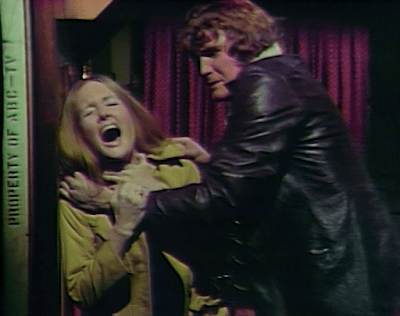
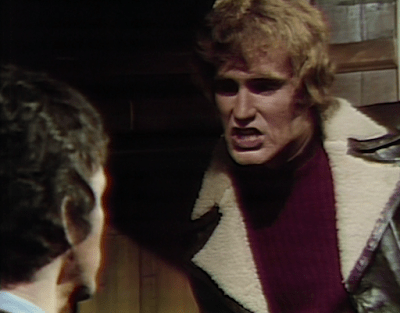
Carolyn wakes up. She goes to the carriage house and tells Jabe she can’t marry him. She won’t explain why. Jabe is enraged by this. He puts his hands around her throat and starts choking her.
Christopher Pennock was a fine actor and a seriously nice guy, and in the last few days he has made us want to believe that Jabe has turned over a new leaf. But this closing makes it clear that he is still a no-goodnik. The Leviathan material is all they have had on the show lately; there are some other characters who have problems that could be developed into something, problems such as lycanthropy and vampirism, but those have been completely subordinated to the Leviathans and are in any case nothing new to Dark Shadows. So despite Nicholas’ assurance that Jabe can’t exist much longer, it is hard to see an end to a period when all they have to offer are Jabe’s tantrums.
When Jabe is choking Carolyn, the camera drifts a bit and exposes the “Property of ABC-TV” stencil on the side of the scenery:
The Leviathan People, a race of Elder Gods, plan to retake the Earth and destroy humankind, and their harbinger is a shape-shifting monster who has taken the form of a tall young man and asked people to call him Jabe. Their plan requires that Jabe join himself to heiress Carolyn Collins Stoddard in an unholy ceremony that will transform Carolyn into the same kind of squamous, rugose, and paleogean creature Jabe defaults to being. Jabe has fallen in love with Carolyn, but so far from redoubling his determination to fulfill the plan his feelings have turned him against it. He wants to renounce his powers, become truly human, and make a life with Carolyn as she is. Though Jabe’s personality has been so obnoxious that even people brainwashed into supporting the Leviathans’ whole program have gotten fed up with him and become his enemies, he has somehow won Carolyn’s heart. She doesn’t know that he is a monster from beyond space and time, still less that he murdered her father and several other people. She is in love with the man he appears to be, and he wants to become that man in fact.
I first shared my thoughts about Dark Shadows online in the comments section of Danny Horn’s great blog Dark Shadows Every Day. In his post about #962, Danny identifies a major problem with the relationship between Carolyn and Jabe:
But both sides have apparently agreed to shield Carolyn from the big sinister secret, so in practice, she hasn’t had very much to do, except to fall passionately in love with Jeb, because of reasons.
As I’ve said before, I don’t know why Carolyn likes Jeb, and I’ve been scratching at that itch for a while. But today, I think I figured out the real problem with her character arc, and it’s all about the let’s-break-antiques scene.
This was Carolyn and Jeb’s first date, back in episode 940. I didn’t write about it at the time, because I had other things to say, and I didn’t realize how important it was until now.
The scene takes place in the antique shop, and it starts with Jeb gazing at her, and sighing, “I’m going to be very happy with you.”
She’s puzzled. “What made you say that?”
“Because I felt it,” he shrugs. “Haven’t you ever said or done what you felt?”
“Sometimes I do.”
“I do it all the time,” Jeb smirks, and swaggers across the room. “Everybody should. I always do what I feel. Right now, I feel like doing this.”
And then he picks up a porcelain figurine from a nearby display, and smashes it on the floor.
Carolyn is horrified, obviously. “Jeb, you shouldn’t have done that!”
He smiles. “Why not?”
“That was an antique, and it didn’t even belong to you!”
“Haven’t you ever felt like breaking something?”
She stops short. “Yes,” she says, “but…”
“Well, then, let’s see you break this.”
Then he picks up another figurine.
“Go on,” he says, offering it to her. “Break it.”
She looks into his eyes, and says, “I wish I could begin to understand you.”
“Maybe you can,” he says, “if you just free yourself. Go on. Just let it drop from your hand.”
[Smash]
He smiles, and opens a bottle of wine. She asks what he’s doing, and he says, “We’re going to celebrate.”
“Celebrate what?”
“Your liberation.”
“I don’t understand.”
He hands her the drink. “Oh, you will… soon.”
It’s a weird scene, and it should have been followed immediately by a dozen more weird scenes along the same lines. This should have been the storyline.
After all, the whole point of the Leviathan threat is that they’re going to take Carolyn, a character that we love and root for, and turn her into a hideous gargantuan, rutting with her blasphemous mate and raising a brood of ambidextrous deathstalkers.
And in the let’s-break-antiques scene, they set up the idea that Jeb is going to change Carolyn’s personality, leading her step by step into his dark world, in the service of her “liberation” from boring traditional values, like respect for other people’s ugly decor. We should have seen her going down that path, becoming more and more estranged from the family and friends who aren’t part of this nightmare death cult.
Except they didn’t. The champagne was drugged, and she blacked out, and since then, they haven’t even touched on the idea that Jeb might be leaving a stain on Carolyn’s soul.
Now, this is a show that’s explored a dozen varieties of hypnosis and possession in minute detail, so it’s not like they don’t know how to write a story like that. They just didn’t. To the extent that we believe that Carolyn loves Jeb, it’s an entirely innocent, human infatuation with a handsome stranger, who she’s unfortunately not really allowed to know very much about.
Because they can’t change Carolyn.
This is an enormous problem for the show, and it’ll be one of the key pieces to the puzzle of Who Killed Dark Shadows. There are four core family members, and they are untouchable. They don’t experience any lasting change, starting around early 1968 and continuing until the end of the show. Sure, they have moments of temporary hypnosis and possession, everybody does, but they don’t actually change.
And if Carolyn can’t change, even a little, then that means there’s no future, just a status quo that leads inexorably towards entropy, and the heat death of this fictional universe.
My main role in Danny’s comments was to draw connections between the episodes he discussed and the episodes from the first 42 weeks of the show, which he made a point of not discussing. In response to the above, I wrote:
It is too bad that the show got to the point where the only stories that counted were the supernatural ones. Not that those shouldn’t always have been the A stories, but there should have been room for B stories where we explore the characters’ personalities and see how humans might react if they were to find themselves living in a world like that of DARK SHADOWS.
As it turned out, it was difficult to do much with human characters even within the supernatural stories. Danny’s hypothetical series of scenes between Carolyn and Jabe where we see Carolyn being seduced to the dark side could have been very powerful if we’d been tracing Carolyn’s evolution from tempestuous, self-centered, spoiled rich girl of 1966 and 1967 to the relatively calm, responsible young woman we saw in 1968 and 1969. They could then keep us in continual suspense- would Carolyn continue to grow into a powerful matriarch, or would the shock of one otherworldly horror after another shatter all her progress and send her reeling back to her most unsympathetic moments? Since we haven’t had scenes focusing on Carolyn’s personality and relationships since Jason McGuire was on the show, and we aren’t expecting any to come ever again, hav[ing] a thread like that on the show at this point would seem as out of place as does a week spent documenting in exhaustive detail the evolution of Bruno’s attitude towards Jeb.
Nancy Barrett is a superb actor, and while she is on camera we believe that Carolyn loves Jabe. But she has to create this impression from the ground up every time she appears. Nothing that is happening reinforces it. Not only does her love for Jabe pop into being out of nowhere, but because she is not involved with anything he is doing it cannot motivate her to take any significant actions. Today Jabe and Carolyn stand before an altar while a high priest of the cult devoted to the Leviathans is performing the ceremony meant to unite them in horrid monstrosity. But Carolyn is there, not because of any decisions she has made or feelings she has, but because she has been hypnotized by the high priest.
I am reminded of the 2006 film Idiocracy. An average man from the early twenty first century suddenly finds himself in a future where everyone has a very low mentality. He goes to the movies and discovers that the most popular film of the era is called Ass. It is a 90 minute closeup of a pair of flatulent buttocks. When he becomes head of state, the protagonist explains that in his day there was something called a “story.” He describes a story as “a way of making you care whose ass it is and why it is farting.” That’s what the Leviathans segment lacks. The execution is good enough to make us believe that particular things are happening, but there is nothing to make us care who is making them happen or why they want them to happen.
One of the few forms of narrative that is still cultivated in the world of Idiocracy is professional wrestling, a dramatic genre in which villainous characters often have changes of heart and become heroic. This is known as the “heel-face turn” (as opposed to the “face-heel turn,” which is the opposite character development.) They have been working on Jabe’s heel-face turn for a few days. Yesterday he asked mad scientist Julia Hoffman to cure him of whatever it is that makes him revert to his monstrous form. Christopher Pennock and Grayson Hall played that scene so well that we wished we could ignore everything else in the episode and believe in it. Jabe started the episode by ordering four zombies whom he had raised from the dead to murder five people: Julia; her friend, vampire Barnabas Collins; two distant cousins of Barnabas’, Quentin Collins and Roger Collins; and Barnabas’ servant Willie Loomis. Jabe told Julia he would not kill her or Barnabas if she complied with his request, but at the end of the episode he had the zombies stuff Quentin in a coffin and bury him alive. After that, we could hardly believe that Jabe had changed at all.
Today, Barnabas is at home when Maggie Evans, The Nicest Girl in Town, bursts into his front parlor. She tells him she is sure Quentin is trapped somewhere and has no more than an hour to live. Barnabas has no idea how Maggie can know this, and she can’t explain it herself. The camera zooms in on a trident drawn on her hand, and regular viewers know what is going on. A while ago, Barnabas’ ex-wife, wicked witch Angelique, cast a spell on Maggie and Quentin causing them to feel an overwhelming love for each other at irregular intervals. Angelique thought this would make Barnabas unhappy, but he hasn’t noticed it, and he has so much else going on right now it seems unlikely he’d care much one way or the other if he did. The spell enables Maggie to lead Barnabas to the grave where Quentin is trapped and to tell Barnabas to dig it up. Quentin is fine when they exhume him, so if anything Barnabas should be glad of Angelique’s spell.
When Quentin comes out of the coffin, he says his only problem is that his legs hurt. Since he is 6’4″ tall and the coffin is at most 5′ long, that’s understandable. He says that Jabe told him he had something out of the ordinary in store for him. Now he knows that whatever else Jabe may be, “he’s a man of his word!” Usually David Selby’s accent raises a bit of a puzzle- why is the rakish scion of an aristocratic old New England family also an amiable West Virginian? But Mr Selby’s delivery of this line, with its note of appreciation for Jabe’s forthrightness, is so perfect that you could never wish him different in any way.
The high priest of the Leviathan cult whom we will see presiding at Jabe and Carolyn’s joining ceremony is none other than suave warlock Nicholas Blair, who was well known around the great estate of Collinwood in 1968. Nicholas finds Julia working on a chemistry experiment preparatory to her project of humanizing Jabe; he smashes her equipment and says he will let her live if she goes away and does not interfere with the Leviathans’ project.
When Nicholas calls on Carolyn to hypnotize her, she recognizes him and expresses mild surprise that he is back. When she insists on addressing him as “Mr Blair,” he tells her that her mother called him by his first name. She replies, “Well, that’s my mother’s business,” and asks him again why he is there.
Jabe visits Julia at Barnabas’ house and pleads with her to do something for him tonight. She says that even if that were possible, she would refuse to do it, since she knows that he buried Quentin alive a few hours ago. He says that she must believe that he is “a changed man” who is willing to “live and let live,” though he is not free to explain what has brought this change on. Barnabas comes downstairs and gives Jabe a dirty look.
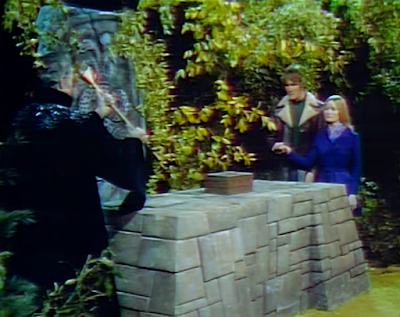
The joining is underway at a cairn in the woods. Only people associated with the Leviathans can see the cairn. A small wooden box sits on the cairn; Jabe originally emerged from that box, four months ago, back when he was nothing more than a whistling sound. Nicholas stands to one side, obscured by branches, reciting a lot of mumbo-jumbo and waving a long rod. Jabe and Carolyn stand together on the other side. Nicholas orders Jabe to take the rod. He does. He stands behind the raised part of the cairn that serves as an altar and faces the box.
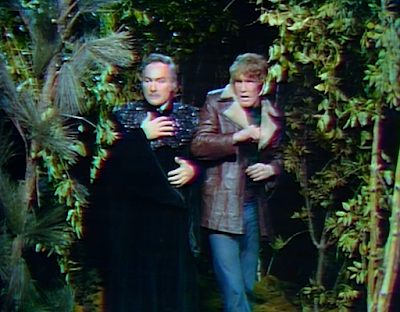
At that moment, Jabe shouts “Now, Barnabas! Get her now, Barnabas!” Barnabas leaps from behind the foliage, grabs Carolyn by the arm, and runs off with her; Jabe brings the rod down on the box, smashing it. Nicholas exclaims “You fool, do you know what you’ve done!? Better leave now or we’ll both go up in it!” The cairn glows and collapses; Nicholas and Jabe stand together off to the side, watching. Jabe clutches himself by the middle, groans, and passes out.
Watching it this time, I was not only surprised by Jabe’s “Now, Barnabas! Get her now, Barnabas!”; I remembered being surprised by it last time we watched the show through. It really is a thrilling moment, one of many in the Leviathans segment. But since it exhausts all of the elements in that segment from which a story could have been built, and since there is absolutely no other storyline going just now, I’m afraid the comparison to Idiocracy’s movie-in-a-movie Ass has to stand.
We are approaching the end of the sixteenth week of a segment made up of material drawn from the tales of H. P. Lovecraft. Central to this is the idea of the Leviathan People, a race of Elder Gods who want to retake the Earth and eliminate humankind. There has been a lot of good stuff in these episodes, but it hasn’t come together as a unit. At this point, the narrative seems to be falling apart completely.
The harbinger of the Leviathans, who appears to be a tall man in his mid twenties named Jeb but is in fact a four-month old shape-shifting monster who would rather be called Jabe, has lost interest in the plan and wishes he could be a real boy. Jabe has alienated virtually everyone with whom he has come into contact, including people who were under heavy mind-control meant to turn them into his slaves, and has been reduced to raising four recently deceased men to serve him as zombies.
Yesterday, he ordered the zombies to kill five of his enemies. The targets he listed were mad scientist Julia Hoffman, vampire Barnabas Collins, Barnabas’ servant Willie Loomis, and Barnabas’ distant cousins Roger Collins and Quentin Collins. The zombies have abducted Julia and brought her to Jabe’s house. She is welcomed there by a man named Sky Rumson. Sky is not a zombie, but may as well be for all the skill Geoffrey Scott brings to the role. When Scott recites his dialogue, you get the impression that he is telling you what an actor would say had they cast one in the part. Grayson Hall could fill any stage without support, making Julia’s scene with Sky relatively painless, but if it was meant to have any significance the audience will never know what that was.
Sky and a zombie force Julia into the back room of the house, where Jabe is in the squamous, rugose, and paleogean form of the true Leviathan. She is terrified by the sight. Jabe resumes his human shape. He and Julia go back to the living room, where he confides in her that he doesn’t want to take his Leviathan form ever again. He wants to renounce his powers and become human. He knows that Julia is giving Barnabas treatments to put his vampirism into remission, and that she succeeded with such treatments when Barnabas was under a different vampire curse in 1968. He asks her to help him rid himself of his Leviathan side. She is unsure she will be able to do so, but can’t resist the challenge. By the end of the scene, she is figuring out what tests she will have to run to diagnose the biochemical basis of Jabe’s condition.
Christopher Pennock really was a fine actor, and he is outstanding in this scene. He sounds like a deeply lonely, helplessly confused young boy who can’t figure out how to overcome the consequences of his own abuse of the people around him. Jabe’s request for Julia’s help and his agreement to lay off Barnabas as the price for it doesn’t fit with the orders he gave the zombies yesterday, the actions he takes later today, or anything else in the Leviathan story, and is a sign that the plot is falling apart faster than the writers can patch it up. But he and Hall are so splendid in showing Jabe’s neediness and Julia’s response to it that it doesn’t matter.
Meanwhile, Sky is at the great house of Collinwood, looking for Jabe’s foster mother-turned-makeout partner Megan Todd (it was 1970, everyone took Freud very seriously.) He meets Roger and Quentin there. They hold him at sword point until he tells them where Julia is and how to get past the zombies. To the extent that there is a reason for Sky to be on the show, it is to illustrate how total the control is the Leviathans have over the minds of the people they have co-opted, so when he gives in so quickly to Quentin’s threat to give him a scar (not even to kill him, just to compromise his potential as a model for deodorant ads) he dissolves the last prospect that the Leviathans themselves will be a danger we can care about.
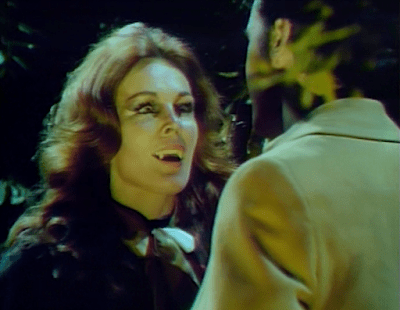
Quentin goes off to rescue Julia, and Roger assumes responsibility for holding the sword. He is momentarily distracted when he sees Megan in the window, and Sky takes advantage, disarming Roger and running out of the house. Outside, he meets Megan and tells her that Jabe is upset with her for some reason. She asks if he is afraid of her. He is puzzled by the question, and tells her she is very beautiful. She invites him to look at her. As he does, she opens her mouth, revealing vampire’s fangs. She bites him.
Quentin arrives at Jabe’s house. Jabe is surprised to see him, but not surprised Sky was too chicken to keep any of his secrets. He orders the zombies to seize Quentin. The tall, portly, shaven headed zombie, who wears a mustache that keeps him from being mistaken for Tor Johnson in Plan 9 from Outer Space, slaps Quentin in the face a single time. With this, Quentin instantly loses consciousness. Yesterday, other zombies slapped Julia and Roger in the face, each a single time, and each of them instantly lost consciousness as well. Great ones with slaps, the zombies.
Jabe instructs the zombies to stuff Quentin into a coffin that is about three feet too short for him, and then has them carry it all the way to the cemetery. He has them bury Quentin in a grave that one of them had recently vacated. I suppose real-estate flipping has been interesting to TV viewers for longer than I had thought.
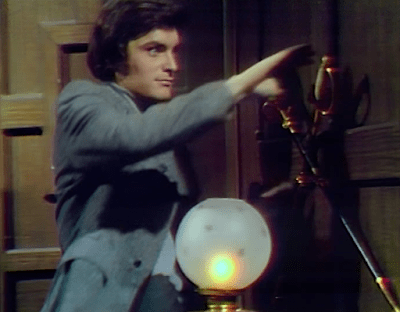
There is a famous goof in today’s episode. When Quentin grabs the sword out of its display on the wall of the Collinwood drawing room*, the lamp underneath it falls off the table and smashes on the floor. You know this wasn’t supposed to happen because it takes place out of frame and you can hear the stagehands sweeping the floor while Sky is pinned to the wall. Also, Dan Curtis was way too tight with a buck to break a lamp for the sake of a scene that’s mainly about a character as minor as Sky Rumson. It’s a shame they couldn’t have pulled the camera back and shown the lamp shattering, it would have been perfectly suited to the moment. And if they had to sweep up the wreckage right then, well, it would have been hilarious if housekeeper Mrs Johnson had come in with her broom and dustpan, taken care of the mess, and left without a word about what Quentin and Roger were doing to Sky.
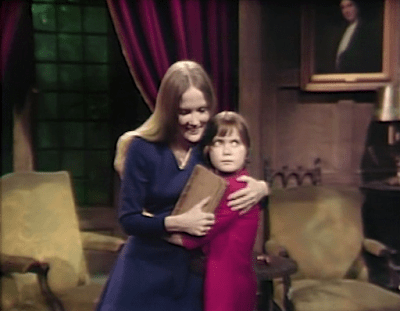
Ten year old Amy Jennings is at home in the great house on the estate of Collinwood. Evidently she’s in a literal mood- she’s in the drawing room, so she’s drawing. Heiress Carolyn Collins Stoddard sees Amy’s work and asks why she is doing it. Amy says she thinks the design is “pretty”; Carolyn replies that “pretty” is the last thing she would call it. That may seem rather rude, but as Amy hasn’t been seen since #912 I suppose she’ll take what she can get.
The design is one which on Dark Shadows is called simply a Naga. It is the secret emblem of a secret cult serving the Leviathan People, a race of Elder Gods. Secret cultist Megan Todd wears the Naga on a large pendant around her neck; Megan’s husband, secret cultist Philip, wears it on a shining ring; Carolyn’s mother, secret cultist Elizabeth Collins Stoddard, wears it as an oversized broach. Amy herself is a secret member of the secret cult, but she hasn’t yet acquired any conspicuous jewelry emblazoned with the secret symbol, leaving her to do her own artwork. Carolyn wonders aloud why so many people are so preoccupied with the design.
Quentin Collins enters. Amy is terrified. Starting in December 1968, Quentin’s ghost haunted Collinwood. By March, the house was uninhabitable and strange and troubled boy David Collins was near death. Old world gentleman Barnabas Collins tried some mumbo-jumbo in hopes of communicating with Quentin; he came unstuck in time and found himself in the year 1897, where he remained for eight months. While Barnabas was flailing about in the late Victorian era, time continued to pass in 1969, and Quentin’s obsession of David finally killed him in September. But a sequence of events with which Barnabas had a tenuous connection changed the circumstances on the night in September 1897 when Quentin originally died, causing him to survive. That night, as it happened, was exactly 72 years before David’s death. On Dark Shadows, anniversaries have the power that laws of nature have in our world, so that caused the haunting to break and David to come back to life. Due to a series of spells cast on him during Barnabas’ sojourn in the past, Quentin is still alive and still apparently in his late twenties in 1970. But the haunting still happened between December 1968 and September 1969, and everyone who lived through it still remembers it.
Quentin has introduced himself to Carolyn as his own great-grandson. Since Carolyn never actually saw his ghost, she is willing to accept this. But Amy had more dealings with the ghost than anyone but David, and it is obvious to her that they are one and the same. She clings to Carolyn.
Carolyn laughs at Amy’s fear and tells her that this Quentin is not the ghost, but is “a cousin of ours.” This is intriguing to regular viewers. It was during the 1897 segment that the audience learned that Quentin was the great-grandfather of Amy and her brother Chris, and just a few weeks ago that Chris learned about that relationship. It is through their descent from Quentin that Amy and Chris are cousins to Carolyn. So if Amy knows she is a Collins, she must have been told that the ghost that tormented her and David was that of her great-grandfather. A scene in which someone gave her that information might have been a good use of Denise Nickerson’s considerable acting talent, but they didn’t bother to produce one.
Quentin tells Carolyn to leave him alone with Amy. Still chuckling, she complies. Once they are alone in the drawing room, Quentin kneels and touches Amy’s face, assuring her that he is “not that Quentin Collins.” David Selby brought immense charm to the role of Quentin, so this scene isn’t as revolting as it might have been, but it is still pretty bad, and we can’t be surprised that Amy is not satisfied.
Amy goes to the village of Collinsport to seek guidance from her spiritual advisor. He is a shape-shifting monster from beyond space and time who usually takes the form of a very tall young man. When he first assumed that form, he invited people to “Call me Jabe,” but no one did. They call him “Jeb” instead, and he answers to it.
Jabe lives in a room above Megan and Philip’s antique shop, and when Amy enters the shop she finds him looking after the place. Apparently shape-shifting monsters from beyond space and time aren’t above doing a little work in retail now and then. She tells Jabe about her encounter with Quentin, and then tells him about a dream she had. In the dream, she went into the long-disused room where she and David first met Quentin. Quentin’s theme song, a sickly little waltz, was playing; she exclaims “It was terrible!” Longtime viewers know the feeling. The tune played incessantly during the “Haunting of Collinwood” period, and when they went back to 1897 characters kept complaining to the living Quentin that he was making them miserable by playing it on his phonograph all the time.
In the dream, Quentin appeared to Amy wearing the nineteenth century clothing and the angry scowl that he wore when he was a ghost. But when he was a ghost, he never spoke words the audience could hear. The only exception was a dream sequence in #767, when Quentin’s ghost spoke to David. That was also the only other dream sequence to be presented as this one is, in flashback as the dreamer is recounting it after the fact. That sequence marked a watershed, the first attempt to explain how Quentin the cranky ghost emerged from Quentin the charming scoundrel we had got to know in the 1897 segment.
This episode, also, has to do with the relationship between these two iterations of Quentin. Amy tells Jabe that Quentin’s ghost in the dream warned her against him by name, and says that she is therefore convinced that the living man she met in the drawing room today is in some way identical to the ghost who haunted the house for those ten months. Amy’s dream marks the final appearance of Quentin’s ghost, but we can see the ghost will not be forgotten.
A state police investigator named Lawrence Guthrie is in town looking into two murders Jabe has committed, those of Carolyn’s father Paul and of a law enforcement officer whose gravestone revealed that his given name was “Sheriff Davenport” (we never learn what Mr Davenport’s title was.) Jabe orders Philip to kill Guthrie. Philip calls Guthrie and asks him to come to the antique shop when Jabe will be out. Once Guthrie is there, Philip tells him that the upstairs room where Jabe stays is an important part of the story of the murders. He shows Guthrie into the room. He stays outside, and locks Guthrie in. Guthrie encounters Jabe there in his true form; Jabe kills him. This is quite effectively handled. My wife, Mrs Acilius, was completely caught off guard by the killing. She believed Philip really was trying to break free of the Leviathan cult, and wondered what Guthrie was supposed to find in the room.
Neither Jabe nor Philip is an especially well-developed character, but Christopher Bernau and Christopher Pennock were both fine actors, and they play off each other very well today. It is a tribute to their performances that Guthrie’s death scene comes as a surprise.
At the end, Quentin is at Collinwood trying to tell Carolyn that it was Jabe who killed her father and Mr S. Davenport. Inexplicably, Carolyn is interested in dating Jabe, and is unwilling to listen to this. Jabe bursts in and announces that there has been another murder, that the murderer is in custody, and that he has confessed to it and to the killings of Paul and Sheriff. That murderer, Jabe says, is Philip. That’s another surprise- after the murder of Guthrie, Jabe did tell Philip that he had another task to perform, and once we hear that he has confessed to the killings it makes perfect sense that that would have been what Jabe meant. But I don’t think anyone could have predicted it. It makes for a strong ending.
Danny Horn’s post about this episode on his great blog Dark Shadows Every Day is a lovely little bit of fanfic proceeding from the assumption that Lawrence Guthrie is the brother of Dr Peter Guthrie, the parapsychologist whom undead blonde fire witch Laura Murdoch Collins killed in March 1967.
The closing credits again misspell writer Violet Welles’ name as “Wells.” They started doing that last week, around the same time the misspelling of wardrobe house Ohrbach’s as “Orhbach’s,” a frequent goof in the show’s first year, reappeared after a long absence.
Old world gentleman Barnabas Collins comes home shortly after dawn and finds that the window of his front parlor has been smashed in. Entering the house, he finds two young men passed out. He knows both of these men, and knows that neither is what he seems to be. The taller of them, who once asked to be called Jabe, is in his true form an indescribable monster from beyond space and time, the harbinger of the Leviathan People, a race of Elder Gods who mean to retake the Earth and destroy humankind. The other, Chris Jennings, is a werewolf. The Leviathans are vulnerable to werewolves, and Barnabas realizes that Chris reverted to his human form when the sun rose, just as he was about to kill Jabe.
Chris comes to, and Barnabas hustles him out of the house. He then wakes Jabe. He tells Jabe that he fought the werewolf off, killing it and saving Jabe’s life. Barnabas was the original leader of a cult devoted to serving the Leviathans, but has since become disaffected. Jabe had seen evidence of this, and set out for Barnabas’ house meaning to punish him for his disloyalty. But by the time the werewolf chased him into the house he was crying out for Barnabas to help him, so he is ready to believe the story. Taking credit for things he had nothing to do with is one of Barnabas’ core competencies, so it is no surprise to longtime viewers that Jabe decides that he can trust Barnabas after all.
Barnabas’ ex-wife Angelique is now married to a man named Sky Rumson. She does not believe that Sky knows anything about her past or about anything supernatural, but the audience has seen over the last few episodes that he is an agent of the Leviathans. Angelique put Barnabas’ distant cousin Carolyn up in a house she and Sky have on an island to help Barnabas in his fight against the Leviathans while Sky was away on a business trip. At the end of that trip, Sky called to ask Angelique to pick him up at an airport far from the island house. When she got to the airport, she found he had already left. She wound up spending several hours alone on the road. Returning viewers know that Sky’s call was a trick to get her away from the house so Jabe could come and have his way with Carolyn. We also know that Jabe chickened out of his evil plan when he actually saw Carolyn, and that she is fine now.
Angelique comes home from her long wild goose chase and asks Sky what happened. He said he had an important phone call coming at the house, so he had to leave early. Angelique accepts this surprisingly easily. Barnabas shows up to take Carolyn home. He and Sky meet. After Barnabas is gone, Sky asks what the deal is with Carolyn. He presses the point, and Angelique tells him everything she knows about Barnabas and the Leviathans, including that he is now “their most dedicated enemy and he means to use every power he has to stop them.”
This scene is bad news for Barnabas, but it is worse for the audience’s image of Angelique. She used to be a wicked witch of vast destructive power, and was supposed to be the ultimate Soap Opera Vixen. But you wouldn’t have to be a witch, or even a vixen, to avoid the situation Angelique puts herself in. Leaving the airport when he knew she was on the way was a colossal act of thoughtlessness, and no husband who committed it could expect to hear a word from his wife about anything else for at least a week. After that, there will be a long period when she will have an unanswerable source of material to keep him off his guard any time he tries to bring up topics she doesn’t want to discuss. By the time Sky is able to start asking questions about why Angelique had Carolyn spend the night, it will probably be another full moon.
That isn’t even the worst of it. Angelique believes that Sky is simply a denizen of the sunlit world known to us in our everyday experience and explained well by science, and she further believes that he sees her in the same way. That makes it all but impossible for her to tell him what she tells him here. She launches right in with “the Leviathans, they’re terribly dangerous creatures, completely evil and they mean to start a whole new society.” If he really were a total naïf in supernatural matters, this story would lead him to pick up the telephone and call the men in the white coats to come and take Angelique to a place where she could get a good long rest.
I don’t think Angelique’s scene with Sky could have worked in any case, but Geoffrey Scott’s limitations as an actor make it even worse than it had to be. He underacted so severely that he could hardly be said to be giving a performance at all. That makes a stark contrast with Lara Parker, who as Angelique fully embraced the hyper-intense Dark Shadows house style of acting, which, in honor of her own hilarious explanation of it, is sometimes known as “Go back to your grave!” That contrast is interesting at a technical level. It goes a long way towards explaining what Orson Welles meant when he said that hamminess was not overacting, but false acting. Parker goes as far over the top as she can, but there is rarely anything false about Angelique, while every tinny note Scott strikes in his flat recitation of his lines is thoroughly fake.
A charismatic actor might have been wasted as Sky, as Parker is wasted today. But the audience might have been able to meet the show halfway if we could believe that Sky was so fascinating to Angelique that she didn’t realize what she was saying. As it is, Scott looks so much like he is modeling menswear for the Sears catalogue that it is always a bit of a surprise when he moves and speaks. However much Angelique might enjoy Sky’s company, it never occurs to us that he would be a match for her in any sense.
Sky goes to Jabe and repeats what Angelique told him about Barnabas. There is an exchange which looks fine in print, but which Scott’s delivery makes sound like a blooper:
JABE: So everything he told me this morning was a lie! And I thought he had saved my life!
SKY: Evidently, everything he told you was a lie.
You would deliver Sky’s line with an emphasis on “everything,” as would I, as would anyone else. But Scott emphasizes “Evidently” and pauses slightly after “you,” making it sound as if he hadn’t heard Jabe. For a fraction of a second, you can see the amazement in Christopher Pennock’s face as he reacts to this clanger.
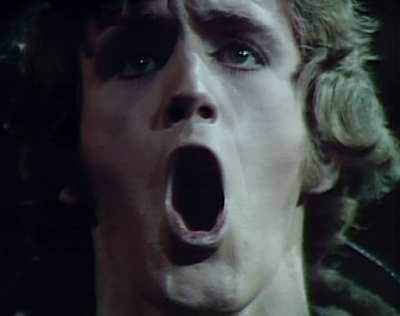
Jabe carries a cage with him as he goes to an old graveyard. The camera locks in on him in closeup as he shouts that, while death might be an adequate punishment for a mere murderer, Barnabas must suffer “More! MORE! MO-O-O-ORE!!!” More, more, more, how do you like it, how do you like it….
The first time I saw this scene, I regarded it as a low point- I imagined someone tuning in to Dark Shadows for the first time at that moment, and instantly turning it off, believing ever after that only people of an extremely low mentality could like the show. I still think it’s pretty embarrassing writing, but having seen him in other roles I’ve come to realize that Pennock was in fact a good actor and that as Jabe he was saddled with an impossible task. Also, I’ve seen video of him on panels of original cast members at Dark Shadows conventions, and it is obvious that he was as sweet as Jabe is vicious. So watching the scene today, I ignored Jabe and looked at Christopher Pennock, studying his face to see what he was thinking as he struggled to find a way to give the audience something worth their while.
Jabe makes an incantation, and a bat comes flying to him. He catches it in the cage. We get a closeup of the bat puppet in the cage, which looks very much like a humane trap from Havahart. We know that Jabe plans to use the bat to make Barnabas back into a vampire, which he was for 172 years, but the realistic cage and the adorable little puppet prevent the situation from generating any terror. Dan Curtis said that when he was producing Dark Shadows, his young daughters used to urge him to make the show more frightening. When we were chuckling at the sight of the bat today, Mrs Acilius imitated a child saying “Make it scary, Daddy!”
Sheriff Davenport and his new sidekick, mad scientist Julia Hoffman, have come to the top of the stairs above Philip and Megan Todd’s antique shop in the village of Collinsport. The sheriff has a search warrant that specifies the room by the landing as a place of interest in connection with the violent death of one Paul Stoddard. Philip begs the sheriff not to enter the room, saying that a boy who lived there recently died and that any disturbance would “defile” it. He swears the room is entirely empty. The sheriff expresses his sympathy, but opens the door anyway.
Inside is a young man. Philip seems as surprised at the sight of him as are the sheriff and Julia. He gives his name as “Hawkes, Jeb Hawkes. Short for Jabez… Call me Jabe.” No one calls him Jabe, which seems a bit rude. Jabe claims that he came by earlier when Megan was in and Philip was out, and that she offered to let him live in the room.
The room does not contain any furniture, any luggage, or any other movable property whatsoever. Moreover, while it is possible Megan might have rented the room without mentioning it to Philip, it is difficult to see what Jabe has been doing up there since she left, and since Philip has been moving around the rest of the building it is even more difficult to suppose Jabe could have left his belongings elsewhere without attracting Philip’s notice. Jabe claims to be a photographer, but does not appear to have any camera equipment. Moreover, the sheriff will later tell Julia that he noticed a distinctive odor on Jabe that was prominent on Paul’s corpse, and that he found one of Paul’s cufflinks, damaged as by fire, on the floor of the antique shop. In the finest traditions of Collinsport law enforcement, the sheriff does not take Jabe or Philip into custody, question either of them more than cursorily, or close off the antique shop for a further search. He does come back later to tell Jabe that he should think about finding another apartment.
Jabe is the latest embodiment of a mysterious creature that has previously taken the form of a newborn boy, an eight year old boy, an eight year old girl, and a thirteen year old boy. The boys were vicious little tyrants who did not seem to think at all, only to follow impulses to dominate and humiliate whomever they met. The girl was a Doppelgänger of Paul’s daughter Carolyn as she was when she was eight, and she existed specifically to make Paul feel worthless because he was a deadbeat dad. None of these children engaged with another character in a way that meant there was anything at stake for them in any scene. They as much as tell us that the same will be true of Jabe. When Philip complains today that he has put him and Megan in a difficult position by failing to tell them of his plans, Jabe answers “Maybe I just didn’t want to let you know. Maybe I just wanted to see you sweat it out.”
The only time one of the children did anything surprising in an effort to take on an adversary was when the eight year old boy shape-shifted and became the young Carolyn. Had the sheriff not shown the clownish ineptitude typical of his office, but instead done what a real cop would do and arrested Jabe and Philip, they might have created a situation in which Jabe would have to surprise us again. It might be interesting to see him turn into the grown-up Carolyn, for example. As it is, Jabe just insults Philip, goes to the police station, and murders the sheriff.
This puts a new spin on Roger Ebert’s category of “Idiot Plot.” Ebert said that a movie had an Idiot Plot when its story would end immediately if any of the characters had the brains of an average member of the audience. In this case, the story stays stuck in an angry and utterly predictable rut because of the sheriff’s inexplicable nonfeasance.
The first time Mrs Acilius and I watched Dark Shadows through, we hated Jabe and didn’t want to see Christopher Pennock again. Later, Pennock will return in several quite different roles, each of them more appealing than the one before. By the end of the series he had become one of our favorites, and it occurred to us that even as Jabe he managed to do a lot of things right. But there is only so much an actor can do to work around a script problem, and as written Jabe is barely a character at all. His actions cause problems for several other people, but nothing we see him do or hear him say makes us care about why he takes those actions as opposed to any others. It certainly doesn’t help that half of his episodes, including this one, are directed by Henry Kaplan, whose idea of visual composition was to shove a camera so close to an actor’s face that you can see about one half of one cheekbone.
It didn’t have to be that way. Not only was Pennock a fine actor when he had something to work with, but in this episode we have a scene between Julia and rakish libertine Quentin Collins that shows how a character with a bizarre backstory and a record of evil deeds can become an audience favorite. Quentin is down in the dumps because he just failed to rescue his one true love, Amanda Harris, from the realm of the dead. Julia urges him to reconnect with the Collinses of Collinwood. He asks how he can possibly explain that he is 72 years older than he looks and is now alive, even though his ghost carried out a protracted and deadly haunting of the estate. This dialogue shows that Quentin’s origins require us to believe any number of impossible things, and longtime viewers remember that he is a murderer who killed his wife in cold blood, among other unspeakable acts. But all we see in this scene are his charm and the affection that he and Julia have for each other, and we want to see more of that, as much as they can give us. With similar material, Pennock could have achieved similar results. But it is already clear that he won’t get it as Jabe.
Postscript
In his scene with Julia, Quentin says that no one at the hotel where he and Amanda have been staying remembers her, and that all traces of the alias she had been using seem to have disappeared. Julia speculates that when he lost her in the underworld, the last 72 years of Amanda’s life were negated, that the past was reset so that she did in fact die on a night in the 1890s when she might have died had one of the gods of the dead not intervened.
This raises two questions. First, Amanda has been keeping Quentin. If they are now in a timeline where she never came to town, who’s paying his hotel bill and buying his liquor? It’s a standard feature of soap operas that unless they are telling a story about conflicts over ownership of a business or a house or some other valuable property, everyone just has an inexhaustible supply of money, but they put enough time into Amanda and Julia’s squabble as to which one of them would be Quentin’s sugar mama that you might have expected a line or two about this question.
Second, if everyone else has forgotten Amanda, how does Julia remember her? Quentin journeyed through the infernal regions with her, and so I suppose it makes a kind of sense that from that supernatural location he would have a perspective that would transcend our perception of time and space. But Julia was in and around Collinsport the whole time Quentin and Amanda were harrowing the abode of the permanently unavailable. I suppose the real answer is that she is the audience’s point of view character, and as such knows everything we know. But it does leave us wondering if, in the course of her adventures, some kind of uncanny power may have rubbed off on her.
There never was an episode #131 of Dark Shadows. They made a point of giving numbers divisible by 5 to episodes that aired on Fridays, so on days when the show was not broadcast-as it was not broadcast on 26 December 1966- they just skipped the number that would have been used had it run that day.
Since that preemption was the result of Christmas-related programming,* this seems like the place to promote 2021’s big Dark Shadows Christmas event, a dramatic reading of the Orson Welles version of Dickens’ A Christmas Carol by ten surviving members of the original cast. Surviving at that time- it turned out to be Mitchell Ryan’s last performance before his death on 4 March 2022; Christopher Pennock had been involved in the early stages of the production, but he would die in February of 2021.
It is irresistible viewing for Dark Shadows fans. It makes extensive use of music from the show- rather too extensive for my taste, but Mrs Acilius liked it, and from what I gather she appears to be in the majority.
The acting is quite good. I was especially impressed by James Storm’s portrayal of Bob Cratchit. I had never seen Mr Storm in anything but Dark Shadows, where he was cast in the preposterously unplayable role of Gerard Stiles, so it was amazing to me to see what he could do when he had something to work with.
Another pleasant surprise was Alexandra Moltke Isles as the Ghost of Christmas Present. Readers of this blog know that I have a high opinion of Mrs Isles’ abilities, but this was her first part in 53 years. I held my breath to see how many steps she had lost in that interval. As it became clear that she could go as deep into her character as ever and pull up a treasure trove of dramatic insight, I was thrilled.
Mrs Isles appeared at one or two Dark Shadows conventions early in the 1980s. During the unpleasantness, she couldn’t very well make herself available for any event where she would be expected to take questions from the floor, but from time to time she sent greetings on video that would be played at conventions. And she sat for several interviews about Dark Shadows over the years. So you can’t say she made herself a complete stranger, but it is still quite a novelty to see her in this setting.
Many longtime fans describe Mrs Isles as the cast member who was least friendly to them when the show was in production, and there may be a reason for that. In the Q & A, she responds to the question about her first encounter with fandom by telling a story about a girl jumping her on the street and trying to rip her hair out of her head. After that introduction, it is remarkable that she’s been around as much as she has.
The person who had been absolutely disconnected from fandom the longest was David Henesy. He stuck with acting for a few years into the 1970s, but never attended a convention or had any connection with any Dark Shadows themed public events until a cast reunion on Zoom in October 2020. His performances as the child characters (he’s by far the youngest member of the cast, a mere 65 years old at the time of taping) are as letter-perfect as was his work in the series.
*A football match, but a football match usually held at Christmas-time.


 Dark Shadows Commentary