Episode 648: Her name is Madame

This is the second of three episodes featuring Cavada Humphrey as Madame Janet Findley, a medium called in to investigate the strange goings-on at the great house of Collinwood. Humphrey’s performance so utterly dominates the segment, and I have so little to add to what I said about her style in yesterday’s post, that all I can do is make a series of more or less miscellaneous observations about its other aspects.

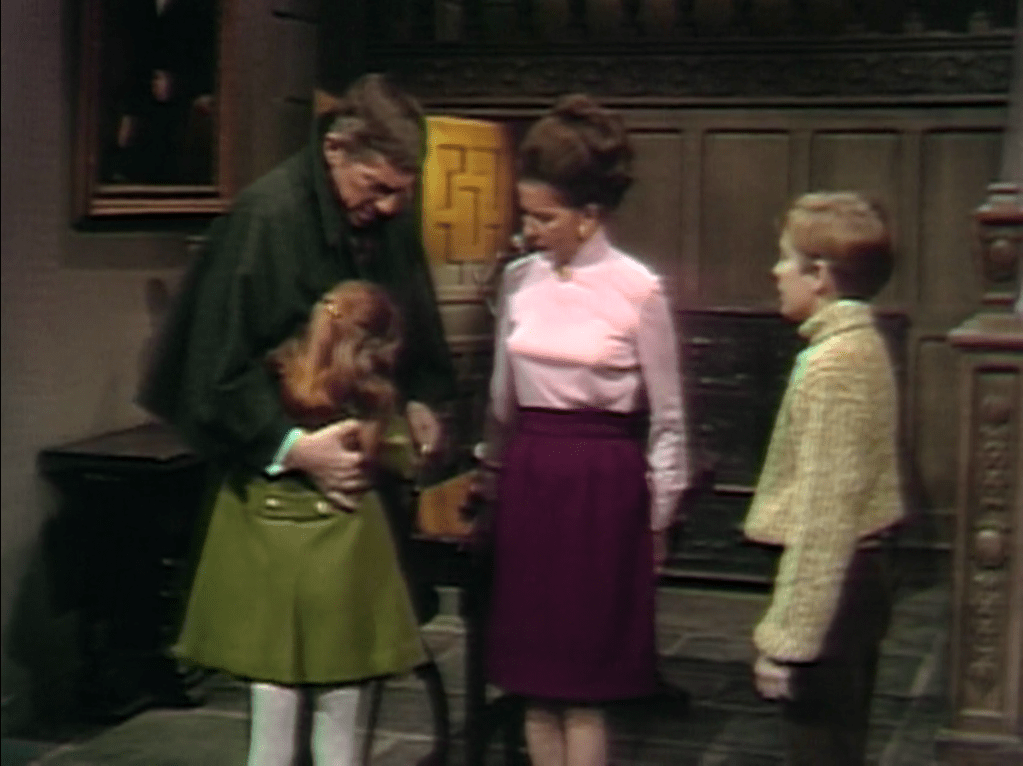
Today Madame Findley meets children David Collins and Amy Jennings. Amy and David are coming under the influence of evil spirit Quentin Collins. She questions them in the drawing room, and finds a hidden panel that leads to the long-abandoned west wing of the house. Over the children’s objections, she enters the secret passage. As soon as she is in, they hurriedly close the panel, locking her in. Evidently their objections were part of a ruse designed to lead her to Quentin’s stronghold. All too often on Dark Shadows, the audience knows too much about what characters are trying to do. This scene stands out, because they really do keep us guessing whether the children want Madame Findley to go into the secret passage. We don’t really know what their goals are until we see them shut her in.

Madame Findley goes into the darkness. Screenshot by Dark Shadows Before I Die.

Earlier in the episode, Amy’s brother Chris dropped in. He was very eager to see permanent houseguest Julia Hoffman, MD. Amy mentioned to Chris that there was another visitor in the house. When Chris asked who it was, Amy replied, “Her name is Madame- Madame something- at least that’s what they call her.”

I heard these lines in the voice of T. S. Eliot. The rhythm is reminiscent of a section of his poem The Waste Land, which in 1968 was an extremely familiar text to people with literary ambitions:

Madame Sosostris, famous clairvoyante,

Had a bad cold, nevertheless

Is known to be the wisest woman in Europe,

With a wicked pack of cards. Here, said she,

Is your card, the drowned Phoenician Sailor,

(Those are pearls that were his eyes. Look!)

Here is Belladonna, the Lady of the Rocks,

The lady of situations.

Here is the man with three staves, and here the Wheel,

And here is the one-eyed merchant, and this card,

Which is blank, is something he carries on his back,

Which I am forbidden to see. I do not find

The Hanged Man. Fear death by water.

I see crowds of people, walking round in a ring.

Thank you. If you see dear Mrs. Equitone,

Tell her I bring the horoscope myself:

One must be so careful these days.

It was indeed a mysterious Tarot card that prompted matriarch Elizabeth Collins Stoddard to call for help, and that call brought Madame Findley to the house. The card she interprets is the Tower of Destruction, which unlike the cards Eliot’s Madame Sostris describes actually appears in existing Tarot decks. She doesn’t have a cold, and she isn’t in the business of selling horoscopes door to door. On the contrary, as Humphrey plays her she is a dazzling presence.

Liz did not call Madame Findley directly. She telephoned occult expert Timothy Eliot Stokes, who introduced her to La Findley. At first sight, Stokes appears to be a stuffy academic with an impossible Anglophile manner, but as we get to know him he turns out to be very much at home in the bizarre netherworld in which the show takes place, so much so that his supernatural adversaries fear that he may have powers surpassing theirs. T(homas) St(earn)s Eliot was so much like T(imothy) Eliot St(oke)s in the first impression he made, so highly regarded by the sort of people who wrote Dark Shadows, and so generally famous in the 1960s that it is very likely that Stokes’ name was at least partly inspired by him.

It’s true that Madame Findley’s name lacks the exotic glamour Eliot gave his character. I suppose if you have all of Europe to choose from, you can take your stray Tarot cards to someone named “Madame Sosostris,” but if you are limited to central Maine, you have to settle for “Janet Findley.”

I made a remark about Madame Findley’s name in the comments on Danny Horn’s post about episode #647 on his great Dark Shadows Every Day:

It’s just delightful that they introduce an otherworldly, mystical character, played with an actress who brings a genuinely eerie note to her performance, and her name is… “Janet Findley.” It’s like Monty Python and the Holy Grail, when they meet the wizard who is known as “Tim.”

I wonder if there’s any connection between the name “Janet Findley” and the name “Janet Fisher,” whom Carolyn mentioned as a friend once of twice in the first season. Seems like a lot of Janet Fs. For that matter, I wonder if there’s a connection between Tim the Wizard from Monty Python and Tim(othy Eliot) Stokes, who a couple of episodes back had to tell Vicki that he isn’t a wizard.

Comment left by Acilius, 8 October 2020, on Danny Horn, “Episode 647: The Wire,” Dark Shadows Every Day, 12 May 2015

That remark drew a response from a commenter who posts as “Mary”:

Findley is a popular name on Dark Shadows. In addition to Janet, Margaret Findley is one of the ghostly widows, Thomas Findley is one of Jeb’s zombies in the Leviathan storyline and Findley’s cove is the location of Carolyn’s cottage in 1995.

Comment left by “Mary,” 18 February 2021, on Danny Horn, “Episode 647: The Wire,” Dark Shadows Every Day, 12 May 2015

When Madame Findley asks about the closed-off parts of the house, Liz tells her about both the west wing and an east wing. The phrase “east wing” had come up a couple of times in the first year of the show, but it always seemed to be either a case of the writers not having made up their minds which side of the house the deserted wing was on or a slip of the tongue by the actors. This is the first time the show makes it clear that the house really does have two deserted wings.

Humphrey was too perfect for Dark Shadows to play only one role. In a comment on Danny’s post about this episode, I indulged in a little fanfic about another part that would have been right for her:

Cavada Humphrey looks quite a bit like Jonathan Frid. I wonder what 1795 would have been like if Barnabas had had an older sister who bossed him around, stood around during his ridiculously childish fits of petulance, occasionally acted as his conscience, and time and again serve as his enabler and protector. It would have been funny to see Grayson Hall’s Countess express disapproval of such a relationship.

Heck, that older sister could have been Sarah. Just because she’s a child in her ghost form doesn’t mean she has to have died at that age. Maybe she comes back in the form in which her relationship to her brother took its permanent shape, when she was about nine and he was about seven. Of course, that possibility is foreclosed at Sarah’s first appearance, when she tells Maggie not to let her “big brother” know she saw her, but I suppose they could have retconned that away with a phony flashback where she says “little brother.”

Comment left by Acilius, 8 October 2020, on Danny Horn, “Episode 648: Astral Disturbances,” Dark Shadows Every Day, 14 May 2015.

I’m very fond of Sharon Smyth, and Sarah’s last appearance in the 1795 segment was so poignant it would have been a substantial loss for her not to have been in it. On the other hand, she had so much less to do when she was playing a living being than she did in the preceding months when Sarah was a ghost, and so much of what she did get to do was outside her rather sharply limited range, that it is not difficult to imagine a different kind of Sarah making the eighteenth century insert a more compelling drama.

Episode 647: Her own sensitivities

This is first of three consecutive episodes featuring Cavada Humphrey as Madame Janet Findley, a medium recruited to investigate the strange goings-on at the great house of Collinwood. Humphrey’s performance dominates these segments completely. Her style is more akin to pantomime than to anything native to spoken drama; she uses every muscle of her body to strike a series of exaggerated poses. Since that includes the muscles of the vocal tract, words occasionally come out in the course of her performance. The result is as bizarre as it sounds like it would be, and on Dark Shadows it is magnificent.

Granted, it is a shock when Humphrey reads the opening voiceover. Without seeing her, it is difficult to know what to make of her speech. When we watched it this time, I tried to make Mrs Acilius laugh by mimicking the poses a person might strike while speaking that way. So far from making the monologue sound silly, that just made it clear to us what Humphrey was doing, and left us both taking her performance seriously.

I’ll make a couple of random remarks about the non-Cavada Humphrey parts of the episode. Under the influence of the ghost of Quentin Collins, children David Collins and Amy Jennings have tried to murder David’s father Roger. Yesterday David took the lead in setting the trap that caused Roger to fall down the stairs while Amy showed reluctance in helping him. Today, the children see that Roger is not seriously hurt. David is relieved and wants to stop doing Quentin’s bidding, while Amy insists that they continue. Denise Nickerson delivers one of Amy’s monologues with her eyes fixed on the camera; the effect is unsettling in the extreme, suggesting as it does that Amy and David have taken leave of the other characters and are now in a dramatic space of their own where they may as well communicate directly with the audience.

Amy tells David and us that Quentin must be obeyed.

On his great blog Dark Shadows Every Day, Danny Horn derides David and Amy’s exchange of roles in their conspiracy. He says that the reason they take turns being “Executive Child” is merely sloppiness on the part of the writing staff:

You can handwave and say that seeing his injured father shocked young David out of his temporary hypno trance, but really the explanation is that Gordon Russell wrote yesterday’s episode and Sam Hall wrote today’s, and they didn’t really bother to synch up on David’s emotional throughline. It happens. This is the “good enough for rock ‘n roll” approach to soap opera dramaturgy.

Danny Horn, “Episode 647: The Wire,” posted 12 May 2015 on Dark Shadows Every Day.

I disagree. There’s nothing hand-wavey about an appeal to David’s motivation. However little attention Hall paid to yesterday’s episode, David’s visit to his father, during which he all but begs for a way to help him in his recovery, leaves no doubt that he meant for us to think that David was relieved that he failed to kill his father and that, having seen where Quentin’s spell would lead, he wanted to break free of it.

And the actual effect of seeing the children waver back and forth in the intensity of their subjection to Quentin, alternating between attempts to break free and turns as “Executive Child” enforcing Quentin’s will on the other, is to show us that we are early in the process of obsession and to create suspense as to whether it will progress all the way to possession. So far, Quentin can dominate only one of the children at a time, while he just tugs at the other. In Madame Findley’s intervention, and for that matter in David’s scene with Roger, we can see paths still open that would lead to breaking his power altogether before he grows strong enough to fully control Amy and David simultaneously.

There is a similarity between David and Amy’s relationship to Quentin at this point and Amy’s brother’s relationship to his curse. Chris has been a drifter for a few years, suggesting that he has been a werewolf for that long, but he is still looking for ways to keep himself from hurting anyone when the Moon is full. The supernatural menaces the show has presented up to this point were introduced as already fully committed to the destruction it was ordained they would cause. David’s mother, undead fire witch Laura Murdoch Collins, was an collection of several entities, some of them more purposeful than others, when she joined the show in December 1966, but it was always her fate to lure David to a fiery death. Vampire Barnabas Collins would eventually become a nuanced character and has now been freed of his curse and become human again, but when he first showed up in April 1967 he was all-in on being a creature of the night. Wicked witch Angelique started her murderous rampage shortly after her arrival in November 1967, and all of the various villains of the Monster Mash period that ran from mid-April to early December 1968 showed up loaded and ready to do their thing. But Chris’ curse has only drawn him halfway into monsterdom, as Quentin’s obsession has only drawn Amy and David halfway into his world of evil.

One inconsistency that may be most profitably explained by carelessness comes when Amy tells David that Quentin calls him by the name “Jamison.” Jamison was the name of David’s grandfather, who was Quentin’s nephew. Earlier, David had, under Quentin’s influence, told Amy to call him “Quentin.” It might have been better if they had decided in advance just who it was whose personality was supposed to overwrite David’s, though I don’t think it is a major flaw.

Episode 645: We’ll go downstairs and be ourselves again

The ghost of the mysterious Quentin Collins has trapped children David Collins and Amy Jennings in a storeroom in the long-deserted west wing of the great house of Collinwood. Unable to open the door to the corridor, David and Amy have found another room hidden behind a panel in the storeroom. A room inside another room is often referred to as a “closet,” and this is the perfect soap opera closet- there is literally a skeleton in it.

On Dark Shadows, a fashion-conscious skeleton is never seen without a wig. This one is no exception. It is seated in a chair that swivels towards the children, revealing its face. This swivel reminds us of one of the most famous reveals of a bewigged skeleton in cinema, that of Norman Bates’ mother in Alfred Hitchcock’s Psycho.

Amy and David conclude that the skeleton in the closet must be Quentin’s. The skeleton sits beside an antique gramophone that plays a sickly old waltz over and over; Amy wonders how it started playing. David has been living in the house for two and a half years, so his experience with ghosts is already very extensive, and the gramophone is the least of his concerns.

The adults in the great house have noticed David and Amy’s absence and have gone looking for them. Matriarch Elizabeth Collins Stoddard calls at the other residence on the estate, the home of her distant cousin Barnabas Collins. She tells Barnabas that she wonders if they may have slipped in while he was sleeping. Barnabas tells Liz that he locked all the doors before going to bed, to which she responds “Barnabas, a locked door never kept David Collins out.” In 1967, Barnabas was a vampire and David kept endangering himself by sneaking into his house. In those days, David’s father Roger once made a similar remark. Barnabas isn’t a vampire anymore, but everyone other than Dark Shadows‘ hardcore fans will always think of him as one. David’s inability to get out of the room where Quentin kept him and Amy would suggest that he too has changed, and is now at a loss before locked doors. But for Liz, her nephew will always be a master burglar.

Barnabas searches his house and does not find the children. He and Liz leave for the great house. Hiding nearby, the children see them go and sneak in. As per Quentin’s orders, they go upstairs and take a wooden cradle. Later, we will see them put the cradle in the room with the skeleton and interact with Quentin’s ghost there. Their activities in the room don’t make any sense to the audience; they clearly are not meant to. They come after Amy and David have agreed to “play the game,” using a phrase we hear for the first time today. Those familiar with the mysterious atmosphere of ghost stories can assume it will be some time before we will get enough information even to guess what sort of game it is.

For longtime viewers, the highlight of today’s episode comes when Amy meets Barnabas and gives him a hug. Amy has dominated the show since her first appearance in #632; Barnabas has been its undisputed star since he joined the cast in #211. It turns out that the two of them became friends when they were both patients at Windcliff, a mental hospital a hundred miles north of town.

Amy hugs Barnabas while Liz and David look on.

The director of Windcliff is Julia Hoffman, MD. For almost a year and a half, Julia has been a permanent houseguest at Collinwood; as 1968 has gone on, she has become Barnabas’ inseparable friend. She hugged Barnabas for the first time in #635, to his evident discomfort. But as we saw when he interacted with the ghost of his little sister Sarah in #364 and again when we saw him with the living Sarah in the extended flashback to the 1790s that ran from November 1967 to March 1968, Barnabas gets along well with little girls, so it isn’t such a surprise that he returns Amy’s embrace.

In #629, Liz told Julia that Barnabas was miserable at Windcliff. If Barnabas were still a vampire, it would be easy to imagine his evil overwhelming the scientific rationality at the heart of a psychiatric facility, as it has long since overwhelmed Julia’s professional ethics. But his curse is in abeyance now. They’ve had to work to keep us thinking that he is exotic and uncanny and dangerous; one look at him in a group therapy session would undo all that work so abruptly that we would never stop laughing. Of course we never see him as a patient there. It was daring of them even to include Liz’ line, inviting us to imagine him in such a mundane setting.

In a comment on Danny Horn’s great Dark Shadows Every Day, Stephen E. Robinson wonders about the image Amy conjures up when she says that she and Barnabas spent time together as patients at Windcliff:

There’s an implication that Barnabas and Amy hung out at Windcliff, because apparently exposing small children, in shock over the deaths of family members, to middle-aged mental patients is part of the healing process. The Barnabas/Amy scene makes me laugh at loud because it’s as if the writers think Windcliff is a vacation resort and Barnabas and Amy met by the pool.

Stephen E. Robinson, comment left 11 May 2015 at 6:59 AM Pacific time, on Danny Horn, “Episode 645: Spirited Away,” 10 May 2015, Dark Shadows Every Day.

Stephen is being generous- Barnabas was in the hospital because he had himself been the victim of a vampire, and Amy was there because her brother Tom had died. She did not know, but Julia did, that Tom had also come back as a vampire, and it was Barnabas who destroyed him, first by driving a stake through his heart, later by forcing him into the sunlight. I’m no psychiatrist, but with that history of closely related but non-discussable traumas I wouldn’t think the two of them ought to spend much time together.

But of course none of that matters. Barnabas and Julia are the show’s principal protagonists, and they ran out of story two weeks ago. Ever since Amy took over, we’ve been waiting to see how she will connect with them. Now that we know she is Barnabas’ substitute sister and Julia’s sometime patient, they are ready to rejoin the action.

Episode 643: Magda, whoever she is

The whole episode takes place within the great house of Collinwood. We start with conversations between heiress Carolyn Collins Stoddard, mysterious drifter Chris Jennings, and sarcastic dandy Roger Collins. They are trying to determine the significance of the events of a séance that took place yesterday, during which Carolyn was possessed by the spirit of someone named “Magda.” This name is unknown to anyone in the house.

Through Carolyn, Magda uttered a command to “Stop them!” because “My curse!” means that “He must stay where he is!” Returning viewers know that Chris’ little sister Amy and Roger’s young son David are in touch with the ghost of Quentin Collins, a great-uncle of Roger’s who lived in the late nineteenth century and whom the family history falsely records as having gone to France and died there. We can assume that Magda was a contemporary of Quentin’s, that he is the one who must remain where he is, and that she means the children when she says “Stop them!” But none of the adult characters knows what Amy and David are up to, and Magda’s words mystify them.

Roger is alone in the drawing room while Carolyn is showing Chris out of the house. He is about to take care of some work he brought home from the office when a book flies off the piano and lands on the floor. He finds a letter tucked in the book. Carolyn comes back, and he tells her what happened. He says that the letter is addressed to his father, Jamison Collins; this is the first time we have heard Jamison’s name. He says that it is dated 1887, when Jamison would have been a boy. And he tells her that it is signed “Quentin.” With a look of recognition, he says “We have a Quentin Collins as an ancestor. Actually, I didn’t know very much about him. I think he spent most of his time abroad.”

Roger reads the letter to her. The text is: “Dear Jamison, you must return to Collinwood. I need your help. You must intercede with Oscar. Only you can save me.” Considering how the book spontaneously leapt from the piano, Carolyn is sure that Magda’s ghost must have wanted them to read the letter, and that she is trying to warn them that someone in the house is in danger. It calls Quentin to their attention.

Roger goes upstairs to check on David. As it happens, Amy is in David’s room at the time, and they are about to go looking for Quentin’s ghost. They know that the adults will not tolerate this, and so David jumps into bed and Amy hides behind the door. There is some farcical business as Roger starts to go, Amy starts to come out, then he stops and she scurries back to her hiding place. Once his father is gone, David tells Amy that it was very unusual for him to drop in. “He never says good night to me.”

When Roger returns to the drawing room, Carolyn, who a few minutes ago announced that someone in the house- “It could be any one of us!”- was in imminent danger, asked Roger why he was “suddenly so concerned about David.” Even longtime viewers who remember Roger as the phenomenally bad father he was in the first 38 weeks of the show will think that this is overdoing it. After all, Magda’s warning to him and Carolyn came in the form of a letter addressed to a boy, and David is the only boy in the house. It is natural enough that the reference to Jamison would bring David to mind.

Amy had slipped into David’s room while he was sleeping. She woke him to say that Quentin was angry because “Something has happened.” She knows nothing about the séance or the conversations going on downstairs, and so cannot share our conjecture that Magda is an old enemy of Quentin’s and it is her activities that are disturbing him. David is at first reluctant to get up and irritated when Amy wants to contact Quentin. As he grumbles at her, they begin to sound like an old married couple, even though they only met on Monday and are eleven years old.

David grudgingly agrees to pick up the antique telephone through which he has heard Quentin’s breath and Amy has heard him speak. The breath is audible, and when he gives the receiver to Amy she hears Quentin says that “she would try to stop” them. He didn’t specify who “she” was, but Amy has drawn the conclusion that they should go to the room in the long deserted west wing of the house where they originally found the telephone and contacted Quentin. Every time David resists her ideas, Amy strikes exactly the note that will lead him to do what she wants. At one point, Amy tells David “You’re braaver than I am!” to which he bluffly replies “Because you’re a girl!” He then presses forward with the plan she had formulated.

You know how kids are, always on their phones. Screenshot by Dark Shadows Before I Die.

The children find that the door they had previously used to get into the west wing is now locked. David says that there is another way in, but that it is a secret very few people know about. He leads her to the door of the drawing room, only to find that Roger and Carolyn are still in there. They hide. Once the coast is clear, David leads Amy to a secret panel behind a chair next to the fireplace. We have seen this panel before, in #87. On that occasion, Roger had used it to sneak into the west wing unobserved and release well-meaning governess Vicki from the room to which David had confined her, hoping that she would die. It was unclear whether anyone other than Roger knew of its existence. We haven’t seen it since. Dark Shadows‘ ratings were very low in October 1966, and most of the people watching now hadn’t heard of it then. So when David says that very few people know about the secret panel in the drawing room, his words apply to the audience as well as to the characters.

David opens the panel. He and Amy go into the passage. When the panel is closed behind them, we see the chair move itself back into place in front of it, suggesting an occult power is at work.

David and Amy encounter various signs of supernatural opposition as they make their way to the room. At one point Amy sounds genuinely frightened and suggests turning back, but she has done her work too well- David is now determined to prove his courage. Once they are in the room, the door slams shut and they find that they are trapped. Longtime viewers who remember what David did to Vicki way back when will see an irony in his captivity in the west wing.

Skillful as Amy is in her management of David Collins, Denise Nickerson and David Henesy haven’t quite figured out how to work together yet. They had very different styles of acting, his coming from inside out as he uses his lines and stage directions to project the character’s feelings and intentions, hers coming from outside in as she throws herself into whatever the character is doing at the moment and finding her inner life through those. She is on top of her form right from the start, but he keeps getting thrown off, atypically mangling his dialogue several times and putting the emphasis in odd places in the lines he does get right. That won’t last long- soon David and Amy will be a “supercouple,” as fun to watch together as any other pairing on the show. But this episode is a bad day at the office for Mr Henesy.

Danny Horn’s post about this episode on his Dark Shadows Every Day takes the bits and pieces of information that will fit well with continuity months down the line, contrasts them with the bits and pieces that won’t, and focuses on a case that the writers didn’t have any plan in mind when they were writing the show. I think Danny simultaneously goes too far and not far enough with this point.

In a 1991 interview that Danny himself put online, writer Violet Welles confirmed that the writing on Dark Shadows, as on other soaps, began with a six month story projection that the writers would break down into “flimsies,” day by day outlines of how it might all play out. No one was going to force them to stick with those projections, much less with the flimsies, but creating them meant that the writers spent a lot of time kicking ideas around for possible plots and possible characters. They also meant that there were stacks of paper recording those ideas, so if someone suggests in November that Quentin might have been enemies with a witch named Magda, it won’t require a feat of memory to recall that suggestion in January. So it is going too far to dismiss all thought of a connection between what the characters say today and what we will see next year.

But he doesn’t go far enough when he suggests that the pressure the writers were under to crank out five scripts a week would have kept them from planning for events we wouldn’t see for several more months. They were indeed subject to impossible deadlines, and they did indeed have to improvise at the last minute. So much so that they did not know whether any given event would happen next week, next month, six months from now, or not at all. They may well have planned a story out in detail thinking they might need it soon, only to have it sit on the shelf until next summer.

I always try to write these commentaries as if I hadn’t seen any of the subsequent episodes, so when I mention foreshadowing I try not to say whether or how it will pay off. I also try to write from a perspective that would have been more or less possible for someone watching the show when it was originally broadcast, so when foreshadowing does pay off or when in other ways an episode echoes something we had seen earlier I try to note that echo first and to speculate about what it might mean later, confining any references to information that became public afterward to the bottom of the post. So I won’t quote the particulars of Danny’s argument, or of my comment on it. I hesitated to say as much as I have about Magda, but when I tried to make the same point without using names the results looked like algebra (“Let x be a ghost and y be a witch. Suppose that x and y lived in the same period; call this period P.”) Since the episode leans so heavily into the relationship between Magda and Quentin today, I resigned myself to the spoiler.

Pre-emption Day: Adam in New York

No episode of Dark Shadows premiered 56 years ago today. That was Thanksgiving, and ABC was showing football at 4 PM.

At this point, Alexandra Moltke Isles had left the part of well-meaning governess Victoria Winters, marking the last step in the character’s long decline from her original position as the show’s chief protagonist. Vicki spent her childhood in a foundling home where she was left as a newborn with a note reading “Her name is Victoria. I cannot take care of her.” During Dark Shadows‘ first months, Vicki was on a quest to find out who her parents were. The show hinted pretty heavily that her mother was reclusive matriarch Elizabeth Collins Stoddard and her father was someone other than Liz’ long-missing husband, the scoundrelly Paul Stoddard, but the whole thing was dropped without any real resolution long ago.

In yesterday’s episode, Frankenstein’s monster Adam was on his way to Vicki’s room, apparently meaning to kill her. We understand Adam’s violence too well to regard him as a very cold villain. Most of the harm he has done is the result of his not knowing his own strength, and the rest is the predictable consequence of the abominable education he has received from his creators, mad scientist Julia Hoffman and recovering vampire Barnabas Collins, and from suave warlock Nicholas Blair. To longtime viewers, Vicki has been important enough for long enough that we do not see any prospect that a character as sympathetic as he is will become her murderer. On the other hand, Nicholas has now left the show, and there is nowhere for Adam to go within any of the ongoing storylines. If he simply disappears, he will be another significant loose end.

In September 2023, I left a long comment on Danny Horn’s Dark Shadows Every Day describing a fanfic idea that would at one stroke answer the questions of Vicki’s origin and of Adam’s fate. Below is a lightly edited version of that comment:

Here’s an idea I had today for a story that would save Vicki.

It would be a TV movie airing late in 1969. Start with a prologue set in Collinwood at that time. Adam returns, looking for Barnabas and Julia. He’s very well-spoken and accomplished now, but still socially awkward, still prone to fits of anger, and in need of help to get papers that he needs to establish a legal identity.

He finds that Barnabas and Julia are gone. He also happens upon some mumbo-jumbo that dislocates him in time and space.

It plops him down in NYC in 1945. With his facial scars, everyone assumes he’s a returning GI injured in the war. He meets a young woman, supporting herself working at a magazine about handheld machines, trying to establish independence from her wealthy family back in Maine. This woman, played by Alexandra Moltke Isles, is Elizabeth Collins.

Adam and Elizabeth slide into a love affair. She has another boyfriend, a dashing young naval officer named Paul Stoddard (Ed Nelson.)

Ed Nelson as the Paul Stoddard of 1945
Dennis Patrick as the Paul Stoddard of 1969

Elizabeth is frustrated with both Adam and Paul; Adam refuses to talk about his background, and while Paul says many words when asked about himself, he doesn’t really give significantly more information than Adam does. Paul is slick, charming, and familiar with all the most fashionable night spots, but he does show signs of a nasty side. Besides, he rooms with a disreputable young sailor named Jason McGuire (John Connell) who keeps turning up at the most disconcerting moments.

From #143, John Connell, suggesting the Jason McGuire of 1945
Dennis Patrick as the Jason McGuire of 1967

For his part, Adam is sincere, passionate, and attentive, but given to quick flashes of anger. He’s just as quick to apologize and sometimes blubbers like a giant baby with remorse for his harsh words, but he’s so big and so strong that when he is carried away in his fits of anger Elizabeth can’t help but be afraid of him. Besides, he’s not a lot of fun on a Saturday night. He doesn’t have a nickel to his name, and his idea of an exciting weekend is an impromptu seminar on Freud’s TOTEM AND TABOO, followed by a couple of games of chess.

Elizabeth’s mother (Joan Bennett) comes to town. Mrs Collins is appalled by Adam’s scars, impatient with his refusal to discuss his background, and contemptuous of his obvious poverty. Paul’s effortless charm and sparkling wit, packaged in the naval dress uniform he makes sure he’s wearing when she first sees him, fit far more tidily into her vision of a son-in-law. Mrs Collins presses her daughter to spurn Adam and pursue Paul, and for a time Elizabeth tries to comply with her wishes.

Yet she cannot forget Adam. Paul realizes this, and sees his chance at an easy life slipping away. We see him in a dive in Greenwich Village telling Jason McGuire that Elizabeth and her inheritance are going to end up with the scar-faced scholar. He and McGuire review Adam’s weaknesses, and decide they can exploit Elizabeth’s concern about his temper. They trick her into believing that Adam is on the run from the law, having beaten his wife to death. They lead her to believe that it’s just a matter of time before his occasional verbal outbursts give way to physical abuse, and that when that happens it will be too late- he will kill her. Believing this, Elizabeth gives Paul another chance, but still cannot break things off with Adam.

Adam does not know what Paul and Jason have led Elizabeth to believe. He knows only that she has become distant from him, and that she is still seeing Paul. He becomes angry and shouts at Elizabeth. He reaches for an object; she believes it is a blunt instrument with which he will kill her. In a moment of panic, she grabs a gun she has been studying for an article the magazine has assigned her to write and shoots him. As he lies motionless on her floor, she discovers that he wasn’t reaching for a weapon at all- he was reaching for a love letter that he had written to her. She realizes that he was no threat to her, that she has shot him for no reason.

She flees to Paul and Jason’s apartment, telling them that she has killed Adam. Paul calms her and promises to take care of matters so that she will not be suspected of any crime. Paul and Jason go to her apartment and find it empty. There are bloodstains on the carpet where Adam fell, and a trail of bloodstains leading down the hallway out the front door. They follow the stains and find Adam nursing a serious, but clearly not fatal, wound. They lead Adam back to Elizabeth’s apartment. They draw on their naval training to remove the bullet, clean and dress the wound. After a conversation. Adam admits that there is no point in his pursuing Elizabeth, and he agrees to leave town. Paul gives Adam some money and promises to tell Elizabeth that he is all right and that he doesn’t hold a grudge. Adam shakes Paul’s hand and leaves.

Paul and Jason clean the bloodstains. They then return to their own apartment. On the way they exchange a look that begins as nervous, and ends with two broad grins. Elizabeth asks why they were away so long. They tell her that it takes quite a while to dispose of a corpse. She sobs. Paul holds her.

Paul and Elizabeth announce their engagement. A few weeks later, the doctor informs Elizabeth that she is pregnant. The child must be Adam’s. Paul is not interested in raising any child, and certainly not interested in splitting the estate with a child not even his own. He orders Elizabeth to give the baby up. She refuses. He points out that she wouldn’t be able to do much mothering if she were in prison for murder. She sobs. In the final scene, we see Elizabeth outside on a snowy day, holding a basket and writing a note. In voiceover, we hear the contents of the note: “Her name is Victoria. I cannot take care of her.”

Episode 632: A new mate

Two arcs overlap today. Suave warlock Nicholas Blair is in one that is coming to its end, while mysterious drifter Chris Jennings is in one that is beginning.

The fansites I consult when I write these posts vary in how much detail they give about what happens in the episodes. At one pole is John and Christine Scoleri’s Dark Shadows Before I Die, which gives detailed summaries of every plot point, usually illustrating each with at least one screenshot. Their post about this one is no exception.

At the other pole is Patrick McCray and Wallace McBride’s Dark Shadows Daybook. They typically present a brief essay about one key point in an episode. Halfway between the two is Danny Horn’s Dark Shadows Every Day, which occasionally drifts towards one or the other of those extremes and occasionally disregards the episode altogether to focus on some other Dark Shadows related topic, but which as a rule focuses on two or three points and weaves them together as it runs through an overview of the day’s narrative outline. It’s a sign of the thickness of today’s story that not only Danny’s post, but even Patrick’s, approaches a Scoleri-esque level of retelling.

Nicholas is under orders from his boss, Satan, to do two things in a very short time. He must sacrifice Maggie Evans, The Nicest Girl in Town, in a Black Mass. For this, he will be rewarded with Maggie’s eternal companionship in Hell. He doesn’t exactly seem happy about this, but he does drug Maggie, dress her up, and put her on an altar, so it seems like he’s going to comply.

Nicholas’ other task is to create a humanoid species entirely subject to the spiritual forces of darkness. This would seem like a big project, but he already has a start on it. A male Frankenstein’s monster known as Adam lives in his house, and at Nichol;as’ bidding Adam has coerced mad scientist Julia Hoffman and her friend, old world gentleman Barnabas Collins, to revive a female of the same breed known as Eve. As their names suggest, Adam and Eve are to be the parents of this new race of people.

Nicholas finds that Adam has grown reluctant. Eve needs reviving because Adam killed her the first time she was brought to life. She hated Adam and rebelled against Nicholas’ command that she mate with him, and at the end the big guy murdered her. Adam says that if Eve comes back to life with the same personality, he will kill her again. Nicholas tells Adam that the reason Eve was so hard to live with was that the woman who donated the “life force” Julia used to animate her was evil, and that the woman who takes that role when Eve is brought back to life will be very sweet and loving. When Adam is skeptical, Nicholas tells him that Maggie will donate the “life force.” Knowing Maggie, Adam finds this acceptable.

Nicholas doesn’t have time to recruit any other woman, since the experiment must take place tonight. It seems he must be telling Adam the truth about Maggie. Perhaps he will take her to Barnabas’ basement and tell Julia to hook her up to the machinery. But even before the end of the episode, when we see her on the altar, her throat apparently about to be cut, it puzzles returning viewers how this can be. Yesterday Barnabas forced Nicholas to promise he would not harm Maggie in any way, and said that he and Julia would not continue working to revive Eve unless he honored that promise. So it is a mystery how he can expect them to cooperate if he shows up with Maggie and tells them to subject her to a procedure that is more likely than not to kill her.

Meanwhile, Chris is visiting his little sister in the hospital. The hospital is Windcliff, a sanitarium about a hundred miles north of Collinsport; Julia is its nominal head. The sister was first mentioned in #627; her name was “Molly” then. It’s “Amy” now. There’s good precedent for such an identity change. When Julia was first mentioned in #242, she was simply “Dr Hoffman,” and she was “one of the best men in the field” of rare blood diseases. A change from “Molly” to “Amy” isn’t so drastic as that.

Amy reacts blankly to Chris. He offers her a box of paints. He tries to get her to say something in response; at length, she replies “Why didn’t you come before?” He doesn’t have a satisfactory answer to that, and she says “You did what you had to do. You brought me the present. You can go now.” He looks for words to express his wish that he could be with her, and all she hears is that he is about to go away again. He breaks down and promises to stay “right here in Collinsport.” Regular viewers will recognize that as a continuity error, but if we imagine it to be a slip on Chris’ part it is intriguing- he has been so far away for so long that any location in Maine seems like Collinsport. He repeats his promise, and finally she throws her arms around him, bursts into tears, and pleads with him to stay.

This is our introduction to Denise Nickerson. In the hands of another actress, Amy’s transition from suspecting Chris to embracing him could have seemed very pat indeed, but she is so utterly cold to him in the first part of the scene, so subtle in showing signs of hope in the middle of it, and so abrupt when time comes to warm up, that the whole thing plays as a real surprise. When we see that she has those skills, we can be confident that the show will be in good hands as long as Nickerson is part of the cast.

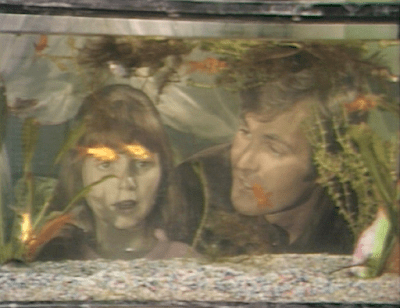
Nickerson and Don Briscoe play part of their scene behind an aquarium. We last saw that aquarium in #276. In that one, we were supposed to be uneasy about Windcliff and about Julia as its director. When we saw her feed the fish, it was a metaphor for her role as the mistress of a strange, self-contained little world whose inhabitants were at her mercy. Julia has been living on the estate of Collinwood for well over a year now, and the only member of Windcliff’s staff whom we see today is a nurse whose bit part was a prize given to beauty contest winner Bobbi Ann Woronko. So our attention is directed not to whoever is in charge of the place, but to Nickerson and Briscoe’s faces distorted in the water as the goldfish pass in front of them. This is rather a heavy-handed way of telling the audience that they are, each in their own way, as much prisoners as are the fish.

In the tank. Screenshot by Dark Shadows Before I Die.

Chris has seen the weather report in the newspaper and realized that the moon will be full tonight. This alarms him. Back at the Collinsport Inn, he asks the innkeeper, whom longtime viewers met in #1 and know as Mr Wells, if he can change his room. He wants the most isolated room in the place. He also wants Mr Wells to lock the door from the outside and to leave the door closed no matter what he hears inside. Mr Wells is reluctant, but agrees to all of these conditions.

Even viewers who stumbled onto Dark Shadows never having heard of it would know from what we have seen between Maggie and Nicholas that it is a horror story. Those who have been to the movies will add Chris’ status as a mysterious drifter to his alarm at the full moon and his request to be locked up and left alone no matter what Mr Wells may hear and will come up with the irresistible conclusion that he is a werewolf. They will also be sure that Mr Wells will eventually decide the sounds coming from behind the door are so terrible he cannot leave Chris alone, and that when he unlocks it Chris will kill him. Of course this is exactly what does happen. Our last shot of Mr Wells shows his face streaked with red and blue markings. The red ones presumably signify blood, and the others signify that most TV sets in the USA in 1968 received only in black and white, so blue lines would look like bruises.

Blue and red. Screenshot by Dark Shadows Before I Die.
The same shot in black and white.

Mr Wells, played by veteran character actor and future TV star Conrad Bain, had last appeared in #61. That was one of the longest gaps between appearances by a cast member, though the record belongs to Albert Hinckley, who like Bain appeared in #1. Hinckley, a train conductor in that one, will return playing a doctor in #868. That’s quite an extended absence from the show, but a remarkably short period to make it all the way through medical school, he must have been very bright.

Also in #1 was Alexandra Moltke Isles as well-meaning governess Victoria Winters; Mrs Isles left the show three days before this episode was taped. Victoria was Dark Shadows’ chief protagonist for its first year, and Mrs Isles’ presence in the cast was a powerful reminder of the show’s history even after the character was relegated to the sidelines of the action. Combining her departure with Mr Wells’ on-screen death, it might seem plausible that Maggie, another survivor from the first episode, might really die on Nicholas’ altar.

Episode 629: I know him by another name

Suave warlock Nicholas has botched his main project, and is in big trouble with his supervisor. He is called into the corner office, which apparently represents Hell, and talks the boss into giving him another chance.

Nicholas gets an unsatisfactory performance review. Screenshot by Dark Shadows Before I Die.

Regular viewers will immediately recognize Hell as a redress of the basement of the Old House on the great estate of Collinwood, home to old world gentleman Barnabas. Strangely enough, this is not the first time it has seemed that Hell is in a corner of Barnabas’ basement. In #325, strange and troubled boy David had a dream in which the ghost of Barnabas’ sister Sarah brought him to the basement. The set was decorated much as we see it today. David met a faceless figure and saw Barnabas, who was at that time a vampire, rise from his coffin. In #512, the ghost of the Rev’d Mr Trask, a witchfinder whom Barnabas murdered in the late eighteenth century, conjured up the spirits of many of Barnabas’ victims, and put him on trial in the basement. Again, we see that it is the abode of the unhappy dead.

Nicholas has to admit to his boss that he has fallen in love with Maggie, The Nicest Girl in Town. Contemptuous of warm human feelings, the boss tells Nicholas that he and Maggie can indeed be together for all time, but only “here”- confirming that the set does represent Hell. Nicholas is horrified, but the boss yields nothing. He will have to sacrifice Maggie in a Black Mass so that she can be damned along with him. He must also get his original project back on track, breeding a race of Frankenstein’s monsters who will be loyal to the spiritual forces of darkness.

Returned to the world of the living, Nicholas goes to the great house of Collinwood, where he tries to persuade mad scientist Julia to help him with the Frankenbabies plan. She can see that he is desperate, and is therefore unimpressed with him. She presses him for more information, and he tells her to read the Book of Genesis. His boss figures in it, as the one who tempted Adam and Eve. Julia gasps at the idea that Nicholas is one of Satan’s direct reports. Nicholas explains what he wants her to do. Julia calls the idea “monstrous,” a description which Nicholas considers apt. She refuses to have any part in such an enterprise, but she capitulates when he threatens her dear friend Barnabas.

Danny Horn’s post about this episode on his great Dark Shadows Every Day is devoted to the packet of View-Master reels featuring images related to episodes made around this time. I’ve always enjoyed View-Master; I think it’s a shame it was slotted as something for young children only. I find it refreshing to spend three or four minutes peering into its little worlds. I left this comment:

Some years ago I bought a bunch of ViewMaster reels. I’d liked them when I was a kid, and I was curious about the non-cartoon ones, the reels depicting landscapes and such. I found that it was a meditative exercise looking into the viewer and teasing out all the 3-D effects.

Anyway, I still have those reels, including the Dark Shadows set. Inspired by this post, I looked at them this morning. There are a bunch of very good shots with high contrast between actors and background. Bud Astredo was particularly good at striking poses that would make him stand out. Grayson Hall is just as good, it’s a shame she’s only in the one picture.

(20 October 2020, 11:12 am Pacific time)

Danny’s post also links to this wonderful piece about the packet on a blog called View-Master 3D.

Episode 622: A position to help each other

Well-meaning governess Vicki is on the terrace of the great estate of Collinwood. A man known variously as Peter and Jeff keeps clutching at Vicki’s arms so sharply that her biceps pulse, then holds her with one hand and paws her with the other as she stands rigidly still. First time viewers, knowing only that Dark Shadows features stories of monsters and crime, would think that the man had some power over the woman and that they were seeing him abuse that power. They would be right. Unfortunately, the man and woman are not Peter/ Jeff and Vicki, but actors Roger Davis and Alexandra Moltke Isles. Vicki is supposed to be in love with Peter/ Jeff and reluctant to part from him, but the instant she has spoken her last line she turns her face from him and runs away, without the slightest attempt to suggest that she wants to linger.

Roger Davis has his fun.

After Vicki escapes from Peter/ Jeff’s repellent attentions, a woman named Eve emerges from the bushes. Peter/ Jeff is angry with her. He grabs her roughly and throws her out of the frame. Peter/ Jeff then stalks off. Eve comes back into the frame. It’s a relief to see her upright and well-put-together- Mr Davis shoved Marie Wallace so hard she had to struggle to right herself as she spun out of view. It looked like she might have slammed her head against the floor.

Marie Wallace using her arm to regain her balance and keep from sustaining a serious injury.

In a comment on Danny Horn’s post about this episode on his blog Dark Shadows Every Day, Marc Masse reports what happened when this scene came up at a panel discussion at a Dark Shadows convention many years later:

This was the episode where Grabby Davis got so overly excited in his scene with Marie Wallace on the terrace that he grabbed her by the arms and threw her completely out of frame. You see her struggling to remain on her feet as she stumbles off to the right. Some 20 years later at a fan convention (it’s in Dark Shadows 25th Anniversary Special from the disc set that has the last episode of the series), Marie Wallace brought this up as Roger Davis was telling the audience of how they (or rather he) would cut up and laugh and have fun while they were making the episode, and of how they would just laugh off their flubs. Wallace then broke in to remind Davis of episode 622 as she recalled, “Hey, Roger? I didn’t laugh when you threw me out of frame in that scene, on camera. Remember that? Several times?” She explained to the audience how all during dress rehearsal he’d never touch her and then when he’d done it on camera he’d come up to her and apologize profusely, but Wallace told him then and there at the convention that she never believed him.

Marc Masse, as “Prisoner of the Night,” in a comment left 8 April 2015 on “Episode 622: Heated Conversations on Somebody Else’s Lawn,” Danny Horn, Dark Shadows Every Day, 8 April 2015.

In a response to another post of Danny’s, Marc added that in the same video you can see actress Donna Wandrey’s appalled reaction to Mr Davis’ statement, and her increasingly visible disdain for him as Miss Wallace makes her case against him.

After Peter/ Jeff is gone, another visitor comes and addresses Eve by name. She is Angelique. Angelique is not a Roger Davis character, she is merely a vampire, so everyone can relax.

Regular viewers have been wondering what would happen when Angelique shared a scene with Eve. Marie Wallace’s style as Eve relies on many of the same techniques Lara Parker uses as Angelique. Both use an elevated style with many catches of breath, changes of volume in mid-sentence, and striking of oratorical poses. Each was capable of making this exaggerated method work, but no one could conceal its profound silliness, and a scene consisting of two characters both using it would be too ridiculous even to make a good joke in a cartoon. What actually happens is that Parker demonstrates the quietest possible version of the style, while Miss Wallace shows a more typically brassy version. Recognizing their approaches as two poles of the same axis, we are not only interested in their encounter, but also in what they show us about the craft of acting.

Angelique persuades Eve to join her in an alliance against warlock Nicholas. This might be an exciting development. Nicholas is the show’s chief villain at the moment, and between them Angelique and Eve just might be able to bring him down. It is also the first alliance we have seen take shape in a long time. Many characters have tried to control other characters, to deceive them, to imprison them, to enslave them, to brain-wash them. But the only group working towards a common end is made up of old world gentleman Barnabas, mad scientist Julia, occult expert Stokes, and servant Willie. That team formed long ago, has not managed to get anywhere lately, and is, at the moment, immobilized by Barnabas’ absence. Yesterday Julia tried to form an alliance with Nicholas against Angelique, but at the last minute his inability to talk with her forthrightly aborted that effort. So it is refreshing to see that the show is still capable of imagining a new alliance.

Danny’s post about this one is one of his very best, a composition in free verse weaving together quotes from the dialogue with retellings of the overarching narrative with meditations on a number of topics that the episode touches on. If you are a Dark Shadows fan and haven’t read Dark Shadows Every Day, this is a fine post to start with. It’s like a song- you may not understand all the lyrics the first time you hear it, but the sound of it will carry you along.

The comments below it include some great stuff too. I’ve already mentioned Marc Masse’s remark about Marie Wallace’s confrontation with Roger Davis. There are also two fanfic ideas about how the show might have resolved the question of who Vicki’s parents were. Someone posting under the name “William” had this plausible one:

My own theory: Victoria the daughter of Jamison Collins and Betty Hanscomb. So she’s Roger and Liz’s half-sister. Liz knows and Roger doesn’t.

Jamison aggressively seduces Betty, on whom Roger had teenage crush. He makes her pregnant and then coldly casts her out. A pregnant Betty shows up at Collinwood and tells Liz and Roger about what happened.

Roger confronts his father in a fit of rage in the Tower Room during one of Collinwood’s famous storms.

Jamison Collins has a heart attack during the confrontation, and Roger leaves him in the room to die. Roger staggers out, and Liz finds her father dead.

Roger has a complete breakdown and is sent to Windcliff, where Dr. Julius Hoffman, uncle of Julia Hoffman, wipes out his memory of that night in the summer of 1946.

Liz, with the help of new guy in town Paul Stoddard, pays off Betty Hanscomb to leave town and arranges for her half-sister to be raised at the foundling home in New York. Grateful to Paul for his help, Liz starts to fall for his charms …

(And this is why Liz is so fond of Victoria, but not like she is with Carolyn. And this is why she refuses to tell Roger anything about why she brought Victoria back).

–“William,” in a comment left 22 August 2016 on “Episode 622: Heated Conversations on Somebody Else’s Lawn,” Danny Horn, Dark Shadows Every Day, 8 April 2015.

That has a lot of potential. Liz doesn’t seem ever to have loved Paul, she did marry him shortly after her father’s death, and Roger’s attitude towards Vicki in the first months of the show was a strange mixture of extreme hostility and obvious attraction. “William’s” story would account for all of those things. But it doesn’t hold a pale blue candle to this theory posted by Pedro Cabezuelo:

Everybody, we’re missing the obvious! Vicki IS Betty Hanscombe!!!!! Somehow she managed to time travel AGAIN and ended up in Collinsport circa the 1940s and adopted the Betty Hanscombe identity, working her way as a servant at Collinwood. She had an affair with Paul Stoddard, gave birth to herself (at which point the adult Vicki ceased to exist) and THAT’S what caused all the irreperable harm to the time stream/parallel time/anything else you want to blame on Vicki.

Pedro Cabezuelo, in a comment left 10 April 2015 on “Episode 622: Heated Conversations on Somebody Else’s Lawn, Danny Horn, Dark Shadows Every Day, 8 April 2015.

I have my own fanfic idea about Vicki’s origin. I’ve shared it here before, and will again. But Pedro’s is so good I want it to be the last word today.

Episode 621: The only known cure

Mad scientist Julia Hoffman and bedraggled servant Willie Loomis have been in the woods, looking for old world gentleman Barnabas Collins. Barnabas has become the victim of vampire Angelique, and loss of blood has brought him very low. Julia and Willie fear that if they do not find Barnabas before nightfall, he will die. Barnabas was a vampire himself until March; they fear he will revert to that condition if they cannot save his life.

Despairing of the search, they return to Barnabas’ house. Julia remarks that “I actually found myself feeling that we’d come home and find him here.” Willie lives there, Julia doesn’t, but as Barnabas’ inseparable friend and partner in all his adventures she may as well. Julia and Willie decide that the only way to save Barnabas is to drive a stake through Angelique’s heart. She tells Willie that she believes the suave Nicholas Blair to be keeping Angelique’s coffin in his house. She sends Willie to fetch a stake and mallet, and she ventures forth to visit Nicholas.

Julia and Nicholas had a very dramatic confrontation in his living room in #619. Today, she tells him she has come to provide medical attention to Frankenstein’s monster Adam. Adam and Barnabas have a Corsican brothers connection, so Julia knows that Barnabas’ injuries will have reduced Adam to a dire state. Nicholas is keeping Adam at his house because he has plans for him, and if those plans fail it “will bring down the Master’s wrath.” Facing that prospect, Nicholas has little choice but to allow Julia to attend to Adam. She gives him some shots, which do provide him with considerable relief. But she says this is only temporary. She proclaims that “the only known cure” for Adam and Barnabas’ joint condition is Angelique’s destruction.

Early in the scene, Julia says that she and Nicholas must work together to help Adam and Barnabas. Nicholas tells her that he has no healing powers. At that, we may think he is about to talk forthrightly about himself as a warlock. But when she asks where Angelique’s coffin is, Niccholas starts playing dumb again. This frustrates Julia, as it might frustrate the audience. Danny Horn’s whole post about the episode on Dark Shadows Every Day is about how much it frustrates him. Julia leaves the stake behind when she goes, and Nicholas takes it downstairs to Angelique’s coffin with the intention of destroying her.

Meanwhile, Julia’s ministrations have done enough to revive Adam and Barnabas that the latter is able to cry out in the woods. Willie finds him and takes him home. Julia comes back, sees them, and sends Willie to call for an ambulance to take Barnabas to Windcliff, a sanitarium of which she is the nominal head and which is located about a hundred miles away. Barnabas objects to that, but Julia insists.

There is a spectacular goof in this one. We see Barnabas lying on the “grass” in the “woods.” For several seconds we can see the edges of the little green rug Jonathan Frid is on, and a studio light on the floor next to it.

“The woods”

Episode 619: Advantages of being the master

Well-meaning governess Vicki has found a grievously injured Barnabas Collins in the woods. Barnabas insists Vicki not take him to a doctor or anyone else, but hide him somewhere no one will find him. She thinks of a secret door to the long-abandoned west wing of the great house of Collinwood, and uses that to take him to a hiding place there.

For the first year of Dark Shadows, the west wing was strongly associated with Vicki. In #14, she alone saw the locked door separating the bedrooms from the west wing open and close, apparently by itself. That was the first unequivocal evidence of supernatural activity on the show. In #84, Vicki’s charge, strange and troubled boy David, led her into the west wing, the first time we had seen its interior. He then trapped her in a room there, hoping she would die. She would languish in that room until David’s father, high-born ne’er-do-well Roger Collins, rescued her in #87. When Vicki was engaged to Roger’s nemesis Burke Devlin in #338, matriarch Liz offered to restore the west wing and let Vicki and Burke live there. After Burke died in a plane crash in #345, Vicki vowed to go on with the project of restoring the west wing. In #347, permanent houseguest Julia Hoffman, MD, exploited Vicki’s interest in the west wing to get her to stare into a crystal supposedly taken from a chandelier there until she is in a state of deep hypnosis.

More recently, Frankenstein’s monster Adam stayed in the west wing for many weeks as the guest of heiress Carolyn. Vicki’s connection with the wing was renewed when Adam abducted her and hid her there for a few days starting in #553. Today, Vicki hides Barnabas in Adam’s old room, re-establishing the west wing as her space. Thus we loop back to a theme that goes back to the third week of the show.

Later in the episode, Barnabas wakes up and is distressed to find that it is almost sunset. He pleads with Vicki to bring him a cross as quickly as possible. The audience knows, but Vicki does not, that Barnabas is the victim of vampire Angelique. Vicki’s ignorance of this point reminds us that she has been excluded from the show’s A-plots ever since #211, when Barnabas was introduced, himself in those days a vampire. Her calm departure to go fetch a cross reminds us that she knows this part of the house well. Every room in it is stuffed with bric-a-brac, undoubtedly she will have seen something nearby that is in the shape of a cross.

Meanwhile, Julia is in a hospital room, visiting local man Joe Haskell. Julia has become Barnabas’ inseparable friend, and Joe is Angelique’s other victim. She does not know that Angelique is the vampire, though she had surmised as much in #608. She questions Joe. At first he denies everything, but after she discloses that she was for a time the victim of yet another vampire he tells her that she must know why he can’t tell her who has been sucking his blood. She asks if the suave Nicholas Blair is hiding the vampire. Joe closes his eyes and scoffs at the idea. This reaction does nothing to curtail Julia’s suspicions of Nicholas.

Julia goes to Nicholas’ house. He genially escorts her into his living room. There, he takes a seat while she stalks about the room and tells him what she knows about him. Barnabas has a self-defeating habit of showing his cards to his adversaries, and longtime viewers may at first be afraid Julia has picked it up from him. Since Nicholas is a warlock who not only controls Angelique but has a wide range of magical powers that he uses to promote Satan’s interests on Earth, he is not an opponent with whom one can afford to make mistakes. Angelique herself was once a witch who, in #378, was able to turn a man into a cat at a moment’s notice. Nicholas’ command of the black arts goes far beyond Angelique’s. He was able to strip Angelique of her powers, raise her from the dead at least twice, and turn her into a vampire. Julia is simply a mad scientist, and she does not have any equipment with her. There’s no telling what Nicholas might do to Julia if their interview displeases him.

On his great blog Dark Shadows Every Day, Danny Horn lists three reasons why we know Julia will survive this confrontation without being turned into a toadstool:

Really, the thing that everybody wants to know is: why can’t the Stormtroopers shoot straight in Star Wars? It turns out there are three simple answers. #1. Stormtroopers shooting laser bolts are more interesting to look at than Stormtroopers who stand around complaining. #2. Shooting Luke Skywalker in the head halfway through the first movie is going to leave a rather obvious gap in the trilogy. #3. ‘Strong Guy Kills Weak Guy’ is not headline news.

Danny Horn, Dark Shadows Every Day, “Episode 619: The Gunslinger,” posted 4 April 2015

This is all very true- of course Nicholas and Julia will not leave each other alone indefinitely, of course the show cannot spare her, of course she will overcome her disadvantages and come away from their showdown with the upper hand. But it misses the point. Suspense comes when we know what must happen, but cannot see any way it might happen. What makes the scene work is the moment when Julia tells Nicholas that Barnabas is missing. That is news to him, and as Danny says elsewhere in his post, it is “the first sign of a crack that’s going to bring his entire operation crashing down,” as his shocked reaction suggests it might be.

Julia realizes she has won her showdown with Nicholas. Screenshot by Dark Shadows Before I Die.

The scene is one of the best in the series, though it is marred by a miscalculated ending. In the early part, we see Julia making an effort to keep her cool while Nicholas sits watching her smugly. She succeeds in keeping her brave face on until she senses that she has Nicholas off guard, at which point she moves in for the kill and tells him about Barnabas. She is then firmly in command. He composes himself and dismisses her.

That’s when it goes wrong. When Julia is heading out the door, Nicholas recovers his smugness and tells her that he must admit that he admires her for coming to see him. She looks alarmed and asks why. He replies, in a half-whisper, “You know.” She hastens out. I can see that this ending may have seemed like a good idea. We clearly saw in the beginning how hard it was for Julia to keep her fear in check and how easy it was for Nicholas to bask in the superiority his powers give him over a mere mortal. Though Julia has emerged as the winner in this engagement, she still has grounds for immense fear, and he for boundless self-confidence. But it is so broadly drawn as to be confusing. Has Nicholas already found a way to turn Julia’s success against her? Has she realized too late that she has made a mistake we aren’t aware of?

We learn shortly after that neither of these things has happened. Angelique comes upstairs. She sees Nicholas being very still. She makes several attempts to engage him in conversation. He finally approaches her and strikes her across the face. He then orders her to undo what she has done to Barnabas before it ruins his plans.

This is the second time Nicholas has slapped a woman in the face. The first time was in #610, when he struck Frankenstein’s monster Eve. Humbert Allen Astredo and Marie Wallace executed that business well, as he and Lara Parker execute it well today. For that matter, Grayson Hall and Lara Parker had done a good job when Julia slapped Angelique in the face in #535. Watching them, you can admire trained professionals practicing a specialized aspect of their craft. But since Nicholas has such vast powers, he is persuasive as a villain only when we are left guessing about just what he is up to. When we see him is reduced to hitting a woman, he shrinks from avatar of Satan to cheap pimp.

After Julia leaves Nicholas’ house, she lingers in the woods outside, watching his front door. She sees Nicholas leave the house, then sees Angelique and realizes that she is the vampire.

Julia is the most intelligent character on the show, and while we watch her in the woods her face suggests that she is thinking clever thoughts. Unfortunately, we hear her interior monologue in a recorded voiceover, and her lines are remarkably obtuse. On the heels of her overdone fear on the way out of Nicholas’ house, it does as much to undercut Julia’s image as a smart person who can win a duel with the Devil as Nicholas’ physical abuse of Angelique undercuts his image as a demonic sorcerer.