No episode of Dark Shadows premiered on ABC 56 years ago today, since the network had decided to cover the visit of the Apollo 11 astronauts to Chicago instead. So I’ve decided to take this opportunity to link to videos of some interesting discussions about the show posted on Youtube.
They couldn’t have in-person conventions with panels including original cast members in the year 2020, what with Covid-19. So they had a big Zoom call instead. That one is especially interesting, because it brought out some people who hadn’t made themselves visible to fandom in decades. In the case of David Henesy, it may have been his first act of fanservice since the show went off the air. When Alexandra Moltke Isles says that her first encounter with a fan was with someone who grabbed her hair and tried to rip it out of her head, that absence is perhaps understandable. The video shows the meeting in speaker view. Fans who groan every time Roger Davis turns up will find it grimly appropriate that he couldn’t figure out how to mute his camera, and so he keeps flashing in when other people have the floor. I can’t embed it, but here is the link.
Another Zoom recording some might enjoy seeing is of an April 2021 gathering in honor of Danny Horn’s great blog Dark Shadows Every Day. I was there, under my off-screen name. The discussion got a bit awkward when some podcasters started vying with each other and with the actual host to take over the moderator’s role, but I think all of us who wanted to do so eventually made ourselves heard. It was a good time.
Since 2020, Dark Shadows fan gatherings have taken on the character and often the label of memorial services, since so many of the people who used to appear on the panels are either deceased or otherwise unable to travel. But some of them have maintained a jolly spirit even so. For example, in this 2024 panel appearance Marie Wallace and Donna Wandrey amusingly complain about some appalling behavior by director Henry Kaplan. Sharon Smyth, who wasn’t on the show when Kaplan was, listens.
This July, Danielle Gelehrter hosted Kathryn Leigh Scott and David Henesy for a Zoom chat under the aegis of her “Terror at Collinwood” podcast. Mr Henesy has his own stories about Kaplan’s misdeeds.
I wouldn’t want you to think that Mrs Acilius and I watch nothing but 56 year old TV shows. Why, this very night, after I’d written the above and scheduled it to go live at 4 PM on Wednesday the 13th, we watched a 61 year old episode of To Tell the Truth. One of the impostors had a voice that sounded terribly familiar to us, but a face we didn’t recognize at all. When the game was over, he said his name was “Bobby Lloyd, and I’m a TV announcer at WHEC TV in Rochester, New York!” Two years later, he was Bob Lloyd, and he was on staff as an announcer for the ABC network, where he would say “Dark Shadows is a Dan Curtis production.”
From December 1968 to through February 1969, strange and troubled boy David Collins (David Henesy) and his friend Amy Jennings (Denise Nickerson) were falling under the power of the malign ghost of Quentin Collins. Occasionally the children were possessed by the spirits of David’s grandfather Jamison and great-aunt Nora; at other times they were possessed by Quentin’s own spirit and that of Quentin’s sometime lover, maidservant Beth. In those same days, Amy’s brother Chris (Don Briscoe) was suffering from a curse that made him a werewolf.
As Quentin’s power over David and Amy grew, so did the frequency and duration of Chris’ spells in lupine form. By #700, Quentin so dominated the great house on the estate of Collinwood that its residents fled to the Old House on the estate, home of their distant cousin Barnabas Collins. David, entirely possessed by Jamison, was close to death. For his part, Chris was stuck in wolf form, apparently permanently, and Barnabas had locked him in a secret room in the old Collins family mausoleum.
Desperate to remedy the situation, Barnabas and his associate, occult expert Timothy Eliot Stokes (Thayer David,) searched Quentin’s old room in the long-deserted west wing of the great house. They found some I Ching wands there. Under Stokes’ direction, Barnabas threw the wands, meditated on them, and found himself transported back in time to 1897. In that year, Quentin, Beth, Jamison, and Nora are alive, and Barnabas is a vampire.
Barnabas had no idea what led Quentin to become a malevolent ghost or what first brought the werewolf curse on Chris, but he had reason to believe that 1897 was an important year in the events leading up to both of those unhappy circumstances. So once he arrived in that period, he spent his nights meddling in all the affairs of the Collins family he found there. Vampires are not problem-solvers; their function in a story is to create problems that other characters will have to solve. So all of Barnabas’ well-intentioned interventions backfired badly. Even disregarding the many murders he committed for his own selfish ends, including the murder of Quentin’s brother Carl Collins, his trip would by any standard have to be considered a disaster.
Now, evil sorcerer Count Petofi (Thayer David) has found that Barnabas is a visitor from the future and is determined to go with him when he returns to 1969. When he demanded Barnabas tell him his secret, Barnabas quite truthfully told him he had no idea what was going on when he found himself transported from one period to another. Petofi did not believe him, and is trying to extort the information he wants by summoning the spirit of David to come from 1969 and possess Jamison (David Henesy) in 1897.
Not only is this an intriguing reversal of the 1968-1969 story in which the ghost of Quentin caused Jamison’s spirit to possess David, it also picks up on some recent hints that they might retcon the whole “Haunting of Collinwood” story to put Quentin’s ghost under the control of Petofi. Even if he can’t hitch a ride with Barnabas, perhaps Petofi will find a way to use Quentin to go back to 1969 with us.
Nora (Denise Nickerson) is with her brother Jamison when the possession takes hold. She is puzzled that he insists on calling her “Amy” and himself “David” and that he tells her to call Quentin on the telephone, even though he is in the house. When Quentin shows up, he recognizes the name David Collins from something Barnabas has told him about the future. But Barnabas has not told Quentin that he is fated to become a family-annihilating ghost, and so Quentin cannot understand how David knows who he is.
Meanwhile, a man named Tim Shaw (Don Briscoe) comes to the house and visits Nora in her room. Tim is Amy’s former teacher, and she considers him a friend. She does not know that since she first knew him, he has lost his moral compass, found the severed Hand of Count Petofi, stolen it, and used its magical powers to make a small fortune in New York City. Evidently all working-class Collinsport boys get rich quick when they go to NYC. In 1961, ex-fisherman Burke Devlin got out of prison and went to that city. By the time he returned to Collinsport in 1966, Burke was a big-time corporate raider who had to think for a moment when David Collins asked him if he’d already made his first $100,000,000. He answered “Not yet.” If he’d had the Hand, no doubt he would have passed that milestone long before.
A couple of days ago, Tim asked Nora to hide a box for him. Unknown to her, the box contained the Hand. Tim asks Nora to return the box to him. She tells him Jamison has it, and he flies into a rage. He gets very rough with her. Briscoe and Nickerson were both good actors, and we’ve seen them share tender moments both as Nora and Tim and as Amy and Chris, so the resulting scene is as uncomfortable as it needs to be to show us that Tim is no longer the long-suffering nice guy we once knew. Moreover, longtime viewers who recognize Tim’s echo of Burke and remember that Burke, though sometimes villainous, was always good with David, will be shocked that Tim does not mirror the earlier character’s consistent soft spot for children.
Tim goes downstairs and sees Quentin coming out of the drawing room. He demands to see Jamison. Quentin tells him that Jamison is ill, and it will be impossible for anyone to talk to him. Tim starts to get ugly about it, and Quentin cuts him off, saying that Jamison doesn’t have the Hand. Tim is shocked that Quentin knows about the Hand, but recovers sufficiently to ask who does. Quentin cheerfully tells Tim that if he goes to the abandoned mill at the end of the North Road, he will find his onetime acquaintance Aristide, and that Aristide will direct him to the man who has the Hand.
Tim knows Aristide only slightly, but he has a grudge against him. Aristide attacked Tim’s girlfriend Amanda and demanded she tell him where the Hand was. Even after he realized Amanda did not know what he was talking about, he beat her and threatened to kill her, forcing her to tell him whatever she did know that would help him retrace Tim’s steps. When Tim found Amanda, Aristide had left her unconscious, and Tim feared at first she might be dead.
We cut to the hideout in the mill, where Tim is waiting with a pistol and thinking that he would be justified in killing Aristide for what he did to Amanda. When Aristide comes, Tim holds him at gunpoint and demands the Hand be returned to him. Aristide tells him that is not possible. They quarrel until another man enters. It is Petofi, who shows Tim that the Hand has resumed its place at the end of his right arm.
That suffices to show Tim that the Hand is no longer available to him. Petofi tells him he should consider himself lucky that the Hand, which followed no one’s commands, chose to make him rich and happy. Tim says he is not happy, and will not be until he can take revenge on the hypocritical Rev’d Gregory Trask and lawyer/ Satanist Evan Hanley. This again reminds longtime viewers of Burke, whose original goal in returning to Collinsport was to wreak vengeance on Roger Collins. As Trask and Evan involved Tim in a homicide when he was not in his right mind and tried to make him alone pay the legal penalty for it, so Roger killed someone with Burke’s car while Burke was passed out drunk in the back seat and saw to it that the court concluded that Burke was driving.
Petofi laughs and congratulates Tim on his choice of enemies. Tim brightens and asks if Petofi will join with him in bringing Trask and Evan down. Petofi explains that he does nothing without a price. Tim says he has a lot of money, and Petofi says he doesn’t have any use for money. Petofi brings up Amanda, only to say that he doesn’t have a use for her either, at least not at the moment. He sends Tim along his way.
Aristide is talking when Petofi dismisses him. He tells him that two visitors are coming, and that he wants to be alone when they arrive. He will not explain further, and so Aristide is in rather a huff when he leaves.
The visitors are Quentin and Jamison/ David. Quentin is carrying his nephew/ great-great-nephew. He demands that Petofi cure Jamison of the possession, which seems to be killing him. Petofi refuses. When Jamison/ David calls Quentin by name, Petofi asks him how a boy who lives in 1969 knows who he is. Quentin’s bewildered reaction leaves us wondering how he will respond if Barnabas ever tells him just why he went to the past.
In the opening teaser, Petofi stood over the coffin in which he has trapped Barnabas. He told Aristide that he and Barnabas have been at war for what even he, at his immense age, considers to be a very long time. He says that they are now engaged in the final battle of that war.
Petofi’s remarks make absolutely no sense whatever in the context of what we have seen. It has been clear so far that Petofi’s presence at Collinwood is an accident, that Barnabas never heard of him before, and that Petofi only just learned that Barnabas has traveled through time. Many of the oddest dead ends on the show were left over from advance plans that hadn’t worked out; so when they were drawing up broad outlines six months before taping, or when they were writing episode summaries (called “flimsies”) thirteen weeks before, they would often include ideas that depended on story points that they never got around to making happen or characters who never worked out. Once in a while, the writers tasked with filling in the flimsies wouldn’t be able to make up a complete 22 minute script without incorporating some of this irrelevant material. So perhaps at some point in the planning process they meant to have stories about Barnabas going back to the eighteenth century and fighting Petofi there. They may still have been kicking that idea around when they shot this installment.
If Dark Shadows has offended, Think but this, and all is mended — That you have but slumbered here While these visions did appear. And now, a word from All Temperature Cheer.
Danny Horn, “Episode 816: Midsummer,” posted 1 February 2016 at Dark Shadows Every Day.
Charity Trask finds Quentin Collins unconscious and disheveled in the woods. She kneels beside him in a show of concern, then notices a woman on the ground near him. The woman’s face is covered with what on a black and white television look like slash marks and her clothing is badly torn. She regains consciousness just long enough to say Quentin’s name. Charity notices that Quentin is holding a scrap of cloth that matches the woman’s dress, and realizes that he is the werewolf who has been terrorizing the area.
Quentin comes to, and Charity tells him they must get help for the injured woman. Quentin’s response is to threaten to kill Charity if she says anything to anyone about what she has seen. He says that he will look after the woman, and repeats his death threats to Charity.
Charity goes home to the great house of Collinwood, where her father, the overbearingly evil Gregory Trask, orders her to marry Quentin by the end of the week. She is horrified and tells him she will not. She cannot explain why. Before Gregory can corner Charity and force her to give him information, twelve year old Jamison Collins enters. Jamison reports seeing the injured woman in the woods, and says that Gregory must go to her at once if she is to survive. Gregory dismisses this as a “tall tale” and says he will not be distracted from punishing Jamison for his long unexplained absence from the house. Charity, on the point of sobbing, urges Trask to take Jamison seriously, and he reluctantly goes to see if there really is a woman in the woods.
We know more than do Charity or Trask. We saw Jamison meet Quentin in the woods next to the woman’s body, and talk to him in an amiable and condescending tone about the possibility of turning this unfortunate incident to their mutual advantage. He also makes it clear that, despite his appearance, he is not simply Jamison. He is a sorcerer named Count Petofi, in possession of Jamison and acting through his body. When Charity asks Jamison/ Petofi if the woman was alone when he found her, he replies that of course she was. Smiling, he asks who she thought he might have seen. Terribly agitated, she soon excuses herself and goes into the foyer. Jamison/ Petofi looks directly into the camera and smiles. David Henesy was the first actor on Dark Shadows to use this technique, back in 1966 when he was playing strange and troubled boy David Collins. He’s been doing it a lot lately, and is still very good at using it to unsettle the audience.
He looks young for 150, but he’s grown quite a bit since 1966. Screenshot by Dark Shadows Before I Die.
Quentin comes down the staircase, wearing a tidy new suit. Charity is shocked that he did nothing to help the injured woman; he resumes his menacing tone and demands to know whether she kept her side of the bargain. He eventually deduces that she did not tell what she saw, and allows her to go upstairs to her bedroom. Quentin is usually charming, often funny, and occasionally aligned with good against evil, but even before he became a monster he was established as a homicidal maniac. When we first met Quentin, he was a ghost haunting Collinwood in the late 1960s and he kept killing people there. The first week of our trip back in time to 1897, we saw him trying to strangle his grandmother in her bed. And his sister-in-law turned him into a werewolf as revenge after he murdered his wife Jenny. Since we are focused on the horror of Charity’s situation as her father is pressuring her to marry Quentin, of course his bloodthirstiness is the aspect of his personality we see most clearly today.
Trask returns, carrying the injured woman. Quentin asks if she was conscious. Trask says she is not conscious. Quentin specifies that he wants to know if she has been conscious at any point while with Trask. This arouses Trask’s suspicions; Quentin protests that it is information he will need when he telephones the doctor. Trask says that she was not, and carries her upstairs.
Quentin goes to the drawing room. Jamison/ Petofi is there, and has some business to discuss. Quentin is too unsettled by the fact of the possession to talk candidly. Jamison/ Petofi decides to humor him. “I’ll become that beautiful child you so want to see… Can we play a game, Uncle Quentin?” Quentin is stunned by Jamison/ Petofi’s sudden change of tone and bearing. It is indeed impressive to see David Henesy drop his mimicry of Thayer David as Petofi and resume his usual approach to the role of Jamison. We’d forgotten just how deeply he had come to inhabit that imitation.
Jamison/ Petofi declares that they will have a treasure hunt. He gives Quentin a series of clues in the form of cryptic rhymes. Quentin is completely stumped by all of them. Finally Jamison/ Petofi just points at the desk drawer he wants Quentin to open and tells him there is a document in it that he can use against Trask. Quentin opens the drawer and pulls out heap after heap of paper, then declares “There’s no paper here!”
Quentin is not especially brainy; much of his appeal comes from the joy David Selby, Ph.D., took in playing a character who at no point says or does anything to demonstrate intellectual prowess. But we are not supposed to believe that he is stupid, at least not so stupid that it is plausible that “There’s no paper here!” was the scripted line. Maybe it was a blooper for “There’s no paper like that here!” or “There’s no paper here I haven’t seen before!” or something like that.
A document bearing a wax seal and a couple of signatures materializes on top of the papers Quentin has pulled out of the desk. He reads it, and sees that it is a full confession to the murder of Trask’s first wife, signed by Trask and lawyer Evan Hanley. All Jamison/ Petofi has to say is “It can be very useful, can’t it? Especially since it’s true… Aren’t games fun, Uncle Quentin?” and Quentin catches on that the document gives him power he can use against Trask.
Meanwhile, the injured woman has briefly regained consciousness in the upstairs bedroom where Trask and Charity are attending her. She spoke Quentin’s name, and Trask sent Charity to fetch him. Trask confronts Quentin about this. Quentin says that the woman’s name is Tessie, that he talked to her a couple of times when they ran into each other at the Blue Whale tavern, and that he knows nothing more about her. He admits he didn’t call the police after he called the doctor; he claims he simply forgot, in the confusion of the moment. Trask says that he will go and make the call. In an accusing tone, he asks “Most unfortunate, isn’t it, that you were the one who forgot?” He leaves Quentin alone with Tessie.
Tessie regains consciousness, looks at Quentin, and reacts with dismay. He tells her he didn’t mean to do it. She moans and dies. As she flops over, her right breast comes perilously close to springing out of her décolletage. When he realizes she has died, Quentin says “Tessie!” with a note of exasperation, as if she’s always doing inconvenient things like that. Mrs Acilius and I laughed out loud.
Downstairs, we see that Trask did not call the police after all. Charity is doing it from the telephone in the drawing room. Quentin enters through the secret panel behind her. We first saw him use this panel in #685, when it was 1969 and he was a silent but peculiarly corporeal ghost. He let himself into the drawing room and strangled silversmith Ezra Braithwaite, played by Abe Vigoda. A bit of an eldritch moment that the killer of Tessie is also the killer of a character played by the actor who would go on to play Tessio in the 1972 film The Godfather.
In Vigoda’s last scene in that movie, Tessio and Corleone Family consigliere Tom Hagen are at pains to assure each other that Tessio’s impending murder and the events that led up to it were strictly business, and that Tessio and his murderers still have the warmest regards for each other. Quentin’s attempt to deny his guilt to Tessie is of that same sort- he didn’t have any hostility towards her, his nature as a werewolf simply required that he kill the nearest person.
By contrast, Quentin’s interaction with Charity is intensely personal and intensely unpleasant. He takes the telephone out of her hand, something that men often do to women on Dark Shadows when they are trapping them, and moves deep into her personal space as he demands to know why she would want to call the police. She tells him her father ordered her to make the call; he says that Tessie will tell the police nothing now, because she is dead. Charity shouts that he killed Tessie, and that she will tell everything.
Danny Horn devotes much of his post about the episode at his great blog Dark Shadows Every Day to the absurdity of Quentin making a date with Tessie on a night when the Moon was full. In a comment, I pointed out that we have no reason to think he did make a date with her:
I don’t think it’s so hard to explain why Tessie was in the woods at dawn, though it does require a little fanfic.
Charity was in Quentin’s room in 806, inviting him to go for a walk on the beach when he’s busy getting drunk and listening to the same dreary little waltz over and over. To get Tessie into the woods, all we have to do is assume that shortly after that scene Quentin ran out of booze before he was drunk enough to stop caring about the upcoming full moon. Not wanting to deal with the Trasks, he didn’t go to the mansion’s liquor pantry, but staggered down to the Blue Whale.
There, Quentin met Tessie. She was upset with him for missing several dates in the last few days. He can’t very well explain what he’s been doing lately, and his refusal to answer Tessie’s questions angers her. She’s about to give Quentin a piece of her mind when he realizes that it will be dark soon, and rushes from the bar.
Now Tessie is really furious. She follows Quentin to the estate. Once there, she sees him change into the werewolf, and hides in terror for most of the night. Shortly before dawn, she thinks he is gone and leaves her hiding place. The werewolf appears and slashes away at her for a few minutes before changing back into human form and collapsing beside her.
And that’s when Charity finally takes her walk, and finds out.
Comment left 17 November 2020 by “Acilius” on Danny Horn, “Episode 808: Twice Burned,” Dark Shadows Every Day, 18 January 2016
Tessie is played by Deborah Loomis, and is the earliest screen credit on her IMDb page. Her next role listed there was in Hercules in New York, a 1970 film which also featured fellow Dark Shadows day player Erica Fitz Mears, who appeared in #594 and #595 as Leona Eltridge. Neither Miss Loomis nor Mrs Mears stuck with acting after the middle of the 1970s, but the two top billed members of the cast worked steadily for some years after. The first name in the credits was comedian Arnold Stang, who was best known at the time for a series of TV commercials for window screens ending with the tag “Arnold Stang says don’t get stung!” Second billed was Arnold Strong, a bodybuilder from Austria making his acting debut. Under his birth name of Arnold Schwarzenegger, Arnold Strong would go on to roles in several later films. I know of no evidence he ever auditioned for a part on Dark Shadows.
From #1 to #274, each episode of Dark Shadows began with a voiceover narration by Alexandra Moltke Isles, usually in character as well-meaning governess Vicki. This identified Vicki with our point of view and suggested that she would sooner or later learn everything we knew.
Jonathan Frid joined the cast as vampire Barnabas Collins in #211, and quickly became the show’s great breakout star. If the upright Vicki found out what we knew about Barnabas, one of them would have to be destroyed. Vicki was the favorite of longtime viewers and Barnabas was attracting new ones, so that was out of the question. Therefore, other members of the cast started taking turns reading the voiceovers, and doing so not as their characters, but in the role of External Narrator.
Today marks the first time Frid himself reads the narration. His training first in Canada, then at Britain’s Royal Academy of Dramatic Arts, and later at Yale School of Drama prepared Frid well in the art of dramatic reading, and in later years he would concentrate on that aspect of his craft. Several of his colleagues are his equals in these voiceovers- I would particularly mention Kathryn Leigh Scott, whose conception of The Narrator is always arresting, and Thayer David, who could consistently achieve the most difficult of all effects in voice acting, a perfectly simple reading. So I can’t say I wish Frid had done all of them, but he is always good, and today’s performance is among his most gorgeous.
The action opens on a set known to longtime viewers as the Evans cottage, where from 1966 to 1968 artist Sam Evans and his daughter Maggie served as Dark Shadows‘ principal representatives of the working class of the village of Collinsport. In those days, it was on this set that we saw how the misdeeds of the ancient and esteemed Collins family had consequences that spilled out of the estate of Collinwood and warped the lives of people trying to make a more or less honest living nearby.
Now the dramatic date is 1897, and Sam hasn’t been born yet. But the cottage is already an artist’s studio. It is temporarily occupied by the nationally famous Charles Delaware Tate, who is painting a portrait of rakish libertine Quentin Collins at the behest of evil sorcerer Count Petofi. Charity Trask, a resident of the great house of Collinwood, is visiting Tate in the cottage when she sees the face in the portrait change from that of Quentin. It takes on a great deal of fur and long fangs, and reminds Charity of a wolf.
By the time Tate looks at the painting again, it has resumed its normal appearance. He tells Charity that the transformation must have been in her imagination. She is willing to consider the possibility, but we know better. Quentin is a werewolf, a condition Petofi knows how to cure. Portraits on Dark Shadows have had supernatural qualities at least since #70, including portraits we saw Sam execute on this set in 1966, 1967, and 1968, and the show has borrowed from The Picture of Dorian Gray before. Moreover, Tate’s reaction to Charity is one of barely controlled panic. Nancy Barrett has to ramp up Charity’s own emotional distress to the limit to make it plausible she would not notice Tate’s extreme agitation. Perhaps if Tate were played by a better actor than the ever-disappointing Roger Davis, his response might have been ambiguous enough that Miss Barrett could keep the tone a bit lower, but his unequivocal display of alarm leaves her nowhere to go but over the top.
Mr Davis was under no obligation to play the scene transparently, since Tate later goes to Petofi’s henchman Aristide and lays out in so many words his precise relationship to Petofi’s operations and his knowledge of them. Tate’s career is his reward for selling his soul to Petofi, and he has already experienced great sorrow as a result of that bargain. Tate knows that the portrait changed to reflect the full Moon’s influence on Quentin and that Petofi is currently in possession of twelve year old Jamison Collins. Aristide tells us that Petofi’s own body is in suspended animation while he acts through Jamison. He also says that it was in 1797 that Petofi’s right hand was cut off, and that if he does not reclaim the hand in a few weeks, by the date of the one hundredth anniversary of the amputation, he will die and so will Tate.
Jamison/ Petofi is in the prison cell in the basement of the Old House on the estate of Collinwood. Barnabas has traveled back in time from the 1960s with some vaguely good intentions and is hanging around 1897 causing one disaster after another. Now, he is doing battle with Petofi and has locked him, in the form of Jamison, in the cell. Barnabas’ reluctant sidekick, broad ethnic stereotype Magda Rákóczi, guards Jamison/ Petofi during the day. Early in the episode, Jamison/ Petofi calls Magda and pleads with her to release him. He tells her that he is “just a little boy” and that she is a “rather heartless creature.” She says she wishes he were a little boy again, but that she isn’t stupid and he won’t fool her. Indeed, the phrase “rather heartless creature” and Jamison/ Petofi’s manner in delivering it sound so much like Thayer David as Petofi that they hardly count as an attempt to deceive Magda.
Later, Jamison/ Petofi casts a spell to summon Aristide, then calls to Magda again. When Magda arrives, Jamison/ Petofi gives himself a better script than the one from which he had acted in his previous scene with her. He pretends not to remember how he got into the cell and to be shocked that Magda knows he is there. Perhaps the utter transparency of his earlier pleadings was an attempt to get Magda to underestimate his abilities as a trickster.
In #803, we saw that when Petofi took possession of him Jamison’s right hand disappeared from his wrist, matching Petofi’s own mutilated condition. When Jamison/ Petofi feigns the amnesia that might come upon recovery from possession, we might therefore expect Magda to demand that he remove his gloves to prove that he is himself again. But he plays the part of Jamison so convincingly that we are not really surprised he does fool Magda. She goes into the cell, embraces Jamison/ Petofi, and he kisses her on the cheek. It is this kiss that spreads his magical power, and she realizes too late that she has been had.
Aristide arrives a moment later, and Jamison/ Petofi calls his portrayal of an innocent boy “an award-winning performance.” Indeed, if there had been daytime Emmys in 1969, David Henesy might have won one for his portrayal of Thayer David playing Petofi playing Jamison.
Aristide wants to kill Magda; Jamison/ Petofi forbids this. Under his power, she announces that she is responsible for all the evil that has happened in 1897. She was responsible for releasing Barnabas and therefore for all the murders and other harm he has done; she made Quentin a werewolf, and is to blame for his killings in his lupine form and for the curse his descendants will inherit; she stole Petofi’s severed hand and is at fault for the deaths of Rroma maiden Julianka and of her own husband Sandor that resulted from the hand’s presence. She even takes the blame for Quentin’s murder of her sister Jenny, the act for which the werewolf curse was meant as vengeance. Magda says she must be punished. Jamison/ Petofi tells her that he is not interested in punishing her. He has another use in mind for Magda She will lead him and Aristide to Barnabas’ coffin today, and they will destroy him.
Longtime viewers will perk up twice when Aristide says that Petofi lost his hand in 1797 and that he has exactly one hundred years to recover it. From December 1966 to March 1967, Dark Shadows’ first supernatural menace was undead blonde fire witch Laura Murdoch Collins, who at intervals of exactly one hundred years incinerated herself and a young son of hers, who was always named David, in an unholy ceremony that renewed her existence, but not that of the Davids. Since the usual laws of nature don’t apply, the show needs some other causal mechanism to create suspense, and anniversaries will do as well as anything else. Another iteration of Laura was on earlier in the 1897 segment. It was fun to see her again, but they could shoehorn her into that year only by retconning away the one hundred year pattern in her immolations. It’s reassuring in a way to see that Petofi is bringing centenaries back.
The date 1797 is also significant. It was in 1796 that Barnabas died and became a vampire. We flashed back to that period for the show’s first costume drama segment in November 1967 to March 1968, and Barnabas went back to 1796 for a week in January 1969. So we may go back again some day, and if Petofi was alive and in his prime in 1797, we might run into him there.
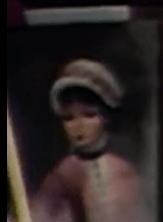
Barnabas and Petofi are not the only characters from the 1790s who might be on the minds of attentive longtime viewers. Barnabas’ little sister Sarah died in 1796, and as a ghost was an extremely important part of the show from June to November 1967. We’ve been getting reminders of Sarah for the last several days. In #792 wicked witch Angelique produced a toy soldier of Barnabas’ that Sarah gave to strange and troubled boy David in #331. In #805, Charity found Sarah’s recorder, a prop that often served as Sarah’s calling card in 1967, and talked about learning to play it. And today, we see a portrait standing on the floor of the Evans cottage, a set which Sarah visited in #260, depicting a girl wearing a bonnet very much like the one Sarah wore as a ghost in 1967 and a pink dress just like the one she wore when we saw her as a living being in the flashback to the 1790s.
Portrait at the cottage.
I wonder if, when they were making up the flimsies for this part of the show, they had thought of reintroducing Sarah. That would have required a recasting of the part- Sharon Smyth was noticeably older when we saw Sarah die in January 1968 than she was when Sarah was a ghost in June 1967, and by now we would wonder what she has been eating in the afterlife that has made her get so much taller. Besides, Miss Smyth* had stopped acting by this point.
The process of planning the stories was in two stages, a rough sketching of themes six months in advance, and a capsule of each episode written thirteen weeks ahead of time. There was a lot of flexibility when it came to putting those plans into effect. Some stories that were supposed to end within thirteen weeks were extended over years, while others that were expected to be a big deal petered out before they got going. In an interview preserved by Danny Horn at his great blog Dark Shadows Every Day, writer Violet Welles said that many of the moments on the show that made the least sense were those written when the plans hadn’t worked out: “toward the end of the cycle, you’d have characters who were really not a lot of interest who had to play scenes with other characters who really didn’t have a lot of interest, dealing with things that basically didn’t concern them. Those were hard to write.”
This episode was taped on 25 July 1969; thirteen weeks before that was 21 May. Six months before was 25 January. By 25 January, Denise Nickerson had been on the show for two months as Amy Jennings. Nickerson was actually born on 1 April 1957, but they several times say that Amy is nine years old. When the show goes to 1897, Nickerson plays Nora Collins, who is also nine. On 19 May, Nickerson taped #761, the last episode she would appear in until #782. She is currently in the middle of a second long absence from 1897, unseen between #783 and #812. Her characters were so important in the months leading up to the 1897 segment and she played them so well that we wonder what they were thinking leaving her in the background so long.
Maybe they were thinking of bringing her back as Sarah. Nickerson didn’t look all that much like Sharon Smyth, and was a far more accomplished young actress than was Miss Smyth, but she did have brown hair, and the show prioritized hair color above all else in recasting parts. For example, two actresses followed Mrs Isles in the role of Vicki, neither of whom had much in common with her either in acting style or in looks, but who both had black hair. So perhaps there was a time when they intended to travel between 1897 and the 1790s and to meet Sarah, played by Denise Nickerson. If Nickerson were still alive, perhaps someone would ask her if she posed for the portrait that is standing on the floor of the Evans cottage today.
*She’s been using her married name for decades now, but when talking about her as a child it’s pretty weird to refer to her as “Mrs Lentz.” Since I use surnames for people associated with the making of the show and attach courtesy titles to surnames of living people, I have to call her “Miss Smyth.”
Soap operas usually have at least one set representing a public gathering place where characters can meet one another unexpectedly. By this point in the development of Dark Shadows, the population of its universe is so heavy with monsters and witches that unexpected meetings usually take place in graveyards, or basements, or out in the woods someplace. But for the first seventy three weeks of the show, one of the most important meeting places was a tavern called The Blue Whale, and as the bartender Bob O’Connell was a significant, though almost always silent, presence.
The Blue Whale has been mentioned occasionally since those days, most recently in #704, shortly after vampire Barnabas Collins traveled back in time to the year 1897. Today is the first time we visit the Blue Whale in the 1897 segment, and the first time we have seen Bob O’Connell as the man pouring since #439, when Dark Shadows was set in the 1790s. In those days, the tavern was called The Eagle and O’Connell’s character’s name was Mr Mooney.
When we arrive at the tavern today, there is only one customer, a young man sitting at a table. When the bartender sets a drink in front of him, he orders a Chartreuse. The bartender moves to take the drink he has just served, apparently thinking the young man changed his mind, but the young man explains that he is waiting for someone else. This man, a heavyset fellow with gray side whiskers, enters a moment before the bartender brings his liqueur.
The bartender wonders if Aristide still wants the drink he originally ordered. Screenshot by Dark Shadows Before I Die.
The younger man is known to returning viewers as a knife-wielding criminal named Aristide, the older as his master, who calls himself Victor Fenn Gibbon. The two urgently discuss a woman named Angelique. Fenn Gibbon tells Aristide that he can almost forgive him for being so distracted by Angelique’s beauty that he allowed her to take “the Hand” from him, and furthermore that she appears to have magical powers. He says that he showed forged papers to one Edward Collins, and that on the basis of those papers Edward concluded that he was “a member of the British aristocracy” and invited him to stay at the great house on the estate of Collinwood. Aristide will have to stay in the village of Collinsport, since Fenn Gibbon does not want their association to become known to the Collinses. Aristide is bitterly disappointed.
This will remind longtime viewers of seagoing con man Jason McGuire and his sidekick, dangerously unstable ruffian Willie Loomis. Jason turned up in March 1967 with a sinister plan and soon took up residence as a guest at Collinwood. Shortly afterward, Willie joined him. At first Jason insisted Willie stay in town. He made that insistence while sitting at virtually the same spot Fenn Gibbon and Aristide occupy today, and Willie reacted with the same disappointment Aristide shows when he was told to stay in a flophouse when his co-conspirator was to be a guest in a mansion.
When Fenn Gibbon tells us that the letters he showed Edward were forgeries, he raises the question of his real name. He seems to have a whimsical sense of humor, and a double barreled name that sounds like a species of small ape found in a peat marsh would appeal to someone trying to test the credulity of an American impressed by the naming conventions of the British upper classes. And indeed, returning viewers know that Edward lacks a sense of humor, is quite a snob, and displays all the tell-tale signs of a hopeless case of Anglophilia.
A small young woman takes her place at the bar. Fenn Gibbon recognizes her as of Romani extraction. He becomes agitated and leaves, but directs Aristide to get to know her. Aristide, whom returning viewers saw meet with misfortune when he tried to pick up Angelique, gladly complies. She responds to his initial approach with a flat declaration that she isn’t interested, but when he mentions the other Romani people in the area, she perks up. She gives her name as Julianka, and asks if he knows a woman named Magda. He says he has met her.
This will intrigue returning viewers. The other day, Aristide robbed Edward’s brother Quentin of the legendary “Hand of Count Petofi,” a severed appendage which broad ethnic stereotype Magda Rákóczi had stolen from Romani chieftain/ organized crime boss King Johnny Romana and which she plans to use to lift a curse she had placed that made Quentin a werewolf. When Quentin told Magda what had happened, he described Aristide only as a “young man.” If Magda really has met Aristide, Quentin’s reticent reply would have cost him an opportunity to help Magda figure out who her enemies really are.
Whether or not Aristide has met Magda, he does know where she lives. He escorts her to the grounds of the Old House at Collinwood. He does not offer to accompany her into the house, but asks her to meet him later at the Blue Whale. As Angelique had responded to Aristide’s overtures by choking him within an inch of his life, Julianka responds to them by drawing a dagger. Aristide just doesn’t have game.
After Aristide parts from Julianka, the werewolf pounces on him. He is about to be devoured when Fenn Gibbon shows up. The sight of pretty little Julianka drove Fenn Gibbon away in a barely concealed panic, but the werewolf doesn’t scare him a bit. He talks calmly to the werewolf, and says that he has orders for him. The werewolf docilely complies. This would be a much bigger surprise if the werewolf were not an adorable little doggie wearing a tidy suit with a watch fob, but it still sends the message that Fenn Gibbon has very extensive powers.
In the Old House, Julianka meets Barnabas. She says that she can use the Hand of Count Petofi to cure Quentin. She also says that Magda’s husband Sandor is in Montreal. This point will be of interest to regular viewers. We haven’t seen Sandor since #750. We may well have been wondering whatever happened to him. We are particularly likely to have been wondering about that this week, since Thayer David, who plays him, is playing Fenn Gibbon. They don’t usually double actors within a time period, and so Fenn Gibbon’s introduction might have suggested they wanted us simply to forget about Sandor. If they are going to take the trouble to tell us he is in Montreal, perhaps we can hope he will return before long, and simply not share scenes with Fenn Gibbon.
Barnabas is in a glum mood. He always is, more or less, but especially so when he has had to deal with Angelique. She told him earlier that she has moved on from her centuries-long fixation on him and now wants to marry Quentin. Barnabas responds with disbelief, declaring that the only reason she would do that is to spite him. Since her obsession led her to turn him into a vampire and kill everyone he ever loved, you can see that Barnabas would have mixed feelings when she tells him that she is looking for a fresh start. On the one hand, it suggest the possibility that he might achieve some kind of freedom. But he’s still a bloodsucking ghoul, his sister and mother and true love and uncle and aunt and countless others are still dead, and the person behind all that doesn’t even care about it anymore.
My wife, Mrs Acilius, points out that it is only appropriate that Angelique made Barnabas a vampire. Angelique too is phenomenally selfish, and whatever she creates becomes a replica of herself. So of course her greatest achievement is to turn a man into a metaphor for extreme selfishness. Barnabas’ selfishness tempers his rage at Angelique’s news; when Julianka comes to him, he is deep in thought, no doubt brooding about what it all means for him.
In his post about this episode at Dark Shadows Every Day, Danny Horn shows that the relationship between Fenn Gibbon and Aristide is modeled on that between Gutman and Wilmer in The Maltese Falcon, and he and his commenters demonstrate that that novel and its 1941 film version included explicit hints that Gutman and Wilmer were occasional sex partners. Aristide has been so eager to connect with the ladies that it’s hard to see much gay subtext between him and Fenn Gibbon so far, but it’s early days for them on the show. Moreover, the echo of Jason and Willie reminds us of the hints the show dropped that those two had shared more than a firm handshake at some point in their seafaring days. The original series bible and the early drafts of the first scripts had referred to The Blue Whale as “The Rainbow Bar”; maybe Aristide and Fenn Gibbon are destined to bring that name back.
Quentin Collins has devoted himself to the pursuit of evil, and as a result he has two intractable problems. When Quentin murdered his wife Jenny, her sister, broad ethnic stereotype Magda Rákóczi, turned him into a werewolf. Magda later found out that Jenny had borne twins to Quentin, and since the curse is hereditary she tried to lift it. She placed the magical “Hand of Count Petofi” on Quentin before his transformation. That didn’t stop him becoming a wolfman, but it did cause his face to be severely disfigured when he returned to human form.
Now Quentin has made his way to the house of Evan Hanley, his onetime friend and partner in Satanism. Evan had recently been disfigured in the same way Quentin is disfigured, also as a result of contact with the hand, and Quentin knows that Evan stole the hand from Magda to use in an attempt to de-uglify himself. When Quentin sees that Evan is handsome again, Evan denies that he used the hand to restore his looks. He claims not to know what happened. That is as frustrating for the audience as it is for Quentin. We were sure Evan would start looking like himself again, and they went to enough trouble to show that he was not able to correct his appearance by himself that we were expecting the cure to involve a significant plot point. When Evan presents us with “It just happened” as his explanation of how he got his old face back, we are quite sympathetic to Quentin’s decision to grab a blunt instrument and knock him out.
Quentin finds the hand in a box in Evan’s desk, and a strange man immediately enters. He demands Quentin give him the hand at once. Quentin is willing to surrender the hand once he has used it to become his desperately handsome self again, but the man will not wait. He pulls a knife to underline his point. The knife is a flat piece of wood cut in a shape with some pronounced curves and no sharp edges, and the man holds it loosely at the end of an arm that is directly over the box Quentin could easily raise to disarm him. So the audience has to help a bit to make the confrontation credible. Still, the acting is very good, and the dialogue, in which the man combines lethal threats with apparently sincere expressions of sympathy for Quentin’s plight and jokes at his expense, is complex and lively enough that we are glad to make the effort. Besides, the man goes to the trouble of telling Quentin that the knife is named “The Dancing Girl” and that it was made long ago by a Persian swordsmith, so he’s giving our imaginations something to work with. I, for one, didn’t have any trouble keeping a straight face when Quentin lost the fight and the man left with the box containing the hand.
Kids, if you are going to rob someone at knife-point, do not imitate what Aristide is doing here. Screenshot by Dark Shadows Before I Die.
Quentin goes to Magda at the Old House on the estate of Collinwood and reports what happened. She is frightened, since she herself stole the hand from a Romani chieftain/ organized crime boss named King Johnny Romana. When he says that a strange man came to take the hand, she assumes that he is an emissary of King Johnny’s, and that his next stop will be to kill her. When Quentin says that the man was young, Magda is puzzled- the recognized norms dictate that King Johnny send “an elder of the tribe” to complete such a task. She sets aside her plan to flee, and agrees to help Quentin in his attempt to summon wicked witch Angelique.
Quentin and Evan conjured Angelique up in #711. In previous segments of the show, when it was set in the 1790s and in the 1960s, Angelique established herself as one of its principal sources of action. But she hasn’t had much to do in 1897. She had a showdown with fellow undead blonde fire witch Laura Murdoch Collins back in May, and has barely been seen since. Quentin and Magda speak for the audience when they wonder where she is and what she has been doing. They speculate that she might have gone home to the depths of Hell, and light some black candles to accompany an incantation meant to call her thence.
Angelique does appear, but not at the Old House. Evan finds her in his parlor when he comes to. One of the possible explanations for the restoration of Evan’s good looks was that he made some kind of bargain with Angelique; this is excluded, not only when he is surprised to see her, but when she asks questions that make it clear she knows nothing about the hand or anything that has happened since Magda brought it back with her. Angelique orders Evan to give her a complete briefing, and we cut back to the Old House.
Quentin is still in front of the black candles, fervently reciting his mumbo-jumbo, and Magda is telling him they have failed. After a moment, Angelique enters. Quentin jubilantly declares that he has succeeded in summoning her, and Angelique says that she is not aware of that. She tells him she was with Evan, and asks about the hand. Quentin tells her it was taken from him, and asks for her assistance. She says she is willing to help him, for a price, and that as a token of her good faith she will retrieve the hand. But first she insists he tells her everything he knows. We cut to the waterfront.
There, the man who took the hand from Quentin is standing alone in the fog. Angelique enters and flirts with him. He gives his name as Aristide. She says she is a puppeteer, and that if he lends her his handkerchief she will perform a trick. She wraps his handkerchief around the neck of a doll depicting a Continental soldier, a familiar prop from 1967 that became prominent during the 1790s segment, and squeezes it. Aristide begins choking, and Angelique orders him to give her the hand before he dies.
The closing credits bill Michael Stroka as playing “Aristede,” an unusual spelling. The following item, posted in the comments under Danny Horn’s post about this episode at Dark Shadows Every Day, confirms my resolution to stick to the conventional spelling:
Factoid… I have the original script for episode 808, and Aristede is spelled throughout as Aristide.
Comment left 3 September 2017 by “Isaac from Studio 16 on W 53rd” on Danny Horn, “Episode 792: Dances with Wolves,” Posted at Dark Shadows Every Day, 19 December 2015.
In the same comment thread, Carol Zerucha goes on at length about Stroka’s ethnicity. He was Slovak, as she is, and she had a big crush on him when she was a kid watching the show. The characters in today’s episode assume that Aristide is Roma, but Ms Zerucha points out that we have no reason to assume they are right, and that he, too, might be Slovak.
Also in that thread, FotB “Straker” says that Aristide looks like William F. Buckley, Jr. I agree. I wish they had at some point cast him as a character who leaned way back in his chair and used polysyllabic words.
Dark Shadows fans like to make jokes about the inefficiency of law enforcement in the fictional town of Collinsport, but in this episode we see that the sheriff and his men really never had a chance. The ancient and esteemed Collins family controls everything in the area, and they will go to any lengths to keep the police from obtaining the information they need to do their job effectively.
Stuffy Edward Collins invokes the police when he demands that broad ethnic stereotype Magda Rákóczi vacate the Old House on the estate of Collinwood. Magda laughs and says that if the police show up, she will tell them that Edward’s distant cousin Barnabas is a vampire. Horrified at the damage it would do to the Collins family name were word of Barnabas’ condition to get out, Edward backs down. Barnabas is at large and has been responsible for at least six homicides since traveling through time to the year 1897, including the murder of Edward’s brother Carl in the drawing room of their home just the other day. But evidently that is a small matter to Edward compared to the danger that the sheriff might be indiscreet.
Barnabas materializes at the police station, where a werewolf is being held in custody. A deputy is startled to see Barnabas in front of him all of a sudden. For only the third time in the series, Barnabas says “Look into my eyes!” and induces an hypnotic trance in someone not his blood thrall. It is the first time he has exercised this power on someone other than Edward’s nine year old daughter Nora. Barnabas tells the deputy that once he has completed his task, he will remember nothing. So he is following the family policy with regard to keeping the police in total ignorance.
Edward shows up and sees Barnabas. Edward is wearing a cross and holding a revolver loaded with six silver bullets, which on Dark Shadows are as effective against vampires as they are against werewolves. Barnabas hides behind the deputy and tells Edward that he is acting in the interests of the future of the Collins family. Edward says that he belongs to the past, not the future. Barnabas doesn’t explain anything; he vanishes.
Not exactly an heroic look for ol’ Barney. Screenshot by Dark Shadows Before I Die.
Barnabas’ post-hypnotic suggestion has its effect, and the deputy is bewildered to find himself face to face with Edward. Edward tells him that they must watch the werewolf. The deputy starts to say something about the sheriff, and Edward replies “The sheriff doesn’t realize what this animal is!” Of course he doesn’t, no one will tell him anything about it.
Back in the Old House, Barnabas and Magda lament their failures. He could not take the werewolf from the cell in the police station to the cell in the basement of the house; she could not persuade lawyer/ Satanist Evan Hanley to return a severed hand he stole from them. They wanted to do these things because the werewolf is Edward’s brother Quentin, whom Magda is trying to free from his curse by means of the hand’s magical powers. Barnabas knows that if they do not succeed, terrible consequences will ensue in 1969.
Closing Miscellany
It is a serious mistake to show the werewolf when he is not in the act of committing a spectacular homicide. They didn’t have the budget to put him in full-body makeup, so he wears a tidy little suit, complete with a watch fob. He is so well put together that it is difficult to imagine him inspiring any fear other than the fear that one will not meet his apparently rather exacting standards of attire.
There is a noteworthy blooper in this one. Magda confronts Evan, declaring “The book, I know you took it from the Old House!” Usually actors roll with each other’s bobbled lines, but this is far enough out that Humbert Allen Astredo obviously has no idea where Grayson Hall is in the script. All he can do is ask “The book?” “The hand!” she corrects.
They also make a goof in the closing credits. This is one of three consecutive days when Louis Edmonds is billed not as Edward, but as Roger Collins, the role he plays in the parts of Dark Shadows set in the 1960s. He’s been identified correctly throughout the first seventeen weeks of the 1897 segment and everyone else is identified correctly in these episodes, so it is not clear what happened.
Danny Horn’s posts at Dark Shadows Every Day are often laugh-out-loud funny, and the one for this episode is especially so. His description of the scene between Magda and Evan has some big laughs, and when he imagines the sheriff’s deputies trying to catch the werewolf by “putting on their alluring lady-werewolf disguises a la the Warner Brothers cartoons,” well that’s just super how could anyone improve on it.
The evil Gregory Trask has married Judith Collins and become the master of the estate of Collinwood. Trask shows his daughter, the repressed Charity, her new home in the great house. In the drawing room, Trask tells Charity that he wants her to marry Judith’s brother, the rakish Quentin, to whom he refers as the one eligible bachelor remaining in the Collins family. This is odd- like his brother Quentin, Edward Collins is a widower, and unlike Quentin Edward is sufficiently conscious of the appearance of propriety that it would be relatively easy for the sanctimonious Trask to control him. Besides, Edward’s son Jamison is Judith’s heir, giving Trask a reason to keep a close eye on both of them.
Broad ethnic stereotype Magda Rákóczi enters and announces that she wants to speak with maidservant Beth Chavez. Trask says that he wants to talk to Magda alone in the drawing room. Charity wants to leave anyway; she hasn’t visited her mother’s grave today. Trask is worried because it is dark and both a vampire and a werewolf are loose on the grounds of the estate, but he and Charity decide it will probably be fine, so off she goes.
Trask gives Magda 24 hours to vacate her home in the Old House on the estate. She tells him she can prove that he murdered his first wife, prompting Trask to reconsider the eviction notice.
In the woods, Charity sees the werewolf, whom we know to be Quentin. She runs back home in a panic. Trask initially opposes Magda’s offer to walk Charity to her bedroom, but when she insists he crumbles. While Charity rests, Magda takes out her tarot deck and tells Charity she will read the cards for her. She brushes Charity’s objections aside as lightly as she had her father’s. She finds that Charity will be paired with an attractive man, but that this man is evil and that she must avoid him at all costs.
Charity has a dream in which she and Quentin speak tenderly to each other and kiss, only for him to zone out while a werewolf appears. The bulk of Charity’s dream consists of her and Quentin striking poses while the soundtrack plays the sickly little waltz Quentin obsessively plays on his gramophone, and David Selby’s voice recites some dreary lyrics that apparently go with it. This does nothing to explain the characters’ in-universe motivations, but it does explain the real-world reason why Dan Curtis wanted the writers to get the audience thinking of Charity and Quentin as a potential couple and to have her encounter the werewolf. In his post about the episode at Dark Shadows Every Day, Danny Horn explains that the sequence is product placement for some records that were released around this time. It’s interesting that Charity has inherited so much of her father’s money-mindedness that she sells advertising time in her dreams, but the actual sequence is unbelievably tedious to watch.
In yesterday’s episode, inveterate prankster Carl Collins told his brother, the rakishly handsome Quentin, that their distant cousin Barnabas was a vampire. Quentin has problems of his own, and he is counting on Barnabas to help him. So he locked Carl up in Barnabas’ hiding place, expecting that when night came Barnabas would prune one more branch off the Collins family tree.
Today, Quentin finds that Carl has escaped. He goes to Barnabas and tells him what has happened. Carl’s practical jokes annoy Barnabas intensely, and Barnabas has never bothered to conceal his disdain for him. He reacts to Quentin’s news with fury and a lot of orders. When Quentin later finds Barnabas standing by Carl’s corpse in the drawing room of the great house of Collinwood, he is really torn up about his brother’s death for almost a whole minute.
A knock comes at the door; it is the oppressively evil Rev’d Gregory Trask. Quentin keeps Trask in the foyer for a bit while Barnabas hides Carl’s body. When Trask forces his way into the drawing room, Barnabas is gone. Carl’s body is cunningly hidden… behind the curtains, propped upright. Of course it falls out almost immediately. Earlier in the episode, Carl took Trask to Barnabas’ hiding place, and we saw that Barnabas had single-handedly lugged his coffin and the structure on which it rests some distance away. If he is strong enough to do that, surely he could have tossed Carl’s body out the window. And regular viewers know that there is a secret panel in this room, of which Barnabas has repeatedly shown that he is well aware. They would probably have expected him to hide the body there. That he just stashes it behind the curtains where it is certain to come into Trask’s view suggests that he isn’t even trying to get away with this particular murder.
Closing Miscellany
John Karlen is breathing pretty deeply during Carl’s big closeup as a corpse. It’s really confusing, I thought they were telling us he wasn’t dead yet.
I don’t know what the writers planned for Carl in the flimsies they sketched out six months before this episode was made, though there is so little room for him in subsequent plot-lines that I suspect he was supposed to die at about this point in the story. Still, his death was accelerated because Karlen had other things to do. He won’t be back on the show until #956, in February of next year.
The creaky little waltz that Quentin listens to obsessively was released as a single in June of 1969 and would hit #13 on the Billboard Hot 100 in August. Regular viewers may be sick of it already, and the characters certainly wish Quentin would get another record. It’s Trask’s turn to complain about it today, giving him something in common with Barnabas.
Trask wears a cross which he uses as a weapon against Barnabas. The show is oddly inconsistent about the effect of the cross on vampires. We’ve seen other characters use crosses against them, and at one point it was said that a cross inside the lid of Barnabas’ coffin immobilized him. But his hiding place is in the middle of a cemetery full of grave markers in the shape of huge crosses, and we see several of them today. Barnabas just walks right past those with no problem. You might think that since the show was made in the USA, where sincerity is so highly regarded, that the cross might be effective against him only if it is wielded by the pure of heart. But Trask is every bit as evil as are Barnabas and Quentin, and it works for him. It’s a puzzlement.
I think of the climax of the Iliad. As Achilles moves in to kill Hector, Athena takes hold of his spear and drives it in, delivering the fatal wound herself.
For modern readers, this may ruin the story. The whole poem has been leading up to this moment; we’ve spent a lot of time with Achilles, listening to him try to figure out what it would mean for him to kill Hector. So why have the goddess take over at the last minute? Isn’t it an evasion of Achilles’ responsibility for his actions, and a cheat for us as we’ve been observing his psychological development?
For the original audience, it was not. They actually believed in their gods. Athena really existed, as far as they were concerned. When an event was important enough, they took a interest. If it was really huge, they would get involved. Moreover, the gods worked closely with each other. So much so that you didn’t pray to one at a time, but always to groups of them. When Athena joins Achilles in his fight, it isn’t her pushing him aside- it’s him doing something so important it blurs the boundary between human and divine.
Something like that is at work in the traditional, pre-modern, conception of demonic possession. To say that a person is possessed is a way of looking at behavior that is reducible neither to moralistic judgment nor to psychological analysis. It isn’t individualistic in the way that those modes of discourse are. Rather, it suggests that the boundaries between the person and the spiritual forces of darkness have broken down. Perhaps the person is partly to blame for that breakdown, but the whole point is that s/he is no longer a distinct being, but is merging into those supernatural forces.
So, imagine a version of Dark Shadows where Elizabeth Collins Stoddard really was the main character. Her whole approach to life is denial. So, you could have had a story with a beginning, middle, and end. In the beginning, we see the lengths she has gone to in her quest to keep from ever having to have an embarrassing conversation. In the middle, we see various horrors take place around her, each worse than the one before, each more obvious than the one before, and each time she finds a way to convince herself it doesn’t exist. At the end, a couple of innocent characters go to her in the drawing room of Collinwood to rescue her from the monsters who are running rampant there. She looks at them placidly and tells them she sees nothing wrong. Why ever do they think she would want to leave her home? All the while leathery-winged demons are fluttering about her head. She doesn’t see them, and they have no choice but to flee.
Comment left 10 November 2020 by “Acilius” on “Episode 780: The Establishment Vampire,” posted 2 December 2015 by Danny Horn at Dark Shadows Every Day
The opening voiceover, delivered by Kay Frye, tells us that a vampire named Dirk Wilkins has been destroyed. We hear that Dirk was the pawn of someone called Barnabas Collins, who hoped to use him to conceal a secret of his own. The narrator also says that “certain things cannot be forgotten, as Judith Collins will learn this day.” This implies that the day’s action will center on challenges in information management.
Returning viewers may not recognize Miss Frye’s voice. We have seen her as Pansy Faye, Cockney showgirl, improbable fiancée of prankster Carl Collins, and victim of Dirk’s first murder. As narrator, Miss Frye forgoes Pansy’s rather uncertain East London accent. She also takes a different approach to the role of narrator than she had to that of Pansy. When we first saw her, Pansy was putting on an act for Carl’s benefit, and Pansy is a terrible actress. When Carl left, Pansy dropped her act and we could see that Miss Frye is as capable a performer as the character is a poor one. Today’s voiceover gives Miss Frye a still better role. The crass and cynical Pansy did not call for much nuance. But as narrator, Miss Frye speaks with a quiet urgency and subtle modulation of the voice that leaves us wondering what might have been had she been cast in a bigger part.
We cut to what regular viewers recognize as the drawing room of the great house of Collinwood in the year 1897, where a man in a cassock is talking tenderly with a woman in a colorful dress. The man is very affectionate, even stroking the woman’s neck with two fingers.
The woman is the Judith Collins mentioned in the opening voiceover; the man is the Rev’d Gregory Trask. It is not mentioned in the episode, but Trask is the keeper of a boarding school called Worthington Hall. Also unmentioned is that Trask conspired with a Satanist named Evan Hanley to brainwash a young man named Tim Shaw, one of the teachers at Worthington Hall, and that once he was under their control they used Tim to murder Trask’s wife Minerva. Trask wanted Minerva out of the way, evidently because he plans to marry Judith and take control of her vast fortune.
Judith is disconsolate at the thought that she was under Dirk’s control. While Trask is talking sweetly to Judith, Tim enters. Trask pulls a gun on him and instructs Judith to call the police and report that Minerva’s murderer has been captured.
Tim, who has up to this point ranged from mousy to timid to utterly defeated, is suddenly assertive. He tells Judith that she won’t want to telephone the sheriff. He says that there are two murderers at Collinwood, and she is one of them.
Tim says that he came upon Judith in the act of shooting neurotic intellectual Rachel Drummond to death. Returning viewers know that this is true; Tim, Judith, and Rachel were all under Dirk’s power at the time, and for reasons that made sense only to the dim-witted Dirk he ordered Judith to kill Rachel. A vague memory comes back to Judith and prompts her to confess; when Trask realizes that Tim will not back down from his accusation and Judith will not participate in a cover-up, he tells Tim he will make a deal with him.
Trask calls the sheriff. He addresses himself to “Sheriff Furman,” a name we have not heard before. It quickly becomes clear that we are not likely to hear it again. He tells the sheriff that Tim was out of town the night Minerva was poisoned and that, in his grief, he had forgotten this fact. Returning viewers know that Evan has told the sheriff that he saw Tim with Minerva while she was dying. One might assume that Trask would at least have to call Evan first to ensure that he gave the sheriff a story to account for this discrepancy, but Trask doesn’t bother to contact Evan at all. Evidently the sheriff is such an abysmal moron that Trask can safely assume he won’t think of any questions.
Sheriff Furman’s manifest incompetence prompts one of Danny Horn’s funniest posts at Dark Shadows Every Day, in which he writes a series of hypothetical police reports about the killings we have seen so far in the 1897 segment. One of Danny’s recurring themes is that law enforcement characters on Dark Shadows serve only to delay the plot. There is so much story in 1897 that the producers saw no need to slow things down, so it shouldn’t be surprising that neither Sheriff Furman nor any of his deputies appear on-screen.
For my part, I wish they had stayed in 1897 considerably longer, so I would have liked to spend one day a week or so without much forward narrative movement. That might have included some episodes when the police show up and you do a lot of recapping, some built around character studies of the type Joe Caldwell wrote so well in 1967, some in which we reconnect with Collinwood as it is on the night in 1969 when Barnabas left for the past, and so on. Not only would that have extended the show’s strongest period and helped new viewers catch up to what is going on, it would also have enabled them to make more use of the many fine actors whom we go weeks on end without seeing. Even David Selby, whose handsome rake Quentin Collins is breaking out as a pop culture sensation at this point, hasn’t been on the show since #768. Other fan favorites are in the midst of even longer unexplained absences; for example, Lara Parker’s wicked witch Angelique has not been seen since #760.
Tim, who was out of the room while Trask was on the phone, returns. He “gladly!” agrees to leave Trask’s employ, and at first says that he will “gladly” leave the village of Collinsport. But then it dawns on him that he needs a job, and he blackmails Judith into assuring him that she will find a place for him in her business.
This will remind longtime viewers of the spring and early summer of 1967. At that time, Dark Shadows took place in a contemporary setting, and there were two major storylines. One was the introduction of the vampire Barnabas Collins. The other was the blackmail of matriarch Elizabeth Collins Stoddard by seagoing con man Jason McGuire. Like Judith, Liz owns all of the Collins family’s assets; also like her, she is played by Joan Bennett. Threatening to expose the terrible secret that she was a murderer, Jason forced Liz to take him into her home, pay his debts, give him a job, and agree to marry him. When she finally balked rather than go through with the marriage, it turned out Liz wasn’t a murderer after all, the whole thing was a scam Jason cooked up.
Jason was a short-term character brought on to tie up the last non-supernatural narrative loose ends and fill time while Barnabas found his footing, as witness the casting of Dennis Patrick, who refused to sign a contract for the role since he wanted to be free to move to Los Angeles without giving more than 24 hours notice. But in those days, before the internet or soap opera magazines, the audience had no way of knowing that. They may well have thought that Barnabas would be destroyed and Jason’s oppression of Liz would become the show’s backbone.
In yesterday’s episode, a vampire was in fact destroyed. In May and June 1967, Barnabas’ chief victim was Maggie Evans, who like Rachel was played by Kathryn Leigh Scott. It was possible then that he would kill Maggie and that she would rise as a vampire, as Lucy Westenra did in Bram Stoker’s Dracula, compelling the good guys to stake her. Rachel doesn’t become a vampire, but Trask does tell the sheriff that it was the men hunting Dirk who shot her, accidentally. So when the final appearances of Dirk and Rachel lead to Judith both submitting to blackmail because of her mistaken belief that she is a murderer and taking steps towards marrying an overwhelmingly evil man, longtime viewers will remember a resolution that seemed to be on the horizon back in 1967.
Carl enters. Judith has no patience for her childish brother, and dismisses his concerns about Pansy. She tells Carl to go with Tim to the Old House on the estate. Tim took Rachel to the Old House when she was dying. Barnabas, who has traveled back in time to 1897, is staying there, and he had befriended Rachel. Tim had hoped Barnabas would help them, but it was daylight and he was not available. Rachel died in the Old House, and Tim left her corpse there when he came to the great house.
When Carl and Tim leave, Trask warns Judith that she almost gave herself away. “You must be more cautious, Judith! Even Carl was suspicious.” Judith agrees, showing that Trask is luring her into his world of lies.
We see Tim and Carl at the Old House. Rachel’s body is no longer there. Who took it, and why didn’t Tim and Carl leave with them? We are not told. Carl goes on about how wonderful Pansy is, and says he is going to the police because he thinks someone at Collinwood has done her harm. Evidently Carl’s suspicions are more highly developed than Trask realizes. Trask underestimates Carl because he is focused exclusively on Rachel and Tim. He never met Pansy, and knows nothing about her.
Carl leaves the house, and Pansy’s ghost appears to Tim. Tim is bewildered, and asks Pansy if she is looking for Barnabas. That is a natural assumption- after all, it is Barnabas’ house and Tim has no idea who Pansy is. When she vanishes into thin air, he shouts for Carl. He finds Carl not far outside the door, and describes the woman he saw. Carl jumps to the conclusion that she is Pansy, and starts calling for her. He sends Tim along to the great house, and continues searching for Pansy.
Evidently Carl’s search did not take long, because we see him standing next to Tim in the drawing room at the great house in the next shot. It is Rachel’s funeral.
Trask delivers a eulogy in which he says of Rachel that “The littlest angels have a new teacher.” Even first-time viewers are likely to laugh out loud at this ridiculous turn of phrase, and those who have been with the show for a while will see more in it than that. From childhood on, Rachel was Trask’s prisoner, first as one of the pupils imprisoned in his horrible school, then when he extorted her into staying on as a teacher with threats that he would have her prosecuted on false charges of theft and murder if she tried to leave. He made flagrant sexual advances to her as well, all the more hideous because he has been responsible for her since she was a small girl. In Rachel and Tim’s helpless personalities, we saw what can happen when a criminal like Trask is given an opportunity to turn a person into filet of human being, and an ominous sign of what might lie in store for Judith’s nephew and niece Jamison and Nora, who are currently among the inmates at Worthington Hall.
Tim and Carl bury Rachel themselves. My wife, Mrs Acilius, asked “Isn’t this usually handled by professionals?” Presumably whoever took Rachel’s body from the Old House would have been a better choice for the work than are Tim and Carl, but that isn’t the Collins way.
Tim announces his intention to get drunk. Carl brings up other things they might do, and Tim says that those will have to wait until after he gets drunk. After Tim leaves to pursue his eminently sound plan, Carl hears Pansy singing. He wonders if she is dead. He realizes that her voice is coming from the mausoleum which we know to have been Barnabas’ longtime home. Carl is played by John Karlen, who in the parts of Dark Shadows set in the 1960s plays the luckless Willie Loomis. It was Willie who inadvertently released Barnabas from the mausoleum, so longtime viewers who see this actor on this set will expect something important to happen in the story.








 Dark Shadows Commentary