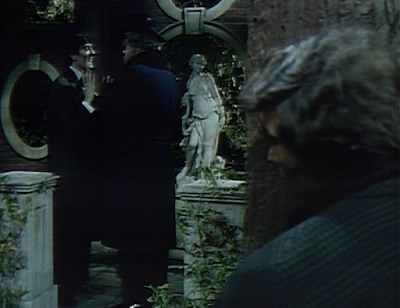
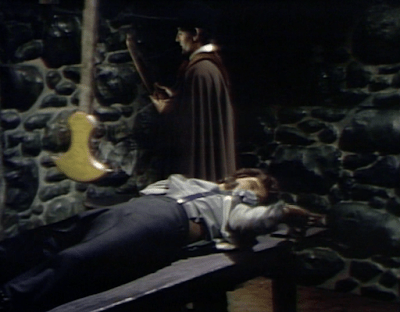
Episode 804: He is a gem, isn’t he

The evil Count Petofi, a 150 year old sorcerer, has taken possession of twelve year old Jamison Collins and is wreaking havoc in the great house of Collinwood. Due to Petofi’s spells, Jamison’s father Edward thinks he is a valet recently separated from the service of the Earl of Hampshire. Edward’s brother Quentin tries to explain to him what is actually going on, but Edward merely concludes that he is Quentin’s valet now. When Quentin follows the Collinses’ long-established protocol for dealing with mentally ill family members and locks Edward in the tower room, Edward bangs on the door and protests that he won’t be able to do his job if he is locked up. “And I will do it!” he vows.

Charity Trask, disastrously uptight step-daughter of Quentin and Edward’s sister Judith, falls under Petofi’s influence and is possessed by the spirit of Cockney showgirl Pansy Faye. Pansy was on the show briefly in June. The childlike Carl Collins, brother to Judith, Edward, and Quentin, was engaged to marry Pansy before she was killed by vampire Dirk Wilkins. Pansy and Charity never met; when Carl asked Charity if she had seen Pansy, the scene was staged to make it seem absurd that the two women could exist in the same universe. Now, they exist in the same body.
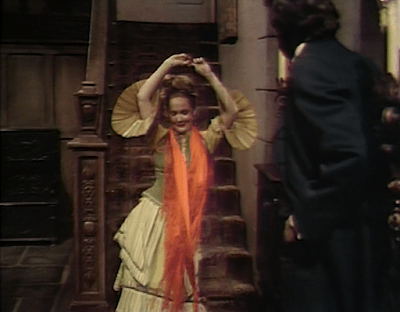
Ta Ra Boom De Ayyyy… Screenshot by Dark Shadows Before I Die.

If Petofi has caused startling changes in Jamison, Edward, and Charity, the change in Quentin is perhaps the most jarring of all. He has been a ghost, a homicidal maniac, a Satanist, a zombie, and a werewolf, but always and everywhere a source of total chaos, who destroys all recognized order and is perfectly at home in the midst of sheer madness. Today, Quentin keeps making earnest attempts to restore everyone to their right minds and reestablish the proper and respectable relations within the household.

First time viewers will immediately catch on that the preteen David Henesy is not the actor who would usually play a 150 year old Hungarian nobleman, and when Nancy Barrett suddenly takes on an East London accent and enters wearing a garish costume and doing a dance with lot of hip shaking and pelvic thrusts, they will know that Charity is turning into someone else. The dialogue in the scenes involving Edward explains what is happening to him. They may not know that Quentin is not supposed to be the defender of the status quo. That information is supplied in two scenes. Charity/ Pansy receives a psychic message from the world beyond telling her that Quentin was involved in the murder of Carl, and she announces this information. Also, Quentin calls for help, and the helper who materializes is his distant cousin, Barnabas Collins the vampire.

At the end of the episode, Barnabas lays hold of Jamison/ Petofi and drags him into the secret passage leading from the drawing room to the west wing. It is usually bad news when a vampire abducts a child and shoves him into a dark space, but David Henesy brings such joy to the role of Jamison/ Petofi that we can hardly doubt that what comes next will be equally fun to watch.

Meanwhile, a painter named Charles Delaware Tate has presented himself. Tate’s first appearance will cause a sinking sensation in longtime viewers; he is played by Roger Davis, a terrible actor who delivers much of his dialogue by shouting while clenching the sphincter muscles in his buttocks, and who routinely assaults the women and children in the cast while on camera. We may have hoped we had seen the last of Mr Davis when his most recent character, Dirk, was destroyed shortly after murdering Pansy. But evidently Pansy’s return in the form of another actress has come at the price of Mr Davis’ return in the guise of another character.

For much of 1968, Mr Davis played a man known variously as Peter Bradford and Jeff Clark. His approach to characterization consisted of shouting “My name is Jeff Clark!” When this technique was played out, he took to shouting “My name is Peter Bradford!” He doesn’t shout today, mercifully. But he does say the name “Charles Delaware Tate” quite a few times.

Today’s story about Tate is potentially interesting. Jamison/ Petofi finds him when he answers the front door. Tate asks to see Jamison Collins; Jamison/ Petofi confirms that despite his appearance, he is indeed the person Tate has come to see. Tate accepts this with a blandness that suggests that he knows he is dealing with a magical personage.

Jamison/ Petofi gives Tate a photograph of Quentin and says that he wants a portrait of him. When Quentin comes to the drawing room and finds Tate sketching, he asks who he is. Again, Quentin adopts a stern tone which suits someone defending the sanctity of private property against an unknown intruder. Tate introduces himself and shows him a handwritten letter which Quentin instantly accepts as the product of his grandmother Edith. He tells Tate that Edith has been dead for some time and that he is not interested in a portrait of himself. Tate says that he has already accepted the commission and the money that Edith sent with it, and so he will rent lodgings in the village of Collinsport and finish the job regardless. Quentin does what viewers have hoped everyone who shared a scene with one of Mr Davis’ characters would do, and throws him out.

The forged letter is a fascinating touch for returning viewers. Petofi made himself welcome as a guest at Collinwood by showing Edward forged papers creating the impression that he shared Edward’s friendship with the Earl of Hampshire. That he has also created papers that Quentin immediately accepts as coming from Edith, who died long before Petofi had any reason to come to Collinwood, suggests that his powers of forgery are very extensive indeed.

Tate not only seems to know that Petofi has magical powers; he also shows an acquaintance with Petofi’s henchman Aristide.* When Tate mentions Aristide, he calls him “Aristeedy,” a sort of pet name with a diminutive suffix. This is probably just a blooper on the part of Mr Davis, but since Petofi is continually telling Aristide how lovely he is and how he is more attractive when he doesn’t speak, it does remind us of the gay subtext that runs through their scenes together. We might suspect that Petofi and Aristide’s sexuality is in one way or another one of the reasons they are connected to Tate.

The script opens all of these questions about Tate. Had he been played by an actor who was capable of depicting depth and highlighting ambiguity, it could have been a lot of fun to speculate about just what their answers might be. In #137, future movie star Frederic Forrest was a featured extra on the dance floor at The Blue Whale tavern; it’s easy to suppose he would have taken a speaking part. So when the show puts Mr Davis in front of us, I like to make the time a little more tolerable by imagining what Forrest might have brought to the role of Tate.

*His name is spelled “Aristede” in the closing credits, but it was “Aristide” in the original scripts.
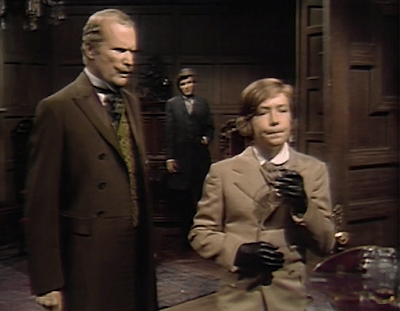
Episode 803: As soon as you’re finished with the mumbo-jumbo

The spirit of evil sorcerer Count Petofi has taken possession of twelve year old Jamison Collins, much to everyone’s consternation. David Henesy spends most of the episode mimicking Thayer David’s Petofi, with hilarious results.

Jamison/ Petofi sipping a glass of “mineral water… for the digestion.” Screenshot by Dark Shadows Before I Die.

We see Jamison’s favorite uncle, Quentin the Satanist, trying to cast a spell to break Petofi’s possession of Jamison. As he always does when he is calling on the dark powers of the unseen realms, Quentin gets very fervent. We pan to Jamison/ Petofi, standing next to Quentin in a state of utter boredom, asking if Quentin will bring him a glass of mineral water once he’s “finished with all the mumbo-jumbo.”

Twice, Jamison/ Petofi pretends he is not possessed, but is his usual preteen self. He does this in order to trick people into letting him kiss them, which is how Petofi’s power spreads to them. This gives Mr Henesy the challenge of showing how Thayer David would play Petofi playing Jamison. That’s the sort of thing an actor needs a director’s help to pull off. Unfortunately, the woeful Henry Kaplan was at the helm today, so we discover that Petofi’s imitation of Jamison sounds exactly like the original, who is in turn uncannily like Jamison’s grandson David Collins and his great-great-grandfather Daniel Collins, who are also played by Mr Henesy.

Those whom Jamison/ Petofi kisses reveal their “true selves.” So maidservant Beth reveals that she was under the power of Jamison’s distant cousin, vampire Barnabas Collins. When Jamison’s father Edward passes this word along to Quentin, Quentin tells him is going to confront Barnabas. Edward has been hunting Barnabas, and by saying this Quentin implies that he knows where Barnabas is and that he has been helping to hide him. For some reason, Edward only smiles in response to this revelation.

Petofi wears a prosthesis in place of his right hand; Edward finds that Jamison’s right hand has also been replaced with a prosthesis. After this horrifying discovery, Jamison/ Petofi kisses Edward. Quentin returns shortly after, and finds that Edward does not recognize him or know the name of the house. Edward identifies himself as a newcomer to the area, and says that he would be glad of any work the family might hire him to do. Evidently his “true self” is a guy who needs a job. Since he has not inherited any assets or accumulated enough to live on, I don’t suppose we can disagree with whatever force it was that declared this to be Edward’s reality.

Episode 801/802: Ignore the truth whenever you can

In the Old House on the estate of Collinwood, broad ethnic stereotype Magda Rákóczi accuses a man who calls himself Victor Fenn Gibbon of being Count Petofi, a sorcerer who, a hundred years before, was cured of lycanthropy at the price of his right hand and most of his magical powers. Fenn Gibbon denies the charge, and fills the awkward silence with a story that Petofi’s saddest morning came when he awoke to find that his pet unicorn was dead, killed by the wolf. Also in the room is the desperately handsome Quentin Collins, who is himself a werewolf. Quentin says that after they return to human form, werewolves do not remember what they did the night before. Since Fenn Gibbon’s story reveals his knowledge of that fact, Quentin takes it as confirmation that he is indeed Petofi.

Petofi’s severed hand is still in existence, and still carries with it great power. Magda stole the hand from Romani tribal leader/ New England crime boss King Johnny Romana several weeks ago in hopes that she could use it to lift the werewolf curse from Quentin. Since then it has been stolen by one person after another, none of whom has much benefited from it. Now schoolteacher-turned-adventurer Tim Shaw has taken the hand and skipped town. Petofi threatens to use his remaining powers to harm Quentin and Magda unless they find the hand and return it to him by morning; they have to admit they have no idea where it is.

At the end of the episode, we are in the great house on the estate. Petofi makes a series of ominous remarks to Magda and Quentin as he takes his suitcase and goes out the front door. Quentin’s twelve year old nephew Jamison appears at the top of the staircase. He is speaking in a raspy voice, continually suppressing a chuckle at his own witty remarks, and squinting by tightening his eyelids in the middle. He addresses Quentin as “Mr Collins,” says he is not in the habit of being interrupted, and walks downstairs with a slow gait, raising himself slightly from the hips as he comes to each step. We recognize an imitation of Petofi, and Magda declares that the boy is possessed.

David Henesy as Count Petofi. Screenshot by Dark Shadows Before I Die.

Regular viewers will be intrigued to see Jamison as a medium for Petofi. Jamison is played by David Henesy, who in the parts of Dark Shadows set in the 1960s plays strange and troubled boy David Collins. In #186, David Collins participated in a séance during which he channeled the spirit of David Radcliffe, a boy who was burned alive by his mother in March 1867, exactly one hundred years before. In December 1968, David Collins was intermittently possessed by the ghosts of Quentin and Jamison, and when Quentin was temporarily dead and his body was a zombie in April 1969 Quentin possessed Jamison. So by this time Mr Henesy has substantial experience playing a boy who is being used as the vehicle for another spirit.

Mr Henesy is also deeply familiar with the style and manner of Thayer David, who plays Petofi. Thayer David’s first role on the show was crazed handyman Matthew Morgan, who had many scenes with David Collins, and his second was much-put-upon indentured servant Ben Stokes, who when the show was set in the 1790s shared screen time with Mr Henesy’s character Daniel Collins. Thayer David’s third role, Ben’s descendant and occult expert Timothy Eliot Stokes, crosses paths with David Collins only occasionally, but he was on so much that all Mr Henesy would have to do to keep up his status as an expert on Thayer David would be to watch the show on his days off. So it is exciting to see what Mr Henesy’s interpretation of Thayer David’s Petofi will be.

David Collins is always on the minds of longtime fans when Mr Henesy appears, and is especially so today. Magda has a crystal ball into which she occasionally peers; she gets melodramatically frustrated with it shortly before we cut to Jamison and Petofi today. This ball originally belonged to David Collins. He received it as a gift from dashing action hero Burke Devlin in #48, and thereafter used it several times to get information to advance the plot and to establish himself as a link between the visible action of the show and the supernatural forces which at that point lurked in an unseen back-world. Magda’s failed attempt at scrying today may seem like a throwaway to relatively recent fans, but when those who have been with the show from the beginning see the ball and then see Jamison so shortly afterward, they will know that something spooky is coming.

Thayer David might never have been cast on Dark Shadows if he had acted under the name he was given at birth. He was originally called David Thayer Hersey. It’s hard to imagine a producer adding David Thayer Hersey to the cast of a show that had already for eight weeks featured David Thomas Henesy.

In place of episode 801: Periodization again

No episode of Dark Shadows premiered 56 years ago this afternoon; the show was preempted by ABC-TV’s coverage of the Apollo 11 mission. That mission included the first steps taken by humans on the surface of the Moon, at a site 25 kilometers south of a crater then known as Sabine D. The following year, Sabine D was renamed Collins. That was not an attempt to console Dark Shadows fans for the trauma of a Monday spent away from Barnabas and his relatives, but was an honor given to United States Air Force officer Michael Collins, Command Module pilot on Apollo 11. Moreover, the nearby crater named Moltke was not named for Alexandra Moltke Isles, who played well-meaning governess Vicki in 333 episodes of Dark Shadows, but for her distant cousin Count Helmuth von Moltke the Elder, who died in 1891 and never appeared on the show (as far as we can tell.)

Photo courtesy of Sky and Telescope.

These changes to the map of the Moon remind me that, on this 56th anniversary watch-through, I’ve been revising my mental map of the show’s development. I used to divide it into chunks with labels like “Meet Vicki,” “Meet Matthew,” “Meet Laura,” “Meet Barnabas,” “Meet Julia,” “Meet Angelique,” and so on. In that scheme, this 161st week is an early part of the chunk I would have called “Meet Petofi.” I still see that the show defaults to having a main character, but now I think in terms of larger units. I also tend to focus more on the writing staff than on the central characters. So the first 38 weeks drew their vitality from the story of Vicki’s attempt to befriend strange and troubled boy David, a story which reached its conclusion at the end of the Phoenix tale, when David chose Vicki and life over his mother and death. That was Dark Shadows version 1.0, and I subdivide it less into the parts driven by Vicki, Matthew, and Laura than into the parts written by Art Wallace alone, by Wallace in alternation with Francis Swann, and by Ron Sproat and Malcolm Marmorstein with uncredited contributions by Joe Caldwell.

Dark Shadows 2.0 ran from March to November 1967, and its most interesting theme was vampire Barnabas Collins’ attempt to pass himself off as a living man native to the twentieth century. The first part of this, written by Sproat and Marmorstein, was even more slow-paced than were the first 38 weeks. Caldwell was credited with a number of scripts from May through October, Gordon Russell joined the staff in July, Marmorstein was fired in August, and Sam Hall replaced Caldwell in November. With each of those changes, the pace picked up and the overall quality of the scripts improved noticeably. There was also a shift in story in the middle of this period, as mad scientist Julia Hoffman teamed up with Barnabas in an attempt to physically transform him into a human, shifting his masquerade from an acting job to a medical problem.

Dark Shadows 3.0 ran from November 1967 to March 1968. This was a costume drama set in the 1790s, an era to which Vicki had traveled when she came unstuck in time while participating in a séance. It seemed at first that it would invert the 1967 story, with Vicki trying to pass herself off as a native in the time to which Barnabas actually belonged, but for some reason they chose to write Vicki as a screaming ninny during this segment. Mrs Isles made a valiant effort to overcome the painfully dumb lines she was given, but by the end of it, the character was no longer sustainable.

Barnabas was a human through the first half of Dark Shadows 3.0, and a vampire for the second half. That alternation answered three questions, each of which opened a door for further development.

First, the audience wanted to see how Barnabas became a bloodsucking ghoul. When they showed this happening in the course of his relationship with wicked witch Angelique, they laid the groundwork for more stories involving her.

Second, the audience wanted to see what Barnabas was like in his lifetime. When they showed this, they proved that he didn’t have to be a vampire to be interesting, and made it possible for Julia’s experiment or some other effort to free him of the effects of the curse to succeed.

Third, the audience wanted to see what Barnabas would be like if he were as deadly as one might expect a vampire to be. In the whole of 1967, Barnabas killed only two characters, each of them a middle aged man who had run out of story and seemed likely to disappear anyway. But he kills seven people in 1795-1796, not counting people who died of fright or confusion or despair as a result of seeing him.

When it was set in contemporary times, Dark Shadows was careful to keep its characters alive. They need to fill 22 minutes a day with conversations, and if they end up with Barnabas alone on the estate of Collinwood those will get to be rather one-sided. But since they were not committed to staying in the 1790s, they could let him slaughter people with abandon. That created a fast pace that the show tried to maintain for the rest of its time on the air. In consequence of that pace, by the end of the 1790s segment the show had left behind its origins as a Gothic romance appealing to an older demographic who were impressed that Joan Bennett was in the cast and had become a kids’ show.

Vicki returned to 1968 in #461, but Dark Shadows 3.0 did not end at that moment. Vicki came back to exactly the same collection of narrative dead-ends the show had gone to the eighteenth century to escape. It wasn’t until #466 that Barnabas found that he had been cured of vampirism- not by Julia, but by another mad scientist. That set the tone for Dark Shadows 4.0. Version 2.0 may have been content with one mad scientist, but 4.0 needed at least two, in addition to multiple witches, Frankensteins, vampires, ghosts, an invisible man, and, if not the Devil himself, at least one of the assistant managers of his upper New England operations. The fast pace of the 1790s segment turned into a frantic dash through this Monster Mash era.

In the course of Dark Shadows 4.0, there were four personnel changes that had especially profound effects. Two were in the cast. At the end of the segment, Mrs Isles left the role of Vicki, never to return to the show. Though Vicki had been pushed to the margins long before, she was so strongly associated with the first phase of Dark Shadows that every time she appeared on screen she made a connection with those early days. With her departure, that link is broken.

Thayer David, who had played crazed handyman Matthew Morgan in 1966 and much-put-upon indentured servant Ben Stokes in the 1790s segment, returned in 1968 as Ben’s descendant, occult expert Timothy Eliot Stokes. Ben was a commentary on Matthew, an example of what he might have been had he not grown up in a community under the somber mark of the Collinses and the many curses they bear. As such, David was like the rest of the cast for the 1790s, playing a character who shed light on the part he took in contemporary dress. But as Stokes, he is playing a man who has no direct connection to Matthew, and little connection to Ben. With that doubling, we see that any performer might return to the cast in a new role at any point in the story.

The other personnel changes during Dark Shadows 4.0 took place behind the camera. Ron Sproat ended his duties as a regular member of the writing staff late in that period, and left the show altogether shortly after. Sproat was the most devoted to conventional soapcraft of all the writers, and was the only one who consistently took care to keep the show comprehensible to first-time viewers. But he didn’t have an especially fertile imagination for story points or for clever dialogue. As Hall and Russell hit their stride and really started cooking, Sproat’s relative weakness became impossible to ignore. The show entered its most exciting phase when Sproat left, but his absence would later be felt at times when the staff tried to keep the story moving at a breakneck pace even when they were too fatigued to make sure it all made some kind of sense.

The least remarked of all the personnel changes was the departure of director John Sedwick. Sedwick was an outstanding visual artist, the equal of his colleague Lela Swift. Swift stayed with the show to the end, eventually combining the role of producer with responsibility for directing half the episodes. But after several men helmed a few episodes each, they settled on the lamentable Henry Kaplan as her alternate in the director’s chair. Kaplan was a famously poor director of actors, and the visual compositions he knew how to orchestrate ran the gamut from closeup to extreme closeup to even more extreme closeup. Dark Shadows was never all that easy for first-time viewers to take seriously, and when you tune in to one of Kaplan’s efforts you’re likely to dismiss it before you hear a word of dialogue.

As Dark Shadows 3.0 didn’t end until the show had already been back in 1968 for a week, so version 4.0 ended well before it began its next time travel story. In #627, we meet werewolf Chris Jennings and hear about Chris’ little sister, who will eventually be named Amy. Amy befriends David, and together they become the central figures in the Haunting of Collinwood by the ghost of Quentin Collins. This leads Barnabas to travel back in time to 1897 in #701. Barnabas and the show will stay in that year until #884. This whole arc, from #627 airing in November 1968 to #884 airing in November 1969, makes up Dark Shadows 5.0.

The major subdivisions of version 5.0 are the “Meet Amy” section that runs from #627 to #700, the “Meet Quentin” section from #701 to #778, and the “Meet Petofi” section from #778 to #884. The transitions among these segments showed that the shift from one time frame to another is not essential for making a chapter break in the show. The reset from the focus on Quentin to the focus on Petofi rolls across a few weeks, and does not have the single spectacular moment when we first find ourselves in 1897, but it is just as definite a break. It even involves doubling Thayer David, who played broad ethnic stereotype Sandor Rákóczi in 5.0.1 (the “Meet Quentin” section,) and who plays sorcerer Count Petofi in 5.0.2 (the “Meet Petofi” section.) As Ben was an alternative version of Matthew, so Petofi is an answer to the question “What would Stokes be like if he were evil?” As such, he brings version 5.0.2 in line with version 3.0, in which characters in one time frame mirror those in another.

That we can make a major transition without returning to the 1960s raises the question of whether we need to go back there at all. Barnabas is on a mission to save David and Amy and Chris, but he could always find a fresh threat to them in the 1890s. And the characters we have met in that period are at least as compelling as are those we left behind in the contemporary time frame. Despite the deficiencies of Henry Kaplan, the writing staff of Hall, Russell, and the brilliantly witty Violet Welles combine with an almost unanimously strong cast to make the dialogue glitter. It is the strongest period of the show by far, and it is difficult to imagine wanting it to end.

We will go back to a contemporary setting, eventually. The H. P. Lovecraft-inspired monster cult known as the “Leviathans” will be the center of version 6.0; in that segment, the show will start on the most adult tone it ever adopts, and end pitched squarely at a very young demographic. The change may well have come because the three-person writing staff burned out, and became a grave matter when Welles left the show.

Version 7.0 is another time travel story, but a story of traveling sideways in time, to an alternative universe where the characters wear clothing appropriate to 1970 but have different personalities and different relationships than do the people with the same names and faces whom we have met previously.

Version 8.0 is the most ambitious of all the segments, starting with a trip in time to the far-off future year 1995, returning to 1970 for a reprise of the Haunting of Collinwood, this time by a ghost who resembles Quentin in hairstyle and wardrobe but not in height, and proceeding to a long stay in the year 1840. That version had enough characters and enough story to last indefinitely, but Hall and Russell were the only full-time writers, and they simply could not keep it up. It finally collapsed, and the last nine weeks were set in another alternate universe, with no characters in common with the stories we had seen up to that point.

Version 9.0 had a drab feeling; some say it isn’t Dark Shadows at all, but another series shot on the same sets with some of the same actors. The name Dim Reflections has been proposed for it. There is one week in the middle of Dim Reflections when Violet Welles comes back to make some uncredited contributions to the scripts; you can tell it’s her, because all of a sudden the characters have senses of humor. But after that Gordon Russell is all alone at his typewriter until Sam Hall returns for the very last day, and by that time everyone knows it is time to go.

Episode 800: Nothing further to lose

When broad ethnic stereotype Magda Rákóczi learned that her sister Jenny had been murdered, she placed a curse on the murderer, Jenny’s husband Quentin Collins. The curse makes Quentin and his male descendants werewolves. In #763, Magda learned that Jenny had given birth to Quentin’s twin children, and ever since she has been trying desperately to lift the curse. It was only this week Quentin found out about the children, after another witch’s curse had already claimed the life of the boy twin. Now he and Magda are debating what risks they should take in their further efforts to save Quentin and any descendants his infant daughter may have.

In #778, Magda returned to her home in the Old House on the estate of Collinwood. She had gone to Boston because she had heard that a Rroma group was in the area and that an old woman who knew how to cure werewolves might be among them. The woman wasn’t there, so Magda did the next best thing. She infiltrated the private quarters of a tribal leader/ organized crime boss known as King Johnny Romana and stole his prized possession. This is a severed hand in a wooden box. It is known as “The Hand of Count Petofi,” after a Hungarian nobleman from whom it was detached over hundred years before, and it has magic powers.

Neither Magda nor anyone she knows has the slightest idea how to control the hand. It has not cured Quentin, briefly disfigured him and his sometime friend Evan Hanley, led to the death of a young woman named Julianka, has been stolen by one person after another, and must soon bring an emissary of King Johnny tasked with Magda’s murder. Moreover, two mysterious and unsavory men known as Aristide and Victor Fenn Gibbon have come to town intent on stealing the hand; at Fenn Gibbon’s bidding, Aristide tortured Quentin and tried to kill him last week, and now he is trying to lure him into a deal.

Magda tells Quentin he is a fool to do business with Aristide and Fenn Gibbon, but Quentin says they have nothing to lose. Aristide implied that Fenn Gibbon can lift the curse; no one else can. They find Fenn Gibbon and Aristide ransacking the Old House. Magda recognizes a design on one of Fenn Gibbon’s buttons. Fenn Gibbon and Quentin struggle, and Fenn Gibbon loses a prosthetic right hand. We have known all along that he was not using his right name, and Magda tells us who he really is. He is Count Petofi himself, still alive more than a century after his mutilation, come to reclaim the hand and all its powers.

Quentin seizes, not the Hand of Count Petofi, but the Hand of Mr Fenn Gibbon. Screenshot by Dark Shadows Before I Die.

Magda and Quentin don’t actually have the hand or know where it is. It has been stolen yet again. This time it is in the possession of Tim Shaw, schoolteacher turned junior executive for the Collins family enterprises. Tim took the hand from the Old House when Magda was out. He takes it to Evan today. Evan is terrified of the hand. Tim threatens him with it. Evan tells Tim what he knows about the hand, and also confesses that he and the evil Gregory Trask brainwashed Tim some time ago and used him to murder Trask’s wife Minerva.

When Evan and Trask decided to use Tim for their evil scheme, he was an innocent. The audience may have known that Tim had the same last name as Raymond Shaw, the main character in The Manchurian Candidate, but nothing else about him suggested he was likely to be of use to sinister figures like Evan and Trask. With his theft of the hand and his interrogation of Evan, we see that Tim has lost his innocence. The stuffy and repressed pedagogue whom we first met was a better fit for Don Briscoe’s heavily interiorized acting style than were the parts he played when the show was set in 1968 and 1969, accursed brothers Tom and Chris Jennings. Briscoe often seemed to be at sea as a vampire or a werewolf, but when he has to show a tortured soul peeking out from inside a three-piece suit he does an expert job. Now that Tim is capable of driving the story, we have a chance to see what Briscoe can do with a starring role crafted for his particular strengths as an actor.

Episode 799: Who understands the Moon

Broad ethnic stereotype Magda Rákóczi is in her home, the Old House on the estate of Collinwood. She takes a hatchet and chops a plastic model of a severed hand into two plastic models, each representing half of a severed hand. She then throws a handkerchief into the fireplace, all the while declaring that no further trouble will come from the hand. Later, she goes to the great house on the estate and tells handsome libertine Quentin Collins about this; to her surprise, he responds by flying into a rage and choking her.

Quentin’s rage abates when a huge image of the hand materializes in the room and floats towards Magda’s rear end. After she goes home, it materializes again and again drifts towards the same destination. With that, she runs outside.

Meanwhile, some activity is going on at The Blue Whale tavern. One man asks another for information about Quentin. The inquirer is named Aristide; the other, Tim Shaw. Tim identifies himself as an employee of the Collins family. Tim tells Aristide that all he knows about Quentin is that he is an arrogant jerk and that the only reason his family lets him live in their mansion is that their grandmother’s will requires them to. Aristide says that he already knew those things, and he asks Tim to carry a message to Quentin.

Tim is in the foyer of the great house while Magda and Quentin are in the drawing room. He eavesdrops on their conversation about the hand. He overhears them saying that the hand is magical, that properly used its powers are limitless, and that it is in a box at Magda’s. After the hand’s second attempt to grope Magda’s buttocks drives her from her house, Tim sneaks in, finds the hand, and tells it that it is just what he needs.

The message Tim brought from Aristide invited Quentin to meet at The Blue Whale. Quentin goes and brings up something that happened a few days ago, when Aristide tied him to a table and tried to kill him. Aristide agrees that this was not a good plan. Aristide says that Quentin can be “cured”; returning viewers know that Quentin is a werewolf, and that it is for this condition that he wants a cure. Aristide admits that he does not know what the cure is; Quentin says that if he had claimed he did know, he would have killed him. But he says that someone else does know. Quentin learned yesterday that Aristide is in the service of a man whom he knows as Victor Fenn Gibbon; evidently Aristide was not aware Quentin had picked up on that, because he is alarmed when Quentin drops Fenn Gibbon’s name. Nonetheless, Quentin does agree to meet Aristide again, and to give him proof that he has the magical hand. Once he has been cured, Quentin will surrender the hand to him.

Before Magda entered the drawing room at the great house, Quentin had been talking with Miss Charity Trask, his sister’s new stepdaughter. Returning viewers know that Charity’s father, the evil Gregory Trask, has decided she ought to marry Quentin. This scene is the first time we see Charity trying to follow this plan. She mentions that Quentin is a widower. It has not been clear to us whether this is generally known. His wife Jenny was hidden away the year before, after he left her, and she was buried very quickly after he murdered her in #748. For all we know, Charity may not know that Jenny is dead, or even that she ever existed. Quentin’s siblings have been holding information about Jenny very tightly; it was just yesterday that Quentin learned Jenny bore twins while he was away. At the same time, he learned that one of those twins has died. He tells Charity that he is a father, and she is confused.

I don’t suppose any of this sounds very exciting, but it is a remarkably fast half-hour. The script is crisp and rapid; even viewers who haven’t missed an episode and know all the background will appreciate the air of mystery that arises from leaving so much unsaid and unexplained. And the actors are uniformly excellent. I can imagine a first-time viewer seeing this one and making a note to watch again tomorrow.

Episode 798: A gift from the unicorn

In the first few decades of commercial television, ambitious shows tended to imitate live theater; since, they’ve tended to imitate feature films. Today’s episode is one of Dark Shadows’ stagiest, and it is a strong one.

The rakish Quentin Collins has lost his hopes of being cured of werewolf-ism, and is moping in the gazebo on the grounds of the estate of Collinwood. He is staring at a revolver, trying to talk himself into committing suicide. He hears two men approaching, and takes cover in some nearby bushes. The men are known to Quentin by the names “Aristide” and “Victor Fenn Gibbon.”* The set is so small that the actors are only a few feet away from each other, but we are supposed to believe that Quentin can’t quite hear what Aristide and Fenn Gibbon are saying. So when the camera is placed at Quentin’s point of view, Michael Stroka and Thayer David vigorously mime the act of talking.

Quentin listens in from a great distance. Screenshot by Dark Shadows Before I Die.

Quentin sees Fenn Gibbon slap Aristide’s face. Aristide responds, not with violence of his own, but with a continuation of the talking he had been doing before, showing Quentin that Fenn Gibbon is Aristide’s boss. The other day, Aristide tied Quentin to a table and tried to kill him by reenacting Poe’s “Pit and the Pendulum,” so this tells Quentin that Fenn Gibbon is his deadly enemy.

We hear some of Aristide and Fenn Gibbon’s dialogue. Fenn Gibbon and Aristide are based on Gutman and Wilmer from The Maltese Falcon. In their previous appearances, Aristide has been eager to connect with every attractive young woman he sees, suggesting that we would not see the strong suggestions of a sexual relationship that come with Gutman and Wilmer both in Dashiell Hammett’s 1930 novel and the 1941 film. But today, Aristide’s unshocked reaction to Fenn Gibbon’s slap shows that he is accustomed to robust forms of physical contact with him, and when Fenn Gibbon tells Aristide that “I’m aware of your charms, my dear Aristide, but I know only too well conversation is not among them,” we can see that there is going to be a substantial gay subtext.

Fenn Gibbon is one of two roles Thayer David plays today. He appears in the opening teaser as broad ethnic stereotype Sandor Rákóczi, husband of the even more offensively conceived Magda. Yesterday, Magda was placed under a curse. At that time, the curse was that everyone who loved Magda would die, but today it is that everyone she loves will die. When Magda talks about the curse with visiting vampire Barnabas Collins, he says that he is under the same curse, which is exactly true- in #705, he was told that everyone who loved him would die, and from the next episode on it was said that everyone he loved would die. Whichever way the curse is put, one would expect it to strike terror in Magda’s heart regarding Sandor. They are a happily married couple, the only one we ever see on Dark Shadows, and so one would expect him to be the first victim of the curse.

The curse was supposed to start when Magda heard three knocks on the front door of her home, the Old House at Collinwood. She hears the knocks, opens the door, and sees Sandor. She immediately falls into the same pattern she exhibits every time she sees Sandor, accusing him of infidelity, accusing him of coming back to her only because he has run out of money, telling him not to bother to lie to her, and generally having a wonderful time. But he is standing rigidly still, his eyes are glazed over, and he can speak only a few words, none of them the usual insults they exchange. He falls dead, a knife in his back. Barnabas touches his body, and says that it is cold, as if he had been dead a long time.

Later, Magda goes to Mrs Fillmore, a woman in the village of Collinsport. Quentin’s late wife Jenny was Magda’s sister. Unknown to Quentin, Jenny gave birth to twins after he left her, and his brother Edward decreed that the twins would be raised by Mrs Fillmore. Magda has never seen the twins, but she loves them nevertheless- the boy twin, anyway; she tells Barnabas that “Gypsies do not prize girls.” When she comes back to the Old House, Magda tells Barnabas and Quentin that the boy twin is dead. Mrs Fillmore said he was perfectly healthy that evening, then she heard a mysterious scream from the children’s bedroom and she found him dead in his crib. His body was cold, as if he had been dead a long time. Quentin is numb, bewildered to learn that he was a father and simultaneously to learn that he has outlived his son.

There have been other episodes in which an actor played one character as a living being and another as a ghost. There have also been episodes that jumped between two periods in history, and in those there were actors who played one character in one time frame and a different one in the other. Thayer David’s doubling as Sandor and as Fenn Gibbon makes this the first episode in which the same actor plays two living beings contemporary with each other in the same episode.

Sandor’s death and Fenn Gibbon’s ascent to prominence mark a transition in the show. They are in the middle of a bloodbath, killing off a great many of the characters who have defined the first twenty weeks of the 1897 flashback. Previously, that has meant they were getting ready to reset the show and go back to contemporary dress. But 1897 has been such a hit that a transition need not mean a return to the 1960s. There is still enough going on in this period that they can introduce a bunch of new characters, develop some new stories, and get a new phase of Dark Shadows started right here in the late Victorian era. Who knows- if they play their cards right, this period might be the new home base for the show, and the 1960s might be an afterthought.

The contemporary world does make one appearance today. Before their encounter at the gazebo, Fenn Gibbon meets Quentin in the drawing room of the great house at Collinwood. Quentin is studying the Moon. The two of them have a little exchange about Quentin’s fascination with the Moon; considering that this episode aired a few hours after Apollo 11 lifted off on the journey that would put the first crew on the Moon, that fascination must have been pretty widely shared by the original audience.

*In this episode, everyone says “Fenn Gibbons,” which we have heard before. But the credits read “Fenn Gibbon,” so I’m sticking with that version.

Episode 797: I do not like death at all

Vampire Barnabas Collins, werewolf Quentin Collins, and broad ethnic stereotype Magda Rákóczi hold a séance to contact the spirit of Rroma maiden Julianka. This is the thirteenth séance we have seen on Dark Shadows. It deviates from the previous ones in three important ways. First, no one objects in the middle of it and has to be sternly hushed by the séance-leader. Second, it doesn’t matter that the physical contact among the participants is broken- previously it had been a fatal error if anyone stopped touching the fingers of the people on either side of them, but this time Quentin jumps up and runs out and it’s no problem. Third, Julianka does not choose one of the participants as a medium and speak through them, but manifests as a ghost.

Julianka appears. Screenshot by Dark Shadows Before I Die.

Perhaps because they are rewriting the rules of the Dark Shadows séance, they make a reference to an earlier milestone in the show’s development. The séance is held in the parlor of the Old House on the estate of Collinwood. That isn’t unusual; séances have been held there on three previous occasions, including the second and in some ways most dramatic one, held in #186. What makes the location noteworthy is Julianka’s movement when she first appears. She comes in as a green screen effect hovering somewhat above floor level, then takes several steps down an unseen staircase.

We have seen that same movement on this same set. It was in #70, when the ghost of the gracious Josette was the first supernatural being to become visible to viewers of Dark Shadows. Aside from the reuse of that footage, we have not seen a ghost move that way since. Compared with the changes that began when Josette walked down from her portrait in #70 and brought the supernatural back-world that had been implicit in the show from its first week into the foreground, these changes to the rules for séances are small potatoes.

Barnabas and Magda hoped to persuade Julianka to give them some information they needed to lift the curse from Quentin and cure his lycanthropy, but she isn’t interested. She blames them for her death, and will not even let them ask questions, let alone answer them. They try to protest that they weren’t the ones who killed her, but she ignores them. So far from helping them end Quentin’s curse, she places a new curse, this one on Magda. She decrees that everyone who loves Magda will die. That was the same curse wicked witch Angelique pronounced on Barnabas in #405 when she made him a vampire. Longtime viewers will be unsure how Julianka’s curse will operate- Magda doesn’t seem likely to become a vampire, but perhaps they are suggesting she will turn into a monster of some other kind.

Unfortunately, Julianka’s appearance today is the last time we will see Diana Davila. In her approach to the role, Miss Davila concentrated very much on her eyes. She kept them open wider than I would have imagined a person could open her eyes, did not blink, and when she looked from side to side she did not turn her eyes in their sockets, but instead turned her head. This dictated a rigidity of movement for the rest of her body and a narrow range of inflection for her voice. Taken as a unit, these mannerisms made for a perfectly logical way of expressing Julianka as a strange, unreachable person, an emissary not only of the tribe of King Johnny Romana, but of another world altogether. In practice, this style had a drawback given the conditions under which actors had to work on Dark Shadows. In the three episodes where Julianka was a living being, Miss Davila did not have quite enough time to learn her lines. She did better than did most cast members, but the particular illusion she was trying to create could be shattered by the slightest bobble. This time, though, she is letter-perfect, and as a result the scene with Julianka’s ghost is one of the most effective in the series.

Episode 796: Don’t sound human

Quentin Collins is strapped to a table under a descending pendulum which supposedly has a razor sharp blade. His captor, a strange man named Aristede, tells wicked witch Angelique that Quentin will die in minutes unless she gives him the severed hand of Count Petofi, which has magical properties. Aristede is under the impression that Quentin and Angelique are engaged, and he has set the blade to strike Quentin’s body at a point causing the maximum wedding night-related inconvenience.

A little off the top I can understand, but this is ridiculous! Screenshot by Dark Shadows Before I Die.

Meanwhile, Quentin’s distant cousin Barnabas Collins has the hand and is hoping it will cure Quentin of a curse under which he is laboring. Rroma maiden Julianka claims that she knows how to use the hand to relieve lycanthropy. Her great-grandmother cured Count Petofi himself of that condition, and took the hand from him as payment for doing so. She is the only living person who knows the procedure, and no one else will know it until her daughter is born.

Barnabas and Angelique have a scene which ends with a decision to go to Aristede together. Barnabas tries to use his vampire powers to hypnotize Aristede; if he had been thinking logically, he could just have taken his bat form and flown around the meeting place, since Quentin can’t be very far from it if Aristede is going to be able to take the hand and stop the pendulum in the few minutes remaining. Instead, he lets Aristede lead him far in the wrong direction. When it seems to be too late, Aristede taunts Barnabas by telling him where to find Quentin’s body. To his consternation, Barnabas then vanishes and the squeaking of a bat rings out. Barnabas rescues Quentin at the last possible second, of course.

In #767, Quentin’s nephew Jamison dreamed that Quentin told him three things would happen that would spell his doom. The first was the discovery of a silver bullet on the great estate of Collinwood. That happened in that very episode. The last would be when the one person Quentin truly loved turned against him. We know that Jamison is the only person Quentin loves, so we know what to look for there. But the second has been a mystery up until now. Quentin said that the only person who could help him would be murdered. It has not been clear until now that there is one and only one person who can relieve Quentin of his curse. Now that Julianka has been identified as that person, viewers who remember back that far will not be surprised that at the end of the episode she is lying in the woods, a mysterious mark on her forehead, unable to move.

Diana Davila plays Julianka with her eyes always wide open. She does not blink, and when she looks from side to side she turns her whole head. The rest of her body is rigid, too, and she maintains a heightened tone throughout. This is quite effective for Julianka as written; she is supposed to seem distant and unapproachable. Miss Davila bobbles over a few too many of her lines for the performance to reach its full potential, but you can see what she was going for, and it was terrific.

Episode 795: My little puppeteer

A MacGuffin day today, as everyone is busy trying to get hold of the magical Hand of Count Petofi. Broad ethnic stereotype Magda Rákóczi stole the Hand, which incidentally is a literal severed hand, from Romani chieftain/ organized crime boss King Johnny Romana. She hoped to use it to cure handsome rake Quentin Collins of the werewolf curse she placed on him, but found that she was unable to master its powers. Several people have stolen it from each other since then; at the beginning of the episode it is in the possession of wicked witch Angelique, who is also unable to figure out how to use it to solve Quentin’s problem.

Today, a man named Aristide is holding Quentin prisoner. He straps Quentin to a table under a descending pendulum with what we are supposed to imagine is a razor sharp blade. He goes to Angelique and tells her that Quentin will die in minutes unless she gives him the hand. Since Angelique can’t see Quentin and Aristide doesn’t even describe the predicament, it isn’t clear why Aristide went to all this trouble, but it does create a memorable image and a nice homage to the works of Edgar Allan Poe. It would also warm the hearts of viewers mourning the end of the Batman TV series.

Holy Toledo! Screenshot by Dark Shadows Before I Die.

Meanwhile, a small and pretty young woman named Julianka has told Quentin’s distant cousin Barnabas Collins that she can cure Quentin if she has the Hand. He gets it from Angelique and takes it back to his house, where Julianka is waiting. She pulls a knife on him and declares that she is an emissary of King Johnny. She will not cure Quentin, and will stab Barnabas if he does not surrender the Hand. Barnabas calmly offers her money and the Hand if she will cure Quentin before she goes, but she refuses. He gives her the Hand. After she goes, we hear his thoughts as he is feeling sorry for her.

In the woods, Julianka hears a squeaking bat. She reacts with horror as the bat turns into Barnabas in front of her. She asks what he is; he tells her that he believes she knows what he is. He does not bite her, but she does become docile. It seems that Barnabas is using the “Look into my eyes!” vampiric power that he only recently acquired. It also seems that, while Julianka was lying when she originally claimed she had come to Collinwood to cure Quentin, she was telling the truth when she said that she was able to do so.

The Hand recently disfigured Quentin’s face, as it had a few days before disfigured the face of Quentin’s onetime friend Evan Hanley. Evan’s good looks returned after a while, and we have not been told why. Today Quentin’s do as well, and when he asks Aristide for an explanation the best he can do is to suggest it may just be luck. They spent quite a bit of time showing Evan’s efforts to cure himself, and even more time showing Quentin feeling sorry for himself, so this is not at all a satisfactory payoff.

In an original cast panel at a Dark Shadows convention in the 80s or 90s, David Selby reminisced about today’s scene between Quentin and Aristede. He said that when the cameras started rolling, he knew what actions he and Michael Stroka were supposed to perform, that he was supposed to end up tied to the table, and that it was supposed to take a certain number of minutes and seconds. He also knew that there was some dialogue they were to speak in the midst of all that, but he couldn’t remember any of it. The teleprompter was out of view. He looked at Stroka, hoping to see something in his face to jog his memory, and what he actually saw was the same blankness he was himself experiencing. So the two of them improvised their way through it. When they were done, they looked at the clock and saw that they had filled exactly the allotted time. But not a word of what they said was in the script. The resulting scene includes some awkward lines, but it has a great energy to it, just the sort of thing that gets you hooked on live theater.