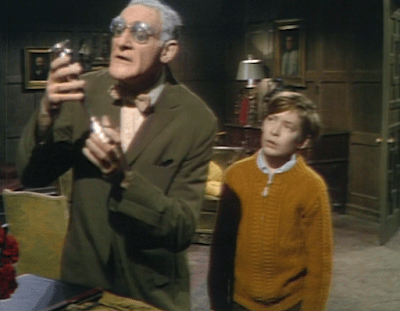
Episode 711: Our beautiful black-hearted child of the angels

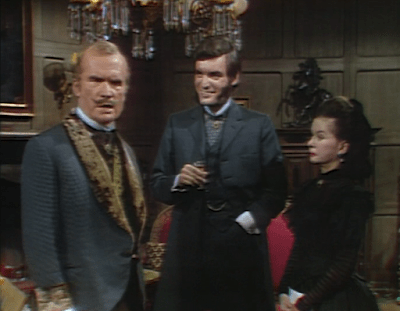
In the groundskeeper’s cottage on the estate of Collinwood, Satanists Evan Hanley and Quentin Collins call on the powers of Hell to send a demon to help them fight Quentin’s recently arrived and deeply mysterious distant cousin Barnabas. The call is answered by none other than our old friend Angelique the wicked witch.

Quentin and Evan have no idea who Angelique is, and she does not know them either. Evan introduces himself to her as a lawyer; he seems genuinely surprised that this does not impress her. Evan tells Angelique that he and Quentin summoned her from Hell and can send her back; she agrees that they summoned her, but is not so sure they can send her back. Quentin tells her that the year is 1897, that she is on an estate known as Collinwood, and that he and Evan have an enemy called Barnabas Collins. Angelique is intrigued by the year, familiar with the estate, and thrilled to hear about Barnabas. Evan starts making demands; Angelique causes him to choke and gasp. She is quite friendly to Quentin, and when Quentin suggests she let Evan breathe and speak again, she indulges him.

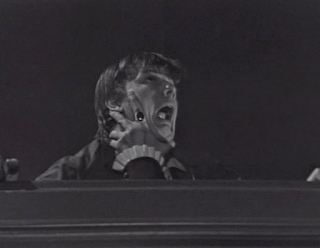
Angelique puts Evan in his place.

Evan is played by Humbert Allen Astredo, who in 1968 played suave warlock Nicholas Blair. He plays Evan with exactly the same bearing, tone of voice, and range of facial expressions he had brought to the role of Nicholas. Viewers who remember Nicholas have been bewildered by this. Barnabas knew Nicholas and fought him; when he met Evan the other day, his reaction left open the possibility that he recognized him as the same person. But Evan’s dabbling in the occult, as we saw it yesterday, shows only an infinitesimal fraction of Nicholas’ vast abilities in that field, and his buffoonish response when Angelique appears shows that he is no relation.

It is when Angelique strikes Evan dumb that we learn why Astredo played him in the same way he played Nicholas. Nicholas was introduced as Angelique’s boss, the master of magical powers much greater than hers. Since the main difficulty with fitting Angelique into a story was that she could easily accomplish any goal if she just kept her focus, adding a character who is even more powerful took the show to an absolute dead end. They had to box Nicholas up inside a lot of pointless business, and he quickly became a source of frustration to the audience. Seeing Astredo as another Nicholas reminds us of that frustration, and when Angelique brushes him aside with a flick of her finger our unease evaporates. We are assured that the plot will keep moving this time, and that Astredo will be free to show us what he can do as an actor.

At the end of Friday’s episode, it was Quentin who tried to stop the ceremony when Angelique’s visage began to take shape in the fire, fearing they had gone too far. Today Quentin realizes there is no turning back, but Evan keeps saying he wants to return Angelique whence she came. It’s hard to see what he expected- he was calling on the Devil to send a demon. I suppose he really is disappointed that Angelique is not excited to find herself in the company of a member of the bar.

Quentin goes home to the great house on the estate. He sneaks up behind governess Rachel Drummond while she is dozing on the sofa in the drawing room and puts his hand on her face. That wakes her. When she protests, he asks if he did it unpleasantly. She answers, “No… I mean, yes!… I don’t know.” That summarizes precisely the natural reaction to Quentin. His behavior is abominable in the extreme, but David Selby’s charisma and easy charm come through even in the character’s darkest moments, and the audience can no more want him to stay off-screen than the female characters can want him to leave them alone.

Quentin and Rachel sit together; his hands are on her face again when Barnabas shows up. Quentin gets up and twits Barnabas with his obvious closeness to Rachel, then excuses himself to go to bed.

Barnabas gives Rachel a music box that once belonged to the gracious Josette. This will induce further flashbacks in longtime viewers. Barnabas is a vampire, and as a living man in the 1790s he was in love with Josette. In May and June of 1967, Barnabas lived in contemporary times. He abducted Maggie Evans, who like Rachel in the portion of the show and like Josette in the portion set in the 1790s, is played by Kathryn Leigh Scott. He tried to erase Maggie’s personality, overwrite it with a copy of Josette’s, and to turn her into his vampire bride. The music box played a crucial part in this remake of the 1932 film The Mummy.

When Barnabas urges Rachel to listen to the music box, we pan to the window and see Angelique peeking in. As Angelique’s great power is the main difficulty with fitting her into a plot, so her single-mindedness is the main difficulty with making an audience enjoy watching her. This shot of her does as much to enlist the sympathies of longtime viewers as does the moment when she shuts Evan up. The whole time Barnabas and Rachel are involved with the music box, we are groaning. It was during the imprisonment of Maggie that Dark Shadows first became a hit, and it is a story that the show has been strongly identified with ever since. But we do not need to see it again. Angelique once married Barnabas and is maniacally possessive of him, and she does not want to see it either.

Angelique is as dismayed as we are, though for a different reason.

In the 1790s segment, which ran from November 1967 to March 1968, we saw that Angelique was motivated at least as much by her hatred of Josette as by her desire for Barnabas. After she has seen Barnabas getting up to his old tricks with Josette-lookalike Rachel, Angelique visits the portrait of Josette which hangs above the mantel in the parlor of the Old House on the estate. Longtime viewers know that Josette’s ghost inhabits the portrait. In #70, the portrait glowed, her ghost (also played by Miss Scott) emerged from it, then went outside and danced among the pillars. In #102, strange and troubled boy David Collins stood in front of the portrait and had a lively conversation with it. We could hear only his side, but it was clear the portrait was answering him. Today Angelique stands where David stood then. She scowls at the portrait and declares “I am Angelique, and I hate you!” She then goes back to the cottage where Evan and Quentin conjured her up and chokes a cloth doll, causing Rachel to collapse. She mouths words, and Rachel speaks them. Hearing Rachel talk about Josette’s death, Barnabas cries out in anguish.

This was the first episode credited to writer Violet Welles, who worked as a Broadway publicist before and after working on Dark Shadows. Ms Welles had been an uncredited collaborator with Gordon Russell on a great many of his projects, including several episodes of Dark Shadows prior to this one. She was by far the best writer of dialogue on the show. It is no wonder that the “Memorable Quotes” section of the Dark Shadows wiki entry for this episode includes whole scenes; the lines glitter with wit. Now that she is with Dark Shadows as a senior writer under her own name, the show enters its most successful period, both artistically and commercially.

Episode 710: The raven and the viper and all the dark creatures

Libertine Quentin Collins has stolen his late grandmother Edith’s will, intending to forge a substitute that will give him control of her vast estate. His distant cousin, the recently arrived and thoroughly mysterious Barnabas, has warned Quentin that Edith’s ghost will haunt him if he persists in this plan. Quentin hears a loud pounding emanating from the walls of the great house of Collinwood. He goes to the study, where Edith lies in her coffin. He sees her there, grinning at him. Quentin returns to his room; the still-grinning Edith sashays in and taunts him. He tells her she is dead; this does not seem to bother her. She just keeps on grinning.

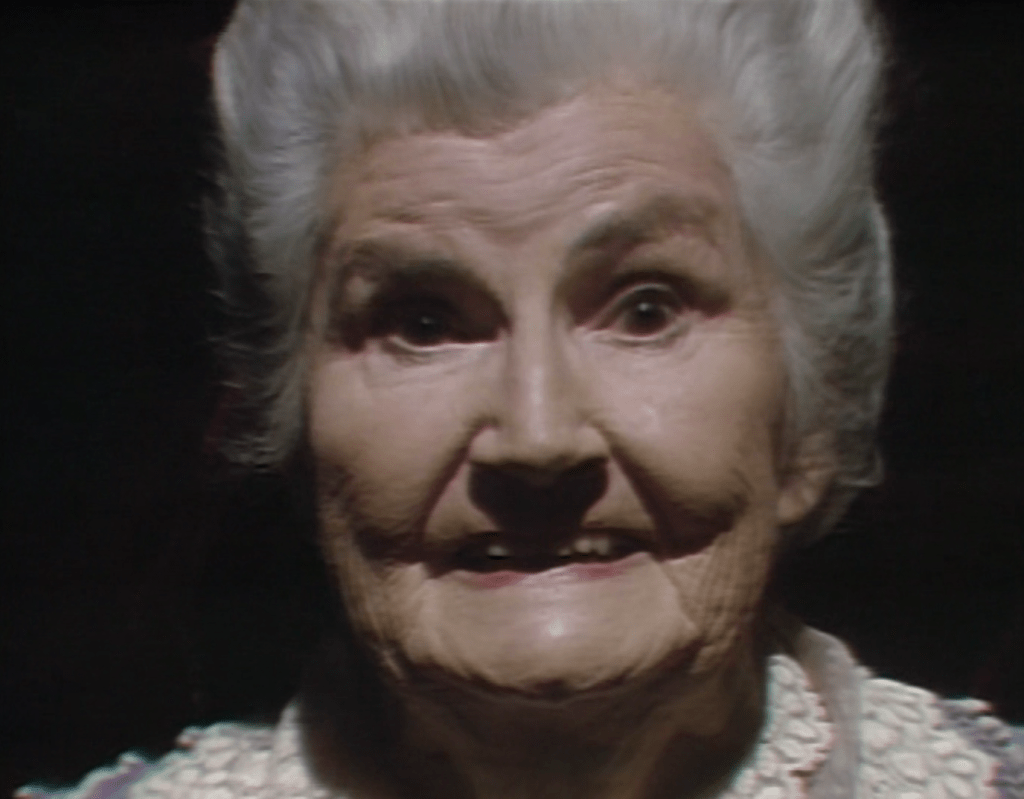
Edith may be dead, but she is clearly having a blast. Screenshot by Dark Shadows Every Day.

Quentin strangles Edith. She falls into an armchair in his room, unmoving but still grinning. He buries her somewhere on the grounds of the estate; her hand sticks up from the earth. He wakes up.

Quentin’s friend, unethical lawyer Evan Hanley, comes calling. Evan asks Quentin to give him the will so he can take it to a forger of his acquaintance. Quentin tells Evan about the dream, and how shaken he is. He also tells him about Barnabas, and his concern that Barnabas is a formidable enemy who may have uncanny powers. When Evan tries to dismiss Quentin’s worries, Quentin responds that he is the last person who should make light of the supernatural. When Quentin speaks of Evan’s “devil-callings,” we learn that the clandestine “meetings” they spoke of the other day are Satanist ceremonies. Evan agrees to meet Quentin at 8:00 that night in the groundskeeper’s cottage on the estate to summon one of the spiritual forces of darkness to fight Barnabas.

Returning viewers know that Quentin is right to fear Barnabas’ connections to the supernatural. Barnabas is a vampire, and his powers include the ability to send hallucinations to torment people with guilty consciences. He is also a time-traveler, who has come to 1897 from 1969 on a mission to prevent Quentin from becoming a ghost who will drive the Collins family of that year out of the great house and plague strange and troubled boy David Collins to the point of death.

First time viewers will not learn that today; aside from the opening voiceover, this episode tells us nothing about Barnabas. It does tell us something about Quentin and Evan. They are super-racist against Romani and Sinti people.

Evan has decided to hire Sandor Rákóczi to forge the will. Sandor and his wife Magda have been staying at the Old House on the estate for some time as Edith’s guests. Quentin’s brother Edward and sister Judith are offended by the presence of these “gypsies” in their midst. Unknown to Evan and Quentin, and unmentioned in today’s episode, Barnabas has bitten Sandor, enslaving him. Presumably Sandor has no secrets from Barnabas, making him a bad choice to be Quentin and Evan’s henchman.

Three times today, Evan addresses Sandor as “Gypsy.” When he is putting it to him that he wants him to forge the will, he barks at him with “Now, one moment, Gypsy.” He insists Sandor fix his price in advance. When Sandor tells Evan he is sad that he does not trust him, he replies “Well, then, be sad, Gypsy, but give me your price, now!” Later, Sandor will express curiosity about Quentin and Evan’s plans, to which Evan will reply “Well, don’t be curious, Gypsy, just do as you’re told.”

Evan told Quentin that the “devil-calling” at the cottage should involve twelve year old Jamison Collins as a “sacrificial lamb.” Quentin sincerely cares about his nephew Jamison, and he protests that he won’t do anything to hurt him. Evan assures him that Jamison will simply be a symbol of the innocence that their dark lord exists to despoil and that the boy himself will not be harmed. When Quentin is talking Jamison into joining him and Evan for a secret meeting that night, he tells him they will look into the future. Jamison asks”How, with a crystal ball?” Quentin replies “No, of course not. That kind of thing is for gypsies. It’s not for men, like you and me.” Scripted television in the US in the 1960s rarely gave such flagrantly racist remarks to recurring characters, not only because the audience included members of minority groups, but also because they are so unattractive that they limit the utility of the characters who make them. In this case, Quentin and Evan are already in league with the Devil, and Quentin is on track to die soon and become a ghost. So we know that they are due for a comeuppance. Moreover, their prejudices may lead them to underestimate Sandor, both on his own account and as a tool of Barnabas, so it is useful to the plot that they are in the grip of such ugly attitudes.

Sandor is in the cottage, preparing to forge a new will for Edith, when Jamison drops in. Jamison does not see what he is doing. He and Sandor spend a couple of minutes sparring verbally. Sandor ends the match when he points out to Jamison that it is getting dark. The boy looks alarmed and runs home while Sandor laughs.

In #701, Sandor and Magda mentioned that the Collinses were afraid of the night. Shortly after, they found out about Barnabas, and learned that they had good reason to be. But Sandor can still laugh when he sees that a boy as old as Jamison runs away at the news that the sun is setting.

Sandor is still in the cottage when Quentin brings Jamison by. Evidently Evan plans to let Sandor participate in the ceremony. Regular viewers will remember that in 1969 the first place Quentin manifested himself outside the little room in the great house where David and his friend Amy discovered him was in the cottage, and that he showed considerable power there. That he and Evan have their Satanic “meetings” in the cottage suggests that the evil he did in 1969 has its roots in what he did during them.

Evan directs Jamison to stare into the fire burning in the hearth. This will ring another bell for longtime viewers. Jamison is played by David Henesy, as is David Collins. From December 1966 through March 1967, David Collins’ mother Laura Murdoch Collins lived in the cottage. She was an undead blonde fire witch, and her plan was to lure David to join her in a fiery death. She would rise from the dead as a humanoid Phoenix, as she had done at least twice before. On each of those previous occasions, she went into the flames with a son named David; the Davids did not rise again, as becomes clear when one of them is available to speak in a séance in #186. Laura often urged David to join her in her favorite pastime, staring into fire. So when Evan urges Jamison to do the same, we wonder if Jamison, too, is in danger of being consumed by its fascination.

As the ceremony goes on, Jamison becomes alarmed. He runs out, and Evan orders Sandor to follow him. Quentin, too, runs to the door and protests that they have gone too far. He points to the flames, in which the likeness of a skull wearing a wig takes shape. We may wonder if more will be added to the skull, perhaps so much as to make up a whole woman, and if this woman will be someone we have met before.

Edith’s role in Quentin’s dream unfortunately marks Isabella Hoopes’ final appearance on Dark Shadows. She was just terrific. I wish they had done a parallel time story set around the period of the Civil War in which Hoopes played an aged Sarah Collins. Her nose, chin, and cheekbones resembled those of Sharon Smyth sufficiently that you can imagine an elderly Sarah looking like her, and she had a playfulness that would make longtime viewers remember the nine year old ghost we met in June 1967.

Episode 709: You are the ghost

Vampire Barnabas Collins has traveled back in time to the year 1897 where he hopes to prevent his distant cousin, libertine Quentin, from becoming a ghost who will ruin things for everyone in 1969. Barnabas knows that if events play out as they did originally, Quentin will die soon. He tells him today that it is his understanding that people become ghosts when they leave unfinished business behind them. He does not know what business Quentin originally left unfinished, or how he can keep him from dying without finishing it on this iteration of the timeline. So you might think that his first priority would be to get as close as possible to Quentin and learn as much as he can about what he wants.

Instead of doing this, Barnabas has gone out of his way to antagonize Quentin by accusing him of stealing his grandmother Edith’s will. Quentin and his siblings are all frenziedly searching for the will, but it is of no concern to Barnabas. Edith cannot possibly have left him any money, and he knows that the original timeline worked out so that the Collins family assets wound up in the hands of people who were oblivious to his sinister nature and happy to let him make his home on their estate. Showing interest in the will can do nothing but raise suspicions as to who this stranger really is and why he showed up when he did.

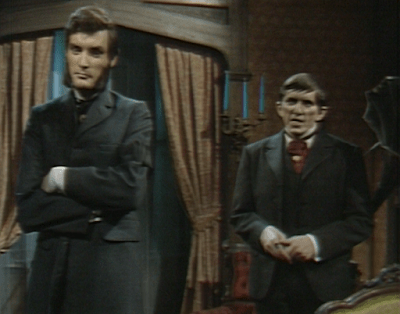
Barnabas confronts Quentin. Screenshot by Dark Shadows Before I Die.

Quentin did in fact steal the will. Edith’s ghost may be at work in the house- her glove mysteriously shows up in the corridor near Quentin’s room, the furniture in the room is turned upside down, and before the end of the episode Quentin alone can hear the pounding of an enormously amplified heartbeat emanating from the walls of his room. But Quentin accuses Barnabas of planting the glove and disordering his room, and in #538 we saw that Barnabas is capable of making people with guilty consciences have hallucinations of just this kind. Barnabas is also frequently seen reading, and it is certainly possible he might have read Edgar Allan Poe’s “Tell-Tale Heart” and decided to make it come to life. He may not even have needed to read the story- we saw in #442 that in 1796, early in his career as a vampire, he bricked up an enemy of his in the style Poe would describe in his 1846 story “The Cask of Amontillado.” Evidently his imagination and Poe’s ran along similar lines.

Barnabas meets governess Rachel Drummond. He is immediately attracted to Rachel, unsurprising since she is played by the lovely Kathryn Leigh Scott. He tells Rachel that she strongly resembles the portrait of Josette Collins, and he relates some facts about Josette’s life and death that did not make it into the family history. Indeed, Miss Scott played Josette in the part of Dark Shadows set in the 1790s.

Yesterday, Barnabas met unethical lawyer Evan Hanley, played by Humbert Allen Astredo. His reaction to Evan was not inappropriate, but the same reaction would also have been fitting had Barnabas thought Evan was Astredo’s previous character, warlock Nicholas Blair. This may have reminded longtime viewers of the 1790s segment, when time-traveling governess Vicki alienated the audience by time and again telling the characters that they were being played by actors who had other parts in the first 73 weeks of the show. Do the characters not look alike to Barnabas, or does he simply have the presence of mind not to waste everyone’s time with tedious drivel about who used to be who? We now know that in Rachel’s case, at least, it is the latter.

Quentin has a scene with his sister Judith in which he tells her that he did not like to play with her when they were children, because she was a “scaredy-cat.” Joan Bennett was 31 years old when David Selby was born, a fact of which the original audience would have been well aware since she was already a major star of motion pictures at the time. Indeed, her father Richard Bennett had been so big on Broadway that her birth was announced on the front pages of the New York papers, so that she never bothered to be coy about her age. But she and Mr Selby are such strong actors that it doesn’t raise an eyebrow when we hear that Judith and Quentin were children together.

Not everyone we see today merits such high praise, alas. Executive producer Dan Curtis was friendly with a man called Roger Davis, and he often let Mr Davis come on the set of Dark Shadows and assault the actors while they were trying to work. Unfortunately this happens today. Mr Davis is usually presented as if he were himself an actor playing a part. His idea of acting is simple enough. For example, he was once supposed to play a character named Jeff Clark, and his approach involved shouting “My name is Jeff Clark!” every episode or two. More recently, he was credited with a role called Ned Stuart, and he went around saying “My name is Ned Stuart!” That’s one way of attempting characterization, I suppose.

Today he is supposed to be someone named Dirk Wilkins. Regular viewers keep waiting for him to yell “My name is Dirk Wilkins!,” but he neglects to do so. He has a mustache, perhaps he thought that was sufficient. He finds Terry Crawford playing maidservant Beth Chavez, grabs her and yells in her face. Mr Selby interrupts this encounter. In character as Quentin, he makes some flip remarks and walks away, and Mr Davis resumes abusing Ms Crawford. Later he finds Ms Crawford on another set and grabs her again. Finally he walks into the set representing Quentin’s room while David Selby is trying to show us Quentin’s panicked response to the sound of the heartbeat. Mr Davis makes some nasty remarks, and when Mr Selby tries to involve him in the scene by tussling with him as Quentin might under those circumstances, it looks like Mr Davis gives him a real punch in the midsection. Mr Selby goes on acting, but the assault takes the audience out of the story. The ABC network really should have posted security guards outside the studio to keep this sort of thing from happening.

Episode 708: The merry chase begins

Matriarch Edith Collins has died. Her grandson Edward stands with recently arrived distant cousin Barnabas in the study of the great house of Collinwood, viewing Edith’s body. Edward asks Barnabas if Edith told him the family’s celebrated secret. Barnabas assures him she did not. Edward claims that the oldest son of the family has known the secret in every generation for a century. This does not appear to be true- Edward is the oldest son in his generation, and he has never known it. We have learned that the family has many false ideas about the secret. That it has been passed from father to son may well be one of these.

We cut to the foyer. Edward’s brother, libertine Quentin, enters with a character we have not seen before. He is lawyer Evan Hanley. Evan and Quentin conspire to replace Edith’s will with a forgery that will leave her money to Quentin. Quentin inveigles Evan into this plot by talking about their “meetings” and intimating that they may become known if he doesn’t get his way. Since Evan is played by Humbert Allen Astredo, whom longtime viewers know as warlock Nicholas Blair, and since Quentin was first introduced as the malevolent ghost of a man who may have been involved with black magic, we might assume that these “meetings” have something to do with the occult.

Quentin exits, and Barnabas and Edward enter. Edward introduces Barnabas to Evan, then he and Evan leave to attend to business. Barnabas gives them a hard look as they go. Barnabas’ conversation with Edward about the secret had grown quite heated, and returning viewers know that he has reason to be uncomfortable about the topic. He knows that the secret in fact concerns him, and that if the family learns it he will be in big trouble. So his expression may be entirely due to the apprehension he still feels as the result of that discussion. On the other hand, Barnabas did know Nicholas and do battle with him, and it is possible that he recognizes a trace of Nicholas in Evan. Astredo plays Evan as a subdued version of Nicholas, with no noticeable difference of posture or manner or cadence. Even if Barnabas can’t see that the two are played by the same actor, he may well have observed the similarity.

Barnabas hears laughter from the walkway at the top of the foyer stairs. He looks up to see twelve year old Jamison. Jamison says that Evan is lying when he says that he had a deep regard for Edith- they hated each other, since Evan knew that Edith believed he was a “shyster.” I’m sure it was possible in central Maine in 1897 for a rich Protestant kid with red hair and an Irish name to drop a shmekndik of Yiddish here and there, but it does get your attention.

Jamison tells Barnabas he is reluctant to view Edith’s body, as he has never seen a dead person. That’s what he thinks- Barnabas is a vampire, so he’s talking with a dead person right now. Barnabas asks Jamison if he likes Quentin. Something about his tone reveals to Jamison that Barnabas is hostile to Quentin, and so Jamison yells at him that he is “just like the others” who disapprove of his favorite uncle. He storms out.

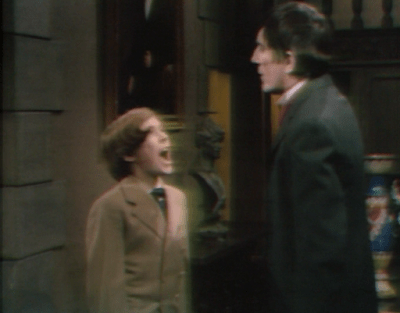
Jamison yells at Barnabas. Screenshot by Dark Shadows Before I Die.

Edith’s grandchildren are scrambling to find her will. Quentin suggests they make a game of the search; stuffy Edward objects that they most certainly will not make a game of it. Of course they will, since the search for a secret will is obviously a comedy plot.

Blackmailing Evan into joining his plot to forge a will in Edith’s name is not Quentin’s only crime today. He also assaults Edith’s friend Magda Rákóczi. Magda and her husband Sandor have been living in the Old House on the estate as Edith’s guests; now Barnabas is staying there. He has bitten Sandor and made him his slave, and bribed Magda into going along with his plans. Quentin calls at the Old House, where he chokes Magda and threatens her with a knife until she tells him where the will is. He then goes back to the great house and exploits Jamison’s trust to manipulate him into stealing the will and giving it to him. Quentin is such a horrible stinker that if he were played by any actor less charming than David Selby he would be intolerable to watch. As it is, we just keep wishing that Quentin would straighten up and fly right.

At the end of the episode, Barnabas accuses Quentin of having the will and threatens to do something “drastic” if he does not give it up. As a matter of fact, Jamison has not yet handed the will over to Quentin at this point, so what Barnabas says is not true. Worse, there is no tactical advantage for Barnabas in openly declaring himself to Quentin as an enemy at this point. Quite the contrary; he has traveled back in time to 1897 to prevent Quentin’s ghost haunting the great house in 1969 and making it uninhabitable, and has no idea what will be involved in doing that. He needs to be on friendly terms with as many people as possible to get the information he needs, and he particularly needs to get as close to Quentin as he can if he is to have any hope of thwarting whatever disaster is in store for him.

This isn’t the first time Barnabas has rashly shown his enemies what he thinks of them. When wicked witch Angelique returned to torment him in the spring of 1968, Barnabas repeatedly confronted her about her evil schemes, keeping her up to date on exactly what he did and did not know, while concealing everything from the people who wanted to help him fight her. Longtime viewers can see that there is no danger that Barnabas will learn anything from his experiences.

Episode 701: Welcome home the prodigal

We begin the part of Dark Shadows set in the year 1897 with an episode featuring a glittering script, a strong cast, and a hopeless director. Henry Kaplan’s visual style consisted of little more than one closeup after another. The first real scene in the episode introduces us to Sandor and Magda Rákóczi, a Romani couple who live in the Old House on the estate of Collinwood. They bicker while Sandor throws knives at the wall. Thayer David really is throwing knives, but since we cut between closeups of the targets and of the actors we cannot see anything dynamic in that action. He may as well be whittling.

Magda ridicules Sandor’s pretensions as a knife-thrower and as a patent medicine salesman, and busies herself with a crystal ball. She tells him that when “the old lady” dies, they will have to leave Collinwood. He says he knows all about that. She wants him to steal the Collins family jewels so that they can leave with great riches. He eventually caves in and sets out for the great house on the estate, more to escape her nagging than out of greed.

Regular viewers will remember that we heard Magda’s name in December 1968. The show had introduced two storylines, one about the malevolent ghost of Quentin Collins and the other about werewolf Chris Jennings, and the characters were starting to notice the strange goings-on that Quentin and Chris generated. The adults in the great house had no idea that Quentin was haunting them or that Chris was a werewolf, so they held a séance in #642. Speaking through heiress Carolyn Collins Stoddard, Magda mentioned “My curse!” and said that “He must not come back!” It was clear in the context of the episode that the “He” who “must not come back” was Quentin. Chris was a participant in the séance, and he broke the circle before Magda could explain what she meant by her “curse.” Séances held in #170 and #281 were cut short by the person whose secret the medium was about to expose; that it is Chris who interrupts this one would suggest to longtime viewers that Magda not only knew Quentin, but that the curse she is about to explain was the one that made Chris a werewolf. Carolyn and her uncle Roger Collins talked a little about Magda in #643, and psychic investigator Janet Findley sensed the ghostly presence of a woman whose name started with an “M” in #648. We haven’t heard about Magda since.

As the living Magda, Grayson Hall manages rather a more natural accent than Nancy Barrett had when channeling her concerns about “my currrrrssssse.” The exaggerated costumes Hall and Thayer David wear make sense when we hear them reminiscing about the old days, when they made their livings as stage Gypsies with a knife-throwing act, Tarot card readings, and a magic elixir. Even the fact that Magda is peering into a crystal ball during this scene is understandable when they make it clear that they are staying in the Old House as guests of the mistress of the great house, an old, dying lady who enjoys their broadly stereotypical antics. But there is no way to reconcile twenty-first century sensibilities to Hall and David’s brownface makeup. Some time later, Hall would claim that one of her grandmothers was Romani. If that was a lie, it is telling that only someone as phenomenally sophisticated as Hall could in the 1970s see that she would need to invent a story to excuse playing such a character.

Objectionable as Sandor and Magda are, their dialogue is so well-written and so well delivered that we want to like them. Moreover, the year 1897 points to another reason fans of Dark Shadows might be happy enough to see Romani or Sinti characters that they will overlook the racist aspects of their portrayal. It was in 1897 that Bram Stoker’s Dracula was published, and it depicted the evil Count as surrounded by “Gypsy” thralls. The character who has brought us on this journey into the past is Barnabas Collins, and upon his arrival he found that he was once more a vampire.

In addition to the strengths of the dialogue, the acting, and the intertext, there is also a weakness in this episode that softens the blow of the brownface. Today the picture is so muddy that it is possible to overlook the makeup. That’s Kaplan’s fault. It would often be the case that one or the other of the cameras wasn’t up to standard, but when the director was a visual artist as capable as Lela Swift or John Sedwick, there would always be at least some shots in a scene using the good camera, and others where the lighting would alleviate some of the consequences of the technical difficulties. But Kaplan doesn’t seem to have cared at all. He had made up his mind to use a particular camera to shoot the Old House parlor with a subdued lighting scheme, and if that camera was not picking up the full range of color, too bad. He’d photograph a lot of sludge and call it a day.

Meanwhile, a man knocks on the door of the great house. He is Quentin, and the person who opens the door is Beth Chavez. We first saw these two as ghosts in #646. Beth spoke some lines during the “Haunting of Collinwood” story, but Quentin’s voice was heard only in his menacing laugh.

We already know Quentin as the evil spirit who drove everyone from the house and is killing strange and troubled boy David Collins in February of 1969. His behavior in this scene is no less abominable than we might there by have come to expect. He pushes past Beth to force his way into the foyer, does not bother to deny that he has come back to persuade his dying grandmother to leave him her money, pretends to have forgotten someone named “Jenny,” makes Beth feel uncomfortable by saying that her association with Jenny makes her position in the house precarious, orders Beth to carry his bags, twists her arm, and leeringly tells her that she would be much happier if she would just submit to his charms. David Selby sells the scene, and we believe that Quentin is a villain who must be stopped. But Mr Selby himself is so charming, and the dialogue in which he makes his unforgivable declarations is so witty, that we don’t want him to go away. He establishes himself at once as The Man You Love to Hate.

In an upstairs bedroom, the aged Edith Collins is looking at Tarot cards. Quentin makes his way to her; she expresses her vigorous disapproval of him. She says that “When Jamison brought me the letter, I said to myself ‘He is the same. Quentin is using the child to get back.'” Quentin replies “But you let me come back.” She says that she did, and admits that he makes her feel young. With that, Edith identifies herself with the audience’s point of view.

The reference to Jamison and a letter reminds regular viewers of #643, when Magda’s ghost caused a letter from Quentin to fall into Roger’s hands. It was addressed to Roger’s father, Jamison, and was written in 1887. It read “Dear Jamison, You must return to Collinwood. I need your help. You must intercede with Oscar. Only you can save me.” They’ve revised the flimsies quite a bit since then; now it is 1897, Jamison is 12, and we don’t hear about anyone named Oscar.

Not about any character named Oscar, anyway. Edith tells Quentin that “Men who live as you do will not age well.” Quentin tells Edith that she ought not to believe in the Tarot, because “This card always has the same picture and people change, even I.” On Dark Shadows, which from its beginning has taken place on sets dominated by portraits, these two lines might make us wonder what it would be like if it were portraits that changed while their subjects remained the same. Oscar Wilde’s Picture of Dorian Gray was published in serial form in 1890 and as a novel in 1891, and it was a sensation on both sides of the Atlantic. The dialogue is so witty that the characters must be well-read, making it quite plausible that Quentin’s remark was meant to remind Edith of the book. Especially so, since Wilde was released from prison in 1897, bringing him back to public notice in that year.

Edith tells Quentin that old and sick as she may be, she can still out-think him. She declares that all of her grandchildren will get what they deserve. All, that is, except Edward. Roger mentioned Edward in #697, naming him as his grandfather and Jamison’s father. Edith says that Edward is the eldest, and therefore she must tell him “the secret.” There is a note of horror in her voice as she says this; Quentin misses that note, and reflexively urges her to tell him the secret. She only shakes her head- the secret isn’t a prize to contend for, it is a burden to lament.

Isabella Hoopes plays this scene lying on her side in bed, a challenging position for any performer. Her delivery is a bit stilted at the beginning, but after she makes eye contact with David Selby she warms up and becomes very natural. I wonder if the initial awkwardness had to do with Kaplan. He held a conductor’s baton while directing, and he used to poke actresses with it. I can’t imagine a person in bed wearing a nightgown would have an easy time relaxing if her attention was focused on him. Once she can connect with Mr Selby, though, you can see what an outstanding professional she was.

Quentin goes to the drawing room, and finds Sandor behind the curtains. He threatens to call the police, and Sandor slinks back to the Old House. Magda berates him for his failure to steal the jewels, and he insists there are no jewels in the great house.

Meanwhile, Barnabas is in his coffin, trying to will someone to come and release him. In #210, dangerously unstable ruffian Willie Loomis had become obsessed with Barnabas’ portrait in the foyer of the great house, so much so that he could hear Barnabas’ heart beating through it. Barnabas called Willie to come to the secret chamber in the old Collins family mausoleum where his coffin was hidden. In his conscious mind, Willie thought he was going to steal a fortune in jewels. His face distorted with the gleeful expectation of that bonanza, he broke the chains that bound the coffin shut, and Barnabas’ hand darted out, choking him and pulling him down.

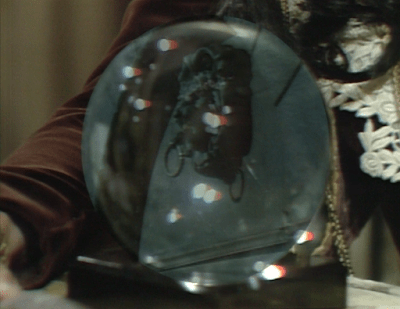
In the Old House, an image suddenly appears in the crystal ball. We can see it, the first time they have actually projected an image in such a ball since the first one made its debut in #48.

Picture in picture. Screenshot by Dark Shadows Before I Die.

Magda notices the image, and tells Sandor to look. He recognizes the old mausoleum. She says that the jewels must be in “the room,” implying that they already know about the hidden panel and the secret chamber behind it. Sandor says it is absurd to imagine Edith going to and from the mausoleum to retrieve pieces of her jewelry collection. Magda ignores this, and urges him to go there. He reluctantly agrees to go with her.

The two of them are heading for the door when they hear a knock. It is Beth, come to say that Edith wants to see Magda. Edith wants what she always wants- to be told that Edward will return before she dies. Sandor says Magda can’t go, but Beth says she will regret it for the rest of her life if she does not. Magda tells Sandor to go on his way without her, and says that she will bring Edith some ancient Gypsy cards, cards older than the Tarot. When she talks about Romani lore, Magda taunts Beth- “but you wouldn’t know anything about that, would you?” Her sarcastic tone implies that Beth has tried to conceal her own Romani heritage.

Sandor opens the secret panel and looks at the chained coffin. He tells himself the jewels can’t be hidden there, then decides he may as well open it anyway- if he doesn’t, Magda will just send him back. Longtime viewers remembering the frenzy in which Willie opened the coffin in #210 will be struck by the utterly lackadaisical attitude with which Sandor performs the same task. Men’s lust for riches may release the vampire, but so too may their annoyance with the wife when she won’t stop carping on the same old thing.

When Willie opened the coffin, it lay across the frame lengthwise and he was behind it. When he raised the lid it blocked our view of his middle. We could see only his face when he realized what he had done, and could see nothing of Barnabas but his hand. The result was an iconic image.

Farewell, dangerously unstable ruffian- hello, sorely bedraggled blood thrall. Screenshot by Dark Shadows Before I Die.

When Sandor opens the coffin, its end is toward us. We see Barnabas at the same time he does. Barnabas’ hand darts up, and also for some reason his foot. The camera zooms in as Barnabas clutches Sandor’s throat. Unfortunately, the shot is so dimly lit that not all viewers will see this. My wife, Mrs Acilius, has eyesight that is in some ways a bit below average, and she missed it completely, even on a modern big-screen television. It’s anyone’s guess how many viewers would have known what was going on when they were watching it on the little TV sets of March 1969, on an ABC affiliate which was more likely than not the station that came in with the poorest picture quality in the area. As a result, the image that marks the relaunch of Barnabas’ career as a vampire is nothing at all. There is so much good stuff in the episode that it easily earns the “Genuinely Good” tag, but Kaplan’s bungling of this final shot is a severe failure.

Grab and kick, and one and two! Screenshot by Dark Shadows Before I Die.

Episode 690: A different mood

We open with governess Maggie Evans entering the bedroom of strange and troubled boy David Collins. She had heard David’s screams and a man’s laughter coming from the room; the man is gone, and David is unconscious on the floor. He has a nasty burn on his arm, and as he is coming to he pleads with “Quentin” not to hurt him.

Once David is fully awake, Maggie asks who Quentin is. David frantically denies that there is any such person, and claims that the laughter she heard was his own voice as he was playing a make-believe game. She says that she knows he couldn’t have made those sounds. He points out that they are the only people in the room. Maggie does not even try to explain how anyone could have left the room unseen; she seems already to have concluded that Quentin is a supernatural being. Maggie identifies Quentin with a strange and frightening man she and housekeeper Mrs Johnson have both seen. David keeps trying to deny everything, and Maggie keeps telling him she wants to help. David sobs, and Maggie holds him.

Maggie holds David.

Quentin is indeed a ghost who is taking possession both of David and of Maggie’s other charge, nine year old Amy Jennings. With their help, Quentin has so far killed two people, tried to kill two others, and set about trying to drive everyone off the estate of Collinwood. Up to this point, Maggie has failed completely to represent any sort of obstacle to Quentin. She is a poor disciplinarian who lets the children run rings around her even when they are themselves, and is altogether at sea when they are doing Quentin’s bidding. This scene promises a breakthrough. Maggie is the first of the adult characters to learn Quentin’s name, she does not flinch from the evidence of his uncanny nature, she vows to fight him, and David finds comfort in her arms.

The breakthrough does not come today, however. After a moment, David declares that no one can help him, and he rushes out of the room. He goes downstairs to the foyer and hears a knocking at the door. He opens it and sees notoriously abusive actor Roger Davis standing there. He reacts to that sight as anyone might, running away without a backward glance.

Maggie follows David downstairs. There is again some question as to how much of the body language in the next scene is the blocking the director gave as an interpretation of Maggie’s response to the character Ned Stuart and how much is Kathryn Leigh Scott’s reaction to Mr Davis. Maggie tells Ned she can’t talk because she must go out in search of David; as she prepares to exit, she circles around with as much space as possible between her and him, never quite making eye contact but glancing back every time he moves towards her. This is not a pattern of movement we have seen before on the show, even when a character was dealing with a vampire or some other murderous foe. Miss Scott looks very much like a woman alone with a man whom she does not trust not to assault her. If he had, it wouldn’t be the first time he has physically abused a castmate on camera.

She keeps her eyes on his hands

A child’s voice is heard, singing the song “Inchworm.” It is Amy, and she is working a jigsaw puzzle in the drawing room. The drawing room brings out Amy’s musical side. She played “London Bridge” on the piano there in #656 and tapped a few random keys on the same instrument in #676. She is quite a good singer, perhaps not surprising since actress Denise Nickerson had been in the cast of the short-lived James Lipton/ Laurence Rosenthal Broadway musical Sherry! in 1967.

Ned enters and introduces himself to Amy. His lines are all perfectly polite and friendly. Amy is supposed to gradually sense that Ned is hostile to her big brother Chris and to become uncomfortable around him, but that is supposed to come at the end of their time together. As it plays out, she already seems uncomfortable when he first enters. A minute or so into the scene, Amy smiles at Ned. Nickerson was remarkably good at flashing quick smiles, but it doesn’t work this time. She looks like she is displaying her teeth to the dentist. When Amy is supposed to start edging away from him, Nickerson turns around and proceeds to her next mark at full speed. The camera pans back, but does not capture her movement- she has gone clean out of the shot, leaving Mr Davis alone in the frame.

She goes as far as she can as fast as she can.

Ned approaches Amy; he grabs her by the shoulders and pulls her back into the shot. Chris enters. Amy starts to warn him against Ned, and he tells her not to be afraid for his sake. Indeed, Chris is safe. It is only women and children who have to be afraid of Roger Davis.

Ned confronts Chris. Evidently something bad happened to Ned’s sister Sabrina. She can’t tell Ned what it was, but he thinks Chris is responsible and wants him to go with him to the Collinsport Inn to see her. Returning viewers know that Chris is a werewolf and that Sabrina saw him transform. He assumed that he had killed her while in his beastly form, and he is surprised to learn from Ned that she is still alive. Chris is a character we are supposed to sympathize with, so it is a bit disturbing that he does not seem particularly relieved to find that he did not kill Sabrina.

In the woods, Amy finds David. She learned some days ago that Quentin wants to hurt Chris, and she has been resisting Quentin’s influence ever since. She and David talk about ways they can work together to fight him. David says that he has decided to tell Maggie what has been happening; Amy objects that this is too dangerous. They seem to be getting somewhere when Quentin appears to them. They are terrified, and then resign themselves to their fate.

Later, the children are in the drawing room with Maggie. Amy is still working her jigsaw puzzle, and David is staring into the fireplace. Longtime viewers will remember that this is something his mother used to do. She was the show’s first supernatural menace and tried to lure David to his doom. Maggie’s predecessor, well-meaning governess Vicki, led the other characters in the campaign that saved David then. We wonder if Maggie will be able to match her success.

Maggie admires the puzzle and calls David over to look at it. David makes a show of being bored, leading Amy to remark airily that boys don’t like jigsaw puzzles. David complains that there is nothing to do. Maggie suggests the three of them sit down together for a heart-to-heart talk, an idea the children reject. They suggest a variety of games they might play. Maggie notices that their manner is quite different than it was earlier in the day. David is more assertive, Amy supercilious. She finally agrees to let them play dress-up.

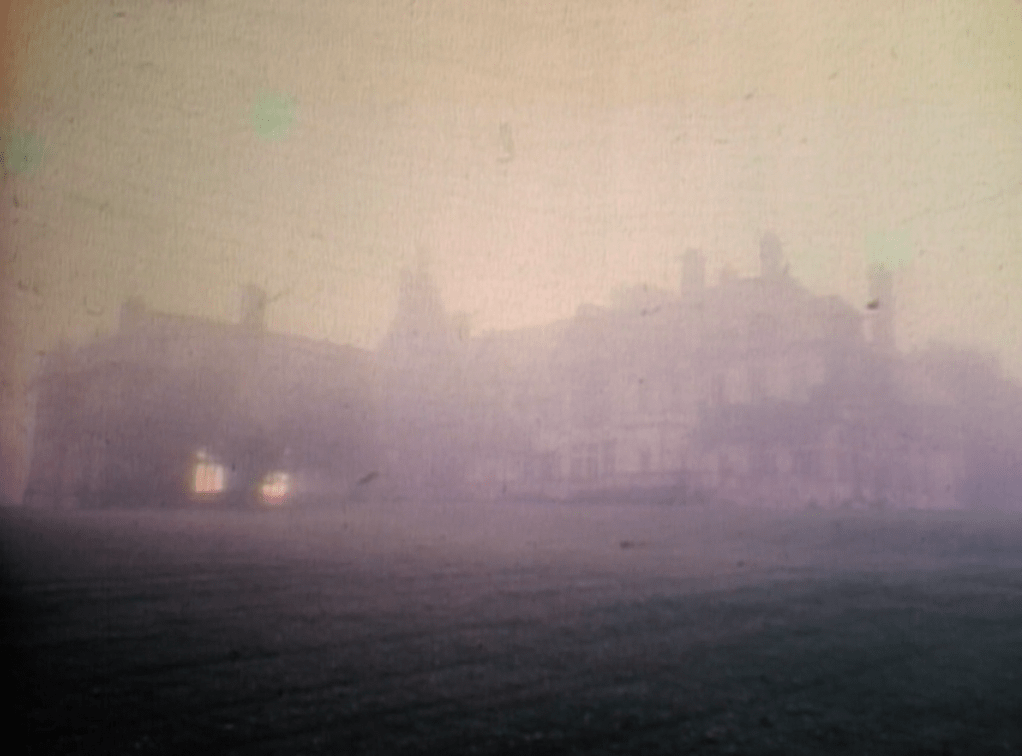
In the first year of the show, the opening voiceovers often involved a weather report. “A cold wind blows from the sea to the great house of Collinwood, but the fog still hangs heavy on its vast lawns” that sort of thing. They stopped doing that some time ago, but today they slip in an almost comically detailed bit about atmospheric conditions- “Soon dark, threatening clouds will gather over Collinwood, and long, ever-lengthening shadows will creep menacingly toward the great house. By late afternoon, rain will come, a rain that will begin slowly but steadily increase into a raging storm.” You expect them to go on with “Expect cooler temperatures and clear skies after 8 PM, with a chance of frost in the morning.” But the rain, at least, plays a part in the story. It explains why David and Amy have to stay indoors, and a roar of thunder gives Amy a chance to sneeringly ask Maggie if she is frightened. It also occasions the use of this still of the exterior of the house, one which I do not believe we have seen before:

We don’t usually see that much of the lawn.

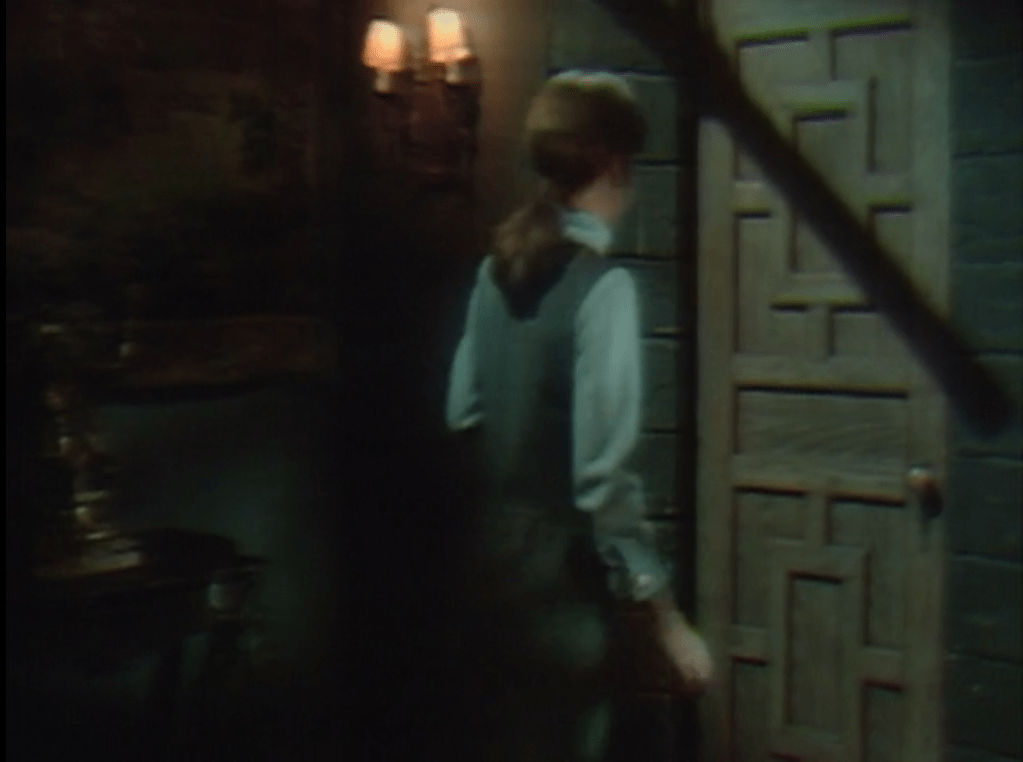
Later, Maggie goes to look for the children. She enters the study. This set has been familiar since early 1967, but today is the first time we see the outside of its door. Lately we have been seeing more of the little spaces that are supposed to join one room to another, part of a strategy to make the house seem like a bigger place.

The sequence before this suggests Maggie is heading into the long-deserted west wing, but once she goes through the door it is clearly the study.

Once in the study, Maggie hears Amy and David calling to her from no particular direction while Quentin laughs. She is bewildered, then the children join Quentin in laughing. His laughter is hearty, theirs is maniacal. Maggie goes out into the corridor, sees something frightening, and retreats into the study. She is only there for a moment when the doorknob starts turning. We end with Maggie staring directly into the camera, its lens representing the point of view of whatever it is that is terrifying her.

Maggie terrified.

This is the first of only two episodes credited to writer Ralph Ellis. Dark Shadows never had more than three writers on staff at any time. I often wish they had had many more. Ellis is one of those whom I would have liked to see as a senior writer on the show right the way through. The episode is well-paced, the characters are clearly defined, and the dialogue is smooth with just a touch of wit. If he had been in charge of, let’s say, every Monday’s script, the whole series would have been a cut above what it actually was. Since he only contributed two scripts, it is especially sad that Roger Davis had to crap on one of them, but even when Mr Davis is on camera you can still tell that Ellis did his job well.

Episode 689: A victim of the werewolf

Old world gentleman Barnabas Collins finds his distant cousin, strange and troubled boy David Collins, trying to pull the metal ring that opens the secret chamber hidden inside the old mausoleum.

Barnabas wants answers. Screenshot by Dark Shadows Before I Die.

Barnabas asks what David was doing. He says he was upset with his governess, Maggie Evans, and was hiding from her. Barnabas gestures around the publicly known part of the mausoleum and says “There’s no place to hide here.” David vigorously agrees, and says he didn’t expect Maggie to come there at all. Barnabas asks if David was trying to get into the hidden chamber.

Panicked, David claims not to know what Barnabas is talking about. Barnabas reminds him that he caught him at the mausoleum in #315. Longtime viewers will recall that he subsequently found part of David’s pocket knife in the hidden chamber and confronted him with it, and David seems to remember that as well. He drops his attempt to deny knowing about the chamber, and tells Barnabas he heard an animal inside it.

This goes to the heart of the issue that has brought Barnabas to the mausoleum. Barnabas has befriended mysterious drifter Chris Jennings and has learned that Chris is a werewolf. When Chris is in his beastly form, Barnabas locks him in the hidden chamber to keep him from hurting anyone. The werewolf is in there now. He was growling and snarling when David arrived, but fell silent when Barnabas entered.

Barnabas asks how an animal could have got into the hidden chamber; David admits he can’t think of a way. He then asks David if he can hear the noise now; he says he can’t. He asks if he might have imagined the whole thing; he doesn’t disagree.

Barnabas takes David back home to the great house of Collinwood. His governess Maggie is waiting up for him. She stays in David’s room until he seems to be asleep, then kisses him on the forehead and goes.

Yesterday, David told Maggie that she is a pretty girl. He’s twelve now, old enough to get excited about that very conspicuous fact, so when he opens his eyes immediately after she leaves the room returning viewers might think the reason he faked being asleep was that he was angling for the kiss.

David went to the mausoleum to release the werewolf because the evil spirit of the late Quentin Collins made him do it. Quentin has been dominating David lately. After Maggie goes, Quentin appears in the room and David confronts him. He says he does not want to be part of Quentin’s cruel schemes any longer. In response, Quentin causes David to suffer extreme pain. Passing by in the hallway, Maggie hears David’s scream and Quentin’s laugh, and she opens the door to find David curled up on the floor.

The laugh is noteworthy. Maggie hears it, and it is not a sound David could have made. She has already seen Quentin, but now she has further evidence that he exists. Moreover, it is the first time Quentin has broken his silence. We first met Quentin when he was in company with another ghost, a woman named Beth Chavez. Beth has spoken since then; we wonder when Quentin will have lines to deliver.

Episode 685: Barnabas, Quentin, and the Thing Glasses

Silversmith Ezra Braithwaite comes to the great house of Collinwood, bearing a ledger with information that old world gentleman Barnabas Collins wants. Barnabas is in the study, so twelve year old boy David Collins lets Mr Braithwaite into the house and escorts him to the drawing room. The two of them play a scene that may not have looked like much on the page, but as delivered by talented comic actors Abe Vigoda and David Henesy the lines are hilarious.

For example, Mr Braithwaite has two pairs of glasses, which he describes to David as his glasses for looking at things and his glasses for looking at people. David asks if the ones he is wearing are his “thing glasses.” We laughed out loud at that whole exchange. Mr Braithwaite asks David to go get “Uncle Barnabas”; David replies “He’s my cousin,” to which Mr Braithwaite answers “Ah, yes.” Again, that wouldn’t be a hit in a joke book, but Vigoda and Mr Henesy sell it. The purest example comes when Mr Braithwaite starts to change his glasses as he turns to the pages of the ledger and says out loud to himself “Oh, Ezra, Ezra, you already got on your reading glasses.” That is a laugh line entirely because of the way Vigoda stresses the words “got” and “on.”

There is a little exchange between Ezra and David that will stand out to longtime viewers:

Ezra: David is it? Well, I don’t remember a Collins being named David before. Now, my name is Ezra, as my father was and his father before him. You find a name like Ezra and you don’t give it up.

David: I guess not.

Ezra: Yes, now, David’s kind of a new-fangled name.

David: No, there’s King David in the Bible.

Ezra: Oh, of course, yes, yes. A good man, too.

In #153, it was established that no Collins ever bore the name “David” until undead blonde fire witch Laura Murdoch Collins insisted that her husband Roger go along with her plan to name their son “David Theodore Collins.” That turned out to be hugely important as evidence of Laura’s evil intentions. In #288, it sounded like they had decided to retcon that away when David looked in a family album, saw a portrait of a “David Collins” from a previous century, and wondered aloud if he had found his namesake. Nothing has come of that potential namesake in the 79 weeks since, and Ezra’s line that he didn’t “remember a Collins being named David before” would suggest that they’ve gone back to the original idea.

Mr Braithwaite, in his thing glasses, examines a piece of silver. David examines him. Screenshot by Dark Shadows Before I Die.

Each time Mr Braithwaite looks at someone through his “thing glasses,” we get a point of view shot showing that his eyesight is blurry. They then cut back to the other actor in regular focus. These shots are brief enough that the repetition isn’t a big problem, but it results in a series of exchanges the actors deliver to the camera rather than to each other. Those don’t work at all. Mr Henesy and Abe Vigoda had such a fine comic rhythm going that it’s a shame to break it up with this clunky stuff.

Reading the ledger, Mr Braithwaite says that the silver pentagram Barnabas wants to know about was bought in April 1897 by Miss Beth Chavez and paid for by Quentin Collins. We have seen Beth’s ghost. She is very tall and so thin you could clasp your fingers around her waist. Her complexion is pale as can be, her hair blonde, her eyes blue. I’ve met a fair number of Chavezes in my time, including a couple of Elizabeth Chavezes, and none has met this description. I have nothing to say against slender blondes, and actress Terrayne Crawford is movie-star beautiful. Still, if a fellow were excited about a blind date with a girl known to him only by the name “Beth Chavez,” he’d probably be a bit disappointed if the person who showed up met her description.

We have also seen Quentin’s ghost. Quentin is manipulating David into helping him with a number of murders he intends to commit. Beth has thwarted one of these murders so far, and is trying to prevent Quentin from achieving other evil plans of his. But Quentin is apparently more powerful than she is.

While Mr Braithwaite is alone in the drawing room, Quentin enters through a secret panel. Earlier in this episode, they made it clear Quentin can choose whether he is visible to the living people in the spaces he occupies; there is no need for him to hide. Why does he use the panel?

Longtime viewers may be able to make a surmise. We saw this panel for the first time in #87, when David’s father Roger used it for a sneaky errand. We didn’t see it or hear of it again until #643, when David told nine-year old Amy Jennings that there was a passage “very few people” knew about, and used it to lead her to the room in which Quentin was at that point confined. Quentin’s use of it will therefore suggest that he knows all the secrets of the house. It also suggests that when he dwelt there as a living being he was a naughty fellow who was in the habit of using its secret passages for the sort of underhanded mischief Roger got up to in #87 and #88.

Quentin strolls up to Mr Braithwaite and smiles at him. Mr Braithwaite is wearing his “thing glasses” and cannot see Quentin clearly. He asks Quentin if he is the friend Barnabas spoke of when he asked him about the pentagram. Quentin nods. Mr Braithwaite says that he himself made the pentagram in April 1897, when he was “fifteen and a half.” It is now February 1969, so we know that Mr Braithwaite is 87. He recognizes Quentin. Shocked to see a man who has been dead for decades apparently alive, well, and in his twenties,* Mr Braithwaite dies of a heart attack.

It’s a shame we won’t be seeing more of Abe Vigoda as Mr Braithwaite. At least they spelled his name correctly in the credits this time; yesterday he was “Abe Vigodo.”

*Two days past his 28th birthday, to be exact. Happy belated 84th to David Selby!

Episode 684: This is a funny house we live in

Dark Shadows has two ongoing storylines at this point. Mysterious drifter Chris Jennings came to town a couple of months ago and turned out to be a werewolf. Heiress Carolyn Collins Stoddard does not know of Chris’ curse. She has taken a fancy to him and set him up in the caretaker’s cottage on the estate of Collinwood. Old world gentleman Barnabas Collins and mad scientist Julia Hoffman do know that Chris is a werewolf, and they are working to help him. Barnabas has found a place to keep him confined on the nights of the full Moon, and Julia is trying to develop a medical intervention that will keep him in his human form.

Meanwhile, Chris’ nine year old sister Amy has taken up residence in the great house on the estate. She and her twelve year old friend, strange and troubled boy David Collins, are falling under the power of the evil spirit of the late Quentin Collins. At first Amy could communicate with Quentin more clearly than David could. This made David envious. In #640, David complained that Amy could hear his voice and he could not, even though “Quentin Collins is my ancestor.” That suggested to the audience that Quentin would turn out also to be Amy and Chris’ ancestor, joining the werewolf story with the Haunting of Collinwood.

Today, Barnabas and Chris have dug up a spot on the ground to which the ghost of a mysterious woman had led Chris. They find a tiny coffin holding the remains of an infant. They discover that the infant was wearing a medallion in the shape of a silver pentagram. The sight of the dead baby shocks Barnabas right away; Chris keeps his composure at first, but seems close to tears a moment later. Quentin stands in the shrubbery and watches Barnabas and Chris.

Barnabas has not seen Quentin and does not know who he is. Others have seen him and described him to Barnabas and Julia. They and those others suspect that he is a malevolent ghost with designs on David and Amy. No one has yet made a connection between Quentin and the werewolf story, however.

Julia and Barnabas have also seen the mysterious woman who led Chris to the baby’s grave. They know that she is a ghost and that she has helped Chris, and they also know that her clothing is of the same vintage as is the clothing which Quentin wears. But they do not know what, if anything, the two ghosts have to do with each other. The audience knows that the female ghost’s name is Beth and that she was with Quentin in the little room in the long deserted west wing of the great house when the children first met him.

Barnabas tells Chris that the pentagram can only be a device to ward off a werewolf, so that there must have been a werewolf in the area when the baby was buried. He also tells Chris that the mysterious woman would not have led him to dig up the grave unless what they found in the coffin would be of help to him.

While Barnabas inspects the pentagram in the drawing room of the great house, David throws darts at a board propped up on a chair nearby. The audience knows that David is under Quentin’s control, so it is obvious to us that the dart playing is an attempt to distract Barnabas and keep him from figuring out the meaning of the pentagram. Lacking our knowledge, Barnabas is merely annoyed with David. Jonathan Frid and David Henesy expertly develop the comedy in Barnabas’ fast-burn reaction to David’s behavior.

Heiress Carolyn Collins Stoddard interrupts the scene. She notices what Barnabas is doing. He shows her the pentagram, and she recognizes the jeweler’s mark as that of Braithwaite’s silver shop in the village of Collinsport. While Barnabas telephones Braithewaite’s and arranges to take the pentagram there to see if the proprietor can give him any information about it, Carolyn tells David she wants to have a conversation with him about some cryptic remarks he made earlier. David refuses, saying that he has homework to do. Carolyn argues with him briefly, but finally gives up and leaves. Barnabas is still involved in his conversation with Mr Braithwaite when David hides the pentagram behind his dartboard.

Barnabas gets off the phone, and David resumes throwing darts. Barnabas asks him why he isn’t doing the homework he was just telling Carolyn presented such an urgent obligation that he could not talk with her. He launches into a shaggy dog story, the upshot of which is that he has to wait for Amy.

More exasperated than ever, Barnabas turns to the desk and sees that the pentagram is gone. He demands David return it. David denies having it. He says that it may have vanished on its own. After all, unaccountable things happen at Collinwood all the time, as Barnabas is in a position to know. The way he says “You should know that” reminds longtime viewers that David has more than once shown signs of figuring out more about Barnabas’ own connections to the supernatural than have any of his adult relatives. In #316, he pointed out that none of the Collinses really knows anything about Barnabas- “He just showed up one night.” And in #660, he told Amy that “Barnabas knows a lot of things he doesn’t tell anybody.” At moments like these, we wonder just how much information David really has at his disposal. Perhaps he secretly knows everything, and has just decided there’s no point in notifying the authorities.

David invites Barnabas to search him. He lists the contents of his pockets, and turns the right front pocket inside out. He tells him that he has a pack of chewing gum, which he got from Amy. He specifies that he traded her a box of raisins for it. As David Henesy delivers the line and Jonathan Frid shows us Barnabas’ reaction, this detail is laugh-out-loud funny. Barnabas surrenders and apologizes to David, fretting about the pentagram’s absence.

Barnabas takes a sketch of the pentagram to Braithwaite’s. In the first months it was on the air, Dark Shadows took us to New York City twice, to Bangor, Maine several times, and to Phoenix, Arizona once. But now that both stories center on characters all of whom dwell in one or another of the houses at Collinwood, it is as rare to leave the estate and go into the neighboring village as it was then to go on those remote excursions.

Old Mr Braithwaite tells Barnabas that the shop has been in operation since 1781 and has been providing fine silver to the Collins family the whole time. Regular viewers know that Barnabas was alive then, and lived in Collinsport. A curse made him a vampire in the 1790s, and he was under its power until he was freed early in 1968. So he must have been quite familiar with Braithwaite’s in its early years. What is more, in #459 we saw that in the first months of Barnabas’ career as a vampire his father Joshua learned of his curse and commissioned a local craftsman to make silver bullets with which he could put Barnabas out of his misery. That craftsman must have been one of the first Mr Braithwaites.

The incumbent Mr Braithwaite tells Barnabas he will consult his records as soon as the shop closes and telephone him if he finds anything. When the call comes, David answers. Mr Braithwaite tells David that he can’t imagine why he forgot about the pentagram since it was one of the very first he made himself, back in 1897. Quentin appears, takes the phone from David, and hears Mr Braithwaite say he will stop by Collinwood with the ledger shortly.

Mr Braithwaite almost remembers.

David protests that Quentin had no right to take the phone from him. Quentin turns to him, gives him a menacing look, and walks toward him. David backs away and and takes a place on the stairs, still objecting loudly to what Quentin did.

Closing Miscellany

The closing credits list the actor who plays Ezra Braithwaite as “Abe Vigodo.” Perhaps in some parallel time-band there was a man of that name who played Tossio in The Good Father and Detective Fosh in Barney Moeller, but this is in fact Abe Vigoda.

“Abe Vigodo”

In his 1977-1978 ABC TV series Fish, Vigoda’s character was married to a woman played by Florence Stanley. Stanley was also a Dark Shadows alum, as a voice actress. She provided sobbing sounds heard in #4, #98, #515, #516, and #666. Vigoda once appeared on the panel at a Dark Shadows convention; his main statement was “I don’t remember much about it.” I can’t find evidence that Stanley ever appeared in such a setting. I would love to imagine that Vigoda and Stanley compared notes about their experiences on Dark Shadows between setups on Fish, but I would be astonished to learn that ever happened.

Vigoda always played old men. The second screen credit on his IMDb page is a 1949 episode of Studio One in which he took the role of “Old Train Passenger.” At that time, he was 28. Vigoda was a marathon runner, a form of exercise that tends to burn out all the fat under the skin of the face. And of course he was a very strong actor, easily able to convince us that he is of a great age. So even though Vigoda was only three years older than Jonathan Frid, and about 175 years younger than Barnabas, it isn’t quite as funny as it might be to hear him call Barnabas one of “you young people.”

Danny Horn devotes his post about this episode on his great Dark Shadows Every Day to three points. The first is his exultation that his least favorite writer, Ron Sproat, was credited with his final script yesterday, so that today is the first day of the Sproatless Dark Shadows. The second is that the show is finally joining the werewolf story with the Haunting of Collinwood. The third is a point I have some reservations about. He says that this is the first episode where Quentin “has a feeling,” and therefore declares it to be Quentin’s debut as a real character. “It’s nice to meet you Quentin. Welcome to the show,” he concludes.

It’s true that Quentin shows a wider range of feelings today than he had previously, but I think it is an exaggeration to say that we are only now seeing his feelings. For example, when in #680 Quentin agrees to Amy’s demand that he stop trying to kill Chris, he looks very much like a man humiliated to find that he has to capitulate to a nine year old girl. In the same episode he showed amusement and anger at appropriate points. Those three responses may not sound like much, but David Selby’s face is a magnificent instrument, one he plays it expertly. For him, they are more than enough to make Quentin into a real person.

Chris and Carolyn have a brief scene in the drawing room as they are getting ready to go on a date. Chris defuses a potentially awkward conversation about his previous failures to respond to Carolyn’s hints that she was interested in him by saying “Oh, I didn’t notice that” in the W. C. Fields imitation he had used with Amy in #677. She chuckles delightedly. This is not implausible. Not only can we imagine her being relieved that the topic didn’t ruin their evening, but W. C. Fields was very much in vogue in the late 1960s, so much so that a fashionable young woman might have chuckled when a man briefly imitated him.

David and Carolyn have an exchange that longtime viewers will find less plausible. He asks her if she has ever seen a ghost; she responds by asking if he has. But each of them knows perfectly well that the other has seen ghosts. David spent the first year of the show on intimate terms with the ghost of the gracious Josette, and he and Carolyn both saw and had substantive conversations with the ghost of Barnabas’ little sister Sarah. In #344, Carolyn told David that when she was a little girl her best friend was the ghost of a boy named Randy. It’s just trashing character development to retcon all that away.

Barnabas says something that will catch the ears of properly obsessed fans. When he is in the shop, he tells Mr Braithwaite that he will gladly drive back from Collinwood whenever he has any information for him. There have been some suggestions lately that Barnabas has learned to drive and has come into possession of a car, but this is the first definite confirmation of that point.

Episode 681: Mr Juggins

The evil spirit of the late Quentin Collins has been taking control of strange and troubled boy David Collins. David tricks his governess, Maggie Evans, into going into a room in the long-deserted west wing of the great house of Collinwood. Quentin appears to Maggie there, frightening her.

Maggie goes to matriarch Elizabeth Collins Stoddard and tells her she saw an unfamiliar man lurking in the west wing. When she says that she suspects David is in cahoots with the man, Liz becomes deeply skeptical. Her disbelief reminds longtime viewers of #27, when Maggie’s predecessor, the well-meaning Vicki Winters, discovered evidence indicating that David was behind an attempt to murder his father, Liz’ brother Roger. Desperate to escape the implication, Liz briefly went so far as to suggest that Vicki herself might be the culprit. That idea was absurd on its face, and Liz treated Vicki as a member of the family, so she dropped it almost as soon as she had put it into words. But Maggie doesn’t have anything definite to back up her suspicions of David, and Liz is no more attached to her than she might be to any other member of the household staff. She remains leery of Maggie throughout the episode.

Quentin appears to David in his room. David talks to Quentin; he praises him for a fine plan, and Quentin smiles and nods in reply. He asks him how he came up with the name “Mr Juggins” and Quentin does not react. When Liz’ daughter Carolyn and local man Chris Jennings enter, Quentin vanishes.

After Carolyn and Chris exit, David sings a song about “Mr Juggins.” Quentin reappears, quite happy. I don’t blame Quentin, the song makes me happy too. It’s sung to the tune of “Yankee Doodle”:

Mr Juggins met Miss Evans on a darkened ni-i-ight,

The poor girl fainted dead away, he gave her such a fri-i-ight.

Mr Juggins keep it up,

Mr Juggins keep it up,

Mr Juggins keep it up,

Until Aunt Liz beleeeeves me!

This is the first time we’ve heard David sing, and it is delightful. David Henesy was in the national touring company of Oliver! in 1964 and 1965, and he does a first-class job with this little ditty. The song also marks the first time David utters the name “Liz”- he has always called her “Aunt Elizabeth.”

Furthermore, the Dark Shadows Almanac, as cited on the Dark Shadows Wiki, reports that the technician responsible for holding up the boom microphones was named Max Jughans. Considering that the shadows of the boom mics appeared on screen in most episodes, the mics themselves in many, and the entire boom mic assembly on occasion, the director’s voice must have come from the control room during many a dress rehearsal calling “Mr Jughans, keep it up!” Certainly David Henesy comes very close to laughing when he first gets to the line “Mr Juggins, keep it up!”

Maggie and Liz talk to David in his room. David offers to take them to the room where Maggie saw Quentin so that he can prove a story he has been telling; Liz replies “You don’t need to prove anything.” This line shows how completely she has disregarded what Maggie has told her. David insists, and they go.

In the room, Maggie gasps. She thinks she is seeing Quentin again. In fact, it is a dummy wearing a coat like his and with a face painted to look more or less like his. David says that he calls the dummy “Mr Juggins.” Liz turns to Maggie and triumphantly asks “Could this be the man you saw?” It’s lucky for Maggie she didn’t get the job when Vicki did, or she would still be in jail for the attempt on Roger’s life.

I’m not saying Mr Juggins is the best guest star Dark Shadows ever had, only that he was one of the best. Screenshot by Dark Shadows Before I Die.