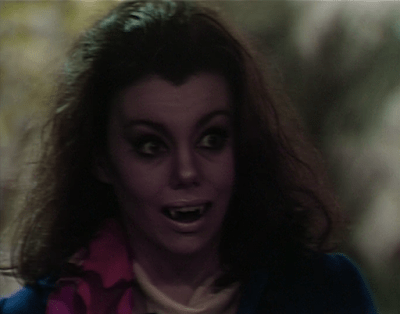
Heiress Carolyn Collins Stoddard has had a dream in which her new husband, whom she knows as Jeb Hawkes but who when we first saw him asked to be called Jabe, was in a fight on top of Widows’ Hill. His opponent, a stooge named Sky Rumson, threw him off the precipice to his death. When she awoke, Carolyn ran to the hill in search of Jabe. Instead, she found Sky. He told her that her dream was not complete, because it did not show her death. He then grabbed her by the throat.
Jabe rushes up and knocks Carolyn out of Sky’s grip. He and Sky fight, and Sky does throw him off the precipice. Carolyn escapes.
Back home at the great house of Collinwood, Carolyn finds her mother, matriarch Elizabeth Collins Stoddard, and permanent houseguest Julia Hoffman, MD. It takes her a while to compose herself sufficiently to tell Liz and Julia what happened. Julia offers Carolyn a sedative, which prompts her to jump up and shout a verbal refusal. By the time Carolyn starts telling the story, her distant cousin, old world gentleman Barnabas Collins, has joined them in the drawing room. She interrupts herself to yell at Barnabas that he always hated Jabe and is probably glad he’s dead. When Carolyn finishes, Barnabas slips out. Liz calls the police, and Julia is surprised neither of them saw Barnabas leave.
For the last nineteen weeks, the show has been trying to make a story out of some themes drawn from the writings of H. P. Lovecraft. That segment is usually called “the Leviathans,” after a race of Elder Gods who are behind the action. Jabe was central to the Leviathan segment. Sky is the only other character remaining from it. Barnabas appears in the house where Sky has been crashing and finds him packing his bag. Sky does not understand how Barnabas got in. Barnabas dismisses his question, merely saying that Sky knows there are things he can do that ordinary people cannot. Sky draws a revolver and fires two rounds at Barnabas point blank, without effect. Sky exclaims “Oh, no!” Barnabas is amused that none of Sky’s late colleagues told him that he is a vampire. He takes Sky’s hand, curls his arm back so that the gun is pointing at his heart, and squeezes Sky’s finger onto the trigger.
Back at the great house, Liz gets a telephone call from the sheriff. The police haven’t found Jabe’s body, and have surmised that it washed out to sea. They have found Sky, and have tentatively ruled his death a suicide. Later, Carolyn has another dream. In this one, Jabe shows up and confirms his death. That marks the end of the Leviathan segment. Carolyn will go on using the name “Mrs Hawkes” and saying she misses Jabe, but otherwise the last nineteen weeks will be forgotten.
Before killing Sky, Barnabas had mentioned that he almost regrets not leaving him to the other person who is on her way to do him in. That is Sky’s estranged wife, wicked witch Angelique. Had the Leviathan segment been more successful, or had Geoffrey Scott been even marginally competent in his performance as Sky, they might have made something of the parallels between Sky and Jabe. They are both very tall men with blonde wives who are dissatisfied with them. Angelique is dissatisfied that Sky is a tool of the Leviathans and that he tried to set fire to her on the orders of their representative, and Carolyn is dissatisfied with Jabe because he keeps running away from dangers he has brought on himself by his rebellion against the Leviathans and he won’t tell her anything about himself. Sky is a mortal man, while Angelique may once have been human but has long since become a creature of the supernatural. Carolyn is a mortal woman, while Jabe is now human but was originally a shape-shifting monster from beyond space and time.
But the ratings have been sinking throughout the Leviathan period, and the whole narrative structure of the arc keeps collapsing around them every time they try to do anything with it. So they are in too much of a hurry to move on to the next thing to do any exploring of the characters. Also, Scott is hopeless. As my wife, Mrs Acilius, put it, it isn’t that he is an actor with just one strategy. He keeps trying different things, and none of them comes close to working. We won’t see him again.
The new story has to do with an alternate universe that is occasionally visible in a room in the long disused east wing of Collinwood. Barnabas, Julia, and others have been spying on its inhabitants, and Barnabas is fixated on the idea that if he can cross over into it his vampirism will disappear. Since his bloodlust is overwhelming him, he is desperate to pursue this forlorn hope. He goes to the room when the alternate universe cannot be seen there, and a moment later finds that it has changed with him in it. Julia is in the hallway, looking in. At first she and Barnabas can see each other, and she can hear him, though he cannot hear her. After a moment, Carolyn’s alternate universe counterpart enters and demands to know who Barnabas is and what he is doing in the house.
Barnabas took Carolyn as his blood-thrall in October 1967. The show went back in time to 1795 the following month. In the 1790s segment, Nancy Barrett played fluttery heiress Millicent Collins. We saw that Barnabas first became a vampire in 1796; not long after, he took Millicent as his blood thrall. Shortly after the show returned to contemporary dress in March 1968, one of Julia’s colleagues in the mad science profession applied a treatment that put Barnabas’ vampirism into remission. That freed Carolyn of her connection to him, and at some point she forgot it ever happened.
For most of 1969, Dark Shadows was set in 1897. In that segment, Miss Barrett played repressed schoolmarm Charity Trask. Barnabas bit her, too. Carolyn’s counterpart in “Parallel Time,” known by her married name Carolyn Loomis, is the fourth character* Miss Barrett played on Dark Shadows; considering that Barnabas is so frantically hungry, it looks like she will follow in the footsteps of her predecessors and serve as his breakfast.
*Or fifth- in #819, sorcerer Count Petofi found Charity’s personality to be an irritant, so he erased it and replaced it with that of the late Pansy Faye, a Cockney showgirl/ mentalist. From that time on, Miss Barrett played Pansy, not Charity.
Suave warlock Nicholas Blair first joined the cast of characters in June 1968, posing as the brother of Cassandra, wife of Roger Collins. Since Cassandra was an alias that 200 year old wicked witch Angelique was using, we knew right away this could not be so. Nicholas asserted himself as Angelique’s boss, faced down the ghost of the fanatical Reverend Trask, and kept saying that he had a plan that was far more important than Angelique’s petty little scheme to establish herself in the great house of Collinwood and turn Roger’s distant cousin Barnabas Collins back into a vampire. As played by Humbert Allen Astredo, Nicholas kept us believing for weeks that we would be in awe once we heard his plan.
Eventually, Nicholas stumbled upon the fact that Barnabas’ best friend, mad scientist Julia Hoffman, had constructed a Frankenstein’s monster in the course of a project to keep his vampirism in remission. From that point on, Nicholas declared that his plan was to force Julia to make a female Frankenstein’s monster, to mate the already existing monster to her, and thereby to breed a new race of people loyal only to his master, Satan. He’d been on the show so long at that point that his sudden parachuting into the Frankenstein story only revealed that up to that point, all his talk about his grand design had been empty boasting.
Moreover, Nicholas’ plan for the patchwork people did not make sense in the context of the show. In a novel or movie like Rosemary’s Baby, the audience sees the heroine raped with the acquiescence of her husband, and our horror at that crime gives force to the premise that she will bear Satan’s only begotten son, who, in an inversion of the Christian story, will transform the whole world by the very fact of his birth. Stealing fresh corpses, chopping them up, and stitching them together isn’t the same horror as rape, but it is a pretty disgusting way to spend an evening, so I suppose that will get you off to some kind of start. But if your show is on the air for half an hour a day across the board Monday through Friday, your audience has time to sit with Nicholas’ scheme and think through all of the practicalities it implies. The new race is going to take many years to grow and multiply and overtake H. Sap., even if its members all have Soap Opera Rapid Aging Syndrome. What are we all supposed to do in the interim, watch the Frankenbabies through nanny cams? It isn’t an idea for series television.
Nicholas not only saddled himself with a plan that obviously wasn’t going to work, he didn’t deliver on his claim to be a surpassingly talented sorcerer. In #528, Angelique asked him to slip a potion to one of her adversaries. He complained that “I am much too talented to spend my time drugging drinks,” but he complied with the request. Not only did that turn out to be a waste of time, later he would on his own initiative drug a couple of other people’s drinks, again without the results he wanted.
Eventually, Nicholas fell in love with Maggie Evans, The Nicest Girl in Town. That amused Angelique, who taunted him with all the times when he had sneered at her for the humanity she showed in her emotional attachment to Barnabas. As Nicholas grew fonder of Maggie, his powers became less reliable, and his involvement with the main plot became more tenuous. No longer able to make Angelique obey him, Nicholas was reduced to using unsightly ex-convict Harry Johnson as his henchman. By the time the Frankenstein project collapsed and Satan called Nicholas back to Hell, not even Astredo’s considerable acting talent could make us take him seriously.
Nicholas returned in February 1970, just over five weeks ago. At that point the show was mainly concerned with an attempt the writers were making to take some material from the tales of H. P. Lovecraft and make a story out of them. The Leviathan People are Elder Gods who want to reconquer the Earth and destroy humankind. Their harbinger was a shape-shifting monster who had taken the form of a tall young man and invited people to call him Jabe. Jabe was supposed to join with Roger’s niece Carolyn to produce a new race of people.
The Lovecraft material never came together, and by the middle of February the makers of the show were scrambling to find a new direction. Nicholas appears to have been a last-minute replacement for a different sort of villain who was supposed to take over as the chief menace in the second half of the segment. Now they have thrown out that second half and are trying to get to something else before the ratings drop any further. So they brought back an already established character and plugged him into the scenes originally meant to be played by the one they never got around to introducing.
Bringing Nicholas in to the Leviathan arc makes it hard for longtime viewers to ignore the similarities between the Leviathans’ plan to breed a new race and his 1968 plan for the patchwork people, including the shared weakness that if either plan were successful, it wouldn’t leave you anything to put on a daytime soap. Also, Nicholas explicitly acknowledges that he has already failed in one such project, lampshading the problem but not alleviating it. He also keeps bringing up his “Master,” who is clearly still Satan. No other character in the Leviathan arc makes reference to any themes derived from Christianity- everyone else is living in the determinedly non-Christian world of Lovecraft’s imagination. So he seems out of place from the beginning.
The Leviathans’ plan was already nearing collapse when Nicholas showed up. Every time Jabe has used his powers, the results have backfired on him. His personality has alienated all of his allies. And now he doesn’t even want to be a shape-shifting monster anymore- he fell in love with Carolyn, and just wanted to take her on dates and then marry her. Nicholas is supposed to be the trouble-shooter who will turn this troubled operation around, but nothing about him inspires confidence that he is the right person for that job.
Since Nicholas arrived, things have gone downhill for the Leviathan cause even faster than they had been before. In #966, Nicholas watched in horror as Jabe smashed the box from which he originally emanated, causing all of the Leviathans’ other visible belongings to vanish. Nicholas then declared that everything was over, and that the time of the Leviathans was no more. But they still didn’t have another story ready to go, so he and Jabe have continued to hang around. Nicholas still has one follower, Angelique’s estranged husband Sky Rumson, but since there is no reason for Sky to be on the show either, that isn’t much of a basis for Nicholas’ continued presence. On his great blog Dark Shadows Every Day, Danny Horn called Nicholas a “failure demon”; all in all, that would seem an apt classification.
Today, Jabe turns up at Nicholas’ place. Nicholas knows that Angelique cursed Jabe to be plagued by a mysterious shadow not his own that follows him and drives him mad. This much is borrowed from George MacDonald’s 1858 novel Phantastes, but unlike the Reverend MacDonald’s allegory of sin and anxiety this shadow is a physical weapon that will kill Jabe when it grows strong enough. Jabe asked Nicholas to use his powers to lift Angelique’s spell the other day, but Nicholas refused, even though he claimed that he could and he acknowledged that it would have been to his advantage to do so. The opening voiceover today reminds us that Nicholas knows all about the shadow.
Now, Jabe is telling Nicholas that he was wrong to turn against him, wrong to smash the box, wrong to give up his destiny of leading the Leviathans to global dominion. Nicholas dwells on his exhaustive knowledge of the shadow and tells Jabe he can take the shadow from him and set it on Angelique. He begins to hypnotize Jabe. When he seems to have Jabe in a trance, he tells him he does not give second chances, and that he is going to kill him and Carolyn. Jabe suddenly produces the paper cutout Angelique used to place the shadow curse on him and places it on Nicholas’ jacket. He then runs out of the room. The shadow appears and envelopes Nicholas, who collapses. Even though he knew in advance exactly what was going on, Nicholas still could not avoid death as the result of getting slapped on the chest with a piece of construction paper. He dies as he lived, a failure demon to the end.
Sky enters. Jabe returns, and Sky tells him Nicholas is dead. Sky whines that because Nicholas was not human, his death will not be the end of him and Jabe will not get away with killing him. Geoffrey Scott’s appallingly bad acting reinforces the image of Nicholas as a colossal loser- if this was the only ally he had left at the end, he must have been an even more hopeless stumblebum than we had thought. Jabe exits. A moment later, Nicholas’ ghost appears to Sky and tells him to kill Jabe.
Jabe goes back to the great house of Collinwood to tell Carolyn that he is rid of the shadow. They are married now, but have spent very little time together because the shadow has kept chasing Jabe off. She is puzzled by the whole thing, in part because Jabe refuses to tell her anything about his situation, and is unenthusiastic about Jabe’s renewed insistence that they go away immediately. She agrees to leave with him in the morning.
Carolyn goes upstairs. In the drawing room, Jabe hears Nicholas’ voice telling him that he will never escape. Roger’s son, strange and troubled boy David Collins, enters; Jabe tells him that he and Carolyn are going on a trip tonight.
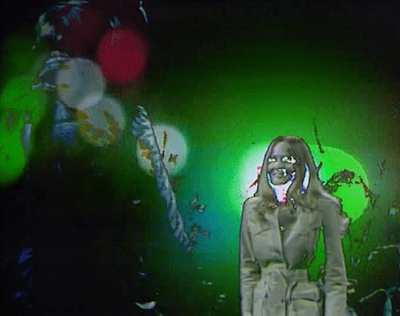
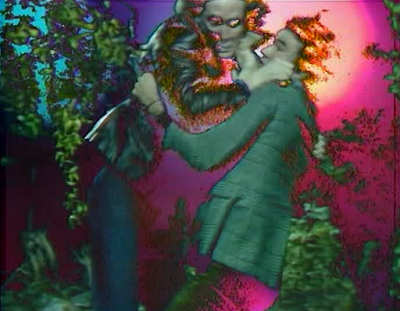
Jabe sent Carolyn upstairs with orders to pack and tell her mother they were leaving, but it would seem she has not complied. She is snoozing in a chair in her room. She has a dream. It begins with Nicholas’ voice rasping at her that it will all end at Widows’ Hill. She then sees Jabe and Sky, lit in groovy psychedelic colors, arguing about Nicholas and fighting near the precipice. Sky throws Jabe over the edge.
Carolyn awakens, calls for Jabe, and rushes out. On her way she tells David that she is going to Widows’ Hill. A moment later Jabe comes along, and David relays this information to him.
Carolyn gets to the top of Widows’ Hill, where Sky is waiting for her. He tells her that the dream Nicholas sent her stopped short of its end, because he did not want her to see her own death. He grabs her by the throat.
Meanwhile, in another universe…
While Jabe, Nicholas, and Carolyn are cleaning up the messes the Leviathan segment left behind, Roger is busy getting the new storyline off the ground. There is a room in the long disused east wing of the great house in which an alternate universe is occasionally visible. Roger goes there, and sees the counterparts of Carolyn and David. They are talking about the boy’s parents, whom Roger ascertains to be, not himself and undead blonde fire witch Laura Murdoch, but the counterparts of his distant cousin Quentin Collins and of Angelique. Everyone else we have seen in “Parallel Time” has the same first name as their counterpart in the main continuity, but David’s is named “Daniel.”
Roger never found out who Cassandra really was, so it is a puzzle for longtime viewers how he knows Angelique’s name. Carolyn and her mother met her under that name at the house she and Sky shared, but somehow did not recognize her as Cassandra. She visited them at Collinwood after her marriage to Sky broke up, but did not see Roger there.
Arrivals and Departures
This is the first time we see this Daniel Collins, but not the first time we are exposed to his name. The closing credits for #958 billed David Henesy not as David Collins, the role he played that day, but as Daniel Collins. I don’t know whether they had already decided that would be his name in Parallel Time and the person making up the credit roll got confused about it, or if the writers thought the goof was funny and gave the character the name as an inside joke.
Also, Mr Henesy played a character named Daniel Collins in February and March 1968, when the show was set in the year 1796. Since they have established that the two universes diverged during that Daniel’s lifetime, he may be this Daniel’s namesake. There is another connection, an accidental one I’m sure but an accident with a bit of an eldritch quality to it. In #350, three weeks before the 1790s segment began and more than sixteen weeks before Daniel made his first appearance, a slip of Nancy Barrett’s tongue left Carolyn referring to David as “Daniel.” It’s odd that the two Daniels were both heralded by these small inadvertences.
This episode marks, not only the final appearance of Nicholas, but also that of Roger. Louis Edmonds will play Roger’s counterpart in the Parallel Time segment, and as these episodes are being taped he is playing still another iteration of Roger on the feature film House of Dark Shadows. He will also be back in another role later on. But all the character development Roger has gone through since we first saw him in episode 1 is at an end.
Monday’s episode gave Roger his real sendoff, and my post about it summed up his history. I will just mention here that when I first saw Dark Shadows, Roger was something of a puzzle to me. That was the 1990s, when I saw it on what was then The SciFi Channel. The first episode I saw was #193, featuring art dealer Portia Fitzsimmons, but I didn’t have a chance to watch it at all regularly until a month or so after that, when Barnabas had already joined the cast. By that point Roger was already very much confined to the margins.
Curious as to when the dazzling Mrs Fitzsimmons would return, I looked online and found what is now the Dark Shadows wiki. I was disappointed to find that she was a one-off character. I also found that her function was to bring to a head a major story centering on Roger. I then looked through the episode summaries of the first weeks of the show. Those were quite terse and indigestible, meant to remind people who had seen the episodes of points they had forgotten. But one thing I did gather from them was that Roger had been a major character when the show started, indeed its chief villain. I couldn’t imagine the sardonic but lovable Roger of 1967 and 1968 in that capacity, and when I finally saw those episodes many years later I was thrilled by Edmonds’ performance.
One of the strongest themes of Roger’s character in his early days as a villain was his open hatred of David. It is nice for longtime viewers that he makes his final exit with an affectionate fatherly hand on David’s shoulder.
For sixteen weeks, Dark Shadows kept gearing up to tell us about the Leviathan People, a Lovecraftian race of Elder Gods who had a plan to retake the Earth and destroy humankind. During that time, the show gave us several good scenes, some striking images, a few thrilling moments, and many outstanding performances. But it never came together into anything that could be called a story. Today, they officially run up the white flag.
The harbinger of the Leviathans is a shape shifting monster from beyond space and time. The monster settled into the form of a tall young man, fell in love with heiress Carolyn Collins Stoddard, and decided he just wanted to be human and marry her. Nicholas Blair, high priest of the cult devoted to the service of the Leviathans, wants to join him and Carolyn, not in marriage, but in a ceremony that will turn her into the same kind of squamous, rugose, and paleogean creature the monster is when he is relaxed. The monster disrupts that ceremony, and suddenly the whole Leviathan project crumbles.
Nicholas tells the monster that he will die soon, since he can no longer change out of his humanoid form. The monster doesn’t understand what he means. Nicholas explains that the body through which he once invited people to “Call me Jabe” cannot live on its own. Since he can no longer shift shape, the monster’s future as Jabe is extremely limited.
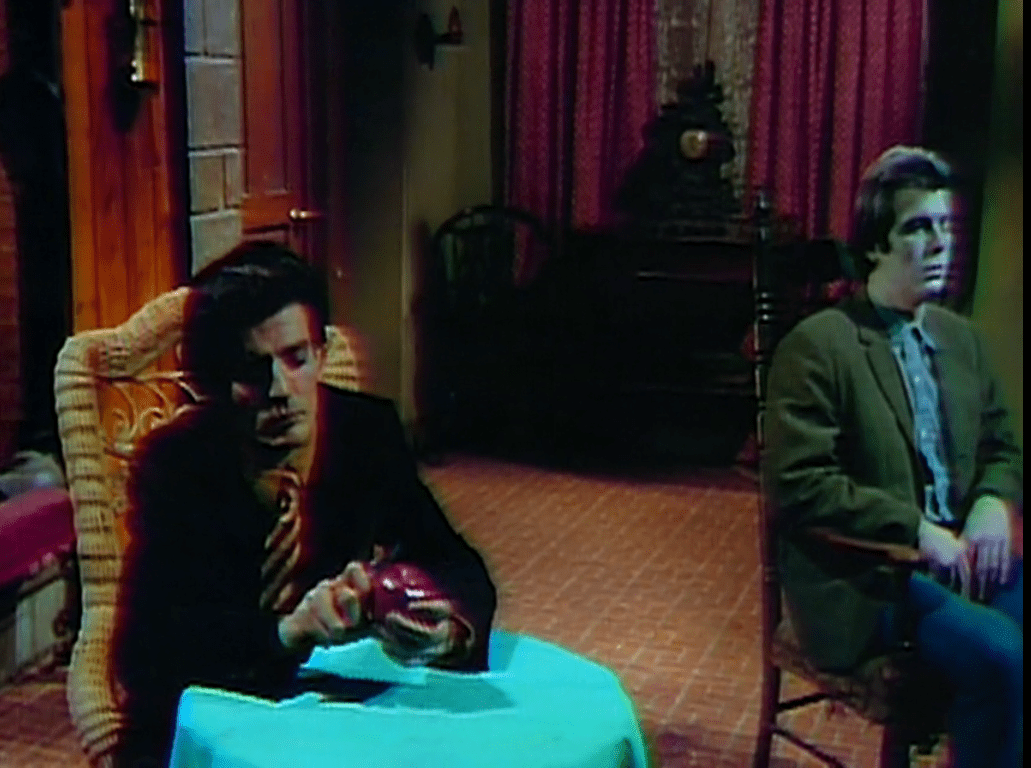
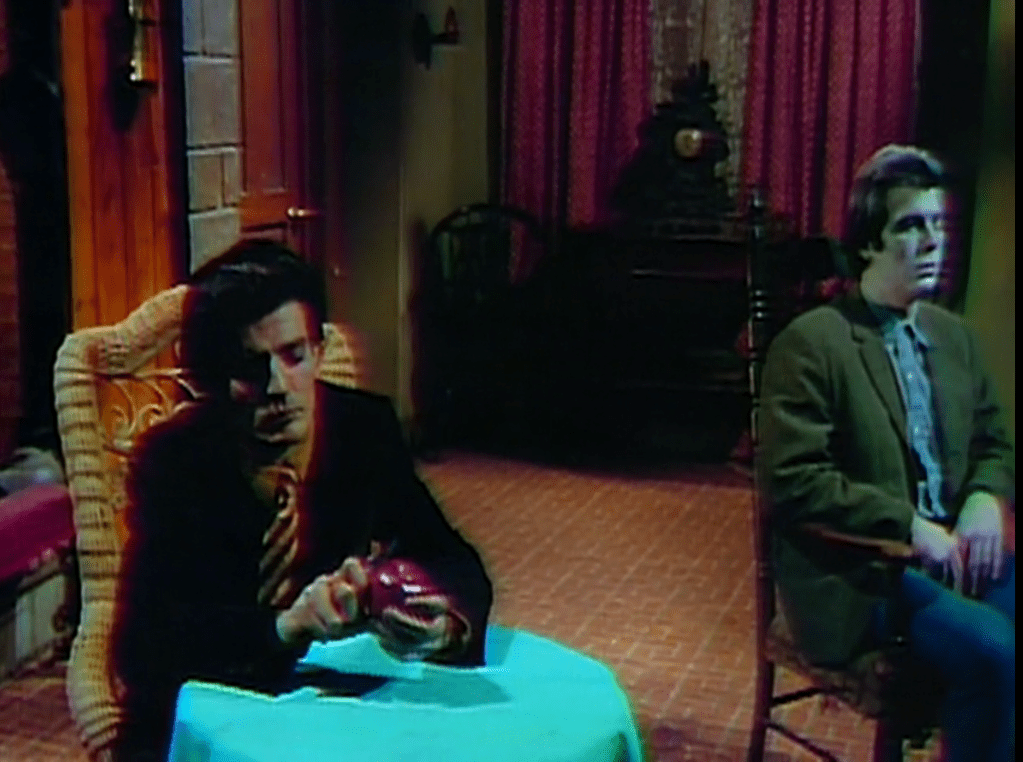
Meanwhile, Nicholas’ henchman Bruno is hanging around the carriage house on the estate of Collinwood, where Jabe has been staying. He peels an apple and sits in a chair next to a zombie. We’ve seen plenty of zombies, but no one on the show has had anything to eat since the diner at the Collinsport Inn was a frequent set in 1966 and early 1967, so the apple is noteworthy.
In a different role, Michael Stroka visited the diner in its one post 1967 appearance, in #813. No one was being served that time, though.
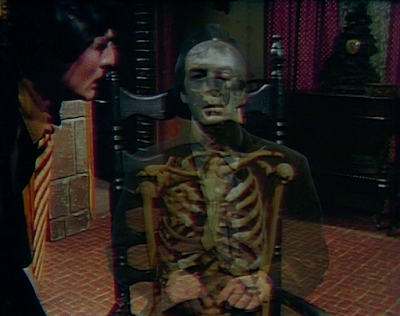
Bruno finds that there is a fire raging in the back room, and orders the zombie to help him put it out. As he gives this order, the zombie’s flesh and clothing disappear. All that is left of him is a skeleton. Bruno goes to the woods and finds another skeleton, this one with eyes in its sockets and clothes around it. He sees Nicholas, and tells him that “All our dead have turned into skeletons!” Nicholas explains that the power of the Leviathans is broken, and their time is up.
Old world gentleman Barnabas Collins takes his distant cousin Carolyn back to her home in the great house of Collinwood. Barnabas tells Carolyn’s mother, matriarch Elizabeth Collins Stoddard, that Carolyn is in a trance. They take Carolyn upstairs and put her in bed.
Liz has been under the control of the Leviathans, a dedicated and ruthless member of their cult. She asks Barnabas what is going on, and he launches into a denunciation of the Leviathans. She responds with complete bewilderment. Barnabas realizes that Liz is not only free of the Leviathans, but that she does not remember them or anything she did for their sake.
This may disappoint longtime viewers. Throughout 1967 and 1968, the show kept Liz firmly shielded from any knowledge of the supernatural stories, let alone active involvement in them. For most of 1969, Dark Shadows was a costume drama set in 1897, and Joan Bennett played Judith Collins. Unlike Liz, Judith was allowed to know what was going on and to take part in the action. She was under mind-control when she shot governess Rachel Drummond to death, but when she was released from that control she remembered what she had done and was desperate to cover it up. In that desperation, she became a player in several plot-lines and we saw what Bennett could do when she had something to work with.
Liz hasn’t actually killed anyone, but she did lock governess Maggie Evans up to keep her from getting in Jabe’s way, and, when it looked like Jabe would kill Maggie, Liz’ greatest worry was that the resulting publicity would exonerate the man who has been framed for the murders Jabe had already committed. So if she came out of the cult remembering what she had done, Liz would be free to become a full participant in any story. Now, she snaps right back into her usual place, which is nowhere at all.
Jabe comes to Carolyn’s room. He orders Liz to get out of his way. As a cultist, she had responded to this sort of thing with dutiful obedience, but now she is quite properly indignant. Jabe is pleased to see that she has changed, but he keeps insisting she let him talk privately with Carolyn, and never thinks to say “please.” At Carolyn’s request, Liz finally agrees to this.
Jabe tells Carolyn that he will die soon unless he goes far away. He refuses to explain why this will happen, as he has consistently refused to answer any of Carolyn’s questions about him. But she somehow loves him anyway, so she agrees to marry him in the morning and leave town with him immediately after. Carolyn writes a farewell note to her mother, then falls asleep.
Carolyn has a dream in which she and Jabe go to the drawing room at Collinwood to get married. They find Nicholas there, and he starts in on the same Satanic invocation he had made before Jabe put the kibosh on the whole Leviathan segment. This was so incongruous that Mrs Acilius and I laughed out loud. Carolyn’s own shocked reaction absorbs the incongruity into the drama. Barnabas interrupts the ceremony and demands that Jabe admit that he murdered Carolyn’s father, Paul Stoddard.
Three times, Carolyn has had dreams in which Jabe made it clearer and clearer that he murdered Paul. Another distant cousin, Quentin Collins, came to her during waking hours and told her the same thing in so many words. But somehow it hasn’t clicked yet. In this dream, Jabe’s reaction to Barnabas finally gets the message through to her. Carolyn says she knows that Jabe killed Paul, and in response Jabe puts his hands around her throat and starts choking her.
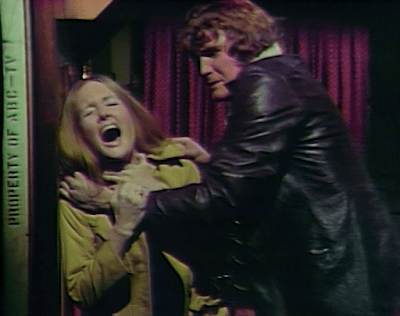
Carolyn wakes up. She goes to the carriage house and tells Jabe she can’t marry him. She won’t explain why. Jabe is enraged by this. He puts his hands around her throat and starts choking her.
Christopher Pennock was a fine actor and a seriously nice guy, and in the last few days he has made us want to believe that Jabe has turned over a new leaf. But this closing makes it clear that he is still a no-goodnik. The Leviathan material is all they have had on the show lately; there are some other characters who have problems that could be developed into something, problems such as lycanthropy and vampirism, but those have been completely subordinated to the Leviathans and are in any case nothing new to Dark Shadows. So despite Nicholas’ assurance that Jabe can’t exist much longer, it is hard to see an end to a period when all they have to offer are Jabe’s tantrums.
When Jabe is choking Carolyn, the camera drifts a bit and exposes the “Property of ABC-TV” stencil on the side of the scenery:
For most of 1968, Dark Shadows was a shapeless mess. The makers of the show had caught on that the audience liked monsters, so they kept tossing one monster after another into the mix, hoping to repeat the popular success they had had with vampire Barnabas Collins the year before. One of the storylines that ended up disappointing this hope most completely was that centering on 6’4″ Frankenstein’s monster Adam; another was the “Dream Curse” that was supposed to revive Barnabas’ vampirism after it had been put into remission by the mad scientists who created Adam.
Suave warlock Nicholas Blair was on the show in those days. Nicholas appeared to be a regional manager for Satan’s operations in upper New England. He found out about Adam and came up with the idea of using him as the progenitor of a new species that would displace humankind and win the Earth for his master. Adam met heiress Carolyn Collins Stoddard and fell hard for her. He also developed an interest in the writings of Sigmund Freud. But he never clicked with the audience, and Nicholas’ plan didn’t make any sense in the context of the show. So the plan flopped and Nicholas was called to the main office. He’s back today.
The A story for the last fourteen weeks has been the effort of the Leviathan People, a race of Elder Gods, to use a 6’4″ shape-shifting monster as the progenitor of a new species that will displace humankind and win the Earth for them. The monster, who once invited people to call him Jabe, met Carolyn and fell hard for her. The Leviathans want Jabe to take Carolyn as his bride and turn her into a creature like himself, but he would rather be human and take Carolyn out on dates. Jabe isn’t the reader Adam was. Adam might be interested in Jabe’s current projects, though. When he was growing into his adult form, Jabe’s foster parents were antique dealers Philip and Megan Todd. He has now arranged to kill Philip, and as we open today he is passionately kissing Megan.
The door opens, and Nicholas enters. He tells Jabe that he is his boss, and that the Leviathan takeover of the Earth was his idea. It is the same idea that didn’t work last time he was on the show, and when he tells Jabe that he failed that time he adds that he does not intend to be punished for failing again.
Nicholas bullies Jabe into going to his room and turning into the inhuman monster he really is. Henchman Bruno shows up to consult with Nicholas while Jabe is in the room. Nicholas tells Bruno it is his responsibility to see to it that Jabe doesn’t kill anyone else. Nicholas leaves, and Bruno goes into Jabe’s room. Less than a minute after Nicholas told him to keep Jabe from further killing, Bruno is standing before the monster, apparently about to be killed.
Bruno manages to get out of the room alive. Jabe returns to human form and follows him. Bruno gasps that Jabe was going to kill him. Jabe replies that he wasn’t, “it was.” Adam might have found significance in this remark. One of Freud’s central concepts was a division between the ego (from the Latin pronoun equivalent to the English “I”) and the id (from the Latin for “it.”) People repress their unacceptable urges and attribute them to something separate from themselves. So, I don’t want to kill my father and marry my mother, it does. Bruno tells Jabe that in the room, he is “it,” and moreover that he himself, as a devotee of the Leviathans, wants to become something like “it.” Evidently the Leviathans’ promise to their followers is that they will replace their ambiguous and divided personalities with pure unreasoning id.
Jabe tells Bruno that he wants to be human. Bruno is horrified by this, commanding “Don’t even say that!” Indeed, Nicholas had said that for the Leviathan People, wanting to be human is the ultimate sin. That suggests a backstory which, if developed, might make the Leviathans scarier than they are. All tales of Elder Gods who want to take the Earth back raise the question of how they lost it in the first place. If our remote ancestors figured out a way to take it from them, surely we, who can learn everything they knew and add to it knowledge they lacked, will be able to prevail against them at least as easily.
But if it was envy of early humans that wrecked the Leviathan world order, a couple of possibilities open up. It could be that some of them defected to join us, so that their final defeat was mostly a struggle between Leviathans with our forebears as helpless on-lookers. In that case, it would remain to be seen whether humans could beat Leviathans. It could also be that the Leviathans who joined the human side have descendants among humans today, and that some of those descendants are vulnerable to co-optation by the Leviathans who are trying to reclaim their former position. There is a hint today that this might turn out to be the case- Bruno asks Nicholas why the estate of Collinwood is so important, and Nicholas, looking uncomfortable, tells him that there is a reason, but that he cannot explain it. Perhaps the members of the Collins family have some Leviathan blood that makes them at once receptive to the appeals of their estranged kinfolk and peculiarly dangerous to them if they are antagonized.
Nicholas is a logical choice to represent the idea that the greatest weakness of the Leviathan People is the temptation to become human. At the zenith of his power in 1968, he would reprove his subordinate Angelique for her romantic feelings for Barnabas, sneering that they made her “so human.” His downfall began when he fell in love with Maggie Evans, The Nicest Girl in Town, and found himself being humanized. So if Jabe is going to meet his doom because his desire for Carolyn makes him renounce his Leviathan form, he is going to remind longtime viewers of Nicholas, and we may as well have Nicholas on the show.
They may have had another reason to want Humbert Allen Astredo back in the cast. Lara Parker used to say that none of her acting lessons really took, and that it was only when Astredo would explain various techniques to her between rehearsals of their scenes as Nicholas and Angelique in 1968 that it all finally clicked for her. I’m sure Parker was exaggerating to make a self-deprecating joke, but it is undeniably true that her performances improved greatly after she had been working with Astredo for a while. So maybe the producers were hoping that some of the less experienced actors in the cast would benefit from time with this outstanding teacher.
The Dream Curse involved more than a dozen repetitions of a sequence over a period of months while one character after another had the same basic nightmare. The sequence involved opening a bunch of doors and seeing enigmatic images. Each time another character had the dream a little bit was added. At the end, it turned out that the curse was not able to renew Barnabas’ vampirism, so there was no point to any of it. For some reason, this did not go over very well with the fans.
Lately, Carolyn has been having a recurring nightmare. We see it for the third time today. The first time she had it, Jabe told her all about himself, and she saw that he had killed someone. Not too long after she woke up, her distant cousin Quentin came by and told her that Jabe had murdered her father Paul. The next time she went to sleep, she had the dream again, and it was clearer that Paul was one of the people Jabe had murdered. This time she even opens Paul’s coffin. She can’t figure out what the dream means. Too bad Adam isn’t around, by now he must have read Freud’s Interpretation of Dreams and enough of the case studies to apply his technique. If she told him the dream, he would be able to explain to her that the dream means that she is an hysterical female who needs to keep coming to him at least twice a week.
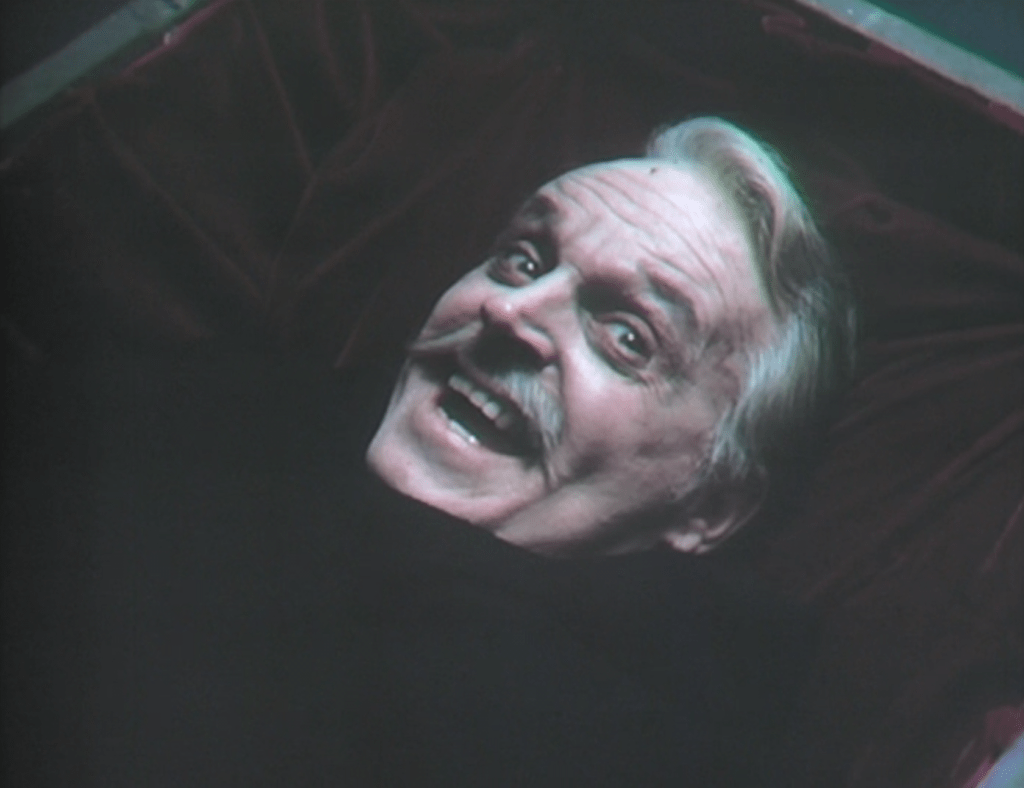
Jabe visits Carolyn, who tells him all about the dream. Not being trained in psychoanalysis, Jabe doesn’t tell her about her unresolved Electra complex or even send her a bill. He just rushes out to exhume Paul’s coffin. This leads to one of the most extraordinary images in Dark Shadows. They wanted to show that Paul’s body was there, but actor Dennis Patrick was by this time in California, producing and taking a role in the movie Joe. So they superimpose a photo of Patrick’s face on a still of a plush-lined box. The resulting image defies all description:
I’d remembered this as an image they flashed on the screen for a moment, but no, they hold it for quite a while. And then they go in for a closeup! Which is the last thing we see before the credits roll!
An old friend of mine has a brother who was hung up on Dark Shadows for a while, he apparently got the DVDs and watched them obsessively for months. When I told him that I was writing this blog, he claimed that this picture of Paul was the only thing he remembered about the show. I can believe it, really. I often try to figure out what they were thinking when they put the episodes together; as you can see with my speculation above about how the Leviathans lost the power they used to have over the Earth, sometimes I resort to some fairly elaborate fanfic to try to puzzle it out. But why they believed it was appropriate to put this image on national television, let alone to linger over it, cut back to it in closeup, and leave it as the climactic episode-ender, that stumps me completely.
Ten year old Amy Jennings is at home in the great house on the estate of Collinwood. Evidently she’s in a literal mood- she’s in the drawing room, so she’s drawing. Heiress Carolyn Collins Stoddard sees Amy’s work and asks why she is doing it. Amy says she thinks the design is “pretty”; Carolyn replies that “pretty” is the last thing she would call it. That may seem rather rude, but as Amy hasn’t been seen since #912 I suppose she’ll take what she can get.
The design is one which on Dark Shadows is called simply a Naga. It is the secret emblem of a secret cult serving the Leviathan People, a race of Elder Gods. Secret cultist Megan Todd wears the Naga on a large pendant around her neck; Megan’s husband, secret cultist Philip, wears it on a shining ring; Carolyn’s mother, secret cultist Elizabeth Collins Stoddard, wears it as an oversized broach. Amy herself is a secret member of the secret cult, but she hasn’t yet acquired any conspicuous jewelry emblazoned with the secret symbol, leaving her to do her own artwork. Carolyn wonders aloud why so many people are so preoccupied with the design.
Quentin Collins enters. Amy is terrified. Starting in December 1968, Quentin’s ghost haunted Collinwood. By March, the house was uninhabitable and strange and troubled boy David Collins was near death. Old world gentleman Barnabas Collins tried some mumbo-jumbo in hopes of communicating with Quentin; he came unstuck in time and found himself in the year 1897, where he remained for eight months. While Barnabas was flailing about in the late Victorian era, time continued to pass in 1969, and Quentin’s obsession of David finally killed him in September. But a sequence of events with which Barnabas had a tenuous connection changed the circumstances on the night in September 1897 when Quentin originally died, causing him to survive. That night, as it happened, was exactly 72 years before David’s death. On Dark Shadows, anniversaries have the power that laws of nature have in our world, so that caused the haunting to break and David to come back to life. Due to a series of spells cast on him during Barnabas’ sojourn in the past, Quentin is still alive and still apparently in his late twenties in 1970. But the haunting still happened between December 1968 and September 1969, and everyone who lived through it still remembers it.
Quentin has introduced himself to Carolyn as his own great-grandson. Since Carolyn never actually saw his ghost, she is willing to accept this. But Amy had more dealings with the ghost than anyone but David, and it is obvious to her that they are one and the same. She clings to Carolyn.
Carolyn laughs at Amy’s fear and tells her that this Quentin is not the ghost, but is “a cousin of ours.” This is intriguing to regular viewers. It was during the 1897 segment that the audience learned that Quentin was the great-grandfather of Amy and her brother Chris, and just a few weeks ago that Chris learned about that relationship. It is through their descent from Quentin that Amy and Chris are cousins to Carolyn. So if Amy knows she is a Collins, she must have been told that the ghost that tormented her and David was that of her great-grandfather. A scene in which someone gave her that information might have been a good use of Denise Nickerson’s considerable acting talent, but they didn’t bother to produce one.
Quentin tells Carolyn to leave him alone with Amy. Still chuckling, she complies. Once they are alone in the drawing room, Quentin kneels and touches Amy’s face, assuring her that he is “not that Quentin Collins.” David Selby brought immense charm to the role of Quentin, so this scene isn’t as revolting as it might have been, but it is still pretty bad, and we can’t be surprised that Amy is not satisfied.
Amy goes to the village of Collinsport to seek guidance from her spiritual advisor. He is a shape-shifting monster from beyond space and time who usually takes the form of a very tall young man. When he first assumed that form, he invited people to “Call me Jabe,” but no one did. They call him “Jeb” instead, and he answers to it.
Jabe lives in a room above Megan and Philip’s antique shop, and when Amy enters the shop she finds him looking after the place. Apparently shape-shifting monsters from beyond space and time aren’t above doing a little work in retail now and then. She tells Jabe about her encounter with Quentin, and then tells him about a dream she had. In the dream, she went into the long-disused room where she and David first met Quentin. Quentin’s theme song, a sickly little waltz, was playing; she exclaims “It was terrible!” Longtime viewers know the feeling. The tune played incessantly during the “Haunting of Collinwood” period, and when they went back to 1897 characters kept complaining to the living Quentin that he was making them miserable by playing it on his phonograph all the time.
In the dream, Quentin appeared to Amy wearing the nineteenth century clothing and the angry scowl that he wore when he was a ghost. But when he was a ghost, he never spoke words the audience could hear. The only exception was a dream sequence in #767, when Quentin’s ghost spoke to David. That was also the only other dream sequence to be presented as this one is, in flashback as the dreamer is recounting it after the fact. That sequence marked a watershed, the first attempt to explain how Quentin the cranky ghost emerged from Quentin the charming scoundrel we had got to know in the 1897 segment.
This episode, also, has to do with the relationship between these two iterations of Quentin. Amy tells Jabe that Quentin’s ghost in the dream warned her against him by name, and says that she is therefore convinced that the living man she met in the drawing room today is in some way identical to the ghost who haunted the house for those ten months. Amy’s dream marks the final appearance of Quentin’s ghost, but we can see the ghost will not be forgotten.
A state police investigator named Lawrence Guthrie is in town looking into two murders Jabe has committed, those of Carolyn’s father Paul and of a law enforcement officer whose gravestone revealed that his given name was “Sheriff Davenport” (we never learn what Mr Davenport’s title was.) Jabe orders Philip to kill Guthrie. Philip calls Guthrie and asks him to come to the antique shop when Jabe will be out. Once Guthrie is there, Philip tells him that the upstairs room where Jabe stays is an important part of the story of the murders. He shows Guthrie into the room. He stays outside, and locks Guthrie in. Guthrie encounters Jabe there in his true form; Jabe kills him. This is quite effectively handled. My wife, Mrs Acilius, was completely caught off guard by the killing. She believed Philip really was trying to break free of the Leviathan cult, and wondered what Guthrie was supposed to find in the room.
Neither Jabe nor Philip is an especially well-developed character, but Christopher Bernau and Christopher Pennock were both fine actors, and they play off each other very well today. It is a tribute to their performances that Guthrie’s death scene comes as a surprise.
At the end, Quentin is at Collinwood trying to tell Carolyn that it was Jabe who killed her father and Mr S. Davenport. Inexplicably, Carolyn is interested in dating Jabe, and is unwilling to listen to this. Jabe bursts in and announces that there has been another murder, that the murderer is in custody, and that he has confessed to it and to the killings of Paul and Sheriff. That murderer, Jabe says, is Philip. That’s another surprise- after the murder of Guthrie, Jabe did tell Philip that he had another task to perform, and once we hear that he has confessed to the killings it makes perfect sense that that would have been what Jabe meant. But I don’t think anyone could have predicted it. It makes for a strong ending.
Danny Horn’s post about this episode on his great blog Dark Shadows Every Day is a lovely little bit of fanfic proceeding from the assumption that Lawrence Guthrie is the brother of Dr Peter Guthrie, the parapsychologist whom undead blonde fire witch Laura Murdoch Collins killed in March 1967.
The closing credits again misspell writer Violet Welles’ name as “Wells.” They started doing that last week, around the same time the misspelling of wardrobe house Ohrbach’s as “Orhbach’s,” a frequent goof in the show’s first year, reappeared after a long absence.
Episode 361 was virtually a one-woman show, featuring Grayson Hall as Julia Hoffman, MD. Julia was being tormented by haunted house-style effects resulting from her involvement with a supernatural entity. The script, by Ron Sproat, was largely a recycling of an episode Sproat had written for Never Too Young, the soap opera that ran on ABC at 4 PM before Dark Shadows premiered.
Episode 658 consisted largely of a one-man show, featuring Joel Crothers as fisherman Joe Haskell. Joe was being tormented by haunted house-style effects resulting from his involvement with a supernatural entity. The script, by Gordon Russell, owed a good deal to Sproat’s work on #361.
Episode 897 ended with a long scene that amounted to a one-woman show, featuring Marie Wallace as antique shop owner Megan Todd. Megan was being tormented by haunted house-style effects resulting from her involvement with a supernatural entity. The script, by Violet Welles, drew from both #361 and #658.
Many fans consider #361 to be The Worst Episode of Dark Shadows, and many consider Megan’s turn at the end of #897 to be The Worst Scene on Dark Shadows. To the extent that #658 is remembered at all, it is because it is one of Crothers’ last appearances on the show. The memory of this fine and well-loved actor makes the fans so weepy that no one can be very harsh about his final star turn.
Today, the second half of the episode is virtually a one-woman show featuring Nancy Barrett as heiress Carolyn Collins Stoddard. Carolyn is being tormented by haunted house-style effects resulting from her involvement with a supernatural entity. The script, by Gordon Russell, recycles elements of #361, #658, and #897.
Russell was usually one of the most careful writers on Dark Shadows, but this one is remarkably shoddy. Carolyn and her mother, matriarch Liz, are staying at the home of a woman named Angelique. Angelique tells them that she has to drive to the airport to pick up her husband, and that she will be away for “several hours.” A couple of minutes later, Liz is also called away, and she tells Carolyn that she is sure “Angelique will only be gone an hour or so.”
Worse, all the action of the episode is completely, flagrantly unnecessary. The calls that leave Carolyn alone in the house are part of a monster’s scheme to get at Carolyn. But Liz is the monster’s loyal servant- if he had told her to bring Carolyn to him, she would gladly have done so.
Carolyn’s torments aren’t quite a monodrama, since they are interrupted by a couple of brief scenes with other actors. But one of those is a dream sequence in which she talks to the monster while we see him silhouetted in darkness. The interaction between them is so limited he may as well be a recorded voice. She also has a few interactions with Angelique’s husband. Since he is played by Geoffrey Scott, he may as well be a cardboard standee.
One advantage this episode has over #361 is that Nancy Barrett was excellent at screaming, second only to Clarice Blackburn in her ability to produce a true blood-curdler. Grayson Hall, accomplished as she was, had asthma and was physically incapable of controlling the timbre of her voice when she raised its volume above a certain level. Sproat’s script for #361 required Julia to scream several times, and every time she tried it Hall emitted a croaking sound that raised a bad laugh. Miss Barrett’s closing scream today, by contrast, really puts the “opera” in “soap opera,” it sounds great.
This is one of the few episodes with no scenes on the estate of Collinwood, and one of very few to take place primarily in a location many miles from the village of Collinsport.
There’s also an interesting moment when Angelique claims to have met Liz and Carolyn’s distant cousin Barnabas while they were both living in England. Barnabas never lived in England, that’s a lie he has been telling his relatives to conceal the fact that he is a recovering vampire who hasn’t left Maine since George Washington was president. Liz is part of the current supernatural storyline and Carolyn has at various times known all about Barnabas, so we don’t expect to be reminded that he’s still peddling the “cousin from England” bit.
Six weeks ago, old world gentleman Barnabas Collins was absorbed into a group serving supernatural beings known as the Leviathans. Also in the group is matriarch Elizabeth Collins Stoddard. Barnabas and Liz are worried that mad scientist Julia Hoffman, Barnabas’ sometime best friend and Liz’ permanent houseguest, is catching on to the truth about their group. They decide Julia must be absorbed into it.
Barnabas finds Julia on a couch in the drawing room, reading a book about lycanthropy. He strikes up a conversation about Chris Jennings, a young man who suffers from that condition. Julia replies bitterly that she still cares about Chris, unlike Barnabas. He tells her that he does care, and they quarrel a bit. He then strokes Julia’s cheek. He did the same thing with Chris’ little sister Amy in #912, at which point Amy fell asleep. Shortly after Amy woke up, she had become part of the Leviathan group. Julia gets a headache and goes to her room, where she does fall asleep.
We didn’t see a dream sequence when Amy fell asleep, but do see one for Julia today. The visuals alternate between two stock clips of lightning flashes as we hear Jonathan Frid give a dramatic reading of some portentous nonsense, then give way to Julia finding Barnabas in the drawing room inviting her to open a wooden box. We saw a dream of Liz’ in #904; she woke from it already transformed into a faithful devotee of the Leviathans. But when Julia wakes up, she just has a worse headache.
They’ve shown us this clip more times than I can count…… but I don’t think we’ve seen this one before. It’s fascinating to me, like an image David Lynch would have used in Eraserhead or the third season of Twin Peaks.
Julia goes downstairs and find Liz holding the box from her dream. She is urging her to open it. Julia is confused by the situation. A knock comes at the door, and she rushes to answer it. It is Chris, saying that it is time for Julia to drive him to the institution where he is locked up on nights of the full moon. Julia calls back to Liz that she will be back later in the evening.
Barnabas enters and says that Julia will never be absorbed into the cult. If she were suited for absorption, the knock at the door would not have distracted her. He explains that “There are certain people, Elizabeth, whom we are not able to absorb. It has to do with their genetic structure. And Julia Hoffman is one of them.” As a former vampire who is now leading a cult that is trying to bring a race of Elder Gods back into the world where they will destroy and replace humankind, Barnabas is supposed to be strange and unnerving, but hearing him talk about “certain people” and their “genetic structure” is off-putting in a whole other way. Why not just say that she’s Jewish, we know you mean that she’s Jewish.
Barnabas then tells Liz that it is now up to her to handle Julia. So far as we know, Liz does not have any special powers like those Barnabas uses when he fondles people’s faces. Liz doesn’t even know what the cult is all about- today, she asks Barnabas what the goal is they are working for, and he tells her he isn’t at liberty to say. So when Barnabas tells her to deal with Julia, we can only remember the last time we saw Joan Bennett playing a character under the control of an uncanny force, when Judith Collins shot and killed neurotic intellectual Rachel Drummond on the orders of vampire Dirk Wilkins in #776.
In #915, one Leviathan ordered Barnabas to kill Julia. When he refused, another caused him to have nightmares, then told him it was OK to leave Julia alive if he could find another way to keep her under control. That episode was written hurriedly and rushed into production at the last minute, three full weeks after this one was in the can, in response to complaints from fans dissatisfied with the Leviathan story in general and Barnabas’ coldness to Julia in particular. It’s anybody’s guess what they were originally planning to do with #915, but today’s episode makes it clear that it did not include the reset of Barnabas’ character that we saw yesterday. He is still leading the Leviathans, and when he delegates the problem to Liz murdering Julia is pretty obviously the likeliest solution.
Not a Portrait of Quentin Collins
Julia’s plan for Chris is to persuade an artist named Charles Delaware Tate to paint a portrait of him. Tate painted a portrait of Chris’ great-grandfather, Quentin Collins, in 1897. That portrait had magical powers. Once it was painted, Quentin’s own werewolf curse went into abeyance. It was the portrait that transformed on nights of the full moon, while Quentin himself remained human. Indeed, the portrait also caused Quentin to remain young and healthy. He returned to Collinsport a couple of weeks ago, and though he is 99 years old he still looks just like he did when he was 28. In #913/ 914, Julia found that Tate, also, is alive, and still looks like he did in 1897.
Quentin and Tate are not the only emigrés from 1897 currently sheltering in Collinsport. Another of Tate’s magical portraits, a concept piece depicting his ideal woman, caused its subject to pop into existence. In 1897, she went by the name Amanda Harris, met Quentin, and fell in love with him. She, too, is unchanged in 1969, though she now calls herself Olivia Corey.
Amanda/ Olivia and Julia are both hunting for paintings by Tate, and met each other through that pursuit. They have also met Quentin, and vied with each other to decide which would be the one to keep him. He has amnesia and knows only that he was carrying papers identifying him as Grant Douglas. He is open to the idea that this is not his real name, but he finds Julia’s attempt to convince him that he is a 99 year old man ludicrous and is frustrated with Amanda/ Olivia’s unwillingness to tell him when and where they first met.
Amanda/ Olivia comes back to her suite at the Collinsport Inn and finds Quentin there, swilling her booze and enormously drunk. He tells her that he finds his room depressing, because it doesn’t have a bar. He says he can’t stand not knowing who he is. She points out that he has taken this in his stride up to now, and asks why today is different. He says he doesn’t know why it is different, but it very much is. When the show was a costume drama set in 1897 and we saw Amanda, she did not know about Quentin’s lycanthropy, and now that she calls herself Olivia she still does not think of the full moon when she sees him in anguish.
Later, Julia shows up at Amanda/ Olivia’s door. She has brought one of Tate’s portraits of Amanda Harris. Amanda/ Olivia staggers back at the sight of it. She composes herself and says that it is of no interest to her, since she already has several of Tate’s paintings of her “grandmother.” Julia tells Amanda/ Olivia that the real reason she is not interested in it is that it is not a portrait of Quentin Collins. She replies that Julia is the one who is fascinated by Quentin, not she. Julia says that she wants to show the portrait to Quentin. Amanda/ Olivia does not bother pretending that his name is “Grant Douglas” or that it might be something other than “Quentin Collins”; she simply tells Julia that he is in his room sleeping off an alcoholic binge. Julia adopts her most unmistakably Mad Scientist manner when she responds “Then this is definitely the right time to see him!” She marches out, and Amanda/ Olivia follows her.
Julia had told Chris that if Quentin’s portrait has been destroyed, his lycanthropy will be back in force. If that is so, she wants to be with him when he transforms. This was a doubly confusing thing to say. First, if the portrait had been destroyed, Quentin would not only be a werewolf, he would also look his age. She therefore knows it is not so. Second, she does not have anything with her to protect her against werewolves. If she is with Quentin when he transforms, he will kill her immediately.
When Julia and Amanda/ Olivia let themselves into Quentin’s room, they find that it is a shambles and he is gone. As a closing cliffhanger, this is supposed to leave us with the fear that a werewolf is stalking Collinsport. But since we know what the portrait does for Quentin, it only leaves us wondering if Amanda/ Olivia will have to pay an extra housekeeping charge because he trashed the room she was renting for him.
When Julia met Tate in #913/914, she could not get him to engage her in any kind of conversation, much less agree to paint a portrait of Chris. She did not mention Amanda/ Olivia. Since Tate was maniacally obsessed with Amanda in 1897, Julia should have known that her acquaintance with her was the strongest card she had to play. So when she goes to Amanda/ Olivia’s suite today, returning viewers were hoping that she was going to propose they team up to persuade Tate to paint Chris. Perhaps that will still happen. If it does, it might be a lot more interesting than is the revelation that Quentin doesn’t keep his hotel room clean.
In #701, old world gentleman Barnabas Collins traveled in time from 1969 to 1897. For the next eight months, ending in #884, Dark Shadows was a costume drama set in that year. On his way back to a contemporary setting, Barnabas took a detour to the 1790s, when he was a vampire. Before he left the 1790s, he was abducted by and absorbed into a cult that serves supernatural beings known as the Leviathans. At their behest, he took a small wooden box with him to November, 1969, and functioned as one of the leaders of the Leviathan cult in that period.
The first six weeks of the Leviathan story has had its strengths. Ever since Barnabas was first cured of vampirism in March 1969, he has been under the impression that he was a good guy and has been doing battle with various supernatural menaces. He was hopelessly inept at this, and created as much work for the other characters by his attempts at virtue as he formerly did in his unyielding evil. That has made him a tremendously productive member of the cast, but it does leave him with a tendency to seem harmless, even when he is trying to murder his way out of a problem. But Barnabas the Leviathan chief has been ice-cold and formidably efficient. Even though not much has yet been done to hurt anyone, seeing him in this mode adds a note of terror to the proceedings.
Moreover, the Leviathans have voided Barnabas’ friendship with mad scientist Julia Hoffman. Since the relationship between the two of them has been the heart of the show for over two years now, from the hostility of their early days to the close bond they formed in the summer of 1968, this reinvigorates the action. It is as interesting to see them fight with each other as it is to see them collaborate against a common foe, and their hate scenes gain an extra depth because we keep wondering about their eventual reconciliation. If they play their cards right, they should be able to keep this up for months.
Today, it all falls apart. Barnabas has drawn a huge following of very young fans who run home from elementary school to watch the show. The 1897 segment was a triumph in large part because it had a core of stories that could hold the attention of adults while also appealing to the preteen demographic. But the Leviathan arc has so far had little to offer anyone but grownups. Apparently the kids were writing angry letters, because this episode, rushed into production at the last minute and bearing signs of haste in every shot, turns Barnabas back into the would-be hero who was such a klutz that he couldn’t even stay in the right century.
The creature who emerged from the box Barnabas brought from the past now appears to be a 13 year old boy and answers to the name Michael. In the opening scene, Michael orders Barnabas to kill Julia. Barnabas declares that he will not, and goes home. There, he tells his troubles to the box, then falls asleep in his chair.
A hooded figure appears to him. This hooded figure says that he is a Leviathan, and tells Barnabas he must comply with Michael’s commands. The Leviathan is not named in the dialogue and there are no actors’ credits at the end, but reference works based on the original paperwork call him Adlar.
Adlar sets out to explain Barnabas’ position, much as Marley’s ghost did to Scrooge in Dickens’ A Christmas Carol. The shortened production schedule shows in inconsistencies that litter Adlar’s speeches. At one point he says that the Leviathans needed Barnabas to transport the box from the eighteenth century to the twentieth; at another, he claims that they are holding his lost love Josette prisoner in the eighteenth century and will inflict a new, far more horrible death on her than the one she died the last time Barnabas was in the 1790s, a threat they will be able to carry out only if they have their own means of traveling back and forth through the years. Barnabas doesn’t pick up on this or any of Adlar’s other inconsistencies; perhaps he is too distracted by the many jump cuts that make this episode look like the videotape was edited with a rusty butter knife.
Adlar threatens to make Barnabas a vampire again, then disappears. He does not tell him that he will be visited by three spirits, one representing his past, another his present, and the third the future he is risking by his present course of action, but this is in fact what happens. Barnabas goes outside, and sees a bat. It was a bat whom he first saw on this very spot who initially made him a vampire. Barnabas rushes inside, looks in the mirror, and does not see a reflection. He thinks of his mouth, and feels fangs growing there.
Next comes Megan Todd, a Leviathan cultist who with her husband Philip is fostering Michael in their home. Barnabas cannot take his eyes off Megan’s long white neck. Megan keeps telling Barnabas that he is the only one she can confide in about her concerns with the progress of the Leviathan plan; he keeps demanding ever more stridently that she leave at once. His bloodlust may explain why he doesn’t notice the continuity problem in the scene. They’ve made the point time and again that it is only while Barnabas is giving orders to her and Philip that Megan remembers that he is their leader. At other times, she thinks he is an outsider. But Megan is the only one who can tell Barnabas a story of family life in any way paralleling that which the Ghost of Christmas Present brings to Scrooge’s attention at the Cratchit house. Continuity has to go if the episode is going to fit into the form of A Christmas Carol.
Suddenly, Barnabas finds himself in an alley by the waterfront. A sign behind him says that he is next to the Greenfield Inn; we saw this sign in #439, set in the year 1796. Evidently the Greenfield Inn is a long-established, though not very reputable, place of lodging.
A woman approaches him. She is very aggressive about insisting he take her with him wherever he is going. He is reluctant at first, urging her to seek friends at the Blue Whale tavern, but she won’t take no for an answer. All of a sudden, he brightens and looks at her with desire. She says she is afraid of him. He asks if she wants to go, and she screws up her courage to declare that she will stay with him. He bares his fangs and attacks. The rough videotape editing adds to the violence of the scene. There is no sensuous bite, only a flash as he lunges at her and then is standing up again, protesting that he didn’t want to do it. When the camera zooms in on the bleeding marks on her neck, it is surprising to see that he didn’t rip her throat out altogether.
We cut back to Barnabas’ house. He is dozing in his chair, and the woman, displaying vampire fangs of her own, walks in through the front door. She approaches Barnabas. He awakens, and is horrified. Adlar tells Barnabas that “she is not up to your usual standards.” She’s standing right there, that’s pretty tactless. Also, she is future four-time Academy Award nominee Marsha Mason. The only other Oscar nominee Barnabas bit was Grayson Hall as Josette’s aunt, the Countess DuPrés, in #886. Hall was only nominated once, so if anything this woman is a step up for him.
Adlar makes the woman disappear, and shows Barnabas that he is not really a vampire again. With that, we see that she is a shade of a future that may come to be, not one that is already ordained. Adlar also tells Barnabas that it is not now necessary to kill Julia. But he does say that Barnabas will have to do something to ensure Julia’s silence, or else Josette will suffer. Barnabas hangs his head and says to the mirror that he has no choice to obey.
Matriarch Elizabeth Collins Stoddard (Joan Bennett) was usually a blocking figure in the first 73 weeks of Dark Shadows, and when the pace of the stories picked up sufficiently that they didn’t need to slam on the brakes so often she drifted far to the margins. When she does show up, she is usually a talk-to for characters who might actually do something. The few times she has been the center of attention have been when she was so crushingly depressed she was a suicide risk. At one point she went beyond that, succumbing to a boredom so extreme that she lapsed into a catatonic state and was mistaken for dead.
Today, Liz is being atypically dynamic. She is trying to figure out what her nephew, strange and troubled boy David Collins, has been up to. Her investigations have shown her that David stole an old book from an antique shop and bought some clothes at a department store. These aren’t exactly the most thrilling discoveries of the age, especially when it appears that David has already returned the book to its rightful owners, but it represents a big step up from her usual activity level.
Liz walks in on David in his room, and finds him reading from a book. He denies that it is the book from the antique shop, but she doesn’t believe him. Later, Liz is poring over the book in her drawing room when her distant cousin Barnabas comes in. She tells him she doesn’t recognize the language or the script in which it is written, but that she has found certain blocks of text that are repeated throughout, in the manner of ritual language. She thinks it must be a religious book of some kind. Barnabas recognizes this as a remarkably intelligent observation. He offers to take the book to the antique shop himself. Liz happily accepts his offer, and goes upstairs to bed.
Liz has a dream. In the dream, David is wearing a fat suit. He takes her to a funhouse. At first the mirrors merely add to her chronic depression, but she brightens when she sees Barnabas in one of the mirrors. And when David recites a bit of doggerel- “Fat and Skinny had a race, all around the steeplechase./ Fat fell down and broke his face./ Skinny said, I won the race!” she laughs heartily. She wakes up. In her bed, she is staring into space, all jollity gone.
Most of the dream is shot in a kaleidoscopic style, splitting the screen into many copies of the same image. Regular viewers know that Dark Shadows puts kaleidoscopic patterns on the screen when it is showing people submitting to one or another form of mind control. For example, when mad scientist Julia Hoffman hypnotizes people, we often see pictures that seem to come from inside a kaleidoscope. Liz herself asks David at the beginning of the dream if the mirrors will show her “all the people I could have been”; he says that no, “They’ll show you all the people you really are.” Since the dream is full of odd looking dolls and puppets, that suggests all the people she really is are controlled by someone other than herself. The cut from her laughing face at the end of the dream sequence to her blank expression when she wakes up would also suggest a discontinuity between the Liz who had the dream and the Liz who will rise from bed.
Over the last few weeks, the show has been developing a story about a cult devoted to mysterious supernatural beings known as the Leviathan people. The cult is secretly absorbing one person after another, enabling the Leviathans to act through them. Barnabas and David have taken turns leading the cult, and the owners of the antique shop are members of it. If Liz is no longer herself, we must conclude that she has now been coopted into the cult as well.
Liz’ daughter Carolyn works at the antique shop. Early in the episode, she met a man whom we could see only from the chest down. He was wearing a belted overcoat. In #902, we had the same view of a man wearing the same overcoat as he wandered into Liz’ house, straightened a portrait of Barnabas, hid from Carolyn, and wandered out again. Evidently this is the same man. Later, Barnabas went to the shop, and Carolyn told him she was smitten by the man and that he would be coming back when the shop closed, after 10 pm.
The man does come back as promised, but doesn’t quite make it into the shop. He is between the streetlight and the door, in a space which we must interpret as representing a sidewalk, when Barnabas runs him down with his car. Carolyn comes out of the shop and Barnabas claims that the man just darted out of nowhere, giving him no chance to stop. It is unclear when Barnabas learned to drive. When he was first on the show in April 1967, he was a vampire who had been sealed in a coffin since the 1790s. He was cured of the effects of vampirism in March 1968, and in #687 we heard about him driving. Perhaps his training in the rules of the road was irregular. Still, you would think he would have a better excuse for driving into a pedestrian than failing to expect him to be on the sidewalk.
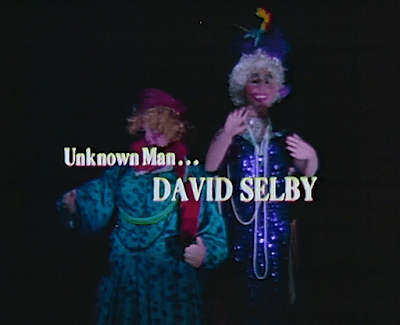
The camera zooms in on the injured man’s face. We don’t see enough of it to be sure who it is. The closing credits tell us that “Unknown Man” is played by David Selby. It must be a goof that we don’t see much of Mr Selby’s face. Over the year he has been playing the rakish Quentin Collins, Mr Selby has become a huge breakout star, rivaling the fame Jonathan Frid has gained as Barnabas. Surely they wouldn’t put him on unless they wanted us to recognize him.
Quentin first came on the show as a ghost at the end of 1968, and found his greatest success from March to November 1969, when the show was set in the year 1897. Since the show returned to a contemporary setting, we have been sure that Quentin will be back, but we haven’t had any reason to expect him to return at any particular time. In #887, the first episode set in November 1969, we saw the back of a man prowling about the estate of Collinwood; we might have suspected he was Quentin. But he turned out to be Liz’ ex-husband Paul Stoddard, who had never before been a real character on the show and who has been unmentioned for more than two years. So when we are kept from seeing the face of another prowler, he could be anyone at all. Perhaps Frank Garner is training to be a ninja, or Ezra Hearne is having a personal crisis.
The closing credits run over this image from Liz’ dream. The dolls move while the credits are scrolling over them, the effect is hilarious. I didn’t think the dream sequence was particularly effective, but I wish every episode ended with these two figures doing their little act.
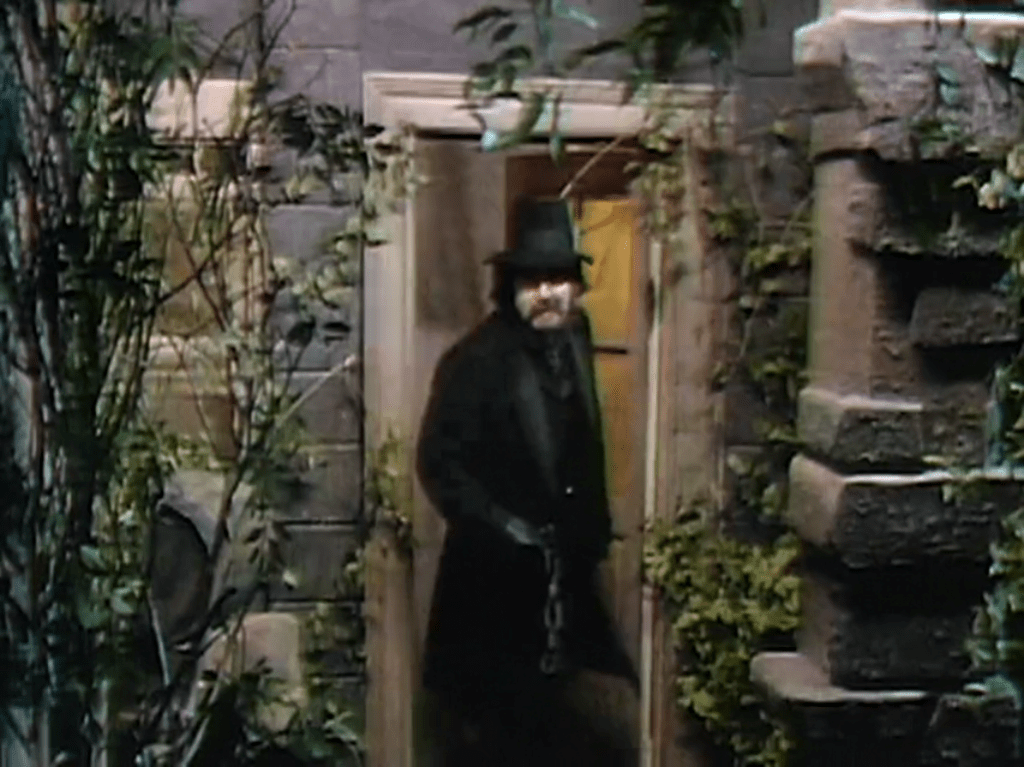
The dramatic date is November 1897. We open in an abandoned mill on the old North Road in Collinsport, Maine. The late Garth Blackwood, once the keeper of Britain’s Dartmoor Prison, is about to avenge his own murder. Blackwood was raised from the dead by sorcerer Count Petofi and Petofi’s stooge, artist Charles Delaware Tate. Petofi wants to be rid of his unreliable servant Aristide, and decided that Blackwood, whom Aristide killed while escaping from Dartmoor and has feared ever since, will be the one to slay him.
Blackwood is ready to strangle Aristide, who takes a moment to tell him that if he does so he will be endangering his own existence. He explains that there are others who conjured him up to perform the very task he is about to undertake, and that once he has completed it they will not need him anymore. Blackwood says that this is no problem. Once he has killed Aristide, he will kill them too. He pulls a chain tight around Aristide’s neck.
Tate is outside while this is happening. The set represents the exterior of the mill. The set is alternately in deep shadow and illuminated by lightning flashes. We haven’t seen it before, it is rather nice.
Tate hides while Blackwood leaves, then goes into the old mill and confirms that Aristide is dead. Aristide was a nasty and inept fellow, but Michael Stroka found so many ways to make him fun to watch that he will be missed.
Back in his studio, Tate tells Petofi what he saw. He also reminds Petofi that Blackwood has killed two other people, and that he will in all likelihood go on killing everyone he meets. Petofi doesn’t care about any of that. All that interests him is his plan to forcibly swap bodies with handsome young Quentin Collins and, as Quentin, to travel to the year 1969.
Blackwood storms in, declares that Petofi and Tate are his prisoners, and says that they are under sentence of death. Petofi tries to cast a spell to make Blackwood go away; he finds that there is more to Blackwood than his magic can control. He can only hold him at bay, and that only for a moment. Tate shoots Blackwood. The bullet wounds cause him to fall and briefly lose consciousness, but he is soon back on his feet. He leaves, and vows that he will return to finish what he started.
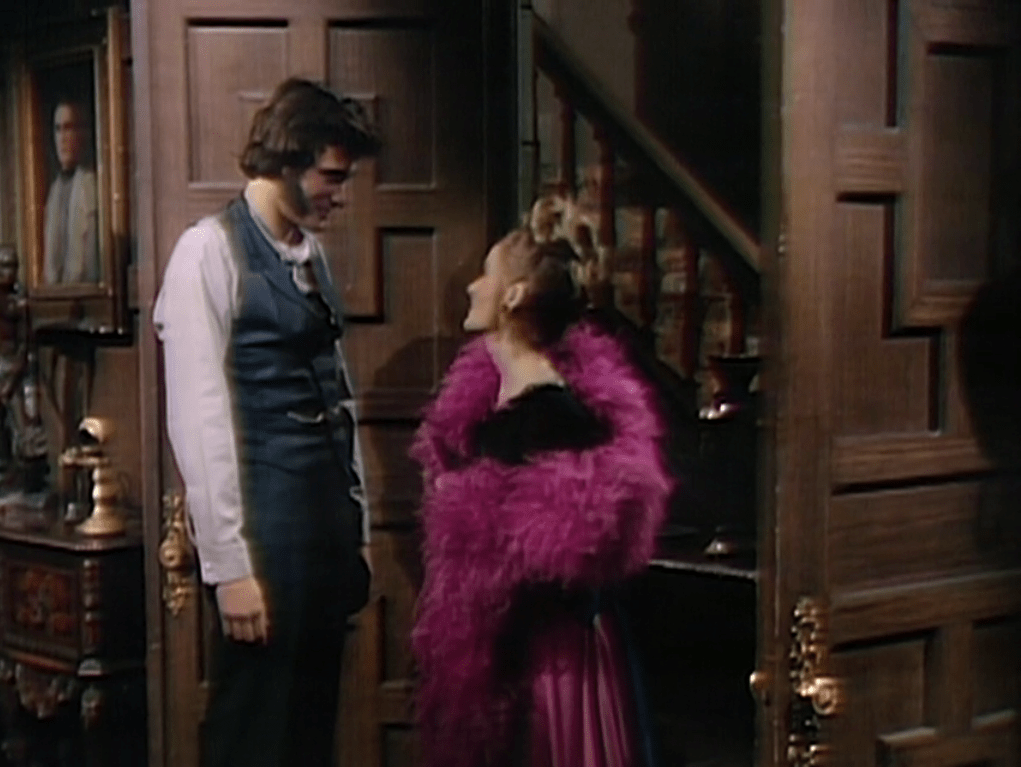
At the great house of Collinwood, Quentin is going through his belongings. Cockney showgirl/ mentalist Pansy Faye enters. Quentin explains that he will be leaving on the early morning train to get away from Petofi. Pansy is sad to see him go, but she well knows how dangerous Petofi is. Quentin further explains that he has been looking through all his old stuff to see if any of it is worth keeping. He doesn’t think any of it is, but she thinks a photograph of him at the age of ten is adorable, and is glad when he makes a gift of it to her. They share a really lovely moment, as she says that she still wishes they could have become lovers and he plays along. She says that if he’d married her, she’d even have given up her career for him. He says gravely that he never would have asked her to do that. Quentin never asked Pansy for any of what she wanted to give him, and her reaction to this line shows that it has reminded her of that fact. But she still cares about him, and it is still a sweet little exchange. They smile their unforgettable movie-star smiles at each other when they part.
Later, Pansy has a dream in which Quentin falls asleep and Petofi seizes his body the instant his guard is down. She awakes, and realizes she must rush downstairs to prevent this dream coming true.





 Dark Shadows Commentary