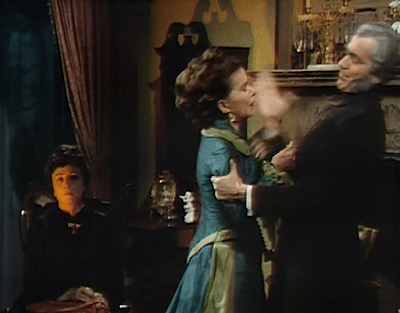
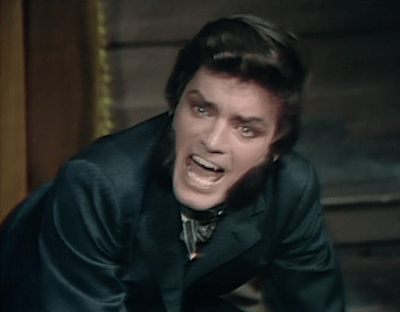
Broad ethnic stereotype Magda Rákóczi is in her home, the Old House on the estate of Collinwood. She takes a hatchet and chops a plastic model of a severed hand into two plastic models, each representing half of a severed hand. She then throws a handkerchief into the fireplace, all the while declaring that no further trouble will come from the hand. Later, she goes to the great house on the estate and tells handsome libertine Quentin Collins about this; to her surprise, he responds by flying into a rage and choking her.
Quentin’s rage abates when a huge image of the hand materializes in the room and floats towards Magda’s rear end. After she goes home, it materializes again and again drifts towards the same destination. With that, she runs outside.
Meanwhile, some activity is going on at The Blue Whale tavern. One man asks another for information about Quentin. The inquirer is named Aristide; the other, Tim Shaw. Tim identifies himself as an employee of the Collins family. Tim tells Aristide that all he knows about Quentin is that he is an arrogant jerk and that the only reason his family lets him live in their mansion is that their grandmother’s will requires them to. Aristide says that he already knew those things, and he asks Tim to carry a message to Quentin.
Tim is in the foyer of the great house while Magda and Quentin are in the drawing room. He eavesdrops on their conversation about the hand. He overhears them saying that the hand is magical, that properly used its powers are limitless, and that it is in a box at Magda’s. After the hand’s second attempt to grope Magda’s buttocks drives her from her house, Tim sneaks in, finds the hand, and tells it that it is just what he needs.
The message Tim brought from Aristide invited Quentin to meet at The Blue Whale. Quentin goes and brings up something that happened a few days ago, when Aristide tied him to a table and tried to kill him. Aristide agrees that this was not a good plan. Aristide says that Quentin can be “cured”; returning viewers know that Quentin is a werewolf, and that it is for this condition that he wants a cure. Aristide admits that he does not know what the cure is; Quentin says that if he had claimed he did know, he would have killed him. But he says that someone else does know. Quentin learned yesterday that Aristide is in the service of a man whom he knows as Victor Fenn Gibbon; evidently Aristide was not aware Quentin had picked up on that, because he is alarmed when Quentin drops Fenn Gibbon’s name. Nonetheless, Quentin does agree to meet Aristide again, and to give him proof that he has the magical hand. Once he has been cured, Quentin will surrender the hand to him.
Before Magda entered the drawing room at the great house, Quentin had been talking with Miss Charity Trask, his sister’s new stepdaughter. Returning viewers know that Charity’s father, the evil Gregory Trask, has decided she ought to marry Quentin. This scene is the first time we see Charity trying to follow this plan. She mentions that Quentin is a widower. It has not been clear to us whether this is generally known. His wife Jenny was hidden away the year before, after he left her, and she was buried very quickly after he murdered her in #748. For all we know, Charity may not know that Jenny is dead, or even that she ever existed. Quentin’s siblings have been holding information about Jenny very tightly; it was just yesterday that Quentin learned Jenny bore twins while he was away. At the same time, he learned that one of those twins has died. He tells Charity that he is a father, and she is confused.
I don’t suppose any of this sounds very exciting, but it is a remarkably fast half-hour. The script is crisp and rapid; even viewers who haven’t missed an episode and know all the background will appreciate the air of mystery that arises from leaving so much unsaid and unexplained. And the actors are uniformly excellent. I can imagine a first-time viewer seeing this one and making a note to watch again tomorrow.
In the first few decades of commercial television, ambitious shows tended to imitate live theater; since, they’ve tended to imitate feature films. Today’s episode is one of Dark Shadows’ stagiest, and it is a strong one.
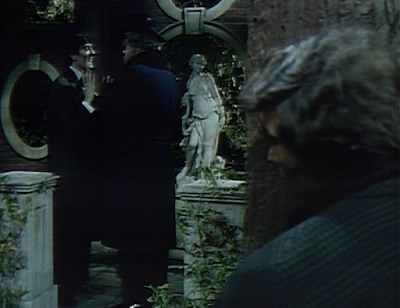
The rakish Quentin Collins has lost his hopes of being cured of werewolf-ism, and is moping in the gazebo on the grounds of the estate of Collinwood. He is staring at a revolver, trying to talk himself into committing suicide. He hears two men approaching, and takes cover in some nearby bushes. The men are known to Quentin by the names “Aristide” and “Victor Fenn Gibbon.”* The set is so small that the actors are only a few feet away from each other, but we are supposed to believe that Quentin can’t quite hear what Aristide and Fenn Gibbon are saying. So when the camera is placed at Quentin’s point of view, Michael Stroka and Thayer David vigorously mime the act of talking.
Quentin sees Fenn Gibbon slap Aristide’s face. Aristide responds, not with violence of his own, but with a continuation of the talking he had been doing before, showing Quentin that Fenn Gibbon is Aristide’s boss. The other day, Aristide tied Quentin to a table and tried to kill him by reenacting Poe’s “Pit and the Pendulum,” so this tells Quentin that Fenn Gibbon is his deadly enemy.
We hear some of Aristide and Fenn Gibbon’s dialogue. Fenn Gibbon and Aristide are based on Gutman and Wilmer from The Maltese Falcon. In their previous appearances, Aristide has been eager to connect with every attractive young woman he sees, suggesting that we would not see the strong suggestions of a sexual relationship that come with Gutman and Wilmer both in Dashiell Hammett’s 1930 novel and the 1941 film. But today, Aristide’s unshocked reaction to Fenn Gibbon’s slap shows that he is accustomed to robust forms of physical contact with him, and when Fenn Gibbon tells Aristide that “I’m aware of your charms, my dear Aristide, but I know only too well conversation is not among them,” we can see that there is going to be a substantial gay subtext.
Fenn Gibbon is one of two roles Thayer David plays today. He appears in the opening teaser as broad ethnic stereotype Sandor Rákóczi, husband of the even more offensively conceived Magda. Yesterday, Magda was placed under a curse. At that time, the curse was that everyone who loved Magda would die, but today it is that everyone she loves will die. When Magda talks about the curse with visiting vampire Barnabas Collins, he says that he is under the same curse, which is exactly true- in #705, he was told that everyone who loved him would die, and from the next episode on it was said that everyone he loved would die. Whichever way the curse is put, one would expect it to strike terror in Magda’s heart regarding Sandor. They are a happily married couple, the only one we ever see on Dark Shadows, and so one would expect him to be the first victim of the curse.
The curse was supposed to start when Magda heard three knocks on the front door of her home, the Old House at Collinwood. She hears the knocks, opens the door, and sees Sandor. She immediately falls into the same pattern she exhibits every time she sees Sandor, accusing him of infidelity, accusing him of coming back to her only because he has run out of money, telling him not to bother to lie to her, and generally having a wonderful time. But he is standing rigidly still, his eyes are glazed over, and he can speak only a few words, none of them the usual insults they exchange. He falls dead, a knife in his back. Barnabas touches his body, and says that it is cold, as if he had been dead a long time.
Later, Magda goes to Mrs Fillmore, a woman in the village of Collinsport. Quentin’s late wife Jenny was Magda’s sister. Unknown to Quentin, Jenny gave birth to twins after he left her, and his brother Edward decreed that the twins would be raised by Mrs Fillmore. Magda has never seen the twins, but she loves them nevertheless- the boy twin, anyway; she tells Barnabas that “Gypsies do not prize girls.” When she comes back to the Old House, Magda tells Barnabas and Quentin that the boy twin is dead. Mrs Fillmore said he was perfectly healthy that evening, then she heard a mysterious scream from the children’s bedroom and she found him dead in his crib. His body was cold, as if he had been dead a long time. Quentin is numb, bewildered to learn that he was a father and simultaneously to learn that he has outlived his son.
There have been other episodes in which an actor played one character as a living being and another as a ghost. There have also been episodes that jumped between two periods in history, and in those there were actors who played one character in one time frame and a different one in the other. Thayer David’s doubling as Sandor and as Fenn Gibbon makes this the first episode in which the same actor plays two living beings contemporary with each other in the same episode.
Sandor’s death and Fenn Gibbon’s ascent to prominence mark a transition in the show. They are in the middle of a bloodbath, killing off a great many of the characters who have defined the first twenty weeks of the 1897 flashback. Previously, that has meant they were getting ready to reset the show and go back to contemporary dress. But 1897 has been such a hit that a transition need not mean a return to the 1960s. There is still enough going on in this period that they can introduce a bunch of new characters, develop some new stories, and get a new phase of Dark Shadows started right here in the late Victorian era. Who knows- if they play their cards right, this period might be the new home base for the show, and the 1960s might be an afterthought.
The contemporary world does make one appearance today. Before their encounter at the gazebo, Fenn Gibbon meets Quentin in the drawing room of the great house at Collinwood. Quentin is studying the Moon. The two of them have a little exchange about Quentin’s fascination with the Moon; considering that this episode aired a few hours after Apollo 11 lifted off on the journey that would put the first crew on the Moon, that fascination must have been pretty widely shared by the original audience.
*In this episode, everyone says “Fenn Gibbons,” which we have heard before. But the credits read “Fenn Gibbon,” so I’m sticking with that version.
When wicked witch Angelique first turned Barnabas Collins into a vampire in the 1790s, he went to the waterfront and preyed on the women he found spending their nights there. When Barnabas traveled in time from the 1960s to the year 1897, he again made his way to the waterfront. Whether he bit the women or not, he choked them to death, earning the sobriquet “The Collinsport Strangler.”
Once he had become a vampire, Barnabas displayed so many traits he had come to have in common with Angelique that we suspect he is not only cursed by her, but possessed by her. More precisely, it often seems that when Angelique made Barnabas a vampire she created a copy of her own personality and put it in his mind, where it took control of him. We have further support for that interpretation in today’s opening reprise. We see Angelique on the same set where Barnabas has several times been the last person a young woman would encounter. This time, she encounters a young man. He flirts with her, as the women flirted with Barnabas. Before long, he is choking and within seconds of death because of her action. In this case, she has taken his handkerchief and is tightening it around the neck of a toy soldier that once belonged to Barnabas. She is threatening to kill him unless he tells her where he has hidden the legendary “Hand of Count Petofi.”
The man’s name is Aristide. He capitulates, telling her he buried the hand at the old cemetery, in a grave marked with a stone bearing the name of Townsend. She gives the handkerchief another tug, and he falls down, unconscious.
Later, we are in the great house on the estate of Collinwood. Angelique comes down the stairs, carrying the box in which the hand is kept. Stuffy Edward Collins sees her. Regular viewers have seen the box on a table in the upstairs hallway many times, from the first week of the show onward. It is rather odd that Edward doesn’t ask her why she is carrying it around. Even if we decide to forget that the prop is familiar and decide to treat it as representing something Edward hasn’t seen before, people don’t usually walk around carrying wooden boxes in front of themselves.
Still, Edward does have other matters on his mind. Angelique had been introduced to the family as Barnabas’ fiancée, at a time when all the Collinses knew about Barnabas was that he was their distant cousin. She disappeared when he was exposed as a vampire. Edward tells her that the family’s lawyer, Evan Hanley, told him that he knew her before she met Barnabas, and that he believes that her association with him was innocent. Edward also says that he cannot believe that this is true. Angelique tells Edward a story about Barnabas biting her and making him her slave; Edward is convinced instantly, and declines her offer to leave at once. He urges her to stay at Collinwood until she can make new plans.
Meanwhile, we have learned that Aristide is alive and not seriously injured. A man in a set of whiskers that represent the aesthetic sensibilities of the late Victorian era developed to their uttermost extremity finds Aristide crumpled on the ground, rouses him from unconsciousness, and responds to his story about Angelique almost killing him with dismay that she stopped short. He tells Aristide not to do anything more. His own credentials are in order, and he will present them at Collinwood as he sets about his second attempt to get the hand.
The man does go to Collinwood. He gives Edward a letter from their “mutual friend,” the Earl of Hampshire. It attests to the good character of its bearer, Victor Fenn Gibbon. Edward insists that Fenn Gibbon stay in the house, and he accepts.
Angelique emerges from the drawing room, still carrying the box. Edward continues to ignore it; Fenn Gibbon can’t take his eyes off it. Edward introduces her as Angelique Duvall. This is the first time we have heard the name “Duvall” in connection with her; when we met her in the part of the show set in the 1790s, her name was Angelique Bouchard, and when she turned up in 1968 she called herself Cassandra Blair. Fenn Gibbon asks if she is French. She says that she was born in the USA, but that her forebears were French people who lived on Martinique. Indeed, when she was known as Angelique Bouchard she lived on that island, and it was there she met Barnabas. Fenn Gibbon tells her that lovely as France’s colonial possessions may be, none is as “exquisite” as she. She is charmed, and excuses herself. She leaves the house, taking the box with her.
While Fenn Gibbon regales Edward with tales of derring-do from the battle of Khartoum, Angelique takes the box to the Old House. There, she meets the rakish Quentin Collins, whose desperately handsome face has been severely disfigured by a previous encounter with the hand. Angelique dismisses Quentin’s girlfriend, maidservant Beth, telling her that she cannot be present during what she must now do for Quentin. Beth leaves, Angelique shows Quentin the hand, and Quentin demands that Angelique set to work curing him. She says there will be a price for her services. If she cures him, he will have to marry her. He has nothing to lose, and she looks exactly like Lara Parker, so of course he agrees.
Angelique picks up the hand and gets to work casting a spell, but the hand quickly escapes her control. She turns to find that it is on Quentin and he is in agony. He pleads with her to help, she cries out that she can do nothing, and we see Fenn Gibbon peering in through the window.
Fenn Gibbon* is the fifth role Thayer David played on Dark Shadows. The first, second, and fourth were all closely associated with the Old House. They were crazed handyman Matthew Morgan, who holed up there after he killed local man Bill Malloy; much-put-upon indentured servant Ben Stokes, who lived and worked there; and broad ethnic stereotype Sandor Rákóczi, who with his even more offensively conceived wife Magda lives at the Old House in 1897. With this iconography behind David, regular viewers will know that when they see Fenn Gibbon in the window of the Old House, they are seeing a man who knows his way around the place.
David’s third role sheds even more light on Fenn Gibbon. In the parts of the show set in 1968 and subsequent years, he plays Professor Timothy Eliot Stokes, expert on the occult and descendant of Ben. Unlike most of the characters who made a splash on the show, Stokes has a functioning conscience. He does not always live within the law, but he always strives to do what is right. When we see that Fenn Gibbon knows about the hand and has orchestrated a criminal conspiracy to obtain it, we see that he is an evil version of Stokes. At once this makes him fascinating to regular viewers. Stokes himself is a reimagining of the show’s first academic specialist in the paranormal, Dr Peter Guthrie, who was killed by a witch in #186. He is a jovial and talkative eccentric, where Guthrie was a tight-lipped and understated Yankee. Fenn Gibbon seems to have inherited Stokes’ whimsical bent and exaggerated manner; we now have to wonder what Stokes would be like as a villain.
Even those who joined the show after it went to 1897 and who therefore do not know about Stokes will be intrigued when they see David as Fenn Gibbon. Sandor hasn’t appeared since #750, but he is still alive. This marks the first time Dark Shadows has cast the same actor as two living characters in the same time frame.** Sometimes an actor has doubled as a living character and as a ghost, or has appeared in two roles in parts of an episode set in different periods of history. But this is a new frontier for doubling on the show. Sandor is always a lot of fun, so we might hope that he will be back and that he and Fenn Gibbon just won’t have scenes together. But coming on the heels of his long absence, it does have an ominous ring.
In #758, Quentin backed Angelique against a wall and asked her why she preferred Barnabas to him. That was a very good question. The two of them are obviously attracted to each other, and have a lot of fun every time they are alone together. By contrast, the only emotions Barnabas has ever shown in response to Angelique are glumness and rage. Her maniacal insistence that Barnabas should love her drove Angelique to wreak immense havoc in the 1790s, and also motivated some story in 1968. But there is nothing to it beyond his misery and her self-absorption. When we see her turn her attentions to Quentin, longtime viewers will cheer at the hope that we are about to be freed from that dead end once and for all.
*He introduces himself today as “Fenn Gibbons,” which is how he is almost always addressed. But the closing credits leave the S off his name. The closing credits have been unreliable lately, identifying Edward as his grandson Roger and misspelling Aristide’s name. Still, “Fenn Gibbon” sounds better to me; “Fenn Gibbons” suggests a group of small apes found in a peat bog.
**Don Briscoe briefly played both werewolf Chris Jennings and Chris’ brother Tom, but that is only a partial exception- Tom was a vampire at that time.
The evil Gregory Trask coerced lawyer/ Satanist Evan Hanley into helping him murder his wife, Minerva, so that he could marry wealthy spinster Judith Collins. Now Trask and Evan have conjured up a magical simulacrum of Minerva and caused it to hang around Judith. They claim they can’t see it, which, coupled with some other troubles Judith has had, leads her to believe that she has lost her mind. Trask and Evan strong-arm Judith into signing a paper, Trask locks her up in the tower room, and Evan makes the simulacrum disappear.
Meanwhile, Judith’s brother Quentin is at large. Quentin is a werewolf, and when he returned to human form this morning his face was disfigured. This worked to his advantage. He was in jail at the time, and he was being watched. The sheriff’s deputy had not recognized Quentin’s brother Edward when he came to jail that night, so it isn’t so surprising he doesn’t recognize Quentin, even though he is six foot four, has a distinctive hairdo and prominent mutton chop sideburns, and is wearing the same blue suit with a frock coat that he always wears. It is surprising that Edward doesn’t recognize him either, but this may be the result of a congenital problem the Collinses have. Not only was Quentin himself stumped when the equally identifiable Evan had a similar glob of makeup on his face recently, but Judith fails to recognize Quentin today when he comes to the drawing room. When Judith found him, Quentin was listening to his favorite record and reciting its lyrics in his unaltered voice, and he identified himself to her by name. Still, she couldn’t see it.
Quentin bursts into Evan’s room shortly after he finishes dissolving the simulacrum of Minerva. He sees that Evan’s face is no longer disfigured, and assumes that he used the magical Hand of Count Petofi to restore his appearance. Evan tells him he did not- he can’t explain why his face reverted, it just did so on its own. This does not satisfy Quentin, and it will not satisfy returning viewers. We saw Evan struggle to fix his problem for some time, and when he found himself in a crisis situation he suddenly turned up looking like his old self. So we’ve been in suspense for several days wondering what the explanation would be for his cure, and we are no more inclined to settle for a non-explanation than is Quentin.
Quentin knocks Evan out with a candlestick; the background music is a cue we have previously heard during on-camera murders, leading us to wonder if Evan will survive the blow. Quentin rummages around for a moment and finds the hand. He is looking at it, wondering how to use it to restore his appearance, when a man in a wool cap enters and orders him to surrender the hand at once.
This episode features one of Dark Shadows‘ all-time great goofs. When Evan is casting the spell to dissolve the simulacrum, a black-clad figure dashes past in front of him. A voice can be clearly heard exclaiming “Jesus, Lacy!” Evidently actor Jerry Lacy was in such a hurry to get from one set to another that he didn’t realize he was crossing a live camera.
The evil Gregory Trask orchestrated a plot to murder his first wife, Minerva, and has married wealthy spinster Judith Collins. Now he and his accomplice, lawyer/ Satanist Evan Hanley, have conjured up a simulacrum of Minerva to hang around Judith and drive her insane. Once Judith is safely confined to the nearest high-class asylum, Trask will enjoy Judith’s riches, minus only whatever percentage Evan squeezes out of him.
Today, Judith stands in her bedroom in the great house on the estate of Collinwood. She isn’t ready to go to bed, and the simulacrum of Minerva is sitting in the rocking chair, sewing. Trask pretends he cannot see the simulacrum, and forbids Judith to leave the room. When Judith becomes upset, he slaps her. This slap occurs on the soundtrack and in our imaginations. What we see on screen some time before the slapping sound effect plays is Jerry Lacy waving his hand a considerable distance short of Joan Bennett’s face. The two of them do such a good job of acting that this failure of blocking does nothing to undercut the oppressive atmosphere. For her part, Clarice Blackburn plays the pseudo-Minerva with just enough animation that we cannot predict what she will do. These performances take a sequence which may not have seemed like much on the page and make it into one of the most frightening scenes on Dark Shadows. When Judith lies to Trask and says that she does not see Minerva, it’s enough to produce a shudder.
Downstairs, Trask answers a knock at the door and broad ethnic stereotype Magda Rákóczi enters. Regular viewers know that Judith despises Magda and Magda hates her, and so it is surprising when we hear that Judith has sent for Magda. Trask blocks her way upstairs. Magda is defiant towards Trask; she knows what he did to Minerva, and is using that knowledge to force him to let her and her husband stay in the Old House on the grounds of Collinwood. But Trask has a new threat to make.
Trask knows that Magda is the sister of the late Jenny, who married Judith’s brother Quentin. He also knows something that not even Quentin knows, that Jenny bore twin children to Quentin after he left her. He threatens to send Jenny’s children away from the village of Collinsport. Evidently Magda wants the children to stay where they are, in the care of a woman named Mrs Fillmore. It is unclear why this would matter to her; we have had no indication that she has met Mrs Fillmore, much less visited the children at her house. But it is important enough to her that they not be moved that Magda responds to Trask’s threat with “What do you want me to do to her?”
We cut to Judith’s room. Magda enters. Judith tells her that the ghost of Mrs Trask vanished a few minutes ago, after sitting in the rocking chair for hours. Judith asks if she thinks she sounds mad, to which Magda replies there is nothing so strange about a simple ghost. The simulacrum reappears, and Judith asks Magda if she sees it. Magda says she does not.
Back downstairs, Magda tells Trask that he is a swine. She spits on the floor next to him and stalks off. Much as Magda hates Judith and many as are the crimes in which she is implicated, she is a warm-hearted sort, and Trask’s bloodless cruelty is not to her liking. Indeed, it is strange she did not tell Judith of Trask’s attempt to extort her complicity and make an alliance with her against him.
Meanwhile, Quentin is being held in the jail. When Magda realized that he murdered Jenny, she turned Quentin into a werewolf. She did not then know about the twins, and so she made the curse hereditary. Once she found out that her own kin were in line to become monsters, she started looking for a way to undo the curse.
The police captured Quentin the night before, while he was in his lupine form. As a result of Magda’s latest futile attempt to cure him, Quentin emerged from his bout of lycanthropy with his face disfigured and his memory a blank. Though his clothing and his hairstyle are so highly distinctive that virtually everyone who has seen the show before can tell that the man in the cell is Quentin, the Collinses suffer from a peculiar form of blindness that keeps them from recognizing people with globs of makeup on their faces, so his brother Edward is at a loss as to who he could be.
Magda is working with time-traveling vampire Barnabas Collins, distant cousin of Quentin, Edward, and Judith, who has set out on a mission to set the events of the year 1897 right so that Quentin will not become a malign ghost ruining things for everyone at Collinwood in 1969. Unfortunately, vampires are not problem-solvers; their function in a story is to create problems. Since coming to 1897, Barnabas has been responsible for at least six homicides. He has wrought a great deal of havoc even beyond those killings. For example, it was as a direct result of his actions that Judith and Trask got together in the first place. Today, Magda goes to Quentin’s cell and tries to tell him that Barnabas will come to him after nightfall and take him to the Old House.
We do not see Barnabas. We are watching Quentin in his cell when we hear a bat squeaking outside the jail. Barnabas can materialize wherever he chooses; he does not choose to materialize in the cell, where Quentin is alone and unattended, but goes into the outer office in his bat form. We hear a deputy in that office talking to the bat affectionately, asking him where he came from. We haven’t seen the deputy before this episode, but one suspects that a fellow who sees a bat in his office and strikes up a friendly conversation with it must have an extremely sweet personality. We then hear the deputy make a horrified exclamation, and the doors to Quentin’s cell and to the world outside open by themselves. As Quentin walks out, we see the deputy slumped at his desk, two bleeding wounds on his neck.
We cut to the darkened interior of the great house at Collinwood. Quentin comes ambling in. Biting the deputy was certainly not part of any plan Barnabas made with Magda, but it isn’t completely surprising- he hadn’t had a square meal for quite a while. But even for Barnabas, it shows an unusually low degree of operational competence to let Quentin wander off by himself when the whole idea is to get him to the Old House.
In the drawing room, we hear Quentin’s thoughts as he dwells on his amnesia. He does not know who he is, where he is, or why he has come. He sees his gramophone, and starts playing his only record. That brings him back to himself.
Judith enters. Quentin is not only wearing his usual suit and his distinctive hairstyle, he is listening to the music he has been playing obsessively for months and reciting the lyrics to it. As if that weren’t enough, his voice is quite outstanding- he must be the only senior member of an aristocratic Maine family with a West Virginia accent. Yet Judith not only fails to recognize her brother, she refuses to believe him when he identifies himself to her by name.
The simulacrum of Minerva enters, holding a letter opener above her head. Earlier this week, Minerva’s actual spirit had possessed Judith, and under her power Judith had held that same letter opener in that same position as she confronted Evan and accused him of her murder. Judith does not remember that, and she screams at the sight.
In yesterday’s episode, inveterate prankster Carl Collins told his brother, the rakishly handsome Quentin, that their distant cousin Barnabas was a vampire. Quentin has problems of his own, and he is counting on Barnabas to help him. So he locked Carl up in Barnabas’ hiding place, expecting that when night came Barnabas would prune one more branch off the Collins family tree.
Today, Quentin finds that Carl has escaped. He goes to Barnabas and tells him what has happened. Carl’s practical jokes annoy Barnabas intensely, and Barnabas has never bothered to conceal his disdain for him. He reacts to Quentin’s news with fury and a lot of orders. When Quentin later finds Barnabas standing by Carl’s corpse in the drawing room of the great house of Collinwood, he is really torn up about his brother’s death for almost a whole minute.
A knock comes at the door; it is the oppressively evil Rev’d Gregory Trask. Quentin keeps Trask in the foyer for a bit while Barnabas hides Carl’s body. When Trask forces his way into the drawing room, Barnabas is gone. Carl’s body is cunningly hidden… behind the curtains, propped upright. Of course it falls out almost immediately. Earlier in the episode, Carl took Trask to Barnabas’ hiding place, and we saw that Barnabas had single-handedly lugged his coffin and the structure on which it rests some distance away. If he is strong enough to do that, surely he could have tossed Carl’s body out the window. And regular viewers know that there is a secret panel in this room, of which Barnabas has repeatedly shown that he is well aware. They would probably have expected him to hide the body there. That he just stashes it behind the curtains where it is certain to come into Trask’s view suggests that he isn’t even trying to get away with this particular murder.
Closing Miscellany
John Karlen is breathing pretty deeply during Carl’s big closeup as a corpse. It’s really confusing, I thought they were telling us he wasn’t dead yet.
I don’t know what the writers planned for Carl in the flimsies they sketched out six months before this episode was made, though there is so little room for him in subsequent plot-lines that I suspect he was supposed to die at about this point in the story. Still, his death was accelerated because Karlen had other things to do. He won’t be back on the show until #956, in February of next year.
The creaky little waltz that Quentin listens to obsessively was released as a single in June of 1969 and would hit #13 on the Billboard Hot 100 in August. Regular viewers may be sick of it already, and the characters certainly wish Quentin would get another record. It’s Trask’s turn to complain about it today, giving him something in common with Barnabas.
Trask wears a cross which he uses as a weapon against Barnabas. The show is oddly inconsistent about the effect of the cross on vampires. We’ve seen other characters use crosses against them, and at one point it was said that a cross inside the lid of Barnabas’ coffin immobilized him. But his hiding place is in the middle of a cemetery full of grave markers in the shape of huge crosses, and we see several of them today. Barnabas just walks right past those with no problem. You might think that since the show was made in the USA, where sincerity is so highly regarded, that the cross might be effective against him only if it is wielded by the pure of heart. But Trask is every bit as evil as are Barnabas and Quentin, and it works for him. It’s a puzzlement.
I think of the climax of the Iliad. As Achilles moves in to kill Hector, Athena takes hold of his spear and drives it in, delivering the fatal wound herself.
For modern readers, this may ruin the story. The whole poem has been leading up to this moment; we’ve spent a lot of time with Achilles, listening to him try to figure out what it would mean for him to kill Hector. So why have the goddess take over at the last minute? Isn’t it an evasion of Achilles’ responsibility for his actions, and a cheat for us as we’ve been observing his psychological development?
For the original audience, it was not. They actually believed in their gods. Athena really existed, as far as they were concerned. When an event was important enough, they took a interest. If it was really huge, they would get involved. Moreover, the gods worked closely with each other. So much so that you didn’t pray to one at a time, but always to groups of them. When Athena joins Achilles in his fight, it isn’t her pushing him aside- it’s him doing something so important it blurs the boundary between human and divine.
Something like that is at work in the traditional, pre-modern, conception of demonic possession. To say that a person is possessed is a way of looking at behavior that is reducible neither to moralistic judgment nor to psychological analysis. It isn’t individualistic in the way that those modes of discourse are. Rather, it suggests that the boundaries between the person and the spiritual forces of darkness have broken down. Perhaps the person is partly to blame for that breakdown, but the whole point is that s/he is no longer a distinct being, but is merging into those supernatural forces.
So, imagine a version of Dark Shadows where Elizabeth Collins Stoddard really was the main character. Her whole approach to life is denial. So, you could have had a story with a beginning, middle, and end. In the beginning, we see the lengths she has gone to in her quest to keep from ever having to have an embarrassing conversation. In the middle, we see various horrors take place around her, each worse than the one before, each more obvious than the one before, and each time she finds a way to convince herself it doesn’t exist. At the end, a couple of innocent characters go to her in the drawing room of Collinwood to rescue her from the monsters who are running rampant there. She looks at them placidly and tells them she sees nothing wrong. Why ever do they think she would want to leave her home? All the while leathery-winged demons are fluttering about her head. She doesn’t see them, and they have no choice but to flee.
Comment left 10 November 2020 by “Acilius” on “Episode 780: The Establishment Vampire,” posted 2 December 2015 by Danny Horn at Dark Shadows Every Day
Vampire Barnabas Collins has stashed his coffin in its old hiding place, the hidden chamber inside the mausoleum where his parents and sister are buried. As dawn approaches, he tells his reluctant sidekick, broad ethnic stereotype Magda Rákóczi, that this is the last day he will have to leave the coffin there. The suspicions that had recently surrounded him have cleared, and he will move the coffin back to the basement of Magda’s home, the Old House on the estate of Collinwood, when he next arises.
The graveyard is immersed in a heavy fog. As Barnabas approaches the mausoleum, a familiar voice calls to him. His old nemesis and ex-wife, wicked witch Angelique, implores him to come with her and leave the year 1897. She warns him that he must return to 1969 now, or it will be too late. Barnabas tells Angelique that he has not accomplished the goals for which he came to the past, and that he will not leave until he has done so.
Longtime viewers may be puzzled when Angelique tells Barnabas that she has helped him before. In #757, Angelique did prevent her fellow undead blonde fire witch, Laura Murdoch Collins, from staking Barnabas, but that did not seem to be intended as a service to Barnabas. Rather, it recalled #417, in which Angelique prevented Barnabas’ friend Ben Stokes from staking him and freeing him of the effects of the vampire curse she had placed upon him. She told Ben that she wanted Barnabas to suffer forever, and nothing she says to Laura indicates that she has changed. Indeed, the only time she ever seemed to act out of goodwill towards Barnabas was in #410, when Barnabas was about to rise as a vampire for the first time and she, regretting the curse, tried to stake him herself. Perhaps there is a retcon coming up, in which it will be made possible for Barnabas and Angelique to join forces against some new enemy.
It certainly seems that the show is about to take a new turn of some kind. The major storylines with which the 1897 segment began are all approaching their natural conclusions, and a number of major characters have already been killed off. Longtime viewers will recognize an acknowledgement of these facts, not only in Angelique’s explicit statement that the proper time for Barnabas’ stay in the late nineteenth century is almost up, but also in the doings of another character in the graveyard.
Inveterate prankster Carl Collins suspects Barnabas of being a vampire, and in a dream visitation his late fiancée Pansy directed his attention to the mausoleum. Lurking outside it, he sees Barnabas open the secret panel and go into the chamber where the coffin is kept. Carl declares that “We’ll get him tonight! We’ll get cousin Barnabas… TONIGHT!”
Carl is played by John Karlen, who first appeared on Dark Shadows as the luckless Willie Loomis. It was Willie who, in a misbegotten attempt at jewel theft, inadvertently freed Barnabas to prey upon the living in #210. In consequence, Barnabas bit Willie and enslaved him. When Willie first served him, Barnabas would control him not only by the usual vampiric practices of blood-drinking and telepathic summoning, but also by frequent heavy beatings with his cane. Later, Willie would come to feel that Barnabas was his friend; it was never clear that Barnabas reciprocated this feeling.
Carl first met Barnabas in #706. He introduced himself by holding a gun to Barnabas’ head and threatening to shoot him if he did not admit that his story of being a long-lost cousin from England was a lie. The gun turned out to be loaded with a flag labeled “FIB,” and the whole thing was Carl’s idea of a joke. Barnabas’ icy response, starting with his incredulous tone while asking if “YOU are a COLLINS?,” set the tone for all of his subsequent dealings with Carl, in which his attitude ranged from undisguised contempt to barely disguised contempt. Yet Carl remained convinced that he and Barnabas were going to be great friends, and he even asked Barnabas to be the best man at his wedding to Pansy. Carl is much more enthusiastic about his supposed friendship with Barnabas than Willie is about his, and Barnabas is far more open about his hostility towards him, making the Carl/ Barnabas relationship a spoof of the Willie/ Barnabas one.
Ever since Pansy’s death, Carl’s thoughts about Barnabas have taken a darker cast. When we see him in the mausoleum, watching the panel open, we know that his plan to “get cousin Barnabas” will take him into the chamber where Willie forever lost his freedom. We know, too, that Willie’s misfortune revolutionized the show; when it puts this actor on this set, Dark Shadows is promising to make major changes.
We cut to the drawing room of the great house on the estate. Rakishly handsome Quentin Collins is talking with Magda. As Angelique cursed Barnabas to be a vampire, so Magda cursed Quentin to be a werewolf. Angelique placed her curse because she was upset that Barnabas did not love her and was under the impression she was about to die. Magda placed hers because Quentin had married and then murdered her sister Jenny. Magda did not know then that Jenny had borne twins to Quentin, a son and a daughter. Since the curse is hereditary, Magda has been trying desperately to reverse it ever since she learned of the children’s existence.
The children are still secret from Quentin, and so he does not understand why Magda is trying to help him. When he demands she tell him, she says “I. Did. Not. KNOWWW!” in exactly the same intonation she had used when she first heard about the children in #763. First time viewers don’t know any more than Quentin does what she is talking about- the children are not mentioned today. Magda makes up an obvious lie, saying that she hadn’t known how much Jenny loved him. That isn’t meant to fool the audience, and doesn’t fool Quentin. But when Carl enters, Quentin drops the subject and leaves new viewers in suspense about what Magda now knows that they do not.
Carl knows that Magda lives with Barnabas, and refuses to talk in front of her. She teasingly asks “Mr Carl” if he “don’t like me any more,” and walks out with a bold stride, suggesting that Carl may at some point have shown signs of liking her rather too avidly for her husband’s comfort. Once she is gone, Carl tells Quentin that there is a vampire in their midst. Quentin dismisses this out of hand, telling him that their brother Edward staked a vampire named Dirk and told him about it in vast and gory detail. Carl asks who made Dirk a vampire; Quentin says that it was Laura. No, says Carl, Barnabas made Dirk a vampire, and Barnabas is a vampire himself.
Quentin begins to laugh, but within seconds realizes that there is a great deal of evidence in plain sight to support Carl’s assertion. He agrees to go with Carl to the mausoleum, but we hear his thoughts as he reflects that Barnabas’ efforts to help him are the only hope he has of release from the werewolf curse.
In the mausoleum, Carl wonders aloud where Barnabas came from. Quentin supposes that he was there all along. Carl is horrified at the thought that he is “the real Barnabas- our ancestor! Oh God, that makes it worse!” Quentin orders Carl to open the panel, and Carl obeys. As my wife, Mrs Acilius, points out, John Karlen once again plays the servant’s role.
In the hidden chamber, the brothers open the coffin, finding the diurnally deceased Barnabas. Quentin tells Carl to hand over the gun he has brought; Carl obeys. Quentin asks Carl if he knows how to get out of the chamber. When Carl says that he does not, Quentin turns the gun on him and forces him to stay. Quentin shuts his brother up in the chamber with the vampire.
In #384, set in the 1790s, Barnabas shot and killed his uncle Jeremiah. Barnabas and Jeremiah were about the same age, and had been very close; they were often compared to brothers. Barnabas was not yet under a curse when he committed that fratricide; it was an act entirely of his own will. Angelique was also partly responsible; she had cast spells on Jeremiah and on Barnabas’ fiancée Josette, causing them to conceive a mad passion for each other and to run off and get married. Enraged, Barnabas broke from the customs of New England and challenged Jeremiah to a duel. Consumed with guilt, Jeremiah deloped and let Barnabas kill him.
Barnabas’ killing of Jeremiah was murder under the laws which prevailed at the time in Maine, which was until 1821 part of Massachusetts. Indeed, Massachusetts’ anti-dueling act of 1730 provided that anyone who had either been killed in a duel or been put to death for winning a duel would “be given an unchristian burial at a gallows or crossroads, with a stake driven through their body.” Since the audience knows that Barnabas is fated to become a vampire, there is a chilling irony in seeing him volunteer for a staked burial.
Dark as was the shadow the duel cast over the subsequent history of the Collinses, at least Barnabas’ act showed a kind of twisted courage. But when Quentin uses Barnabas as a weapon to kill his brother, he is acting from the most abject cowardice. In the century that they have been subject to black magic, the Collinses have sunk from tragic grandeur to infantile squalor.
Quentin goes to the Old House and tells Magda what he has done. Magda is horrified at another murder. “No! Too many people are suspicious now. We’ve got to stop it or we’ll all be found out!” Since Magda is not a member of the Collins family, she is often the straight man reacting to revelations of their misdeeds and monstrosities. And since she is played by the charismatic Grayson Hall, the audience tends to adopt her point of view. So it is easy for us to forget that she is a functional sociopath. Despite all the killings we know to have resulted from her actions, it is still startling that Magda’s only objection to Quentin’s attempt to murder his brother is that she is afraid of getting caught.
We cut to another scene on the same set. Magda has summoned Angelique to the front parlor of the Old House. She asks Angelique to erase Carl’s memory so that Barnabas will not choose to kill him. Angelique taunts Magda as an “amateur” in the occult arts, and declares that she is done helping Barnabas. Magda says that she has read the Tarot, and that the cards tell her that Angelique loves Barnabas. She renews her plea to prevent the killing of Carl, but Angelique will not yield.
The reference to the Tarot rings a bell for longtime viewers. In the 1790s segment, Hall played the Countess DuPrés, Josette’s aunt. Angelique was introduced in that segment; she was the countess’ maidservant, and appeared to be a beginner in witchcraft. The countess was oblivious to Angelique’s sideline, and in #393 declared her to be an uninteresting woman whom she had known ever since she was an uninteresting child. The countess spent most of her time in the front parlor of the Old House reading the Tarot. That Angelique speaks so haughtily to the Tarot reader and “amateur” witch Magda on the same set highlights the reversal of roles in this segment.
Meanwhile, Carl searches the hidden chamber for a way to escape. He finds that one of the stones in the steps slides and reveals a lever. He turns the lever, opening the panel. He runs out and vows to destroy Barnabas, in the process almost knocking over a large tombstone that wobbles as if it were made of Styrofoam.
In episodes #310-315, made and set in 1967, strange and troubled boy David Collins was trapped in the hidden chamber for a whole week. He never did find the release lever- the ghost of Barnabas’ little sister Sarah finally took pity on him, materializing and showing it to him. The show avoids the implication that David is drastically dumber than his great-great uncle Carl by showing that the stone concealing the lever is already slightly ajar.
A lot happens in this one. Inveterate prankster Carl Collins realizes that his fiancée, Cockney showgirl Pansy Faye, is dead. He has a dream in which he meets Pansy backstage as she is preparing for her final performance, then sees her standing on stage before him, his sister Judith, and their distant cousin Barnabas; when he awakes from the dream, Carl is sure he has figured out what happened to Pansy, and he sets out for the very place where Barnabas is planning to rest during the day. This seems to imply that Carl will discover that Barnabas is a vampire.
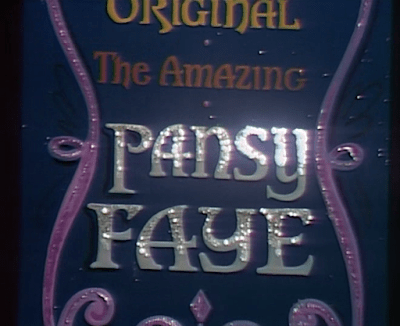
The dream sequence is like nothing we’ve seen before on Dark Shadows, though it is strongly reminiscent of the kind of thing you would have seen on near-contemporary shows like ABC’s prime-time horror anthology Night Gallery hosted by Rod Serling and the Paulist Fathers’ syndicated morality plays Insight hosted by the Rev’d Fr Ellwood Kieser. It starts with a closeup of a sign on which Pansy’s name is emblazoned in glittery letters, and plays over a soundtrack of an audience applauding thunderously. Pansy calls Judith, Barnabas, and Carl to join her on stage, each in their turn; their behavior in this drama-within-a-drama mirrors their behavior in the framing narrative.
Meanwhile, Barnabas’ unwilling sidekick, broad ethnic stereotype Magda Rákóczi, has returned from Boston. There, she met with a leading member of the Romani people, whose name she alternately pronounces as “King Johnny Romana” and “King Johnny Romano.” She shows Barnabas a box she took from King Johnny. It contains a severed hand wearing a ring, which Magda declares will solve their troubles. Magda has placed a curse on Judith and Carl’s brother Quentin, turning Quentin into a werewolf. After placing that curse, Magda learned that her sister Jenny had borne two children to Quentin, and since the curse is hereditary she is desperate to find a way to lift it. Barnabas traveled back in time to 1897 in the course of his own attempt to resist the effects Magda’s curse will have in 1969, so they are allied in this effort.
Barnabas is utterly unimpressed with the hand and with Magda’s plan to place it on Quentin as he is about to transform. He seems convinced that Magda is just trying to conceal the fact that she failed to find anyone in King Johnny’s camp who could actually help them. He doesn’t care about the original owner of the hand, a legendary nobleman named Count Petofi who was himself cured of lycanthropy, or about an incantation Magda says over the hand that is supposed to prepare it to draw the curse from Quentin. He isn’t even interested when she admits that she stole the hand from King Johnny and that if they don’t get it back to him before he realizes it is missing he will send someone to kill her. He reacts as if the whole thing is a show she is putting on to build up her cover story.
In a metafictional set of way, Barnabas is onto something. The original storylines the writers had prepared for the 1897 segment are coming to a head. Several of its major characters have already died, and others, such as Carl, would not be very attractive customers for a life insurance salesman. Apparently the original flimsies, written six months ago, gave only a few more weeks until Barnabas was to return to 1969 and take the show back to contemporary dress. But 1897 is a hit. The ratings are soaring, and there are some dynamics among the characters that they want to explore in a lot more depth. So they want to stay, but to keep the momentum going they need more story and a number of new characters, including a major villain whom Barnabas and Quentin can team up to fight together. So the writers find themselves in the same position with regard to us that Magda is in with regard to Barnabas, trying to sell us on their latest preposterous brainstorm.
Pansy’s farewell performance in Carl’s dream is, alas, Kay Frye’s final appearance on Dark Shadows. Some fans seem unable to look past Pansy’s own hilariously inept performance when we first see her doing her act, and to see that Miss Frye herself does a terrific job playing a cold, cynical working girl. She is good today, when Pansy is on stage and in her character as the “world-famous mentalist and singer,” but is also trying to tell Carl the truth about Barnabas. I only wish they could have brought Miss Frye back as someone else, either in the extended 1897 segment or in another time period.
Vampire Barnabas Collins is about to leave his house with his thrall, maidservant Beth Chavez, to look for Dirk Wilkins, a dimwitted servant whom he inadvertently turned into a vampire and let go. They are stopped when Barnabas’ distant cousin, inveterate prankster Carl Collins, comes in and insists on telling him about his recent trip to “Atlantic City, New Jersey, the Queen of the Boardwalk cities!”
Carl offers Barnabas some saltwater taffy, only to find that the tin is empty. He frets that “she” must have eaten it all on the trip back- “You know how women eat when they are nervous.” This leads to Carl’s second order of business, introducing Barnabas to Miss Pansy Faye. Carl met Pansy on the train, and he intends to marry her.
Carl opens the door, then stands before Barnabas and Beth and announces in his most booming voice “Presenting! Direct from her triumphs before Her Imperial Majesty, Queen Victoria of England, that world-famous mentalist and most beguiling songstress, Miss Pansy Faye!” Pansy enters, singing and dancing. In a vaguely Cockney accent, she intones:
I’m gonna dance for you! Gonna dance your cares away. I’ll do the Hoochie Koo, and the Ta Ra Boom De Ay! I’ll sing a happy song, as we dance the whole night long! When the music begins, I’ll give you some spins, I’ll even invent a step or two! So, on with the show! You’ll love it, I know! Oh, I’m going to dance for you!
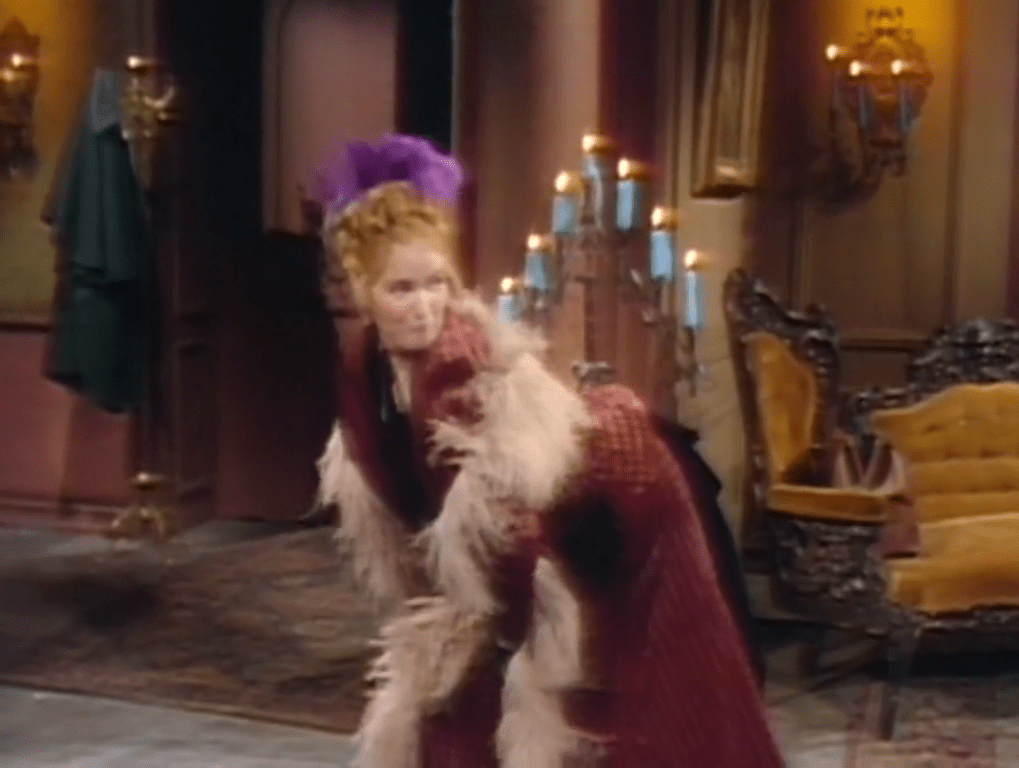
Pansy’s dance is not particularly elaborate; it is performed almost entirely below the waist, and ends with her bending over and thrusting her rear end upward. That is followed by a cut to Barnabas wearing a look of stupefaction that all the black magic and demonic intrusions he has witnessed over the centuries have not elicited. He turns to Beth, who is visibly struggling to keep a straight face.
Against the backing track of Dark Shadows super-solemn music, this scene is hilarious. Longtime viewers will savor it even more than others. Carl is played by John Karlen, who in the parts of Dark Shadows set in the 1960s plays the luckless Willie Loomis, Barnabas’ first blood thrall. When Barnabas first enslaved Willie in the spring and summer of 1967, the show was at its bleakest. Barnabas was able to fool his distant relatives in the great house into regarding him as a living being and letting him occupy the Old House, but that was only because they had been isolated and embattled for so many months before. When we saw Barnabas and Willie on this set in those days, Barnabas was as grim as death itself, beating Willie with his heavy cane whenever he dared do more than whimper. That Karlen is now here as the man who is introducing a character as exuberantly and preposterously alive as Pansy and that Barnabas’ current thrall is suppressing a laugh takes the despair of that period and packs it with joy.
The despair reasserts itself at the close of the episode. Pansy will go out into the woods, Dirk will take her as his first victim, and Barnabas will come home to discover her body propped up in a chair in the parlor. But the comedy in between is so strong that we can be confident that this will not be the last word. Carl tries to persuade his sister, spinster Judith, to accept his marriage to Pansy. He tells her that he is a new man thanks to Pansy’s influence; he has actually managed to go 48 hours without playing a practical joke. Judith is impressed by this new record, but still will not believe that Pansy is fit to become a Collins. She controls all the family’s wealth, and threatens to cut Carl off without a penny if he goes through with the marriage. He reacts with a series of facial expressions that the Three Stooges would have admired.
While Barnabas and Carl are out, Pansy stays in the Old House with Beth. Beth offers her a cup of coffee; Pansy says she would prefer sherry. Beth goes to look for sherry, and Pansy is caught off-guard that Beth doesn’t live there. When Beth says that she is based at the big house on the property, Pansy asks how big it is. Beth says that it is very big indeed; Pansy says that Carl had told her it was like a palace, and Beth confirms that it is indeed on that scale. Pansy is surprised that Carl was telling her the truth. She takes the drink at a single gulp. With Carl, Pansy was acting a part, and she was a terrible actress indeed. Alone with Beth, she drops the act. The Cockney accent is still not too well-developed, but Kay Frye is much more convincing as a hard-boiled working class woman than Pansy is in any of her roles.
Carl persuades Judith to sit still in Barnabas’ parlor while Pansy does her mentalist act, trying to locate Dirk. Pansy actually goes into a trance and announces that Dirk is dead and his murderer is in the room. When she comes to, Pansy is as surprised as anyone at what happened. Judith is demanding an apology, and Pansy is shocked when Barnabas tells her that she accused someone in the room of murder. A moment later, she is alone, wondering what came over her and lamenting that she “mucked that one up.”
The Old House is a dangerous place to be a fake practitioner of supernatural arts. In #400, set in the 1790s, fanatical but inept witchfinder the Rev’d Mr Trask performed an exorcism of the Old House, and was visibly delighted when that exorcism seemed to work. That time it was the intervention of wicked witch Angelique that gave Trask his apparent success, but now it seems that Pansy is simply getting it right for the first time.
That Dirk leaves Pansy in a chair in Barnabas’ front parlor is also something that will bring back memories for longtime viewers. In the 1790s segment, another brassy dame on the make brightened up the show for a little while before meeting a grisly demise on this spot. She was Suki Forbes, estranged wife of untrustworthy naval officer Nathan Forbes. Barnabas strangled Suki in #423, after she had discovered his secret. Suki took until #424 to die, but did not manage to disclose what she knew about Barnabas.
An even closer parallel is to #530. In that one, Frankenstein’s monster Adam hates Barnabas for making him what he is. Adam attacks a man called Joe Haskell and thinks he has killed him. At the end of the episode, Barnabas finds that Adam has planted Joe’s body in the front parlor. Any doubt that Adam was trying to frame Barnabas for Joe’s murder would be removed by consulting the novel Frankenstein, in which the Creature frames another character for the murder of his creator’s brother. Dirk knows that Barnabas made him into a vampire, and so has the same motivation to pin a murder charge on Barnabas that Adam had.
Adam was just a few months old when he tried to frame Barnabas for murder, and Dirk is a simpleton. Neither of them had the skills to get the police interested in Barnabas, no matter how many dead bodies they add to the decor of his house. On the other hand, Barnabas himself once very nearly managed to make such a plan work. In #440 and #441, part of the 1790s segment, Barnabas left the corpse of his victim Maude Browning in a bed belonging to Trask. It was only Nathan Forbes’ timely intervention that kept Trask from the gallows that time.
Vampire Barnabas Collins first appeared on Dark Shadows in #210 and quickly became the show’s main character and star attraction, but the word “vampire” was not uttered on-screen until #410, and thereafter was used quite sparingly for a long while. Those days are definitely behind us now; the characters say “vampire” eight times in this one.
Barnabas has traveled back in time to the year 1897, and is embroiled in a great many storylines, none of which he fully understands or has any idea of changing for the better. Yesterday, crazed groundskeeper Dirk Wilkins told twelve year old Jamison Collins (David Henesy) that Barnabas was a vampire, and Jamison, checking on his story, found an empty coffin in Barnabas’ basement. Today, Jamison tells his father, the stuffy Edward (Louis Edmonds,) what Dirk said and what he saw.
Edward comes to Barnabas’ house, repeats Jamison’s story, and asks to see the basement. Barnabas has hidden the coffin, but Edward tells him that he cannot dismiss the story so easily. A few weeks before, Edward discovered that Jamison’s mother Laura was an undead blonde fire witch bent on incinerating her children to renew her own existence; since that experience, he can no longer disregard claims about the supernatural. There have been a number of attacks on the estate of Collinwood and in the village of Collinsport which have left victims drained of blood and showing bite marks on their necks; he must take Jamison’s claims seriously. He is alone with Barnabas in his basement while explaining this to him, rather a foolhardy position in which to lay out to a man one’s grounds for suspecting that he is a vampire.
Edward leaves. Barnabas is in a bind. Jamison’s children will be the adults at Collinwood in the 1960s, and they are the ones who accept Barnabas’ story that he is their distant cousin from England and give him the Old House on the estate to live in. If Jamison knows about him, it will hardly be likely that his children will be so welcoming. Even if he can reverse his journey through time, there will be no future for him to go back to. So he tells his blood thrall, maidservant Beth, that they must provide a vampire to take the blame for his earlier deeds and allay Jamison and Edward’s suspicions.
Barnabas thinks that he has already arranged a solution to this problem. He bit Dirk in order to shut him up and bring him under control, but apparently he over-ate. Dirk is not going to live through the night. When he dies, he will rise as a vampire. Barnabas and Beth will see to it that Dirk is caught and that he takes the fall for Barnabas’ crimes.
Barnabas has stashed Dirk in a secret room off the parlor of the Old House, a space behind the bookcase in the front parlor. Barnabas opens this space, intending to sit by Beth until they see Dirk die, only to find that it is too late- Dirk has wandered off.
Longtime viewers will find satisfactions in the reflections of earlier characters that run throughout this episode. The secret chamber in which Barnabas tried to keep Dirk is not a place which he has used before, but it first appeared on the show long before he did. In #115, another crazed servant, handyman Matthew Morgan, locked well-meaning governess Vicki up in the chamber, eventually attempting to kill her there. When Barnabas suddenly thinks of that chamber, he is emphasizing the echo of Matthew in Dirk’s rampage.
Edward’s fearlessness in standing alone before Barnabas in his basement and telling him that he suspects he may be a vampire is also something we have seen before. From November 1967 to March 1968, when Dark Shadows was set in the 1790s, Louis Edmonds played haughty overlord Joshua Collins. In #446, Joshua found his son Barnabas rising from his coffin in this same basement and confronted him about his bad behavior. When Barnabas moved to kill him, Joshua glared at him and Barnabas slunk away in shame. Edward is quite different from Joshua; on the one hand he lacks the earlier man’s sense of enterprise and drive for power, while on the other he is far more loving towards his children and quicker to set aside his individual pride for the sake of family unity. But we can see that he does share his kinsman’s ability to fend off vampire attacks by insisting on good manners.
The most fully developed echo is of #333. In that episode, set in contemporary times, strange and troubled boy David Collins (David Henesy,) had seen a coffin in Barnabas’ basement. Connecting that with an abundance of other readily available evidence, David concluded that Barnabas was a vampire. David’s father, high-born ne’er-do-well Roger Collins (Louis Edmonds,) refused to consider such a notion. When local men Burke and Dave went to Barnabas’ house and demanded to search the basement, he initially resisted. At length he led them downstairs. The coffin was not there. Burke and Dave went back to the great house of Collinwood, and Roger crowed with triumph that they had been so silly as to take David’s story seriously. Embarrassed, Burke and Dave asked David if he might have made the whole thing up.
Barnabas may have had this incident in mind, and with it a hope that by showing Edward the empty basement he would embarrass him as he had embarrassed Burke and Dave, perhaps turning him into the same kind of ally that Roger was in 1967. But Edward is made of sterner stuff, and he sheds light on what was in the minds of the makers of the show.
Laura was another iteration of the show’s first supernatural menace. From December 1966 to March 1967, we learned that David’s mother, Laura Murdoch Collins, was a humanoid Phoenix who had returned from the dead to incinerate him along with herself and thereby renew her existence. Roger eventually came face to face with that fact and made himself marginally useful in the effort to stop her. Afterward, he was shocked out of his habit of openly expressing hatred for David, and eventually even showed a modicum of affection and concern for the boy. But he quickly snapped back into the Collins family’s traditional attitude of denial that the supernatural could have any role in human events, and he would not be budged from this denial.
The Laura we saw in 1897 was a violent retcon of many of the most important features of the story we saw in 1966 to 1967, and as Jamison’s mother she implies that Roger married his own grandmother. So it seemed inexplicable that the makers of the show would choose to introduce her. It is when Edward explains that his experience with Laura has opened his mind to the possibility of dangers intruding from the world of the supernatural, that we understand why they did it. They are showing us that Edward is on a continuum about halfway between Joshua and Roger.
Joshua was in a way too strong for his world to support, so that he defeated his own aims and produced tragedies for all those he meant to elevate. By contrast, Roger is like one of Nietzsche’s “Last Men,” what nowadays some call “cage-stage,” a person who is so degenerated he cannot exist on his own or create anything lasting but can be happy in captivity. Edward does not have Joshua’s anomalous strength; like Roger, he lives in his sister’s house as her guest and works for her business as an employee. But neither does he have Roger’s cowardly inability to face facts or his vicious glee in the humiliation of others. He is brave enough and strong enough and fair-minded enough to represent a grave threat to Barnabas.







 Dark Shadows Commentary