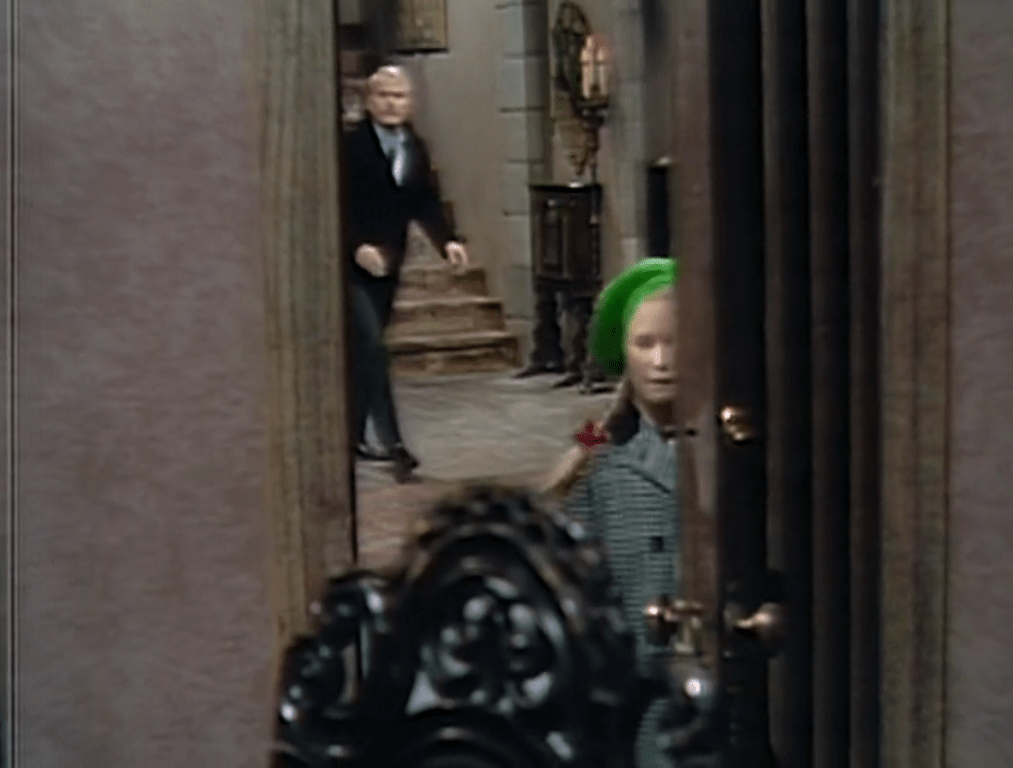
Paul Stoddard (Dennis Patrick) has been staying in his ex-wife’s home, the great house on the estate of Collinwood. At the end of yesterday’s episode, he found a boy known as Alexander hiding in his room. He chased Alexander out of the room. We saw Alexander go behind some curtains. In today’s opening reprise of that scene, Paul looks behind the curtain and sees, not Alexander, but a girl. The girl calls him “Daddy” and runs off. He looks at a photo album and recognizes her as his daughter Carolyn as she was at the age of eight. Since Carolyn is alive and well, the girl cannot be her ghost. He concludes that she must be something that the mysterious enemies whom he knows to be persecuting him have conjured her up.
Paul sees this pseudo-Carolyn a few more times, but no one else does. The last time he sees her, he chases her into a closed room.
Paul chases the pseudo-Carolyn into a closed room.
When Paul opens the door to the room and invites permanent houseguest Julia Hoffman to look inside, no one who could be mistaken for Carolyn is there. Alexander is, and he has the same book with him that the pseudo-Carolyn took into the room with her.
The foyer from a new angle.
Alexander is not the eight year old boy he appears to be. He is both a borrowing from H. P. Lovecraft’s The Dunwich Horror and a meta-fictional comment on Soap Opera Rapid Aging Syndrome. He began life a couple of weeks ago as a whistling sound coming out of a wooden box, spent a week as a newborn baby, then emerged in his current form. When he masquerades as the very young Carolyn, he doesn’t get any bigger or smaller, but he does shift his shape between male and female. Which, good for him (them?,) I suppose.
Many longtime viewers will be even more intrigued by another metamorphosis that we see today. The foyer set has always stopped a little bit downstage from the front door. The room into which Paul chases Carolyn/ Alexander lies beyond this line. Previously, when characters had entered that space they simply exited and were picked up elsewhere later. The only time the camera followed actors beyond the line was in #664, when time-traveling vampire Barnabas Collins and indentured servant Ben Stokes walked from the foyer to the study by way of an undecorated area of the studio. That area is decorated now.
New set.
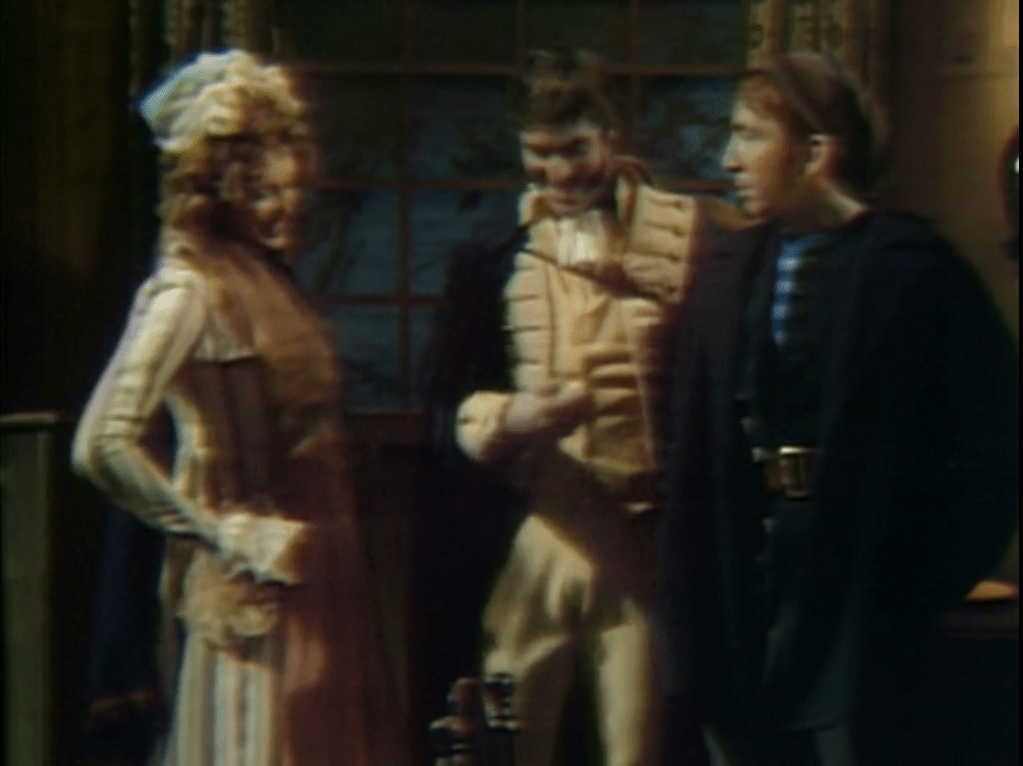
In the picture of Julia, Paul, and Alexander above, we see a portrait in the foyer behind Paul’s left shoulder. That depicts Barnabas as he was in the 1790s, before he became a vampire. It first appeared in #204, when Dennis Patrick was on the show as Paul’s sometime friend, seagoing con man Jason McGuire. It was still being painted when Patrick joined the cast a few weeks before. When he first entered the great house in #195, there was a mirror on that spot. The mirror had been trading places with a metal doodad that was shaped like a coat of arms. At the moment Jason entered, the mirror caught a portrait on the opposite wall, making it look like there was a portrait there. On repeat viewings, that effect makes it clear that Jason’s purpose is to clear the decks of leftover story elements that will not be needed in the show’s future as a supernatural thriller.
When Jason first came to the house and insisted on staying, he and Liz stood in the foyer. She looked into a space beyond the camera, to the viewer’s left (=stage right,) and said that she supposed she could find a room for him there. Jason identified the imaginary part of the house Liz was facing as the servants’ quarters, and when in later episodes we saw servants going to their rooms that was indeed the direction they exited. So when they have Patrick on screen when they enlarge the performing space available in the foyer to include an area to the viewer’s right (=stage left,) they are picking up on that aspect of his iconography.
The Carolyn side of Carolyn/ Alexander is played by Lisa Ross, whose given name was Alyssa Mary Ross. In later years, she took her husband’s name and was known as Mrs Eppich. She was born in 1959 and died in 2020; her family put a very nice tribute page to her online, you should look at it.
Lisa Ross had brown eyes; Nancy Barrett, who plays the adult Carolyn, has brilliantly blue eyes. Since half the episodes of Dark Shadows in this period were directed by Henry Kaplan, a specialist in extreme closeup shots, no regular viewers can be unaware of this. For a single episode, #578, Miss Barrett was replaced as Carolyn by Diana Walker. That one was directed by Sean Dhu Sullivan, who was adept at a wider variety of setups than Kaplan and therefore did not shove the camera into the actors’ faces over and over. Miss Walker’s eyes might be brown, I can’t tell. If so, maybe it was her Carolyn whose juvenile form Alexander assumed.
When Dark Shadows debuted in June 1966, matriarch Elizabeth Collins Stoddard (Joan Bennett) had not left the estate of Collinwood in eighteen years. We soon gathered that Liz was afraid that if she strayed far from the house someone might open the locked room in the basement and discover that her husband Paul was buried there, dead of a blow she dealt him when he was trying to run off with a chunk of her patrimony.
Liz’ reclusiveness was a major theme of Dark Shadows‘ first 55 weeks. After the show committed itself to becoming a supernatural thriller with the story of Laura the humanoid Phoenix, which ran from December 1966 to March 1967, they brought in Paul’s old friend and partner in crime Jason McGuire (Dennis Patrick) as an in-betweener to sweep away the few miscellaneous this-worldly narrative threads not already subsumed in the Laura story and to help introduce the next uncanny Big Bad, vampire Barnabas Collins.
It turned out Jason was the one who agreed to bury Paul for Liz, in return for the money Paul had been trying to steal from her. Upon his return to Collinwood, Jason blackmailed Liz with this information. Time and again she caved in to his demands. Liz let him stay in the great house, gave him money, hired him for a lucrative non-job in the family business, let his rapey sidekick Willie Loomis stay in a room just down the hall from those occupied by her daughter Carolyn Stoddard and her all-but-acknowledged daughter, well-meaning governess Victoria Winters, and was in the middle of a wedding ceremony meant to unite her with Jason when she finally burst out with the truth. When she did that, Carolyn dropped the loaded pistol with which she had planned to prevent Jason becoming her stepfather. For his part, Jason said that Paul wasn’t dead, and that he hadn’t buried him. Perhaps the whole thing started when Jason said “cranberry sauce,” and Liz misheard it as “I buried Paul.” With that, the wedding was off, and a few days later Barnabas killed Jason. Since Jason was on his way out of town and had no friends left, no one missed him. He has barely been mentioned since.
Now, Paul himself has come back. Like Jason, he is played by Dennis Patrick. He has charmed Carolyn into thinking he had nothing to do with faking his own death, and she is falling over herself in her eagerness to establish a relationship with the father who left the family when she was an infant. Carolyn and Liz are on their way out the front door of the great house, heading to a committee in charge of raising funds for the hospital, when the phone rings. It is Paul, asking Carolyn to come to his hotel room at once. She agrees. She gives her mother a vague excuse, irking her, and the women leave the house separately.
In the hotel room, Paul tells Carolyn that he is in some kind of trouble that he can’t explain. Someone is trying to do something terrible to him, but he does not know who or what. Carolyn takes a firm tone when she urges him to tell her what he does know, and when she tells him that whatever is happening she will help him.
Father and daughter embrace, and Liz enters. She is furious to see Paul. She demands Carolyn leave the room. Only when Paul says that he and Liz need a moment together does Carolyn comply. The ex-spouses have a confrontation in which Liz gets to voice her righteous indignation with Paul. She tells him that she expects him to be on the next train out of town. She lists some of the people she will call if he isn’t. Among these is the proprietor of the hotel, who will presumably throw him out in the street at her behest.
In its first months, Dark Shadows tended to attract an aging audience, largely composed of people who still thought of Joan Bennett as the star she was in the late 1930s and early 1940s. Now, with its cast of vampires and werewolves and witches and ghosts and zombies and mad scientists and heaven knows what, it is more of a kid’s show. By the end of the costume drama segment set in the year 1897 that ran from March to November of 1969, viewers over the age of twelve would find themselves reacting to more and more episodes with little more than an indulgent chuckle.
Now that they have returned to contemporary dress, they have swung sharply back towards an adult audience. Carolyn was supposed to be a teenager when the show started; Nancy Barrett was significantly older than the character, and they let Carolyn catch up to her age after a while. But having her spend her evenings serving alongside her mother on the hospital’s fundraising board suggests that they’ve aged her up quite a bit further than that, foreclosing any youth-oriented stories. The conventionally soapy situation the Stoddards find themselves in today is of course something that will be of little interest to the elementary school students who are running home to see the show at this period. And while the main overall story is supernatural, about a cult controlled by unseen beings called the Leviathans that assimilates to itself one character after another, it is understated in tone, allegorical in development, and densely allusive in its relation to its literary antecedents. However many older viewers the show may have lost in the second half of the 1897 segment, they are in danger of shaking off an even larger number of their very young fans if they continue down this road.
In Art Wallace’s original story bible for Dark Shadows, titled “Shadows on the Wall,” the blackmail story was to be followed immediately by Paul’s return. Wallace called for Paul to be a man pursued by dark forces from his past. They made major changes to “Shadows on the Wall” long before they taped the first episode, and it has been almost entirely forgotten for years now. Indeed writer Ron Sproat, who was with the show from October 1966 to January 1969, said that executive producer Dan Curtis told him when he joined the staff that they were going to be leaving “Shadows on the Wall” behind and never let him see it. But they did dip into it in the case of Paul’s return- he is indeed being pursued by dark forces from his past. The Leviathan cult is after him.
After his confrontation with Liz, we see Paul sitting at the bar in the Blue Whale tavern. The jukebox plays a tune familiar from the early days of the show, when the Blue Whale was a frequent set and there were usually extras dancing in the background. Today the only people we see there are Paul and a middle aged sailor sitting next to him.
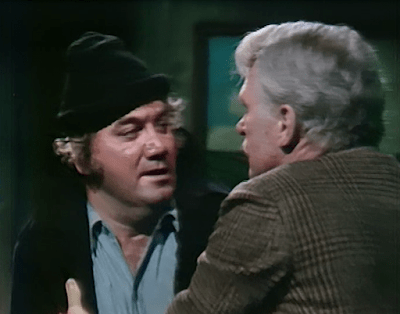
The sailor keeps looking at Paul. We hear Paul’s thoughts as he wonders if the sailor is “one of them.” Paul irritably asks him why he is looking at him. The sailor says that he wants to buy Paul a drink. Paul angrily snaps back that “I buy my own drinks!” After some sharp words, the two men warm to each other. They wind up getting handsy with each other and disappear for some private time together.
This scene turns out to be motivated by the two men’s mutual awareness of the Leviathan cult. Over the years, I’ve seen lots of guys in bars interact with each other in exactly this way. I don’t know what that’s all about, maybe the Leviathans are real.
Since I mentioned “Shadows on the Wall” above, I should say that the tavern figures in there as well. Only it isn’t called “The Blue Whale,” but “The Rainbow Bar.” I don’t know, somehow I think Paul and the sailor might not have got off to such a rocky start if the show had gone with that name. Sounds friendlier, somehow, at least to lonesome sailors and the mature men for whom they want to buy drinks.
Paul’s new buddy, unnamed in the dialogue, is identified in the closing credits as “Jack Long.” He is played by Kenneth McMillan, in his first screen credit. In the 1970s and 1980s, McMillan was one of the busiest television actors in the USA. I always mixed him up with Dolph Sweet, who was a similar physical type. Sweet appeared on Dark Shadows once, in #99. He played Ezra Hearne, the most loyal employee at Liz’ cannery. Sweet was a tremendous actor, McMillan a very good one, and they occasionally worked together. So long as they are doing normal soap opera stuff, it would have been nice if they could have had a little story about Ezra’s reunion with his long-lost cousin Jack. Maybe Jack could have introduced Paul to Ezra, we could have seen how he’d fit in with the family.
No episode of Dark Shadows premiered 56 years ago today. That was Thanksgiving, and ABC was showing football at 4 PM.
At this point, Alexandra Moltke Isles had left the part of well-meaning governess Victoria Winters, marking the last step in the character’s long decline from her original position as the show’s chief protagonist. Vicki spent her childhood in a foundling home where she was left as a newborn with a note reading “Her name is Victoria. I cannot take care of her.” During Dark Shadows‘ first months, Vicki was on a quest to find out who her parents were. The show hinted pretty heavily that her mother was reclusive matriarch Elizabeth Collins Stoddard and her father was someone other than Liz’ long-missing husband, the scoundrelly Paul Stoddard, but the whole thing was dropped without any real resolution long ago.
In yesterday’s episode, Frankenstein’s monster Adam was on his way to Vicki’s room, apparently meaning to kill her. We understand Adam’s violence too well to regard him as a very cold villain. Most of the harm he has done is the result of his not knowing his own strength, and the rest is the predictable consequence of the abominable education he has received from his creators, mad scientist Julia Hoffman and recovering vampire Barnabas Collins, and from suave warlock Nicholas Blair. To longtime viewers, Vicki has been important enough for long enough that we do not see any prospect that a character as sympathetic as he is will become her murderer. On the other hand, Nicholas has now left the show, and there is nowhere for Adam to go within any of the ongoing storylines. If he simply disappears, he will be another significant loose end.
In September 2023, I left a long comment on Danny Horn’s Dark Shadows Every Day describing a fanfic idea that would at one stroke answer the questions of Vicki’s origin and of Adam’s fate. Below is a lightly edited version of that comment:
Here’s an idea I had today for a story that would save Vicki.
It would be a TV movie airing late in 1969. Start with a prologue set in Collinwood at that time. Adam returns, looking for Barnabas and Julia. He’s very well-spoken and accomplished now, but still socially awkward, still prone to fits of anger, and in need of help to get papers that he needs to establish a legal identity.
He finds that Barnabas and Julia are gone. He also happens upon some mumbo-jumbo that dislocates him in time and space.
It plops him down in NYC in 1945. With his facial scars, everyone assumes he’s a returning GI injured in the war. He meets a young woman, supporting herself working at a magazine about handheld machines, trying to establish independence from her wealthy family back in Maine. This woman, played by Alexandra Moltke Isles, is Elizabeth Collins.
Adam and Elizabeth slide into a love affair. She has another boyfriend, a dashing young naval officer named Paul Stoddard (Ed Nelson.)
Ed Nelson as the Paul Stoddard of 1945 Dennis Patrick as the Paul Stoddard of 1969
Elizabeth is frustrated with both Adam and Paul; Adam refuses to talk about his background, and while Paul says many words when asked about himself, he doesn’t really give significantly more information than Adam does. Paul is slick, charming, and familiar with all the most fashionable night spots, but he does show signs of a nasty side. Besides, he rooms with a disreputable young sailor named Jason McGuire (John Connell) who keeps turning up at the most disconcerting moments.
From #143, John Connell, suggesting the Jason McGuire of 1945Dennis Patrick as the Jason McGuire of 1967
For his part, Adam is sincere, passionate, and attentive, but given to quick flashes of anger. He’s just as quick to apologize and sometimes blubbers like a giant baby with remorse for his harsh words, but he’s so big and so strong that when he is carried away in his fits of anger Elizabeth can’t help but be afraid of him. Besides, he’s not a lot of fun on a Saturday night. He doesn’t have a nickel to his name, and his idea of an exciting weekend is an impromptu seminar on Freud’s TOTEM AND TABOO, followed by a couple of games of chess.
Elizabeth’s mother (Joan Bennett) comes to town. Mrs Collins is appalled by Adam’s scars, impatient with his refusal to discuss his background, and contemptuous of his obvious poverty. Paul’s effortless charm and sparkling wit, packaged in the naval dress uniform he makes sure he’s wearing when she first sees him, fit far more tidily into her vision of a son-in-law. Mrs Collins presses her daughter to spurn Adam and pursue Paul, and for a time Elizabeth tries to comply with her wishes.
Yet she cannot forget Adam. Paul realizes this, and sees his chance at an easy life slipping away. We see him in a dive in Greenwich Village telling Jason McGuire that Elizabeth and her inheritance are going to end up with the scar-faced scholar. He and McGuire review Adam’s weaknesses, and decide they can exploit Elizabeth’s concern about his temper. They trick her into believing that Adam is on the run from the law, having beaten his wife to death. They lead her to believe that it’s just a matter of time before his occasional verbal outbursts give way to physical abuse, and that when that happens it will be too late- he will kill her. Believing this, Elizabeth gives Paul another chance, but still cannot break things off with Adam.
Adam does not know what Paul and Jason have led Elizabeth to believe. He knows only that she has become distant from him, and that she is still seeing Paul. He becomes angry and shouts at Elizabeth. He reaches for an object; she believes it is a blunt instrument with which he will kill her. In a moment of panic, she grabs a gun she has been studying for an article the magazine has assigned her to write and shoots him. As he lies motionless on her floor, she discovers that he wasn’t reaching for a weapon at all- he was reaching for a love letter that he had written to her. She realizes that he was no threat to her, that she has shot him for no reason.
She flees to Paul and Jason’s apartment, telling them that she has killed Adam. Paul calms her and promises to take care of matters so that she will not be suspected of any crime. Paul and Jason go to her apartment and find it empty. There are bloodstains on the carpet where Adam fell, and a trail of bloodstains leading down the hallway out the front door. They follow the stains and find Adam nursing a serious, but clearly not fatal, wound. They lead Adam back to Elizabeth’s apartment. They draw on their naval training to remove the bullet, clean and dress the wound. After a conversation. Adam admits that there is no point in his pursuing Elizabeth, and he agrees to leave town. Paul gives Adam some money and promises to tell Elizabeth that he is all right and that he doesn’t hold a grudge. Adam shakes Paul’s hand and leaves.
Paul and Jason clean the bloodstains. They then return to their own apartment. On the way they exchange a look that begins as nervous, and ends with two broad grins. Elizabeth asks why they were away so long. They tell her that it takes quite a while to dispose of a corpse. She sobs. Paul holds her.
Paul and Elizabeth announce their engagement. A few weeks later, the doctor informs Elizabeth that she is pregnant. The child must be Adam’s. Paul is not interested in raising any child, and certainly not interested in splitting the estate with a child not even his own. He orders Elizabeth to give the baby up. She refuses. He points out that she wouldn’t be able to do much mothering if she were in prison for murder. She sobs. In the final scene, we see Elizabeth outside on a snowy day, holding a basket and writing a note. In voiceover, we hear the contents of the note: “Her name is Victoria. I cannot take care of her.”
Haughty tyrant Joshua Collins goes to the basement of the Old House on his estate and finds his son Barnabas rising from a coffin. Barnabas explains to his father that he has become a vampire.
This scene prompts considerable discussion in fandom about gay subtext. In his post about the episode on Dark Shadows Every Day, Danny Horn points out that actors Jonathan Frid and Louis Edmonds were both gay, and speculates that this fact might have had some influence on the way they play Barnabas’ coming out to his father. “I’m not suggesting that this situation is intended to be a metaphor for a gay child talking to his father about his terrible, shameful secret life… But the ‘keep the secret, don’t tell my mother’ part — there’s some resonance, isn’t there? At least, it’s a hook into the story that helps us to get closer, and really feel some of the horror of this moment. A father hands a gun to his son, and says, Kill yourself, so that your mother never finds out.”
Even this tentative raising of the question, with its “I’m not suggesting” and “some resonance” and “at least,” is too much for Patrick McCray. In his Dark Shadows Daybook post about #446, he concedes that “homosexuality is the obvious choice” for an interpretive lens through which to read the scene, but goes on to flatly assert that “this isn’t a veiled metaphor for something like homosexuality.” For him, as for Danny, Barnabas figures in the scene as a murderer first and last, and Joshua as a man finding himself irrevocably severed from the world of rationally explainable phenomena.
For my part, I think that we have to remember that intentionality is always a more complicated thing in a work of art than it is when lawyers are interpreting a contract or cryptographers are cracking a cipher. Certainly the scene is not simply a coming-out scene played in code. Barnabas’ murders do not map onto any metaphor for sexual encounters. While the vampire’s bite is often a metaphor for the sexual act, Barnabas presents his acknowledgement in this scene that he has murdered three women in terms of the secrets he calculated he could keep by killing them and maintains a cold, matter-of-fact tone while doing so. When in the course of the scene Barnabas exasperates Joshua by attempting to murder him, there is nothing erotic between the men. No doubt the scene is at one level meant to be what Danny Horn and Patrick McCray say it is, the point when Joshua realizes he is part of a supernatural horror story and the audience realizes that Barnabas is a cold-blooded killer. As such, it is one of the key moments that defines the 1795 flashback as The Tragedy of Joshua Collins.
But there are other levels of intentionality here as well. One has to do with the word “vampire.” When Barnabas is trying to tell his story to Joshua, his first approach is to give him the facts and leave it to him to apply the correct label. But the facts are so alien to Joshua that they only deepen his confusion. Seeing his father’s bewildered reaction, Barnabas’ frustration mounts until he finally shouts “I am a vampire!”
We have heard this word only once before on Dark Shadows, when wicked witch Angelique mentioned it in #410, but it figured in the show as a metaphor for outness long before it was spoken. In #315, Barnabas’ associate, mad scientist Julia Hoffman, urges him not to murder strange and troubled boy David Collins. She catches herself, breaking off after saying that David deserves better than “to die at the hands of a-” Barnabas grins and teases her, asking “At the hands of a what, doctor?” He dares her to say the word and taunts her for her faux pas in coming so close to using it. Julia and Barnabas have a tacit understanding that they will discuss his vampirism only in euphemisms and circumlocutions. To say the word would be to push beyond the limits of Barnabas’ outness to Julia.
When he tries to avoid calling himself a vampire, Barnabas is trying to establish a relationship in which his father will know enough that he is no longer inclined to ask questions, but not enough to achieve any real understanding of his feelings. When he realizes that he cannot keep from using the embarrassing, ridiculous, utterly necessary word, Barnabas is forced to come out to Joshua in a way he had desperately wanted to avoid.
Moreover, Jonathan Frid’s performance as Barnabas departs starkly from anything else he does on Dark Shadows. After he calls himself a vampire, Frid’s whole body relaxes. His neck, shoulders, and hips are looser than we have ever seen them; even his knees bend a little. His voice shifts a bit away from the old-fashioned mid-Atlantic accent he typically uses as Barnabas, a bit toward twentieth century Hamilton, Ontario. At that point, he is not playing a murderer or a creature from the supernatural or an eighteenth century aristocrat- he is playing himself, enacting a scene from his own life.
Barnabas’ coming out to his father is not today’s only story about information management. Joshua rules his corner of the world by parceling out just that information he thinks people ought to have. We have seen this habit lead to disaster after disaster. In his scene with Barnabas, we see another such instance. Joshua has come to the basement because naval officer/ sleazy operator Nathan Forbes told him that he had seen Barnabas at the Old House, and that Barnabas had attacked Joshua’s second cousin Millicent. After Barnabas admits to his various murders, Joshua brings up the attack on Millicent. Barnabas denies that he had any involvement in that attack, sparking an angry response from Joshua. When Barnabas later asks Joshua why he came to the basement, he swears that Barnabas will never know why.
Had Joshua told Barnabas that Nathan sent him to the basement, the two of them might have figured out that Nathan faked the attack on Millicent as part of his scheme to trick her into agreeing to marry him and to blackmail Joshua into consenting to the marriage. That in turn might have helped Joshua find a way to prevent Nathan from carrying out his evil schemes. But his parsimony with information leaves Joshua believing Nathan’s story about the attack, and therefore puts him and the rest of the Collinses entirely at Nathan’s mercy. When we see the effect that the radical honesty of coming out as a vampire had on Barnabas, we can’t help but wonder how many misfortunes the Collinses might have avoided if they had not lived according to Joshua’s code of truthlessness.
A voice comes from the upstairs. Naomi Collins, wife to Joshua and mother to Barnabas, has entered the house. Joshua leaves his gun with Barnabas and tells him to do the honorable thing, then hastens up to meet her.
Naomi tells Joshua that she he came to the Old House because Nathan told her he had gone there. She insists that Joshua explain what is going on; he pleads with her not to ask. She tells him to think of her; a quiver in his voice, he says “I am thinking of you now.” Naomi is as mystified and as frustrated by Joshua’s refusal to explain himself as Joshua had been with Barnabas’ story, but even as she plays these reactions Joan Bennett also shows us Naomi softening towards her husband. She catches a glimpse of the lover hidden beneath the lord of the manor, peeking out from below the massive superstructure of his pride.
Back in the great house, Nathan is sprawled on the sofa, his boots resting on a polished table, guzzling the Collinses’ fine liqueurs. When Joshua and Naomi return, Nathan offers Joshua a snifter of brandy and invites him to drink it with him in the drawing room. Joshua reacts indignantly, protesting that he is not accustomed to a guest offering him the hospitality of his own house.
This exchange is familiar to longtime viewers. From March to June of 1967, when Dark Shadows was set in contemporary times, the great house was dominated by seagoing con man Jason McGuire, who was blackmailing reclusive matriarch Liz. Several times, most notably in #200 and #264, Jason poured himself a drink and invited Liz’ brother, high-born ne’er-do-well Roger Collins, to join him. Roger would protest that he was not accustomed to being offered a drink of his own brandy in his own house, often drawing the rejoinder that it was Liz’ brandy and Liz’ house, and that he was as much her guest as Jason was.
Roger and Joshua are both played by Louis Edmonds. Roger represents the final stage of decay from the height Joshua represents. He has squandered his entire inheritance, committed acts of cowardice that cost the lives of two men, and let a more or less innocent man go to prison in his place. In #4 he tried to sneak into well-meaning governess Vicki’s room while she slept, and when Liz caught him he told her he didn’t want to be lectured on his “morals,” leaving no doubt that he was looking for some kind of cheap sexual thrill at Vicki’s expense. He openly scorns his responsibilities as a father, cares nothing for the family’s traditions, and the one time we see him working in his office at the headquarters of the family’s business all he does is answer the telephone and tell the caller to contact someone else instead. He drinks constantly, is always the first to give up on a difficult task, makes sarcastic remarks to everyone, and backs down whenever he faces the prospect of a fair fight. In #273, he even admitted to Liz that, had he known what Jason knew about her, he probably would have blackmailed her too.
Joshua’s relentlessly dishonest approach to life may be rooted in fear, and it is never difficult to see that its end result would be to produce a man as craven as Roger. But Joshua himself is as strong as Roger is weak. It is impossible to imagine Roger shaking off an attempt on his life as Joshua shakes off Barnabas’ attempt to strangle him today. While Roger is prepared to sacrifice any member of his family for his own convenience, Joshua will go to any lengths to protect Naomi from the truth of Barnabas’ horrible secret. Nor does Joshua take the easy way out even when he is knuckling under to Nathan. In their scene today, Nathan makes it clear that he is willing to accompany Joshua back to the Old House. Had Roger known what Joshua knows about that basement, he would never have missed an opportunity to send Jason there and let Barnabas do his dirty work for him. But Joshua cuts Nathan off the moment he raises the subject.
Joshua does go back to the coffin room, and he finds Barnabas standing around. He is disappointed that his son has not killed himself. Barnabas tries to explain that he cannot die by a gunshot, but Joshua dismisses his words. He takes the gun himself and, with a display of anguish, shoots Barnabas in the heart. Only thus, he believes, can he keep the unbearable truth from coming to light.
Fluttery heiress Millicent Collins has been staying at the great estate of Collinwood as the guest of her second cousin, haughty tyrant Joshua Collins, and Joshua’s wife Naomi. Today, Millicent has news for Joshua and Naomi. She has agreed to marry naval officer/ sleazy operator Nathan Forbes.
Joshua and Naomi are stunned by this announcement. Millicent had been obsessed with avenging herself on Nathan for some time, ever since she discovered that when they became engaged on a previous occasion he was already married. But now Nathan has apparently rescued her from an attempt on her life by Joshua and Naomi’s son Barnabas, and Millicent no longer holds Nathan’s late wife against him. For their part, Joshua and Naomi are quite sure that Barnabas did not attack Millicent, and suspect that the whole thing was a ruse by Nathan. Joshua forbids Millicent to marry Nathan, and threatens to have her declared insane if she tries to go through with the marriage.
Nathan shows up. He tells Joshua that he and Millicent will not marry without his consent. At that, Joshua agrees to meet privately with Nathan. Joshua withdraws. Millicent tells Nathan that she wishes he had not told Joshua that they would accede to his demands, and Nathan tells her that he has the situation in hand.
In this scene, played out in the entryway and seen from a point of view inside the coat closet, director John Sedwick makes some clever use of a portrait. The portrait, which hangs in the drawing room in the parts of Dark Shadows set in the 1960s and which is identified by fans as that of Joshua,* at first mirrors the furious Joshua as he looks at a sheepish Nathan:
Richard Wagner Collins is on Joshua’s side.
Nathan screws up his courage to face his accusers.
As Nathan begins to make his play, his face overlaps with the portrait, creating the momentary illusion of a kiss. Joshua is startled by Nathan’s assertiveness.
Smoochy-smoochy!
When Nathan and Millicent are alone in the entryway, Nathan stands where Joshua had stood. The portrait now mirrors him as before it had mirrored Joshua, suggesting that he is in the process of taking Joshua’s place.
Big Richard energy
Joshua and Nathan meet in the study. The study was a set that first became prominent during a blackmail story that played out from March to June of 1967, when Dark Shadows was set in contemporary times. Then, seagoing conman Jason McGuire had established the drawing room of the great house at Collinwood as his base, and the study was a place to which his victim, reclusive matriarch Liz, would retreat, only to discover that Jason had even more power over her than she had thought.
Now, the show is a costume drama set in the 1790s, and Nathan is coming to resemble Jason more and more strongly. Joshua is in Liz’ place as head of the household. When Nathan starts talking about a secret he is sure Joshua very much wants to keep from public view, Joshua at first has no idea what he is talking about. He assumes, to his scornful amazement, that Nathan is taking a shot in the dark, hoping that Joshua might have some shameful secret and gambling that he will be able to convince him that he is in a position to expose it.
Nathan shows Joshua Barnabas’ cane with its distinctive wolf’s-head handle. He assures Joshua that Barnabas dropped it when he attacked Millicent. Joshua does not believe that Barnabas had anything to do with the attack on Millicent, for the excellent reason that he knows Barnabas is dead. Joshua cannot share this information with Nathan, since he has insisted on lying to everyone and claiming that Barnabas is alive and well and living in England. In fact, Nathan and a henchman of his did fake the attack on Millicent, but Barnabas’ situation is not so simple as his parents believe. Unknown to them, or to Nathan, or to any of the Collinses, Barnabas has risen from the dead and now preys upon the living as a vampire.
For his part, Nathan knows that his one-time friend Barnabas is in town, and that he is responsible for the many killings that have recently taken place there. He believes that Barnabas is alive and has become a serial killer, and that the family spread the story about England to cover up this new hobby. Nathan presses more information on Joshua about sightings he and others have recently made of Barnabas, and about evidence connecting Barnabas with the murders. Since Joshua himself had seen that Barnabas’ coffin was vacant in #422 and occupied again in #428, he cannot simply dismiss Nathan’s story. Nathan tells him that Barnabas is hiding in the Old House on the estate, and Joshua decides to go there.
While Joshua prepares to go, Nathan makes himself at home in the great house. He pours himself a drink in the drawing room, as Jason McGuire often did. We cut from the shot of him doing that to the study, where Naomi pours her own drink. Longtime viewers, remembering the miserable state to which Jason reduced Liz while blackmailing her, will be apprehensive that Nathan’s blackmail of the family will bring the alcoholic Naomi to an equally profound despair.
At the Old House, Joshua encounters much put-upon servant Ben Stokes, who tries to keep him from going to the basement. Ben has reason to hate Joshua, and often expressed such hatred earlier in the 1795 flashback. But there is no hatred in him today. He sincerely wants to spare Joshua the sight that he knows awaits him downstairs. But Ben is powerless to stop Joshua, and sadly watches him go through the cellar door.
Joshua finds Barnabas’ coffin at the foot of the stairs. The lid opens, and Joshua sees a hand under it wearing a familiar ring. As Jason had inadvertently pushed Liz to discover a secret she had herself not dreamed of when he directed her attention to the basement of the great house once too often, thereby losing his power over her and leading to his death at Barnabas’ hands, so Nathan is about to change Joshua’s awareness of the situation in ways he himself could not have anticipated and which are likely to lead to his own downfall.
Naval officer/ sleazy operator Nathan Forbes seemed to have lost his best chance at getting rich quick when his fiancée, fluttery heiress Millicent Collins, discovered that he was already married when they got engaged. Since then, he has figured out that Millicent’s second cousin, Barnabas Collins, did not go to England as the family has been telling everyone, but that he is still lurking about the village of Collinsport and has murdered several people there. Among Barnabas’ victims was Nathan’s wife Suki.
Widower Nathan has a plan to profit from this information. Today, we see the first step in Nathan’s plan. He persuades his henchman, commercial mariner Noah Gifford, to wear a mask, carry Barnabas’ cane, and assault Millicent while he lies in wait. Apparently he will rescue her, and she will tell her family both that Nathan was the hero of the incident and that the attacker carried Barnabas’ instantly recognizable cane.
The whole episode is full of comic moments, and the climactic scene of the assault at the gazebo had my wife, Mrs Acilius, laughing out loud and making comparisons to A Funny Thing Happened on the Way to the Forum. That reaction shows that Nathan and Noah are a more successful rewriting of Dark Shadows‘ first seagoing con man, Jason McGuire, and his henchman Willie Loomis. Jason was supposed to be a comic villain, but the writers never gave him much that was funny to do or say. Actor Dennis Patrick was such a talented comic that he could pad his part with facial expressions, tones of voice, and gestures that got laughs, especially in his scenes with Willie. But it was never at all clear why he needed Willie, and most of the time he was on camera Jason was grinding the other characters down with a depressing blackmail scheme. But Nathan keeps scrambling to find his way into his marks’ good graces, and he and Noah get up to all sorts of high-jinks. Regular viewers will be happy to see a demonstration of what Jason and Willie might have been had Dark Shadows been able to employ a better writing staff in 1967.
Another major improvement over the period when Dark Shadows was set in 1966 and 1967 is the show’s use of Joel Crothers. He did what he could with the part of hardworking young fisherman Joe Haskell, but since Joe’s only note is earnestness he always winds up as less of a character than a function. But Nathan is always working an angle, is never quite predictable, and is tremendously fun to watch. The prospect of seeing Crothers return to the role of Joe is one of the major reasons the audience might want to prolong our stay in the eighteenth century.
Closing Miscellany
Noah remarks on one of the odd quirks of the Collins family when he mentions that the vacant Old House on their property is still full of all sorts of valuable objects. From the first week of the show, we’ve seen that disused parts of their estate are heavily stocked with high-priced antiques. This acknowledgement of the oddness of that fact leaves us wondering if the show is going to change it.
Today marks the only appearance on Dark Shadows of actress Charlotte Fairchild. Fairchild plays a downstairs maid who tells Millicent that a man has brought her a fan. Her angular figure and pale complexion made her a perfect choice to play an eighteenth century servant, and she does a fine job with the dialogue.
Vampire Barnabas Collins arises from the dead, goes to the front parlor of his house, and finds a friend of his passed out drunk in an armchair. The friend, much put-upon servant Ben Stokes, had left the house the night before after saying that he would no longer help Barnabas in his murderous schemes. Barnabas brings this up, but apparently Ben has decided he has nowhere else to go, so he’s back.
Barnabas tells Ben that he has two projects going at the moment. He dropped his cane with its instantly recognizable silver handle in the shape of a wolf’s head at the scene of an attempted murder last night; the victim, a streetwalker named Maude Browning, screamed and someone came running. Barnabas orders Ben to find the cane and bring it back before it leads to his exposure.
The other project is Barnabas’ attempt to take revenge on the Rev’d Mr Trask, a visiting witchfinder who has wrought considerable havoc in town. Barnabas recently discovered he had some magical powers, and he has been using those powers to drive Trask insane. He says that he will stay in the house and cast more spells on Trask while Ben goes to Maude’s room over the feed store to look for the cane.
In his room at a local inn, Trask can’t keep a candle lit. He hears Barnabas’ laughter, and declares that it is the voice of the Devil. Or as Trask calls him, THE DE-VILLL!!!! A knock comes at the door. Trask is fearful, but answers when the knocker identifies himself as naval officer Nathan Forbes.
Trask believes hapless time traveler Vicki Winters to be the witch. A court has agreed with him, convicting Vicki of witchcraft and sentencing her to hang. Trask tells Nathan that the witch has started tormenting him. Since Nathan testified against Vicki, Trask warns that she might do the same to him next. When Nathan takes Trask’s warning lightly, he responds with some overheated rhetoric. To this, Nathan remarks that it’s never man-to-man with Trask. When he listens to him, he gets the feeling that sitting in a pew and that the rest of the congregation is absent.
Trask then tries to tell Nathan about the terrible visions he has been suffering. While he does so, he hears Barnabas’ voice and sees his hand. Nathan, of course, can neither see nor hear these manifestations.
Lately Nathan has established himself as a rather cold villain, but he used to be a good-hearted sort, though with some glaring personality defects. We catch another glimpse of the friendly Nathan when he tells Trask the trial must have taken a toll on him. He offers to take Trask out of his room and give him a place to rest. Trask responds indignantly to this offer, and demands Nathan leave him alone.
We cut to Ben searching Maude’s room. When Ben leaves, Nathan catches sight of him. Nathan follows Ben back to Barnabas’ house. Nathan stands at the window and eavesdrops as they talk about Ben’s search of the docks and of Maude’s room, of his failure to find the cane, and of the drunken ramblings with which Maude has been confusing the barroom patrons who want her to tell them about the attack she suffered.
When the show was set in 1967, we saw several characters stand at this window and listen as Barnabas held incriminating conversations with his henchmen. Most notably in #274, seagoing con man Jason McGuire eavesdropped as Barnabas handled a box of jewelry and told his sorely bedraggled blood thrall Willie Loomis of his evil plans for Vicki. As Nathan has become more and more a villain, he has become more and more reminiscent of Jason. The night after Jason listened to Barnabas and Willie, Barnabas killed him. Seeing Nathan in this position, regular viewers will wonder if it implies that his death is as near today as Jason’s was then.
Barnabas and Ben leave the house. Ben suggests they leave Collinsport and go someplace where Barnabas will not be recognized. Barnabas will not hear of it. He moans that the house is the place where he and his lost love Josette were supposed to live and be happy. Ben pleads with him to let go of the memory of Josette. Having seen Barnabas in 1967, we know that this plea will fall on deaf ears. Barnabas calls himself “stupid” for leaving the cane at the scene of the crime; the ever-forthright Ben tells him he’s being more stupid now. None of Barnabas’ twentieth century confederates would have dared say a thing like that to him, making Ben’s boldness a refreshing change for regular viewers.
We cut back to Maude’s room. Nathan is bringing Maude home. She is much the worse for drink. He urges her to stay in her room with the door and window locked, then goes.
A bat squeaks at the window, Maude panics, and Barnabas materializes in the room. He asks her about the cane. She tells him she doesn’t have it, and he strangles her. It’s one of the most brutal on-screen murders we have seen so far.
From Maude’s room, we cut to the door to Trask’s. He stands in front of it and we hear him deliver a monologue in a recorded voiceover. This is the first time we have heard an interior monologue from Trask. He shouts so much that it often seems that if you could read his mind you’d see nothing but all-caps disquisitions about THE ALMIGHTY! and THE DE-VILLL! But in fact, he’s telling himself that Nathan must have been right and that all the visions he saw and voices he heard must have been the result of nervous strain brought on by his hard work during Vicki’s trial. He goes into his room, telling himself to calm down. He looks at his bed, and finds Maude’s strangled corpse sprawled there.
The opening voiceover is delivered by Vala Clifton, who makes her debut today as Maude Browning, a young lady whose profession it is to make herself agreeable to the gentlemen she meets. This marks the first time since episode #1 that the first voice we have heard was that of someone we had not seen previously. The rule lately has been that the introduction is always delivered by a woman who appears in the episode. Today, that leaves Ms Clifton as the only candidate.
At the top of the episode, vampire Barnabas Collins tells his friend, much put-upon servant Ben Stokes, of his plans for revenge on the Rev’d Mr Trask, a visiting witchfinder responsible for much misery and injustice. When he makes it clear that he plans to murder Trask and to do it in an especially atrocious manner, Ben puts his foot down and says that he will no longer help Barnabas in any way. Barnabas threatens to kill Ben if he doesn’t come back with the implements he has ordered. Ben says that he may as well kill him right away. He stands still and squeezes his eyes shut, evidently expecting Barnabas to accept the invitation. Barnabas does put on his strangling face and move towards Ben, but at the last second he relents.
We then see Ben at The Eagle tavern, demanding “More rum!” Maude is at his table, trying to engage him in conversation. He warns her against going out at night, bringing up Ruby Tate, a woman who died on the docks some nights before. Maude has already said that she arrived in town the day of Ruby’s death, but when she is explaining why she isn’t afraid to go out alone at night she suddenly becomes the expert on Ruby’s ways. “She talked to anyone. I don’t.” This is a delicious little moment, reminding us of all the people we’ve known who make up little stories to persuade themselves that they are immune from the misfortunes that have befallen others.
Untrustworthy naval officer Nathan Forbes enters the tavern accompanied by a man in sailor’s togs. Maude gives up on Ben and leaves his table; she chats with Nathan for a moment, her eyes on the bulge in his pants most of the time. That’s understandable, it’s rather a conspicuous bulge.
Maude leaves the tavern, and Nathan directs his companion to sit with Ben and to get information from him about Barnabas Collins. The man introduces himself to Ben, giving his name as Noah Gifford. Noah claims to be looking for work on the great estate of Collinwood. Ben tells Noah to stay away from there and to go back to the sea. He is drunk enough to mention Barnabas’ name, but doesn’t say much about him. He says that he wishes he could go to sea himself. He says that he likes tea, and wants to go to China to get a nice strong cup of it.
In #363, the ghost of Barnabas’ little sister Sarah mentioned that her father and his friends were always going to China on their ships. When Ben brings up China, regular viewers might remember that, and take it as confirmation that the Collinses were involved in trade with China in the 1790s.
Right before we watched this episode, I was reading an article by Amitav Ghosh in the 23 January 2024 issue of The Nationmagazine about trade between the USA and China. Mr Ghosh says that between 1784 and 1804, the USA shipped a wide variety of products to China, but that from 1805 on Americans sold nothing to China but opium. He likens the label “China trade” for that commerce to calling Pablo Escobar’s business “the Andean trade.” Right up to the beginning of the flashback in #365 the show was equivocating on whether Barnabas, Sarah, and the rest of them lived in the eighteenth century or in the 1830s. Choosing 1795-1796 as the setting for this segment turns out to be a way of lightening one of the darker shadows the history we know from our time-band might otherwise have cast over the world of the show.
Nathan’s connection with Noah will sound another echo in the minds of longtime viewers. The first unsavory mariner on the show was seagoing con man Jason McGuire, who spent several months in 1967 blackmailing reclusive matriarch Liz. Jason was accompanied by a henchman, dangerously unstable ruffian Willie Loomis. Nathan at first seemed to be a good-natured and likable fellow, if a bit free with the servant girls and regrettably mercenary in his engagement to marry heiress Millicent Collins. But ever since it turned out that he already had a wife and that she was blackmailing him into splitting Millicent’s inheritance with her, Nathan has been reminding us more and more of the sinister Jason. When he turns up with Noah in tow, the resemblance is complete. We can only wonder if Noah will follow Willie’s lead and get into some kind of terrible trouble at the Collins family mausoleum in the cemetery north of town.
On the docks, Barnabas meets Maude. He goes through the same struggle to keep himself from biting her that he had gone through with Ruby in #414. He is so slow to move in for the kill that she has time to scream and attract Nathan’s attention. Barnabas hears someone running towards them, drops his cane, and runs off.
Nathan sends Maude back to the tavern. He finds the cane and recognizes his old friend Barnabas’ signature wolf’s head handle. In the tavern, he asks Maude to describe her assailant. She mentions that the man wore a gold ring with a large black stone. Knowing that Barnabas always wore such a ring, Nathan is convinced that he did not go to England as his family has been telling everyone, but that he is in Collinsport and is the strangler who has been terrorizing the community.
Nathan seemed most virtuous when Barnabas was alive and he was his more or less loyal friend. So it is a jolt that his reaction to the idea that Barnabas might be a serial killer is to tell Ruby that, lucky as she was to escape the Collinsport Strangler, she “may not be the only lucky one tonight.” Since he has not made any move to contact the authorities, there can be little doubt that his luck is not an opportunity to stop the killings, but the discovery of information he can use to blackmail the Collins family out of every penny they have. He has completed his transformation from a good guy with a rakish side into a deep-dyed villain.
Closing Miscellany
As Nathan enters the waterfront scene, we see a sign behind him labeled “Greenfield Inn.” We saw weeks ago that the Collinsport Inn, familiar from the first year of the show, already exists in the 1790s, so evidently this is a different hostelry. In #214, when Barnabas had returned to Collinsport in 1967, high-born ne’er-do-well Roger Collins did mention that any place in town other than the Collinsport Inn where there were rooms for rent would hardly “qualify as a flophouse”; perhaps the Greenfield Inn is the ancestor of one of these frightful places.
Greenfield Inn. Presumably not the front entrance.
Originally broadcast on 29 February 1968, this was the only episode of Dark Shadows to air on a Leap Day. One of the reasons I started the episode summaries this blog when I did is that the calendars for the years 2022-2027 match those for 1966-1971, so that I can post on the 56th anniversary of each original broadcast, matching not only the date but also the day of the week.
When Dark Shadows debuted in June 1966, it was a Gothic romance in which characters sometimes equivocated about whether they were using the word “ghost” metaphorically to refer to present troubles caused by past conflicts or literally to refer to things that go bump in the night.
That version of the series ended with the story of undead fire witch Laura Murdoch Collins. In Laura’s months on the show, her arc absorbed such major plot elements as the conflict between high-born ne’er-do-well Roger Collins and local man Burke Devlin, the psychological problems of strange and troubled boy David, David’s relationship with his well-meaning governess Vicki, and the tensions between the ancient and esteemed Collins family and the working class people of the town of Collinsport. By the time Laura went up in smoke in #191 and #192, there was no life remaining in any open narrative thread, and Dark Shadows 1.0 was at an end.
Dark Shadows 2.0 launched in #193 with the introduction of seagoing con man Jason McGuire. Jason was an in-betweener who would tie up the loose ends remaining from the 25 weeks before Laura joined the gallery of characters and facilitate the introduction of Laura’s successor as a major supernatural menace, vampire Barnabas Collins. Jason kept himself busy blackmailing reclusive matriarch Elizabeth Collins Stoddard, his sidekick Willie Loomis accidentally released Barnabas, and the show kept dropping hints that when Liz finally stood up to Jason all of the original secrets would be laid bare.
The makers of Dark Shadows didn’t do much advance planning, so they kept Jason on the show for 13 weeks after Barnabas premiered while they tried to come up with some other way to fill the time. When Jason’s plan finally blew up in his face, they even left some of the old secrets still buried, most notably the question of where Vicki originally came from.
Barnabas finally killed Jason in #275, and he hasn’t been mentioned in a while. But he is not forgotten. As we open today, lawyer Tony Peterson has caught heiress Carolyn Collins Stoddard in his office, rummaging through his safe. Tony has been dating Carolyn and is clearly very much attracted to her. He invites her to tell him a story that will give him an excuse not to call the police. She has to think fast to come up with one, and what she settles on is a version of the story of Jason and Liz.
Tony knows that Carolyn was trying to steal a notebook that he had put in his safe. This notebook was the property of his newest client, Julia Hoffman, a permanent guest at the great house of Collinwood. Carolyn tells Tony that Julia was blackmailing Liz. The notebook, she claims, is a diary kept by a man with whom Liz had an affair, and it contains proof that the man was Carolyn’s father. Julia knew the man and knew that he was planning to come to Collinwood to squeeze money out of Liz in return for his silence, but he died before he could do so. Julia took the diary and picked up where he left off.
Since Tony’s professional ethics will not allow him to be a party to blackmail, this is the one story that could give him a plausible reason not to report Carolyn’s crime to the police. It also gives him a reason to feel sorry for the Collinses, whom he hated when we first saw him, removing an obstacle to the possibility he might fall in love with Carolyn.
The echo of the Jason/ Liz story in the image of Liz forced to accept a blackmailer as a member of the household offers a great deal more than narrative convenience to regular viewers. The audience knew what Jason was threatening to tell if Liz did not submit to his demands, but the characters did not. One idea that some among them seemed to suspect was that Jason was Vicki’s father and Liz was her mother. Indeed, the makers of the show did plan to explain Vicki’s paternity at the end of the blackmail arc, a plan they abandoned so late that the climactic episode runs some minutes short. When Carolyn brings up the idea of her mother being blackmailed to keep it secret that she bore a child out of wedlock, those of us who have been watching all along will realize that she was among those who suspected that this was the secret that gave Jason his hold over her.
The audience knows that there will be no romance between Tony and Carolyn, because we know that she is Barnabas’ blood thrall. Barnabas sent her after Julia’s notebook, because it contains the records of an experiment in which she tried to cure him of vampirism. It would expose him were it to fall into the hands of the authorities. Since Barnabas wants to rid himself of Julia, perhaps by killing her, perhaps by driving her totally insane, he cannot leave such a document out of his possession.
Dark Shadows has come to as much of a dead end now as it had when Laura’s arc was ending. None of the ongoing stories has room for more than a few steps of further development, and if they keep running through those steps at the current pace everything will be resolved in a couple of days. Bringing up Jason, whose introduction marked the beginning of Dark Shadows 2.0, leads us to wonder if they have something up their sleeves that will launch Dark Shadows 3.0.
Tony takes Carolyn home to Collinwood, where he confronts Julia. He tells her what Carolyn told him. She denies it, and says that she will write a letter entrusting the notebook to him to remain unread unless something happens to her, in which case he will read it and hand it over to the authorities. That satisfies him that he isn’t a party to blackmail, and he agrees to her terms.
For the last couple of days, Barnabas has been using black magic in an attempt to break Julia’s grip on sanity. Her clear thinking and calm demeanor in this scene prove that this attempt has failed. The only open question in the only ongoing conflict is, therefore, whether Barnabas will try to murder Julia. She is such a valuable character that it is hard to feel any real suspense about whether he will succeed in killing her, but there is a chance that he will make an attempt.
David and Vicki have come home from a trip to Boston. David enters the drawing room, sees Julia, and greets her. She can barely pay attention to him long enough to say hello. He asks if she is all right; again, she is clearly not at all focused on him. She excuses herself, saying she has to go to Barnabas’ house.
David’s relationships to the other characters were the engine that drove Dark Shadows 1.0, and when Barnabas began to pose a danger to David that same engine accelerated the pace of Dark Shadows 2.0. Julia has been central to the plot for some time; that she can’t be bothered to take any notice of David tells us that that engine has fallen apart. Whatever they are planning to do next week, David won’t be at the heart of it.
David leaves the drawing room. He gets as far as the foyer. There, he sees his friend, the ghost of Barnabas’ ten year old sister Sarah. He tells Sarah that he has been on a trip. She asks where he went. He says he went to China. “Oh,” she responds, blandly. “You’re not impressed?” “No, my father’s friends used to go to China on their ships.” “Well, I didn’t really go to China. I went to Boston.” “BOSTON!!!” Sarah exclaims. “I went to Boston once!” She’s electrified. It’s adorable beyond belief.
Suddenly, Sarah looks disturbed and says she has to go. David asks why, and she says there is trouble brewing at the Old House. Again, David has been sidelined. If there is going to be any more action, it will have to come from fresh sources.
The Old House is Barnabas’ house, and that’s where we go next. We see Julia arriving there. She tells Barnabas that Vicki is back. He is mildly interested. She then tells him that she has seen Sarah. Barnabas longs to see Sarah, and is tormented that she will appear to others but not to him. He accuses Julia of lying. She insists that she is not, and taunts him with Sarah’s refusal to appear to him. He grabs Julia by the throat. He has done this before as a threat, but this time it looks like he really means to strangle her. Before he can, a wind blows the door open and the candles out, and Sarah walks in. She approaches her brother, glaring at him.
The Collinsport police have solved the case of the abduction of Maggie Evans, The Nicest Girl in Town. The investigation has been stalled for months, because Maggie is suffering from amnesia covering the entire period of her captivity. So the authorities spread a rumor that Maggie’s memory was returning, camped out on her lawn, shot the first guy who strayed onto the property, and declared him to be the culprit.
Though this method would appear to be impeccably scientific, strange and troubled boy David Collins is unconvinced. The wounded man is the luckless Willie Loomis, servant of David’s cousin, old world gentleman Barnabas Collins. David is sure that Willie wouldn’t hurt anyone, and has developed an intense aversion to Barnabas.
David’s aunt, matriarch Elizabeth Collins Stoddard, is discussing this situation with his well-meaning governess Vicki. Liz mentions that Willie originally came to the estate of Collinwood as a friend of seagoing con man Jason McGuire. She says that she is prepared to believe any bad thing about any friend of Jason’s.
This is the third day in a row we have heard Jason’s name mentioned. That marks quite a departure from recent months of the show. In #275, Barnabas killed Jason, and in #276 he forced Willie to help him bury the body. He was forgotten, apparently forever, shortly thereafter.
It is not clear at all where the show is heading. A few weeks ago, David learned that the secret chamber where Jason is buried exists, that Barnabas and Willie know about it, and that there is something hidden in it that makes Willie uncomfortable. Barnabas knows that David has been in the chamber, and is thinking of killing him. So perhaps the next storyline will involve Barnabas trying to do away with David lest Jason’s death be discovered.
Bolstering that expectation is the fact that Willie has survived the shooting. When he was first shot, day before yesterday, the police said he had five bullets in his back and that only a miracle could keep him alive. Yesterday, we heard that he was in a coma and that the preliminary medical report on his case gave him virtually no chance of living. Today, his doctor, addled quack Dave Woodard, tells his medical colleague Julia Hoffman that the odds are a hundred to one against Willie seeing another day. Experienced soap opera viewers will know that when a man has been declared dead so many times, he will be with the series for years to come. Willie does feel bad about what happened to Jason, so if David manages to lead the authorities to the secret chamber, that might bring matters to a head.
The scene between Woodard and Julia marks an interesting first. Julia is, among other things, a psychiatrist, and Maggie was her patient for a time. Woodard believes that she is at Collinwood in order to find out who abducted Maggie. He is surprised she plans to stay on now that Willie has been named. She claims that she is trying to keep her cover story intact, that she is an historian studying the old families of New England. This doesn’t make much sense to him, but he doesn’t expect it to- he thinks he knows her real motive. He thinks she is in love with Barnabas. Julia smiles, and doesn’t deny it.
Returning viewers know that Julia’s actual motives are infinitely less wholesome. She is a mad scientist, and Barnabas is a vampire. She is conducting an experimental treatment which, if successful, will relieve him of that condition. For the sake of that experiment, she has become Barnabas’ accomplice. She induced Maggie’s amnesia, she has lied to everyone she has met, including the sheriff, and she is happy that Willie is likely to die and take the blame for Barnabas’ crimes. Woodard’s idea that she is in love with Barnabas delights her because it helps conceal her true role. It also starts us wondering if it is the beginning of a story in which the two of them avoid awkward questions by pretending to be a couple, then perhaps really do fall in love.











 Dark Shadows Commentary
