Another drab-looking outing from director Henry Kaplan, enlivened with some witty writing by Violet Welles and sprightly acting by John Karlen and David Henesy.
Daft prankster Carl Collins (Karlen) goes to the suite in the west wing of the great house of Collinwood recently occupied by his brother, the late Quentin Collins. Carl finds his nephew, twelve year-old Jamison Collins (Henesy) sitting by Quentin’s gramophone, listening to a sickly sweet waltz of which Quentin was fond. Carl mutters and rambles, claiming at one moment that Quentin is not really dead and at the next that he has a theory about who really killed him. Jamison just stares in response. Carl, agitated, demands that Jamison turn off the gramophone. When he does not answer, Carl declares that he is Jamison’s uncle. Jamison calmly replies that Carl is not his uncle, but his brother.
Carl comes back with his sister Judith. They question Jamison, who seems to know things only Quentin would know. Judith declares that “The child is possessed!” and flounces out of the room.
Jamison’s governess, Rachel Drummond, has a dream in which Jamison and Judith make her uncomfortable. She tries to go to the drawing room, only to find Carl blocking her way. He is wearing a railroad conductor’s hat and holding Jamison’s toy locomotive. He tells her it is too late to pass this point, and shows her a gigantic pocket watch to prove the point. She wakes up to find Quentin’s body sitting in a rocking chair next to her bed.
One day in the year 1897, Edward, Carl, and Quentin Collins hear their sister Judith read their grandmother’s will. Stuffy Edward and childlike Carl are shocked to find that Judith is the sole heir of their family’s vast holdings. Quentin stole the will and tried to forge a new one, so he is not shocked, but he is weirdly gleeful about the paragraph relating to him. He will receive no property and no income, but will be guaranteed a place to live in the great house of Collinwood forever. This enshrines his relationship with Judith as one of the clearest examples of Dark Shadows’ signature dynamic of Bossy Big Sister and Bratty Little Brother. No matter how atrociously Quentin may behave, no matter how loudly Judith may disapprove of him, she has no authority to punish him and her concern for the family’s good name will compel her to cover up his misdeeds and shelter him from their natural consequences.
Meanwhile, governess Rachel Drummond and ladies’ maid Beth Chavez are busy with a mystery concerning the room on top of the tower that stands in the middle of the great house. Rachel has seen lights in the room and suspects someone is being held prisoner there; contrary to the direct orders of Judith and Edward, and against Beth’s very strongly worded advice, Rachel is investigating this matter aggressively. She sneaks up the stairs to the top of the tower, listens at the door to the room, and sees Beth coming out of it with a tray.* She then goes to Beth’s room, where she interrupts Quentin sexually harassing Beth. When she tells Beth what she saw in the tower and asks about it, Beth is shocked that Rachel went into the tower. She denies everything.
Later, Rachel goes back to the top of the tower and again listens at the door. She hears a cradle rocking. We saw that cradle in #645, when Dark Shadows was set in contemporary times and Quentin and Beth were ghosts haunting children David Collins and Amy Jennings. They sent Amy and David to fetch the cradle from the attic of the Old House on the estate and to bring it to Quentin’s old room in the west wing of the great house. This is one of the first times in the 1897 segment when we explicitly close a loop opened during the “Haunting of Collinwood” story.
*At the beginning of the episode, we saw Beth approach the room with the tray and a baby doll. During that scene, we hear what I believe is new music. It has been quite some time since we have heard any new cues, so this stands out.
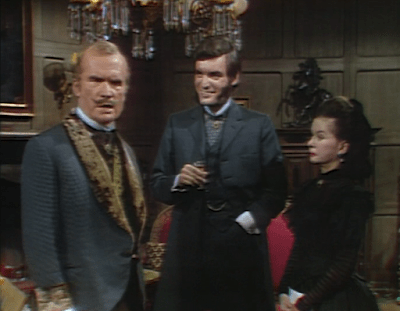
One day in 1897, Edward Collins convenes his siblings Judith, Carl, and Quentin for a family meeting in the drawing room of the great house of Collinwood. Their grandmother Edith died the night before. She was supposed to tell Edward a celebrated family secret, but did not do so. Edward is convinced she must have told one of the others, and declares that no one will leave the room until he finds out which.
Returning viewers know that Edith did not tell any of them, and we can imagine a half hour of nothing but the four Collinses of Collinwood sitting around staring at each other. Fortunately, Quentin points out that Edith was briefly alone with their recently arrived and thoroughly mysterious cousin, Barnabas Collins, and she might possibly have told him. Edward orders Carl to go to the Old House on the estate, where Barnabas is staying. Carl asks why it’s always him who has to do these things, and Edward angrily shoos him away. Louis Edmonds and John Karlen were both talented comic actors, and this little exchange is very funny.
In the Old House, Carl finds Sandor Rákóczi coming up from the cellar. He asks Sandor what he is doing there. Sandor says he lives there. Carl says that he’d heard Barnabas was living in the house now. Sandor says that Barnabas hired him and his wife Magda as servants. Carl laughs at that and says of Barnabas “He is an odd one, isn’t he?” Sandor gives him a fierce look, offended. Carl apologizes.
Carl explains that he has come to fetch Barnabas. Sandor says Barnabas won’t be back until after dark. Carl explains why they need him at the great house, and Sandor laughs. “You must have Gypsy blood! Nobody in the family trusts nobody else!” Carl laughs, too.
This scene may remind longtime viewers of the first time we saw Thayer David on this set, when he was playing crazed handyman Matthew Morgan. The dramatic date and the date of production were both 1966 then. Strange and troubled boy David Collins found Matthew hiding in the Old House, and agreed to help him avoid the police. Carl is a grown man, but he is as eager to please and uninterested in asserting dominance for any length of time as was the nine year old David. Further, he is so naive that he reacts with bewilderment to the idea that lust for money might be a motive for murder. Carl may not be less prejudiced against Romani people than are the rest of the Collinses, but his childlike qualities allow him to laugh at a joke that would have drawn a violent response from any of his siblings.
Carl insists that Sandor go home with him and tell Edward that Barnabas is away. Again, this shows Carl’s childishness. He wants to prove to Edward that he did as he was told and went to the Old House. In fact, Edward is appalled to see Sandor in the great house, and can barely stand listening to him.
While Sandor is leaving, Judith stops him. Sandor is astounded that she is speaking to him at all. She tells him that her grandmother may have tolerated his presence in the Old House, but that she and her brothers will not. Sandor and his wife Magda are to leave the property within twenty four hours. Judith does not give Sandor a chance to tell her that Barnabas has hired them as servants.
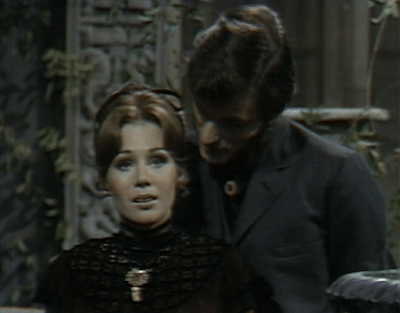
On the terrace, Quentin finds Rachel Drummond, the new governess. The two of them look very good together. In fact, Quentin’s seductive manner and Rachel’s response to it make them the most attractive couple we have seen on the show, by a long way.
They talk about the house. Quentin mentions that no one has been in the room on top of the tower since 1796, 101 years ago. Later that night, Rachel will see a light burning in the room, and she will rush into the drawing room to tell Edward about it.
She comes in after a meeting between Edward and Judith. Judith came to tell her brother about something entirely new to the audience. She says that the matter relating to the tower room is going well. Maidservant Beth goes to the room three times a day, and Beth also goes into town regularly to take money to a Mrs Fillmore.
This will interest returning viewers. The other day, Quentin found Beth going into town with a parcel and an envelope containing $300 in cash. Beth said Judith gave her permission to go to town to conduct personal errands, and claimed, absurdly, that she had saved the money from her salary. We now know that she was taking the money to this Mrs Fillmore for some purpose of Edward and Judith’s. Later, Quentin found Beth taking a tray of food upstairs. He asked who was supposed to eat it; she said it was for Edith. When he pointed out that it was more than Edith could eat, she said Judith would be eating with her. In Edith’s room, Beth told Judith about this. She said they would have to be more careful now that Quentin was back home, and dismissed her to take the rest of the food “upstairs.” We now know that this “upstairs” is the tower room, and that Beth is helping Judith and Edward to hide someone there of whose presence in the house Quentin is unaware.
However much this may interest us, it does not interest Edward at all. He is outraged that Judith so much as mentioned the matter to him, saying that he wants her to handle it without notifying him in any way. She objects that they will have to talk about it sometimes; he does not agree.
When Rachel enters and tells them about the light, Edward detains her with a disquisition about the impossibility of the tower room being lighted while Judith scurries off and goes upstairs. After a while, Edward takes Rachel back to the terrace and shows her that the room is dark. He asserts that it was also dark when she looked at it earlier, and it has been dark for over a hundred years.
Longtime viewers will recognize this scene. In March 1968, Dark Shadows was set in 1796, and Barnabas had just become what he is again now, a vampire. Barnabas’ father, haughty overlord Joshua, confined him to the tower room while he tried to find a way to free his son of his curse. Barnabas’ mother Naomi saw lights in the tower room, as did his second cousin Millicent. When Naomi told Joshua about the lights, he pretended not to see them, and when Millicent told her husband Nathan she had seen the lights, he, for his own reasons, also pretended not to see them. Those pretenses led each woman to go to the room, resulting in madness for Millicent and suicide for Naomi. Quentin tells Rachel that the tower room has been closed since 1796 because “a woman killed herself” there; that is an explicit reference to Naomi.
Like Edward and Judith, Joshua and Naomi were played by Louis Edmonds and Joan Bennett. It is a sign of how much more dynamic the 1897 section is than the 1790s section that Judith is an active participant in whatever scheme is going on, not simply a helpless person who stumbles upon a terrible secret and promptly kills herself.
Yesterday, we were in the great house on the estate of Collinwood when dying nonagenarian Edith Collins met mysterious newcomer Barnabas Collins. She told Barnabas that she recognized him. Edith had been entrusted with the Collins family’s darkest secret, which was about Barnabas. He is a vampire, entombed in the 1790s to be kept forever away from the living. Now it is 1897, and Edith sees that the family has failed. She must tell the secret to her eldest grandchild, Edward Collins. Edward comes into the room and Edith tries to tell him what has happened. She has difficulty speaking. Edward asks Barnabas to excuse them. He replies “Of course,” and leaves the room. He does stand at the door and listen to their conversation, apparently waiting to see if Edward will come out with a crucifix and a sharpened stake.
Today, we find that Edith was so shocked by the sight of Barnabas that she has lost her sense of her surroundings. Barnabas was kept in a chained coffin in an old family mausoleum, and Edith does manage to say the word “mausoleum” to Edward, but that’s as far as she gets with the secret. Thereafter, she weaves in and out of the moment, reliving several periods of her life, some as far back as the time of her wedding to Edward’s grandfather.
At the word “mausoleum,” Barnabas rushes back to the Old House on the estate, where he has been staying. He tells his unwilling servant, a woman named Magda Rákóczi, that she must fetch her husband Sandor and that she and Sandor must go to the mausoleum at once, take the coffin out of the secret chamber where it is hidden, leave no trace of any kind in the chamber, and carry the coffin to the house. Magda points out one of several facts that make it impossible to comply with these orders, which is that Sandor is in town where Barnabas sent him. Barnabas refuses to acknowledge this or any other insuperable difficulties, and goes back to the great house.
While Barnabas is sitting in the drawing room clenching his fists on the armchair where he is waiting to see what Edward will do when he learns that he is a vampire, a hidden panel opens and a man carries a pistol into the room. The man holds the pistol at Barnabas’ head and demands he tells him who he really is. The man identifies himself as Carl Collins, one of Edward’s brothers. Barnabas yields nothing. The man discharges the pistol, from which emerges a flag labeled “Fib.” He laughs. Barnabas is not amused. The audience may not share Carl’s sense of humor either, but the subsequent scene in which Carl claims to see that Barnabas has a kind face, predicts that the two of them will become close friends, and offers to let him borrow the pistol and play jokes with it himself, is hilarious. Jonathan Frid plays Barnabas’ icy reaction to Carl perfectly, and as Carl John Karlen does not betray the least glimmer of awareness of Barnabas’ affect.
Carl goes to the Old House to call on Magda. The scene there begins with Magda showing her palm to Carl. He wants her to read the Tarot cards; she says the cards will not speak unless she has money in her hand. Like his siblings, Carl is convinced that the secret which Edith keeps and which she has vowed to disclose only to Edward is the key to control of the family fortune. Magda knows better, but she goes through the cards anyway. They tell her that the family’s fortune is even larger than anyone knows, that when Edith’s will is found it will come as a surprise to everyone, that the surprise will lead to murder, and that the person who inherits the money will not keep it. The Queen of Cups turns up in a position that indicates Edith is still in control, but the last card Magda draws leads her to gasp and stand. She reels about the room, and declares that Edith is dead. “The cards are silent.”
Back in the house, Edward lets Barnabas into Edith’s room. He closes his grandmother’s eyes, and tells Barnabas that she did not tell him the secret. He vows to learn the secret even “if it’s the last thing I do!” We cut to Barnabas, looking uncomfortable. No doubt he is thinking of how inconvenient it would be if Edward were to find out the secret and he had to see to it that it was indeed the last thing he ever did.
This is the sixth consecutive installment to which I have given the “Genuinely Good Episode” tag, a record so far. Like the preceding five, it is stuffed with wonderful things. The acting is all very very good. Isabella Hoopes does a marvelous job as the delirious Edith, as Edward Louis Edmonds gives a master class in how to play a stuffy man, and the pairings of Grayson Hall, John Karlen, and Jonathan Frid with each other all unfold brilliantly, full of laughs but never losing their dramatic tension. So many of the episodes fans most enjoy would be drab for people coming to the show for the first time that it is always a memorable occasion when we see one like this, that anyone should be able to recognize as an outstanding half hour of television. It’s true the visual side lets us down a little; even by the standards of 1960s daytime television, the color is murky and there are too many closeups. But Sam Hall’s script and the performances are so good that no fair-minded person will complain very much about those problems.
Fans will take a special interest in Edith’s ramblings. When it first aired, viewers had no way of knowing how much of what she says about the family’s history will be reflected in upcoming episodes. The writers themselves probably didn’t have a much clearer idea about that than we do. But watching the series through for the first time, our default assumption about each of her lines is that it will have some significance as we go, so if we are committed to watching the show we listen closely.
We’ve already learned that Edith is over 90, so the very latest she could have been born is 1807. More likely she was born a bit before that, sometime between 1801 and 1806. She says today that her father-in-law was Daniel Collins. From November 1967 to March 1968, Dark Shadows was set in the late 1790s, and we saw Daniel. He was about 11 in 1795, so he would have been born in 1784 or thereabouts. So he could have been no more than 23 years old when Edith was born. Presumably his son Gabriel was the same age as his bride, though he might have been significantly younger. Edith does say that she always hated Daniel; perhaps she was a good deal older than Gabriel, and Daniel disapproved of her initially for that reason.
Edith tells us that Gabriel has been dead for 34 years, placing his death date in late 1862 or early 1863. She does not mention his cause of death or say anything about their son who was the father of Edward, Carl, and the others. It is firmly fixed that Edward and Carl’s brother Quentin was born in 1870, so Gabriel’s son must have survived him by several years.*
Edith says several times that the secret has been passed down from generation to generation and that she must tell it to Edward because he is the oldest. That seems to imply that Daniel told his oldest child, whom we presume to have been Gabriel, and that Gabriel told his oldest child, whom we presume to have been the unnamed father of Edith’s four grandchildren. He would then have told Edith before he died, either because Edward was not yet old enough to hear it, or because he was not available at the time.
But that implication is not at all secure. Edith says that Edward must be the keeper of the secret because he is the oldest- she doesn’t say what the connection is between being the oldest and keeping the secret. For all we know, she could have decided on her own to invent that tradition, starting with Edward and continuing with Edward’s oldest child. And when she says that it was passed down from generation to generation, she does not specify how many generations have been involved or which member of each generation did the passing. All we know is that someone of one generation learned it from someone else of a different generation, and that Edith believes it is the family’s responsibility to keep Barnabas from preying upon the living.
I think it’s reasonable to assume that sometime between 1897 and 1967 the secret was lost and not continually passed down. Perhaps in the original timeline Quentin was successful in killing Edith before Edward arrived, or maybe Edward died later in life before he was able to pass it on.
As far as Joshua passing the secret on, maybe he did, or maybe it was the elderly Ben Stokes who started the tradition?
Joshua was Barnabas’ father, and Ben Stokes was a much-put-upon indentured servant who was Barnabas’ devoted friend. They were the two people who knew that Barnabas was a vampire and that he was entombed in the secret chamber of the mausoleum. I replied to “Mike”:
I love that idea. Edith’s desire to tell the oldest son may lead us to assume that it has been handed down to the oldest son generation after generation, and it does lead the “Fab Four”** to assume that it brings with it some kind of power and access to riches. But their assumption is wrong, and ours may also be. Perhaps Joshua never told anyone. Perhaps the first person to tell the secret was Ben Stokes, and the person he told was Edith.
The scene between Barnabas and Magda brought another question to my mind. In #334, Barnabas was able to lock the panel in the mausoleum that leads to the secret room. Why doesn’t he just do that? It has also been made clear that as a vampire he is far stronger than are humans- if he wants to move the coffin from the mausoleum to the Old House, surely he could pick it up himself and do it more quickly and with less risk of detection than could Magda and Sandor. My wife, Mrs Acilius, agrees that we don’t know why Barnabas doesn’t lock the panel, but she says that it is perfectly clear why he can’t move the coffin- that is manual labor, and he is an aristocrat. His servants must do that.
*In a later episode, Quentin will mention that he knew Gabriel, throwing the 1862/3 date into question. But they never get around to any stories that depend on anything that happened in Gabriel’s later years. By the time we get to that one, only obsessive fans will remember his name. Eventually we meet two characters named Gabriel Collins, one in episodes that will air in 1970 and the other in the 1971 film Night of Dark Shadows, but a death date in the 1860s is not relevant to anything we learn about either of them.
**The “Fab Four” are Edith’s grandchildren, Edward, Carl, Quentin, and their sister Judith.
Occult expert Timothy Eliot Stokes is searching the room in the long-deserted west wing of the great house of Collinwood where heiress Carolyn has been hiding Frankenstein’s monster Adam since #539 in July. Strange and troubled boy David Collins saunters into the room and greets him with a casual “Hello, professor.” When a flustered Stokes makes up a story about Carolyn sending him to the room to look for some old books, David calmly replies, “Oh, I thought you might be looking for Adam.”
We haven’t seen David since #541. The only time we saw him interact with Adam was when they crossed paths in the woods in #495, and in none of the countless scenes featuring Adam cooped up in this dusty little room has David been mentioned. Yet today he tells Stokes that he visited Adam there many times, and that the two of them became great friends. I take that to mean that Ron Sproat, writer of today’s script, wanted to show us a lot of conversations between David and Adam and was overruled by the producers. It’s a major disappointment Sproat didn’t get his way. David Henesy and Robert Rodan would have been a wonderful pairing. David Collins tells Stokes that Adam told him last night that he would be leaving Collinwood before morning, and that he would never return.
Carolyn enters the room and tells David to go. He eavesdrops on her conversation with Stokes. He hears Stokes acknowledge that he is in the room without her permission, confirming that he was lying when he claimed Carolyn sent him there. He stays long enough to hear that Stokes is anxious to find Adam because he is afraid he is in danger. He goes off to look for the big guy.
During Carolyn’s conversation with Stokes, it becomes clear that she does not remember the events of the previous night. Since that night stretched over 13 episodes, that is quite a gap. During it, a mate was created for Adam; Carolyn participated in the first attempt at that procedure as the donor of the “life force.” She did that under the influence of suave warlock Nicholas Blair; Nicholas later enlisted her in another task, after which he erased her memory. Perhaps she forgot everything she did while his spell was upon her. That would explain why she doesn’t remember anything about Adam’s mate or about his passionate goodbye kiss. The show was so much more interesting during the little interval when Carolyn knew what was going on that it is almost as big a disappointment to learn of this mind-wipe as it is to hear that we were denied a chance to see a friendship develop between David and Adam.
David goes to Eagle Hill cemetery to look for Adam. He sees Willie Loomis, bedraggled servant of David’s distant cousin Barnabas Collins, emerge from the old Collins family mausoleum. David hides behind a tombstone until Willie is gone.
David wonders what Willie was doing in the mausoleum. He goes inside, and decides to open the panel to the hidden chamber. There, he finds Maggie Evans, The Nicest Girl in Town, bound and gagged. He calls her by name, and we cut to commercial.
This situation will be familiar to longtime viewers. In #124, David found his governess, the well-meaning Vicki Winters, bound and gagged in a secret room in the Old House on the estate. That time, he panicked and left Vicki still restrained.
After the commercial break, we spend some time with Willie and Stokes in the Old House, where Barnabas now lives. Thayer David plays Stokes. In #124, he played Matthew Morgan, the crazed handyman who was holding Vicki prisoner. Seeing him in this house with Willie at this point in the episode ensures that those of us who saw it will remember #124 and wonder how David’s response to the situation with Maggie will compare to his failure to help Vicki.
Willie then goes back to the mausoleum and finds David sitting on one of the coffins in the publicly known part. He asks David what he is doing there. David answers in a roundabout way. We start to wonder if he may have reverted to his old form and left Maggie where she was. But he eventually gets around to describing how Maggie behaved when he was untying her. Willie is terribly upset to find that Maggie is gone.
Willie abducted Maggie and locked her up in the mausoleum because Barnabas and mad scientist Julia Hoffman were planning to impose the role of “life force” donor on her. While there, she remembered that in May and June of 1967 Barnabas was a vampire who fed on her, imprisoned her, tried to replace her personality with that of his lost love Josette, and tortured her when she resisted. Willie doesn’t see any way to let her out when she has information like that. In the middle of today’s episode, Kathryn Leigh Scott and John Karlen have a big scene in the mausoleum as Maggie defies Willie and he begs her to be nice to him. They do an excellent job, but it is quite a relief to be out of that dungeon.
A terrible script, full of repetitious language and recycled story points, but each member of the cast is in top form. They almost make it feel like we haven’t seen all of this before.
In May and June of 1967, vampire Barnabas Collins imprisoned Maggie Evans, The Nicest Girl in Town, and tried to brainwash her into thinking she was his his lost love, the gracious Josette. After Maggie escaped from Barnabas, she was in a state of total mental collapse for several weeks. By the time her memory came back in August, Maggie’s psychiatrist, mad scientist Julia Hoffman, had become Barnabas’ accomplice. Julia has a preternatural power of hypnosis, and she used it to block Maggie’s memories before she could expose Barnabas.
Now, Barnabas and Julia are conducting an experiment to build a female Frankenstein’s monster. Once constructed, the new woman is to be the mate to patchwork man Adam. They need an existing woman to donate her “life force” to animate their creation. They were planning to use Maggie. Barnabas’ servant Willie has a crush on Maggie, so when he learned of their intentions he abducted Maggie before they could get at her.
Willie stashed Maggie in the hidden chamber of the old Collins family mausoleum. As it turns out, Barnabas had taken Maggie there to torture her when she was his prisoner, so when she found herself in that setting her memories came back. Maggie made that clear at the end of yesterday’s episode; she and Willie spend most of today’s talking it over. Kathryn Leigh Scott plays Maggie’s horror and John Karlen plays Willie’s panic with admirable intensity.
Barnabas is visiting the great house of Collinwood when his distant cousin Roger tells him that heiress Carolyn Collins Stoddard has left the house to spend several days in Boston. Adam is threatening to kill various people unless the experiment is completed soon and Carolyn donates the life force, so Barnabas is alarmed by this news.
Barnabas goes home to the Old House on the estate. He finds Carolyn waiting for him there. She tells him she knows all about the experiment and is eager to serve as the donor. Barnabas is bewildered by her enthusiasm. As Carolyn, Nancy Barrett plays this scene with such gusto that she is electrifying to watch. When Barnabas finds her standing in his front parlor looking at him with total self-assurance the show has what is, as far as I am concerned, its sexiest moment so far.
Dangerously unstable ruffian Willie accidentally freed vampire Barnabas from his coffin in #210, and became his sorely bedraggled blood thrall. Barnabas has since been cured of his vampirism, more or less, and when first we saw Willie after that it seemed he might be about to revert to his old ways. But he has settled back into a life under Barnabas’ thumb. Today, he is digging up a grave, planning to steal a body for Barnabas and mad scientist Julia to use in creating a Frankenstein’s monster.
Willie is interrupted in this gruesome task when hardworking young fisherman Joe, walking through the graveyard, spots him and announces that he will be taking him to the sheriff. Joe is pale and has trouble concentrating; at one point he asks Willie about a voice only he can hear. Willie is in such a panic that he doesn’t notice the signs that Joe is ill. When Joe walks off, Willie is still pleading with him not to go to the police.
As it happens, Joe is not on his way to the sheriff’s office. He has been bitten by Angelique, formerly the wicked witch who made Barnabas a vampire, now a vampire herself. He is answering her summons. Were Willie not so terrified of the sheriff, perhaps he would have recognized a fellow sufferer of his old affliction.
Joe has been on Dark Shadows from the beginning, long before Willie and Barnabas joined the cast. For his first 112 weeks, he was the show’s most straightforward specimen of Healthy Man. His only foible was his tendency to lose track of his plans when he had the chance to help a neighbor. Now Angelique has transformed him into an addict desperate for a fix.
Joe and Willie represented opposite extremes of personality before they were bitten, and actors Joel Crothers and John Karlen were similarly remote from each other in their approaches to their work. Karlen used techniques like those popularized by Marlon Brando and James Dean to throw himself into a depiction of Willie’s emotions that could be compelling no matter how stale the dialogue he was given. Crothers could overcome weak lines as well, but he did it with a manner as precise and deliberate as Karlen’s was volatile and intense. For example, today he says “There are places I should be, other places,” which may not look like much in print, but his delivery shows a deep poetry in it.
Joe goes to Angelique in the house by the sea where she is staying. He wrestles with his compulsion to submit to her bite; she assures him that he will soon forget everything else in his life, including his love for his fiancée Maggie. Regular viewers will hear an unexpected echo in this; Maggie is played by Kathryn Leigh Scott, who in the part of Dark Shadows set in the 1790s played gracious lady Josette. It was her frustration that Barnabas loved Josette and not her that led Angelique to cast the spells that caused disaster in those days, culminating in her transformation of Barnabas into a vampire.
Joe awakens after the bite and tells Angelique about his encounter with Willie. Angelique’s master Nicholas appears. He instructs Joe to tell him what happened in the graveyard, and dismisses Angelique. We see Joe’s old gallantry one last time as he tells Angelique she doesn’t have to take orders from Nicholas. She tells him she does, and leaves him alone with Nicholas.
Nicholas tells Joe that he controls Angelique, and therefore controls him. Joe tells him he did not stop to tell the sheriff about Willie. It is Nicholas who wants a Frankenstein’s monster and has set up the scheme that is forcing Barnabas and Julia to try to make one, and so he is relieved to hear that. Nicholas gives Joe an order we do not hear.
Meanwhile, Willie is back at Barnabas’ house, still in a state of panic. Barnabas asks what is wrong, and he tells him that Joe found him digging up a grave and said he would go to the police. Willie wants to leave town at once, but Barnabas refuses.
Barnabas is figuring out how he can dump responsibility for the whole mess on Willie when a knock comes at the door. Thinking it is the sheriff, he sends Willie upstairs, telling him that if he talked to them he would only make it worse. It turns out to be Joe, come to tell Barnabas what he saw and explain that he decided that, since Willie saved his life a while ago, he won’t go to the police after all. Barnabas is very quiet and very courtly, sounding for all the world like Boris Karloff. After Joe leaves, Willie enters, jubilant to be off the hook. Barnabas is troubled by Joe’s obvious ill-health.
Back in the house by the sea, Nicholas tells Angelique that he has received some alarming news from the hospital. The victim of her first bite, easygoing electrician Tom, is coming out of his coma. If Tom tells what he knows, Nicholas and Angelique will be exposed. Angelique has only been a vampire for a short time, and is unsure of her powers. But Nicholas has demonstrated sufficient ability that it is difficult to see Tom as much of a threat to him. The episode thus ends without any particular suspense.
Suave warlock Nicholas Blair tells his subordinate, the wicked witch known variously as Angelique and Cassandra, that she has an hour to figure out why her recent attempt to turn Barnabas Collins back into a vampire failed. When she tells him that won’t be enough time, he suggests she spend the hour preparing for her final destruction. At the last minute, her stepson David tells Angelique/ Cassandra about an audiotape message that happens to give her exactly the information she needs.
Angelique/ Cassandra has been an extremely unsympathetic villain, so it is daring to have an episode mostly from her point of view which is suspenseful if and only if we want her to stay around. My wife, Mrs Acilius, says that might have been a reasonable bet when a character as dynamic as Angelique/ Cassandra is played by a performer as appealing as Lara Parker, but it doesn’t pay off today, for two reasons. First, the episode doesn’t have much of a plot. Second, returning viewers will be angry with Angelique/ Cassandra right now. She just subjected us to a three month ordeal called “The Dream Curse,” in which we saw the same dull sequence play out a dozen times, heard it described almost twice as many times, and then found out that there was no point to any of it. We know perfectly well that Angelique/ Cassandra is too interesting to stay off the show for long, so that the “final destruction” Nicholas is threatening will probably last for three weeks at most. But we really do want to see her punished for wasting our time.
This is the first episode in which John Karlen reads the opening narration, and only the third episode in which any male performer reads it. Most cast members have read these narrations more or less in the characters they will play in that day’s episode; Karlen takes his place alongside Kathryn Leigh Scott as one of two who strive to invest the role of Narrator with its own personality.
This was the last of the five episodes credited to director John Weaver. It isn’t hard to find reasons why they wouldn’t have contracted him to do more. There are a number of moments when the action jolts to a standstill for no apparent reason, Humbert Allen Astredo as Nicholas never seems to know what direction he should be facing, and when Angelique/ Cassandra orders the bedraggled Willie Loomis to “Look into my eyes!” we get a shot of him looking past her.
Recovering vampire Barnabas Collins is dead, and this time it seems like he might stay that way. At least it seems so to his friend Julia Hoffman, MD, and his servant Willie Loomis; they’ve buried him, and are talking about what to do next. Julia decides they should tell people Barnabas went on a long trip, and that they themselves should leave the area before dawn. They will go to a sanitarium called Windcliff. Julia will resume her duties as its chief, while Willie will take a job there doing whatever he can handle.
Julia orders Willie to pack his things; he asks if he should pack Barnabas’ things also. Julia is impressed that Willie thinks of this. Perhaps he is remembering his onetime friend Jason McGuire, whom Barnabas killed in #275. Jason was hated by all and was under orders from the sheriff to leave town when he fell afoul of Barnabas, and so it was easy for everyone to assume he had simply gone away. Still, in #277, sarcastic dandy Roger wondered why Jason hadn’t taken his clothes or his shaving kit. No one ever tried to tie up that loose end, but perhaps Willie learned of the problem and made a note of it for the next time he had to conspire to conceal a death.
Willie goes directly from Barnabas’ freshly dug grave to Maggie Evans’ house. Willie has an unwholesome preoccupation with Maggie. Longtime viewers will remember Willie’s menacing approach to her in #202 and #207, before Barnabas got hold of him and turned him from a dangerously unstable ruffian into a sorely bedraggled blood thrall; those who are mindful of the period when Dark Shadows first became a hit will remember May and June of 1967, when Maggie was Barnabas’ prisoner and Willie tried desperately to lessen her suffering; and first time viewers will be startled by the beginning of the scene, when we see Willie peeking through the window at Maggie. When Barnabas’ vampirism went into remission, his former victims tended to return to the personalities they had before he bit them. Willie has not quite become the rapey goon he was in his first two weeks on the show, but neither is he the first man a woman would choose to be alone with.
Willie!
Since she is The Nicest Girl in Town, Maggie has long since forgiven Willie what he did when he first came to Collinsport. And Julia used a magical version of hypnosis on Maggie to induce amnesia covering the whole period of her involvement with Barnabas and to leave her with warm feelings of goodwill for him. But it’s late at night, so when Willie knocks, she is reluctant to let him in. He insists, and she relents.
Willie tells her he will be going away soon to take an exciting new job. Maggie says that she is sure everyone will miss him. At first he repeats the story that Barnabas is going away on a long trip, but then he starts crying. When Maggie asks why, he tells her Barnabas has died. He asks her to keep this secret, but the most she will agree to do is to wait until he leaves town to start talking about it.
Meanwhile, Julia has gone to the great house of Collinwood, where she has been a houseguest for about a year. Before she goes upstairs to pack, she stops and tells Roger’s wife Cassandra that Barnabas is dead.
Julia knows that Cassandra is actually Angelique, the wicked witch responsible for Barnabas’ woes. It would seem that the whole point of covering up Barnabas’ death would be to keep Angelique/ Cassandra from finding out about it. Yet Julia not only goes out of her way to tell her, she also declares to her that she will continue to fight against her.
Angelique/ Cassandra spits out that Julia is in love with Barnabas, to which Julia replies “Not nearly as much as you are.” For some time, the show has been developing the theme that Julia would like Barnabas to be her lover. In their post about the episode on Dark Shadows Before I Die, John Scoleri said “So Julia’s true feelings are finally on the table.” To which Christine Scoleri replied, “Where have you been? Julia’s feelings have been on the table, the wall, the floor…pretty much everywhere for a long time.”
Willie’s visit to Maggie and Julia’s to Angelique/ Cassandra mark a difference between the first year of Dark Shadows and its later phases. When the show started, the characters were too good at keeping secrets, with the result that very little happened. They took this to such an extreme that one of the two principal storylines with which the show began- well-meaning governess Vicki’s attempt to find out who her parents were- died out altogether because reclusive matriarch Liz and her lawyers, the only characters who knew anything about it, would never talk.
Now, the characters involved in the action don’t keep secrets from each other at all, with the result that events comes thick and fast, but it is hard to build complex alliances or to explore nuanced relationships. They still conceal information from Vicki, Liz, Roger, and other characters left over from the early days, rendering them background figures with little to contribute to the story. Video game enthusiasts might call them “NPCs”- non-player characters.
Professor Timothy Eliot Stokes, occult expert, enters. Stokes tells Julia that a man named Adam appears to be dead. Julia goes with him to an abandoned shack in the woods where she examines Adam’s body and pronounces him dead. When Stokes tells her that Adam exhibited sharp pains in his neck starting at about 11 PM, that he called out for Barnabas, that his strength appeared to ebb for no apparent reason, and that he then died, Julia’s eyes widen. Suddenly Adam comes back to life. He starts gasping for air and miming a struggle against an invisible barrier just above his face. Julia tells Stokes she will have to go. He protests that she must stay with her patient. What she says next doesn’t mean much to Stokes, and would mean less to a first-time viewer:
JULIA: He is suffocating- I may know why. No, it’s impossible! But it may be that they are the same. Experiment- perhaps Adam is why-
STOKES: What are you talking about?
JULIA: Barnabas- I buried him- alive!
Regular viewers know that Adam is a Frankenstein’s monster created in an experiment begun by mad scientist Eric Lang. Shortly before he died of wounds inflicted by Angelique/ Cassandra, Lang recorded an audiotape in which he explained that as long as Adam lives, Barnabas’ vampirism will remain in remission. Julia has not heard that tape, but the audience has, time without number. We also know that when Barnabas was sealed up in a wall from #512 to #516, Adam experienced the pains that Barnabas suffered. In these lines, we see Julia for the first time beginning to understand the true nature of the connection between Adam and Barnabas.
Stokes’ approach to Julia is as indiscreet in its own way as were Willie’s to Maggie and Julia’s to Angelique/ Cassandra. Adam hates Julia and Barnabas, because they abused him shockingly in his first weeks of life, and forbade Stokes to bring her. Julia’s closing outburst is also an extreme indiscretion, as Stokes is basically a law-abiding person who could not be expected to help Julia and Willie cover up their many crimes. Again, we have come a long way from the days when the show would drop a major story rather than have a recurring character breach attorney-client privilege.
Like the Scoleris, Danny Horn was in good form when blogging about this part of the show. His post on Dark Shadows Every Day about this episode makes a number of penetrating observations about the connections between Julia and Willie’s opening scene at the grave and absurdist plays like Waiting for Godot and Rosenkrantz and Guildenstern are Dead.
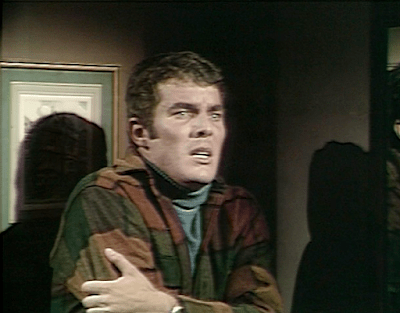
A lot of wonderful acting in this one. We start off with Willie Loomis (John Karlen,) staggering into the cottage Maggie Evans (Kathryn Leigh Scott) shares with her father Sam (David Ford.) Yesterday, Maggie’s boyfriend Joe beat Willie up. Maggie invites Willie in, comforts him, tries to treat his wounds, and agrees to drive him home. Joe had excellent reasons for insisting Willie stay away from Maggie, and those reasons might lead returning viewers to react to the beginning of the scene with frustration. But Karlen and Miss Scott are so good together that they very smoothly defuse that frustration, and we soon find ourselves as absorbed in the scene as we were in the many scenes the same actors shared in May and June of 1967, when Maggie was the prisoner of Barnabas the vampire* and Willie, as Barnabas’ slave, was trying desperately to reduce her suffering.
A very tall man named Adam (Robert Rodan) comes to the open front door and announces “Willie bad!” Maggie has no idea who Adam is. Adam enters the cottage and clarifies his intention with a declaration of “Kill Willie!” Willie tries to talk Adam out of this plan, and reminds him of the good times they had together. Maggie tells Adam that Willie is hurt, and Adam looks concerned when he responds “Willie hurt?” Rodan gets the same flicker of light into Adam’s eyes that you might see in the eyes of a toddler who is intrigued to hear that someone is having feelings he wouldn’t have expected them to have. Before long, though, Adam is angry again. Maggie takes a hammer and tries to hit Adam, leading Adam to state a new plan- “Kill Maggie!”
Sam comes home. Sam befriended Adam during a trip Maggie recently took out of town. He tells Maggie to stand behind him. She does, and he talks to Adam about their friendship. Adam agrees that Sam is his friend and that he would never hurt him, but he refuses to agree when Sam tells him that Maggie is also his friend. Maggie makes a move that confuses Adam. Trying to get at her, Adam hits Sam very hard. Adam sees that he has knocked Sam down, and he runs away.
We see Adam in the woods, and for the first time hear his voice in a pre-recorded monologue telling us his thoughts. “Afraid! Adam afraid! Adam bad! Adam hurt friend!” Rodan’s acting is more than sufficient to enable us to figure out that this was what Adam was thinking even without the monologue, but he does such a good job of voice acting that I don’t really begrudge it. Crude as the lines are, Rodan simultaneously expresses fine shades of fear and guilt through them.
Willie and Maggie have another scene in the Evans cottage. She is stern with him now, demanding to know what Willie knows about Adam. Willie denies that he knows anything, and she points out that when he was trying to calm Adam he appealed to several facts from their previous acquaintance. Willie tells a story to cover that up, essentially the same story Barnabas made up to tell the sheriff in #505. Maggie is a lot smarter than the sheriff- that isn’t saying much, chewing gum is a lot smarter than the sheriff- and even he didn’t buy this line when Barnabas was pushing it. She tells Willie in a firm tone that she will continue to ask questions until she gets answers she can believe. She explicitly tells him she will ask Barnabas. Maggie’s firmness and Willie’s barely controlled panic make for another gripping encounter.
Willie goes back home to Barnabas’ house. Barnabas’ best friend Julia Hoffman (Grayson Hall) is there. Willie tells Julia they have to find Adam before the police do, since he now knows enough words to get them all in a lot of trouble. Usually when Julia and Willie have their staff conferences, she is firmly in charge and full of ideas. But she is at a complete loss today. She has no idea how to capture Adam, and she doesn’t know where Barnabas is.
What’s more, Julia has just seen a ghost. She heard sobbing coming from the basement, and when she went down there she saw a woman in white whom she recognized as Josette Collins, deceased. Josette dematerialized in front of her. Now the sobbing starts back up, and Julia accompanies Willie to the basement.
Josette is already gone when they get there. Julia tells Willie what she saw earlier. She figures out that Barnabas is bricked up behind the wall where Josette’s ghost had stood. She explains her reasoning in terms that viewers who have seen the last several episodes will be able to follow, but which don’t make a bit of sense to Willie. His sharp befuddlement and her vague certitude make for a laugh-out-loud funny scene.
In the early months of the show, several characters heard a sobbing woman in the locked room in the basement of the great house of Collinwood. It was strongly implied in a number of those episodes that the woman was the ghost of Josette. In #272, matriarch Liz said that she herself was the one who did the sobbing. That didn’t fit very well with what we had seen, but by that point the show had reconceived Josette as part of Barnabas’ story and stopped involving her ghost in the action. Longtime viewers have a strong reminder of the “Sobbing Woman” story today, since Barnabas’ basement is a redress of the set used for the basement of the great house and the alcove where he is walled up is in the same place as the door to locked room in basement of great house.
*Maggie has amnesia about all that, and thinks Barnabas is her friend. His vampirism is in remission now.






 Dark Shadows Commentary