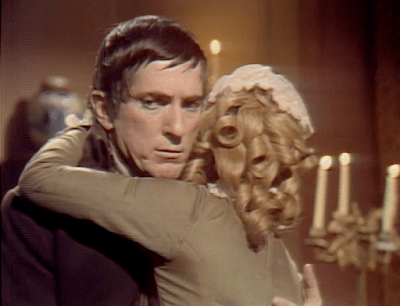
Episode 442: For the love of God, Montresor!

When vampire Barnabas Collins rose from his grave to prey upon the living in April 1967, he was a bleak, frightening presence. As the show went on, we saw him spend a great deal of time ruminating on murders he might like to commit, but he had few opportunities to act on those thoughts. By November, when well-meaning governess Vicki came unstuck in time and wound up in the year 1795, Barnabas had killed only two people, only one of them with premeditation. Both of those victims, seagoing con man Jason McGuire and addled quack Dave Woodard, had long since lost their relevance to the plot, and neither has been mentioned more than a few times since his death. As a result, Barnabas’ talk of killing comes to seem like nothing more than a series of hostile fantasies.

Soon, Dark Shadows will have to return to a contemporary setting. It was the frightening impression Barnabas created in his first weeks that made Dark Shadows a hit, and to keep it going the show will have to make him seem dangerous again. In the fifteen and a half weeks they have been in the 1790s, he has killed at least six people, including his uncle, his aunt, his wife, two streetwalkers, and a woman named Suki. That’s an adequate rate of murders to reestablish Barnabas as a fiend, but volume will only get you so far. They need to give us some shocking images of cruelty, preferably as the result of crimes committed with slender motives, to get him back in place as a truly scary creature.

Today, the show addresses both that need and the need to give a fitting sendoff to a character who has been one of the standouts of the eighteenth century flashback. The Rev’d Mr Trask, visiting witchfinder, was, along with repressed spinster Abigail, one of the two bright lights of the show’s otherwise dreary reworking of Arthur Miller’s The Crucible. Now the witch trial is over, Vicki has been convicted, and she is waiting to be hanged. In #437, Vicki gave a speech which left little doubt that at the moment appointed for her execution she would return to the 1960s and the costume drama period would end. Therefore, Trask can hardly reopen the case without confusing the whole plot. As a personality totally warped by fanaticism, he can’t very well branch out into other kinds of stories without a long buildup, much longer than they are likely to stay in the 1790s. Yet Trask has been so much fun that the audience would feel cheated if he simply went back where he came from.

So Barnabas lures Trask to his basement, ties him to the ceiling, and seals him up behind a brick wall. Unfortunately, this homage to Edgar Allan Poe’s “Cask of Amontillado” does not adapt the most celebrated line of that story and have Trask cry out “For the love of God, Mr Collins!”

Barney’s bricklaying project. Screenshot by Dark Shadows Before I Die.

Closing Miscellany

In a moment of black humor, the closing credits run over an image of the completed brick wall. We might imagine Jerry Lacy still dangling from the ceiling behind the wall. Mr Lacy was often a model of an actor’s devotion to his craft, but I very much doubt that even he took matters that far.

Hey Jerry, you OK in there until tomorrow? Screenshot by Dark Shadows Before I Die.

A recording of Jonathan Frid reading “The Cask of Amontillado” made in the spring of 1992 can be found on YouTube, posted by Frid’s longtime business partner Mary O’Leary.

In #264, high-born ne’er-do-well Roger Collins visited Barnabas at home. When it was time for a drink, Barnabas offered him a glass of amontillado. Poe’s story is so famous and amontillado is such an unusual variety of sherry that it must have been a deliberate reference. Perhaps the idea of Barnabas sealing someone up behind bricks was floating around among the writing staff for months and months.

Several fansites label it a continuity error that Trask reacts to the sight of Barnabas by exclaiming that he is dead. The family has been covering up Barnabas’ death, putting word about that he went to England. Many think Trask should not be among those privy to the Collinses’ secret. But as Danielle Gelehrter points out in a comment on Danny Horn’s Dark Shadows Before I Die, Trask and the gracious Josette discussed Barnabas’ death in #412.

I am writing this post on 19 February 2024. In a bit of synchronicity, yesterday, I saw this post on the site that all normal people still call Twitter:

Episode 439: Whose cane this is

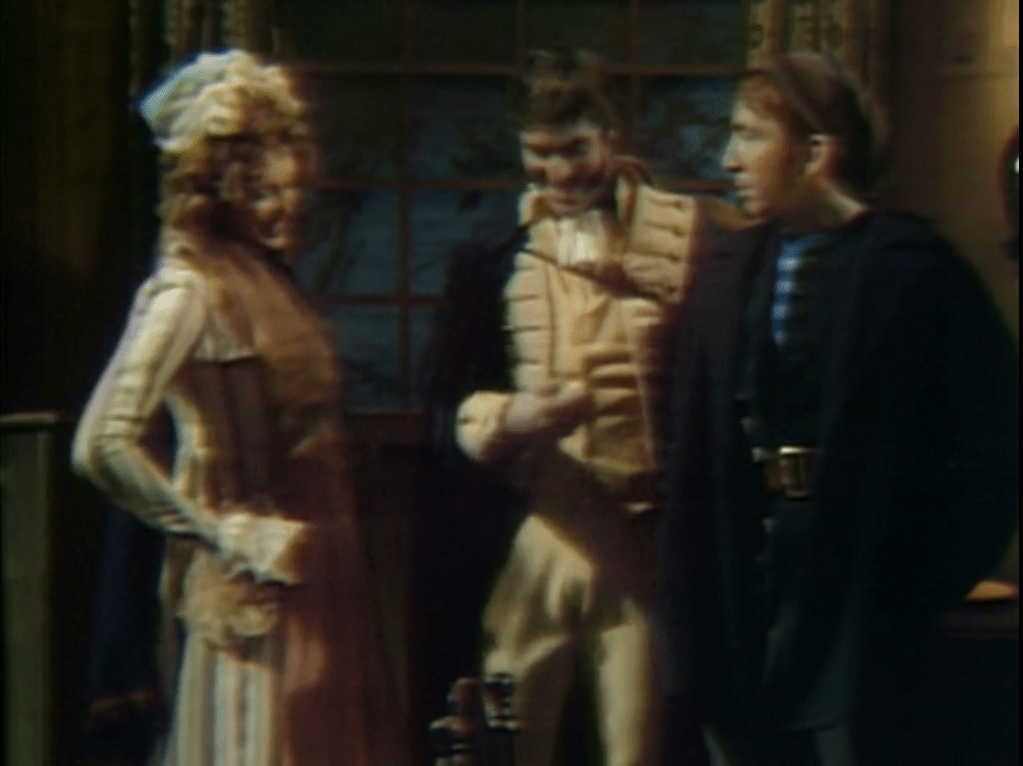
The opening voiceover is delivered by Vala Clifton, who makes her debut today as Maude Browning, a young lady whose profession it is to make herself agreeable to the gentlemen she meets. This marks the first time since episode #1 that the first voice we have heard was that of someone we had not seen previously. The rule lately has been that the introduction is always delivered by a woman who appears in the episode. Today, that leaves Ms Clifton as the only candidate.

At the top of the episode, vampire Barnabas Collins tells his friend, much put-upon servant Ben Stokes, of his plans for revenge on the Rev’d Mr Trask, a visiting witchfinder responsible for much misery and injustice. When he makes it clear that he plans to murder Trask and to do it in an especially atrocious manner, Ben puts his foot down and says that he will no longer help Barnabas in any way. Barnabas threatens to kill Ben if he doesn’t come back with the implements he has ordered. Ben says that he may as well kill him right away. He stands still and squeezes his eyes shut, evidently expecting Barnabas to accept the invitation. Barnabas does put on his strangling face and move towards Ben, but at the last second he relents.

We then see Ben at The Eagle tavern, demanding “More rum!” Maude is at his table, trying to engage him in conversation. He warns her against going out at night, bringing up Ruby Tate, a woman who died on the docks some nights before. Maude has already said that she arrived in town the day of Ruby’s death, but when she is explaining why she isn’t afraid to go out alone at night she suddenly becomes the expert on Ruby’s ways. “She talked to anyone. I don’t.” This is a delicious little moment, reminding us of all the people we’ve known who make up little stories to persuade themselves that they are immune from the misfortunes that have befallen others.

Untrustworthy naval officer Nathan Forbes enters the tavern accompanied by a man in sailor’s togs. Maude gives up on Ben and leaves his table; she chats with Nathan for a moment, her eyes on the bulge in his pants most of the time. That’s understandable, it’s rather a conspicuous bulge.

Maude leaves the tavern, and Nathan directs his companion to sit with Ben and to get information from him about Barnabas Collins. The man introduces himself to Ben, giving his name as Noah Gifford. Noah claims to be looking for work on the great estate of Collinwood. Ben tells Noah to stay away from there and to go back to the sea. He is drunk enough to mention Barnabas’ name, but doesn’t say much about him. He says that he wishes he could go to sea himself. He says that he likes tea, and wants to go to China to get a nice strong cup of it.

In #363, the ghost of Barnabas’ little sister Sarah mentioned that her father and his friends were always going to China on their ships. When Ben brings up China, regular viewers might remember that, and take it as confirmation that the Collinses were involved in trade with China in the 1790s.

Right before we watched this episode, I was reading an article by Amitav Ghosh in the 23 January 2024 issue of The Nation magazine about trade between the USA and China. Mr Ghosh says that between 1784 and 1804, the USA shipped a wide variety of products to China, but that from 1805 on Americans sold nothing to China but opium. He likens the label “China trade” for that commerce to calling Pablo Escobar’s business “the Andean trade.” Right up to the beginning of the flashback in #365 the show was equivocating on whether Barnabas, Sarah, and the rest of them lived in the eighteenth century or in the 1830s. Choosing 1795-1796 as the setting for this segment turns out to be a way of lightening one of the darker shadows the history we know from our time-band might otherwise have cast over the world of the show.

Nathan’s connection with Noah will sound another echo in the minds of longtime viewers. The first unsavory mariner on the show was seagoing con man Jason McGuire, who spent several months in 1967 blackmailing reclusive matriarch Liz. Jason was accompanied by a henchman, dangerously unstable ruffian Willie Loomis. Nathan at first seemed to be a good-natured and likable fellow, if a bit free with the servant girls and regrettably mercenary in his engagement to marry heiress Millicent Collins. But ever since it turned out that he already had a wife and that she was blackmailing him into splitting Millicent’s inheritance with her, Nathan has been reminding us more and more of the sinister Jason. When he turns up with Noah in tow, the resemblance is complete. We can only wonder if Noah will follow Willie’s lead and get into some kind of terrible trouble at the Collins family mausoleum in the cemetery north of town.

On the docks, Barnabas meets Maude. He goes through the same struggle to keep himself from biting her that he had gone through with Ruby in #414. He is so slow to move in for the kill that she has time to scream and attract Nathan’s attention. Barnabas hears someone running towards them, drops his cane, and runs off.

Nathan sends Maude back to the tavern. He finds the cane and recognizes his old friend Barnabas’ signature wolf’s head handle. In the tavern, he asks Maude to describe her assailant. She mentions that the man wore a gold ring with a large black stone. Knowing that Barnabas always wore such a ring, Nathan is convinced that he did not go to England as his family has been telling everyone, but that he is in Collinsport and is the strangler who has been terrorizing the community.

Nathan seemed most virtuous when Barnabas was alive and he was his more or less loyal friend. So it is a jolt that his reaction to the idea that Barnabas might be a serial killer is to tell Ruby that, lucky as she was to escape the Collinsport Strangler, she “may not be the only lucky one tonight.” Since he has not made any move to contact the authorities, there can be little doubt that his luck is not an opportunity to stop the killings, but the discovery of information he can use to blackmail the Collins family out of every penny they have. He has completed his transformation from a good guy with a rakish side into a deep-dyed villain.

Closing Miscellany

As Nathan enters the waterfront scene, we see a sign behind him labeled “Greenfield Inn.” We saw weeks ago that the Collinsport Inn, familiar from the first year of the show, already exists in the 1790s, so evidently this is a different hostelry. In #214, when Barnabas had returned to Collinsport in 1967, high-born ne’er-do-well Roger Collins did mention that any place in town other than the Collinsport Inn where there were rooms for rent would hardly “qualify as a flophouse”; perhaps the Greenfield Inn is the ancestor of one of these frightful places.

Greenfield Inn. Presumably not the front entrance.

Originally broadcast on 29 February 1968, this was the only episode of Dark Shadows to air on a Leap Day. One of the reasons I started the episode summaries this blog when I did is that the calendars for the years 2022-2027 match those for 1966-1971, so that I can post on the 56th anniversary of each original broadcast, matching not only the date but also the day of the week.

Episode 432: Cousin Abigail’s religion

In the deserted Old House on the great estate of Collinwood, repressed spinster Abigail Collins has stumbled upon the coffin in which her nephew Barnabas spends his days. She arrives just as he is rising for the evening. Abigail knows that Barnabas is dead, but she has never heard of vampires, so she has no idea what to make of what she sees.

Barnabas taunts Abigail. When she cries that the Devil is trying to touch her, he cynically asks why she thinks that the Devil always wants to touch her. The broadcast date is 1968, when Freudianism was riding high in the circles frequented by the sort of people who wrote and produced Dark Shadows. The dramatic date is 1796, when that school of thought was undreamed of. Still, there were various strands of folk wisdom about the adverse psychological effects of celibacy, so Barnabas’ smirking comment undoubtedly means exactly what the original audience would have taken it to mean.

From the moment Barnabas saw Abigail at the end of yesterday’s episode, we’ve wondered how he would go about killing her. She is his aunt, after all; the vampire’s bite is so widely recognized a metaphor for the sexual act that we could hardly expect the ABC censors to have allowed him to make a meal of her. In the end, he simply bares his fangs and she dies of fright.

Barnabas scares Abigail to death. Screenshot by Dark Shadows Before I Die.

Abigail has been a villain; even the opening voiceover refers to her as “a woman who has been responsible for much grief.” During their confrontation, Barnabas tells Abigail many truths that, had she known them earlier, would have kept her from causing that grief. If she accepts them now, she will be remorseful. To the extent that we want Abigail to know what she has done, we identify with Barnabas during this scene. That might lead us to think that her death by fright is a way of letting us see Barnabas as the good guy, since he does not kill her by physical contact. But throughout the confrontation he has been telling her that she is about to die. Before he bares his teeth, he makes a dramatic announcement that clearly tells us that he is bringing matters to their climax, and when he sees her die he does not look the least bit unhappy. He seems to have known that the sight of his teeth had the power to kill his aunt, and to have deliberately used that power.

Abigail is the sister of Barnabas’ father, haughty overlord Joshua Collins. Before he even became a vampire, Barnabas killed Joshua’s brother Jeremiah in a duel. By his clumsiness, Barnabas inadvertently caused the death of his own sister, little Sarah Collins. Things are getting rather lonesome for Joshua.

In the great house on the same estate, young Daniel Collins is trying to slip out into the night. Yesterday, he arranged to meet secretly with much put-upon servant Ben so Ben could give him pointers on how to run away from this depressing house. The lady of the house, Joshua’s wife Naomi, intercepts Daniel. She asks if he plays whist, and he complains that he isn’t allowed to play cards because that is “against cousin Abigail’s religion.” Naomi says that so long as it isn’t against his religion, it’s no problem for her.

This isn’t the first indication that Abigail’s religion is different from that of the rest of the family. As rich New England landowners in the eighteenth century, we can assume they are all Congregationalists, but the loose polity of Congregationalism left room for a lot of variation from one congregation to another. She may well have attended a stricter meeting than did the other members of the family, though she seems to have taken her greatest satisfaction in imposing her austere ways on the other members of the household.

Naomi suggests that Daniel and his older sister Millicent might stay at Collinwood with her and Joshua indefinitely. Daniel is clearly not a fan of this idea, and struggles to find a polite way to say that he is desperate to go back home to New York City. He is still struggling when a knock comes at the door. It is the Rev’d Mr Trask, whom Abigail called in from out of town to find witches. Trask is currently prosecuting Victoria Winters, former governess to Daniel and the late Sarah. Abigail asked Trask to meet her because she thought she would find evidence against Vicki in the Old House. Since she found Barnabas instead, she will not be keeping the appointment.

While Naomi goes to look for Abigail, Trask takes the opportunity to work on Daniel. At first Trask seems to be far more agreeable than we have ever seen him before. So when Daniel apologizes for telling him that he looks like the Devil and that he sees no reason they should exchange any words, Trask smiles and calmly says that he appreciates his honesty. Trask holds Abigail up as an exemplar of Christian virtue; Daniel says that he cannot bring himself to want to emulate Abigail, since she “is always so, so unhappy, as if whatever she has eaten doesn’t agree with her.” Trask takes this remark in good turn.

Daniel keeps insisting that Vicki is not a witch, but is very nice. Trask takes everything he says as evidence against Vicki. For example, when he tells Trask that Vicki extolled the virtues of curiosity, Trask exclaims that “Curiosity is the Devil’s money! What you buy with it is disbelief in everything it is right to believe in!” Even in this portion of their encounter, Trask seems far smoother than the screaming fanatic we’ve seen up to now. Daniel complains that Trask keeps talking about the Devil when “I want nothing to do with him.” At that, Trask leans in and says that if Daniel feels that way, he can still be saved. When Daniel asks how he can be saved, we can see how Trask might have managed to win a new follower, if he hadn’t gone straight to a demand that Daniel testify against his friend Vicki.

Trask and Daniel have a man-to-man talk. Screenshot by Dark Shadows Before I Die.

Trask finally loses his temper. Naomi returns and is appalled when she hears Trask telling Daniel that he bears the mark of the Devil. Daniel runs out into the night, and Naomi tells Trask he is to blame for that.

Daniel wanders about in the woods, looking for Ben. He quickly concludes that he must have missed Ben, and he thinks of going back to the house. Remembering that Trask is there, he chooses to stay outside.

Naomi is in the woods looking for Daniel; Trask joins her, much to her displeasure. Daniel sees Abigail’s corpse propped against a tree. He shouts for Naomi. She and Trask come, and he points the corpse out to them.

Daniel shares his gruesome discovery. Screenshot by Dark Shadows Before I Die.

Abigail is the second character Clarice Blackburn has played on Dark Shadows. She joined the cast in #67 as housekeeper Mrs Johnson. In her first months on the show, Mrs Johnson was out to get revenge on the Collins family for their treatment of her former employer and the object of her unrequited love, the late Bill Malloy. Blackburn was told to think of the character as if she were Mrs Danvers, the terrifying housekeeper in Daphne DuMaurier’s Rebecca. After the Death of Bill Malloy storyline ended, Mrs Johnson transformed into a warm-hearted old biddy whose wildly indiscreet chatter gave the other characters just the information they could use to advance the plot.

Mrs Johnson was always fun to watch, and one of the reasons to look forward to the show’s return to a contemporary setting is that she is waiting for us in 1968. But after her first few weeks, her appearances were rare and usually brief. Abigail gave Blackburn her first chance to show viewers of Dark Shadows what she could do when she had the chance to work on a big canvas. In later storylines, she will have more such opportunities, but we will always miss Abigail.

Episode 415: Sarah Collins

Sarah dies. Screenshot by Dark Shadows Before I Die.

When Dark Shadows first aired in June 1966, it kept hinting that behind the action we saw there was a back-world of supernatural presences some of whom might eventually interact with the characters. Often these hints occurred in conversations between a character native to the village of Collinsport and newly arrived governess Vicki. The local would use the word “ghost” metaphorically to refer to unresolved conflicts around the estate of Collinwood, Vicki would shriek “You don’t mean you believe in ghosts!?,” and the other would say that he damn well did believe in ghosts and that if Vicki stuck around long enough she would, too.

The first ghost whose name we heard was Josette, mentioned in #5 as a grand lady from France who came to town to marry Jeremiah Collins, was unhappy with him, and threw herself to her death from the precipice known as Widows’ Hill. Josette manifested herself on camera in #70 and rescued Vicki from murderous groundskeeper Matthew Morgan in #126. In that climactic encounter, we saw Josette and a group of other wraiths. Joining the ghosts of women who jumped from Widows’ Hill at various points in the 19th century was the ghost of Bill Malloy, who had been a living character in the first ten weeks of the show and had shimmered into view as a ghost and sang a song in #85. This assemblage suggests that the spectres haunting Collinwood know each other and act with a common purpose at least occasionally.

The first supernatural menace to appear on the show was undead fire witch Laura Murdoch Collins, mother of strange and troubled boy David. Josette warned several characters of the threat Laura posed to David. Josette herself was unable to fight Laura directly. In #165, she manifested in the room where Laura held the sleeping David, but had to retreat when Laura ordered her to go. Thereafter it was up to Vicki, advised by Josette, to organize the opposition to Laura. If #126 showed that the benevolent spirits can act together to defeat a threat from a mortal man, #165 and its aftermath showed that they must withdraw into the back-world when the enemy is of an uncanny nature.

In April of 1967, vampire Barnabas Collins succeeded Laura as the show’s new danger from beyond the grave. In #212, Barnabas went to the Old House at Collinwood, the place where Josette is most present, and told her portrait above the mantel that her power was at an end. In #223 and #240, Josette’s friend David felt her absence from the Old House and lamented that the family had lost its tutelary spirit. With that, we bid farewell to the wispy presences we had seen in #126. A vampire is too dynamic an adversary for them. It seemed for a period that the show had simplified its ontology- there are those who live by the laws of nature we know, there is Barnabas, and that is that.

That period ended in #255. Barnabas has passed himself off as a cousin from the Collins family’s long-lost English branch and settled in to the Old House. He is keeping Maggie Evans, The Nicest Girl in Town, as a prisoner in a barred cell in the basement. Maggie looks out her window and sees a little girl in 18th century garb sitting in the corridor. The girl is holding a doll and singing “London Bridge.” She does not respond to Maggie’s attempts to get her attention.

In the next several episodes, we learn that the little girl’s name is Sarah, that she has a big brother, and that she can’t find anyone she knows. Even if the closing credits hadn’t immediately given away the fact that she is the ghost of Barnabas’ little sister, we would be able to gather that she is a supernatural being who was pulled out of the back-world when Barnabas rose from the grave. For the next 22 weeks, Sarah keeps popping up in the world of 1967. We wonder what she will do next, when she and Barnabas will confront each other, and what other paranormal beings are waiting to erupt into the visible world.

In #365, the major characters held a séance to contact Sarah and ask her what she was trying to tell them. Sarah spoke through Vicki and said that she would not appear to them again. She also said that she wanted to “tell the story from the beginning.” With that, Vicki vanished from the table and a woman in an 18th century dress appeared in her place. The woman identified herself as Phyllis Wick, governess to Sarah Collins, and demanded to know where she was. Meanwhile, Vicki found herself in the year 1795, in Phyllis’ place. At a stroke, the back-world and the foreground are interchanged.

Now it is 26 January 1796, Sarah’s eleventh birthday. She is not having a happy one. Last night she found Barnabas in the family mausoleum with blood smeared on his face. She may not know that he has become a vampire, but she knows that something has gone horribly wrong with him. She runs off and hides behind a tombstone. By the time faithful servant Ben finds her and carries her home, she is severely weakened by exposure. She cannot speak, but mouths Barnabas’ name and looks distressed. Her mother Naomi and cousin Millicent keep vigil at her bedside.

Night falls; Barnabas rises again, and Ben tells him that Sarah is gravely ill. Barnabas resolves to visit her. Unable to talk him out of this plan, Ben offers to help him get into her room unobserved.

Ben relieves Naomi and Millicent, then ushers Barnabas into the room. Barnabas tries to reassure Sarah. Eventually she warms to him. She regains the power of speech, and with her first words she asks her brother to hold her. He does. She tells him she will always love him, then dies in his arms.

This is Sharon Smyth’s last appearance on Dark Shadows. As a child, she had some rather obvious limitations as an actress, a fact Sharon Smyth Lentz cheerfully acknowledges nowadays. During her first 22 weeks, she was playing a ghost, so there were many scenes where all she had to do was seem vague and detached and she could be effective. The story moved very slowly during that period, giving the writers and directors time to figure out her strengths. Near the end of it, she excelled in two scenes with a lot of dialogue. In #348 she had a complicated, serious conversation with heiress Carolyn Collins Stoddard, and in #364 she had her confrontation with Barnabas. Supported by Nancy Barrett and Jonathan Frid, she executed those scenes very well indeed.

In 1795, Sarah is alive and the plot moves at a breakneck pace. Under those conditions, it would have taken intricate advance planning to craft scenes that would have been in Sharon Smyth’s range. But the writers of Dark Shadows rarely had time to do any advance planning. When the show was moving slowly enough, they could usually hit all the major points the audience would expect to see, but there are some glaring omissions in 1795. Young Daniel Collins will be played by David Henesy, who also plays David Collins. Since the relationship between Vicki and David had been the core of the first 39 weeks of the show and the relationship between Sarah’s ghost and David had been one of the most intriguing elements of the 22 weeks she was haunting Collinwood, it is particularly disappointing that we barely see Vicki with Sarah and never see Sarah and Daniel together at all.

I first saw Dark Shadows on the SciFi Channel, as it was then called, in the 1990s. I saw a handful of episodes on random mornings when I happened to be off work. They whetted my curiosity about the show, but I left it to chance until I saw an episode with Sarah’s ghost. Then I decided to set my VCR and watch regularly until I found an explanation for what was going on with her. The whole idea of supernaturalism is that there are phenomena which defy explanation, so of course I never reached that point. Naturally, I got hooked on the show within a couple of weeks.

On his Dark Shadows Every Day, Danny Horn rather unfairly, albeit hilariously, griped that “Sharon stopped acting after Dark Shadows, or possibly during.” When she looks back on her days as a child actress, Mrs Lentz talks about how excited her mother was to meet show biz celebrities, and says that her main gratification was in pleasing her. But she has fond memories of many castmates, and says that her favorite person to run lines with was Jonathan Frid. So there is something sweet about her ending her time on the show in his arms.

Episode 401: The A V club

At the top of the episode, much-put-upon servant Ben is locked in a barred cell in the basement of the great house of Collinwood. Haughty overlord Joshua Collins and his family just moved into the house a week or two ago, and parts of it are still under construction. Evidently the basement cells are an essential part of any well-appointed home in the area, and had to be among the first amenities installed.

Until November of 1967, Dark Shadows was set in contemporary times, largely in this house. We saw the basement several times, but never had any indication that there were prison cells there. The old manor house had a cell in its basement, and in June 1967 vampire Barnabas Collins kept the lovable Maggie Evans prisoner in that cell. Maggie escaped when the ghost of Barnabas’ little sister Sarah appeared to her in #260 and told her a riddle that pointed to a secret passage out of it. Sarah told Maggie that her father had forbidden her to tell anyone about the passage, and that even Barnabas doesn’t know about it.

Joshua is Sarah and Barnabas’ father, so when he, they, and their mother Naomi moved out of the Old House in #393 without any reference to the cell downstairs we wondered if the show had decided to retcon away Sarah’s knowledge of it. The first indication that there were not going to do this came in #399, when Sarah visited her sometime governess, Vicki. Vicki had been accused of witchcraft and was hiding in the Old House as the guest of Barnabas, who is at this time alive and gallant. During their conversation, Vicki needs a place to hide while the house is being searched, and Sarah leads her to a room upstairs that Sarah says “everyone else has forgotten about- even Barnabas.” That Sarah knows parts of the house that are secret even from Barnabas is an unmistakable reference to #260, and shows that her knowledge was not a postmortem development. When we see today that Joshua has installed a cell in the basement of the new house, it is confirmed for us that there is one in the basement of the Old House as well.

Dark Shadows is set in and near the fictional town of Collinsport, Maine. This segment of the show takes place in 1795, when Maine was part of Massachusetts. Slavery was abolished in Massachusetts in the early 1780s, at which point the Old House would have been in use for many years. It is never made clear whether the Collinses held any African or indigenous people as slaves, but indentured servants like Ben were subject to beatings and confinement at the command of those who had purchased their labor. Their obligation was limited to a term of years and was not passed on to their offspring, unlike the status of slavery, but the treatment Joshua routinely metes out to Ben makes it clear that he was accustomed to regarding humans as his property. So it is hardly surprising that he maintains a dungeon to which he confines members of his household establishment who have displeased him.

Vicki has been caught and is now a prisoner in Collinsport’s public jail. Barnabas meets her there. He has come to suspect that his new wife, Angelique, is the real witch. During their visit, Vicki makes some remarks which convince him that this is so.

Barnabas believes that Angelique has put a spell on Ben to force him to do her bidding. The audience knows that this is correct. He finds Ben hiding in a fishing shack on the Collins family property. Angelique’s spell prevents Ben from speaking her name, but he does manage to draw her initial in the dust on a barrel top when Barnabas asks him to indicate the real witch’s name.

Ben writes a letter. Screenshot by Dark Shadows Before I Die.

We spent a fair bit of time in the fishing shack in February and March of 1967. It was introduced in #173 as a favorite haunt of strange and troubled boy David Collins, and in #191 David’s mother, undead fire witch Laura Murdoch Collins, tried to burn him to death in the flames which destroyed the shack. There was a clear echo of #191 at the moment when Vicki was captured in Friday’s episode, and the return of the fishing shack today amplifies that echo for regular viewers. Today’s script is credited to Ron Sproat, the only writer from those days who was still with the show at this point. Sproat would have remembered that #191 marked the end of the first version of Dark Shadows, and would have known that by invoking it he would be telling regular viewers that the events taking place in these episodes are going to have major consequences for the show.

Sproat’s script is clean and direct, one of his best contributions. Lela Swift’s direction is typically crisp and tight. But what really elevates this episode is Jonathan Frid’s performance. Barnabas is alternately transparent and opaque. In the first scene he is open with Ben about his doubts concerning Vicki and Angelique. In the second he talks with Joshua and holds back all the most important information. In the third he is open with Vicki about his problems with her story. In the last, he knows exactly what he wants from Ben, and gets it by deceiving him about his attitude towards Vicki and Angelique. Whether Barnabas is showing his mental processes or hiding them, he is equally fascinating. In the transparent scenes, he draws us into his struggle to choose between two apparently impossible alternatives, and in his guarded ones he prompts us to try to discern his hidden thoughts. It’s a wonderful job, and well worth seeing.

Danny Horn’s post about this episode on his Dark Shadows Every Day is an essay about the similarities between Angelique on Dark Shadows and Samantha on Bewitched. He provides such an extensive and detailed list that there can be no doubt that the connection was intentional and that the audience was supposed to recognize it. I’m not sure what the makers of Dark Shadows wanted us to think when they drew so heavily on that popular prime-time show; in tone, Bewitched was light and silly, Dark Shadows absurdly serious, so I guess it could have been whatever the opposite of satire is. Or the reference to Bewitched could be a sign to the audience that Angelique’s relationship with Barnabas, horribly and all-consumingly destructive as it is now, might eventually settle into something that will run for years and years, as that show already had.

Episode 400: Fire knows your name

The Rev’d Mr Trask, a cleric of sorts, is convinced that there is a witch in the Old House on the great estate of Collinwood. He is right about this. He is also convinced that the witch is the eccentric Victoria Winters. He is wrong on this point. The real witch is Angelique Collins, wife of the master of the house, the gallant Barnabas. Barnabas, who as a man of the Enlightenment asserts that there are no witches, is hiding Vicki, and has reluctantly agreed to let Trask perform a rite of exorcism, believing that once he is finished he will have to go away and everyone will have to admit that Vicki is innocent.

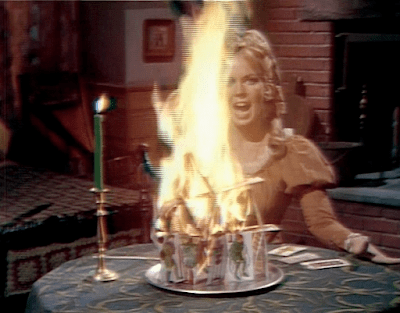
At the top of the episode, we see Angelique building a house of cards and delivering a soliloquy about her plan to cast a spell to make it look like Trask’s fraudulent ritual has proven Vicki’s guilt. There is an element of suspense as we wonder what the character’s actions will lead to, and an even more powerful suspense as we marvel at the courage it took for the actress to remain calm enough build a house of cards on what is essentially a live television show. Forget the Daytime Emmys, Lara Parker deserved a medal for this feat.

Angelique recites a spell over the house of cards, then sets it on fire. The first time they used an incompletely contained fire on Dark Shadows was in #191, and as a result of that daring experiment a load-bearing beam caught fire and collapsed in the middle of a scene. They finished taping before putting the fire out, and somehow everyone survived. There was also an off-camera fire during a conversation between Barnabas and Vicki in #290, and Jonathan Frid and Alexandra Moltke Isles just kept delivering their lines while we heard fire extinguishers blasting in the background. As a result of an excessive pre-treatment of the cards with lighter fluid, today’s fire burns faster and expels debris over a wider area than had been intended. I suppose a technical term for a rapid fire that expels debris is an “explosion.” Parker keeps up her incantation while this explosion progresses directly in her face. That shows an entirely different kind of courage than she showed with the house of cards, but she exhibits it in an equally rare degree.

The fire starts. Screenshot by Dark Shadows Before I Die.

Downstairs, Trask is standing at the threshold of the house, doing his own fire ceremony. He draws Vicki’s initials on the doorstep, holds up a dowsing rod, and jabbers for a while. Then he sets fire to the rod. In her room, Vicki sees flames erupting from the floor. She shouts in panic.

Barnabas is upstairs. He hears Angelique shouting “Eye of fire, heart of ice!” Her shouts grow louder and louder as she repeats the phrases faster and faster. My wife, Mrs Acilius, said that the pattern of Angelique’s voice sounded to her like someone having an orgasm. The willingness to risk the laugh that pattern might bring represents a third form of courage; by this point, we would have to admit that whatever we may think of Angelique, Lara Parker was one of the bravest people imaginable.

Barnabas is about to investigate, but then he hears Vicki shouting “Fire!” Between these two shouting women, he goes to the one who doesn’t sound like she’s enjoying herself. By the time he gets to Vicki’s room, she is gone. He sees no sign of fire.

Vicki runs out the front door, into Trask’s arms. He shouts “I’ve caught the witch!” and forces her to the ground. He looks delighted that his shtick actually worked, for once.

“I caught the witch!” Screenshot by Dark Shadows Before I Die.

This moment is an odd inversion of the ending of #191. That episode ends with strange and troubled boy David running out of the burning building where his mother, undead fire witch Laura Murdoch Collins, was trying to immolate him, and finding refuge in Vicki’s arms. At that moment, life triumphs over death, and Dark Shadows version 1.0 reaches its conclusion.

When Vicki runs out of the house and into Trask’s arms, death and folly win a victory over life and reason. Nothing comes to a conclusion- the story just gains new layers of complexity. We don’t even go to a commercial break, but get a reaction from Angelique first.

Barnabas talks with Angelique, mystified by what just happened. When he mentions that he heard her in her old room shouting strange words, she lies and says she was in the sewing room. After she leaves, we hear his thoughts- he had searched the sewing room, and knows she is lying. He now believes that there is a witch. He would find it much easier to believe that Vicki, a strange girl who claims to be displaced in time from the year 1967, 172 years in the future, is that witch than to face the prospect that his own wife is, but he can neither overlook the lie she has told nor the sheer improbability that so flagrant a quack as Trask came up with the right answer to any question. He remembers that indentured servant Ben claimed to have been enslaved by the witch, and resolves to find out what Ben can tell him.

We first got to know Barnabas in the months between April and November of 1967, when he was a vampire preying on the living in Vicki’s native time. In those days, he never mentioned Angelique, and there was no indication that he suspected any of the witchcraft we have seen since we embarked on our journey to 1795. Perhaps in the original timeline, when the place Vicki has taken was occupied by a woman named Phyllis Wick, Angelique had to proceed more slowly and carefully, with the result that Barnabas was turned into a ghoul without ever picking up on what was going on. If so, it would be Vicki’s complete failure to adapt to her new time in any way that accelerated the pace of events and thereby exposed Angelique to Barnabas’ suspicions.

Episode 394: Not a simple woman

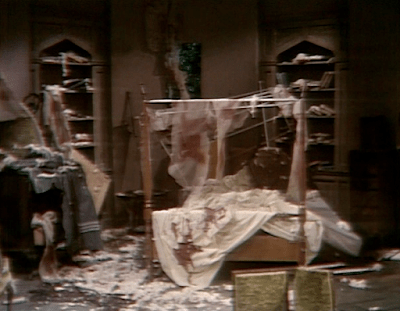
The ghost of Jeremiah Collins has gone to the newly built great house of Collinwood and made a terrible mess in the bedroom that was to be occupied by a house-guest of the Collins family, the Countess DuPrés. Among those who discover the mess is Angelique, who was the countess’ maid before she became the fiancée of Jeremiah’s nephew, Barnabas. Not everyone in the house knows of the change in Angelique’s station, so it is unclear whether she ought to stick with her former role and clean the room herself or start functioning as a member of the family by calling for a servant to do it. Since Angelique is also the wicked witch who raised Jeremiah from the grave, putting her in this awkward position would seem to be a passive-aggressive way for him to get back at her.

Messy room. Screenshot by Dark Shadows Before I Die.

Repressed spinster Abigail Collins, sister of the master of the house, comes into the room. She insults Angelique’s former master, the countess’ brother André, prompting him to leave the room in a huff. Angelique begins to follow André, but Abigail orders her to to stay.

Angelique has taken no care to cover her tracks, and it is obvious to all that something very unusual has been happening around the estate of Collinwood since she arrived. Most of those who have witnessed the strange goings-on are rational, modern people who are reluctant to believe in the supernatural, and the rest have settled on the idea that eccentric governess Victoria Winters is the witch. But Abigail has learned of Angelique’s engagement to Barnabas, has realized that every bizarre occurrence has contributed to making it possible, and has concluded that Angelique is in league with Vicki and the devil.

Up to this point, Abigail has been a figure who did ridiculous things but whom we came to respect as we saw that a person of her time and place might well have interpreted the information available to her as she does. In this scene, she isn’t ridiculous at all. She is mistaken about Vicki, who is a well-meaning innocent. But she has figured Angelique out long before anyone else has even begun to suspect her. Abigail emerges as a character who is smart enough to turn the story in fresh and surprising directions.

Abigail interrogates Angelique. Screenshot by Dark Shadows Before I Die.

Once Abigail has left the room, Angelique summons Jeremiah and tells him she has something for him to do before she will let him return to his grave. Jeremiah has already gone beyond the instructions she gave him, not only in befouling the countess’ room but also in repeatedly showing himself to Naomi Collins, the lady of the house. But I suppose Angelique has such a limited staff she can’t afford to let someone go for overenthusiasm.

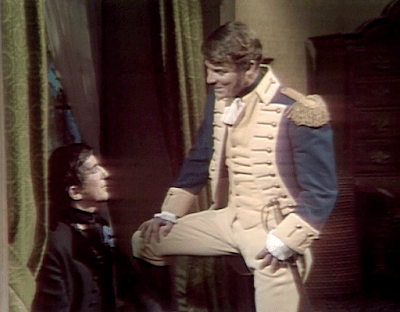
We see Barnabas in his new room in the great house. His friend Nathan comes and asks him about the report that he is going to marry Angelique. Barnabas confirms that it is true, and assures Nathan that Angelique is not pregnant.

Nathan is puzzled that Barnabas wants to marry Angelique. Screenshot by Dark Shadows Before I Die.

As written, the scene is a bit of a throwaway, but the actors flirt with each other pretty blatantly throughout the scene. As the screenshot above shows, it begins with Nathan thrusting his crotch into Barnabas’ face while Barnabas smiles appreciatively, and it continues along that line. Considering that Nathan is puzzled that Barnabas wants to marry a woman, even a beautiful one, and that viewers know that Barnabas intends it to be a sham marriage, the flirty tone makes it hard not to recognize a comment on a familiar closet situation. Jonathan Frid and Joel Crothers were both gay, but they had many scenes together and never seemed to be flirting at any other time, so perhaps this comment was intentional on their part and that of director John Sedwick.

After Nathan leaves, Jeremiah appears in Barnabas’ room. He denounces Barnabas for killing him in a duel over the gracious Josette and vows to haunt Barnabas and Josette forever if they marry.

This does not at all reflect the attitude Jeremiah had in life. Jeremiah and Josette married under the influence of a spell Angelique cast on them, and they deeply regretted the pain their elopement brought Barnabas. In his last conversation with Josette before the duel, Jeremiah made it clear that he was going to let Barnabas kill him and that it was all right with him if Josette and Barnabas went on to marry. Jeremiah’s rantings to Barnabas today are Angelique’s words, not his own. This leads us to wonder if she is simply manipulating him as a puppet, or if some fragment of her personality took up residence in Jeremiah when she raised him from the dead. We’ve seen several times that supernatural beings on Dark Shadows are complex phenomena made of parts that work independently and often at cross-purposes with each other, so perhaps when Angelique casts a spell she is dividing herself into parts that will thwart each other’s goals.

Regular viewers know that the segment of the show set in 1795 will show us Barnabas becoming a vampire. We assume that Angelique will be responsible for this transformation. Since the Barnabas we knew in 1967 showed many of the personality traits that Angelique has shown in 1795, seeing her at least use Jeremiah’s reanimated corpse as a mouthpiece for her words and perhaps turn it into a part of herself makes us speculate if the vampiric Barnabas we thought we knew was really Angelique all along.

After Jeremiah leaves Barnabas’ room, Angelique comes in. She tells Barnabas that Abigail is making trouble for them, he tells her about Jeremiah’s apparition, and they decide to marry at once. This three-part sequence in Barnabas’ room- his scenes with Nathan, with Jeremiah, and then with Angelique- mirrors a sequence in Josette’s room in yesterday’s episode, in which she is visited by Jeremiah, then by the countess, then by Angelique. That sequence ended with Angelique telling Josette that she and Barnabas were to be married and thus represented a step towards the wedding. The echo of its structure at the end of today’s installment gives us a sense that the wedding is approaching with irresistible momentum.

In place of episode 391: Jonathan Frid reads “The Water Ghost of Harrowby Hall”

It used to be customary in many parts of the English-speaking world to tell ghost stories at Christmas. Charles Dickens’ A Christmas Carol is today the most famous of these stories, and it was dramatized in 2021 by the surviving members of the Dark Shadows cast.

But there are many others. John Kendrick Bangs’ “Water Ghost of Harrowby Hall” is one. Here is a recording of Jonathan Frid’s dramatic reading of it. He did it in the fall of 1969, and it was posted to YouTube by Frid’s close friend and longtime business partner Mary O’Leary in 2022.

The story echoes Dark Shadows at several points, most obviously when we hear about a ghost which, like that of Bill Malloy in #85, leaves pieces of the sea in its wake, and when we hear about a maiden who, like so many in the series, jumps off a seaside cliff and finds a watery grave at its foot.

When we listened to it, my reaction prompted my wife, Mrs Acilius, to say that I was “trying to ruin it, like you always do.” I’d pointed out that the Oglethorpes spend the whole story trying to build structures to contain the water that the ghost brings with her. Surely the logical thing would be to build a drain to sluice it all out of the house.

When Mrs A said that this would leave them without a story to tell, I protested that it should give them a more interesting story. Let them make a series of unsuccessful attempts to keep the water out, then an unsuccessful attempt to keep it in, and finally construct a means of draining it out. That would set you up for an ending where you see that the drainage, even though it might be mechanically successful, will still be an unsatisfactory response to the real problem, which is not the water at all but the curse of which the water is a symptom. That led her to agree that I was not “trying to ruin it,” which is about all I could hope for, I suppose.

Episode 390/ 391: Accept me as I am

Wicked witch Angelique cast a spell bringing a painful and apparently terminal illness to little Sarah Collins, beloved baby sister of young gentleman Barnabas. Angelique was enraged that Barnabas would not love her and wanted him to watch Sarah in agony, so that the love he felt for his sister would torture him. Barnabas happened by Angelique’s room in the servants’ quarters of the manor house of Collinwood while Sarah was languishing, and it occurred to Angelique that she had some leverage to use against him. She told him she might know of a cure for Sarah, and extorted his promise to marry her if she effected it. He agreed, Sarah recovered, and today Angelique comes to collect.

At first, Barnabas is bewildered by Angelique’s belief that they are going to marry. She brings up his promise. He is flabbergasted to find that she took it seriously. He does not know that she is a witch, and only now seems to suspect that she is a crazy person. She asks if he won’t have her because she is a servant. He gallantly denies that class makes any difference. He says that the real problem is in his feelings for Josette, his former fiancée, who eloped with his uncle Jeremiah. He says that he knows there can never again be anything between him and Josette, but neither will he ever cease to love her. Barnabas asks if Angelique would be willing to marry him, knowing that Josette will always have the first place in his heart; she asks what that matters, as long as she gets to be his wife. She repeatedly releases him from the promise he made while Sarah was ill, but he agrees to marry her anyway.

The lovers embrace. Screenshot by Dark Shadows Before I Die.

Yesterday’s episode and today’s include writer Ron Sproat’s first significant scenes featuring Angelique and Barnabas. In the scenes Sam Hall and Gordon Russell gave them, it seems that, while Barnabas has definitely made up his mind that Josette is the one for him, he also has the hots for Angelique. So he squirms and looks unhappy when Angelique throws herself at him, but he does kiss her and he does not hesitate to accept her invitation to visit her alone in her room in the servants’ quarters. So we can imagine that when Barnabas first met Angelique on the island of Martinique, believing as he did at that time that Josette could never love him, he was just doing what came naturally to him when he availed himself of her favors.

But in Sproat’s scenes, Barnabas isn’t attracted to Angelique at all. Yesterday he saw her while he was frantically worried about Sarah’s illness, so any sign of attraction would have had to be subtle. But today, they have a long, deeply emotional conversation in the course of which they decide to get married, and throughout he looks and sounds like he’s talking to his grandmother. That invites us to imagine their affair on Martinique in quite a different light. Perhaps he settled for Angelique then in the same way he is settling for her now- he despaired of ever getting the relationship he really wanted, and decided to give the path of least resistance a try.

It may not be irrelevant that Sproat was gay. For that matter, so was actor Jonathan Frid, a fact that wasn’t publicly acknowledged by his representatives until he’d been dead for ten years, but that can’t have been all that hard for sophisticated viewers to figure out in 1967.

Before Dark Shadows took us back in time to 1795, we knew Barnabas as a vampire trying to convince people he was a living man. In his efforts to pass, we often saw him alienated from his own feelings, isolated from others, and unable to express himself through any conventional form of masculinity. It wasn’t hard to find gay subtext in him then. But I think that in this scene we see the most specific and recognizable closet situation he has been in so far. When he expresses disbelief that Angelique will “accept me as I am,” even knowing “the way I feel,” the character collapses into the actor for a moment, and Josette merges into some guy to whom Frid would never feel comfortable introducing us. When he takes Angelique at her word and agrees to a sham marriage, he sees her as someone who has a place for the man he is. From what we have seen of her single-minded pursuit of Barnabas’ devotion, we know that she expects to turn him into someone else, and that they will both be terribly disappointed.

Episode 379: Governesses are supposed to be trusting

Dark Shadows became a hit after vampire Barnabas Collins joined the cast in April of 1967. Displaced from a previous era, Barnabas spent most of his time trying to con people into believing that he was a native of the twentieth century. The difficulties Barnabas encountered in his performance in the role of modern man dovetailed so neatly with those actor Jonathan Frid encountered in his characterization of a vampire that his every scene was fascinating to watch.

The audience’s main point-of-view character for the first year of the show or more was well-meaning governess Vicki. Now Vicki finds herself in a situation like that which made Barnabas a pop culture phenomenon. The ghost of Barnabas’ ten year old sister Sarah has sent Vicki back in time to 1795, when Barnabas and Sarah are both living beings and the vampire curse has not yet manifested on the estate of Collinwood. Vicki and Barnabas have traded places- she is now the time-traveler who must trick everyone into thinking she belongs in their period, while he is her warm-hearted, if uncomprehending, friend.

Unfortunately, the show has not chosen to write 1795 Vicki as a fast-thinking con artist. By the time the Collins family of 1967 met Barnabas, he was wearing contemporary clothing and telling them a story about being their cousin from England. Vicki shows up in her 1967 clothes and carrying a copy of a Collins family history printed in the 1950s. She goes around blurting out information she learned from reading that book and introduces herself to each character by telling them that they are played by actors who had other parts in the first 73 weeks of the show. Vicki’s natterings have convinced two ladies in the manor house, repressed spinster Abigail Collins and visiting aristocrat Countess DuPrés, that she is a witch.

Today, we open with the countess setting a trap to expose Vicki. Haughty overlord Joshua Collins vanished from the front parlor yesterday, in the middle of an argument with his brother Jeremiah. Jeremiah looked away from Joshua for a moment, and when he looked back his brother was gone and there was a small house cat in his place. The countess insists Vicki come into the parlor and reenact Joshua and Jeremiah’s argument. Vicki keeps protesting that the whole idea is silly, but the countess will not be stopped.

The countess imitates Joshua. This is the first time we have seen Grayson Hall play one character mimicking another, and it is hilarious. I suppose it would have ruined the laugh if Vicki had shown that she was in on the joke, but at least it would have provided evidence that Vicki hasn’t left her entire brain in 1967.

The countess tries to get Vicki to speculate on what goes on behind closed doors between Joshua and his wife Naomi. Vicki says that “It’s not my place to judge their marriage,” managing to sound like a dutiful servant, if not like an eighteenth century English speaker. The countess goes on testing Vicki with provocations that seem unconnected with each other, and she tries not to say anything wrong. That goes on until the cat reappears.

Barnabas is Joshua’s son. He enters and sees the cat. Vicki leaves, and Barnabas tells the countess he doesn’t think he has ever seen the cat before. Caddish naval officer Nathan Forbes enters to confer with Barnabas about the search for Joshua. Nathan overhears the countess suggesting to Barnabas that Vicki is a witch and is responsible for making his father disappear.

Nathan finds Vicki. He tries to warn her that the countess suspects her of being a witch. This is the second time we have seen someone explicitly tell Vicki that she will have to do a better job of faking her way through her current situation, after a scene in #367 where the kindly Jeremiah told her in so many words that she would have to make up a better story to tell people about herself. No one had needed to do that for Barnabas when he was lying his way through 1967, and if they had he would have had a stake in his heart before he’d been on the show a week.

Nathan tries to talk sense into Vicki’s head. Screenshot by Dark Shadows Before I Die.

At least Vicki tried to absorb what Jeremiah told her in #367. When Nathan tells her today how bad she has made things for herself, she just gets uptight. There have always been times when the writers solved plotting problems by having Vicki do something inexplicable, but now it seems Dumb Vicki is the only side of the character we will be allowed to see.

The countess confronts Vicki again, inviting her to take a lesson in tarot card reading. As the countess probes Vicki for information, we hear Vicki’s voice in a recorded monologue, wondering if she could tell the countess the truth. She may as well- she has pretty well blown any chance she ever had at establishing a false identity for herself.

Vicki in over her head. Screenshot by Dark Shadows Before I Die.

When the countess asks Vicki where she was trained to be a governess, she says that she was raised in a foundling home in Boston and was trained there. The only false part of this account is that the foundling home was in New York. Changing the location to Boston only makes it that much easier for people based in Maine to check her story and prove it false. When the countess asks when she was born, she says “March 4, 19-” and catches herself. The countess remarks on the strangeness of the slip, and Vicki is conscious enough not to fall into her trap when she invites her to put the wrong digits after “17.”

By the end of their encounter, it should be obvious even to Vicki that the countess suspects her of witchcraft. The countess presses Vicki about her knowledge of the supernatural, telling her that Barnabas regards her as clairvoyant. Vicki tries to dismiss that as “his joke.” When Vicki protests that she does not know why the countess keeps asking her questions about the supernatural, the countess impatiently tells her that she certainly does know. She declares that something terrible is happening in the house, and that she is determined to find out what it is.

Having made it clear that she thinks Vicki is a witch, the countess leaves her alone in the room with the layout of tarot cards she had been studying. Vicki decides to rearrange the cards. She thinks to herself that she will thereby warn the countess of the upcoming tragedies. But the countess will know that the cards are not where she dealt them, and it will be obvious that it was Vicki who moved them. She will know that she is receiving a message, not from whatever realm tarot cards are supposed to access, but from Vicki. If that message foretells disasters that in fact occur, she will only be confirmed in her suspicions. It is difficult to imagine a stupider act Vicki could have committed.

Difficult, but for a writer as imaginative as Sam Hall it is not impossible. In the next scene, Vicki is talking to Barnabas while the countess stands nearby. Vicki tells Barnabas that Joshua will return. She speaks with such assurance that Barnabas takes it as another sign of her clairvoyance, and the countess reacts with horror, hearing the witch declare that she is about to lift her spell.

The moment when Mrs Acilius shouted at the screen, “Vicki, SHUT! UP!” Screenshot by Dark Shadows Before I Die.

Alone with the countess, Barnabas admits that he is starting to think that she may have a point about witchcraft. The countess answers that he is becoming wise.

Closing Miscellany

The asthmatic Grayson Hall has a coughing fit during her scene with Vicki and the tarot cards. It is one of the less amusing bloopers, she really sounds like she’s suffering.

I chuckled a little when Vicki stops at “19-” in giving her birthdate. Alexandra Moltke Isles’ year of birth is given on various websites as early as 1943 and as late as 1949. I think it is only fitting that someone so central to a show like Dark Shadows should be a little mysterious, so I’m glad that all we really know about Mrs Isles’ birth is that it took place on 11 February 194-.