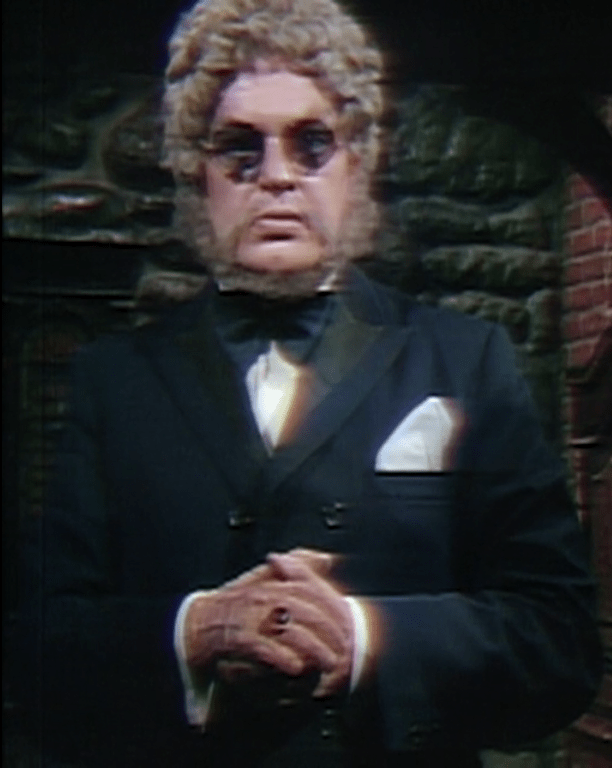
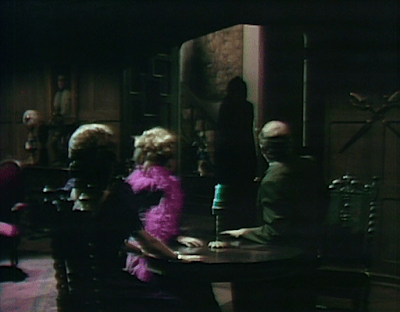
Episode 807: An award-winning performance, wouldn’t you say?

From #1 to #274, each episode of Dark Shadows began with a voiceover narration by Alexandra Moltke Isles, usually in character as well-meaning governess Vicki. This identified Vicki with our point of view and suggested that she would sooner or later learn everything we knew.

Jonathan Frid joined the cast as vampire Barnabas Collins in #211, and quickly became the show’s great breakout star. If the upright Vicki found out what we knew about Barnabas, one of them would have to be destroyed. Vicki was the favorite of longtime viewers and Barnabas was attracting new ones, so that was out of the question. Therefore, other members of the cast started taking turns reading the voiceovers, and doing so not as their characters, but in the role of External Narrator.

Today marks the first time Frid himself reads the narration. His training first in Canada, then at Britain’s Royal Academy of Dramatic Arts, and later at Yale School of Drama prepared Frid well in the art of dramatic reading, and in later years he would concentrate on that aspect of his craft. Several of his colleagues are his equals in these voiceovers- I would particularly mention Kathryn Leigh Scott, whose conception of The Narrator is always arresting, and Thayer David, who could consistently achieve the most difficult of all effects in voice acting, a perfectly simple reading. So I can’t say I wish Frid had done all of them, but he is always good, and today’s performance is among his most gorgeous.

The action opens on a set known to longtime viewers as the Evans cottage, where from 1966 to 1968 artist Sam Evans and his daughter Maggie served as Dark Shadows‘ principal representatives of the working class of the village of Collinsport. In those days, it was on this set that we saw how the misdeeds of the ancient and esteemed Collins family had consequences that spilled out of the estate of Collinwood and warped the lives of people trying to make a more or less honest living nearby.

Now the dramatic date is 1897, and Sam hasn’t been born yet. But the cottage is already an artist’s studio. It is temporarily occupied by the nationally famous Charles Delaware Tate, who is painting a portrait of rakish libertine Quentin Collins at the behest of evil sorcerer Count Petofi. Charity Trask, a resident of the great house of Collinwood, is visiting Tate in the cottage when she sees the face in the portrait change from that of Quentin. It takes on a great deal of fur and long fangs, and reminds Charity of a wolf.

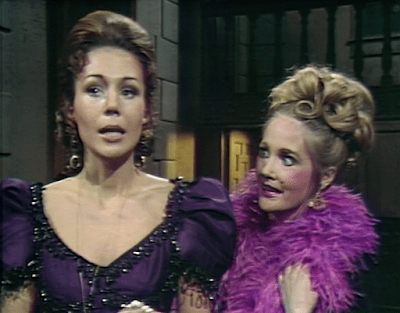
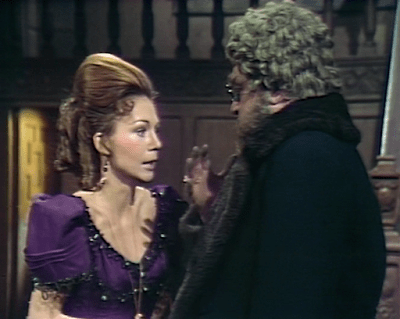
By the time Tate looks at the painting again, it has resumed its normal appearance. He tells Charity that the transformation must have been in her imagination. She is willing to consider the possibility, but we know better. Quentin is a werewolf, a condition Petofi knows how to cure. Portraits on Dark Shadows have had supernatural qualities at least since #70, including portraits we saw Sam execute on this set in 1966, 1967, and 1968, and the show has borrowed from The Picture of Dorian Gray before. Moreover, Tate’s reaction to Charity is one of barely controlled panic. Nancy Barrett has to ramp up Charity’s own emotional distress to the limit to make it plausible she would not notice Tate’s extreme agitation. Perhaps if Tate were played by a better actor than the ever-disappointing Roger Davis, his response might have been ambiguous enough that Miss Barrett could keep the tone a bit lower, but his unequivocal display of alarm leaves her nowhere to go but over the top.

Mr Davis was under no obligation to play the scene transparently, since Tate later goes to Petofi’s henchman Aristide and lays out in so many words his precise relationship to Petofi’s operations and his knowledge of them. Tate’s career is his reward for selling his soul to Petofi, and he has already experienced great sorrow as a result of that bargain. Tate knows that the portrait changed to reflect the full Moon’s influence on Quentin and that Petofi is currently in possession of twelve year old Jamison Collins. Aristide tells us that Petofi’s own body is in suspended animation while he acts through Jamison. He also says that it was in 1797 that Petofi’s right hand was cut off, and that if he does not reclaim the hand in a few weeks, by the date of the one hundredth anniversary of the amputation, he will die and so will Tate.

Jamison/ Petofi is in the prison cell in the basement of the Old House on the estate of Collinwood. Barnabas has traveled back in time from the 1960s with some vaguely good intentions and is hanging around 1897 causing one disaster after another. Now, he is doing battle with Petofi and has locked him, in the form of Jamison, in the cell. Barnabas’ reluctant sidekick, broad ethnic stereotype Magda Rákóczi, guards Jamison/ Petofi during the day. Early in the episode, Jamison/ Petofi calls Magda and pleads with her to release him. He tells her that he is “just a little boy” and that she is a “rather heartless creature.” She says she wishes he were a little boy again, but that she isn’t stupid and he won’t fool her. Indeed, the phrase “rather heartless creature” and Jamison/ Petofi’s manner in delivering it sound so much like Thayer David as Petofi that they hardly count as an attempt to deceive Magda.

Later, Jamison/ Petofi casts a spell to summon Aristide, then calls to Magda again. When Magda arrives, Jamison/ Petofi gives himself a better script than the one from which he had acted in his previous scene with her. He pretends not to remember how he got into the cell and to be shocked that Magda knows he is there. Perhaps the utter transparency of his earlier pleadings was an attempt to get Magda to underestimate his abilities as a trickster.

In #803, we saw that when Petofi took possession of him Jamison’s right hand disappeared from his wrist, matching Petofi’s own mutilated condition. When Jamison/ Petofi feigns the amnesia that might come upon recovery from possession, we might therefore expect Magda to demand that he remove his gloves to prove that he is himself again. But he plays the part of Jamison so convincingly that we are not really surprised he does fool Magda. She goes into the cell, embraces Jamison/ Petofi, and he kisses her on the cheek. It is this kiss that spreads his magical power, and she realizes too late that she has been had.

Aristide arrives a moment later, and Jamison/ Petofi calls his portrayal of an innocent boy “an award-winning performance.” Indeed, if there had been daytime Emmys in 1969, David Henesy might have won one for his portrayal of Thayer David playing Petofi playing Jamison.

Aristide wants to kill Magda; Jamison/ Petofi forbids this. Under his power, she announces that she is responsible for all the evil that has happened in 1897. She was responsible for releasing Barnabas and therefore for all the murders and other harm he has done; she made Quentin a werewolf, and is to blame for his killings in his lupine form and for the curse his descendants will inherit; she stole Petofi’s severed hand and is at fault for the deaths of Rroma maiden Julianka and of her own husband Sandor that resulted from the hand’s presence. She even takes the blame for Quentin’s murder of her sister Jenny, the act for which the werewolf curse was meant as vengeance. Magda says she must be punished. Jamison/ Petofi tells her that he is not interested in punishing her. He has another use in mind for Magda She will lead him and Aristide to Barnabas’ coffin today, and they will destroy him.

Longtime viewers will perk up twice when Aristide says that Petofi lost his hand in 1797 and that he has exactly one hundred years to recover it. From December 1966 to March 1967, Dark Shadows’ first supernatural menace was undead blonde fire witch Laura Murdoch Collins, who at intervals of exactly one hundred years incinerated herself and a young son of hers, who was always named David, in an unholy ceremony that renewed her existence, but not that of the Davids. Since the usual laws of nature don’t apply, the show needs some other causal mechanism to create suspense, and anniversaries will do as well as anything else. Another iteration of Laura was on earlier in the 1897 segment. It was fun to see her again, but they could shoehorn her into that year only by retconning away the one hundred year pattern in her immolations. It’s reassuring in a way to see that Petofi is bringing centenaries back.

The date 1797 is also significant. It was in 1796 that Barnabas died and became a vampire. We flashed back to that period for the show’s first costume drama segment in November 1967 to March 1968, and Barnabas went back to 1796 for a week in January 1969. So we may go back again some day, and if Petofi was alive and in his prime in 1797, we might run into him there.

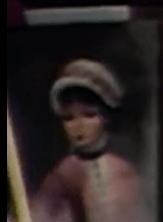
Barnabas and Petofi are not the only characters from the 1790s who might be on the minds of attentive longtime viewers. Barnabas’ little sister Sarah died in 1796, and as a ghost was an extremely important part of the show from June to November 1967. We’ve been getting reminders of Sarah for the last several days. In #792 wicked witch Angelique produced a toy soldier of Barnabas’ that Sarah gave to strange and troubled boy David in #331. In #805, Charity found Sarah’s recorder, a prop that often served as Sarah’s calling card in 1967, and talked about learning to play it. And today, we see a portrait standing on the floor of the Evans cottage, a set which Sarah visited in #260, depicting a girl wearing a bonnet very much like the one Sarah wore as a ghost in 1967 and a pink dress just like the one she wore when we saw her as a living being in the flashback to the 1790s.

Portrait at the cottage.

I wonder if, when they were making up the flimsies for this part of the show, they had thought of reintroducing Sarah. That would have required a recasting of the part- Sharon Smyth was noticeably older when we saw Sarah die in January 1968 than she was when Sarah was a ghost in June 1967, and by now we would wonder what she has been eating in the afterlife that has made her get so much taller. Besides, Miss Smyth* had stopped acting by this point.

The process of planning the stories was in two stages, a rough sketching of themes six months in advance, and a capsule of each episode written thirteen weeks ahead of time. There was a lot of flexibility when it came to putting those plans into effect. Some stories that were supposed to end within thirteen weeks were extended over years, while others that were expected to be a big deal petered out before they got going. In an interview preserved by Danny Horn at his great blog Dark Shadows Every Day, writer Violet Welles said that many of the moments on the show that made the least sense were those written when the plans hadn’t worked out: “toward the end of the cycle, you’d have characters who were really not a lot of interest who had to play scenes with other characters who really didn’t have a lot of interest, dealing with things that basically didn’t concern them. Those were hard to write.”  

This episode was taped on 25 July 1969; thirteen weeks before that was 21 May. Six months before was 25 January. By 25 January, Denise Nickerson had been on the show for two months as Amy Jennings. Nickerson was actually born on 1 April 1957, but they several times say that Amy is nine years old. When the show goes to 1897, Nickerson plays Nora Collins, who is also nine. On 19 May, Nickerson taped #761, the last episode she would appear in until #782. She is currently in the middle of a second long absence from 1897, unseen between #783 and #812. Her characters were so important in the months leading up to the 1897 segment and she played them so well that we wonder what they were thinking leaving her in the background so long.

Maybe they were thinking of bringing her back as Sarah. Nickerson didn’t look all that much like Sharon Smyth, and was a far more accomplished young actress than was Miss Smyth, but she did have brown hair, and the show prioritized hair color above all else in recasting parts. For example, two actresses followed Mrs Isles in the role of Vicki, neither of whom had much in common with her either in acting style or in looks, but who both had black hair. So perhaps there was a time when they intended to travel between 1897 and the 1790s and to meet Sarah, played by Denise Nickerson. If Nickerson were still alive, perhaps someone would ask her if she posed for the portrait that is standing on the floor of the Evans cottage today.

*She’s been using her married name for decades now, but when talking about her as a child it’s pretty weird to refer to her as “Mrs Lentz.” Since I use surnames for people associated with the making of the show and attach courtesy titles to surnames of living people, I have to call her “Miss Smyth.”

Episode 775: Call it a vampire or whatever you like

Neurotic intellectual Rachel Drummond is the third character Kathryn Leigh Scott has played on Dark Shadows, and today she joins the other two in becoming the victim of a vampire. In the parts of Dark Shadows set in the 1960s, Miss Scott plays Maggie Evans, The Nicest Girl in Town. Vampire Barnabas Collins took Maggie as his victim in May and June of 1967, and tried to brainwash her into believing she was his lost love Josette. At first Maggie responded to the vampire’s bite with the same addictive behavior it prompted in others, but eventually she shook loose of Barnabas’ power and rebelled against him. She tried to stake Barnabas, and when that failed she escaped from him. It was only because her psychiatrist betrayed her to become Barnabas’ co-conspirator and to hypnotize Maggie into forgetting her experience that she did not expose Barnabas.

When Dark Shadows flashed back to the 1790s to show how Barnabas became a vampire and to suggest that he might still be interesting if he weren’t one, Miss Scott played Josette. After he had brought the vampire curse on himself, Barnabas bit Josette, who like Maggie at first responded blissfully. When Josette realized Barnabas wanted to make her into a vampire as well, she, like Maggie, resolved to escape. Maggie’s escape took her from the prison cell in Barnabas’ basement through a tunnel to the beach below the cliff of Widow’s Hill; Josette’s escape led to very nearly the same spot, but it began, not in the cell, but at the top of the cliff, and it involved her flinging herself to her death on the rocks below.

Early in 1968, Barnabas was freed of the effects of his vampirism, and he set about battling other supernatural menaces. In the course of one such battle, he has come unstuck in time, and taken us with him to the year 1897. In that year, he is once again a vampire. One of his victims was dim-witted servant Dirk Wilkins. Since Barnabas was beginning to attract suspicion, he allowed Dirk to die and rise as a vampire, planning to tip people off to Dirk’s hiding place so that he would be found and destroyed and everyone would attribute all the vampire attacks of the previous few months to him. This plan fell apart immediately, when Barnabas lost track of Dirk as soon as he first rose.

Rachel has stumbled into Dirk’s hiding place. She asks him if he knows what happened to her friend Tim, and he bites her. She shows some signs of a blissful initial reaction to the bite, but still has some questions about Tim. Dirk tells her to forget about Tim and to stay where she is. He returns before dawn to find her waiting. She brings Tim up again, and he ignores her. She helps him close the lid of his coffin, caressing it. Though Rachel is obedient, this does not mean that she is any more under Dirk’s power than Maggie was under Barnabas’ power when she rebelled against him or Josette was when she jumped off Widow’s Hill. Rachel’s personality is something that takes place deep inside her head and prevents her from asserting herself against other people. Even if Dirk were not a vampire, she would probably have been just as compliant.

While Rachel is sitting dutifully in his hiding place, Dirk calls upon Barnabas. He tells Barnabas that he will kill Rachel unless he brings blonde fire witch Laura Murdoch Collins back to life before dawn. Returning viewers know that Barnabas has no idea how to revive Laura. We also know that no one else is going to bring Laura back, because she was running out of story when she vanished in #760 and they already have more characters than they can fully use. Even a fan favorite like Miss Scott is absent from the show for dozens of episodes at a time. So it seems that Rachel is doomed.

Meanwhile, Barnabas has another problem to deal with. His distant cousin, stuffy Edward Collins, has summoned him to the great house of Collinwood. Edward suspects Barnabas of vampirism, and has told him so. Edward’s sister, spinster Judith, has turned up with bite marks on her neck and an oddly subdued affect. Edward brings Barnabas face to face with Judith. When she does not react to him as Edward expects a victim to react to the vampire who bit her, Edward is embarrassed and stumbles through a series of half-expressed apologies. Barnabas declares that he will resume the search for Dirk, and instructs Edward to stay with Judith at all times. He hopes that Judith will lead Edward to Dirk’s lair.

Edward does sit with Judith for a time, but when he hears some noises in the foyer he leaves the room to investigate. He wanders all through the house for a number of minutes, long enough that the recorded background music plays beyond the cues we are used to hearing and gets to some tunes we haven’t heard in months.

While Edward is conducting this journey, Dirk sneaks up behind him on the walkway at the top of the foyer stairs and grabs him by the neck, knocking him out. Dirk then appears in Judith’s room, gives her a gun, and tells her he will have a job for her to do soon. He dematerializes before Edward comes back and finds Judith still in bed.

Later, Edward leaves again to make tea, and when he brings the tray back Judith is gone. In its first months, one of the themes of Dark Shadows was that the Collinses of 1966 were running out of money, so it made sense that they were chronically short of servants. In this period, however, the Collinses are supposed to be at the zenith of their wealth and power. It is simply a flaw in the story that Edward himself has to leave Judith to find out what the noises were in the foyer or to fetch her tea.

The task Dirk set for Judith was to murder Rachel. After dawn, she goes to the hiding place, pulls the gun, and tells Rachel she is sorry for what she must do. In the parts of Dark Shadows set in the 1960s, Joan Bennett plays matriarch Elizabeth Collins Stoddard. In #569 and #570, it looked like Liz might be bitten by vampire Tom Jennings. But the show is firmly committed to a prohibition against involving Liz directly in the plot, so that came to nothing. When Judith presents herself as Rachel’s designated assassin, longtime viewers will be glad to see that Judith is not subject to the same restrictions.

Judith prepares to kill Rachel. Screenshot by Dark Shadows Before I Die.

Episode 774: Sometimes people change their roles in life

Tim Shaw, uptight teacher turned victim of brainwashing turned fugitive murder suspect, makes his way into an abandoned root cellar. He finds a coffin there. Naturally, he opens the coffin. That’s what everyone does on Dark Shadows when they find a coffin where one shouldn’t be. You meet the most interesting people that way.

Tim finds that the coffin is empty, and goes into a dark corner to hide. Someone comes to the door, and Tim gets up to greet whoever it might be. He hasn’t been a fugitive very long, and hasn’t quite perfected all the skills that the status calls for.

Tim sees Dirk Wilkins, a dimwitted servant of the ancient and esteemed Collins family who has been missing for several days. Tim calls out “Dirk!” This is the first time we learn the two men know each other. They are unlikely to have been friends. Tim rarely left the school where he worked. The school has been housed in a building on the Collins family’s estate for several weeks, so it makes sense that he and Dirk would have met, but Dirk has been unpleasant to everyone we have seen him with, including his employers and pretty girls he wants to attract. It is hard to imagine the painfully shy Tim befriending him.

Dirk turns out to be a vampire, and he bites Tim. We then cut back to the school. The headmaster, the overwhelmingly evil Gregory Trask, is browbeating Tim’s fellow teacher and onetime girlfriend, neurotic intellectual Rachel Drummond. Returning viewers will recall that Trask has made flagrant passes at Rachel, and also know that Trask conspired with a local Satanist to cast a spell on Tim which caused him to kill Trask’s wife Minerva. Trask is pretending to be upset about Minerva’s murder and to believe that Rachel plotted with Tim to commit it. He tells Rachel that if she does not leave the school, he will accept that she is innocent. She goes to her room, distraught. Later in the episode, Trask will telephone his co-conspirator, gloating that the authorities are on their side.

Spinster Judith Collins, sole proprietor of all her family’s great wealth, shows up to offer her condolences to Trask. They find that Rachel is gone, and he tells her that she must have gone with Tim. Trask realizes that Tim and Rachel have no money, and wonders if there is anyone who might give them enough to allow them to flee the state. Judith says that her distant cousin Barnabas Collins, who is currently staying at the Old House on the estate, is very fond of Rachel and that he might give them some money. She says that she will get in her carriage and go to the Old House before Rachel can get there. She will tell Barnabas about the murder and about Tim and Rachel’s involvement in it, thereby ensuring that he will not give them any money.

Judith consoles he new widower. Screenshot by Dark Shadows Before I Die.

Judith knocks on the front door of the Old House and gets no answer. She enters, and finds the house empty. She is still in the front parlor when Dirk enters. She chastises him for staying on her property after she dismissed him, and tells him she will call the police if he is not gone within 24 hours. He walks towards her, backing her against the wall and ignoring her demands that he let her leave. He says that he is no longer her servant, but that she will soon be his. He bites her.

Judith was right when she told Trask that Rachel would go to the Old House. Rachel does go there. She peeks in the window, sees Judith sitting in a chair, and scurries off. This is rather an odd moment- Judith told Trask just a few minutes before that she would go to the Old House in her carriage. It seems unlikely that she drove her own carriage and there is no driver waiting outside, but even if if she did the carriage must still be sitting there in full view. How did Rachel fail to notice it?

Trask comes to the Old House and tells Judith he wanted to offer her his support in her conversation with Barnabas. Trask knows how fond Barnabas is of Rachel, and may well suppose that he would want more details about Minerva’s death than Judith could offer before he agreed to regard Rachel as a criminal. Judith says Dirk’s name when Trask enters, and when Trask notices the bleeding wounds on her neck he quickly realizes that Dirk inflicted them.

We cut back to the root cellar, which we see Rachel entering. She sees the coffin, and of course opens it. That’s just good manners. She turns, and sees Dirk in the entryway.

In his post about this episode at Dark Shadows Every Day, Danny Horn transcribes a conversation among Roger Davis, Jerry Lacy, and director Lela Swift captured on video when the three were on a panel at a convention:

Roger Davis:  I do remember being very excited when I got to be a vampire on the show, so excited, and the first person that I got to bite was Joan Bennett, and I was so enthusiastic and excited I knocked her over — flat on her back!

Jerry Lacy:  I remember when you did it, it was rehearsal in the morning.

Roger:  Was it?

Jerry:  Yeah. You grabbed her, and you bit her, and then you just threw her. And she was already sixty years old then.

Lela Swift:  Then we had to pick Joan up and put her together again.

Danny Horn, “Episode 774: What’s Up, Dirk,” posted at Dark Shadows Every Day, 21 November 2015.

To which my comment is, fuck that guy. I don’t make a habit of swearing, but there are not enough curse words in the language to express my reaction to Mr Davis chortling through his reminiscences of physically abusing his female scene partners. He can fuck off straight to hell.

This story gives an extra dimension to the scene between Judith and Trask in the Old House. Mr Lacy plays Trask’s relentless evil so effectively that he is difficult to watch; my wife, Mrs Acilius, refuses to watch his episodes this time through the series. It usually makes a viewer’s skin crawl to see Trask posing as a representative of something good. But knowing that behind Trask in the position of standing by Judith after she had been attacked by Dirk was Jerry Lacy standing by Joan Bennett after she had been attacked by Roger Davis, our response is much more complex. After all the times we might have wondered how anyone could fail to see through Trask’s blatant hypocrisy, this time enough of the thoroughly decent humanity of Jerry Lacy peeks through that we can understand why Judith has been so supportive of Trask.

The cast went into makeup after the morning rehearsal. From the looks of Dirk’s fake mustache and artificial pallor, makeup artist Vincent LoScalzo must not have brought his usual enthusiasm to his work when Mr Davis sat in his chair. The mustache in particular is so crudely affixed that it looks like Mr Davis might have done his own makeup today.

Episode 734: After school detention

Until November 1967, Dark Shadows was set in contemporary times. So when #283 was shown in July 1967, we could assume that its dramatic date more or less matched its broadcast date.

In that one, psychiatrist Julia Hoffman (Grayson Hall) brought her patient Maggie Evans (Kathryn Leigh Scott) to the old cemetery north of the village of Collinsport, Maine. When Maggie reacted to one or another of the sights of the cemetery with a particularly strong emotion, Julia pressed closer to it. This technique led the two women to a mausoleum. Once inside the mausoleum, Maggie had the strongest reaction of all. Julia was trying to break through Maggie’s amnesia. She did not yet know that vampire Barnabas Collins had held Maggie prisoner, and that there was a secret room hidden in the mausoleum where he once tortured her.

Now, the dramatic date is 1897. Broad ethnic stereotype Magda Rákóczi (Grayson Hall) brings neurotic intellectual Rachel Drummond (Kathryn Leigh Scott) to the old cemetery north of the village of Collinsport, Maine. Rachel’s position as governess in the great house on the estate of Collinwood has been eliminated, and she is terrified that she will have to return to Worthington Hall, a hideously abusive school where she was forced to spend a miserable childhood as a pupil and an equally miserable first part of adulthood as a teacher. The headmaster of Worthington Hall, the evil Gregory Trask, is demanding Rachel return to his school-cum-cult, extorting her with threats of false criminal charges against her and her one friend from the school, fellow student-turned-teacher Tim Shaw. Magda takes Rachel to the same mausoleum we saw in #283, because she knows about the secret room and has decided it is the perfect place for Rachel to hide from Trask.

Meanwhile, Tim is on the job at the school, shaking his head at Rachel’s former charge, twelve year old Jamison Collins. Tim is played by Don Briscoe, who when the show was set in 1968 and 1969 played cursed brothers Tom and Chris Jennings. The Jenningses were supposed to be bad-boy sex symbols, and Briscoe often seemed stiff and uncomfortable when he had to take his shirt off or be aggressive. But as a beaten man who takes refuge from his guilt in pomposity, he’s just terrific. They found the perfect part for him.

On Dark Shadows Before I Die, Christine Scoleri says that she finds Tim Shaw the fretful schoolteacher to be “Totally hot!” Evidently Don Briscoe didn’t have to play a troubled bad boy to be a sex symbol for some people.

Jamison hasn’t done his schoolwork, and Tim is keeping him after class. Trask enters, and asks why Jamison is in detention. Tim claims that Jamison is not being punished, but that the two of them are just talking. Trask is displeased with that hint of friendliness, and before long he finds a reason to lock Jamison in a storage closet. Jamison objects to this confinement, prompting Trask to gleefully declare that “there are worse punishments! Much worse!” When Jamison lets himself out of the closet, he finds Trask waiting for him, grinning. Trask says that they will spend the day together tomorrow, and that in the course of their time together he will ordain Jamison’s further punishment.

Trask sends Tim to Collinwood to fetch Rachel. He makes a show of resistance before going. At first he has trouble finding her; he goes back to the school and reports to Trask that he has failed. Trask refuses to accept this, and sends him back. Tim meets Magda and persuades her that he is Rachel’s friend. She leads him to the secret room, and leaves him alone with Rachel. When Rachel and Tim leave the room, Trask is waiting for them.

Episode 733: From pocket to pocket

A lot of business about a magical urn that belongs to undead blonde fire witch Laura Collins. This is Laura’s second tour on Dark Shadows; she didn’t have an urn the first time around, but the plot is much busier these days and she needs a MacGuffin for her enemies to chase after if she’s going to stay afloat.

There are also a couple of moments when characters deride spinster Judith Collins as “plain Judith,” envious of the “pretty wives your brothers brought home.” This is ridiculous. Judith isn’t even Hollywood ugly; she’s played by Joan Bennett, one of the great beauties of the screen in her youth and still, in her late 50s, a remarkably attractive woman.

But all in all, the episode is quite good. The highlight is a confrontation between governess Rachel Drummond and a villain who makes her first appearance today, Minerva Trask. Minerva is the wife of the loathsome Rev’d Gregory Trask, and with him she runs a boarding school called Worthington Hall. Rachel grew up at Worthington Hall, and like all other children there she was subjected to continual abuse at the hands of the Trasks. We haven’t seen Gregory for several days; as played by Jerry Lacy, he is so overwhelmingly evil a presence that the makers of the show wisely decided to use him sparingly. It looks like Rachel will soon be forced to go back to Worthington Hall as a teacher.

Minerva is played by Clarice Blackburn, whom many consider to be the single best actor in the whole series. For example, Nancy Barrett gave her that title in her interviews with the authors of the book Barnabas and Company. Blackburn is absolutely believable as the sanctimonious Minerva, so much so that I found her scenes as difficult to watch as are those featuring Mr Lacy as Gregory. Kathryn Leigh Scott plays the terror and misery Minerva inspires in Rachel quite effectively, but to be honest I felt those emotions very intensely myself just watching the episode on TV. I suspect that when you have a scene partner like Blackburn, all you need is to learn your lines and remember your training and you’ll connect with the audience.

Rachel and Minerva. Screenshot by Dark Shadows Before I Die.

Rachel tells her troubles to broad ethnic stereotype Magda Rákóczi, who volunteers to help her escape the Trasks. Magda’s plan requires Rachel to do three extraordinary things. She must give her garnet-encrusted broach, the only keepsake her late mother gave her, to Magda to sell to raise money for a coach ride to Boston. She must spend the night in a secret room hidden in an old mausoleum. And once in Boston, she will have to find employment without having recourse to any credentials or references that would make it possible for her to find a situation agreeable to a neurotic intellectual such as herself. We could never believe Rachel would do any of these things if she were facing a less gruesome threat than return to Worthington Hall.

Longtime viewers may wonder just how far Rachel’s fears will drive her. In #9, broadcast and set in the year 1966, flighty heiress Carolyn Collins Stoddard told well-meaning governess Victoria Winters that over the years, two governesses had leapt to their deaths from the precipice atop Widow’s Hill, and that legend had it that a third governess would someday follow their lead. In other episodes, before and after, that story was rephrased as “two women” rather than “two governesses.”

So far, we have only seen one woman take the plunge, and she wasn’t a governess. She was the gracious Josette, also played by Miss Scott. Josette jumped in 1796 because she saw that she was about to be made into a vampire. Now, the dramatic date is 1897. The prospect of turning into a member of the teaching faculty of Worthington Hall is scarcely less horrifying than is the prospect of becoming a vampire, so perhaps it will turn out that Rachel was one of those whom Carolyn had in mind after all.

Episode 731: Your greatest weakness

One of the first “Big Bads” on Dark Shadows was crazed handyman Matthew Morgan, played by Thayer David. Matthew was the most devoted employee of reclusive matriarch Elizabeth Collins Stoddard (Joan Bennett.) Matthew took his devotion to Liz to such an extreme that he was a menace to everyone else. In November and December of 1966, we learned that Matthew had decided that Liz’ second most dedicated employee, plant manager Bill Malloy, was a threat to her. Matthew had tried to put a stop to Bill’s doings. Not knowing his own strength, Matthew accidentally killed Bill. When well-meaning governess Victoria Winters discovered what had happened, Matthew abducted Victoria, held her prisoner in the long-deserted Old House on the grounds of the estate of Collinwood, and was about to murder her when a bunch of ghosts emanated from the show’s supernatural back-world and scared him to death.

In those days, Dark Shadows was a slow-paced “Gothic” drama set in contemporary times. From November 1967 to March 1968, it was a costume drama set in the 1790s, and its plot often moved at a breakneck speed. Among the characters then was much-put-upon indentured servant Ben Stokes, who like Matthew was played by Thayer David. At first Ben made a stark contrast with Matthew. He was as relaxed, friendly, and reasonable as Matthew was tense, forbidding, and paranoid. But when his one ally among the Collins family, scion Barnabas, was cursed to become a vampire, Ben’s devotion made him resemble Matthew ever more closely. In his development, we saw a retrospective reimagining of Matthew. The curses that were placed on Barnabas and the rest of the Collinses from the 1790s on had burdened the village of Collinsport, and people who grew up there labored under the consequences of those curses and of the Collinses’ attempts to conceal them. Ben was what Matthew might have been had he not been warped by the evil that began when black magic was first practiced in the area so many generations before.

In January 1969, the show briefly returned to 1796, to a time coinciding with the last days of the earlier flashback. We saw that by that point, the curses had already transformed life on and around the great estate. In that period, Ben’s efforts to protect Barnabas led him inadvertently to kill a man, not knowing his own strength, and then to cover that crime up by killing a woman, not at all inadvertently. He had become Matthew. The curse placed on Barnabas had become the curse of all those who work for the Collinses and all of those who live in the shadow of their wealth and power.

Before Matthew, Dark Shadows‘ chief villain was high-born ne’er-do-well Roger Collins (Louis Edmonds); after, it was Roger’s estranged wife, undead blonde fire witch Laura Murdoch Collins (Diana Millay.) In this episode, the makers of the show take a page from its 1790s flashbacks. They have Edmonds and Millay reconceive the Roger and Laura of that atmospheric, sometimes almost action-free soap as characters appropriate to the fast-paced supernatural thriller it now is.

Since #701, Dark Shadows has been set in the year 1897. Louis Edmonds plays Roger’s grandfather Edward; Diana Millay plays Edward’s estranged wife, undead blonde fire witch Laura Murdoch Collins. In his days as a villain, Roger’s defining characteristic was his unnatural lack of family feeling. He had squandered his entire inheritance, a fact which did not bother him in the least. When his sister Liz confronted him in #41 about the difficulties he had created by putting his half of the family business up for sale, he airily replied that he had enjoyed his inheritance. When in #273 Liz and Roger discussed a blackmail plot of which she had been the victim, Roger admitted that had he known her terrible secret, he probably would have used it to force her to give him her half of the estate so that he could squander that, as well.

It wasn’t only the family’s material possessions and Liz’ right to them to which Roger was indifferent. He openly hated his son, strange and troubled boy David Collins (David Henesy.) He continually insulted David, badgered Liz to send David away, and in #83 coldly manipulated David’s fears to lead him to try to murder Victoria.

In the 1897 segment, Edward is as stuffily serious about the family business as Roger was in 1966 nihilistically apathetic about it. Edward loves his children, twelve year old Jamison (David Henesy) and nine year old Nora, but his rage at Laura has come between himself and them. Laura left Edward the year before to run after Edward’s brother, breezy libertine Quentin (David Selby.) Edward tried to conceal the fact that his brother cuckolded him. He has repeatedly declared that Laura “No longer exists!” and has forbidden her name to be mentioned in the house.

Edward trapped between the enigmatic Laura and the exuberant Quentin. Screenshot by Dark Shadows Before I Die.

For his part, Quentin bears a striking similarity to the early, wicked Roger. He wants money only to spend it, a fact which he cheerfully admits. He tried to forge a will in his grandmother Edith’s name to cheat his sister Judith (Joan Bennett) out of her inheritance, having previously threatened to kill Edith. He does have great affection for Jamison, but since he often uses the boy as a pawn in Satanic ceremonies, his fondness for his nephew is not much of an improvement over Roger’s hatred for his son. Indeed, Quentin’s resemblance to Roger connects the 1897 segment not only to the early months of the show, but also to the weeks immediately preceding it. Early in 1969, Quentin’s ghost had taken possession of David Collins and was causing him to die. When we see that Quentin is now what Roger was originally, David’s ordeal takes on a new dimension. He is dying for the sins of his father.

In this episode, Laura has returned. Edward has offered her a great deal of money to go away and never come back; she refuses. She threatens to tell the world about her relationship with Quentin if Edward does not let her stay at Collinwood. Edward buckles to this blackmail. Laura tells him that “Family pride is your greatest weakness,” making him Roger’s exact opposite.

When Laura was at Collinwood from December 1966 to March 1967, her old boyfriend Burke Devlin kept pestering her with his suspicion that he, not Roger, was David Collins’ father. Burke was not the first character to bring this idea up. Roger had mentioned it to Liz in #32, when they were talking about an attempt David had made to kill Roger. At that time, Liz was horrified that Roger seemed to want to believe that David was Burke’s natural son.

It seems unlikely that Quentin is Jamison’s father. They have been firm about 1870 as Quentin’s date of birth, and in 1897 Jamison is quite plainly twelve. Laura may have gone on to marry her own grandson, but it would be a bit of a stretch for her to have started sleeping with her brother-in-law when he was fifteen, even if he did look like David Selby.

But Roger’s anger and jealousy about Burke and Laura do mirror Edward’s about Quentin and Laura. It was abundantly clear that Roger and Burke’s deepest pain regarding Laura was that their intense attachment to each other was disrupted when she left Burke for Roger; Diana Millay used her gift for dry comedy to make this explicit in a scene the three of them played in the groundskeeper’s cottage in #139. Likewise, Edward’s frustration with and disappointment in his brother is at least as deep a source of anguish to him as is his loss of Laura’s love.

Laura, too, is quite different this time around. The first Laura story took shape gradually over a period of weeks, as Laura herself emerged from the mist. Now Laura is a forceful presence from her first appearance. Originally we heard that Laura had married into several of the leading families of the Collinsport region; now they have given up on the idea of developing other leading families, and Laura just keeps coming back to the Collinses. In the first story, they laid great emphasis on the interval of precisely one hundred years between her appearances; now, the number of years doesn’t seem to have any particular significance. As we go, we will see an even more important difference. When we first met Laura, she was utterly determined to make her way into a pyre so that she could rise as a humanoid Phoenix; now she is unhappy about the whole thing, and angry with people who have helped her on her fiery way.

Edward lets Laura live in the cottage where Roger and Liz would put her in 1966. In the final scene, she goes there and finds Quentin, drunk and trying to conjure up an evil spirit. Quentin keeps telling Laura that she is dead. Frustrated with her persistent refusal to concur with this statement, Quentin puts his hands around her neck and announces that whether or not she is dead now, she will be by the time he gets through with her.

Roger was uncharacteristically sober at the beginning of his three-scene in the cottage with Burke and Laura in #139, but he did enter brandishing a fire-arm. So Quentin’s homicidal intentions on this set further cement his affiliation with his great-nephew in the eyes of longtime viewers.

Millay and Edmonds are not the only actors whose screen iconography the show turns to advantage today. We first saw Kathryn Leigh Scott and Don Briscoe together in #638, when she was playing ex-waitress Maggie Evans and he was playing mysterious drifter Chris Jennings. They met in the foyer at Collinwood. Maggie was angry with Chris, and Chris was guilt-ridden. Today, Miss Scott plays governess Rachel Drummond and Briscoe plays teacher Tim Shaw. They meet in the foyer at Collinwood. Rachel is angry with Tim, and Tim is guilt-ridden.

Though the same actors are playing the same basic emotions on the same set, the situations are different, and the characters are very different. Maggie is Dark Shadows‘ principal representative of the working class of the village of Collinsport. She speaks directly and bluntly, using the plainest language she can to dare Chris to try to excuse his inexcusable behavior. Chris occupies a lowly and unsettled place in the world, and he dodges her gaze and evades her questions, saying as little as he can, almost mumbling.

But Rachel is a neurotic intellectual, and she expresses her anger in complex sentences featuring vocabulary that only a very well-read person would have used in 1897 (for example, the word “sadist.”) Tim retreats from her anger into a defense of his job that quickly devolves into the tiredest platitudes imaginable. At one point he actually intones “It is better to light one candle than to curse the darkness.” Miss Scott makes Rachel’s highly literate onslaught on Tim as forceful as was Maggie’s unvarnished challenge to Chris, and Briscoe makes Tim’s pompous posturing as pitiable as was Chris’ broken burbling. Writer Gordon Russell must have been delighted that the actors did such good work with his ambitious pages.

Episode 727: The lost lamb

Well-meaning time-traveler/ bloodsucking abomination from the depths of Hell Barnabas Collins has found himself in the year 1897, where he must take action to prevent his distant cousin Quentin from becoming a malevolent ghost who will ruin everything for everyone on the estate of Collinwood in 1969. He has no idea what that action will be, so has decided to intrude as aggressively as he can in as much of the family’s business as he can until something turns up.

At the moment, Barnabas is strenuously trying to keep Judith Collins, the mistress of Collinwood, from sending her twelve year old nephew Jamison to a boarding school called Worthington Hall. Worthington Hall is run by the Rev’d Gregory Trask, a descendant of one of Barnabas’ old nemeses. Yesterday, Trask had an unsettling encounter with Jamison during which the camera dwelt heavily on Jamison’s nervous habit of fiddling with his belt, prompting us to wonder why Trask gives Jamison the feeling that he ought to make very sure he remains fully clothed.

Today, Trask’s daughter Charity shows up. Nancy Barrett, who previously played the sometimes-capricious, always likable heiress Carolyn and the fragile, highly comic heiress Millicent, makes Charity just as imposing a heavy as her father.

Jamison’s governess, neurotic intellectual Rachel Drummond, tells Barnabas that she was a student at Worthington Hall for many years, and that the place was gruesome. The Trasks kept the children separated from one another, locked them in cupboards for weeks on end when they incurred their displeasure, and generally exploited and abused them. She herself was forced to stay at the school as a teacher when Trask lied to her and claimed that she owed him money, and she escaped with the aid of a fellow sufferer.

Trask confronts Rachel in the drawing room. She tries to stand up for herself, but he breaks her resistance down expertly. Trask’s one moment of weakness comes when he starts talking about Rachel’s lovely hair, and he suddenly turns away. The mask has slipped, and the audience has seen that Trask’s interest in Rachel is sexual. But Rachel is too intimidated to recognize what has happened, and when he resumes his righteous tone she crumbles. When she next sees Barnabas, she rushes away in tears.

Rachel is terrified by Trask. Screenshot by Dark Shadows Before I Die.

Rachel had another traumatic experience over the last few days. Quentin died, turned into a zombie, and abducted her. No one has given her the news yet, but Quentin came back to life yesterday. She is horrified when he comes into the drawing room and sees Quentin. At first he takes on a lumbering gait, and she screams. Then he laughs and starts walking normally. He explains what happened, as best he can, and they have a strangely pleasant conversation. Again, this is a testament to the high quality of the acting. It is hard to imagine that anyone less charming than David Selby could make us believe a woman would be so comfortable with Quentin after what Rachel has been through.

Barnabas takes on the form of a bat and bites Charity in her bedroom. Presumably he does this so that he can use her as an agent against her father. This raises the question of why he didn’t just bite Trask and put an end to the whole thing. Of course, the real-world explanation is that the writers wanted to keep the story going, but usually they take care to maneuver Barnabas into a situation where he is compelled to bite one person rather than another. So it’s rather sloppy to end the episode this way.

Still, this is a very good installment. Too good for some viewers; my wife, Mrs Acilius, refuses to watch the Gregory Trask episodes, because Jerry Lacy plays him so effectively that it ruins her day to spend half an hour in the presence of such an overpowering evil. Kathryn Leigh Scott brings Rachel’s self-doubts and final defeat vividly to life as well. By the time I got to the end of their scene, I was shouting at the screen “Bring back the zombies and werewolves and witches!” So I cheered when Barnabas bit Charity.

Episode 723: A mindless hulk

Quentin Collins is dead, his sister Judith would have you know. Their brother Carl is not so sure, but Carl is quite daft. So when high-strung governess Rachel Drummond reports that Quentin has taken a seat in the rocking chair in her bedroom, Judith is exasperated. She orders Carl to stop quivering and go into Rachel’s room himself to look at the rocking chair. Carl obeys Judith, and sees that the chair is vacant. Judith then orders Rachel to accompany her to the drawing room to see Quentin resting in his coffin. To Judith’s consternation, they see that the coffin is empty.

Judith and Rachel wonder who is playing morbid games with Quentin’s corpse. Of all the residents of the great house on the estate of Collinwood, Carl would seem to be the most obvious suspect. He is not only mentally unbalanced, but is also an inveterate prankster whose practical jokes are often disturbingly unpleasant. However, Carl is quick to break into maniacal laughter when he sees that the targets of his japes are uncomfortable, and he is not laughing now. He seems to be quite sincerely terrified. So Judith sends Carl upstairs to see if the body has been returned to Rachel’s room.

While the ladies are alone in the drawing room, Judith and Carl’s distant cousin Barnabas arrives. Judith tells Barnabas what has happened. When Judith expresses puzzlement as to how a dead body could be moved in and out of Rachel’s bedroom without using the door to the corridor, Barnabas mentions that there is a secret panel in the room. Judith is startled. She asks Barnabas how he, who only arrived from England a few weeks before, could possibly know about that panel. He claims that he read a “rare volume” by “the architect of Collinwood.” Judith does not seem entirely convinced, but she lets this explanation pass unchallenged.

Carl does not find the body in Rachel’s room, but he does notice something behind the drapes in the corridor. He pulls them apart to see Quentin. Carl screams. Quentin lumbers towards Carl and begins strangling him. Carl collapses, and Quentin leaves him on the floor.

Carl comes to in the drawing room. He tells Barnabas, Judith, and Rachel what happened. Judith cannot believe that Quentin has risen from the grave, and Barnabas takes it upon himself to tell her about zombies. He claims to have seen a zombie and to have witnessed ceremonies used to put them to rest while he was a young man on the island of Martinique.

Barnabas shocks everyone with his arcane knowledge. Screenshot by Dark Shadows Before I Die.

Judith agrees to let Barnabas try his mumbo-jumbo. While the ladies are upstairs, Barnabas and Carl are in the drawing room, burning some potpourri next to Quentin’s coffin. Quentin comes lumbering in, and they withdraw to the shadows. The fun Jonathan Frid and John Karlen had working together is one of the most enjoyable things to see on Dark Shadows, but they get a little bit carried away in the moment when Barnabas and Carl hide. As they scurry off, they are so obviously a couple of kids playing that we are distracted from their otherwise outstanding performances.

Quentin comes back and resumes his place in the coffin. At Judith’s insistence, Carl and Barnabas bury the coffin on the grounds and pour cement over it. Judith assures Rachel that this means Quentin will not come back. Rachel is disappointed when Judith says she believes that Barnabas has gone back to the Old House on the estate, where he is staying. Since they have had such an exhausting night and it is almost dawn, Judith assumes that Barnabas will want to go to bed. Judith herself does retire.

Barnabas comes back and tells Rachel that he had to make sure she was all right. She thanks him, and says that during the day she will be leaving Collinwood, never to return. He asks her to reconsider. He says that he wants to see her again, but that he has to leave immediately and he cannot possibly return until the following night. He will not tell her why. Regular viewers know that Barnabas is a vampire and that he will turn to dust if he doesn’t get back into his coffin in a few minutes and stay there until sundown. Barnabas doesn’t seem to think that his relationship with Rachel has come to a point at which he can share secrets like that with her, so he evades her questions and rushes off. Rachel heads upstairs.

We see the doors open by themselves and hear the wind. Thinking Barnabas has returned, Rachel hurries down. Baffled that no one is there, she goes outside. She turns and sees Quentin. He plods towards her, and she faints into his arms. This impressively well choreographed movement brings us to a dramatic conclusion.

Episode 717: I know what color a lie is

A showcase for the actors today. We begin in the room on top of the tower at the great house on the estate of Collinwood. Madwoman Jenny Collins, who has been locked up in that room for some time, is threatening to stab her sister-in-law Judith with a large pair of scissors. Judith and her brother Edward have been hiding Jenny and trying to keep the rest of the family in the dark about her presence in the house. For services to this secret, they have been paying maidservant Beth Chavez and, we heard in #707, someone named Mrs Fillmore. Beth comes in just in time to distract Jenny with talk about her “babies,” and thereby to prevent her from killing Judith. Jenny turns to some baby dolls, and cuddles them happily.

Judith goes downstairs and encounters newly hired governess Rachel Drummond. Rachel has caught on the someone is living in the tower room, and the other day sneaked up there and let Jenny out. Judith reprimands Rachel for seeing and hearing things that don’t exist. Rachel is a neurotic intellectual. Her insecurities compelled her to investigate the question of the tower room, and also make it plausible that she might eventually cave in to Judith’s attempt to gaslight her into believing that she didn’t really see what she saw.

Rachel goes out, and Beth enters. Judith shows how frustrated she is with the whole situation. This scene is a bit of a letdown. As Judith, Joan Bennett was brilliant opposite Marie Wallace’s Jenny, and brilliant again opposite Kathryn Leigh Scott’s Rachel. But she falls to pieces alone with Terrayne Crawford as Beth. So many of the fansites feature so much grousing about Miss Crawford’s literalist style of acting that I hate to pile on, but it is true that she did not give Bennett anything to play off of. When Miss Crawford delivers a line, its meaning is the dictionary meaning of the words that compose it, no more and no less. She never leaves you wondering what else is going on in Beth’s mind. Sharing a scene with her would be like sharing a scene with a sign labeled “No Right on Red.” Later, Miss Wallace will have a two-scene with Miss Crawford, but as a character in a psychotic state she doesn’t need support. Her lines in that scene are flowery gibberish that don’t work at all, but neither actress is to blame for that.

The master class in acting resumes as we cut to the Old House on the estate. The mysterious Barnabas Collins has recently arrived at Collinwood and is staying in the Old House as the guest of his distant cousins in the great house. Rachel and Barnabas are attracted to each other, and she tells him what has happened. He says that he believes her, and goes on to say that no one at Collinwood is what they seem. She pleasantly replies “Except for you!” He hesitates before agreeing.

More than meets the eye.

In fact, Barnabas has more than five hundred episodes of secrets he is keeping from Rachel and everyone else. Jonathan Frid’s work prior to Dark Shadows was almost entirely on stage, but he used his face like a movie actor, keeping every part of it but his eyes virtually immobile. With that, he can isolate emotions, playing just one feeling at a time. All anyone can see by looking at him in his scenes with Rachel today is that he is anguished. Rachel interprets that anguish as a sign that he cares about her, and she is delighted to think that she has such a straightforward and reliable friend.

Returning viewers know that Barnabas is in fact the most dangerous person Rachel has ever met. That knowledge on our part frees Miss Scott to play Rachel’s relief at Barnabas’ friendliness as broadly as she likes. Her unrestrained display of good cheer brightens the episode’s otherwise somber emotional palette, but the irony the audience finds in a woman having this reaction to Barnabas keeps the dramatic tension high.

Barnabas walks Rachel back to the great house. They have made a plan that she will bring him the key to the tower room and he will go up there to investigate. She impulsively kisses him on the cheek. Rachel goes in the house and finds to her surprise that Judith is still awake. Judith detains Rachel in the drawing room with a glass of sherry and a lot of disconnected talk. Judith doesn’t make eye contact with Rachel during this scene; she doesn’t want a conversation. She is simply enjoying her new position as head of the household. Rachel cannot get away until Beth enters and Judith abruptly dismisses her.

Barnabas has been watching the windows of the tower room and has seen lights go on and off. Nervous, he considers letting himself into the room without a key; he has the means to do that, but he would like to keep Rachel from knowing about his abilities, and so he resolves to wait for her.

After Rachel brings Barnabas the key, he goes to the tower room and uses it to let himself in. No one is there. He picks up the damaged, severed head of a doll, one of Jenny’s “babies.” Suddenly, he hears someone enter. He turns, and reacts with shock.

Episode 715: The grace to be curious

The first character Dark Shadows introduced was Victoria Winters. Vicki began her life as an infant in care at the Hammond Foundling Home in New York City. She grew up there, then “stayed on as a teacher.” For reasons no one would ever explain to her, Vicki was called to the great house of Collinwood to serve as governess to strange and troubled boy David Collins.

In those first months, the Collinses of Collinwood were running out of money, barely able to hold on to the estate and the family business. It was credible that if they were to hire a live-in tutor for David, they would have to settle for someone with Vicki’s slender resume.

By the time Vicki was written out of the show in its 126th week, Dark Shadows had long since forgotten all the stories about the Collinses’ straitened finances, and retconned them as boundlessly rich. So it took some explaining that they replaced Vicki with Maggie Evans. Maggie started off as a wisecracking waitress who introduced herself to Vicki in #1 by declaring that anyone who lived at Collinwood was a “jerk.” Her signature line, spoken in #128, was “Whaddaya hear from the morgue?” Long after Maggie morphed into The Nicest Girl in Town, there was never a sign that she had any formal education beyond high school or any interest in teaching at any level. She was the show’s chief representative of Collinsport’s working class, and her relationship to the Collinses was far from warm.

So when they want to get Maggie into the great house to be the besieged and uncertain new governess in an adaptation of The Turn of the Screw, they show us matriarch Liz in a tizzy over Vicki’s mysterious disappearance. Liz insists that David and his friend Amy must have a new governess immediately, that very night, and that since Maggie is available and the children both know and like her, Maggie it must be.

Now the show has become a costume drama set in 1897, when the Collinses are at the apex of their wealth. There are two young children in the great house, so there ought to be a governess. She is Rachel Drummond, and she was introduced in #705. Like Maggie, she is played by Kathryn Leigh Scott. Unlike Maggie, she was trained for the position, recommended by an agency, and brought to the estate by the children’s father. Rachel speaks with the precise elocution one might expect of a late-Victorian governess. Her talk is intellectually ambitious- today, she discusses a work of philosophy she once studied, and when we hear her make remarks such as “I should become a realist,” it sounds like she is saying that she ought to join some movement in literature or the arts. One of the things that has surprised me most on this watch-through of the show is what a capable actress Miss Scott already was so early in her career. Rachel is worlds away from the occasionally hardboiled, never bookish Maggie, and even further removed from the other role we have already seen Miss Scott play, the gracious and ghostly Josette.

The show calls our attention to the contrasts between Rachel, Maggie, and Josette today. Rachel goes to the Old House on the estate and meets with Romani stereotype Magda Rákóczi. Rachel looks at the portrait of Josette over the mantel and says “We’re supposed to look alike… at least he says we do.” The “he” in question, Magda’s boss Barnabas Collins, is a well-meaning time-traveler/ bloodsucking abomination from the depths of Hell who in May and June of 1967 abducted Maggie and tried to replace her personality with Josettte’s.

Magda takes some money from Rachel in return for reading her palm. Magda is played by Grayson Hall, who first appeared on Dark Shadows a week after Maggie escaped from Barnabas. At that time she was Julia Hoffman, MD, Maggie’s psychiatrist. Seeing her examine Rachel’s palm today and hearing her tell Rachel all about herself, we remember when Julia used to shine a light in Maggie’s eyes and probe for information about what happened to her. Knowing that Magda is in Barnabas’ service, we remember that Julia shifted her loyalties to Barnabas and used her powers of hypnosis to erase Maggie’s memory of what he had done to her. We might wonder if Magda will move in the opposite direction, and betray Barnabas for Rachel’s sake.

Expert examination. Screenshot by Dark Shadows Before I Die.

There is a scene today between Rachel and Edward Collins, father of her charges. Both Miss Scott and Louis Edmonds have trouble with their lines, and each of them breaks eye contact at inappropriate moments. These awkward bobbles coincide with a lot of noise that sounds like a newscast. That noise is most likely audio bleedthrough from what was on the videotape before they recorded the episode on it, but the actors’ signs of distraction coincide with it so exactly that it is hard to dismiss a suspicion that what we are hearing was audible in the studio.