Episode 670: A nice couple

The only story that reliably worked in the first 38 weeks of Dark Shadows was the attempt of well-meaning governess Vicki Winters to befriend her charge, strange and troubled boy David Collins. Its success was less to do with the writers than with the actors. When we saw Vicki in David’s room giving him his lessons, her dialogue was as bad as anything else the actors found in the scripts, including one moment when she had to read a description of the coastline of Maine to him from a geography textbook. But Alexandra Moltke Isles and David Henesy used everything other than the words to show us a young woman and a hurting boy learning to trust each other. Their use of space, of body language, of facial expressions, of tones of voice, all showed us that process step by step, and it was fascinating to watch.

Vicki and David’s story reached its conclusion in #191, when David’s mother, undead blonde fire witch Laura Murdoch Collins, tried to lure David to his demise in a burning shack while Vicki tried to rescue him. At the end, David ran from the shack into Vicki’s arms. When he chose Vicki and life over his mother and death, there was nowhere left for their relationship to go. We saw a few more tutoring scenes in the spring and summer of 1967, when vampire Barnabas Collins was first on the show, but have seen none since. Mrs Isles left Dark Shadows in November, and the recast Vicki made her final appearance a week ago, in #665.

The new governess in the great house of Collinwood is Maggie Evans, who was introduced in #1 as a wisecracking waitress and a hardboiled representative of the working class of the village of Collinsport, but whom actress Kathryn Leigh Scott shortly afterward reinvented as The Nicest Girl in Town. The town barely exists anymore, so when Vicki disappeared into a rift in the fabric of time and space it was almost a foregone conclusion Maggie would move into Vicki’s room upstairs in the great house. After all, the room was first occupied in the 1790s by the gracious Josette, whom Miss Scott played in the parts of the show set in that period.

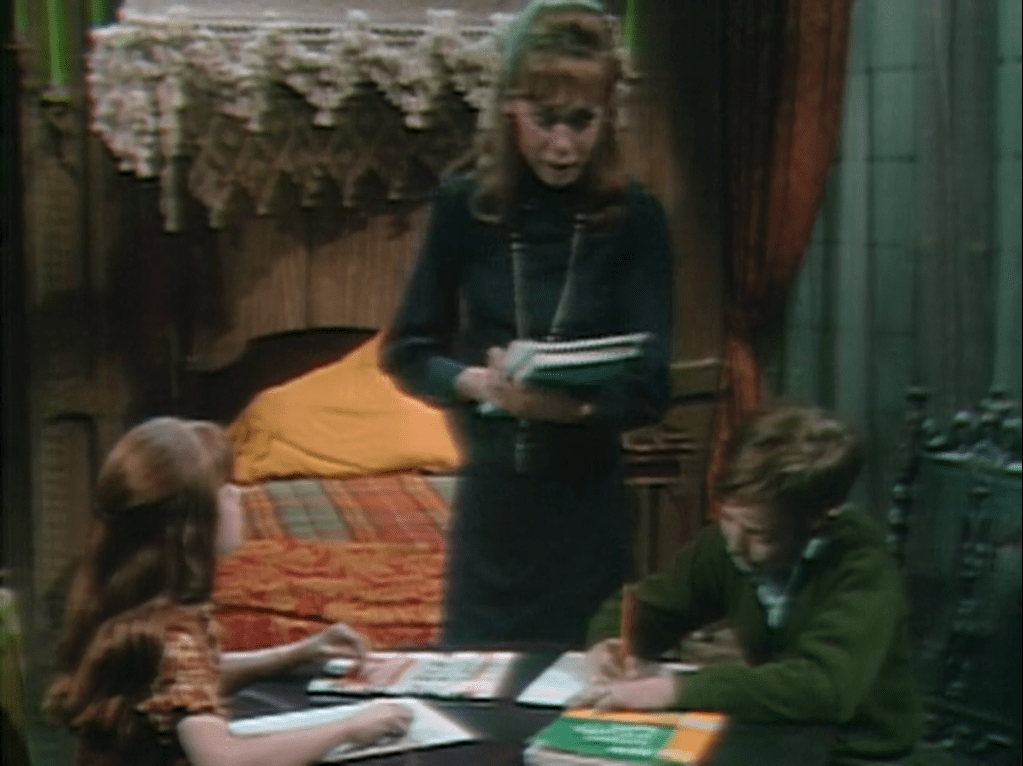
Today, we see our first tutoring scene in over a year and a half. David isn’t Maggie’s only charge; he has been joined by permanent houseguest Amy Jennings. Yesterday and the day before, we saw evidence that Maggie is a poor disciplinarian. We see further such evidence at the beginning of the tutoring scene, when the children complain about their lessons and Maggie quickly starts to explain herself and bargain with them. Amy and David are coming under the influence of the evil spirit of the late Quentin Collins. If the adult who is employed full-time to supervise David and Amy were up to her job, they wouldn’t be much help to him. So it’s no wonder the show three days in a row tells us that Maggie is a squish.

Maggie on the job.

To advance a plan of Quentin’s, Amy pretends to be ill and to faint during the lesson. David Collins is almost as subtle an actor as is David Henesy; when he is pretending to see signs of illness in Amy’s face, he looks at her with one eye and speaks with a most convincing note of concern. By contrast, Amy’s performance is exaggerated, showing none of the easy fluency Denise Nickerson brought to her roles. My wife, Mrs Acilius, chuckled at Amy’s fake faint and at some of the fussing she and David do when they are left alone together. She said it was refreshing to see that David and Amy are still kids. It certainly adds to the poignancy of what we are seeing Quentin do to them when we think of them as real children whose innocence he is exploiting for his evil project.

Amy’s fake faint convinces Maggie, and it leads to a lot of running around, ending with Maggie going to the cottage on the estate where Amy’s big brother Chris is staying as a guest of heiress Carolyn Collins Stoddard. Chris is a werewolf and is about to transform, and Quentin’s goal was to get Carolyn to go to the cottage. David has been making terrible pronouncements to Amy about how Carolyn will never bother them again, and the two of them are distressed to hear that Maggie rather than Carolyn is going to see Chris. So we are supposed to take it that Quentin knows about Chris’ situation and wants him to attack Carolyn.

Episode 655: The doctor’s office

Hardworking young fisherman Joe Haskell has been through a lot lately, and it is taking its toll. He was bitten and enslaved by a female vampire, with the result that he lost his job and his fiancée. He was still under her power when he realized that his cousin and close friend, Tom Jennings, was also a vampire. Now he has been attacked by a werewolf and has discovered that that werewolf is, on the few nights of the month when the moon is not full, Tom’s brother Chris. Last night he saw Chris transform in his lupine shape. He took Chris’ revolver and emptied it into the werewolf’s furry chest, but that only slowed him down. Joe escaped from the werewolf’s wrath, but we see today that he is never going to be right again.

Chris’ nine year old sister Amy is staying at the great house of Collinwood as the guest of matriarch Elizabeth Collins Stoddard. As we open, Liz’ daughter Carolyn is in the drawing room, recently returned from a trip. She is terribly distraught to hear a recap of the last couple of weeks from permanent houseguest Julia Hoffman, MD. While they talk, Joe slips into the house, crazy-eyed and bent-backed.

Joe makes his way up to the bedroom where Amy is asleep. He dwells on what her brothers became, then approaches her bed with his hands in strangling position. After a commercial break, he says “Save her!,” then agrees with himself that he ought to save Amy.

Joe calls on Amy. Screenshot by Dark Shadows Before I Die.

Joe wakes Amy, urges her to be silent, and starts packing her clothes. She asks if they are going to join Chris, and Joe becomes violently agitated. Amy grows frightened. Joe grabs her, puts his hand over her mouth, and carries her out of the house, leaving her half-packed bag behind.

In the woods, Joe hears sounds which he believes to be the werewolf. He starts shouting that he won’t let it have Amy. He is so absorbed in this that Amy gets loose and runs from him.

Joe’s derangement is entirely explainable as a natural response to the horrible and incomprehensible traumas he has undergone. The same could be said of the other mentally ill character in today’s episode, Liz, and in Monday’s episode Julia very nearly said it. Today, however, the show raises the possibility that Liz’ trouble might be the result of ongoing persecution by the spiritual forces of darkness.

Months ago, Liz fell afoul of her brother Roger’s wife. She called herself Cassandra, but was really an evil sorceress named Angelique wearing a black wig. This wiggéd witch cast a spell that caused Liz to sink into a deep depression, obsessed with the idea she would be buried alive. Twice before, Liz has sunk into similar depressions. The first was the result of a spell cast by Roger’s previous wife, Laura Murdoch Collins, who like Angelique/ Cassandra was an undead blonde fire witch. (Roger has a type.) The second was a response to a long blackmail to which a seagoing con man named Jason McGuire subjected her. For the last several weeks it has seemed that this third bout might be lifting, but it came back with a vengeance last week when well-meaning governess Victoria Winters dematerialized before Liz’ eyes.Vicki’s departure was as much a shock to Liz, in its own way, as Chris’ transformation was to Joe. Even before any spells were cast on her, Liz had shut herself up in the house and refused to leave for eighteen years. So we know that Liz is given to depression.

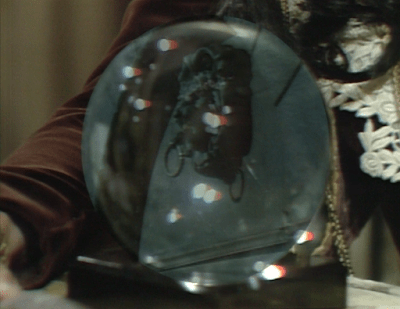
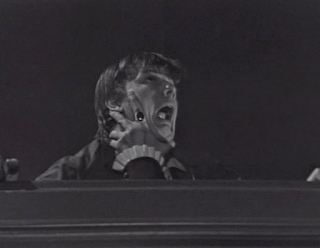
Today Liz has a nightmare. The dream sequence begins with a melody that for all the world sounds like “Rock-a-bye Baby” played on a kazoo, but which turns out to be a distorted recording of Amy singing that lullaby. Liz sees Amy atop the cliff on Widows Hill, a place associated with death and peril. In the past, several women have fallen to their deaths from Widows’ Hill; we have seen Liz and Vicki attempt suicide there. Amy’s image is as distorted as is the sound of her voice. She is swaying from side to side, perhaps dancing the hula; the visual effects exaggerate this sway.

Liz is trying to get Amy away from the cliff when she sees Angelique/ Cassandra. The witch tells her that she will fulfill her curse and see that Liz is buried alive. Liz finds that she can no longer communicate with Amy, for which Angelique/ Cassandra taunts her.

Shortly after Liz wakes up from her dream, Carolyn and Julia come to her room. They hear her crying out that “she” is a danger to her, but a moment later Liz cannot remember who that was. Julia mentions to Carolyn today that multiple psychiatrists have reported that Liz cannot remember how her depression started; that she sees Angelique/ Cassandra in the nightmare but cannot remember who she was so shortly after suggests that the nightmare is part of the depression. If Angelique/ Cassandra’s continued activity is causing the one, it must therefore be causing the other.

Liz says that she is afraid for Amy and asks Carolyn to check on her. When she finds Amy missing, she asks Julia what to tell her mother. Without missing a beat, Julia says “Lie to her!” This is perfectly fitting- Julia is the show’s most fluent and most accomplished liar. Julia and Carolyn begin a search. Julia is on the phone asking for the sheriff when Amy comes in the front door, followed by Joe.

Julia is at first relieved to see Amy with good ol’ Joe. But Amy is terrified of Joe, and when she runs upstairs Julia blocks the staircase to keep him from following. Joe says that he must take Amy far away from Collinsport at once. Julia says that if he can explain why, she will let him. Nothing he can put into words makes much sense to her, and he is so obviously unhinged that there is no way anyone would think he was the right person to assume responsibility for a child. Julia tells Joe that whatever he may have encountered in the village poses no threat to Amy in the mansion. He laughs, shakes his head, and mutters “You don’t know… you don’t know…”

Julia’s attempt to reassure Joe is interrupted by a blood-curdling scream from upstairs. She hurries up to see what is happening. Joe goes on laughing and muttering, wandering out of the house. That the scream coming from upstairs, where Amy is, does not catch his attention when he is so determined to protect Amy from imminent danger shows that he is truly lost, never to recover.

Julia finds a distraught Carolyn standing over an immobile Liz. She gives Liz a quick look, and tells Carolyn that she is dead. You might think Julia would be more careful about this. She has several times made erroneous death pronouncements, most recently when she pronounced Liz herself dead in #604. That incident led Julia to conclude that Liz had an unusual disorder that could cause her to appear to be dead. Especially since Julia knows about Liz’ overwhelming fear that she will be mistakenly thought dead and be buried alive, this hasty diagnosis is bizarre. Of course we end with a shot of Liz on the floor and hear her voice on the soundtrack saying “I’m not dead! I’m not dead!”

Liz had collapsed after she had a vision of Angelique/ Cassandra appearing in her room and touching her. This would seem to be a strong suggestion that the show wants us to think that Liz is still actively hag-ridden, and that her depression is therefore among Dark Shadows‘ supernatural storylines. On the other hand, the vision might have been an hallucination on Liz’ part, and her apparent death might be the result of a psychological syndrome. There may not be any mental process in our world that can induce a seizure so complete that it would fool doctors into thinking that a patient was dead, but in the world of Dark Shadows Julia, whose abilities are all supposed to be strictly the result of her scientific training, can use hypnosis to erase and rewrite people’s memories at will. If the power of suggestion is that great in this fictional universe, it is easy to suppose that self-hypnosis could conceal anyone’s vital signs from the most sophisticated examination.

This was the first episode directed by Henry Kaplan. Lela Swift directed the first twenty episodes of the show, and half of the rest. From #21, she shared directing duties with John Sedwick, usually trading off from one week to the next. Sedwick left the show in June, and several other men have taken turns as Swift’s relief. Kaplan will occupy that spot until the end of the series.

Swift and Sedwick were both ambitious and accomplished visual artists, and the others have more or less lived up to the standard they set. Today’s episode doesn’t look particularly bad, but a great many of the hundreds of segments Kaplan would go on to direct would be made up of one closeup after another, most of them badly out of focus. Swift will continue to work at her usual high level, but the sludge Kaplan dumps on our screens day after day will go a long way towards breaking people of the habit of watching Dark Shadows and discrediting it in the eyes of critics and television professionals.

Moreover, Kaplan did not work well with actors. Many of the cast hated Kaplan for his habit of using a stick, not only to point to their marks, but often to prod them physically. Others hated him for the verbal abuse he casually heaped on them. In a recent panel discussion, Marie Wallace and Donna Wandrey share stories about the difficulties of working with this disagreeable hack. The performances in this one do not show Kaplan’s malign influence. Joel Crothers does a marvelous job as Joe. While the actresses step on each others’ lines so often that it is clear they are nervous, that is not so very unusual.

Episode 647: Her own sensitivities

This is first of three consecutive episodes featuring Cavada Humphrey as Madame Janet Findley, a medium recruited to investigate the strange goings-on at the great house of Collinwood. Humphrey’s performance dominates these segments completely. Her style is more akin to pantomime than to anything native to spoken drama; she uses every muscle of her body to strike a series of exaggerated poses. Since that includes the muscles of the vocal tract, words occasionally come out in the course of her performance. The result is as bizarre as it sounds like it would be, and on Dark Shadows it is magnificent.

Granted, it is a shock when Humphrey reads the opening voiceover. Without seeing her, it is difficult to know what to make of her speech. When we watched it this time, I tried to make Mrs Acilius laugh by mimicking the poses a person might strike while speaking that way. So far from making the monologue sound silly, that just made it clear to us what Humphrey was doing, and left us both taking her performance seriously.

I’ll make a couple of random remarks about the non-Cavada Humphrey parts of the episode. Under the influence of the ghost of Quentin Collins, children David Collins and Amy Jennings have tried to murder David’s father Roger. Yesterday David took the lead in setting the trap that caused Roger to fall down the stairs while Amy showed reluctance in helping him. Today, the children see that Roger is not seriously hurt. David is relieved and wants to stop doing Quentin’s bidding, while Amy insists that they continue. Denise Nickerson delivers one of Amy’s monologues with her eyes fixed on the camera; the effect is unsettling in the extreme, suggesting as it does that Amy and David have taken leave of the other characters and are now in a dramatic space of their own where they may as well communicate directly with the audience.

Amy tells David and us that Quentin must be obeyed.

On his great blog Dark Shadows Every Day, Danny Horn derides David and Amy’s exchange of roles in their conspiracy. He says that the reason they take turns being “Executive Child” is merely sloppiness on the part of the writing staff:

You can handwave and say that seeing his injured father shocked young David out of his temporary hypno trance, but really the explanation is that Gordon Russell wrote yesterday’s episode and Sam Hall wrote today’s, and they didn’t really bother to synch up on David’s emotional throughline. It happens. This is the “good enough for rock ‘n roll” approach to soap opera dramaturgy.

Danny Horn, “Episode 647: The Wire,” posted 12 May 2015 on Dark Shadows Every Day.

I disagree. There’s nothing hand-wavey about an appeal to David’s motivation. However little attention Hall paid to yesterday’s episode, David’s visit to his father, during which he all but begs for a way to help him in his recovery, leaves no doubt that he meant for us to think that David was relieved that he failed to kill his father and that, having seen where Quentin’s spell would lead, he wanted to break free of it.

And the actual effect of seeing the children waver back and forth in the intensity of their subjection to Quentin, alternating between attempts to break free and turns as “Executive Child” enforcing Quentin’s will on the other, is to show us that we are early in the process of obsession and to create suspense as to whether it will progress all the way to possession. So far, Quentin can dominate only one of the children at a time, while he just tugs at the other. In Madame Findley’s intervention, and for that matter in David’s scene with Roger, we can see paths still open that would lead to breaking his power altogether before he grows strong enough to fully control Amy and David simultaneously.

There is a similarity between David and Amy’s relationship to Quentin at this point and Amy’s brother’s relationship to his curse. Chris has been a drifter for a few years, suggesting that he has been a werewolf for that long, but he is still looking for ways to keep himself from hurting anyone when the Moon is full. The supernatural menaces the show has presented up to this point were introduced as already fully committed to the destruction it was ordained they would cause. David’s mother, undead fire witch Laura Murdoch Collins, was an collection of several entities, some of them more purposeful than others, when she joined the show in December 1966, but it was always her fate to lure David to a fiery death. Vampire Barnabas Collins would eventually become a nuanced character and has now been freed of his curse and become human again, but when he first showed up in April 1967 he was all-in on being a creature of the night. Wicked witch Angelique started her murderous rampage shortly after her arrival in November 1967, and all of the various villains of the Monster Mash period that ran from mid-April to early December 1968 showed up loaded and ready to do their thing. But Chris’ curse has only drawn him halfway into monsterdom, as Quentin’s obsession has only drawn Amy and David halfway into his world of evil.

One inconsistency that may be most profitably explained by carelessness comes when Amy tells David that Quentin calls him by the name “Jamison.” Jamison was the name of David’s grandfather, who was Quentin’s nephew. Earlier, David had, under Quentin’s influence, told Amy to call him “Quentin.” It might have been better if they had decided in advance just who it was whose personality was supposed to overwrite David’s, though I don’t think it is a major flaw.

Episode 646: Morbid games children play

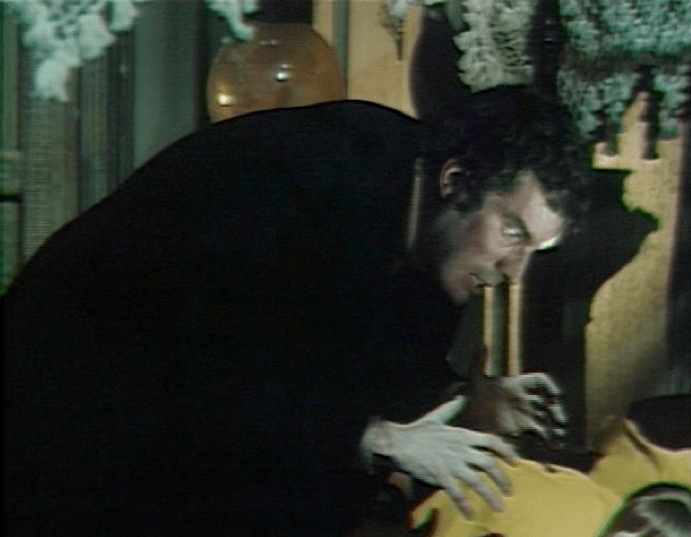
The ghost of Quentin Collins has lured children Amy Jennings and David Collins to the room in the long deserted west wing of the great house of Collinwood where his skeleton is hidden. For the first time, Quentin appears. Later, a woman in a white dress will also materialize.

Quentin. Screenshot by Dark Shadows Before I Die.

An old gramophone starts playing a sickly waltz, and David snaps into an odd mental state. He is slow to respond when Amy calls him by name, and tells her she knows that the waltz is his favorite piece of music. She does not know this, and is puzzled to hear it, since he hadn’t heard the waltz until the night before. Soon it becomes apparent that David is coming to be possessed by Quentin. He tells Amy that they have things they must do, including a conversation with “Roger.” Roger is David’s father; this is the first time we have heard him refer to him by name, and it makes it clear to regular viewers that David is not himself. Later, they are wearing clothes of the same period as those Quentin and the woman in the white dress wore, and they decide to address each other as “Quentin” and “Beth.”

Longtime viewers will also recognize the motif of a piece of music as a device with the power to overwrite a character’s personality. In #155, David’s mother, undead fire witch Laura, gave him a music box, apparently as part of her plan to prepare him to follow her to a fiery doom.

Another music box became much more famous a little later. In the summer and fall of 1967, David’s distant cousin Barnabas was a vampire, and he was determined to re-create his lost love, the gracious Josette. His plan involved forcing a young woman to listen to Josette’s music box incessantly. Barnabas hoped that someone who spent enough time listening to the box would forget her old habits and memories and turn into Josette. The music box did seem to have some measure of the power Barnabas had in mind. First Maggie, The Nicest Girl in Town, then Vicki, David’s well-meaning governess, did spend substantial amounts of time listening to the music box with a vacant look on her face. Episode #303 ended with Vicki’s boyfriend Burke listening to the music box and staring off into space; Mrs Acilius wondered if that meant Burke was going to think he was Josette. Burke wouldn’t have looked so good in the dress that comes with the part, but who knows, maybe he and Barnabas would have been happy together.

David and Amy carry a chest out the front door of the great house. Roger and his sister, matriarch Liz, see them do this and ask what is in the chest. David says that it is full of his toys, and that he and Amy want to play with them outdoors. Roger points out that David has never taken a chest full of toys outdoors before, and asks what has led him to do so now. David tells him it is a military secret. Amy explains that one of David’s toy soldiers is broken and they are going to bury him with full military honors. Amused by this idea, Roger holds the front door open and salutes the children as they carry the chest past. In fact, the chest holds, not a toy soldier, but Quentin’s skeleton. It is that which Amy and David bury.

At night, Roger is about to go to sleep when a knock comes on his bedroom door. It is Amy, telling him she heard from sounds from the downstairs that made her suspect someone might be trying to break into the house. Roger takes this concern seriously enough that he retrieves a pistol from his nightstand and carries it as he goes to investigate.

David ties a wire across the second stair from the top of the case from the bedrooms to the foyer, opens the front door, then hides. Roger enters. He is alarmed to see that the front door is open. He stumbles on the trap David has set. He lies unconscious and bleeding at the foot of the stairs. Amy and David enter, see his condition, and nod at each other gravely.

This is the second time David has tried to kill Roger. The first time, in #15, he had sabotaged the brakes on Roger’s car. As he watched the car pull away, he called to his mother. Laura was not physically present, and would not be for another 22 weeks, but when those who watch the show from the beginning learn of her supernatural character they will ask if she influenced David to patricide. Today there is no doubt that David and Amy are doing the bidding of the ghosts, and so we wonder again if David was under Laura’s power when he took the bleeder valve from the wheel cylinder of Roger’s car.

I don’t know how much of a spoiler it is to tell someone reading a Dark Shadows blog that in the spring of 1969 Quentin would become a major breakout star, rivaling Barnabas’ popularity. Quentin would be such a big part of the show’s appeal that Dan Ross would give the last 16 of the 32 original Dark Shadows novels he wrote under his wife Marilyn’s name titles beginning with the words “Barnabas, Quentin, and the.” They were:

  • Barnabas, Quentin, and the Mummy’s Curse, April 1970
  • Barnabas, Quentin, and the Avenging Ghost, May 1970
  • Barnabas, Quentin, and the Nightmare Assassin, June 1970
  • Barnabas, Quentin, and the Crystal Coffin, July 1970
  • Barnabas, Quentin, and the Witch’s Curse, August 1970
  • Barnabas, Quentin, and the Haunted Cave, September 1970
  • Barnabas, Quentin, and the Frightened Bride, October 1970
  • Barnabas, Quentin, and the Scorpio Curse, November 1970
  • Barnabas, Quentin, and the Serpent, December 1970
  • Barnabas, Quentin, and the Magic Potion, January 1971
  • Barnabas, Quentin, and the Body Snatchers, February 1971
  • Barnabas, Quentin, and Dr Jekyll’s Son, April 1971
  • Barnabas, Quentin, and the Grave Robbers, June 1971
  • Barnabas, Quentin, and the Sea Ghost, August 1971
  • Barnabas, Quentin, and the Mad Magician, October 1971
  • Barnabas, Quentin, and the Hidden Tomb, December 1971
  • Barnabas, Quentin, and the Vampire Beauty, March 1972

My first choice is always to title these entries after lines of dialogue from the episodes, and “morbid games children play” was so perfect that I couldn’t pass it up. But Barnabas, Quentin, and the Bleeder Valve was also very tempting, and I do suspect I will use at least a few Barnabas, Quentin, and the titles in the next two and a half years.

Episode 641: Your time is now

In #2, high-born ne’er-do-well Roger Collins saw governess Victoria Winters standing at the edge of a high cliff overlooking the ocean. She didn’t know he was there until he startled her by asking her if she was planning to jump. As the weeks go on, Vicki will learn of other women who have leapt to their deaths from that spot, including a story that over the years two governesses were among them and that legend says a third will someday follow suit. The cliff is the face of Widows’ Hill, named after women whose husbands never returned home from the sea; several times during storms an eerie note sounds in the wind, a note known as “The Widows’ Wail,” which the locals believe to be the ghosts of the Widows announcing that a tragic death will soon take place.

Vicki stands at the edge of the cliff again at the end of this installment while the Widows’ Wail sounds. She is distraught that she has herself become a widow and is dwelling on the idea that she can be reunited with her husband in death.

Though occult expert Timothy Eliot Stokes told her earlier in the episode that “Your time is now!,” Vicki’s time as a lively part of the show in fact ran out in March 1967, with the resolution of the story about her effort to befriend her charge, Roger’s strange and troubled young son David. Actress Alexandra Moltke Isles finally gave up on the character and left Dark Shadows after #627. Her successor in the role, Betsy Durkin, has essentially nothing to work with. We do not share her grief for the husband she is mourning; he was one of Dark Shadows‘ most repellent characters, and it is such a relief that he is away that we sympathize only too much with everyone who tells her to stop bringing him up. Nor do we have any other reason to care about her, since she is relevant to no ongoing plotlines. Even longtime viewers who remember the foreshadowing of Vicki’s possible death by a jump off the cliff will not react strongly to the sight of her there, since Miss Durkin is not Mrs Isles and does not bring her screen iconography to the reprise of the theme.

This phase of the show actually belongs to a character introduced in #632, eleven year old Amy Jennings. When Amy meets Stokes today she announces that she likes him because he is funny; he replies that he is pleased to find that “My appeal extends to all ages now.” Indeed it does; in its first year, Dark Shadows was very much aimed at adults, some of whom remembered Joan Bennett as one of the great movie stars of the 1930s and 1940s and were impressed by her presence in the cast as matriarch Liz, some of whom appreciated it as a specimen of slow-paced, highly atmospheric Gothic romance, and some of whom were fascinated by the story of Vicki and David and its theme of a grownup trying to make a difference in the life of a troubled child. But by the time Stokes arrived in #464, Dark Shadows had become a kids’ show. As Thayer David plays him, Stokes is amusing enough that anyone can like him, but the absolute seriousness with which he regularly expounds the most preposterous mumbo-jumbo is designed to make him a favorite of the very young.

Amy likes Stokes. Screenshot by Dark Shadows Before I Die.

Amy’s friendship with David develops in scenes that kids will find engaging, as they go exploring the big haunted house of Collinwood and find their way into spooky adventures. She also takes the lead in her relationships with adults more consistently than David ever did. While in the first year and a half of the show David often knew things the adults didn’t know, that was usually because he accepted the facts they refused to see. No matter what he said or did, he couldn’t move them from their habits of denial and evasion. But Amy has sources of information that the grownups around her don’t have. So today she has a vision of her brother Chris in some kind of terrible trouble. When she tells Vicki and Liz about her vision, Liz tries to telephone Chris and is deeply disturbed when he doesn’t answer. As my wife, Mrs Acilius, pointed out, it is after one o’clock in the morning, so you wouldn’t expect her to attach great importance to his failure to pick up the phone. That she does suggests that she is taking Amy seriously.

Returning viewers know that Amy’s vision is correct. Chris is a werewolf, and he just killed a barmaid. That Amy not only has a paranormal means of knowing how Chris is doing, but that she is also able to get through to the adults and influence their actions, suggests that she will have a major impact on the werewolf story as long as it continues. Indeed, she already has- the werewolf was about to eat Liz the other day, but backed off when he saw Amy nearby.

Amy is central to the other storyline that is beginning at this point. That is “The Haunting of Collinwood,” in which the ghost of Liz and Roger’s’ great-uncle Quentin Collins is going to be creating difficulties for everyone. Amy and David went into the long-deserted west wing of the house and retrieved an antique telephone from a room there. Though its cord is cut, Amy can sometimes hear Quentin’s voice through its receiver. When she is alone and worried about Chris, she picks the telephone up and asks for Quentin. She is disappointed he does not answer. None of the adults knows about Quentin’s ghost or the telephone. Not even David has heard more than Quentin’s breathing through the receiver. Again, Amy is uniquely positioned to understand and affect the action.

According to the closing credits, this week’s five episodes were directed by “Penberry Jones.” The name “Penberry Jones” is unknown to Google aside from these credits, and it sounds like a joke of some sort. Though the fansites all mention the improbability of Jones’ name and the likelihood that it is a pseudonym, none that I could find offers any clue as to who might have been behind that pseudonym. From the early 1970s until the quarantines of Covid-19 in 2020, Dark Shadows fans would organize festivals a couple of times every year at which panels of people who had been involved in making the show took questions from the audience. If any of those audiences asked who Penberry Jones was, either they did not get an answer or that answer was not recorded.

The name “Penberry” may remind longtime viewers of Dark Shadows of episode #83, which is about Roger burying a pen. Roger was a major villain then, and his part gave actor Louis Edmonds an opportunity to show what he could do. Roger has long since been demoted to occasional comic relief; one might imagine that Edmonds wanted to take a turn in the director’s chair, and that he chose his whimsical pseudonym as a nod to his character’s origins. Appealing as that idea may be, it does not seem at all likely. So many of the panel discussions among cast members abounded in fond stories about Edmonds that surely someone would have mentioned it if he had directed five episodes.

Indeed, most of the longer-lived members of the cast participated in so many of those panels that they all had moments when they had to grope more or less desperately for something fresh to say. If anyone whose name fans would recognize and who worked closely with the cast were “Penberry Jones,” it’s hard to imagine that one or another of them wouldn’t have brought it up in one of those moments.

Whoever it was must have been known to executive producer Dan Curtis and line producer Bob Costello, and probably quite well known to them. The Directors Guild of America does allow its members to change the names under which they are credited, as for example John Walter Sullivan was allowed to direct several episodes of Dark Shadows as “Jack Sullivan” and several more as “Sean Dhu Sullivan.” But it does not allow them simply to use pseudonyms at will. It wasn’t until 1969 that directors working in features could be billed as “Alan Smithee,” and then they had to prove that they did not really have control of the final product before they were allowed to substitute that name for their own. The first television production credited to “Alan Smithee” didn’t appear until 1970. So it is unlikely that “Penberry Jones” directed any screen productions under any other name. Curtis and Costello probably wouldn’t have chosen a first-time director with no imminent prospects of other screen work unless it were someone they already knew and trusted.

If “Penberry Jones” didn’t cover anyone the cast knew well or a director who worked under another name, but was someone who was close to Dan Curtis or Bob Costello, it should be possible to compile a short list of suspects. I’m not so deeply immersed in the behind-the-scenes lore that I can compile that list myself, but maybe you are. If so, I’d like to hear from you in the comments!

The director’s name isn’t the only puzzle in the closing credits. Every previous episode of Dark Shadows ended with the credits playing in front of a stationary shot of one or another set. It was always one shot per closing credits sequence. This time they start with a stationary shot of Vicki’s room, then cut to a stationary shot of the foyer. It’s hard to see what the point of that transition is. Perhaps we could ask “Penberry Jones,” if we had any idea who that was.

Episode 611: She must come willingly

Suave warlock Nicholas Blair proposes to Maggie Evans, The Nicest Girl in Town. Maggie declines, citing her concern for her troubled ex-fiancé Joe Haskell. Nicholas has a man named Harry Johnson under his power, and a vial of poison he wants to give to Joe. After his disappointing date with Maggie, Nicholas goes home and takes a firm grip on his Harry Johnson. He orders Harry to slip the poison to Joe.

That was all I had to say about the episode, but my wife, Mrs Acilius, had a great deal more. She saw it as an essay about free will.

In the opening scenes, Nicholas talks with Frankenstein’s monsters named Adam and Eve. Adam was created in May, in a procedure that used parts salvaged from corpses and a “life force” extracted from recovering vampire Barnabas Collins. When Nicholas found out about Adam, he came up with the idea of a humanoid species bred from patchwork people and loyal to his master Satan. He schemed to have Eve created as Adam’s mate. Nicholas decided that the donor of Eve’s “life force” should be “the most evil woman who ever lived”; he therefore conjured up Danielle Roget, an eighteenth century homicidal maniac based on Madame DuFarge from A Tale of Two Cities, and assigned her the task. Now he finds that Eve has Danielle’s memories and personality, and that she hates Adam. She has found a man she recognized as the reincarnation of someone she was involved with when she was Danielle, and has made up her mind that they will love each other.

Nicholas is frustrated he cannot control Eve. He turns from her and looks into the camera, as if appealing to the audience for sympathy. Nicholas does not seem to understand what went wrong. He had the basic ingredients for his new species- a male and a female. He had not reckoned on one of them disregarding his plan and choosing a direction of her own.

Nicholas turns to us.

Adam sees Eve storm out of the house as he is going to see Nicholas. He asks Nicholas where she is going, and is astonished when Nicholas tells him he doesn’t know. Adam is unhappy that Eve does not want him, and thinks that a change of scene would help. Still upset about his conversation with Eve, Nicholas is slow to focus his attention on Adam. When Adam complains Nicholas thinks that he and Eve belong to him, Nicholas turns to him and starts telling him what he wants to hear. Evidently it is dawning on Nicholas that Adam, too, might start to make his own decisions.

The man Eve has chosen is named Peter, but he prefers to be called Jeff. Eve shows up at his apartment, refuses to leave, and tells him that they are going to be together from now on. Roger Davis’ inadequacies as an actor leave this scene flat. Eve keeps talking about signs of doubts and irresolution she sees in Peter/ Jeff’s face, none of which Mr Davis is able to manifest. All he does is yell and pout. But as Eve, Marie Wallace manages to make the point that Eve is no more interested in anyone else’s free will than is Nicholas. She wants Peter/ Jeff to love her, and that is all there is to it so far as she is concerned.

For his part, Nicholas has learned nothing from the failure of his attempt to match Adam and Eve. He thinks all he has to do is get Joe out of the way and Maggie will come to him “willingly.” He even seems to underestimate Harry. He doesn’t bother lying to Harry about what he wants him to do to Joe, and Harry is horrified at the idea of complicity in murder. Harry is a career criminal, and several times we have seen him try to get money out of people by blackmail, extortion, or spying. Nicholas could easily have told him he is about to commit a crime he is used to committing and avoid all resistance. For example, he might have said that the potion was a truth serum and once Joe took it he would have to tell him some secret they could use against him. But it simply doesn’t occur to him to take Harry’s sensibilities into account, and he winds up having to threaten him to gain his compliance. A villain who is supposed to have subtle but irresistible powers loses a piece of his menace every time he resorts to an “or else!,” so this is a significant setback for the character of Nicholas.

Episode 610: You are the angel of death

A woman named Eve sees a man standing on the terrace of the great house of Collinwood. She addresses the man as “Peter Bradford.” Regular viewers know that this is indeed his name, but we also know that he prefers to be called “Jeff Clark.” Peter/ Jeff has died and came back to life since he was first known as “Peter Bradford,” so I suppose you could say that’s a case of deadnaming. But while most transfolk tend to be patient when people inadvertently deadname them, Peter/ Jeff is a huge jerk about correcting people who use his former name. Yesterday twelve year old David Collins called him “Peter Bradford,” and he grabbed the boy and shook him until it looked like he had given him a concussion.

Eve is also a returnee from the world of the dead. Doubly so; her body is a Frankenstein creation made of parts salvaged from corpses, while her memories and personality are those of eighteenth century homicidal maniac Danielle Roget. Peter lived in that same era, and when Eve/ Danielle recognizes him we learn that they knew each other then. Peter/ Jeff doesn’t assault her as he did David; she’s his own size. He doesn’t recognize her, which she attributes to the fact that she looks different than she did when they knew each other. He keeps whining that his name is “Jeff Clark,” but she isn’t having it.

Meanwhile, Peter/ Jeff’s fiancée, well-meaning governess Vicki, is in the drawing room, having a conversation with matriarch Liz. There is a blooper in the middle of this conversation. Liz is supposed to say something like “Then you’ve resolved all your difficulties,” but Joan Bennett stumbles over the words. Alexandra Moltke Isles improvises a response that makes sense of it. That response is smooth enough, but she delivers the rest of her lines very quickly and with unusually little eye contact with her scene partner. Perhaps that is because she was afraid the improvised line was going to put the scene over time, or maybe she realized she had called attention to Bennett’s flub and was nervous because she had embarrassed a big star.

Or maybe Mrs Isles was nervous because her next scene was going to be with Peter/ Jeff, and she knew it would involve Roger Davis putting his hands on her. As they exit, Peter/ Jeff clutches Vicki by wrapping his arms around her in a remarkably awkward fashion, and she visibly squirms. This is most likely Mrs Isles’ discomfort arising from Mr Davis’ habit of physically assaulting his scene partners. A charitable viewer just might be able to believe that it is Vicki’s discomfort because Peter/ Jeff just spent the whole scene telling her transparent lies. He doesn’t want to tell her about his encounter with Eve/ Danielle, and makes up totally unconvincing excuses for his distracted state. Perhaps Mrs Isles channeled her unhappiness at being yoked with Mr Davis into her expression of Vicki’s dissatisfaction with the loathsome little man she is engaged to marry.

Peter/ Jeff steers Vicki offscreen.

Once Vicki and Peter/ Jeff are gone, Eve/ Danielle emerges from the bushes whence she had been spying on them. Liz comes out to the terrace and sees Eve/ Danielle. She asks who she is. When she does not answer, Liz tells her that she knows- she is the angel of death. Eve/ Danielle is startled by this, and hurries away.

The next scene takes place in the house of suave warlock Nicholas Blair. Nicholas has been keeping Eve/ Danielle there since she came to life. She has returned from Collinwood. Nicholas is upset with her for going out without his permission. She taunts him, and he slaps her. He threatens to kill her, and she says that while she does not know what his plans are, it is clear to her that she figures too prominently in them for him to do that.

Coming so shortly after we saw an actress give strong signs of unease at contact with Roger Davis, Nicholas’ slap to Eve/ Danielle’s face is a lesson in how professional actors handle scenes involving physical violence. Eve/ Danielle is relaxed before the slap and in shock after it. Her reaction gives the scene its energy. If Marie Wallace had reason to believe Humbert Allen Astredo would actually hit her, she may well have been as tense before the slap as Mrs Isles was before Roger Davis slithered his arms around her, and the scene would have dribbled out as lifelessly as does Peter/ Jeff’s scene with Vicki.

Once Nicholas concedes that Eve/ Danielle is important to his plans, she relaxes again and decides she may as well tell him about her encounter with Peter/ Jeff. Nicholas is intrigued, and disturbed. He tells Eve/ Danielle that “If it is true that they are one and the same, then there are forces at work here that I don’t know about.” Eve/ Danielle’s memory of her previous existence is very incomplete, and she wants Nicholas to help her to learn more about herself. Once he has heard about Peter/ Jeff, he is eager to oblige. He hypnotizes her.

At this point, my wife, Mrs Acilius, expressed frustration. “He’s going to hypnotize her and afterward she won’t remember anything! It’s only interesting if she remembers.” Eve/ Danielle does have a flashback to 1795, but at the end she seems to come out of the trance on her own. She turns to Nicholas, calls him by name, and says that she remembers Peter Bradford and she loves him. Since Nicholas doesn’t give her a post-hypnotic suggestion and snap his fingers, it seems likely she will remember her past with Peter.

When Danielle was introduced, I assumed that the name “Roget” was a case of deadline-induced selection. She is based on Madame DuFarge from A Tale of Two Cities, so she had to be French. But the writer didn’t have a list of French surnames at his fingertips, so he looked at his desk, saw a copy of Roget’s Thesaurus, and went with that. Perhaps that was what happened, but today Eve/ Danielle lives up to her namesake and goes into the synonym business. She calls Peter/ Jeff by his original name. She is on the receiving end of synonymy from Liz, since “the angel of death” is as good a name for her as any. And one of the memory gaps Eve/ Danielle wants Nicholas to help her fill is her previous name.

Marie Wallace plays Danielle in the flashback, even though she had mentioned in the first act that she looked different in those days. This occasions much discussion on the fansites. Here is the debate on the Dark Shadows Wiki:

During the fiashback scene, Danielle Roget should have been played by Erica Fitz instead of Marie Wallace. Fitz had previously portrayed Danielle Roget in episode 594, so it would have made sense and for character continuity to continue using the same actress. [Addendum: There are strong reasons to argue otherwise as well. One could argue that this is a memory that Nicholas is conjuring in Eve, so it’s from Eve’s perspective, and she would naturally see herself in her current guise, not even knowing what Danielle Roget looked like. This is also a reasonable place for dramatic license to prevail. The scene is very short, and it wouldn’t have been especially practical to have an additional actress. It’s also possible that viewers may have been confused if another actress was in the scene–Erica Fitz was on the show for only two episodes, so viewers at the time might not even have seen or not fully remembered what she looked like. Aside from that, it’s also possible Erica Fitz was not available.]

Discussion under “Bloopers and Continuity Errors” in “610” on The Dark Shadows Wiki.

In a comment on his own post about the episode on Dark Shadows Every Day, Danny Horn puts it more succinctly:

Yeah, I think the in-universe explanation is that the flashback pictured at the top of this post is Eve’s hypnosis-assisted memory of the event, so she’s picturing herself as she is now.

The real-world explanation is that Marie Wallace is playing Eve/Danielle now, and exactly nobody wants Erica Fitz to come back and appear in the flashback.

Comment left 23 March 2015 by Danny Horn on “Episode 610: Inexplicable You,” Dark Shadows Before I Die, 21 March 2015.

For my part, I’m sure Erica Fitz Mears is a very nice lady, and we should all give her money to help with her health problems. But no, she was not a good actress and I do not regret that she did not get more work on screen. Since Mrs Mears was only in two episodes, today’s flashback might have been an opportunity to give some other actress a chance to show what she could do as Danielle. But Miss Wallace does a very good job, and rounding the episode with two confrontations between the same pair of performers does a great deal to strengthen its structure. It would probably have been a mistake to cast anyone else in the flashback.

The flashback scene does come as bad news to longtime viewers, for reasons that have nothing to do with the casting of Danielle. When in November 1967 the show needed to develop a backstory for vampire Barnabas Collins, it took us back to 1795 and introduced Angelique, a maniacal ex-girlfriend who was determined to disrupt Barnabas’ new romance. That was a triumph that turned Barnabas from a stunt that boosted their ratings sufficiently to ward off cancellation into one of the major pop-culture phenomena of the 1960s, and Angelique herself became one of the show’s most important characters. That they are trying the same tactic with Peter/ Jeff, right down to a dramatic date of 1795, leads us to fear that they see him as a permanent part of the cast, and that they want to tie Eve/ Danielle as closely to him as Angelique is tied to Barnabas.

Episode 609: For want of a fig leaf

Adam and Eve are discussing the Fall, comparing their incomplete memories of what came before it. This is not a flashback. The Adam and Eve we see today are Frankenstein’s monsters, and they do not live in exile from Eden when the world was young, but in the town of Collinsport, Maine in 1968. The Fall they have in mind is the one that is also known as Autumn. Adam is ashamed, not because he is naked, but because Eve accuses him of preferring life in captivity. He is not naked at all, even though Eve walks in on him and sees his Harry Johnson. Harry Johnson is the man to whom Adam has entrusted a letter, but since Adam’s favorite pastime is studying the works of Sigmund Freud, and since by 1968 “johnson” had been a familiar English slang word for “penis” for over a century, he would likely have been the first to make the connection to the predicament of their Biblical namesakes.

Adam takes Eve to his old home, a dusty room in the long-deserted west wing of the great house of Collinwood. Heiress Carolyn hid him there for a period that seemed so long the audience might feel that the original Adam and Eve were probably still around when it started. Carolyn greets them there. She is happy to see Adam again and eager to befriend Eve. Adam wants that too, but Eve isn’t having it. She quarrels with Adam and storms out, leaving Carolyn in an awkward position.

On the terrace outside the great house, an unpleasant man named Peter who prefers to be called Jeff is waiting for his date, well-meaning governess Vicki. Vicki has kept him waiting for an hour. Vicki’s charge, young David, happens by. Peter/ Jeff immediately makes it clear why Vicki is in no hurry to see him. He greets David with an accusation that he was hiding from him. When David denies this, Peter/ Jeff demands that he tell him who he was hiding from. Peter/ Jeff may have forgotten who is a guest in whose house, but David hasn’t, and he turns to go. Peter/ Jeff stops him, asking “We’re friends, aren’t we?” David doesn’t explicitly agree that they are, but he stays.

Peter/ Jeff starts to talk about his plans to marry Vicki. David calls him “Peter,” and since the closest thing he has to a personality is his insistence on being called “Jeff” he grabs David and shakes him violently. Watching this scene today, my wife, Mrs Acilius, said one word- “Psycho.” She wasn’t talking about Peter/ Jeff, but about actor Roger Davis. When one character shakes another, it is usually the actor playing the shakee who makes all the movements, while the shaker just mimes the action without actually touching them. Not so Mr Davis- he really did rattle David Henesy around hard enough that it’s pure luck he didn’t give him a concussion. That’s typical of the approach Mr Davis took to his performances on Dark Shadows, in the course of which he assaulted several women on camera. Mr Henesy is uncharacteristically tense throughout this scene, does not sustain eye contact with Mr Davis, and when the scene ends he rushes off stage.

Roger Davis has his fun. Screenshot by Dark Shadows Before I Die.

In his dialogue, Peter/ Jeff makes some pretty bizarre remarks:

You know, David, pretty soon, you’re gonna find out that love isn’t something you can remember. Sixteen years old… You know when you’re sixteen, you can really love somebody. And then you come back ten years later and you wouldn’t even notice her.

At this, David gives Peter/ Jeff a look that accords with Mrs Acilius’ one word assessment of Roger Davis. “Love isn’t something you can remember”? Which item on the sociopathy screening test is that? And what does “Sixteen years old” have to do with anything? David is twelve, Peter/ Jeff and Vicki are in their twenties, no one mentioned the number sixteen. And David would be doing Vicki a solid if he told her that her fiancé won’t remember her in ten years.

David Collins wonders what the #%*^ is wrong with Peter/ Jeff, while David Henesy recovers from Roger Davis’ assault on him. Screenshot by Dark Shadows Before I Die.

David leaves, and Eve shows up. She recognizes Peter/ Jeff and addresses him as “Peter Bradford!” The closing credits start rolling before Peter/ Jeff can shake her violently while whining that he wants to be called “Jeff Clark.” Eve is the reincarnation of an eighteenth century homicidal maniac; she hasn’t killed anyone since she was brought to life the other day, and Peter/ Jeff would be an excellent choice for her first victim. If she does kill him, I would be “Team Eve” all the way.

Episode 606: Hello, Barnabas

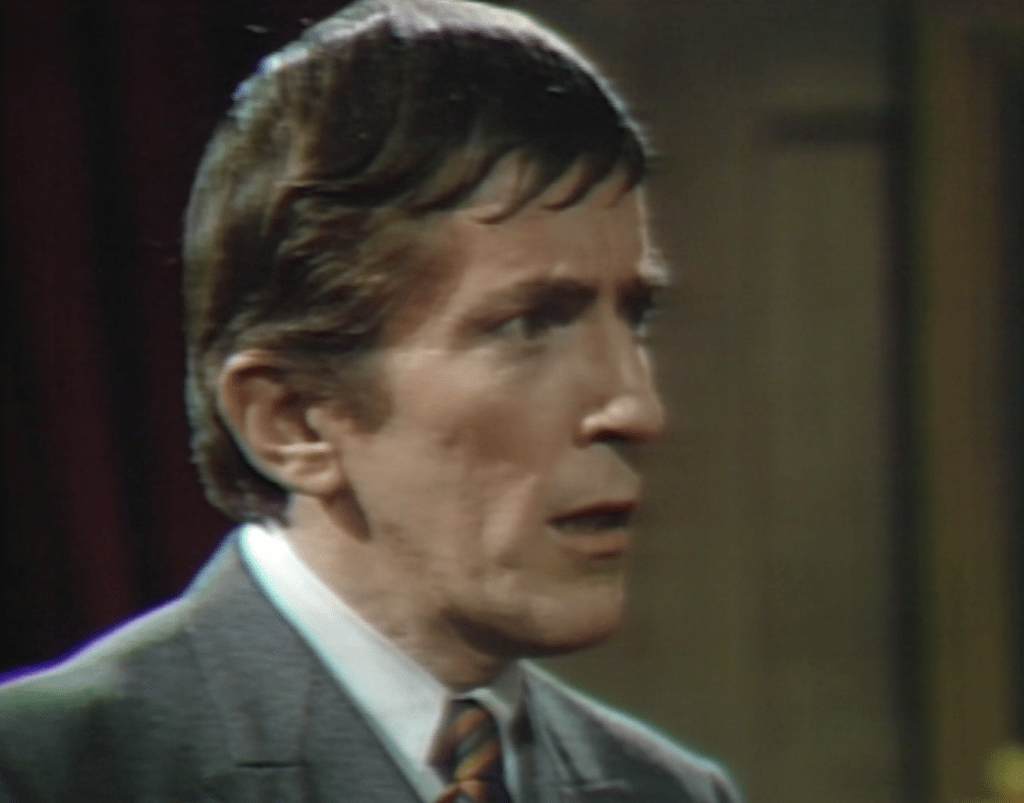
Vampire Angelique has bitten her onetime husband, old world gentleman Barnabas Collins, and brought him under her power. Barnabas asks if she plans to make him a vampire again, restoring the curse she placed on him when she was alive and they were married, 172 years before. Angelique is herself subordinate to suave warlock Nicholas Blair, and does not know what Nicholas’ plans are. All she can say in response is “Possibly.”

Barnabas keeps bringing up mad scientist Julia Hoffman and occult expert Timothy Eliot Stokes, who are waiting for him in his house. When Barnabas says that they will be suspicious if he does not return soon, Angelique replies “Let them be suspicious. It doesn’t matter to me.” When Barnabas asks what he can tell Julia and Stokes, Angelique replies “Tell them anything. Tell them the truth.” At that, a smile spreads across her face. We’ve already heard Julia ask Stokes what they will do if Barnabas is in trouble, and Stokes’ reply that there is nothing they can do. When Angelique suggests Barnabas tell Julia and Stokes the truth, her smile suggests that she has come to the same conclusion.

“Tell them anything. Tell them the truth.”

Angelique is usually so frantic in her manner and so monomaniacally focused on her goal that she does not seem to have any unspoken thoughts at all. But today she is tranquil, utterly satisfied with what she has done to Barnabas. “Tell them the truth” and the smile afterward are a turning point for the character. She has what she wants, and now something else is going on inside her head, something we would not have expected and can’t quite figure out.

It doesn’t last. A moment later, she is insisting that Barnabas must find a way to keep Julia and Stokes’ suspicions under control. But for a few seconds, a vista opened before us, and we caught a glimpse of an entirely new direction the show might take, both with Angelique’s character and with the relationship of a vampire to a victim. It even seemed possible that the alternately frenzied and glum secret-keeping that gives Dark Shadows its rhythm might give way to something entirely new. When that vista disappears, we find ourselves going back over some old familiar ground, but the sense of possibility does not quite leave us.

Angelique bites Barnabas twice today. Lara Parker was much shorter than Jonathan Frid, and the first time she bites him she has to get to his neck from a standing start with only a couple of seconds before the shot fades out to the opening titles. Her straining to get to her tiptoes was so obvious it made me and Mrs Acilius laugh out loud. But the second time, she comes at him from several feet away, and she takes the opportunity to make a sweeping turn and end with a balletic rise to en pointe, I believe using the rolling motion known as relevé. Frid helps Parker somewhat by bowing his head while Barnabas pleads with Angelique not to bite him. That one looks great.

Episode 602: Someone who will make you happy to be a vampire

Frankenstein’s monster Adam came to life in #485, and has been cooped up in one cage after another ever since. Last week a mate was created for him and given the name Eve. Eve hates Adam, and today tells him that she will kill him as soon as she can. Adam is getting pretty tired of the whole thing.

Adam’s latest keeper is suave warlock Nicholas. Nicholas masterminded the creation of Eve because he hopes she and Adam will make Frankenbabies, founding a humanoid species that will owe its creation to Satan. Adam doesn’t know about Nicholas’ allegiance to the Devil or about his plans, but he is sick of taking his orders. The two quarrel at the beginning of today’s episode. Nicholas quiets Adam by showing off one of his magical gimmicks. Hanging on his wall is a device that is usually a mirror, but that can be switched over to function as a closed circuit television focused on anyone he chooses. Today, he wants to know where his unruly subordinate, vampire Angelique, has wandered off to.

Nicholas and Adam look into the mirror, where we see Angelique at the bedside of an unpleasant man named Peter who prefers to be called Jeff. She is about to bite Peter/ Jeff, contrary to Nicholas’ rules for her diet. We zoom in, and the scene from the mirror takes over our own screen. After a moment, Nicholas is there too, stopping Angelique and scolding her for disobeying his nutrition guidelines. It’s too bad we didn’t see Nicholas step into the mirror, like Buster Keaton in Sherlock, Junior, but you can’t have everything.

After Angelique obeys Nicholas’ command to leave Peter/ Jeff’s apartment, Nicholas puts Peter/ Jeff back to bed. He casts spells on him to cause him to forget his encounters with Angelique and to heal from the effects of them. While he was doing this, my wife, Mrs Acilius, was talking to the screen, pleading with Nicholas to cast a spell on Roger Davis to give him some acting ability. Shortly after that, Mr Davis delivered some more lines, making it instantly clear that Nicholas had no such power.

Back at Nicholas’ house, Adam is fuming that Nicholas switched the mirror back to reflecting mode just as the show was getting interesting. In the room with him, and she is too bored for words. The two of them have a rough physical confrontation, and Adam locks her up in the basement. Eve has the memories and personality of Danielle Roget, an eighteenth century homicidal maniac whom Nicholas conjured up to animate Eve. He first brought her out of Hell in a ceremony he conducted in this basement; when Adam takes her there, she is terrified he will send her back. Eve is so impatient with Adam’s naivete that it is startling to see her overestimate his knowledge of the situation.

Adam and Eve fight. Screenshot by Dark Shadows Before I Die.

Nicholas comes home and has another chat with Adam. Angelique enters the room and announces that it is almost dawn. Nicholas dismisses Adam. Angelique expects to be punished for her unauthorized attacks on Peter/ Jeff, but Nicholas tells her that he has a job she will like. He wants her to bite old world gentleman Barnabas Collins and enslave him. Since Angelique has been obsessed with Barnabas since the 1790s, this assignment delights her.

*Peter/ Jeff is fully dressed, in a coat, tie, and shoes, by the way. That’s the bedtime uniform for young men in Collinsport, as for Angelique’s other victim, the recently unemployed Joe Haskell.