Episode 830: Up in the tower room, all bloody

We open in the woods on the estate of Collinwood, where a young woman in heavy makeup and bright clothing is crying. Another woman in even heavier makeup and even brighter clothing approaches and asks her what is wrong. The first woman says that she had a vision which told her that the rakish Quentin Collins will die of stab wounds twelve days from now, on 10 September 1897.

The first woman used to be Charity Trask, the miserably repressed daughter of the evil Gregory Trask. She is now possessed by the spirit of Cockney showgirl Pansy Faye. Charity knew that Quentin was a werewolf, and wanted nothing to do with him. Evidently Pansy did not acquire that knowledge when she took up residence in Charity’s body, and has decided that she will marry Quentin. Quentin has no interest in either Charity or Pansy, and already has two other fiancées, one of whom he loves, at least after his fashion, and the other of whom is sealed to him by a pact with the Devil. Yesterday Charity/ Pansy learned of the second engagement, and tried to kill Quentin to prevent it coming about; week before last, she tried to end the first engagement by killing the fiancée. Pansy had her faults, but she wasn’t inclined to physical violence. That part seems to be Charity’s contribution to the symbiont.

The other woman is broad ethnic stereotype Magda Rákóczi. Magda was the one who made Quentin a werewolf in the first place. She cursed him for murdering his wife Jenny, who was her sister. It was only after she had placed the curse that Magda learned that Jenny had given birth to Quentin’s twin children, a boy and a girl. Since the curse is hereditary, Magda is now desperate to lift it, and she and Quentin have become allies.

Some time ago, we learned that if Quentin dies, there will be no hope of lifting the curse. So Magda is terrified when Charity/ Pansy tells her of her vision of Quentin’s death.  She takes her back home to the great house on the estate, where her father and Quentin are bickering while they recap yesterday’s story. Trask tries to deny that Charity/ Pansy is insane or that she is capable of killing, but when she enters and announces that she will murder the first person who comes between her and Quentin he has to admit that it might be time to find a place for her in residential care.

We turn our attention to the upstairs of the great house. We see Charity/ Pansy in bed, with Magda sitting in a chair beside. The gramophone is playing a record of Pansy Faye’s theme song. Regular viewers will wonder where Charity/ Pansy could possibly have found such a thing. Charity never met the living Pansy, who was killed the very evening she arrived at Collinwood. Perhaps Pansy’s fiancé, the childlike Carl Collins, bought the record when he met Pansy in Atlantic City and brought it back with him. Carl himself was killed well before the possession began, but perhaps Charity or Charity/ Pansy found it among Carl’s effects.

Charity asks Magda if she likes the tune. “I only like Gypsy music,” she replies. Charity/ Pansy and Quentin both reiterate their theme songs endlessly, but few other characters in the 1897 segment have so much as a dedicated entrance cue. This line of Magda’s makes us wonder what the show might have been like if they had given every major character a theme song.

Trask has a crisis in the drawing room. He hears a ghostly voice warning him that there will be another killing soon. He starts shouting the name “Minerva!” and pleading for mercy. First time viewers might not know what to make of this. Those who have been with the show for a while know that Minerva was Trask’s wife and Charity’s mother, and that he instigated a plot to murder her so that he could marry wealthy spinster Judith Collins and become master of Collinwood. When the voice starts to talk about “the beast that walks like a man,” Trask says “You’re… not Minerva?” Jerry Lacy is an expert comic actor, and his delivery of that line is laugh-out-loud funny.

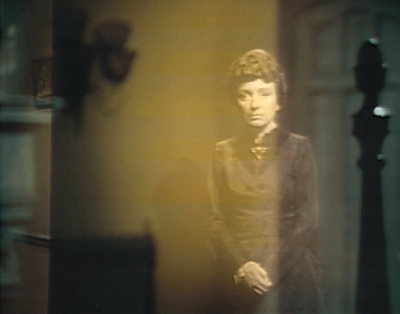
The same ghost appears visibly to Quentin in his room. He recognizes it as that of Tessie Kincaid, a woman he killed in a recent fit of lycanthropy. He knows that she is appearing to him because tonight there will be a full Moon.

Tessie appears to Quentin. Screenshot by Dark Shadows Before I Die.

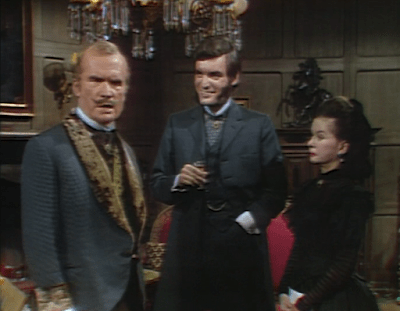
Magda enters and finds Quentin writing a suicide note. She tells him he must not kill himself. She chains him to a post in his room and stands by with a pistol. Trask enters and finds them in this compromising position. Mrs Acilius and I laughed as we imagined how Magda and Quentin might have claimed they were planning to spend the evening.

But there is no point in lying to Trask. Between what Tessie’s ghost told him and what he overheard while eavesdropping on a conversation Quentin and Magda had earlier in the drawing room, he has figured out Quentin’s problem. He takes the gun from Magda and recognizes the bullets with which it is loaded as silver. He announces that he will wait until the Moon rises and see what happens.

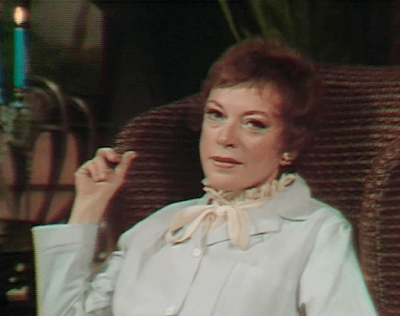
Tessie’s turn today marks Deborah Loomis’ third and final appearance on Dark Shadows. Miss Loomis didn’t get to do very much, but she made the most of all of it, and I wish we had seen more of her.

Episode 789: We are going to create a thing

In #762, the Rev’d Mr Gregory Trask walked in on lawyer Evan Hanley and handsome rake Quentin Collins as they were performing a Satanic rite. Trask’s response was to blackmail Evan. Trask wanted his wife Minerva out of the way so that he could marry rich spinster Judith Collins, Quentin’s sister. Threatened with exposure, Evan cast a spell on an unfortunate young man named Tim Shaw. He brainwashed Tim into reenacting the plot of The Manchurian Candidate, with Trask in the Angela Lansbury role and Evan as the People’s Republic of China. As Evan and Trask planned, Tim killed Minerva. Shortly after, Trask married Judith.

On their wedding day, Judith saw Minerva’s ghost in the corner of the drawing room in the great house of Collinwood. In yesterday’s episode, Minerva’s ghost took possession of Judith, and the closing cliffhanger showed the possessed Judith about to stab Evan with a letter opener to avenge Minerva’s death. As we open today, Judith’s brother Edward enters and prevents the stabbing, and Judith is released from possession. She can remember nothing that happened while she was under Minerva’s power, and Edward is convinced that she has gone mad.

Edward takes Judith to her room, and Trask enters. Evan tells him that Minerva’s ghost has been in touch with Judith. The ghost knows what they did, and if the contact continues Judith will know as well. Trask demands that Evan do something to prevent that, and Evan says that he can cast a spell that may turn the haunting to their advantage and neutralize Judith permanently.

The plan turns out to be the creation of a “black ghost.” The only Black actor to have had a speaking part on Dark Shadows was Beverley Hope Atkinson, who played an unnamed nurse in one scene in #563, almost a year ago. Humbert Allen Astredo, who plays Evan, was also in that scene, playing suave warlock Nicholas Blair. Atkinson was terrific, and it would be great to see her again, but it turns out that the “black ghost” is not actually black. Nor is it a ghost. This misnamed entity is a simulacrum of Minerva, a kind of supernatural hologram that Evan will fabricate and that will appear when Judith is around. This will lead Judith to believe that she is insane, thereby causing her actually to become insane and to cease to be an obstacle to Trask’s enjoyment of her wealth.

The simulacrum first shows up in a transparent form in Judith’s bedroom. Judith screams. In the drawing room, Trask and Edward hear her scream and break off a conversation in which Edward has been urging Trask to agree to annul his marriage to the obviously disturbed Judith. Judith comes downstairs. She is reluctant to explain why she screamed, and tells Edward and Trask that nothing is wrong. She and Trask go to the drawing room and talk privately. He has to prod her a bit before she will admit she saw Minerva. He tells her it was just her imagination. She considers this; after all, she was in bed when she saw the image, so it may have been a dream. But then the simulacrum appears in the drawing room, near the spot where she saw Minerva’s ghost on her wedding day. Judith sees Minerva sitting quietly and sewing. Trask pretends he does not see anything; after a bit, Judith pretends she can’t see the image either. Trask leaves Judith alone with the simulacrum. Judith goes upstairs, and the simulacrum follows her. When they reach the top of the staircase, Judith cries out in fear and tells the simulacrum to stay away from her.

Though it is disappointing to be reminded that Beverley Hope Atkinson isn’t coming back, it is always good to see Clarice Blackburn. In her interviews with the authors of the book Barnabas and Company, Nancy Barrett said that Blackburn was the best performer in the entire cast of Dark Shadows. She doesn’t have a lot to do today- she delivers the opening voiceover, we see a snapshot of her, and as the simulacrum she stands motionless in a corner, sews placidly, then is seen from behind as she follows Judith up the stairs. But if there ever was a case to prove the old cliche that no part is small when a big enough actor plays it, Blackburn makes each of these little turns into a moment viewers will remember.

As Judith, Joan Bennett also deserves a great deal of credit for getting the gaslighting plot off to a good start. For example, there is an embarrassingly ill-written scene when Judith is in her room, pacing back and forth while some vibes play on the soundtrack. A knock comes at the door, and the music stops. Judith opens the door, and no one is there. The music resumes, and she starts pacing again. There is another knock. Again the music stops, again Judith opens the door, and again no one is there. The music resumes, and she’s back to pacing. The knock comes a third time. A third time the music stops, and a third time Judith turns to the door. This time she asks who’s there. It’s Trask. She lets him in, and he denies having knocked before. Knocking on doors and running away is a pretty crude tactic even on a show with an audience consisting largely of kids aged twelve and under, and the apparent complicity of the music in Trask’s plot is the kind of thing they ridiculed in Looney Tunes cartoons. But Bennett’s soulful performance holds our attention throughout.

This is the second time Dark Shadows has shown us an adventurer trying to gaslight his new wife so that she will go away and give him unfettered access to her fortune. The first time was in March 1968, when the show was set in 1796. Naval officer/ sleazy operator Nathan Forbes had married fluttery heiress Millicent Collins. Nathan discovered that Millicent had transferred all her assets to her little brother Daniel. Nathan then set about driving Millicent out of her mind so that he could take her place as Daniel’s legal guardian. That plot also featured some weak writing, but Joel Crothers and Nancy Barrett were so irresistible as Nathan and Millicent that it hardly mattered. Perhaps the writers wanted to revisit the gaslighting theme to show that this time they could consistently write scripts worthy of their outstanding cast.

Episode 775: Call it a vampire or whatever you like

Neurotic intellectual Rachel Drummond is the third character Kathryn Leigh Scott has played on Dark Shadows, and today she joins the other two in becoming the victim of a vampire. In the parts of Dark Shadows set in the 1960s, Miss Scott plays Maggie Evans, The Nicest Girl in Town. Vampire Barnabas Collins took Maggie as his victim in May and June of 1967, and tried to brainwash her into believing she was his lost love Josette. At first Maggie responded to the vampire’s bite with the same addictive behavior it prompted in others, but eventually she shook loose of Barnabas’ power and rebelled against him. She tried to stake Barnabas, and when that failed she escaped from him. It was only because her psychiatrist betrayed her to become Barnabas’ co-conspirator and to hypnotize Maggie into forgetting her experience that she did not expose Barnabas.

When Dark Shadows flashed back to the 1790s to show how Barnabas became a vampire and to suggest that he might still be interesting if he weren’t one, Miss Scott played Josette. After he had brought the vampire curse on himself, Barnabas bit Josette, who like Maggie at first responded blissfully. When Josette realized Barnabas wanted to make her into a vampire as well, she, like Maggie, resolved to escape. Maggie’s escape took her from the prison cell in Barnabas’ basement through a tunnel to the beach below the cliff of Widow’s Hill; Josette’s escape led to very nearly the same spot, but it began, not in the cell, but at the top of the cliff, and it involved her flinging herself to her death on the rocks below.

Early in 1968, Barnabas was freed of the effects of his vampirism, and he set about battling other supernatural menaces. In the course of one such battle, he has come unstuck in time, and taken us with him to the year 1897. In that year, he is once again a vampire. One of his victims was dim-witted servant Dirk Wilkins. Since Barnabas was beginning to attract suspicion, he allowed Dirk to die and rise as a vampire, planning to tip people off to Dirk’s hiding place so that he would be found and destroyed and everyone would attribute all the vampire attacks of the previous few months to him. This plan fell apart immediately, when Barnabas lost track of Dirk as soon as he first rose.

Rachel has stumbled into Dirk’s hiding place. She asks him if he knows what happened to her friend Tim, and he bites her. She shows some signs of a blissful initial reaction to the bite, but still has some questions about Tim. Dirk tells her to forget about Tim and to stay where she is. He returns before dawn to find her waiting. She brings Tim up again, and he ignores her. She helps him close the lid of his coffin, caressing it. Though Rachel is obedient, this does not mean that she is any more under Dirk’s power than Maggie was under Barnabas’ power when she rebelled against him or Josette was when she jumped off Widow’s Hill. Rachel’s personality is something that takes place deep inside her head and prevents her from asserting herself against other people. Even if Dirk were not a vampire, she would probably have been just as compliant.

While Rachel is sitting dutifully in his hiding place, Dirk calls upon Barnabas. He tells Barnabas that he will kill Rachel unless he brings blonde fire witch Laura Murdoch Collins back to life before dawn. Returning viewers know that Barnabas has no idea how to revive Laura. We also know that no one else is going to bring Laura back, because she was running out of story when she vanished in #760 and they already have more characters than they can fully use. Even a fan favorite like Miss Scott is absent from the show for dozens of episodes at a time. So it seems that Rachel is doomed.

Meanwhile, Barnabas has another problem to deal with. His distant cousin, stuffy Edward Collins, has summoned him to the great house of Collinwood. Edward suspects Barnabas of vampirism, and has told him so. Edward’s sister, spinster Judith, has turned up with bite marks on her neck and an oddly subdued affect. Edward brings Barnabas face to face with Judith. When she does not react to him as Edward expects a victim to react to the vampire who bit her, Edward is embarrassed and stumbles through a series of half-expressed apologies. Barnabas declares that he will resume the search for Dirk, and instructs Edward to stay with Judith at all times. He hopes that Judith will lead Edward to Dirk’s lair.

Edward does sit with Judith for a time, but when he hears some noises in the foyer he leaves the room to investigate. He wanders all through the house for a number of minutes, long enough that the recorded background music plays beyond the cues we are used to hearing and gets to some tunes we haven’t heard in months.

While Edward is conducting this journey, Dirk sneaks up behind him on the walkway at the top of the foyer stairs and grabs him by the neck, knocking him out. Dirk then appears in Judith’s room, gives her a gun, and tells her he will have a job for her to do soon. He dematerializes before Edward comes back and finds Judith still in bed.

Later, Edward leaves again to make tea, and when he brings the tray back Judith is gone. In its first months, one of the themes of Dark Shadows was that the Collinses of 1966 were running out of money, so it made sense that they were chronically short of servants. In this period, however, the Collinses are supposed to be at the zenith of their wealth and power. It is simply a flaw in the story that Edward himself has to leave Judith to find out what the noises were in the foyer or to fetch her tea.

The task Dirk set for Judith was to murder Rachel. After dawn, she goes to the hiding place, pulls the gun, and tells Rachel she is sorry for what she must do. In the parts of Dark Shadows set in the 1960s, Joan Bennett plays matriarch Elizabeth Collins Stoddard. In #569 and #570, it looked like Liz might be bitten by vampire Tom Jennings. But the show is firmly committed to a prohibition against involving Liz directly in the plot, so that came to nothing. When Judith presents herself as Rachel’s designated assassin, longtime viewers will be glad to see that Judith is not subject to the same restrictions.

Judith prepares to kill Rachel. Screenshot by Dark Shadows Before I Die.

Episode 714: The available ladies in the house

One day in the year 1897, Edward, Carl, and Quentin Collins hear their sister Judith read their grandmother’s will. Stuffy Edward and childlike Carl are shocked to find that Judith is the sole heir of their family’s vast holdings. Quentin stole the will and tried to forge a new one, so he is not shocked, but he is weirdly gleeful about the paragraph relating to him. He will receive no property and no income, but will be guaranteed a place to live in the great house of Collinwood forever. This enshrines his relationship with Judith as one of the clearest examples of Dark Shadows’ signature dynamic of Bossy Big Sister and Bratty Little Brother. No matter how atrociously Quentin may behave, no matter how loudly Judith may disapprove of him, she has no authority to punish him and her concern for the family’s good name will compel her to cover up his misdeeds and shelter him from their natural consequences.

Edward flummoxed, Quentin delighted, Judith in charge. Screenshot by Dark Shadows Before I Die.

Meanwhile, governess Rachel Drummond and ladies’ maid Beth Chavez are busy with a mystery concerning the room on top of the tower that stands in the middle of the great house. Rachel has seen lights in the room and suspects someone is being held prisoner there; contrary to the direct orders of Judith and Edward, and against Beth’s very strongly worded advice, Rachel is investigating this matter aggressively. She sneaks up the stairs to the top of the tower, listens at the door to the room, and sees Beth coming out of it with a tray.* She then goes to Beth’s room, where she interrupts Quentin sexually harassing Beth. When she tells Beth what she saw in the tower and asks about it, Beth is shocked that Rachel went into the tower. She denies everything.

Later, Rachel goes back to the top of the tower and again listens at the door. She hears a cradle rocking. We saw that cradle in #645, when Dark Shadows was set in contemporary times and Quentin and Beth were ghosts haunting children David Collins and Amy Jennings. They sent Amy and David to fetch the cradle from the attic of the Old House on the estate and to bring it to Quentin’s old room in the west wing of the great house. This is one of the first times in the 1897 segment when we explicitly close a loop opened during the “Haunting of Collinwood” story.

*At the beginning of the episode, we saw Beth approach the room with the tray and a baby doll. During that scene, we hear what I believe is new music. It has been quite some time since we have heard any new cues, so this stands out.

Episode 646: Morbid games children play

The ghost of Quentin Collins has lured children Amy Jennings and David Collins to the room in the long deserted west wing of the great house of Collinwood where his skeleton is hidden. For the first time, Quentin appears. Later, a woman in a white dress will also materialize.

Quentin. Screenshot by Dark Shadows Before I Die.

An old gramophone starts playing a sickly waltz, and David snaps into an odd mental state. He is slow to respond when Amy calls him by name, and tells her she knows that the waltz is his favorite piece of music. She does not know this, and is puzzled to hear it, since he hadn’t heard the waltz until the night before. Soon it becomes apparent that David is coming to be possessed by Quentin. He tells Amy that they have things they must do, including a conversation with “Roger.” Roger is David’s father; this is the first time we have heard him refer to him by name, and it makes it clear to regular viewers that David is not himself. Later, they are wearing clothes of the same period as those Quentin and the woman in the white dress wore, and they decide to address each other as “Quentin” and “Beth.”

Longtime viewers will also recognize the motif of a piece of music as a device with the power to overwrite a character’s personality. In #155, David’s mother, undead fire witch Laura, gave him a music box, apparently as part of her plan to prepare him to follow her to a fiery doom.

Another music box became much more famous a little later. In the summer and fall of 1967, David’s distant cousin Barnabas was a vampire, and he was determined to re-create his lost love, the gracious Josette. His plan involved forcing a young woman to listen to Josette’s music box incessantly. Barnabas hoped that someone who spent enough time listening to the box would forget her old habits and memories and turn into Josette. The music box did seem to have some measure of the power Barnabas had in mind. First Maggie, The Nicest Girl in Town, then Vicki, David’s well-meaning governess, did spend substantial amounts of time listening to the music box with a vacant look on her face. Episode #303 ended with Vicki’s boyfriend Burke listening to the music box and staring off into space; Mrs Acilius wondered if that meant Burke was going to think he was Josette. Burke wouldn’t have looked so good in the dress that comes with the part, but who knows, maybe he and Barnabas would have been happy together.

David and Amy carry a chest out the front door of the great house. Roger and his sister, matriarch Liz, see them do this and ask what is in the chest. David says that it is full of his toys, and that he and Amy want to play with them outdoors. Roger points out that David has never taken a chest full of toys outdoors before, and asks what has led him to do so now. David tells him it is a military secret. Amy explains that one of David’s toy soldiers is broken and they are going to bury him with full military honors. Amused by this idea, Roger holds the front door open and salutes the children as they carry the chest past. In fact, the chest holds, not a toy soldier, but Quentin’s skeleton. It is that which Amy and David bury.

At night, Roger is about to go to sleep when a knock comes on his bedroom door. It is Amy, telling him she heard from sounds from the downstairs that made her suspect someone might be trying to break into the house. Roger takes this concern seriously enough that he retrieves a pistol from his nightstand and carries it as he goes to investigate.

David ties a wire across the second stair from the top of the case from the bedrooms to the foyer, opens the front door, then hides. Roger enters. He is alarmed to see that the front door is open. He stumbles on the trap David has set. He lies unconscious and bleeding at the foot of the stairs. Amy and David enter, see his condition, and nod at each other gravely.

This is the second time David has tried to kill Roger. The first time, in #15, he had sabotaged the brakes on Roger’s car. As he watched the car pull away, he called to his mother. Laura was not physically present, and would not be for another 22 weeks, but when those who watch the show from the beginning learn of her supernatural character they will ask if she influenced David to patricide. Today there is no doubt that David and Amy are doing the bidding of the ghosts, and so we wonder again if David was under Laura’s power when he took the bleeder valve from the wheel cylinder of Roger’s car.

I don’t know how much of a spoiler it is to tell someone reading a Dark Shadows blog that in the spring of 1969 Quentin would become a major breakout star, rivaling Barnabas’ popularity. Quentin would be such a big part of the show’s appeal that Dan Ross would give the last 16 of the 32 original Dark Shadows novels he wrote under his wife Marilyn’s name titles beginning with the words “Barnabas, Quentin, and the.” They were:

  • Barnabas, Quentin, and the Mummy’s Curse, April 1970
  • Barnabas, Quentin, and the Avenging Ghost, May 1970
  • Barnabas, Quentin, and the Nightmare Assassin, June 1970
  • Barnabas, Quentin, and the Crystal Coffin, July 1970
  • Barnabas, Quentin, and the Witch’s Curse, August 1970
  • Barnabas, Quentin, and the Haunted Cave, September 1970
  • Barnabas, Quentin, and the Frightened Bride, October 1970
  • Barnabas, Quentin, and the Scorpio Curse, November 1970
  • Barnabas, Quentin, and the Serpent, December 1970
  • Barnabas, Quentin, and the Magic Potion, January 1971
  • Barnabas, Quentin, and the Body Snatchers, February 1971
  • Barnabas, Quentin, and Dr Jekyll’s Son, April 1971
  • Barnabas, Quentin, and the Grave Robbers, June 1971
  • Barnabas, Quentin, and the Sea Ghost, August 1971
  • Barnabas, Quentin, and the Mad Magician, October 1971
  • Barnabas, Quentin, and the Hidden Tomb, December 1971
  • Barnabas, Quentin, and the Vampire Beauty, March 1972

My first choice is always to title these entries after lines of dialogue from the episodes, and “morbid games children play” was so perfect that I couldn’t pass it up. But Barnabas, Quentin, and the Bleeder Valve was also very tempting, and I do suspect I will use at least a few Barnabas, Quentin, and the titles in the next two and a half years.

Episode 644: Well that was a waste of time

There is some reason to believe that writer Ron Sproat was disaffected from the rest of the production staff at this time. Today’s script is so unbelievably bad that it is tempting to think he wrote it as an act of protest.

Children Amy and David have gone looking for the ghost of Quentin Collins and are now trapped in a room in the long deserted west wing of the great house of Collinwood. David’s father Roger, his aunt Liz, and his cousin Carolyn are moving about the house in a conga line trying to find them.

Quentin’s ghost is keeping the children locked up; the ghost of someone named Magda is trying to lead the adults to rescue them. At one point the adults watch a mirror while letters appear on it spelling out “Jamison,” the name of Liz and Roger’s father. This is plainly a supernatural manifestation, but it advances neither Magda’s goal nor Quentin’s. Perhaps Jamison’s ghost can’t rest with all the racket Quentin and Magda are making, and he just wants to say hello.

Hi, kids, it’s grandpa! Screenshot by Dark Shadows Before I Die.

In the locked room, David bangs on a wall, finds it is hollow, and speculates about what is on the other side. Amy protests “We can’t go through a wall!” In response, he again bangs on the wall, again finds it hollow, again speculates about what’s on the other side, and Amy again protests “We can’t go through a wall!” Later in the episode, they start this scene a third time, but they stop before Amy has another chance to say “We can’t go through a wall!” It’s just as well she does stop short of saying this a third time. By the end of the episode, they’ve found a crowbar, which enables them to pry the paneling open and go through the wall quite easily.

Meanwhile, the adults have progressed to the drawing room, where they argue about whether to search the west wing. They troop upstairs and find the door to that part of the house locked. This leads them to conclude that David and Amy can’t have gone in there, and the parade goes back to the drawing room. There, they again argue about whether to search the west wing. They again troop upstairs, this time unlocking the door and conducting the search. After they fail to find the children, they return to the drawing room again, where Roger speaks for all of us when he says “Well, that was a waste of time.”

When the adults were shuffling around huddled in their little clump, I found it hard not to look at Liz’ face and see Joan Bennett thinking that she used to be a big movie star and now she’s reduced to this stage business that would have embarrassed the Three Stooges. This week’s episodes were directed by a mysterious figure billed as “Penberry Jones”; whoever Jones was, I don’t think s/he was to blame for the weird little parade the adult characters keep making through the house. The script calls for the actors to talk with each other constantly while walking together through narrow, awkward spaces such as stairways, darkened corridors, and a cluttered store-room, and so it would have taken more time than they had to choreograph a more fluid set of movements.

David and Amy hear a waltz. It has a creaky sound to it, as though it were being played on an old gramophone. This is introduced as a special effect. Unfortunately, Dark Shadows introduces special effects by ramping up the background music, so when the children first talk about the waltz we can barely hear it. After a commercial break, the background music calms down and the waltz is more audible. We will hear it a great many times over the next several months, so often that it will be ironic to think that there was a time when we wanted to hear it but could not. I suppose Penberry Jones probably did have the discretion to tone down the accompaniment, so that would be one strike against him or her.

Longtime viewers will notice a small deviation from continuity when David tells Amy that ghosts come out only at night. In the first year of the show, David often saw the ghost of the gracious Josette in the Old House of Collinwood during the day, and from June to November 1967 he and the ghost of nine year old Sarah played together in the sunlight several times.

Episode 565: I keep hearing the sea

One mad scientist built a Frankenstein’s monster, and another brought it to life. The builder, Eric Lang, had forced a man to dig up freshly buried corpses he used as materials. That man, an unpleasant fellow named Peter who prefers to be called Jeff, left Lang’s employ after he awoke on a surgical table and found Lang trying to cut his head off. Shortly after that, Lang died, and his colleague Julia Hoffman completed the experiment.

Lang and Julia’s creation is known as Adam. Adam is under the mistaken impression that Julia’s friend, recovering vampire Barnabas Collins, was his maker. He is now threatening to kill all the Collinses unless Barnabas and Julia provide him with a mate. They are complying. They have collected Lang’s journals, and are keeping a cadaver and some equipment in Barnabas’ basement.

Well-meaning governess Vicki is engaged to marry Peter/ Jeff. Barnabas is fond of Vicki, and Adam’s original threat was to kill her. He kidnapped her and held her prisoner for a couple of days; it was when he released her that he extended his threat to the whole family. When he was holding her, Adam gave Vicki’s engagement ring to Barnabas as proof of his seriousness. Now Barnabas has told Vicki that her ring turned up outside his house, and she drops by to pick it up.

Barnabas is alarmed that Vicki came to the house after dark. He knows not only that Adam is still at large, but also that a vampire named Tom Jennings is on the prowl. Vicki doesn’t remember her time as Adam’s prisoner and knows nothing about Tom, but she has heard enough about strange goings-on that she appreciates Barnabas’ concern. She assures Barnabas that she didn’t walk through the woods, and she isn’t alone. Peter/ Jeff is just outside, waiting in her car. Barnabas tells her he’s sorry Peter/ Jeff didn’t come in with her. As he says this, he looks at the door, giving the impression that he is sincere. Earlier, Peter/ Jeff had told Vicki that he was jealous of Barnabas; this scene makes it clear that he has nothing to worry about on that score. Regular viewers know that Julia has a crush on Barnabas; his behavior towards Vicki, whom he sometimes claims to love and want to marry, leaves her looking blissful.

Vicki notices that Julia is carrying one of Lang’s journals; Barnabas tells her that he and Julia are thinking of writing a book about Lang. Vicki knows only that Lang was a doctor who was a friend of theirs, so she accepts this explanation easily. When she goes, Barnabas insists on accompanying her to the car.

Barnabas returns, and tells Julia that he and his servant Willie Loomis will go out and try to find Tom before he bites someone. He speaks tenderly to her; she smiles.

Julia, content with the state of her relationship with Barnabas. Screenshot by Dark Shadows Before I Die.

Julia goes to the basement to close down the experiment for the night. She is still in a blissful mood as she listens to the radio playing the Jackie Gleason Orchestra’s truly appalling version of George Gershwin’s “Love is Here to Stay.” Since they have a stolen corpse in the basement and incriminating documents scattered throughout the house, the front door is of course unlocked. Peter/ Jeff lets himself in and is shocked to find Lang’s journal on the desk in the front parlor.

Julia comes upstairs and finds Peter/ Jeff. He explains that he wanted to see Barnabas and asks why they have Lang’s journal. Julia repeats the story Barnabas told Vicki. Peter/ Jeff laughs at the idea that Barnabas and Julia would write a book about Lang’s attempt to build a man from stolen body parts; Julia says it won’t be about that part of his life. Peter/ Jeff is still laughing when he leaves the house.

It’s odd Julia sticks with Barnabas’ story. A few days ago, Peter/ Jeff confronted Barnabas and Julia with his suspicion that Adam is Lang’s creation. Had she said they were disturbed by his suggestion and were checking Lang’s records to make sure there was no way he could be right, he wouldn’t be in a position to contradict her. He certainly wouldn’t be bothered that they lied to Vicki to cover up what they know about Lang’s experiment, since he is at one with them in his desperation to keep her from ever finding out what he did. Later, we see her writing a note to Barnabas explaining that Peter/ Jeff had not believed “my- really, your- story.” Perhaps she is embarrassed that she did not live up to her usual standards as Dark Shadows’ most fluent and most plausible liar.

Julia heads back to the basement, and we see a figure peering in the window. It is Tom. Coming on the heels of her failure to deceive Peter/ Jeff, this leaves us with no doubt that Julia’s happy night will soon give way to misery.

Bad news for Julia. Screenshot by Dark Shadows Before I Die.

While Julia is writing her note for Barnabas, Tom appears in the basement. Julia sees him, realizes who he is, and screams as he bares his fangs and approaches the camera.

Dead eyes, sharp fangs. Screenshot by Dark Shadows Before I Die.

This ending comes as an anticlimax. The sight of Tom at the window was enough to let us know what Julia was in for; there was no real need to continue the episode beyond it. Moreover, the scene is poorly executed. When Tom walks toward the camera, he twice stops himself awkwardly because he’s running out of set. He also stops in the middle of opening his mouth, apparently realizing he has started that move too soon. Julia’s scream doesn’t help, either. Grayson Hall was a brilliant actress, the heart of the show, but she was terrible at screaming. This is actually one of her better attempts, but coupled with Don Briscoe’s stumbling it still brings a bad laugh.

Episode 563: A kind of magician

Beverly Hope Atkinson

This episode features the first appearance on Dark Shadows by an actor of color, and the only speaking part any non-White performer ever had. (CORRECTION: Mr Nakamura, played by Sho Onodera in #903, has a couple of lines.) This fact is made even more depressing because that performer fits so perfectly into the show that a first time viewer would assume she had been a major player from episode #1.

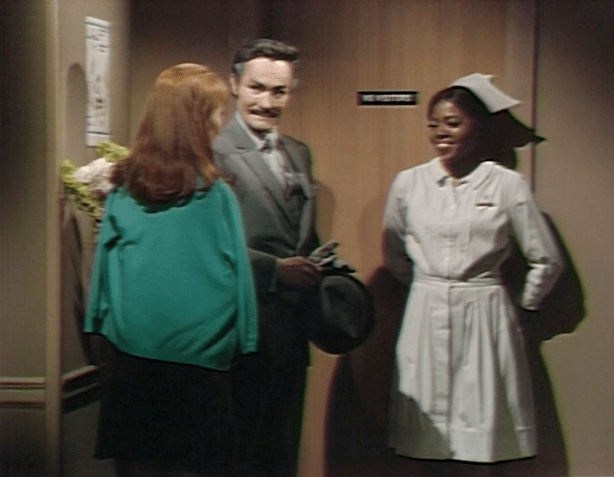
Beverly Hope Atkinson plays an unnamed nurse who meets suave warlock Nicholas Blair when he is trying to make his way into a hospital room occupied by Tom Jennings, a victim of one of Nicholas’ evil schemes. She firmly refuses him admittance. When Maggie Evans, The Nicest Girl in Town, enters and asks to see Tom, the unnamed nurse smiles brightly and says “Of course, Maggie!” in a tone that makes it sound like they’ve been friends all their lives. She then shuts the door before Nicholas can follow. He asks her why Maggie can go in and he cannot, and she tells him sternly that Maggie has permission from the doctor.

Unnamed nurse is happy to see Maggie. Screenshot by Dark Shadows Before I Die.

I have a fanfic idea about Atkinson’s nurse that I originally posted as a comment on Danny Horn’s Dark Shadows Every Day. I can’t find it there, but here is a copy of it:

In the first 42 weeks of the show, when the supernatural was in the background and the stories were slow, it would have been easy to have a couple of tea party scenes at the Evans cottage where Maggie and her lifelong friend, Unnamed Nurse, recap whatever is going on. Those scenes could have led to a whole exploration of the tension between the working-class people in the village and the jerks in the big house on the hill. That in turn could have led to the introduction of Unnamed Nurse’s family, headed by Unnamed’s parents, Mr and Mrs Nurse, including her brothers, Young Mr Nurse and Master Nurse, and her sister, Moody Miss Nurse. We could then have seen the ancestors of the Nurse family in each of the flashback segments and analogues of them in Parallel Time.

At some point in my musings about this idea, I decided the family should be named “Wilson” (if I had a reason for this, I’ve forgotten it, but I now think of Atkinson’s character as Nurse Wilson,) and that in a flashback segment we should learn that they are descended from free persons of color who settled in Collinsport before the Civil War and were the first proprietors of the Collinsport Inn. Some wicked deed by a member of the Collins family knocked them out of the entrepreneurial class long ago, and they’ve been working their way back up the socio-economic ladder ever since.

We met Maggie in #1 as the waitress at the diner in the Collinsport Inn. She, her late father Sam, and her fiancé, hardworking young fisherman Joe Haskell, have been Dark Shadows‘ main representatives of the people in the village. Her house, the modest counterpoint to the mansions on the Collins family’s great estate, has been familiar to us from the beginning, and is the place where we have seen most vividly what the Collinses’ doings have meant for the people who work for their businesses and live in their town. So, as a frequent visitor there, the nurse could have given a whole new dimension to the drama, showing that it isn’t just one family whose lives hang in the balance, but that a whole community is exposed to the consequences of what happens on the hill.

The Blue Whale

Joe is sitting alone at a table in the Blue Whale tavern, and he looks terrible. He’s pale and fidgety, looking around and periodically jumping up to peek out the window.

Maggie comes in and joins Joe. At first she is angry with him- he stood her up last night, without so much as a telephone call. She sees how upset he is and her anger is mixed with worry. He pounds on the table while the camera is tight on her. Her startled reaction reminds us of the early months of the show, when Sam was a self-pitying drunk and Maggie was a sophisticated portrait of an Adult Child of an Alcoholic.

Maggie startled. Screenshot by Dark Shadows Before I Die.

After that moment, Maggie gets very quiet. When Joe says with alarm that it is getting dark, she responds that “It usually does, at this time of day.” It’s inherently funny to hear someone make that kind of matter-of-fact statement in response to an inexplicably intense remark, but also poignant to those of us who remember Maggie’s early interactions with Sam. From childhood on, simple rationality must have seemed to Maggie like a joke in the face of the overpowering irrationality at the center of her life.

As it happens, Joe is indeed exhibiting addicted behavior. But he isn’t hooked on alcohol. Instead, he is under the power of a vampire. Angelique, who was once the wicked witch who first made Barnabas Collins a vampire, found herself reduced to bloodsucker status when she displeased Nicholas. At Nicholas’ direction, she bit Joe the other day, and now Joe is desperate to hear her summons and report for another bite. She does call, and he does dash out, leaving a bewildered Maggie behind.

It was at the Blue Whale that we first met Joe, back in #3. Then, he was an upstanding young man who indignantly rejected the attempts of one of the Collins family’s sworn enemies to bribe him into spying against them. We’ve seen him in the tavern many times since then, always as the doughty representative of the wholesome and intelligible world against the sinister and supernatural. For example, in #215 it was a deeply troubled Joe who brought the news to Maggie and others at the Blue Whale that the cows on his uncle’s farm had been somehow drained of blood, news which turned out to be the first sign of vampirism in the area. This is the first time we’ve seen the Blue Whale since #358, back in November, and the first time a scene has closed with the formerly very familiar Blue Whale jukebox dance tunes in even longer than that. Longtime viewers see a loop closing. Joe leaves the place where he has most often shown himself as one who dwells in the daylight and goes down to the deepest dark.

Once Joe is gone, Nicholas enters. He engages Maggie in conversation, and talks his way into the seat Joe vacated. Soon he is doing magic tricks for her and she is agreeing to have dinner with him. He brings up the idea of staying out all night, and she seems amenable. Where is her old friend the nurse when you need her?

The Fix

Joe lets himself into Nicholas’ house, a place by the sea that he is renting from the Collinses. Angelique is there. Joe laments his dependency on her, and asks if she was the one who attacked Tom, whom he identifies as his cousin. Perhaps the son of the uncle whose cows fell victim to Barnabas long ago! She doesn’t bother to deny it. She tells him that they will both visit Tom tonight. She bites Joe.

Joe visits Tom, who has emerged from the coma in which Angelique’s first bite left him. He tells Joe all about Angelique’s attack on him. He says he knows how bizarre the story sounds, but that he hopes that if he has Joe to vouch for him he will be able to make the police take it seriously. Joe gives Tom a few perfunctory assurances, then opens the window. Joe explains that he is doing this because it is hot in the room. Tom does not agree that it is hot, but Joe insists, and Tom is too ill to argue long.

Joe leaves, and we jump forward to 2 AM. The window is still open- apparently no nurse was on duty. Perhaps the hospital thought Beverly Hope Atkinson’s character did such a good job on the day shift that the patients could just cruise along through the night. We hear a bat squeaking, and Angelique appears. She bites Tom.

In Barnabas’ first weeks on Dark Shadows, the show made heavy use of the idea that vampires can enter a lodging only when they have been invited. For example, he went to the diner after hours so that Maggie would have to invite him in, and later went to her house and stood just outside the front door for a noticeably long time before she explicitly asked him to enter. They haven’t done anything with that idea in a long time, but neither have they very clearly contradicted it. Perhaps Joe’s opening of the window is the invitation Angelique needs to make her way into the hospital.

Episode 546: A woman, born on Martinique in 1774

Suave warlock Nicholas has expressly forbidden his subordinate, the wicked witch known variously as Angelique and Cassandra, from killing Frankenstein’s monster Adam. But now he has twice caught her trying to do just that. He punishes her by stripping her of her powers. He tells her that she is now a human being, and that she will die soon.

Nicholas de-witches Angelique/ Cassandra, while also trying to hold her wig in place. Screenshot by Dark Shadows Before I Die.

Angelique/ Cassandra’s husband, sarcastic dandy Roger, comes downstairs and confronts her about her indifference to him. She responds that there never was anything between them and never will be, and rushes out of the house. My wife, Mrs Acilius, is a soap opera fan from way back, and she says that as far as she is concerned this archetypal soap moment makes for a “Genuinely Good Episode.”

Angelique/ Cassandra goes to see recovering vampire Barnabas. He opens the door and asks what she wants. She says that she was once the mistress of the house and that as such she has a right to enter.

Ever since she showed up in the year 1968, Angelique/ Cassandra has been trying Barnabas’ patience and the audience’s by pretending that she was not the witch he married in the 1790s. He asks her why she has dropped that pretense now, and she says that she, like he, has become human. She also says that she will die at dawn. It is unclear why she thinks this- all Nicholas told her was that her life expectancy was to be measured in “minutes.” She declares her intention to kill Barnabas, and is pointing a gun at him when the episode ends.

If it does not lead to her immediate demise, depriving Angelique/ Cassandra of her powers would be an intriguing way of making her a more flexible character. In the costume drama segment set in the late eighteenth century, she was so powerful that she painted herself into a corner, facing no real opposition. The only suspense she could generate came when she was indecisive or distracted and got in her own way. In 1968, her subordination to Nicholas has pushed her to the opposite extreme. She has been very busy, but hasn’t done much. If she survives without her powers, it might be interesting to see her learn how to live as a human after all this time.

Angelique/ Cassandra’s appearance reflects the end of her dual identity perhaps more clearly than was intended. When she answered to the name Angelique in the 1790s, she had blonde hair; when she turned up in 1968 calling herself Cassandra, she wore a black wig. Throughout this episode, the wig keeps sliding around on her head.

This episode includes another of the innumerable replays of an audiotape message about Barnabas and Adam. The other day, it seemed that Nicholas and Cassandra had taped over the message, as undead fire witch Laura Murdoch Collins taped over a recording she didn’t want parapsychologist Peter Guthrie to hear in #172. But Friday they played it for us yet again. When Nicholas threatens Angelique/ Cassandra with death if she keeps disobeying him, Mrs Acilius said to the screen “I’ll kill you myself if you play that tape again!” I am glad to report that this is the last time we will hear the thing.

Danny Horn’s Dark Shadows Every Day post about this episode juxtaposes screenshots and dialogue from the scene in which Nicholas strips Angelique/ Cassandra of her powers with screenshots and dialogue from a contemporary episode of General Hospital. The contrast is hilarious. It also shows why even the conventionally soapy scenes with Roger and Barnabas stand out from the other daytime dramas of the period. Director Lela Swift’s use of the camera was incomparably more dynamic and ambitious than anything General Hospital was doing, Robert Cobert’s original orchestral score is comprehensible to a modern audience in a way that an organ playing in the background would never be, and the action is paced so that it takes less time for Angelique/ Cassandra to lose her supernatural powers, end her marriage to Roger, and pull a gun on Barnabas than it took Lucille to explain to Audrey that she had an idea about how she could learn to play bridge.

Episode 531: A blazing light

Yesterday, recovering vampire Barnabas opened the door to his closet. Hardworking young fisherman Joe fell out, and Barnabas saw Frankenstein’s monster Adam at the window, laughing menacingly. Adam has many reasons to hate Barnabas, and Barnabas concludes that Adam wants to frame him for the murder of Joe.

A commenter on John and Christine Scoleri’s Dark Shadows Before I Die, posting under the name “Grant,” pointed out that in Mary Wollstonecraft Shelley’s novel Frankenstein the Creature kills someone and frames one of Frankenstein’s closest friends for the crime. The reference seems to be pretty obvious.

Barnabas’ friend, mad scientist Julia, shows up. She finds that Joe is not dead. She says that he has, in a bit of Collinsport English we have heard once or twice before, “a pulsebeat.” She and Barnabas have a long conversation about a variety of topics, several of them highly incriminating, while Joe lies on the floor. Julia goes off to attend to another matter, and Barnabas’ servant Willie comes. Joe is still on the floor while Willie argues against Barnabas’ orders to take Joe to the hospital. Barnabas, who had told Julia that Adam must have “wanted Joe to be found here,” dismisses Willie as “absurd” when he says that Adam is trying to frame them.

When Willie was first on the show, he was a dangerously unstable ruffian who was determined to rape all the young women and beat up their boyfriends. In #210, he accidentally released Barnabas, who enslaved him and turned him into a nice guy. Now that Barnabas’ vampirism has gone into remission, Willie has taken several steps back to his old ways. He whines that if Joe dies, his fiancée Maggie might turn to him. Barnabas finds this idea “insane,” and Willie tells him that Maggie has recently stopped by the house and talked to him more than once. This is true, and Barnabas’ reaction makes it clear that it is the first time he has heard it. He responds that he is not interested in discussing Willie’s “mental aberrations,” and tells him that if Joe dies he will tell the police about Willie’s interest in Maggie. That leaves Willie no choice but to help get Joe to the hospital.

Julia has gone off to see well-meaning governess Vicki. Vicki is about to have a nightmare that is part of the “Dream Curse.” Three months ago, wicked witch Angelique decreed that one person after another would have the same dream. After Vicki has it, the dream will pass to Barnabas, and Angelique means for it to reactivate his vampirism. Vicki doesn’t seem to know that Barnabas was a vampire, though she has had many clues, as for example when he kept biting her and sucking her blood. I suppose she just thought he had a really aggressive make-out technique. But she does know that Barnabas is supposed to die if he has the dream.

Julia urges Vicki to come with her to Windcliff, a sanitarium she runs, and promises that she will get the best of care there. But she finds that Vicki is resigned to having the dream. Julia reports this to Barnabas, and tells him that she wants to go away with him, far away from Vicki. Vicki can’t pass the dream to Barnabas unless she describes it to him after she has it, and she won’t be able to do that if she can’t find him. Barnabas refuses to go, reminding Julia that those who have the dream suffer terribly until they pass it on to the next person. When he says “You know how I feel about Vicki,” Julia gets a brief closeup, and her reaction reminds us that she is supposed to be harboring an unrequited love for Barnabas. This is rather an easy point to forget. Barnabas and Julia spend all their time together and tell each other all their secrets. Since there doesn’t seem to be any such thing as sexual contact in the world of Dark Shadows, it’s hard to see how her feelings could be much more requited.

Julia urges Barnabas to run away with her.
“You know how I feel about Vicki.”

Vampires are metaphors for extreme selfishness, and Barnabas usually plays to type. It is startling that he tells Julia that any part of his motivation for sticking around is his wish to spare Vicki suffering. But he also talks about his long vain struggle against Angelique in terms that immediately make it clear that whatever goodwill he might have for Vicki is a distant third behind his usual ruling passions, self-pity and laziness, but still, her well-being is among his considerations. That sets him apart from her ostensible boyfriend, a man variously known as Peter and Jeff. As Christine Scoleri points out on Dark Shadows Before I Die, Vicki might never have had the dream at all if Peter/ Jeff hadn’t refused to listen to her explanation of the curse and insisted that she stay where he could visit her easily, yet now that she is suffering from the dream and its effects he is nowhere to be seen. Christine speaks for all of us with her summary of Peter/ Jeff’s character- “What a louse!”

Vicki has the dream. Barnabas beckons her into the haunted house attraction where the bulk of it has always taken place before. She keeps telling him that she doesn’t want to have the dream, not for her sake, but for his. She opens three doors that show Halloween gimmicks we’ve seen before, then opens a fourth behind which she sees the Sun. The Sun shrinks into the distance, and she walks through the door, following it. Her face dissolves into an image of the Sun; the Sun dissolves to the exterior of Barnabas’ house. We cut to the interior, looking at the doors. A small dot of Sun appears there. It expands until it fills most of the screen. The doors open, and the Sun gives way to Vicki. She enters, and sees Barnabas lying on the floor by his desk. He is bleeding from two small wounds on his neck.

Part of the dream is a bit of doggerel that has never made much sense. The last lines are “Ahead a blazing light does burn, And one door leads to the point of return.” These lines are almost explained today. Each door exposes a symbol of something that is frightening either to the dreamer or to Barnabas or to both. Vicki isn’t afraid of the Sun, but she knows that Barnabas has a strange and intense relationship with it. In #277, he harangued her about his hatred for the Sun; in #347, he made plans with her to watch the Sun rise, plans which he had to break under very strange circumstances in #349. So now we know that the “blazing light” is the Sun, which vampires cannot withstand.

Of the ten characters who had the dream before Vicki, only strange and troubled boy David, her charge and dear friend, was able to walk through any of the doorways. In his case, he walked into a gigantic spider web and was caught there, just a few feet beyond the entry. But Vicki is on the path that “leads to the point of return,” and she goes to a different set altogether.

Had Barnabas’ introduction not brought a new audience to the show, Dark Shadows would probably have been canceled in June 1967. In that case, the final episode would have been #260, and it surely would have ended with Vicki, who was in those days the show’s main character, driving a stake through Barnabas’ heart. That she and the Sun overlap in the same space on the screen suggests that by passing the dream to Barnabas she will fulfill her original destiny and become his destroyer.

When Vicki looks into the parlor and sees Barnabas bloodied and lying on the floor by his desk, we are reminded of #405. In that episode, we saw that Angelique originally turned Barnabas into a vampire by sending a bat to bite him in this room. At that time, he fell, not by his desk, but by the staircase. That’s very close to where Joe was lying for the first half of the episode, so they have to do some rearranging to avoid suggesting an identity between them. Barnabas’ vampirism is so much the foundation of the show’s success that virtually everyone in the audience expects him to relapse sooner or later, but they are being careful not to raise the question of whether Joe will also join the ranks of the undead.

Until the dream, the episode is made up of long scenes with a great deal of dialogue. That isn’t unusual for Dark Shadows. It is unusual that the scenes play out with very little background music. I wonder if director Jack Sullivan decided that a spare sound design would set the right mood for the very ambitious dream sequence. I think it paid off- the dialogue scenes felt slow, but Vicki’s dream achieves the surrealistic quality it needs.

One of the main themes Danny Horn developed on his blog Dark Shadows Every Day was his ridiculously exaggerated impatience with the character of Vicki and his severe bias against Alexandra Moltke Isles’ acting. That gave me something to talk about in his comments section, and was part of the reason I started this blog. Danny’s post about this episode very nearly makes up for his incessant Vickiphobia. He alternates stills of Vicki with epigrams written in her voice, and the result is just magnificent, worth anyone’s while to read.