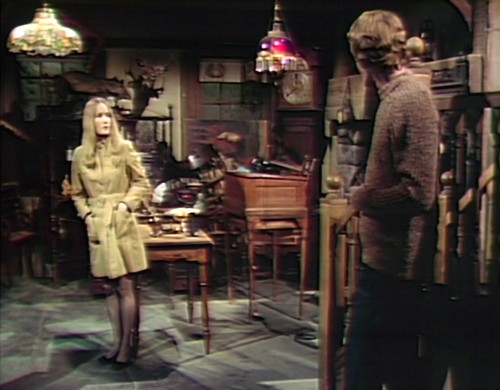
Wicked witch Angelique made her first appearance in #368/369, set in the year 1795. We first saw Angelique when she entered the doors of the Old House on the estate of Collinwood, working as a lady’s maid and hiding her powers.
Today, it is 1970 and Angelique is back in the Old House. Her ex-husband, vampire Barnabas Collins, has summoned her and asked her to lift a curse she placed on Jabe, the husband of his distant cousin Carolyn. Barnabas tells Angelique that her quarrel was never with Jabe, but with suave warlock Nicholas Blair. Earlier in the episode we had seen Angelique and Nicholas having a discussion about how much they hate each other. He taunted her by claiming she has not changed in the last 200 years. When Barnabas invites Angelique to redirect her wrath towards Nicholas, she perks up. She orders Barnabas to fetch Carolyn’s husband and leave him alone in the Old House with her.
Angelique sits by the fire with Jabe and explains that she cannot simply liquidate the curse. It must end with someone’s death. But the good news is that it does not have to be his death. He can transfer it to someone else. He says he doesn’t want to kill anyone. She tells him that the person she has in mind is Nicholas. Suddenly he’s all ears as she explains the process for handing the curse over.
Angelique finds the limit of Jabe’s newfound reverence for life. Screenshot by Dark Shadows Before I Die.
Longtime viewers know that Nicholas was quite wrong to say Angelique has never changed. She was monomaniacal and utterly narcissistic in 1795. She wasn’t so very different when we next saw her in 1968, though the show’s pace was a bit slower at that point and so Lara Parker was free to play her with more nuance. That made a difference that the show underlined early in 1969, when Barnabas took a brief trip back in time to the 1790s and ran into Angelique as she was when first we knew her. Even though they were still enemies in 1968, they occasionally had to tell each other the truth, and occasionally had to leave each other alone to fight other adversaries. The unbending hostility the eighteenth century version of Angelique showed Barnabas startled him and us after we had seen the relatively circumspect approach she took to conducting a cold war against him.
Throughout most of 1969, Dark Shadows was set in 1897. Angelique showed up then, and she remembered the events of 1968. Barnabas and his friend, mad scientist Julia Hoffman, were there as time travelers. Julia actually befriended Angelique, and Angelique became Barnabas’ ally in the battles he attempted to wage in that period. Angelique even let go of her erotic obsession with Barnabas, transferring her affections to his distant cousin Quentin Collins.
After the show came back to contemporary dress, Julia stumbled upon Angelique. She found that Angelique had sworn not to use her powers, had married a man who made her happy, and had lost all interest in Barnabas or anyone else at Collinwood. She was as relaxed and attentive to others as in 1795 she had been frantic and self-absorbed. Only after it turned out the same supernatural enemies Barnabas and Julia were fighting had corrupted her husband did Angelique start casting spells again, and then in pursuit of more rational, identifiable goals than she had ever sought in the eighteenth century.
That arc of character development ends with this episode. We will see Lara Parker as several more characters up to and beyond the end of the series, some of them named Angelique, but none of whom went through the transformations we have seen.
Today also marks the final appearances of werewolf Chris Jennings and his girlfriend Sabrina Stuart. Evidently the makers of the show planned to bring them back in a few months, after an upcoming story plays out, but by that time actor Don Briscoe was unable to work. He had bipolar personality disorder and tried to self-medicate with street drugs.
Quentin was such a big hit in 1897 that they had a magic spell put on him that immunized him against aging and brought him intact to the contemporary setting. Today, Barnabas takes Quentin to a room in the long disused east wing of Collinwood where you can occasionally catch glimpses of an alternate universe. The effect manifests while they are looking in, then winks out, leaving the dark, bare room that is in that space in their universe. Once that happens, Barnabas announces “You have just seen Parallel Time.” Those of us who have been watching from the beginning know that he got the line wrong. You’re supposed to say “Parallel Time is a Dan Curtis Production.”
Heiress Carolyn Collins Stoddard and her new husband, who answers to the name of Jeb Hawkes even though when he first appeared he wanted to be called Jabe, have given up on their honeymoon. Jabe is being plagued by a magical shadow that follows him about, as does the shadow that plagues the protagonist of George MacDonald’s 1858 novel Phantastes. Jabe woke up in the bed he and Carolyn were sharing on their wedding night, saw the shadow, and insisted they flee the hotel at once. Since then, they have fled many hotels, and Jabe has kept refusing to explain why. Only after Jabe has ordered Carolyn out of his place in the carriage house on the estate of Collinwood and told her he doesn’t want her anymore does she see the shadow and find out what is going on.
The wedding night scene was the first time we saw two people in bed together on Dark Shadows. Jabe’s shirtlessness, another novelty, emphasized that he and Carolyn had had sex. For its first years, Dark Shadows was as chaste as any daytime soap of the 1960s; there were long stretches when you could not prove that sex even existed in its universe. But it’s the 1970s now, and Carolyn wants more than one experience of connubial intercourse.
Carolyn is determined to help Jabe fight the shadow. He won’t tell her where it came from. She suggests a series of people who might be possible allies in their battle; he responds to each name with a demand that she forget the person. She grows frustrated. She says she will try to enlist the aid of suave warlock Nicholas Blair. Jabe can block this only by going off himself to meet with Nicholas’ henchman Bruno and plead for help against the shadow.
As Jabe is leaving, governess Maggie Evans enters. Maggie brightly asks Carolyn how married life is treating her. When she does not get the usual enthusiastic response, she repeats the question in an uncertain tone. When Carolyn dodges that, Maggie changes the subject. It emerges that Maggie has a dinner date with old world gentleman Barnabas Collins. Carolyn responds, “Oh, maybe someday, you and Barnabas…”
They’ve made something recently of a budding romance between Maggie and Barnabas. As Jabe is keeping terrible secrets from Carolyn, so Barnabas is keeping a terrible secret from Maggie. All of Jabe’s secrets stem from a storyline that never took off, that is now extinct, and that we didn’t particularly want to hear about even when it was going on, so we can sympathize with his reluctance to bring it back up.
But Barnabas’ secret presents immediate practical difficulties. He is a vampire. Where are they going to go for dinner? If they go to a restaurant where the cuisine might appeal to Maggie, there won’t be anything for Barnabas. If they go to the docks and he drinks the blood of a sex worker, there won’t be anything on the menu for her. Also, the most famous storyline on the whole series, the one that first made it a hit, was in May and June of 1967, when Barnabas fed on Maggie, imprisoned her, and tortured her in hopes of erasing her personality and replacing it with that of his lost love Josette. The memory of that has repeatedly been wiped from Maggie’s mind, but even viewers who joined the show long after it ended are aware of it. In fact, right now they are gearing up to take most of the principal cast to Tarrytown, New York to film a feature film adaptation of that story. The sight of Maggie falling in love with Barnabas would therefore be at least a little queasy-making for much of the audience.
Carolyn and Jabe, Barnabas and Maggie, are only two of the troubled couples in this springtime episode. Sabrina Stuart wants to marry werewolf Chris Jennings. She talks with Chris’ great-grandfather, Quentin Collins. There is a strong family resemblance between great-grandfather and great-grandson, in that they are both twenty nine years old. Apparently, at least- Quentin is in fact a centenarian, but the magic spells that put his own lycanthropy in remission also immunized him against aging.
Sabrina says that there is no hope for Chris as long as Bruno is hanging around. Bruno knows that Chris is a werewolf, and has evil plans for him. She tells Quentin that she wants to offer Bruno money to go away and forget about Chris. Quentin doubts this will work, but agrees to go with Sabrina. He promises to come back in an hour. Of course, we know that if he were actually going to go with her he wouldn’t go away in the interim. We probably wouldn’t even have this planning scene, we would find them already on their way to Bruno’s. So the suspense is about what will happen to prevent Quentin meeting Sabrina at the appointed time.
We cut to Bruno’s place. Jabe is there, telling Bruno he needs Nicholas’ help. Bruno ridicules Jabe, saying that Nicholas has no interest in helping him. He also tells him that it wouldn’t matter if someone did help him- he’s going to die soon anyway. When the storyline in which he was introduced ended, he lost the power that enabled him to live. Jabe insists that he can will himself to stay alive. The longer he stays with Bruno, the more opportunities Bruno has to be nasty to him. Bruno says that Carolyn will soon be a young widow, and that she will “need a lot of consoling.” Bruno is in the same amorous mood as everyone else in the episode, and he speculates that he himself might give her some of that consoling. This angers Jabe further.
Quentin makes it all the way to Sabrina’s door when a trident appears on his hand. Returning viewers know that this is the sign of a spell that was cast on him and Maggie, causing them to have an intense passion for one another at irregular intervals. He turns away from Sabrina’s door and goes to call on Maggie. We see the two of them on the terrace at Collinwood. The terrace is often a place for smooching, but it is usually rather stagey, decorous smooching. This is a real make-out session.
Quentin and Maggie getting busy (pronounced “bizz-ay.”)
Sabrina gives up on Quentin an hour after he was supposed to come to her apartment and goes to Bruno’s alone. When Bruno tells her that the money won’t persuade him to forget about Chris, she draws a pistol and announces that she is going to kill him. We cut to the credits.
Again, we know that if Sabrina were really going to shoot Bruno, she wouldn’t have said anything- she would just have taken the gun from her purse and opened fire. My wife, Mrs Acilius, pointed out that the suspense this generates is not whether she will make good her threat, but what will happen to prevent her doing so.
Yesterday, Barnabas Collins went to the long-disused east wing of the great house of Collinwood to search for the coffin that vampire Megan Todd occupies during the day. Barnabas is himself the vampire who ended Megan’s human life, passing his curse along to her. When his friend, mad scientist Julia Hoffman, makes a characteristic remark and tells him “you must not feel personally about Megan Todd,” Barnabas asks “How can I feel any other way?” Most of Barnabas’ feelings, in this or any other matter, consist of pity for himself, but there is a trace of sympathy for Megan in there someplace, probably.
Now, Barnabas has taken Julia to a spot that he happened upon while looking for Megan. While Julia was in the carriage house on the estate with matriarch Elizabeth Collins Stoddard, Barnabas saw two women who looked and sounded exactly like them in a brightly lit, fully furnished, heavily decorated room behind a pair of doors in the otherwise dark and empty east wing. Julia’s double was wearing a French maid outfit and giving orders to Liz’, which is probably someone’s fetish but which is totally out of character for the women Barnabas knows.
In #351, Barnabas was without a blood-thrall. Julia offered to guard his coffin during the day. They were not really friends at that point, and he reacted to her offer warily. Among his objections was that it was not suitable for her, as a medical doctor, to fill such a position. She assured him that she was not volunteering “to be your maid.” Longtime viewers might remember that line when they see Parallel Julia in her livery.
There was an invisible barrier in the doorway that Barnabas could not cross, and he was unable to attract the attention of the women who were so near to him, even when he shouted what he supposed to be their names. The doors closed, and when they opened again the barrier was gone, but so were the doubles of Julia and Liz, along with all the furnishings and lights that had surrounded them.
Thinking of what Barnabas has told her about the room, Julia hesitates to enter it with him. She dismisses her concern as “silly.” Regular viewers will perk up at this- labeling a fear as “silly” is the surest way of marking it as the basis of an upcoming major story point. Once inside the bare room, Julia starts thinking out loud:
JULIA: I was at Eliot Stokes’ house one night, oh, last spring. We were having a brandy after dinner and he started talking about time… He was complaining that we all simply accept it. We don’t have much choice, I thought.
But Eliot had been reading a theory. It sounded insane to me. A theory of parallel time… we live on this universe in 1970, right? We accept the fact that our time is the only time that we can truly know. Suppose time is like a road and parallel to it there’s another road. On one we live the lives we know, but on the other road our lives are different because we’re in a different time-band* and we’ve made different choices. For example, in that other band of time I could’ve made a different choice when I was at college. Instead of being a doctor I could’ve married and had children.
Barnabas, you don’t actually think through some warp in the time band that you have actually seen us living other lives?
BARNABAS: I don’t know, there’s got to be a more rational explanation.
JULIA: Must there?
So, now we know that we are about to launch a new kind of time travel story. The show has taken us back in time for long costume drama inserts, most notably from November 1967 to March 1968 when it was set in the 1790s and from March to November 1969 when it was set in 1897. Now they are going to travel sideways in time, and take us to a parallel universe where Julia is a maid and Liz is not the lady of the house.
At the end of the episode, Barnabas sees the room change again. Parallel Time Liz and Parallel Time Julia uncover a portrait that hangs there, the portrait of a woman whom PT Liz insists is dead and PT Julia insists is still the rightful mistress of the room. Barnabas recognizes the subject as the Parallel Time counterpart of his ex-wife, wicked witch Angelique.
With this, the behavior of PT Liz and PT Julia falls into place. We’re about to see a story derived from Daphne Du Maurier’s Rebecca. PT Julia is Mrs Danvers, the housekeeper maniacally devoted to Rebecca, the late wife of Maxim de Winter. PT Angelique is the one whose death and continued ownership of the room have been a point of contention between PT Julia and PT Liz. We’ve seen a photograph of Parallel Time counterparts of Barnabas’ distant cousin Quentin Collins and strange and troubled boy David Collins, signed “Your loving husband, Quentin.” PT Quentin is the one whom we have heard Liz say is returning with a new wife. In the main “time-band,” Quentin is a penniless rogue with a long supernatural backstory, but his counterpart is the master of Collinwood, and Liz ranks somewhere below the uniformed domestics in the household hierarchy. The David we know is the son of Liz’ brother Roger and a blonde fire witch named Laura Murdoch, but evidently his Parallel Time counterpart is the son of the counterparts of Quentin and Angelique. We have had no indication of who Quentin’s new wife is to be.
This is not the first reference to Rebecca on the show. When Clarice Blackburn joined the cast as housekeeper Mrs Johnson in September 1966, she was supposed to model the character on Mrs Danvers. Mrs Johnson came to Collinwood as a spy for Collins family nemesis Burke Devlin, driven by her certainty that Roger was responsible for the death of her beloved former employer Bill Malloy. Bill, like Rebecca, had drowned under suspicious circumstances, though he didn’t have much else in common with her. By the time the “Death of Bill Malloy” story played out, Mrs Johnson had taken on a new function as an inveterate gossip who made narrative progression possible by blabbing everything she knew to everyone she met. Blackburn’s outstanding talents made her a significant part of the show for quite some time; it’s a shame she isn’t going to be part of the upcoming segment.
Rebecca was not the only Du Maurier novel to inspire a story on Dark Shadows. Dangerously unstable ruffian Willie Loomis first freed Barnabas to prey upon the living after David and Mrs Johnson told him the plot of Du Maurier’s Frenchman’s Creek and claimed that it happened to one of the Collins ancestors. Searching for the treasure the pirate gave to the lady, Willie stumbled upon Barnabas’ coffin. He opened it, earning a bite that made him the vampire’s slave.
Willie’s mistake was that he did not know what kind of show he was on. When Dark Shadows began, executive producer Dan Curtis and ABC vice president for daytime programming Leonard Goldberg** meant for it to be the television equivalent of the “Gothic romance” novels that were so popular in those days. Du Maurier’s novels were among the cornerstones of the Gothic romance genre, and if it were still that kind of show in April 1967 Willie would have been on solid ground in his expectation that there might be a lot of jewels hidden in an unmarked coffin in the old mausoleum. But when Laura was on the show from December 1966 to March 1967, her story subsumed all the major plot threads into a tale of the supernatural. Willie and his sometime friend, seagoing con man Jason McGuire, were on the show as in-betweeners to sweep up the last non-paranormal odds and ends and help introduce the next uncanny menace.
Now, the show is heading in the opposite direction, and Willie is back to help take us there. In Parallel Time, Dark Shadows will finally do the Daphne Du Maurier adaptation that didn’t work out in the Bill Malloy story and that was never meant to work out for Willie. But Megan has to be destroyed before Barnabas can decamp for Parallel Time, and he and Julia order Willie to destroy her.
It was not a foregone conclusion that Julia and Barnabas would want to stake Megan. At the moment, Julia is giving Barnabas injections meant to relieve him of the effects of the vampire curse. Similar injections had worked in 1968 and again during the 1897 segment. Julia shows Barnabas the cross she wears to ward Megan off, and he does not recoil from it. That suggests the injections are having some effect on him, even though he keeps complaining that they aren’t doing anything to curb his bloodlust. When Julia and Barnabas find Megan in the east wing, she refuses the injections. When they find that she is feeding on Roger, they conclude that she cannot be allowed to see another night.
Willie is horrified by the command to drive a stake through Megan’s heart. He protests that he doesn’t even know her. As Barnabas and Julia tell him of the nightmare that awaits everyone if he doesn’t do as they say, he starts to talk about his fiancée Roxanne and the secrets he has been keeping from her. He worries about the image she will have of him if she finds out that he is the former blood-thrall of one vampire and the destroyer of another. “I mean, she’s gonna be thinkin’ I’m weird or somethin’!” I suppose that would be an occupational hazard for blood-thralls.
Willie is worried Roxanne might get the wrong idea about him. Screenshot by Dark Shadows Before I Die.
There is an odd moment when Julia is asking Liz about the east wing. Liz tells her that Roger knows more about the legends of the house than she does. When Julia was first on the show, she was posing as an historian looking into the old families of New England. In those days, Liz mentioned that Roger knew far less about the Collins past than she did, which fit with the original keynote of Roger’s character, an extreme lack of family feeling. But by this point, Roger has merged with the roles Louis Edmonds played in the 1790s and 1897 segments, both of whom were dedicated to the honor of the Collins name.
*The first appearance of this bit of Collinsport English.
**Not to be confused with his then-boss, network president Leonard Goldenson.
On Dark Shadows, weddings are usually stopped when one of the couple makes a decision in the middle of the ceremony that leads to the exhumation of an empty coffin. In #270, the first wedding followed that pattern, when instead of saying her vows matriarch Elizabeth Collins Stoddard announced that she and her intended, seagoing con man Jason McGuire, had killed her first husband, Paul Stoddard. That led the sheriff to dig up the spot in the basement of the great house of Collinwood where Liz said Jason had buried Paul, only to discover an empty box. It turned out Paul wasn’t dead at all.
The next wedding we saw was in #397, set in the year 1796. Scion Barnabas Collins and wicked witch Angelique Bouchard managed to get through the ceremony, but before the night was out Angelique had been abducted by the late Jeremiah Collins, whom she had raised from the dead as a zombie. Jeremiah dug up his own grave, opened his empty coffin, and put Angelique in it.
In #625, well-meaning governess Vicki was supposed to marry an unpleasant man known variously as Peter and Jeff. Peter/ Jeff left the ceremony to dig up another grave, and find another empty coffin.
For sixteen weeks, Dark Shadows was dominated by an effort to take some themes from the tales of H. P. Lovecraft and build them into a story. We kept hearing about the Leviathan People, a race of Elder Gods who were trying to retake the Earth and destroy humankind. The Leviathan material never coalesced into a story, and they gave up on it last week.
The last event in the Leviathan segment was an attempted wedding between Liz’ daughter Carolyn and someone who appears to be a very tall young man, but is in fact a shape-shifting creature from beyond space and time. When he first assumed the form of the tall young man, the creature asked people to call him Jabe. That didn’t come off, so he answers to “Jeb” instead. The Leviathan plan has always called for Jabe to join himself with Carolyn in an unholy ceremony that would cause her to become the same sort of creature he is, and last Friday they stood by an altar in the woods while Nicholas Blair, the high priest of a cult devoted to the service of the Leviathans’ project, called on Jabe to take his place behind the altar. There, Jabe deviated from the rubrics of the ceremony. He smashed a small wooden box and called for Barnabas to rescue Carolyn. The wooden box was empty, but it was not exactly a coffin- it was the matrix from which Jabe first emerged, four months ago, when he was nothing more than a whistling.
After their traditional Collinwood non-wedding in #625, Vicki and Peter/ Jeff had a second ceremony in #637. They completed it, but shortly afterward the supernatural powers that allowed Peter/ Jeff to exist in the 1960s lost their grip and he vanished into a rift in time and space. Today Jabe and Carolyn also complete a second ceremony, but it seems their marriage is approaching a similar crisis. When Jabe smashed the box, Nicholas told him that his humanoid appearance was all that was left of him, and that it was only a projection from a true form that was destroyed with the box. He could not continue to exist as Jabe for very long. As Peter/ Jeff prolonged his time in the 1960s by force of will, Jabe has prolonged his own existence beyond what Nicholas had thought possible, but returning viewers will still expect him to vanish at any moment.
Moreover, Jabe has made many powerful enemies. One of them is Angelique. She has taken a cue from George MacDonald’s 1858 novel Phantastes and plagued him with a shadow that he does not cast but that follows him about. The shadow menaces Jabe a couple of times today, and each time it prompts him to shriek to Carolyn that they must flee. Since he won’t explain to her what is going on, we can only wonder if he will meet his demise before she concludes that he is an abject lunatic and files for an annulment.
Meanwhile, Barnabas and his friend, mad scientist Julia Hoffman, are on a vampire hunt. Barnabas is a vampire himself; Angelique turned him into one when their marriage didn’t work out, Julia and another mad scientist cured him of the effects of that curse in 1968, and then Jabe placed another vampire curse on him more recently. Barnabas has bitten a woman named Megan Todd and accidentally turned her into a vampire. One of Megan’s victims, a man named Sky Rumson, tips Barnabas and Julia off that her coffin is hidden somewhere in the long-disused east wing of the great house. Barnabas conducts a search there while Julia goes with Liz to inspect the carriage house on the estate, where Jabe has been staying.
In the first months of the show, they went back and forth on whether the great house had a vacant west wing or a vacant east wing. They eventually settled on a west wing, and the west wing was an important locale at various points. Once in a while actors would slip and refer to an east wing. It was not until #648 that the show made it unequivocally clear that the house had both east and west wings, and not until #760 that we had a look inside the east wing. This is the first reference to it since then.
Barnabas is walking through a dark, dusty corridor, thinking that no one had been down it in “years.” Double doors open, and Barnabas sees a fully furnished, brightly lit room. He tries to enter, and suddenly turns into a mime struggling to escape from an invisible cage. He sees a framed photograph on a table in the room. The photograph appears to show his distant cousin Quentin sitting next to Liz’ nephew, strange and troubled boy David. It is signed “Your loving husband, Quentin.” Barnabas knows that Quentin and David have not been photographed together, and Quentin’s only marriage ended when he murdered his wife long before David was born, so neither the photograph nor the writing on it make any sense to him.
Barnabas sees Liz enter the room from a doorway on the other side. She is wearing a completely different outfit than she had on when Barnabas saw her shortly before. She does not see Barnabas or hear him, even though he is standing only a few feet away and calling out to her. She opens a closet and examines some clothes.
Julia enters, wearing a French maid outfit. She demands to know what Liz is doing. Since Barnabas knows Liz as the owner of Collinwood and Julia as a houseguest there, albeit one of unlimited tenure and an overpowering nature, her tone is as inexplicable as her attire. She orders Liz to leave the clothes alone. They argue about a person to whom they refer only as “she.” Liz says that “she” is dead, Julia insists that “she” will return. Liz wants to prepare the room for someone else’s use, Julia declares that only “she” will ever possess it.
The doors close. Barnabas cries out to Liz and Julia. He opens the doors again, only to find that the room is entirely bare. It has no furniture, no carpeting, no lights, no decoration of any kind. It is as dark and as dusty as the rest of the east wing, and appears to have been unvisited for as long.
Barnabas returns to the main part of the house. He sees Liz and Julia returning through the front door, dressed as they had been before they left for the carriage house and talking to each other in the same relaxed, friendly manner. Flummoxed, he asks Julia if they went anywhere other than the carriage house. She says they did not. He tells her he did not find Megan’s coffin, and tries to explain what he did in fact see.
The Man Who Wasn’t There
It would seem that whatever phenomenon Barnabas is seeing when he looks into this room is going to mark the beginning of the next phase of Dark Shadows. When Jabe smashed the box, he ended the Lovecraft segment. But the show had not set up any story to follow it. For the last few days, we’ve passed the time watching him and some other characters left over from it flounder about helplessly. Peter/ Jeff’s ghost showed up and claimed to have a grudge against Jabe that dated from the 1790s. Since Jabe did not exist in those days, I suspect the tale Peter/ Jeff tells is a remnant of some story they planned long ago but never developed, with Jabe hastily put in the place of some character they projected but did not introduce.
I’m not sure what the untold story and never-introduced character were, but there may be a clue in this episode. Sky Rumson was at one point under the power of the Leviathans. Barnabas tells Sky that Jabe has smashed the box and everyone is now free of their power, which fits with what we have seen and with what Nicholas told his henchman Bruno. Sky is indeed disconnected from the Leviathans- he now figures only as Megan’s victim. But for no reason that has to do with today’s events, he denies that and says “My deal was with Mr Strak.”
In #899 and #900, there was a flashback to the year 1949. We saw that Paul Stoddard unwittingly sold his daughter Carolyn to the Leviathans that year, and that their agent was a Mr Strak. Strak was played by John Harkins, who had played a monster in several episodes not long before. The whole point of Strak as a character seemed to be that he was someone Paul could never find again, so that he was entirely helpless in the face of the deal he had struck. The casting of Hankins reinforced that for viewers who recognized him, since he was pretty obviously there to use up the last two episodes on his contract. It would seem to defeat the purpose to bring his name up again, yet Sky’s reference to Strak marks the second time we have heard his name recently. Doomed Leviathan cultist Nelle Gunston told Barnabas in #951 that Strak had recruited Bruno.
Nicholas’ association with the Leviathans is also hard to explain. He was on the show in 1968 as Angelique’s boss. At that time the show was taking a peculiar sort of Christian turn, and it was very clear that Nicholas was in the employ of Satan. Indeed, just last week he invoked Satan at the ceremony to join Carolyn and Jabe. But the Leviathans are rooted in Lovecraft’s resolutely non-Christian cosmology, and when Jabe himself performed an incantation to raise some dead men to serve him as zombies he called upon multiple “gods of the underworld,” not Satan. Moreover, we know that Nicholas was at Collinwood in 1968, and Nicholas tells Jabe that he has been confined to the underworld since then. It is therefore nonsensical when Sky treats Nicholas as his long-established supervisor in the Leviathan cult.
I suspect that Nicholas’ role, the references to Strak, and Peter/ Jeff’s complaint against Jabe are all traces of a single never-introduced character. They may have intended, in the early stages of planning the Leviathan segment, to bring in a second Leviathan, one who had been lurking on the Earth for a long time and had great powers, though he could not fill Jabe’s intended place as harbinger of the new age. This projected character would have been the main villain of the second half of the Leviathan segment, which would have involved another trip in time back to the late eighteenth century. When the ratings sagged, they often scrapped a lot of what they had written and everything they had planned to get to something fresh. Since the Leviathan segment was a flop, it certainly would not be surprising if they had chucked that new villain, along with the second half of the Leviathan segment and its time-travel story, plugging in Nicholas, the references to Strak, and Peter/Jeff’s complaint to Jabe to cover what they tore out.
Closing Miscellany
The clergyman who marries Jabe and Carolyn is called “the Reverend Brand.” The clergyman who married Barnabas and Angelique in 1796 was called “the Reverend Bland.” Those names are similar enough that I have to suppose there was some point to it. Perhaps an inside joke between writers Gordon Russell and Sam Hall.
The show has been ambiguous about the Collinses’ precise religious affiliation. In the 1790s, we saw that repressed spinster Abigail Collins was a very extreme sort of Congregationalist, but the other members of the family pointedly referred to “Cousin Abigail’s religion” as one of the things that set her apart from the rest of the family. As the name suggests, Congregationalists vary quite a bit from place to place, so the other Collinses’ differences with Abigail do not mean that they were not of that tradition in the 1790s. As upper crust New Englanders of an early vintage, they would likely have been Congregationalists at some point, though by the 1790s, they may well have been Unitarians or Presbyterians. By the 1960s they could have been just about any kind of Protestant without occasioning comment. Today, Liz mentions that the Reverend Brand has a “vestry meeting” to attend. Only Anglicans call the lay leadership of their parishes a “vestry,” and the only Anglican denomination the Collinses could plausibly have belonged to in 1970 was The Episcopal Church.
We see Jabe and Carolyn asleep in bed together on their wedding night. This is the first time we see a couple sharing a bed on Dark Shadows. What’s more, while most sleepers we have seen have been fully clothed under their bedsheets, even wearing shoes, Jabe is wearing only pajama bottoms, and those are tugged down noticeably below his waist when he first gets out of bed. You can say goodbye to the uptight Sixties, it’s the Seventies now, baby.
During the joining ceremony between Jabe and Carolyn, Bruno was in the carriage house. There was a magical room there where Jabe changed between his human form and his rugose, paleogean one. When Jabe smashed the box, Bruno saw that room suddenly engulfed in flames. Later, he and Nicholas examined the room, and could not find any sign there had ever been a fire there. Nicholas explained that the fire was a supernatural manifestation, and that what it consumed was not any of the material aspects of the room, but its character as Jabe’s changing station. But Liz tells Julia she is going to the carriage house to inspect fire damage, and when they come back they say that they have seen such damage.
Danny Horn’s post about this episode on his great blog Dark Shadows Every Dayis a particular delight. It’s so full of spoilers about the story that begins today that I can’t say much about it. I’ll tell you it is written from the perspective of a person who would be familiar with the versions of Liz and Julia that Barnabas encounters in the east wing, but not with him. Danny is writing from an imaginary world in which actor David Selby went into politics and was elected president of the United States in 2016.
The Leviathan People, a race of Elder Gods, plan to retake the Earth and destroy humankind, and their harbinger is a shape-shifting monster who has taken the form of a tall young man and asked people to call him Jabe. Their plan requires that Jabe join himself to heiress Carolyn Collins Stoddard in an unholy ceremony that will transform Carolyn into the same kind of squamous, rugose, and paleogean creature Jabe defaults to being. Jabe has fallen in love with Carolyn, but so far from redoubling his determination to fulfill the plan his feelings have turned him against it. He wants to renounce his powers, become truly human, and make a life with Carolyn as she is. Though Jabe’s personality has been so obnoxious that even people brainwashed into supporting the Leviathans’ whole program have gotten fed up with him and become his enemies, he has somehow won Carolyn’s heart. She doesn’t know that he is a monster from beyond space and time, still less that he murdered her father and several other people. She is in love with the man he appears to be, and he wants to become that man in fact.
I first shared my thoughts about Dark Shadows online in the comments section of Danny Horn’s great blog Dark Shadows Every Day. In his post about #962, Danny identifies a major problem with the relationship between Carolyn and Jabe:
But both sides have apparently agreed to shield Carolyn from the big sinister secret, so in practice, she hasn’t had very much to do, except to fall passionately in love with Jeb, because of reasons.
As I’ve said before, I don’t know why Carolyn likes Jeb, and I’ve been scratching at that itch for a while. But today, I think I figured out the real problem with her character arc, and it’s all about the let’s-break-antiques scene.
This was Carolyn and Jeb’s first date, back in episode 940. I didn’t write about it at the time, because I had other things to say, and I didn’t realize how important it was until now.
The scene takes place in the antique shop, and it starts with Jeb gazing at her, and sighing, “I’m going to be very happy with you.”
She’s puzzled. “What made you say that?”
“Because I felt it,” he shrugs. “Haven’t you ever said or done what you felt?”
“Sometimes I do.”
“I do it all the time,” Jeb smirks, and swaggers across the room. “Everybody should. I always do what I feel. Right now, I feel like doing this.”
And then he picks up a porcelain figurine from a nearby display, and smashes it on the floor.
Carolyn is horrified, obviously. “Jeb, you shouldn’t have done that!”
He smiles. “Why not?”
“That was an antique, and it didn’t even belong to you!”
“Haven’t you ever felt like breaking something?”
She stops short. “Yes,” she says, “but…”
“Well, then, let’s see you break this.”
Then he picks up another figurine.
“Go on,” he says, offering it to her. “Break it.”
She looks into his eyes, and says, “I wish I could begin to understand you.”
“Maybe you can,” he says, “if you just free yourself. Go on. Just let it drop from your hand.”
[Smash]
He smiles, and opens a bottle of wine. She asks what he’s doing, and he says, “We’re going to celebrate.”
“Celebrate what?”
“Your liberation.”
“I don’t understand.”
He hands her the drink. “Oh, you will… soon.”
It’s a weird scene, and it should have been followed immediately by a dozen more weird scenes along the same lines. This should have been the storyline.
After all, the whole point of the Leviathan threat is that they’re going to take Carolyn, a character that we love and root for, and turn her into a hideous gargantuan, rutting with her blasphemous mate and raising a brood of ambidextrous deathstalkers.
And in the let’s-break-antiques scene, they set up the idea that Jeb is going to change Carolyn’s personality, leading her step by step into his dark world, in the service of her “liberation” from boring traditional values, like respect for other people’s ugly decor. We should have seen her going down that path, becoming more and more estranged from the family and friends who aren’t part of this nightmare death cult.
Except they didn’t. The champagne was drugged, and she blacked out, and since then, they haven’t even touched on the idea that Jeb might be leaving a stain on Carolyn’s soul.
Now, this is a show that’s explored a dozen varieties of hypnosis and possession in minute detail, so it’s not like they don’t know how to write a story like that. They just didn’t. To the extent that we believe that Carolyn loves Jeb, it’s an entirely innocent, human infatuation with a handsome stranger, who she’s unfortunately not really allowed to know very much about.
Because they can’t change Carolyn.
This is an enormous problem for the show, and it’ll be one of the key pieces to the puzzle of Who Killed Dark Shadows. There are four core family members, and they are untouchable. They don’t experience any lasting change, starting around early 1968 and continuing until the end of the show. Sure, they have moments of temporary hypnosis and possession, everybody does, but they don’t actually change.
And if Carolyn can’t change, even a little, then that means there’s no future, just a status quo that leads inexorably towards entropy, and the heat death of this fictional universe.
My main role in Danny’s comments was to draw connections between the episodes he discussed and the episodes from the first 42 weeks of the show, which he made a point of not discussing. In response to the above, I wrote:
It is too bad that the show got to the point where the only stories that counted were the supernatural ones. Not that those shouldn’t always have been the A stories, but there should have been room for B stories where we explore the characters’ personalities and see how humans might react if they were to find themselves living in a world like that of DARK SHADOWS.
As it turned out, it was difficult to do much with human characters even within the supernatural stories. Danny’s hypothetical series of scenes between Carolyn and Jabe where we see Carolyn being seduced to the dark side could have been very powerful if we’d been tracing Carolyn’s evolution from tempestuous, self-centered, spoiled rich girl of 1966 and 1967 to the relatively calm, responsible young woman we saw in 1968 and 1969. They could then keep us in continual suspense- would Carolyn continue to grow into a powerful matriarch, or would the shock of one otherworldly horror after another shatter all her progress and send her reeling back to her most unsympathetic moments? Since we haven’t had scenes focusing on Carolyn’s personality and relationships since Jason McGuire was on the show, and we aren’t expecting any to come ever again, hav[ing] a thread like that on the show at this point would seem as out of place as does a week spent documenting in exhaustive detail the evolution of Bruno’s attitude towards Jeb.
Nancy Barrett is a superb actor, and while she is on camera we believe that Carolyn loves Jabe. But she has to create this impression from the ground up every time she appears. Nothing that is happening reinforces it. Not only does her love for Jabe pop into being out of nowhere, but because she is not involved with anything he is doing it cannot motivate her to take any significant actions. Today Jabe and Carolyn stand before an altar while a high priest of the cult devoted to the Leviathans is performing the ceremony meant to unite them in horrid monstrosity. But Carolyn is there, not because of any decisions she has made or feelings she has, but because she has been hypnotized by the high priest.
I am reminded of the 2006 film Idiocracy. An average man from the early twenty first century suddenly finds himself in a future where everyone has a very low mentality. He goes to the movies and discovers that the most popular film of the era is called Ass. It is a 90 minute closeup of a pair of flatulent buttocks. When he becomes head of state, the protagonist explains that in his day there was something called a “story.” He describes a story as “a way of making you care whose ass it is and why it is farting.” That’s what the Leviathans segment lacks. The execution is good enough to make us believe that particular things are happening, but there is nothing to make us care who is making them happen or why they want them to happen.
One of the few forms of narrative that is still cultivated in the world of Idiocracy is professional wrestling, a dramatic genre in which villainous characters often have changes of heart and become heroic. This is known as the “heel-face turn” (as opposed to the “face-heel turn,” which is the opposite character development.) They have been working on Jabe’s heel-face turn for a few days. Yesterday he asked mad scientist Julia Hoffman to cure him of whatever it is that makes him revert to his monstrous form. Christopher Pennock and Grayson Hall played that scene so well that we wished we could ignore everything else in the episode and believe in it. Jabe started the episode by ordering four zombies whom he had raised from the dead to murder five people: Julia; her friend, vampire Barnabas Collins; two distant cousins of Barnabas’, Quentin Collins and Roger Collins; and Barnabas’ servant Willie Loomis. Jabe told Julia he would not kill her or Barnabas if she complied with his request, but at the end of the episode he had the zombies stuff Quentin in a coffin and bury him alive. After that, we could hardly believe that Jabe had changed at all.
Today, Barnabas is at home when Maggie Evans, The Nicest Girl in Town, bursts into his front parlor. She tells him she is sure Quentin is trapped somewhere and has no more than an hour to live. Barnabas has no idea how Maggie can know this, and she can’t explain it herself. The camera zooms in on a trident drawn on her hand, and regular viewers know what is going on. A while ago, Barnabas’ ex-wife, wicked witch Angelique, cast a spell on Maggie and Quentin causing them to feel an overwhelming love for each other at irregular intervals. Angelique thought this would make Barnabas unhappy, but he hasn’t noticed it, and he has so much else going on right now it seems unlikely he’d care much one way or the other if he did. The spell enables Maggie to lead Barnabas to the grave where Quentin is trapped and to tell Barnabas to dig it up. Quentin is fine when they exhume him, so if anything Barnabas should be glad of Angelique’s spell.
When Quentin comes out of the coffin, he says his only problem is that his legs hurt. Since he is 6’4″ tall and the coffin is at most 5′ long, that’s understandable. He says that Jabe told him he had something out of the ordinary in store for him. Now he knows that whatever else Jabe may be, “he’s a man of his word!” Usually David Selby’s accent raises a bit of a puzzle- why is the rakish scion of an aristocratic old New England family also an amiable West Virginian? But Mr Selby’s delivery of this line, with its note of appreciation for Jabe’s forthrightness, is so perfect that you could never wish him different in any way.
The high priest of the Leviathan cult whom we will see presiding at Jabe and Carolyn’s joining ceremony is none other than suave warlock Nicholas Blair, who was well known around the great estate of Collinwood in 1968. Nicholas finds Julia working on a chemistry experiment preparatory to her project of humanizing Jabe; he smashes her equipment and says he will let her live if she goes away and does not interfere with the Leviathans’ project.
When Nicholas calls on Carolyn to hypnotize her, she recognizes him and expresses mild surprise that he is back. When she insists on addressing him as “Mr Blair,” he tells her that her mother called him by his first name. She replies, “Well, that’s my mother’s business,” and asks him again why he is there.
Jabe visits Julia at Barnabas’ house and pleads with her to do something for him tonight. She says that even if that were possible, she would refuse to do it, since she knows that he buried Quentin alive a few hours ago. He says that she must believe that he is “a changed man” who is willing to “live and let live,” though he is not free to explain what has brought this change on. Barnabas comes downstairs and gives Jabe a dirty look.
The joining is underway at a cairn in the woods. Only people associated with the Leviathans can see the cairn. A small wooden box sits on the cairn; Jabe originally emerged from that box, four months ago, back when he was nothing more than a whistling sound. Nicholas stands to one side, obscured by branches, reciting a lot of mumbo-jumbo and waving a long rod. Jabe and Carolyn stand together on the other side. Nicholas orders Jabe to take the rod. He does. He stands behind the raised part of the cairn that serves as an altar and faces the box.
At that moment, Jabe shouts “Now, Barnabas! Get her now, Barnabas!” Barnabas leaps from behind the foliage, grabs Carolyn by the arm, and runs off with her; Jabe brings the rod down on the box, smashing it. Nicholas exclaims “You fool, do you know what you’ve done!? Better leave now or we’ll both go up in it!” The cairn glows and collapses; Nicholas and Jabe stand together off to the side, watching. Jabe clutches himself by the middle, groans, and passes out.
Watching it this time, I was not only surprised by Jabe’s “Now, Barnabas! Get her now, Barnabas!”; I remembered being surprised by it last time we watched the show through. It really is a thrilling moment, one of many in the Leviathans segment. But since it exhausts all of the elements in that segment from which a story could have been built, and since there is absolutely no other storyline going just now, I’m afraid the comparison to Idiocracy’s movie-in-a-movie Ass has to stand.
We are approaching the end of the sixteenth week of a segment made up of material drawn from the tales of H. P. Lovecraft. Central to this is the idea of the Leviathan People, a race of Elder Gods who want to retake the Earth and eliminate humankind. There has been a lot of good stuff in these episodes, but it hasn’t come together as a unit. At this point, the narrative seems to be falling apart completely.
The harbinger of the Leviathans, who appears to be a tall man in his mid twenties named Jeb but is in fact a four-month old shape-shifting monster who would rather be called Jabe, has lost interest in the plan and wishes he could be a real boy. Jabe has alienated virtually everyone with whom he has come into contact, including people who were under heavy mind-control meant to turn them into his slaves, and has been reduced to raising four recently deceased men to serve him as zombies.
Yesterday, he ordered the zombies to kill five of his enemies. The targets he listed were mad scientist Julia Hoffman, vampire Barnabas Collins, Barnabas’ servant Willie Loomis, and Barnabas’ distant cousins Roger Collins and Quentin Collins. The zombies have abducted Julia and brought her to Jabe’s house. She is welcomed there by a man named Sky Rumson. Sky is not a zombie, but may as well be for all the skill Geoffrey Scott brings to the role. When Scott recites his dialogue, you get the impression that he is telling you what an actor would say had they cast one in the part. Grayson Hall could fill any stage without support, making Julia’s scene with Sky relatively painless, but if it was meant to have any significance the audience will never know what that was.
Sky and a zombie force Julia into the back room of the house, where Jabe is in the squamous, rugose, and paleogean form of the true Leviathan. She is terrified by the sight. Jabe resumes his human shape. He and Julia go back to the living room, where he confides in her that he doesn’t want to take his Leviathan form ever again. He wants to renounce his powers and become human. He knows that Julia is giving Barnabas treatments to put his vampirism into remission, and that she succeeded with such treatments when Barnabas was under a different vampire curse in 1968. He asks her to help him rid himself of his Leviathan side. She is unsure she will be able to do so, but can’t resist the challenge. By the end of the scene, she is figuring out what tests she will have to run to diagnose the biochemical basis of Jabe’s condition.
Christopher Pennock really was a fine actor, and he is outstanding in this scene. He sounds like a deeply lonely, helplessly confused young boy who can’t figure out how to overcome the consequences of his own abuse of the people around him. Jabe’s request for Julia’s help and his agreement to lay off Barnabas as the price for it doesn’t fit with the orders he gave the zombies yesterday, the actions he takes later today, or anything else in the Leviathan story, and is a sign that the plot is falling apart faster than the writers can patch it up. But he and Hall are so splendid in showing Jabe’s neediness and Julia’s response to it that it doesn’t matter.
Meanwhile, Sky is at the great house of Collinwood, looking for Jabe’s foster mother-turned-makeout partner Megan Todd (it was 1970, everyone took Freud very seriously.) He meets Roger and Quentin there. They hold him at sword point until he tells them where Julia is and how to get past the zombies. To the extent that there is a reason for Sky to be on the show, it is to illustrate how total the control is the Leviathans have over the minds of the people they have co-opted, so when he gives in so quickly to Quentin’s threat to give him a scar (not even to kill him, just to compromise his potential as a model for deodorant ads) he dissolves the last prospect that the Leviathans themselves will be a danger we can care about.
Quentin goes off to rescue Julia, and Roger assumes responsibility for holding the sword. He is momentarily distracted when he sees Megan in the window, and Sky takes advantage, disarming Roger and running out of the house. Outside, he meets Megan and tells her that Jabe is upset with her for some reason. She asks if he is afraid of her. He is puzzled by the question, and tells her she is very beautiful. She invites him to look at her. As he does, she opens her mouth, revealing vampire’s fangs. She bites him.
Quentin arrives at Jabe’s house. Jabe is surprised to see him, but not surprised Sky was too chicken to keep any of his secrets. He orders the zombies to seize Quentin. The tall, portly, shaven headed zombie, who wears a mustache that keeps him from being mistaken for Tor Johnson in Plan 9 from Outer Space, slaps Quentin in the face a single time. With this, Quentin instantly loses consciousness. Yesterday, other zombies slapped Julia and Roger in the face, each a single time, and each of them instantly lost consciousness as well. Great ones with slaps, the zombies.
Jabe instructs the zombies to stuff Quentin into a coffin that is about three feet too short for him, and then has them carry it all the way to the cemetery. He has them bury Quentin in a grave that one of them had recently vacated. I suppose real-estate flipping has been interesting to TV viewers for longer than I had thought.
There is a famous goof in today’s episode. When Quentin grabs the sword out of its display on the wall of the Collinwood drawing room*, the lamp underneath it falls off the table and smashes on the floor. You know this wasn’t supposed to happen because it takes place out of frame and you can hear the stagehands sweeping the floor while Sky is pinned to the wall. Also, Dan Curtis was way too tight with a buck to break a lamp for the sake of a scene that’s mainly about a character as minor as Sky Rumson. It’s a shame they couldn’t have pulled the camera back and shown the lamp shattering, it would have been perfectly suited to the moment. And if they had to sweep up the wreckage right then, well, it would have been hilarious if housekeeper Mrs Johnson had come in with her broom and dustpan, taken care of the mess, and left without a word about what Quentin and Roger were doing to Sky.
The chief villain on Dark Shadows at the moment is a shape-shifting monster from beyond space and time who has decided the only shape he is interested in assuming is that of a tall young man. When he first appeared in this form, the monster asked people to “Call me Jabe.” Jabe is supposed to seize control of the Earth and eradicate the human race, but he couldn’t even get people to comply with this simple request. He’s been answering to “Jeb” for weeks now.
Several of Jabe’s followers, people who were completely down with the part about exterminating all humans, have found that his personality is just too much to put up with. Some of these are trying to destroy him. One of Jabe’s followers-turned-aspiring-assassins is a crazed sadist known only as Bruno. Yesterday, Bruno trapped Jabe with a werewolf, a creature to whom Jabe is vulnerable. Jabe escapes from the werewolf and confronts Bruno about his attempt to murder him.
Jabe is unconvinced by Bruno’s paper-thin excuses, but is shocked when Bruno tells him that Megan Todd, who was once Jabe’s foster mother and his most devoted follower, has been bitten by vampire Barnabas Collins and is now helping Barnabas in his own battle against Jabe. When Jabe finds a sleeping Megan calling out for Barnabas to summon her and sees the bite marks on her neck, he blames himself. Barnabas, too, used to be one of Jabe’s followers, and when he turned against him Jabe made him a vampire. He refuses to let Bruno kill Megan, and instead puts him in charge of keeping her away from Barnabas.
Regular viewers would likely not have been surprised that Jabe survived yesterday’s closing cliffhanger- once he is gone, the current story will end, and they don’t yet have anything ready to go when that happens. But we would have expected Jabe to kill Bruno. That he not only does not do this, but keeps him around, shows just how precarious Jabe’s position has become. He is surrounded by enemies, many of whom know all of his secrets, and several of whom have supernatural powers. His grip on his few remaining allies is uncertain, and he does not seem to have the tactical sense to use his own powers effectively. So the writers have to slow the story way down to keep from running out of road.
Meanwhile, the werewolf is prowling through the woods. He meets his great-grandfather, Quentin Collins. It was a curse Quentin brought on himself that made him and his male descendants werewolves. The same magic spell that put Quentin’s own lycanthropy into remission immunized him against aging. The werewolf recognizes Quentin as one of his own kind and won’t attack him. When the sun comes up, the werewolf collapses and reverts to the form of Chris Jennings, who resembles his great-grandfather in that each of them is twenty-nine years old.
Quentin tells Chris that he wants to help him; Chris says that he ought to, since it’s his fault that he’s a werewolf. Quentin doesn’t have anything to say to that, nor is he willing to give Chris the help he asks for, which is immediate death. He asks Chris what he remembers; he says that the night before, Bruno was holding him prisoner, aided by the reanimated corpse of Sheriff Davenport. Chris wonders if he killed Bruno.
Quentin and Chris go to the old crypt where Bruno and Zombie Davenport had kept Chris. They find the shredded remains of Davenport’s defiled corpse, but no trace of Bruno. Quentin tells Chris that he didn’t kill any living person, that he only returned to death something that had already died, and rightly so. He advises Chris to avoid zombies from now on. When we heard Quentin offer this great-grandfatherly guidance, Mrs Acilius laughed out loud- what does Quentin think, that Chris spends his nights hanging out at the zombie bar?
It turns out Chris will have more trouble following great-granddad’s counsel than he might have thought. At the end, Jabe stands in a cemetery, by a row of four fresh graves of men each of whom died in his thirties, and prays to the “god of the Underworld” to raise them so that he can use them to kill five other people and send their souls his way forever. Whichever god he reaches apparently likes the terms of this deal, because a hand pops up through the dirt.
This post is something of a private milestone for me. I was inspired to blog about Dark Shadows by Danny Horn’s great Dark Shadows Every Day.As the title would suggest, Danny’s original idea was to post about an episode a day, but as he went his posts got to be more and more ambitious and less and less frequent. He posted a review of #1170 in October 2019, then gave up altogether for several months, not posting again until July 2020. Danny started with #210; since the makers of the show skipped some episode numbers, #1170 was the 946th episode he had covered. I started at the beginning, so #962 is my 947th episode.
My project is in no way comparable to Danny’s. I have his blog to consult, as well as other fine sites, especially John and Christine Scoleri’s Dark Shadows Before I Die, while he was usually the first to review the episodes he dealt with. And my posts are nothing like as ambitious as were his. So, if I have only a few stray remarks to make about an episode, I just make those remarks and call it a day. In that situation, Danny would write a detailed review of a novel or a board game or something else related to the show, or analyze an historical event connected with it, or compose a stunning prose poem, then append his remarks about the episode as a postscript. But modest as my aims are, I’m still haunted by the fear that I’ll run out of steam, so it’s reassuring to me that I’ve maintained daily posting beyond the point at which he took his long hiatus.
I have my eye on a couple of upcoming Danny-derived benchmarks. He posted about a total of 1018 episodes; I’ll reach that number with #1033 on 10 June. And of course #1170 itself has a cursed aura, I’ll be glad to get beyond that. Once I do, I’ll probably be counting down by percentages until I reach the end of the series with #1245 in April 2027.
After April 2027, I plan to review the feature film Night of Dark Shadows* in a post to go up on the 56th anniversary of its release, 3 August 2027, and Tim Burton’s 2012 film Dark Shadows at some point thereafter. I’m leaning towards reviewing the series that aired on NBC in primetime in 1991 and the pilot that Dan Curtis shot for the WB network in 2004. If I do write about those things, the posts will go up sometime after the one about Night of Dark Shadows and before the one about the Tim Burton movie. I probably won’t cover any of the novels or comic books or newspaper strips or other spinoffs. I did review Dan Curtis’ TV movie of Frankenstein on a preemption day in 2024, and if I review any of his other standalone adaptations of material that Dark Shadows mined it will be on upcoming preemption days, not as posts that appear after I’ve finished the original series.
*House of Dark Shadows was released 28 October 1970, while the show was still on. My post about it should go live on 28 October 2026, the same day as the one about #1132.
The residents of the estate of Collinwood are divided. Matriarch Elizabeth Collins Stoddard, her nephew David Collins, and their distant cousin, eleven year old Amy Jennings, have been brought under the power of the Leviathan People, an unseen race of Elder Gods who mean to retake the Earth from humankind. Liz has invited the harbinger of the Leviathans, a shape-shifting monster who in his human form is a young man who once revealed he wanted to be known as Jabe, to live in the carriage house on the estate. Jabe’s onetime foster mother Megan Todd is living as Liz’ guest in the main house.
The main house is also home to mad scientist Julia Hoffman and governess Maggie Evans, who have ranged themselves against the Leviathans. Yesterday Jabe was about to kill Maggie when he saw something outside Collinwood’s Tower Room that scared him off. Wanting to know what it was Jabe was afraid of, Julia went to the scene to investigate, and found Jabe lurking there. Before he could attack her, the mysterious presence returned, and Jabe ran off. Today, we see the presence- it is a dark shadow. It makes perfect sense that a reminder of which show he is on would terrify Jabe. The writers keep painting his character into a corner so that he won’t be able to continue once the current storyline ends.
The shadow appears to be that of a slim man wearing a comically oversized hat and a cape. The only character who dressed that way was painter Charles Delaware Tate. Tate was killed by a werewolf in #922. It seems unlikely that Tate’s ghost would haunt Jabe, since werewolves and Leviathans are each other’s implacable enemies. Granted, the Leviathans are also hostile to humans, but Tate was always something of a post-humanist himself. For a while he had magical powers that he used to blur the boundary between humans and their portraits, and in his later years he tried to replace himself with a robot. Besides, Tate was always such a jerk to every individual person he met that it is difficult to imagine him taking much trouble to defend humanity in the mass.
Jabe has murdered three people so far. He raised one of these, Sheriff Davenport, from the dead. He made Davenport into a peculiarly garrulous zombie and forced him to do his bidding. I don’t know of any stories where the same person manifests after death as both a zombie and a ghost, but then I’m no expert on tales of the supernatural. So I guess the shade could be Davenport’s.
Jabe also murdered Paul Stoddard, Liz’ ex-husband and father of her daughter Carolyn. Last week Jabe was afraid Paul’s ghost would come after him, so he dug his body up and burned it. Today we hear that the village of Collinsport is buzzing with talk about the fact that Paul’s body went missing. So Paul is a possibility. The third victim, Maine state police investigator Lawrence Guthrie, was a one-time character. It would seem a bit late to start developing him now.
At the end of the episode, the ghost appears to David in the form of a man hanging from the ceiling. We get a clear look at the ghost’s trouser legs and boots. This rules out, not only Davenport, Paul, and Guthrie, but almost all characters from the parts of Dark Shadows set in contemporary times. The only women who have worn trousers were Carolyn, in a couple of 1966 episodes, and Megan. Both of them are still alive. The only man who wore boots was motorcycle enthusiast Buzz, who dated Carolyn for a little while in 1967. Those longtime viewers who remember Buzz might be amused if it were to turn out that he was the Leviathans’ mightiest foe.
This episode also features Roger Collins, who is Liz’ brother and David’s father. Roger meets his distant cousin Quentin Collins. From December 1968 to September 1969, Quentin was a ghost who haunted Collinwood, rendering the place uninhabitable and killing David. There was a time travel story going on for most of that period, and in September 1897 events played out differently than they had the first time through. The result of that difference was that Quentin did not die. The haunting broke and David came back to life on the anniversary of the change. Some magic spells cast on him have kept Quentin alive and apparently twenty nine years old ever since, but the haunting still happened and Roger’s memory of it gives him a shock when he sees the living Quentin. He quickly composes himself; he has already heard of Quentin’s claim to be his own great-grandson, and accepts it cheerfully.
Amy is Quentin’s actual great-granddaughter, and she is not so easily persuaded. Both as a living being in the 1890s and as a ghost in the 1960s, Quentin was obsessed with a phonograph recording of a sickly little waltz and inflicted endless replays of it on the residents of Collinwood. While Quentin and Roger are chatting in the drawing room, she starts playing the waltz. Amy asks Quentin if he likes it. He zones out, and after a long interval declares that he likes it very much. She says she is going to play it again, and Roger forbids her.
Amy says she doesn’t have anything to do. Roger puts his hand on her shoulder, tells her that the house is full of good books, and marches her off to find one. I had remembered this scene with David as the one Roger takes to the library, and moreover had remembered it as their last scene together. When the show started, Roger was a villain and David was a budding psychopath, so it would have been touching to end their story on this note of loving paternal firmness.
Later, Amy goes upstairs to David’s room. David has for several weeks been using a wheelchair because of a broken leg, but it hasn’t occurred to anyone to move him to one of the vacant rooms on the first floor. She tells him about Quentin, and he tells her to get the sacred book of the Leviathan people from its hiding place on the top shelf of his bookcase. They search the book for guidance. Just as they find something promising, they feel a ghostly chill. The book flies off David’s desk and bursts into flames. The ghost has done its work; David observes that “The chill is gone.”
David keeps ordering Amy around the whole time they are on together. This is quite a change from the beginning of Amy’s time on the show, in the early days of Quentin’s haunting, when they bickered like an old married couple and took turns being the one in charge. Since then, Amy has been in steep decline, absent from the cast and unmentioned for months at a time. Indeed, today is the last episode in which Denise Nickerson will appear only as Amy Jennings. Amy will make two brief appearances in upcoming episodes where Nickerson plays another character, but this is the end of the road for her as a significant presence on the show. She started so strong and Nickerson was so talented that it is very sad to see her go like this. The chill is gone, baby.
Roger doesn’t know about the Leviathans, but he has caught on that something very strange is going on. He goes to the Old House on the estate, home to his distant cousin Barnabas Collins. He finds Quentin there. Quentin tells him Barnabas is not in. Roger tells Quentin about the strange goings-on, and Quentin says that he can explain them. He warns Roger that the knowledge he is about to impart to him will put him in deadly jeopardy.
Once Roger has heard the story, he says he wants to take David and flee. Quentin tells him this will not work- the Leviathans will kill both of them if they try it. All they can do is fight them. Roger is unconvinced of their chances, but does not have a better idea.
Roger was one of the last characters to hold out against the evidence that the show had become a supernatural thriller. Even after he was forced to accept that he was up against uncanny forces of evil, he would snap back to “Surely there is a logical explanation!” mode the minute the danger had passed. That changed when Quentin’s ghost forced the family out of the main house in #694. When he accepts Quentin’s story today, we can see that it will no longer be Roger’s function to slow the story down. That is good news and bad news- Dark Shadows long had too many speed bumps, and like all of Louis Edmonds’ characters, Roger is too delightful to be related to such a lowly rank. But not since he ceased to be a villain in #201 have the writers come up with anything else for him to do. We may be losing Roger altogether before much longer.
A woman is in a bedroom, packing a bag. A man bursts in with a flaming torch. She exclaims:
Sky, what are you doing?
SKY: I wanted it to work out. I really wanted you to be with me, and I’m sorry you can’t. Goodbye Angelique.
Sky then charges at Angelique with the torch, and we break for the opening title. When we return, Angelique is dodging the flames and they are quarreling. She takes a statuette and tightens a cloth around its neck. Sky begins choking. Angelique orders him to put the torch in the fireplace. He does. She continues tightening the cloth, and he collapses. The actions combine with the eerie music on the soundtrack to tell us that Angelique is casting a spell on Sky. Angelique kneels over Sky and talks about how their marriage was all wrong from the beginning. She takes on a calm tone while allowing that they are equally at fault really; “We both kept from each other our darkest secrets.” She tells Sky she really did love him and wishes it could have worked out between them. All the while she delivers this speech in her mature, thoughtful voice, she is pulling the cloth ever tighter, apparently strangling Sky to death.
We cut to a terrace, where a sinister looking man is silently calling for someone named Maggie to come to him. A young woman comes and tells the sinister looking man she felt she had to come to that spot. She is Maggie, and she calls him Barnabas. She says he doesn’t look like himself, and asks if he has been ill. He is distressed at her questions. She says that sometimes he seems very warm, and other times it seems she doesn’t know him at all. He gives her a ring, and tells her it is very dear to him and a token of their deep friendship. They embrace. He looks at her neck and opens his mouth. His canines are unusually long. A young man calls out a sharp “Excuse me!”
The young man marches up, addresses Maggie as “Miss Evans,” and apologizes for interrupting the moment. He insists on talking with Barnabas alone. When Maggie Evans has left them, the young man sternly observes that “I don’t have to ask what would have happened if I hadn’t arrived when I did.” He tells Barnabas that he must stay away from Maggie, because “In your present state you can only hurt her, you know that.” He says that it is almost sunup. Because someone named “Julia” has been unable to locate someone named “Willie,” he will accompany Barnabas home and will spend the day there.
We cut to the young man dozing in a chair. He is awakened by a knock at the door. He answers it, and finds Angelique. He reacts to the sight of her with shock. She greets him with “Well, don’t just stand there, Quentin. Kiss me.” After a commercial break, she repeats the command. Quentin gives a tiny smooch to a spot of air a few inches in front of Angelique’s lips, prompting her to remark that “You never meant it before, but you used to do a lot better than that.”
Angelique tells Quentin that since they last saw each other, “We’re both a great deal older, and I hope one of us at least is wiser.” Neither of them looks to be much more than 30, so one might assume that by “a great deal older” she means that they are in very different stages of life than they were in the few years of their separation. Quentin tells Angelique that “Barnabas said you hadn’t grown any older, and he was right.” She responds that he also looks exactly the same as when last they met. Since we saw in the first scene that Angelique has the power to cast magic spells, this exchange raises the possibility that they may be much older than they look.
Quentin wonders why Angelique has come back. She says “Oh, Quentin, don’t look so apprehensive. Actually, I came here hoping that I’d be able to see Barnabas, that I’d be in time, but obviously, I’m not.” Quentin guardedly asks “What do you mean obviously?” She says that she knows what has happened. Barnabas went to her house the previous evening and told her that her husband had betrayed him to someone called “Jeb Hawkes.”
Quentin is startled to hear this about Sky. Angelique explains. “Barnabas has told you all about the Leviathans, hasn’t he?… Sky was one of them, before I met him. I left him tonight and I’m never going back to him.” Whatever the Leviathans are, it seems genuinely to sadden Quentin that Angelique found out she had unknowingly married one. He asks if there is anything he can do to help her.
Angelique tells him there is nothing he can do. She goes on to explain: “The truth is my interest in you in the past was never more than a device intended to upset Barnabas. I was very good at devices, always have been. Perhaps, in spite of my feelings for Sky, Barnabas has always been my one true love.” Since Quentin was so unhappy to see Angelique and she told him that his kisses were never sincere, it is not too surprising that this confession does not seem to wound his ego in any way. He tells her that he is sorry it is too late for her to see Barnabas, and he sounds like he means it. He is quick to agree when she says she wants to spend the day in the house, and he suggests she take a nap in an upstairs bedroom.
Angelique says that “It feels good to be back in this house.” She reminisces about a time when she lived there and was happy. She says “I’ll sleep in Ang-… I’ll sleep in Josette’s room.” It sounds like the name she checked herself partway through saying was her own. Since she did live there, it would make sense that there would be a room that others would call “Angelique’s room,” but she does not refer to herself in the third person at any other point in the episode, so we are left wondering if the actress just slipped.
The next scene takes place in the same room. Again Quentin is by himself, this time reading the newspaper. Again he is disturbed by a knock on the front door. He gets up, mutters “All right,” and opens it. To our surprise, he finds Sky. It had looked like Angelique killed Sky in the first act, but here he is, without so much as a frog in his throat to show that he was strangled nearly to death this morning.
Sky tells Quentin that he believes his wife is in the house, and asks if he may come in. Quentin says that he would of course let him in if his wife were there, and before he can deny that she is, Angelique comes downstairs. Quentin asks Angelique if she wants him to stay; she says he can go.
Sky tells Angelique that he has spent the day with someone named “Nicholas Blair.” This Nicholas told him all of Angelique’s secrets. Angelique says Nicholas would have done better to tell Sky about her “before you almost got yourself killed.” Sky ignores this and says that things haven’t really changed between them- he still loves her. She points out that just a few hours ago, she had to choke him out to stop him killing her, not a common event in happy marriages. He says that Nicholas has agreed to let them live together if “you become one of us.” Evidently Nicholas, too, is a “Leviathan,” and is inviting Angelique to become one. She rejects this, saying that she wants nothing to do with Nicholas or the Leviathans and would be interested in Sky only if he broke free of them. They part.
Barnabas enters, a tense expression on his face. He tells Angelique that Quentin told him she was there. Angelique praises Quentin for his kindness and understanding and tells Barnabas that he was right about everything. Calling herself a fool, she says that what has happened to him is her fault. She thought she could trust Sky with Barnabas’ secret, and it was Sky’s betrayal that brought his current misfortune upon Barnabas.
Barnabas relaxes, and tells Angelique that she didn’t hurt him deliberately. She concedes this point, but says that she did do so “the first time.” He says that was long ago and is best forgotten. She embraces him, then says that it is “ironic, how it happened in the same identical way.” The more she talks about whatever it is she is referring to, the more visibly uncomfortable Barnabas grows. Finally she says that maybe this means that “we could become closer friends than we were before… Perhaps it means that we can start again. Start at the beginning as we did the first time.” That’s too much for him, and he turns away from her. She keeps going on about how they are “both outcasts,” and he looks like he wants to run screaming into the night.
She mentions Nicholas, and suddenly Barnabas’ eyes are fixed on her again. She hadn’t known he hadn’t known Nicholas was involved. He declares that he must tell Maggie that Nicholas has returned, because when Nicholas was around before he tried to kill Maggie. Barnabas tells Angelique to wait for him, and rushes out to tell Maggie about the new danger she is in. Angelique gives snippy responses to each mention of Maggie’s name, and looks jealous when Barnabas leaves.
Back on the terrace, Barnabas tells Maggie about Nicholas in a quiet, urgent voice. She assures him she knows how to take care of herself. He tells her that “you mean far too much to me” for him to be happy when she is in the kind of danger Nicholas represents. We see Angelique eavesdropping from the shadows, fuming.
In the next scene, Angelique is still on the terrace, still eavesdropping, but Maggie is inside the house with Quentin. They address each other as “Miss Evans” and “Mr Collins.” Quentin Collins is urging Maggie to stay away from Barnabas “for your own good and for his.” He tells her that “the people he was involved with” are “out to kill him,” and that “if they know you are seeing him, they may do it through you,” by using her as the bait for a trap. Maggie will not agree to stop seeing Barnabas.
At this confirmation that Maggie and Barnabas have been “seeing each other,” Angelique turns to the camera. “You asked if there was any way you could help me, Quentin. Well, there is. Only, you’ll never be aware of it. I am what I was and what I shall always be. I call upon the powers of darkness to help me once again. Make a flame where there was no flame before and let that flame transmit the power of love to those who look into it.” The fireplace in the room where Maggie and Quentin are talking to each other flares up and they look into it. Angelique does some more spellcasting, and all of a sudden Maggie and Quentin are calling each other by their first names, embracing, and talking about their mad love for each other. They look at their hands and notice each of them now sports a trident-shaped symbol that had not been there before.
What a Longtime Viewer Might See
Barnabas’ trouble, unspecified in today’s dialogue, is that the Leviathans have turned him back into what he was from the 1790s until March 1968, a vampire. Barnabas was one of the pop culture crazes of the 1960s, and Dark Shadows was known to millions who never saw a second of the show as the soap opera with a vampire. So even first time viewers were unlikely to need an explanation. But not mentioning it will bring fond memories back for some longtime fans, since Barnabas had been on the show for 40 weeks before the word “vampire” was uttered.
Maggie is the governess to the children at the great house of Collinwood. In 1967, Barnabas abducted her, tortured her, and tried to erase her personality and replace it with that of his lost love Josette. Her memory of that experience has been wiped several times, once by Nicholas, and now she thinks Barnabas is just peachy. They’ve been getting very cozy for the last several weeks. The ring that he gives her today is Josette’s.
Considering their past, it’s pretty weird Barnabas has a shot with Maggie, but it wouldn’t be any less weird if Angelique had a shot with Barnabas. Not only did she kill him and raise him from the dead as a vampire, she was also responsible for the deaths of the people he cared most about, including Josette, his mother, and his little sister. Her approach to him today reminds us that they have so much in common that it often seems as if Barnabas were not only cursed by Angelique, but possessed by her.
Maggie’s predecessor as governess was the well-meaning Victoria Winters. Vicki was Dark Shadows‘ original audience identification character, and drove most of the action in the 42 weeks before Barnabas debuted in April 1967. When Barnabas replaced Vicki as the show’s big attraction, she kept putting herself in situations where it would be difficult for him not to bite her. It was as if Vicki knew that she was a character on a show of which Barnabas was the star, and she was working to establish herself in the A story. The terrace set made its first appearance in one of those situations, in #299. Vicki hugs Barnabas and moves her neck as close as she can get it to his fangs, before a friend shows up and interrupts him, pushing Vicki back out of the plot. Quentin’s interruption brings that scene back to the minds of those who saw that episode.
Angelique and Quentin got to know each other when Barnabas had traveled back in time to 1897 and the show was, for eight months in 1969, a costume drama set in that year. By the end of that period, she was as monomaniacally fixated on Quentin as she had previously been on Barnabas. She didn’t even care that Barnabas was off chasing another woman. So we might wonder if she is putting on a brave face when she tells Quentin that she merely used him as a means of getting Barnabas’ attention.
From November 1967 to March 1968, Dark Shadows was set in the 1790s. That segment introduced Angelique as the witch who first made Barnabas a vampire. The spell she casts on Maggie and Quentin today is identical to one she cast on Josette and Barnabas’ uncle Jeremiah in 1795, right down to the tridents on their hands. Since Maggie and Josette are both played by Kathryn Leigh Scott, the connection will be hard for longtime viewers to miss.
First time viewers might be puzzled by Maggie and Quentin’s protestations that their attraction to one another does not make sense. Even if Maggie has been “seeing” Barnabas, she and Quentin are such a gorgeous pair of young people that it would be weird if they didn’t get together sooner or later. But those who saw #691 will remember that at that point, Quentin was a ghost who tried to strangle Maggie. During the 1897 storyline, history was changed so that Quentin didn’t die, but after the manner of time on Dark Shadows that difference only took effect on the anniversary of the event. The haunting still took place, and Maggie and the others affected by it remember vividly what Quentin’s ghost did.
Old world gentleman Barnabas Collins has fallen afoul of a shape-shifting monster from beyond time and space who once hoped people would call him “Jabe.” The monster, who has settled for the name “Jeb,” turns Barnabas back into what he was from the 1790s until 1968, a vampire.
Re-vamped, Barnabas suddenly gets a lot of gray in his hair and a much darker complexion. Makeup artist Vince Loscalzo deserves a lot of credit for these bits of color, they are placed perfectly to emphasize the look of anguish as Barnabas realizes what has happened to him and struggles to resist his urges. The actors’ faces were the medium of Loscalzo’s art, and he outdid himself with these complements to Jonathan Frid’s face.
People talk endlessly about the heroic makeup work Dick Smith did with Jonathan Frid one week in October 1967 and again on a feature film, but Vince Loscalzo did great stuff like this day in and day out for years. Screenshot by Dark Shadows Before I Die.
We see Barnabas sitting at a table in The Blue Whale, the tavern in the village of Collinsport. He is the only patron in the room. He has a glass of reddish liquid in front of him, and the bartender is moving around the room. The bartender looks at Barnabas, as if to ask, “How do you like your glass of AB negative, Mr Collins?” But he turns away and moves on.
A young woman enters. Barnabas invites her to join him at his table. He sees that she is wearing a pendant that identifies her as a member of the secret cult that serves Jabe and other creatures who intend to seize control of the Earth, supplanting humankind. Barnabas introduces himself, and says that he was the one who made it possible for Jabe to come to life. This is true, but it is also true that he has become disaffected from the cult. Even after Jabe turned him back into a vampire, Barnabas is still determined to thwart it.
The young woman introduces herself as Nelle Gunston, who was recruited into the cult while living a dreary life with her parents in Virginia. Nelle tells Barnabas that everything has changed for her since she joined the cult. She says that she will gladly do anything she can to advance its objectives, including murder. They have this conversation in nice loud voices while the bartender is nearby.
Barnabas’ friends, mad scientist Julia Hoffman and recovering werewolf Quentin Collins, enter. He introduces them to Nelle, then explains to them that he and Nelle have a private matter to discuss. Quentin and Julia go to the bar, where Quentin orders brandies. They talk about Nelle’s pendant and their fear that Barnabas is falling back under the power of the cult while the bartender is in their space serving them drinks. Evidently they’ve learned to rely on his discretion. They are still deep in conversation when Barnabas leaves with Nelle.
Barnabas takes Nelle back to his place on the pretext that Jabe will meet them there. She asks him why it is so dark in there; he asks her how she got into the cult. She catches on that Jabe is not coming and that Barnabas is not loyal to him. She draws a knife and is about to stab Barnabas when he bares his fangs to her.
Quentin and Julia let themselves into Barnabas’ house. They find Nelle dead on the floor and Barnabas wallowing in self-pity next to her. Julia takes a second look at Nelle and sees the puncture wounds on her neck. She tells Barnabas she will renew the treatments that first put his vampirism into remission two years before; he says there is something else he has to do first. After he rushes out, Quentin and Julia talk about how they will hide Nelle’s body.
Nelle was the perfect victim for Barnabas- no one in town knew her, no one expected her to come, no one will notice she is missing. And he is determined to weaken the cult, so reducing its numbers by one fits his goals.
Barnabas goes to the antique shop in the village. Jabe is in an upstairs room; Barnabas is convinced that Jabe can assume his true form and lay it down only in that room. We saw him do that in a house on an island many miles away in #946, and he told Barnabas that he had done so in #947, but apparently that doesn’t count, somehow. Jabe is far more powerful in his true form than he is when he is man-shaped, but he cannot mingle with humans in that form. So Barnabas believes that he will limit Jabe’s options if he destroys the room. He pours gasoline all around the first floor of the shop and sets a match to it.
Nelle is played by Elizabeth Eis, in her first appearance on Dark Shadows. They say that the first thing actors have to do to work effectively is to pay attention to each other. Eis shows how far this can take you. She listens ravenously to everything Frid says and never takes her eyes off him. The script doesn’t give her a huge amount to work with, but simply by giving her scene partner her total attention she creates a sensational performance. The producers noticed; she will be back later this year in two quite different roles.
This episode is the last time we see either the Blue Whale or Bob O’Connell as the Bartender. The Blue Whale was an important part of the show from its debut in June 1966 until the first costume drama insert began in November 1967. O’Connell appeared as the Bartender in 60 episodes (three of them as other bartenders in other periods of history) and had speaking parts in 6. It’s too bad he doesn’t get to say anything today, but at least he is in the closing credits.
Hail and farewell to Bob the Bartender, the jukebox, and the tavern. Screenshot by Dark Shadows Before I Die.

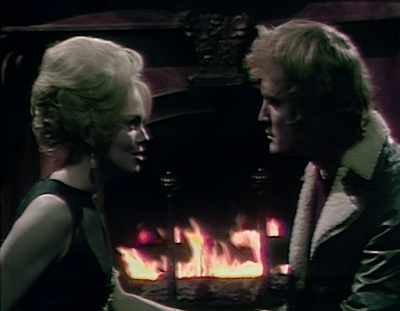
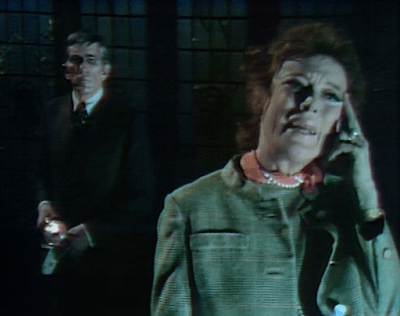
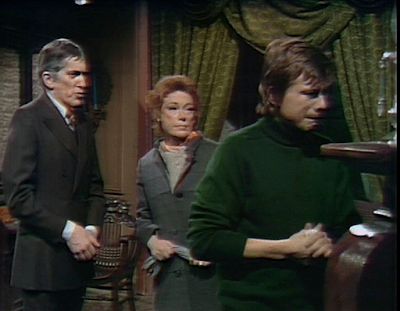
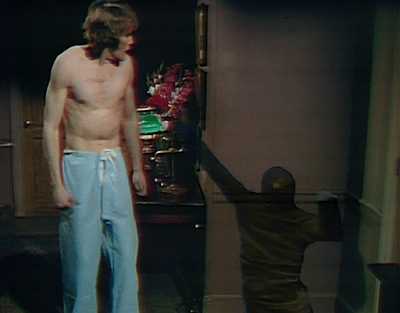
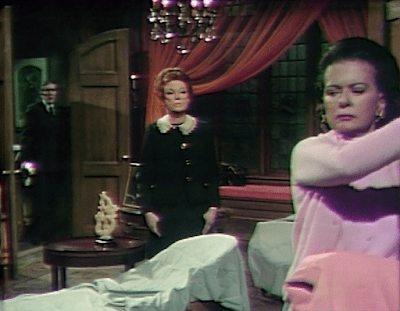

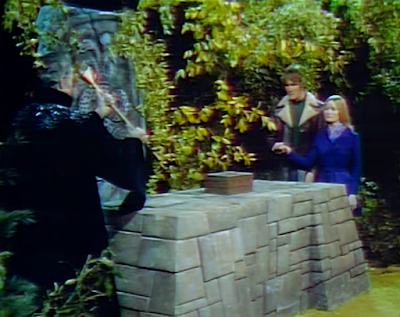

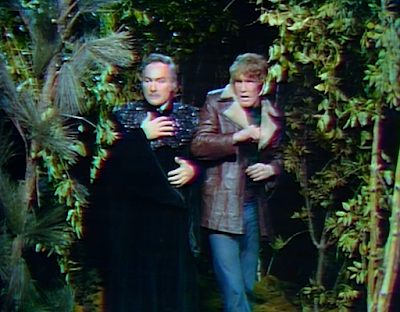
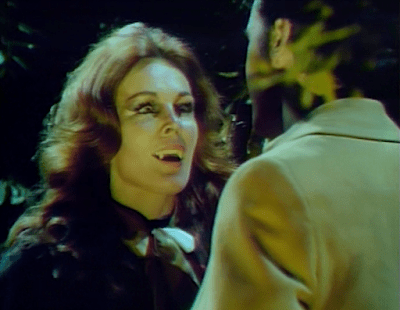
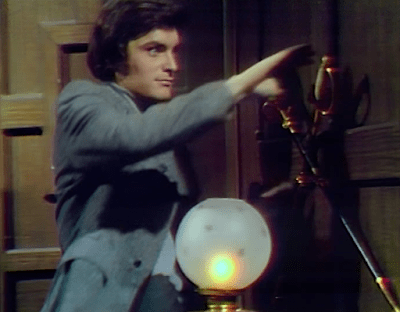
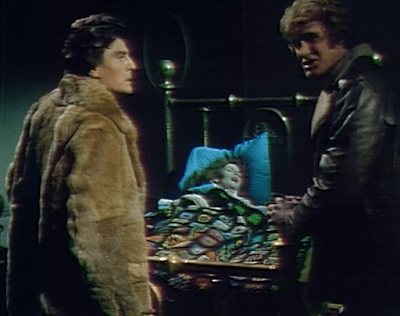
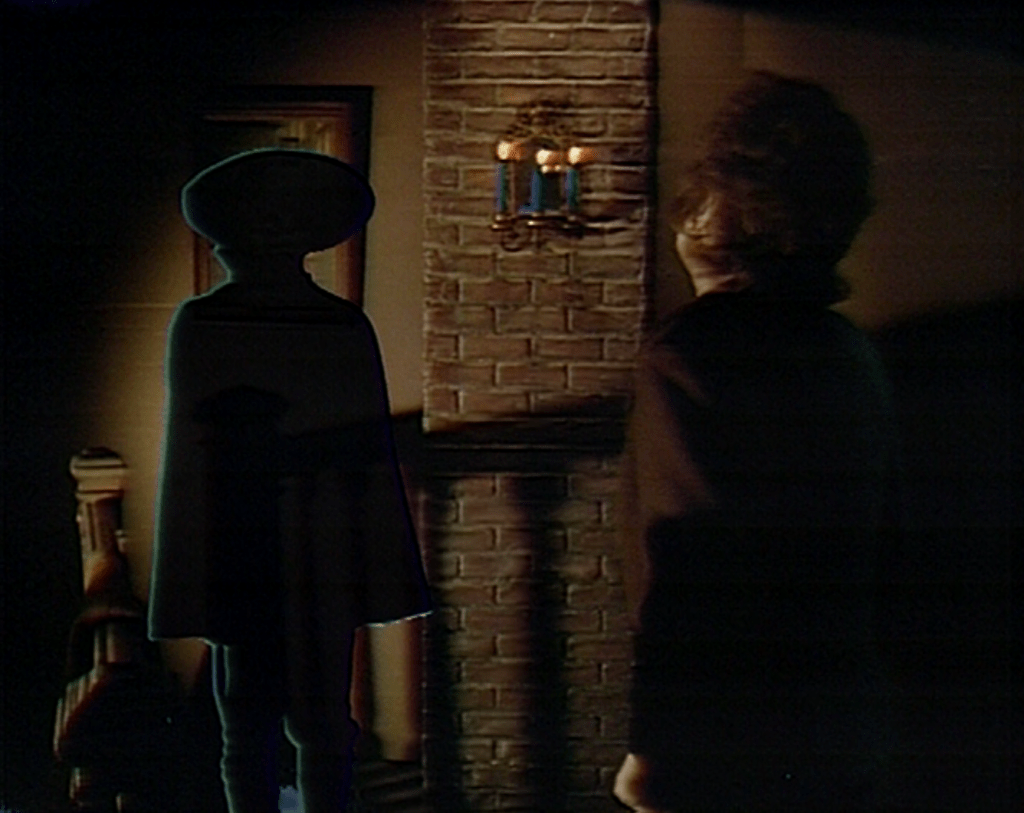
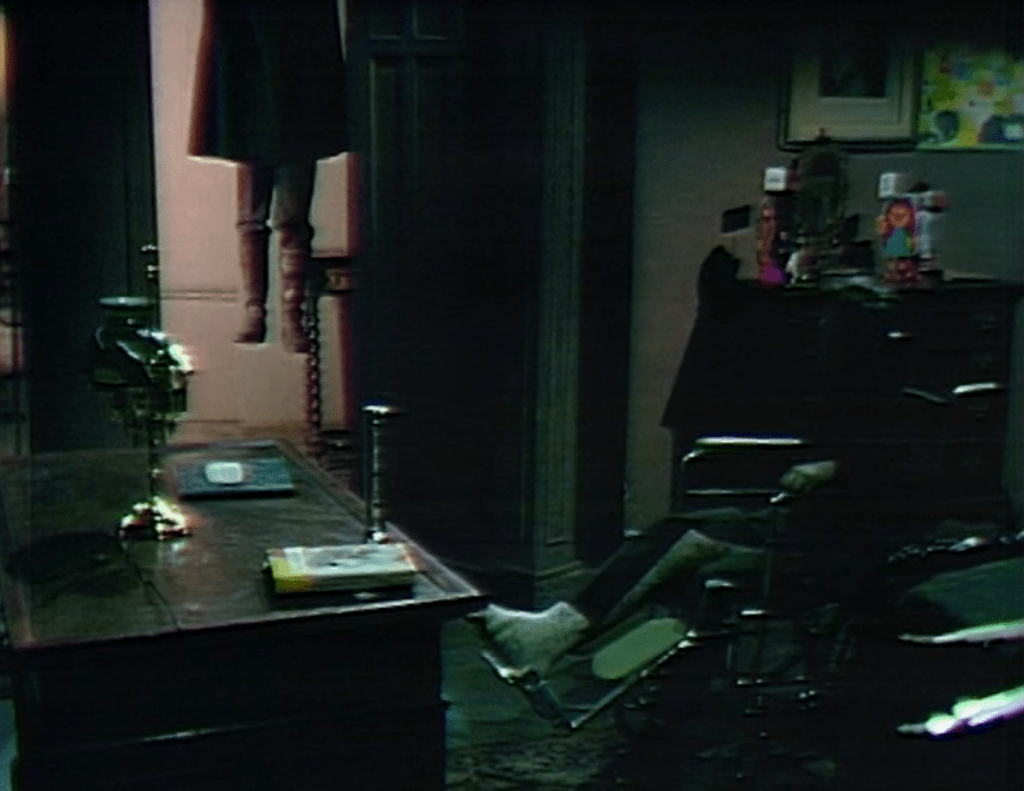
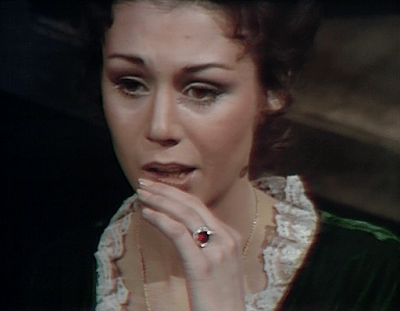
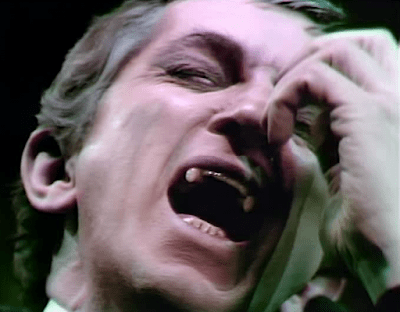
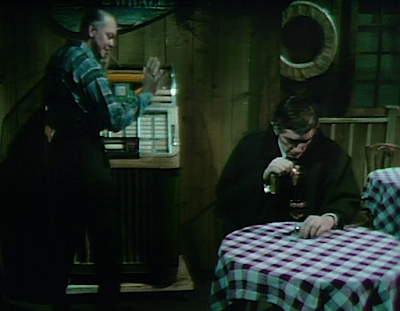
 Dark Shadows Commentary