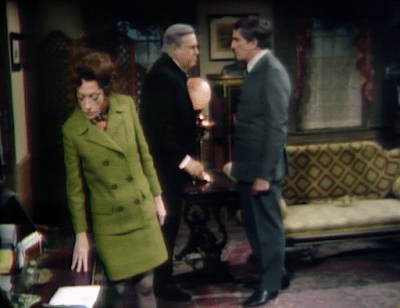
If you’re telling a fictional story and your audience is with you, they will treat whatever you don’t explain as something that does not need to be explained. So if the story takes place in and around a village on the Atlantic coast about 50 miles from Bangor, Maine, you don’t need to explain why Bar Harbor doesn’t exist in the world you are describing. They will take it for granted that your village is on that spot instead.
When you introduce fantastic elements and don’t explain them, you have “fantasy fiction.” That’s the category Dark Shadows has belonged to since undead blonde fire witch Laura Murdoch Collins joined the cast of characters late in 1966 and her arc absorbed all of the unresolved narrative threads that were still generating interest. So in March 1970, it turned out that an alternate universe could sometimes be glimpsed in a room in the long-disused east wing of the great house of Collinwood, and that people who entered the room at the right time could cross over into that universe. The aperture between the universes was not induced by any process, either natural or artificial; it was just there, and it was marked by an ordinary door. The handful of throwaway lines we heard about the many-worlds hypothesis were not explanatory in any way; they were simply a description of one way the show might use the alternate universe to develop characters. Because the practicalities were not explained, we accepted them as something that needed no explanation.
Mad scientist Julia Hoffman and her friend, old world gentleman Barnabas Collins, crossed over into the other universe. They escaped from it in July, while the alternate version of Collinwood was on fire. Evidently the flames disturbed the aperture, because they found themselves, not in the summer of 1970, but in 1995. In that far-off future year, Collinwood was in ruins and everyone who had lived there was either dead, missing, or insane. Julia and Barnabas learned that this sad state of affairs resulted from a mysterious disaster that took place at some point in 1970. They had gathered only a little information as to what this disaster might have been when they had to flee for their lives. A ghost led them to a magic doorway behind which a staircase appeared. They followed this staircase to another doorway. They passed through that, and found themselves back in the Collinwood of their own native universe in 1970, sometime before the disaster is due to strike.
Passing from 1995 to 1970 by means of a stairway is as fantastic as passing from one universe to another by means of a door, but it was not explained, and has barely been mentioned these last three weeks as Julia, Barnabas, and those they have told of their experiences have been trying to figure out what the disaster is going to be and how they might prevent it. So we have accepted it as readily as we accepted the “Parallel Time room.”
That changes today. Julia knows that the ghosts represent people who lived in 1840, and has started looking for information about the staircase in documents from that year. Quentin Collins has been giving her a hand with this project. She finds a plan for a “Proposed Stairway into Time” signed by another Quentin Collins and dated 1840.
The ghost of governess Daphne Harridge seemed friendly to Julia and Barnabas in 1995, but in 1970 she has ensorcelled Quentin and kept him from being as helpful to Julia as he might. Today, Daphne oversees the destruction of a notebook in which teens David Collins and Hallie Stokes have written an account of their experiences with her and the other ghosts. But later it seems Daphne might be coming back around. She gives Quentin another journal, which he hands over to Julia. In it, Julia finds that Quentin’s namesake from 1840 had written about the thoughts that led him to design his “Proposed Stairway into Time”:
There is no such thing as time. There’s only space, physical space, and it is space that measures the distance between those points which we, in our ignorance and folly, insist are points in time. All time is one point, one moment. It is ever existent and it is ever accessible, and it is physical space that can be used to make all time easily accessible.
This describes the show’s method of jumping backward, forward, and sideways in time accurately enough. They cut from a set in one part of the studio to a set in another, and in so doing they have defeated chronology. Since Julia has found the note as part of an investigation that has kept her busy for so long, we are led to expect that we will be hearing more of this kind of talk, perhaps arranged in a pattern that will create the impression that we are being presented with an explanation of something.
Dark Shadows has been desperately short of story since Julia and Barnabas returned to 1970, and spinning out explanations is one way of introducing new story points. When these explanations resemble theories that researchers are actually using to look into natural phenomena, they turn fantastic fiction into science fiction. At no point has Dark Shadows come anywhere near this genre, and it does not seem like the “Proposed Stairway into Time” will lead them there. But who knows. Before Laura came on the show, it was a Gothic romance that included hints that ghosts and other unearthly forces were at work in an uncanny back-world behind the action. If Laura could transform it from that into the supernatural thriller it has been ever since, perhaps Quentin’s namesake from 1840 will be able to transform it into a science-fiction show.
If they are going to take that route, a time-travel gimmick would seem to be the logical way to merge onto it. Ghosts and vampires and zombies and other revenants, like time travel and alternate universes, are ways of making believe that options which events have foreclosed are still at least partly open to us. So if we say that the 1840 Quentin built a time machine, we can subsume more or less everything else we have seen under the idea that he created a rupture in space-time through which all of the other weird phenomena have been cascading.
The ghost of Daphne Harridge wants to kill Quentin Collins, for no reason the show divulges to us; then she doesn’t, again for no reason we can see. Daphne insists teenager David Collins and Hallie Stokes not look at her, then insists they do look at her. David refuses to join hands with Hallie and Daphne to gain mystical knowledge, then demands Hallie join hands with him in a séance. Quentin is under Daphne’s power and unable to assist Julia Hoffman in her quest to free the great house of Collinwood from the hauntings; then he orders Julia to attend him while he performs an exorcism of the house.
In his post about the episode on his great Dark Shadows Every Day, Danny Horn said everything I wanted to say about how unsatisfying all of this is. The show has had its ups and downs. I call this segment The Re-Haunting of Colllinwood, because the A story from December 1968 to March 1969 is often called The Haunting of Collinwood and this is a recycling of that. The original Haunting of Collinwood was itself pretty slow-paced and frequently got bogged down with ominous games of dress-up. This time around the pace is again slow and the rounds of dress-up are even more tedious.
It is somewhat interesting to listen to Quentin reciting traditional Christian formulas as he conducts the exorcism. When we first got to know him, Quentin was a devout and enthusiastic Satanist. I suppose all religions lose adherents from time to time.
Quentin Collins and David Collins are under the influence of the unspeaking ghost of Daphne Harridge. Quentin and David each fret about their inability to resist Daphne, to understand their own actions, or to tell each other or anyone else what is going on. Since Daphne is herself a total enigma at this point, the audience learns nothing when these characters are on screen.
Barnabas Collins and Julia Hoffman know that Daphne is associated with an impending catastrophe. They are trying to learn about her as part of their efforts to prevent this catastrophe. Since Daphne will not allow either David or Quentin to give them any information, they are helpless.
The episode ends with Daphne about to stab Quentin in the back. This is not much of a cliffhanger. Quentin is 100 years old, but has the body of a 30 year old because of a magic spell that also makes him impervious to physical injury. Daphne can stab him all day and all night, and all that will happen is that his enchanted portrait will get a little grislier.
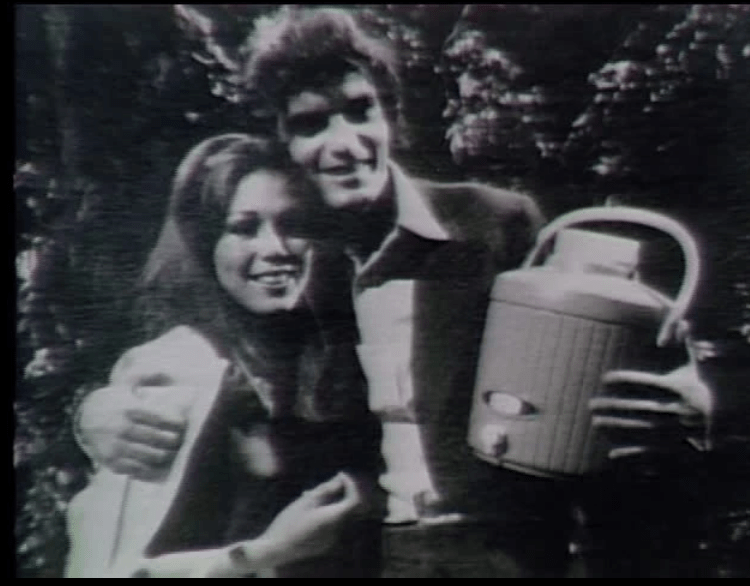
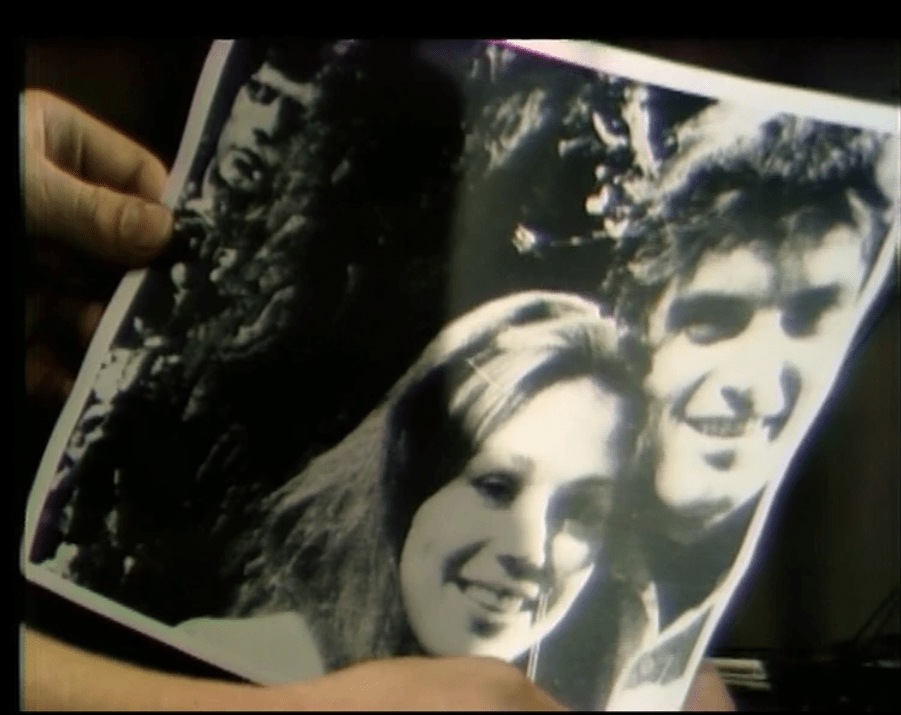
There is some business about a photograph David took. We saw this photograph in #1064, when there was some dispute about whether one of the ghosts was visible in it. Today David shows it to Quentin and asks him if he sees a face in it. Quentin says that it does look like a face, but he thinks it’s just an optical illusion created by the sunlight on some leaves. We imagine that the face will be a subtle thing, as it would have to be if it were somewhere in the photograph we saw in #1064, but when they show it to us later the face is as prominent as any other feature of the image. The result is an insult to the audience’s intelligence.
The original photograph, as seen in #1064.The photograph as presented today.
Grouchy New England teen David Collins and his live-in girlfriend Hallie Stokes go to a playroom for small children that intermittently manifests itself in a space otherwise occupied by a linen closet in the west wing of the great house of Collinwood. Hallie is possessed by the spirit of a girl named Carrie, who died in 1841. David hasn’t caught on that Hallie isn’t herself, and in his exasperation he asks her to “stop acting like the world’s number-one weirdo.” Carrie is puzzled by the word “weirdo.” She recognizes it as a derivative of “weird,” but claims that “the addition of the letter O makes it completely incomprehensible.” Evidently Carrie wasn’t all that quick on the uptake. If someone called me a “peculiar-Z,” I might not know why the letter Z was added, but it would be perfectly clear to me what they were saying. Historians of American English often say that the 1830s and 1840s were the single busiest period for the invention of new slang terms the USA has ever seen, so that if Carrie were as stumped by the “O” on “weirdo” as she claims to be, she would likely have been unable to conduct a conversation with many of her contemporaries.
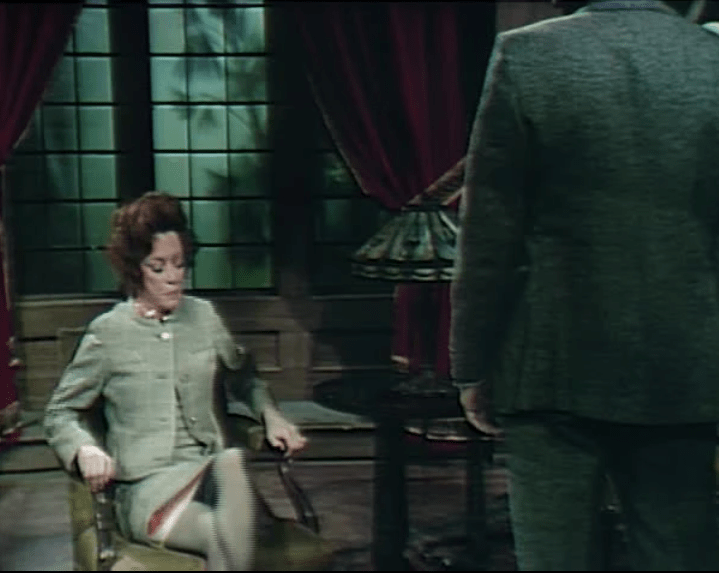
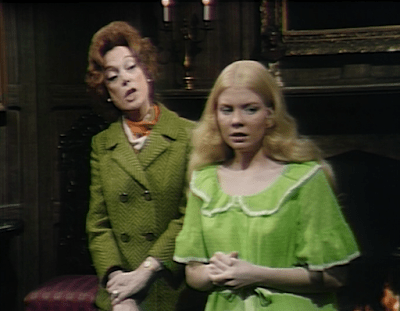
David’s realistic 1970 dialogue and Carrie’s antiquated verbiage bounce off each other to produce some intentional comedy; my wife, Mrs Acilius, thought the scene was really funny. It is certainly more appealing than the rest of the episode, which is yet another series of events that take place only because the characters cannot bring themselves to tell each other what’s going on. Because the ghosts won’t let them, yes yes yes, we’ve been through all that many times before. The fansites seem bored enough by the whole thing that one of biggest points of discussion is whether it is reasonable to say that, because a bit of Grayson Hall’s slip is visible under her skirt at one point, we can say that we see her “underwear.” I guess the slip is “underwear” in the sense that she is wearing it under something else, and it probably wasn’t supposed to be visible, but you’d have to be a very specific kind of person to get excited about it.
Feast your eyes, pervs.
Hall plays Julia Hoffman, MD. Julia is a psychiatrist, among other things. She tells Quentin Collins that the ghost of Daphne Harridge, a governess who like her charge Carrie died in 1841, fills the room with the scent of lilacs when she is near. Quentin is so obviously lying when he tells Julia that he has not smelled that scent that we are probably supposed to assume that Julia is onto him.
We come to the end of the first week of The Re-Haunting of Collinwood, a rehash of a story that they got all the good out of when they did it the first time in December 1968 to March 1969.
The story isn’t going anywhere we haven’t been before, but there is some good stuff in this one. Kathleen Cody does an excellent job of acting as teen Hallie Stokes, brooding and subtle as she protests to her friend David Collins about the strangeness of their situation. Miss Cody had a very bad day at the office yesterday, and it is good to see what she can do.
As David, David Henesy commits one of the more memorable bloopers when he is supposed to tell Hallie that “We need a lot more clues” to figure out what is going on, but actually says “We need a lot more cues.”
Director Lela Swift, a gifted visual artist, outdoes herself at several points. I would particularly mention exceptionally fluid shot when Barnabas Collins and Julia Hoffman are in the foreground, in the doorway of the drawing room, and Quentin Collins approaches the through the foyer. Quentin’s loose-limbed, swinging motion combines with Barnabas and Julia’s intensely static pose to create a sense of rapid movement within strict boundaries.
There is some new stock footage of the Moon illustrating a solar eclipse; even though the final shot shows the Moon sprouting a corona at totality, it is so refreshing to see color pictures in this context that we can write that off.
The eclipse itself fulfills one of the cryptic clues a future version of Barnabas’ distant cousin Carolyn gave him, that something important would happen on “The night of the Sun and the Moon.” A lunar eclipse is a night of the Sun and the Moon, all right, but it is not at all all clear that anything that happens today would have struck Carolyn as especially noteworthy, even if she were in today’s episode.
While he is watching the eclipse, Quentin says that he is sad about his great-grandson and great-grand-daughter, Chris and Amy Jennings, and Chris’ fiancée Sabrina Stuart. Chris inherited an old curse of Quentin’s and was a werewolf. Quentin has managed to escape the effects of that curse, and also of aging, but no one could find a way to help Chris. Some time ago, when the show was set in an alternate universe where Barnabas and Julia were staying, Chris, Amy, and Sabrina left. All Quentin says is that he was sorry to see them go “that way.” We never hear a reference to any of them again.
Chris’ storyline ran out of road several months ago, and he was Sabrina’s only connection. So it would be no surprise that they are gone, even if actor Don Briscoe’s health problems had not overwhelmed him. We’re free to believe that Sabrina took Chris to a big farm in the country where he could play with the other werewolves. Amy was so central to the original Haunting of Collinwood segment in 1968 and 1969 that it would be impossible to pretend there was anything new about the Re-Haunting if she were around, so her departure was also inevitable.
Quentin Collins comes to the drawing room of the great house of Collinwood to deliver some bad news to his distant cousin, Elizabeth Collins Stoddard. He was peering into the room in the east wing of the house through which an alternate universe is occasionally visible. He saw the room as it is in that other timeline, engulfed in smoke and occupied by a young woman calling the name “Barnabas.” Since Liz and Quentin’s distant cousin, Barnabas Collins, and Barnabas’ dear friend Julia Hoffman crossed over into the alternate universe some time ago and the aperture in the east wing is the only place where transits between the universes are known to be possible, Quentin proclaims to Liz that the “only conclusion” one can reach is that “we shall never see them again!” No sooner has he got those words out than the drawing room doors open to reveal Julia and Barnabas standing side by side, smiling happily, and saying “Elizabeth! Quentin! We’ve returned!”
One might think this would cure Quentin of the idea that he knows what the “only conclusion” is at which one might reasonably arrive, but no such luck. He tells Barnabas and Julia that today’s date is 3 August 1970. They say that was the date when they left the other universe, and that they then spent over a week in the year 1995, when they saw a bleak and horrifying future that resulted from a disaster that will occur later in 1970 unless they can somehow prevent it. Quentin says their experience in the future must have been an hallucination, because they can’t have come back to 3 August in one year from any date other than 3 August in another year. Julia and Barnabas share detailed recollections of their experience in the future, and have already met a living person in 1970 whom they saw for the first time as a ghost in 1995, but this argument shakes their confidence.
Quentin’s claim, nonsensical as it is to new viewers, actually does fit in with a notion the show has been developing since it first committed to being a supernatural thriller in late 1966 and early 1967. Since the laws of nature that science studies do not apply, they have to find other predictive models that will make it possible to build suspense. So they had well-meaning governess Victoria Winters figure out that women named Laura Murdoch incinerated their young sons named David at intervals of “exactly one hundred years!!!,” and therefore that Laura Murdoch Collins would soon present a mortal danger to her young son David Collins.
From that point on, the power of anniversaries has been a tremendously potent force in the metaphysics of Dark Shadows. Barnabas traveled back to the 1790s in #661 by going to a grave on the anniversary of its occupant’s death and shouting at the deceased for a while (shouting is also a potent metaphysical force.) Quentin himself first joined the cast of characters as the malevolent ghost of a man who died in 1897 and in 1968 and 1969 returned to haunt Collinwood, kill several people, and drive the survivors from the house. Barnabas traveled back to 1897 and bungled around until someone else changed history to prevent Quentin dying or even aging. On the anniversary of that change, the haunting broke, just in time to allow David to return from the dead. But when Quentin showed up as a living being late in 1969, everyone who had lived through the ten months of the haunting remembered it. So apparently the reality of Dark Shadows is a composite of all the various, mutually inconsistent timelines, and the consequences of the actions not taken are just as real as are those of the ones taken. The power of anniversaries is the thread that binds these unmatched events into a cosmic crazy quilt.
As the aperture between universes was a door to a room in the east wing, so the aperture from 1995 to 1970 was a door inside a room in the west wing. Barnabas and Julia were trapped in a mysterious playroom there when the ghost of a blonde teenager known to them as Carrie appeared, beckoned to them, and walked through the wall. A moment later, a door materialized in the spot through which Carrie had exited. Julia and Barnabas went through the door and found themselves on a staircase. They followed the staircase to another door. It was the door through which they had entered the playroom, but the corridor outside was in good repair, not in ruins as it was in 1995. They saw a girl there who appeared to be Carrie, though she was wearing different clothes, was alive, and demanded to know who they were.
Barnabas and Julia gave the girl their thanks for her help, and she repeated that she had no idea who they were or what they were talking about. She said that she was not named Carrie, but Hallie, Hallie Stokes, niece of Professor Timothy Eliot Stokes. She told them Liz was in the drawing room, Liz’ brother Roger was in Europe, and the year was 1970.
Later, Julia questions Hallie about some names and phrases she heard in 1995. Grayson Hall delivers all of these questions as if she were playing a Gestapo interrogator in a very bad World War Two movie. Even when Hallie says it is her bedtime, Hall enunciates the lines “All right, Hallie. Good night” while standing rigidly still and peering at the girl from under a single ruffled eyelid, as if the next words were going to be “Dream uff ze Fazzerlahnt, und uff ze famlee you shtill haff zere!”
Hallie is terrified of Julia, a perfectly natural reaction which Grayson Hall seems to think she needed to explain by turning into a villain from Hogan’s Heroes. Screenshot by Dark Shadows Before I Die.
The script calls for Hallie to hear something sinister in Julia’s voice, and Hall was an extraordinarily accomplished actress who should easily have been able to make us understand why a friendly series of questions might sound that way to a nervous person. This exaggerated performance cannot be explained as an ordinary failure. She also failed atypically last week when required to show that Julia was secretly under the control of the evil spirit. There was zero subtlety in her performance, leaving it inexplicable that Barnabas didn’t instantly catch on. Those episodes, like this one, were directed by Henry Kaplan, a hack. Kaplan’s idea of working with actors involved poking them with a stick and tying them up with gaffer tape. Hall’s misfires may not have been a protest against Kaplan’s brutishness and incompetence, but he certainly did not do anything to help her correct them.
When Julia and Barnabas left for the alternate universe, Quentin was still living somewhere in the village of Collinsport; it was implied Julia was paying his rent. At some point since, he has relocated to the great house. We see today that he has moved back into his old room. This is as hilarious for longtime viewers as was the instant refutation of Quentin’s claim that the only logical conclusion from the available facts is that they will never see Barnabas and Julia again. During the 1968-1969 “Haunting of Collinwood” segment, Quentin’s room served the same function the mysterious playroom served in the excursion to 1995 and in this incipient Re-Haunting of Collinwood. It was a place known at first only to the children, who visited it, fell under the power of the ghosts of its former occupants, and thereby became the instruments of general destruction. But he’s even brought his old stuff with him, including his haunted phonograph.
When we got to know Quentin as a living being during the eight months the show was set primarily in 1897, we saw that he had the same vices and the same appeal Roger had when he was introduced as a villain at the beginning of the series. Roger was eventually nerfed into a harmless snob who made sarcastic remarks and sipped brandy, and then reinvented again as an upright family man. Throughout those personality shifts, Roger continued to be one of the “Logical Explanation People.” No matter what he saw or experienced, he would reject any supernatural account and insist “There must be a logical explanation!” Quentin has followed Roger’s character progression to the point where he, a former student of black magic who conjured up demons from a fireplace, who turned into a zombie the first time he died and into a werewolf after he was resurrected, who died again and became a ghost, whose second death was then averted when he became half of a magical dyad including an enchanted oil painting, and who is now a hundred years old even though to all outward appearances he is about 30, is insisting that There Must Be a Logical Explanation.
As if that were not enough, when we see Quentin in his room he is wearing a dressing gown, an article of attire Roger favored in his first months on the show. Roger drifted to the margins of the action as he lost his capacity for villainy; he made his final appearance in #979. The show has had so much difficulty figuring out what to do with Quentin since it returned from 1897 that we may well fear he is headed for the same fate, and these resonances do nothing to assuage that fear.
Hallie comes in to see Quentin. She asks if Barnabas and Julia are good people. He hesitates to answer. He knows that Barnabas is a vampire and Julia is a mad scientist. Nonetheless, they are his friends, and he believes that they are motivated by a sincere desire to prevent the disasters they think they have foreseen. So he might answer truthfully by saying that they are locked in a three-way tie with him for the title of Most Dangerous Person You Have Ever Met, but that he likes them, and so long as Barnabas doesn’t start looking at her neck and Julia doesn’t try to strap her to a table and hook her up to an apparatus including Tesla coils she will probably survive her encounter with them. But he’s more interested in reassuring her than he is in adhering to strict literal accuracy, and so he says “Now look, now you listen to me. Barnabas and Julia are very fine people, and you don’t have to be afraid of them or of anything else. Now you believe that.” None of the other actors is having a good day at the office with this episode, but David Selby is on top form, and he delivers this little speech with a note of urgency that makes him sound like he is telling the truth, but with a panicked flicker in his eyes that makes it clear he is desperate for Hallie to accept a lie that might keep Julia and Barnabas from murdering her.
Hallie tells Quentin that she saw Barnabas and Julia emerge from a door in the west wing. He calls Barnabas to his room and tells him that since the aperture to the other universe is in the east wing, that causes Quentin to think there might be something to their story after all. Barnabas leads him to the door, and says that the playroom was behind it in 1995. Quentin says that there is no playroom there and never has been. Barnabas himself knew that full well when first he opened the door and saw the room in 1995, but for some reason is shocked today when sees that it is a linen closet. Quentin says that there cannot possibly ever be a playroom there, since the other wall is to the outside. Evidently it is perfectly in order for an entire alternate universe to intermittently fit into a room in the east wing, but the west wing doesn’t swing that way.
In his post about the episode on his great Dark Shadows Every Day, Danny Horn complains about Kathleen Cody’s performance as Hallie, claiming that she renders the next several weeks of the show unwatchable. I agree that in adopting a constant tone of freaked-out disbelief, Miss Cody made an acting choice that left her nowhere to go. If you’re already at the limit of the amount of bizarreness you can accept in your life, that’s it for you as a character on Dark Shadows.
I can see why Miss Cody thought that was the only way to go, though. This is her first substantive appearance on the show, and Quentin warns Barnabas not to tell anything disturbing to Hallie, because “She’s a very sensitive child… She frightens quite easily.” Everything else in the script reinforces the idea that Hallie is on the brink of a panic attack, so that’s how she plays it today. That’s the angle subsequent scripts are going to stick with, so I can see that Miss Cody felt she had no choice but to stay in the corner she had painted herself into.
When actors find themselves in a jam like that, a director might be expected to offer some kind of helpful guidance. That wasn’t going to happen with Henry Kaplan at the helm, and even principal director Lela Swift, an outstanding visual artist, was not an enthusiastic director of actors. John Karlen said that the only direction Lela Swift ever gave him was the single word “Go!” So once an actor took a wrong turn on Dark Shadows, they could find themselves trapped in a dead end. Many of the cast members who joined the show without much experience have spoken with gratitude about guidance they received from their veteran cast-mates; Karlen, Joan Bennett, Jonathan Frid, Clarice Blackburn, and Humbert Allen Astredo are most often mentioned as gifted teachers of acting. The only director any of the actors mentioned as a source of productive suggestions was John Sedwick, who left the show in June 1968. So unless Miss Cody could get some help from one of her cast-mates, it was very likely that her initial mistakes would doom her whole performance.
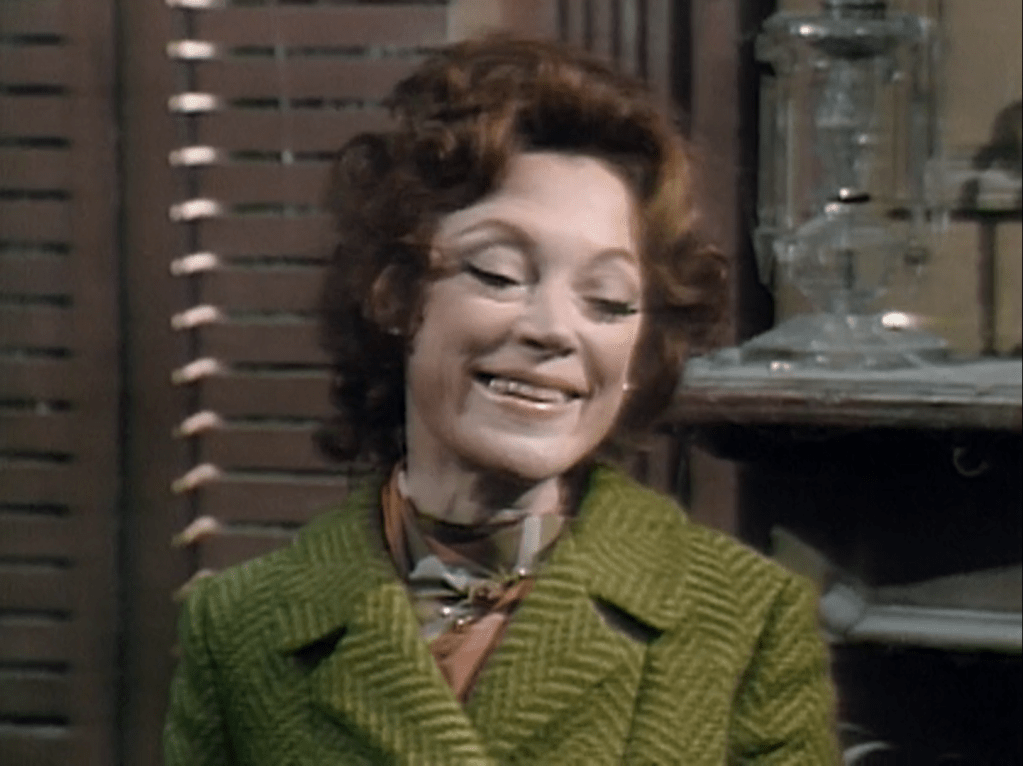
I wonder how long the actors had the script before they started taping this one. As unspeaking, barely mobile ghosts Gerard and Daphne, James Storm and Kate Jackson didn’t need much prep time; as lunatics Carolyn Fredericks (neé Stoddard) and Quentin Collins, Nancy Barrett and David Selby probably didn’t need much more. But vampire Barnabas Collins has a lot of dialogue today, and Jonathan Frid rarely seems to be within a country mile of his scripted lines. That isn’t so unusual, but Grayson Hall’s trouble really stands out. Barnabas’ friend, Julia Hoffman, MD, is possessed by Gerard and is pleased that Barnabas keeps meeting with one failure after another. We are supposed to know this, Barnabas isn’t. But she has a huge grin on her face each time she gloats to Barnabas about one of his setbacks. The one time Frid is clearly delivering a line that was written for him, Barnabas tells a conspicuously blissed-out Julia that she seems “almost pleased.” Hall was a highly accomplished actress, and we would expect her to be able to do “secretly pleased” in her sleep. But when this line comes up, she gets a bad laugh.
Far and away the happiest we have ever seen Julia, this strikes Barnabas as “almost pleased.”
The episode ends with Barnabas going to the drawing room of the great house of Collinwood in response to a note from Carolyn. He finds her sitting at the desk there. He talks to her for a moment, then notices that she is not moving. He touches her, and she falls over dead. The episode has its problems, but that is an extremely effective closing curtain.
Dark Shadows just spent sixteen weeks in an alternate universe where Quentin Collins was neither the family-annihilating ghost he was when first we saw him in December 1968 nor the charming rogue we got to know when the show went back in time in March 1969. Instead, he was a foul-tempered sourpuss who treated his wife like an irritating child and refused to learn anything from anyone. Like those previous iterations of the character, “Parallel Time” Quentin had a compulsion to choke people, but unlike them he was no fun to watch.
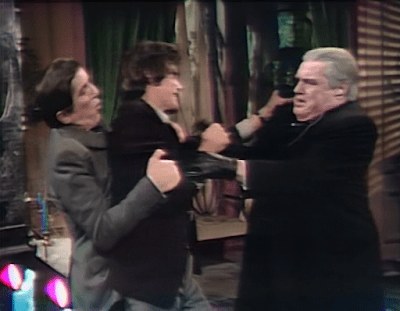
Now we have traveled forward in time to the year 1995. Here, Quentin is an escaped mental patient who is sometimes extremely docile and at other times just as extremely refractory. But one thing hasn’t changed, which is his zeal for strangling anyone who bothers him. He sees the elderly Timothy Eliot Stokes, expert in the supernatural, and at once grabs him by the throat. Quentin’s friend Barnabas Collins pulls him off of Stokes. Barnabas suggests that Dr Julia Hoffman should give Quentin a sedative. He responds “The only sedative I need is to get my hands around Stokes’s neck. I’ll be calm for the rest of my life!” That’s our Quentin.
Barnabas tries to keep Quentin from giving Stokes his signature Collinwood Handshake. Screenshot by Dark Shadows Before I Die.
Quentin blames Stokes for the fact that the estate of Collinwood has been a demon-ridden ruin for the last 25 years. Stokes has been telling Julia and Barnabas that it was that way when he got there. He returned from a trip to Europe in the autumn of 1970, a few months after Barnabas and Julia left on their journey into the alternate universe and out to this future year, and found the place in its current condition and everyone associated with it destroyed in one way or another. But Quentin says that the real disaster came only when Stokes tried to exorcize a ghost. That just made the ghost angry.
Once Quentin is out of the way, Barnabas tells Stokes he believes that Quentin’s madness is a symptom of the ghost’s continued hegemony over Collinwood. He is determined to try another exorcism. Stokes advises him against it, but says he will try to help him if he does go ahead.
Meanwhile, the ghost, who according to the credits is named Gerard, has taken possession of Julia. The ghost has ordered Julia to do something she does not want to do. She keeps this from Barnabas. She tells Barnabas they should give up and go away. He refuses, and she sadly says that whatever will happen will happen. From the look on her face, it seems that the ghost has ordered her to do away with Barnabas and she is resigned to the idea that she will eventually obey this command.
There are other ghosts in the area as well. Yesterday Julia and Barnabas saw the ghosts of two teenagers who were apparently named Tad and Carrie while they danced a minuet and exchanged a chaste kiss, and they heard Quentin talking earnestly to an invisible person he called Daphne. A woman with long black hair briefly comes into Barnabas’ view in his parlor today; the credits confirm that she is Daphne. Anyone who watched US television in the 1970s, 1980s, or 1990s will already know that she is Kate Jackson, and might be interested to know that she is making her first screen appearance.
When Daphne appears, the air smells of lilacs. That comes as something of a relief. The opening voiceover told us that Collinwood is ruled by “a ghost whose mere presence corrupts the surrounding air.” That would suggest rather a less pleasant odor than that of lilac perfume.
The ghost of the gracious Josette was the chief supernatural presence on the show for its first 42 weeks, and an occasional visitor for some time after. Her signature was the scent of jasmine, so longtime viewers are getting a hint that Daphne will turn out to be important.
For many months starting in late 1968, the estate of Collinwood was haunted by the ghost of Quentin Collins. Quentin’s presence became steadily more intolerable until the living members of the Collins family had to abandon the great house in #694. At the end of that episode, we saw Quentin standing on the walkway at the top of the foyer stairs, laughing in triumph.
Vampire Barnabas Collins traveled back in time in #701 and blundered around until history was changed. In #838, set in September 1897, Quentin’s death was prevented. On the anniversary of that event in September 1969, the haunting broke, though the people who lived through it remembered Quentin’s ghost and the events of the haunting. A magic spell was cast on Quentin keeping him forever young, and late in 1969 he took his place among the Collinses whom he had once driven from the family home.
Now, Barnabas and his friend, mad scientist Julia Hoffman, have come unstuck in time again. They find themselves in Collinwood in the year 1995. The house is in ruins, the members of the family either dead, missing, or insane, and the village of Collinsport full of people who won’t answer any of their questions. Quentin is around, having escaped from a psychiatric facility and come back to the estate. Today, Barnabas and Julia have taken him to the great house to try to get him to tell them something useful.
Julia and Barnabas want Quentin to see an upstairs room that is in much better shape than the rest of the house. They open the door, and see a ghost which appears to be strange and troubled teen David Collins. Quentin flees in terror and makes his way to the foyer while Barnabas and Julia watch the ghost vanish.
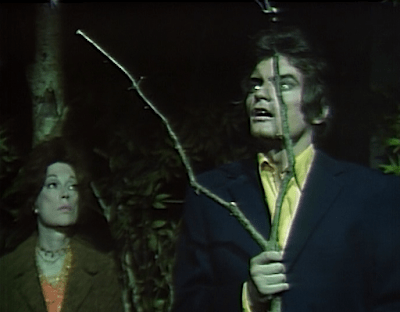
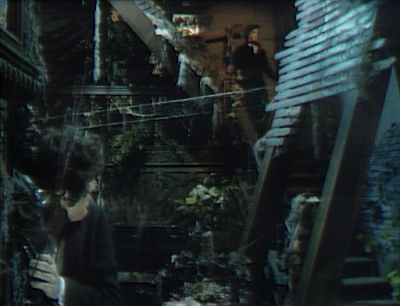
Quentin finds that he cannot open the front doors. He sees the ghost of a young man staring at him from the walkway at the top of the stairs. Like Quentin during “The Haunting of Collinwood,” this ghost has lots of curly black hair, does not speak, and wears a dark suit from the nineteenth century. Since David Selby is very tall and James Storm is rather the other thing, I can’t help but think of him as Mini-Quentin. The credits tell us that his name is Gerard.
Quentin rolls around on the floor, terrified of Gerard. Barnabas and Julia come and try to calm him down. Quentin says the doors won’t open; Barnabas opens them. Quentin runs out. Julia says she senses an evil presence, which, considering that every character we’ve seen so far is a murderer, is not too surprising. She and Barnabas leave.
Two ghosts dance a minuet by the gazebo. Julia and Barnabas think that one of the ghosts is David; the other is a blonde girl whom they do not recognize. The ghosts kiss each other. They walk towards the woods and vanish.
Barnabas and Julia go to the Old House on the estate. They find Quentin, and overhear him talking in an anguished voice to someone named “Daphne.” He tells them that the ghost they saw was not David Collins, but was named Tad. Julia remembers that they found a birthday card addressed to “Tad” and signed “Carrie.” If the ghost who looks like David is actually Tad, one might assume that the blonde girl is Carrie, though she could be Daphne or some other personage.
The next afternoon, Quentin finds Julia sleeping in an armchair in the parlor of the Old House. He asks to see Barnabas. Julia reacts with puzzlement. She says Quentin knows perfectly well that Barnabas cannot rise until the sun sets. He says he doesn’t know what she’s talking about. Julia is shocked. Once you’ve learned that a fellow is a vampire, that information doesn’t usually slip your mind. But he seems quite sincere. He wanders off.
The blonde girl appears at the window and beckons to Julia. Julia follows her, silently. It seems at first that Julia is in a trance, since she does not call to the girl by the names “Carrie” or “Daphne.” But when the girl leads her into the great house, Julia keeps moving her head around as she watches her step, making it clear she is wide awake. The girl leads her into the strangely intact room, where Gerard is waiting for her.
Danny Horn’s post about the episode on his great Dark Shadows Every Day is full of remarks about how cleverly they blur the line between soundtrack music that the characters can’t hear and atmospheric sounds that they can, disorienting us in a way that adds greatly to the effect of the scares and confusion. It is indeed powerful, and there is a lot of other good stuff in this one.
But this is the first episode of the 1995 segment I wouldn’t show to someone new to Dark Shadows to entice them into watching the show. The pacing is just too slow for the material. We have time to start asking questions that take us out of the story. For example, Julia and Barnabas lament that they have no idea what is going on and are desperate for Quentin to tell them what he knows. But as soon as he volunteers a piece of information, telling him that they saw Tad’s ghost rather than David’s they flatly contradict him. Also, Julia gives Quentin a sedative. We wonder where she got it, since her prescription pad is 25 years out of date and any samples she had in her bag have been sitting out, unrefrigerated and exposed to dry rot, for that same period. Those and other incongruities are the sorts of things we could easily overlook if we were moving as fast as we moved in all five episodes last week, but when events move as leisurely as they do today they mean trouble.
Vampire Barnabas Collins and mad scientist Julia Hoffman have come unstuck in time and found themselves in 1995, 25 years ahead of their proper period. The great house on the estate of Collinwood is in ruins. Some of the people they knew are missing, some are dead, and the rest are determined not to help them find out what happened when disaster struck in 1970.
In his post about the episode on his great blog Dark Shadows Every Day, Danny Horn writes that “if this is July 1995, then Barnabas and Julia are on completely the wrong track. They want to know where Elizabeth and Roger and Maggie are, and the answer is obvious — they’re watching the O.J. trial. Where else would they be?”
Barnabas’ distant cousin Carolyn owns Collinwood now, and she doesn’t have cable. So she is in the great house, a demon-haunted wreck which most people avoid. Julia and Barnabas have followed her there. They hear Carolyn talking and laughing inside an upstairs room that didn’t exist in 1970. They let themselves in. Unlike the rest of the great house and every other structure on the estate, the room is in perfect repair, well-lit and full of luxury items. Carolyn has repeatedly told Barnabas and Julia to stay off her property, even sending the sheriff to arrest them on one of their previous trespassing expeditions to the great house, and she is outraged at this latest intrusion. She demands how dare they follow her into the room, and they respond by praising themselves for their good intentions.
Julia and Barnabas finally leave the room, and Carolyn relaxes. She turns and starts talking to someone who, to her surprise, is not there. She is all the more furious that Barnabas and Julia have driven this person away.
Not content with one home invasion, Julia and Barnabas go to the apartment of their former friend Timothy Eliot Stokes. Before they pushed past him into his parlor, Stokes had been reading a letter from a psychiatric facility where Barnabas and Carolyn’s distant cousin Quentin is a patient. His interior monologue read the part to us about Quentin having taken a turn for the worse. While Barnabas hectors Stokes, Julia leans way down and reads the letter. It turns out Quentin has escaped from the facility. At length, Stokes tells them that he was out of town when the disaster occurred in 1970 and that he doesn’t know much about it. He agrees to help them.
Later in the episode, two scenes take place between Stokes and Carolyn. Carolyn enters Stokes’ apartment and reproves him for collaborating with the enemy. She laments that Julia and Barnabas ruined the birthday party, and that there won’t be another birthday party for a year. He has no idea what she is talking about and tries to reason with her. He finally takes her home. These, like every scene with Carolyn in the 1995 segment, are spectacularly good. Nancy Barrett is an excellent actress, Dark Shadows suited her strengths perfectly, and crazy lady Carolyn Fredericks was as good a part as any performer could wish for. Thayer David was terrific also, and the two of them are unforgettable together today.
Barnabas and Julia return to the playroom, since they haven’t been arrested yet tonight. They find a brand new birthday card addressed to “Tad” and signed “Carrie.” Barnabas has never heard those names in connection with Collinwood and wonder who they could be.
Barnabas says that he wants to question Quentin. Julia responds “Barnabas, If Quentin has been in a mental institution, he can’t help us.” It’s true that it takes special training and considerable experience to gain useful information by questioning severely disturbed people, but Julia has those qualifications. She is a psychiatrist who, when we first saw her in #265, was conducting an examination of a barely verbal patient. Over the last three years, everything that Julia had in those days has been stripped from her, a theme the show has been exploring heavily for the last six weeks. This line seems like a throwaway, but it underlines the transformation we have seen.
Quentin’s existence depends on a magical portrait painted in the year 1897. In an upstairs room at the Old House, Julia and Barnabas find this portrait intact. At that very moment, Quentin himself rushes in with a knife and tries to slash it. Barnabas thwarts him.
Quentin won’t believe that Barnabas and Julia are who they appear to be. He babbles as if he were still in the psychiatric facility. He claims never to have heard of the playroom, then insists the playroom was always there. They take him to the playroom, their third trip there today. Quentin looks in the room and flees in terror. Barnabas and Julia stay, and see the ghost of strange and troubled teen David Collins. The appearance of David’s ghost is one of the most forceful week-ending images in the series, up there with Barnabas’ hand darting out of its coffin in #210 or the Old House in sunlight in #365.