Episode 826: King Johnny’s court

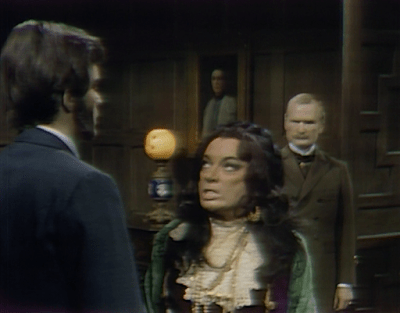
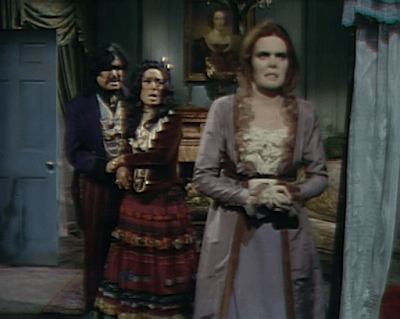
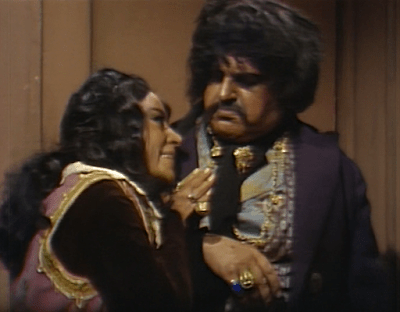
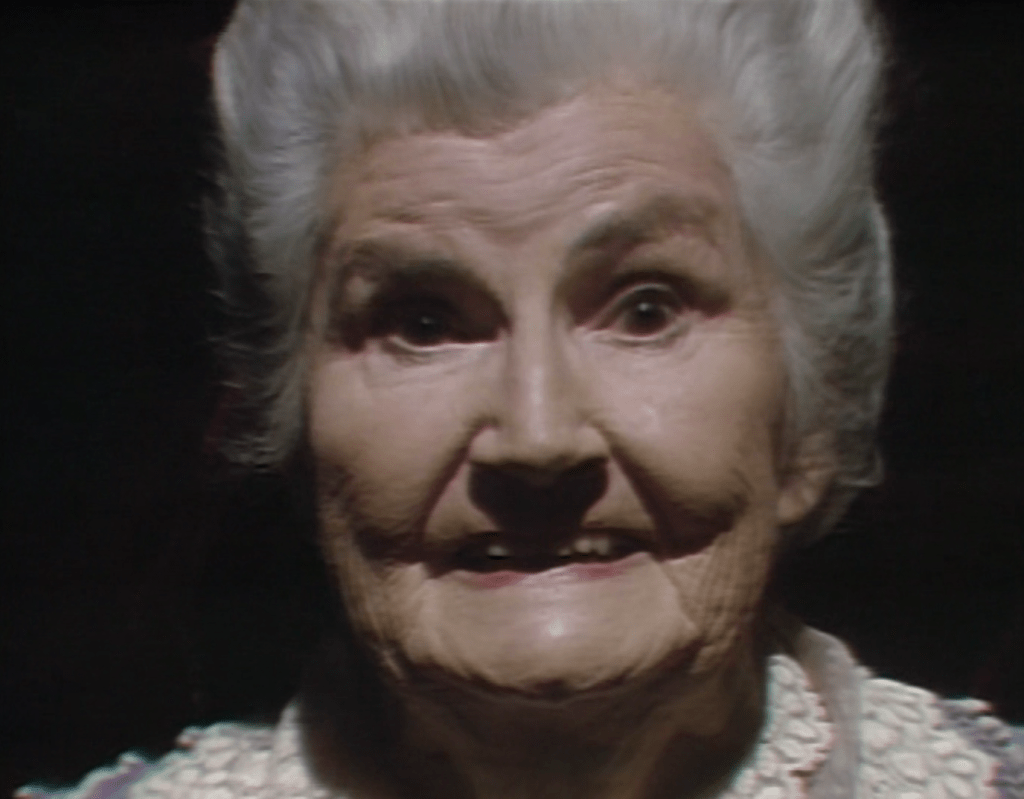
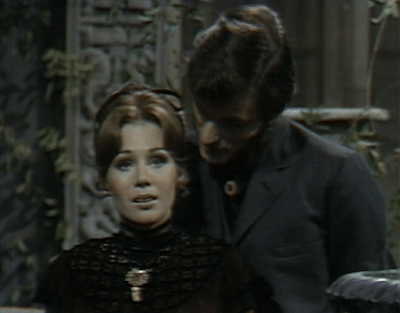
Rroma chieftain/ New England crime boss King Johnny Romana puts broad ethnic stereotype Magda Rákóczi on trial in the secret room of the old Collins family mausoleum. Evidently King Johnny has considerable magic powers; he conjures up the ghosts of several notorious murderers to serve as the jury. He also brings in the ghost of Magda’s husband to serve as the one witness for the defense.

The scenario is a remake of The Devil and Daniel Webster, a play that debuted at the Martin Beck Theatre in 1939. But the makers of Dark Shadows were likely thinking of a more recent Broadway production as well. From November 1964 to June 1965, a musical with a book by Ernest Kinoy and music by Walter Marks ran first at the Shubert Theatre, then at the Lunt-Fontanne, for a total of 232 Broadway performances. Its title is one of King Johnny’s favorite words- Bajour.

King Johnny keeps complaining that Magda tried to “pull the bajour on me!,” by which he means that she gave him one thing disguised as another. In the show, based on Joseph Mitchell’s stories of life among Rroma in the New York metropolitan area, bajour refers simply to a confidence trick with a big payoff for its perpetrators. The cast, saddled with a bunch of instantly forgettable songs, sings as joyously as it can about how the Rroma, to whom they of course refer as “gypsies,”* love nothing more than cheating lonely old women out of their life savings. This uninhibited celebration of racism reported losses of nearly a million dollars, more than twice the total amount of money invested in it. Perhaps the fictional Rroma weren’t the only ones who enjoyed running a good scam. Perhaps, too, Mel Brooks’ 1967 film The Producers wasn’t entirely a work of fiction.

The cast of Bajour does not appear to have overlapped with that of any episode of Dark Shadows. The closest link I can find to the cast at this period of the show is Michael Bennett, who danced in Bajour and later married Donna McKechnie. Many very distinguished performers appeared in Bajour, but I’m not tempted to do any imaginary recasting. I’m sure Chita Rivera and Herschel Bernardi were wonderful as leads Anyanka and Cockeye Johnny Dembo, but they couldn’t have outdone Grayson Hall and Thayer David as Magda and Sandor. Herbert Edelman was good in everything, and I’m sure his turn as “The King of Newark” was no exception, but no one could have done more than Paul Michael does to make the cartoonish role of King Johnny watchable. Paul Sorvino had a great career, and even has a screen credit in common with Henry Judd Baker- they both appeared in the disastrous 1980 film Cruising. I’m sure Sorvino would have been interesting as a replacement for Baker as Istvan, the mute Black Rroma, but that part is all about physical presence, and as was the case with Baker’s part in Cruising he is effective in a way that Sorvino could not have matched. Nancy Dussault is another performer who never lets an audience down, but Diana Davila’s approach to the character of Rroma maiden Julianka was so cleverly conceived that I couldn’t bear to think of anyone else taking the part.

While I’m on the topic of the Rroma, I want to bring up an oddity about my favorite Dark Shadows blog, Danny Horn’s great Dark Shadows Every Day. When he was writing about these episodes, Danny often stopped to ridicule the idea of a Rroma tribe living in New England in 1897. Danny works for the Wikimedia Foundation; you’d think he’d be in the habit of checking Wikipedia, where the article “Romani People in the United States” would tell him that, while Rroma have been migrating to North America continually since 1498, the majority of the ancestors of the million or so Americans who now identify as Rroma came in the late nineteenth century. The new arrivals tended to take some time to assimilate to the ways of the USA; the article is, as of this writing, illustrated with a photo of a Rroma caravan near Portland, Oregon, in 1905:

Rroma caravan near Portland, Oregon, in 1905. Photograph by the Portland Oregonian, found on Wikipedia.

Most Romani-Americans are totally assimilated nowadays, so much so that many people in the USA don’t realize that there actually is such an ethnic group. But there are still Romani heritage festivals in many cities, and the last traditional caravans were still traveling the Great Plains as late as the 1940s. And in Maine in 1897, Romani caravans were a frequent sight, one that indeed aroused exactly the sort of zyganophobic** reactions Magda and Sandor encountered from virtually everyone in their first days on the show.

Even Istvan isn’t as hard to explain as Danny seems to think. In the early days of European settlement, Rroma were often brought across the Atlantic as slaves; that was the case for the people on Christopher Columbus’ third voyage in 1498. Some intermarried with enslaved people of African extraction. There are still Afro-Romani communities in Louisiana and Cuba.

I started writing about Dark Shadows in the comment sections on Danny’s blog. He made a great display of ignoring the first 42 weeks of the show, and consistently made the harshest possible judgments of the acting of Alexandra Moltke Isles, who played well-meaning governess Vicki. That created a space for me to point out when the show was harking back to its early days, and to defend Mrs Isles. I would be remiss in a post like this if I did not mention that Mrs Isles made a documentary feature in 2003 called Porraimos: Europe’s Gypsies in the Holocaust. I’ve never been able to get hold of a copy of the film, but the New York Times liked it when it was shown on PBS.

*Rroma sometimes call themselves Gypsies, but you can’t assume they’ll like it if an outsider uses that word.

**Zyganophobia- racism against Rroma.
Episode 798: A gift from the unicorn

In the first few decades of commercial television, ambitious shows tended to imitate live theater; since, they’ve tended to imitate feature films. Today’s episode is one of Dark Shadows’ stagiest, and it is a strong one.

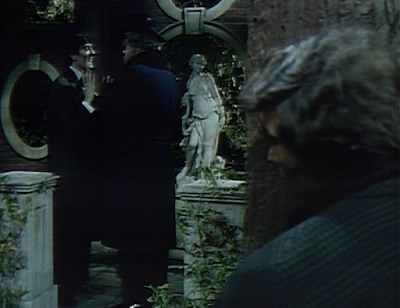
The rakish Quentin Collins has lost his hopes of being cured of werewolf-ism, and is moping in the gazebo on the grounds of the estate of Collinwood. He is staring at a revolver, trying to talk himself into committing suicide. He hears two men approaching, and takes cover in some nearby bushes. The men are known to Quentin by the names “Aristide” and “Victor Fenn Gibbon.”* The set is so small that the actors are only a few feet away from each other, but we are supposed to believe that Quentin can’t quite hear what Aristide and Fenn Gibbon are saying. So when the camera is placed at Quentin’s point of view, Michael Stroka and Thayer David vigorously mime the act of talking.

Quentin listens in from a great distance. Screenshot by Dark Shadows Before I Die.

Quentin sees Fenn Gibbon slap Aristide’s face. Aristide responds, not with violence of his own, but with a continuation of the talking he had been doing before, showing Quentin that Fenn Gibbon is Aristide’s boss. The other day, Aristide tied Quentin to a table and tried to kill him by reenacting Poe’s “Pit and the Pendulum,” so this tells Quentin that Fenn Gibbon is his deadly enemy.

We hear some of Aristide and Fenn Gibbon’s dialogue. Fenn Gibbon and Aristide are based on Gutman and Wilmer from The Maltese Falcon. In their previous appearances, Aristide has been eager to connect with every attractive young woman he sees, suggesting that we would not see the strong suggestions of a sexual relationship that come with Gutman and Wilmer both in Dashiell Hammett’s 1930 novel and the 1941 film. But today, Aristide’s unshocked reaction to Fenn Gibbon’s slap shows that he is accustomed to robust forms of physical contact with him, and when Fenn Gibbon tells Aristide that “I’m aware of your charms, my dear Aristide, but I know only too well conversation is not among them,” we can see that there is going to be a substantial gay subtext.

Fenn Gibbon is one of two roles Thayer David plays today. He appears in the opening teaser as broad ethnic stereotype Sandor Rákóczi, husband of the even more offensively conceived Magda. Yesterday, Magda was placed under a curse. At that time, the curse was that everyone who loved Magda would die, but today it is that everyone she loves will die. When Magda talks about the curse with visiting vampire Barnabas Collins, he says that he is under the same curse, which is exactly true- in #705, he was told that everyone who loved him would die, and from the next episode on it was said that everyone he loved would die. Whichever way the curse is put, one would expect it to strike terror in Magda’s heart regarding Sandor. They are a happily married couple, the only one we ever see on Dark Shadows, and so one would expect him to be the first victim of the curse.

The curse was supposed to start when Magda heard three knocks on the front door of her home, the Old House at Collinwood. She hears the knocks, opens the door, and sees Sandor. She immediately falls into the same pattern she exhibits every time she sees Sandor, accusing him of infidelity, accusing him of coming back to her only because he has run out of money, telling him not to bother to lie to her, and generally having a wonderful time. But he is standing rigidly still, his eyes are glazed over, and he can speak only a few words, none of them the usual insults they exchange. He falls dead, a knife in his back. Barnabas touches his body, and says that it is cold, as if he had been dead a long time.

Later, Magda goes to Mrs Fillmore, a woman in the village of Collinsport. Quentin’s late wife Jenny was Magda’s sister. Unknown to Quentin, Jenny gave birth to twins after he left her, and his brother Edward decreed that the twins would be raised by Mrs Fillmore. Magda has never seen the twins, but she loves them nevertheless- the boy twin, anyway; she tells Barnabas that “Gypsies do not prize girls.” When she comes back to the Old House, Magda tells Barnabas and Quentin that the boy twin is dead. Mrs Fillmore said he was perfectly healthy that evening, then she heard a mysterious scream from the children’s bedroom and she found him dead in his crib. His body was cold, as if he had been dead a long time. Quentin is numb, bewildered to learn that he was a father and simultaneously to learn that he has outlived his son.

There have been other episodes in which an actor played one character as a living being and another as a ghost. There have also been episodes that jumped between two periods in history, and in those there were actors who played one character in one time frame and a different one in the other. Thayer David’s doubling as Sandor and as Fenn Gibbon makes this the first episode in which the same actor plays two living beings contemporary with each other in the same episode.

Sandor’s death and Fenn Gibbon’s ascent to prominence mark a transition in the show. They are in the middle of a bloodbath, killing off a great many of the characters who have defined the first twenty weeks of the 1897 flashback. Previously, that has meant they were getting ready to reset the show and go back to contemporary dress. But 1897 has been such a hit that a transition need not mean a return to the 1960s. There is still enough going on in this period that they can introduce a bunch of new characters, develop some new stories, and get a new phase of Dark Shadows started right here in the late Victorian era. Who knows- if they play their cards right, this period might be the new home base for the show, and the 1960s might be an afterthought.

The contemporary world does make one appearance today. Before their encounter at the gazebo, Fenn Gibbon meets Quentin in the drawing room of the great house at Collinwood. Quentin is studying the Moon. The two of them have a little exchange about Quentin’s fascination with the Moon; considering that this episode aired a few hours after Apollo 11 lifted off on the journey that would put the first crew on the Moon, that fascination must have been pretty widely shared by the original audience.

*In this episode, everyone says “Fenn Gibbons,” which we have heard before. But the credits read “Fenn Gibbon,” so I’m sticking with that version.

Episode 794: The hand doesn’t always bring out the best in people

Soap operas usually have at least one set representing a public gathering place where characters can meet one another unexpectedly. By this point in the development of Dark Shadows, the population of its universe is so heavy with monsters and witches that unexpected meetings usually take place in graveyards, or basements, or out in the woods someplace. But for the first seventy three weeks of the show, one of the most important meeting places was a tavern called The Blue Whale, and as the bartender Bob O’Connell was a significant, though almost always silent, presence.

The Blue Whale has been mentioned occasionally since those days, most recently in #704, shortly after vampire Barnabas Collins traveled back in time to the year 1897. Today is the first time we visit the Blue Whale in the 1897 segment, and the first time we have seen Bob O’Connell as the man pouring since #439, when Dark Shadows was set in the 1790s. In those days, the tavern was called The Eagle and O’Connell’s character’s name was Mr Mooney.

When we arrive at the tavern today, there is only one customer, a young man sitting at a table. When the bartender sets a drink in front of him, he orders a Chartreuse. The bartender moves to take the drink he has just served, apparently thinking the young man changed his mind, but the young man explains that he is waiting for someone else. This man, a heavyset fellow with gray side whiskers, enters a moment before the bartender brings his liqueur.

The bartender wonders if Aristide still wants the drink he originally ordered. Screenshot by Dark Shadows Before I Die.

The younger man is known to returning viewers as a knife-wielding criminal named Aristide, the older as his master, who calls himself Victor Fenn Gibbon. The two urgently discuss a woman named Angelique. Fenn Gibbon tells Aristide that he can almost forgive him for being so distracted by Angelique’s beauty that he allowed her to take “the Hand” from him, and furthermore that she appears to have magical powers. He says that he showed forged papers to one Edward Collins, and that on the basis of those papers Edward concluded that he was “a member of the British aristocracy” and invited him to stay at the great house on the estate of Collinwood. Aristide will have to stay in the village of Collinsport, since Fenn Gibbon does not want their association to become known to the Collinses. Aristide is bitterly disappointed.

This will remind longtime viewers of seagoing con man Jason McGuire and his sidekick, dangerously unstable ruffian Willie Loomis. Jason turned up in March 1967 with a sinister plan and soon took up residence as a guest at Collinwood. Shortly afterward, Willie joined him. At first Jason insisted Willie stay in town. He made that insistence while sitting at virtually the same spot Fenn Gibbon and Aristide occupy today, and Willie reacted with the same disappointment Aristide shows when he was told to stay in a flophouse when his co-conspirator was to be a guest in a mansion.

When Fenn Gibbon tells us that the letters he showed Edward were forgeries, he raises the question of his real name. He seems to have a whimsical sense of humor, and a double barreled name that sounds like a species of small ape found in a peat marsh would appeal to someone trying to test the credulity of an American impressed by the naming conventions of the British upper classes. And indeed, returning viewers know that Edward lacks a sense of humor, is quite a snob, and displays all the tell-tale signs of a hopeless case of Anglophilia.

A small young woman takes her place at the bar. Fenn Gibbon recognizes her as of Romani extraction. He becomes agitated and leaves, but directs Aristide to get to know her. Aristide, whom returning viewers saw meet with misfortune when he tried to pick up Angelique, gladly complies. She responds to his initial approach with a flat declaration that she isn’t interested, but when he mentions the other Romani people in the area, she perks up. She gives her name as Julianka, and asks if he knows a woman named Magda. He says he has met her.

This will intrigue returning viewers. The other day, Aristide robbed Edward’s brother Quentin of the legendary “Hand of Count Petofi,” a severed appendage which broad ethnic stereotype Magda Rákóczi had stolen from Romani chieftain/ organized crime boss King Johnny Romana and which she plans to use to lift a curse she had placed that made Quentin a werewolf. When Quentin told Magda what had happened, he described Aristide only as a “young man.” If Magda really has met Aristide, Quentin’s reticent reply would have cost him an opportunity to help Magda figure out who her enemies really are.

Whether or not Aristide has met Magda, he does know where she lives. He escorts her to the grounds of the Old House at Collinwood. He does not offer to accompany her into the house, but asks her to meet him later at the Blue Whale. As Angelique had responded to Aristide’s overtures by choking him within an inch of his life, Julianka responds to them by drawing a dagger. Aristide just doesn’t have game.

After Aristide parts from Julianka, the werewolf pounces on him. He is about to be devoured when Fenn Gibbon shows up. The sight of pretty little Julianka drove Fenn Gibbon away in a barely concealed panic, but the werewolf doesn’t scare him a bit. He talks calmly to the werewolf, and says that he has orders for him. The werewolf docilely complies. This would be a much bigger surprise if the werewolf were not an adorable little doggie wearing a tidy suit with a watch fob, but it still sends the message that Fenn Gibbon has very extensive powers.

In the Old House, Julianka meets Barnabas. She says that she can use the Hand of Count Petofi to cure Quentin. She also says that Magda’s husband Sandor is in Montreal. This point will be of interest to regular viewers. We haven’t seen Sandor since #750. We may well have been wondering whatever happened to him. We are particularly likely to have been wondering about that this week, since Thayer David, who plays him, is playing Fenn Gibbon. They don’t usually double actors within a time period, and so Fenn Gibbon’s introduction might have suggested they wanted us simply to forget about Sandor. If they are going to take the trouble to tell us he is in Montreal, perhaps we can hope he will return before long, and simply not share scenes with Fenn Gibbon.

Barnabas is in a glum mood. He always is, more or less, but especially so when he has had to deal with Angelique. She told him earlier that she has moved on from her centuries-long fixation on him and now wants to marry Quentin. Barnabas responds with disbelief, declaring that the only reason she would do that is to spite him. Since her obsession led her to turn him into a vampire and kill everyone he ever loved, you can see that Barnabas would have mixed feelings when she tells him that she is looking for a fresh start. On the one hand, it suggest the possibility that he might achieve some kind of freedom. But he’s still a bloodsucking ghoul, his sister and mother and true love and uncle and aunt and countless others are still dead, and the person behind all that doesn’t even care about it anymore.

My wife, Mrs Acilius, points out that it is only appropriate that Angelique made Barnabas a vampire. Angelique too is phenomenally selfish, and whatever she creates becomes a replica of herself. So of course her greatest achievement is to turn a man into a metaphor for extreme selfishness. Barnabas’ selfishness tempers his rage at Angelique’s news; when Julianka comes to him, he is deep in thought, no doubt brooding about what it all means for him.

In his post about this episode at Dark Shadows Every Day, Danny Horn shows that the relationship between Fenn Gibbon and Aristide is modeled on that between Gutman and Wilmer in The Maltese Falcon, and he and his commenters demonstrate that that novel and its 1941 film version included explicit hints that Gutman and Wilmer were occasional sex partners. Aristide has been so eager to connect with the ladies that it’s hard to see much gay subtext between him and Fenn Gibbon so far, but it’s early days for them on the show. Moreover, the echo of Jason and Willie reminds us of the hints the show dropped that those two had shared more than a firm handshake at some point in their seafaring days. The original series bible and the early drafts of the first scripts had referred to The Blue Whale as “The Rainbow Bar”; maybe Aristide and Fenn Gibbon are destined to bring that name back.

Episode 750: Hold back the night

Magda at Jenny’s grave. Screenshot by Dark Shadows Before I Die.

The name “Magda” was first mentioned on Dark Shadows in #642, broadcast and set in December 1968. At that time, the residents of the great house of Collinwood had noticed unaccountable goings-on, and as they often do they held a séance to appeal to the spirits of the dead for guidance. The spirit they reached in that one identified herself as Magda. She repeated two things- “My curse!” and “He must not return!” Magda said enough to suggest that she had cursed someone and regretted doing so, and that she knew that the Collinses were threatened by the return of someone from her own period, but that was all. Since the Collinses of 1968 had never heard of anyone associated with their house named Magda and could find no record of such a person, those suggestions remained vague and useless to them.

They meant a good deal more to regular viewers. We already knew that the malign ghost of Quentin Collins had appeared in a room in the long-deserted west wing of the great house, that children David Collins and Amy Jennings were falling under the ghost’s influence, and that Quentin lived at Collinwood near the end of the nineteenth century. We therefore assume that Quentin is the one who “must not return!,” and that Magda, whoever she was, must have known Quentin and therefore also have lived sometime in the 1890s.

Among the participants in the séance was Amy’s older brother, mysterious drifter Chris Jennings. Chris broke the séance off before Magda could go into enough detail to help the others. The show had long since established that the person who ends a séance prematurely is the one who harbors a dreadful secret that the voice from beyond might uncover. Even the characters have caught on to this pattern; they treat Chris with suspicion. They do not know what we do, that Chris is a werewolf. So he is indeed under a curse, and we can take it that his curse originated when Magda placed it on one of his ancestors.

Over the next few months, Quentin’s power steadily grew, and at the same time Chris’ periods in his animal form grew longer and more frequent. These two developments moved in such close tandem that we had to suspect that there was some causal relationship between them. This suspicion was reinforced when, in #683, another ghost associated with Quentin, that of a tall, thin, blonde woman named Beth, led Chris to what proved to be the unmarked grave of an infant. That infant was wearing an amulet meant to ward off werewolves. The records of the silversmith who made the amulet showed that it was commissioned and paid for in 1897 by Quentin Collins and Beth Chavez. Thus we learned that a werewolf was active in the area of Collinwood when Beth and Quentin were alive, and that they cared about a baby who died at that time. The logical inference would be that the curse under which Chris labors originated at that time, that Beth and Quentin had something to do with it, and that the baby was related to someone who became one of Chris’ ancestors.

Now, the show has become a costume drama set in 1897. Quentin and Beth are alive. Beth is a maidservant who first came to Collinwood in the train of Quentin’s estranged wife, Jenny. Quentin left Jenny and was banished from the house the previous year; word was put about that Jenny responded to the desertion by going away and leaving no forwarding address. When Quentin returned to Collinwood in #701, he was surprised to find Beth still on staff, and he set to work trying to seduce her.

In #720, Quentin discovered that Jenny had not in fact gone so far away as he and everyone else had been led to believe. She turned up and stabbed him. He then learned that Jenny had become violently insane when he left her and that his sister Judith and brother Edward had responded to her illness by locking her up in a room hidden inside the great house. They kept Beth in their employ because she was the one entrusted to care for Jenny.

Now, Beth has given in to Quentin’s charms. The other night Jenny was hiding in Beth’s room while Beth and Quentin shared a tender moment, and she reacted by coming at them with a knife. Quentin disarmed Jenny, restrained her, and then put his hands around her throat. While Beth pleaded with him to stop, he choked Jenny to death. He keeps protesting that, because Jenny at one point had a knife, this was an act of self defense, but the audience and Beth both saw what happened, and she won’t agree with him any more than we will.

Edward and Judith have decided to shield Quentin from the legal consequences of his actions, and in the village of Collinsport the will of the Collinses supersedes the laws of the state of Maine. But Quentin finds no comfort in his immunity from criminal prosecution. Just hours before he murdered Jenny, Quentin discovered that he knew nothing about her origins. He thought she was some kind of Anglo, but she was passing. She was actually a Romani woman. Her sister is one of the neighbors, broad ethnic stereotype Magda Rákóczi.

In Wednesday’s episode, Edward convinced Magda the police and courts would do nothing to punish Quentin, and so Magda threatened to place a curse on him to avenge Jenny’s death. Edward, a rational-minded modern man, dismissed Magda’s threat as “words.” But Beth and Quentin know things about the universe they occupy that Edward does not know. When Beth heard Magda’s threat, she looked wide-eyed at Quentin, walked backwards away from him, and ran off. Quentin, who is obsessed with the occult, was immediately terrified, and has been dissolving into a puddle ever since.

Yesterday, Quentin fell into a trap Magda set for him and brought a curse upon himself. Today, Magda stands with her husband Sandor by Jenny’s grave, watches the full Moon rise, and recites an incantation specifying that Quentin’s male descendants will suffer from the same curse he does. So far as Magda knows, Quentin does not yet have any descendants, male or female, and so that proviso is just an abstraction for her.

We know more than Magda does. Not only have returning viewers heard her spirit say that she regrets the curse and been led to the conclusion that it fell on Chris Jennings, but even those who are watching the show for the first time today know that Quentin and Jenny are the parents of twin infants whom Judith is paying a Mrs Fillmore to raise in her home in the village of Collinsport. Mrs Fillmore’s name was first mentioned in #707, and it comes up today when Judith is firing Beth.

Judith explains to Beth that, since Jenny is no longer around, she no longer has any work to do at Collinwood. She indicates her dissatisfaction with Beth, and says that it is only through Edward’s influence that she included a severance payment with her letter of dismissal. Beth mentions her task of taking money to Mrs Fillmore to pay her for taking care of Jenny and Quentin’s children; Judith does not see a need to retain an employee simply to carry an envelope full of cash to the village every now and then.

Beth objects that Judith is terminating her employment because she has become involved with Quentin; Judith takes that as an opportunity to castigate her for the impropriety of that relationship. Joan Bennett plays Judith’s reaction to Beth quite effectively; in a comment on Danny Horn’s post about the episode at Dark Shadows Every Day, “Rev Velveteen” writes:

I wanted to mention a Judith Collins, er, Joan Bennett acting moment I found particularly entertaining here. When she’s giving Beth the boot and the servant attempts to “innocently” inquire as to why she’s being let go, Judith turns around and gives her SUCH a look! Huge eyes, a stifled gasp, then bright pursed lips…Her expression goes from incredulous (Are you freaking KIDDING me?) to amused (Just how stupid does she think we are?) to triumphantly satisfied (Fine, we shall just both play out this little charade and I’ll soon be rid of you.) Her chin goes up as she turns away snarkily-“Let’s just say that now Jenny’s gone, your services are no longer needed,” which everyone on and off screen knows is a total lie. It’s such a sweet piece of work by Ms. Bennett, I need to keep an eye out to see if she repeats that expression because it just sums up the whole character of any Collins she plays when as the perpetual straight man, she’s faced with yet another absurd situation. And is also just stunning in that gorgeous green dress.

Comment left by “Rev Velveteen” at 12:43 am Pacific time, 25 June 2020, on Danny Horn, “Episode 750: Gypsy Ascendant,” 18 October 2015, Dark Shadows Every Day

Yesterday, Judith gave the penniless Quentin $10,000 on condition that he leave Collinwood forever and induce Sandor and Magda to do the same. Quentin had hoped to use the money to bribe them into forgoing Jenny’s vengeance, but they only pretended to take it to lure him into bringing the curse on himself. Magda contemptuously threw the cash at him after he did so.

Quentin has told Judith that Magda took the money and agreed to go. Today, Magda comes to the house to ask for Jenny’s things. Judith starts in with lecture about how she must go at once, since she and Sandor have been paid so well to leave, and Magda reveals that she did not take the money. Enraged at Quentin’s childish lie, Judith demands he return the $10,000. He tells her to sue him, and stalks off. Judith fumes, knowing that she has been cheated and that she cannot assert her rights without creating the public scandal that she fears above all else.

Quentin finds Beth packing Jenny’s things. He tells her he has to leave tonight, and announces that she will be coming with him. She responds in a mild tone that she doesn’t seem to have any say in the matter. She tells Quentin that she has lost her job, and says that she will give him her decision in the afternoon.

Sandor comes for Jenny’s things. Quentin offers him the $10,000 all for himself if he can lift the curse. He says he doesn’t know how. Quentin says he will give it all to him if only he will tell him what form the curse will take. Sandor shakes his head at Quentin’s desperation and says that knowing that would be of no benefit to him.

As night falls, Quentin goes to Beth’s room. She agrees to go with him, but insists on running a personal errand first. Even though she just told him that they have to be honest with each other, she will not tell him what it is. She is still honoring Judith and Edward’s decree that Quentin must not know that Jenny gave birth to his twin children after he left her, and that they are in Mrs Fillmore’s care.

Quentin keeps saying there is no time left to do anything but run. We might wonder why he didn’t stop by Beth’s room earlier. She is on her way out the door when Quentin cries out and collapses in severe pain. Regular viewers recognize Quentin’s pains as the same Chris had when he turned into a werewolf. When we see the rising moon and hear the baying of the hounds, we know who Chris’ forebears are, and why Magda came to regret her curse.

Episode 749: The kiss of death

In the parts of Dark Shadows set in the 1960s, Louis Edmonds plays Roger Collins, younger brother of matriarch Elizabeth Collins Stoddard. In 1966 and 1967, we saw that Roger had squandered his entire inheritance. He was reduced to living as a guest in Liz’ house and working as an employee for her business. Roger was the show’s first villain. His villainy was confined to a storyline known as “The Revenge of Burke Devlin.” That story never really caught on, and by #201 even Burke Devlin had lost interest in it. Roger receded to the margins, and for the rest of the series Edmonds’ gift for sarcastic dialogue kept the character alive as occasional comic relief.

From November 1967 to March 1968, Dark Shadows was a costume drama set in the 1790s. Edmonds, a costume drama specialist in his years on Broadway, came into his own as haughty overlord Joshua Collins. Joshua’s focus on moneymaking and his determination to preserve the glamour of the Collins family name at all costs placed him at the opposite pole from Roger, a blithe spendthrift pathologically lacking in family feeling. Joshua used his power to cover up all of the tragic and horrible events we saw in the 1790s segment, and imposed a false history in its place.

Now, the show is set in 1897. Edmonds plays Edward, the stuffy eldest brother of the adult members of the Collinses of Collinsport. Edward has Joshua’s imperious demeanor and his determination to conceal the family’s disgraces, but like Roger he finds himself penniless, dependent on his sister’s largess. Yesterday he learned that his youngest brother, libertine Quentin, had killed his estranged wife Jenny. So far, Quentin has been a breezily amoral wastrel, easily recognizable to longtime viewers as a kindred spirit of his great-nephew Roger. But Quentin shocked himself when he murdered Jenny, and he had a terrified look on his face as he tried to sneak out of the house afterward.

Edward intercepted him then and forbade him to go. Edward had learned from Quentin’s girlfriend, Jenny’s former maid Beth, what happened. Edward was in a high dudgeon about the mess Quentin had made, but did not seem particularly surprised or at all grieved. He was quite confident he would be able to hush the whole thing up, and fabricated a story about Jenny falling down the stairs and dying shortly after from a head injury.

What did shock Edward was Quentin’s revelation that Jenny was the sister of one of the neighbors, Magda Rákóczi. Magda is a member of the Romani people, an ethnicity against whom Edward and the rest of the Collinses are violently prejudiced. “You married a Gypsy!” he exclaims in utter disgust. He remained convinced that he could keep the whole thing quiet, and drilled Beth and Quentin in the lies they were to tell Magda and her husband Sandor.

Magda did not give Edward a chance to direct the little play he had written. She found physical evidence indicating Quentin had murdered Jenny, and accused him. When she threatened to go to the police, Edward asked her what she imagined the authorities would do when asked to choose between the word of a Collins and the word of a “Gypsy.” At that, Magda dropped her plan to go to the police and vowed to place a curse on Quentin. Edward dismissed that as “words,” but Quentin is deeply involved in the occult. He is helpless with fear.

Today, Edward calls on Quentin in his room. He finds that Quentin has not slept all night. He continues to regard Quentin’s fear of Magda’s curse with total contempt, but perks up when Quentin says that he has thought of a way to escape it. Returning viewers already know that there is one way wide open to Quentin to escape the curse. He can go to the police and confess that he murdered Jenny.

This, of course, is not Quentin’s idea. He wants to offer Magda $10,000. Neither he nor Edward has that kind of money, but their sister Judith, whom their grandmother chose as her sole heiress, does. Edward says that he might be able to persuade Judith to give him that sum on one condition. Their grandmother’s will left Quentin no property or income, but it did guarantee him the right to live in the great house of Collinwood as long as he might wish. If he will sign documents renouncing that right, Judith might give him the money.

Edward embarrassed by Quentin’s craven mewling. Screenshot by Dark Shadows Before I Die.

Quentin drifts off to sleep. He has a nightmare. Sandor and Magda show him Jenny’s body and tell him he can escape punishment if he blesses it. He does so, and Jenny comes back to life. She asks for a kiss. Quentin gives it, and Magda and Sandor laugh. They say that the kiss has sealed his fate- it is “the kiss of death!”

Edward returns with word that Judith will give him his $10,000, but that she has added a condition. Not only Quentin, but Sandor and Magda too, will have to leave the area forever. Quentin promises to make that happen, and signs the papers.

Meanwhile, Magda and Sandor are at home in the Old House on the grounds of the estate. Magda has mixed a potion and told Sandor that “a very old Gypsy woman” once used it to place a terrible curse on someone called “Count Petofi.” All they have to do is trick Quentin into drinking the potion, and the same curse will befall him. Sandor disdainfully replies that he had thought Magda might have come up with a plan that had a chance of working. He can’t imagine Quentin drinking anything they might give him.

They look out the window, and see Quentin coming to the house. They are pleasantly surprised that he is delivering himself. He knocks. They open the door, and he bursts in. Magda makes a great show of telling him he is not welcome and demanding he leave. He tells them about the nightmare, and says he knows that it is part of the curse. He offers them money to lift it. Magda is at first openly offended, while Sandor behaves as if he is tempted. Quentin shows them the money, and Magda plays the part of a woman succumbing to greed. She asks Jenny’s spirit to forgive her, and takes the envelope. She makes a gesture that Quentin takes to be an act of spellcasting. While she counts the money, Sandor says they will have to share a drink to complete the deal. Quentin happily agrees.

Once Quentin has taken the drink, Magda tells him that he has been fooled. The nightmare was not part of any curse, but was simply the voice of his own conscience. She tells him that the drink brought the curse on him, and that he will begin to suffer its effects tonight. She throws the money at him and tells him to take it. He reels away, dazzled by the horror of it all.

Magda’s curse shows the limits of the Collinses’ power. Their prestige and connections enable them to intimidate the authorities so that they need not worry about an insistent police investigation. But their freedom from that concern has allowed Quentin to travel so far into depravity that he has committed murder and brought a curse upon himself. When they encounter someone who will not be intimidated, their only recourse is to money. Magda’s unwillingness to sell her sister’s vengeance for any number of dollars means that the rich Judith would be as powerless against her as are the impecunious Edward and Quentin.

Not only has the Collinses’ station led Quentin to indulge himself in one vice after another until he is so far gone he cannot imagine good behavior, it has led him to assume that everyone assigned to a humbler place in the world can be bought. Sandor and Magda are quite good actors, almost as good as Thayer David and Grayson Hall, and they look very much like people who are tempted to take the bribe Quentin is offering. But even to make the offer shows a complete lack of perspicacity. Jenny has not been dead for twenty four hours, and he somehow supposes her sister is ready to bargain away her memory.

Quentin cannot say he wasn’t warned. His dream told him that Magda and Sandor would trick him into bringing the curse on himself by leading him to believe they were giving him a way to escape the curse. He is so far gone in the symptoms of his over-privileged background that he cannot even interpret this message. Thus we see that the real curse of the Collinses, the obstacle that blocks the sunlight and casts all the dark shadows that shroud them, is their wealth and power. The first ten months of the show made some feints towards developing a social drama about the relations between the Collinses in their house on the hill and the working people in the village below. The village is mentioned nowadays only as a source for victims of the various monsters bred at Collinwood, but the price everyone pays for the Collinses’ exalted position is always front and center.

Episode 748: Here in the past

Madwoman Jenny Collins is hiding in the quarters of her formerly devoted servant, Beth. Beth enters with Jenny’s estranged husband, libertine Quentin. Jenny eavesdrops as Beth tearfully tells Quentin that she was once very close to Jenny, but that now she wishes her ill, because she is in love with him. Quentin and Beth embrace, and Jenny lunges at them with a kitchen knife.

Quentin disarms Jenny and strangles her. We were introduced to Quentin as a murderous ghost haunting the great house of Collinwood in 1969, and when we first came to the year 1897 to meet him as a living being it was a matter of minutes before he was squeezing his grandmother’s throat and threatening to kill her. Quentin has been going around the house announcing for days and days that he plans to kill Jenny, so it comes as no surprise to the audience that he puts his hands around her neck even though she has already been disarmed, fights off Beth’s attempts to stop him, and keeps choking Jenny until some time after she has stopped moving. We have been well-prepared for this unambiguous image of intentional homicide.

Once Quentin has finished his work, he runs out of the room. Beth goes to the foyer and, between sobs, tells Quentin’s stuffy brother Edward that Jenny is in her room, dead.

In Beth’s room, Edward feels Jenny’s wrist and says that she is indeed dead. Once Beth has given him a few of the salient details of the murder, he declares that he has heard enough. He orders Beth to take the knife back to the kitchen and put it where it belongs. They talk briefly about Jenny and Quentin’s children, whose existence has previously only been hinted to the audience and has been denied to other characters as recently as yesterday.

We cut to the foyer. Quentin comes creeping down the stairs, holding a bag and looking from side to side. When Quentin reaches the foot of the stairs, Edward seizes the bag and orders him to stay in the house. In the drawing room, Edward tells Quentin and Beth what story they will put about to cover up the murder and save the family name. Beth is to say that she found Jenny lying at the foot of the stairs, stunned. She helped Jenny to her room, then left her there for a moment while she went to look for help. Finding no one, she came back and saw Jenny lying on the bed. When she could not wake her, she realized she had died of the injuries she sustained in her fall.

Quentin says that the story will not work. He tells Edward that earlier in the evening, Jenny’s presence at Collinwood was revealed to three more people, distant cousin Barnabas Collins and ethnic stereotypes Magda and Sandor Rákóczi. Edward says that as a member of the family, Barnabas will not question the story, and that as “Gypsies,” Sandor and Magda will do anything in return for money. Quentin says that Magda and Sandor will not be so easy to deal with. When they learned that Jenny was in the house, Magda told Quentin something which he tells Edward and Beth “None of us ever knew,” that Jenny was her sister.

Edward is thunderstruck, and exclaims “You married a Gypsy!” Yesterday it seemed that Edward and Quentin’s sister Judith, the owner of the house, had known Jenny’s origin for some time, and that it was why she locked Jenny up in the house when she went insane rather than sending her to a mental institution where Sandor and Magda might be among her visitors. And as far back as #701, it seemed likely that Beth knew secrets relating to Jenny, to Magda, and to Romani heritage. In that episode, Quentin marveled that Beth was still around Collinwood when Jenny, who had brought her to the house as her servant, had left, and Magda taunted Beth by bringing up a bit of Romani folklore and laughing “But you wouldn’t know anything about that, would you?” So while Jenny’s background is news to Quentin and Edward, it may not be true that “None of us” knew.

Magda and Sandor come to the house. On their previous visits to the great house, they have acted like servants or like stage Gypsies come to tell fortunes and sing songs. But now that the word is out about Jenny’s true identity, they come in with their heads up and look Edward in the eye. They say that they have come to see Jenny. Edward turns away from them, and says that there has been an accident. Jenny is dead. Horrified, Magda asks where she is. Edward says that she is in Beth’s room, and offers to have Beth show them the way. Magda says that she knows where it is, and that she and Sandor want to go by themselves. Edward says “Of course,” very much in the tone a gentleman uses with his equals.

In the room, Magda notices that Jenny is holding a button in her hand. She concludes that she pulled it off the coat of a man with whom she was fighting for her life. Sandor notices heavy bruising around her neck.

Meanwhile, Edward is drilling Beth and Quentin in the stories they are to tell. Beth recites the whole thing, and he tells her to remember every word. Quentin is less cooperative, but still seems to have learned his part. He tells them not to speak until they are spoken to.

Sandor and Magda enter. She asks some questions; Edward answers, and shows offense when she tries to direct them to Beth. Before he can proceed to the next act of the little drama he has prepared, letting first Beth and then Quentin corroborate his account with the stories he has given them, Magda looks at Quentin’s coat. She can see that a button is missing and that the ones that remain match the one she found in Jenny’s hand. She calls him a murderer, and says that the police will hear of it.

Edward says that Quentin might have lost the button anywhere at any time. He asks her what the authorities in the village of Collinsport would do if asked to choose between a Romani person’s word and that of a Collins. Magda drops the idea of going to the police, and tells Quentin that she will place a curse on him that will make him suffer as Jenny suffered, but that his suffering will not be subject to the release that death has brought Jenny. Quentin is terrified, Edward dismissive.

Magda tells Quentin she will curse him. Screenshot by Dark Shadows Before I Die.

From the very beginning, one of the main themes of Dark Shadows has been denial, the psychological defense mechanism. In this one, we see that denial is, among other things, the wish that time would stop moving forward. Quentin says that he is not going to go to jail for something he did not mean to do. He obviously did mean to kill Jenny, but he does not want to accept any of the consequences that follow from that act. He wants to be frozen in his comfortable, carefree life, without punishment from the law or vengeance from Magda. Edward wants the family name to be frozen in the lofty regard in which it was held before Quentin murdered Jenny.

For her part, when Magda tells Quentin it will not be possible for him to die, she is promising to give him and Edward what they want, but not in the way they want it. A curse is a way of freezing time. The suffering it brings persists, unchanged, from year to year. It cannot be explained, it cannot be escaped, it falls on one person after another whatever their deserts. Its only logic is to renew itself endlessly.

Episode 745: What I am is what I will be

Broad ethnic stereotypes Sandor and Magda Rákóczi are in the parlor of their home, the Old House on the great estate of Collinwood, quarreling about a locket. Shortly before, Magda found maidservant Beth Chavez and libertine Quentin Collins in the parlor, and she noticed Beth snatch a locket from a table and try to hide it. Beth claimed that the locket was hers, but Magda declared that it was not, and that she knew who it really belonged to. Now Beth and Quentin have left, Magda has the locket, and Sandor is pleading with Magda to stop trying to figure out what it means that the locket is in the house. “She is far away!” he protests.

Returning viewers know that the locket belongs to madwoman Jenny, Quentin’s estranged wife. Unlike Magda, we also know that Quentin’s brother and sister, with the assistance of Beth and another servant, have been keeping Jenny prisoner in a series of cells deep in the great house ever since Quentin left her the previous year. Yesterday Jenny had a strong reaction to Magda’s name, in the course of which she started muttering about Sandor as well, hinting that the Rákóczis are of some importance to Jenny.

Sandor and Magda hear a voice from an upstairs bedroom. They go there, and are astonished to find Jenny. They ask her where she went when Quentin left her; she denies that Quentin ever did leave her, and talks about being locked up in a room. It dawns on Magda and Sandor that the Collinses locked Jenny up in the house and have been keeping her there. Jenny angrily says that yesterday she was horrified when Sandor and Magda’s caravan pulled up at the home she and her husband share, and that she told them never to speak to her again; they tell her that happened years ago. She is shocked and disbelieving.

Sandor and Magda are distressed by Jenny’s madness. Screenshot by Dark Shadows Before I Die.

Jenny sneeringly calls Magda and Sandor “Gypsies.” Magda replies “You are a Gypsy, too.” Jenny replies that “What I was is not what I am.” After a few more moments, Magda and Jenny embrace and Magda calls her sister.

The revelation that Jenny is Magda’s sister is one of the most effective twists in the whole series. When Mrs Acilius and I first watched the show through, we were thunderstruck by it. The most amazing thing is that it makes so much sense we couldn’t believe we hadn’t figured it out. The Collinses have disdain for Jenny, not only because their black sheep brother brought her into the family, but also because she is of obscure birth. So when she became mentally ill, why didn’t they just ship her off to an institution and have done with it? The answer is racism. They are not simply embarrassed that Quentin chose an unsuitable wife; they are frozen with horror that a Romani person now bears their family name. They cannot take the chance that anyone, even the staff of a discreet, high-end sanitarium, will learn of this shame, and so they hide her away in their own house.

In #701, the first episode of the part of Dark Shadows set in the year 1897, it was established that Beth came to Collinwood as Jenny’s maid and that it is surprising she stayed after Jenny ceased to be a visible member of the family. In the same episode, Magda mentioned some Romani folklore to Beth, said, “But you wouldn’t know anything about that!,” and laughed tauntingly while Beth looked alarmed. The implication that Beth has been trying to conceal her own Romani heritage, combined with her association with Jenny, was something else we were surprised we didn’t pick up on the first time through the show. Perhaps that is because of the visuals. As Sandor and Magda, Thayer David and Grayson Hall wear heavy brownface makeup and dark curly wigs. As Beth, the tall, wasp-waisted Terrayne Crawford has her own light blonde hair, pale skin, and blue eyes. So it was easy to take Magda’s line as a reflection of something that was in the flimsies months before they cast the part of Beth Chavez with an obviously Anglo actress, and to assume that we would never hear of it again.

There are some flaws on screen today. Early on, Quentin walks in front of a green-screen with a picture of the Old House, and it is ludicrously fake even by the standards of special effects on Dark Shadows.

The real house in this photo burned down about this time, perhaps because it couldn’t stand the disgrace of having appeared in this shot. Screenshot by Dark Shadows Before I Die.

Later, there are three goofs in thirty seconds. Sandor leaves Magda alone in the room with Jenny. Jenny is supposed to slam a book down on Magda’s head to stun her, but we can clearly see that the book sweeps through a space several inches to Magda’s left. When Magda falls and Jenny runs out, Sandor isn’t supposed to see Jenny, but the two of them are on screen together and their shoulders actually brush against each other. Once downstairs, Jenny is supposed to try the front door, find it locked, and look for a hiding place. But when she touches the door, it opens, and she has to pull it shut before she can play her scene about being unable to get out.

Episode 724: There has to be truth to make a story

Ethnic stereotype Magda Rákóczi is at home in the Old House on the great estate of Collinwood when Rachel Drummond, governess to the children in the great house on the same estate, comes to the door. Rachel says that the late Quentin Collins has risen from the dead and attacked her. Quentin was about to bury Rachel in his own disused grave when Magda’s husband Sandor showed up. Sandor fought Quentin, enabling Rachel to escape. Rachel cannot satisfactorily answer Magda’s questions about whether Sandor survived the fight, and Magda will not honestly answer Rachel’s questions about how Sandor knew to come to her aid.

Sandor makes his way back. Magda is overjoyed to see him and throws herself at him with undisguised affection. He responds with his usual grumpiness. At the end, she remembers that they are not alone, and she reverts to their usual form of pretend-quarreling. Their dialogue is great fun, and Grayson Hall and Thayer David make the most of every laugh line:

Magda overjoyed to be reunited with Sandor. Screenshot by Dark Shadows Before I Die.

Magda: Oh, the hero!

Sandor: I am all right.

Magda: Oh, my big, bad, bold hero.

Sandor: Oh, shut up. I cannot hit you. My arm is too sore.

Magda: Oh, what a brave man you are.

Sandor: Yes.

Magda: What a brave man to fight a zombie, a brave, foolish man.

Rachel: He is a brave man. Thank you, Sandor.

Sandor: I don’t like to see a beautiful lady getting buried before her time.

Magda: But you could have been killed.

Sandor: Yes, that at least would have made you cry. Get me some hot water. My wrist is beginning to swell.

Magda: Oh, so now, I have to nurse you. It is better he should have finished you!

Sandor and Magda are the first happily married couple we have seen on Dark Shadows, and this scene shows them at their very happiest. It is not only a good bit of comedy, it is quite lovely.

Rachel is bookish and intellectually ambitious, very much the sort of young lady you might expect to find in charge of the education of the children in a wealthy family in the late Victorian age. She tells Sandor that she cannot accept that Quentin has risen from the dead and is roaming about as a zombie, even though she has encountered as much evidence of the fact as anyone could want. When Sandor urges Rachel to believe what she has seen, she asks what she will have to believe in next- “Ghosts? Witches? Werewolves?” Sandor affirms that he believes in all of those things, and Rachel replies that she cannot.

Well might Sandor believe in such beings. He is under the power of the new master of the Old House, Barnabas Collins, a vampire. Barnabas rises from his coffin in the basement at dusk, when Rachel is upstairs sleeping. Barnabas knows that Angelique, the same witch who made him into a vampire in the 1790s, is controlling Quentin and persecuting Rachel. When Quentin turns up in the basement, Barnabas remembers a ceremony he saw on Angelique’s home island of Martinique that reunited a zombie’s soul with his body and made him once more a living man. He sends Sandor to the attic to retrieve a packet of letters he wrote to his uncle Jeremiah in those days, describing the ceremony.

Jeremiah’s name will jolt longtime viewers. Angelique raised Jeremiah from his grave as a zombie in #393. Over the next five episodes he initially did Angelique’s bidding, then turned on her. They never did tell us that Jeremiah had returned to his grave, in spite of Angelique’s phenomenally vehement exhortations to him to do so. It’s too bad Barnabas didn’t remember these letters then, he might have been able to un-kill Jeremiah.

Or perhaps not. The ceremony is a total failure today, so maybe Barnabas just doesn’t have what it takes to reunite a soul with a body.

When Sandor and Quentin are fighting in the graveyard, we see a tombstone labeled “Laura Murdoch Radcliffe, born 1840.” The Oxford English Dictionary doesn’t have any examples of the phrase “Easter Egg” meaning hidden content of special interest to devotees until 1986, and for that matter this episode aired a few days before Easter began in 1969. So it is doubly premature to call this an Easter Egg. We learned in #181 that a woman named Laura Murdoch Radcliffe died (by fire!) in 1867, with her young son David in her arms; other Laura Murdochs have died that way in other years, and in #187 the residents of the great house decide that Laura Murdoch Collins is likely to take her own young son David to the same fate. The show has been dropping reminders of the Laura story lately, and any longtime viewers who can read this tombstone will appreciate the reference.

I suspect that the original audience for this particular Easter Egg was pretty nearly limited to the set decorators. The inscription is on screen for less than a second, and it is as clear as it is in the capture above for only a small fraction of that time. It’s hard to see even on a modern television; on a 1960s-vintage TV set tuned to an ABC affiliate, many of which had the worst reception in their markets, it must have been totally illegible to something like 99% of the audience. Moreover, it comes at the end of the fight scene, when most eyes were focused on Sandor’s falling figure. Not very many of the few thousand people who might have had a good enough picture to read the inscription would have been looking at it. And most of the audience who were tuning in at this point had joined the show after Barnabas was introduced, the month after Laura went up in smoke, her name unmentioned since. But in the age of streaming and DVDs, we can all appreciate the reference.

Episode 710: The raven and the viper and all the dark creatures

Libertine Quentin Collins has stolen his late grandmother Edith’s will, intending to forge a substitute that will give him control of her vast estate. His distant cousin, the recently arrived and thoroughly mysterious Barnabas, has warned Quentin that Edith’s ghost will haunt him if he persists in this plan. Quentin hears a loud pounding emanating from the walls of the great house of Collinwood. He goes to the study, where Edith lies in her coffin. He sees her there, grinning at him. Quentin returns to his room; the still-grinning Edith sashays in and taunts him. He tells her she is dead; this does not seem to bother her. She just keeps on grinning.

Edith may be dead, but she is clearly having a blast. Screenshot by Dark Shadows Every Day.

Quentin strangles Edith. She falls into an armchair in his room, unmoving but still grinning. He buries her somewhere on the grounds of the estate; her hand sticks up from the earth. He wakes up.

Quentin’s friend, unethical lawyer Evan Hanley, comes calling. Evan asks Quentin to give him the will so he can take it to a forger of his acquaintance. Quentin tells Evan about the dream, and how shaken he is. He also tells him about Barnabas, and his concern that Barnabas is a formidable enemy who may have uncanny powers. When Evan tries to dismiss Quentin’s worries, Quentin responds that he is the last person who should make light of the supernatural. When Quentin speaks of Evan’s “devil-callings,” we learn that the clandestine “meetings” they spoke of the other day are Satanist ceremonies. Evan agrees to meet Quentin at 8:00 that night in the groundskeeper’s cottage on the estate to summon one of the spiritual forces of darkness to fight Barnabas.

Returning viewers know that Quentin is right to fear Barnabas’ connections to the supernatural. Barnabas is a vampire, and his powers include the ability to send hallucinations to torment people with guilty consciences. He is also a time-traveler, who has come to 1897 from 1969 on a mission to prevent Quentin from becoming a ghost who will drive the Collins family of that year out of the great house and plague strange and troubled boy David Collins to the point of death.

First time viewers will not learn that today; aside from the opening voiceover, this episode tells us nothing about Barnabas. It does tell us something about Quentin and Evan. They are super-racist against Romani and Sinti people.

Evan has decided to hire Sandor Rákóczi to forge the will. Sandor and his wife Magda have been staying at the Old House on the estate for some time as Edith’s guests. Quentin’s brother Edward and sister Judith are offended by the presence of these “gypsies” in their midst. Unknown to Evan and Quentin, and unmentioned in today’s episode, Barnabas has bitten Sandor, enslaving him. Presumably Sandor has no secrets from Barnabas, making him a bad choice to be Quentin and Evan’s henchman.

Three times today, Evan addresses Sandor as “Gypsy.” When he is putting it to him that he wants him to forge the will, he barks at him with “Now, one moment, Gypsy.” He insists Sandor fix his price in advance. When Sandor tells Evan he is sad that he does not trust him, he replies “Well, then, be sad, Gypsy, but give me your price, now!” Later, Sandor will express curiosity about Quentin and Evan’s plans, to which Evan will reply “Well, don’t be curious, Gypsy, just do as you’re told.”

Evan told Quentin that the “devil-calling” at the cottage should involve twelve year old Jamison Collins as a “sacrificial lamb.” Quentin sincerely cares about his nephew Jamison, and he protests that he won’t do anything to hurt him. Evan assures him that Jamison will simply be a symbol of the innocence that their dark lord exists to despoil and that the boy himself will not be harmed. When Quentin is talking Jamison into joining him and Evan for a secret meeting that night, he tells him they will look into the future. Jamison asks”How, with a crystal ball?” Quentin replies “No, of course not. That kind of thing is for gypsies. It’s not for men, like you and me.” Scripted television in the US in the 1960s rarely gave such flagrantly racist remarks to recurring characters, not only because the audience included members of minority groups, but also because they are so unattractive that they limit the utility of the characters who make them. In this case, Quentin and Evan are already in league with the Devil, and Quentin is on track to die soon and become a ghost. So we know that they are due for a comeuppance. Moreover, their prejudices may lead them to underestimate Sandor, both on his own account and as a tool of Barnabas, so it is useful to the plot that they are in the grip of such ugly attitudes.

Sandor is in the cottage, preparing to forge a new will for Edith, when Jamison drops in. Jamison does not see what he is doing. He and Sandor spend a couple of minutes sparring verbally. Sandor ends the match when he points out to Jamison that it is getting dark. The boy looks alarmed and runs home while Sandor laughs.

In #701, Sandor and Magda mentioned that the Collinses were afraid of the night. Shortly after, they found out about Barnabas, and learned that they had good reason to be. But Sandor can still laugh when he sees that a boy as old as Jamison runs away at the news that the sun is setting.

Sandor is still in the cottage when Quentin brings Jamison by. Evidently Evan plans to let Sandor participate in the ceremony. Regular viewers will remember that in 1969 the first place Quentin manifested himself outside the little room in the great house where David and his friend Amy discovered him was in the cottage, and that he showed considerable power there. That he and Evan have their Satanic “meetings” in the cottage suggests that the evil he did in 1969 has its roots in what he did during them.

Evan directs Jamison to stare into the fire burning in the hearth. This will ring another bell for longtime viewers. Jamison is played by David Henesy, as is David Collins. From December 1966 through March 1967, David Collins’ mother Laura Murdoch Collins lived in the cottage. She was an undead blonde fire witch, and her plan was to lure David to join her in a fiery death. She would rise from the dead as a humanoid Phoenix, as she had done at least twice before. On each of those previous occasions, she went into the flames with a son named David; the Davids did not rise again, as becomes clear when one of them is available to speak in a séance in #186. Laura often urged David to join her in her favorite pastime, staring into fire. So when Evan urges Jamison to do the same, we wonder if Jamison, too, is in danger of being consumed by its fascination.

As the ceremony goes on, Jamison becomes alarmed. He runs out, and Evan orders Sandor to follow him. Quentin, too, runs to the door and protests that they have gone too far. He points to the flames, in which the likeness of a skull wearing a wig takes shape. We may wonder if more will be added to the skull, perhaps so much as to make up a whole woman, and if this woman will be someone we have met before.

Edith’s role in Quentin’s dream unfortunately marks Isabella Hoopes’ final appearance on Dark Shadows. She was just terrific. I wish they had done a parallel time story set around the period of the Civil War in which Hoopes played an aged Sarah Collins. Her nose, chin, and cheekbones resembled those of Sharon Smyth sufficiently that you can imagine an elderly Sarah looking like her, and she had a playfulness that would make longtime viewers remember the nine year old ghost we met in June 1967.

Episode 707: Dark for over a hundred years

One day in 1897, Edward Collins convenes his siblings Judith, Carl, and Quentin for a family meeting in the drawing room of the great house of Collinwood. Their grandmother Edith died the night before. She was supposed to tell Edward a celebrated family secret, but did not do so. Edward is convinced she must have told one of the others, and declares that no one will leave the room until he finds out which.

Returning viewers know that Edith did not tell any of them, and we can imagine a half hour of nothing but the four Collinses of Collinwood sitting around staring at each other. Fortunately, Quentin points out that Edith was briefly alone with their recently arrived and thoroughly mysterious cousin, Barnabas Collins, and she might possibly have told him. Edward orders Carl to go to the Old House on the estate, where Barnabas is staying. Carl asks why it’s always him who has to do these things, and Edward angrily shoos him away. Louis Edmonds and John Karlen were both talented comic actors, and this little exchange is very funny.

In the Old House, Carl finds Sandor Rákóczi coming up from the cellar. He asks Sandor what he is doing there. Sandor says he lives there. Carl says that he’d heard Barnabas was living in the house now. Sandor says that Barnabas hired him and his wife Magda as servants. Carl laughs at that and says of Barnabas “He is an odd one, isn’t he?” Sandor gives him a fierce look, offended. Carl apologizes.

Carl explains that he has come to fetch Barnabas. Sandor says Barnabas won’t be back until after dark. Carl explains why they need him at the great house, and Sandor laughs. “You must have Gypsy blood! Nobody in the family trusts nobody else!” Carl laughs, too.

This scene may remind longtime viewers of the first time we saw Thayer David on this set, when he was playing crazed handyman Matthew Morgan. The dramatic date and the date of production were both 1966 then. Strange and troubled boy David Collins found Matthew hiding in the Old House, and agreed to help him avoid the police. Carl is a grown man, but he is as eager to please and uninterested in asserting dominance for any length of time as was the nine year old David. Further, he is so naive that he reacts with bewilderment to the idea that lust for money might be a motive for murder. Carl may not be less prejudiced against Romani people than are the rest of the Collinses, but his childlike qualities allow him to laugh at a joke that would have drawn a violent response from any of his siblings.

Carl insists that Sandor go home with him and tell Edward that Barnabas is away. Again, this shows Carl’s childishness. He wants to prove to Edward that he did as he was told and went to the Old House. In fact, Edward is appalled to see Sandor in the great house, and can barely stand listening to him.

While Sandor is leaving, Judith stops him. Sandor is astounded that she is speaking to him at all. She tells him that her grandmother may have tolerated his presence in the Old House, but that she and her brothers will not. Sandor and his wife Magda are to leave the property within twenty four hours. Judith does not give Sandor a chance to tell her that Barnabas has hired them as servants.

On the terrace, Quentin finds Rachel Drummond, the new governess. The two of them look very good together. In fact, Quentin’s seductive manner and Rachel’s response to it make them the most attractive couple we have seen on the show, by a long way.

Chemistry lesson. Screenshot by Dark Shadows Before I Die.

They talk about the house. Quentin mentions that no one has been in the room on top of the tower since 1796, 101 years ago. Later that night, Rachel will see a light burning in the room, and she will rush into the drawing room to tell Edward about it.

She comes in after a meeting between Edward and Judith. Judith came to tell her brother about something entirely new to the audience. She says that the matter relating to the tower room is going well. Maidservant Beth goes to the room three times a day, and Beth also goes into town regularly to take money to a Mrs Fillmore.

This will interest returning viewers. The other day, Quentin found Beth going into town with a parcel and an envelope containing $300 in cash. Beth said Judith gave her permission to go to town to conduct personal errands, and claimed, absurdly, that she had saved the money from her salary. We now know that she was taking the money to this Mrs Fillmore for some purpose of Edward and Judith’s. Later, Quentin found Beth taking a tray of food upstairs. He asked who was supposed to eat it; she said it was for Edith. When he pointed out that it was more than Edith could eat, she said Judith would be eating with her. In Edith’s room, Beth told Judith about this. She said they would have to be more careful now that Quentin was back home, and dismissed her to take the rest of the food “upstairs.” We now know that this “upstairs” is the tower room, and that Beth is helping Judith and Edward to hide someone there of whose presence in the house Quentin is unaware.

However much this may interest us, it does not interest Edward at all. He is outraged that Judith so much as mentioned the matter to him, saying that he wants her to handle it without notifying him in any way. She objects that they will have to talk about it sometimes; he does not agree.

When Rachel enters and tells them about the light, Edward detains her with a disquisition about the impossibility of the tower room being lighted while Judith scurries off and goes upstairs. After a while, Edward takes Rachel back to the terrace and shows her that the room is dark. He asserts that it was also dark when she looked at it earlier, and it has been dark for over a hundred years.

Longtime viewers will recognize this scene. In March 1968, Dark Shadows was set in 1796, and Barnabas had just become what he is again now, a vampire. Barnabas’ father, haughty overlord Joshua, confined him to the tower room while he tried to find a way to free his son of his curse. Barnabas’ mother Naomi saw lights in the tower room, as did his second cousin Millicent. When Naomi told Joshua about the lights, he pretended not to see them, and when Millicent told her husband Nathan she had seen the lights, he, for his own reasons, also pretended not to see them. Those pretenses led each woman to go to the room, resulting in madness for Millicent and suicide for Naomi. Quentin tells Rachel that the tower room has been closed since 1796 because “a woman killed herself” there; that is an explicit reference to Naomi.

Like Edward and Judith, Joshua and Naomi were played by Louis Edmonds and Joan Bennett. It is a sign of how much more dynamic the 1897 section is than the 1790s section that Judith is an active participant in whatever scheme is going on, not simply a helpless person who stumbles upon a terrible secret and promptly kills herself.