Episode 712: A pawn in this cruel game

Dark Shadows first developed its conception of the supernatural in depth when undead blonde fire witch Laura Murdoch Collins was on the show from December 1966 to March 1967. Laura was not so much one person as she was a complex of at least three distinct beings. There was a charred corpse in the morgue in Maricopa County, Arizona; a phantom that Laura’s son, strange and troubled boy David Collins, can sometimes see through his window as she flickers above the lawns of the estate of Collinwood; and a living woman who carries on conversations with people but is never seen eating or drinking. People who encounter Laura also experience dream visitations that resemble her and unaccountable compulsions to do things relating to her, but it is never clear which of those psychic phenomena come from Laura and which from her arch-nemesis, the ghost of the gracious Josette. It is clear that the various parts that make up Laura are not always aware of each other, and sometimes work at cross-purposes with each other.

Laura’s successor as Dark Shadows‘ chief supernatural menace was vampire Barnabas Collins, who joined the show in April 1967. Like Laura, Barnabas comes in several parts, not all of them working together harmoniously. For example, sometimes doors slam shut when he is in a house, and only he can open them. This is never shown as something he deliberately makes happen, and it does not always serve any intelligible purpose of his. Also, when he is active dogs start howling. Sometimes that immobilizes his targets with fear and confusion, but just as often it costs him the element of surprise and foils his plans. So whatever uncanny forces cause these things to happen are clearly not subject to Barnabas’ will. They accompanied him out of the darkness.

Shortly after Barnabas’ arrival, the show retconned Josette as his lost love and cast her as Princess Ankh-Esen-Amun to his Imhotep in a remake of the 1932 film The Mummy. In that film, the undead man tried to remake contemporary woman Helen Grosvenor in the image of the ancient Ankh-Esen-Amun. Taking that role in Barnabas’ attempt to recreate Josette was Maggie Evans, The Nicest Girl in Town. As in the 1932 film Zita Johanns played Helen in the contemporary scenes and Ankh-Esen-Amun in a flashback to ancient Egypt, so in #70 and #126 had Miss Scott already played the ghost of Josette.

While Barnabas pursued his crazed and evil plan to Josettify Maggie, the ghost of his little sister Sarah showed up. Sarah befriended Maggie and helped her escape from her “big brother.” Sarah did more and more, ultimately sending well-meaning governess Vicki back in time so that from November 1967 to March 1968, Dark Shadows was a costume drama set in the 1790s, when Barnabas and Sarah were alive.

Like Laura and Barnabas, Sarah may have looked like single person, but was in fact a complex of independent beings. In #325, she visits David in a dream and gives him information only she would have. In #327, David sees Sarah during waking hours and tells her about the dream, and it all comes as news to her. This daylight Sarah makes it clear to David that she does not want him to have the information the dream version of her gave him so shortly before.

Moreover, child actress Sharon Smyth was instructed to play Sarah as Barnabas’ conscience. When Barnabas is freed to prey upon the living, he unknowingly pulls Sarah out of the supernatural back-world behind the action of the show, the unseen realm where Josette’s ghost, the “Widows,” the ghost of Bill Malloy, and the rest of them lurk, and brings her with him into 1967. Sarah, however many of her there are, is part of the same complex that includes Barnabas and the forces that surround him.

In the 1790s portion, we met wicked witch Angelique and saw her place the curse that turned Barnabas into a vampire. Like the other supernatural forces, Angelique was a complex of multiple beings, some of which were opposed to each other. In her case, spellcasting was a matter of breaking off little bits of herself that took on lives of their own. Angelique was obsessed with the idea that Barnabas would fall in love with her. She could easily cast a spell to make him do that, but insisted to her helper that Barnabas must come to her “of his own will.” Those were the exact words Barnabas used when talking to his own thrall about Vicki, who succeeded Maggie as the object of his gruesome fantasies. When we heard Angelique take the same line, it dawned on us that the Barnabas we saw from April to November 1967 was not merely cursed by Angelique, he was possessed by her. His thoughts were her thoughts, his plans were her plans. When Barnabas fights Angelique, it is one of her replicas of herself coming back to oppose her, as the zombie version she created of Barnabas’ uncle Jeremiah came back to bury her alive in #396.

Now, Barnabas has traveled back in time to 1897. He has met governess Rachel Drummond, who is played by Kathryn Leigh Scott and whom he recognizes as a double of Josette. Angelique has also come to 1897, conjured up by some Satanists whom Barnabas has antagonized for no apparent reason. Angelique peered through the windows of the great house of Collinwood just in time to see Barnabas giving Rachel Josette’s music box. Dismayed, she went to the Old House on the estate, looked at Josette’s portrait, and declared “I am Angelique, and I hate you!” She, like Barnabas, looks at Rachel and sees another Josette.

Angelique’s motivation in the 1790s segment was ostensibly about her desire for Barnabas, but it was her hatred for Josette that drove her at every turn. Now we see that Barnabas is compelled to create another Josette whom he can love; Angelique is just as powerfully compelled to create another Josette to hate. Since Barnabas’ “love” involves killing its object and raising her as a vampire, it would seem to be as hateful as is Angelique’s overt hostility.

After Angelique proclaimed her hatred to the portrait, she took a cloth doll representing Rachel and strangled it. Rachel herself collapsed, unable to breathe. Angelique mouthed words; Rachel spoke them, leading Barnabas to believe that they were a message from Josette.

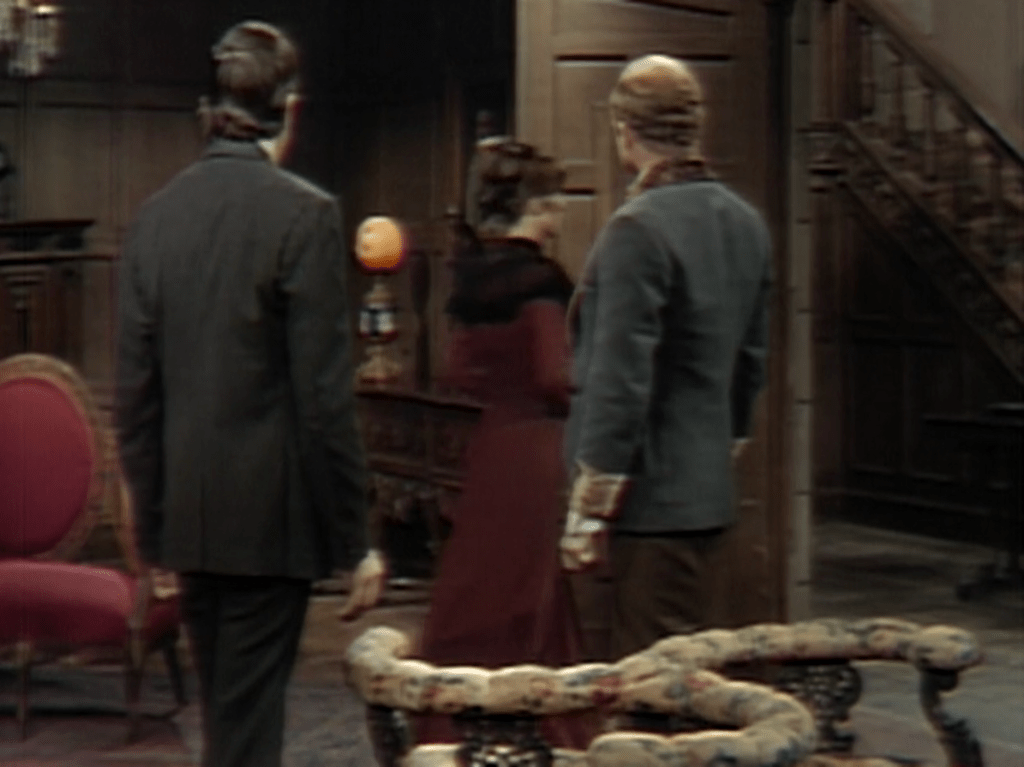
Today, Rachel is in the drawing room at the great house, recovering from her choking episode. Barnabas is holding her and looking longingly at her neck when stuffy Edward Collins enters. Edward demands to know what is going on, and Barnabas explains that Rachel had trouble breathing and fainted. Edward becomes concerned and wants to call a doctor; he becomes suspicious when Rachel, who he just met a few days ago, does not want to see a doctor. Barnabas manages to distract Edward from his suspicions with some chatter about the circumstances under which Rachel fainted.

In the groundskeeper’s cottage on the estate, Angelique casts a spell to summon Rachel. Back in the great house, Rachel suddenly looks up, her eyes wide open and focused at a point in the middle distance. She stands up and walks with her neck very still, moving like a wind-up doll. She announces to Edward and Barnabas that she will be going outside for a breath of fresh air. She refuses Barnabas’ offer to accompany her. Edward and Barnabas watch her wonderingly as she marches out with her robotic gait.

Barnabas and Edward wonder what has got into Rachel all of a sudden

Rachel arrives at the cottage and finds Angelique. Angelique calls Rachel “Josette.” When she protests that her name is Rachel, Angelique echoes the Barnabas we first knew and tells her that, when she wills it, her name will be Josette. She tells Rachel that she will not understand what is happening to her, but that Barnabas will soon understand very well.

Back in the great house, a servant tells Edward that he found a woman in the cottage. Barnabas is there, and he reacts to the description with alarm. He goes to the cottage, clearly afraid that he will find Angelique there. Before he can complete a search, a rooster crows and Barnabas hastens back to his coffin in the basement of the Old House on the estate.

Barnabas opens the coffin, and finds Rachel lying in it, unconscious. This sets up a comedy of manners. He hardly knows her well enough to lie down with her, and he can’t very well wake her and ask her to make way for him. We end with him facing this problem in etiquette.

We may also remember #248, when Barnabas expressed his frustration with Maggie’s refusal to turn into Josette by forcing her into his coffin. Perhaps Angelique knows that he did that, and is taunting him with a memory of which he has since shown an ability to be ashamed. If so, the point of the taunt is that he is not different from her. Angelique called Rachel a “pawn” in the “cruel game” she is playing with Barnabas. Angelique, who when we first saw her in the 1790s segment was so monomaniacally devoted to her goals that she could not see events from any perspective other than her own, can now understand that what she is doing to Rachel is horrible. That’s why she is doing it, to show Barnabas that he is part of the same horror as herself and that he can never transcend it.

Episode 710: The raven and the viper and all the dark creatures

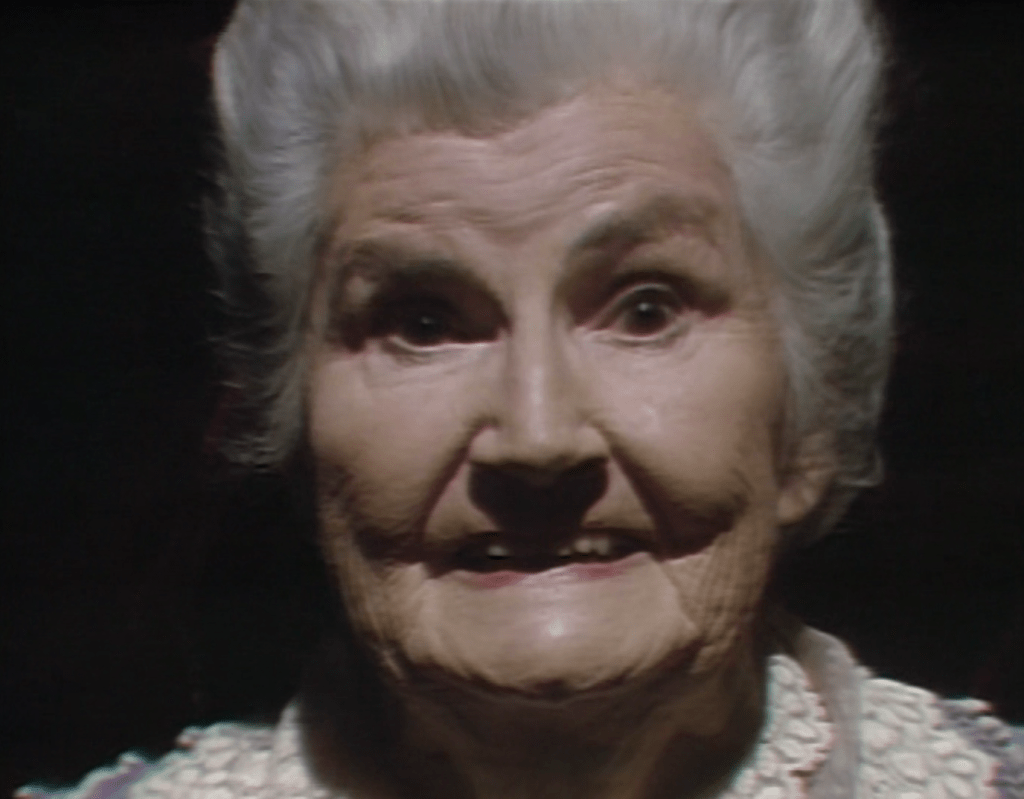
Libertine Quentin Collins has stolen his late grandmother Edith’s will, intending to forge a substitute that will give him control of her vast estate. His distant cousin, the recently arrived and thoroughly mysterious Barnabas, has warned Quentin that Edith’s ghost will haunt him if he persists in this plan. Quentin hears a loud pounding emanating from the walls of the great house of Collinwood. He goes to the study, where Edith lies in her coffin. He sees her there, grinning at him. Quentin returns to his room; the still-grinning Edith sashays in and taunts him. He tells her she is dead; this does not seem to bother her. She just keeps on grinning.

Edith may be dead, but she is clearly having a blast. Screenshot by Dark Shadows Every Day.

Quentin strangles Edith. She falls into an armchair in his room, unmoving but still grinning. He buries her somewhere on the grounds of the estate; her hand sticks up from the earth. He wakes up.

Quentin’s friend, unethical lawyer Evan Hanley, comes calling. Evan asks Quentin to give him the will so he can take it to a forger of his acquaintance. Quentin tells Evan about the dream, and how shaken he is. He also tells him about Barnabas, and his concern that Barnabas is a formidable enemy who may have uncanny powers. When Evan tries to dismiss Quentin’s worries, Quentin responds that he is the last person who should make light of the supernatural. When Quentin speaks of Evan’s “devil-callings,” we learn that the clandestine “meetings” they spoke of the other day are Satanist ceremonies. Evan agrees to meet Quentin at 8:00 that night in the groundskeeper’s cottage on the estate to summon one of the spiritual forces of darkness to fight Barnabas.

Returning viewers know that Quentin is right to fear Barnabas’ connections to the supernatural. Barnabas is a vampire, and his powers include the ability to send hallucinations to torment people with guilty consciences. He is also a time-traveler, who has come to 1897 from 1969 on a mission to prevent Quentin from becoming a ghost who will drive the Collins family of that year out of the great house and plague strange and troubled boy David Collins to the point of death.

First time viewers will not learn that today; aside from the opening voiceover, this episode tells us nothing about Barnabas. It does tell us something about Quentin and Evan. They are super-racist against Romani and Sinti people.

Evan has decided to hire Sandor Rákóczi to forge the will. Sandor and his wife Magda have been staying at the Old House on the estate for some time as Edith’s guests. Quentin’s brother Edward and sister Judith are offended by the presence of these “gypsies” in their midst. Unknown to Evan and Quentin, and unmentioned in today’s episode, Barnabas has bitten Sandor, enslaving him. Presumably Sandor has no secrets from Barnabas, making him a bad choice to be Quentin and Evan’s henchman.

Three times today, Evan addresses Sandor as “Gypsy.” When he is putting it to him that he wants him to forge the will, he barks at him with “Now, one moment, Gypsy.” He insists Sandor fix his price in advance. When Sandor tells Evan he is sad that he does not trust him, he replies “Well, then, be sad, Gypsy, but give me your price, now!” Later, Sandor will express curiosity about Quentin and Evan’s plans, to which Evan will reply “Well, don’t be curious, Gypsy, just do as you’re told.”

Evan told Quentin that the “devil-calling” at the cottage should involve twelve year old Jamison Collins as a “sacrificial lamb.” Quentin sincerely cares about his nephew Jamison, and he protests that he won’t do anything to hurt him. Evan assures him that Jamison will simply be a symbol of the innocence that their dark lord exists to despoil and that the boy himself will not be harmed. When Quentin is talking Jamison into joining him and Evan for a secret meeting that night, he tells him they will look into the future. Jamison asks”How, with a crystal ball?” Quentin replies “No, of course not. That kind of thing is for gypsies. It’s not for men, like you and me.” Scripted television in the US in the 1960s rarely gave such flagrantly racist remarks to recurring characters, not only because the audience included members of minority groups, but also because they are so unattractive that they limit the utility of the characters who make them. In this case, Quentin and Evan are already in league with the Devil, and Quentin is on track to die soon and become a ghost. So we know that they are due for a comeuppance. Moreover, their prejudices may lead them to underestimate Sandor, both on his own account and as a tool of Barnabas, so it is useful to the plot that they are in the grip of such ugly attitudes.

Sandor is in the cottage, preparing to forge a new will for Edith, when Jamison drops in. Jamison does not see what he is doing. He and Sandor spend a couple of minutes sparring verbally. Sandor ends the match when he points out to Jamison that it is getting dark. The boy looks alarmed and runs home while Sandor laughs.

In #701, Sandor and Magda mentioned that the Collinses were afraid of the night. Shortly after, they found out about Barnabas, and learned that they had good reason to be. But Sandor can still laugh when he sees that a boy as old as Jamison runs away at the news that the sun is setting.

Sandor is still in the cottage when Quentin brings Jamison by. Evidently Evan plans to let Sandor participate in the ceremony. Regular viewers will remember that in 1969 the first place Quentin manifested himself outside the little room in the great house where David and his friend Amy discovered him was in the cottage, and that he showed considerable power there. That he and Evan have their Satanic “meetings” in the cottage suggests that the evil he did in 1969 has its roots in what he did during them.

Evan directs Jamison to stare into the fire burning in the hearth. This will ring another bell for longtime viewers. Jamison is played by David Henesy, as is David Collins. From December 1966 through March 1967, David Collins’ mother Laura Murdoch Collins lived in the cottage. She was an undead blonde fire witch, and her plan was to lure David to join her in a fiery death. She would rise from the dead as a humanoid Phoenix, as she had done at least twice before. On each of those previous occasions, she went into the flames with a son named David; the Davids did not rise again, as becomes clear when one of them is available to speak in a séance in #186. Laura often urged David to join her in her favorite pastime, staring into fire. So when Evan urges Jamison to do the same, we wonder if Jamison, too, is in danger of being consumed by its fascination.

As the ceremony goes on, Jamison becomes alarmed. He runs out, and Evan orders Sandor to follow him. Quentin, too, runs to the door and protests that they have gone too far. He points to the flames, in which the likeness of a skull wearing a wig takes shape. We may wonder if more will be added to the skull, perhaps so much as to make up a whole woman, and if this woman will be someone we have met before.

Edith’s role in Quentin’s dream unfortunately marks Isabella Hoopes’ final appearance on Dark Shadows. She was just terrific. I wish they had done a parallel time story set around the period of the Civil War in which Hoopes played an aged Sarah Collins. Her nose, chin, and cheekbones resembled those of Sharon Smyth sufficiently that you can imagine an elderly Sarah looking like her, and she had a playfulness that would make longtime viewers remember the nine year old ghost we met in June 1967.

Episode 525: Tree in the forest

Beginning in #365, well-meaning governess Vicki Winters spent nineteen weeks in the 1790s. Ever since Vicki brought Dark Shadows back to a contemporary setting in March 1968, the show has been dealing with the consequences of her journey.

Today, we open with a dream sequence. The boyfriend who followed Vicki from the 1790s, a man named Peter, came to the twentieth century with total amnesia and a belligerent personality that kept him from listening when Vicki tried to explain who he was. His dream is about people and events from 1796, and it finally breaks down his insistence that he is someone else. That insistence was never at all interesting- it wasn’t as if his name were Watt Iduno Hu, in which case he and Vicki could at least have done a version of Abbott and Costello’s “Who’s on First?” But now that it is over, there are no obstacles at all between Peter and Vicki, and no reason for either of them to be on the show.

Meanwhile, suave warlock Nicholas Blair has carried a portrait of wicked witch Angelique from the bedroom where he is staying in the great house on the estate of Collinwood down to the drawing room. He makes a tremendous display of effort as he concentrates on the portrait, talks to it in an urgent voice, and makes many movements with his hands, all in an attempt to make contact with Angelique’s spirit so that he can reconstitute her body. Vicki walks in on him as he is doing this, and he breaks off, embarrassed. He finds out that Vicki owns the portrait, and she refuses him permission to borrow it.

Nicholas caught in the act.

Later, Nicholas finds out about Vicki’s visit to the 1790s. He is intrigued that in those days the same witchfinder who has disincorporated Angelique mistook Vicki for a witch and tried to perform an exorcism on her. He decides that the spot on which this rite took place must be the same as that where Angelique’s ashes are now deposited. So he casts a spell on Vicki, causing her to lead him to the place.

Other fansites feature complaints that Nicholas could just have cast a spell on Vicki during their first scene together. In his post about the episode on Dark Shadows Every Day, Danny Horn writes of their first scene that “Nicholas actually has the power to mesmerize Vicki and get her to do whatever he wants, so technically he could just put the whammy on her right now, and tell her to clear the room.” And on Dark Shadows Before I Die, Christine Scoleri wonders “If Blair could make Vicki ‘listen and obey’ so easily, then why didn’t he just make her give him the portrait instead of getting all pissy when she refused to loan it to him?”

That didn’t bother me. When Vicki walked in on Nicholas in the drawing room, he was straining himself to make contact with the spirit of Angelique. He again puts himself deeply into his mumbo-jumbo when he casts his spell on Vicki. So it seemed perfectly reasonable to me that he couldn’t just drop what he was doing with the portrait and go directly into another spell.

The obvious sexual symbolism of the scene in the drawing room reinforces that point. On the Dark Shadows Daybook, Patrick McCray describes the display Nicholas makes while interacting with the painting depicting his putative sister as suggestive of incestuous feelings;* and the awkwardness Humbert Allen Astredo and Alexandra Moltke Isles bring out when Vicki walks in on Nicholas getting all worked up as he stares at a woman’s picture and puts all his energy into imagining her physical presence will likely seem familiar to anyone who has ever had a room-mate. Since Nicholas’ mind is so intensely engaged with the idea of Angelique, it isn’t hard to imagine that he would need time to redirect his attention to Vicki.

*His actual words were “uncomfortably Kentuckian,” but Mrs Acilius was born in Kentucky and is tired of incest jokes about her onetime neighbors. [UPDATE: Patrick points out his own Kentuckian heritage, and protests that his little joke was an irony fondly intended.]

Episode 519: Poor suffering servant of Satan!

Roger Collins is on the telephone in the foyer of the great house of Collinwood. He is assuring the caller that it will be fine if Maggie, whom returning viewers know to be The Nicest Girl in Town, comes to stay. He says that he and Cassandra will be glad to have her for as long as she wants to be with them, and that he is sure Liz will approve. First time viewers thus learn that Roger has a wife named Cassandra, and that they live as guests in a house belonging to someone called Liz. A moment later, Liz enters, and is too distracted to hear anything Roger says to her.

Roger ends the phone call, and follows Liz into the drawing room. She stares out the window and makes a gloomy remark about death. He says he understands she must be very upset about Sam Evans. Returning viewers know that Sam was Maggie’s father, and that he died in yesterday’s episode. Roger goes on about how it is natural to be grieved at the loss of a friend like Sam, but soon learns that Liz’ mood has nothing to do with Sam’s demise- it’s news to her that he is dead.

Roger’s lines will startle longtime viewers. For the first 40 weeks of the show, Roger and Sam were united by a deep and abiding mutual hatred, and since then they have had no contact at all. Roger’s words about Sam as a family friend are so far from what we have previously seen that they should be considered a retcon.

Liz and Roger spend several minutes in the drawing room. She keeps going on about the all-pervasive reality of death, and he keeps urging her to see a doctor. There isn’t much to their lines, but Joan Bennett and Louis Edmonds were such extraordinary screen performers that it’s always fun to watch them together. This scene might be a particular pleasure to longtime viewers, who have rarely seen Roger as the responsible adult in any encounter.

We dissolve to a bedroom where a young woman in a black wig is sifting through some powders, looking directly into the camera, and telling Liz that her obsession with death will become even worse than it already is and will have dire consequences. Liz will believe that she is someone else, a woman who lived and died in another century, and may die by the same poison that killed that person.

There is a knock at the door. It is Roger. The woman hides her powders and lets him in. He addresses her as Cassandra and asks why the door was locked. Thus first-time viewers learn that she is his wife, that this is their room, that she is a witch, and that Liz’ problem is the result of a spell she has cast.

Cassandra tells Roger that she locked the door because David kept pestering her about Sam’s death and she wanted a moment to herself. With that, first-time viewers find out that David is Roger’s son, that Cassandra is his stepmother, and that she expects Roger to consider locking him out of the room an appropriate response to his grief about Sam.

Roger does not so consider it, and is bewildered by what Cassandra tells him. He tells Cassandra that Liz is in a bad way, and he is worried about her. Cassandra says she did not know that Roger was so concerned about his family. Baffled by this, Roger says that of course he is concerned, Liz is his sister. This tells first time viewers both what Roger’s relationship to Liz is, and that Cassandra has so little sense of family that she cannot imagine how other people feel.

Regular viewers will learn more. In the first year of the show, Roger’s keynote was his lack of loyalty to the family. That has now been set aside once and for all, and his normal attachment to his son and his sister provide a contrast with Cassandra’s apparently sociopathic coldness. Further, we saw a great deal of Cassandra from November 1967 through March 1968, when the show was a costume drama set in the 1790s and she was called Angelique. We saw then that Angelique had no conception of family or friendship, and that her idea of love begins and ends with her control over a person.

Cassandra promises to join Roger downstairs for a game of bridge in half an hour. He leaves, and she gets back to work spellcasting. As she does so, a figure in a black cassock materializes behind her. She turns, and the figure vanishes. In a quizzical tone, she says Roger’s name, revealing that she did not see the figure or realize that it is a supernatural presence. Together with her locking the door, scrambling to hide her magical paraphernalia when Roger knocked, lying to cover what she was doing, and failing to understand what a person with a reasonable amount of human empathy would consider acceptable behavior, her puzzlement shows that whatever her powers may be, they have definite limits.

Back in the foyer, another young woman with black hair lets a man into the house. She calls him Joe, and he calls her Vicki. Joe and Vicki talk about Sam’s death and about Maggie. Joe says that he wants to marry Maggie as soon as possible and to move away. Vicki is all for their marriage, but does not want them to go. Joe talks about how close he and Sam were. Longtime viewers will remember that when Sam and Roger were enemies, Sam was the town drunk. Even then, Joe was always happy to help him in whatever way he could, and did not see his condition as any obstacle to marrying Maggie.

Liz enters and angrily addresses Joe as “Lieutenant Forbes.” Joe has never heard of Lieutenant Forbes, and cannot understand why Liz, who knows him well, would not recognize him. Vicki clearly does know who Liz is talking about, and manages to calm her down. After Liz apologizes and hastens away, Vicki answers Joe’s questions only by saying that Forbes is someone from “the past.” Since we heard Cassandra talk about Liz taking on the personality of someone who lived in “another century,” this suggests that Vicki, too, has an unnatural familiarity with that same century.

Joe wants to go upstairs to the room where Maggie is sleeping so that he will be the first person she sees when she wakes up. Vicki is about to lead him to Maggie when Cassandra insists she join her in the drawing room to talk about David. Vicki tells Joe which door to open, and complies with Cassandra’s directions. This shows that Vicki is a member of the household staff whose responsibilities have to do with David. Regular viewers know that she is his governess, and that they are very close.

Cassandra tells Vicki that David has been asking about Sam’s last words. Vicki says that he addressed them to Maggie, not to her, and implies that she did not hear them. When Cassandra continues probing, Vicki protests. She asks if Cassandra can’t see that she is upset. Considering how clueless Cassandra was about human feelings in her conversation with Roger, it is entirely possible that she cannot. Vicki tells her that Liz is deeply depressed; Cassandra feigns ignorance. Vicki says in a cold voice, “You wouldn’t know anything about that,” then leaves.

Longtime viewers know that it was Vicki who came unstuck in time in #365 and took us with her to the 1790s. During her nineteen weeks in the past, Vicki came to know not only Forbes, but Angelique. She knows perfectly well that Angelique and Cassandra are the same person, that she is a witch, and that she is a deadly menace to everyone. She likely suspects that Liz’ depression is the consequence of one of Cassandra’s spells, and the tone of her parting remark would suggest that she does. Further, those who saw the show yesterday know that Vicki is lying about Sam’s last words. They were addressed to her, and she heard them clearly. She is choosing not to repeat them to Cassandra lest Cassandra use them for her nefarious purposes.

Cassandra is alone in the drawing room for only a few seconds. She is joined there by the same figure who had appeared in her room. This time she sees him. He confronts her.

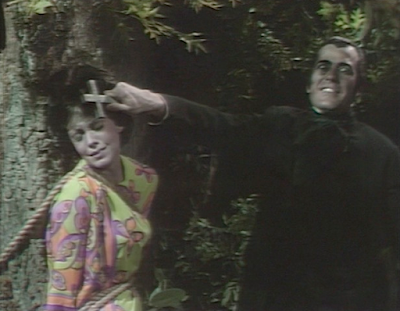
Regular viewers know that the figure is the Rev’d Mr Trask, a fanatical witchfinder who mistook Vicki for the witch in the 1790s and sent her to the gallows. He tells Cassandra that he now has the opportunity to correct that error. He shows her a cross, from which she recoils. We cut to a scene in the woods. Trask has tied Cassandra to a tree and performs an exorcism on her. This is Trask’s go-to technique; he tied Vicki to a tree in #385 and performed an exorcism on her in #386. Since Cassandra actually is in league with the devil (or as Trask would say, THE DE-VILLL!!!,) he has more success this time. Cassandra vanishes and leaves the ropes hanging on the tree.

Trask exorcises Cassandra. Screenshot by Dark Shadows Before I Die.

A first-time viewer might take this climax as an indication that Dark Shadows is a Christian show and Trask is its hero. Not only is Trask going after the right target, he is clearly making some headway. He says all the right things about casting the evil out of Cassandra and saving whatever good is left in her. His delivery of his lines is so fervent that Mrs Acilius, a vigorous Christian, cheered him on. In fact, Trask’s wild incompetence throughout the 1790s segment led to one disaster after another, and was of a piece with the show’s light regard for religion. Not until #450 did a cross provoke a reaction from a monster; that was the first suggestion the show gave that there might be anything to Christianity, and the scenes between Cassandra and Trask today are the second.

Dark Shadows borrows story points freely from all sorts of books, plays, movies, and folklore. So far, it has steered clear of Christianity as a source. For obvious reasons- most of the audience is at least nominally Christian, and Christianity is, in one way or another, a live option for the rest. So it’s a topic that can take over very quickly once it is introduced. I suppose a specifically Christian version of Dark Shadows could have worked, but I can’t imagine that the staff they had would have been particularly interested in making a show like that. So when it looks like they are going to let Trask have even a temporary win, we see the show running one of its boldest risks yet.

Episode 513: The woman in the window

Wiggéd witch Angelique/ Cassandra and her reluctant cat’s paw Tony are on the terrace at the great house of Collinwood, quarreling about Tony’s failure to complete his latest mission. Angelique/ Cassandra talks about the punishments she is capable of inflicting on Tony, and decides that she will force him to fall hopelessly in love with her. This punishment will begin as soon as she has kissed him.

This is not the first time Angelique/ Cassandra has found a reason to kiss Tony. The last time she did so, in #489, her stepson David caught them, and she had to scramble to come up with a spell to wipe his memory. This time, her sister-in-law Liz catches them, and she curses Liz to become obsessed with death. As she is casting the spell, she tells Liz that the obsession will make her life less empty. It does not promise to make it more interesting for the audience to watch.

Joan Bennett as The Woman in the Window. Screenshot by Dark Shadows Before I Die.

Episode 486: Endless corridors of trial and error

Today’s cast includes a vampire, a wicked witch, two mad scientists, a Frankenstein’s monster, and an irritable housekeeper. The deadly menace turns out to be the housekeeper.

In a laboratory in a house by the sea, mad scientists Eric Lang and Julia Hoffman are trying to transfer recovering vampire Barnabas Collins’ “life force” into the body of the creature Lang has built for the purpose, a creature Barnabas has named Adam. In the drawing room of the great house atop Widow’s Hill, wicked witch Angelique disrupts that attempt by sticking a pin into a clay figure that she addresses as “Dr Lang.” It is unclear how Angelique attached the clay figure to Lang, though since it has roughly the same acting ability as Addison Powell the pairing seems natural enough.

Lang gasps for air. Julia helps both him and Barnabas. Barnabas gets up from the operating table and declares he will go to the great house and stop Angelique. Lang tries to tell Julia how to carry on his work, but keeps breaking down. While Julia is out of the room getting some heart medicine, Angelique removes the pin from the clay figure. During that moment of relief, Lang is alone in the lab. He turns on his tape recorder and says that if both Barnabas and Adam live, Barnabas will be free of the vampire curse. Adam will drain it from him, but will not suffer from its symptoms. If Adam dies, Barnabas will revert to active vampirism.

Angelique resumes tormenting Lang as Julia returns to the laboratory. Lang cannot keep his breath long enough to tell Julia his message or make it clear that she should listen to the tape. Angelique says that Lang has suffered enough for tonight, and that she will put the pin away. As she is about to do so, the door to the drawing room opens and housekeeper Mrs Johnson comes in. Mrs Johnson startles Angelique, who inadvertently drives the pin through the clay figure, killing Lang.

This is the second death to which Mrs Johnson has contributed. The two cases are very similar. She unknowingly gave undead fire witch Laura Murdoch Collins the information she needed to cast the spell that killed parapsychologist Dr Peter Guthrie. Guthrie resembled Lang not only in holding a terminal degree, studying the uncanny, and doing battle with an undead witch, but also in his use of a tape recorder. In #170 and #171, Guthrie recorded the audio of a séance; in #172, Laura erased the recording and replaced it with the sound of fire; and in #185, he was on his way to get his tape recorder to use at another séance when Laura cast the spell that killed him. Mrs Johnson is a menace to a very specific kind of person.

Barnabas comes to the great house and threatens Angelique, calling her by the name “Cassandra,” the alias under which she has married sarcastic dandy Roger Collins and found a place in the house. At first he says he will burn her if Lang dies. She pretends not to know what he’s talking about, and says that she will expose him as a madman. He looks at her neck and leans in, a sign that his vampire urges are coming back. The telephone rings, and Mrs Johnson enters. Angelique/ Cassandra explains their compromising position by claiming that she was fainting; with that, she shows that her threat to air her complaints is a bluff, since she could easily have demanded Mrs Johnson call the police.

Barnabas is getting thirsty. Screenshot by Dark Shadows Before I Die.

Mrs Johnson says the call is for Barnabas. It is Julia reporting Lang’s death. Barnabas makes some grim remarks to Angelique/ Cassandra, then goes back to the laboratory and talks with Julia. She is distraught, but agrees to pick up where Lang left off.

We end with a dream sequence. Angelique has loosed a “Dream Curse” on the people of Collinsport. One after another, they have the same basic dream, in each case beginning with an appearance by the next person to have the dream beckoning them into a haunted house attraction and ending with a door opening to expose something the previous dreamers didn’t see. Julia’s dream begins with Mrs Johnson, telling us she will be the next up. It proceeds with her walking through a foggy room, including a clear shot of the fog machine. It ends with the sight of a skeleton wearing a wedding dress and the sound of Angelique’s distinctive laugh, telling us that the position Angelique has gained by marrying Roger is particularly dangerous to Julia. Since Julia lives in the same house as Angelique and they know all about each other, this is not exactly a major revelation.

Featuring a very special appearance by the fog machine. Screenshot by Dark Shadows Before I Die.

The dream involves the beckoner’s voice reciting a little bit of doggerel. As it goes on, some beckoners say “through endless corridors by trial and error,” others say “through endless corridors of trial and error.” I prefer “of trial and error.” That implies that the corridors are themselves made up of decisions people have made and of the consequences of those decisions. Saying that the characters are moving through the corridors “by trial and error” means that the corridors exist whether anyone engages with them or not. We saw Angelique start the curse, so we know it isn’t something that has been out there in reality all along, and it expresses itself in dreams, not in anything that persists when people stop paying attention to it. Besides, the whole idea of drama is to show decisions and their consequences, so “of trial and error” is better on every front.

Episode 467: Pulsebeat

In a room at the Collinsport Hospital, very loud physician Eric Lang (Addison Powell) opens the curtains to show his patient, old world gentleman Barnabas Collins, that it is a sunny afternoon. It takes Barnabas a moment to realize that this is Lang’s way of showing him that he has cured him of his longstanding affliction, vampirism. Once he figures it out, Barnabas is very happy to be human again.

Barnabas talks with Lang about the origins of his vampirism. At one point Lang says “Ah, so a curse was responsible.” You know how doctors are, always coming out with the same cliches. Lang does say something novel when he remarks on Barnabas’ “pulsebeat.” That specimen of Collinsport English will be back.

In the great house of Collinwood, Barnabas’ distant cousins Roger and Liz are at odds. Roger keeps having conversations with a portrait, in the course of which he loses track of the time. The correct time is 1968, and he keeps thinking it is 1795. When he does that, he mistakes himself for his collateral ancestor Joshua Collins and his sister Liz for Joshua’s wife Naomi. Today, Liz has to slap Roger to get him back to himself. Louis Edmonds’ alternation between Joshua and Roger is masterful, one of the outstanding moments of acting in the whole series.

The portrait is of Angelique, the wicked witch who made Barnabas into a vampire in the first place. At the hospital, it becomes clear that Angelique’s spirit is controlling Roger through it. He is cold and distant, staring out the window when Barnabas tells Liz he wants to take up gardening, refusing to say a word when Lang enters the room. When he takes his leave, Roger looks at Barnabas and declares “It’s not this easy.” We realize that he is a puppet for Angelique. Roger steals Lang’s cartoonish mirror-bearing headpiece.

Lang meets Roger. Screenshot by Dark Shadows Before I Die.

We cut back and forth between Barnabas’ hospital room and the drawing room at Collinwood. At Collinwood, Roger shows the headpiece to the portrait and explains that it was Lang’s. He starts to twist it. In the hospital, Lang suddenly leaps up with a splitting headache. Roger stops twisting, and Lang says he’s better. He resumes twisting, and Lang resumes suffering. Roger tells the portrait he cannot obey its command to put the headpiece in the fire, and throws it across the room. In the hospital, Lang suddenly recovers from his headache. Barnabas tells him it was Angelique’s doing, and says that he will have to become a vampire again to spare Lang her attentions.

On his blog Dark Shadows Every Day, Danny Horn identified Addison Powell as “THE WORST ACTOR EVER TO APPEAR ON DARK SHADOWS.” I don’t agree with that. In yesterday’s episode, for example, Powell attained a level that could fairly be described as “competent,” a label that forever eluded figures like Mark Allen (Sam Evans #1,) Michael Currie (Constable/ Sheriff Carter,) and Craig Slocum (Noah Gifford and, later, Harry Johnson.) And there will be times when his ludicrous overacting lends just the note of camp that turns a scene from a tedious misfire to an occasion for chuckling. But he is pretty bad today. When an actor gets to be depressing to watch, I sometimes make his scenes bearable by trying to imagine what it might have been like if, instead of casting him, they had chosen someone else who might have been available.

So many members of the original Broadway cast of the musical 1776 appeared on Dark Shadows at one time or another that I tend to assume that any of them would have accepted any part on the show. Howard da Silva played Benjamin Franklin in 1776, and he is my imaginary Dr Lang.

You can see da Silva’s Franklin in the 1972 movie version of 1776, where he plays the Sage of Philadelphia with frequent chortles that suggest a mad scientist gleefully working to release a murderous nightmare on the world, which is more or less the show’s vision of the founding of the USA. That isn’t Franklin’s only note- he has occasion to speak earnestly about the British Empire’s mismanagement of its North American possessions, and sorrowfully about the need to leave slavery alone while concentrating on the fight for independence. Those who have seen da Silva play subtle and powerfully compassionate men in his other work, for example as the psychiatrist in the 1962 film David and Lisa and as the defense attorney in the 1964 Outer Limits episode adapting Isaac Asimov’s story “I, Robot,” will hardly be surprised that he could be effective in those moments.

So when Powell overdoes the shouting, I imagine da Silva in his place, going through his bag of tricks to show us a man who might be taking a maniacal satisfaction in his blasphemous labors, who might be profoundly devoted to the relief of suffering, and who might be both at once. Sometimes I get a pretty clear image of what that would have been like, and when that happens the show in my head is hard to beat.

Episode 451: The pit of my soul

Haughty overlord Joshua Collins and good witch Bathia Mapes decide to take Joshua’s son Barnabas to the deserted Old House on the estate of Collinwood. Bathia has agreed to do battle with the ghost of wicked witch Angelique in hopes of lifting the curse whereby Angelique turned Barnabas into a vampire. Bathia warns Joshua that if she is interrupted, Angelique will defeat her. In that case, Barnabas will remain as he is, and Bathia will die. Joshua assures her that no one will come to the Old House.

Bathia, Joshua, and Barnabas before they go to the Old House. Screenshot by Dark Shadows Before I Die.

In the great house on the estate, Barnabas’ mother Naomi talks with fluttery heiress Millicent Collins and Millicent’s new husband, naval officer/ sleazy operator Nathan Forbes. Millicent’s mental health has always been fragile, and Nathan has been making a concerted effort to shatter it altogether so that he can get his hands on her share of the Collins fortune. Making matters worse, Barnabas bit Milllicent the other day. She has a beautiful mad scene today, one of several that Nancy Barrett knocks out of the park during this storyline. She insists on telling Naomi that she has seen Barnabas. This distresses Naomi, who knows that Barnabas is dead but does not know about the vampire curse.

Millicent gives Naomi enough details to stir her curiosity about what is going on at the Old House. She goes there, interrupting Bathia’s efforts. Joshua manages to hustle Naomi out of the house, but the damage is done. Bathia bursts into flames and dies. In keeping with his habit of covering up compromising information, Joshua has kept everything from Naomi. Once more, we see the cost of this habit. Had he leveled with her about Barnabas’ condition, Barnabas might have been freed.

There is a detailed comparison of the script for this episode with the finished product on a tumblelog called sights9. It is in five parts, the first of them here.

A very famous blooper occurs before Joshua and Bathia take Barnabas from the great house to the Old House. Bathia is supposed to be giving instructions, but falls silent, stares at the teleprompter, and squints helplessly for a long moment. Then we hear the line producer, Bob Costello, prompt her with “Then go to the house” and she picks back up.

Episode 400: Fire knows your name

The Rev’d Mr Trask, a cleric of sorts, is convinced that there is a witch in the Old House on the great estate of Collinwood. He is right about this. He is also convinced that the witch is the eccentric Victoria Winters. He is wrong on this point. The real witch is Angelique Collins, wife of the master of the house, the gallant Barnabas. Barnabas, who as a man of the Enlightenment asserts that there are no witches, is hiding Vicki, and has reluctantly agreed to let Trask perform a rite of exorcism, believing that once he is finished he will have to go away and everyone will have to admit that Vicki is innocent.

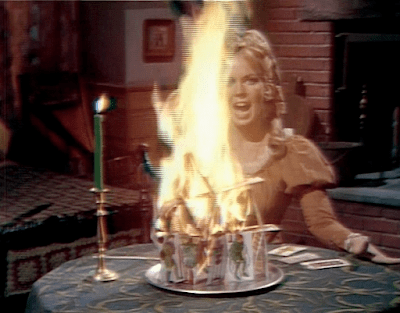
At the top of the episode, we see Angelique building a house of cards and delivering a soliloquy about her plan to cast a spell to make it look like Trask’s fraudulent ritual has proven Vicki’s guilt. There is an element of suspense as we wonder what the character’s actions will lead to, and an even more powerful suspense as we marvel at the courage it took for the actress to remain calm enough build a house of cards on what is essentially a live television show. Forget the Daytime Emmys, Lara Parker deserved a medal for this feat.

Angelique recites a spell over the house of cards, then sets it on fire. The first time they used an incompletely contained fire on Dark Shadows was in #191, and as a result of that daring experiment a load-bearing beam caught fire and collapsed in the middle of a scene. They finished taping before putting the fire out, and somehow everyone survived. There was also an off-camera fire during a conversation between Barnabas and Vicki in #290, and Jonathan Frid and Alexandra Moltke Isles just kept delivering their lines while we heard fire extinguishers blasting in the background. As a result of an excessive pre-treatment of the cards with lighter fluid, today’s fire burns faster and expels debris over a wider area than had been intended. I suppose a technical term for a rapid fire that expels debris is an “explosion.” Parker keeps up her incantation while this explosion progresses directly in her face. That shows an entirely different kind of courage than she showed with the house of cards, but she exhibits it in an equally rare degree.

The fire starts. Screenshot by Dark Shadows Before I Die.

Downstairs, Trask is standing at the threshold of the house, doing his own fire ceremony. He draws Vicki’s initials on the doorstep, holds up a dowsing rod, and jabbers for a while. Then he sets fire to the rod. In her room, Vicki sees flames erupting from the floor. She shouts in panic.

Barnabas is upstairs. He hears Angelique shouting “Eye of fire, heart of ice!” Her shouts grow louder and louder as she repeats the phrases faster and faster. My wife, Mrs Acilius, said that the pattern of Angelique’s voice sounded to her like someone having an orgasm. The willingness to risk the laugh that pattern might bring represents a third form of courage; by this point, we would have to admit that whatever we may think of Angelique, Lara Parker was one of the bravest people imaginable.

Barnabas is about to investigate, but then he hears Vicki shouting “Fire!” Between these two shouting women, he goes to the one who doesn’t sound like she’s enjoying herself. By the time he gets to Vicki’s room, she is gone. He sees no sign of fire.

Vicki runs out the front door, into Trask’s arms. He shouts “I’ve caught the witch!” and forces her to the ground. He looks delighted that his shtick actually worked, for once.

“I caught the witch!” Screenshot by Dark Shadows Before I Die.

This moment is an odd inversion of the ending of #191. That episode ends with strange and troubled boy David running out of the burning building where his mother, undead fire witch Laura Murdoch Collins, was trying to immolate him, and finding refuge in Vicki’s arms. At that moment, life triumphs over death, and Dark Shadows version 1.0 reaches its conclusion.

When Vicki runs out of the house and into Trask’s arms, death and folly win a victory over life and reason. Nothing comes to a conclusion- the story just gains new layers of complexity. We don’t even go to a commercial break, but get a reaction from Angelique first.

Barnabas talks with Angelique, mystified by what just happened. When he mentions that he heard her in her old room shouting strange words, she lies and says she was in the sewing room. After she leaves, we hear his thoughts- he had searched the sewing room, and knows she is lying. He now believes that there is a witch. He would find it much easier to believe that Vicki, a strange girl who claims to be displaced in time from the year 1967, 172 years in the future, is that witch than to face the prospect that his own wife is, but he can neither overlook the lie she has told nor the sheer improbability that so flagrant a quack as Trask came up with the right answer to any question. He remembers that indentured servant Ben claimed to have been enslaved by the witch, and resolves to find out what Ben can tell him.

We first got to know Barnabas in the months between April and November of 1967, when he was a vampire preying on the living in Vicki’s native time. In those days, he never mentioned Angelique, and there was no indication that he suspected any of the witchcraft we have seen since we embarked on our journey to 1795. Perhaps in the original timeline, when the place Vicki has taken was occupied by a woman named Phyllis Wick, Angelique had to proceed more slowly and carefully, with the result that Barnabas was turned into a ghoul without ever picking up on what was going on. If so, it would be Vicki’s complete failure to adapt to her new time in any way that accelerated the pace of events and thereby exposed Angelique to Barnabas’ suspicions.

Episode 399: Fraud in this house

Little Sarah Collins misses her governess, the well-meaning Vicki. Unknown to Sarah or her elders, Vicki is a time-traveler, displaced from 1967 by Sarah’s own ghost to come to this year 1795 and see how the troubles that will afflict the Collins family in days to come began. Vicki has utterly failed to adapt to her new surroundings, and is now in hiding, suspected of witchcraft.

Vicki is secreted in the Old House on the great estate of Collinwood, the guest of its owner, gallant gentleman Barnabas Collins. Unfortunately for her, Barnabas’ new wife Angelique is the real witch, and by her harebrained behavior Vicki has volunteered for the role of Angelique’s patsy. Angelique takes advantage of Vicki’s presence in the house to cast spells directing ever more suspicion her way and increasing the likelihood she will be caught.

We see Sarah in the foyer of the great house, tossing a ball in the air. Tossing a ball was one of her favorite pastimes as a ghost in 1967. In those days, she usually sang “London Bridge” while playing ball, but she is silent now. Indeed, we have yet to hear the tune in connection with the living Sarah. She is interrupted by Vicki’s disembodied voice calling her to the Old House. Regular viewers, remembering Sarah as the calmest and most adroit of ghosts, will be intrigued to see the living Sarah bewildered by a supernatural phenomenon.

The voice stops, and we cut to the Old House, where a puzzled Barnabas catches Angelique doing something weird with candles. She makes up a story about having needed the light to search a dark corner for a piece of jewelry she dropped. In the course of the story, she says that she was crawling about “like a cat.” It’s a bit startling to hear her compare herself to a cat, since in #378 she turned Barnabas’ father, haughty overlord Joshua, into a cat. It doesn’t make an impression on Barnabas, though, and he quickly disregards the whole thing.

Back in the great house, repressed spinster Abigail meets her brother Joshua in the drawing room of the great house. She is sure Vicki is a witch and that Barnabas is sheltering her in the Old House. Joshua had earlier given Abigail and her favorite divine, the Rev’d Mr Trask, free rein to investigate Vicki; he now seems to regret that decision, and on no account does he want any member of the family to go to his disowned son Barnabas’ house. When Abigail finds Sarah and forces her to tell the story about hearing Vicki’s voice calling her to the Old House, she seizes the high ground. She insists that Sarah go to the Old House and that she and Joshua follow her there. When Abigail says “Come, Joshua,” she leaves him little choice but to comply.

Sarah enters the Old House through the front door, and for the first time in 1795 the strains of “London Bridge” play on the soundtrack. Apparently Sarah’s visit to her former home marks a step towards her postmortem fate. She calls for Vicki. Barnabas asks Sarah what she’s doing there. Abigail and Joshua appear at the threshold and ask to be admitted. Angelique, as lady of the house, invites them in and offers to make tea. Abigail refuses the offer and announces their purpose. While the adults quarrel, Sarah slips out. We cut to Vicki’s room; evidently Sarah went directly to her, for they are already in the middle of a conversation.

In 1967, the spectral Sarah was an expert in the arts of concealment and escape. She has some of those talents already in her living form. She takes Vicki to a compartment in the attic that none of the adults, not even Barnabas, remembers. Vicki hides there while Abigail and Joshua search the house.

Having found Sarah, Abigail questions her closely. Sarah stands with her back to her aunt; it is uncharacteristic of Abigail to allow this, and we wonder why she does. Young Sharon Smyth plays the scene so well that we are glad to see her face. Abigail asks if Sarah knows that “curious and terrible forces” beset them; Sarah replies with a crisp “Yes, ma’am!” She asks if she knows what happens to little girls who lie, especially to their elders; “Yes, ma’am!” We see the struggle on Sarah’s face as she denies having seen Vicki.

Sarah makes herself lie to Abigail. Screenshot by Dark Shadows Before I Die.

After they complete their search, Joshua agrees that Vicki is not there and is embarrassed by the whole thing. Abigail insists that she is there, citing Sarah’s lies as proof. Now we understand why she let Sarah turn her back on her- she didn’t intend to extract the truth from her, since a lie would serve equally well. Abigail demands that Trask be brought back to perform a rite of exorcism. Joshua reacts to this demand with distaste, Barnabas with indignation, but Angelique persuades her husband to allow it.

After the visitors have left and Barnabas has gone to be alone, Angelique gives a soliloquy about how she will turn Trask’s fraudulent mumbo-jumbo to her own purposes. Vicki’s face is superimposed over hers in an effect we have not seen since the days of blonde fire witch Laura Murdoch Collins. Laura’s face was superimposed over those of people on whom she cast spells, most significantly over parapsychologist Dr Peter Guthrie in #185. Laura’s spell killed Guthrie; evidently Angelique’s plans for Vicki are equally final.