Charity Trask walks into the drawing room of the great house on the estate of Collinwood and finds a paper on the desk. It is a full confession to the murder of her mother, the late Minerva Trask, signed by her father Gregory and by Collins family attorney Evan Hanley. It also bears a red seal.
Trask enters and Charity tells him what she has read. He rants and raves for a while, claiming that she must be under the Devil’s power if she believes the confession. He forces her onto her knees and orders her to pray, then tries to destroy the paper.
Later, Gregory Trask is alone in the drawing room. It goes dark, a violent storm suddenly breaks out, the windows blow open, and the flames surge much higher in the fireplace than we have ever seen them. Trask cries out for Minerva to leave him alone. When he calls himself an innocent man, the storm rages more fiercely than ever.
The storm ends as quickly as it began, and a man appears in the doorway. He asks who Trask was talking to, and Trask denies that he was talking to anyone. Trask mentions the storm, and the man says there hasn’t been a bit of wind all day. Trask turns and sees that the window is closed and there is no sign of a storm outside.
The man identifies himself as Charles Delaware Tate. Trask recognizes the name as that of a nationally famous painter. Tate explains that the late Edith Collins commissioned him to paint a portrait of her grandson, Quentin Collins, but that Quentin has refused to sit for him. He asks Trask for a photograph of Quentin. Trask remembers that there is such a photograph in a drawer in the desk. When he opens the drawer, the confession falls out, undestroyed.
Returning viewers know that Tate is associated with a 150 year old sorcerer known as Count Petofi. We also know that Petofi is currently residing in the body of twelve year old Jamison Collins and is casting spells to expose the secrets of various people connected with Collinwood. Jamison’s distant cousin Barnabas Collins the vampire is doing battle with Petofi, and has locked Jamison/ Petofi in the prison cell in the basement of the Old House on the estate. That has done little to curb his power; from the cell, he was able to project himself into a dream of Evan’s, cast a spell on him, and compel him to draw up the paper Trask keeps trying to destroy. Jamison/ Petofi does seem anxious to get out of the cell, however. He offers to cure Quentin of lycanthropy if he lets him out. When broad ethnic stereotype Magda Rákóczi talks Quentin out of accepting the offer, Jamison/ Petofi growls a threat at her.
We do not know why Petofi wants Tate to paint a portrait of Quentin, but we get a clue at the end of the episode. Tate has rented a house which longtime viewers will recognize as the Evans cottage. For the first two years of the show, the Evans cottage was a frequent set. It was home to artist Sam Evans and his daughter Maggie, The Nicest Girl in Town. In December 1966 and January 1967, an unseen force compelled Sam to paint portraits of undead blonde fire witch Laura Murdoch Collins. Those portraits had supernatural powers. They were not alone. Portraits have been a prominent part of the show’s set decoration from the very beginning, and have been a gateway between the world of the living and the world of the dead since #70. We may well assume, then, that Tate’s portrait of Quentin will also have uncanny powers.
Charity is visiting Tate in the cottage and looking at the portrait. He has only been working for a day or two, and he says it will take him about two weeks to finish. Yet the figure is almost finished now. As Charity studies it, Quentin’s face turns into that of the werewolf. In May and June of 1968, they did a story partly based on Oscar Wilde’s The Picture of Dorian Gray, and in #701, the very first episode in which he could speak, Quentin compared pictures and people, saying that one changes while the other stays the same. So we are prepared to see Quentin’s curse transferred from his body to his portrait.
The 150 year old evil sorcerer Count Petofi has taken possession of twelve year old Jamison Collins. Jamison/ Petofi has been casting spells to make the various residents of the estate of Collinwood reveal their true selves. Jamison’s distant cousin, Barnabas the vampire, has locked Jamison/ Petofi in the prison cell in the basement of the Old House on the estate. When Barnabas says that he will let Jamison out once Petofi has vacated his body, Jamison/ Petofi replies “If that is what you intend to do, Mr Collins, I’m afraid that you are stupid and incompetent.” There is no need to cast a spell on Barnabas- Maker of Stupid and Incompetent Plans is his true self, and we love him for it.
The great house on the estate is currently under the legal authority of the evil Rev’d Gregory Trask, husband of Judith Collins, who is a patient in a mental hospital. Jamison/ Petofi’s spell has caused Trask’s daughter Charity to be intermittently possessed by the spirit of Cockney showgirl Pansy Faye. Trask is horror-stricken by the makeup, clothes, and hairstyle Charity wears when Pansy is in charge of her, and her East London accent, insouciant attitude towards him, and tendency to sing and dance escalate this horror further. Nancy Barrett and Jerry Lacy are both talented comic actors, and their scenes as Charity/ Pansy and Trask are hilarious.
Collins family lawyer Evan Hanley is at home. Barnabas appears in Evan’s drawing room and asks for some information which Evan denies having. Evan tells Barnabas he has renounced his former interest in black magic and Satanism. Barnabas is skeptical, and Evan replies that his latest forays resulted in a gruesome disfigurement of his face. This disfigurement was later relieved, how we (frustratingly) do not know. But he wants nothing more to do with the occult, since he values the ability to look at himself in the mirror. Barnabas reminds Evan that he cannot see himself in a mirror, implying that he will use his vampire powers against him if he does not cooperate.
Trask comes to Evan’s house. He asks him to draw up papers that will complete his plan to seize control of all the Collins family’s assets. He mentions in passing that Jamison thinks he is Petofi. Evan knows enough about Petofi to be terrified. He tells Trask that neither of them has a chance in a battle with Petofi, and refuses to draw up the papers. Trask responds contemptuously.
Alone in the cell, Jamison/ Petofi decides to have some fun with Evan. We see Evan dozing in his armchair. He has a dream in which Jamison appears. Jamison kisses him; it is by his kisses that Petofi spreads the “true self” spell. Later, Evan goes to the great house at Collinwood and presents Trask with a paper to sign. Trask signs it eagerly, assuming it is the document he asked Evan to bring him. Instead, Evan has prepared a full confession to the murder of Trask’s first wife Minerva. The two of them plotted this murder together, and Trask is horrified when he sees his signature on it. He throws the paper in the fire; after he leaves the room, it rematerializes on the desk, complete with signatures.
During Trask’s confrontation with Charity/ Pansy Faye, the picture suddenly changes from color to sepia tone. After about a half a minute, it changes back. Evidently there was a fault in the videotape master at this point, and an excerpt from the kinescope was used to patch it. The color comes back right after Trask slaps Charity/ Pansy, causing Pansy to release Charity for a bit. It creates the eerie feeling that Trask somehow fixed our TV set by slapping her.
Dark Shadows continually comments on itself as it goes along. In the early days, all the episodes were scripted by Art Wallace. Wallace’s favorite method of composition was a sort of diptych, in which two sets of characters faced similar situations and responded to them differently, highlighting the contrast between their personalities. Petofi’s “true self” spell is of course another way of creating similar contrasts between characters played by the same actor.
As the show came to focus on time travel stories, they could cast actors as characters who represent alternative versions of parts they played in other periods, again putting characters played by the same actors in contrast with one another. And as Wallace would juxtapose similar situations within a single episode, the multiple times periods allowed them to take themes that had been developed in one way in a story set in one year and develop them differently in a story set in another. So Jamison/ Petofi’s contagious curse is a reworking of the “Dream Curse,” which dragged on from April to July 1968. The Dream Curse involved a lot of repetition and very little variety of tone. Jamison/ Petofi’s spells all get right to the point, and are sometimes scary, sometimes bizarre, and often quite funny. So the second time is definitely the charm here.
At one point Charity holds a recorder and tells her father she wants to learn how to play it. The first time we saw this prop was in #260. That episode was set in 1967, and Barnabas was holding Maggie Evans, The Nicest Girl in Town, prisoner in the cell where Jamison/ Petofi is today. The ghost of Barnabas’ little sister Sarah befriended Maggie, and materialized in the cell playing “London Bridge” on that recorder. Over the next several months, the recorder came to be a symbol of Sarah, one that she occasionally left behind as a sign that she had been in a place. Longtime fans will likely remember that, and see it as an indication that what is happening to Charity is going to have permanent consequences, as Sarah’s haunting had permanent consequences.
The evil Count Petofi, a 150 year old sorcerer, has taken possession of twelve year old Jamison Collins and is wreaking havoc in the great house of Collinwood. Due to Petofi’s spells, Jamison’s father Edward thinks he is a valet recently separated from the service of the Earl of Hampshire. Edward’s brother Quentin tries to explain to him what is actually going on, but Edward merely concludes that he is Quentin’s valet now. When Quentin follows the Collinses’ long-established protocol for dealing with mentally ill family members and locks Edward in the tower room, Edward bangs on the door and protests that he won’t be able to do his job if he is locked up. “And I will do it!” he vows.
Charity Trask, disastrously uptight step-daughter of Quentin and Edward’s sister Judith, falls under Petofi’s influence and is possessed by the spirit of Cockney showgirl Pansy Faye. Pansy was on the show briefly in June. The childlike Carl Collins, brother to Judith, Edward, and Quentin, was engaged to marry Pansy before she was killed by vampire Dirk Wilkins. Pansy and Charity never met; when Carl asked Charity if she had seen Pansy, the scene was staged to make it seem absurd that the two women could exist in the same universe. Now, they exist in the same body.
If Petofi has caused startling changes in Jamison, Edward, and Charity, the change in Quentin is perhaps the most jarring of all. He has been a ghost, a homicidal maniac, a Satanist, a zombie, and a werewolf, but always and everywhere a source of total chaos, who destroys all recognized order and is perfectly at home in the midst of sheer madness. Today, Quentin keeps making earnest attempts to restore everyone to their right minds and reestablish the proper and respectable relations within the household.
First time viewers will immediately catch on that the preteen David Henesy is not the actor who would usually play a 150 year old Hungarian nobleman, and when Nancy Barrett suddenly takes on an East London accent and enters wearing a garish costume and doing a dance with lot of hip shaking and pelvic thrusts, they will know that Charity is turning into someone else. The dialogue in the scenes involving Edward explains what is happening to him. They may not know that Quentin is not supposed to be the defender of the status quo. That information is supplied in two scenes. Charity/ Pansy receives a psychic message from the world beyond telling her that Quentin was involved in the murder of Carl, and she announces this information. Also, Quentin calls for help, and the helper who materializes is his distant cousin, Barnabas Collins the vampire.
At the end of the episode, Barnabas lays hold of Jamison/ Petofi and drags him into the secret passage leading from the drawing room to the west wing. It is usually bad news when a vampire abducts a child and shoves him into a dark space, but David Henesy brings such joy to the role of Jamison/ Petofi that we can hardly doubt that what comes next will be equally fun to watch.
Meanwhile, a painter named Charles Delaware Tate has presented himself. Tate’s first appearance will cause a sinking sensation in longtime viewers; he is played by Roger Davis, a terrible actor who delivers much of his dialogue by shouting while clenching the sphincter muscles in his buttocks, and who routinely assaults the women and children in the cast while on camera. We may have hoped we had seen the last of Mr Davis when his most recent character, Dirk, was destroyed shortly after murdering Pansy. But evidently Pansy’s return in the form of another actress has come at the price of Mr Davis’ return in the guise of another character.
For much of 1968, Mr Davis played a man known variously as Peter Bradford and Jeff Clark. His approach to characterization consisted of shouting “My name is Jeff Clark!” When this technique was played out, he took to shouting “My name is Peter Bradford!” He doesn’t shout today, mercifully. But he does say the name “Charles Delaware Tate” quite a few times.
Today’s story about Tate is potentially interesting. Jamison/ Petofi finds him when he answers the front door. Tate asks to see Jamison Collins; Jamison/ Petofi confirms that despite his appearance, he is indeed the person Tate has come to see. Tate accepts this with a blandness that suggests that he knows he is dealing with a magical personage.
Jamison/ Petofi gives Tate a photograph of Quentin and says that he wants a portrait of him. When Quentin comes to the drawing room and finds Tate sketching, he asks who he is. Again, Quentin adopts a stern tone which suits someone defending the sanctity of private property against an unknown intruder. Tate introduces himself and shows him a handwritten letter which Quentin instantly accepts as the product of his grandmother Edith. He tells Tate that Edith has been dead for some time and that he is not interested in a portrait of himself. Tate says that he has already accepted the commission and the money that Edith sent with it, and so he will rent lodgings in the village of Collinsport and finish the job regardless. Quentin does what viewers have hoped everyone who shared a scene with one of Mr Davis’ characters would do, and throws him out.
The forged letter is a fascinating touch for returning viewers. Petofi made himself welcome as a guest at Collinwood by showing Edward forged papers creating the impression that he shared Edward’s friendship with the Earl of Hampshire. That he has also created papers that Quentin immediately accepts as coming from Edith, who died long before Petofi had any reason to come to Collinwood, suggests that his powers of forgery are very extensive indeed.
Tate not only seems to know that Petofi has magical powers; he also shows an acquaintance with Petofi’s henchman Aristide.* When Tate mentions Aristide, he calls him “Aristeedy,” a sort of pet name with a diminutive suffix. This is probably just a blooper on the part of Mr Davis, but since Petofi is continually telling Aristide how lovely he is and how he is more attractive when he doesn’t speak, it does remind us of the gay subtext that runs through their scenes together. We might suspect that Petofi and Aristide’s sexuality is in one way or another one of the reasons they are connected to Tate.
The script opens all of these questions about Tate. Had he been played by an actor who was capable of depicting depth and highlighting ambiguity, it could have been a lot of fun to speculate about just what their answers might be. In #137, future movie star Frederic Forrest was a featured extra on the dance floor at The Blue Whale tavern; it’s easy to suppose he would have taken a speaking part. So when the show puts Mr Davis in front of us, I like to make the time a little more tolerable by imagining what Forrest might have brought to the role of Tate.
*His name is spelled “Aristede” in the closing credits, but it was “Aristide” in the original scripts.
Broad ethnic stereotype Magda Rákóczi is in her home, the Old House on the estate of Collinwood. She takes a hatchet and chops a plastic model of a severed hand into two plastic models, each representing half of a severed hand. She then throws a handkerchief into the fireplace, all the while declaring that no further trouble will come from the hand. Later, she goes to the great house on the estate and tells handsome libertine Quentin Collins about this; to her surprise, he responds by flying into a rage and choking her.
Quentin’s rage abates when a huge image of the hand materializes in the room and floats towards Magda’s rear end. After she goes home, it materializes again and again drifts towards the same destination. With that, she runs outside.
Meanwhile, some activity is going on at The Blue Whale tavern. One man asks another for information about Quentin. The inquirer is named Aristide; the other, Tim Shaw. Tim identifies himself as an employee of the Collins family. Tim tells Aristide that all he knows about Quentin is that he is an arrogant jerk and that the only reason his family lets him live in their mansion is that their grandmother’s will requires them to. Aristide says that he already knew those things, and he asks Tim to carry a message to Quentin.
Tim is in the foyer of the great house while Magda and Quentin are in the drawing room. He eavesdrops on their conversation about the hand. He overhears them saying that the hand is magical, that properly used its powers are limitless, and that it is in a box at Magda’s. After the hand’s second attempt to grope Magda’s buttocks drives her from her house, Tim sneaks in, finds the hand, and tells it that it is just what he needs.
The message Tim brought from Aristide invited Quentin to meet at The Blue Whale. Quentin goes and brings up something that happened a few days ago, when Aristide tied him to a table and tried to kill him. Aristide agrees that this was not a good plan. Aristide says that Quentin can be “cured”; returning viewers know that Quentin is a werewolf, and that it is for this condition that he wants a cure. Aristide admits that he does not know what the cure is; Quentin says that if he had claimed he did know, he would have killed him. But he says that someone else does know. Quentin learned yesterday that Aristide is in the service of a man whom he knows as Victor Fenn Gibbon; evidently Aristide was not aware Quentin had picked up on that, because he is alarmed when Quentin drops Fenn Gibbon’s name. Nonetheless, Quentin does agree to meet Aristide again, and to give him proof that he has the magical hand. Once he has been cured, Quentin will surrender the hand to him.
Before Magda entered the drawing room at the great house, Quentin had been talking with Miss Charity Trask, his sister’s new stepdaughter. Returning viewers know that Charity’s father, the evil Gregory Trask, has decided she ought to marry Quentin. This scene is the first time we see Charity trying to follow this plan. She mentions that Quentin is a widower. It has not been clear to us whether this is generally known. His wife Jenny was hidden away the year before, after he left her, and she was buried very quickly after he murdered her in #748. For all we know, Charity may not know that Jenny is dead, or even that she ever existed. Quentin’s siblings have been holding information about Jenny very tightly; it was just yesterday that Quentin learned Jenny bore twins while he was away. At the same time, he learned that one of those twins has died. He tells Charity that he is a father, and she is confused.
I don’t suppose any of this sounds very exciting, but it is a remarkably fast half-hour. The script is crisp and rapid; even viewers who haven’t missed an episode and know all the background will appreciate the air of mystery that arises from leaving so much unsaid and unexplained. And the actors are uniformly excellent. I can imagine a first-time viewer seeing this one and making a note to watch again tomorrow.
The evil Gregory Trask has married Judith Collins and become the master of the estate of Collinwood. Trask shows his daughter, the repressed Charity, her new home in the great house. In the drawing room, Trask tells Charity that he wants her to marry Judith’s brother, the rakish Quentin, to whom he refers as the one eligible bachelor remaining in the Collins family. This is odd- like his brother Quentin, Edward Collins is a widower, and unlike Quentin Edward is sufficiently conscious of the appearance of propriety that it would be relatively easy for the sanctimonious Trask to control him. Besides, Edward’s son Jamison is Judith’s heir, giving Trask a reason to keep a close eye on both of them.
Broad ethnic stereotype Magda Rákóczi enters and announces that she wants to speak with maidservant Beth Chavez. Trask says that he wants to talk to Magda alone in the drawing room. Charity wants to leave anyway; she hasn’t visited her mother’s grave today. Trask is worried because it is dark and both a vampire and a werewolf are loose on the grounds of the estate, but he and Charity decide it will probably be fine, so off she goes.
Trask gives Magda 24 hours to vacate her home in the Old House on the estate. She tells him she can prove that he murdered his first wife, prompting Trask to reconsider the eviction notice.
In the woods, Charity sees the werewolf, whom we know to be Quentin. She runs back home in a panic. Trask initially opposes Magda’s offer to walk Charity to her bedroom, but when she insists he crumbles. While Charity rests, Magda takes out her tarot deck and tells Charity she will read the cards for her. She brushes Charity’s objections aside as lightly as she had her father’s. She finds that Charity will be paired with an attractive man, but that this man is evil and that she must avoid him at all costs.
Charity has a dream in which she and Quentin speak tenderly to each other and kiss, only for him to zone out while a werewolf appears. The bulk of Charity’s dream consists of her and Quentin striking poses while the soundtrack plays the sickly little waltz Quentin obsessively plays on his gramophone, and David Selby’s voice recites some dreary lyrics that apparently go with it. This does nothing to explain the characters’ in-universe motivations, but it does explain the real-world reason why Dan Curtis wanted the writers to get the audience thinking of Charity and Quentin as a potential couple and to have her encounter the werewolf. In his post about the episode at Dark Shadows Every Day, Danny Horn explains that the sequence is product placement for some records that were released around this time. It’s interesting that Charity has inherited so much of her father’s money-mindedness that she sells advertising time in her dreams, but the actual sequence is unbelievably tedious to watch.
Nine year old Nora Collins walks in on her teacher, Charity Trask, being bitten by vampire Barnabas Collins. Barnabas tells Nora to “Look into my eyes!” He hypnotizes Nora and mind-wipes away her memory of him. Barnabas has been on Dark Shadows for more than two years now, and this is only the second time he has pulled the “Look into my eyes!” move with someone whose blood he has not been drinking. The previous occasion was also with Nora, in #756. In the parts of Dark Shadows set in the 1960s, Barnabas is usually paired with mad scientist Julia Hoffman, who is the master of a magical form of hypnosis that allows her to rewrite people’s memories at will. So if Barnabas exercised this traditional vampire power in those segments of the show, he’d be stepping on Julia’s territory. But this episode is part of a time-travel story set in 1897, and Julia is not here.
Barnabas has been exposed and is being hunted by a number of people. His current hiding place is inside a cave. He confers there with his reluctant sidekick, broad ethnic stereotype Magda Rákóczi. Today the show is being taped on new cameras, and the image is crisper and more nuanced than we have seen since it went to color in August of 1967. The cave would barely have shown up through yesterday’s cameras, but it looks nifty today.
Magda is Barnabas’ sidekick, she is quick with lies, and she is played by Grayson Hall, but she does not do hypnosis. Screenshot by Dark Shadows Before I Die.
Magda has stolen a severed hand that a crime boss was keeping in a box, and believes that she can use it to undo a curse she placed on the rakish Quentin Collins. Barnabas is worried that they will not use the hand correctly when the time comes to release Quentin. Since there is no way to test the procedure they plan to use on Quentin, he asks if it will be able to help someone else. Magda says that it should. He has the bright idea to summon Charity. He evidently overate, and she is in danger of dying from loss of blood.
Vampires are metaphors for extreme selfishness, and with this suggestion Barnabas is a case in point. If the hand can lift curses from the people it touches, why does Barnabas not have Magda place it on him? If it freed him of vampirism, that would heal Charity and his other victims, and would allow him to stroll up to the vampire hunters on some sunny day and watch their suspicions of him collapse. But that is out of the question, because he does not know how to control the hand. He is simply using Charity as a laboratory animal.
Barnabas telepathically summons Charity. As it happens, lawyer/ Satanist Evan Hanley is at her bedside. Evan is among the vampire hunters, and knows Charity is under Barnabas’ power. He physically restrains her from leaving her room. Barnabas and Magda despair of bringing Charity and the hand together. The hand then disappears from its box. Magda thinks the hand is simply lost and is terrified that she will not be able to return it to its owner, but Barnabas is serenely convinced that it has gone to Charity under its own power.
This turns out to be true. The hand materializes in Charity’s room. Evan sees it, and, expert that he is in occult lore, exclaims “The hand of Ojden!” It settles on Charity’s face, and when it vanishes the bite marks are gone from her neck and she is once again her brisk, authoritative, and intensely priggish self, no longer a thrall of Barnabas. The hand reappears in the cave next to the box, and Barnabas smugly announces to Magda that it completed its mission.
For some reason, Barnabas’ self-satisfied certitude crumbles and he feels compelled to check on Charity to see that she has indeed been healed. He materializes in her room, but she is not there and the cock is already crowing. When he returns to the cave, Evan meets him, holding up a cross and keeping him from getting back into his coffin.
Vampire Barnabas Collins has been exposed and is in hiding. Most of those who would destroy him are as evil as he is, and none is as much fun to watch, so we’re on his side.
Stuffy Edward Collins catches Barnabas’ blood thrall Charity Trask in the basement of the Old House on the estate of Collinwood. Barnabas sent her there to fetch some soil from his original grave which he will use to make a new coffin habitable. Edward asks Charity what she is doing in the basement; she lies and claims that she can’t remember. This is an interesting moment for fans of Dark Shadows. Nancy Barrett’s acting style is uninhibited and often larger-than-life; one suspects that she was often accused of overacting. But Charity really does overact. In the contrast between her one-dimensional, exaggerated manner when she feigns amnesia and Miss Barrett’s own very noisy but highly textured performances, we see the definitive refutation of any such charge.
Charity got into the basement through a tunnel that connects the beach below Widows’ Hill to a prison cell in the basement of the Old House. In #260, set in 1967, we saw that the tunnel was in place when Barnabas and his little sister Sarah were living beings in the eighteenth century, that Sarah was aware of the tunnel, and that their father Joshua forbade her to tell Barnabas about it. Sarah’s ghost told Barnabas’ victim Maggie Evans how to escape through the tunnel. When Barnabas pursued her through it, we could see from his reaction that he was seeing the tunnel for the first time. The other Collinses of the 1960s were unaware of the existence even of the cell, let alone of the tunnel.
Now it is 1897, and when Charity mentions the tunnel to Edward he impatiently responds that he knows all about the tunnel. His tone suggests that he would expect Charity to know that he knows about it; evidently it is no secret among the residents of Collinwood. Since Edward’s twelve year old son Jamison is one of those residents, and Jamison’s daughter Liz and son Roger will be the adults at Collinwood in the 1960s, one wonders how that knowledge was lost in the seventy years separating this time-travel story from the principal time frame.
In the last scene, Barnabas is in Charity’s bedroom, about to chow down on her bloodstream. We pan from a two-shot to a closeup of Charity. She gives a thirty five second speech about how it isn’t safe for him to stay long, since her father knows that she is under Barnabas’ power and is lying in wait for him. Thirty five seconds is evidently how long it took for Jonathan Frid to put in Barnabas’ fangs, because when we pan back to him they are showing and he is ready to bite. At that moment, Jamison’s nine year old sister Nora walks in and reacts with horror to the sight of Barnabas with his mouth on Charity’s neck.
When vampire Barnabas Collins first appeared on Dark Shadows in April 1967, regular viewers may have thought they knew what to expect. They had just spent four months focused on undead blonde fire witch Laura Murdoch Collins, mother of strange and troubled boy David. David’s well-meaning governess Victoria Winters gradually realized that Laura was a deadly threat to him. After some initial confusion, Vicki rallied the other characters in opposition to Laura. Ultimately Laura went up in smoke and David escaped her clutches, choosing Vicki and life over his mother and death.
In many ways, the Laura story was modeled on Bram Stoker’s Dracula. So when Laura’s successor as supernatural menace was an out and out vampire, we may have expected further mining of that source. Barnabas bit and abducted Vicki’s friend Maggie Evans. As the daughter of drunken artist Sam, Maggie had played a key role in the “Revenge of Burke Devlin” storyline. But that storyline fizzled in the show’s early months, and by #201 even Burke Devlin lost interest in it. Maggie was at that point surplus to requirements, and when Barnabas added her to his diet we might have suspected that she would die and rise as a vampire. As Mina and the group she led in Dracula had to destroy her friend Lucy when Lucy rose as “the Bloofer Lady,” so Vicki and her friends would have to destroy Maggie. Vicki herself would then stake Barnabas. The average viewer would have expected this to be the sign to move on to the next menace; those who were aware of TV ratings and programming decisions might think it would be Dark Shadows‘ way of going out with a flourish before its impending cancellation.
Barnabas turned out to be a hit. The idea of a vampire on a daytime soap was such an oddity that a sizable new audience tuned in out of curiosity, and Jonathan Frid’s portrayal of Barnabas’ scramble to impersonate a living man native to the twentieth century resonated with so many of them that he became a breakout star. So they had to figure out a way to make him a permanent part of the cast. That meant Maggie couldn’t die. In the first place, they couldn’t risk making Barnabas responsible for the death of so likable a character. Second, as the survivor of the horrendous abuse Barnabas inflicts on her Maggie would have a new function, as the witness who might emerge to expose him and wreck the show. Third, while Maggie was in Barnabas’ clutches Kathryn Leigh Scott proved herself such a versatile actress that it would obviously damage the show to lose her. So Barnabas not only failed to kill Maggie, he completed only two homicides in the whole of 1967. Each of his two victims was a male character who had run out of story. As a result, the killings and the victims were quickly forgotten.
Barnabas’ nonlethal vampirism made it easier to keep the cast intact, but it also drained him of the lurid novelty that had made him such a draw. To reassure the audience that Barnabas really was a bloodthirsty fiend from the depths of Hell, the show had Vicki come unstuck in time in #365. She found herself in the 1790s, when Barnabas first became a vampire. That gave us a whole cast of characters whom we did not expect to see again once the show returned to contemporary dress. So Barnabas was free to slaughter people to his heart’s content.
The 1790s flashback was a hit in the ratings. When Vicki brought us back to 1968 in #461, the makers of the show had to figure out a way to keep the momentum going. They cured Barnabas of the effects of the vampire curse and surrounded him with a hectic parade of other refugees from 1930s horror movies- mad scientists, Frankensteins, witches, werewolves, and a couple of fresh vampires. After that Monster Mash period exhausted itself, they took us through a long, deliberately paced segment focusing on just two stories, one about a tormented werewolf and the other about a ghost who takes possession first of two young children, then of the whole estate of Collinwood. Barnabas, who has come to see himself as a good guy and the protector of the family, tries to cure the werewolf and reason with the ghost. His efforts instead transport him back in time to 1897.
In that year, Barnabas is a vampire again. He keeps saying that his only goal is to prevent the evils that will befall the family in 1969, but he is as uninhibitedly murderous as he ever was in the periods when he was unambiguously a villain. In Friday’s episode, he murdered one of the principal members of the Collins family, prankster Carl Collins, uncle of the Jamison Collins whose daughter and son are the adults at Collinwood in the 1960s. Barnabas had become so careless after so many killings that he left Carl’s body propped up behind the curtains in the windows of the drawing room, where it fell into plain view moments after Barnabas’ foe the Rev’d Gregory Trask entered. In this episode, Trask enlists Edward Collins, brother of Carl and father of Jamison, to help him hunt Barnabas.
My wife, Mrs Acilius, points out that when we see a character closing the doors to the drawing room, that person is in charge of the house. So in the early months of the show matriarch Liz was the one to close the doors; when Liz was taken to a hospital and her daughter Carolyn was in charge, Carolyn closed the doors. When Vicki was fully in command of the campaign against Laura, she closed the doors to consult privately with her lieutenants. When Trask and Edward go into the drawing room to discuss the situation, it is Trask who closes the doors. Vicki was good, so consistently so that she had to be written out of the show months ago. But Trask is overwhelmingly evil. That he has ascended to the rank of door-closer means that virtue has no stronghold anywhere.
Edward and Trask go to the Old House on the estate, where Barnabas has been staying. They find Barnabas’ reluctant sidekick, broad ethnic stereotype Magda Rákóczi. Magda denies that Barnabas is in the house and pretends not to know what Trask and Edward are talking about when they say that Barnabas is a vampire. Trask slaps Magda in the face; we have seen many face-slaps on Dark Shadows, but so far as I can recall this is the first delivered while the slap-ee has her back to the camera. Since he does not have to swing his hand very close to Grayson Hall’s face, Jerry Lacy can therefore put full force into the gesture, making it look like Trask is delivering a truly brutal blow to Magda. Afterward, Magda rubs her face and vows revenge on Trask. She quotes a rather confusing “old gypsy saying”: “Walk fast and the Devil will overtake you; walk slow and misfortune will catch you. You’d better not walk slow, because I will never be far behind.”
Edward and Trask search the Old House and find nothing. At dusk, Barnabas emerges from the secret room behind the bookcase in the front parlor. Magda hadn’t thought to look there, and Trask and Edward didn’t know the room existed. Barnabas says he will have to find a new hiding place for his coffin. Magda says she will do whatever she can to help him. Barnabas is surprised at her support for him; after all, he has bitten and enslaved her husband Sandor, and his destruction would mean Sandor’s restoration. Magda has an atypical moment of speechlessness, after which she says that Trask is an “animal” and must be punished at all costs.
Trask and Edward went back to the main house early in the morning to look for the plans to the Old House. It apparently took them all day to find them. By the time they have gone through them and identified all of its secret rooms, Barnabas is already up. They come back to the Old House and find the empty coffin in the secret room. Trask says that he will make the coffin “unusable” for Barnabas before daybreak. He leaves Edward, who is carrying a gun loaded with silver bullets, to guard the house.
Barnabas goes to one of his blood-thralls, Trask’s daughter Charity. He tells Charity that he is “in serious trouble” and commands her to go to the basement of the Old House. There, she will find some soil from his original grave, which he needs to prepare his new resting place. He tells her about a tunnel from the beach to the basement which she can use to elude detection by Edward. Since Barnabas has just materialized in Charity’s room and will shortly materialize in the secret room in the Old House while Edward is standing on the other side of the bookcase, we wonder why he can’t use that same power to get into the basement himself.
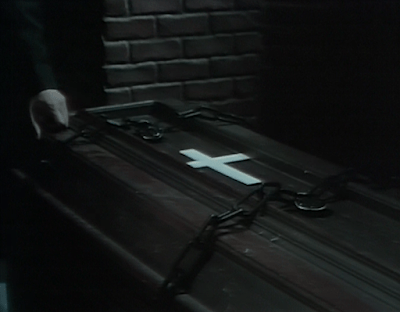
Barnabas finds that the coffin is topped with a cross. He can’t get close enough to take hold of the coffin and move it, so presumably even after he gets the soil he needs he will have to plunder a mortuary showroom to get a fresh resting place before dawn.
Charity does go to the basement. She puts some soil in her purse, then knocks over a crate, attracting Edward’s attention. She does not run away, but merely hides in an alcove until Edward comes down, sees her in shadow, and orders her to show herself.
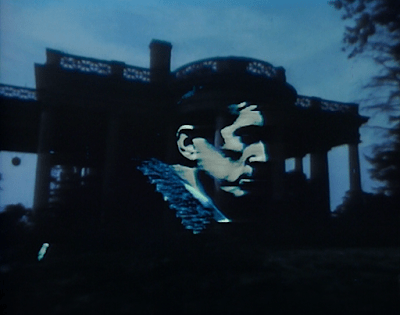
The opening voiceover plays over this image, a type of visual effect we have not seen before at the beginning of an episode:
A transparent sticker of Barnabas superimposed on the exterior of the Old House. Screenshot by Dark Shadows Before I Die.
Barnabas Collins has bitten dimwitted servant Dirk Wilkins, turning Dirk into a vampire like himself. Barnabas has been out all night, searching for Dirk’s hiding place. He hopes to expose Dirk and frame him for his own crimes.
Barnabas comes home to the Old House on the estate of Collinwood to find that Dirk seems to be trying to do the same thing to him. There is a blood-drained corpse in an armchair in his front parlor. It is that of Miss Pansy Faye, Cockney showgirl and Dirk’s first victim.
Barnabas’ distant cousins live in the great house on the estate. One of them, prankster Carl Collins, brought Pansy home with the intention of making her his bride. No sooner does Barnabas discover Pansy’s remains than Carl starts banging on the front door, shouting that he wants to speak with her.
Barnabas hides what’s left of Pansy in a secret chamber behind a bookcase, then lets Carl in. Grisly as the circumstances are, one person lying to another about the presence of a third nearby is a stock situation from farce, and John Karlen and Jonathan Frid play the scene with the particular brand of desperate seriousness that only works in farce. Barnabas persuades Carl to go away and search the grounds of the estate.
That takes a few minutes, starting from what the opening voiceover told us in so many words was “an hour before dawn.” In what remains of that hour, Barnabas takes Pansy’s body to a cemetery and buries her in a shallow grave between tombstones, telling her to “rest in peace.”
Barnabas comes home, and finds Carl, who has in the interval not only gone to the great house, the groundskeeper’s cottage, and a house on the estate which is currently occupied by a school, but has also gone into the village of Collinsport and made inquiries about Pansy. A speedy bunch, the Collinses.
Before Barnabas returned to the house, Carl had heard Pansy’s disembodied voice singing the song she had so memorably performed for Barnabas in yesterday’s episode. He had spoken to Pansy’s voice telling her that his grandmother’s will gave him a house to live in and that she could live there with him. This is puzzling for returning viewers. In #714, it was made perfectly clear that the will did not mention Carl at all. Edith Collins left her entire estate to Carl’s sister Judith, and the only one of the brothers who was mentioned was Quentin, who received no money or negotiable assets of any kind but who was guaranteed the right to stay at Collinwood as long as he pleased. Perhaps they are retconning that away, perhaps Carl is lying to Pansy, or perhaps Carl is losing his grip on reality.
Whether or not we are supposed to doubt Carl’s sanity, Barnabas talks Carl into suspecting that he might have hallucinated Pansy’s voice. Carl leaves, and Barnabas has time to return to his coffin before dawn.
The rest of the episode is taken up with doings at the school Carl had visited. We saw Carl questioning Charity Trask, daughter of the school’s master, the overwhelmingly evil Gregory Trask. The prim Charity was exasperated that Carl kept asking about Pansy after she had already denied having seen her. The scene is an interesting one- Charity and Pansy are such total opposites that it is a shame they never met. It would be amusing to see them juxtaposed.
Charity is engaged to marry Tim Shaw, a teacher at the school. Neither of them is happy about this situation. Tim was in love with Rachel Drummond, another of the teachers, and Charity is Barnabas’ blood thrall. But Gregory blackmailed Tim and bullied Charity into accepting the arrangement.
Charity’s mother, prudish Minerva Trask, does not like Tim or want him as a son-in-law. She urges Charity to set her sights on Carl. Charity says that she would rather marry Barnabas; Minerva says that her instincts are sound, but that she ought not to settle for a cousin of the rich Collinses when one of the brothers is available. Even if they have retconned Carl into owning a house, he is clearly not a rich man, so this reveals that Minerva knows as little about his financial position as she does about the curse under which Barnabas labors.
Charity tries to engage Tim in conversation, and is baffled that he is not willing to talk to her. Indeed, he does not seem like himself at all. Not only is he dismissive with Charity, but when Minerva confronts him he is bold and insolent, a far cry from the broken man we have seen interacting with the Trasks previously. When Charity tells him their engagement is off, he does not express the relief that she and we expect, but puts on a stagey voice we have not heard him use before and marches off to apologize to her mother.
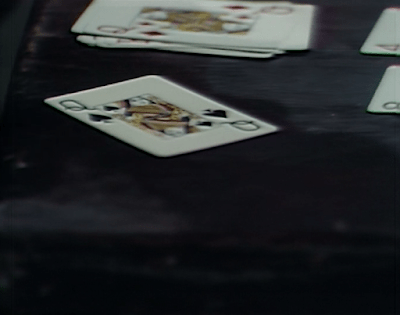
There is a reason for Tim’s behavior. Gregory enlisted warlock Evan Hanley to brainwash Tim so that he would kill Minerva. There is some business with the Queen of Spades, first when Tim mutters the phrase “Queen of Spades,” then when Evan sends him a note on which is scrawled “Queen of Spades,” and lastly when he walks in on Minerva playing solitaire and sees her turn up the Queen of Spades. Many viewers in 1969 would have remembered Richard Condon’s 1959 novel The Manchurian Candidate and its 1962 film version. In Condon’s novel, Raymond Shaw became a robot capable of murder when he saw the Queen of Hearts; in the film, the card was the Queen of Diamonds. Many first time viewers, seeing Tim Shaw’s reaction to the Queen of Spades, would have made the connection and understood why he ends the episode by poisoning Minerva’s tea.
Tim Shaw differs from Raymond Shaw in that he is under a spell for a long while, including the whole time we see him today, and he can talk and act independently while it operates on him. Raymond simply became catatonic when he saw the card and remained that way until he heard a command. He then executed the command and came back to himself once he was finished. Tim’s behavior may suggest a nod to another literary work, Pushkin’s story “The Queen of Spades.” That tale, which Tchaikovsky turned into an opera and which in 1949 was made into a feature film, is about a timid man who inadvertently kills a powerful woman and loses control of himself as a consequence. Like Tim, Captain Herman is coerced into marrying a woman he does not love. Presented with an opportunity to get out of the marriage, he finds himself making extraordinary efforts to go through with it, efforts which bring about his ultimate downfall.
Undead blonde fire witch Laura Murdoch Collins realizes that Barnabas Collins is a vampire, and that when he was alive he was the “strange, dreamy boy with sad eyes” she was fond of in the 1760s, when she was married to his uncle. Laura and Barnabas confront each other in a graveyard at the beginning of the episode; she tells him he is not human. He passes up the opportunity to reply “So few people are, these days.” At the end of the episode, Laura and her witless henchman Dirk let themselves into Barnabas’ house after dawn. She has a mallet and stake, he has a pistol to ensure no one interferes.
It means something to longtime viewers that we end today with Laura poised to destroy Barnabas. It was Laura who cleared the way for Barnabas’ first introduction. She was the show’s first supernatural menace when she was on from December 1966 to March 1967, and her story was structured very much like Bram Stoker’s Dracula. That was successful enough that the following month they introduced Barnabas as Dracula Mark II. That Laura knew Barnabas in the 1760s when she was already what she is and he was still a boy also nods to this history.
Laura went up in smoke in March 1967, when the show took place in a contemporary setting, and reappeared in April 1969, when it was a costume drama set in 1897. In the interval, Dark Shadows changed from a slow-paced, moody Gothic drama meant for an audience largely consisting of people who were fans of Joan Bennett’s in the 1930’s to a slam-bang supernatural thriller with a huge following among preteens. In her first tour as Laura, Diana Millay could focus on her strengths in dry comedy and subtle psychological drama. This time around, she recognizes the new demographic and plays Laura like a villain on Batman. At times it seems odd that Dirk isn’t wearing a jumpsuit with his name stenciled on it.
Perhaps when she hits the stake with the mallet, the word “Whack!” will be printed in a bubble on the screen. Screenshot by Dark Shadows Before I Die.
Meanwhile, Barnabas materializes inside a classroom at a school where Laura’s nine-year old daughter Nora is alone. Nora tells Barnabas that she is not happy at the school and that she and her twelve year old brother Jamison want to leave with their mother. Barnabas tells her to “Look into my eyes!” and he puts the zap on her. When he is done, he tells her that their conversation will be their secret. She smiles, looks directly into the camera, and tells the audience “I like secrets!” Denise Nickerson had a talent for delivering lines to the camera, and ever since she joined the show in November 1968 they’ve had her do that quite often. Rather too often, I’m sorry to say- it can chill the audience to see a character who is so disconnected from everyone else that they just start talking to us if the effect is used sparingly, but they have her do it so frequently that it has lost its force by now.
Nora and Jamison’s school is a miserable place, less a center of learning than a dungeon where the sadistic Rev’d Gregory Trask gleefully inflicts unwarranted and cruel punishments on both children and teachers. Trask’s daughter Charity is a member of the faculty, and since #727 she has also been Barnabas’ blood thrall. In #753, we saw Charity acting as her father’s second in command at the school, enforcing a particularly vicious sanction against Jamison. It did not then seem that her subjection to Barnabas had modified her role in her father’s operation at all.
When Charity enters and finds Barnabas with Nora, her two enslavements come into conflict. Barnabas tells her that Laura will be coming to the school to see Nora soon, and orders her to let her in. Charity is very confused and starts talking about her father and his rules. Barnabas bites her, leaving her more tranquil but quite weak.
Laura knocks on the door. Charity finds that Barnabas has vanished, and lets her in. She demands to see Nora, saying that she will take her away. Charity says that no relatives are allowed to visit the children at night, and that she will need permission from others to allow Laura to take Nora. Laura insists, and eventually Charity complies. She sends Nora down, and brings her packed suitcase. But Nora has told her mother that she does not want to go. We saw in 1967 that Laura’s children must go with her willingly if she is to perform her evil mission, and so she has to yield. She looks at the collar Charity has drawn up to cover her neck, and says that she will not tell her father that two of Nora’s relatives have visited her tonight.
Some of the actors have trouble with the names “Laura” and “Nora” today. It really was a mistake to give Nickerson’s character a name that rhymes with “Laura.” In #354, set in 1967, matriarch Elizabeth Collins Stoddard told her daughter Carolyn that “Aunt Catherine” would be overjoyed to host her in her home in Boston, and that this never-before mentioned aunt gives wonderful parties attended by men Carolyn’s own age. Catherine cannot have been Elizabeth’s sister or a member of Carolyn’s father’s family; she must be Elizabeth’s own aunt. Nora is the only one of Elizabeth’s aunts we ever hear about, and she would have been 79 in 1967. As a grande dame of Boston society, she might still have been giving big parties featuring people of all ages, and so naming the character “Catherine” would have closed that loop.
It would also have opened the door for another story to add some action to the rather slow period leading up to the 1897 flashback. Aunt Catherine could have come to Collinwood from Boston in 1969 and met the evil ghost of the roguish Quentin Collins. Recognizing her favorite uncle but knowing that he came to a dark and mysterious end, that would have set up a confrontation that might have led to an enigmatic conclusion. Quentin killed other adults who knew about him, but his relationship with Catherine would have made it maladroit to bring their encounter to so straightforward a climax. Better to have her disappear inexplicably. That disappearance would be followed by signs that the disturbances in the house had suddenly grown far more dangerous. We would wonder if Catherine had joined with Quentin as another evil spirit, or if the two of them were doing battle in some unseen realm and inflicting collateral damage in the world of the living.
I have an idea who they should have cast as Aunt Catherine. Isabella Hoopes played dying matriarch Edith Collins at the beginning of the 1897 segment, and she was great fun. Had we been introduced to Hoopes as the spry and sophisticated Aunt Catherine, her turn as Edith would have been even richer. When Quentin chokes and threatens to kill Edith, we would try to read their interaction as a clue to what happened between him and Catherine before her disappearance. When Edith haunts Quentin after her death, we would look for clues as to what happened to Catherine after her disappearance. And of course Nickerson’s role as Catherine’s younger self would have gained another dimension, not only as we watch her interactions with Quentin, but also as we compare her personality at the age of nine to that of the octogenarian we had met previously.
I even have some dialogue Catherine could have exchanged with the Collinses of 1969:
Catherine: Roger, I hear you have married again. Will you present me to your wife this time? I must admit I took it rather personally that I could never meet Laura.
Roger: I’m sorry, Aunt Catherine. Cassandra and I have already gone our separate ways.
Catherine: Oh, I’m the one who should be sorry- it was tactless of me not to know… We Collinses have never have had much luck in marriage, have we?
Elizabeth: You and Uncle Ambrose were happy.
Catherine: Yes. Happy… But there wasn’t much luck to that. After all, he was my fourth husband and I was his third wife. We simply applied the lessons of experience.
Carolyn: So there is hope. After your disappointments, you found your grand passion.
Catherine (a look of frank disbelief on her face): Not exactly. (Pause.) Carolyn, your mother told me some time ago you were the one involved in a grand passion. His name is- what- Bud?
Carolyn: Buzz?
Catherine: Yes, Buzz. I should have remembered that, I once knew a Navy flyer who went by that name. If your Uncle Roger won’t be introducing me to anyone, will you at least present me to Buzz?
Carolyn: Oh, it ended between me and Buzz some time back. He’s left town.
Catherine: Ah, too bad. I’d have liked to meet another Buzz, the one I knew was so elegant.
Elizabeth: This one was hardly elegant. He rode a motorcycle, and that was his whole life. He always wore leather clothing and dark glasses, with a long beard and a ragged mop of hair. You never saw the like, Aunt Catherine.
Catherine: On the contrary, I have seen the like every often. Just such men make up your cousin William’s preferred milieu.
Carolyn (laughing): I once told mother I was going to marry Buzz, but that was an empty threat. Buzz isn’t the sort of man who really wants a wife.
Catherine: Neither is William.
(Elizabeth, Roger, and Carolyn fall silent. After a moment, they all start talking at once.)
Elizabeth: Have you seen-
Roger: How is old Mr-
Carolyn: Was your trip-
(They fall silent again. Another awkward pause ensues.)
Elizabeth: Do you know that there is another Collins at Collinwood?
Catherine: Oh?
Elizabeth: Yes, a distant cousin of ours, from England. His name is Barnabas Collins.
Catherine (furrows her brow): Barnabas Collins? Named for the man in the foyer?
Elizabeth: Yes, the portrait is of his ancestor.
Catherine: How odd. When I was a girl, I asked the old people around here about all of the portraits. They were happy to go on at length about all the others, but they were always tongue-tied when we got to that one. Left me with the impression there was something exceptionally sinister about it, or about the man. Of course that only piqued my curiosity.
Carolyn (suddenly defensive): There is certainly nothing sinister about our Barnabas!
Catherine: Nothing sinister? Are you sure he is a Collins?
(Roger and Elizabeth chuckle, Carolyn flushes.)
Elizabeth: Oh, he is a Collins, all right. He’s quite an expert on the family’s past. I’m sure the two of you would have a great deal to talk about.
Catherine: I’m sure. But I would rather choose another topic. At my age I can’t forget that I will soon be part of the past. I would like to keep my eyes on the future while I still have one.
This scene would have left longtime viewers with some suspense-generating questions. Why did Roger’s wife Laura go out of her way to avoid Catherine? Who were the “old people” at Collinwood in Catherine’s childhood? What did they know about Barnabas? Further, Laura and Buzz were so emblematic of two of the early phases of Dark Shadows that involving Catherine in a conversation referring to both of them would promise that she will be woven in with the whole narrative structure of the show.
Moreover, seeing a Collins who had spent decades far from Collinwood might give us a fresh perspective on the main characters. We see only those whose minds and hearts have been deformed by the many curses that loom over the estate. Meeting one who has been outside their influence for so long would suggest what it has cost the others to stay on the estate. We might then feel anew the tragedy that we have been taking for granted.






 Dark Shadows Commentary