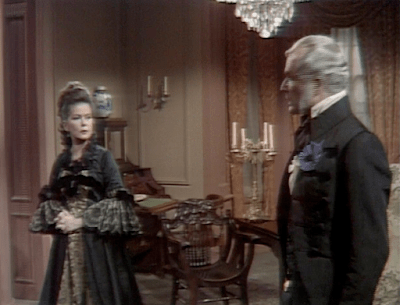
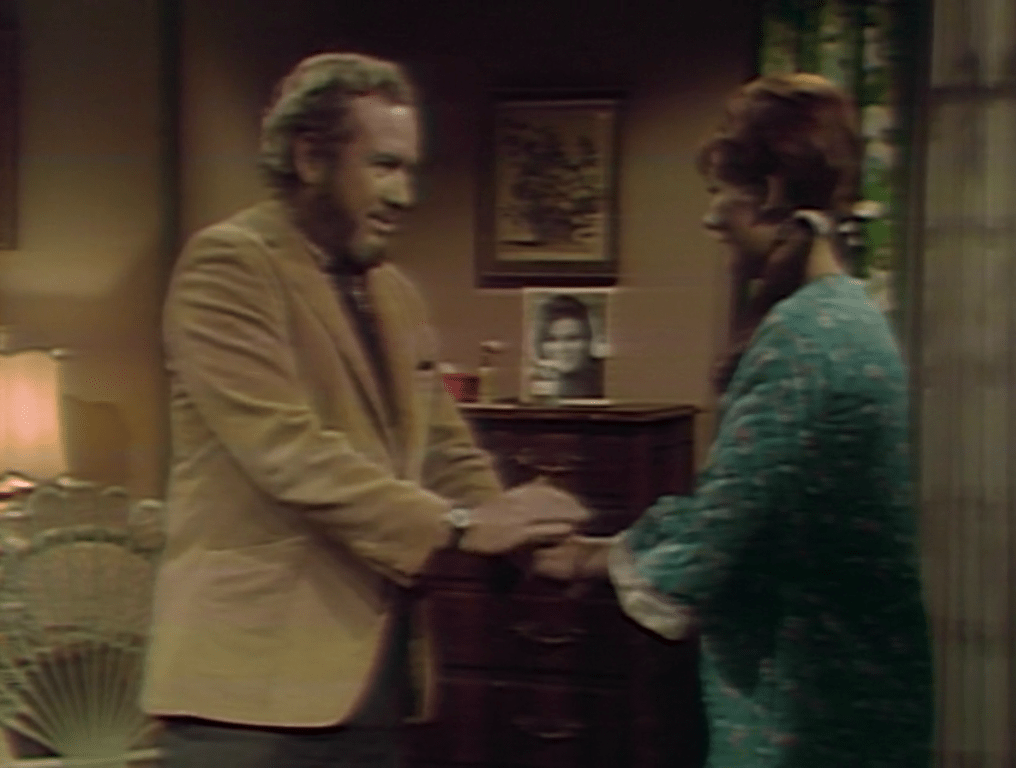
We open in the drawing room of the great house of Collinwood, where Naomi Collins (Joan Bennett) is drinking alone. Her husband Joshua (Louis Edmonds) enters, returning home after an absence of some days, and greets Naomi with a loud expression of scorn for her alcoholism. She looks up and recites these lines: “A little bird flew to the window. It hovered there for a moment, and then flew away. The first bird of the morning.” Many times, Joan Bennett found ways to show the viewers of Dark Shadows why she had been one of the biggest movie stars of her generation, but this is not one of those times. She delivers this little speech stiffly, as if embarrassed by it.
Joshua is about to leave the room when Naomi tells him that their daughter Sarah died the night before, on her eleventh birthday. He is thunderstruck and says that he cannot believe it. Naomi replies, “Yes, that is what we must do- not believe it!” With this line, Joan Bennett recovers her footing. As matriarch Elizabeth Collins Stoddard in the first 73 weeks of Dark Shadows, when the show was set in 1966 and 1967, Bennett created a character who had devoted her entire life to this motto. Now that the show is set in the late 18th century, we see that the Collinses had been living by it for hundreds of years. Once she starts playing a character who is wrestling with denial, Bennett is in familiar territory, and she is terrific to watch.
Joshua believes that the bewildered Victoria Winters (Alexandra Moltke Isles) is a witch, and that a spell she cast on Sarah caused her death. He goes to the gaol in the village of Collinsport where Vicki is being held, awaiting trial on witchcraft charges. We see her in her cell, the first time we have seen this set. Joshua confronts her there. She denies his accusation. She tells him she is a time-traveler displaced from 1967 and that she has been trying to use her knowledge of history to rescue people from the fates that she has read about. This is true, as it happens, but of course Joshua is not favorably impressed. He tells her to enjoy the few sunsets and sunrises that she will see between now and the day she is put to death.
A week before, Naomi and Joshua’s other child, their forty-ish son Barnabas (Jonathan Frid,) had died of a mysterious illness. Joshua decreed that no one must know that Barnabas had died. He had Barnabas’ body interred in a secret chamber hidden inside the Collins family mausoleum, and put out the word that Barnabas had gone to England.
Unknown to Joshua or Naomi, Barnabas has become a vampire. Joshua’s remark to Vicki about sunrises and sunsets thus carried an ironic charge for regular viewers. When Barnabas emerges from his coffin after this sunset, his friend, much put-upon servant Ben Stokes (Thayer David,) tells him Sarah has died. Barnabas blames himself for this. Sarah had seen him with blood on his face, and in her fear had run away. Alone in the night, she suffered from exposure. Barnabas tells Ben that he will go into the village of Collinsport, confess everything to the authorities, and let the sunlight destroy him. At least that will save Vicki. Ben pleads with him to find another way, but Barnabas insists.
Sarah’s remains have been deposited in a vault in the outer part of the mausoleum. Naomi comes in to look at the vault again; Joshua follows her. Naomi has many bitter words for Joshua; he is ready to lament the deaths of their children. Barnabas and Ben, hiding inside the secret chamber, listen to this painful conversation.
Joshua losing his grip on NaomiBarnabas and Ben eavesdrop.
For viewers who have been watching Dark Shadows from the beginning, the scene of Barnabas and Ben eavesdropping on Joshua and Naomi evokes two earlier scenes with particular force. In #318, Barnabas and his associate, mad scientist Julia Hoffman, stood on the same spots where Barnabas and Ben stand now, listening as two local men talking in the outer chamber revealed knowledge that might expose their many crimes. In #118, crazed groundskeeper Matthew Morgan, also played by Thayer David, held Vicki prisoner in a different secret chamber, and the two of them listened as another pair of local men searched for Vicki just outside. In those episodes, Frid and David played men who were bent on murder, but whom we knew to be unlikely to kill their intended targets. Today, they are playing characters who are both desperate to stop killing, but we know that they are doomed to take more lives.
After Naomi and Joshua leave, Barnabas tells Ben he cannot turn himself in. The family must not be disgraced. He tells Ben to come back in the morning with a stake made of holly and to drive it through his heart. He gives him this command in just the same words the witch Angelique had used in #410. Ben had not at that time known what had become of Barnabas, and had complied only because he was under Angelique’s power. He resists Barnabas’ command now, saying that he cannot destroy one who has been a true friend to him. Barnabas tells him he is already destroyed, and that staking him will be a mercy. Ben reluctantly agrees.
In episode 368/369 of Dark Shadows, haughty overlord Joshua Collins of Collinsport, Maine told his house-guest, the Countess DuPrés, that he was surprised she still chose to “affect a title,” since in this year of 1795 “France has followed our example and become a republic.” After the countess handed Joshua his head, he fumed to his wife Naomi that her snobbish Old World ways offended him, since he is such a devout believer in human equality.
It was immediately clear to any viewer that Joshua was being hypocritical. He tyrannizes his family and treats his servants as domestic animals that have unaccountably, and rather inconveniently, gained the power of speech. When he says that all men are equal, he means that he, personally, is the equal of anyone in a sufficiently lofty position, and the superior of everyone else.
Audience members who know something about the history of the late eighteenth century in the USA and France will find more to savor in Joshua’s preposterous position. By 1795, the French Revolution had gone through its most radical phases, and was anathema to everyone in the USA other than some of the nascent political tendency led by Thomas Jefferson, a tendency known in the southeast and New England as the Republican Party and in the middle states and the west as the Democratic Party. When Joshua says with great satisfaction that “France has followed our example and become a republic,” he is identifying himself with the most militant factions of the Jeffersonian party, and when he tells Naomi that “all men are equal” he is echoing the most famous passage of Jefferson’s most celebrated writing.
Ridiculous as it is to hear Joshua invoke the egalitarian rhetoric for which Jefferson was so well known, as a major landowner in a rural area far removed from the major cities he was perfectly typical of the most important backers of the Democratic/ Republicans. Jefferson himself was a member of this category, and he displayed both a remarkably sophisticated understanding of the leftwardmost theorists of the French Revolution, as demonstrated for example in the edition of the works of Destutt de Tracy that he prepared for publication in 1817, and a dismally cruel approach to his livelihood as a slave-holding planter.
When Dark Shadows was on the air in 1966-1971, the party that traced its origins to Jefferson was undergoing a revolution of its own. The coalition he forged between working-class groups in the north and rich slave-owners in the south had been an inspiration to the Democratic Party from the days before the Civil War right through the presidencies of Woodrow Wilson and Franklin Roosevelt. After World War Two, the African American freedom movement finally scrambled this unlikely coalition, winning Black southerners the vote and challenging the dominance the heirs of the slave-owners had long held in the Democratic Solid South. Thoughtful Americans, seeing this change, might well think back to the origins of the Democratic Party and to the ridiculous incongruity of Jefferson’s soaringly egalitarian words coming out of his and other oligarchic mouths.
At the top of today’s episode, Joshua is very thorough about betraying all of Jefferson’s ideals. He tells Naomi that the common folk of the town must not know that their son Barnabas killed his uncle Jeremiah in a duel. Naomi replies that everyone already knows; Joshua insists that they do not, and declares that they will believe what he tells them to believe.
One of the major themes of Jefferson’s correspondence, as indeed of Destutt de Tracy and other Enlightenment philosophes, was what Karl Marx, a close reader of Destutt de Tracy, would call “false consciousness,” the tendency of the oppressed classes to see the world in categories generated by the ruling class, and that if false consciousness were erased the oppressed would rise up and sweep away all manner of social evils. Joshua’s determination to keep the working people of Collinsport in the dark about what is happening on the estate of Collinwood puts him at the opposite extreme from the beliefs his leader Jefferson professed. In his own life, Jefferson himself set about enforcing regimes of lies on more than one occasion, as for example when he used his office as president of the United States to cover up the crimes of General James Wilkinson. Even viewers who hadn’t read Jefferson’s letters and who were unaware of Jefferson’s less inspiring actions may well have known, in 1967, that the confidence which the Declaration of Independence expresses in what will happen if “the facts be submitted to a candid world” sat uneasily with the lies on which slavery in particular and white supremacy in general rests.
Joshua begins dictating to Naomi a fictitious story that sounds oddly familiar to regular viewers. Before well-meaning governess Vicki was plunged into her uncertain and frightening journey into the past, we had heard several versions of the Collins family history, none of which resembles the events that we have actually seen play out so far. As Joshua tells Naomi what he has decided people should believe, for the first time the outlines of the Collins family history published in the 1950s come into view. That history is not only sustained by false consciousness, but has its origins in a brazen lie.
Joshua is busy fabricating when Naomi interrupts him with more bad news. Barnabas has decided to marry Angelique, maid to the Countess DuPrés and to the countess’ niece, Barnabas’ former fiancée Josette. The great egalitarian Joshua is thunderstruck that his son would fall into the clutches of an “adventuress.”
Joshua sends Naomi to fetch Barnabas. He thunders his disapproval of the marriage, and Barnabas stands his ground.
Later, we see Josette in the cemetery, at Jeremiah’s grave. Barnabas spots her, and wonders whether he should tell her about his engagement to Angelique. He doesn’t want her to hear of it from someone else, as she surely will very soon. But the place could not be less appropriate. He approaches her; they have an awkward little talk, in the course of which he urges her to hate him for killing her husband. She says she cannot. She tells him not to say any more. He is helpless.
Angelique arrives and tells Josette that her carriage is waiting. Josette invites Barnabas to ride back to the manor house with them; he declines. Josette leaves the two of them alone for a moment; with a note of jealousy that belies her agreement to a sham marriage to a man who will always love Josette, she asks Barnabas if she interrupted something. He says that she did not. That’s true- he had already given up the idea of telling her about their engagement when Angelique joined them.
Back in the manor house, Joshua summons Angelique to the front parlor, where he offers her $10,000 to relinquish her claim on Barnabas and go back to the island of Martinique. It is difficult to compare prices between 1795 and 2023; to get a sense of proportion, we might remember that when Joshua offered Vicki a job as governess to little Sarah Collins in #367, he offered her a salary of $4 a week, and that this was rather a generous rate of pay for the position. So it would take even an upper servant 2500 weeks, that is to say almost fifty years, to earn the amount of money Joshua is offering Angelique.
Angelique refuses Joshua’s bribe. He says he is prepared to offer more, but when he sees that she is firm in her refusal he switches to threats. Naomi intervenes and says that she does not want to break ties. With Naomi’s promise of friendship, Angelique agrees to wait until the mourning period for Jeremiah is complete before marrying Barnabas.
What returning viewers know that Joshua, Naomi, Barnabas, the countess, and Josette do not is that Angelique is not only a maid, but is also a witch. It was under her spell that Josette, though in love with Barnabas, conceived a mad passion for Jeremiah, that Jeremiah, though a loyal friend to Barnabas, reciprocated that passion, and that the two of them, though they struggled with their consciences, eloped. That elopement prompted the jilted Barnabas to challenge his uncle to a duel, and his bewilderment at his own actions prompted Jeremiah to delope and let Barnabas kill him. Angelique and Barnabas had had a brief romantic fling before he became engaged to Josette, and she believed that once Josette was out of the way Barnabas would return to her.
It hadn’t quite worked out that way. In her frustration at Barnabas’ continued preference for Josette, Angelique cast a spell on Sarah, sickening her and threatening her life. When she saw how upset Barnabas was by his little sister’s illness, Angelique said that she could cure it, and extorted his promise to marry her if she did so. She released Barnabas from that promise in #390/391. When he told her that Josette would always come first for him, even though he knew there could never again be anything between them, she said she would marry him anyway. Apparently thinking he wouldn’t be likely to find another woman willing to enter a sham marriage on that basis, Barnabas proposed, and Angelique accepted.
In their conversation in the parlor, Joshua tells Angelique that he knows about the promise she extorted from Barnabas with her ability to cure Sarah. Evidently Barnabas told Naomi about that. There are those in the house who believe that witchcraft is afoot; indeed, Vicki is in hiding, having been accused as the witch. This story would seem to be proof positive that Angelique, not Vicki, is the guilty party, and she does widen her eyes when Joshua brings it up. But he and Naomi don’t make the connection.
Back in the graveyard, Angelique is holding a miniature coffin and casting a spell.
Where did she get that miniature? Screenshot by Dark Shadows Before I Die.
In her bedroom, Josette hears Angelique’s disembodied voice, saying that Jeremiah is not dead. She runs to the front door, where Naomi sees her. Unable to dissuade her from going out in the night, Naomi follows Josette to Jeremiah’s grave. Josette keeps hearing the voice; Naomi does not hear it. But when Jeremiah’s hand bursts out of the soil, both women see it.
Jeremiah waves to the ladies. Screenshot by Dark Shadows Before I Die.
In the parts of Dark Shadows set in the twentieth century, Joan Bennett played matriarch Elizabeth Collins Stoddard. Of all the major characters, Liz was the most reluctant to acknowledge the existence of supernatural forces, and she was the one who was least likely to see the evidence of such forces that abounded in the world around her. So when we see her as Naomi watching Jeremiah’s hand reaching out of his grave, it is the first time we have seen her react to an incontrovertible sign of the paranormal. It makes us wonder how far back in the Collinses’ past the roots of Liz’ denial extend.
On Wednesday, we met a new arrival from Paris by way of the island of Martinique. She is Angelique, maidservant to the Countess DuPrés and onetime bedfellow of rich young gentleman Barnabas Collins. Barnabas is engaged to marry the countess’ niece Josette, and is anxious to keep Angelique in the background. Angelique does not share either of Barnabas’ goals.
At rise, Angelique meets Barnabas’ uncle Jeremiah in the front parlor of the manor house of Collinwood. She has found a toy soldier and asks Jeremiah about it. When he identifies it as one of the toys Barnabas was most fond of in his boyhood, he volunteers to take it to the playroom himself. She asks to keep it for a while, so that she can study its workmanship. He doesn’t object, and exits. Once she is alone in the parlor, Angelique starts talking to herself. She says that she will use it to cause Barnabas unimaginable pain. This is the first direct suggestion we have seen that Angelique is involved in witchcraft.
Time-traveling governess Vicki enters. She tells Angelique that they should be friends, because they are both servants in the house, and it is a foreign setting to both of them. Angelique asks what Vicki means by describing herself as foreign, since she is an American. Vicki realizes that she can’t tell someone she has just met that she is a time traveler thrust here from 1967 by the ghost of the little girl she is supposed to be educating, and so she mutters something about how Angelique wouldn’t understand. After they part, we hear Angelique musing that Vicki has no idea what she understands. At no point does Angelique show any interest whatever in becoming friends with Vicki.
Later, we see Angelique alone in her room with the toy soldier and Barnabas’ handkerchief. She is talking to herself about her evil plans again when she is interrupted by a knock at the door. She hides the things and answers it. Barnabas enters.
Barnabas renews the effort he made at the end of Wednesday’s episode to friendzone Angelique. Again, she isn’t having it. After he leaves, she takes the soldier and the handkerchief back out and tells them that she has decided to wait for Josette’s arrival to enact her revenge on Barnabas.
She won’t have to wait long. Josette’s father, André, is entering the parlor, grumbling about the lack of servants at Collinwood. He beckons his daughter, and she follows him into the house. She is played by Kathryn Leigh Scott.
A major cast member of the parts of Dark Shadows set in the 1960s as Maggie Evans, The Nicest Girl in Town, Miss Scott has played Josette’s ghost more than once. She created the part in #70, when she was the shimmery figure who emerged from Josette’s portrait in the very house we are in today and danced among its pillars. She reprised the part in #126, again in this house, when Josette led the other ghosts in rescuing Vicki from crazed handyman Matthew Morgan. For some months Barnabas, who is in 1967 a vampire, held Maggie prisoner here and tried to replace her personality with that of Josette. Barnabas often seemed convinced that Maggie really was Josette, and when strange and troubled boy David saw Maggie wearing Josette’s dress in #240 he said that her face was “exactly the same” as it was on the many occasions when he had seen Josette’s ghost.
Barnabas’ plan to Josettify Maggie is drawn from the 1932 film The Mummy, in which the undead Imhotep (Boris Karloff) is released from his tomb, holds Helen Grosvenor (Zita Johanns) prisoner, and tries to replace Helen’s personality with that of his lost love Princess Ankh-Esen-Amun. In that movie, there is a flashback to ancient Egypt, where we see that Zita Johanns also plays Ankh-Esen-Amun and we realize that Imhotep’s crazy plan was rooted in some supernatural connection between the two women. The connection between Josette and Maggie has been equivocal until now- Miss Scott was always veiled when she played Josette’s ghost, and stand-in Dorrie Kavanuagh was the one wearing the dress in #240. Moreover, after Maggie got away in #260, Barnabas soon turned his attentions to Vicki, and decided he would try the same gimmick with her. But now we see that Barnabas really was onto something with regard to Maggie, and we wonder where it will lead. I remember the first time we watched the show, my wife, Mrs Acilius, reacted with great excitement to Josette’s entrance in this episode and exclaimed “Of course! Maggie is Josette!”
Vicki spent the first three days of this week telling the actors what parts they played in the first 73 weeks of Dark Shadows, an annoying habit. But there is a reason for it. She knew Barnabas and Sarah as supernatural beings in 1967, so she will recognize them as the same people here. And Josette’s looks reveal her connection to Vicki’s friend Maggie, so she will recognize that. Since only Angelique, of the characters we have met so far in 1795, is played by someone who did not appear previously, the writers are in a difficult position with regard to all of the other members of the company.
I wish they had solved that problem by having Vicki show up in 1795 unable to speak. The suggestion I made in my post about #366 is that she could have materialized in the midst of the accident that upset the carriage bringing the original governess, Phyllis Wick.* Vicki could have sustained a slight injury that left her mute for a week or so, could have had voiceover monologues registering her recognitions of Barnabas, Sarah, and Josette/ Maggie, and would not have had audible monologues when she saw the others. By the time she could talk again, Vicki would know that she was supposed to pretend to be Phyllis Wick.
Clearly Vicki is supposed to get into some kind of trouble in 1795; she is still the heroine, and the first rule of all soap operas is that the heroine must always be in danger. But she is supposed to be seeing the events that started the phase of the Collins family curse that involves Barnabas’ vampirism, and those events did not involve a governess who went around calling people by the wrong names and blurting out information she learned from reading the Collins family history. The logic of the plot requires that whatever trouble Vicki gets into is more or less the same trouble Phyllis Wick would have got into, and the appeal of the character requires that the audience watch to see what kind of con artist Vicki might turn out to be. Both of those imperatives demand that she try to masquerade as Phyllis.
Vicki does manage to keep herself from telling André and Josette that they are being played by the actors who took the parts of Sam and Maggie Evans in other parts of Dark Shadows. She can’t help staring at Josette, however. Josette is quite cheerful when she asks Vicki why she is staring; André, a more conventional aristocrat than his relaxed daughter, is visibly annoyed with Vicki’s impertinence.
There was an opportunity here for Vicki to show some quick thinking. She could have told Josette that Barnabas has gone on at length about her appearance, and that she is amazed at the accuracy of his descriptions. That would have endeared her to Josette as the bearer of the message that her fiancé is very much in love with her, and would have reassured her that, while Vicki is an attractive young woman who lives under Barnabas’ roof, she is not a rival for his affections. As it is, Vicki just mumbles something about not having known she was staring.
Angelique enters. She and Josette rush into each other’s arms and speak French. Miss Scott tells a funny story about that moment. She and Lara Parker had talked about the script and agreed that two Frenchwomen excited to see each other after a long separation ought to greet each other in French, and they persuaded the producer of their point. Only when they got the revised script with the dialogue in French did it dawn on them that neither of them could speak the language. Fortunately, several other members of the cast were fluent in it, and coached them through.
We can see that Josette really regards Angelique as a friend. Viewers who have been with the show from the beginning will remember Josette’s ghost as a powerful and stalwart force for good, and will also know that Maggie is The Nicest Girl in Town. So whatever grievance Angelique may have against Barnabas, and however unjust may be the social system that has exalted Josette and subordinated Angelique, when we see Angelique faking friendship for Josette while planning to make her watch her lover suffer, we know that she is really evil.
Barnabas enters. Josette tells him that her long, difficult journey was worthwhile now that she is with him. This is a very sharp retcon. In #345, mad scientist Julia Hoffman asked Barnabas if Josette ever came to him of her own free will, and he responded with a silent grimace that left no doubt as to the answer. Now, we see that she has gladly sailed from Martinique to central Maine in late autumn to be with him.
Barnabas and Josette are alone, and he wants to kiss her. She is bashful and says that their parents might be upset if they don’t wait for the wedding. He says they might pretend to be, but that in reality it is expected. That is a sweet little conversation, and it ends in a sweet little kiss.
Angelique is back in her room. She twists Barnabas’ handkerchief around the neck of his toy soldier.
The episode ends with Barnabas on the floor, apparently asphyxiating, while Josette looks on in horror.
Wednesday, Barnabas made it clear that he had his affair with Angelique because he didn’t think Josette could love him. That gives Angelique a perfectly understandable motive for seeking revenge on him. A rich man exploited his position to trifle with her, a servant, giving no thought to her feelings or interests.
The selfishness and entitlement Barnabas exhibited thereby is jarring in the mild-mannered, apparently egalitarian fellow we have seen so far this week, but it fits perfectly with his behavior as a vampire in 1967. Seen from another angle, his behavior is consistent with everything the Collinses have done to get themselves in trouble since we first met them. He was tempted to take advantage of Angelique because he had underestimated his own lovability and despaired of making a real connection with Josette.
Barnabas is still underestimating himself and Josette now. Never once does it occur to him to come clean to her about what he did with Angelique. While Josette would no doubt be saddened to learn that her beloved fiancé had dallied with her pet servant, as a rich French girl from Martinique she has after all lived her whole life among wealthy men surrounded by enslaved women, and so could hardly have been shocked by what Barnabas had done. Surely she would have decided to go ahead with the wedding, and she would have known to be wary of Angelique.
By failing to trust Josette with the truth about his misdeeds, Barnabas puts her and himself at Angelique’s mercy. We think of 1966, when matriarch Elizabeth Collins Stoddard and her brother, high-born ne’er-do-well Roger Collins, were both prisoners of shameful secrets they dared not share even with each other. In 1967, when those secrets were finally laid bare to the whole world, Liz and Roger found they were free to go on about their business as if nothing had happened. In Barnabas’ petrified silence, we see all of the shadows that have kept his relatives in darkness for so long.
*Whom Dorrie Kavanaugh played in her brief appearance at the end of #365.
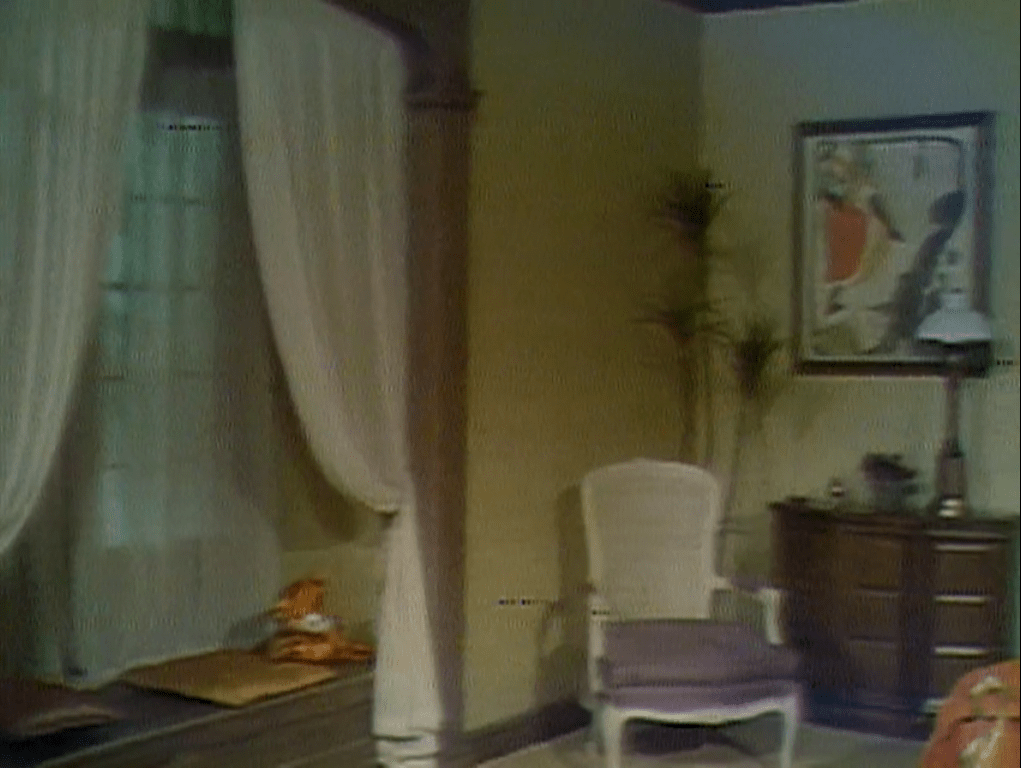
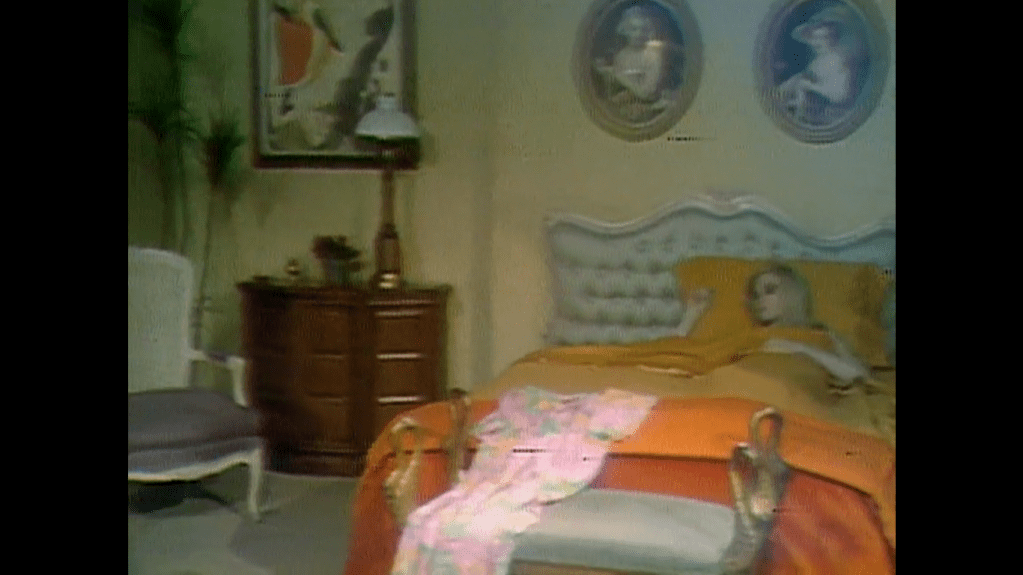
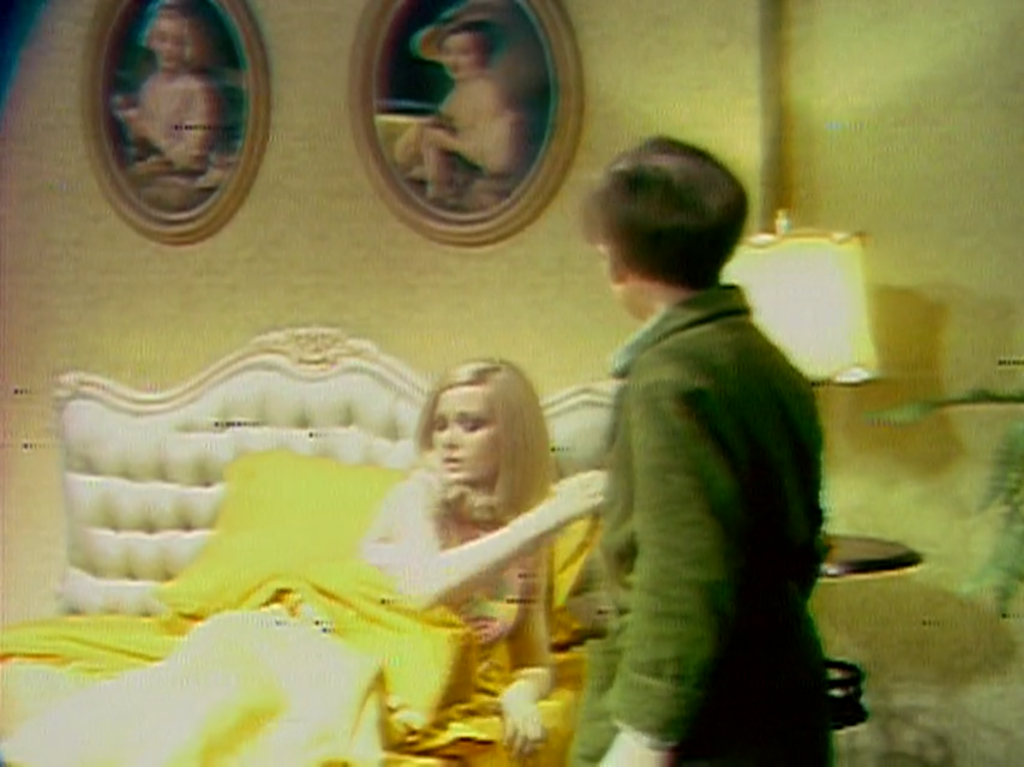
We open on a new set, the bedroom of heiress Carolyn Collins Stoddard in the great house of Collinwood. Dark Shadows has been in color since #295 in August. Though directors Lela Swift and John Sedwick were both ambitious visual artists, they haven’t been able to do much with color so far. With Carolyn’s bedroom, Swift and the staging team have accomplished one of their first real essays in color. It is composed mostly of shades of yellow, pink, and orange.
The color schemes of the other interiors we’ve seen up to this point run the gamut from sedate to subdued to drab to dank, so we already know we are in a unique space. The only other room in Collinwood that might have matched this one for brightness was the kitchen, but we haven’t seen that since #208.
Carolyn’s young cousin, strange and troubled boy David, lets himself into her room. He touches her, and she awakes with a scream. He explains that he just dropped in to make sure she wasn’t dead. When she turns on the light, the screen is so bright that I reflexively squinted, a reaction I’d never before had to an image on Dark Shadows.
Bright room.
David can’t quite explain why he was afraid Carolyn might be dead, but he does insist that she take an antique toy soldier, saying that she will be safe if she keeps it with her. Carolyn’s mother, matriarch Liz, comes into the room to investigate Carolyn’s scream. Liz wonders what David is doing there. Carolyn hastens to say that he was just making sure she was all right.
David goes, and Carolyn tells Liz she doesn’t think anything can be done for him at home. Liz is reluctant to send him away. Regular viewers will not be surprised by this. We know that Liz took David and his father, her ne’er-do-well brother Roger, into Collinwood at the beginning of the summer of 1966 and summoned her unacknowledged daughter, well-meaning governess Vicki, to come look after David starting with #1 on 27 June 1966, so that her conviction that the family ought to look after him got the whole show started. Nonetheless, Liz is so disturbed by David’s unusual statements and depressive affect that she agrees that he needs residential care.
We cut to the Old House on the estate. Vampire Barnabas Collins is sitting in a basement room where mad scientist Julia Hoffman maintains a laboratory. The room is full of electrical equipment, a bit odd since the Old House has no electricity; the laboratory itself is lit by flaming torches. But if we’ve ever seen a Universal Studios production from the 1930s, we know that where you find a mad scientist, you will find electrical currents, so naturally things start buzzing when Julia flips a switch.
Barnabas confined
Julia is trying to implement a medical cure for Barnabas’ vampirism. In the first shot of this scene, we see a visual metaphor for that project. Barnabas, an uncanny being, is confined to a small space in the middle of an elaborate collection of technology. If Julia succeeds, the supernatural will be vanquished altogether and scientific rationality will fill the whole world. The color scheme emphasizes the contrast between Julia’s optimistic goal and the terrain on which she operates. The walls and floor are dominated by the grays and browns of the basement, but the frames and tubing of her equipment are a bright metallic hue, light plays on the glass components, and the intense greens, reds, and blues of the potions are distributed in a slightly unbalanced, lively pattern. The irregular shapes of the frames and tubing emphasize this pattern, and contrast with the solid gray of the floor and the even grid of the brickwork on the walls.
This image not only represents Julia’s plans, but also one of the major themes the show is exploring at this period. Too many characters have encountered too much evidence of supernatural forces and beings for anyone to simply deny that such things exist. But even those who have been most heavily exposed to them keep reverting to a naturalistic frame of reference. Sure, Julia spends all her time hanging around with a vampire and has encountered a couple of ghosts, but she’s determined to ring all of those phenomena around with scientific explanations and technological interventions until they yield to rational control.
Julia’s project has hit its first major setback, as the latest treatment led Barnabas’ hands to age dramatically. He expresses the fear that time will catch up with him, and his apparent age will soon catch up with his actual age, something like 200 years. Julia’s hope that her experiment will not only free Barnabas of his curse, but found a new kind of medicine that will free everyone else of aging and death, will thus be defeated.
Barnabas gives a remarkable little speech about the situation he finds himself in:
I’ve been granted privileges given to few other men… For most men, time moves slowly, so very slowly. They don’t even realize it. But time has revealed itself to me in a very special way. Time is a rushing, howling wind raging past me, withering me in one relentless blast and then continues on. I have been sitting here passively, submissive to its rage, watching its work. Listen. Time, howling, withering.
Writer Joe Caldwell has a fine sense of what actors can do, and this odd little bit of purple prose is right in Jonathan Frid’s wheelhouse. It doesn’t make a whole lot of sense, but the sound of his voice delivering it is so gorgeous it may as well be Shakespeare. Well, maybe not Shakespeare, but Ben Jonson at least.
It is possible to read this speech as a programmatic statement. Daytime soap operas of the 1960s were famously slow-paced; the old joke was that a viewer saw an episode that ended with a character hearing a telephone ring, missed four months of the show, and tuned back in to see the episode that started with the same character saying “Hello.” Even by the standards of the period, the first months of Dark Shadows were notoriously leisurely, with action often as not playing out in real time. When we are watching the 21 episodes centering on Roger’s attempts to find a fountain pen he misplaced, it is indeed the case that “time moves slowly, so very slowly.” But those days are behind us. The show is whipping through plot points at a pace that many prime time series contemporary with it would have had a hard time matching.
If the speech is programmatic, it is also autobiographical on the part of the screenwriter. A fast pace promises excitement for the viewers, but makes life hard for a writing staff that never numbered more than three. Indeed, this is the last episode Joe Caldwell will write for two and a half years. Perhaps he felt the demands of the new pace as “a relentless blast” withering his talents, and had to bow out.
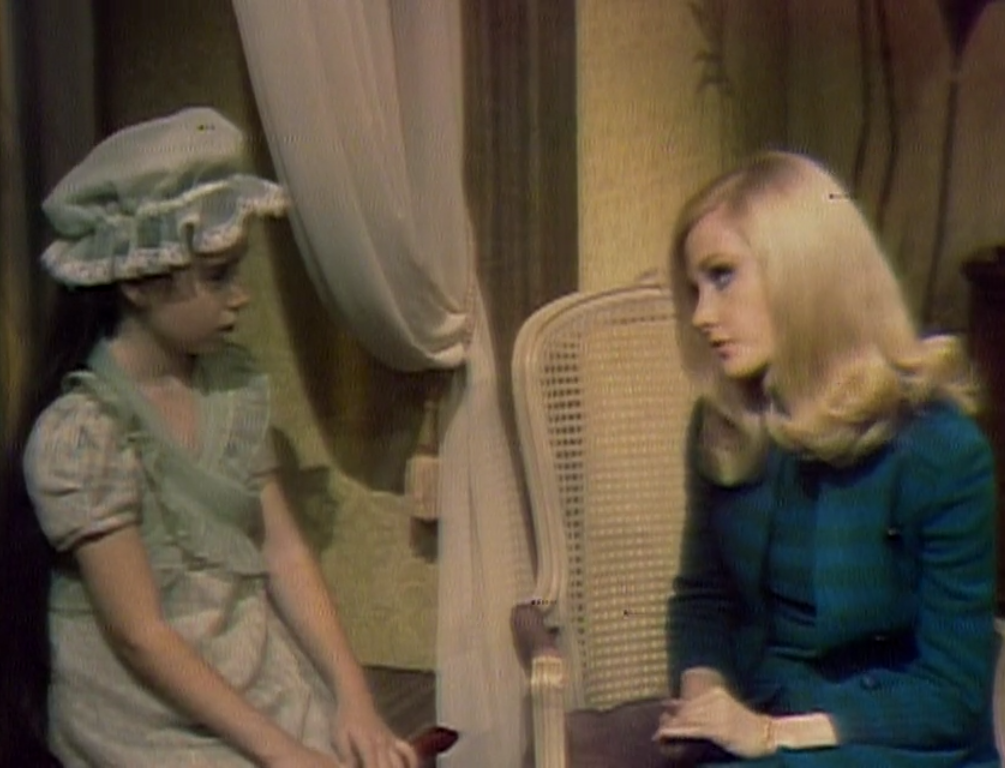
We return to Carolyn’s room. She is in front of her mirror, contemplating the toy soldier. She hears the strains of “London Bridge” playing on a wooden flute, which she has learned is a sign that the ghost of ten year old Sarah Collins is present. Carolyn grew up in this haunted house, so it may not be entirely surprising that her response is to lean back and enjoy the music. But she sits up when Sarah manifests herself in visible form.
Ghost in the mirror
Sarah speaks, and Carolyn sees her reflected in her mirror. The following scene is so extraordinary I’m going to transcribe all of the dialogue:
Sarah: David must have given you that.
Carolyn: Sarah!
Sarah: He told you my name.
Carolyn: Sarah, how did you get in here?
Sarah: Didn’t David tell you?
Carolyn: Tell me what?
Sarah: All about me.
Carolyn: I’m not sure I understand.
Sarah: I think I’m a ghost. Matter of fact, I’m sure I am.
Giving the facts
This is the first time Sarah has described herself in any terms, certainly the first time she has called herself a ghost. Her coyness about herself had left David confused about what she was; it was not until #325 that he finally concluded that she was a ghost. After that, she became more forthright with him. When he wasn’t sure what she was, she would wait until she was out of his line of sight to appear and disappear. But in #327, she fades away while he’s looking right at her.
Coming out to David not only allowed Sarah to relax around him, but has led her to discard her coyness altogether. She is startlingly blunt with Carolyn as this conversation goes on:
Carolyn: B-but- I don’t believe in-
Sarah: Yes you do. Or I wouldn’t have been able to come here. You’re not afraid of me, are you?
Carolyn: No…
Sarah: If you are, I understand.
This is the first confirmation that Sarah can appear only to those who are prepared to believe in her. It’s true that most of the people who have seen and heard her- David; Maggie Evans, The Nicest Girl in Town; Maggie’s father Sam; Vicki; Barnabas; Julia; Barnabas’ sometime blood thrall Willie; and local physician Dave Woodard- have either had extensive contact with the supernatural or had reasoned their way to the conclusion that she existed. But she also showed herself to Maggie’s nurse at the mental hospital Julia runs, and we don’t know anything about her background or beliefs. And local man Burke Devlin heard Sarah when she and David were talking in #327. While Burke has had plenty of contact with supernatural beings and in the early days of Dark Shadows, when he was fun, was willing to believe in them, he was at that point tearing around bellowing that there were no such things as ghosts. So this is new and unexpected information.
Carolyn’s denial that Sarah frightens her is given in a trembling voice that shows it to be a lie. Still, she isn’t as frightened as she might be. The other day, in #344, Carolyn was in David’s room when Sarah manifested there, not in the visible form of a little girl, but as the sound of “London Bridge” and as information appearing in David’s mind about Burke’s imminent death. Carolyn was terrified of Sarah when she came that way.
Carolyn: Well, what do you want?
Sarah: Don’t send David away.
Carolyn: How do you know about that?
Sarah: I don’t know, I just do.
At this point, we see Carolyn’s fear fading. She is starting to react to Sarah as if she really were a ten year old girl.
Carolyn urging Sarah to be reasonable.
Carolyn: But Sarah, we have to send David away. It’s the only way we can help him.
Sarah: But if you send David away, I won’t have anyone to play with.
Carolyn: Well, maybe it isn’t good for David to play with you.
Sarah: Why do you say that?
Carolyn: Because it leads him into believing all sorts of things that aren’t true.
Sarah: How do you know they’re not true?
Carolyn: Well, they’re just not, they couldn’t be.
Sarah: He wasn’t lying about me, was he?
Carolyn: No.
Sarah: Well.. then maybe David is acting the way he is because no one will believe him.
Carolyn: But… it isn’t possible.
Sarah: People say I’m not possible, but I am. Why doesn’t that make the rest possible?
Carolyn: Sarah, maybe you don’t know the stories David’s been telling!
Sarah: Why do you think that?
Carolyn: Because they’re too fantastic! And besides, they’ve all been proved false.
Sarah: How do you know they’ve been proved false?
Carolyn: Sarah, are you trying to tell me that Barnabas actually slee-
This exchange is the ultimate example of a character accepting the existence of a particular supernatural being and then snapping back into a frame of reference that does not allow for supernatural beings. Carolyn knows that Sarah is a ghost, and starts arguing with her about how fantastic the world is permitted to be.
There comes a knock at the door. Carolyn turns away from Sarah to look at the door, and when she looks back, Sarah has vanished. Regular viewers know that Sarah was Barnabas’ little sister, that she wants to keep him from doing horrible things to people she likes, but that she will not say anything against him. So when Carolyn says Barnabas’ name, we know that Sarah is about to vanish.
Sarah’s part is an outstanding example of writing to an actor’s abilities, even more so than was Barnabas’ speech. Caldwell knew that Jonathan Frid had a flair for making flowery gibberish appealing, because that is what he has been doing the whole time he’s been on Dark Shadows. What Sharon Smyth has been doing well as Sarah is being a cutie pie and creating a vague and mysterious impression. When she has more than a few lines to deliver, things tend to get very wobbly. Today, she has to maintain a commanding tone and an adult demeanor throughout an extended patch of rapid-fire dialogue. Absolutely nothing we have seen on screen would suggest that she could handle that. But she pulls it off, more than competently. There are a few glances at the teleprompter, but at no point does she break out of the patient and authoritative manner she has to adopt. It is an impressive job of acting by any standard.
The person at Carolyn’s door is Liz. Liz is Dark Shadows‘ queen of denial. Viewers who have been with the show from the beginning have seen a few cracks in her facade of disbelief in the supernatural. In #10, she dozed off in the drawing room and started talking in her sleep about ghosts. When Vicki insisted to her in #127 that she had seen a ghost, Liz said she believed her. And in #280 and #281, Liz reluctantly agreed to participate in a séance, and afterward agreed that Vicki had been possessed by a spirit. But even in those moments Liz was fighting to keep the topic of ghosts at bay, and the rest of the time she has presented a blank wall to any attempt to face facts about the strange goings-on. So it is not surprising that Carolyn tells her mother she was talking to herself while tidying up her room.
Having talked Liz into sending David away, she now has to talk her back out of it. She manages to get her to agree to wait a few days. “London Bridge” plays. Carolyn reacts to it, Liz does not.
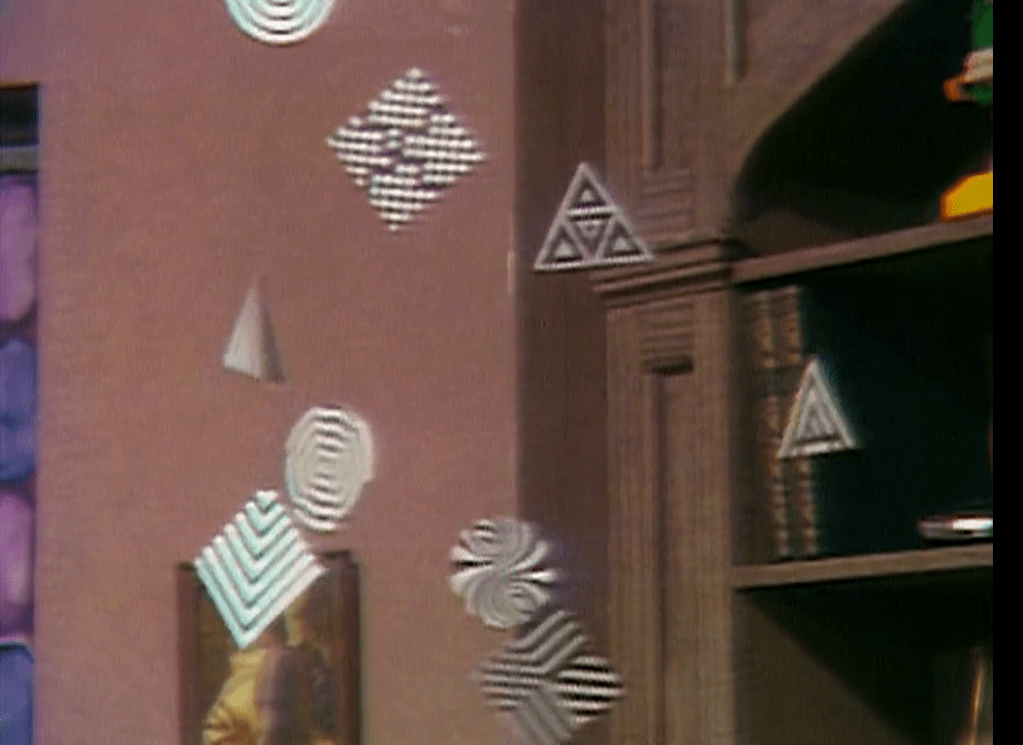
In his room, a distraught David is looking at a mobile. Its whimsical black and white markings suggest a puzzle and make a stark contrast with the vivid colors around them.*
Puzzling shapes.Back to the wall.
Carolyn comes in. She brings the toy soldier and tells David she doesn’t think she will need it. He insists that she will, but she explains that Sarah visited her and now she believes him and knows how to help him. David is horrified by this. He says that Sarah visited Dr Woodard, that Woodard believed him, and that led to his death. He begs Carolyn not to believe him and claims to have been lying. He sobs and clutches her.
Anguished embrace.
Back in the Old House, Julia prepares to give Barnabas another treatment. He snaps at her. She tells him that whatever happens, she wants him to know that she always wished him well. That prompts him to unload a further stream of sour remarks about her competence and intentions. Julia carries out the treatments, only to find that the aged appearance of Barnabas’ hands has spread to his head.
In his post about this episode on Dark Shadows Every Day, Danny Horn puts it well when he says that “This is just good soap opera construction. People that we care about, facing terrible danger, and desperate to help each other.” He’s referring specifically to the scenes between David and Carolyn and Liz, but it applies to everyone. We care not only about the good people in the great house (well, they’ve been relatively good, lately,) but also about Barnabas and Julia, evil people who are the terrible danger David and Carolyn and Liz are facing, but who make the show fun to watch. We care about Sarah too, and she’s desperately trying to accomplish exactly the result we most want to see, an outcome in which David, Barnabas, and everyone else we enjoy watching stays on the show.
*Evidently this mobile was a commercially produced item. One of the commenters on Danny Horn’s Dark Shadows Every Dayreports having had one like it as a child.
Maggie Evans, The Nicest Girl in Town, is not allowed to leave home. The yard outside her door is full of policemen. They are hoping that a rumor that her amnesia is breaking and she will soon remember who abducted her and held her prisoner will draw that person out of hiding. If he approaches the house, they will… it isn’t clear what they will do, exactly. Whatever they do, Maggie hopes that it will end the danger so that she can get back to her normal life.
Maggie and her father Sam talk about the situation. This conversation doesn’t advance the plot or give the audience new information, but it is somewhat interesting to people who have been watching the show from the beginning. For the first 40 weeks of the show, Sam was an alcoholic and Maggie’s attempts to keep him out of trouble were a substantial part of the story. Adult Child of an Alcoholic (ACoA, in the lingo of the twelve step movement) mannerisms such as advertising that she is happy by starting utterances with a laugh and stressing whatever syllables have a rising pitch are still a major part of Maggie’s characterization.
Father and daughter
But Sam isn’t an alcoholic anymore. Not only doesn’t his drinking cause him problems, but we’ve seen him function as a social drinker. He keeps a bottle of whiskey in the living room of the Evans cottage and occasionally takes a drink or two; he often goes to The Blue Whale tavern and enjoys happy hour there. But he declines drinks when they are offered at inconvenient times, doesn’t get drunk, doesn’t have trouble with his work, and Maggie doesn’t have any complaints. The other day, the show referred back to Sam’s drinking days. He and the sheriff went to The Blue Whale, where Sam started the rumor about Maggie’s memory. Sam pretended to be drunk and the sheriff pretended to hush him while he declared that Maggie would be leading the police to her captor any day now. But he was stone sober the whole time, even though he had had a drink at home before leaving for the tavern.
The show dropped the theme of Sam’s alcoholism when it gave up on the storyline of “The Revenge of Burke Devlin.” Sam had started drinking because of the events behind that storyline and his drunkenness made it unpredictable what role he would play in it. Since that ended in #201, the writers don’t seem to see a point in presenting Sam as an alcoholic, even as one in recovery. But I think that is a mistake. The actors and directors remember that Sam has that history, and it adds depth to both David Ford’s portrayal of Sam and Kathryn Leigh Scott’s of Maggie. You wouldn’t have to spend any more screen time presenting Sam as a recovering alcoholic than they spend now presenting him as a social drinker. All he’d have to do is reply to a remark about booze by saying that he never touches the stuff anymore, and you’ve made the point.
Viewers who have been with the show from the beginning will look at Sam and Maggie’s heart-to-heart talk and remember the scenes from the first 40 weeks where Maggie wound up playing the parent in the parent-child relationship. Seeing him really function as a father here will not only reassure us that they are free of that now, but will also explain why Maggie kept falling into all of the patterns of behavior that enabled Sam when he was a drunk. Today, he’s the Daddy she knew before alcohol got the better of him, the one she was always sure was still in there someplace.
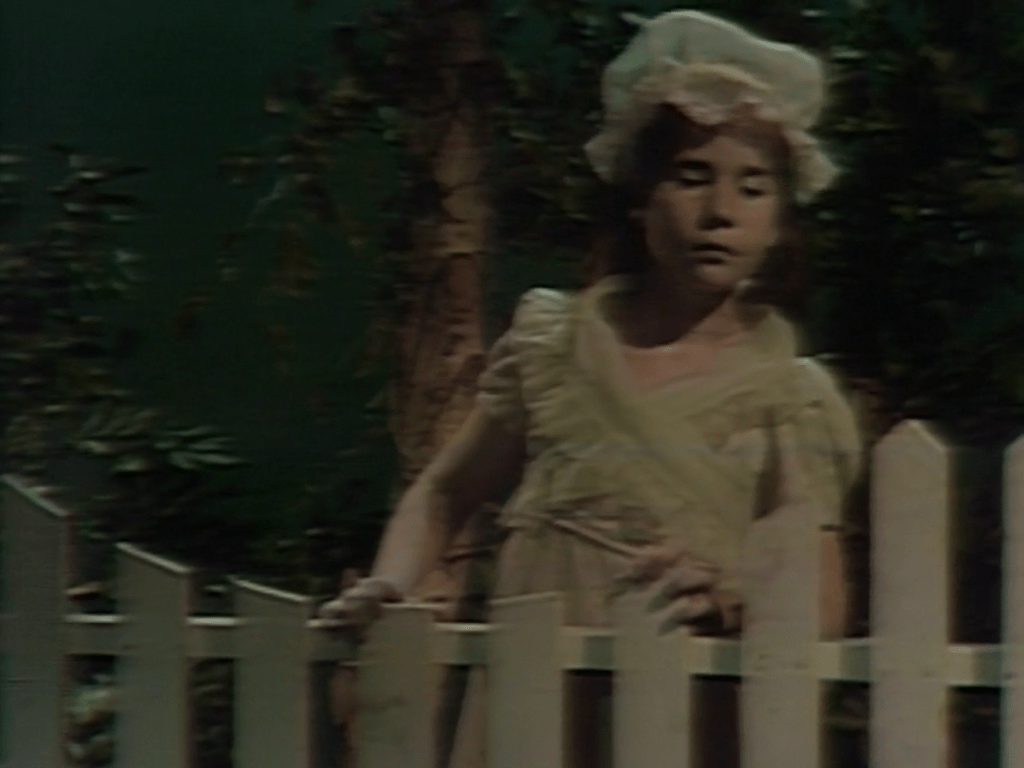
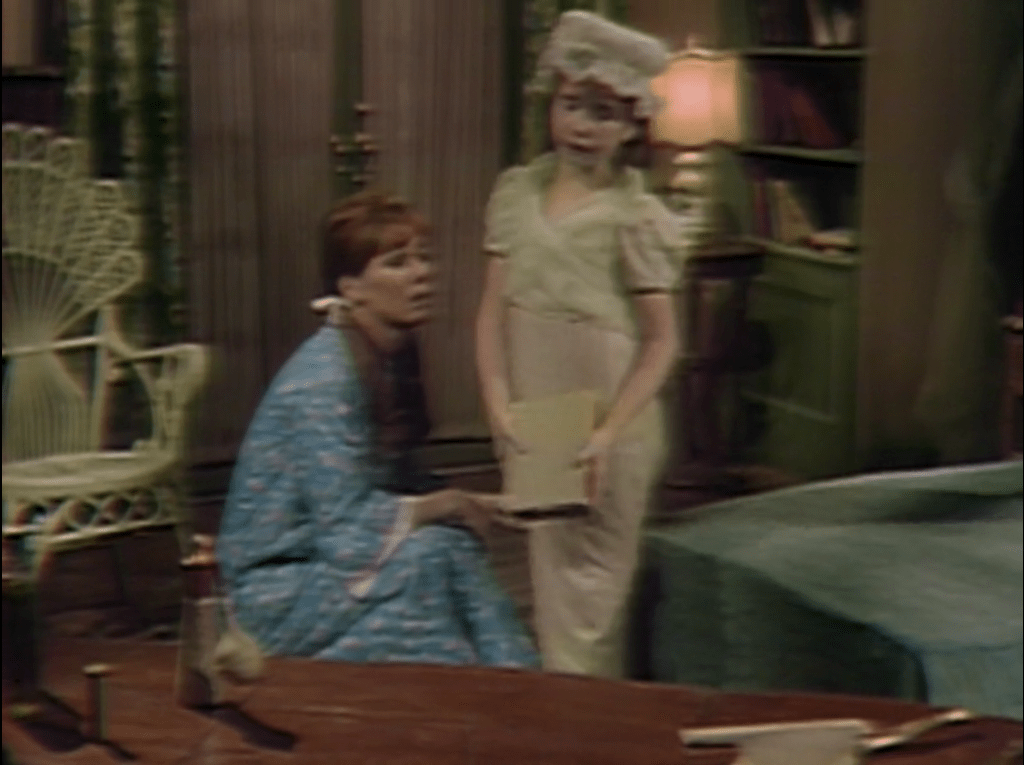
Sam leaves the room, and Maggie gets a visitor. After Sam had assured Maggie that the house was so well-guarded no one could get in, we saw a shot of the permanently nine year old ghost of Sarah Collins outdoors, peering over a picket fence.
Looking for a friend
Maggie falls asleep, and wakes to find Sarah in the room with her. Maggie repeatedly asks Sarah how she got in, and Sarah keeps declining to answer. Maggie keeps trying to get her father into the room, and Sarah keeps telling her that if a third person comes in, she will have to go away. Sarah finds that Maggie is not in possession of the doll she gave her, and tells her that she will have to get it back as soon as possible and keep it with her at all times. Maggie asks more than one question about that as well, and Sarah again tells her that she can’t explain. Sarah gets to be quite exasperated that she has to keep reviewing the ghost rules with Maggie.
Sarah can not believe Maggie still doesn’t get it.
Several characters have entertained the possibility that Sarah might be a ghost, among them Maggie and Sam. They keep snapping back from really believing that she is. In the early months of the show, characters had speculated that there might be ghosts on and around the great estate of Collinwood, but they couldn’t let go of the idea that they lived in a world that basically made sense according to the usual natural laws. So no matter what they saw, they kept retreating from the full implications of the supernatural events that came to be a more and more obvious part of their experiences. Sarah’s impatience with Maggie today is reflected in the impatience many viewers of the show express when characters who have had encounter after encounter with the paranormal won’t stop droning on about how there must be a perfectly logical explanation.
Sarah keeps repeating herself and Maggie keeps missing the point. Maggie tells Sarah that she will like Sam, who likes little girls. That again is a poignant line to those who are thinking about the happy life Maggie had with her father before he started drinking and that has only recently resumed, though it is lost on newer viewers. We also know that Sarah already likes Sam- she visited him in this house in #260 and told him where to find Maggie.
But in the world of Dark Shadows, ghosts cannot appear to more than one person at a time. For example, in #141 strange and troubled boy David Collins took his mother, undead fire witch Laura Murdoch Collins, to the Old House on the grounds of Collinwood, hoping that the ghost of Josette Collins would appear to her. He left her alone in the house, explaining that Josette appears only to one person at a time. Josette did communicate with Laura after David left, though Laura concealed that fact from her son.
We’ve seen only two exceptions to the rule that ghosts appear to one person at a time. The first case was in #165, when Josette manifested herself in a room with David and Laura. The second time was in #294, when Sarah herself helped Maggie escape from the mental hospital where mad scientist Julia Hoffman was keeping her for evil reasons. Both Maggie and her nurse could see Sarah that time.
But those were special occasions. It was such a strain for Josette to present herself to two people that she could shimmer into view only when David was asleep, and a few words from Laura were enough to shoo her away before he could wake up, though he did feel her presence afterward. And Sarah’s appearance to Maggie and the nurse lasted for only a few seconds. Viewers reminded of Sarah’s earlier appearance to Sam will remember that she vanished before he finished a sketch of her that she very much wanted him to give her, so however great a power she might represent, we know that it is not entirely under her control. She can do what she is supposed to do and tell people what they are supposed to know, but she cannot simply do as she wishes, and when she has completed an assigned task or entered an uncongenial situation she will disappear.
Eventually Maggie insists on opening the door and calling to Sam. Of course Sarah has vanished when he enters, of course the men guarding the house didn’t see her, and of course Sam and Maggie fret that if Sarah could come and go unobserved so could the person they are trying to catch. Those bits bring on our frustration with characters who don’t get that they are living in a universe pervaded with supernatural beings. If they were proceeding from the premise that Sarah was a ghost and considering the possibility that Maggie’s captor may also have been some kind of uncanny being, that would indicate that the action is about to start moving a lot faster. As it is, it’s just filler.
Meanwhile, Julia has left her hospital and come to Collinwood, where she is in league with Maggie’s captor, vampire Barnabas Collins. Barnabas has heard the rumor that Maggie is recovering from her amnesia. Julia induced that amnesia to keep Maggie from exposing him and inconveniencing her.
In Friday’s episode, Julia tried to talk Barnabas out of killing Maggie. He had calmly and suavely told her that he had no choice but to yield to her arguments, and she had been satisfied that she had persuaded him. Today, he tells his sorely bedraggled blood-thrall Willie Loomis that he will set out for the Evans cottage as soon as the clouds cover the moon and give him a deep enough cover of darkness.
Willie sneaks over to the terrace at the great house of Collinwood, where he informs Julia of Barnabas’ intentions. Julia cannot believe that her powers of persuasion failed to win Barnabas away from his plan to kill Maggie. Willie has to repeat himself time and again, until he grows as exasperated with Julia as Sarah was with Maggie.
This is the first time we have seen Julia in denial. It’s understandable that she would overestimate her ability to bend Barnabas to her will- not only has she had a great deal of success so far at dominating their relationship, but she is usually able to manipulate people to a fantastic degree. When she induced Maggie’s current amnesia, she took her in a matter of minutes from a state in which she remembered everything that had happened to her to one in which an impenetrable mental block covered exactly the period in which Barnabas abused her. Someone who can do that might well have difficulty grasping the fact that she has not turned someone to her way of thinking.
Barnabas stares out the window of his house in the direction of the Evans cottage and thinks murderous thoughts about Maggie. My wife and I often laugh about the comment Danny Horn made on this scene in his post about this episode on his blog Dark Shadows Every Day:
Meanwhile, the dogs are howling, and Barnabas is standing at the window, staring out into the night.
“Goodbye, Maggie Evans,” he thinks. “I might have loved you. I might have spared you. Now… you must die.”
Man, what a diva. He even has backup singers.
Danny Horn, “Episode 321: What We Talk About When We Talk About Ghosts,” Dark Shadows Every Day, 3 February 2014
When the show dwells on the dog-noise, Mrs Acilius and I often turn to each other, say “the backup singers!,” and laugh. When we watched this episode yesterday, we laughed louder than usual because our beagle joined in with them, right on cue. He often looks up when the howling starts, the backup singers are the stars of the show as far as he is concerned, but it is unusual for him to sing along. They must be in particularly good voice in this one.
Strange and troubled boy David Collins got himself trapped in the secret chamber of the old Collins mausoleum in #310, and everyone has been searching for him ever since. Most of them want to get him home safe, but his distant cousin, Barnabas, has a different agenda. He suspects that David has learned that he is a vampire, and is determined to be the first to find him so that he can kill him.
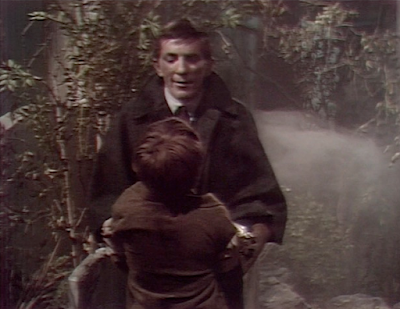
Friday, David got out of the secret chamber and walked outside, straight into Barnabas’ hands. Today, we open with a reprise of that scene. After Barnabas greets his young cousin with a richly sinister “Hel-lo, David!,” he questions him sharply. He expresses dissatisfaction with David’s answers, then tells him that because no one is at home in the great house of Collinwood, he will be taking David to his own house. David grows more and more uncomfortable. Just as he is coming to be really frightened, the voice of local man Burke Devlin calls his name.
When Burke reaches them, David throws his arms around him and Barnabas squirms guiltily. Burke dislikes Barnabas, and gives him a suspicious look while he and David explain what has happened. When Burke says that there are people at home in the great house, David flashes a look of alarm at Barnabas. Barnabas says that no one had answered when he knocked on the door earlier, so he assumed everyone had joined the search. The two men take David home.
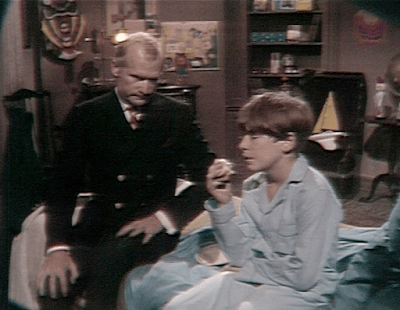
There, David eats a sandwich in his room while his father Roger asks him where he has been. This conversation is just magnificent. Roger is trying to be stern, but is such a flagrantly neglectful father that David knows full well that he can’t be bothered to punish him. So while Roger puts a series of pointed questions to him, David ignores him and muses aloud about Barnabas. “Barnabas is mysterious, isn’t he, Father?…You know, we don’t know anything about him. He just showed up one night.” Roger keeps urging David to forget about Barnabas and start answering his questions, but gets nowhere. Louis Edmonds and David Henesy were both talented comic actors, and they worked well together, so it’s no surprise this scene is laugh-out-loud funny.
Along with the comedy comes the thrill of a potential change in the show. In his post about this episode, Danny Horn writes: “It’s a great moment. It’s like the ‘logical explanation’ spell was suddenly broken, and David just realized how bizarre his life is.” The structure of Dark Shadows’ storylines has been that someone has a terrible secret, they are deep in denial about the extent to which the secret is deforming their lives, and when they finally let go of their secrets they are free. So matriarch Liz had a terrible secret that kept her from leaving her house for over eighteen years, she revealed the secret in #270, and now she’s happy to go anywhere. She’s on an extended visit to Boston at the moment. Roger had a secret connected with an incident for which Burke went to prison years ago and he spent all his time making a fool of himself as he struggled to keep it hidden; he admitted the truth in #201, and since then he has been a carefree fellow who can make anyone laugh. So the Collins family curse that Barnabas embodies is made up chiefly of denial, and it can be defeated by facing facts. If David has seen through all the lies and is willing to reckon with the truth, he has the power to bring everything to a conclusion. So when he says that Barnabas “just showed up one night,” we catch a glimpse of what it would be like if the entire series came to its ultimate climax.
We end with David still in his room, telling well-meaning governess Vicki that he feels someone evil is watching him. We cut to Barnabas in his own house, staring out the window at the great house in the distance, thinking his sinister thoughts. David’s feeling should be familiar to him- when his mother, undead fire witch Laura Murdoch Collins, was staying in the cottage in the estate, she often stared out her window and caused David to have nightmares.
Laura was a threat to David because the basic conditions of her existence drove to kill her son. Barnabas’ threat to him is a result of circumstances that were always likely to arise, but that might not have, and that might yet be changed. So when Laura was on the show, the suspense was how she would be destroyed before she could kill David. Now with Barnabas, there is a question whether he will try to kill David at all. So the suspense is more complicated, and there are more options for pacing. The plot doesn’t have to be either glacial or rapid, as it did with Laura, but can move at any of a variety of speeds depending on which of the many possible directions they decide to take the story.
In our house, we watch Dark Shadows on Tubi, a free advertiser-supported streaming app. As we click on each episode, we see a summary reading “Freed from his grave after 200 years, a tormented vampire returns home to protect his loved ones in this classic gothic daytime TV series.”
That “tormented vampire” is Barnabas Collins. In the opening scenes of today’s episode, Barnabas is talking with Julia Hoffman, a mad scientist who is trying to cure him of vampirism. They are discussing the missing David Collins, the ten-year old boy who is the last bearer of the Collins family name. This ardent protector of family announces that he must be the first to find David, because he is going to kill him. He tells Julia that he’d been “getting very fond” of David, but that he is pretty sure the boy knows that he is a vampire, so he will have to choose survival over “sentiment.” When Julia objects, Barnabas smiles and tells her that he might also be killing her and his sorely bedraggled blood thrall Willie soon. He invites her to inform Willie of this fact.
Barnabas goes to the great house of Collinwood, where he visits well-meaning governess Vicki. Vicki is worried sick about David, to whom she is devoted. She regards Barnabas as a dear friend, and he enjoys spending time with her. He has some vague intention of killing Vicki so that she will rise as his vampire bride, and may get around to doing that once he has killed David, Vicki’s fiancé Burke, and maybe Julia and Willie. Perhaps what he is determined to “protect his loved ones” from is aging- with him around, it seems unlikely anyone is going to get much older.
Vicki unwittingly tips Barnabas off as to where David is. David is trapped in the secret chamber inside the Collins mausoleum in the old cemetery north of town. Vicki doesn’t know that this chamber exists, but Barnabas was confined there for 170 years. So when she tells him that the doddering caretaker of the cemetery thought he heard voices coming from behind the stone walls of the outer chamber, she thinks she is giving evidence that the old man has lost his mind. Barnabas, however, knows different.
David learned about the chamber from the permanently nine year old ghost of Barnabas’ sister Sarah. Sarah has been showing up a lot lately, and yesterday we saw several characters starting to admit that she must be a supernatural being. It is Sarah’s friendship with David that has led Barnabas to believe that he knows he is a vampire. In fact, she did not tell him about this, but David did overhear a conversation between Barnabas and Willie which gave him enough clues that he could probably figure it out.
When Barnabas arrives at the cemetery, he meets the caretaker and has a confusing conversation that is straight out of vaudeville. On his Dark Shadows Every Day, Danny Horn compares it to “a summer stock production of Abbott and Costello Meet Frankenstein, where Abbott is being played by Count Dracula.” At one point Barnabas is so exasperated with the caretaker that he nearly blurts out that he is Sarah’s brother. That’s the second time in the episode a character almost blurts out a word that would make a major change in the show- towards the beginning, Julia came within a breath of saying “vampire,” a word we have not yet heard on Dark Shadows.
Meanwhile, Sarah appears to David. He asks her how she got into the sealed chamber, and she replies “I can get in anywhere.” David is dissatisfied with this answer, but doesn’t really seem surprised to see her. He seems to know that she is a ghost, and to be holding off on using the word in her presence in the same way that Julia is holding off on using the word “vampire” with Barnabas. It’s just sort of indelicate to use a label people haven’t told you they like. Maybe Sarah prefers to be called a Phantom-American, and it would be this whole big thing if you called her a “ghost.”
Sarah shows David how to open the panel. He does, and when he looks back she is gone. He expresses irritation with her for “hiding,” which is rather strange- he was trapped in the chamber for days, so clearly she wasn’t hiding there the whole time. She must have made her way in through the solid walls. Even if David hasn’t figured out that she is a ghost, he must know that she can get out the same way.
David walks out of the mausoleum, directly into the hands of his cousin Barnabas. It was obvious that he would, but that obviousness is not a problem- on the contrary, it comes with a sense of inevitability that leaves us dreading what Barnabas is going to do to David.
I think that’s too simple an interpretation to cover everything we’ve seen Sarah do so far on the show. It is true that she never really gets anyone out of danger. She helped Maggie Evans, The Nicest Girl in Town, escape from Barnabas when he was about to kill her, but that escape led directly to her imprisonment in Julia’s hospital. She broke Maggie out of that hospital before Julia could complete her evil plan to keep her in a state of total psychological collapse, only to lead her directly to Barnabas. She prevented Barnabas killing Maggie in her bed, but left him determined to strike again if Julia failed to keep her memory from returning.
Some say that Sarah is really an avatar of Barnabas, that she is his conscience roaming free in the world. Julia explicitly proposed this interpretation on screen in #302, and Sharon Smyth Lentz says that it is direction she was given when she was playing Sarah. So it was an idea that the writers meant to develop, but I don’t think it covers everything either. A guilty conscience can lead a person to take actions that will lead to his own exposure, but the likeliest way Sarah’s latest actions will lead to Barnabas’ exposure will be if he kills David and is caught. That doesn’t really sound like “conscience.”
Dark Shadows is, in all its phases, the story of the great estate of Collinwood and the accursed family that lives there. I would say that, whatever else Sarah is, she is a symptom of the curse that Barnabas also embodies. For several weeks, Barnabas has had a tendency to lie low and keep quiet, letting the curse fester silently and pull the Collinses and the community around them deeper into its power by imperceptible steps. Sarah disrupts all of his plans, prompting him to act and forcing into the open more and more evidence that spiritual forces of darkness are at work.
But for all the inconvenience she represents to Barnabas, Sarah is no more an opponent of the curse itself than he is a protector of family and friends. On the contrary, she presents a different version of the curse. She confronts the living characters with facts they are desperate to avoid facing. If they continue on the form they have set so far, most of them will react to the evidence of otherworldly dangers by digging ever deeper into denial. If they do that, even Barnabas’ destruction would not really free them from the life-draining evil that engendered him.
In 281 of the posts that follow, I link to comments I made on Danny Horn’s blog, “Dark Shadows Every Day.”
Not all of these comments were absolutely unique. I frequently refer to denial, the psychological defense mechanism, as a story point on Dark Shadows, and more than once I connect it with the show’s supernatural themes.
From the very beginning, the show focuses on the Collinses as a family addicted to denial. Elizabeth hasn’t left her house for 19 years because she’s guarding a secret; she’s summoned Vicki to live with the family for reasons she conceals so deeply that we never find out what they are; she almost loses the house, the business, and everything else as she gives in to the demands Jason McGuire makes in return for his silence. For his part, Roger is terrified that Burke will reveal the secret they share, and goes to extreme lengths to keep that secret hidden; he openly hates his son, but can tell no one why; his estranged wife is a profoundly mysterious figure, whose own secret is so powerful as to imply that the consensus view of reality prevailing in the community where the show is set is an elaborate lie. David sees ghosts; eventually the audience also sees them, and we know that some of the adult characters can see them, too. Yet all of the adult characters hotly deny that the ghosts exist until Vicki breaks the embargo after she sees the ghost of Bill Malloy in episode 126. Not until Carolyn tells David about her childhood friend Randy in episode 344 will another adult even allow David to suspect that she thinks ghosts might be real.
Of course it doesn’t make much difference that Gerard possesses Liz. Liz’ whole thing, from episode 1 on, is that she refuses to acknowledge painful realities. That’s what Gerard wants her to do, so all she needs is a little nudge to go back to her usual state. Even though she isn’t on the show much, I think of Liz as the main character in the sense she embodies denial, and the show is very largely an exploration of what can happen when people are deep enough in denial.
Roger’s angry dismissal of Barnabas and Julia’s concerns this time, combined with Liz’s triumphant reaction to the sight of Mr Jughans at the end of last Monday’s episode, actually do make sense both of Barnabas and Julia’s refusal to tell her what they’re up to and of Liz’s own acquiescence in their absurd behavior. The Collinses may reside in the state of Maine, but the state in which they hold their true citizenship and to which they give their sole allegiance is the state of denial. If Barnabas and Julia tell Liz what’s going on, she will have to build some structure of lies to conceal it from herself and from everyone else, regardless of the cost. If they simply act like lunatics and impose on her with nonsensical demands, however, she can set about convincing herself that it is somehow all right to have Barnabas and Julia around her house.
I don’t think Roger and Liz are goldfish in the way that so many characters were in earlier episodes. They’re people in deep denial about the nature of the world in which they find themselves. That’s what makes their scenes powerful in the two or three weeks leading up to this installment. They refuse to believe in ghosts, and so they think they are protecting the children from Maggie, Mrs Johnson, Julia, and Barnabas when those characters talk about what’s going on. In fact, they are enabling Quentin’s abuse of the children. When Liz and Roger break down and face facts, they relieve us from involvement in that terrible situation. They also stun us, especially if we’ve been watching from Episode 1, because we’ve seen the immense price each of them has paid to avoid dealing with unhappy realities.
Of course, it is abuse to coerce children into harming their loved ones, so it isn’t just allegorical. It’s realistic to show this form of child abuse working in the same ways as do other forms.
The Collinses are such a wretched bunch that the children of the family must have been the objects of a great deal of abuse over the centuries, yet the show wimps out of exploring that topic at the climax of the Phoenix story, when Roger and Carolyn stop openly proclaiming their hatred for David. For the next 500 or so episodes, the only abuse inflicted on the few Collins children we see is the occasional attempt to murder one of them. In this fictional universe, being the target of a murder plot is a so routine an experience for so wide a variety of people that it seem odd to describe it specifically as “child abuse.”
We don’t really have to think about Collins children being abused until the Haunting of Collinwood story. Then we go to 1897, when the show finally takes child abuse seriously and connects it to the Collinses’ addiction to secrecy and their desperate unhappiness.
I think of the climax of the Iliad. As Achilles moves in to kill Hector, Athena takes hold of his spear and drives it in, delivering the fatal wound herself.
For modern readers, this may ruin the story. The whole poem has been leading up to this moment; we’ve spent a lot of time with Achilles, listening to him try to figure out what it would mean for him to kill Hector. So why have the goddess take over at the last minute? Isn’t it an evasion of Achilles’ responsibility for his actions, and a cheat for us as we’ve been observing his psychological development?
For the original audience, it was not. They actually believed in their gods. Athena really existed, as far as they were concerned. When an event was important enough, they took a interest. If it was really huge, they would get involved. Moreover, the gods worked closely with each other. So much so that you didn’t pray to one at a time, but always to groups of them. When Athena joins Achilles in his fight, it isn’t her pushing him aside- it’s him doing something so important it blurs the boundary between human and divine.
Something like that is at work in the traditional, pre-modern, conception of demonic possession. To say that a person is possessed is a way of looking at behavior that is reducible neither to moralistic judgment nor to psychological analysis. It isn’t individualistic in the way that those modes of discourse are. Rather, it suggests that the boundaries between the person and the spiritual forces of darkness have broken down. Perhaps the person is partly to blame for that breakdown, but the whole point is that s/he is no longer a distinct being, but is merging into those supernatural forces.
So, imagine a version of Dark Shadows where Elizabeth Collins Stoddard really was the main character. Her whole approach to life is denial. So, you could have had a story with a beginning, middle, and end. In the beginning, we see the lengths she has gone to in her quest to keep from ever having to have an embarrassing conversation. In the middle, we see various horrors take place around her, each worse than the one before, each more obvious than the one before, and each time she finds a way to convince herself it doesn’t exist. At the end, a couple of innocent characters go to her in the drawing room of Collinwood to rescue her from the monsters who are running rampant there. She looks at them placidly and tells them she sees nothing wrong. Why ever do they think she would want to leave her home? All the while leathery-winged demons are fluttering about her head. She doesn’t see them, and they have no choice but to flee.









 Dark Shadows Commentary