Episode 864: Shipwreck Point

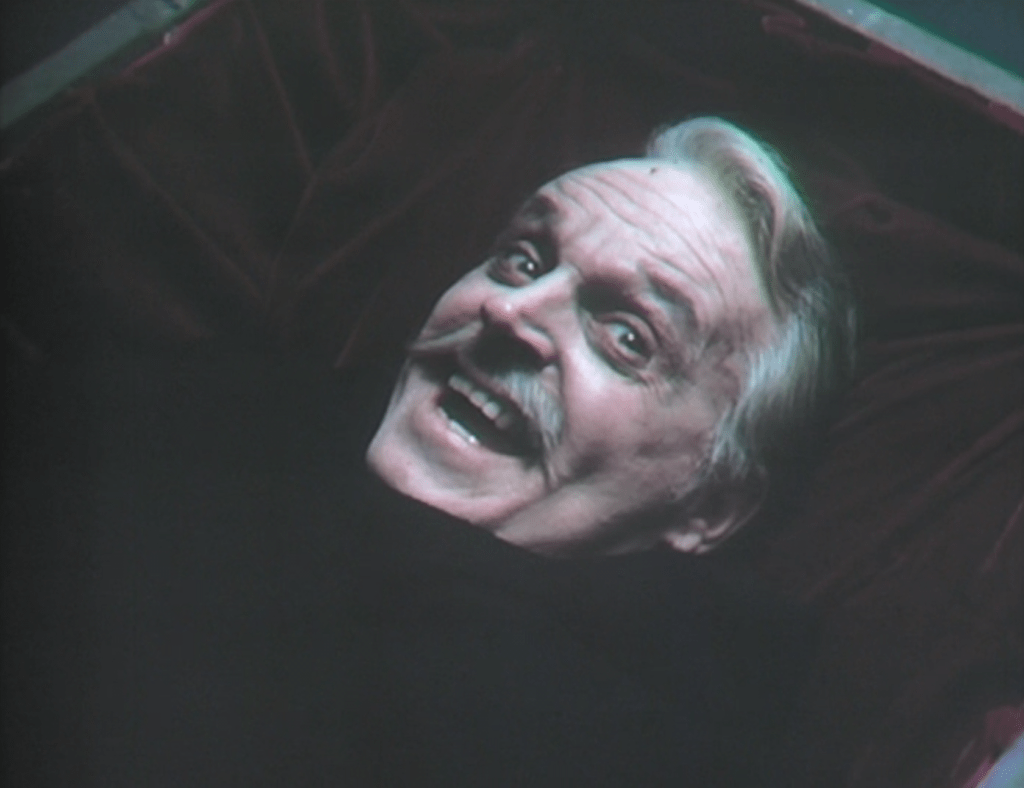
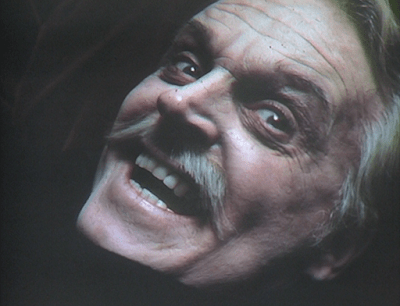
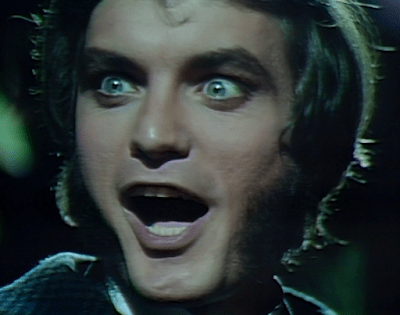
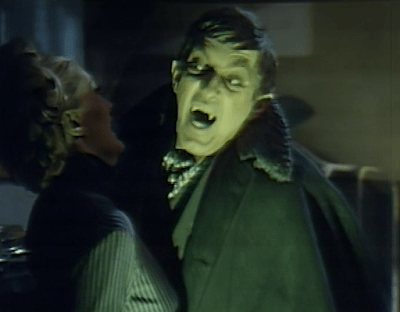
Sorcerer Count Petofi is currently occupying the body of rakish Quentin Collins. When he is in this form, I refer to him as Q-Petofi.

Q-Petofi. Screenshot by Dark Shadows Before I Die.

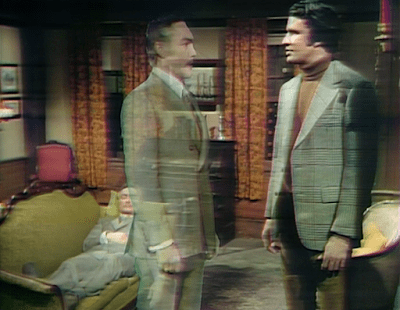
Lawyer/ Satanist Evan Hanley has displeased Q-Petofi. Q-Petofi has put the zap on Evan and made him dig his own grave. Evan begs for his life, but does so in a stilted, robotic voice that suggests he is struggling against Q-Petofi’s power. It is a neat job of acting by Humbert Allen Astredo.

Evan points out that it would raise suspicions if Q-Petofi were seen with his servant Aristide, especially inside the great house of Collinwood. Evan himself, however, is the Collins family’s attorney, trusted by everyone in the house. If anyone there has suspicions about Q-Petofi, they will confide in him. Q-Petofi decides that he may as well let Evan live, and orders him to keep tabs on wicked witch Angelique.

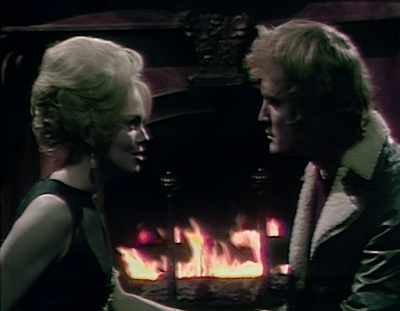
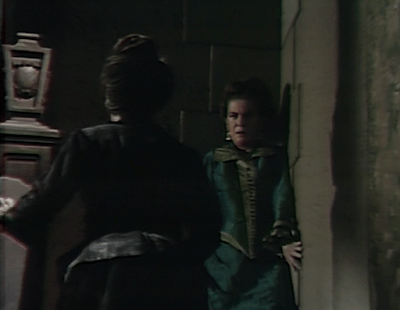
We cut to the foyer of Collinwood, where Angelique is staying. She is on the telephone trying to reach the local pharmacy, and is annoyed that the meds she wants are not yet available. Another houseguest, Cockney showgirl/ mentalist Pansy Faye, enters. Angelique hurriedly ends the call. Pansy taunts Angelique for the end of her engagement to Quentin. After Pansy exits, Angelique gets back on the phone and resumes talking to the pharmacist. Q-Petofi enters, and Angelique pretends she is talking to someone else, then hangs up.

Returning viewers know that Angelique is carrying on a medical intervention designed by time-traveling mad scientist Julia Hoffman, MD. Julia’s friend, vampire Barnabas Collins, made his way from 1969 to 1897, and she followed him. Julia had recreated an experimental treatment that put Barnabas’ vampirism into abeyance for a little while early in 1968 when she snapped back to her own time, vanishing from 1897. Shortly before Julia disappeared, Angelique agreed to complete the procedure and turn Barnabas into a real boy.

Angelique seems less powerful than usual today. Her dealings with the pharmacy are a logical consequence of her agreement to take over Julia’s plan, but she doesn’t usually have to get exasperated with people over the telephone, and not since her early days as a witch in the 1790s has she been so vulnerable to discovery by random passersby. Later, she goes to Barnabas’ hiding place, and Evan follows her. There have been times when Angelique could materialize and dematerialize at will, and it was impossible for any mere mortal to keep track of her whereabouts, but evidently she doesn’t feel up to that today. She does tell Q-Petofi she has a headache, maybe that’s true.

Pansy has a scene in the studio of artist Charles Delaware Tate. She tells Tate she wants to buy one of his paintings; he tells her that everything is for sale, but that his prices are high. She picks out a portrait of the lovely and mysterious Amanda Harris; he throws a tantrum and doesn’t want to sell it to her. When she reminds him that he said all the paintings are for sale, he names the ridiculously high price of $5000. That would be well over $150,000 in 2025. Without missing a beat, Pansy pulls out a few large-denomination bills and fans them under Tate’s nose.

Pansy’s only source of income was a cabaret act she recently did at the Blue Whale, a tavern in the village of Collinsport. We saw her there the other day shortly before nine PM, when she was the only person in the barroom. So it doesn’t seem likely she could have earned that quantity of cash there. Nor is there any apparent reason why Pansy would want a portrait of Amanda, whom she saw as a rival for Quentin’s affections. It seems likely that someone else put her up to buying it.

The obvious candidate would be Judith Collins Trask, owner of Collinwood and all the Collins family businesses. Judith is married to the odious Gregory Trask, whose late daughter Charity provided the host body through which Pansy, who died in #771, has been interacting with the world of the living since Petofi erased Charity’s personality in #819. Judith has persuaded Pansy to move back into Collinwood. Judith has herself recently returned to the great house after Trask had her confined to a mental hospital for a period of more than thirteen weeks. Her stuffy but lovable brother Edward told Judith that Trask spent much of that time trying to seduce Amanda, and Judith wants to get the facts about what went on in her absence.

Closing Miscellany

Director Henry Kaplan was not in good form in this one. In the opening, studio lights are clearly visible right in the middle of the screen, between Evan and Q-Petofi. The same thing happened in yesterday’s episode. The other directors might have made a mistake like that once, but I don’t think any of them would have done it two days in a row.

The camera is also frequently out of focus, as is typical of Kaplan’s shows, and it moves unsteadily. He must have been trying to get the camera operators to do something he hadn’t prepared them for, it looks really bad.

There are a couple of notable bloopers that aren’t particularly Kaplan’s fault. When Angelique makes a remark about Q-Petofi’s attitude towards brandy, David Selby says “Don’t you think it’s possible for one’s…change…or one’s taste to change in brandy?” That is followed by a silent beat, as both he and Lara Parker are stunned by the nonsense that just came out of his mouth.

When Tate lets Pansy into his studio, the shade falls out of the window. He looks at it for a second, then the scene goes on. It is one of the all-time great goofs.

Episode 789: We are going to create a thing

In #762, the Rev’d Mr Gregory Trask walked in on lawyer Evan Hanley and handsome rake Quentin Collins as they were performing a Satanic rite. Trask’s response was to blackmail Evan. Trask wanted his wife Minerva out of the way so that he could marry rich spinster Judith Collins, Quentin’s sister. Threatened with exposure, Evan cast a spell on an unfortunate young man named Tim Shaw. He brainwashed Tim into reenacting the plot of The Manchurian Candidate, with Trask in the Angela Lansbury role and Evan as the People’s Republic of China. As Evan and Trask planned, Tim killed Minerva. Shortly after, Trask married Judith.

On their wedding day, Judith saw Minerva’s ghost in the corner of the drawing room in the great house of Collinwood. In yesterday’s episode, Minerva’s ghost took possession of Judith, and the closing cliffhanger showed the possessed Judith about to stab Evan with a letter opener to avenge Minerva’s death. As we open today, Judith’s brother Edward enters and prevents the stabbing, and Judith is released from possession. She can remember nothing that happened while she was under Minerva’s power, and Edward is convinced that she has gone mad.

Edward takes Judith to her room, and Trask enters. Evan tells him that Minerva’s ghost has been in touch with Judith. The ghost knows what they did, and if the contact continues Judith will know as well. Trask demands that Evan do something to prevent that, and Evan says that he can cast a spell that may turn the haunting to their advantage and neutralize Judith permanently.

The plan turns out to be the creation of a “black ghost.” The only Black actor to have had a speaking part on Dark Shadows was Beverley Hope Atkinson, who played an unnamed nurse in one scene in #563, almost a year ago. Humbert Allen Astredo, who plays Evan, was also in that scene, playing suave warlock Nicholas Blair. Atkinson was terrific, and it would be great to see her again, but it turns out that the “black ghost” is not actually black. Nor is it a ghost. This misnamed entity is a simulacrum of Minerva, a kind of supernatural hologram that Evan will fabricate and that will appear when Judith is around. This will lead Judith to believe that she is insane, thereby causing her actually to become insane and to cease to be an obstacle to Trask’s enjoyment of her wealth.

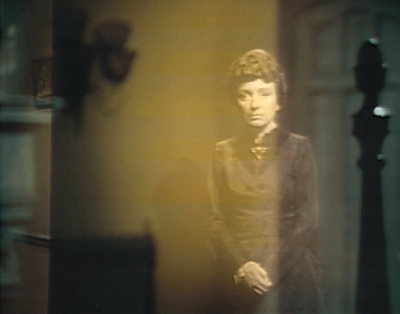
The simulacrum first shows up in a transparent form in Judith’s bedroom. Judith screams. In the drawing room, Trask and Edward hear her scream and break off a conversation in which Edward has been urging Trask to agree to annul his marriage to the obviously disturbed Judith. Judith comes downstairs. She is reluctant to explain why she screamed, and tells Edward and Trask that nothing is wrong. She and Trask go to the drawing room and talk privately. He has to prod her a bit before she will admit she saw Minerva. He tells her it was just her imagination. She considers this; after all, she was in bed when she saw the image, so it may have been a dream. But then the simulacrum appears in the drawing room, near the spot where she saw Minerva’s ghost on her wedding day. Judith sees Minerva sitting quietly and sewing. Trask pretends he does not see anything; after a bit, Judith pretends she can’t see the image either. Trask leaves Judith alone with the simulacrum. Judith goes upstairs, and the simulacrum follows her. When they reach the top of the staircase, Judith cries out in fear and tells the simulacrum to stay away from her.

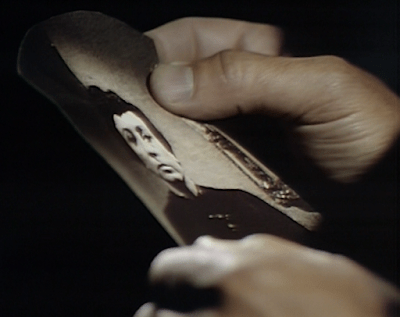
Though it is disappointing to be reminded that Beverley Hope Atkinson isn’t coming back, it is always good to see Clarice Blackburn. In her interviews with the authors of the book Barnabas and Company, Nancy Barrett said that Blackburn was the best performer in the entire cast of Dark Shadows. She doesn’t have a lot to do today- she delivers the opening voiceover, we see a snapshot of her, and as the simulacrum she stands motionless in a corner, sews placidly, then is seen from behind as she follows Judith up the stairs. But if there ever was a case to prove the old cliche that no part is small when a big enough actor plays it, Blackburn makes each of these little turns into a moment viewers will remember.

As Judith, Joan Bennett also deserves a great deal of credit for getting the gaslighting plot off to a good start. For example, there is an embarrassingly ill-written scene when Judith is in her room, pacing back and forth while some vibes play on the soundtrack. A knock comes at the door, and the music stops. Judith opens the door, and no one is there. The music resumes, and she starts pacing again. There is another knock. Again the music stops, again Judith opens the door, and again no one is there. The music resumes, and she’s back to pacing. The knock comes a third time. A third time the music stops, and a third time Judith turns to the door. This time she asks who’s there. It’s Trask. She lets him in, and he denies having knocked before. Knocking on doors and running away is a pretty crude tactic even on a show with an audience consisting largely of kids aged twelve and under, and the apparent complicity of the music in Trask’s plot is the kind of thing they ridiculed in Looney Tunes cartoons. But Bennett’s soulful performance holds our attention throughout.

This is the second time Dark Shadows has shown us an adventurer trying to gaslight his new wife so that she will go away and give him unfettered access to her fortune. The first time was in March 1968, when the show was set in 1796. Naval officer/ sleazy operator Nathan Forbes had married fluttery heiress Millicent Collins. Nathan discovered that Millicent had transferred all her assets to her little brother Daniel. Nathan then set about driving Millicent out of her mind so that he could take her place as Daniel’s legal guardian. That plot also featured some weak writing, but Joel Crothers and Nancy Barrett were so irresistible as Nathan and Millicent that it hardly mattered. Perhaps the writers wanted to revisit the gaslighting theme to show that this time they could consistently write scripts worthy of their outstanding cast.

Episode 787: You said that, I said nothing

Dark Shadows fans like to make jokes about the inefficiency of law enforcement in the fictional town of Collinsport, but in this episode we see that the sheriff and his men really never had a chance. The ancient and esteemed Collins family controls everything in the area, and they will go to any lengths to keep the police from obtaining the information they need to do their job effectively.

Stuffy Edward Collins invokes the police when he demands that broad ethnic stereotype Magda Rákóczi vacate the Old House on the estate of Collinwood. Magda laughs and says that if the police show up, she will tell them that Edward’s distant cousin Barnabas is a vampire. Horrified at the damage it would do to the Collins family name were word of Barnabas’ condition to get out, Edward backs down. Barnabas is at large and has been responsible for at least six homicides since traveling through time to the year 1897, including the murder of Edward’s brother Carl in the drawing room of their home just the other day. But evidently that is a small matter to Edward compared to the danger that the sheriff might be indiscreet.

Barnabas materializes at the police station, where a werewolf is being held in custody. A deputy is startled to see Barnabas in front of him all of a sudden. For only the third time in the series, Barnabas says “Look into my eyes!” and induces an hypnotic trance in someone not his blood thrall. It is the first time he has exercised this power on someone other than Edward’s nine year old daughter Nora. Barnabas tells the deputy that once he has completed his task, he will remember nothing. So he is following the family policy with regard to keeping the police in total ignorance.

Edward shows up and sees Barnabas. Edward is wearing a cross and holding a revolver loaded with six silver bullets, which on Dark Shadows are as effective against vampires as they are against werewolves. Barnabas hides behind the deputy and tells Edward that he is acting in the interests of the future of the Collins family. Edward says that he belongs to the past, not the future. Barnabas doesn’t explain anything; he vanishes.

Not exactly an heroic look for ol’ Barney. Screenshot by Dark Shadows Before I Die.

Barnabas’ post-hypnotic suggestion has its effect, and the deputy is bewildered to find himself face to face with Edward. Edward tells him that they must watch the werewolf. The deputy starts to say something about the sheriff, and Edward replies “The sheriff doesn’t realize what this animal is!” Of course he doesn’t, no one will tell him anything about it.

Back in the Old House, Barnabas and Magda lament their failures. He could not take the werewolf from the cell in the police station to the cell in the basement of the house; she could not persuade lawyer/ Satanist Evan Hanley to return a severed hand he stole from them. They wanted to do these things because the werewolf is Edward’s brother Quentin, whom Magda is trying to free from his curse by means of the hand’s magical powers. Barnabas knows that if they do not succeed, terrible consequences will ensue in 1969.

Closing Miscellany

It is a serious mistake to show the werewolf when he is not in the act of committing a spectacular homicide. They didn’t have the budget to put him in full-body makeup, so he wears a tidy little suit, complete with a watch fob. He is so well put together that it is difficult to imagine him inspiring any fear other than the fear that one will not meet his apparently rather exacting standards of attire.

Whoooo’s a well-dressed doggie? You are! Screenshot by Dark Shadows Before I Die.

There is a noteworthy blooper in this one. Magda confronts Evan, declaring “The book, I know you took it from the Old House!” Usually actors roll with each other’s bobbled lines, but this is far enough out that Humbert Allen Astredo obviously has no idea where Grayson Hall is in the script. All he can do is ask “The book?” “The hand!” she corrects.

They also make a goof in the closing credits. This is one of three consecutive days when Louis Edmonds is billed not as Edward, but as Roger Collins, the role he plays in the parts of Dark Shadows set in the 1960s. He’s been identified correctly throughout the first seventeen weeks of the 1897 segment and everyone else is identified correctly in these episodes, so it is not clear what happened.

Danny Horn’s posts at Dark Shadows Every Day are often laugh-out-loud funny, and the one for this episode is especially so. His description of the scene between Magda and Evan has some big laughs, and when he imagines the sheriff’s deputies trying to catch the werewolf by “putting on their alluring lady-werewolf disguises a la the Warner Brothers cartoons,” well that’s just super how could anyone improve on it.

Episode 764: A primitive tribe

Odds and ends today:

The Kindest, Warmest, Bravest, Most Wonderful Human Being I’ve Ever Known in My Life

The show is doing an homage to The Manchurian Candidate this week, with schoolteacher Tim Shaw brainwashed into becoming an assassin when he sees the Queen of Spades. We open with the plan going awry. Lawyer/ warlock Evan Hanley did the brainwashing with the intention that Tim would kill someone else, but when he shows Tim the card, Tim tries to kill him. As Evan, Humbert Allen Astredo shows us a man suddenly becoming frightened and just as suddenly making up his mind to be brave. In other episodes, Astredo has already shown us Evan responding to fear in other ways. He really was a remarkably good actor, and it is a pleasure to see how much variety he can find in his parts.

Later, we see Judith Collins, the mistress of Collinwood, playing solitaire. Tim comes to the house. We know that each episode ends with a cliffhanger, and so this leads us to expect that we will end today with Tim’s hands around Judith’s throat. But that is a misdirection. In fact, Judith turns the Queen of Spades away from Tim at the last second, and he leaves the room without attacking her.

Slight Enough to Vanish, But Too Dense to Live

Tim’s brainwashing is a B-story on the show right now, and it would throw off the rhythm of the week to end two consecutive episodes with cliffhangers from it. The A-story is about the rakish Quentin Collins, who has been cursed to become a werewolf. There is a full moon tonight, and the sheriff’s department is roaming the grounds of the great estate of Collinwood with guns looking for the wolf who walks like a man. Joining in the search is Quentin’s distant cousin, Barnabas Collins, who is, unknown to all but a very few people, a vampire. Barnabas has traveled back in time to the year 1897, and among the things he is hoping to do is to learn how the werewolf curse that has afflicted his friend Chris Jennings in the 1960s first began.

Barnabas learned in 1969 that in 1897 Quentin and a woman named Beth Chavez paid a man named Ezra Braithwaite to make a silver pendant in the form of a pentagram and that a baby boy was buried in that year wearing that pendant. Tonight, Ezra telephones Barnabas at the great house of Collinwood and tells him that Beth just came in, ordered such a pendant, and told him to send the bill to Quentin.

Barnabas knows that the pentagram was an amulet meant to ward off werewolves. Beth is Quentin’s girlfriend, a fact that is no secret to anyone, not even Barnabas. So you might assume Barnabas would have figured out that Quentin is the werewolf. But apparently he has not. He materializes inside Beth’s room and demands she tells him who the werewolf is. When she refuses, he bites her. That bite is the cliffhanger.

Dear cousin Barnabas. Screenshot by Dark Shadows Before I Die.

Barnabas occasionally makes remarks about how he wants to keep the original timeline intact so that the people he knew in the 1960s will still be there when he gets back. But he’s been feasting on the people he meets in 1897 with abandon. Beth is the fourth resident of Collinwood he has bitten, and he has killed at least two young women in the village. Moreover, his approach to every problem he encounters or imagines is to confront the most powerful person associated with it and antagonize them immediately. It’s hard to see how he expects anything to remain unchanged after he inserts this rampage into the history of the late Victorian age.

But You Wouldn’t Know Anything About That

Judith tells Barnabas today that Beth came to Collinwood as a lady’s maid two years ago. Beth claims to have a cousin in town to Judith today while lying to cover up her trip to Braithwaite’s, and when Barnabas asks Judith if Beth is from Collinsport she mentions this cousin as her reason for believing that she is. Judith clearly knows very little about Beth, and cares less.

The lady who brought Beth as her maid was Quentin’s then-wife, Jenny, who was secretly a member of the Romani people. In #701 it was hinted that Beth was concealing a Romani origin of her own. Casting the tall, blonde, blue-eyed, pale Terrayne Crawford as Beth would seem to indicate that they were not committed to following up this hint, but in today’s scenes with Judith they do go out of their way to emphasize that Beth’s background is a mystery.

The Woman Who Never Left

Beth has been helping the family hide the fact that Jenny went mad and bore twins after Quentin left her. Quentin murdered Jenny in #748, eliminating the need for a servant to cover up her existence, and the twins, about whom Quentin does not know, are firmly ensconced in the care of a woman in the village named Mrs Fillmore. In #750, Judith fired Beth, but it didn’t take. Beth never left the house, and after a while the family started giving her orders again. Today Beth tells Judith that Mrs Fillmore reports that the boy twin is feverish, and asks to be kept on staff until he gets well. Judith agrees.

Judith tells Beth that she has decided to tell Quentin about the twins. She hopes that is what will prompt her brother to cast aside his selfish ways and become a mature adult. Beth is horrified and begs her not to do so. Judith, puzzled, says that Beth has always urged her to tell Quentin. She asks why she has changed her mind, and she makes up something obviously false about Quentin being unable to cope with the news that his son has a fever.

Yesterday, Beth learned that Quentin’s curse is hereditary. Returning viewers might wonder if she is afraid that Quentin will also learn that, and that if he does he might kill his children to prevent them passing it on. He does keep saying that he would rather be dead than have the curse, so he might talk himself into regarding such a murder as an act of mercy.

Featuring Edward Marshall as Ezra Braithwaite

Edward Marshall plays Ezra, a part played in #684 and #685 as an 87 year old man living in the year 1969 by Abe Vigoda (who was 48 at the time, but he and the makeup department both knew their business well enough that he was entirely convincing.) Mr Marshall appeared in #669 as unsightly ex-convict Harry Johnson, a part originally created by the not-always-stellar Craig Slocum. Mr Marshall gave Harry the same attitude and many of the same mannerisms Slocum had given him, but was so much more fun to watch that I wanted to see a lot more of him.

Parts of Harry’s costume and most of his surly demeanor are recycled in the 1897 segment in the character of dimwitted groundskeeper Dirk Wilkins, played by the repulsive Roger Davis. Whenever Dirk is on screen, I imagine Mr Marshall in Mr Davis’ place. I recommend that bit of mental recasting, it goes a long way towards making Dirk bearable. Unfortunately this is Mr Marshall’s final appearance on Dark Shadows.

Episode 752: Matters other than the law

Libertine Quentin Collins murdered his wife Jenny the other day, shortly after he learned that she was the sister of broad ethnic stereotype Magda Rákóczi. Since Quentin is convinced that Magda has magical powers, this would seem to suggest a low degree of impulse control on his part.

Magda did place a curse on Quentin, and she refuses to tell him what it is. Last night he doubled over in pain, lost consciousness, and disappeared from the great house on the estate of Collinwood. This morning he has shown up in the foyer, flat on his back, his clothing in shreds and blood all over him. His girlfriend, Jenny’s former maid Beth, found him and helped him to his room. Neither of them can figure out what happened to him overnight.

Meanwhile, Collins family attorney Evan Hanley has come to meet with Quentin’s sister Judith, who owns the estate and the Collins family’s businesses. Judith is enraged that Quentin took $10,000 from her in return for signing an agreement to leave the house and never come back, but has refused either to leave or to return the money. Evan assures Judith he will take care of the matter at once. While he is still in the drawing room, Judith answers the telephone. She learns that a young woman named Dorcas Trilling was brutally killed on the estate the night before, her body ripped apart as if by a wild animal of some kind.

Unknown to Judith, Evan and Quentin are members of a Satanist coven. Evan does call on Quentin and Beth in Quentin’s room, and he does deliver Judith’s message. He and Quentin both ask Beth to leave so they can discuss another matter. At first she resists, but finally she does go. Quentin tells him what happened the night before and that he believes Magda has cursed him. Evan sees the bloody clothing in a pile on the floor, and his face shows a grim surmise. Nonetheless, he does not tell Quentin about Dorcas.

Quentin asks Evan to help him with Magda. Evan says that he will do so, but cautions Quentin that his help will come at a very high price. Quentin asks what happened to their friendship. Evan tells him that “There is no such thing as a friend” and laughs. That must come as quite a nasty shock to Quentin. You spend time with a fellow conjuring up demons, forging wills, and working together to impoverish half your family and kill the other half, and you think you mean something to each other. But no, it just isn’t that way with Evan.

Evan calls on Magda at the Old House on the estate. Magda is coy and does not tell him anything he does not already know, but he does notice that she is wearing a pendant in the form of a pentagram. She says it is just a bit of Romani jewelry, worth only a few cents. He offers her a hundred dollars for it. She refuses, saying that it was a gift from her late mother, and offers to show him other pieces of the same type. Evan tells her that he knows the pentagram can protect against many supernatural menaces, and asks which one she is guarding against at the moment. She keeps mum.

Back in Quentin’s room, Evan chalks a pentagram all over his rug. He tells Quentin and Beth that at nightfall, they must set two black candles burning, one in each of two points of the pentagram, and Quentin must take up a position in the center of the pentagram. He must not move from this spot until daybreak.

The year is 1897, and the first vacuum cleaner wasn’t invented until 1901. It’s going to be quite a job to clean that rug. Screenshot by Dark Shadows Before I Die.

Quentin is having an anxiety attack, and refuses to cooperate with Evan’s plan. This is consistent with his character as we have seen it so far. In #710, he and Evan summoned a creature to rise from Hell and smite one of their enemies, and when a form actually started to take shape, he panicked and tried to run away. Quentin is obsessed with black magic and the occult, but when it turns out there is something to all of his spells and incantations, he cannot bring himself to face the reality of it.

Quentin declares that he wants a plan that “makes sense.” He then says they have to kill Magda. Evan replies that that is the worst thing they could possibly do. If they kill Magda, there will never be any way to lift the curse.

Later that night, Beth and Quentin are still in the room. The pains come on Quentin again. She hurriedly picks up the chalk and redraws the parts pentagram that Quentin had smudged, then sets a chair in the middle. She tries to get Quentin into that chair, but he is unable to get himself onto the seat. She turns to look for the black candles, then hears snarling and growling. She turns to the spot off camera where Quentin is, and reacts with horror. We know that Quentin is a werewolf; now she knows it, too. As the closing credits roll, it does not seem likely that she will have much chance to make use of that knowledge.

Episode 711: Our beautiful black-hearted child of the angels

In the groundskeeper’s cottage on the estate of Collinwood, Satanists Evan Hanley and Quentin Collins call on the powers of Hell to send a demon to help them fight Quentin’s recently arrived and deeply mysterious distant cousin Barnabas. The call is answered by none other than our old friend Angelique the wicked witch.

Quentin and Evan have no idea who Angelique is, and she does not know them either. Evan introduces himself to her as a lawyer; he seems genuinely surprised that this does not impress her. Evan tells Angelique that he and Quentin summoned her from Hell and can send her back; she agrees that they summoned her, but is not so sure they can send her back. Quentin tells her that the year is 1897, that she is on an estate known as Collinwood, and that he and Evan have an enemy called Barnabas Collins. Angelique is intrigued by the year, familiar with the estate, and thrilled to hear about Barnabas. Evan starts making demands; Angelique causes him to choke and gasp. She is quite friendly to Quentin, and when Quentin suggests she let Evan breathe and speak again, she indulges him.

Angelique puts Evan in his place.

Evan is played by Humbert Allen Astredo, who in 1968 played suave warlock Nicholas Blair. He plays Evan with exactly the same bearing, tone of voice, and range of facial expressions he had brought to the role of Nicholas. Viewers who remember Nicholas have been bewildered by this. Barnabas knew Nicholas and fought him; when he met Evan the other day, his reaction left open the possibility that he recognized him as the same person. But Evan’s dabbling in the occult, as we saw it yesterday, shows only an infinitesimal fraction of Nicholas’ vast abilities in that field, and his buffoonish response when Angelique appears shows that he is no relation.

It is when Angelique strikes Evan dumb that we learn why Astredo played him in the same way he played Nicholas. Nicholas was introduced as Angelique’s boss, the master of magical powers much greater than hers. Since the main difficulty with fitting Angelique into a story was that she could easily accomplish any goal if she just kept her focus, adding a character who is even more powerful took the show to an absolute dead end. They had to box Nicholas up inside a lot of pointless business, and he quickly became a source of frustration to the audience. Seeing Astredo as another Nicholas reminds us of that frustration, and when Angelique brushes him aside with a flick of her finger our unease evaporates. We are assured that the plot will keep moving this time, and that Astredo will be free to show us what he can do as an actor.

At the end of Friday’s episode, it was Quentin who tried to stop the ceremony when Angelique’s visage began to take shape in the fire, fearing they had gone too far. Today Quentin realizes there is no turning back, but Evan keeps saying he wants to return Angelique whence she came. It’s hard to see what he expected- he was calling on the Devil to send a demon. I suppose he really is disappointed that Angelique is not excited to find herself in the company of a member of the bar.

Quentin goes home to the great house on the estate. He sneaks up behind governess Rachel Drummond while she is dozing on the sofa in the drawing room and puts his hand on her face. That wakes her. When she protests, he asks if he did it unpleasantly. She answers, “No… I mean, yes!… I don’t know.” That summarizes precisely the natural reaction to Quentin. His behavior is abominable in the extreme, but David Selby’s charisma and easy charm come through even in the character’s darkest moments, and the audience can no more want him to stay off-screen than the female characters can want him to leave them alone.

Quentin and Rachel sit together; his hands are on her face again when Barnabas shows up. Quentin gets up and twits Barnabas with his obvious closeness to Rachel, then excuses himself to go to bed.

Barnabas gives Rachel a music box that once belonged to the gracious Josette. This will induce further flashbacks in longtime viewers. Barnabas is a vampire, and as a living man in the 1790s he was in love with Josette. In May and June of 1967, Barnabas lived in contemporary times. He abducted Maggie Evans, who like Rachel in the portion of the show and like Josette in the portion set in the 1790s, is played by Kathryn Leigh Scott. He tried to erase Maggie’s personality, overwrite it with a copy of Josette’s, and to turn her into his vampire bride. The music box played a crucial part in this remake of the 1932 film The Mummy.

When Barnabas urges Rachel to listen to the music box, we pan to the window and see Angelique peeking in. As Angelique’s great power is the main difficulty with fitting her into a plot, so her single-mindedness is the main difficulty with making an audience enjoy watching her. This shot of her does as much to enlist the sympathies of longtime viewers as does the moment when she shuts Evan up. The whole time Barnabas and Rachel are involved with the music box, we are groaning. It was during the imprisonment of Maggie that Dark Shadows first became a hit, and it is a story that the show has been strongly identified with ever since. But we do not need to see it again. Angelique once married Barnabas and is maniacally possessive of him, and she does not want to see it either.

Angelique is as dismayed as we are, though for a different reason.

In the 1790s segment, which ran from November 1967 to March 1968, we saw that Angelique was motivated at least as much by her hatred of Josette as by her desire for Barnabas. After she has seen Barnabas getting up to his old tricks with Josette-lookalike Rachel, Angelique visits the portrait of Josette which hangs above the mantel in the parlor of the Old House on the estate. Longtime viewers know that Josette’s ghost inhabits the portrait. In #70, the portrait glowed, her ghost (also played by Miss Scott) emerged from it, then went outside and danced among the pillars. In #102, strange and troubled boy David Collins stood in front of the portrait and had a lively conversation with it. We could hear only his side, but it was clear the portrait was answering him. Today Angelique stands where David stood then. She scowls at the portrait and declares “I am Angelique, and I hate you!” She then goes back to the cottage where Evan and Quentin conjured her up and chokes a cloth doll, causing Rachel to collapse. She mouths words, and Rachel speaks them. Hearing Rachel talk about Josette’s death, Barnabas cries out in anguish.

This was the first episode credited to writer Violet Welles, who worked as a Broadway publicist before and after working on Dark Shadows. Ms Welles had been an uncredited collaborator with Gordon Russell on a great many of his projects, including several episodes of Dark Shadows prior to this one. She was by far the best writer of dialogue on the show. It is no wonder that the “Memorable Quotes” section of the Dark Shadows wiki entry for this episode includes whole scenes; the lines glitter with wit. Now that she is with Dark Shadows as a senior writer under her own name, the show enters its most successful period, both artistically and commercially.

Episode 708: The merry chase begins

Matriarch Edith Collins has died. Her grandson Edward stands with recently arrived distant cousin Barnabas in the study of the great house of Collinwood, viewing Edith’s body. Edward asks Barnabas if Edith told him the family’s celebrated secret. Barnabas assures him she did not. Edward claims that the oldest son of the family has known the secret in every generation for a century. This does not appear to be true- Edward is the oldest son in his generation, and he has never known it. We have learned that the family has many false ideas about the secret. That it has been passed from father to son may well be one of these.

We cut to the foyer. Edward’s brother, libertine Quentin, enters with a character we have not seen before. He is lawyer Evan Hanley. Evan and Quentin conspire to replace Edith’s will with a forgery that will leave her money to Quentin. Quentin inveigles Evan into this plot by talking about their “meetings” and intimating that they may become known if he doesn’t get his way. Since Evan is played by Humbert Allen Astredo, whom longtime viewers know as warlock Nicholas Blair, and since Quentin was first introduced as the malevolent ghost of a man who may have been involved with black magic, we might assume that these “meetings” have something to do with the occult.

Quentin exits, and Barnabas and Edward enter. Edward introduces Barnabas to Evan, then he and Evan leave to attend to business. Barnabas gives them a hard look as they go. Barnabas’ conversation with Edward about the secret had grown quite heated, and returning viewers know that he has reason to be uncomfortable about the topic. He knows that the secret in fact concerns him, and that if the family learns it he will be in big trouble. So his expression may be entirely due to the apprehension he still feels as the result of that discussion. On the other hand, Barnabas did know Nicholas and do battle with him, and it is possible that he recognizes a trace of Nicholas in Evan. Astredo plays Evan as a subdued version of Nicholas, with no noticeable difference of posture or manner or cadence. Even if Barnabas can’t see that the two are played by the same actor, he may well have observed the similarity.

Barnabas hears laughter from the walkway at the top of the foyer stairs. He looks up to see twelve year old Jamison. Jamison says that Evan is lying when he says that he had a deep regard for Edith- they hated each other, since Evan knew that Edith believed he was a “shyster.” I’m sure it was possible in central Maine in 1897 for a rich Protestant kid with red hair and an Irish name to drop a shmekndik of Yiddish here and there, but it does get your attention.

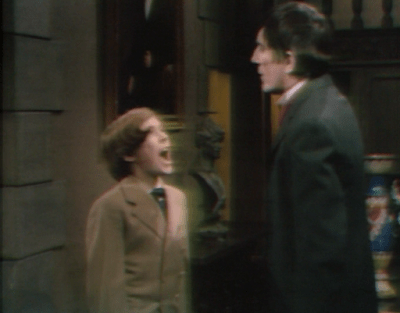
Jamison tells Barnabas he is reluctant to view Edith’s body, as he has never seen a dead person. That’s what he thinks- Barnabas is a vampire, so he’s talking with a dead person right now. Barnabas asks Jamison if he likes Quentin. Something about his tone reveals to Jamison that Barnabas is hostile to Quentin, and so Jamison yells at him that he is “just like the others” who disapprove of his favorite uncle. He storms out.

Jamison yells at Barnabas. Screenshot by Dark Shadows Before I Die.

Edith’s grandchildren are scrambling to find her will. Quentin suggests they make a game of the search; stuffy Edward objects that they most certainly will not make a game of it. Of course they will, since the search for a secret will is obviously a comedy plot.

Blackmailing Evan into joining his plot to forge a will in Edith’s name is not Quentin’s only crime today. He also assaults Edith’s friend Magda Rákóczi. Magda and her husband Sandor have been living in the Old House on the estate as Edith’s guests; now Barnabas is staying there. He has bitten Sandor and made him his slave, and bribed Magda into going along with his plans. Quentin calls at the Old House, where he chokes Magda and threatens her with a knife until she tells him where the will is. He then goes back to the great house and exploits Jamison’s trust to manipulate him into stealing the will and giving it to him. Quentin is such a horrible stinker that if he were played by any actor less charming than David Selby he would be intolerable to watch. As it is, we just keep wishing that Quentin would straighten up and fly right.

At the end of the episode, Barnabas accuses Quentin of having the will and threatens to do something “drastic” if he does not give it up. As a matter of fact, Jamison has not yet handed the will over to Quentin at this point, so what Barnabas says is not true. Worse, there is no tactical advantage for Barnabas in openly declaring himself to Quentin as an enemy at this point. Quite the contrary; he has traveled back in time to 1897 to prevent Quentin’s ghost haunting the great house in 1969 and making it uninhabitable, and has no idea what will be involved in doing that. He needs to be on friendly terms with as many people as possible to get the information he needs, and he particularly needs to get as close to Quentin as he can if he is to have any hope of thwarting whatever disaster is in store for him.

This isn’t the first time Barnabas has rashly shown his enemies what he thinks of them. When wicked witch Angelique returned to torment him in the spring of 1968, Barnabas repeatedly confronted her about her evil schemes, keeping her up to date on exactly what he did and did not know, while concealing everything from the people who wanted to help him fight her. Longtime viewers can see that there is no danger that Barnabas will learn anything from his experiences.

Episode 619: Advantages of being the master

Well-meaning governess Vicki has found a grievously injured Barnabas Collins in the woods. Barnabas insists Vicki not take him to a doctor or anyone else, but hide him somewhere no one will find him. She thinks of a secret door to the long-abandoned west wing of the great house of Collinwood, and uses that to take him to a hiding place there.

For the first year of Dark Shadows, the west wing was strongly associated with Vicki. In #14, she alone saw the locked door separating the bedrooms from the west wing open and close, apparently by itself. That was the first unequivocal evidence of supernatural activity on the show. In #84, Vicki’s charge, strange and troubled boy David, led her into the west wing, the first time we had seen its interior. He then trapped her in a room there, hoping she would die. She would languish in that room until David’s father, high-born ne’er-do-well Roger Collins, rescued her in #87. When Vicki was engaged to Roger’s nemesis Burke Devlin in #338, matriarch Liz offered to restore the west wing and let Vicki and Burke live there. After Burke died in a plane crash in #345, Vicki vowed to go on with the project of restoring the west wing. In #347, permanent houseguest Julia Hoffman, MD, exploited Vicki’s interest in the west wing to get her to stare into a crystal supposedly taken from a chandelier there until she is in a state of deep hypnosis.

More recently, Frankenstein’s monster Adam stayed in the west wing for many weeks as the guest of heiress Carolyn. Vicki’s connection with the wing was renewed when Adam abducted her and hid her there for a few days starting in #553. Today, Vicki hides Barnabas in Adam’s old room, re-establishing the west wing as her space. Thus we loop back to a theme that goes back to the third week of the show.

Later in the episode, Barnabas wakes up and is distressed to find that it is almost sunset. He pleads with Vicki to bring him a cross as quickly as possible. The audience knows, but Vicki does not, that Barnabas is the victim of vampire Angelique. Vicki’s ignorance of this point reminds us that she has been excluded from the show’s A-plots ever since #211, when Barnabas was introduced, himself in those days a vampire. Her calm departure to go fetch a cross reminds us that she knows this part of the house well. Every room in it is stuffed with bric-a-brac, undoubtedly she will have seen something nearby that is in the shape of a cross.

Meanwhile, Julia is in a hospital room, visiting local man Joe Haskell. Julia has become Barnabas’ inseparable friend, and Joe is Angelique’s other victim. She does not know that Angelique is the vampire, though she had surmised as much in #608. She questions Joe. At first he denies everything, but after she discloses that she was for a time the victim of yet another vampire he tells her that she must know why he can’t tell her who has been sucking his blood. She asks if the suave Nicholas Blair is hiding the vampire. Joe closes his eyes and scoffs at the idea. This reaction does nothing to curtail Julia’s suspicions of Nicholas.

Julia goes to Nicholas’ house. He genially escorts her into his living room. There, he takes a seat while she stalks about the room and tells him what she knows about him. Barnabas has a self-defeating habit of showing his cards to his adversaries, and longtime viewers may at first be afraid Julia has picked it up from him. Since Nicholas is a warlock who not only controls Angelique but has a wide range of magical powers that he uses to promote Satan’s interests on Earth, he is not an opponent with whom one can afford to make mistakes. Angelique herself was once a witch who, in #378, was able to turn a man into a cat at a moment’s notice. Nicholas’ command of the black arts goes far beyond Angelique’s. He was able to strip Angelique of her powers, raise her from the dead at least twice, and turn her into a vampire. Julia is simply a mad scientist, and she does not have any equipment with her. There’s no telling what Nicholas might do to Julia if their interview displeases him.

On his great blog Dark Shadows Every Day, Danny Horn lists three reasons why we know Julia will survive this confrontation without being turned into a toadstool:

Really, the thing that everybody wants to know is: why can’t the Stormtroopers shoot straight in Star Wars? It turns out there are three simple answers. #1. Stormtroopers shooting laser bolts are more interesting to look at than Stormtroopers who stand around complaining. #2. Shooting Luke Skywalker in the head halfway through the first movie is going to leave a rather obvious gap in the trilogy. #3. ‘Strong Guy Kills Weak Guy’ is not headline news.

Danny Horn, Dark Shadows Every Day, “Episode 619: The Gunslinger,” posted 4 April 2015

This is all very true- of course Nicholas and Julia will not leave each other alone indefinitely, of course the show cannot spare her, of course she will overcome her disadvantages and come away from their showdown with the upper hand. But it misses the point. Suspense comes when we know what must happen, but cannot see any way it might happen. What makes the scene work is the moment when Julia tells Nicholas that Barnabas is missing. That is news to him, and as Danny says elsewhere in his post, it is “the first sign of a crack that’s going to bring his entire operation crashing down,” as his shocked reaction suggests it might be.

Julia realizes she has won her showdown with Nicholas. Screenshot by Dark Shadows Before I Die.

The scene is one of the best in the series, though it is marred by a miscalculated ending. In the early part, we see Julia making an effort to keep her cool while Nicholas sits watching her smugly. She succeeds in keeping her brave face on until she senses that she has Nicholas off guard, at which point she moves in for the kill and tells him about Barnabas. She is then firmly in command. He composes himself and dismisses her.

That’s when it goes wrong. When Julia is heading out the door, Nicholas recovers his smugness and tells her that he must admit that he admires her for coming to see him. She looks alarmed and asks why. He replies, in a half-whisper, “You know.” She hastens out. I can see that this ending may have seemed like a good idea. We clearly saw in the beginning how hard it was for Julia to keep her fear in check and how easy it was for Nicholas to bask in the superiority his powers give him over a mere mortal. Though Julia has emerged as the winner in this engagement, she still has grounds for immense fear, and he for boundless self-confidence. But it is so broadly drawn as to be confusing. Has Nicholas already found a way to turn Julia’s success against her? Has she realized too late that she has made a mistake we aren’t aware of?

We learn shortly after that neither of these things has happened. Angelique comes upstairs. She sees Nicholas being very still. She makes several attempts to engage him in conversation. He finally approaches her and strikes her across the face. He then orders her to undo what she has done to Barnabas before it ruins his plans.

This is the second time Nicholas has slapped a woman in the face. The first time was in #610, when he struck Frankenstein’s monster Eve. Humbert Allen Astredo and Marie Wallace executed that business well, as he and Lara Parker execute it well today. For that matter, Grayson Hall and Lara Parker had done a good job when Julia slapped Angelique in the face in #535. Watching them, you can admire trained professionals practicing a specialized aspect of their craft. But since Nicholas has such vast powers, he is persuasive as a villain only when we are left guessing about just what he is up to. When we see him is reduced to hitting a woman, he shrinks from avatar of Satan to cheap pimp.

After Julia leaves Nicholas’ house, she lingers in the woods outside, watching his front door. She sees Nicholas leave the house, then sees Angelique and realizes that she is the vampire.

Julia is the most intelligent character on the show, and while we watch her in the woods her face suggests that she is thinking clever thoughts. Unfortunately, we hear her interior monologue in a recorded voiceover, and her lines are remarkably obtuse. On the heels of her overdone fear on the way out of Nicholas’ house, it does as much to undercut Julia’s image as a smart person who can win a duel with the Devil as Nicholas’ physical abuse of Angelique undercuts his image as a demonic sorcerer.

Episode 610: You are the angel of death

A woman named Eve sees a man standing on the terrace of the great house of Collinwood. She addresses the man as “Peter Bradford.” Regular viewers know that this is indeed his name, but we also know that he prefers to be called “Jeff Clark.” Peter/ Jeff has died and came back to life since he was first known as “Peter Bradford,” so I suppose you could say that’s a case of deadnaming. But while most transfolk tend to be patient when people inadvertently deadname them, Peter/ Jeff is a huge jerk about correcting people who use his former name. Yesterday twelve year old David Collins called him “Peter Bradford,” and he grabbed the boy and shook him until it looked like he had given him a concussion.

Eve is also a returnee from the world of the dead. Doubly so; her body is a Frankenstein creation made of parts salvaged from corpses, while her memories and personality are those of eighteenth century homicidal maniac Danielle Roget. Peter lived in that same era, and when Eve/ Danielle recognizes him we learn that they knew each other then. Peter/ Jeff doesn’t assault her as he did David; she’s his own size. He doesn’t recognize her, which she attributes to the fact that she looks different than she did when they knew each other. He keeps whining that his name is “Jeff Clark,” but she isn’t having it.

Meanwhile, Peter/ Jeff’s fiancée, well-meaning governess Vicki, is in the drawing room, having a conversation with matriarch Liz. There is a blooper in the middle of this conversation. Liz is supposed to say something like “Then you’ve resolved all your difficulties,” but Joan Bennett stumbles over the words. Alexandra Moltke Isles improvises a response that makes sense of it. That response is smooth enough, but she delivers the rest of her lines very quickly and with unusually little eye contact with her scene partner. Perhaps that is because she was afraid the improvised line was going to put the scene over time, or maybe she realized she had called attention to Bennett’s flub and was nervous because she had embarrassed a big star.

Or maybe Mrs Isles was nervous because her next scene was going to be with Peter/ Jeff, and she knew it would involve Roger Davis putting his hands on her. As they exit, Peter/ Jeff clutches Vicki by wrapping his arms around her in a remarkably awkward fashion, and she visibly squirms. This is most likely Mrs Isles’ discomfort arising from Mr Davis’ habit of physically assaulting his scene partners. A charitable viewer just might be able to believe that it is Vicki’s discomfort because Peter/ Jeff just spent the whole scene telling her transparent lies. He doesn’t want to tell her about his encounter with Eve/ Danielle, and makes up totally unconvincing excuses for his distracted state. Perhaps Mrs Isles channeled her unhappiness at being yoked with Mr Davis into her expression of Vicki’s dissatisfaction with the loathsome little man she is engaged to marry.

Peter/ Jeff steers Vicki offscreen.

Once Vicki and Peter/ Jeff are gone, Eve/ Danielle emerges from the bushes whence she had been spying on them. Liz comes out to the terrace and sees Eve/ Danielle. She asks who she is. When she does not answer, Liz tells her that she knows- she is the angel of death. Eve/ Danielle is startled by this, and hurries away.

The next scene takes place in the house of suave warlock Nicholas Blair. Nicholas has been keeping Eve/ Danielle there since she came to life. She has returned from Collinwood. Nicholas is upset with her for going out without his permission. She taunts him, and he slaps her. He threatens to kill her, and she says that while she does not know what his plans are, it is clear to her that she figures too prominently in them for him to do that.

Coming so shortly after we saw an actress give strong signs of unease at contact with Roger Davis, Nicholas’ slap to Eve/ Danielle’s face is a lesson in how professional actors handle scenes involving physical violence. Eve/ Danielle is relaxed before the slap and in shock after it. Her reaction gives the scene its energy. If Marie Wallace had reason to believe Humbert Allen Astredo would actually hit her, she may well have been as tense before the slap as Mrs Isles was before Roger Davis slithered his arms around her, and the scene would have dribbled out as lifelessly as does Peter/ Jeff’s scene with Vicki.

Once Nicholas concedes that Eve/ Danielle is important to his plans, she relaxes again and decides she may as well tell him about her encounter with Peter/ Jeff. Nicholas is intrigued, and disturbed. He tells Eve/ Danielle that “If it is true that they are one and the same, then there are forces at work here that I don’t know about.” Eve/ Danielle’s memory of her previous existence is very incomplete, and she wants Nicholas to help her to learn more about herself. Once he has heard about Peter/ Jeff, he is eager to oblige. He hypnotizes her.

At this point, my wife, Mrs Acilius, expressed frustration. “He’s going to hypnotize her and afterward she won’t remember anything! It’s only interesting if she remembers.” Eve/ Danielle does have a flashback to 1795, but at the end she seems to come out of the trance on her own. She turns to Nicholas, calls him by name, and says that she remembers Peter Bradford and she loves him. Since Nicholas doesn’t give her a post-hypnotic suggestion and snap his fingers, it seems likely she will remember her past with Peter.

When Danielle was introduced, I assumed that the name “Roget” was a case of deadline-induced selection. She is based on Madame DuFarge from A Tale of Two Cities, so she had to be French. But the writer didn’t have a list of French surnames at his fingertips, so he looked at his desk, saw a copy of Roget’s Thesaurus, and went with that. Perhaps that was what happened, but today Eve/ Danielle lives up to her namesake and goes into the synonym business. She calls Peter/ Jeff by his original name. She is on the receiving end of synonymy from Liz, since “the angel of death” is as good a name for her as any. And one of the memory gaps Eve/ Danielle wants Nicholas to help her fill is her previous name.

Marie Wallace plays Danielle in the flashback, even though she had mentioned in the first act that she looked different in those days. This occasions much discussion on the fansites. Here is the debate on the Dark Shadows Wiki:

During the fiashback scene, Danielle Roget should have been played by Erica Fitz instead of Marie Wallace. Fitz had previously portrayed Danielle Roget in episode 594, so it would have made sense and for character continuity to continue using the same actress. [Addendum: There are strong reasons to argue otherwise as well. One could argue that this is a memory that Nicholas is conjuring in Eve, so it’s from Eve’s perspective, and she would naturally see herself in her current guise, not even knowing what Danielle Roget looked like. This is also a reasonable place for dramatic license to prevail. The scene is very short, and it wouldn’t have been especially practical to have an additional actress. It’s also possible that viewers may have been confused if another actress was in the scene–Erica Fitz was on the show for only two episodes, so viewers at the time might not even have seen or not fully remembered what she looked like. Aside from that, it’s also possible Erica Fitz was not available.]

Discussion under “Bloopers and Continuity Errors” in “610” on The Dark Shadows Wiki.

In a comment on his own post about the episode on Dark Shadows Every Day, Danny Horn puts it more succinctly:

Yeah, I think the in-universe explanation is that the flashback pictured at the top of this post is Eve’s hypnosis-assisted memory of the event, so she’s picturing herself as she is now.

The real-world explanation is that Marie Wallace is playing Eve/Danielle now, and exactly nobody wants Erica Fitz to come back and appear in the flashback.

Comment left 23 March 2015 by Danny Horn on “Episode 610: Inexplicable You,” Dark Shadows Before I Die, 21 March 2015.

For my part, I’m sure Erica Fitz Mears is a very nice lady, and we should all give her money to help with her health problems. But no, she was not a good actress and I do not regret that she did not get more work on screen. Since Mrs Mears was only in two episodes, today’s flashback might have been an opportunity to give some other actress a chance to show what she could do as Danielle. But Miss Wallace does a very good job, and rounding the episode with two confrontations between the same pair of performers does a great deal to strengthen its structure. It would probably have been a mistake to cast anyone else in the flashback.

The flashback scene does come as bad news to longtime viewers, for reasons that have nothing to do with the casting of Danielle. When in November 1967 the show needed to develop a backstory for vampire Barnabas Collins, it took us back to 1795 and introduced Angelique, a maniacal ex-girlfriend who was determined to disrupt Barnabas’ new romance. That was a triumph that turned Barnabas from a stunt that boosted their ratings sufficiently to ward off cancellation into one of the major pop-culture phenomena of the 1960s, and Angelique herself became one of the show’s most important characters. That they are trying the same tactic with Peter/ Jeff, right down to a dramatic date of 1795, leads us to fear that they see him as a permanent part of the cast, and that they want to tie Eve/ Danielle as closely to him as Angelique is tied to Barnabas.

Episode 540: Intervening factor

Suave warlock Nicholas Blair tells his subordinate, the wicked witch known variously as Angelique and Cassandra, that she has an hour to figure out why her recent attempt to turn Barnabas Collins back into a vampire failed. When she tells him that won’t be enough time, he suggests she spend the hour preparing for her final destruction. At the last minute, her stepson David tells Angelique/ Cassandra about an audiotape message that happens to give her exactly the information she needs.

Nicholas threatens Angelique. Screenshot by Dark Shadows Before I Die.

Angelique/ Cassandra has been an extremely unsympathetic villain, so it is daring to have an episode mostly from her point of view which is suspenseful if and only if we want her to stay around. My wife, Mrs Acilius, says that might have been a reasonable bet when a character as dynamic as Angelique/ Cassandra is played by a performer as appealing as Lara Parker, but it doesn’t pay off today, for two reasons. First, the episode doesn’t have much of a plot. Second, returning viewers will be angry with Angelique/ Cassandra right now. She just subjected us to a three month ordeal called “The Dream Curse,” in which we saw the same dull sequence play out a dozen times, heard it described almost twice as many times, and then found out that there was no point to any of it. We know perfectly well that Angelique/ Cassandra is too interesting to stay off the show for long, so that the “final destruction” Nicholas is threatening will probably last for three weeks at most. But we really do want to see her punished for wasting our time.

This is the first episode in which John Karlen reads the opening narration, and only the third episode in which any male performer reads it. Most cast members have read these narrations more or less in the characters they will play in that day’s episode; Karlen takes his place alongside Kathryn Leigh Scott as one of two who strive to invest the role of Narrator with its own personality.

This was the last of the five episodes credited to director John Weaver. It isn’t hard to find reasons why they wouldn’t have contracted him to do more. There are a number of moments when the action jolts to a standstill for no apparent reason, Humbert Allen Astredo as Nicholas never seems to know what direction he should be facing, and when Angelique/ Cassandra orders the bedraggled Willie Loomis to “Look into my eyes!” we get a shot of him looking past her.