Episode 713: The heart of the room

Vampire Barnabas Collins returns to his coffin at dawn to find it already occupied. Governess Rachel Drummond is resting there, and is under the impression that she is Barnabas’ lost love Josette. He exclaims that only his old enemy, wicked witch Angelique, could be “monstrous enough” to put Rachel in this position.

Longtime viewers remember that in #248 Barnabas forced Maggie Evans, who like Rachel is played by Kathryn Leigh Scott, into this coffin because she refused to submit to his attempt to brainwash her into thinking she was Josette. So we know that Angelique is not all alone in the ranks of the sufficiently monstrous. On the other hand, we also know that it was Angelique who made Barnabas a vampire in the first place, and that like others who labor under Angelique’s curses he is in many ways a reflection of her. So perhaps his remark is not so preposterous an example of lack of self-awareness as it initially seems.

Shortly after, Rachel comes to in the front parlor of Barnabas’ home, the Old House on the estate of Collinwood, and is puzzled to find herself there with him. She has no idea how she got to the Old House, and certainly has no memory of the coffin in its basement. Barnabas tells Rachel he found her wandering in the woods. She goes to pieces, overwhelmed that she is not in control of her actions. He talks soothingly to her. Rachel collects herself, but is still struggling not to let Barnabas see her cry. He offers to walk her home to the great house on the estate. This offer is sheer bravado on his part- the sun has been up for some time, and he cannot possibly expect to survive outdoors all the way to the great house. Luckily for Barnabas, Rachel declines his offer. Unable to keep her emotions in check any longer, she hurries out the front door, walking herself home.

At the great house, Rachel sees maidservant Beth enter the foyer carrying a baby doll. Rachel says that her charge Nora will like the doll very much. Beth sputters at this remark, and spinster Judith Collins summons Beth to the drawing room. Rachel eavesdrops while Judith scolds Beth for her carelessness. Returning viewers know that Beth is helping Judith and Judith’s brother Edward keep someone prisoner in the room atop the tower of the great house, and that it is hugely important to Judith and Edward that no one knows about this. Beth’s sputtering response to Rachel told us also that the doll is not for Nora, but for this mysterious prisoner. Rachel does not have all the information about the matter that we do, but she has enough to suspect something very much like the truth, so we wonder what she gets out of the conversation she overhears.

Later, Rachel meets Beth in the foyer and urgently pleads with her for information about Edward’s wife, the mother of Nora and of her other charge, Jamison. Beth tells her what Edward has already made abundantly clear, that the topic is utterly forbidden. Rachel sidles up to Beth, bends her head at an angle, and speaks in an urgent whisper, something we have not seen from either Maggie or Miss Scott’s other role, Josette. Indeed, Rachel is quite a fresh character, impressively so from an actress whom longtime viewers already seen for so many hours.

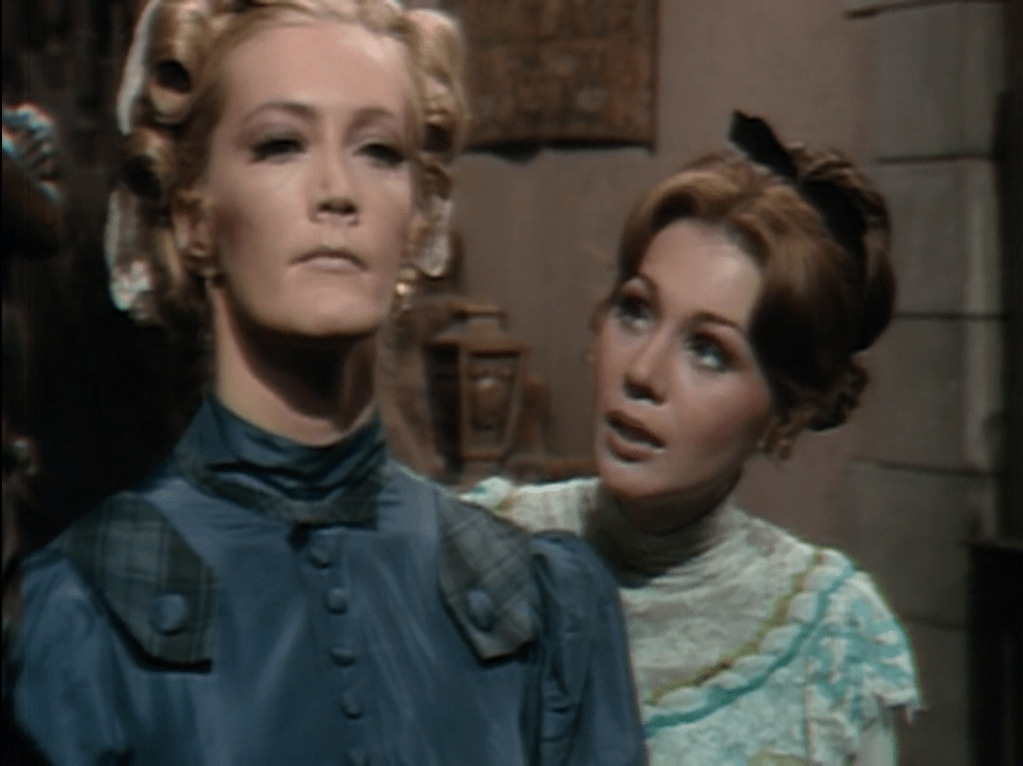
Rachel pleads with Beth for more information.

Judith overhears Rachel’s questioning of Beth and Beth’s response that Rachel should leave the matter alone. Judith dismisses Beth and talks to Rachel, telling her that Beth has given her very good advice. Judith has figured so far as a stern and menacing figure; it is something of a surprise that she does not fire Rachel on the spot, and even more of a surprise that she indicates she will not report the conversation to Edward.

The opening voiceover will tell us in a couple of days that Rachel’s reckless curiosity is “spurred on by her own fears.” Miss Scott has been playing this motivation all along. When we first saw Rachel, she and Edward were in a train station. He was being courteous to her, but she was stiff and awkward, clearly very much afraid of something. She is often seen reading, and her dialogue is both filled with signs of intellectual ambition and delivered with a frantic edge, suggesting that her studiousness has its roots in her attempt to defend herself against some danger. We have no idea as yet what that danger was or how it formed Rachel before we met her, but we know that her reaction to the evidence that she has found that someone is being held prisoner in the tower room at Collinwood is a deepening of her long-established fears, not the sudden appearance of new fear.

For her part, Judith’s main concern is finding her late grandmother’s missing will. The late Mrs Collins kept the provisions of her will secret, and it was stolen shortly after her death by some people who wanted to forge a new will and get the estate for themselves.

A woman named Magda Rákóczi shows up at the house, claiming to be able to help Judith find the will. Judith is violently prejudiced against Magda for her Romani ethnicity, and dismisses her offer of help out of hand. But Magda persists. Knowing that her grandmother had a fondness for Magda, Judith lets her into the drawing room and sits behind her while she reads the tarot. Judith keeps protesting that the previous cases Magda cites as evidence that the tarot can tell the future prove nothing, and that in her interpretations of them she is “making no sense whatsoever.”

Magda then says that the arrangement of the cards means that the will is hidden in the room where Judith’s grandmother died, in “the heart of the room.” In an entirely different voice than she has been using so far, Judith asks “What is meant by the heart of the room?” With that, Magda knows that she has Judith in the palm of her hand, and she starts to ham it up. “The hearrrt of the roooom… is a booook! A book that was very important to your grandmother! A very, very oooolld booook!” Judith decides this must be the family history, and she tells Magda that she will look through it at once.

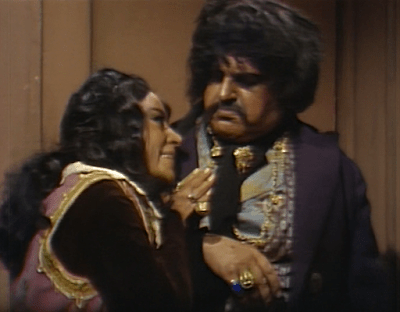
Magda goes over the top. Screenshot by Dark Shadows Before I Die.

In fact, Barnabas found the will and hid it in the family history. He has sent Magda to tell Judith where to find it. It comes as no surprise to us when Judith comes downstairs with the will and is jubilant to find that she is the sole heir of her grandmother’s vast holdings. After all, Barnabas wants the original provisions of the will to be enacted, and the only way to ensure that result is to see that it comes to the hand of the person who is its chief beneficiary.

We end with Beth standing at the door to the tower room, holding the doll and addressing the person inside as “Jenny.” We learned in #701 that Beth was originally maid to a lady named Jenny, that everyone thinks Jenny has gone away, and that it is surprising Beth has stayed on at the house in Jenny’s absence. Now it is confirmed that Jenny is the prisoner in the tower room. The obvious inference is that Jenny is Edward’s estranged wife, and that she has become the sort of crazy lady who appreciates baby dolls.

Episode 712: A pawn in this cruel game

Dark Shadows first developed its conception of the supernatural in depth when undead blonde fire witch Laura Murdoch Collins was on the show from December 1966 to March 1967. Laura was not so much one person as she was a complex of at least three distinct beings. There was a charred corpse in the morgue in Maricopa County, Arizona; a phantom that Laura’s son, strange and troubled boy David Collins, can sometimes see through his window as she flickers above the lawns of the estate of Collinwood; and a living woman who carries on conversations with people but is never seen eating or drinking. People who encounter Laura also experience dream visitations that resemble her and unaccountable compulsions to do things relating to her, but it is never clear which of those psychic phenomena come from Laura and which from her arch-nemesis, the ghost of the gracious Josette. It is clear that the various parts that make up Laura are not always aware of each other, and sometimes work at cross-purposes with each other.

Laura’s successor as Dark Shadows‘ chief supernatural menace was vampire Barnabas Collins, who joined the show in April 1967. Like Laura, Barnabas comes in several parts, not all of them working together harmoniously. For example, sometimes doors slam shut when he is in a house, and only he can open them. This is never shown as something he deliberately makes happen, and it does not always serve any intelligible purpose of his. Also, when he is active dogs start howling. Sometimes that immobilizes his targets with fear and confusion, but just as often it costs him the element of surprise and foils his plans. So whatever uncanny forces cause these things to happen are clearly not subject to Barnabas’ will. They accompanied him out of the darkness.

Shortly after Barnabas’ arrival, the show retconned Josette as his lost love and cast her as Princess Ankh-Esen-Amun to his Imhotep in a remake of the 1932 film The Mummy. In that film, the undead man tried to remake contemporary woman Helen Grosvenor in the image of the ancient Ankh-Esen-Amun. Taking that role in Barnabas’ attempt to recreate Josette was Maggie Evans, The Nicest Girl in Town. As in the 1932 film Zita Johanns played Helen in the contemporary scenes and Ankh-Esen-Amun in a flashback to ancient Egypt, so in #70 and #126 had Miss Scott already played the ghost of Josette.

While Barnabas pursued his crazed and evil plan to Josettify Maggie, the ghost of his little sister Sarah showed up. Sarah befriended Maggie and helped her escape from her “big brother.” Sarah did more and more, ultimately sending well-meaning governess Vicki back in time so that from November 1967 to March 1968, Dark Shadows was a costume drama set in the 1790s, when Barnabas and Sarah were alive.

Like Laura and Barnabas, Sarah may have looked like single person, but was in fact a complex of independent beings. In #325, she visits David in a dream and gives him information only she would have. In #327, David sees Sarah during waking hours and tells her about the dream, and it all comes as news to her. This daylight Sarah makes it clear to David that she does not want him to have the information the dream version of her gave him so shortly before.

Moreover, child actress Sharon Smyth was instructed to play Sarah as Barnabas’ conscience. When Barnabas is freed to prey upon the living, he unknowingly pulls Sarah out of the supernatural back-world behind the action of the show, the unseen realm where Josette’s ghost, the “Widows,” the ghost of Bill Malloy, and the rest of them lurk, and brings her with him into 1967. Sarah, however many of her there are, is part of the same complex that includes Barnabas and the forces that surround him.

In the 1790s portion, we met wicked witch Angelique and saw her place the curse that turned Barnabas into a vampire. Like the other supernatural forces, Angelique was a complex of multiple beings, some of which were opposed to each other. In her case, spellcasting was a matter of breaking off little bits of herself that took on lives of their own. Angelique was obsessed with the idea that Barnabas would fall in love with her. She could easily cast a spell to make him do that, but insisted to her helper that Barnabas must come to her “of his own will.” Those were the exact words Barnabas used when talking to his own thrall about Vicki, who succeeded Maggie as the object of his gruesome fantasies. When we heard Angelique take the same line, it dawned on us that the Barnabas we saw from April to November 1967 was not merely cursed by Angelique, he was possessed by her. His thoughts were her thoughts, his plans were her plans. When Barnabas fights Angelique, it is one of her replicas of herself coming back to oppose her, as the zombie version she created of Barnabas’ uncle Jeremiah came back to bury her alive in #396.

Now, Barnabas has traveled back in time to 1897. He has met governess Rachel Drummond, who is played by Kathryn Leigh Scott and whom he recognizes as a double of Josette. Angelique has also come to 1897, conjured up by some Satanists whom Barnabas has antagonized for no apparent reason. Angelique peered through the windows of the great house of Collinwood just in time to see Barnabas giving Rachel Josette’s music box. Dismayed, she went to the Old House on the estate, looked at Josette’s portrait, and declared “I am Angelique, and I hate you!” She, like Barnabas, looks at Rachel and sees another Josette.

Angelique’s motivation in the 1790s segment was ostensibly about her desire for Barnabas, but it was her hatred for Josette that drove her at every turn. Now we see that Barnabas is compelled to create another Josette whom he can love; Angelique is just as powerfully compelled to create another Josette to hate. Since Barnabas’ “love” involves killing its object and raising her as a vampire, it would seem to be as hateful as is Angelique’s overt hostility.

After Angelique proclaimed her hatred to the portrait, she took a cloth doll representing Rachel and strangled it. Rachel herself collapsed, unable to breathe. Angelique mouthed words; Rachel spoke them, leading Barnabas to believe that they were a message from Josette.

Today, Rachel is in the drawing room at the great house, recovering from her choking episode. Barnabas is holding her and looking longingly at her neck when stuffy Edward Collins enters. Edward demands to know what is going on, and Barnabas explains that Rachel had trouble breathing and fainted. Edward becomes concerned and wants to call a doctor; he becomes suspicious when Rachel, who he just met a few days ago, does not want to see a doctor. Barnabas manages to distract Edward from his suspicions with some chatter about the circumstances under which Rachel fainted.

In the groundskeeper’s cottage on the estate, Angelique casts a spell to summon Rachel. Back in the great house, Rachel suddenly looks up, her eyes wide open and focused at a point in the middle distance. She stands up and walks with her neck very still, moving like a wind-up doll. She announces to Edward and Barnabas that she will be going outside for a breath of fresh air. She refuses Barnabas’ offer to accompany her. Edward and Barnabas watch her wonderingly as she marches out with her robotic gait.

Barnabas and Edward wonder what has got into Rachel all of a sudden

Rachel arrives at the cottage and finds Angelique. Angelique calls Rachel “Josette.” When she protests that her name is Rachel, Angelique echoes the Barnabas we first knew and tells her that, when she wills it, her name will be Josette. She tells Rachel that she will not understand what is happening to her, but that Barnabas will soon understand very well.

Back in the great house, a servant tells Edward that he found a woman in the cottage. Barnabas is there, and he reacts to the description with alarm. He goes to the cottage, clearly afraid that he will find Angelique there. Before he can complete a search, a rooster crows and Barnabas hastens back to his coffin in the basement of the Old House on the estate.

Barnabas opens the coffin, and finds Rachel lying in it, unconscious. This sets up a comedy of manners. He hardly knows her well enough to lie down with her, and he can’t very well wake her and ask her to make way for him. We end with him facing this problem in etiquette.

We may also remember #248, when Barnabas expressed his frustration with Maggie’s refusal to turn into Josette by forcing her into his coffin. Perhaps Angelique knows that he did that, and is taunting him with a memory of which he has since shown an ability to be ashamed. If so, the point of the taunt is that he is not different from her. Angelique called Rachel a “pawn” in the “cruel game” she is playing with Barnabas. Angelique, who when we first saw her in the 1790s segment was so monomaniacally devoted to her goals that she could not see events from any perspective other than her own, can now understand that what she is doing to Rachel is horrible. That’s why she is doing it, to show Barnabas that he is part of the same horror as herself and that he can never transcend it.

Episode 707: Dark for over a hundred years

One day in 1897, Edward Collins convenes his siblings Judith, Carl, and Quentin for a family meeting in the drawing room of the great house of Collinwood. Their grandmother Edith died the night before. She was supposed to tell Edward a celebrated family secret, but did not do so. Edward is convinced she must have told one of the others, and declares that no one will leave the room until he finds out which.

Returning viewers know that Edith did not tell any of them, and we can imagine a half hour of nothing but the four Collinses of Collinwood sitting around staring at each other. Fortunately, Quentin points out that Edith was briefly alone with their recently arrived and thoroughly mysterious cousin, Barnabas Collins, and she might possibly have told him. Edward orders Carl to go to the Old House on the estate, where Barnabas is staying. Carl asks why it’s always him who has to do these things, and Edward angrily shoos him away. Louis Edmonds and John Karlen were both talented comic actors, and this little exchange is very funny.

In the Old House, Carl finds Sandor Rákóczi coming up from the cellar. He asks Sandor what he is doing there. Sandor says he lives there. Carl says that he’d heard Barnabas was living in the house now. Sandor says that Barnabas hired him and his wife Magda as servants. Carl laughs at that and says of Barnabas “He is an odd one, isn’t he?” Sandor gives him a fierce look, offended. Carl apologizes.

Carl explains that he has come to fetch Barnabas. Sandor says Barnabas won’t be back until after dark. Carl explains why they need him at the great house, and Sandor laughs. “You must have Gypsy blood! Nobody in the family trusts nobody else!” Carl laughs, too.

This scene may remind longtime viewers of the first time we saw Thayer David on this set, when he was playing crazed handyman Matthew Morgan. The dramatic date and the date of production were both 1966 then. Strange and troubled boy David Collins found Matthew hiding in the Old House, and agreed to help him avoid the police. Carl is a grown man, but he is as eager to please and uninterested in asserting dominance for any length of time as was the nine year old David. Further, he is so naive that he reacts with bewilderment to the idea that lust for money might be a motive for murder. Carl may not be less prejudiced against Romani people than are the rest of the Collinses, but his childlike qualities allow him to laugh at a joke that would have drawn a violent response from any of his siblings.

Carl insists that Sandor go home with him and tell Edward that Barnabas is away. Again, this shows Carl’s childishness. He wants to prove to Edward that he did as he was told and went to the Old House. In fact, Edward is appalled to see Sandor in the great house, and can barely stand listening to him.

While Sandor is leaving, Judith stops him. Sandor is astounded that she is speaking to him at all. She tells him that her grandmother may have tolerated his presence in the Old House, but that she and her brothers will not. Sandor and his wife Magda are to leave the property within twenty four hours. Judith does not give Sandor a chance to tell her that Barnabas has hired them as servants.

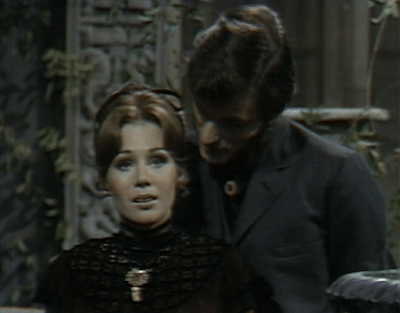
On the terrace, Quentin finds Rachel Drummond, the new governess. The two of them look very good together. In fact, Quentin’s seductive manner and Rachel’s response to it make them the most attractive couple we have seen on the show, by a long way.

Chemistry lesson. Screenshot by Dark Shadows Before I Die.

They talk about the house. Quentin mentions that no one has been in the room on top of the tower since 1796, 101 years ago. Later that night, Rachel will see a light burning in the room, and she will rush into the drawing room to tell Edward about it.

She comes in after a meeting between Edward and Judith. Judith came to tell her brother about something entirely new to the audience. She says that the matter relating to the tower room is going well. Maidservant Beth goes to the room three times a day, and Beth also goes into town regularly to take money to a Mrs Fillmore.

This will interest returning viewers. The other day, Quentin found Beth going into town with a parcel and an envelope containing $300 in cash. Beth said Judith gave her permission to go to town to conduct personal errands, and claimed, absurdly, that she had saved the money from her salary. We now know that she was taking the money to this Mrs Fillmore for some purpose of Edward and Judith’s. Later, Quentin found Beth taking a tray of food upstairs. He asked who was supposed to eat it; she said it was for Edith. When he pointed out that it was more than Edith could eat, she said Judith would be eating with her. In Edith’s room, Beth told Judith about this. She said they would have to be more careful now that Quentin was back home, and dismissed her to take the rest of the food “upstairs.” We now know that this “upstairs” is the tower room, and that Beth is helping Judith and Edward to hide someone there of whose presence in the house Quentin is unaware.

However much this may interest us, it does not interest Edward at all. He is outraged that Judith so much as mentioned the matter to him, saying that he wants her to handle it without notifying him in any way. She objects that they will have to talk about it sometimes; he does not agree.

When Rachel enters and tells them about the light, Edward detains her with a disquisition about the impossibility of the tower room being lighted while Judith scurries off and goes upstairs. After a while, Edward takes Rachel back to the terrace and shows her that the room is dark. He asserts that it was also dark when she looked at it earlier, and it has been dark for over a hundred years.

Longtime viewers will recognize this scene. In March 1968, Dark Shadows was set in 1796, and Barnabas had just become what he is again now, a vampire. Barnabas’ father, haughty overlord Joshua, confined him to the tower room while he tried to find a way to free his son of his curse. Barnabas’ mother Naomi saw lights in the tower room, as did his second cousin Millicent. When Naomi told Joshua about the lights, he pretended not to see them, and when Millicent told her husband Nathan she had seen the lights, he, for his own reasons, also pretended not to see them. Those pretenses led each woman to go to the room, resulting in madness for Millicent and suicide for Naomi. Quentin tells Rachel that the tower room has been closed since 1796 because “a woman killed herself” there; that is an explicit reference to Naomi.

Like Edward and Judith, Joshua and Naomi were played by Louis Edmonds and Joan Bennett. It is a sign of how much more dynamic the 1897 section is than the 1790s section that Judith is an active participant in whatever scheme is going on, not simply a helpless person who stumbles upon a terrible secret and promptly kills herself.

Episode 706: What it was to be a Collins

Yesterday, we were in the great house on the estate of Collinwood when dying nonagenarian Edith Collins met mysterious newcomer Barnabas Collins. She told Barnabas that she recognized him. Edith had been entrusted with the Collins family’s darkest secret, which was about Barnabas. He is a vampire, entombed in the 1790s to be kept forever away from the living. Now it is 1897, and Edith sees that the family has failed. She must tell the secret to her eldest grandchild, Edward Collins. Edward comes into the room and Edith tries to tell him what has happened. She has difficulty speaking. Edward asks Barnabas to excuse them. He replies “Of course,” and leaves the room. He does stand at the door and listen to their conversation, apparently waiting to see if Edward will come out with a crucifix and a sharpened stake.

Today, we find that Edith was so shocked by the sight of Barnabas that she has lost her sense of her surroundings. Barnabas was kept in a chained coffin in an old family mausoleum, and Edith does manage to say the word “mausoleum” to Edward, but that’s as far as she gets with the secret. Thereafter, she weaves in and out of the moment, reliving several periods of her life, some as far back as the time of her wedding to Edward’s grandfather.

At the word “mausoleum,” Barnabas rushes back to the Old House on the estate, where he has been staying. He tells his unwilling servant, a woman named Magda Rákóczi, that she must fetch her husband Sandor and that she and Sandor must go to the mausoleum at once, take the coffin out of the secret chamber where it is hidden, leave no trace of any kind in the chamber, and carry the coffin to the house. Magda points out one of several facts that make it impossible to comply with these orders, which is that Sandor is in town where Barnabas sent him. Barnabas refuses to acknowledge this or any other insuperable difficulties, and goes back to the great house.

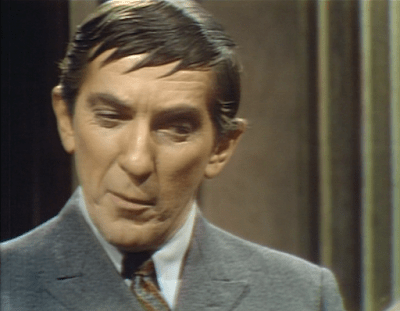
While Barnabas is sitting in the drawing room clenching his fists on the armchair where he is waiting to see what Edward will do when he learns that he is a vampire, a hidden panel opens and a man carries a pistol into the room. The man holds the pistol at Barnabas’ head and demands he tells him who he really is. The man identifies himself as Carl Collins, one of Edward’s brothers. Barnabas yields nothing. The man discharges the pistol, from which emerges a flag labeled “Fib.” He laughs. Barnabas is not amused. The audience may not share Carl’s sense of humor either, but the subsequent scene in which Carl claims to see that Barnabas has a kind face, predicts that the two of them will become close friends, and offers to let him borrow the pistol and play jokes with it himself, is hilarious. Jonathan Frid plays Barnabas’ icy reaction to Carl perfectly, and as Carl John Karlen does not betray the least glimmer of awareness of Barnabas’ affect.

Barnabas does not enjoy Carl’s greeting. Screenshot by Dark Shadows Before I Die.

Carl goes to the Old House to call on Magda. The scene there begins with Magda showing her palm to Carl. He wants her to read the Tarot cards; she says the cards will not speak unless she has money in her hand. Like his siblings, Carl is convinced that the secret which Edith keeps and which she has vowed to disclose only to Edward is the key to control of the family fortune. Magda knows better, but she goes through the cards anyway. They tell her that the family’s fortune is even larger than anyone knows, that when Edith’s will is found it will come as a surprise to everyone, that the surprise will lead to murder, and that the person who inherits the money will not keep it. The Queen of Cups turns up in a position that indicates Edith is still in control, but the last card Magda draws leads her to gasp and stand. She reels about the room, and declares that Edith is dead. “The cards are silent.”

Back in the house, Edward lets Barnabas into Edith’s room. He closes his grandmother’s eyes, and tells Barnabas that she did not tell him the secret. He vows to learn the secret even “if it’s the last thing I do!” We cut to Barnabas, looking uncomfortable. No doubt he is thinking of how inconvenient it would be if Edward were to find out the secret and he had to see to it that it was indeed the last thing he ever did.

This is the sixth consecutive installment to which I have given the “Genuinely Good Episode” tag, a record so far. Like the preceding five, it is stuffed with wonderful things. The acting is all very very good. Isabella Hoopes does a marvelous job as the delirious Edith, as Edward Louis Edmonds gives a master class in how to play a stuffy man, and the pairings of Grayson Hall, John Karlen, and Jonathan Frid with each other all unfold brilliantly, full of laughs but never losing their dramatic tension. So many of the episodes fans most enjoy would be drab for people coming to the show for the first time that it is always a memorable occasion when we see one like this, that anyone should be able to recognize as an outstanding half hour of television. It’s true the visual side lets us down a little; even by the standards of 1960s daytime television, the color is murky and there are too many closeups. But Sam Hall’s script and the performances are so good that no fair-minded person will complain very much about those problems.

Fans will take a special interest in Edith’s ramblings. When it first aired, viewers had no way of knowing how much of what she says about the family’s history will be reflected in upcoming episodes. The writers themselves probably didn’t have a much clearer idea about that than we do. But watching the series through for the first time, our default assumption about each of her lines is that it will have some significance as we go, so if we are committed to watching the show we listen closely.

We’ve already learned that Edith is over 90, so the very latest she could have been born is 1807. More likely she was born a bit before that, sometime between 1801 and 1806. She says today that her father-in-law was Daniel Collins. From November 1967 to March 1968, Dark Shadows was set in the late 1790s, and we saw Daniel. He was about 11 in 1795, so he would have been born in 1784 or thereabouts. So he could have been no more than 23 years old when Edith was born. Presumably his son Gabriel was the same age as his bride, though he might have been significantly younger. Edith does say that she always hated Daniel; perhaps she was a good deal older than Gabriel, and Daniel disapproved of her initially for that reason.

Edith tells us that Gabriel has been dead for 34 years, placing his death date in late 1862 or early 1863. She does not mention his cause of death or say anything about their son who was the father of Edward, Carl, and the others. It is firmly fixed that Edward and Carl’s brother Quentin was born in 1870, so Gabriel’s son must have survived him by several years.*

Edith says several times that the secret has been passed down from generation to generation and that she must tell it to Edward because he is the oldest. That seems to imply that Daniel told his oldest child, whom we presume to have been Gabriel, and that Gabriel told his oldest child, whom we presume to have been the unnamed father of Edith’s four grandchildren. He would then have told Edith before he died, either because Edward was not yet old enough to hear it, or because he was not available at the time.

But that implication is not at all secure. Edith says that Edward must be the keeper of the secret because he is the oldest- she doesn’t say what the connection is between being the oldest and keeping the secret. For all we know, she could have decided on her own to invent that tradition, starting with Edward and continuing with Edward’s oldest child. And when she says that it was passed down from generation to generation, she does not specify how many generations have been involved or which member of each generation did the passing. All we know is that someone of one generation learned it from someone else of a different generation, and that Edith believes it is the family’s responsibility to keep Barnabas from preying upon the living.

In a comment on Danny Horn’s post about episode 705 on Dark Shadows Every Day, someone calling himself “Mike” had a very interesting theory:

I think it’s reasonable to assume that sometime between 1897 and 1967 the secret was lost and not continually passed down. Perhaps in the original timeline Quentin was successful in killing Edith before Edward arrived, or maybe Edward died later in life before he was able to pass it on.

As far as Joshua passing the secret on, maybe he did, or maybe it was the elderly Ben Stokes who started the tradition?

Joshua was Barnabas’ father, and Ben Stokes was a much-put-upon indentured servant who was Barnabas’ devoted friend. They were the two people who knew that Barnabas was a vampire and that he was entombed in the secret chamber of the mausoleum. I replied to “Mike”:

I love that idea. Edith’s desire to tell the oldest son may lead us to assume that it has been handed down to the oldest son generation after generation, and it does lead the “Fab Four”** to assume that it brings with it some kind of power and access to riches. But their assumption is wrong, and ours may also be. Perhaps Joshua never told anyone. Perhaps the first person to tell the secret was Ben Stokes, and the person he told was Edith.

The scene between Barnabas and Magda brought another question to my mind. In #334, Barnabas was able to lock the panel in the mausoleum that leads to the secret room. Why doesn’t he just do that? It has also been made clear that as a vampire he is far stronger than are humans- if he wants to move the coffin from the mausoleum to the Old House, surely he could pick it up himself and do it more quickly and with less risk of detection than could Magda and Sandor. My wife, Mrs Acilius, agrees that we don’t know why Barnabas doesn’t lock the panel, but she says that it is perfectly clear why he can’t move the coffin- that is manual labor, and he is an aristocrat. His servants must do that.

*In a later episode, Quentin will mention that he knew Gabriel, throwing the 1862/3 date into question. But they never get around to any stories that depend on anything that happened in Gabriel’s later years. By the time we get to that one, only obsessive fans will remember his name. Eventually we meet two characters named Gabriel Collins, one in episodes that will air in 1970 and the other in the 1971 film Night of Dark Shadows, but a death date in the 1860s is not relevant to anything we learn about either of them.

**The “Fab Four” are Edith’s grandchildren, Edward, Carl, Quentin, and their sister Judith.

Episode 701: Welcome home the prodigal

We begin the part of Dark Shadows set in the year 1897 with an episode featuring a glittering script, a strong cast, and a hopeless director. Henry Kaplan’s visual style consisted of little more than one closeup after another. The first real scene in the episode introduces us to Sandor and Magda Rákóczi, a Romani couple who live in the Old House on the estate of Collinwood. They bicker while Sandor throws knives at the wall. Thayer David really is throwing knives, but since we cut between closeups of the targets and of the actors we cannot see anything dynamic in that action. He may as well be whittling.

Magda ridicules Sandor’s pretensions as a knife-thrower and as a patent medicine salesman, and busies herself with a crystal ball. She tells him that when “the old lady” dies, they will have to leave Collinwood. He says he knows all about that. She wants him to steal the Collins family jewels so that they can leave with great riches. He eventually caves in and sets out for the great house on the estate, more to escape her nagging than out of greed.

Regular viewers will remember that we heard Magda’s name in December 1968. The show had introduced two storylines, one about the malevolent ghost of Quentin Collins and the other about werewolf Chris Jennings, and the characters were starting to notice the strange goings-on that Quentin and Chris generated. The adults in the great house had no idea that Quentin was haunting them or that Chris was a werewolf, so they held a séance in #642. Speaking through heiress Carolyn Collins Stoddard, Magda mentioned “My curse!” and said that “He must not come back!” It was clear in the context of the episode that the “He” who “must not come back” was Quentin. Chris was a participant in the séance, and he broke the circle before Magda could explain what she meant by her “curse.” Séances held in #170 and #281 were cut short by the person whose secret the medium was about to expose; that it is Chris who interrupts this one would suggest to longtime viewers that Magda not only knew Quentin, but that the curse she is about to explain was the one that made Chris a werewolf. Carolyn and her uncle Roger Collins talked a little about Magda in #643, and psychic investigator Janet Findley sensed the ghostly presence of a woman whose name started with an “M” in #648. We haven’t heard about Magda since.

As the living Magda, Grayson Hall manages rather a more natural accent than Nancy Barrett had when channeling her concerns about “my currrrrssssse.” The exaggerated costumes Hall and Thayer David wear make sense when we hear them reminiscing about the old days, when they made their livings as stage Gypsies with a knife-throwing act, Tarot card readings, and a magic elixir. Even the fact that Magda is peering into a crystal ball during this scene is understandable when they make it clear that they are staying in the Old House as guests of the mistress of the great house, an old, dying lady who enjoys their broadly stereotypical antics. But there is no way to reconcile twenty-first century sensibilities to Hall and David’s brownface makeup. Some time later, Hall would claim that one of her grandmothers was Romani. If that was a lie, it is telling that only someone as phenomenally sophisticated as Hall could in the 1970s see that she would need to invent a story to excuse playing such a character.

Objectionable as Sandor and Magda are, their dialogue is so well-written and so well delivered that we want to like them. Moreover, the year 1897 points to another reason fans of Dark Shadows might be happy enough to see Romani or Sinti characters that they will overlook the racist aspects of their portrayal. It was in 1897 that Bram Stoker’s Dracula was published, and it depicted the evil Count as surrounded by “Gypsy” thralls. The character who has brought us on this journey into the past is Barnabas Collins, and upon his arrival he found that he was once more a vampire.

In addition to the strengths of the dialogue, the acting, and the intertext, there is also a weakness in this episode that softens the blow of the brownface. Today the picture is so muddy that it is possible to overlook the makeup. That’s Kaplan’s fault. It would often be the case that one or the other of the cameras wasn’t up to standard, but when the director was a visual artist as capable as Lela Swift or John Sedwick, there would always be at least some shots in a scene using the good camera, and others where the lighting would alleviate some of the consequences of the technical difficulties. But Kaplan doesn’t seem to have cared at all. He had made up his mind to use a particular camera to shoot the Old House parlor with a subdued lighting scheme, and if that camera was not picking up the full range of color, too bad. He’d photograph a lot of sludge and call it a day.

Meanwhile, a man knocks on the door of the great house. He is Quentin, and the person who opens the door is Beth Chavez. We first saw these two as ghosts in #646. Beth spoke some lines during the “Haunting of Collinwood” story, but Quentin’s voice was heard only in his menacing laugh.

We already know Quentin as the evil spirit who drove everyone from the house and is killing strange and troubled boy David Collins in February of 1969. His behavior in this scene is no less abominable than we might there by have come to expect. He pushes past Beth to force his way into the foyer, does not bother to deny that he has come back to persuade his dying grandmother to leave him her money, pretends to have forgotten someone named “Jenny,” makes Beth feel uncomfortable by saying that her association with Jenny makes her position in the house precarious, orders Beth to carry his bags, twists her arm, and leeringly tells her that she would be much happier if she would just submit to his charms. David Selby sells the scene, and we believe that Quentin is a villain who must be stopped. But Mr Selby himself is so charming, and the dialogue in which he makes his unforgivable declarations is so witty, that we don’t want him to go away. He establishes himself at once as The Man You Love to Hate.

In an upstairs bedroom, the aged Edith Collins is looking at Tarot cards. Quentin makes his way to her; she expresses her vigorous disapproval of him. She says that “When Jamison brought me the letter, I said to myself ‘He is the same. Quentin is using the child to get back.'” Quentin replies “But you let me come back.” She says that she did, and admits that he makes her feel young. With that, Edith identifies herself with the audience’s point of view.

The reference to Jamison and a letter reminds regular viewers of #643, when Magda’s ghost caused a letter from Quentin to fall into Roger’s hands. It was addressed to Roger’s father, Jamison, and was written in 1887. It read “Dear Jamison, You must return to Collinwood. I need your help. You must intercede with Oscar. Only you can save me.” They’ve revised the flimsies quite a bit since then; now it is 1897, Jamison is 12, and we don’t hear about anyone named Oscar.

Not about any character named Oscar, anyway. Edith tells Quentin that “Men who live as you do will not age well.” Quentin tells Edith that she ought not to believe in the Tarot, because “This card always has the same picture and people change, even I.” On Dark Shadows, which from its beginning has taken place on sets dominated by portraits, these two lines might make us wonder what it would be like if it were portraits that changed while their subjects remained the same. Oscar Wilde’s Picture of Dorian Gray was published in serial form in 1890 and as a novel in 1891, and it was a sensation on both sides of the Atlantic. The dialogue is so witty that the characters must be well-read, making it quite plausible that Quentin’s remark was meant to remind Edith of the book. Especially so, since Wilde was released from prison in 1897, bringing him back to public notice in that year.

Edith tells Quentin that old and sick as she may be, she can still out-think him. She declares that all of her grandchildren will get what they deserve. All, that is, except Edward. Roger mentioned Edward in #697, naming him as his grandfather and Jamison’s father. Edith says that Edward is the eldest, and therefore she must tell him “the secret.” There is a note of horror in her voice as she says this; Quentin misses that note, and reflexively urges her to tell him the secret. She only shakes her head- the secret isn’t a prize to contend for, it is a burden to lament.

Isabella Hoopes plays this scene lying on her side in bed, a challenging position for any performer. Her delivery is a bit stilted at the beginning, but after she makes eye contact with David Selby she warms up and becomes very natural. I wonder if the initial awkwardness had to do with Kaplan. He held a conductor’s baton while directing, and he used to poke actresses with it. I can’t imagine a person in bed wearing a nightgown would have an easy time relaxing if her attention was focused on him. Once she can connect with Mr Selby, though, you can see what an outstanding professional she was.

Quentin goes to the drawing room, and finds Sandor behind the curtains. He threatens to call the police, and Sandor slinks back to the Old House. Magda berates him for his failure to steal the jewels, and he insists there are no jewels in the great house.

Meanwhile, Barnabas is in his coffin, trying to will someone to come and release him. In #210, dangerously unstable ruffian Willie Loomis had become obsessed with Barnabas’ portrait in the foyer of the great house, so much so that he could hear Barnabas’ heart beating through it. Barnabas called Willie to come to the secret chamber in the old Collins family mausoleum where his coffin was hidden. In his conscious mind, Willie thought he was going to steal a fortune in jewels. His face distorted with the gleeful expectation of that bonanza, he broke the chains that bound the coffin shut, and Barnabas’ hand darted out, choking him and pulling him down.

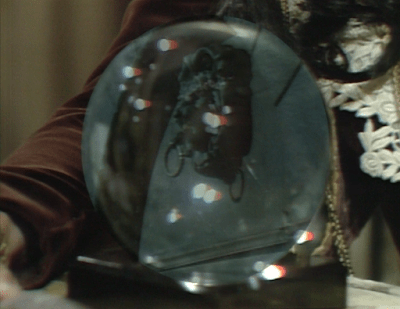
In the Old House, an image suddenly appears in the crystal ball. We can see it, the first time they have actually projected an image in such a ball since the first one made its debut in #48.

Picture in picture. Screenshot by Dark Shadows Before I Die.

Magda notices the image, and tells Sandor to look. He recognizes the old mausoleum. She says that the jewels must be in “the room,” implying that they already know about the hidden panel and the secret chamber behind it. Sandor says it is absurd to imagine Edith going to and from the mausoleum to retrieve pieces of her jewelry collection. Magda ignores this, and urges him to go there. He reluctantly agrees to go with her.

The two of them are heading for the door when they hear a knock. It is Beth, come to say that Edith wants to see Magda. Edith wants what she always wants- to be told that Edward will return before she dies. Sandor says Magda can’t go, but Beth says she will regret it for the rest of her life if she does not. Magda tells Sandor to go on his way without her, and says that she will bring Edith some ancient Gypsy cards, cards older than the Tarot. When she talks about Romani lore, Magda taunts Beth- “but you wouldn’t know anything about that, would you?” Her sarcastic tone implies that Beth has tried to conceal her own Romani heritage.

Sandor opens the secret panel and looks at the chained coffin. He tells himself the jewels can’t be hidden there, then decides he may as well open it anyway- if he doesn’t, Magda will just send him back. Longtime viewers remembering the frenzy in which Willie opened the coffin in #210 will be struck by the utterly lackadaisical attitude with which Sandor performs the same task. Men’s lust for riches may release the vampire, but so too may their annoyance with the wife when she won’t stop carping on the same old thing.

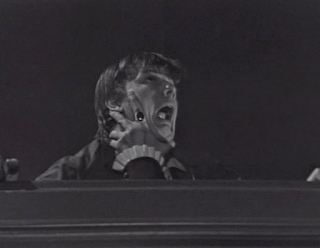
When Willie opened the coffin, it lay across the frame lengthwise and he was behind it. When he raised the lid it blocked our view of his middle. We could see only his face when he realized what he had done, and could see nothing of Barnabas but his hand. The result was an iconic image.

Farewell, dangerously unstable ruffian- hello, sorely bedraggled blood thrall. Screenshot by Dark Shadows Before I Die.

When Sandor opens the coffin, its end is toward us. We see Barnabas at the same time he does. Barnabas’ hand darts up, and also for some reason his foot. The camera zooms in as Barnabas clutches Sandor’s throat. Unfortunately, the shot is so dimly lit that not all viewers will see this. My wife, Mrs Acilius, has eyesight that is in some ways a bit below average, and she missed it completely, even on a modern big-screen television. It’s anyone’s guess how many viewers would have known what was going on when they were watching it on the little TV sets of March 1969, on an ABC affiliate which was more likely than not the station that came in with the poorest picture quality in the area. As a result, the image that marks the relaunch of Barnabas’ career as a vampire is nothing at all. There is so much good stuff in the episode that it easily earns the “Genuinely Good” tag, but Kaplan’s bungling of this final shot is a severe failure.

Grab and kick, and one and two! Screenshot by Dark Shadows Before I Die.

Episode 685: Barnabas, Quentin, and the Thing Glasses

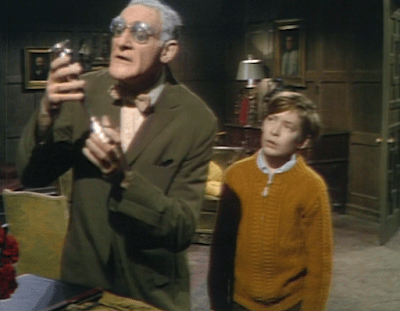
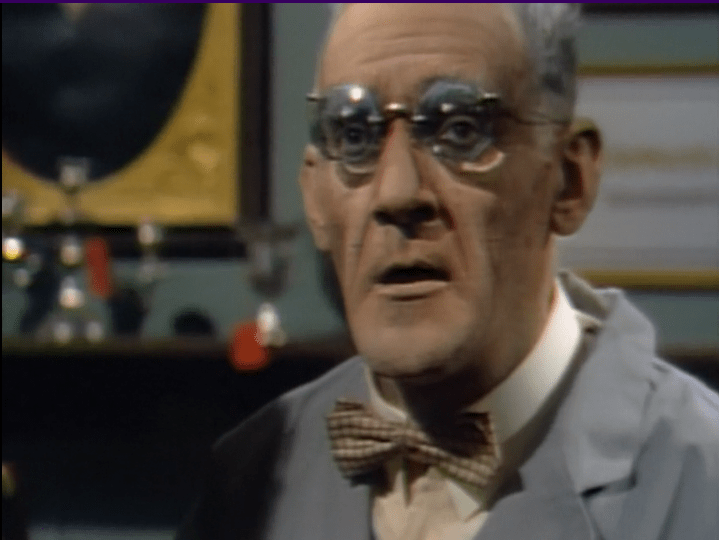
Silversmith Ezra Braithwaite comes to the great house of Collinwood, bearing a ledger with information that old world gentleman Barnabas Collins wants. Barnabas is in the study, so twelve year old boy David Collins lets Mr Braithwaite into the house and escorts him to the drawing room. The two of them play a scene that may not have looked like much on the page, but as delivered by talented comic actors Abe Vigoda and David Henesy the lines are hilarious.

For example, Mr Braithwaite has two pairs of glasses, which he describes to David as his glasses for looking at things and his glasses for looking at people. David asks if the ones he is wearing are his “thing glasses.” We laughed out loud at that whole exchange. Mr Braithwaite asks David to go get “Uncle Barnabas”; David replies “He’s my cousin,” to which Mr Braithwaite answers “Ah, yes.” Again, that wouldn’t be a hit in a joke book, but Vigoda and Mr Henesy sell it. The purest example comes when Mr Braithwaite starts to change his glasses as he turns to the pages of the ledger and says out loud to himself “Oh, Ezra, Ezra, you already got on your reading glasses.” That is a laugh line entirely because of the way Vigoda stresses the words “got” and “on.”

There is a little exchange between Ezra and David that will stand out to longtime viewers:

Ezra: David is it? Well, I don’t remember a Collins being named David before. Now, my name is Ezra, as my father was and his father before him. You find a name like Ezra and you don’t give it up.

David: I guess not.

Ezra: Yes, now, David’s kind of a new-fangled name.

David: No, there’s King David in the Bible.

Ezra: Oh, of course, yes, yes. A good man, too.

In #153, it was established that no Collins ever bore the name “David” until undead blonde fire witch Laura Murdoch Collins insisted that her husband Roger go along with her plan to name their son “David Theodore Collins.” That turned out to be hugely important as evidence of Laura’s evil intentions. In #288, it sounded like they had decided to retcon that away when David looked in a family album, saw a portrait of a “David Collins” from a previous century, and wondered aloud if he had found his namesake. Nothing has come of that potential namesake in the 79 weeks since, and Ezra’s line that he didn’t “remember a Collins being named David before” would suggest that they’ve gone back to the original idea.

Mr Braithwaite, in his thing glasses, examines a piece of silver. David examines him. Screenshot by Dark Shadows Before I Die.

Each time Mr Braithwaite looks at someone through his “thing glasses,” we get a point of view shot showing that his eyesight is blurry. They then cut back to the other actor in regular focus. These shots are brief enough that the repetition isn’t a big problem, but it results in a series of exchanges the actors deliver to the camera rather than to each other. Those don’t work at all. Mr Henesy and Abe Vigoda had such a fine comic rhythm going that it’s a shame to break it up with this clunky stuff.

Reading the ledger, Mr Braithwaite says that the silver pentagram Barnabas wants to know about was bought in April 1897 by Miss Beth Chavez and paid for by Quentin Collins. We have seen Beth’s ghost. She is very tall and so thin you could clasp your fingers around her waist. Her complexion is pale as can be, her hair blonde, her eyes blue. I’ve met a fair number of Chavezes in my time, including a couple of Elizabeth Chavezes, and none has met this description. I have nothing to say against slender blondes, and actress Terrayne Crawford is movie-star beautiful. Still, if a fellow were excited about a blind date with a girl known to him only by the name “Beth Chavez,” he’d probably be a bit disappointed if the person who showed up met her description.

We have also seen Quentin’s ghost. Quentin is manipulating David into helping him with a number of murders he intends to commit. Beth has thwarted one of these murders so far, and is trying to prevent Quentin from achieving other evil plans of his. But Quentin is apparently more powerful than she is.

While Mr Braithwaite is alone in the drawing room, Quentin enters through a secret panel. Earlier in this episode, they made it clear Quentin can choose whether he is visible to the living people in the spaces he occupies; there is no need for him to hide. Why does he use the panel?

Longtime viewers may be able to make a surmise. We saw this panel for the first time in #87, when David’s father Roger used it for a sneaky errand. We didn’t see it or hear of it again until #643, when David told nine-year old Amy Jennings that there was a passage “very few people” knew about, and used it to lead her to the room in which Quentin was at that point confined. Quentin’s use of it will therefore suggest that he knows all the secrets of the house. It also suggests that when he dwelt there as a living being he was a naughty fellow who was in the habit of using its secret passages for the sort of underhanded mischief Roger got up to in #87 and #88.

Quentin strolls up to Mr Braithwaite and smiles at him. Mr Braithwaite is wearing his “thing glasses” and cannot see Quentin clearly. He asks Quentin if he is the friend Barnabas spoke of when he asked him about the pentagram. Quentin nods. Mr Braithwaite says that he himself made the pentagram in April 1897, when he was “fifteen and a half.” It is now February 1969, so we know that Mr Braithwaite is 87. He recognizes Quentin. Shocked to see a man who has been dead for decades apparently alive, well, and in his twenties,* Mr Braithwaite dies of a heart attack.

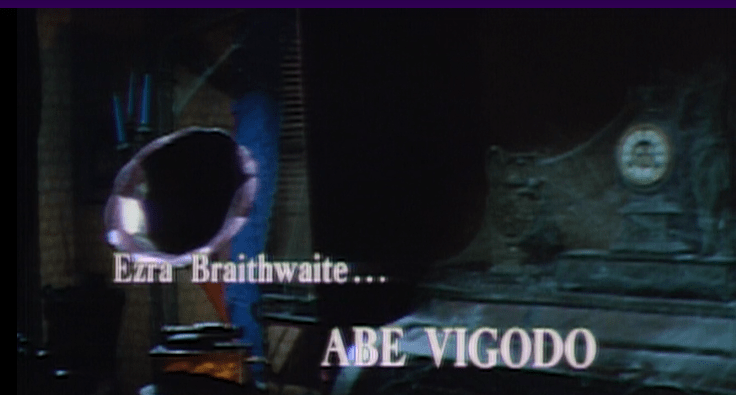
It’s a shame we won’t be seeing more of Abe Vigoda as Mr Braithwaite. At least they spelled his name correctly in the credits this time; yesterday he was “Abe Vigodo.”

*Two days past his 28th birthday, to be exact. Happy belated 84th to David Selby!

Episode 684: This is a funny house we live in

Dark Shadows has two ongoing storylines at this point. Mysterious drifter Chris Jennings came to town a couple of months ago and turned out to be a werewolf. Heiress Carolyn Collins Stoddard does not know of Chris’ curse. She has taken a fancy to him and set him up in the caretaker’s cottage on the estate of Collinwood. Old world gentleman Barnabas Collins and mad scientist Julia Hoffman do know that Chris is a werewolf, and they are working to help him. Barnabas has found a place to keep him confined on the nights of the full Moon, and Julia is trying to develop a medical intervention that will keep him in his human form.

Meanwhile, Chris’ nine year old sister Amy has taken up residence in the great house on the estate. She and her twelve year old friend, strange and troubled boy David Collins, are falling under the power of the evil spirit of the late Quentin Collins. At first Amy could communicate with Quentin more clearly than David could. This made David envious. In #640, David complained that Amy could hear his voice and he could not, even though “Quentin Collins is my ancestor.” That suggested to the audience that Quentin would turn out also to be Amy and Chris’ ancestor, joining the werewolf story with the Haunting of Collinwood.

Today, Barnabas and Chris have dug up a spot on the ground to which the ghost of a mysterious woman had led Chris. They find a tiny coffin holding the remains of an infant. They discover that the infant was wearing a medallion in the shape of a silver pentagram. The sight of the dead baby shocks Barnabas right away; Chris keeps his composure at first, but seems close to tears a moment later. Quentin stands in the shrubbery and watches Barnabas and Chris.

Barnabas has not seen Quentin and does not know who he is. Others have seen him and described him to Barnabas and Julia. They and those others suspect that he is a malevolent ghost with designs on David and Amy. No one has yet made a connection between Quentin and the werewolf story, however.

Julia and Barnabas have also seen the mysterious woman who led Chris to the baby’s grave. They know that she is a ghost and that she has helped Chris, and they also know that her clothing is of the same vintage as is the clothing which Quentin wears. But they do not know what, if anything, the two ghosts have to do with each other. The audience knows that the female ghost’s name is Beth and that she was with Quentin in the little room in the long deserted west wing of the great house when the children first met him.

Barnabas tells Chris that the pentagram can only be a device to ward off a werewolf, so that there must have been a werewolf in the area when the baby was buried. He also tells Chris that the mysterious woman would not have led him to dig up the grave unless what they found in the coffin would be of help to him.

While Barnabas inspects the pentagram in the drawing room of the great house, David throws darts at a board propped up on a chair nearby. The audience knows that David is under Quentin’s control, so it is obvious to us that the dart playing is an attempt to distract Barnabas and keep him from figuring out the meaning of the pentagram. Lacking our knowledge, Barnabas is merely annoyed with David. Jonathan Frid and David Henesy expertly develop the comedy in Barnabas’ fast-burn reaction to David’s behavior.

Heiress Carolyn Collins Stoddard interrupts the scene. She notices what Barnabas is doing. He shows her the pentagram, and she recognizes the jeweler’s mark as that of Braithwaite’s silver shop in the village of Collinsport. While Barnabas telephones Braithewaite’s and arranges to take the pentagram there to see if the proprietor can give him any information about it, Carolyn tells David she wants to have a conversation with him about some cryptic remarks he made earlier. David refuses, saying that he has homework to do. Carolyn argues with him briefly, but finally gives up and leaves. Barnabas is still involved in his conversation with Mr Braithwaite when David hides the pentagram behind his dartboard.

Barnabas gets off the phone, and David resumes throwing darts. Barnabas asks him why he isn’t doing the homework he was just telling Carolyn presented such an urgent obligation that he could not talk with her. He launches into a shaggy dog story, the upshot of which is that he has to wait for Amy.

More exasperated than ever, Barnabas turns to the desk and sees that the pentagram is gone. He demands David return it. David denies having it. He says that it may have vanished on its own. After all, unaccountable things happen at Collinwood all the time, as Barnabas is in a position to know. The way he says “You should know that” reminds longtime viewers that David has more than once shown signs of figuring out more about Barnabas’ own connections to the supernatural than have any of his adult relatives. In #316, he pointed out that none of the Collinses really knows anything about Barnabas- “He just showed up one night.” And in #660, he told Amy that “Barnabas knows a lot of things he doesn’t tell anybody.” At moments like these, we wonder just how much information David really has at his disposal. Perhaps he secretly knows everything, and has just decided there’s no point in notifying the authorities.

David invites Barnabas to search him. He lists the contents of his pockets, and turns the right front pocket inside out. He tells him that he has a pack of chewing gum, which he got from Amy. He specifies that he traded her a box of raisins for it. As David Henesy delivers the line and Jonathan Frid shows us Barnabas’ reaction, this detail is laugh-out-loud funny. Barnabas surrenders and apologizes to David, fretting about the pentagram’s absence.

Barnabas takes a sketch of the pentagram to Braithwaite’s. In the first months it was on the air, Dark Shadows took us to New York City twice, to Bangor, Maine several times, and to Phoenix, Arizona once. But now that both stories center on characters all of whom dwell in one or another of the houses at Collinwood, it is as rare to leave the estate and go into the neighboring village as it was then to go on those remote excursions.

Old Mr Braithwaite tells Barnabas that the shop has been in operation since 1781 and has been providing fine silver to the Collins family the whole time. Regular viewers know that Barnabas was alive then, and lived in Collinsport. A curse made him a vampire in the 1790s, and he was under its power until he was freed early in 1968. So he must have been quite familiar with Braithwaite’s in its early years. What is more, in #459 we saw that in the first months of Barnabas’ career as a vampire his father Joshua learned of his curse and commissioned a local craftsman to make silver bullets with which he could put Barnabas out of his misery. That craftsman must have been one of the first Mr Braithwaites.

The incumbent Mr Braithwaite tells Barnabas he will consult his records as soon as the shop closes and telephone him if he finds anything. When the call comes, David answers. Mr Braithwaite tells David that he can’t imagine why he forgot about the pentagram since it was one of the very first he made himself, back in 1897. Quentin appears, takes the phone from David, and hears Mr Braithwaite say he will stop by Collinwood with the ledger shortly.

Mr Braithwaite almost remembers.

David protests that Quentin had no right to take the phone from him. Quentin turns to him, gives him a menacing look, and walks toward him. David backs away and and takes a place on the stairs, still objecting loudly to what Quentin did.

Closing Miscellany

The closing credits list the actor who plays Ezra Braithwaite as “Abe Vigodo.” Perhaps in some parallel time-band there was a man of that name who played Tossio in The Good Father and Detective Fosh in Barney Moeller, but this is in fact Abe Vigoda.

“Abe Vigodo”

In his 1977-1978 ABC TV series Fish, Vigoda’s character was married to a woman played by Florence Stanley. Stanley was also a Dark Shadows alum, as a voice actress. She provided sobbing sounds heard in #4, #98, #515, #516, and #666. Vigoda once appeared on the panel at a Dark Shadows convention; his main statement was “I don’t remember much about it.” I can’t find evidence that Stanley ever appeared in such a setting. I would love to imagine that Vigoda and Stanley compared notes about their experiences on Dark Shadows between setups on Fish, but I would be astonished to learn that ever happened.

Vigoda always played old men. The second screen credit on his IMDb page is a 1949 episode of Studio One in which he took the role of “Old Train Passenger.” At that time, he was 28. Vigoda was a marathon runner, a form of exercise that tends to burn out all the fat under the skin of the face. And of course he was a very strong actor, easily able to convince us that he is of a great age. So even though Vigoda was only three years older than Jonathan Frid, and about 175 years younger than Barnabas, it isn’t quite as funny as it might be to hear him call Barnabas one of “you young people.”

Danny Horn devotes his post about this episode on his great Dark Shadows Every Day to three points. The first is his exultation that his least favorite writer, Ron Sproat, was credited with his final script yesterday, so that today is the first day of the Sproatless Dark Shadows. The second is that the show is finally joining the werewolf story with the Haunting of Collinwood. The third is a point I have some reservations about. He says that this is the first episode where Quentin “has a feeling,” and therefore declares it to be Quentin’s debut as a real character. “It’s nice to meet you Quentin. Welcome to the show,” he concludes.

It’s true that Quentin shows a wider range of feelings today than he had previously, but I think it is an exaggeration to say that we are only now seeing his feelings. For example, when in #680 Quentin agrees to Amy’s demand that he stop trying to kill Chris, he looks very much like a man humiliated to find that he has to capitulate to a nine year old girl. In the same episode he showed amusement and anger at appropriate points. Those three responses may not sound like much, but David Selby’s face is a magnificent instrument, one he plays it expertly. For him, they are more than enough to make Quentin into a real person.

Chris and Carolyn have a brief scene in the drawing room as they are getting ready to go on a date. Chris defuses a potentially awkward conversation about his previous failures to respond to Carolyn’s hints that she was interested in him by saying “Oh, I didn’t notice that” in the W. C. Fields imitation he had used with Amy in #677. She chuckles delightedly. This is not implausible. Not only can we imagine her being relieved that the topic didn’t ruin their evening, but W. C. Fields was very much in vogue in the late 1960s, so much so that a fashionable young woman might have chuckled when a man briefly imitated him.

David and Carolyn have an exchange that longtime viewers will find less plausible. He asks her if she has ever seen a ghost; she responds by asking if he has. But each of them knows perfectly well that the other has seen ghosts. David spent the first year of the show on intimate terms with the ghost of the gracious Josette, and he and Carolyn both saw and had substantive conversations with the ghost of Barnabas’ little sister Sarah. In #344, Carolyn told David that when she was a little girl her best friend was the ghost of a boy named Randy. It’s just trashing character development to retcon all that away.

Barnabas says something that will catch the ears of properly obsessed fans. When he is in the shop, he tells Mr Braithwaite that he will gladly drive back from Collinwood whenever he has any information for him. There have been some suggestions lately that Barnabas has learned to drive and has come into possession of a car, but this is the first definite confirmation of that point.

Episode 678: This time, I saved him

At the estate of Collinwood, two ghosts are at odds over the fate of a werewolf. Caught in the crossfire are a mad scientist, a recovering vampire, and a couple of kids.

The ghosts are the evil Quentin Collins and a weepy woman so far known only as Beth. The werewolf is Chris Jennings, who is staying in the caretaker’s cottage on the estate. The mad scientist is Julia Hoffman, MD, a permanent guest in the great house. The recovering vampire is Julia’s inseparable friend Barnabas Collins, master of the Old House. The kids are Chris’ nine year old sister Amy and strange and troubled boy David Collins, who live in the great house.

Yesterday, Quentin went to the cottage and put strychnine in Chris’ whiskey. Beth appeared to Julia and led her and Barnabas to the cottage in time to save Chris; today, they figure out that Beth is a ghost.

Quentin has been exercising power over David and Amy, at first with Beth’s cooperation. Beth appears to Amy in a dream visitation. While she guides Amy to images of Chris and David and to the realizations that Quentin means to kill Chris and that David has tried vainly to stop him, we hear Beth speak for the first time. She says everything twice, giving her dialogue a lyrical quality that could be quite lovely. Unfortunately, Terrayne Crawford’s limitations as an actress keep that loveliness from coming through.

Barnabas and Julia know that Chris is a werewolf and have persuaded him to accept their help. They question Chris and are satisfied that he did not poison himself. When he mentions that David visited him the previous morning, Barnabas decides to go interrogate David. Longtime viewers know that David has extensive experience with ghosts, a fact of which Barnabas has at times been most uncomfortably aware. Once Barnabas has learned that Beth is a ghost, it will strike us as reasonable that he will be interested in David’s connection with the matter.

Amy goes to the cottage and sees Julia tending to Chris. They tell her he just had an upset stomach and will be fine. She does not believe them, and says she had a dream that convinced her Chris was in mortal danger. This intrigues Julia, who presses for more details about the dream. Amy clams up, but now Julia and Barnabas, the show’s two chief protagonists, have figured out that David and Amy have something to do with ghosts, and that those ghosts in turn have to do with Chris. The Haunting of Collinwood story hasn’t made any real progress for several weeks, but that can now change.

Back in the great house, Barnabas questions David about his visit to Chris. He doesn’t get any more information out of him than Julia had got out of Amy. There is a bit of intentional humor when Barnabas tells David he thought it would be pleasant to share breakfast with him and Amy. David says it isn’t so pleasant at breakfast- housekeeper Mrs Johnson is in a bad mood in the mornings. Barnabas suggests they ignore her, and David replies that it is not easy to do that. David Henesy delivers this line with perfect comic timing.

Barnabas realizes David knows more than he is telling. Screenshot by Dark Shadows Before I Die.

Amy shows up and responds favorably to Barnabas’ self-invitation to their breakfast. After Barnabas leaves the room, Amy confronts David about Quentin’s attempt to kill Chris. David has despaired of opposing Quentin, and is terrified when Amy tells him she will go tell matriarch Elizabeth Collins Stoddard everything that has been going on. He is convinced Quentin will kill them if she does this. He is pleading with her to come back when the episode ends.

Episode 674: When there is a moon

Heiress Carolyn Collins Stoddard is attracted to mysterious drifter Chris Jennings, so much so that she has set Chris up in the caretaker’s cottage on the estate of Collinwood. Today, Carolyn’s friend Donna Friedlander is visiting her. The day’s main action is a classic farce plot. Donna wants Chris to drive her home to Bangor, Maine, but in order to keep a secret from her he makes a series of increasingly frantic attempts to avoid doing so. In the end Donna doesn’t get her ride, and Chris doesn’t keep his secret.

The episode deviates from the typical farce in that Chris is not a man trying to keep his or his roommate’s girlfriends from finding out about each other. He is a werewolf, and the Moon is full. If Donna is with him after dark, he will kill her, as he has already killed an unknown number of people in the last several years.

Donna is a student of interior design, and Carolyn is showing her around the great house. We first see her when Carolyn brings her into the study. Chris is in the room with his sister, nine year old Amy, who has been staying at the great house. Chris is distracted, abrupt, and rude with Donna. His manner grows even less inviting when he sees an inverted red pentagram on Carolyn’s face, typically the sign that the person will be the werewolf’s next victim. His eyes bug out, he breaks into a sweat, and turns his back on the ladies, stalking off to stare out the window.

Donna and Carolyn leave the room. In the hallway outside the study, Donna exclaims “Wow!” and exhales as if she were very worked up. She tells Carolyn that Chris is her type. She summarizes that type as “moody”; a more fitting description of what Donna saw of Chris’ behavior would be “not interested,” but hey, I’m not the sex police. If Donna gets excited by foul-tempered guys who ignore her and want her to go away, that’s none of my business.

Donna expresses her interest in Chris.

The little space in which Donna tells Carolyn she is attracted to Chris is a new set. We’ve been seeing a lot more of these tiny nondescript corners representing hallways lately, and Donna’s identification with interior design makes us conscious of this one. In #664, they even had actors walk from one set to another through some undecorated studio space that they tried to persuade us was a corridor. It seems they are developing a strategy to make us feel that the great house is a bigger place than they have managed to create in our minds just by cutting from one room to another.

Complicating matters for Chris are old world gentleman Barnabas Collins and mad scientist Julia Hoffman. Barnabas has figured out that Chris is the werewolf, and today explains this to Julia.

Barnabas uses the word “werewolf” as he is bringing Julia up to date. This represents a departure from the show’s previous practice. Barnabas was himself a vampire when he first came on the show in #211, but they didn’t use the word “vampire” for 40 weeks, until #410. They aren’t afraid of vocabulary anymore.

Julia doubts Barnabas’ interpretation of the facts, and he decides to demonstrate his thesis by putting Chris in an awkward position. He invites Chris, Carolyn, and Donna to join him and Julia for dinner at his home, the Old House on the estate. Chris excuses himself by claiming to have a business meeting in Bangor for which he must leave at once. At this, Donna asks for a ride to that town. Barnabas watches Chris’ discomfort with a smug grin, confident that he is being proven right.

Outside the front door of the great house, Chris tries to wriggle out of giving Donna a ride by saying that now he is getting a migraine and will have to cancel his meeting. He offers to give Donna his keys, suggesting she hide them under the front seat when she parks his car at the bus station in Bangor. She initially accepts this, but later comes to the cottage to say she has decided against it. She is there when he transforms, and runs away.

Back in the great house, Barnabas is telling Julia that werewolves are vulnerable to silver weapons, so he will be able to use the head of his cane to control Chris. Julia wonders if Chris may already have left with Donna. Barnabas airily dismisses this, assuring her that he knows Chris well enough to be sure that Donna is perfectly safe. In fact, Barnabas barely knows Chris at all, but he is so pleased with himself for having figured out who the werewolf is that we can see there wouldn’t be much point in reminding him of this. At his leisure, Barnabas sets out for the cottage, which he finds to be unoccupied and in disarray. Donna’s mauled corpse lies in the woods nearby.

We might wonder why Chris saw the pentagram on Carolyn and not on Donna during the scene in the study. Is the show telling us the pentagram is out of order as a warning system? If so, is it just breaking down from overuse, or is some other supernatural presence interfering with it? Or maybe it isn’t automatic, but is a message from some spirit that has guessed wrong this time? They don’t explain, and the pentagram has been a big enough part of the werewolf story up to this point that it produces a lot more confusion than you might expect.

Yesterday’s episode ended with a bewildered Chris finding Amy in the cottage. Amy was listening to a mysterious voice Chris could not hear. Chris’ bewilderment deepened when Amy obeyed the voice’s command to hurry away. He finally discovered that Amy lit a fire in his hearth and burned a shirt of his in it. Chris took us to the final blackout holding the scorched remains of his shirt, giving a look in the direction Amy had fled, and exclaiming “My shirt!” in a pained voice that would make anyone laugh.

Today’s episode opens with a reprise of that interaction, but it is played very differently. Instead of a light scene that ends with a note of comedy, we have a heavier confrontation that builds to a melodramatic shock. Chris is alarmed, not bewildered, to find Amy in his cottage, and his alarm mounts when she responds to the mysterious voice. When he goes to the hearth, he is forceful, apparently angry. He still exclaims “My shirt!” even though the wardrobe department did not provide a shirt, but his voice is not the high-pitched, defeated squawk that had made the end of yesterday’s installment so funny. This is a full-throated baritone shout. The more serious tone of the scene sets us up for an outing that is technically a comedy and is at several turns quite funny, but that finally concerns itself with a matter of life and death.

Donna is played by Beverly Hayes, in her only appearance on Dark Shadows. Miss Hayes’ IMDb page tells us that for a few months in 1965 she was a regular on a soap called A Flame in the Wind, that in 1968 and 1969 she had a recurring part on The Secret Storm, and that after her one shot on Dark Shadows she was absent from the screen for 41 years, returning in a 2010 production called Marathon. Since then she has been in other little-known independent films, including something from 2015 called House of Shadows, which sounds suspiciously like an imitation of Dark Shadows. She also has some writing credits. Donna is perfect as a one-shot, but Miss Hayes does such a good job with her I wish they’d cast her in other roles later on.

Episode 673: Urgent business

This episode rests squarely on the shoulders of eleven year old Denise Nickerson, playing the role of nine year old Amy Jennings. A performer of any age could take pride in the results.

We first see Amy in the predawn hours of a night when a werewolf is prowling the grounds of the great estate of Collinwood. The werewolf has attacked heiress Carolyn Collins Stoddard; old world gentleman Barnabas Collins is out hunting him. In the opening sequence, Barnabas fired a shotgun at the werewolf without result, then hit him with his silver-headed cane and drove him off. Barnabas is still outside, still tracking the werewolf. Barnabas’ friend, mad scientist Julia Hoffman, is nervously pacing in the drawing room of the great house.

Amy comes downstairs. Julia sees her and demands to know why she is up and dressed at such an hour. Amy says she must go to the caretaker’s cottage on the estate, where her grownup brother Chris lives. Julia forbids her to go out. Julia saw the werewolf attack Carolyn, but says nothing about the incident. She tells Amy only that it is dangerous in the woods at night. Amy says that she had a dream from which she drew the conclusion that “Something is happening to [Chris,] and it’s happening now!” Neither Amy nor Julia knows that Chris is the werewolf, but they both know that Amy has a paranormal sensitivity to whatever is going on with Chris. Julia offers to go to the cottage if Amy will stay in the house. Amy gladly agrees, and Julia gets a gun and goes.

This quarrel could have been quite annoying. Julia is withholding vital information from Amy, who is in her turn insistent on doing something she could not possibly expect to be permitted. The actresses make it interesting. Amy stands very still, locks her eyes on Julia’s, and enunciates each word carefully, showing every sign of an earnest attempt to persuade her. When she cannot, she does not display anger or frustration or irritation. The only emotion she projects is a sense of urgency. Unlike children throwing tantrums, who make conflicting demands because they are in the grip of conflicting feelings, Nickerson leads us to believe that Amy is pursuing a single coherent objective. We expect her to be part of action that will advance the story.

Grayson Hall emphasizes Julia’s attentive response to Amy’s words and her reluctance to physically restrain her. It is still inexplicable that Julia fails to tell Amy about the attack on Carolyn and about the fact that Barnabas is walking around with a gun ready to shoot at figures moving in the darkness, but those failures don’t bother us as much as we might expect them to do. We see her taking seriously information which we know to be accurate, and this gives us grounds to hope that she will do something intelligent.

Julia gets to Chris’ cottage and back without being eaten by the werewolf or shot by Barnabas. At the cottage, she finds that the furniture has all been overturned and Chris is not in. Back home, she smiles and tells Amy that she saw Chris and he was fine. Julia’s lies convince Amy. She brightens immediately and happily goes back to bed. This really is an amazing moment of acting on Nickerson’s part; Amy’s mood switches in a second from dread and gloom to a big glowing smile. Executing that lift on command is the equivalent of faking a loud laugh and having the result sound natural.

The next morning, Amy mentions to Julia that she and Carolyn have plans to go into town. That leaves Julia no choice but to level with Amy about the werewolf attack. Amy is shocked that Carolyn was hurt, and even more shocked that she might have been killed. Julia assures her that the wounds Carolyn did suffer were minor and that she will be all right after some rest, but Amy is deeply affected. She looks directly into the camera and tells the audience that she did not want Carolyn to be harmed.

Amy tells us she is sorry that Carolyn was hurt. Screenshot by Dark Shadows Before I Die.

In the first months of Dark Shadows, strange and troubled boy David Collins was the only character who looked directly into the camera. He did it several times in those days, and actor David Henesy’s talent for the role of Creepy Little Kid always made it pay dividends. He stopped looking into the camera in the autumn of 1966 when David Collins stopped being a menace, and various other actors have been called on to break the fourth wall from time to time since. Since Amy joined the show, eye contact with the audience has become her province, and Nickerson manages to deliver a jolt every time they have her do it.

First-time viewers won’t know why Amy is so eager for us to know that she did not wish Carolyn ill, but the way she addresses herself to us leaves no doubt that Julia is missing the point when she makes conventional remarks about how no one wanted anything bad to happen to Carolyn, no one could have prevented it, etc etc. The camera stays on Amy as Julia burbles through these lines, and the particular sadness on her face confirms what she indicated by looking at us, that she knows more about the incident that Julia imagines.

Returning viewers know that Amy and David are falling under the power of the evil spirit of the late Quentin Collins, and that Quentin ordered them to send Carolyn out the night before so that she would no longer obstruct his plans. We also know that Quentin, who had for many weeks been confined to the little room in the long-deserted west wing of Collinwood where David and Amy first saw him several weeks ago, was the other day able to manifest himself in Chris’ cottage. He is gaining strength, and Amy and Chris’ presence on the estate is part of the reason.

Amy talks Julia into letting her go outside. Again, this could be an annoying scene. As Julia points out, the animal that attacked Carolyn has not been captured, and Barnabas has not returned. Further, regular viewers know that Amy’s promise to stay within sight of the front door is worthless, since she and David have often broken similar promises. But Julia knows that Amy has an extraordinary awareness of the situation, and she knows also that in #639 the werewolf ran away when he saw Amy. So all Grayson Hall has to do is look at Amy with a searching gaze and talk to her in a hushed voice, and we get the idea that she has come to the conclusion that the child will be able to take care of herself.

Amy wanders deep into the woods, and comes to a spot where we earlier saw the werewolf transform back into Chris. When that happened, the camera caught the hem of a white dress and panned up to show the face of the woman wearing it. At first it was a puzzle who that might be. Wicked witch Angelique often wore white dresses, but she is not connected to the ongoing stories, and the last time we saw her she was killed in a way that suggests she won’t come back to life at least until this thirteen week cycle is over. The ghost of the gracious Josette was known in the first year of the show as “the woman in white,” but we saw her quite recently, and she doesn’t have anything to do with Chris and Amy.

The figure turned out to be the ghost of someone named Beth. We have seen her only once before, in #646. She was with Quentin, and like him could exist only in a little room in the long-deserted west wing of the great house. But now she, too, is able to roam about the estate. When Amy comes to the spot where Chris transformed, Beth appears to her. She begins crying. Amy sounds like any other sweet little girl when she urges Beth not to cry, and then suddenly becomes quite a different person. Her face goes blank, and she declares in a flat voice that she knows what she must do. This isn’t such a tricky transition as the one Nickerson achieved when Amy cheered up in response to Julia’s lie, but it certainly is effective.

Amy goes to Chris’ cottage. He is out. She finds his bloodstained shirt, puts it in the fireplace, and sets it alight. Chris comes in and sees her. She embraces him, and tells him she must be going. He asks why, and she seems genuinely surprised by the question. “Can’t you hear her?” Chris says he can’t, Amy says she can, and she hurries away.

Chris looks at the fireplace. One sleeve of his shirt is hanging out, a fire hazard; he puts it into the center of the hearth. He examines it, and with dismay exclaims “My shirt!” Don Briscoe delivers that line with the timing and inflection of Jack Benny, and it is hilarious. Mrs Acilius and I laughed long and loud at it; we are convinced that the humor must have been intentional, at least on the part of actor Don Briscoe, probably on that of director Lela Swift, and possibly on that of writer Ron Sproat as well. The episode belongs to Nickerson, but that final line leaves us with a strong memory and a deep fondness for Briscoe as well.