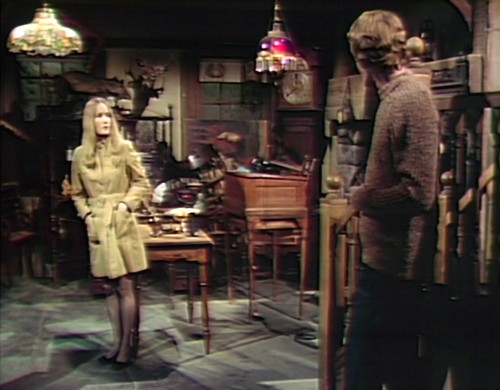
Heiress Carolyn Collins Stoddard has had a dream in which her new husband, whom she knows as Jeb Hawkes but who when we first saw him asked to be called Jabe, was in a fight on top of Widows’ Hill. His opponent, a stooge named Sky Rumson, threw him off the precipice to his death. When she awoke, Carolyn ran to the hill in search of Jabe. Instead, she found Sky. He told her that her dream was not complete, because it did not show her death. He then grabbed her by the throat.
Jabe rushes up and knocks Carolyn out of Sky’s grip. He and Sky fight, and Sky does throw him off the precipice. Carolyn escapes.
Back home at the great house of Collinwood, Carolyn finds her mother, matriarch Elizabeth Collins Stoddard, and permanent houseguest Julia Hoffman, MD. It takes her a while to compose herself sufficiently to tell Liz and Julia what happened. Julia offers Carolyn a sedative, which prompts her to jump up and shout a verbal refusal. By the time Carolyn starts telling the story, her distant cousin, old world gentleman Barnabas Collins, has joined them in the drawing room. She interrupts herself to yell at Barnabas that he always hated Jabe and is probably glad he’s dead. When Carolyn finishes, Barnabas slips out. Liz calls the police, and Julia is surprised neither of them saw Barnabas leave.
For the last nineteen weeks, the show has been trying to make a story out of some themes drawn from the writings of H. P. Lovecraft. That segment is usually called “the Leviathans,” after a race of Elder Gods who are behind the action. Jabe was central to the Leviathan segment. Sky is the only other character remaining from it. Barnabas appears in the house where Sky has been crashing and finds him packing his bag. Sky does not understand how Barnabas got in. Barnabas dismisses his question, merely saying that Sky knows there are things he can do that ordinary people cannot. Sky draws a revolver and fires two rounds at Barnabas point blank, without effect. Sky exclaims “Oh, no!” Barnabas is amused that none of Sky’s late colleagues told him that he is a vampire. He takes Sky’s hand, curls his arm back so that the gun is pointing at his heart, and squeezes Sky’s finger onto the trigger.
Back at the great house, Liz gets a telephone call from the sheriff. The police haven’t found Jabe’s body, and have surmised that it washed out to sea. They have found Sky, and have tentatively ruled his death a suicide. Later, Carolyn has another dream. In this one, Jabe shows up and confirms his death. That marks the end of the Leviathan segment. Carolyn will go on using the name “Mrs Hawkes” and saying she misses Jabe, but otherwise the last nineteen weeks will be forgotten.
Before killing Sky, Barnabas had mentioned that he almost regrets not leaving him to the other person who is on her way to do him in. That is Sky’s estranged wife, wicked witch Angelique. Had the Leviathan segment been more successful, or had Geoffrey Scott been even marginally competent in his performance as Sky, they might have made something of the parallels between Sky and Jabe. They are both very tall men with blonde wives who are dissatisfied with them. Angelique is dissatisfied that Sky is a tool of the Leviathans and that he tried to set fire to her on the orders of their representative, and Carolyn is dissatisfied with Jabe because he keeps running away from dangers he has brought on himself by his rebellion against the Leviathans and he won’t tell her anything about himself. Sky is a mortal man, while Angelique may once have been human but has long since become a creature of the supernatural. Carolyn is a mortal woman, while Jabe is now human but was originally a shape-shifting monster from beyond space and time.
But the ratings have been sinking throughout the Leviathan period, and the whole narrative structure of the arc keeps collapsing around them every time they try to do anything with it. So they are in too much of a hurry to move on to the next thing to do any exploring of the characters. Also, Scott is hopeless. As my wife, Mrs Acilius, put it, it isn’t that he is an actor with just one strategy. He keeps trying different things, and none of them comes close to working. We won’t see him again.
The new story has to do with an alternate universe that is occasionally visible in a room in the long disused east wing of Collinwood. Barnabas, Julia, and others have been spying on its inhabitants, and Barnabas is fixated on the idea that if he can cross over into it his vampirism will disappear. Since his bloodlust is overwhelming him, he is desperate to pursue this forlorn hope. He goes to the room when the alternate universe cannot be seen there, and a moment later finds that it has changed with him in it. Julia is in the hallway, looking in. At first she and Barnabas can see each other, and she can hear him, though he cannot hear her. After a moment, Carolyn’s alternate universe counterpart enters and demands to know who Barnabas is and what he is doing in the house.
Barnabas took Carolyn as his blood-thrall in October 1967. The show went back in time to 1795 the following month. In the 1790s segment, Nancy Barrett played fluttery heiress Millicent Collins. We saw that Barnabas first became a vampire in 1796; not long after, he took Millicent as his blood thrall. Shortly after the show returned to contemporary dress in March 1968, one of Julia’s colleagues in the mad science profession applied a treatment that put Barnabas’ vampirism into remission. That freed Carolyn of her connection to him, and at some point she forgot it ever happened.
For most of 1969, Dark Shadows was set in 1897. In that segment, Miss Barrett played repressed schoolmarm Charity Trask. Barnabas bit her, too. Carolyn’s counterpart in “Parallel Time,” known by her married name Carolyn Loomis, is the fourth character* Miss Barrett played on Dark Shadows; considering that Barnabas is so frantically hungry, it looks like she will follow in the footsteps of her predecessors and serve as his breakfast.
*Or fifth- in #819, sorcerer Count Petofi found Charity’s personality to be an irritant, so he erased it and replaced it with that of the late Pansy Faye, a Cockney showgirl/ mentalist. From that time on, Miss Barrett played Pansy, not Charity.
Suave warlock Nicholas Blair first joined the cast of characters in June 1968, posing as the brother of Cassandra, wife of Roger Collins. Since Cassandra was an alias that 200 year old wicked witch Angelique was using, we knew right away this could not be so. Nicholas asserted himself as Angelique’s boss, faced down the ghost of the fanatical Reverend Trask, and kept saying that he had a plan that was far more important than Angelique’s petty little scheme to establish herself in the great house of Collinwood and turn Roger’s distant cousin Barnabas Collins back into a vampire. As played by Humbert Allen Astredo, Nicholas kept us believing for weeks that we would be in awe once we heard his plan.
Eventually, Nicholas stumbled upon the fact that Barnabas’ best friend, mad scientist Julia Hoffman, had constructed a Frankenstein’s monster in the course of a project to keep his vampirism in remission. From that point on, Nicholas declared that his plan was to force Julia to make a female Frankenstein’s monster, to mate the already existing monster to her, and thereby to breed a new race of people loyal only to his master, Satan. He’d been on the show so long at that point that his sudden parachuting into the Frankenstein story only revealed that up to that point, all his talk about his grand design had been empty boasting.
Moreover, Nicholas’ plan for the patchwork people did not make sense in the context of the show. In a novel or movie like Rosemary’s Baby, the audience sees the heroine raped with the acquiescence of her husband, and our horror at that crime gives force to the premise that she will bear Satan’s only begotten son, who, in an inversion of the Christian story, will transform the whole world by the very fact of his birth. Stealing fresh corpses, chopping them up, and stitching them together isn’t the same horror as rape, but it is a pretty disgusting way to spend an evening, so I suppose that will get you off to some kind of start. But if your show is on the air for half an hour a day across the board Monday through Friday, your audience has time to sit with Nicholas’ scheme and think through all of the practicalities it implies. The new race is going to take many years to grow and multiply and overtake H. Sap., even if its members all have Soap Opera Rapid Aging Syndrome. What are we all supposed to do in the interim, watch the Frankenbabies through nanny cams? It isn’t an idea for series television.
Nicholas not only saddled himself with a plan that obviously wasn’t going to work, he didn’t deliver on his claim to be a surpassingly talented sorcerer. In #528, Angelique asked him to slip a potion to one of her adversaries. He complained that “I am much too talented to spend my time drugging drinks,” but he complied with the request. Not only did that turn out to be a waste of time, later he would on his own initiative drug a couple of other people’s drinks, again without the results he wanted.
Eventually, Nicholas fell in love with Maggie Evans, The Nicest Girl in Town. That amused Angelique, who taunted him with all the times when he had sneered at her for the humanity she showed in her emotional attachment to Barnabas. As Nicholas grew fonder of Maggie, his powers became less reliable, and his involvement with the main plot became more tenuous. No longer able to make Angelique obey him, Nicholas was reduced to using unsightly ex-convict Harry Johnson as his henchman. By the time the Frankenstein project collapsed and Satan called Nicholas back to Hell, not even Astredo’s considerable acting talent could make us take him seriously.
Nicholas returned in February 1970, just over five weeks ago. At that point the show was mainly concerned with an attempt the writers were making to take some material from the tales of H. P. Lovecraft and make a story out of them. The Leviathan People are Elder Gods who want to reconquer the Earth and destroy humankind. Their harbinger was a shape-shifting monster who had taken the form of a tall young man and invited people to call him Jabe. Jabe was supposed to join with Roger’s niece Carolyn to produce a new race of people.
The Lovecraft material never came together, and by the middle of February the makers of the show were scrambling to find a new direction. Nicholas appears to have been a last-minute replacement for a different sort of villain who was supposed to take over as the chief menace in the second half of the segment. Now they have thrown out that second half and are trying to get to something else before the ratings drop any further. So they brought back an already established character and plugged him into the scenes originally meant to be played by the one they never got around to introducing.
Bringing Nicholas in to the Leviathan arc makes it hard for longtime viewers to ignore the similarities between the Leviathans’ plan to breed a new race and his 1968 plan for the patchwork people, including the shared weakness that if either plan were successful, it wouldn’t leave you anything to put on a daytime soap. Also, Nicholas explicitly acknowledges that he has already failed in one such project, lampshading the problem but not alleviating it. He also keeps bringing up his “Master,” who is clearly still Satan. No other character in the Leviathan arc makes reference to any themes derived from Christianity- everyone else is living in the determinedly non-Christian world of Lovecraft’s imagination. So he seems out of place from the beginning.
The Leviathans’ plan was already nearing collapse when Nicholas showed up. Every time Jabe has used his powers, the results have backfired on him. His personality has alienated all of his allies. And now he doesn’t even want to be a shape-shifting monster anymore- he fell in love with Carolyn, and just wanted to take her on dates and then marry her. Nicholas is supposed to be the trouble-shooter who will turn this troubled operation around, but nothing about him inspires confidence that he is the right person for that job.
Since Nicholas arrived, things have gone downhill for the Leviathan cause even faster than they had been before. In #966, Nicholas watched in horror as Jabe smashed the box from which he originally emanated, causing all of the Leviathans’ other visible belongings to vanish. Nicholas then declared that everything was over, and that the time of the Leviathans was no more. But they still didn’t have another story ready to go, so he and Jabe have continued to hang around. Nicholas still has one follower, Angelique’s estranged husband Sky Rumson, but since there is no reason for Sky to be on the show either, that isn’t much of a basis for Nicholas’ continued presence. On his great blog Dark Shadows Every Day, Danny Horn called Nicholas a “failure demon”; all in all, that would seem an apt classification.
Today, Jabe turns up at Nicholas’ place. Nicholas knows that Angelique cursed Jabe to be plagued by a mysterious shadow not his own that follows him and drives him mad. This much is borrowed from George MacDonald’s 1858 novel Phantastes, but unlike the Reverend MacDonald’s allegory of sin and anxiety this shadow is a physical weapon that will kill Jabe when it grows strong enough. Jabe asked Nicholas to use his powers to lift Angelique’s spell the other day, but Nicholas refused, even though he claimed that he could and he acknowledged that it would have been to his advantage to do so. The opening voiceover today reminds us that Nicholas knows all about the shadow.
Now, Jabe is telling Nicholas that he was wrong to turn against him, wrong to smash the box, wrong to give up his destiny of leading the Leviathans to global dominion. Nicholas dwells on his exhaustive knowledge of the shadow and tells Jabe he can take the shadow from him and set it on Angelique. He begins to hypnotize Jabe. When he seems to have Jabe in a trance, he tells him he does not give second chances, and that he is going to kill him and Carolyn. Jabe suddenly produces the paper cutout Angelique used to place the shadow curse on him and places it on Nicholas’ jacket. He then runs out of the room. The shadow appears and envelopes Nicholas, who collapses. Even though he knew in advance exactly what was going on, Nicholas still could not avoid death as the result of getting slapped on the chest with a piece of construction paper. He dies as he lived, a failure demon to the end.
Sky enters. Jabe returns, and Sky tells him Nicholas is dead. Sky whines that because Nicholas was not human, his death will not be the end of him and Jabe will not get away with killing him. Geoffrey Scott’s appallingly bad acting reinforces the image of Nicholas as a colossal loser- if this was the only ally he had left at the end, he must have been an even more hopeless stumblebum than we had thought. Jabe exits. A moment later, Nicholas’ ghost appears to Sky and tells him to kill Jabe.
Jabe goes back to the great house of Collinwood to tell Carolyn that he is rid of the shadow. They are married now, but have spent very little time together because the shadow has kept chasing Jabe off. She is puzzled by the whole thing, in part because Jabe refuses to tell her anything about his situation, and is unenthusiastic about Jabe’s renewed insistence that they go away immediately. She agrees to leave with him in the morning.
Carolyn goes upstairs. In the drawing room, Jabe hears Nicholas’ voice telling him that he will never escape. Roger’s son, strange and troubled boy David Collins, enters; Jabe tells him that he and Carolyn are going on a trip tonight.
Jabe sent Carolyn upstairs with orders to pack and tell her mother they were leaving, but it would seem she has not complied. She is snoozing in a chair in her room. She has a dream. It begins with Nicholas’ voice rasping at her that it will all end at Widows’ Hill. She then sees Jabe and Sky, lit in groovy psychedelic colors, arguing about Nicholas and fighting near the precipice. Sky throws Jabe over the edge.
Carolyn awakens, calls for Jabe, and rushes out. On her way she tells David that she is going to Widows’ Hill. A moment later Jabe comes along, and David relays this information to him.
Carolyn gets to the top of Widows’ Hill, where Sky is waiting for her. He tells her that the dream Nicholas sent her stopped short of its end, because he did not want her to see her own death. He grabs her by the throat.
Meanwhile, in another universe…
While Jabe, Nicholas, and Carolyn are cleaning up the messes the Leviathan segment left behind, Roger is busy getting the new storyline off the ground. There is a room in the long disused east wing of the great house in which an alternate universe is occasionally visible. Roger goes there, and sees the counterparts of Carolyn and David. They are talking about the boy’s parents, whom Roger ascertains to be, not himself and undead blonde fire witch Laura Murdoch, but the counterparts of his distant cousin Quentin Collins and of Angelique. Everyone else we have seen in “Parallel Time” has the same first name as their counterpart in the main continuity, but David’s is named “Daniel.”
Roger never found out who Cassandra really was, so it is a puzzle for longtime viewers how he knows Angelique’s name. Carolyn and her mother met her under that name at the house she and Sky shared, but somehow did not recognize her as Cassandra. She visited them at Collinwood after her marriage to Sky broke up, but did not see Roger there.
Arrivals and Departures
This is the first time we see this Daniel Collins, but not the first time we are exposed to his name. The closing credits for #958 billed David Henesy not as David Collins, the role he played that day, but as Daniel Collins. I don’t know whether they had already decided that would be his name in Parallel Time and the person making up the credit roll got confused about it, or if the writers thought the goof was funny and gave the character the name as an inside joke.
Also, Mr Henesy played a character named Daniel Collins in February and March 1968, when the show was set in the year 1796. Since they have established that the two universes diverged during that Daniel’s lifetime, he may be this Daniel’s namesake. There is another connection, an accidental one I’m sure but an accident with a bit of an eldritch quality to it. In #350, three weeks before the 1790s segment began and more than sixteen weeks before Daniel made his first appearance, a slip of Nancy Barrett’s tongue left Carolyn referring to David as “Daniel.” It’s odd that the two Daniels were both heralded by these small inadvertences.
This episode marks, not only the final appearance of Nicholas, but also that of Roger. Louis Edmonds will play Roger’s counterpart in the Parallel Time segment, and as these episodes are being taped he is playing still another iteration of Roger on the feature film House of Dark Shadows. He will also be back in another role later on. But all the character development Roger has gone through since we first saw him in episode 1 is at an end.
Monday’s episode gave Roger his real sendoff, and my post about it summed up his history. I will just mention here that when I first saw Dark Shadows, Roger was something of a puzzle to me. That was the 1990s, when I saw it on what was then The SciFi Channel. The first episode I saw was #193, featuring art dealer Portia Fitzsimmons, but I didn’t have a chance to watch it at all regularly until a month or so after that, when Barnabas had already joined the cast. By that point Roger was already very much confined to the margins.
Curious as to when the dazzling Mrs Fitzsimmons would return, I looked online and found what is now the Dark Shadows wiki. I was disappointed to find that she was a one-off character. I also found that her function was to bring to a head a major story centering on Roger. I then looked through the episode summaries of the first weeks of the show. Those were quite terse and indigestible, meant to remind people who had seen the episodes of points they had forgotten. But one thing I did gather from them was that Roger had been a major character when the show started, indeed its chief villain. I couldn’t imagine the sardonic but lovable Roger of 1967 and 1968 in that capacity, and when I finally saw those episodes many years later I was thrilled by Edmonds’ performance.
One of the strongest themes of Roger’s character in his early days as a villain was his open hatred of David. It is nice for longtime viewers that he makes his final exit with an affectionate fatherly hand on David’s shoulder.
Dark Shadows spent a few months trying to put a story together from some themes drawn from the works of H. P. Lovecraft. A race of Elder Gods known as the Leviathan People wanted to escape from their long captivity in the underworld, retake the Earth, and destroy humankind. To that end, they controlled the minds of several people in and around the village of Collinsport, formed them into a cult, and entrusted them with the care of a fast-growing, shape-shifting monster. When the monster was able to assume the form of a grown man, he was supposed to be joined to heiress Carolyn Collins Stoddard in an unholy ceremony that would transform Carolyn into the same sort of being he was, and mark the beginning of the Time of the Leviathan People.
In #965, the unholy ceremony was underway. But the monster, who when he first appeared as an adult invited people to “Call me Jabe,” had decided he would rather become a human than turn Carolyn into a Leviathan. So he called to Carolyn’s distant cousin, old world gentleman Barnabas Collins, to whisk her away from the scene while he used the Leviathan sceptre to smash the Leviathan box, causing the Leviathan altar to explode and the Leviathan high priest to declare that the time of the Leviathans was over. He told Jabe that he had not only ruined the Leviathans’ grand design, but had doomed himself. His squamous, rugose, and paleogean form was his only true form; the tall young man is just a projection that cannot survive on its own.
Evidently, the original plan was that Jabe’s rebellion would begin a second half of the Leviathan arc. In that half, the chief villain would be a Leviathan who had been roaming the Earth for centuries and who wielded powers as great as Jabe’s even though he could not fulfill Jabe’s intended role as harbinger of Leviathan world dominion. The battle that Barnabas, Jabe, and their allies waged against that villain would involve a trip back in time to the 1790s, during a brief visit to which period Barnabas had first encountered the Leviathans. That return to the 1790s would tie the Leviathans into the tales that have become basic to the show’s backstory, including the stories of the gracious Josette, well-meaning governess Vicki, and Barnabas’ first vampire curse.
They abandoned that plan in some haste. The Leviathan arc never came together as a coherent story, and it was a flop in the ratings. So they never introduced the second Leviathan villain. In his place, they brought back suave warlock Nicholas Blair, who had been one of the villains in 1968, and made him the high priest of the cult and Jabe’s supervisor. When we hear about past deeds that Nicholas could not have done, they nonsensically attribute them either to Mr Strak, a character whose whole point was that he was only on the show once and could never be seen or heard of again, or to Jabe himself, who is four months old. The ghost who was supposed to usher in the return to the eighteenth century turns up in two episodes, does some shouting, then meets wicked witch Angelique, who tells him that he is irrelevant to the story and causes him to disappear forever.
Now, the show is gearing up to tell a story about a parallel universe that Barnabas has found in the east wing of the great house of Collinwood. But all the actors we need to kick that story off are in the cast of the film House of Dark Shadows, which had started principal photography by the time this episode was taped. So we have to find a way to take the characters left over from the Leviathan arc and make a story out of whatever it is they are doing.
Even though Nicholas has said in so many words that the Leviathan segment is over, he and his henchman Bruno are still hanging around Collinsport. They are joined by a third stooge, Angelique’s estranged husband Sky Rumson. Sky had been a fabulously successful publisher because of the deal he made when he met Nicholas and sold his soul to him, but now that the Leviathans have been defeated his enterprises are going under. Sky has apparently been crashing at Bruno’s place.
Bruno and Sky are holding a young woman named Sabrina Stuart prisoner. Sabrina had shown up and offered Bruno a packet of cash to leave Collinsport and forget about her fiancé, Chris Jennings, whom he knows to be a werewolf. Bruno refused to leave, saying that he hopes to exploit Chris’ curse for his own evil purposes. Sabrina then drew a gun on him. Before she could shoot, Sky bumbled in and distracted her. Bruno ordered Sky to guard Sabrina while he contacted Nicholas. Sky resented Bruno’s commands, but obeyed them anyway.
When Sky gets Sabrina into Bruno’s back room, she asks him what they are going to do to Chris. Sky lampshades the fact that there is no reason for him to be on the show when he says that he has never heard of Chris and has no idea what is going on. After Bruno and Nicholas have conferred, Sabrina tells Sky that they seem to have forgotten about him. Sky protests that this is impossible, since Nicholas had promised to talk with him about his future. He goes out to the front room, and sees that Sabrina was right. Bruno and Nicholas have in fact left without him.
Sky finds Angelique sitting in the corner, waiting for him. She left him when she learned that he was a pawn of the Leviathans and he tried to set fire to her. She taunts him for his reduced circumstances:
ANGELIQUE: From tycoon to lackey. My, how the mighty are fallen.
SKY: Angelique, what are you doing here?
ANGELIQUE: Oh, I came to see you, Sky.
SKY: How did you know where to find me?
ANGELIQUE: Oh, I’ve been keeping a very close watch on your activities. Tell me-how does it feel to be a has-been?
SKY: What are you talking about?
ANGELIQUE: That’s what you are, you know.
SKY: I said, what are you talking about?
ANGELIQUE: Every one of your business ventures is a disaster. There’s nothing you can do about it, because all you are now is Nicholas Blair’s slave.
SKY: That’s not true! I’m very important to him!
ANGELIQUE: Oh, don’t be absurd. Consider right now, what you’re doing- what he has you doing. Keeping guard over a helpless young girl. You’re not important to Nicholas. He doesn’t care anything about you.
SKY: That’s not true.
ANGELIQUE: What does Nicholas plan to do with that girl anyway? Or hasn’t he consulted you?
SKY: Angelique, shut up!
ANGELIQUE: What’s the matter, Sky? Am I making you unhappy?
SKY: Get off my back!
ANGELIQUE: [Chuckling] Oh, you’ve grown quite thin-skinned in your declining days, haven’t you?
Shall I tell you how it’s all going to end? Nicholas is going to find some ingenious way of doing himself in, he always does. And then you’re going to be alone. All alone. With no one to turn to. And then… Someone’s going to put you out of your misery. Who knows? It may even be me. Well, I better not keep you any longer. I know you have an important job to do in the next room.
Angelique’s sarcastic characterization of guarding Sabrina as “an important job” not only reflects the lowly status of the work compared to the executive responsibilities Sky recently had as the head of a big business. The story has passed Sabrina and Chris by as completely as it has passed by Sky, Nicholas, and Bruno. Chris knows that on nights of the full moon, he will become an animal who, if not restrained, will kill at least one random person. Both magical and scientific means to relieve him of his curse have failed, but he has friends who will keep him cooped up on those nights so that he doesn’t hurt anyone. Yet he persistently refuses to let them do so. He is deliberately choosing to be a serial murderer. Not only is there no moral ambiguity about him, he has no plans or goals to draw our curiosity and win our sympathies in spite of ourselves. He is a simply and tediously bad person, and to the extent that livelier characters go along with him we like them less. Since Sabrina has no interest in anything other than her relationship with Chris, the two of them are both useless.
Nicholas is puzzled that Jabe continues to exist. He thinks that Jabe’s love for Carolyn, whom he has married, is giving him such a strong will to live that he has managed to hold onto his humanoid form for so long. As Angelique indicated when she told Sky that “Nicholas is going to find some ingenious way of doing himself in, he always does,” Nicholas’ run on the show in 1968 ended with the total failure of all his efforts and his abrupt recall to Hell. But he hopes that he can turn things around for himself. He was only seconded to the Leviathans by his real boss, Satan. He thinks he might be able to get his career back on track in Satan’s organization if he can be the one to destroy Jabe. To that end, he wants to use the werewolf to kill Carolyn, thereby depriving Jabe of his zest for life and making him fade away.
Siccing the werewolf on Carolyn is a typical Nicholas scheme. Even in his monstrous form, Jabe was defenseless against werewolves. So all Nicholas has to do is set the werewolf on him. Bringing Carolyn into it only increases the chances of failure. Moreover, Jabe is likely to be killed off soon, so we might have been willing to believe Nicholas would be the one to do it. But Carolyn has been a core member of the cast since the first week, so once Nicholas promulgates a scheme that involves her death, regular viewers know nothing will come of it.
Moreover, Nicholas has only a short time to make good his designs on Jabe. Angelique blames Jabe for Sky’s involvement with the Leviathans, and has taken a page from George MacDonald’s 1858 novel Phantastes by plaguing him with an autonomous shadow that occasionally appears to him. The shadow that attached itself to Anodos, MacDonald’s protagonist, was an allegory for anxiety as a consequence of unredeemed sin, but the shadow Angelique imposes on Jabe is a direct threat to his physical survival. It grows in size and intensity at each appearance, and when it engulfs Jabe entirely it will kill him.
In the drawing room of the great house of Collinwood, Jabe calls on Angelique to relieve him of the shadow. Nicholas comes instead. Jabe asks him for help against the shadow. He refuses. He does say that he very much hopes that he, not Angelique, is the one who finishes Jabe off, but he will not try to remove the shadow even to improve his own odds of success. Again, we are left wondering why the camera keeps settling on Nicholas if he won’t take action to change the direction of the plot.
Angelique appears to Jabe after Nicholas has gone. Jabe pleads with her to lift the shadow, and she says no. He tells her he had nothing to do with Sky’s recruitment to the Leviathan cult, and that he barely knows Sky. Angelique knows these things to be true, so she pauses before she answers him. She tells him he was the center of the Leviathan conspiracy, so she blames him for everything done in the course of it.
We end up at Bruno’s place. Sky has told Chris that Sabrina is being held prisoner there, and has given him the key. Chris lets himself in and opens a closet. He finds Sky in it, strung up by his wrists and bleeding. Sky begs for help, and Bruno appears. He holds a gun on Chris and greets him with “Good evening, Mr Jennings! Sabrina and I have been waiting for you.”
Writer Gordon Russell deserves a lot of credit for taking this unpromising material and coming up with a well-constructed script with a fast pace and intelligent dialogue. The actors also do a good job, all of them except the woefully inept Geoffrey Scott as Sky.
But director Henry Kaplan really does let everyone down. The episode starts with a fantastically bad job of blocking. Bruno and Sabrina are standing at right angles to each other, enabling us to see both of their faces.
Right angle pose.
Unfortunately, this pose means that when Sabrina draws her gun, she is not pointing it at Bruno, but holding it in front of him and threatening to fire it into the wall. Kaplan’s habit of relying heavily on closeups in lieu of a visual strategy does nothing to obscure this, and viewers who missed yesterday may be genuinely puzzled as to who or what Bruno is afraid Sabrina will shoot.
For sixteen weeks, Dark Shadows kept gearing up to tell us about the Leviathan People, a Lovecraftian race of Elder Gods who had a plan to retake the Earth and destroy humankind. During that time, the show gave us several good scenes, some striking images, a few thrilling moments, and many outstanding performances. But it never came together into anything that could be called a story. Today, they officially run up the white flag.
The harbinger of the Leviathans is a shape shifting monster from beyond space and time. The monster settled into the form of a tall young man, fell in love with heiress Carolyn Collins Stoddard, and decided he just wanted to be human and marry her. Nicholas Blair, high priest of the cult devoted to the service of the Leviathans, wants to join him and Carolyn, not in marriage, but in a ceremony that will turn her into the same kind of squamous, rugose, and paleogean creature the monster is when he is relaxed. The monster disrupts that ceremony, and suddenly the whole Leviathan project crumbles.
Nicholas tells the monster that he will die soon, since he can no longer change out of his humanoid form. The monster doesn’t understand what he means. Nicholas explains that the body through which he once invited people to “Call me Jabe” cannot live on its own. Since he can no longer shift shape, the monster’s future as Jabe is extremely limited.
Meanwhile, Nicholas’ henchman Bruno is hanging around the carriage house on the estate of Collinwood, where Jabe has been staying. He peels an apple and sits in a chair next to a zombie. We’ve seen plenty of zombies, but no one on the show has had anything to eat since the diner at the Collinsport Inn was a frequent set in 1966 and early 1967, so the apple is noteworthy.
In a different role, Michael Stroka visited the diner in its one post 1967 appearance, in #813. No one was being served that time, though.
Bruno finds that there is a fire raging in the back room, and orders the zombie to help him put it out. As he gives this order, the zombie’s flesh and clothing disappear. All that is left of him is a skeleton. Bruno goes to the woods and finds another skeleton, this one with eyes in its sockets and clothes around it. He sees Nicholas, and tells him that “All our dead have turned into skeletons!” Nicholas explains that the power of the Leviathans is broken, and their time is up.
Old world gentleman Barnabas Collins takes his distant cousin Carolyn back to her home in the great house of Collinwood. Barnabas tells Carolyn’s mother, matriarch Elizabeth Collins Stoddard, that Carolyn is in a trance. They take Carolyn upstairs and put her in bed.
Liz has been under the control of the Leviathans, a dedicated and ruthless member of their cult. She asks Barnabas what is going on, and he launches into a denunciation of the Leviathans. She responds with complete bewilderment. Barnabas realizes that Liz is not only free of the Leviathans, but that she does not remember them or anything she did for their sake.
This may disappoint longtime viewers. Throughout 1967 and 1968, the show kept Liz firmly shielded from any knowledge of the supernatural stories, let alone active involvement in them. For most of 1969, Dark Shadows was a costume drama set in 1897, and Joan Bennett played Judith Collins. Unlike Liz, Judith was allowed to know what was going on and to take part in the action. She was under mind-control when she shot governess Rachel Drummond to death, but when she was released from that control she remembered what she had done and was desperate to cover it up. In that desperation, she became a player in several plot-lines and we saw what Bennett could do when she had something to work with.
Liz hasn’t actually killed anyone, but she did lock governess Maggie Evans up to keep her from getting in Jabe’s way, and, when it looked like Jabe would kill Maggie, Liz’ greatest worry was that the resulting publicity would exonerate the man who has been framed for the murders Jabe had already committed. So if she came out of the cult remembering what she had done, Liz would be free to become a full participant in any story. Now, she snaps right back into her usual place, which is nowhere at all.
Jabe comes to Carolyn’s room. He orders Liz to get out of his way. As a cultist, she had responded to this sort of thing with dutiful obedience, but now she is quite properly indignant. Jabe is pleased to see that she has changed, but he keeps insisting she let him talk privately with Carolyn, and never thinks to say “please.” At Carolyn’s request, Liz finally agrees to this.
Jabe tells Carolyn that he will die soon unless he goes far away. He refuses to explain why this will happen, as he has consistently refused to answer any of Carolyn’s questions about him. But she somehow loves him anyway, so she agrees to marry him in the morning and leave town with him immediately after. Carolyn writes a farewell note to her mother, then falls asleep.
Carolyn has a dream in which she and Jabe go to the drawing room at Collinwood to get married. They find Nicholas there, and he starts in on the same Satanic invocation he had made before Jabe put the kibosh on the whole Leviathan segment. This was so incongruous that Mrs Acilius and I laughed out loud. Carolyn’s own shocked reaction absorbs the incongruity into the drama. Barnabas interrupts the ceremony and demands that Jabe admit that he murdered Carolyn’s father, Paul Stoddard.
Three times, Carolyn has had dreams in which Jabe made it clearer and clearer that he murdered Paul. Another distant cousin, Quentin Collins, came to her during waking hours and told her the same thing in so many words. But somehow it hasn’t clicked yet. In this dream, Jabe’s reaction to Barnabas finally gets the message through to her. Carolyn says she knows that Jabe killed Paul, and in response Jabe puts his hands around her throat and starts choking her.
Carolyn wakes up. She goes to the carriage house and tells Jabe she can’t marry him. She won’t explain why. Jabe is enraged by this. He puts his hands around her throat and starts choking her.
Christopher Pennock was a fine actor and a seriously nice guy, and in the last few days he has made us want to believe that Jabe has turned over a new leaf. But this closing makes it clear that he is still a no-goodnik. The Leviathan material is all they have had on the show lately; there are some other characters who have problems that could be developed into something, problems such as lycanthropy and vampirism, but those have been completely subordinated to the Leviathans and are in any case nothing new to Dark Shadows. So despite Nicholas’ assurance that Jabe can’t exist much longer, it is hard to see an end to a period when all they have to offer are Jabe’s tantrums.
When Jabe is choking Carolyn, the camera drifts a bit and exposes the “Property of ABC-TV” stencil on the side of the scenery:
The Leviathan People, a race of Elder Gods, plan to retake the Earth and destroy humankind, and their harbinger is a shape-shifting monster who has taken the form of a tall young man and asked people to call him Jabe. Their plan requires that Jabe join himself to heiress Carolyn Collins Stoddard in an unholy ceremony that will transform Carolyn into the same kind of squamous, rugose, and paleogean creature Jabe defaults to being. Jabe has fallen in love with Carolyn, but so far from redoubling his determination to fulfill the plan his feelings have turned him against it. He wants to renounce his powers, become truly human, and make a life with Carolyn as she is. Though Jabe’s personality has been so obnoxious that even people brainwashed into supporting the Leviathans’ whole program have gotten fed up with him and become his enemies, he has somehow won Carolyn’s heart. She doesn’t know that he is a monster from beyond space and time, still less that he murdered her father and several other people. She is in love with the man he appears to be, and he wants to become that man in fact.
I first shared my thoughts about Dark Shadows online in the comments section of Danny Horn’s great blog Dark Shadows Every Day. In his post about #962, Danny identifies a major problem with the relationship between Carolyn and Jabe:
But both sides have apparently agreed to shield Carolyn from the big sinister secret, so in practice, she hasn’t had very much to do, except to fall passionately in love with Jeb, because of reasons.
As I’ve said before, I don’t know why Carolyn likes Jeb, and I’ve been scratching at that itch for a while. But today, I think I figured out the real problem with her character arc, and it’s all about the let’s-break-antiques scene.
This was Carolyn and Jeb’s first date, back in episode 940. I didn’t write about it at the time, because I had other things to say, and I didn’t realize how important it was until now.
The scene takes place in the antique shop, and it starts with Jeb gazing at her, and sighing, “I’m going to be very happy with you.”
She’s puzzled. “What made you say that?”
“Because I felt it,” he shrugs. “Haven’t you ever said or done what you felt?”
“Sometimes I do.”
“I do it all the time,” Jeb smirks, and swaggers across the room. “Everybody should. I always do what I feel. Right now, I feel like doing this.”
And then he picks up a porcelain figurine from a nearby display, and smashes it on the floor.
Carolyn is horrified, obviously. “Jeb, you shouldn’t have done that!”
He smiles. “Why not?”
“That was an antique, and it didn’t even belong to you!”
“Haven’t you ever felt like breaking something?”
She stops short. “Yes,” she says, “but…”
“Well, then, let’s see you break this.”
Then he picks up another figurine.
“Go on,” he says, offering it to her. “Break it.”
She looks into his eyes, and says, “I wish I could begin to understand you.”
“Maybe you can,” he says, “if you just free yourself. Go on. Just let it drop from your hand.”
[Smash]
He smiles, and opens a bottle of wine. She asks what he’s doing, and he says, “We’re going to celebrate.”
“Celebrate what?”
“Your liberation.”
“I don’t understand.”
He hands her the drink. “Oh, you will… soon.”
It’s a weird scene, and it should have been followed immediately by a dozen more weird scenes along the same lines. This should have been the storyline.
After all, the whole point of the Leviathan threat is that they’re going to take Carolyn, a character that we love and root for, and turn her into a hideous gargantuan, rutting with her blasphemous mate and raising a brood of ambidextrous deathstalkers.
And in the let’s-break-antiques scene, they set up the idea that Jeb is going to change Carolyn’s personality, leading her step by step into his dark world, in the service of her “liberation” from boring traditional values, like respect for other people’s ugly decor. We should have seen her going down that path, becoming more and more estranged from the family and friends who aren’t part of this nightmare death cult.
Except they didn’t. The champagne was drugged, and she blacked out, and since then, they haven’t even touched on the idea that Jeb might be leaving a stain on Carolyn’s soul.
Now, this is a show that’s explored a dozen varieties of hypnosis and possession in minute detail, so it’s not like they don’t know how to write a story like that. They just didn’t. To the extent that we believe that Carolyn loves Jeb, it’s an entirely innocent, human infatuation with a handsome stranger, who she’s unfortunately not really allowed to know very much about.
Because they can’t change Carolyn.
This is an enormous problem for the show, and it’ll be one of the key pieces to the puzzle of Who Killed Dark Shadows. There are four core family members, and they are untouchable. They don’t experience any lasting change, starting around early 1968 and continuing until the end of the show. Sure, they have moments of temporary hypnosis and possession, everybody does, but they don’t actually change.
And if Carolyn can’t change, even a little, then that means there’s no future, just a status quo that leads inexorably towards entropy, and the heat death of this fictional universe.
My main role in Danny’s comments was to draw connections between the episodes he discussed and the episodes from the first 42 weeks of the show, which he made a point of not discussing. In response to the above, I wrote:
It is too bad that the show got to the point where the only stories that counted were the supernatural ones. Not that those shouldn’t always have been the A stories, but there should have been room for B stories where we explore the characters’ personalities and see how humans might react if they were to find themselves living in a world like that of DARK SHADOWS.
As it turned out, it was difficult to do much with human characters even within the supernatural stories. Danny’s hypothetical series of scenes between Carolyn and Jabe where we see Carolyn being seduced to the dark side could have been very powerful if we’d been tracing Carolyn’s evolution from tempestuous, self-centered, spoiled rich girl of 1966 and 1967 to the relatively calm, responsible young woman we saw in 1968 and 1969. They could then keep us in continual suspense- would Carolyn continue to grow into a powerful matriarch, or would the shock of one otherworldly horror after another shatter all her progress and send her reeling back to her most unsympathetic moments? Since we haven’t had scenes focusing on Carolyn’s personality and relationships since Jason McGuire was on the show, and we aren’t expecting any to come ever again, hav[ing] a thread like that on the show at this point would seem as out of place as does a week spent documenting in exhaustive detail the evolution of Bruno’s attitude towards Jeb.
Nancy Barrett is a superb actor, and while she is on camera we believe that Carolyn loves Jabe. But she has to create this impression from the ground up every time she appears. Nothing that is happening reinforces it. Not only does her love for Jabe pop into being out of nowhere, but because she is not involved with anything he is doing it cannot motivate her to take any significant actions. Today Jabe and Carolyn stand before an altar while a high priest of the cult devoted to the Leviathans is performing the ceremony meant to unite them in horrid monstrosity. But Carolyn is there, not because of any decisions she has made or feelings she has, but because she has been hypnotized by the high priest.
I am reminded of the 2006 film Idiocracy. An average man from the early twenty first century suddenly finds himself in a future where everyone has a very low mentality. He goes to the movies and discovers that the most popular film of the era is called Ass. It is a 90 minute closeup of a pair of flatulent buttocks. When he becomes head of state, the protagonist explains that in his day there was something called a “story.” He describes a story as “a way of making you care whose ass it is and why it is farting.” That’s what the Leviathans segment lacks. The execution is good enough to make us believe that particular things are happening, but there is nothing to make us care who is making them happen or why they want them to happen.
One of the few forms of narrative that is still cultivated in the world of Idiocracy is professional wrestling, a dramatic genre in which villainous characters often have changes of heart and become heroic. This is known as the “heel-face turn” (as opposed to the “face-heel turn,” which is the opposite character development.) They have been working on Jabe’s heel-face turn for a few days. Yesterday he asked mad scientist Julia Hoffman to cure him of whatever it is that makes him revert to his monstrous form. Christopher Pennock and Grayson Hall played that scene so well that we wished we could ignore everything else in the episode and believe in it. Jabe started the episode by ordering four zombies whom he had raised from the dead to murder five people: Julia; her friend, vampire Barnabas Collins; two distant cousins of Barnabas’, Quentin Collins and Roger Collins; and Barnabas’ servant Willie Loomis. Jabe told Julia he would not kill her or Barnabas if she complied with his request, but at the end of the episode he had the zombies stuff Quentin in a coffin and bury him alive. After that, we could hardly believe that Jabe had changed at all.
Today, Barnabas is at home when Maggie Evans, The Nicest Girl in Town, bursts into his front parlor. She tells him she is sure Quentin is trapped somewhere and has no more than an hour to live. Barnabas has no idea how Maggie can know this, and she can’t explain it herself. The camera zooms in on a trident drawn on her hand, and regular viewers know what is going on. A while ago, Barnabas’ ex-wife, wicked witch Angelique, cast a spell on Maggie and Quentin causing them to feel an overwhelming love for each other at irregular intervals. Angelique thought this would make Barnabas unhappy, but he hasn’t noticed it, and he has so much else going on right now it seems unlikely he’d care much one way or the other if he did. The spell enables Maggie to lead Barnabas to the grave where Quentin is trapped and to tell Barnabas to dig it up. Quentin is fine when they exhume him, so if anything Barnabas should be glad of Angelique’s spell.
When Quentin comes out of the coffin, he says his only problem is that his legs hurt. Since he is 6’4″ tall and the coffin is at most 5′ long, that’s understandable. He says that Jabe told him he had something out of the ordinary in store for him. Now he knows that whatever else Jabe may be, “he’s a man of his word!” Usually David Selby’s accent raises a bit of a puzzle- why is the rakish scion of an aristocratic old New England family also an amiable West Virginian? But Mr Selby’s delivery of this line, with its note of appreciation for Jabe’s forthrightness, is so perfect that you could never wish him different in any way.
The high priest of the Leviathan cult whom we will see presiding at Jabe and Carolyn’s joining ceremony is none other than suave warlock Nicholas Blair, who was well known around the great estate of Collinwood in 1968. Nicholas finds Julia working on a chemistry experiment preparatory to her project of humanizing Jabe; he smashes her equipment and says he will let her live if she goes away and does not interfere with the Leviathans’ project.
When Nicholas calls on Carolyn to hypnotize her, she recognizes him and expresses mild surprise that he is back. When she insists on addressing him as “Mr Blair,” he tells her that her mother called him by his first name. She replies, “Well, that’s my mother’s business,” and asks him again why he is there.
Jabe visits Julia at Barnabas’ house and pleads with her to do something for him tonight. She says that even if that were possible, she would refuse to do it, since she knows that he buried Quentin alive a few hours ago. He says that she must believe that he is “a changed man” who is willing to “live and let live,” though he is not free to explain what has brought this change on. Barnabas comes downstairs and gives Jabe a dirty look.
The joining is underway at a cairn in the woods. Only people associated with the Leviathans can see the cairn. A small wooden box sits on the cairn; Jabe originally emerged from that box, four months ago, back when he was nothing more than a whistling sound. Nicholas stands to one side, obscured by branches, reciting a lot of mumbo-jumbo and waving a long rod. Jabe and Carolyn stand together on the other side. Nicholas orders Jabe to take the rod. He does. He stands behind the raised part of the cairn that serves as an altar and faces the box.
At that moment, Jabe shouts “Now, Barnabas! Get her now, Barnabas!” Barnabas leaps from behind the foliage, grabs Carolyn by the arm, and runs off with her; Jabe brings the rod down on the box, smashing it. Nicholas exclaims “You fool, do you know what you’ve done!? Better leave now or we’ll both go up in it!” The cairn glows and collapses; Nicholas and Jabe stand together off to the side, watching. Jabe clutches himself by the middle, groans, and passes out.
Watching it this time, I was not only surprised by Jabe’s “Now, Barnabas! Get her now, Barnabas!”; I remembered being surprised by it last time we watched the show through. It really is a thrilling moment, one of many in the Leviathans segment. But since it exhausts all of the elements in that segment from which a story could have been built, and since there is absolutely no other storyline going just now, I’m afraid the comparison to Idiocracy’s movie-in-a-movie Ass has to stand.
We are approaching the end of the sixteenth week of a segment made up of material drawn from the tales of H. P. Lovecraft. Central to this is the idea of the Leviathan People, a race of Elder Gods who want to retake the Earth and eliminate humankind. There has been a lot of good stuff in these episodes, but it hasn’t come together as a unit. At this point, the narrative seems to be falling apart completely.
The harbinger of the Leviathans, who appears to be a tall man in his mid twenties named Jeb but is in fact a four-month old shape-shifting monster who would rather be called Jabe, has lost interest in the plan and wishes he could be a real boy. Jabe has alienated virtually everyone with whom he has come into contact, including people who were under heavy mind-control meant to turn them into his slaves, and has been reduced to raising four recently deceased men to serve him as zombies.
Yesterday, he ordered the zombies to kill five of his enemies. The targets he listed were mad scientist Julia Hoffman, vampire Barnabas Collins, Barnabas’ servant Willie Loomis, and Barnabas’ distant cousins Roger Collins and Quentin Collins. The zombies have abducted Julia and brought her to Jabe’s house. She is welcomed there by a man named Sky Rumson. Sky is not a zombie, but may as well be for all the skill Geoffrey Scott brings to the role. When Scott recites his dialogue, you get the impression that he is telling you what an actor would say had they cast one in the part. Grayson Hall could fill any stage without support, making Julia’s scene with Sky relatively painless, but if it was meant to have any significance the audience will never know what that was.
Sky and a zombie force Julia into the back room of the house, where Jabe is in the squamous, rugose, and paleogean form of the true Leviathan. She is terrified by the sight. Jabe resumes his human shape. He and Julia go back to the living room, where he confides in her that he doesn’t want to take his Leviathan form ever again. He wants to renounce his powers and become human. He knows that Julia is giving Barnabas treatments to put his vampirism into remission, and that she succeeded with such treatments when Barnabas was under a different vampire curse in 1968. He asks her to help him rid himself of his Leviathan side. She is unsure she will be able to do so, but can’t resist the challenge. By the end of the scene, she is figuring out what tests she will have to run to diagnose the biochemical basis of Jabe’s condition.
Christopher Pennock really was a fine actor, and he is outstanding in this scene. He sounds like a deeply lonely, helplessly confused young boy who can’t figure out how to overcome the consequences of his own abuse of the people around him. Jabe’s request for Julia’s help and his agreement to lay off Barnabas as the price for it doesn’t fit with the orders he gave the zombies yesterday, the actions he takes later today, or anything else in the Leviathan story, and is a sign that the plot is falling apart faster than the writers can patch it up. But he and Hall are so splendid in showing Jabe’s neediness and Julia’s response to it that it doesn’t matter.
Meanwhile, Sky is at the great house of Collinwood, looking for Jabe’s foster mother-turned-makeout partner Megan Todd (it was 1970, everyone took Freud very seriously.) He meets Roger and Quentin there. They hold him at sword point until he tells them where Julia is and how to get past the zombies. To the extent that there is a reason for Sky to be on the show, it is to illustrate how total the control is the Leviathans have over the minds of the people they have co-opted, so when he gives in so quickly to Quentin’s threat to give him a scar (not even to kill him, just to compromise his potential as a model for deodorant ads) he dissolves the last prospect that the Leviathans themselves will be a danger we can care about.
Quentin goes off to rescue Julia, and Roger assumes responsibility for holding the sword. He is momentarily distracted when he sees Megan in the window, and Sky takes advantage, disarming Roger and running out of the house. Outside, he meets Megan and tells her that Jabe is upset with her for some reason. She asks if he is afraid of her. He is puzzled by the question, and tells her she is very beautiful. She invites him to look at her. As he does, she opens her mouth, revealing vampire’s fangs. She bites him.
Quentin arrives at Jabe’s house. Jabe is surprised to see him, but not surprised Sky was too chicken to keep any of his secrets. He orders the zombies to seize Quentin. The tall, portly, shaven headed zombie, who wears a mustache that keeps him from being mistaken for Tor Johnson in Plan 9 from Outer Space, slaps Quentin in the face a single time. With this, Quentin instantly loses consciousness. Yesterday, other zombies slapped Julia and Roger in the face, each a single time, and each of them instantly lost consciousness as well. Great ones with slaps, the zombies.
Jabe instructs the zombies to stuff Quentin into a coffin that is about three feet too short for him, and then has them carry it all the way to the cemetery. He has them bury Quentin in a grave that one of them had recently vacated. I suppose real-estate flipping has been interesting to TV viewers for longer than I had thought.
There is a famous goof in today’s episode. When Quentin grabs the sword out of its display on the wall of the Collinwood drawing room*, the lamp underneath it falls off the table and smashes on the floor. You know this wasn’t supposed to happen because it takes place out of frame and you can hear the stagehands sweeping the floor while Sky is pinned to the wall. Also, Dan Curtis was way too tight with a buck to break a lamp for the sake of a scene that’s mainly about a character as minor as Sky Rumson. It’s a shame they couldn’t have pulled the camera back and shown the lamp shattering, it would have been perfectly suited to the moment. And if they had to sweep up the wreckage right then, well, it would have been hilarious if housekeeper Mrs Johnson had come in with her broom and dustpan, taken care of the mess, and left without a word about what Quentin and Roger were doing to Sky.
The residents of the estate of Collinwood are divided. Matriarch Elizabeth Collins Stoddard, her nephew David Collins, and their distant cousin, eleven year old Amy Jennings, have been brought under the power of the Leviathan People, an unseen race of Elder Gods who mean to retake the Earth from humankind. Liz has invited the harbinger of the Leviathans, a shape-shifting monster who in his human form is a young man who once revealed he wanted to be known as Jabe, to live in the carriage house on the estate. Jabe’s onetime foster mother Megan Todd is living as Liz’ guest in the main house.
The main house is also home to mad scientist Julia Hoffman and governess Maggie Evans, who have ranged themselves against the Leviathans. Yesterday Jabe was about to kill Maggie when he saw something outside Collinwood’s Tower Room that scared him off. Wanting to know what it was Jabe was afraid of, Julia went to the scene to investigate, and found Jabe lurking there. Before he could attack her, the mysterious presence returned, and Jabe ran off. Today, we see the presence- it is a dark shadow. It makes perfect sense that a reminder of which show he is on would terrify Jabe. The writers keep painting his character into a corner so that he won’t be able to continue once the current storyline ends.
The shadow appears to be that of a slim man wearing a comically oversized hat and a cape. The only character who dressed that way was painter Charles Delaware Tate. Tate was killed by a werewolf in #922. It seems unlikely that Tate’s ghost would haunt Jabe, since werewolves and Leviathans are each other’s implacable enemies. Granted, the Leviathans are also hostile to humans, but Tate was always something of a post-humanist himself. For a while he had magical powers that he used to blur the boundary between humans and their portraits, and in his later years he tried to replace himself with a robot. Besides, Tate was always such a jerk to every individual person he met that it is difficult to imagine him taking much trouble to defend humanity in the mass.
Jabe has murdered three people so far. He raised one of these, Sheriff Davenport, from the dead. He made Davenport into a peculiarly garrulous zombie and forced him to do his bidding. I don’t know of any stories where the same person manifests after death as both a zombie and a ghost, but then I’m no expert on tales of the supernatural. So I guess the shade could be Davenport’s.
Jabe also murdered Paul Stoddard, Liz’ ex-husband and father of her daughter Carolyn. Last week Jabe was afraid Paul’s ghost would come after him, so he dug his body up and burned it. Today we hear that the village of Collinsport is buzzing with talk about the fact that Paul’s body went missing. So Paul is a possibility. The third victim, Maine state police investigator Lawrence Guthrie, was a one-time character. It would seem a bit late to start developing him now.
At the end of the episode, the ghost appears to David in the form of a man hanging from the ceiling. We get a clear look at the ghost’s trouser legs and boots. This rules out, not only Davenport, Paul, and Guthrie, but almost all characters from the parts of Dark Shadows set in contemporary times. The only women who have worn trousers were Carolyn, in a couple of 1966 episodes, and Megan. Both of them are still alive. The only man who wore boots was motorcycle enthusiast Buzz, who dated Carolyn for a little while in 1967. Those longtime viewers who remember Buzz might be amused if it were to turn out that he was the Leviathans’ mightiest foe.
This episode also features Roger Collins, who is Liz’ brother and David’s father. Roger meets his distant cousin Quentin Collins. From December 1968 to September 1969, Quentin was a ghost who haunted Collinwood, rendering the place uninhabitable and killing David. There was a time travel story going on for most of that period, and in September 1897 events played out differently than they had the first time through. The result of that difference was that Quentin did not die. The haunting broke and David came back to life on the anniversary of the change. Some magic spells cast on him have kept Quentin alive and apparently twenty nine years old ever since, but the haunting still happened and Roger’s memory of it gives him a shock when he sees the living Quentin. He quickly composes himself; he has already heard of Quentin’s claim to be his own great-grandson, and accepts it cheerfully.
Amy is Quentin’s actual great-granddaughter, and she is not so easily persuaded. Both as a living being in the 1890s and as a ghost in the 1960s, Quentin was obsessed with a phonograph recording of a sickly little waltz and inflicted endless replays of it on the residents of Collinwood. While Quentin and Roger are chatting in the drawing room, she starts playing the waltz. Amy asks Quentin if he likes it. He zones out, and after a long interval declares that he likes it very much. She says she is going to play it again, and Roger forbids her.
Amy says she doesn’t have anything to do. Roger puts his hand on her shoulder, tells her that the house is full of good books, and marches her off to find one. I had remembered this scene with David as the one Roger takes to the library, and moreover had remembered it as their last scene together. When the show started, Roger was a villain and David was a budding psychopath, so it would have been touching to end their story on this note of loving paternal firmness.
Later, Amy goes upstairs to David’s room. David has for several weeks been using a wheelchair because of a broken leg, but it hasn’t occurred to anyone to move him to one of the vacant rooms on the first floor. She tells him about Quentin, and he tells her to get the sacred book of the Leviathan people from its hiding place on the top shelf of his bookcase. They search the book for guidance. Just as they find something promising, they feel a ghostly chill. The book flies off David’s desk and bursts into flames. The ghost has done its work; David observes that “The chill is gone.”
David keeps ordering Amy around the whole time they are on together. This is quite a change from the beginning of Amy’s time on the show, in the early days of Quentin’s haunting, when they bickered like an old married couple and took turns being the one in charge. Since then, Amy has been in steep decline, absent from the cast and unmentioned for months at a time. Indeed, today is the last episode in which Denise Nickerson will appear only as Amy Jennings. Amy will make two brief appearances in upcoming episodes where Nickerson plays another character, but this is the end of the road for her as a significant presence on the show. She started so strong and Nickerson was so talented that it is very sad to see her go like this. The chill is gone, baby.
Roger doesn’t know about the Leviathans, but he has caught on that something very strange is going on. He goes to the Old House on the estate, home to his distant cousin Barnabas Collins. He finds Quentin there. Quentin tells him Barnabas is not in. Roger tells Quentin about the strange goings-on, and Quentin says that he can explain them. He warns Roger that the knowledge he is about to impart to him will put him in deadly jeopardy.
Once Roger has heard the story, he says he wants to take David and flee. Quentin tells him this will not work- the Leviathans will kill both of them if they try it. All they can do is fight them. Roger is unconvinced of their chances, but does not have a better idea.
Roger was one of the last characters to hold out against the evidence that the show had become a supernatural thriller. Even after he was forced to accept that he was up against uncanny forces of evil, he would snap back to “Surely there is a logical explanation!” mode the minute the danger had passed. That changed when Quentin’s ghost forced the family out of the main house in #694. When he accepts Quentin’s story today, we can see that it will no longer be Roger’s function to slow the story down. That is good news and bad news- Dark Shadows long had too many speed bumps, and like all of Louis Edmonds’ characters, Roger is too delightful to be related to such a lowly rank. But not since he ceased to be a villain in #201 have the writers come up with anything else for him to do. We may be losing Roger altogether before much longer.
The Leviathan People are an unseen race of Elder Gods who want to displace humankind and retake the Earth. To that end, they have assembled a secret cult of people who are under their control.
One of the most fervently devoted cultists is Megan Todd. Megan is standing on the terrace of the great house of Collinwood. Old world gentleman Barnabas Collins, former leader of the cult, appears. Megan tells Barnabas he is a traitor to the Leviathans. Barnabas tells her he is more than that- he has become a vampire. He bites Megan, breaking the Leviathans’ grip on her and taking her into his own power.
In the 1790s, Barnabas was briefly married to a wicked witch named Angelique. It was Angelique who, in those days, first made him a vampire. She has mellowed considerably since then. She has renounced the use of her powers and is living on an island off the coast of central Maine with her husband, a businessman named Sky Rumson. Barnabas turns up in Angelique’s bedroom and tells her that the Leviathans have made him a vampire again. He also tells her that Sky was the one who tipped off the Leviathans that he had become disaffected from the cult. She does not want to believe this.
Sky introduces Angelique to a man named Nicholas Blair. Sky tells Angelique that Nicholas is responsible for all his success. Angelique and Nicholas are surprised to see each other. He was her boss when she was working in Satan’s upper New England operation, back in 1968. Later, Sky will confirm to Angelique that he is a member of the Leviathan cult, and will tell her that his dearest wish is that she should also join it.
While Angelique is in her room packing to leave, Nicholas tells Sky that she cannot become a member of the cult, and gives him a flaming torch to use to kill her. Sky says that he really loves Angelique and doesn’t want to comply. Nicholas insists. We cut to Angelique. Sky bursts in, the torch in his hand, not noticeably shorter than it was when Nicholas gave him his orders. Evidently it didn’t take long for him to pick a side.
Dark Shadows never explicitly used the bit of lore that says vampires cannot cross flowing water, so I don’t suppose we can say it was an inconsistency for them to have Barnabas get himself onto an island and back to the mainland. I’m a bit disappointed they didn’t incorporate it into the story- it’s a familiar bit, and Angelique is so powerful that if she and Barnabas are going to be on the same side they need to put as many obstacles between them as they can to keep the suspense going. Otherwise she can just turn all of his adversaries into toadstools.
For most of 1968, Dark Shadows was a shapeless mess. The makers of the show had caught on that the audience liked monsters, so they kept tossing one monster after another into the mix, hoping to repeat the popular success they had had with vampire Barnabas Collins the year before. One of the storylines that ended up disappointing this hope most completely was that centering on 6’4″ Frankenstein’s monster Adam; another was the “Dream Curse” that was supposed to revive Barnabas’ vampirism after it had been put into remission by the mad scientists who created Adam.
Suave warlock Nicholas Blair was on the show in those days. Nicholas appeared to be a regional manager for Satan’s operations in upper New England. He found out about Adam and came up with the idea of using him as the progenitor of a new species that would displace humankind and win the Earth for his master. Adam met heiress Carolyn Collins Stoddard and fell hard for her. He also developed an interest in the writings of Sigmund Freud. But he never clicked with the audience, and Nicholas’ plan didn’t make any sense in the context of the show. So the plan flopped and Nicholas was called to the main office. He’s back today.
The A story for the last fourteen weeks has been the effort of the Leviathan People, a race of Elder Gods, to use a 6’4″ shape-shifting monster as the progenitor of a new species that will displace humankind and win the Earth for them. The monster, who once invited people to call him Jabe, met Carolyn and fell hard for her. The Leviathans want Jabe to take Carolyn as his bride and turn her into a creature like himself, but he would rather be human and take Carolyn out on dates. Jabe isn’t the reader Adam was. Adam might be interested in Jabe’s current projects, though. When he was growing into his adult form, Jabe’s foster parents were antique dealers Philip and Megan Todd. He has now arranged to kill Philip, and as we open today he is passionately kissing Megan.
The door opens, and Nicholas enters. He tells Jabe that he is his boss, and that the Leviathan takeover of the Earth was his idea. It is the same idea that didn’t work last time he was on the show, and when he tells Jabe that he failed that time he adds that he does not intend to be punished for failing again.
Nicholas bullies Jabe into going to his room and turning into the inhuman monster he really is. Henchman Bruno shows up to consult with Nicholas while Jabe is in the room. Nicholas tells Bruno it is his responsibility to see to it that Jabe doesn’t kill anyone else. Nicholas leaves, and Bruno goes into Jabe’s room. Less than a minute after Nicholas told him to keep Jabe from further killing, Bruno is standing before the monster, apparently about to be killed.
Bruno manages to get out of the room alive. Jabe returns to human form and follows him. Bruno gasps that Jabe was going to kill him. Jabe replies that he wasn’t, “it was.” Adam might have found significance in this remark. One of Freud’s central concepts was a division between the ego (from the Latin pronoun equivalent to the English “I”) and the id (from the Latin for “it.”) People repress their unacceptable urges and attribute them to something separate from themselves. So, I don’t want to kill my father and marry my mother, it does. Bruno tells Jabe that in the room, he is “it,” and moreover that he himself, as a devotee of the Leviathans, wants to become something like “it.” Evidently the Leviathans’ promise to their followers is that they will replace their ambiguous and divided personalities with pure unreasoning id.
Jabe tells Bruno that he wants to be human. Bruno is horrified by this, commanding “Don’t even say that!” Indeed, Nicholas had said that for the Leviathan People, wanting to be human is the ultimate sin. That suggests a backstory which, if developed, might make the Leviathans scarier than they are. All tales of Elder Gods who want to take the Earth back raise the question of how they lost it in the first place. If our remote ancestors figured out a way to take it from them, surely we, who can learn everything they knew and add to it knowledge they lacked, will be able to prevail against them at least as easily.
But if it was envy of early humans that wrecked the Leviathan world order, a couple of possibilities open up. It could be that some of them defected to join us, so that their final defeat was mostly a struggle between Leviathans with our forebears as helpless on-lookers. In that case, it would remain to be seen whether humans could beat Leviathans. It could also be that the Leviathans who joined the human side have descendants among humans today, and that some of those descendants are vulnerable to co-optation by the Leviathans who are trying to reclaim their former position. There is a hint today that this might turn out to be the case- Bruno asks Nicholas why the estate of Collinwood is so important, and Nicholas, looking uncomfortable, tells him that there is a reason, but that he cannot explain it. Perhaps the members of the Collins family have some Leviathan blood that makes them at once receptive to the appeals of their estranged kinfolk and peculiarly dangerous to them if they are antagonized.
Nicholas is a logical choice to represent the idea that the greatest weakness of the Leviathan People is the temptation to become human. At the zenith of his power in 1968, he would reprove his subordinate Angelique for her romantic feelings for Barnabas, sneering that they made her “so human.” His downfall began when he fell in love with Maggie Evans, The Nicest Girl in Town, and found himself being humanized. So if Jabe is going to meet his doom because his desire for Carolyn makes him renounce his Leviathan form, he is going to remind longtime viewers of Nicholas, and we may as well have Nicholas on the show.
They may have had another reason to want Humbert Allen Astredo back in the cast. Lara Parker used to say that none of her acting lessons really took, and that it was only when Astredo would explain various techniques to her between rehearsals of their scenes as Nicholas and Angelique in 1968 that it all finally clicked for her. I’m sure Parker was exaggerating to make a self-deprecating joke, but it is undeniably true that her performances improved greatly after she had been working with Astredo for a while. So maybe the producers were hoping that some of the less experienced actors in the cast would benefit from time with this outstanding teacher.
The Dream Curse involved more than a dozen repetitions of a sequence over a period of months while one character after another had the same basic nightmare. The sequence involved opening a bunch of doors and seeing enigmatic images. Each time another character had the dream a little bit was added. At the end, it turned out that the curse was not able to renew Barnabas’ vampirism, so there was no point to any of it. For some reason, this did not go over very well with the fans.
Lately, Carolyn has been having a recurring nightmare. We see it for the third time today. The first time she had it, Jabe told her all about himself, and she saw that he had killed someone. Not too long after she woke up, her distant cousin Quentin came by and told her that Jabe had murdered her father Paul. The next time she went to sleep, she had the dream again, and it was clearer that Paul was one of the people Jabe had murdered. This time she even opens Paul’s coffin. She can’t figure out what the dream means. Too bad Adam isn’t around, by now he must have read Freud’s Interpretation of Dreams and enough of the case studies to apply his technique. If she told him the dream, he would be able to explain to her that the dream means that she is an hysterical female who needs to keep coming to him at least twice a week.
Jabe visits Carolyn, who tells him all about the dream. Not being trained in psychoanalysis, Jabe doesn’t tell her about her unresolved Electra complex or even send her a bill. He just rushes out to exhume Paul’s coffin. This leads to one of the most extraordinary images in Dark Shadows. They wanted to show that Paul’s body was there, but actor Dennis Patrick was by this time in California, producing and taking a role in the movie Joe. So they superimpose a photo of Patrick’s face on a still of a plush-lined box. The resulting image defies all description:
I’d remembered this as an image they flashed on the screen for a moment, but no, they hold it for quite a while. And then they go in for a closeup! Which is the last thing we see before the credits roll!
An old friend of mine has a brother who was hung up on Dark Shadows for a while, he apparently got the DVDs and watched them obsessively for months. When I told him that I was writing this blog, he claimed that this picture of Paul was the only thing he remembered about the show. I can believe it, really. I often try to figure out what they were thinking when they put the episodes together; as you can see with my speculation above about how the Leviathans lost the power they used to have over the Earth, sometimes I resort to some fairly elaborate fanfic to try to puzzle it out. But why they believed it was appropriate to put this image on national television, let alone to linger over it, cut back to it in closeup, and leave it as the climactic episode-ender, that stumps me completely.
We are in the fourteenth week of a story about the Leviathan People, a race of Elder Gods who are planning to retake the Earth from humankind. At first, old world gentleman Barnabas Collins was a zealous acolyte of the Leviathans and the faithful leader of a cult devoted to their service. The first chapter of the story came to an end when a shape-shifting monster from beyond space and time, the harbinger of the Leviathans’ return, ordered Barnabas to kill his best friend, mad scientist Julia Hoffman. Barnabas refused that order and became disaffected from the cult, held in line only by the Leviathans’ threats.
The shape-shifting monster has grown, and now spends most of his time as a young man whom everyone calls Jeb, despite his initial request to be called Jabe. Barnabas learned the other day that some of the threats the Leviathans had been making were empty, and so tried to smash a small wooden box that is important to them. Jabe stopped him, and punished the attempt by turning Barnabas back into what he was from the 1790s until 1968, a vampire.
Jabe’s home is a room above an antique shop owned by cultists Megan and Philip Todd. There is a lot of talk about this room as the only place where Jabe can change form. This is confusing to regular viewers. We saw him change from boy to girl while visiting the great house of Collinwood in #909, and in #946 and #947 he changed from his true, non-human, form into Jabe while at a house on an island many miles from the village of Collinsport. Today, Barnabas burns the antique shop down in order to destroy the room; Jabe says that he left the room through the window when the fire started, and changed from his true form into his human shape while outside. I keep trying to give them the benefit of the doubt about this, but at this point the whole theme of the “Chosen Room” falls apart completely.
Nonetheless, the antique shop sets and the troubled relationship between Philip and Megan have been signatures of the Leviathan story so far. Now the shop is gone, and Megan is gleeful that Philip is in jail, having confessed to three murders Jabe committed and unlikely ever to live with her again. So we can say that chapter two of the Leviathan story is over.
Barnabas’ re-vamping marks a transition in more than this storyline. He is the central character of the show and its main attraction; whether or not he is a vampire determines a great deal about what kind of show it is. You could periodize the show into segments depending on whether he is a vampire or not. I’ll risk a spoiler and tell you we have now begun a long segment of Barnabas-as-vampire.
Barnabas goes to the jail and has a conference with Philip. Jabe overtaxed Philip’s allegiance to the Leviathans, as he overtaxed Barnabas’. Philip has confessed to Jabe’s murders only because he loves Megan, believes she still loves him, and fears that if he does not do what Jabe commands he will kill Megan. Barnabas tells him that in fact Megan no longer cares about him at all, but is entirely devoted to Jabe.
In the real world, the state of Maine did away with capital punishment in 1887, a fact which applied to the universe of Dark Shadows in 1966. In #101, high-born ne’er-do-well Roger Collins disappointed his son, strange and troubled boy David, by mentioning it. But the prospect of a gallows is more melodramatic than is that of any prison sentence, however long, and so Philip announces that he is going to be hanged for Jabe’s murders.
Matriarch Elizabeth Collins Stoddard, owner of the great estate of Collinwood and of the businesses that employ most of the people in and around the village of Collinsport, is a devoted member of the Leviathan cult. Liz gives Jabe the carriage house on the estate to live in, telling him its back room will be suited to take the place of the now-destroyed Chosen Room. He tells her that Barnabas has betrayed the cult, but that she need not act against him yet. The carriage house was mentioned a few times in 1969, when Dark Shadows was a costume drama set in 1897 and the Collinses were still traveling by carriage. I believe this is our first confirmation that the carriage house still exists in the twentieth century.
Megan comes to visit Jabe at the carriage house. She is exultant that Philip is in jail. Jabe tells her he has no intention of resuming his true form; she is appalled. The plan has been that he will take Liz’ daughter Carolyn as his bride, and that she will then turn into the same kind of being he is. If he is going to be humanoid all the time, then he will just be taking Carolyn out on dates. Megan says that this was not the point. Jabe dismisses her objections, and tells her that their own relationship is different now than it was when he was first taking shape and she and Philip were his foster parents. He pulls her close to him and gives her a passionate kiss.
Jabe spent several weeks in the form of a succession of children. The children showed violent hostility towards Philip and remarkably little sense of boundaries in their relationship with Megan; the reference to the Freudian Oedipus complex was not subtle then, and the kiss he gives to Megan while he is setting Philip up for a judicial murder makes the connection explicit.

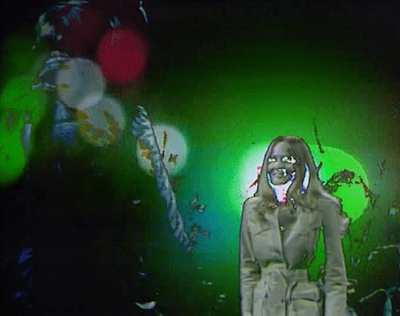
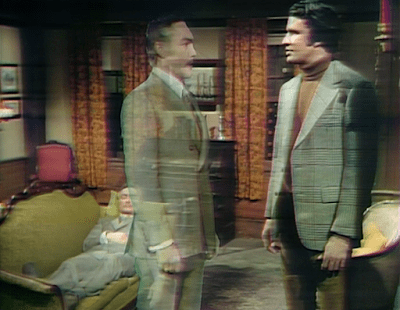
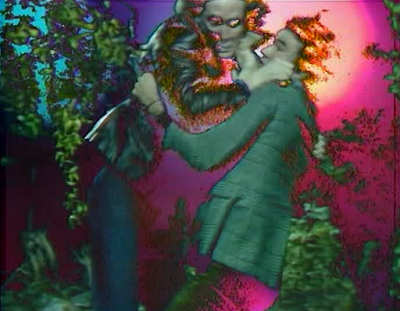
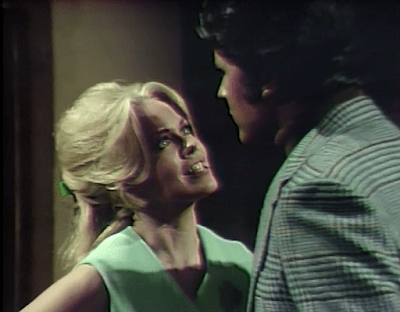
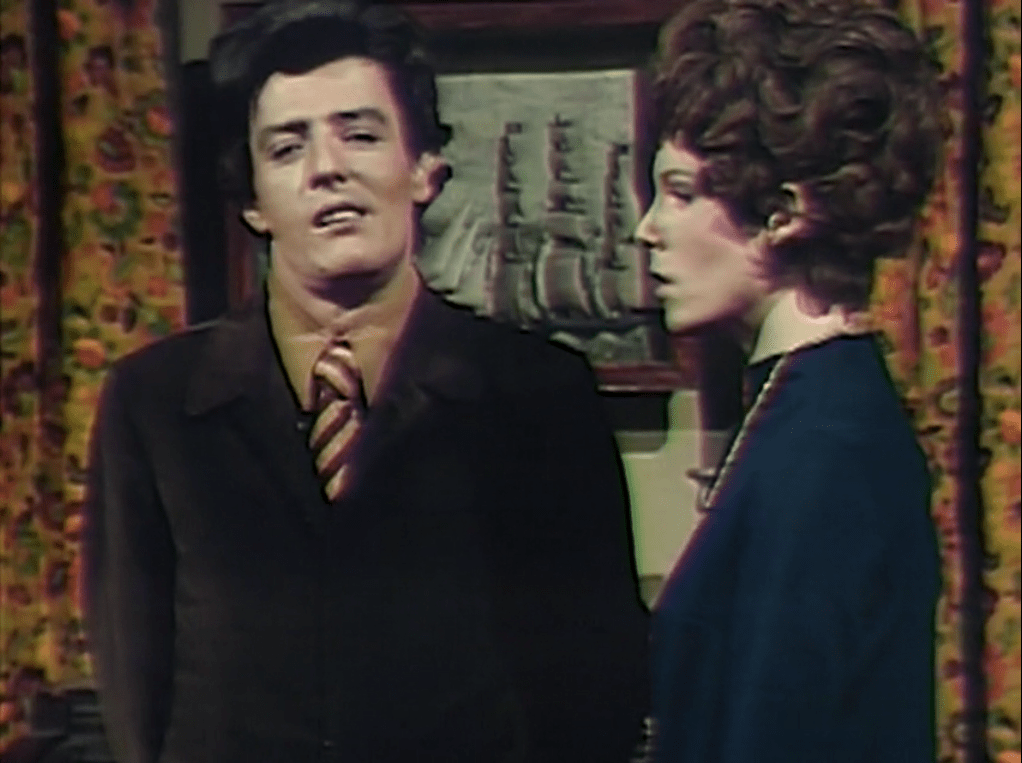
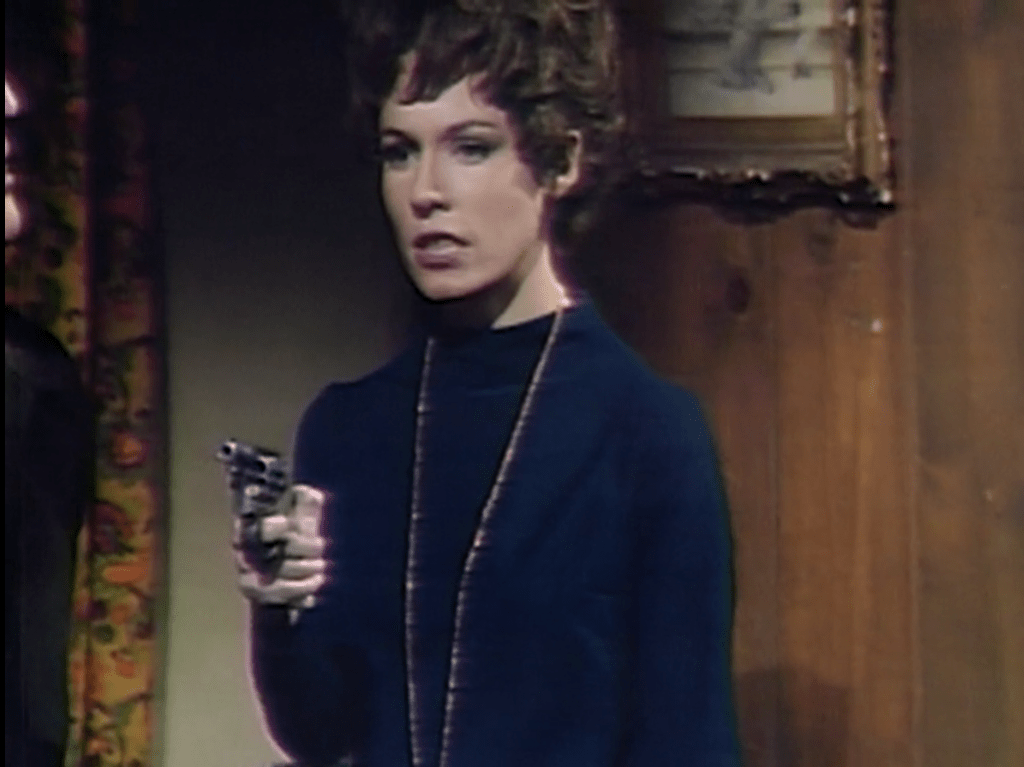
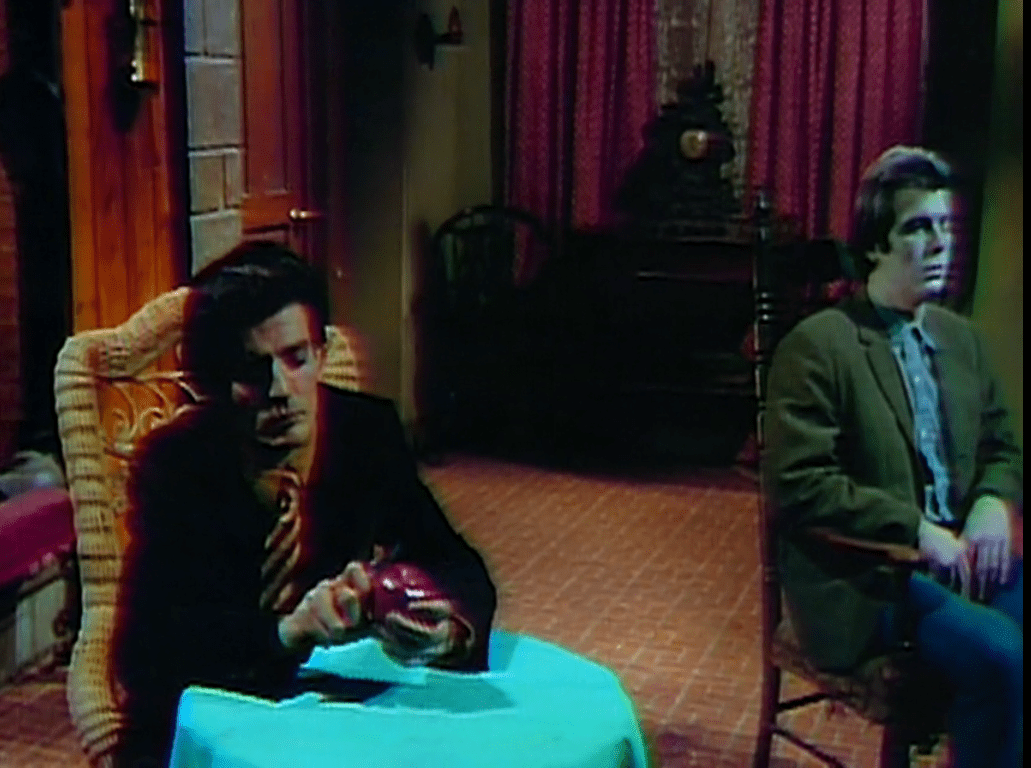
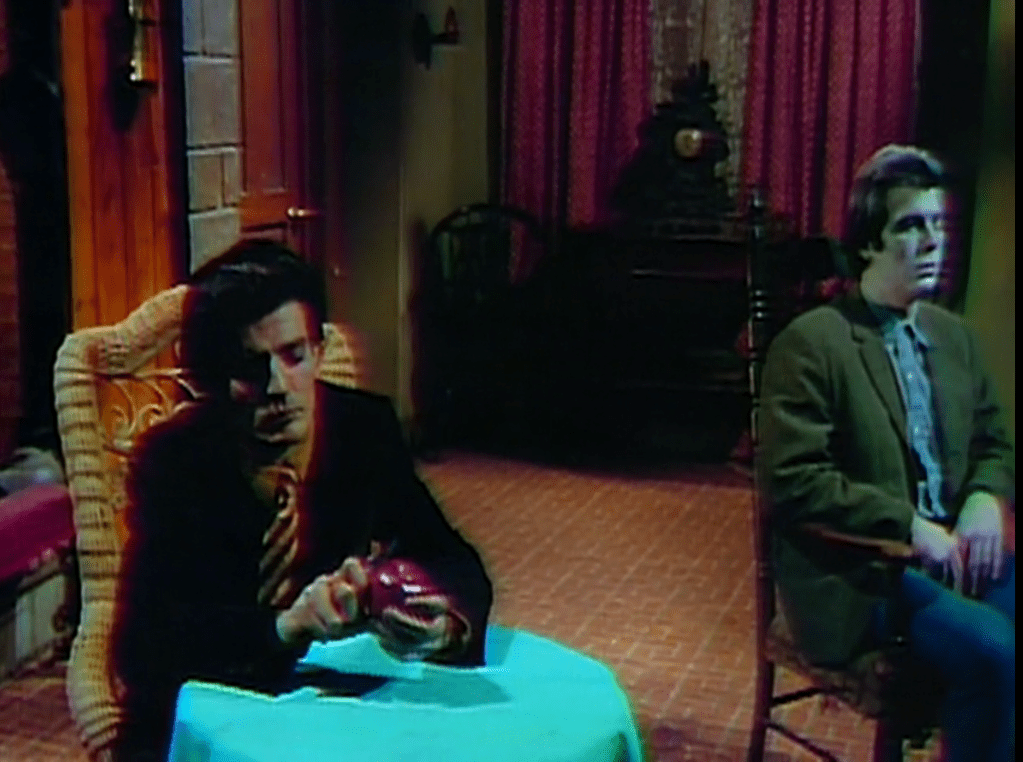
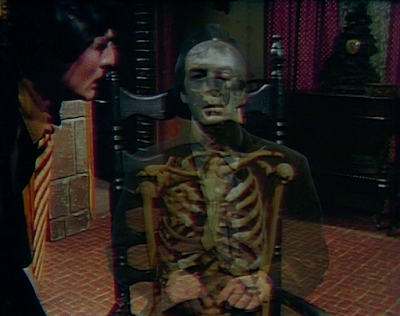
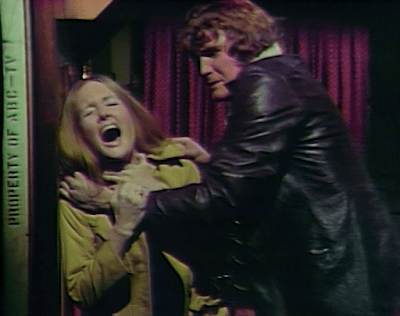
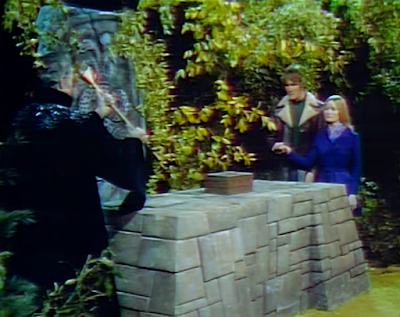

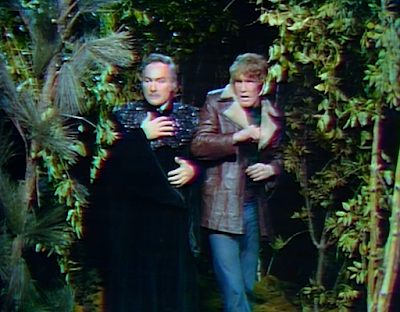
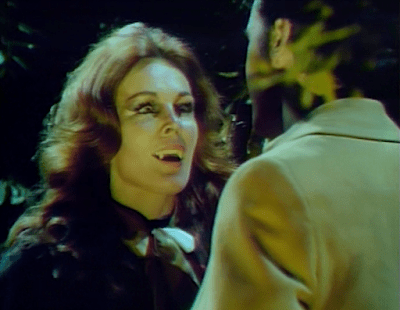
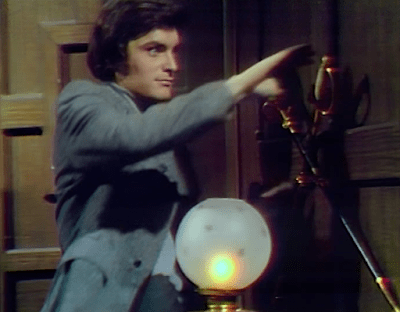
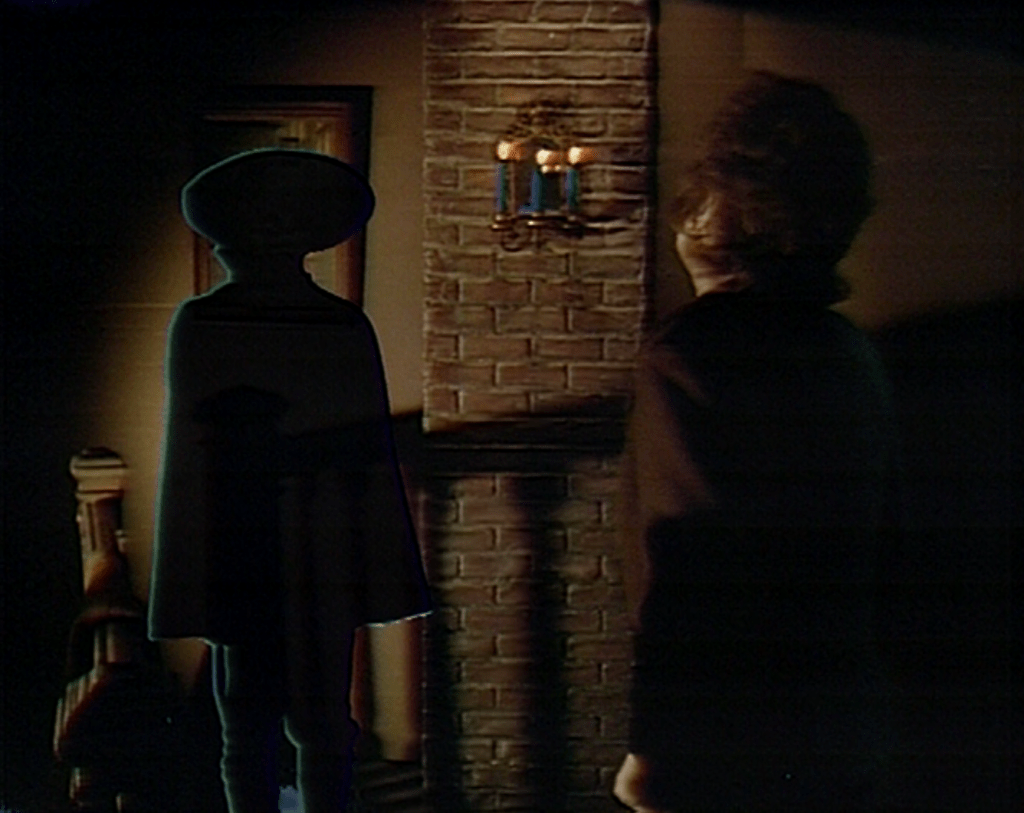
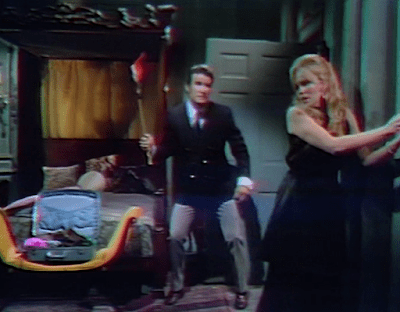
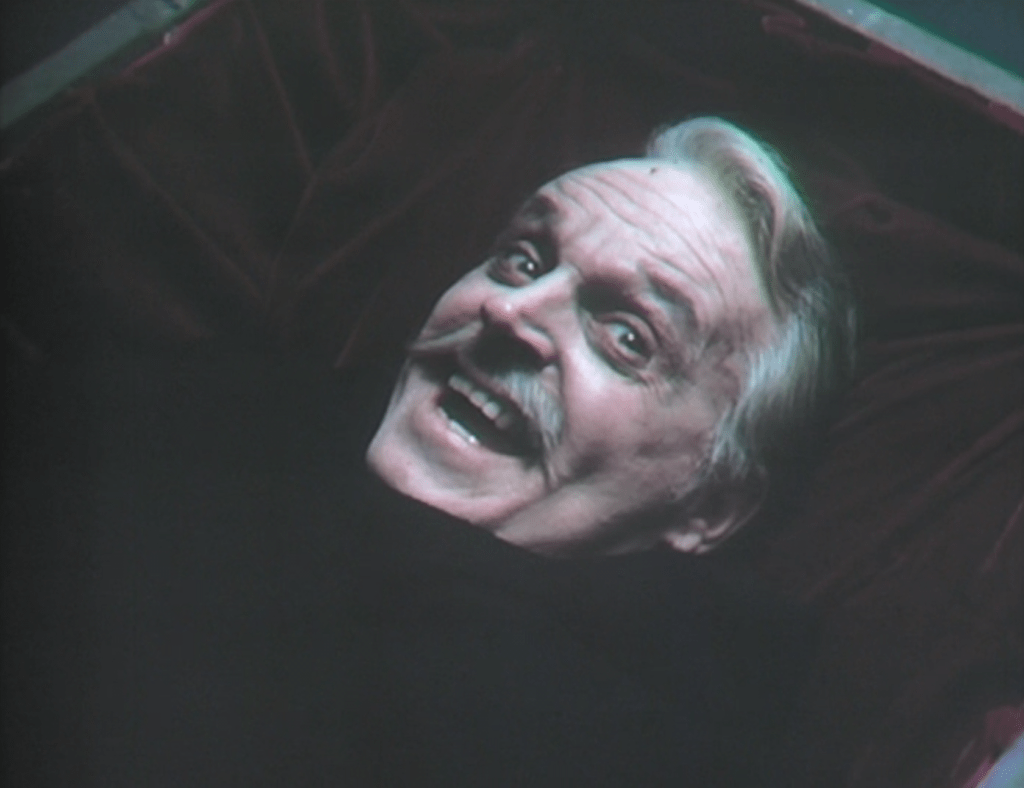
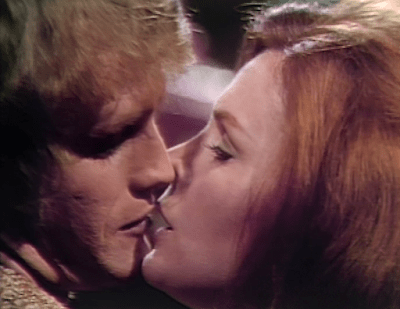
 Dark Shadows Commentary